

Aureus Mining has now released its interim results for the year ending 2015.
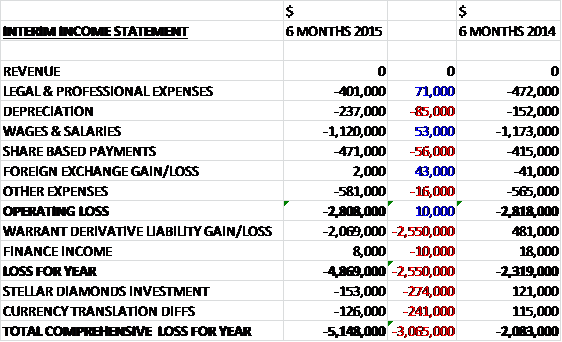
Once again there were no revenues and a small fall in legal and professional expenses was offset by a rise in depreciation and likewise, a fall in wages was offset by an increase in share based payments. We then see slightly higher “other expenses” but a beneficial swing in foreign exchange losses to give an operating loss of $2.8M, broadly flat year on year. The group also had a $2.1M increase in the warrant liability as their share price increased so that the loss for the year stood at $4.9M, an increase of $2.6M when compared to the first half of 2014.
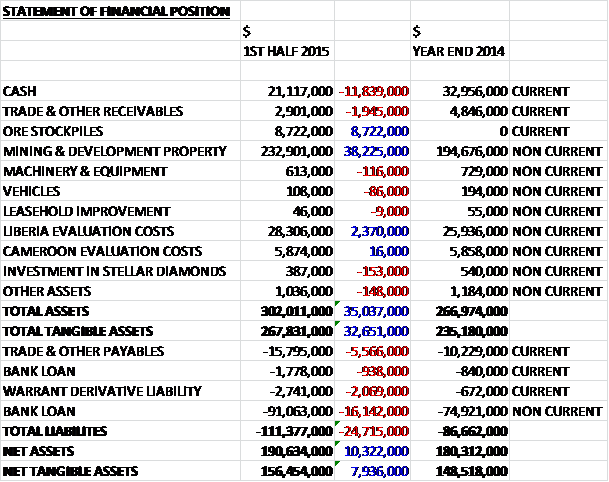
When compared to the end point of last year, total assets increased by $35M driven by a $38.2M increase in mining and development property, an $8.7M growth in ore stockpiles and a $2.4M increase in capitalised evaluation costs at the other Liberian assets, partially offset by an $11.8M fall in cash and a $1.9M decline in receivables (which still includes a $2.5M advance payment to the earthworks contractor that remains unrecovered). Liabilities also increased during the period due to a $17M hike in bank loans, a $15.8M growth in payables and a $2.1M increase in the warrant derivative liability. The end result is a $7.9M increase in net tangible assets to $156.4M.
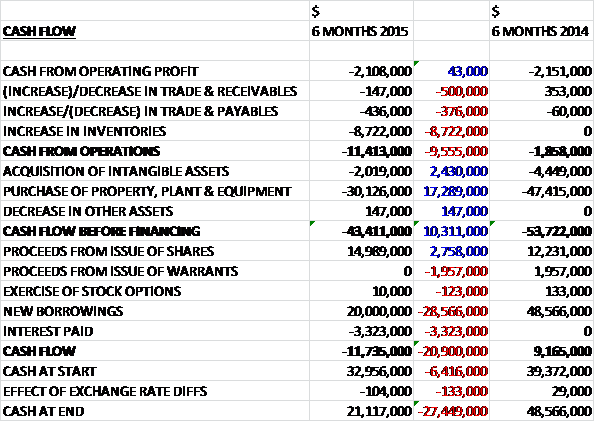
Before movements in working capital, cash losses were broadly flat year on year at $2.1M before a large increase in inventories meant that the cash outflow from operations stood at $11.4M, an increase of $9.6M when compared to the first half of last year. The group then spent $30.1M on further developing the tangible assets (producing mine), $2M on evaluating the prospective mines (mainly relating to the works programme at New Liberty and Ndablama) and $3.3M on loan interest payments so that before financing the cash outflow was $46.7M, an improvement of $7M when compared to the first half of last year. The group the made $15M from new share issues and took out borrowings of $20M to give a cash outflow of $11.7M for the period and a cash level of $21.1M at the end of the half year.
A key focus during the period was to achieve first gold from the New Liberty processing plant which occurred in May, and then complete the plant commissioning and undergo a phased ramp-up to a capacity of 95,000 tonnes of ore per month by July.
During the period the group completed the return water pond and the outflow trench civils at the tailings storage facility and work continued on the plant stockpile silt traps. Phase one of the TSF penstock line was also completed, providing sufficient storage for the first year and a half of operations. Work is planned to resume on phase two after the end of the wet season. The structural, mechanical, platework and piping contractor mobilised an additional two structural teams and an additional two mechanical teams to site to ensure that first gold was delivered to schedule, and civil works and steel erection at the plant site was completed during the period. All finishing and electrical fit out works and installations were also completed at the plant site.
During April an eight hour performance test was undertaken on the crushing circuit of the process plant where no serious issues were identified and the pre-leach thickener was also filled with water and the rakes commissioned with the plant water supply. The gold room and electrowinning circuit were also commissioned and certified ready to receive first gold. Following the successful first gold pour which occurred on schedule in May, the plant was temporarily shut down and work re-started on the final commissioning of the Carbon in Leach tanks and circuit with work also commencing on the installation of the vertimill. Civil and mechanical snagging checks were undertaken at the process plant. This process involved checking the design and construction procedure compliance and the electrical and instrumentation compliance checks were also completed alongside independent structural QA work to ensure that the project construction meets the contracted specification. Following the planned plant shut down, a phased ramp-up commenced with the plant meeting name-plate capacity in July.
During the period, work also progressed on the construction of the floor bund and drainage works around the Larjor pit and extending this to cover the northern boundary of the Kinjor pit ensuring that mining could progress during the impending wet season. This included the installation of the necessary sumps and pumps to keep the pit clear of the surface water, all of which are now operating as designed and allowing mining activities to continue throughout the wet season.
Mining activities during the period have continued to progress with advances in fresh rock mining rates in both the Kinjor and Larjor starter pits with ore being stockpiled ready for processing. Waste rock was utilised during the period to increase the size of the ROM Pad to accommodate these stockpiles, to develop the flood protection bund and to provide a hard surface for all haul roads in preparation for the wet season. Work will now focus on the Larjor pit, with RC grade control drilling and in-pit mapping ongoing.
As far as exploration at New Liberty was concerned, regional geological mapping was undertaken to allow the generation of further targets. Detailed regolith mapping started in the vicinity of the mine to define areas hosting potentially concealed mineralisation. On Anomalies B and C, both targets located near to the mine, deepened trenches returned better results with depth. Auger drilling was performed on Anomaly B to pass the ferricrete and reach the saprolite.
At West Mafa and Goja targets, located 6km and 9km NW of New Liberty respectively, soil anomalies occur in erosional and residual terrains and so are representative of the in situ mineralisation. Channel sampling has identified mineralisation and gives clues to the controls on mineralisation aiding future exploration. Previous trench results from the West Mafa target showed gold spikes associated with narrow quartz veins in amphibolites, gneisses and iron rich formations. A geology fact map was produced for the area and interpretive geology maps developed. Trench and pit results from the Goja target showed broad mineralisation developed in close proximity to intrusives with better grades found at depth. Further work will be conducted around New Liberty with follow up work to be carried out on prioritised targets.
At Ndablama, further mapping is currently being undertaken to gain better understanding of the nearby targets within the pressure shadow which hosts the prospects. At Leopard Rock, the Bea Mountain License has been enlarged to include the Leopard Rock target immediately South of the license and hosts the SE extension to the gold bearing rocks associated with the Ndamlama project. Further mapping is being undertaken to gain better understanding of the license ready for a phase two drilling programme planned for the future. At Gondoja, work has been ongoing to map the regolith around the area to better delineate soil anomalies. The results of 40 pits excavated along the Yambesei Shear corridor SW of Gondoja were received and show strike extensions to mineralisation and possible parallel zones.
Trenching was undertaken at the Musa target, located between Gondoja and Gbalidee. Bedrock mineralisation could be defined at a sheared contact between amphibolites and granites. Along with the detailed geological mapping, pitting and trenching will be completed to bring all the Yambesei shear zone targets to an advanced stage by the year-end 2015. At Silver Hills, work focused on regolith mapping in the central zone. Selective channel samples from artisanal sites were collected at the Belgium target in order to better define the mineralisation potential. Pits dug along strike confirmed the presence of mineralisation suggesting continuity over a strike length of 400m. Further work including detailed mapping with pitting and trenching will be conducted to bring the Belgium target to an advanced stage. Meanwhile the central zone will continue to be prioritised through mapping and pitting to define the presence of additional mineralised zones.
During the period, work on the Yambesei licence consisted of extending and infilling the Yembesei soil grid to cover the area between Welinkua and Janemana where serval BLEG anomalies were found. A total of 12 lines were completed. Further reconnaissance trips were undertaken to the Archean West license. A series of traverses were completed within the Mabong licence to locate areas for further follow up work. These showed a complex lithological suite of gneisses, amphibolites, mafics, ultramafics and BIF cut by dolerite dykes as well as two parallel NE trending shear zones.
Exploration work continued on the interpretation of the mineralised systems of the Kambele and Dimako targets following on from core reclogging. The work was recommended in order to produce a new interpretation of the mineralisation models and determine their potential to host economic deposits. Regolith mapping was carried out over the Kambele-Dem area where extensive ferricrete occurs and is expected to conceal mineralisation. Several pits dug across the regolith profile show gold enrichment with depth. A GIS study was undertaken over the license area and resulted in the identification of structural lineaments along which field verification has shown the presents of artisanal sites. A ground induced polarisation of ground magnetic survey is planned to be conducted at the Amndobi prospect followed by a first pass RC drill programme.
During the period Liberia was declared Ebola free in May but in June the first new case was confirmed since March. Five contacts associated with this first case have since been confirmed. All contacts have now completed their 21 day follow up period and the last case was discharged after testing negative in July and no new cases have been reported in the week to the start of August.
During the period, $8M was drawn down from the senior facility and $12M was drawn down from the expensive Subordinated facility. There were no new warrants issued during the period so there are still 40,072,175 outstanding. In February the company raised a further $15.5M through the issue of 56,000,000 new shares at a price of 18p per share. The financing comprised the issue of 29,239,766 shares at a value of $8.1M to the IFC and the issue of 26,760,234 shares worth $7.4M for brokered financing. Operational cash flows are expected to be generated from Q3 2015 once production commences at New Liberty – at the end of the period the group had cash of $21.1M.
During the period, the group achieved the significant milestone of first gold at its New Liberty mine. Plant commissioning was substantially completed and process plant nameplate capacity was achieved in July and the primary focus for the rest of the year is to bring production levels up to steady state and to generate operating cash flows.
Overall then, this was a period of real progress for Aureus. Financially, there was an increased loss as the higher share price increased the warrant derivative liability. Net assets improved, however, as both inventories and property, plant and equipment increased and the group issued more shares for cash. Cash losses were broadly flat before an increase in inventories meant that the cash outflow from operations increased considerably. There was less cash spent on the New Liberty mine, however so before financing the cash outflow reduced. At the period-end there was $21M in cash left and both loans were fully drawn so whether the anticipated cash inflow in Q3 will come soon enough and in sufficient quantity to prevent further share dilution is a key consideration.
The group did pour its first gold in May but really had to struggle to hit the self-imposed deadline and the plant was shut down again after the pour. It seems to be meeting capacity in July, however, so hopefully the targets for the year will be hit. This is clearly an exciting time for the group and probably the opportune moment to buy into a company such as this (apart from the euphoria after the first discovery) but the one big elephant in the room here is the performance of the price of gold and until the latest decline is halted, it is difficult to invest in any gold mining company.
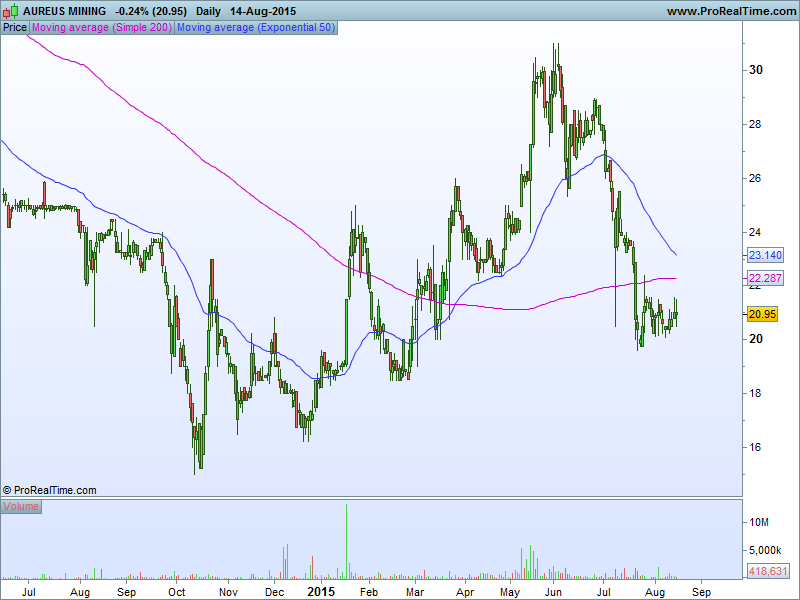
The decline in the share price may have been halted but I will continue to wait it out.
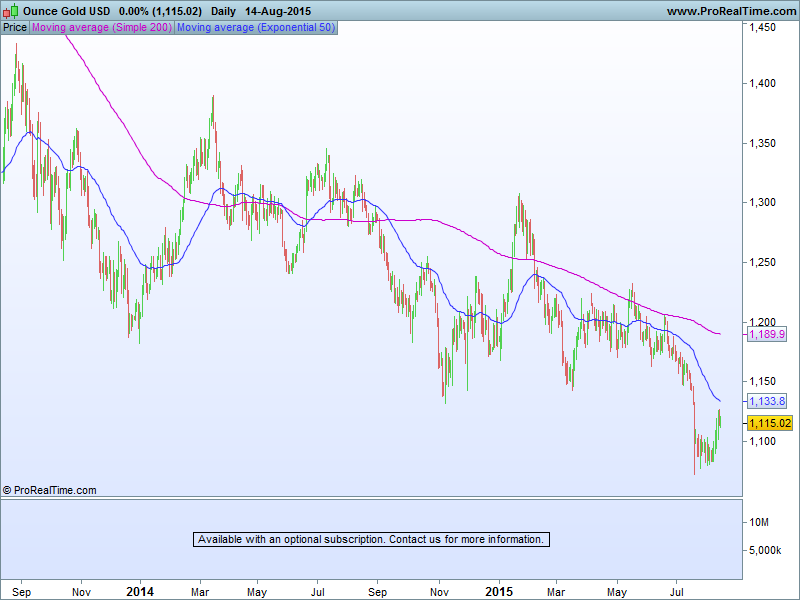
Despite the recent small recovery, the trend in gold price looks fairly bad.
On the 20th August the group announced that the opening ceremony for the New Liberty mine had taken place. The final plant commissioning has now been completed and the company is now working towards reaching steady state production in Q4. I think this announcement is largely ceremonial but it is pleasing to see that things are moving in the right direction. The gold price is moving back up to the trend line too but as things stand I think the gold price is probably too week for an investment here. If the downtrend is broken, I will probably reassess.
On the 7th September the group released an operations update and announced the commencement of gold sales and initial mining and processing operations from the New Liberty Gold Mine. The company achieved nameplate capacity on the gold plant in mid-July and continues to progress through the commissioning and ramp-up process in order to optimise recoveries and work towards a declaration of commercial production.
Mining operations were hampered from April to July due to a lack of a consistent supply of explosives caused by a delay in the delivery of the emulsion plant from China. The delivery was impacted due to shipping restrictions to Ebola affected countries. In order to alleviate this situation, a supply chain was set up through Ghana and the Ivory Coast to transport explosives by road. The emulsion plant will now be commissioned in early November and the company now has three months of supply of explosives at New Liberty and has a regular supply to the site.
Initially mining, road construction and the development of the run of mine pad were hampered by the lack of hard rock which was caused by the delay in the delivery of explosives. Nevertheless, the mining team has stripped over six million tonnes of waste rock and mined 263,673 tonnes of ore. As at the end of August, the ore stockpiles total 211,363 tonnes and with an adequate supply of explosive material there have recently been considerable improvements in mining sequencing and ore fragmentation is improving as mining progresses below the weathered rock.
The construction of the operational water management system ensures that effective mining can be undertaken during the rainy season. Mitigations include a flood bund around the pit, pump stations and creek diversion. All are working as designed and mining operations have continued to progress throughout the wet season and are now focussing below the weathered oxide zone in the Larjor starter pit and moving into fresh rock within the Kinjor pit. The primary focus of the mining team during September is to push back waste to access more ore and increase face length.
Grade control drilling and mining reconciliation to date have continued to show that the ore body is extremely robust and representative of the resource model. The on-site mine lab operated by ALS Global is now fully operational and has been processing samples over the last two weeks. The lab can prepare 200 samples per day and is equipped with two furnaces for Fire Assay analysis. A revised mining schedule is being enacted to enable the company to achieve its production targets for the first year of operations. This updated plan will include a three month acceleration of the delivery of an HD785 haul truck and a PC1250 excavator to January 2016, which will facilitate an increase in the mining rates enabling the mining team to catch up on the near term shortfall.
To date the New Liberty process plant has processed 52,310 tonnes of ROM ore at an average feed grade of 3.6g/t at an average gold recovery of 89%. During the plant commissioning phase, there have been four gold dore shipments for smelting and refining at the MKS PAMP refinery in Switzerland. This has resulted in sales of 4,881 ounces of gold at an average price of $1,119 per ounce. In late July it was noted that the mill discharge grates were not optimum for the ROM ore and therefore needed replacing. The supplier has worked with the company and more robust, heavy duty grates have been installed. As a consequence of the discharge problem, however, the mill could not be operated at full design capacity. This caused undue deterioration on some of the mill liners and lifters which must also be replaced. The replacement of these components has been undertaken at no cost to the group and the mill will continue to operate throughout September with a full mill re-line being scheduled to take place in early October. Plant processing operations are no focused on optimising reagent consumption, grind size and gold recoveries.
The company is on track to declare commercial production during Q4 2015 which will be declared on the first day of the calendar month following the mill having operated at an average of 60% or more of the designed production capacity calculated over a 60 day period. The value of the gold produced prior to commercial production will be deducted from the capitalised construction costs of the mine rather than recorded as revenue.
Following the resurgence of a small number of Ebola cases in June, all associated contacts have now completed their follow up monitoring period and Liberia was declared Ebola free for a second time by the WHO following a continuous period of 42 concurrent days without a case ending in the end of August.
The second and final payment has been made in relation to the settlement agreement for the acquisition of certain mining rights from Weajue Hill Mining Corp. The legacy mining rights are situated in the Weaju area covering only 1.7km2 of the total 457km2 mining license granted to the company. As part of the settlement agreement, a second payment was required to be made on the completion of a feasibility study for the Weaju project. The payment comprises £445K and 1,148,611 new Aureus shares which equates to the equivalent of $5 per ounce of measured, indicated and inferred resources.
It is good to hear about the updated production at the mine and the lack of explosives situation now seems to have been resolved. I am highly tempted to take an initial position here with the price of gold and the potential emergence of Ebola being the main two impediments to this.
On the 20th October the group informed the market that gold production at the New Liberty Mine has temporarily stopped due to a mechanical failure within the secondary crusher. The company’s operational team are working with DRA, the EPCM contractor, and specialist technicians from the crusher’s OEM who are on site to conduct the repairs. Following an initial assessment, all required tools, spares and equipment have been sourced and are being expedited to the mine. The OEM expects to complete their repair work and have the crushed fully operational by the end of October.
To recommence production as quickly as possible, a mobile crusher with a capacity of 200 tonnes per hour has been sourced in country and is being transported by road to the mine to cover the intervening downtime period and allow for crushing and stockpiling operations to continue whilst the crusher is undergoing repair. It is anticipated that the temporary crusher will arrive at the mine by the 23rd October and be operational shortly afterwards. Following the repair of the secondary crusher, the mobile crusher the mobile crusher will be retained for a period of time to provide additional flexibility during the ramp up of operation.
The company believes that this temporary shutdown in processing activities will not severely impact production levels but may halt gold production for up to two weeks. During this time, the company will continue with mining operations to increase its ore stockpiles. It is also taking this opportunity to undertake other additional preventative maintenance activities across the process plant that were scheduled to be undertaken later in the year.
During the process of commissioning and ramping up the process plant, the company has made eight shipments of gold ore, resulting in sales of approximately 10,000 ounces of gold. Following the repair of the secondary crusher, they will continue to work towards the achievement of commercial production and although now delayed, management expects this will be achieved by the end of the year. The first repayment under the debt facilities is due in January 2016, and providing the plant now moves smoothly through the remaining commissioning phase to steady state design capacity, the cash flow from operations in Q4 will be sufficient to meet this obligation.
That is a big “if” and I must say I am a bit nervous about this so I will wait on the side lines for now.
On the 2nd November the group reported that fold producing operations at the New Liberty goldmine have restarted following the repair of the secondary crusher. They recommenced on the 28th October in order to build up a stockpile of crushed ore before processing operations restarted on the 30th. The mobile crusher, which was sourced in-country, has a capacity of 200 tonnes per hour and is sufficient to supply the New Liberty bar mill which runs at a designed feed rate of 146 tonnes per hour. This mobile crusher will be retained on site for six months to provide additional operational flexibility during the final testing and commissioning phase of the plant, and also to provide additional crushed rock material for use on haul roads and other infrastructure.
Technicians from the OEM of the secondary crusher successfully completed repairs to remediate the mechanical failure. These repairs were completed on the 29th October following which time the crusher has been tested extensively to ensure all parameters are operating correctly before being recommissioned and ramped back up to its full capacity. Following the resumption of crushing activities, a stockpile of 6,000 tonnes of crushed fine ore allowed for the restart of milling and CIL processing operations with milling operations starting on 30th October.
During the 19 day temporary shutdown, mining operations continued to progress, leaving ROM stockpiles totalling 55,283 tonnes at 3.16g per tonne and oxide stockpiles of 105,203 tonnes at 2.04g per tonne. Additionally during this period, the company took the opportunity to undertake further preventative maintenance works around the plant site. Following the successful restart of processing operations, the focus of the company returns to working towards declaring commercial production at the mine which management now expects to achieve in early 2016.
On the 3rd November the group announced that it had agreed to acquire three exploration licences from Sarama Resources. They are contiguous to the company’s Bea Mountain mining licence and are located close to the New Liberty Mine. Exploration work undertaken by Sarama defined a 15 km long gold corridor highlighted by gold in soil anomalies and extensive artisanal mining, which on average are within a 15km radius of the New Liberty mine. Gold mineralisation intersected by drilling includes intercepts of 3.9g per tonne over 7.5m from 9.3m and 2.3g per tonne over 5m from 28m. Altogether the holes have effectively tested only 1km of the identified 15km anomalous soil corridor.
The licenses have been acquired for a total of 2,600,000 shares in Aureus and Samara will retain an uncapped 1% net smelter return royalty on gold produced from the Cape Mount permit. Once the company develops a cash flow positive position, they will undertake exploration on the rest of the 15km soil corridor. They have already identified targets for follow up work, which includes zones showing continuous mineralisation. They will undertake further field work over the next year including geology and regolith mapping with some pitting and trenching before conducting a full interpretation of the geological and structural settings of the whole corridor.
So, the re-start of the mining operations is a good sign, but it is a shame that commercial production will not start until next year. This new exploration license looks interesting though, and I look forward to a time when the group is cash flow positive!