Somero has now released its final results for the year ended 2015.
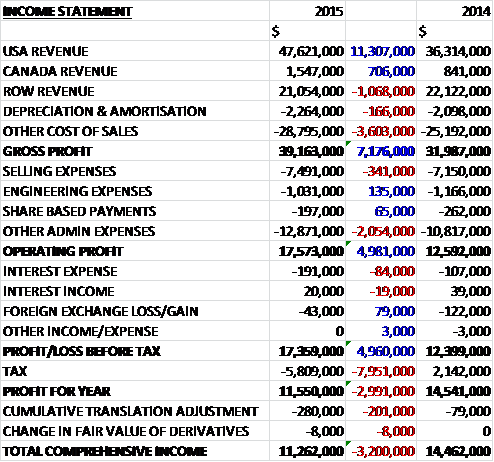
Revenues increased when compared to last year as a $1.1M decline in ROW revenue was more than offset by an $11.3M growth in US revenue and a $706K increase in Canadian revenue. Depreciation increased by $166K and other cost of sales grew by $3.6M which gave a gross profit $7.2M above that of 2014. Selling expenses increased by $341K but engineering expenses fell by $135K with admin costs up $2.1M to give an operating profit some $5M ahead of last time. A growth in interest expense was offset by a more favourable forex loss which meant that pre-tax profits grew by $5M. We then see an $8M detrimental swing to a tax payment, however, relating to both higher federal taxes payable and the lack of a deferred tax benefit which occurred in 2014. This meant that the profit for the came in at $11.6M, a decline of $3M year on year.
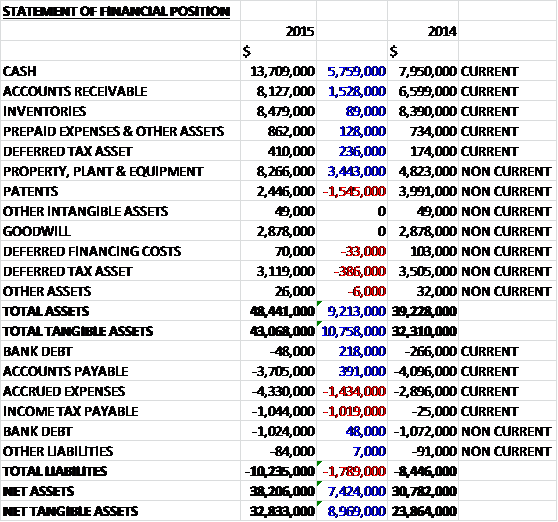
When compared to the end point of last year, total assets increased by $9.2M driven by a $5.8M growth in cash, a $3.4M increase in property, plant & equipment, and a $1.5M growth in accounts receivable, partially offset by a $1.5M decrease in the value of patents. Total liabilities also increased during the year due to a $1.4M growth in accrued expenses and a $1M increase in current tax payables. The end result is a net tangible asset level of $32.8M, a growth of $9M year on year.
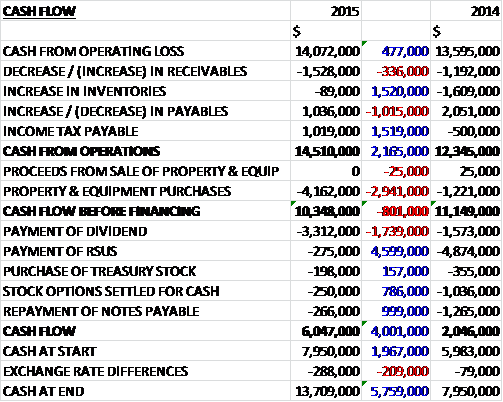
Before movements in working capital, cash profits increased by $477K to $14.1M. There was a small cash outflow from working capital but the group received $1M in tax payments to give a cash from operations of $14.5M, a growth of $2.2M year on year. The group spent $4.2M on capex to give a free cash flow of $10.3M which easily covered the $3.3M in dividends and after a few stock purchases and a small repayment of debt the cash flow for the year came in at $6M to give a cash level of $13.7M at the year-end.
Large line sales increased from $22.4M to $28.3M as a result of increased volume and price increased, small line sales grew from $9.7M to $13.6M also due to higher volumes and price increases, 3D Profiler System sales increased from $3.7M to $4.4M and other revenues, including sales of spare parts, topping spreaders, mini screeds and accessories increased modestly from $11.1M to $11.9M.
In North America, annual cement consumption from non-residential building construction grew 14%. The healthy increase in non-residential construction spending spurred customer demand for replacement machines, fleet additions and technology upgrades. This combined with new product instructions, price increases and a shortage of skilled labour in the concrete contractor industry all contributed to the 32% annual sales increase in the region.
Europe continued its positive trajectory with a solid year of growth with sales increased 58% to $5.7M with this growth being driven by improvements in the UK, Spain, Poland, Italy and Germany. Sales in the Middle East grew to $2.7M, well ahead of expectations and driven by increased activity in Dubai, Turkey and Saudi Arabia. As expected, sales in Russia remained slow due to its continued unstable geo-political climate.
The Chinese market was challenging in 2015 but market conditions stabilised in the second half of the year and the board remain encouraged by the underlying market fundamentals. They ended the year with $6.1M in sales, a decrease of $3.4M year on year. A significant factor impacting the market was a slowdown in money flow throughout the construction industry. To address this factor, in Q4 the group began offering long-term financing to customers that require installation of their machines shut-off payment protection tool. While their experience with this programme has been very positive so far, they will continue to develop alternative third-party financing options for customers. In the meantime they expect the Somero long-term financing programme will have a positive impact on sales.
The training and education efforts that are being promoted through the Concrete College in China and the efforts of the sales engineers in the country are increasing awareness, acceptance and demand for higher quality floors and higher wages in China are leading to demand for greater automation which increases the value of the group’s equipment.
In SE Asia, sales increased by $600K to $1.3M and the region is viewed as a significant growth opportunity in the coming years given their low market penetration and the growing demand for high quality floors in the region. In Australia, sales decreased by $1.4M to just $1M, mainly due to the devaluation of the Australian dollar which led to the group’s equipment becoming more expensive for local customers and if this continues, it will inhibit the growth opportunity in the country in 2016.
The results in India were flat year on year with $600K of revenues in the country as the group are still in the initial phase of penetration in the market. They will continue to focus their efforts to promote the benefits of higher quality floors, increase their marketing activities and hold educational seminars for engineers and architects to drive broader acceptance of wide-placement methods and flatness.
During the year the group have completed development of three new products: the new S-940 Laser Screed, the S-10A Laser Screed machines as well as the Somero Floor Levelness System. The S-10A and the Floor Levelness System were both launched in Q4 whilst the S-940 was launched in Q1 2016 with the released in Q4 contributing $400K in sales during the year. Sales of the S-485 Laser Screed machine introduced in Q4 2014 grew considerably to $3.9M in 2015.
Last year the board concluded that the anticipated growth of the business over the medium term required expanded facilities. They therefore decided to expand the Michigan facility and planned construction of a new global HQ and training facility in Fort Myers, Florida. In October they completed their 20,000 square foot expansion of the operations and support offices in Michigan for a total cost of $1.3M with the expansion providing the group with a facility that is able to support growth exceeding their 2018 strategic objective of doubling their 2013 revenues.
Also during the year the group purchased land, designed and began construction of the new 14,000 square foot global HQ in Fort Myers for a total expected cost of $4.8M. Ground breaking occurred in October and the product remains on budget with completion expected in Q2 2016.
This year the group incurred amortisation charges of $1.5M which is expected to be the same in 2016, although in 2017 this will fall to $901K and by 2018 the intangible assets will be fully amortised, although there is $1.1M of the commercial real estate mortgage that is due for payment compared to negligible amounts in 2016 and 2017. This year there was a big swing to a tax payment. This is in part due to a one-off reversal of a deferred tax valuation allowance of $4.1M and $5.9M in settlements of RSI’s and stock options which were deductible for tax purposes in 2014.
It is worth noting that both the allowance for doubtful accounts and the bad debt expense increased this year with the former up from $324K to $698K and the bad debt expense increasing from $49K to $381K which is a fairly big hike. The group is obviously very susceptible to changes in the state of the general economy in the US, along with their ability to protect their IP rights and the potential future growth of competitors. Additionally there were two large customers, representing 11% and 10% of total accounts receivable.
During the year, Ron Maskalunas stepped down from the board having spent nine years with the group. He was replaced by Robert Scheuer who previously served in executive roles at Dover Corp and Kraft Foods.
Key drivers of growth in North America will be growth in US non-residential construction spend which is forecast to increase by 5% to 7% through to 2019. Other growth drivers are technology upgrades to an aging fleet of installed Somero equipment, fleet additions, new product introductions and a shortage of skilled labour in the concrete construction industry. In Europe, growth will be driven by continued recovery of the non-residential construction market and addition to technology upgrades to an aging fleet of equipment, fleet additions, new product introductions and a shortage of skilled labour.
In China, the group expect growth will be driven by large multinational corporation projects that require high quality floors that adhere to western flatness standards, broader domestic acceptance of levelness floor specifications as supported by the China Flooring Association, an increase in the availability of long-term financing options and an increasing shortage of skilled labour. In other ROW territories, the primary drivers of growth will be increased demand for higher quality concrete floors, broader domestic acceptance of levelness floor specifications and shortages of skilled labour.
Going forward, healthy trading momentum in the US was carried forward into 2016 from the strong finish to 2015. The momentum is driven by demand for replacement equipment, fleet additions, technology upgrades and new products. The underlying non-residential construction market fundamentals in the US remain strong, evidenced by lengthy project backlogs for the group’s customers that extend will into 2016. In Europe they are seeing a similar carryover of momentum into 2016 which highlights a continued, steady recovery from the recessionary low point in 2010. In the Middle East, coming off very strong growth in 2015, the board expect to continue to see significant opportunities in the coming year.
In Latin America, they expect a stable performance in Mexico and Chile and are optimistic for improvement in the other countries in the region except for Brazil. The Asian markets remain positioned for improvement and will be driven by increased penetration of the group’s products.
They expect to see greater willingness to use their products and services as flatness standard levels grow. In China, the group are providing customers with new direct long-term financing options which have been enabled by the development of a machine shut-off capability. This is likely to have a positive impact on sales in the region but it seems to be that local customers may be able to find a way around the shut off. Overall, the board are confident that the group will deliver another year of solid growth.
At the year-end, the group had a net cash position of $12.6M, an increase of $6M when compared to the end of 2014. At the current share price the shares are trading on a PE ratio of 11.8 which reduces to 9.3 on next year’s consensus forecast. After a 25% increase in the full year dividend, the shares are now yielding about 2.5% which increases to 3.4% on next year’s forecast, although it should be noted that dividends are paid in US dollars.
Overall then, this has been a very strong year for the group. Profits were down but this was only due to last year’s deferred tax receipt and pre-tax profits grew. Net assets were also up, as was the operating cash flow with some very strong free cash generation. The group performed well in North America, Europe, the Middle East and SE Asia but the performance in Russia, China and Australia was weaker with the well-publicised issues in those countries taking their toll on sales.
I am a little nervous about the group providing credit to their Chinese customers but hopefully they will do this in a sensible way. Really, this is a play on US construction and this is apparently very healthy with the strong momentum from last year continuing into 2016. With a healthy net cash position, a forward PE ratio of 9.3 and dividend yield of 3.4% these shares are still looking cheap to me and I am more than happy to continue holding. Although, of course, with this share one must keep an eye on the health of the US construction industry.
On the 21st March the group announced that CEO Jack Cooney sold 1,400,000 shares in the company at a value of £2M in order to satisfy a US tax obligation. Following the sale, he is interested in 1,414,364 shares so he has disposed of half of his holding. Apparently US tax legislation obliges him to make withdrawals from his current pension plans during 2016, the assets of which consist solely of Somero shares. I am not sure I totally understand that but following the sale he has stated he will not dispose of any of his remaining shares for the next two years at least.
On the 31st March the group announced that CFO John Yuncza purchased 17,500 shares at a value of £26.4K and non-executive director Robert Scheuer purchased 22,500 shares at a value of £34K. John now has 39,613 shares while Robert now owns 25,000 shares.
On the 6th June the group released a trading update for the year to date. Overall business is progressing well with positive trading in the core US, European and Chinese markets. In the Latin American, Southeast Asian, Korean and Middle East territories, year to date trading is somewhat below previous year levels, although the board expects improvement over the rest of the year.
In a product basis, sales of the new products, S-10A and S-940 have been key contributors to growth, along with sales of the 3-D profiler system, S-15 and STS-11m. In addition, driven by increased customer project activity, sales of parts and services have been particularly strong in the year to date.
The overall positive trading environment, together with margin improvement due to price increases and cost controls, and solid operating cash flow generation means that the overall results are tracking comfortably in line with market expectations for the full year. This all sounds decent enough and I am happy to hold.
On the 12th July the group released a trading update covering the first half of the year. Trading in June was significantly stronger than in the previous month and when compared to the same month of 2015. This was led by particularly strong activity in North America with China, the Middle East and Europe also contributing satisfactorily to overall growth. The company now expects to report results slightly ahead of current market expectations for the year as a whole.