

Getech has now released their interim results for the year ending 2017.
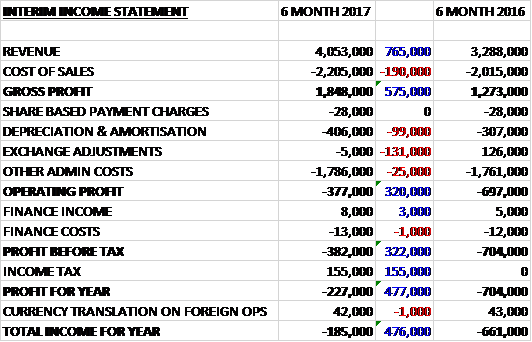
Revenue increased by £765K when compared to the first half of last year representing a six month contribution from Exprodat, being offset somewhat by a very challenging services market, and after cost of sales grew by just £190K, the gross profit was up £575K. There was a £99K increase in depreciation and amortisation, a £131K negative forex swing and a £25K increase in other admin costs to give an operating loss which was a £320K improvement on last time. Finance costs were broadly similar but the group did have a tax credit of £155K which meant that the loss for the period was £227K, an improvement of £477K year on year.
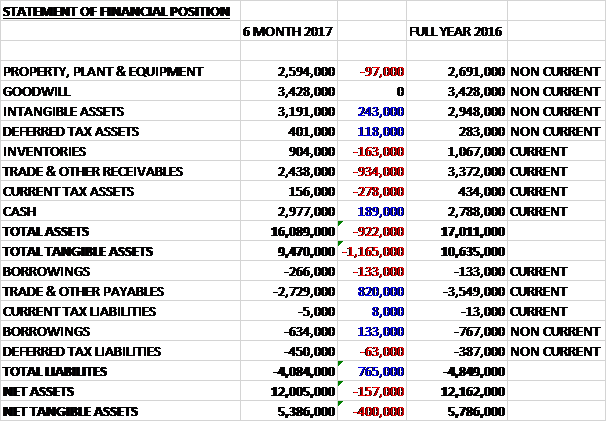
When compared to the end point of last year, total assets decreased by £922K, driven by a £934K decline in receivables, a £278K fall in current tax assets and a £163K decrease in inventories, partially offset by a £243K growth in intangible assets, a £118K increase in deferred tax assets and a £189K growth in cash. Total liabilities also declined during the period due to an £820K fall in payables. The end results was a net tangible asset level of £5.4M, a decline of £400K over the past six months.
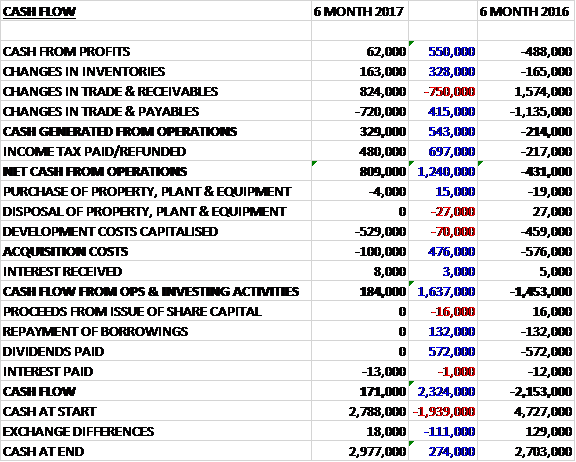
Before movements in working capital, cash profits saw a positive £550K swing to £62K. There was a cash inflow from working capital and after the £480K tax rebate relating to refunds received from overpaid tax in the US along with R&D allowances, the net cash from operations was £809K, a positive swing of £1.2M year on year. The group spent £529K on development costs relating to the Globe platform and £100K on acquisition costs to give a free cash flow of £184K. After £13K of interest was paid, the cash flow for the period was £171K and the cash level at the period-end was £3M.
Under the new CEO, Jonathan Copus, the senior management team has been reshaped and underlying costs have been significantly lowered. The cost base has been achieved through the reduced use of contractors and by lowering the staff headcount by 18%. The full cash benefit of these steps will not be realised until the second half and redundancy costs were £451K in the first half with a further £26K to be incurred in H2.
Within the group’s newly defined products division, they are on track to deliver Globe Phase 2 in July. An additional supermajor joined the Globe sponsor group during the period which strengthened the customer base. The current phase of Globe investment is due to be completed before the end of the year and sponsor discussions regarding a series of enhanced forward work plans are underway. Software renewals remained strong and the customer list now totals 39 companies.
Within the services division the group have worked for the governments of Lebanon, Mozambique, Namibia, Pakistan and Sierra Leone. Closer to home they won a mandate to define and deliver a multi-faceted spatial data strategy for the UK Oil and Gas Authority which has also commissioned the group to complete technical work over the SW Approaches area. Revenues from the mining and nuclear sectors continue to diversify earnings away from oil and gas, and in partnership with Esri UK, they are working with TfL and Scottish Water.
The group has found that in the oil and gas exploration market, greater crude oil price stability and lower costs have opened up a margin against which companies are becoming increasingly confident to invest. The first beneficiary of this trend is production and development, however, so exploration budgets remain depressed. Industry redundancies have also made the geoscience consulting market more crowded which places downward pressure on day-rates. The group are working to extend the application of their core technical skills further along the oil and gas asset value chain and are actively targeting new areas under the wider natural resources industry including atomic energy, agriculture, forestry, mining, mater and environmental management.
Going forward any material recovery in discretionary exploration spending is likely to be a slow build but the board do take some cautious encouragement from recent trading. Since the period-end, their software and data sales have continued to grow and in March they signed an agreement with the OGA for them to license their UK MultiSat data across the North Sea with is the third sale of their products and services to the OGA so far this year.
The services market has shown signs of gradual improvement. The group recently signed consultancy agreements with RAK GAS and Victoria Oil and Gas. They have also been engaged by the government of Lebanon as a senior advisor to their offshore licensing activities. They have also shaped a new service to assist pipeline operators in their implementation of Esri’s new ArcGIS pipeline referencing software.
Beyond oil and gas the group are engaged in a broad range of discussions across the natural resources space. Their latest win was a contract secured through their Esri partnership to provide GIS content building and training to Scottish Water.
The group made a loss in the first half so PE ratios are not a good way to vale the shares at the moment – I have not been able to find any forecasts. There is currently no dividends being proposed here.
Overall then the period has been an improvement over last time but the pace of change has been slow. Losses did improve but it is hard to tell how much of this was organic and how much due to the Exprodat contribution. Net assets declined but the operating cash flow improved with the group just about breaking even at the cash profit stage. They even had some free cash following a tax rebate after overpaying in previous periods. Going forward, H2 seems to have started OK and costs should be reduced but the oil and gas exploration market is going nowhere fast and I feel the rate of change is a bit slow here so I am out.
On the 17th May the group announced the sale of a suite of geology, gravity and magnetic data products. Under a license agreement signed with a leading global resource company, the group has sold its Earth Systems Modelling Product, Depth to Basement data, a package of gravity and magnetic data and a resubscription to Globe. The sale will generate gross income of $900K, the majority of which will be recognised in 2017. The contract is in line with the board’s financial expectations for the current year.
On the 20th September the group released a trading update for the year as a whole. Against what remains a volatile market, they have worked to enhance their cash profitability through cost management and has strengthened the commercial positioning of their products. The net impact of these steps is partially obscured by exceptional costs and a year-end timing issue. I feel that could have been made a bit clearer!
During the year they closed sales with a total value of £8.5M, of which £7.7M will be recognised as revenue in 2017. A significant programme of cost saving measures implemented during the year resulted in underlying like for like costs being 32% down but restructuring costs (£500K), M&A payments (£500K), and debt repayments (£100K) resulted in an additional £1.1M cash outflow. Cash balances at the year-end totalled £1.7M, a reduction of £1.1M on the prior year reflecting the timing of several payment delays which have subsequently been received.
The group also announced that they are moving their year-end to December. I really hope they manage to publish meaningful comparisons to cover this – many companies don’t seem to bother.