
Omega Diagnostics has now released their interim results for the year ending 2018.
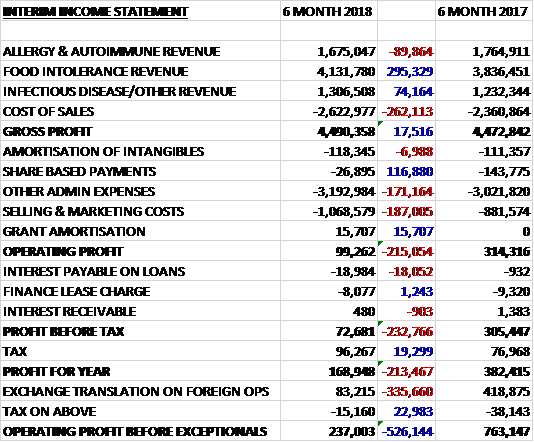
Revenues increased when compared to the first half of last year, helped by favourable forex movements, as a £90K decline in allergy and autoimmune revenue was more than offset by a £295K growth in food intolerance revenue and a £74K increase in infectious disease revenue. Cost of sales increased by £262K to give a gross profit broadly flat. Share based payments declined by £117K but other admin expenses were up £178K and selling and marketing costs grew by £187K to give an operating profit £215K lower. Interest payments increased by £18K but tax receipts were up £19K so the profit for the year was £169K, a decline of £213K year on year.
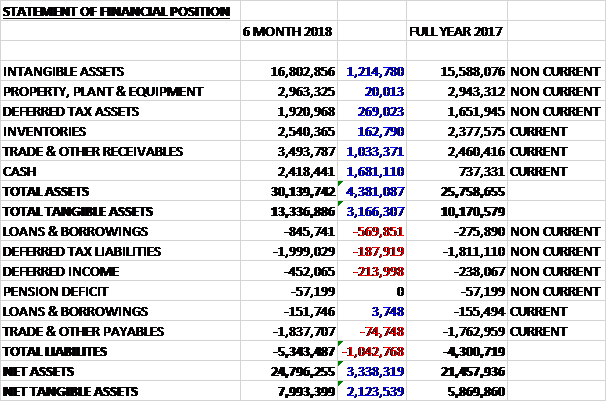
When compared to the end point of last year, total assets increased by £4.4M driven by a £1.7M increase in cash, a £1.2M growth in intangible assets, a £1M increase in receivables and a £269K growth in deferred tax assets. Total liabilities also increased due to a £566K increase in borrowings, a £214K growth in deferred income and a £188K increase in deferred tax liabilities. The end result was a net tangible asset level of £8M, a growth of £2.1M over the past six months.
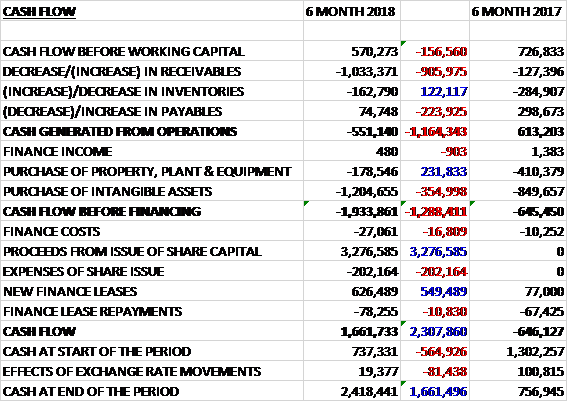
Before movements in working capital, cash profits declined by £157K to £570K. There was a cash outflow from working capital, predominantly due to a growth in receivables, and there was a cash outflow of £551K from operations, a deterioration of £1.2M year on year. The group spent £179K on property, plant and equipment along with £1.2M on intangible assets so there was a cash outflow of £1.9M before financing. This was covered by the net £3.1M of cash from new share capital and £626K from new finance leases to give a cash flow of £1.7M for the half year and a cash level of £2.4M at the period-end.
The pre-tax loss in the Allergy and Autoimmune business was £270K, a deterioration of £174K year on year on revenues that declined by 5%. In Germany revenues fell by 9% in Euro terms but was mitigated to some extent by a favourable currency impact. Autoimmune sales decreased by 60K to just 240K and having stabilised last year, the further decline in German sales was disappointing.
The group have progressed as planned with extending the Allersys menu and expect to CE mark an additional eight allergens before the end of the calendar year. They have also continued their discussions with IDS and while these have taken longer than expected, they feel they are close to agreeing the global distribution terms that will allow them to deliver value from this product range.
The pre-tax profit in the Food Intolerance business was £1.5M, a decline of £121K when compared to the first half of last year despite revenues increasing by 8%. This growth was driven by the Food Print Lab system with more steady growth in Food Detective due to the slow-down of one key market.
The group now have three partner companies in North Americas for the Food Print system and remain convinced that the product can be an important tool for practitioners and nutritionists in the wider arena of food sensitivities, allergies and gut health. In the US, it had become clear that one partner in particular will take longer than first thought to achieve a level of sales that was previously indicated to them. This is based on regulatory approvals taking longer to achieve which has impacted on expectations for revenue growth.
The pre-tax loss in the Infectious disease business was £111K, an improvement of £36K when compared to the first half of 2017 with revenues up 7% reflecting gains in Asia and the Middle East mitigating a reduction in Africa.
As previously announced, the group have CE-marketed their Visitect CD4 test which they anticipate will allow access to opportunistic sales through business to business channels in countries which require a CE-mark. They will now seek to move forward with WHO prequalification and expect that to be achieved in H2 2019. They are also looking to expand its portfolio with a lower cut-off test for the management of advanced HIV disease.
The group have been looking to develop a range of new panels on the Allergodip dipstick test for emerging markets and, in the longer term, for China. They have recently encountered some technical challenges with the product and they are currently reviewing certain options to determine whether it will be feasible to resolve these challenges. As it is not certain at this stage whether these challenges will be overcome, the second half is likely to be impacted by an asset impairment charge of £800K but the revenue expectation for Allergodip in the current year was not material to the group as a whole.
It has also been announced that CEO Andrew Shepherd is now taking on a global ambassador role and will hand over the reins to Colin King who will succeed him as CEO.
Going forward, whilst the board was previously expecting stronger revenues in the second half, it is now likely to be only slightly higher than in the first half. This is due to a number of challenges across the food intolerance business and the weakness in the German allergy market. Accordingly whilst they expect to remain profitable this year, profitability in the second half is now expected to be relatively modest when compared to previous years. Whilst there are a number of short term headwinds in the core business, the board believe that the impact will be more than mitigated by the expected success over the medium term as they complete the commercialisation of key products for Allergy, Malaria and CD4.
At the current share price the shares are trading on a PE ratio of 28.7 which falls to 24.2 on the full year consensus forecast.
Overall then this has been a bit of a disappointing period for the group. Profits are down and although net assets have increased, this was due to the share placing. The operating cash flow deteriorated and doesn’t cover the development costs. The infectious disease business, although still loss making, did see some improvement but there was further deterioration in allergy and autoimmune as the German business continued to struggle, and food intolerance profits declined with slower than expected North American sales of Food Print.
The prolonged negotiation with IDS is a bit of a concern and it would be good to get this sorted and the potentially terminal issues with Allergodip is a real blow. There are always tantalising treats just around the corner, though, with Visitect finally looking like making progress but with a forward PE of 24.2 I am losing patience here.
On the 10th April the group released a trading update covering the year ended 2018. Following his appointment as CEO, Colin King has undertaken a strategic review. They are looking to reduce their cost base significantly with the proposed closure of the German Allergy business and their manufacturing site in India. The estimated impact of the closures will be the elimination of £800K of losses at both sites and non-cash asset write-downs of approximately £5M for the German business and £700K for the Indian site. They are also looking at streamlining some UK operations which is expected to create annualised savings of around £200K.
The headwinds experienced in the last period have continued and the board are now focusing their efforts and resources where they believe they can generate the best returns. They exploring whether the two loss making operations can be sold but discussions to date do not indicate that a material sum can be realised. The cost of closing these business is expected to be around £600K. Following the closure of these businesses it is expected that the group will return to profitability on a lower revenue base.
Turnover is now expected to be £13.6M, a reduction of 6% on last year’s results. This is reflective of pressures on gross margin and continuing headwinds in the core business. Pre-tax losses are expected to be around £700K.
The number of partner companies in North America for Food Print reduced to two in the second half of the year with the withdrawal of one company for their internal financial reasons. Of the remaining two, one is still awaiting regulatory approval for testing samples collected in the US, resulting in lower than expected sales and the group are actively pursuing opportunities to add additional sales channels.
Since the last update, they have added two additional allergens to Allersys with a further two expected by the end of the month which will extend the menu to 53 allergens. Whilst the length of time taken over discussions with IDS has been frustrating, the board expect to provide a further update shortly.
They have recently appointed their first dedicated distributor for CD4 in Nigeria and have started the product registration process with the National Agency for Food and Drug administration in the country which will allow business to business sales to start through the distributor. They have also made progress with a second version of the CD4 test to be used for identifying advanced HIV disease. Two pilot batches of devices have been evaluated at a hospital in South Africa and both met their performance design goals. A third batch is currently under evaluation and if acceptable performance is demonstrated they will start some final robustness and optimisation and then proceed to validation.
The outlook for CD4 is encouraging with the first individual country distributorship being signed. The major sales hurdle they still need to overcome is the individual country by country registration process. They have started this will six countries and plan to start a further six registrations over the coming months.
With a renewed focus and following the closure of two loss making operations, it is expected that the group will return to profitability on a lower revenue base. They have the resources to drive Allersys and the Food Intolerance business as they commercialise CD4.
On the 20th April the group announced that they have finally signed a global distribution agreement with IDS for their Allersys range. The partnership is a long term supply agreement and they are working with IDS to introduce the initial launch panel of 51 allergy tests into the market. Whilst they expect modest sales growth in the short term this is an important step.
On the 23rd April it was announced that Finance Director Kieron Harbinson purchased 125K shares at a value of £16K. Following the purchase he now owns 606,617 shares. It was also announced that CEO Colin King purchased 190,476 shares at a value of £20K and he now owns 468,253 shares.
On the 24th April it was announced that group R&D director Edward Valente purchased 124K shares are a value of £18K.
Overall then there is much to digest here. This year’s results are likely to be quite poor but the progress being made on Allersys and CD4 are encouraging. On balance I think it might be too soon to buy back in here.
On the 2nd May the group announced the closure of the German business. They had not been able to sell it so they have initiated insolvency proceedings through the German court system. The contingent cost associated with this closure is expected to be around £450K, but could be less. Last year the business made an EBITDA loss of €400K.