Tower Resources Share Blog – Final Results Year Ended 2015

Tower Resources has now released its preliminary results for the year ended 2015.

TRPincome

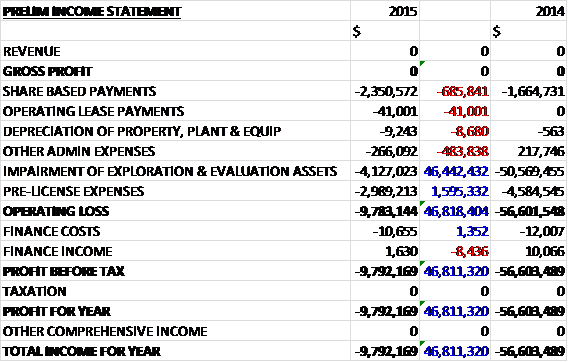
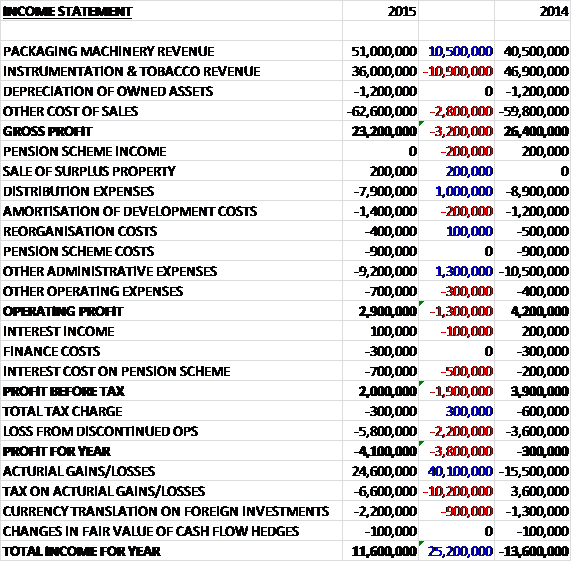
As the group is still just an explorer, there was no revenue or gross profit. Share based payments seem very high, however, and increased by $686K to $2.4M. Other admin expenses grew by about $500K but pre-license costs declined by $1.6M and impairments of exploration assets decreased by $46.4M but were still $4.1M. This all gave an operating loss of $9.8M, a positive movement of $46.8M year on year. With minimal finance costs, this was broadly the same as the profit for the year.

TRPassets

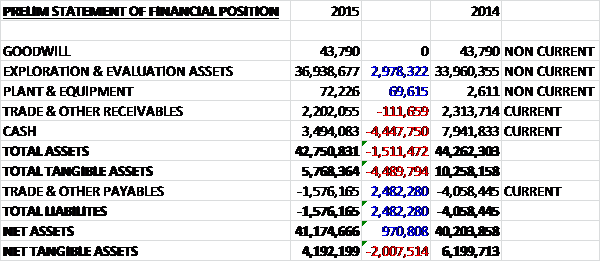
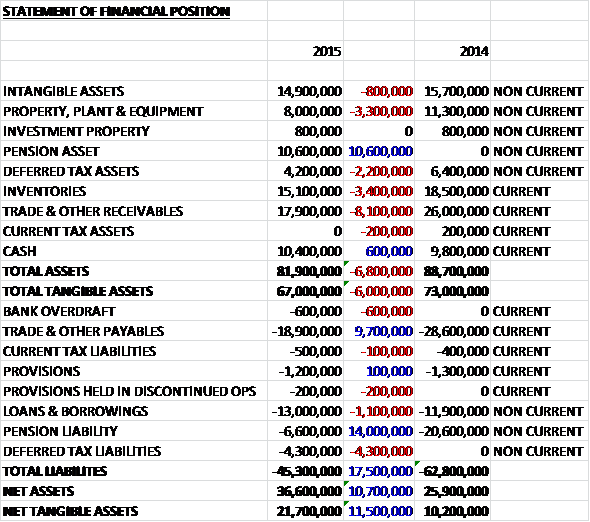
When compared to the end point of last year, total assets declined by $1.5M driven by a $4.4M fall in cash and a $112K decline in receivables, partially offset by a $3M growth in exploration and evaluation assets. Total liabilities also declined due to a $2.5M fall in payables. The end result is a net tangible asset level of $4.2M, a decline of $2M year on year.

TRPcash

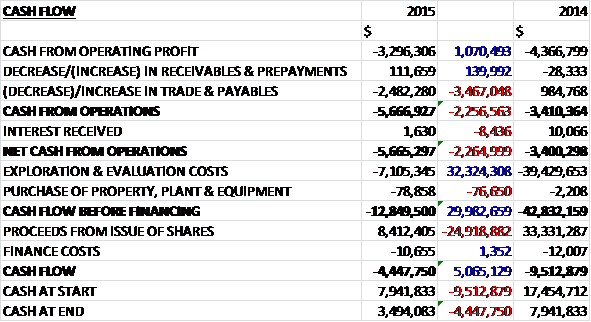
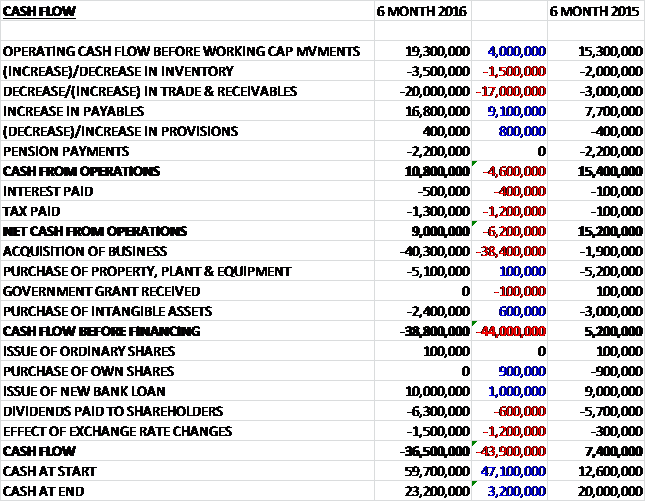
Before movements in working capital, the cash loss reduced by $1.1M to $3.3M. There was a further cash outflow from working capital movements due to a decline in payables to give a net cash outflow from operations of $5.7M, an increase of $2.3M year on year. The group also spent $7.1M on exploration so that the cash outflow before financing stood at $12.9M. After an $8.4M receipt of cash from the issue of new shares, the cash outflow for the year was $4.4M and the cash level at the year-end was $3.5M.

A major event during the year was the signing in September of the Thali PSC in the Rio Del Rey shallow water area of Cameroon. The group has a 100% interest in the block which already has three discovery wells. In a difficult market, the company raised $8M to fund the acquisition which brought a major new shareholder into the fold in the form of M&G Investment with an 18% holding. They have also reduced and deferred other near-term commitments and have withdrawn from areas where they see little chance of commerciality in the medium term.

The board want to use this period of low costs to further strengthen their asset base by assembling a larger portfolio of low risk exploration and appraisal opportunities in proven and emerging basins. They continue to seek sizable working interests, ideally as operator, which allows them to determine the precise nature, cost and timing of their activity. They intend to keep near-term commitments low and to finance the higher cost activities through farm outs to larger companies.

In Namibia the group was committed to a 2015 work programme designed to obtain a fuller understanding of the results of the well and its implications for the remaining prospectivity of the license, especially the large untested deeper targets including the Albian carbonates. This has now been completed and the license relinquished. In Kenya the group made the decision to withdraw from the license following completion of the Badada-1 well and subsequent assessment of remaining prospectivity on the block. All costs capitalised with respect to this license are impaired as of the year-end.

In South Africa the group made the decision not to pursue the joint application with New Age for an Orange Basin license and subsequently impaired capitalised costs totalling $867K. A further $500K is included within receivables with respect to amounts owed to the group by New Age at the year-end relating to the initial farm out arrangement 2013 and is considered recoverable.

At the year-end the group had cash balances of $3.5M and they are expected to need to raise additional funds in 2016/2017 in order to maintain sufficient cash resources for their working capital needs and their committed capital expenditure programmes over the next year or so. The directors are confident that they can raise sufficient funds from the capital markets, private investment, farm-outs or assets disposals. It is possible, though, that the group may need no more cash from the market this year.

The group have taken out operating leases on their office properties with about $78K due within the year. They are also committed to funding various exploration expenditures. In Kenya there is a net commitment of $100K in 2016 on Block 2B which was relinquished in August. In South Africa on the Algoa-Gamtoos block, there is a $100K commitment in 2016 and a $2.1M commitment in 2017. In Cameroon, on the Thali license there is a commitment of $13.3M over 2017 and 2018.

At the AGM the board are proposing to restructure and consolidate the company’s shares so that for each 250 shares currently held, shareholders will receive one new share. As well as reducing the volatility of the shares, this will enable them to issue new shares if needed as the market price is currently below the nominal value. The board, staff and consultants who own over 15% of the issued share capital have undertaken to vote in favour of these resolutions and I am sure the majority of the other shareholders will too, as it is pretty essential really.

In February 2016 it was announced that non-executive director Peter Blakey had decided to retire from the board. He is now 75 years old and one of the founders of the company. During the year the group appointed Phil Frank as a non-executive director and Nigel Quinton as exploration director.

Overall then, the group seems to be treading water a bit at the moment. The acquisition of the Thali block in Cameroon does look to be a sensible move and the positioning towards lower risk, lower reward concessions is probably a sensible one. There is $3.5M of cash left in the bank but not much in the way of commitments over the coming year. There is much more in 2017, however, by which time the company will have to raise more capital in one way or the other. Until that happens I am sitting on the side lines (or rather, more accurately, sitting on my shares which are pretty much worthless).

On the 16th March the group announced that it had granted options over 134,400,000 shares at a premium of 150% over the current price (0.19p) which is very nice for the directors, but at least there is a sensible exercise price included.

Victoria Oil & Gas Share Blog – Interim Results Year Ending 2016

Victoria Oil and Gas has now released its interim results for the year ending 2016. The company has changed its accounting reference date to 31st December and will release audited results for the seven month period to the end of December by the end of May. During the prior year a change in accounting treatment resulted in Cameroon Holdings being treated as an associate as opposed to an unlisted investment. The 35% ownership in the associate recovers a portion of the royalties paid by the group.

VOGinterimincome16

Revenues increased by $7.3M when compared to the first half of last year largely due to the gas consumed by ENEO. Production royalties grew by $619K and depreciation was up $3.7M which meant that gross profit was $3.1M ahead of last time. Sales and marketing expenses declined by $759K but share based payments were up $1.6M with other admin costs down $360K. We then see other gains/losses swing to the negative to the tune of $1.1M and after a $1.1M share of profit from the associate the group had an operating profit of $740K which, due to $49.8M of impairments last time, represented a $52.3M positive swing. Finance costs grew by $352K but income tax costs were down by $547K which gave a loss for the first half of the year of $890K, a decrease of $52.5M year on year.

VOGinterimassets16

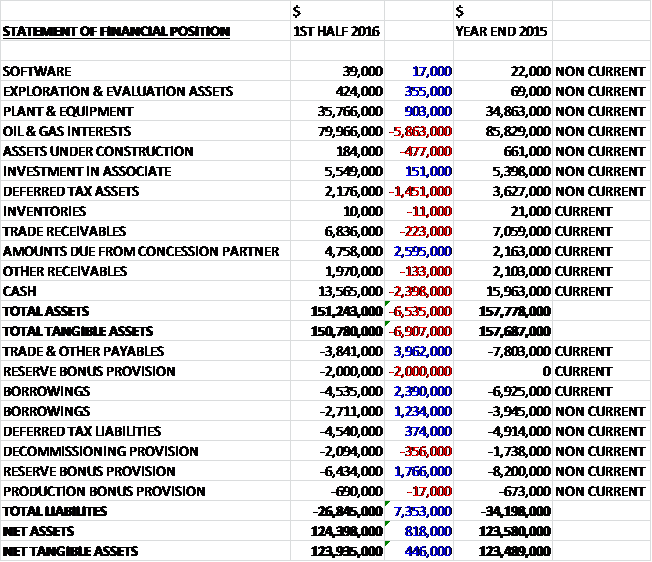
When compared to the end point of last year, total assets declined by $6.5M driven by a $5.9M fall in the value of oil and gas interests, a $2.4M decrease in cash, and a $1.5M decline in deferred tax assets, partially offset by a $2.6M increase in the amounts due from a concession partner and a $903K growth in plant and equipment. Total liabilities also declined during the period due to a $4M fall in payables and a $3.6M decrease in borrowings. The end result is a net tangible asset level of $123.9M, a growth of just $446K over the past six months.

VOGinterimcash16

Before movements in working capital, cash profits increased by $7.9M to $8.7M. There was a cash outflow through working capital, however, with a growth in receivables and a fall in payables which meant that the operating cash flow was $2.9M, a positive movement of $10.4M year on year. The group then spent $1.7M on tangible assets, mainly pipeline related, and $379K on intangibles and after a $971K dividend receipt from an associate there was a free cash flow of $1.8M. After finance costs of $871K and the repayment of $3.1M worth of borrowings, the cash flow for the half year was $2.2M and the cash level at the period-end stood at $13.6M.

The profit in Cameroon was $1.9M compared to a loss of $1.4M in the first half of last year. Gas sales for thermal and retail power were 656mmscf, a reduction of 63mmscf year on year whilst gas sales for grid power were 874mmscf compared to zero last time. In total, the average daily gas production was 8.85mmscf per day compared to 3.91mmscf per day last time; and condensate sales increased from 11,334bbls to 23,110bbls. Gas prices remained largely unchanged throughout the period due to the fixed price contracts in place but condensate prices have been negatively impacted by the global downturn in oil prices.

The gas sales figures currently represent 100% of the sales of the Logbaba project but during 2016, revenues will be split in accordance with the participating interests with just 60% being attributable to GDC as all of the exploration costs are expected to have been recovered. Management expect the point of revenue sharing to resume during Q1 2016.

ENEO consumed at the higher dry season level for June before reducing to the lower wet season take or pay levels for the remaining five months of the period. January 2016 marks the return to the dry season with the grid power sector now recording consistent consumption in excess of 9mmscf per day with January actually producing an average production of 13.9mmscf per day.
Within the period the group started the supply of gas to Dangote Cement, a 1.5M tonne per year clinker cement plant and also connected Societe Industrielle Camerounaise des Cacaos, a subsidiary of a Swiss-owned chocolate group and one of the world’s largest producers of cocoa. The business increased its capacity from 32,000 to 50,000 tonnes per year of cocoa following connection to the gas.

The loss in Russia was $464K compared to the $49.8M loss in the first half of 2015 relating to the full impairment of the assets.

It is worth noting the increase in receivables. Some $4.8M of these receivables (compared to $2.2M at the end of last year) are due from RSM and relate to RSM’s funding obligation for its 40% participating interest in the Logbaba concession. As the group are expecting RSM to start receiving its own share of earnings from the concession, I assume these don’t represent non-payment of receivables but perhaps indicate the ramp-up in gas sales.

The key objectives for the group in the year ahead are to increase gas supply to customers by 30%; to successfully complete a two well drilling programme for the expansion of gas reserves; to complete designs for increasing the gas treatment plant capacity to 40mmscf per day; to add over 13km to the pipeline network by building in new industrial areas; to progress new market products such as compressed natural gas; to continue to reduce production overheads across the group; and to expand business development efforts into other parts of Africa. The capital projects planned for 2016 will be funded through a combination of operational cash flows, partner contributions and debt.

The group has engaged Petrofac to manage the initial well design and services procurement phase of the 2016 well drilling programme and at the time of writing they had issued a letter of credit in the amount of $2M to a drill rig supplier for mobilisation costs and an additional $2M is committed upon presentation of a valid bill of lading of the specified drill rig. Further drilling-related purchase orders and commitments to date amount to $3.3M (a total of $7.3M committed so far then) and the company’s remains on track to spud the first of the two new wells by the middle of the coming year.

After the period-end, in February, the group reached an agreement with Glencore to acquire a 75% participating interest in the Matanda Block PSC with Victoria acting as operator. The assignment is conditional in the proposed work programme being agreed and other customary approvals from the government in Cameroon which will determine the acquisition date. The block borders the Logbaba concession at the southern boundary with about 70% of the block onshore. It is highly prospective for significant natural gas and gas condensate resources. The other 25% interest is held by Afex Global. One of the key attractions of the block is its proximity to the existing gas processing plant and pipeline network.

During the period, James McBurney resigned as a director and Iain Patrick was appointed as a non-executive director in December.

At the period-end the group had a net cash position of $6.3M compared to $5.1M at the end of last year.

Overall then, this has been a period of progress for the group. The losses fell and net assets grew modestly. There is also real progress on cash generation with the operating cash flow increasing and some cash actually being generated before financing, although it was all swallowed up by loan repayments. These figures represent the first supply to ENEO for grid power but it was also mostly during the wet season which has lower demand. As we enter the dry season, revenues should increase but unfortunately this coincides with RSM resuming its 40% share of sales so this will have a real impact on the figures.

Over the coming year the group is drilling two wells which will apparently be paid for using cash and debt (ie no placings) but whether this is achievable, I am not sure. They currently have $13.6M in cash with $7.3M of that already committed to the initial stages of the first well. It is unclear how much headroom is on the banking facilities but I suspect they will need to be renegotiated. The acquisition of the Matanda block looks to be a great, opportunistic play and one that adds a great deal of more potential.

I am torn here, for the first time in a long time, VOG is actually looking to be a decent investment but until I know how much the 60% of revenues will actually look like in profit terms and the costs of the wells, it is hard to take the plunge.

On the 13th April the group announced that it had agreed a $26M debt facility to support its production expansion at Logbaba through to 2017. They aim to avoid the equity markets whilst ensuring gearing is restricted to appropriate levels.

During 2016 the group intends to increase gas production from the Logbaba project by 30%, following the doubling in production in 2015. The key elements of the expansion programme are to drill one twin well and one step out well at the Logbaba plant sire with the objective of increasing production reserves; extend the Bonaberi pipeline to customers with gas service agreements in place; and to increase the gas processing plant capacity in three phases to handle the expected increased gas flow from wells. It is the group’s objective to fund the development through operating revenues and capital contributions from RSM (good luck with that!) in addition to the funding announced here.

The new facility has a repayment period of five years and incurs interest of 7.15% per annum.
On the 19th April the group released an operations update covering Q1 2016. Total gas sales of 1,131.2mmscf was an increase of 726.6mmscf when compared to Q1 last year. This growth has come entirely from an increase in supplies for grid power with thermal sales remaining flat at 250.6mmscf and retail power reducing by 53.4mmscf to 37mmscf. The total amount of condensate sold more than doubled to 13,591bbls. This resulted in revenues pf $12.8M and a net cash position at the end of the quarter of $4.6M compared to $5.9M at the end of the prior quarter.
These figures are in line with internal expectations as the quarter covered the first half of the dry season where gas consumption in the grid power sector is typically higher.

Following the approval of the work programme at the forthcoming operating committee meeting, the board expect to begin first work on Matanda at the end of 2016 once they have completed the Logbaba drilling campaign. Of the two wells to be drilled at Logbaba, one is a twin of the La-104 well drilled in 1957 and the other will be a step-out well that will be drilled into a target that is intended to prove up more of the group’s reserves. Both the wells will be drilled from a drilling pad adjacent to the gas plant and they will be tied into the production facilities immediately after they are completed.

In addition to developing the gas reserves, one of the wells has an additional objective of an exploration tail. This is to be drilled from the base of the Logbaba formation down to 4,200m below the surface to test the hydrocarbon potential of the Mundeck formation which had gas shows in La-104. A contract has been signed with Savannah Oil Services to provide the drilling rig for the project and it is currently on route to Cameroon. Petrofac is providing well design and project management services and the detailed design and programme preparation has started.

Major site preparation work is underway including slope stabilisation, full security fence line, levelling for drilling rig track and drilling pad preparation. New warehousing for rig supplies, storage and camp civils are also under construction and long lead time orders have been placed. The current plan is to start drilling in late Q2 and to complete by the end of the year. The budget total is less than $40M, significantly below the initial estimates but the start of the programme has resulted in some preliminary expenditure which explains the lower cash position at the end of the quarter.

The process plant expansion study has been completed. Stage one of the gas plant expansion to 25mmscf per day capacity (up from 20) is in the preliminary engineering phase and further phases will commence to tie in with well results.

An agreement was reached with SATOM, a road construction company, to lay GDC gas pipe and a bitumen road at the same time. 2.1km of pipeline has been laid during the quarter to be commissioned in phases over Q2 and new thermal customers are scheduled to come on line in Q2.

So, the new debt facility is good news as it reduces the need for a dilutive placing and things seems to be progressing well. The sales to grid power look decent enough but sales to other customers look rather disappointing.

Somero Share Blog – Final Results Year Ended 2015

Somero has now released its final results for the year ended 2015.

SOMincome

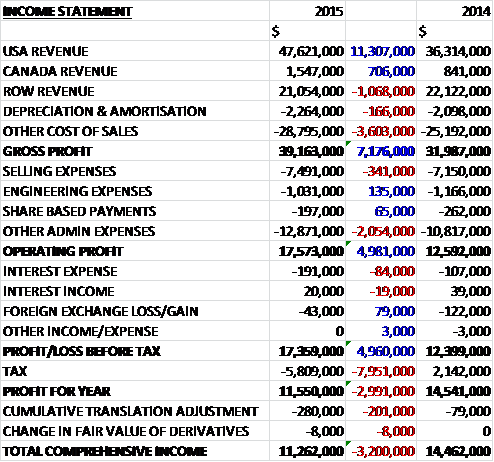
Revenues increased when compared to last year as a $1.1M decline in ROW revenue was more than offset by an $11.3M growth in US revenue and a $706K increase in Canadian revenue. Depreciation increased by $166K and other cost of sales grew by $3.6M which gave a gross profit $7.2M above that of 2014. Selling expenses increased by $341K but engineering expenses fell by $135K with admin costs up $2.1M to give an operating profit some $5M ahead of last time. A growth in interest expense was offset by a more favourable forex loss which meant that pre-tax profits grew by $5M. We then see an $8M detrimental swing to a tax payment, however, relating to both higher federal taxes payable and the lack of a deferred tax benefit which occurred in 2014. This meant that the profit for the came in at $11.6M, a decline of $3M year on year.

SOMassets

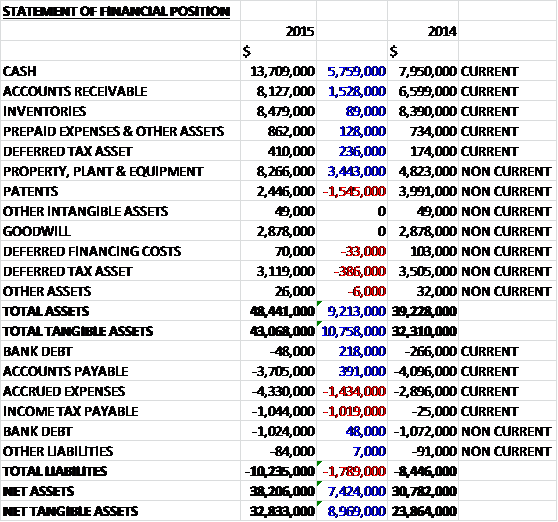
When compared to the end point of last year, total assets increased by $9.2M driven by a $5.8M growth in cash, a $3.4M increase in property, plant & equipment, and a $1.5M growth in accounts receivable, partially offset by a $1.5M decrease in the value of patents. Total liabilities also increased during the year due to a $1.4M growth in accrued expenses and a $1M increase in current tax payables. The end result is a net tangible asset level of $32.8M, a growth of $9M year on year.

SOMcash

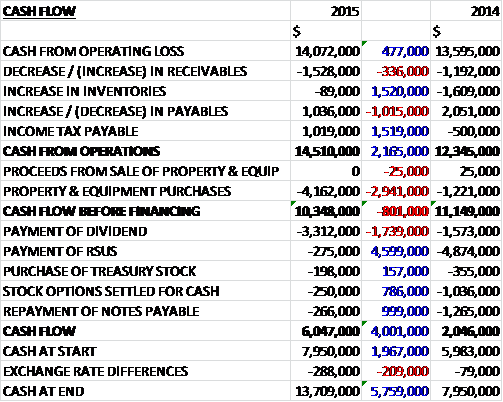
Before movements in working capital, cash profits increased by $477K to $14.1M. There was a small cash outflow from working capital but the group received $1M in tax payments to give a cash from operations of $14.5M, a growth of $2.2M year on year. The group spent $4.2M on capex to give a free cash flow of $10.3M which easily covered the $3.3M in dividends and after a few stock purchases and a small repayment of debt the cash flow for the year came in at $6M to give a cash level of $13.7M at the year-end.

Large line sales increased from $22.4M to $28.3M as a result of increased volume and price increased, small line sales grew from $9.7M to $13.6M also due to higher volumes and price increases, 3D Profiler System sales increased from $3.7M to $4.4M and other revenues, including sales of spare parts, topping spreaders, mini screeds and accessories increased modestly from $11.1M to $11.9M.

In North America, annual cement consumption from non-residential building construction grew 14%. The healthy increase in non-residential construction spending spurred customer demand for replacement machines, fleet additions and technology upgrades. This combined with new product instructions, price increases and a shortage of skilled labour in the concrete contractor industry all contributed to the 32% annual sales increase in the region.

Europe continued its positive trajectory with a solid year of growth with sales increased 58% to $5.7M with this growth being driven by improvements in the UK, Spain, Poland, Italy and Germany. Sales in the Middle East grew to $2.7M, well ahead of expectations and driven by increased activity in Dubai, Turkey and Saudi Arabia. As expected, sales in Russia remained slow due to its continued unstable geo-political climate.

The Chinese market was challenging in 2015 but market conditions stabilised in the second half of the year and the board remain encouraged by the underlying market fundamentals. They ended the year with $6.1M in sales, a decrease of $3.4M year on year. A significant factor impacting the market was a slowdown in money flow throughout the construction industry. To address this factor, in Q4 the group began offering long-term financing to customers that require installation of their machines shut-off payment protection tool. While their experience with this programme has been very positive so far, they will continue to develop alternative third-party financing options for customers. In the meantime they expect the Somero long-term financing programme will have a positive impact on sales.

The training and education efforts that are being promoted through the Concrete College in China and the efforts of the sales engineers in the country are increasing awareness, acceptance and demand for higher quality floors and higher wages in China are leading to demand for greater automation which increases the value of the group’s equipment.

In SE Asia, sales increased by $600K to $1.3M and the region is viewed as a significant growth opportunity in the coming years given their low market penetration and the growing demand for high quality floors in the region. In Australia, sales decreased by $1.4M to just $1M, mainly due to the devaluation of the Australian dollar which led to the group’s equipment becoming more expensive for local customers and if this continues, it will inhibit the growth opportunity in the country in 2016.

The results in India were flat year on year with $600K of revenues in the country as the group are still in the initial phase of penetration in the market. They will continue to focus their efforts to promote the benefits of higher quality floors, increase their marketing activities and hold educational seminars for engineers and architects to drive broader acceptance of wide-placement methods and flatness.

During the year the group have completed development of three new products: the new S-940 Laser Screed, the S-10A Laser Screed machines as well as the Somero Floor Levelness System. The S-10A and the Floor Levelness System were both launched in Q4 whilst the S-940 was launched in Q1 2016 with the released in Q4 contributing $400K in sales during the year. Sales of the S-485 Laser Screed machine introduced in Q4 2014 grew considerably to $3.9M in 2015.

Last year the board concluded that the anticipated growth of the business over the medium term required expanded facilities. They therefore decided to expand the Michigan facility and planned construction of a new global HQ and training facility in Fort Myers, Florida. In October they completed their 20,000 square foot expansion of the operations and support offices in Michigan for a total cost of $1.3M with the expansion providing the group with a facility that is able to support growth exceeding their 2018 strategic objective of doubling their 2013 revenues.

Also during the year the group purchased land, designed and began construction of the new 14,000 square foot global HQ in Fort Myers for a total expected cost of $4.8M. Ground breaking occurred in October and the product remains on budget with completion expected in Q2 2016.

This year the group incurred amortisation charges of $1.5M which is expected to be the same in 2016, although in 2017 this will fall to $901K and by 2018 the intangible assets will be fully amortised, although there is $1.1M of the commercial real estate mortgage that is due for payment compared to negligible amounts in 2016 and 2017. This year there was a big swing to a tax payment. This is in part due to a one-off reversal of a deferred tax valuation allowance of $4.1M and $5.9M in settlements of RSI’s and stock options which were deductible for tax purposes in 2014.

It is worth noting that both the allowance for doubtful accounts and the bad debt expense increased this year with the former up from $324K to $698K and the bad debt expense increasing from $49K to $381K which is a fairly big hike. The group is obviously very susceptible to changes in the state of the general economy in the US, along with their ability to protect their IP rights and the potential future growth of competitors. Additionally there were two large customers, representing 11% and 10% of total accounts receivable.

During the year, Ron Maskalunas stepped down from the board having spent nine years with the group. He was replaced by Robert Scheuer who previously served in executive roles at Dover Corp and Kraft Foods.

Key drivers of growth in North America will be growth in US non-residential construction spend which is forecast to increase by 5% to 7% through to 2019. Other growth drivers are technology upgrades to an aging fleet of installed Somero equipment, fleet additions, new product introductions and a shortage of skilled labour in the concrete construction industry. In Europe, growth will be driven by continued recovery of the non-residential construction market and addition to technology upgrades to an aging fleet of equipment, fleet additions, new product introductions and a shortage of skilled labour.

In China, the group expect growth will be driven by large multinational corporation projects that require high quality floors that adhere to western flatness standards, broader domestic acceptance of levelness floor specifications as supported by the China Flooring Association, an increase in the availability of long-term financing options and an increasing shortage of skilled labour. In other ROW territories, the primary drivers of growth will be increased demand for higher quality concrete floors, broader domestic acceptance of levelness floor specifications and shortages of skilled labour.

Going forward, healthy trading momentum in the US was carried forward into 2016 from the strong finish to 2015. The momentum is driven by demand for replacement equipment, fleet additions, technology upgrades and new products. The underlying non-residential construction market fundamentals in the US remain strong, evidenced by lengthy project backlogs for the group’s customers that extend will into 2016. In Europe they are seeing a similar carryover of momentum into 2016 which highlights a continued, steady recovery from the recessionary low point in 2010. In the Middle East, coming off very strong growth in 2015, the board expect to continue to see significant opportunities in the coming year.

In Latin America, they expect a stable performance in Mexico and Chile and are optimistic for improvement in the other countries in the region except for Brazil. The Asian markets remain positioned for improvement and will be driven by increased penetration of the group’s products.
They expect to see greater willingness to use their products and services as flatness standard levels grow. In China, the group are providing customers with new direct long-term financing options which have been enabled by the development of a machine shut-off capability. This is likely to have a positive impact on sales in the region but it seems to be that local customers may be able to find a way around the shut off. Overall, the board are confident that the group will deliver another year of solid growth.

At the year-end, the group had a net cash position of $12.6M, an increase of $6M when compared to the end of 2014. At the current share price the shares are trading on a PE ratio of 11.8 which reduces to 9.3 on next year’s consensus forecast. After a 25% increase in the full year dividend, the shares are now yielding about 2.5% which increases to 3.4% on next year’s forecast, although it should be noted that dividends are paid in US dollars.

Overall then, this has been a very strong year for the group. Profits were down but this was only due to last year’s deferred tax receipt and pre-tax profits grew. Net assets were also up, as was the operating cash flow with some very strong free cash generation. The group performed well in North America, Europe, the Middle East and SE Asia but the performance in Russia, China and Australia was weaker with the well-publicised issues in those countries taking their toll on sales.

I am a little nervous about the group providing credit to their Chinese customers but hopefully they will do this in a sensible way. Really, this is a play on US construction and this is apparently very healthy with the strong momentum from last year continuing into 2016. With a healthy net cash position, a forward PE ratio of 9.3 and dividend yield of 3.4% these shares are still looking cheap to me and I am more than happy to continue holding. Although, of course, with this share one must keep an eye on the health of the US construction industry.

On the 21st March the group announced that CEO Jack Cooney sold 1,400,000 shares in the company at a value of £2M in order to satisfy a US tax obligation. Following the sale, he is interested in 1,414,364 shares so he has disposed of half of his holding. Apparently US tax legislation obliges him to make withdrawals from his current pension plans during 2016, the assets of which consist solely of Somero shares. I am not sure I totally understand that but following the sale he has stated he will not dispose of any of his remaining shares for the next two years at least.

On the 31st March the group announced that CFO John Yuncza purchased 17,500 shares at a value of £26.4K and non-executive director Robert Scheuer purchased 22,500 shares at a value of £34K. John now has 39,613 shares while Robert now owns 25,000 shares.

On the 6th June the group released a trading update for the year to date. Overall business is progressing well with positive trading in the core US, European and Chinese markets. In the Latin American, Southeast Asian, Korean and Middle East territories, year to date trading is somewhat below previous year levels, although the board expects improvement over the rest of the year.

In a product basis, sales of the new products, S-10A and S-940 have been key contributors to growth, along with sales of the 3-D profiler system, S-15 and STS-11m. In addition, driven by increased customer project activity, sales of parts and services have been particularly strong in the year to date.

The overall positive trading environment, together with margin improvement due to price increases and cost controls, and solid operating cash flow generation means that the overall results are tracking comfortably in line with market expectations for the full year. This all sounds decent enough and I am happy to hold.

On the 12th July the group released a trading update covering the first half of the year. Trading in June was significantly stronger than in the previous month and when compared to the same month of 2015. This was led by particularly strong activity in North America with China, the Middle East and Europe also contributing satisfactorily to overall growth. The company now expects to report results slightly ahead of current market expectations for the year as a whole.

Swallowfield Share Blog – Interim Results Year Ending 2016

Swallowfield has now released its interim results for the year ending 2016.

SWLincome

Revenues increased when compared to the first half of last year as a £1.6M decline in European revenue due to the weakness of the euro was more than offset by a £2.6M growth in UK revenue and a £485K increase in ROW revenue. Cost of sales increased modestly to give a gross profit £1.3M above that of last time. Commercial and admin costs grew by £843K but there was a £554K pension scheme curtailment gain which meant that the operating profit was £1M above that of the first half of 2015. Finance costs crept up and tax was £100K higher as it is anticipated that the UK taxable profits will be above the brought forward tax losses which will mean they will be fully utilised now, to give a profit for the half year period of £960K, an increase of £911K year on year.

SWLassets

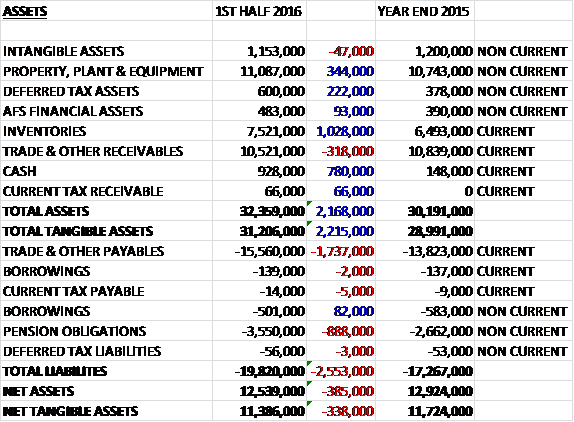
When compared to the end point of last year total assets increased by £2.2M driven by a £1M growth in inventories, a £780K increase in cash, a £344K growth in property, plant and equipment and a £222K increase in deferred tax assets due to the increase in pension obligations, partially offset by a £318K decline in receivables. Total liabilities also increased during the period due to a £1.7M growth in payables and an £888K increase in the pension obligations due to a reduction in bond yields. The end result was a net tangible asset level of £11.4M, a decline of £385K over the past six months.

SWLcash

Before movements in working capital, cash profits increased by £557K to £1.3M. There was a small cash inflow through working capital but this was less than last year so that after a £254K detrimental movement in income tax, the net cash from operations was £1.6M, a decline of £1.1M year on year. This was more than enough to pay for capex, though, and free cash flow was £740K which covered the dividends of £226K but the group still took out more debt of £346K, however, which meant that the cash flow for the period was £780K and the cash level at the period-end was £928K.

Overall the performance was in line with board expectations. The core contract manufacturing business delivered growth in both sales and contribution margin and within the owned brands, the group integrated the Real Shaving brand and executed launches of the Bagsy and MR. brands into Debenhams and Boots respectively.

The group has focused resources on the “drive” and “build” product categories at the expense of the service product categories which they are seeking to exit. The drive categories include personal care aerosols, hot pour products and roll-ons whilst the build categories include cosmetic pencils, fragrance, gifting and premium liquids. During the period the drive and build categories delivered a combined 9% sales growth with a strong margin growth from the drive categories in particular.

The group have introduced a number of new products across a range of key customers and also secured agreements for future supply of several innovative haircare products to major premium brand owners which will positively impact business performance in 2017. They have also seen growth in volumes from their plastic aerosol foaming shower gel which was introduced last year. Furthermore, they delivered their first order under a partnership arrangement entered into with a leading US aerosol manufacturer. This arrangement enables the production of Swallowfield formulation in the US in a cost efficient way to allow European based customers to launch their products into the region which enables the group to receive a commission.

The Real Shaving Company brand has been fully integrated into the business and both sales and margins are contributing positively. A new aerosol product was added to the range and launched in October in the UK and will be introduced in Canada in the spring. A new sampling campaign will be executed in H2 and the group have entered into a sponsorship package with Somerset County Cricket Club.

The premium beauty brand, Bagsy, was rolled out in October to 36 Debenhams stores on full display units. Sales have been building steadily and there are a number of in-store promotions planned through the spring and summer. Further distribution extensions are being worked on, both in the UK and internationally, and the group have entered into an agreement with the fashion designer Savannah Miller which will result in a number of new products to be launched later in the year under the name Savannah Miller for Bagsy.

The new male haircare brand, MR, was launched into 350 Boots stores in October and sales have also been building steadily. Again, a range of in-store promotions and digital advertising through the spring and summer are expected to build further consumer awareness and sales. The value brand Tru continues to generate sales in existing outlets and the group are looking to further extend its retail distribution.

The board have identified a project to implement an upgrade of the group’s energy and waste infrastructure at the main Wellington site which aims to generate savings of about £150K per annum. This work is now underway with the installation of a new compressor and boiler complete and waste treatment trial in progress. This is expected to be completed during the current year.
During the period the group had one customer representing over 23% of total revenues. This represents a clear risk but apparently it reflects the timing of new launches and strong re-orders falling in the first half of the year which is expected to normalise over the full year – does this mean revenues are likely to be lower?

During the period the group recognised a credit of £770K relating to a curtailment gain which represents a reduction in liabilities on close of the defined benefit pension scheme to future accrual. One-off costs of £220K were incurred during this closure process which gives a net gain of £550K. The last scheme funding valuation which took place in April 2014 revealed a funding deficit of £1.3M which meant the company agreed to pay £108K per annum over ten years to eliminate the deficit which the valuation due to take place in 2017. The pension scheme is actually quite large given the size of the company with the total value of obligations standing at £23M.

Despite challenging retail conditions and the increasing macro-economic uncertainty, the board expect to see continued growth in both sales and profitability for the full year.

Net debt at the period-end stood at £4.9M compared to £5.4M at the end of last year. At the current share price the shares are trading on a hefty PE ratio of 27.1 which reduces to 14.7 on the full year forecast. After the reinstatement of the interim dividend, the shares are yielding 1.6% which increases to 1.7% on the full year forecast.

Overall then, this was a period of good progress for the group. Profits were up but net assets fell due to an increase in pension obligations. The operating cash flow also declined but this was due to a less favourable movement in working capital and cash profits increased with a decent amount of free cash being generated. The core contract manufacturing business seems to have performed well but there are no details about the contribution from the own brands, but I suppose it is early days. There is still a decent amount of debt here and the pension scheme is an omnipresent issue which means the forward PE of 14.7 and dividend yield of 1.7% doesn’t appear that cheap. Despite this, I feel there is enough momentum and quality here to justify this price so I am continuing to hold.

On the 6th June the group announced the acquisition of Brand Architekts and a placing in order to raise £8.6M which was significantly oversubscribed.

Brand Architekts owns and manages a portfolio of mid-premium beauty and personal care products that are sold in major UK high street retailers as well as through export. The business generated pre-tax profits of £2M last year and will be a transformational acquisition, being immediately earnings enhancing.

The majority of its sales are through major UK high street retailers, many of which are already existing customers of Swallowfield but further sales are made through export, notably to North America, Australia, Scandinavia and Turkey. Their key brands include Dirty Works, Kind Natured, Argan, Happy Naturals, DrSalts, Superfacialist and Senspa and they currently outsource production to suppliers in China. The two current owners will be entering into consultancy agreements for two years following the completion of the acquisition.

The total consideration for the acquisition is £11M, including contingent consideration of £1.85M and will come from the proceeds of the placing along with a modest extension of the current banking facilities.

The placing is to raise £8.6M at a price of 155p per share, a small premium to the share price the day before the announcement. The placing shares will represent about 33% of the total share capital following admission which means that the total voting rights will be 16,865,267.

The group’s current trading is in line with expectations, continuing the strong momentum in the first half of the year. The group’s owned brands continue to make good progress with further retail and online stockists added and the development of new marketing collaborations such as Bagsy with the fashion designer Savannah Miller and the Real Shaving Company with Somerset Cricket T20 Blast.

On the 11th July the group released a trading update covering the year ended 2016. They anticipate full year profitability will be towards the upper end of expectations. Overall revenues are expected to show growth of 10% having been bolstered by the strong performance of innovative new products introduced during the last year and the developing owned brands portfolio. This has also driven strong year on year growth in margin. There was a net debt position of £4.3M at the year-end compared to £5.4M at the end of the prior year.

The acquisition of Brand Architekts was completed after the year-end so had no impact on these figures. Initial feedback from customers regarding the new products has apparently been positive. Whilst the board are mindful of the broader economic and political environment as a result of the EU referendum, they are confident they can navigate any potential macro-economic uncertainty that may lie ahead.

Empresaria Share Blog – Final Results Year Ended 2015

Empresaria has now released their final results for the year ended 2015.

EMRincome

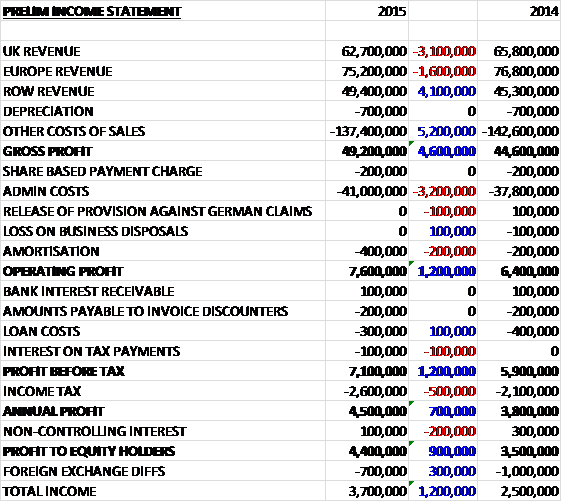
There was a modest fall in revenues when compared to last year due to currency headwinds and the decision to reduce exposure to some low margin business as a £3.1M decline in UK revenue and a £1.6M fall in European revenue was mostly offset by a £4.1M growth in ROW revenue. Cost of sales declined, however, to give a gross profit £4.6M ahead of last year. Admin costs increased by £3.4M, including a £200K growth in amortisation, which meant that the operating profit grew by £1.2M when compared to 2014. Finance costs remained steady but tax increased by £500K which gave a profit for the year of £4.4M, an increase of £900K year on year.

EMRassets

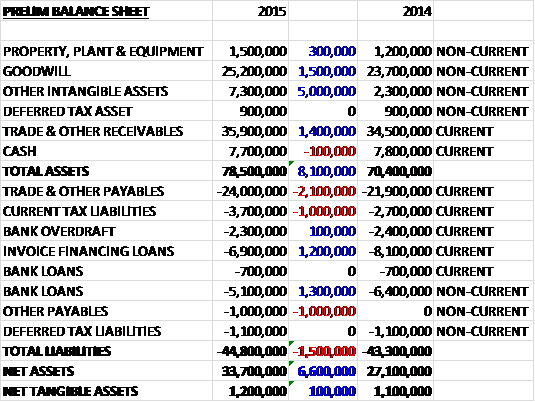
When compared to the end point of last year, total assets increased by £8.1M driven by a £5M growth in intangible assets, a £1.5M increase in goodwill and a £1.4M growth in receivables. Total liabilities also increased during the year as a £2.1M growth in current payables, a £1M growth in non-current “other” payables and a £1M increase in current tax liabilities were partially offset by a £1.3M decline in the bank loans and a £1.2M decrease in invoice financing loans. The end result is a net tangible asset level of just £1.2M, an increase of £100K year on year.

EMRcash

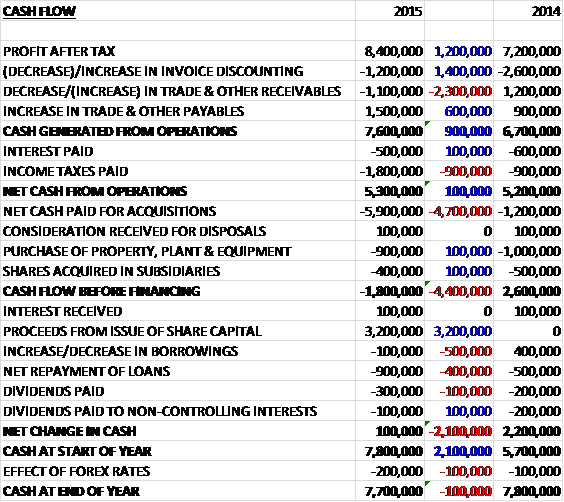
Before movements in working capital, cash profits increased by £1.2M to £8.4M. There was a cash outflow through working capital with an increase in receivables and tax paid was £900K higher than last time to give a net cash from operations of £5.3M, an increase of £100K year on year. The group spent £900K on property, plant and equipment and £400K of shares in the subsidiaries before a £5.9M payment for acquisitions meant that there was a cash outflow of £5.9M before financing. The group then issued new shares which netted them £3.2M which was used to pay back £1M of loans and pay out £400K in dividends so that the cash flow the period was £100K and the cash level at the year-end was £7.7M.

NFI from temporary recruitment was down 1.5% due to a 3.5% reduction in sales, partially offset by improved margins. Permanent sales, including the offshore recruitment business, now account for 45% of NFI. Nearly half of NFI is earned from the technical and industrial division.

The operating profit in the UK division was £2.1M, a decline of £100K year on year on revenues that declined by 5% due to the deliberate move away from low value work in the Technical and Industrial sector. The lower paid end of this sector has been heavily impacted by changes in legislation with false self-employment legislation implemented in April 2014 and new travel and subsistence rules in place from April 2016. Their approach to transition away from the generalist market and increase their presence in professional and specialist roles has helped offset the impact of this to a certain extent but there has been a short-term profit impact with a lower contribution from this sector this year.

Excluding this sector, there was revenue growth of 27% with a particularly strong result from the professional services sector, aided by improved conditions in the banking sector and ongoing growth in the HR and secretarial areas. They also saw a full year contribution from Ball and Hoolahan which was acquired at the end of last year as the business was integrated into the Become group. The board have plans to grow the brand’s presence across the network over the next few years. There were also positive performances from their brands in domestic services and retail.

NFI actually increased by 16% to £18.4M but due to the above mentioned move away from the lower margin work there was a reduction in conversion ratio. In addition, they saw increased costs in Q4 from three brands moving office which has caused an increase in rent costs and one-off moving expenses.

The operating profit in the Continental Europe division (mostly Germany) was £3.7M, a growth of £700K when compared to last year. This is due to the Headway business in Germany and Austria where revenue growth is coupled with a more appropriate cost base with the German economy growing this year and business confidence remaining positive into 2016.

The healthcare business in Finland is making good progress with its move away from the import model which is reliant on Estonian staff working in Finland, to a local model. Costs were removed with the closure of a physical presence in Estonia and whilst the group will continue to place Estonian staff, they expect the mix to be in favour of Finnish workers by the end of 2016. The local economic conditions remain weak but the board are pleased with the progress being made.

Due to the weakness of the Euro, currency rates have negatively impacted profits with growth in constant currency being £300K higher. In line with their strategy to exit businesses without strong growth prospects, they finalised the exit of the loss making business in the Czech Republic via a disposal, and in Slovakia which was closed down.

The operating profit in the ROW division was £1.8M, an increase of £600K when compared to 2014 following investments made last year with the new offices all delivering improved contributions. There were mixed performances across the region with the established markets in Japan and Australia performing well along with Thailand, Chile and India.

In India the offshore recruitment services business has seen significant growth with staff numbers at the end of the year up 65% on the prior year. The plan to open a third office in 2016 was brought forward due to high demand, opening in November 2015. This business mainly services clients in the US and UK with a focus on IT and healthcare and the board see good opportunities for continued growth over the coming year.

Market conditions in SE Asia and China have been mixed. In Indonesia they have seen business confidence dented by worsening economic conditions. The executive search business saw slightly lower profit levels and the training business has been restructured to reflect the lower sales level. The majority of this programme has been completed in the year and the management team has been strengthened so the board expect to see a market improvement in performance in 2016.

In Thailand they have seen strong growth and there have been improved performances in the Philippines, Malaysia and Singapore. The group have a small presence in China which has been restructured and rebranded and they see good prospects moving into 2016 with a greater emphasis on Chinese clients rather than multinational companies. In January 2015 the small stand-alone brand in Malaysia was sold to management and they now operate in that market through the Monroe Consulting brand which is making good progress.

On October the group purchased Pharmaceutical Strategies, a US staffing company specialising in the pharmacy benefit management sector of the US healthcare market. The initial consideration is £4.7M with £2.7M of deferred consideration payable in 2016 and a further £500K of contingent consideration for future years, making a total consideration of £7.9M. The acquisition generated goodwill of £2.2M and the business contributed £100K to profits in the two and a bit months following the acquisition and if it had been purchased at the start of the year, it would have delivered £200K to the group’s profit. It is worth noting that due to their high levels of debt, the group had to issue further equity in order to make this acquisition.

The business specialised in providing qualified pharmacists and nurses to the healthcare sector, in particular to the pharmacy benefit management companies. The sector is undergoing high growth rates due to the implementation of the Affordable Care Act and the investment also takes the group into a new geography and provides a base for their other brands if they want to enter the US market (something that shouldn’t be undertaken lightly in my view). In any case, the business is expected to deliver a good uplift in profit in 2016, having integrated well into the group.

Apart from the main acquisition there were a number of other investments and disposals during the year. The group purchased 10% of PT Monroe Consulting in Indonesia for £300K, taking their total interest to 90%; and they purchased 9% of Mansion House in the UK for £100K, taking their total shareholding to 67%. They received £100K in deferred consideration from the disposal of the Bar 2 payroll business in 2013, and the disposals of Metis and January this year and GiT in March. In addition the group made a deferred consideration of £500K for the purchase of 75% of shares in Ball & Hoolahan in September which represented the maximum amount payable under the sale and purchase agreement.

The group uses a debt to debtors ratio throughout the report which is not something I have seen before. Anyway, they have achieved their target in this metric so it doesn’t look as though debt reduction is much of a priority going forward which is a little bit of a shame in my view.
The board see exciting opportunities across the group in spite of current global uncertainty and are confident in their ability to deliver profitable growth in 2016, benefiting from the investments made in existing brands and the purchase of Pharmaceutical Strategies.

At the year end, the group had a net debt position of £7.3M compared to £9.8M at the end of last year. At the current share price the shares are trading on a PE ratio of 9.5 which falls to 8.3 on next year’s consensus forecast. After a 43% increase in the final dividend, the shares are now yielding 1.1% which is nothing to get excited about.

Overall then, this has been a year of progress for the group. The profit increased although the net tangible asset level remained flat, as did the operating cash flow due to a higher tax payment and increase in receivables – cash profits did increase and before acquisitions there was a decent level of free cash produced. There was a good performance in mainland Europe despite the weakness of the euro as revenues increased and costs fell in the Germany business which seems to have performed very strongly. There was also a good performance in the ROW business as weakness in Indonesia and China was more than offset by growth in Thailand and India. There was some weakness in the UK, however, as the group moved away from some lower margin business.

The Pharmaceuticals Strategies acquisition seems decent enough but there are some risks involved with this as the US is a tough nut to crack. Also, I prefer businesses that grow using their own cash flow rather than raising equity and diluting shareholders – the net debt is also quite high here so they are probably growing quicker than they should in my view. The dividend is nothing to write home about, as should be the case given the debt and the acquisition policy but the forward PE ratio of 8.3 is looking cheap. This is a tricky one as I am tempted to buy some shares as a bit of a value play. I will have a think!

On the 29th April the group announced that is acquired the remaining 25% interest in Ball and Hoolahan for £250K from Roy Hoolahan as part of a planned succession. Marc Sigrist, who joined B&H as operations director in December will replace Roy as MD. The business generated pre-tax profit of £300K last year.

On the 5th May the group announced that it had made a good start to the year with growth in NFI compared to the same period of 2015. They have seen particularly good trading in Germany, Japan, India and Chile. The US based Pharmaceuticals Strategies is performing well and recent new client wins give the board confidence that it will deliver full year profits in line with their expectations. They do continue to look for further acquisitions which makes me a little nervous but overall the group remains on course to meet market expectations for the full year so steady as she goes then.

On the 1st June the group announced that it had acquired a further 10% of the shares in Monroe Consulting Thailand for a cash consideration of £200K. They now hold a 70% interest in the business which generated a pre-tax profit of £400K last year.

On the 5th July the group announced the acquisition of 82.6% of Rishworth for a total consideration of £7.5M with the rest remaining in the hands of the senior management team. The business is a specialist recruitment group headquartered in New Zealand with a regional office in Sweden, providing pilots and aviation personnel to clients across the globe with a significant presence in Europe, Africa and Asia supplying businesses such as Norwegian, Korean Air and Vietnam Airlines. It is a 100% contract recruitment business with pilot contracts typically lasting between three and five years.

Last year the business made NFI of £4.7M and adjusted EBIT of £1.9M and the board believe the acquisition will be earnings enhancing this year. It is difficult to ascertain how much goodwill will be generated but I think since Rishworth has net liabilities of £451K, this will be nearly £8M. This looks to be a useful acquisition but I feel EMR is looking a bit stretched with regards to debt and the balance sheet so I am not rushing to buy the shares.

On the 21st July the group released a trading update covering the first half of the year. The group is continuing to perform well and is on course to meet market expectations for the full year.

NFI in the first half was up 13% and the group has seen particularly strong trading in Continental Europe, Asia Pacific and the Americas, especially in Germany, Japan, India, Chile and China. The investment in Pharmaceutical Strategies in performing in line with expectations.

In the UK there was a slowdown in May and June as business confidence dropped in the run up to the EU referendum. Following the Brexit result, it has stabilised and sales pipelines are holding up well. Being a globally diversified business they are well positioned to manage the effects of a slowdown in any particular sector or geography. Whilst they are monitoring the short term outlook for the UK, they see strong growth opportunities across the group and will benefit from the effect of current exchange rates as overseas earnings are translated into Sterling.

Whilst there is general uncertainty in the UK markets, this accounts for less than a third of business and overall this is a pretty decent update.

BPI Share Blog – Final Results Year Ended 2015

BPI has now released its final results for the year ended 2015.
BPIincome

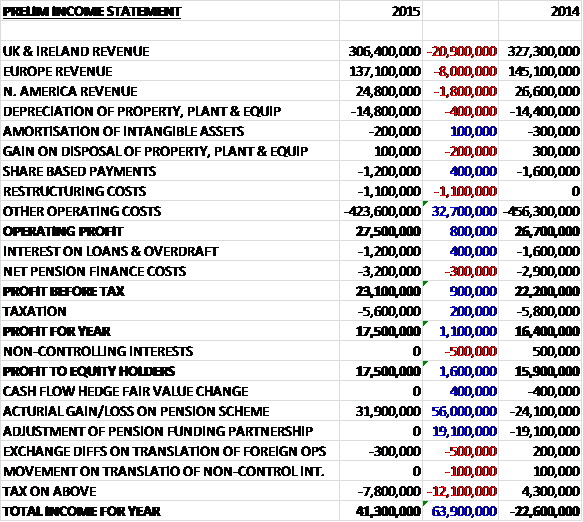
Revenues declined when compared to 2014, reflecting lower average polymer costs for the year and the impact of currency translation on the European sales with a £20.9M fall in UK & Ireland revenue, an £8M decrease in Europe revenue and a £1.8M fall in North America revenue. Depreciation increased by £400K but this was offset by a £400K decline in share based payments and we also see £1.1M-worth of restructuring costs but other operating expenses fell by £32.7M to give an operating profit £800K above that of last year. Bank interest on loans fell by £400K reflecting the favourable borrowing terms negotiated last year but this was offset by a £300K increase in net pension finance costs and after a modest decline in tax, the profit for the year came in at £17.5M, a growth of £1.6M year on year.
BPIassets

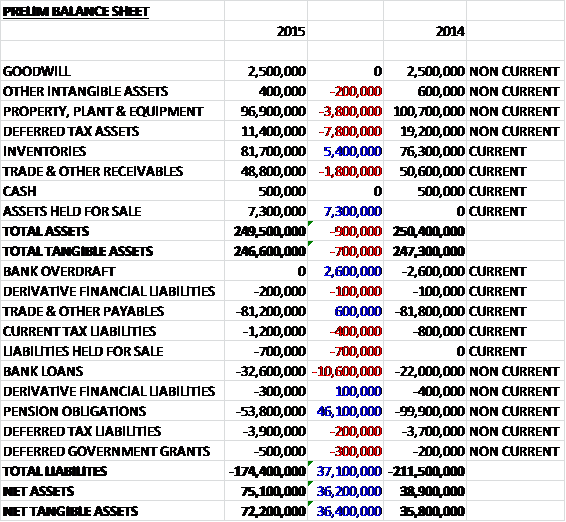
When compared to the end point of last year, total assets declined by £900K driven by a £7.8M fall in deferred tax assets relating to the reduction in the pension deficit, a £3.8M decrease in property, plant & equipment and a £1.8M decline in receivables, partially offset by a £7.3M growth in assets held for sale relating to the Chinese subsidiary, and a £5.4M increase in inventories. Total liabilities also declined during the year as a £46.1M fall in pension obligations relating to the change in inflation index, and a £2.6M decrease in the bank overdraft was partially offset by a £10.6M increase in bank loans. The end result is a net tangible asset level of £72.2M, a growth of £36.4M year on year.
BPIcash

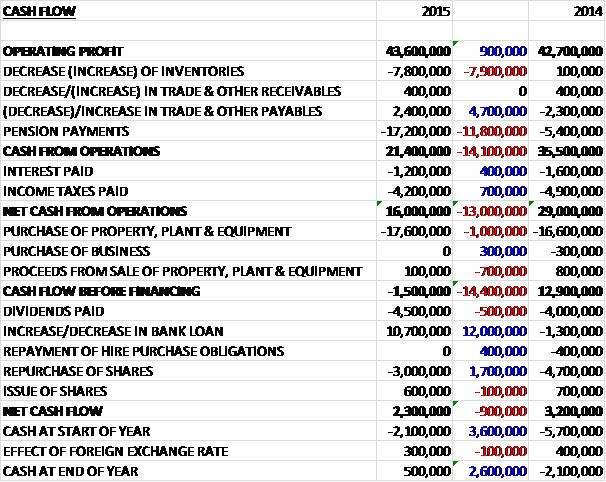
Before movements in working capital, cash profits increased by £900K to £43.6M but there was a sizeable growth in inventories and an £11.8M increase in pension payments which meant that after both interest and tax declined modestly, the net cash from operations was £16M, a decline of £13M year on year. This did not cover the £17.5M of capex (which is expected to remain broadly similar next year) so that before financing there was a cash outflow of £1.5M. The group also paid out £4.5M in dividends and spent £3M on their own shares and after a £10.7M increase in the bank loan there was a cash flow of £2.3M for the year and a cash level of £500K at the year-end.

Total volumes reduced by about 1% to 272,000 tonnes, reflecting reduced demand from certain sectors in the UK, including the loss of an unprofitable contract to supply refuse sacks to a major retailer. Within these numbers, the group saw an increase in demand for silage stretchwrap of just over 2%.

The operating profit in the UK and Ireland was £11.6M, a growth of £400K year on year as a result of a strong performance from the recycling operations. The operating profit in Mainland Europe was £15.7M, a decline of £600K when compared to last year, reflecting the impact of turbulent raw material costs in the first half of the year and detrimental movements in foreign exchange. The operating profit in North America was £1.3M compared to a loss of £800K in 2014 as previously reported difficulties with plant installation were rectified.

In October the group sold their Promopack reprographic business at Henor to Reprographic Systems for £200K as it has failed to make a return for a number of years. Also, in November they announced the closure of a stretchfilm plant in Widnes with the transfer of production to a larger plant in Leominster; and they reduced numbers employed at WMB, the consumer facility at Worcester and in the films business in Sevenoaks in order to align staffing levels against current demand at these locations. These actions resulted in a restructuring charge of £1.1M this year and should enhance future profits by around £500K.

During the year the company agreed with the trustees of the pension scheme to change the index used to revalue pensions in payment from RPI to CPI. This resulted in a reduction in the present value of scheme liabilities of £27.6M and to increase the security of pensions for scheme members (and no doubt to get the agreement of the trustees) the group also made a one off payment of £11.2M into the scheme.

A continuing problem for the group is the price of polymer, the main raw material. Polymer costs increased by some 50% between early March and the end of June, the greatest short term increase that the industry has ever seen. This had an impact on short term margins in the summer and although polymer prices have eased back, they remain 20% above their position in last February. Middle East polymer producers continue to favour Far East markets, partly as a result of duty when importing products into Europe and extra capacity in North America has not yet come on stream. The board believe that European polymer producers may be able to take advantage of the current market position, particularly if there are any further plant outages so it sounds as if the raw material pressures are not yet over.

After the year-end, the group signed an agreement to sell its Chinese subsidiary to Amcor Investment, an Australian based packaging group. The disposal is expected to complete in Q2 2016. The consideration is estimated to be about £9.4M with an estimated £6.4M upon completion with the balance payable in instalments following the agreement of working capital and satisfaction of certain post completion arrangements, all of which are expected to take place within the next year. The proceeds will be used to reduce borrowings. The estimated gain on disposal will be about £4M reflecting property and forex gains and this year the business made a small loss.

Going forward, 2016 has started well and the group’s investment programme in new plant, and action taken to bring facilities in line with demand are both designed to assist improved operating performance. They also expect continued success in supplying agricultural film markets. In addition, the recent weakness of sterling should enhance results through translation of the overseas earnings and improving the competitiveness of the UK business. The board continue to review a number of acquisition opportunities in the UK and mainland Europe but it remains to be seen whether they can bring any of these to conclusion. The board are confident that 2016 will deliver further progress.

At the current share price the shares are trading on a PE ratio of 11.3 which falls to 9.8 on next year’s consensus forecast. After a 12.5% increase in the annual dividend, the shares are now yielding 2.5% which increases to 2.6% on next year’s forecast.

Overall then, this year seems to have been a solid one for the group. Profits increased and net assets improved considerably due to the changes made to the pension scheme. The operating cash flow did fall but this was due to the increased cash payment into the pension scheme and an increase in inventories with cash profits increasing year on year. The group didn’t generate any free cash, however, mainly as a result of the pension payment.

The UK business performed well due to a strong performance from the recycling operations, and the North American business returned to profit as last year’s difficulties with the plant installation were rectified. Profits fell in Europe, however, due to the issued with polymer raw material and the weak Euro, both of which have partially been rectified so far this year. The polymer situation remains a cause for concern, however, as it sounds as though some volatility will remain this year.

With a forward PE of 9.8 and a dividend yield of 2.6% these shares look pretty good value to me, polymer issues and sluggish top line growth notwithstanding, and the recent weakness in sterling can only be good for the group going forward. I am tempted to take a position here.

BPI have released their annual report which gives a much more detailed account of how the year has gone operationally so I have revisited the shares.

Passing through the polymer price increased was challenging and the group’s margins were squeezed. Prices of the raw material eased between August and October but rose again in the final two months of the year. Euro prices reduced in January and February in Europe and the outlook for prices in the year should be downward but the supply position remains very tight. The same level of reduction was nor seen in the UK due to the recent weakness in Sterling. North America also saw reductions in January and February but prices still remain too high in relation to feedstock costs and Far Eastern prices.

Significant capacity additions have been approved in North America on the back of a plentiful supply of shale gas but this capacity is unlikely to arrive before 2017 and will result in North America becoming a significant exporter of polymer.

Lower oil and gas prices resulted in reduced energy costs in Belgium, Holland and Canada but while the UK wholesale electricity costs reduced reflecting the lower oil and gas prices, the group saw minimal benefit due to increasing energy taxes and environmental levies. The cost of manufactured tonne in the UK remains significantly higher than in the group’s European and Canadian operations but even the European prices put the group at a competitive disadvantage in global terms.

The European operating profit fell by £600K to £15.7M but in euro terms increased by €1.4M on volumes that were 4% ahead at 75,400 tonnes. The sales mix continued to improve and the business benefited from investment in new equipment and product development. Sales volumes saw growth in both silage and industrial products but margins were squeezed by the raw material price increases in Q2.

Total sales of silage products increased by 4.5% with reasonable growing conditions and low levels of carry-over stock in most markets. This increase arose against a background of cold but wet weather in Northern Europe and consistent hot and dry weather in Central Europe from April onwards resulting in lower volumes in the second half. Sales of the advanced silage products SilotitePro and Baletite increased by 14% with market feedback continuing to be positive. Sales of these products now account for over 22% of the total silage volumes and this is expected to increase each year. Baletite is a replacement for traditional round bale netting and SilotitePro is a new generation of silage film with improved economics and environmental properties and both will reinforce the group’s market leading position in silage wrap.

The significant polymer price increase in Q2 resulted in a very difficult pricing environment with margins suffering and falling below those of 2014. The reduction in polymer prices in early 2016 may delay the start of the new season and result in anther difficult year with further pressure on margins. Volume sales of printed film for the food industry grew by 9% with growth in both French Fries and vegetable markets. A new replacement printing press to replace two older units and enable greater production efficiencies and a small increase in capacity was installed in H2 and is running well.

Demand in pallet protection film and general purpose film remained reasonable despite some competitive pricing but sales of stretch hoods increased. Sales of Bontite, an industrial stretch product, again showed an increase as new legislation on load stability offered additional opportunities. At Roselare, total extrusion production was 20,000 tonnes with growth in all three of the group’s strategic products: stretch hoods, feedstock for printing and thinner insulation films. These products now account for 67% of production as sales volumes of the new thinner products for the insulation industry increased by 24% while stretch hoods were up 35%.

Sales from the industrial film plant in Hardenberg in Holland increased by over 7% and sales of other FFS products grew by 16% as they benefited from the installation late last year of a replacement eight colour printing press. Growth was achieved from the building, chemical and fertilizer sectors. Volumes of bags were maintained but customers do continue to move to FFS products. The board approved an upgrade of the extrusion equipment in their heavy duty factory at Hardenberg and the building work was completed and the first extruder installed. They have also authorised the installation of an additional extruder for FFS to meet growing demand in the petrochemical sector as they secure additional business.

Production fixed costs and labour costs per tonne improved with lower scrap and quality complaints. The European business remains well invested with clear strategic plans at each site which will enable further growth. Zele in Belgium will continue to focus on silage stretch products and printed film for the food industry. Roeselare in Belgium will focus on a reduced number of products, including stretch hoods, feedstock for printing and a range of pre-stretched thinner products for the insulation industry. Hardenberg in Holland is focused on industrial products and is a leading supplier of FFS to the petrochemical and other industries.

The business has achieved strong results for the last few years and with further investment in new capacity, combined with the development of new and improved products, should deliver similar or better returns in future years.

The operating profit in the UK and Ireland business was £11.6M, a growth of £400K year on year despite very challenging conditions due to the extreme volatility in polymer prices particularly in Q2 and the impact of sterling strengthening against the euro. The group also saw no relief from the very high energy costs despite lower oil and gas costs as taxes continued to increase.
Sales volumes reduced to 188,700 tonnes as the group exited some low margin retail refuse sack business and saw reduced demand in a number of sectors. Total sales to the more resilient sectors reduced slightly to 67% of the total due to lower demand arising from the competitive pressures in the retail food sector.

Sales of collation shrinkwrap, which are mainly to the food and drink industries, reduced marginally in 2015, despite volume from some new customers, as demand remained flat and the soft drink sector faced difficult trading conditions. Converter volumes improved despite demand being patchy as the group were successful in winning new customers but downgauging continued, restricting growth in volumes. Intra-group sales were down reflecting lower demand from some of the food retailers and their suppliers. Margins suffered from the polymer price increases in Q2, however. The group have strengthened their sales team to focus on delivering volume growth.

The group’s sites continue to operate efficiently with a focus on reducing scrap and operating costs. Their plan to upgrade new extrusion lines at Bromborough has continued with three coextrusion lines now fully operational and performing well with good outputs and gauge profiles, and a five-layer coextrusion line has been ordered for delivery in early 2016. These new lines will increase coextrusion capacity, produce thinner films and offer customers tighter tolerances with improved performance. At Sevenoaks, the group began the process of transferring mono work to the lower cost site at Bromborough so they can focus on the high quality coextrusion market at Sevenoaks which resulted in a number of redundancies. The site at Winsford continued to perform well, although volumes were slightly below those of 2014.

External volume sales of silage stretchwrap were just below last year despite good growth in the UK and Norwegian markets. In the UK the group continue to position themselves as suppliers to the leading co-operatives and agricultural merchants. The Irish market remains the lowest priced in Europe and while the group focus on a restricted range of customers, their market share reduced on pricing pressure. Margins were lower due to the combination of resin price increases and adverse exchange rates. Sales of the prestretched Wrapsmart Ultra continue to grow and were 13% ahead of last year. Sales of cast industrial stretchwrap were lower than 2014 as it continues to be imported from the Middle East and Far East.

Widnes produced a range of blown machine reels and hand rolls for the packaging industry and, despite strong competition in the conversion sector and a continuing move to prestretch products, volumes increased by 16% as the group benefited from the rationalisation of the product range and secured additional customers. In November they announced the closure of the facility with production being moved to Leominster which will reduce their cost base and offer customers higher quality products.

At Leominster the programme of investment to upgrade older extrusion equipment and improve output and quality continued. Output at the site showed a small improvement and scrap was in line with last year. All conversion for Wrapsmart, including the machines acquired in 2014 from STC, was moved to a new hall at the end of 2014 which resulted in increased efficiency and lower scrap in 2014. A new multi-layer extrusion line was authorised for installation in Q1 2016. The building work has been completed and all equipment delivered with a target start date for production of April 2016. Labour and production costs remained well controlled on all sites.

Recycling remained a challenged with the continued lack of availability of clean waste scrap. Total recycling volumes were down on 2014 with washed volumes and dry recycling both reduced. The group have begun an investment programme based on a new generation of recycling equipment. The first new machine was delivered and installed in December 2014 and this has enabled the group to increase efficiencies and reduce maintenance, labour and energy costs. The machine is performing well and allowing them to access waste which they previously would have considered wash grade. The washing plant installed in 2013 to remove paper contamination from waste plastic, most of which was exported to the Far East, continues to perform well.

Availability of scrap continues to be a key issue and the group are now bringing in packaging scrap from Europe. Scrap prices reduced during the year as demand from the Far East lessened. The agricultural recycling volumes reduced to the poor availability of scrap in the UK and Ireland so the group continue to target alternative supplies in mainland Europe. A number of new start-up recycling facilities in the UK have now ceased trading but there remains strong competition for scrap from mainland Europe.

The group’s construction films experienced a slow start to the year and volumes were lower in 2015. The group did continue to target strong growth in their structural water proofing and gas protection range of products, however, and they were able to achieve good growth in market share and in a flat market, increased sales by 7%. Total tonnage of refuse sacks fell by 7% over 2014 as they exited some low margin business in the retail sector. Pressure on margins in all sectors remained intense and the group are required to continually develop new and improved products to remain competitive. In the healthcare sector, the group continued to supply a range of downgauged waste sacks to the NHS and secured additional apron business in the second half of the year. At the beginning of 2015, they secured refuse and clinical waste sacks from the Scottish Health Service, replacing an overseas supplier. Volumes to the local authority sector continued to reduce as councils move to wheelie bins or stop providing sacks.

Volumes reduced in the retail sector as the group exited a number of underperforming lines. Margin pressure remains intense but they continue to supply a number of the larger national food retailers and develop downgauged products. They intend to launch their own-branded Visqueen Ultimate product through both retailers and online platforms. The supply chain sector continues to perform well with good growth at some customers but the sector is highly competitive with intense margin pressure.

There was considerable focus at Heanor on operational improvements in production which resulted in lower scrap and manning levels. A first coextrusion line was installed in December 2014 and has enabled the group to offer an improved range of products. A second line has now been ordered for delivery in June. A new three lane bag machine has also been ordered to uprate their capacity on standard sizes and replace an old conversion machine.

The group’s industrial activities at Ardeer and Greenock saw volumes reduce due to lower demand from the construction and animal feed sectors. Construction volumes were down, reflecting low demand in the market at the start of the year and in the summer with a number of customers experiencing reduction in activity levels and then reducing stock levels. Volumes of the more complex printed cement sacks saw further growth in the year due to additional customer wins, including some export business and the board anticipates further growth as more packing lines are installed.

Sales volumes of compost sacks for consumer packaging for retail horticulture increased as the group secured more business from their existing customers. Volumes to the animal feed sector were down due to unseasonably mild winters at both ends of the year. Packaging volumes for furniture and carpets, industrial packaging and garment film for online retailers were broadly maintained. Pallet stretch hooding volumes were in line with 2014 but, as they secure new customers, volumes should grow in 2016.

The Ardeer site continues to improve its operational performance and is benefiting from the new extrusion investment for heavy duty sacks. These new lines have delivered higher outputs, improved film quality and reduced scrap and energy costs. The year further benefited from a third line which was installed during Q4 2014. Two further extrusion lines for other products were installed towards the end of the year and are running at anticipated outputs and will benefit the coming year. A replacement eight-colour printing press was installed in the second half of 2015 and is performing well. Greenock continued to perform well with lower scrap rates and reduced costs.

The small site at Flint is focused on products requiring hygiene accreditation and continued to perform well with steady volumes and improved efficiencies. The small trading operation in Norwich also continued to perform well despite lower sales.

The operational performance of the wide line at Ardeer continued to progress with improved utilisation. This line manufactures a range of agricultural and horticultural film products that are sold in the UK and certain European markets. Total volume sales showed a small increase over 2014 with growth in silage sheet in both the UK and Europe replacing reduced volumes to North America following the installation of the new line in Canada. A new seven layer wide line has been authorised to increase capacity and develop more advanced products. Horticultural sales improved with some growth in the UK and exports despite pressure from the weaker euro.

In the consumer sector, at Worcester, sales volumes reduced as the sector remained under pressure throughout the year due to the difficult trading conditions at the major supermarkets. Margin pressure remained intense as supermarkets and their suppliers attempted to continue to reduce costs. All this against a background of increasing raw material prices resulted in lower margins. A number of redundancies were made in December to align staff levels with demand. The business strategy remains to broaden the customer and product base and an experienced sales director was appointed to develop new markets and products. While success will not be immediate, the group are quoting a number of new customers and are confident in securing additional volume. A new fast changeover printing press has been ordered for delivery in March.

The plant in China manufactures aprons and a range of bags including refuse, swing and pedal, food and freezer. The group installed in 2014 further extrusion equipment and an additional eight colour printing press to increase capacity for the production of packaging for bread and fresh produce. Total volumes increased year on year with some growth in Wrapsmart, bread bags and healthcare products. Margins showed some recovery as raw material prices fell in the Far East. Progress on increasing sales to Oceania by supplying the bread and produce markets was slower than expected and led to the decision to sell the business following an approach.

It was a difficult year for Jordan Plastics as sales volumes reduced and margins were impacted by the strength of sterling for sales in to Ireland. The pre-press and plate making business provided artwork, origination and printing plates to group businesses and external customers. The business continued to suffer from flat demand and due to the need for reinvestment, it was sold in Q4.

The total capex in the UK business was more than £12M as the group invested to replace older equipment, increase efficiencies and reduce scrap and maintenance, energy and labour. New extrusion lines were installed at Bromborough, Ardeer and Heanor and a printing press at Ardeer. Planned expenditure for 2016 includes extrusion equipment for Bromborough, Ardeer and Heanor and a fast changeover printing press for Worcester. The UK business is now well positioned and will continue to see further operational improvements and will benefit from capex projects and the current weakening of sterling against the euro.

The North American business saw an operating profit of £1.3M compared to a loss of £800K last year with the new extrusion line in full production and running well with the loss last year attributable to delays and problems with the installation of the line. Total product sold fell, however, as the group withdrew from the manufacture of low margin overwintering film in the horticulture sector.

Sales in agricultural products were nearly 2% below last year as the business experienced offshore low cost competition at the start of the year, some drought conditions in certain areas and crop yields that were below average. Sales of horticultural products fell by 2.5M pounds as the group discontinued the manufacture of overwintering film and focussed on greenhouse films.

Polymer prices continued at high levels in the region despite low feedstock costs and this, combined with a strong US dollar, encouraged the import of lower priced material impacting on volumes and margins. The new extrusion line performed as expected with good running speeds and operating at lower scrap and cost levels. Unfortunately a number of power outages adversely impacted the running of the line, resulting in higher than expected scrap and maintenance costs but the line is now running well again at the start of 2016. They also installed a new rewinding line late in the year that will be operational for 2016.

The business was restored to profit in the year and they are now developing new agricultural and horticultural products on the new seven layer extrusion line which will bring benefits in future years. With supportive weather conditions, further progress should be made in the coming year.
The current economic outlook remains uncertain following the collapse in the oil price and outlook for the global economy. The recent weakness of sterling will be helpful, however. The group have taken action to eliminate loss-making units, reducing their cost base and moving the business towards more resilient and growing markets and the board look forward to 2016 with confidence.

Overall then, the main take-away from all of this is that most end markets seem to be a little difficult and the group’s margins are under pressure due to erratic polymer pricing with the high cost of electricity not helping in the UK. In Europe, silage products did well, although volumes were lower in the second half in this weather-dependent product. The business also performed well in its other product areas in the region.

In the UK and Ireland it is quite difficult to ascertain exactly where the decent performance came from with most of the group’s end markets struggling. The higher profit against lower sales suggests that the investments made in the plants are improving margins despite the raw material difficulties. The North American business returned to profit after the problems with the new extrusion line were (mostly) rectified, although here too the group’s markets seem to be struggling.

The group seems to be struggling to increase sales with instead profits coming from improvements in production efficiency and product mix so the business could be ex-growth. The depreciation in sterling no doubt helps, however, and the shares do look cheap. They could be worth a go for the dividend?

On the 27th April the group confirmed the completion of the sale of its Chinese subsidiary to Amcor for a total consideration of £9.7M and the initial consideration of £6.4M has now been received. The balance will be paid in instalments following the agreement of closing working capital and satisfaction of certain post completion arrangements. The working capital, estimated at £2M, is expected to be payable in June with instalments of £300K in H2 2016 and the final instalment of £1M payable in early 2017 with the proceeds being used to reduce borrowings. The gain on disposal is now estimated to be over £5M.

Also it was announced that the trading performance n Q1 has been strong and ahead of management expectations having benefited from lower energy costs and favourable currency translation effects. This all seems quite positive and now the furore around the results has died down I have decided to take a position here.

On the 10th May the group released a trading update covering the first four months of the year. Trading was strong and ahead of management expectations having benefited from lower energy costs and favourable currency translation effects. Polymer prices, which eased slightly in Q1, now seem to be firming again and although the group will be passing these increases on to their customers, there will be the usual lag in doing so.

They also announced the closure of their films plant at Sevenoaks. Production of high quality films will be moved to a larger, more modern facility at Bromborough. This site has faster production rates and has recently been upgraded by a significant capital expenditure programme, making it the largest speclialised film plant in the country.

Closure costs at Sevenoaks will be around £1M and the board currently anticipate an increased contribution from the Bromborough plant of over £1M per annum from 2017. These closure costs will be offset by the gain on disposal of the Chinese subsidiary of over £5M as previously announced. In all, the board remain confident of the outcome for 2016.

Steady progress seems to be being made here then and I have bought into the company for the first time.

On the 9th June the group announced that it had received a cash and share offer for the company from RPC. Under the terms of the offer, each shareholder will receive 470p in cash and 0.60141 new RPC shares. This offer values BPI at about 940p per share based on the closing price of 781.5p for RPC. The offer represents a premium of about 30% on the closing price of BPI shares. Based on RPC’s closing price of 815.5p, however, the offer values each BPI share at 960.4p.

So far RPC have received irrevocable undertakings and a letter of intent with respect of nearly 21% of BPI shares and the board recommend the offer. This seems decent enough to me, although a bit of a shame to see the company go. Nonetheless, this has been a decent profitable trade for me.

Keller Share Blog – Final Results Year Ended 2015

Keller has now released their final results for the year ending 2015.

KLRincome

Revenues fell when compared to last year as a £75M growth in North American revenue was more than offset by a £99.8M decline in Australian revenue, mainly as a result of the completion of the Wheatstone contract; a £10M fall in EMEA revenue due to weakness in the Euro and a £3.1M decrease in Asian revenue. Depreciation increased by £2.9M but other underlying operating costs fell by £50.9M. We also see no contract dispute costs which were £54M last year but there was a £31.2M goodwill impairment and no contingent consideration payment which was an income of £4.7M in 2014 so the operating profit was some £29.4M above that of last year. Finance costs and tax were both modestly higher, the former due to lower non-cash income from financial assets, which gave a profit for the year of £25.5M, an improvement of £28.5M year on year.

KLRassets

When compared to the end point of last year, total assets increased by £18.5M driven by a £36.2M growth in property, plant & equipment, a £14.5M increase in receivables, an £8.6M growth in current tax assets and a £3.4M increase in deferred tax assets, partially offset by a £23.4M decline in intangible assets and a £22.5M decrease in cash. Total liabilities also increased during the year as a £58.3M growth in borrowings, a £20.2M increase in payables and a £7M growth in deferred tax liabilities were partially offset by a £31.5M fall in provisions, a £13.7M decline in other liabilities and a £7.2M decrease in current tax liabilities. The end result is a net tangible asset level of £173.9M, a growth of £11.1M year on year.

KLRcash

Before movements in working capital, cash profits increased by £13.9M to £154.3M. There was a cash outflow through working capital compared to an inflow last year and there was also a £27.5M payment relating to the contract dispute provided for last year and a £15.9M increase in tax paid to give a net cash from operations of £63.9M, a decline of £63M year on year. The group spent a net £69.1M on property, plant & equipment and £52.5M on acquisitions so that before financing there was a cash outflow of £58M. The group took out a net £61.9M of new borrowings and paid £19.1M in dividends so that there was a cash outflow of £16.6M to give a cash level of £62.9M at the year-end.

In the US, expenditure on construction increased significantly for the fourth consecutive year with good growth in most segments of the market. Private non-residential construction grew by 12% whilst in the residential market housing starts were up 11% year on year with strong growth in both single family and multi-family homes. Growth in public expenditure on construction continued, up 6% on 2014. In Canada construction activity in the resources markets remains very subdued although demand in the commercial and infrastructure segments fared somewhat better.

Conditions in European markets remained mixed with Southern Europe in particular remaining challenging. There are some positive signs in the Central European markets of Germany, Poland and Austria as well as in the UK. Elsewhere there are good opportunities in the Middle East where construction markets have been relatively unaffected by the low oil price. The construction market in South Africa is slowing and whilst there are some good opportunities elsewhere in Africa, a number are in the oil and gas sector so their timing is uncertain. Globally the group’s direct exposure to the oil and gas projects was 6% of revenue.

Construction expenditure in the group’s Asian markets remains varied. In India they are continuing to see signs of increasing business confidence but the Singapore and Malaysian markets are relatively quiet. In Australia, construction expenditure across most segments has been subdued for some time and is showing few signs of improving. An exception is the near-shore marine segment where there remain a number of projects to upgrade or expand ports and harbours.

The operating profit in North America was £76.4M, a growth of £16.5M year on year with an operating margin that increased from 7.7% to 9%. The US business had a very strong second half, building on the good progress made in the first half as construction activity continues to improve across the country. The largest North American business, Hayward Baker, had a good year. The business improved its results despite having fewer major projects.

The US piling companies performed very well, particularly Case and HJ Foundation which had record years on the back of strong regional markets and an excellent performance on a number of large projects. Highlights for Case included major projects working on the installation of catenary poles on rail lines and at a hydroelectric plant at Red Rock Dam in Iowa whilst HJ Foundation benefitted from buoyant conditions in its domestic South Florida market, completing the foundations for a number of projects in Miami.

Bencor, the diaphragm wall company acquired in August, has been integrated into the group and work on its $135M project to repair and upgrade the East Branch Dam in Pensylvania is progressing to plan. Suncoast, the post-tension business which mainly serves the residential construction market recorded a strong performance, taking advantage of the increase in housing starts in the year.

Keller Canada has struggled in very difficult market conditions but managed to record a small profit, helped by reductions in overheads. Despite much reduced revenue, gross margins held up OK and the business performed the only major piling project in the year in the Alberta oil sands. On a more positive note, the business has just been awarded a C$34M technically demanding project in Toronto in connection with the expansion of the city’s metro system.
The operating profit in EMEA was £21.3M, an increase of £8.4M when compared to last year with operating margins that increased from 2.9% to 4.8% reflecting the benefit of continuing business improvement initiatives and a good performance on their major contract in the Caspian region along with an excellent performance in the Central European business and a strong result from Franki Africa.

Despite the mixed market conditions in Europe, the business improved their results through a focus on cost control, risk management and careful contract selection. The business in Central Europe underpinned this improvement. The Polish business benefited from the infrastructure investment in the country and was recently awarded a €17M ground improvement contract in connection with the upgrade of the S7 motorway in the north of the country. Germany reported an excellent result and the group’s Austrian business performed well in a competitive market, making good progress on the €31M St. Kanzian contract, the major grouting project on the Koralm railway line between Graz and Klagenfurt.

The UK business also had a better year in 2015, working on a wide variety of commercial and infrastructure projects and much effort is being devoted to ensure the group secures significant work on the major infrastructure projects scheduled for the next few years in the country. Conditions in the larger markets in Southern Europe remain very challenging. The French market remains subdued whilst volumes in Spain are at very low levels.

Competition in the Middle East remains tough but the group increased profit in the region. This performance was aided by a good result in Saudi Arabia and a number of contract wins in Qatar. Franki Africa had a good year, significantly increasing both revenue and profit on the back of a strong performance in South Africa and the successful completion of Ada Phase 2, a major jetty project off the coast of Ghana.

The operating profit in Asia was £4.5M, a decline of £3.8M year on year with an operating margin that declined from 7.5% to 4.2%. After a disappointing first half, both revenue and profit picked up significantly in Asia in the second half of the year following a break-even performance in H1.

Despite a much improved second half, the ASEAN business as a whole had a disappointing year with revenue broadly flat and profit much reduced. In Singapore the market was quiet with no growth in commercial construction and a virtual stop in projects for the oil and gas industry. In addition, they suffered from significant delays on their major vibro-compaction contract at Changi airport for reasons beyond their control.

The Malaysian construction market slowed significantly in the year as a result of the fall in the oil price. This slowdown, combined with a delay on one of the larger projects meant that the traditional Malaysian business had a disappointing year. Ansah, the small driven piling business acquired in 2014, however, far exceeded board expectations, winning some substantial work on the RAPID petrochemical complex being constructed by Petronas in the SE of the county. In total their work on RAPID will total nearly $50M.

Towards the end of the year the group won their first major ground improvement project in Indonesia. This is a $25M contract to provide vibro-compaction works at Pluit City, a newly created group of islands near Jakarta. The Indian business performed well in the year, aided by an improving construction market. The business has entered the near-shore marine construction market, using some of the existing expertise in Australia.

The operating profit in Australia was £7.2M, a decrease of 8.5M when compared to 2014 with margins declining from 6% to 4.5%. This reflects a very difficult market for the traditional foundation business and having no replacement contract of near equivalent sixe for Wheatstone. In response to the difficult market, the group is merging its three piling businesses into one. This is proceeding to plan and has apparently been well received by customers. As a result of this, and other cost cutting measures, they have reduced their Australian overheads by A$7M on an annualised basis.

In contrast to the construction market as a whole, the near-shore marine segment has remained robust and the business focusing on this segment performed well. Waterway had an excellent year and Austral, which was acquired in July, has had an encouraging start as part of the group. In the last two months, the Australian business has won two large projects – they construction of Mayfield No7 wharf for A$43M in Newcastle, NSW and the foundations for the next phase of a major commercial development in Sydney for A$37M. As a result of these, along with the acquisition of Austral, the Australian order book is now 20% higher than this time last year.

With effect from the start of 2016, the Asia and Australia divisions were merged to create a new Asia-Pacific division under one leadership team headquartered in Singapore and going forward they will report their results in three divisions, which is a bit of a shame in my opinion.
There were a number of exceptional items that are recorded on the income statement. This year the most important one is the £31.2M goodwill impairment relating to Keller Canada whose results have been below those expected at the time of the acquisition, mainly due to a severe slowdown in investment in the Canadian oil sands following the reduction in the price of oil. There remains £27.6M of goodwill in the Canadian business.

Last year there was a £54M charge for a contract dispute relating to a project that the UK subsidiary completed in 2008. The dispute was subject to litigation proceedings involving a number of parties but these were settled in February 2015. The exceptional charge represents management’s best estimate of the net cost to the group before taking account of future recoveries under insurance. During this year, they paid a net £27.5M in cash relating to the dispute and the remainder of the costs are expected to be mostly incurred in 2016.

The group have continued to invest in new facilities and equipment in Renchen, Germany and have added a new manufacturing hall to enable them to raise output and build the vibro and grouting machines of the future. In all, they have made capital investments well above depreciation during the year.

The group made three acquisitions during the year. In July they acquired Austral Construction, a business based in Melbourne, Australia for a total consideration of £26.5M consisting £19.9M in initial cash and £6.6M of contingent consideration which generated goodwill of £6.7M. In August they acquired Bencor, a business based in Dallas, USA. The group paid £29M in cash and the transaction generated goodwill of £3.2M. Also in August the group acquired Ellington Cross, a business based in Charleston in the US for a cash consideration of £1.9M with goodwill of £200K generated. In the period to December the three business generated £500K of net profit to the group.

Last year, Justin Atkinson retired as CEO and he was replaced by Alain Michaelis in May 2015. Following this, chairman Roy Franklin has decided to retire in 2016 having been with the group since 2007 and Chairman since 2009.

At the end of January the group order book of work to be undertaken over the coming year was 15% higher with increases in all divisions. Whilst conditions in their market are varied, the ongoing strength in the US, the largest market, continuing improvements in operating performance and the strong order book mean that the board are confident of another year of progress in 2016 and results are expected to be in line with expectations.

The year-end net debt was £183M compared to £102.2M at the end of last year. This increase reflects the £52.5M spent on acquisitions and a £27.5M cash outflow relating to the troublesome contract provided for last year along with a growth in capex. At the current share price the shares are trading on a PE ratio of 10.4 which falls to 8.6 on next year’s forecast. After a 7.5% increase in the total dividend, the shares are yielding 3.3% which increased to 3.5% on next year’s consensus forecast.

Overall then this has been a solid year for the group in some rather tough markets. Excluding the contract dispute and goodwill impairment, profit increased year on year and net tangible assets also grew. The operating cash flow did decline, but this was mainly due to a reversal of the favourable working capital movements last year along with the payments relating to the disputed contract and cash profits grew. Due to the above issues, there was no free cash flow generated.

North America saw a strong performance, particularly in H2 as the construction market in the US showed good growth, although this was somewhat offset by a difficult environment in Canada driven by the fall in the oil price. The EMEA business also performed well due to a lucrative Caspian contract and a strong performance in Germany and Poland, partially offset by weakness in Spain and France. The Asian business found going difficult, although trading did improve in the second half of the year. Both Singapore and Malaysia were affected by the declining oil price and delays in some large contacts. Conditions in Australia were difficult and profit here fell due to a subdued market and the end of the Wheatstone contract.

Of the acquisitions, the Australian Construction company purchase looks a little mis-timed and expensive, although the US business look better – the acquisitions did not really contribute much to the results this year. In conclusion then, the order book is up and the all-important US construction market shows no signs of weakness, although other areas are more problematic. With a forward PE of 8.6 and dividend yield of 3.5% these shares look cheap to me unless there is a prolonged slowdown in the States and I have decided to buy in here.

On the 29th April the group appointed Peter Hill as non-executive Chairman to succeed Roy Franklin who retires in July. Peter is currently Chairman of Volution Group and non-executive director at Essentra and the Royal Air Force. Previously he has been CEO of Laird.

On the 13th May the group announced that it had acquired the freehold of a processing and warehousing facility near Bristol for £62M from GJ ltd, pursuant to a settlement agreement in connection with the previously announced contract dispute arising on a project completed in 2008. Keller’s final liability from this dispute is in part dependent on the value of the property after some remedial works and in order to maximise this value, the board have decided to acquire it now with a view to marketing it to third parties imminently and the intention of completing a sale before the end of the year.

The facility is fully operational, has a tenant on a long term lease and the acquisition price represents an annual rental yield of 6.8%. The group expects to recoup most, if not all, of the purchase price on sale and management is confident that the existing provision in respect of this settlement will prove more than adequate. The purchase has been largely financed by a new bank facility raised for this purpose and will have no impact on trading.

On the 24th January the group released a trading update for the year to date. There has been no significant change in market trends since the last report. For the group as a whole, both revenue and profit in the first four months of the year are slightly above last year. They have seen good performances from their North American and EMEA divisions but this has been offset by a disappointing performance in Asia Pacific. Tendering activity and contract awards are generally healthy. At the end of April, the order book of work undertaken over the next year was 15% higher year on year. Looking ahead, the group remains on course to meet the board’s expectations for the full year.

In North America, the total US construction market continues to grow steadily, with both private and public expenditure on construction in Q1 up on the comparable period of 2015. The group’s US business has had a good start to the year and bidding activity across the country remains robust. The Canadian business continues to operate in a difficult market but results will improve due to the seasonally better second half as the business starts to work on a number of large jobs.

In Europe, conditions in the larger construction markets remain stable whilst in the Middle East, despite construction activity levels remaining healthy, the group have seen some projects delayed as a result of the low oil price. The main European businesses in the UK, Germany, Poland and Austria have all had a good start to the year but elsewhere trading has been mixed, despite good progress being made on the large contract in the Caspian region.

The Asian Pacific markets of Australia, Singapore and Malaysia have been very challenging with volumes well down on the levels of recent years. Whilst trading in India has been solid, elsewhere the group has suffered from reduced revenue. This reflects both the depressed market conditions and delays in the start dates of certain large projects. As a result the board expect the Asia Pacific region to record a loss in the first half of the year. They continue to reduce their cost base, however, and with an order book well ahead of last year, the second half will see a significant increase in revenue and a return to profitability.

Apart from the £62M property acquisition, there has been no material change in the financial position of the group.

Overall then, the poor performance in Asia is disappointing but the improved order book means the second half should improve. I will continue to hold.

On the 25th May the group announced that non-executive director Peter Hill had purchased 10,000 shares at a value of £93,404. This represents his first share purchase.

Ricardo Share Blog – Interim Results Year Ending 2016

Ricardo has now released its interim results for the year ending 2016.

RCDOinterimincome

Revenues grew when compared to the first half of last year as a £2.7M decline in performance products revenue was more than offset by a £40M growth in technical consulting revenue with £25.5M of this coming from acquisitions. Cost of sales also increased to give a gross profit £16.7M above that of last time. Depreciation and amortisation increased by £600K and other admin expenses grew by £11.4M with a £1.1M growth in the amortisation of acquired intangibles and a £500K increase in acquisition costs being offset by a £1.5M RDEC claims income relating to prior years. This gave an operating profit some £4.6M above that of the first half of 2015. Finance costs grew by £400K due to higher borrowings and tax was up £1.5M due to the changes in the R&D tax allowance to operating profit, which meant that the profit for the first half of the year came in at £10.1M, a growth of £2.7M year on year.

RCDOinterimassets

When compared to the end point of last year, total assets increased by £40.2M driven by a £37.5M growth in receivables, a £20.9M increase in goodwill, a £13.6M increase in other intangible assets, a £3.5M growth in inventories and a £2.4M increase in property, plant and equipment was partially offset by a £36.5M decline in cash and a £2.6M reduction in deferred tax assets. Total liabilities also increased during the period as a £23M growth in payables, a £10M increase in bank loans and a £3.1M growth in deferred tax liabilities were partially offset by a £2.3M reduction in current tax liabilities and a £2.2M decline in pension obligations due entirely to the £2.2M cash contributions paid into the scheme. Overall the net tangible asset level was £43.6M, a decrease of £27.5M over the past six months.

RCDOinterimcash

Before movements in working capital, cash profits increased by £4M to £19.3M. There was a cash outflow though working capital, with an increase in inventories and a particularly large growth in receivables which meant that after a £400K increase in interest paid and a £1.2M growth in tax paid the net cash from operations came in at £9M, a decline of £6.2M year on yea. The group spent £5.1M on property, plant and equipment along with £2.4M on intangible assets but the £40.3M spent on acquisitions meant that before financing there was a cash outflow of £38.8M. The group received £10M of new loans and after a £6.3M payment of dividends there was a cash outflow of £36.5M for the period and a cash level of £23.2M at the period-end.

The underlying operating profit in the Technical Consulting business was £10.5M, a growth of £3.6M when compared to the first half of last year with £1.6M of this coming from the acquisitions. The European technical consulting division was a key driver of profit generation with profits growing significantly as a result of an internal reorganisation undertaken at the end of the prior period to reduce costs. The performance of the US business improved on its result in the first half of last year whilst maintaining an encouraging order pipeline as they enter the second half. In Asia they continue to grow their activities and enter the second half with a stronger order book too. The environmental consulting business has performed as expected and is reducing its reliance on the public sector where ongoing price cuts are being experienced.

In Automotive the group experienced increasing levels of activity in their major markets. Fuel economy, alternative fuels and CO2 reduction remain top global industry priorities. The group have secured a range of large multi-year programmes in vehicle systems, hybrid and electric systems and the core powertrain areas of their business, focused on both new and existing product upgrades. Vehicle lightweighting remains an area of growth and they continue to invest in advanced combustion and other key technologies in areas related to improvements in overall vehicle efficiency such as intelligent driveline and electrification. The future of mobility solutions including connected and autonomous vehicle technology in particular, is attracting significant interest in North America.

The rail business has grown significantly with the acquisition of LR Rail. Integration activities are progressing well and they have won significant levels of new business in the UK, the Netherlands and Asia. The largest win was for a multi-year rail project for the independent validation and verification of a transit railway in Asia. The order book remains very strong and the business also saw its “PanMon” pantograph monitoring systems formally approved by the Network Rail for use across the UK national rail network.

In Commercial Vehicles, the group has secured a number of large engine and transmission projects across the medium and heavy duty sectors and continue to see strong interest across Asia, in particular. The future pipeline is based around a broad mix of largely engine and transmission opportunities. In the US, greenhouse gas and low NOx standards are driving interest in powertrain and trailer efficiency, emissions control and use of alternative fuels.

Growth in the environmental consulting business is focused on private sector and international expansion. Key practice areas are energy and climate change, air quality, resources and waste, sustainable transport, chemical risk and water. The recent additions through acquisitions have provided further opportunities for growth into the electricity networks and water sectors. In power generation the focus remains on growing large scale generator sets business and across the renewables sector, they continue to pursue a range of opportunities in offshore wind, tidal and energy storage applications.

In Defence, the group established Ricardo Defence Systems in the US last year which is enabling them to deliver US classified projects and expand the range of opportunities that they can pursue across future land platforms. In the UK, they have broadened their network within the MOD and have continued to grow key relationships with defence contractors and in Asia they have secured a contract to design a new defence vehicle. The off-highway market is currently very challenging as a number of large OEMs are managing business cost reduction programmes in response to global challenges in the mining, construction and agriculture markets.

The underlying operating profit in the Performance Products business was £2.8M, a decline of £900K year on year which was as expected. The result in the current period was driven principally by two key programmes being in a transitional phase as customers prepare to launch new products into the market. The expansion of the engine build facility is now complete which enables a doubling of capacity and the capability to deal with increased engine variants. Production of engines for the 650S, 675LT and the McLaren P1 supercar continue in line with expectations and full production of engines for the new 570S has been added.

The group remains a key supplier to the motorsport sector having commenced deliveries for two new GT3 clients and an R5 Rally works team. They also continue to manufacture for Formula 1 and products such as the transmissions for the Japanese Super Formula 14, Indy Lights and the Renault World Series. Production continues for the Porsche Cup and Bugatti transmissions in line with the long term supply agreements. In Defence, as part of a teaming agreement with a leading defence Tier 1, the group has developed and provided retrofit kits for the Cougar family of vehicles for the MOD.

The closing order book grew from £140M this time last year to £201M at the end of the first half of this year, of which £55M was acquired with the LR Rail and Cascade businesses, resulting in a 4% increase in the order book on a like for like basis.

During the period the group made two acquisitions. In July they acquired the Lloyds Register Rail business of Lloyd’s Register. LR rail is a rail consultancy and assurance business and is a partner to a wide range of international clients with services ranging from rolling stock design, signalling and train control, intelligent rail systems, operational efficiency improvement, training and independent assurance services. The initial cash consideration was £40.6M and the acquisition generated goodwill of £17.7M. As part of the acquisition, the group agreed to acquire the interests of a joint venture operation in China for £1.9M but the completion has been delayed and completion is expected in March 2016. The business generated an underlying operating profit of £1.4M during the period.

In August the group acquired Cascade Consulting for a total cash consideration of £3.2M. Cascade is an environmental consultancy business specialising in the UK water sector which provides additional capability and reach in water resource management, ecosystem services and environmental impact assessment. The acquisition generated goodwill of £2.3M and generated profits of 200K during the period.

In 2013, legislation was enacted to allow UK companies to elect for the Research and Development Expenditure Credit on qualifying expenditure incurred since April 2013, instead of the existing super-deduction rules which will be abolished from April 2016. Management has decided to adopt the RDEC regime as of July 2015 which also allows claims to be made on qualifying expenditure under RDEC in excess of the tax relief received under the legacy scheme since July 2013. The credit relating to claims made for the excess in RDEC over the tax relief received under the legacy scheme in prior years is recorded as other income as it is non-recurring. In previous periods the tax relief received under the legacy scheme was recorded as a reduction in the income tax expense. In short, the R&D credit is no longer a tax incentive that benefits the tax line but is instead treated as grant income within operating profit to offset R&D expenditure.

During the period Laurie Bowen joined the board as a non-executive director following the retirement of Hans-Joachim Schopf. Furthermore David Hall stepped down from the board at the AGM as a non-executive director after nine years in the role and Malin Persson joined the board in January as a non-executive director. Going forward the group continue to trade in line with board expectations and they remain confident of further progress in the full year.

At the end of the period the group was in a net debt position of £32.2M compared to a net cash position of £11M at the same point of last year. At the current share price the shares are trading on a PE ratio of 22.2 falling to 18.6 on the full year consensus forecast. After a 9% increase in the interim dividend, the shares are yielding 1.9% which increases to 2% on the full year forecast.

Overall then this was a strong period for the group. Profits increased both organically and through acquisitions although net tangible assets did decline due to those acquisitions. The operating cash flow also fell but this was due to a large increase in receivables and cash profits grew year on year. There was a modest amount of free cash flow generated before acquisitions but not enough to cover the dividends, although I suppose this is a seasonal working capital issue.

The technical consulting division performed well, driven by the European business with all markets performing well apart from the public sector environmental market and the off-highway sector. The performance products division has a less successful period but this was due to two key programmes being in a transitional phase and was flagged up by management previously. There is a good order book, although the increase is mainly due to the acquisitions, of which LR Rail is the more material. It looks a bit expensive but seems to be contributing well. With a net debt position, a forward PE of 18.6 and dividend yield of 2% these shares are not cheap but this is a quality business that is performing well so the premium is probably justified and I continue to hold.

On the 19th May the group released a trading update for the first ten months of the year. During the period they have seen good revenue growth and profit is tracking in line with board expectations. Revenue was 32% higher than in the same period in the prior year and was up 9% on a like for like basis.

The Technical Consulting business continued to perform well. Within this segment, the European business is showing good growth following the integration of the operations in the UK and Germany in the prior year. The Rail and Energy businesses both continue to perform well and they continue to win a good level of work in Asia. In the US, trading continued to be difficult with reduced levels of work in Detroit and Chicago partially offset by increasing work in California.

In the Performance Products segment they now expect profits in the second half of the year to be lower than in the same period last year as increased volumes in respect of the new engine supply contract of McLaren are expected to be more than offset by lower one-off software license sales and a reduced level of high performance and monorail transmissions in the period.

Order intake in the period was £278M, which is £62M higher than the same period last year. On a like for like basis, order intake is £11M higher. The total order book at the end of April was £207M compared to £152M at the same point of last year. Overall the board remain confident of continued progress over the rest of the year and I am happy to continue holding.

On the 1st July the group announced that non-executive director Malin Persson purchased 1,500 shares at a value of £11.5K. This represents here maiden share purchase. It was also announced that Chairman Sir Terry Morgan purchased 5,000 shares at a value of £35K. Sir Terry now owns 15,000 shares in the company.

On the 5th July the group announced that it is acquiring the Italian motorcycle, urban mobility and industrial design and engineering business, Exnovo. This is a continuation of the relationship that has existed between the two businesses since February 2014 when a MoU was signed to jointly collaborate in pursuing major motorcycle business opportunities. This acquisition will significantly expand Ricardo’s full product development capability in the rapidly growing scooter, motorcycle and urban mobility market.

Based in Italy, the business has specialist styling, design, chassis, vehicle, electrical and prototype build expertise. It also brings complementary customer relationships in Asia and Southern Europe. The business has revenues of €3M and was acquired for an undisclosed sum and as such, it is rather difficult to analyse the acquisition!

On the 13th July the group announced that non-executive director Laurie Bowen purchased 4,000 shares at a value of £30.6K. This represents his first share purchase.

On the same day the group announced that it had received a £35M order to supply an advanced DCT for a new supercar. This multi-year order will see the performance products division supply an advanced dual clutch transmission that it has designed and developed in collaboration with a leading OEM for a luxury supercar that will enter production later in 2016. Deliveries of the new transmissions will start later this year and will continue over the life of the vehicle.

On the 19th July the group released a trading update where they stated that overall customer activity in the last two months has been positive leading to a strong year-end order book and a good pipeline across different segments. The board expect profit for the year to be in line with their expectations and the business is well positioned as it enters the new year.

The Brexit vote has clearly caused some uncertainty in the wider market but the board do not expect it to have any significant impact on their performance. The international spread of their customers and operations is helpful and they have had confirmation that the recently awarded EU research funding through the Horizon 2020 framework will remain in place.

The Lloyds Register and Casade acquisitions completed in the period have both performed in line with expectations.

Overall, this slew of information seems positive to me and I think these shares are now pretty decent value – I have bought back in here.

Wentworth Resources Share Blog – Final Results Year Ended 2015

As of the year-end, the participation interests in production operations in the Mnazi Bay Concession were M&P with 48% who are also the operator, Wentworth with 32% and TPDC with 20%.

Wentworth Resources has now released its final results for the year ended 2015.

WRLincome

Revenues increased by $3.6M when compared to last year but costs also increased. Depletion and depreciation was up $1.2M following the commencement of gas deliveries to the pipeline; production and operating costs increased by $622K; and employee salaries grew by $436K; which were offset by contractor and consultant costs which declined by $371; office and admin costs decreasing by $298K; and travel and accommodation costs which were down $249K to give an underlying operating loss some $2.6M better than last year. In 2014 we also see considerable reversals of impairments, however so that the actual operating loss saw a detrimental movement of $21.3M when compared to last year. As far as finance costs were concerned, an $841K reduction in interest costs was more than offset by a $994K reduction in the accretion on the TPDC receivable and a $1.2M detrimental change in the TPDC receivable estimate. The group did register a $34.3M deferred tax recovery, however, to give a profit for the year of $27M, a growth of $11.8M year on year.

WRLassets

Total assets grew by $54.3M when compared to the end point of last year, driven by a $34.3M increase in deferred tax assets, a $10.2M growth in natural gas properties, a $9.4M increase in exploration & evaluation assets, and a $3.2M growth in receivables from TPDC, partially offset by a $2.7M decline in cash. Total liabilities also increased during the year as a $20M growth in borrowings was partially offset by a $1.1M decline in payables. The end result is a net tangible asset level of $137.3M, a growth of $25.7M year on year.

WRLcash

Before movements in working capital, cash losses improved by $3.4M to $4.9M. There as a modest inflow from working capital to give a cash outflow from operations of $4.8M, an improvement of $4.7M year on year. The group then spent $10.3M on exploration costs with $8.6M relating to drilling of the Kifaru-1 exploration well in Mozambique, $12.9M on production expenditure with $8.1M spent on the MB-4 development well and $3.3M spent on field infrastructure and connection works in Tanzania, and a $1.1M addition to the long-term receivable to give a cash outflow of $29.1M before financing. The group also paid $906K on interest so needed to issue new share capital worth $7.3M and take out new borrowings of $20M which gave a cash outflow for the year of $2.7M and a cash level of $2.7M at the year-end.

The operating loss in Tanzania was $3.3M in 2015 compared to $5.6M last year. Gas deliveries to TPDC via the new pipeline started in August and the company recorded gas sales of 1,172,092MMbtu for revenue of $3.52M with the joint venture being fully paid for gas delivered into the pipeline. Gas sales to Tanesco and the 18MW power plant in Mtwara were 209,206MMbtu during the year while the gas price remained fixed at $5.36 per MMbtu. The higher gas sales during the year compared to last year ($1.12M) resulted from higher demand due to new electricity customers and lower downtime at the plant. At the year-end, sales invoiced for the period from August to December totalling $440K remained unpaid.

Although field operation expenses were relatively flat, the group recognised an expense of $790K relating to the cost of settlement of ongoing Tanzania tax audits for 2008 to 2012 of gas and discontinued transmission and power operations. The group saw admin costs reduce due to downsizing office space, streamlining IT and reducing third party consulting, however.

In August the first gas delivery from the Mnazi Bay concession to the new Mtwara to Dar es Salaam gas pipeline commenced. The government owned pipeline which travels from Mtwara in the south of Tanzania to the commercial capital Dar es Salaam and two gas processing plants. The pipeline has a capacity of 784MMscf per day and is owned and operated by the state owned TPDC.

The government’s electric utility company, TANESCO, plans to add an additional 1,155MW of electricity to the national grid over the next three years by constructing four power stations in addition to the 150MW Kinyerezi-1 power station that was completed during Q4 and is currently being commissioned and brought up to full operating capacity. Two 40Mw turbines are yet to be brought on stream at the plant but are expected to be commissioned by the end of Q1 2016. Additional gas fired power plants at Kinyerezi, Kilwa and Mtwara are planned.

The majority of gas supplied by the company to the new pipeline will be used for power generation whilst a minor portion is expected to be consumed by industrial customers. During Q4, the Mnazi Bay gas field supplied about 46MMscf per day for power generation at the Kinyerezi-1, Symbion and Ubungo II power generation facilities and also to the 18MW power plant in Mtwara. When the final turbines have been commissioned at Kinyerezi-1, the power station is expected to utilise about 30MMscf per day of gas while demand at the Ubungo II and Symbian power plants is expected to be 50MMscf per day once they are operating at full capacity. Future gas demand is expected to come from the planned expansion of the Kinyerezi-1 power station, the construction of three more power stations at Kinyerezi, the Kilwa power station and growth in industrial demand with total estimated demand for natural gas in the country exceeding supply by the end of 2018.

The joint venture partners are contracted to supply up to 80MMscf per day of gas for the first eight months of the gas sales contract from the commercial operations date with an option to increase this supply after eight months to a maximum of 130MMscf per day of natural gas. The supply contract is for the next fifteen years. The commercial operations date is expected to be reached during the first half of 2016 and importantly payments for gas delivered from October to January have been received within the agreed periods.

The gas price is fixed at $3 per MMbtu, escalating annually at the US CPI Industrial Index and the joint venture partners are not responsible for paying a tariff for transporting the gas or any third party processing fees. Initial volumes of 640MMscf and 320MMScf delivered during August and September were purchased by TPDC to fill and pack the pipeline and from October volumes delivered to the pipeline were used by the power plants to generate electricity.

The existing five wells in the Mnazi Bay concession are expected to be able to produce a combined minimum of 80MMscf per day and therefore will be able to meet the initial contracted delivery volumes and during the year the MB-4 well was drilled in Q2, was tested and achieved a constrained flow rate of up to 41MMscf per day. Four wells have been tied in to the connection point of the new pipeline and in Q4 production averaged 44MMscf per day which is limited to the current nomination from TPDC. The fifth well, MB-1, is currently producing about 2MMScf per day which fuels the 18MW power plant in Mtwara.

Subject to deliverability from the existing Mnazi Bay wells and the drilling of additional development wells as deemed necessary, the company anticipates gas sales to the pipeline to increase to 130MMscf per day as market demand grows. Gas deliveries could escalate up to 270MMscf per day should additional exploration success occur in the concession with 210MMscf per day expected to be supplied to the Madimba GPF and 60MMscf per day expected to be supplied directly to a power plant planned for construction in the Mtware region or supplied to industrial customers in the area.

Construction of surface infrastructure included the installation of flow lines and well control infrastructure at the well site locations. Although the Madimba GPF is fully capable of handling wellhead gas, it is necessary to remove water ahead of delivery because the joint venture partners own the liquid content of the gas and also to minimise condensation in the sub-marine pipeline leading into the Madimba GPF. The gas specifications contained in the sales agreement stipulate the acceptable conditions for properties such as temperature, water content and pressure which is the main reason for limited processing of the gas at the Mnazi Bay GPF.
The company is looking to advance an exploration drilling programme in 2017, the costs of which they expect to be fully funded from internally generated cash flow.

The new petroleum act in Tanzania became effective in September. Some of the key changes include the stipulation that TPDC shall hold at least 25% of all interests in oil and gas blocks except where they decide otherwise; and that TPDC are awarded exclusive rights as National gas aggregator to purchase, collect and sell natural gas from producers, excluding gas earmarked for export as part of LNG projects. The company does not expect operations in the country to be materially impacted by the introduction of the act but given TPDC currently only own 20% of the Mnazi Bay concession, surely they could obtain another 5%? This act came in just before the new president was elected in November. This represented the re-election of the ruling party so the group don’t expect the change in personnel to have a material impact on their operations.

The operating loss in Mozambique was $638K this year compared to $561K in 2014. The Tembo-1 exploration well was drilled to a total depth of 4,553 metres and a gas discovery was made in Cretaceous aged sands. Natural gas and some condensate was recovered which confirmed the petrophysical analysis. In July the company provided format notification of its intention to proceed with an appraisal of the discovery.

All of the work programme and commitments of the Romuva onshore block concession agreement have been fulfilled and the third and last exploration phase of the block expired at the end of August. Anadarko, the current operator, M&P and PTTEP have all given notice of the relinquishment of their respective participating interests in the block from the same date.
Wentworth continued discussions with the other remaining party to the Romuva concession, state-owned ENH, to reach an agreement on assigning interests of the relinquishing parties (73%), appointing an operator of the block, determining an appropriate appraisal area and agreeing an appraisal plan. A definitive plan forward is expected during H1 2016.

During the initial year of the appraisal programme the work programme is expected to be limited to reprocessing of existing seismic data with a specific focus on the sands relating to the discovery. Should the results of this reprocessing be encouraging, it is contemplated that the work programme could involve acquiring additional 2D seismic data. Acquisition, processing and interpretation could take up to 18 months depending on the weather conditions and contingent upon identifying a suitable appraisal target, an appraisal well may be proposed.

In Mozambique too, the government passed a new petroleum act which allows the National oil company to compete with other private oil companies, and introduces new terms for exploration licenses and new regulation regarding local content. The group does not expect the changes to have an impact on their activities in the country. At present the oil and gas sector in Mozambique appears stable when compared to the Tanzanian sector which the board describes as a challenging business environment. In addition there is a notable increase in construction industry in the capital Maputo with a number of hotels and apartment blocks under construction and the country appears to be positioning itself to be a leader in the energy sector in East Africa in the years to come.

A deferred tax asset is recognised to the extent that it is probable that taxable profit will be available against which it can be utilised. A deferred tax asset of $34.3M was acknowledged during the year and is attributable to the accumulated tax loss carry forward of the Tanzanian subsidiary which is expected to be offset against future taxable income. Following this, there is now some $22.6M of unrecognised tax losses. During the year the company received a tax assessment relating to a discontinued subsidiary of the company totalling $1.2M for the period 2009 to 2012. Settlement was reached with the TRA and the company paid a liability of $870K which was recoded as a production and operating expense.

There are a number of long-term receivables still to be collected by the group. There are receivables from TANESCO relating to gas sales to an 18MW power plant and at the year end, the concession partners were owed five months of gas sales with $438K owing to Wentworth. It is thought that the completion of the gas pipeline should provide an opportunity for TANESCO to operate with lower input costs which may generate positive cash flow so that it can pay these receivables to the group. This doesn’t sound very positive to me and it almost seems as through the group is supplying TANESCO for free at the moment. There was also $6.5M of receivables due from the government related to the company’s disposal of transmission and distribution assets.

The major receivable is $35.3M due from TPDC, a partner in the Mnazi Bay concession related to historical costs paid by Wentworth to get the concession to the level it is now at. The current portion of this receivable is $18.2M which the group expects to receive over the next year. It is worth noting that last year the current portion was set at $14.5M but only $2.3M was actually received during the year through retained gas revenues and a further $3.3M of TPDC’s Mnazi Bay costs were paid by the group. The group expect the receivable to be fully recovered within two years but this seems doubtful to me. TPDC is also the operator of the new transnational gas pipeline and at the year-end, the group was owed $1.7M related to December gas sales to TPDC, although after the year-end, this amount was paid. This is clearly a potential risk going forward.
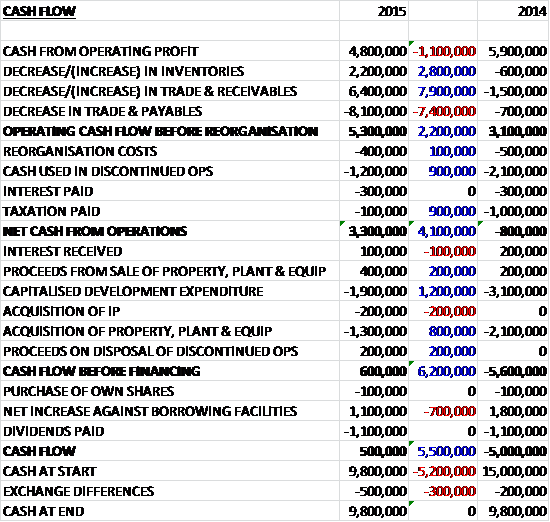
The group does have some susceptibility to interest rate changes and an increase of 1% in the LIBOR rate would result in an increase of $260K in annual interest rate expenses. At the end of last year the group entered into two long-term credit facilities; a $20M loan to finance field infrastructure development and a $6M loan to pay off an old loan. At the year-end, the full amount was drawn down on the two facilities. During the year the group closed a private placing issuing 15.4M new shares for a cash consideration of $7.6M.

Total net proved reserves as of the end of the year are estimated at 12.7mboe and the 2P net reserve estimate is 19.1mboe compared to 11.36mboe and 15.91mboe respectively last year. This increase is the result of the Mnazi Bay partners entering into a gas sales agreement with TPDC and commencing sales through the new pipeline.

Within the year, the group has commitments of $6.3M relating to payables, $7.3M in borrowings to pay back (with repayments starting in Q2 2016) and $1.5M of other liabilities. There are currently $3.3M in receivables that are due within the year and no headroom on either of the two loan facilities as they are both fully drawn down. Given the above and the fact there is only $2.7M of cash left, the group are perilously close to needing more funding. The continued payment by TPDC is imperative going forward but the board feel this is sufficient to meet the company’s current and ongoing obligations.

Demand for Mnazi Bay gas is expected to be in the range of 70 to 80MMScf per day for the balance of 2016. Starting at some point during the second half of 2017 additional power plants are planned to become operational thereby increase demand for natural gas. The existing five wells within the concession are performing as well as expected and combined will be able to meet the gas demand until a step up in demand materialises. As such, there is no exploration or development drilling planned for 2016 and giving consideration to the actual well performance during 2016 and a more definitive timetable for additional gas demand, the company expects to establish and active drilling programme in 2017.

Management is engaged in ongoing discussions with the Mozambique government to agree various issues relating to the proposed appraisal of the Tembo-1 gas discovery. Agreement in the issues is expected to be reached in the coming months and involve minimal capital commitments for the remainder of 2016.

Not including the deferred tax asset acknowledgement, the group did not make a profit this year so we can’t really value it on a PE basis. The group is expected to make a profit next year, however, and they are trading on a forward consensus PE of 6.4.

Overall then, this has been a year of change for the group. They are still heavily loss making if we discount the deferred tax asset recognition but the underlying operating loss is improving. The increase in net assets is due to the deferred tax assets which should mean the group don’t have to pay tax for quite some time. The operating cash outflow is improving but the group is still heavily burning cash. Of course the big news during the year was the commencement of gas delivery to the newly constructed pipeline, which after a short delay has been relatively trouble-free with 46MMScf per day being supplied in Q4 which could well increase towards about 80MMScf per day by the end of 2016.

In Mozambique, the partners in the concession seem to have deserted it so it is quite surprising to see the group holding on to their share with the only other partner left being the national oil company. I think perhaps, given the limited need for capex here over the next year they probably want to keep a foothold in the country.

The big issue that continues to hang over the group is the terrible payment record of the various government bodies in Tanzania. The large receivable from TPDC seems little closer to being paid off and it is imperative that they continue paying for the gas being supplied to the pipeline which seems a real risk to me. Also, the money owed by the government itself is no closer to being paid, indeed they seem to be finding lots of tax that the group hasn’t paid so they seem to be paying the government rather than the other way round! Finally, the state owned energy company has stopped paying for gas being supplied to the small local power plant so when that will be received is anyone’s guess. Reading between the lines, operating in Tanzania seems like a nightmare.

This is all very relevant as the company only have cash of $2.7M left and there is no headroom in their borrowing arrangements. Indeed they are obliged to start paying the loans back this year. This all looks very precarious to me and despite there apparently being a forward PE of 6.4 on offer here, the risks seem too high in my view. I will keep the company on my watch list though.

Molins Share Blog – Final Results Year Ended 2015

Molins has now released its final results for the year ended 2015. As the group has restructured its divisions I think it would be useful to go over the divisional split. The packaging machinery division supplies automated product handling, cartoning and robotic end-of-line packing machinery and systems, and operates from three locations in Canada, the Netherlands and Singapore. In addition it provides technical consultancy and machinery to solve packaging and processing challenges from their base in Coventry.

The Instrumentation and Tobacco Machinery division comprises both the tobacco machinery activities and the quality control, testing and analytical instrumentation business, which has customers in both the tobacco and other consumer goods sectors. The instrumentation business is based in Milton Keynes with sales and service offices in China, India, Singapore and the US. It supplies and supports process and quality control instruments and within the tobacco industry it is the market leading supplier.

The division also designs, manufactures, markets and services machinery for the tobacco industry and provides aftermarket support to its customers globally. This part of the division is headquartered in Princes Risborough where the central engineering and logistics teams are located together with the main distribution centre for spare parts. There is a manufacturing facility based in Brazil which serves the South American markets and the main machining and assembly operation is in the Czech Republic.

MLINincome

Revenues were broadly flat when compared to 2014 as a £10.9M fall in instrumentation and tobacco revenue was offset by a £10.5M growth in packaging machinery revenue. Cost of sales increased, however, so the gross profit was £3.2M below that of last year. Distribution expenses fell by £1M and other admin expenses declined by £1.3M to give an operating profit £1.3M below that of 2014. The interest on the pension scheme was £500K up but tax fell by £300K to give a profit from continuing operations of £1.7M, a decline of £1.6M year on year. The loss from the discontinued operation meant that there was a £4.1M loss during the year, however, which was a £3.8M deterioration year on year.

MLINassets

When compared to the end point of last year, total assets declined by £6.8M driven by an £8.1M fall in receivables, a £3.4M decrease in inventories, a £3.3M fall in property, plant & equipment and a £2.2M decline in deferred tax assets, partially offset by a £10.6M pension asset relating to the UK scheme. Total liabilities also declined during the year as a £14M fall in the pension liability relating to the US scheme and a £9.7M decrease in payables was partially offset by a £4.3M growth in deferred tax liabilities and a £1.1M increase in loans and borrowings. The end result is a net tangible asset level of £21.7M, an increase of £11.5M year on year.

MLINcash

Before movements in working capital, cash profits declined by £1.1M to £4.8M. There was a modest cash inflow from working capital and after that, along with interest, tax payments that were some £900K lower, and £1.2M of cash used in the discontinued operations, the net cash from operations was £3.3M, a growth of £4.1M year on year. The group then spent £1.9M on development expenditure, £200K on the acquisition of IP and a net £900K on property, plant and equipment which left them with £600K of free cash. This did not cover the dividends, however, so they took out £1.1M of new borrowings to pay the dividends and leave a cash flow of £500K and a cash level of £9.8M at the year-end.

Overall the group’s results were in line with expectations. The performance of the packaging machinery division was strong but the challenges within the geopolitical environment and general market sector continued to impact the instrumentation and tobacco machinery division.
The underlying operating profit in the Packaging Machinery division was £3.9M, a growth of £2.1M year on year reflecting the impact of increased operational efficiencies and higher volumes.
These results benefited from the strategy of focusing on a more standardised range of products for the target sectors of nutrition, beverages, pharmaceuticals and healthcare. The international sales and service structures that have been established over the past three years have apparently helped the division to meet the needs of both multinational and regional customers in most parts of the world. They group are continuing to focus on developing their activity in Asia where customers are increasingly using mechanical packaging in order to reduce cost and improved quality.

While sales in the second half showed a significant uplift on the same period of last year, there was a distinct softening in market conditions across all regions in the period with customers taking longer to finalise purchasing decisions. As they entered 2016, this trend continued and the division started the new financial year with a lower order book than last year’s strong position. While they are now more cautious about the trading backdrop, there are a significant number of prospective projects being discussed.

The underlying operating profit in the Instrumentation and Tobacco Machinery division was just £100K, a decline of £3.5M when compared to last year which reflected lower sales across both parts of the division. Within the tobacco machinery business, the contraction in demand experienced in 2014 did not reverse and order prospects remained limited and very competitive, resulting in a reduced overall order intake. They did secure a number of projects with customers in South East Asia, North Africa and North America, however, while continuing to focus on meeting the very specific product and service needs of their customers.

Within the instrumentation business, the reduction in demand from the tobacco industry only started to be felt in Q1 2015. This reduction drove further competitive pricing pressures, which were also exacerbated by the relative strength of sterling against the euro. The order intake in the last part of the year was stronger, however, and the business has entered 2016 with a larger order book that at this point last year. The group have taken further steps to remove cost from the division and reduced headcount in the tobacco machinery business by 20% including the closure of the sales office in Russia. They have also consolidated certain activities in Richmond, USA into the UK operation during the year and will complete a relocation of their operation in Brazil to a smaller and more cost effective site in Curitiba in H1 2016.

In the tobacco machinery business the recent intensive period of investment is drawing to a close with the successful completion of the field trial of the new Alto cigarette making machine in the first half of the year and a product launch for the new Optima cigarette packing machine at the industry show held in London in November. The group are currently focused on expanding their product range in non-tobacco markets, and in the year they purchased the IP for non-invasive thermometry measuring equipment which is mainly aimed at the nutrition sector and they are in the process of bringing it to market.

In May the group sold Arista Labs for £300K which was counted as a discontinued operation during the year. The loss of £5.8M relates to a £900K loss from trading activities, a £3.5M loss on disposal of net assets and a £1.3M impairment of goodwill along with a net £100K cost incurred on disposal.

The group’s pension schemes are worthy of mention. The IAS valuation of the UK scheme resulted in a net surplus at the end of the year of £10.6M with the valuation of the assets at £346.9M and the valuation of the liabilities at £336.3M. The accounting variations of the US pension scheme showed an aggregated net deficit of £6.6M with total assets of £14.9M. The main causes of the improvement in the valuation of the liabilities in the UK scheme were the increase in the discount rate, reflecting higher interest rates at the year-end and a gain arising from a change to the demographic assumptions.

The last completed scheme specific funding valuation of the group’s UK defined benefit scheme that was carried out in June 2012, showed a funding level of 86% of liabilities which represented a deficit of £53M. The company has agreed a deficit recovery plant which commits them to paying £1.7M per annum into the scheme and the payments increase by 2.1% per annum. The deficit recovery plant will be formally reassessed following the completion of the scheme funding valuation which is currently being carried out.

The company is also responsible for paying a statutory levy to the pension protection fund. The quantum of this levy is dependent on a number of factors, including a specific method of calculating a pension deficit for this purpose and a credit assessment of the company. The levy that will be paid in 2016 is largely linked to the group’s financial information reported in 2014 and it is expected that this will result in a payment considerably in excess of the 2015 levy but no actual estimates are given which is a pain.

The board is mindful of the challenges being faced in 2016 which they expect to include a significant rise in the statutory levy payable to the pension protection fund. There is currently little sign of an immediate recovery in the tobacco sector, although the order book at the beginning of the year for instrumentation was strong. The packaging machinery division has made encouraging progress but it entered 2016 with a lower order book and the board are now more cautious about trading conditions, although there are a significant number of prospective projects under discussion.

At the year-end, the group had a net debt position of £3.2M compared to £2.1M at the end of last year. At the current share price, the shares a trading on a PE ration of 7.7 for continuing operations which reduces to 6.5 on next year’s consensus forecast. After the final dividend was reduced, the shares are now yielding 6% which reduced to 4.1% on next year’s forecast.

Overall then this has been another difficult year for the group. Profits declined but net assets improved due to movements in the pension scheme values. Although operating cash flows improved, this was due to more favourable working capital movements and cash profits fell.
There was some free cash generated but this did not cover the dividends. The packaging machinery division performed well, aided by the group selling more standardised products but the outlook looks less certain. Conversely the Tobacco and Instrumentation division performed poorly and while the tobacco industry still looks difficult, the instrumentation division seems to be picking up in 2016.

The pension scheme is still a cause for concern. Although the group is now showing a surplus on its balance sheet, they are still paying out £1.7M a year to fund it which is a material amount for a company of this size. The valuation of the scheme is currently ongoing so it will be important to see the results of that and what kind of deficit reduction payments are required going forward but I would have thought the swing to assets on the balance sheet is a good sign. Of concern though is the fact that the levy to the pension protection found is going to be much higher in 2016. Sadly no ballpark figures are given but the board are cutting the dividend to conserve cash so this is likely to be material.

Going forward, there are no signs of recovery in the tobacco sector and while the instrumentation outlook is looking healthier, the packaging machinery division is entering 2016 with a lower order book. With a forward PE ratio of 6.5 and yield of 4.1% makes the shares look rather cheap but given the softening in the packaging machinery market and the uncertainties surrounding the pension protection levy, I have sold my speculative purchase at a loss.

On the 22nd April the group released a trading update for Q1. Trading was at similar levels to the prior year and while the board continue to be cautious about market conditions, their expectations of group trading for the year as a whole remains unchanged, supported by the current level of order prospects.

On the 11th May the group announced the appointment of Tony Steels as CEO from June 6th with current CEO Dick Hunter stepping down after eight years in the role. In addition, they have announced the appointment of Andrew Kitchingman as a non-executive director. Tony joint the group from Cytec, part of Solvay SA, a chemicals and advanced materials company where he was global business director of the process materials division. Andrew worked in corporate finance with companies including KPMG, Brewin Dolphin and WH Ireland.