Finsbury Food Share Blog – Final Results Year Ended 2016

Finsbury Food has now released its final results for the year ended 2016.

fifincome

Revenues increased when compared to last year with a £57.2M growth in UK bakery revenue and a £6.3M increase in overseas revenue (a £12.8M increase in organic revenue in total). Cost of sales also increased to give a gross profit £23.7M above that of last year. Depreciation was up £1.7M, share option charges increased by £749K and R&D costs grew by £550K with other admin expenses increasing by £15.9M. We also see a £4.3M impairment of goodwill against a £3.2M acquisition expense last year which means the operating profit grew by £3.3M. Finance costs/expenses tended to be similar to last year but tax charges grew by £1.4M to give a profit for the year of £7.8M, an increase of £1.6M year on year.

fifassets

When compared to the end point of last year, total assets increased by £7.1M driven by a £3M growth in cash, a £2.6M increase in assets under construction, a £2.1M growth in trade receivables, a £1.8M increase in plant and equipment and a £1.3M growth in inventories, partially offset by a £2.5M decline in goodwill. Total liabilities also increased during the year due to a £2.6M growth in the pension liability, a £1.5M increase in borrowings, a £1.4M growth in deferred tax liabilities, a £1.3M increase in accruals and deferred income and a £1.2M growth in the current tax liability. The end result was a net tangible asset level of £24.1M, a growth of £1.5M year on year.

fifcash

Before movements in working capital, cash profits increased by £9.7M to £24.7M. There was a cash outflow from working capital along with a £257K growth in interest payments and a £439K increase in tax charges to give a net cash from operations of £20.3M, a growth of £5.1M year on year. The group spent £12.1M on capex to give a free cash flow of £8.1M. This was enough to cover the £2.8M spent on shares for the employee scheme and the £3.3M paid out in dividends and after a net £3.3M in new loans, the cash flow for the year was £3.1M and the cash level at the year-end was £3M.

The impact of the extra week this year is to increase pre-tax profits by £358K but the organic growth of 5% was well spread, exceeding that of the market and initial expectations. The underlying profit in the UK bakery division was £15.9M, a growth of £5M year on year. Over 21% of the UK bakery sales are now into the faster growing out of home foodservice channel, compared to 0% two years ago. The underlying profit in the overseas segment was £1.5M, an increase of £357K when compared to last year as a result of improved distribution of licensed celebration cake and free from bakery ranges.

In the past year in the total UK ambient cake market, there has been a market value and unit sales fall of 0.4% and 1.5% respectively. Ambient cake is marginally outperforming ISB cake over this period and the group continue to perform well in their core markets of celebration cake, whole cake and cake bites.

Annual retail bread and morning good market sales are in decline, driven by the fall in sales of packaged sliced bread. Finsbury are a niche plyer in this market, instead they are focused on the growing sectors such as artisan bread, hot cross buns and rolls along with doughnuts, muffins and morning pastries. The foodservice bread and morning goods market continues to grow. Growth is coming from a number of categories, in particular added value burger buns such as brioche buns.

Successful licenses this year have included Minions, Star Wars and Batman which have been linked to big movie releases, and the more evergreen licenses of Me to You, Peppa Pig and Paw Patrol.

The group made a record capex investment of £12M during the year which facilitated a new artisan bread bakery, increased hot cross bun capacity and further cake automation. The growth strategy going forward will continue to be delivered by a combination of organic growth and targeted acquisitions. In areas such as celebration cakes and organic bread as well as diversifying into new channels such as foodservice cake will deliver organic growth and further acquisitions will introduce new product, customer or channel diversification or accelerate market consolidation in the core product areas.

The group is upgrading its IT systems with the objective of having a common ERP across UK Bakery. The system is the latest version of the existing system within the Fletchers business acquired in 2014. Recognising the inherent risks to a systems upgrade, an appropriate corporate governance structure has been put in place but the fact that the new system is the latest version of the existing system in operation within Fletcher’s business is a significant risk reduction factor.

During the year an impairment of the goodwill arising from the acquisition of Anthony Alan Foods in 2007 was made. This reflects the challenging market and changing dynamics of the healthier grocery market. The related goodwill has been fully impaired.

During the year the group announced the addition of two non-executive directors, Marnie Millard and Zoe Morgan, along with the forthcoming retirements of Paul Monk and Edward Beale who have both been on the board for over fourteen years.

Along with other food businesses the group will face inflationary pressures through both commodities cost increases, further driven by currency weakness after the Brexit vote, and the national living wage. If maintained, the devaluation of Sterling will lead to a new era of cost inflation for many raw materials and the planned future national living wage increases will increase costs and put pressure on margins. The group are working hard to offset this cost inflation through enhanced efficiencies but inevitably these pressures are inflationary.

At the current share price the underlying PE ratio is 12.8 which falls to 12.2 on next year’s consensus forecast. At the end of the year the net debt stood at £19.7M compared to £21.2M at the end of last year. After a 12% increase in the total dividend, the shares are yielding 2.3% which increases to 2.4% on next year’s forecast.

Overall then this has been a good year for the group. Profits increased despite the goodwill impairment, net tangible assets grew and operating cash flow was up with a decent level of free cash being generated. Both the UK and overseas business are growing despite some market problems but there are some potential banana skins on the horizon. The new IT upgrade has the potential to cause some disruption; the decline in the value of sterling is increasing raw material costs and the new living wage is increasing staff costs. Nonetheless, with a forward PE of 12.2 and yield of 2.4% this looks fairly priced in and these shares are probably priced about right – I continue to hold.

On the 28th September, deputy Chairman Paul Monk sold 146,000 shares at a value of £181K. After this sale he now holds 145,547 shares in the company.

On the 23rd November the group released a trading update covering the first four months of the year. Following the strong growth in recent years, trading so far this year has been flat and in line with expectations. Total group revenues were £101.5M during the period with the UK bakery division declining by 4% and the 50%-owned European business showing a 36.5% growth.

Input costs have increased substantially following sterling’s weakness but the group has been able to respond to these challenges by modifying promotional activity whilst also reviewing potential opportunities for reformulation changes to minimise the costs and maintain the affordability of their products.

This doesn’t sound all that positive to me and with the potential headwind of the living wage too, I am tempted to get out of this share.

On the 19th January the group released an update covering H1. Since the last update, trading has continued to be solid throughout the Christmas period and performance is in line with management expectations. Total group revenues were £156.6M during the half, delivering a flat year on year performance. The UK bakery division declined by 2.9% against a backdrop of UK food retail market deflation whilst the overseas division grew by 31.7%.

The group continues to benefit from strong cashflow and invested £5M in capital projects in the first half to build on its product innovation and continue to improve efficiency and productivity throughout the group. The board has identified continued investment as an aid to address the current challenges of sterling induced commodity inflation and planned national living wage increases. The scale of the current cost inflation is such that despite internal initiatives, further cost recovery will be required and will become inflationary in the second half of the year.

Overall, the decline in the UK is a concern, and this, combined with increased costs mean that I don’t think the time is right to invest here.

Ricardo Share Blog – Final Results Year Ended 2016

Ricardo has now released its final results for the year ended 2016.

rcdoincome

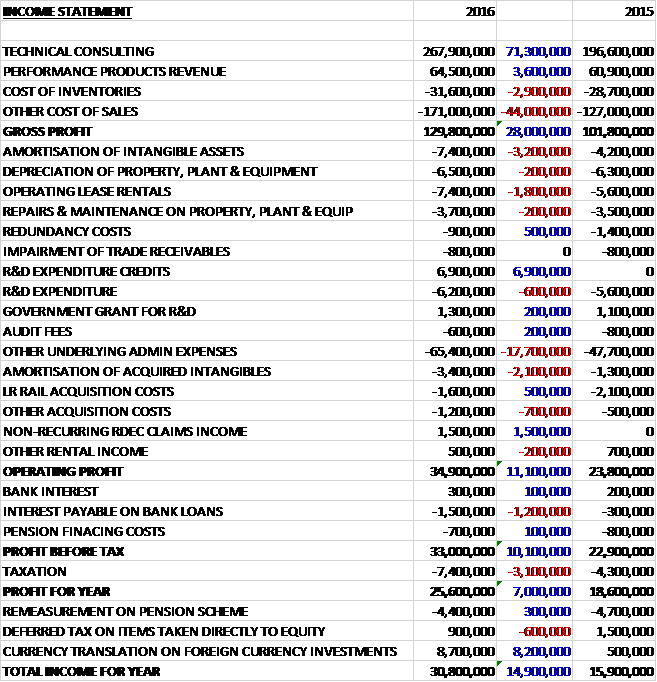
Revenues increased when compared to last year with a £71.3M growth in technical consulting and a £3.6M increase in performance products, mainly attributable to acquisitions with organic revenue up 7%. Cost of sales also grew which gave a gross profit £28M above that of last year. Amortisation increased by £3.2M, operating lease rentals were up £1.8M and other underlying admin expenses increased by £17.7M but there was a £6.9M R&D expenditure credit. The amortisation of acquired intangibles was up £2.1M but there was a £1.5M in non-recurring RDEC claims income to give an operating profit £11.1M higher. Interest cost increased by £1.2M and tax charges grew by £3.1M, partially relating to the new R&D tax rules, which meant that the profit for the year came in at £25.6M, a growth of £7M year on year.

rcdoassets

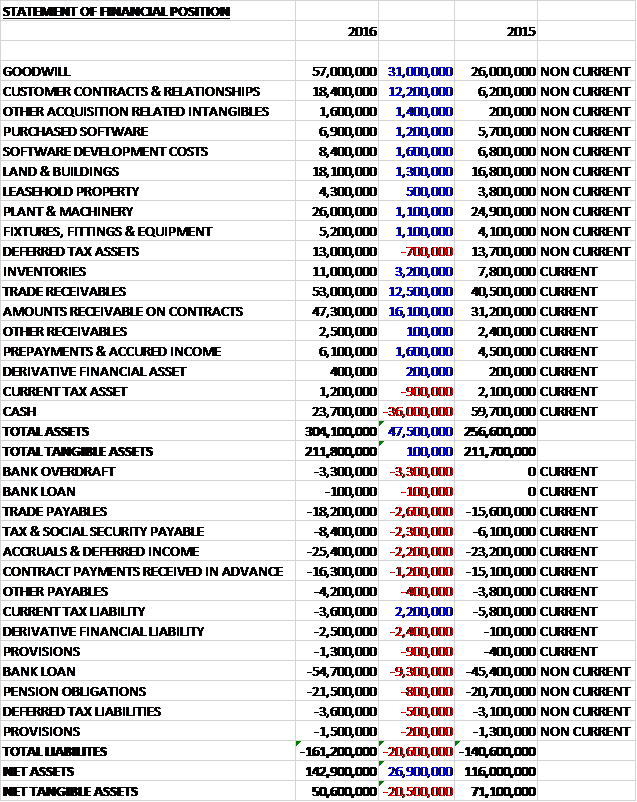
When compared to the end point of last year, total assets increased by £47.5M to £304.1M driven by a £31M growth in goodwill, a £16.1M increase in amounts receivable on contracts, a £12.5M growth in trade receivables, a £12.2M increase in customer contracts & relationships and a £3.2M growth in inventories, partially offset by a £36M reduction in cash. Total liabilities also increased during the year due to a £9.3M increase in bank loans and a £3.3M growth in bank overdrafts along with some smaller increases. The end result is a net tangible asset level of £50.6M, a decline of £20.5M year on year.

rcdocash

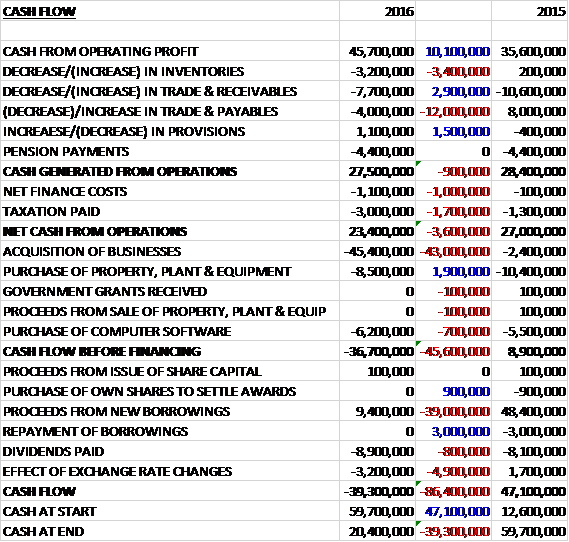
Before movements in working capital, cash profits increased by £10.1M to £45.7M. There was a cash outflow from working capital and this was larger than last year so after finance costs grew by £1M and tax was up £1.7M, the net cash from operations came in at £23.4M, a decline of £3.6M year on year. This covered the £8.5M of fixed asset purchases and £6.2M in computer software but not the £45.4M spent on acquisitions so there was a cash outflow of £36.7M before financing. The group took out £9.4M of new borrowings which covered the £8.9M paid out in dividends so the cash outflow for the year was £39.3M to give a cash level of £20.4M at the year-end.

The operating profit in the technical consulting division was £28.1M, a growth of £9.3M year on year, of which £3.9M was attributable to Lloyd’s Register Rail and £600K to Cascade. The European Technical Consulting division was a key driver of growth, with profits growing significantly as a result of an internal reorganisation undertaken in the prior year to improve co-ordination and delivery to clients, as well as to achieve cost efficiencies. The division secured a range of large, multi-year programmes in the automotive, commercial vehicles and energy sectors with a particular increase in vehicle electrification activities in many regions. Activity levels have been high across all engineering disciplines with increasing demand for powertrain application, calibration, electrical and electronics skills.

The rail business has performed well with a number of successful joint bids with the core business. They have established a new brand and have seen a positive reaction to the new products and services they can offer. In July, following the award of UKAS accreditation, they established Ricardo Certification, a business that will independently manage and deliver the assurance and accreditation services to the Rail sector.

The performance of the US business has struggled in challenging market conditions with reduced levels of work in Detroit and Chicago, partially offset by increasing work in California. The business is increasingly focused on achieving growth in the commercial vehicles sector, especially around platooning technologies and the growth of autonomous vehicle and connected car technologies in both the traditional automotive and new entrant landscape. Ricardo Defence Systems was established in the previous year to enable the group to deliver classified projects for the US Defence Administration, and this business has won a number of new contracts, primarily in the land defence business.

China remains a key market and the group have secured a number of large, locally won contracts, some of which are being locally delivered through the Shanghai and Beijing based technical centres. These contracts have included a mixture of hybrid vehicle, engine, transmission and rail activities. In the motorcycle business the business has been on the delivery of existing large, multi-year powertrain and vehicle programmes and the global roll-out of an expanded product and services offering to existing and new clients. As a result they have secured a number of contracts with new clients in the UK, US and Asia. They are also developing their urban mobility product offering.

The energy and environment consulting business has performed well, reducing its reliance on the UK public sector where ongoing cuts continue to be experienced. In Asia the business continues to grow its activities, establishing a greater geographical footprint through the acquisition of the rail business in China. The strategic consulting activities continue to make progress.

The operating profit in the Performance Products division was £7.3M, a decline of £400K when compared to last year due to lower one-off software license sales and an expected reduced level of shipments of high performance and monorail transmissions this year, partially offset by increased volumes in respect of the new engine supply contract for McLaren. The order intake in the year stood at £103M compared to £43M as they secured a high profile multi-year transmission supply contract.

The expansion of the engine build facility is now complete. This gives a doubling of capacity and the capability to deal with increased engine variants. Production of engines for the McLAren 650S, 675LT and the P1 supercar continues in line with expectations, and full production of engines for the 570S has been added. The group remains a key supplier to the motorsport sector, having started deliveries for BMW and Multimac GT3 programmes and for the Hyundai R5 Rally programme. They continue to manufacture for Formula 1, and supply products such as the transmissions for the Japanese Super Formula 14, Indy Lights and the Renault World Series. Production also continues for the Porsche Cup and Bugatti transmissions in line with long term supply agreements. As part of a teaming agreement with a defence Tier 1 business, the group has developed and provided retrofit kits for the Cougar family of vehicles for the UK MOD.

The year ended with another record closing order book of £231M compared to £140M last year, with £66M of that in respect of the two acquired businesses. On a like for like basis, the closing order book has increased by 18%.

On the 1st July 2015 the group completed the acquisition of Lloyd’s Register Rail, a rail consultancy and assurance business. They provide services ranging from rolling stock design, signalling and train control, intelligent rail systems, operational efficiency improvements, training and independent assurance services. The acquisition cost £46.3M in cash and generated goodwill of £24.2M. Since the date of acquisition, the business has contributed £3.9M in underlying operating profit.

In August the group acquired Cascade Consulting for a total cash consideration of £3.2M which included goodwill of £2.5M. The business is an environmental consultancy business specialising in the UK water sector which provides additional capability and reach in water resource management, ecosystem services and environmental impact assessment. Since acquisition it has contributed £600K to the underlying operating profit of the group.

After the year-end the group acquired Motorcycle Engineering Italia for an initial cash consideration of £2.1M. The business was formed from the operating assets and employees of Exnovo, a vehicle design house. The acquisition generate goodwill of £2.1M.

The average value of Sterling was 1.9% higher against the Euro, 5.9% lower against the US dollar and 1.5% lower against the Chinese Renminbi during the year but significant exposures are hedged through forex contracts. The movement in forex rates and the impact on performance was more significant as a result of the Brexit vote but these movements have only impacted upon the final week of the year.

The new R&D Expenditure Credit (RDEC) became mandatory from April and the group adopted RDEC from July 2015. Under the new regime, the current year R&D credit is no longer a tax incentive that benefits the corporation tax line in the income statement but is instead treated as grant income to offset R&D expenditure within operating profit, increasing pre-tax profit, the associated tax charge and the effective rate of tax. In addition, applications have been revised during the current year in respect of 2014 and 2015 which were open under the new RDEC regime, generating £1.5M of non0recurring income.

Going forward, market conditions remain positive. The group has European operations which will continue to support the EU’s R&D programmes and deliver to their European clients close to their operations, as before. They enter the new financial year with a record order book and a good pipeline of opportunities across all sectors. Taking this together with the long term assembly contracts, the board continue to have confidence in the further development of the group.

At the current share price the shares trade on a PE ratio of 20.5 which increases to 26 on next year’s consensus forecast which looks very expensive. After a 9% increase in the full year dividend, the shares are yielding 1.9% which falls to 1.6% on next year’s forecast. The group has a net debt position of £34.4M as of the year end compared to a net cash position of £14.3M at the end of last year.

Overall then this has been a fairly good year for the group. Profits have increased, both organically and through the contribution from acquisitions and whilst the operating cash flow declined, this was due to working capital movements with cash profits growing. The net tangible asset level did take a battering, however. The technical consulting business is growing well with the European division being the driver due to cost controls and some decent new projects driven by the drive for vehicle electrification. The US division fared less well, however, due to a tough market.

The performance products business saw profits decline due to lower software sales and a reduction in high performance and monorail transmissions. There was a large order intake, however, and the business for McLaren seems to be ramping up. The forward PE of 26 and yield of 1.6% seems to have baked this good news in, however, so I am just holding for now (although I am not sure how accurate these figures are given the ridiculous rules surrounding private investors and access to broker forecasts).

On the 7th October the group announced that MD Mark Barge sold 2,045 shares at a value of £20K. O the 10th October he sold another 1,153 shares at a value of £12K. He now owns just 911 shares in the company.

Swallowfield Share Blog – Final Results Year Ended 2016

Swallowfield has now released its final results for the year ended 2016.

swlincome

Revenues have increased when compared to last year as a £429K fall in ROW revenues was more than offset by a £1.6M growth in UK revenues and a £3.9M increase in EU revenues. Staff costs increased by £1.7M and R&D expenses were up £110K with other cost of sales increasing by £915K which gave a gross profit £2.2M above that of last year. Commercial and admin costs increased by £1.5M but there was a £645K one-off gain from the pension scheme closure which meant that operating profit grew by £1.4M. After finance costs declined somewhat and tax expenses grew by £205K the profit for the year came in at £2M, a growth of £1.3M year on year.

swlassets

When compared to the end point of last year, total assets increased by £8.4M to £38.6M driven by a £4M growth in trade receivables, a £2.6M increase in inventories, a £650K growth in cash and a £559K increase in prepayments and accrued income. Total liabilities also increased during the year with a £1.8M growth in accruals and deferred income; a £5.3M increase in trade payables and a £1.8M hike in pension obligations. The end result is a net tangible asset level of £11.6M, broadly flat year on year with a decline of just £99K.

swlcash

Before movements in working capital, cash profits increased by £683K to £2.8M. There was a fairly neutral movement in working capital, compared to a slightly positive cash movement last year but after tax payments fell by £70K, the net cash from operations came in at £2.5M, a growth of £190K year on year. The group spent £1.2M on capex to give a free cash flow £1.4M before £726K was paid back on loans to give a cash flow of £650K and a cash level of £798K at the year-end.

The core contract manufacturing business delivered strong growth in both sales and margin and the group delivered a number of new product launches for some of their global brand owner customers which brought strong sales growth and enhanced their reputation.

The group’s drive and build categories posted sales growth of 17% and 9% respectively and margin growth was ahead of sales growth in both cases. They have reduced their proportion of sales in service categories from 10% to 2% and virtually all new business is now in product categories where they feel they have a strong competitive position with reasonable margins and higher customer loyalty. The next phase of the product category focus will concentrate on investing to further extend their leadership positions across the drive and build categories by strengthening their capabilities in terms of product formulation technology, packaging formats and production cost efficiency.

During the period they introduced a number of new products across a range of key customers and secured agreements for future supply of several haircare products to major premium brand owners which will continue to positively impact business performance in 2017. They have also seen growth in volumes of the plastic aerosol foaming shower gel which was introduced last year.

The group have delivered their first orders under a partnership arrangement entered into with a leading US aerosol manufacturer. This arrangement enables the production of group formulations in the US adapted to US regulatory requirements in a cost effective way to allow European customers to launch their products into North America. The group receives a commission and satisfies an increasingly common customer need.

Within their own brands, the group integrated the Real Shaving Company brand and executed the launches of Bagsy and MR into Debenhams and Boots respectively. Each of these brands are continuing to build their contribution to sales and margin. A new aerosol product was added to the Real Shaving range and launched in October 2015 in the UK and Canada in spring 2016. The group have also secured listings of a range of gift and travel packs with a major high street health and beauty retailer.

Bagsy was rolled out in October 2015 to 38 Debenhams stores on full display units. Sales have been building steadily and they have executed a number of in-store promotions. Further distribution extensions are being worked on, both in the UK and internationally and they have entered into an exclusive agreement with fashion designer Savannah Miller. They will be co-developing a number of new products to be launched in October under the Savannah Miller for Bagsy name and she is now promoting the Bagsy brand on QVC.

MR was launched into 350 Boots stores in October last year and sales have been building steadily. The value brand, Tru, continues to generate sales in existing outlets and the group is seeking to extend its retail distribution further at the same time as exploring other product categories.

There have been a number of projects to increase labour efficiency, line speeds and automation across the manufacturing sites which has contributed to the increased margin seen. The group have also installed a new compressor and boiler system at their Wellington site which has helped reduce energy consumption by 8%.
It is worth noting that the group is still rather susceptible to a small number of large clients with one accounting for 19% and another for 18% of revenues.

During the year the group closed the defined benefit pension scheme to future accrual. After finalising the valuation they entered in to a formal consultation with the members and after this was concluded, they recognised a credit of £870K relating to a curtailment gain which represents a reduction in liabilities on closure to future accrual. One-off costs of £220K were incurred during this process. At the reporting date, the yields on bonds of all types were lower than they were last year and coupled with the volatile market conditions impacting asset valuations, this translated into an increase in the pension deficit in the year.

After the year-end the group acquired Brand Architekts which the broad will prove transformational for their own brand business. The acquisition was financed, in part, through raising £8.6M in a placing with institutional shareholders. The business owns and manages a portfolio of mid-premium beauty and personal care brands. The majority of sales are through major UK high street retailers, many of which are already existing customers. Further sales are made through export, notably in North America, Australia, Scandinavia and Turkey.

Key brands include Dirty Works, Kind Natured, Argan, Happy Naturals, Dr Salts and Senspa and they currently outsource their production to suppliers in the UK and China. Last year, the business generated a pre-tax profit of £2M.

The success in winning a number of new contracts to support product launches in the core contract manufacturing business over the past year and a half provides the group with a strong pipeline as they move into the new financial year, particularly in H1. The integration of Brand Architekts is progressing well and trading across the business is in line with board expectations.

At the current share price the shares are trading on a hefty PE ratio of 19.7 but this is expected to reduce to 11.2 on next year’s consensus forecast. At the year-end, the group has a net debt position of £4.3M compared to £5.4M at the end of last year. After a 55% increase in the dividend the shares are trading on a yield of 1.3% which grows to 2.2% on next year’s forecast.

Overall then this has been a good year for the group. Profits are up, operating cash flow increased and there was a decent amount of free cash generated. Net assets did decline modestly, however, which can be attributed to an increase in the pension deficit. Both manufactured and own brands seem to be growing and there are a lot of initiatives in order to grow in the future. The forward PE of 11.2 seems decent value and the yield of 2.2% is not too bad either, although a high level of growth has been pencilled in. Overall I am relatively happy to hold here.

On the 10th November the group released a statement covering the first four months of the year where they stated trading was in line with expectations. In the manufacturing business, the delivery of significant new product launches for major brand owners will contribute strongly to their performance, particularly in the first half of the year. Further contract wins have been achieved, both with UK and European customers, which will start to contribute from the begging of the next year.

In the branded business, volumes of the Christmas gifting ranges are ahead of previous years and the board expect these to make a strong contribution in the first half. The board anticipate that profitability in the first half of the year will see a small benefit from the recent weakness of Sterling. Long-term they aim to self-hedge by aligning sales and purchases in the same currencies. While they remain conscious of the continuing macro uncertainty both in the UK and internationally, they expect to maintain their positive momentum and are confident of prospects for the year.

This all seems pretty decent, I continue to hold

Air Partner Share Blog – Interim Results Year Ending 2017

Air Partner has now released its interim results for the year ending 2017.

airincome

Revenues were broadly flat when compared to the first half of last year but cost of sales declined by £4M which gave a gross profit nearly £4.1M above that of last time. Underlying admin costs increased by £3.3M but an increase in restructuring costs and the amortisation of acquired intangibles was mostly offset by a decline in acquisition costs so the operating profit was £770K up. Finance costs increased by £41K and tax charges grew by £269K so the profit for the period came in at £1.9M, a growth of £465K year on year.

airassets

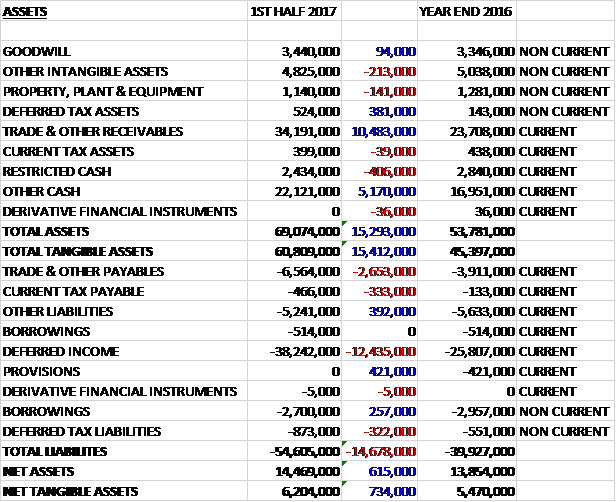
When compared to the end point of last year, total assets increased by £15.3M to £69.1M, driven by a £10.5M growth in receivables and a £5.2M increase in non-restricted cash, partially offset by a £406K decline in restricted cash. Total liabilities also increased during the period due to a £12.4M growth in deferred income and a £2.7M increase in payables. The end result is a net tangible asset level of £6.2M, a growth of £734K over the past six months.

aircash

Before movements in working capital, cash profits declined by £640K to £1.9M. There was a cash inflow from working capital compared to an outflow last year with the increase in receivables reducing considerably. After tax payments increased by £118K and interest was up £41K, the net cash from operations came in at £5.1M, an improvement of £6.3M year on year. The group only spent £22k on capex which left them with free cash of £5.1M, easily enough to cover the £1.7M paid out in dividends and a £257K loan repayment so the cash flow for the period was £3.1M and the cash level at the period-end was £24.6M.

The profit in the Commercial Jet Broking business was £1.9M, a growth of £271K year on year with the increase driven by strong trading in the UK and Europe, albeit with some continuing challenges in the US. Within the UK Commercial Jet team, they increased their focus on developing a clearer sales strategy, invested in key talent, particularly in the sports sector, and focused on improving the service levels they provide to their customer base. Success stories for the UK include a strong contribution from the sports sector, with flights conducted for a number of Premier League football teams, continued success from their oil and gas clients, along with continued government work.

In Europe, growth has been driven through an increase in their tour operations programme, the sports sector, with flights for Euro 2016, football clubs and major cycling events; and continued successes in the automotive industry. Although H1 performance in the US was below board expectations, prospects for H2 look promising as a result of government and election related contracts.

Cabot Aviation has had an encouraging start to the year, primarily through the successful remarketing of two Kenya Airways B777-2000ERs to Omni International. They continue to hold the mandate to remarket a further two B777-200Ers and two 737-700s on behalf of Kenya Airways together with a B787 for a cruise operator and two B747-400s for China Airlines.

The profit in the Private Jet Broking business was £1.5M, an increase of £525K when compared to the first half of last year, largely driven by a very strong performance in the UK, a solid performance in Europe, with the US showing signs of improvement after a disappointing performance last year. JetCard cash deposits stood at £16.1M at the period-end, an increase of £2.5M and the number of JetCards increased by 9 to 218 with utilisation increasing by 25% in the period.

The profit in the Freight Broking business was £306K, a decline of £88K when compared to the first half of 2016 as a strong performance in automotive in Europe was not enough to compensate for the lack of any government aid agency work during the period.

The Baines Simmons business provided a maiden profit of £1K during the period after it was acquired in August 2015. There have been a number of contract wins during the period, including the renewal of the Isle of Man aircraft registry for a further ten years and the provision of in-house training at BAE Systems, focusing on the Typhoon aircraft.

Richard Jackson joined the board in September having spent eleven years at the Civil Aviation Authority as group director of consumer protection. Amanda Wills was appointed to the board in April, she is a former CEO of Virgin Holidays. Shaun Smith, group finance director of Norcros also joined the board in May.

Given the strong first half performance and current trading the board remains confident that its expectations for the remainder of the financial year will be achieved. So far the group has not noted any adverse impact on trade as a result of the Brexit vote but JetCard and Cabot Aviation revenues within the UK are denominated primarily in Euros and US dollars respectively, which provides an upside as a result of the weakening of Sterling. Where possible, however, the group uses natural hedging to minimise its forex exposure.

At the current share price the shares are trading on a PE ratio of 21.1 which reduces to 10.3 on the full year consensus forecast. After a 10% increase in the interim dividend, the shares are yielding 5.2% which is expected to remain the same for the full year. At the period-end, excluding the jetcard cash, the net cash position was £5.2M compared to £1.4M at the same point of last year.

On the 13th December the group announced the acquisition of Clockwork Research, a fatigue risk management consultancy. The acquisition is being funded from existing cash resources and is expected to be earnings enhancing in the first year of ownership (last year the business made revenues of £700K). The business delivers fatigue risk management solutions for clients across various sectors of the aviation industry, including commercial air transport, business jets, cargo operations, air medical and search and rescue services as well as regulation authorities. In addition to projects in the aviation sector, over the last eleven years it has expanded activities into other safety-critical operating environments such as oil and gas and mining.

There is no mention of how much the consideration is but this seems like a small acquisition.

On the 2nd February the group released a trading update for the year as a whole. Trading in the second half of the year remained in line with expectations and the integration of Clockwork Research is progressing well. It was also announced that Chairman Richard Everitt is standing down at the AGM having been at the group for seventeen years – he has been appointed as Chairman of the Dover Harbour Board last year.

Not too much to go on here but it all looks fine.

On the 28th June the group announced that trading in the new financial year had started in line with their expectations and they remain optimistic for the rest of the year. It was also announced that Richard Everitt was standing down as Chairman to be replaced by current senior independent director Peter Saunders.

On the 25th July the group announced that the remarketing division had been appointed by Saudi Arabian airlines as its exclusive remarketing agent in respect of 15 Boeing 777-200ER aircraft.

On the 25th August the group released a trading update covering the first half of the year. They have made a strong start to the year with underlying pre-tax profit at least £4M compared to £3M in the first half of 2016. They also retain a strong net cash position. The broking division has performed well across all product lines while the consulting and training division is delivering solid results with an encouraging pipeline of opportunities to be secured in H2. Overall the board remains comfortable with their expectations for the full year.

Somero Share Blog – Interim Results Year Ending 2016

Somero has now released its interim results for the year ending 2016.

somincome

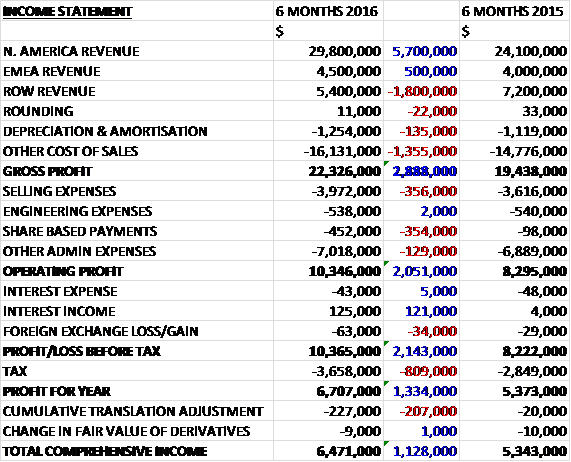
Revenues increased when compared to the first half of last year as a $1.8M decline in ROW revenue was more than offset by a $5.7M growth in North American revenue and a $500K increase in EMEA revenue. Depreciation and amortisation increased by $135K and other cost of sales was up $1.4M to give a gross profit $2.9M above that of last time. Selling expenses grew by $356K mainly due to increased personnel and marketing costs, share based payments were up $354K and other admin expenses increased by $129K which meant that the operating profit increased by $2.1M. We then see a $121K increase in interest income but also an $809K increase in tax charges to give a profit for the period of $6.7M, a growth of $1.3M year on year.

somassets

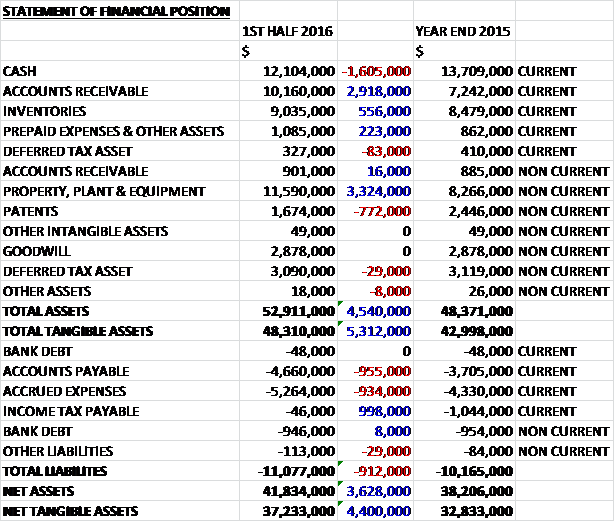
When compared to the end point of last year, total assets increased by $4.5M driven by a $3.3M growth in property, plant & equipment and a $2.9M increase in accounts receivable, partially offset by a $1.6M decline in cash. Total liabilities also increased during the period as a $998K decline in income tax payable was more than offset by a $955K growth in accounts payable and a $934K increase in accrued expenses. The end result was a net tangible asset level of $37.2M, a growth of $4.4M over the past six months.

somcash

Before movements in working capital, cash profits increased by $1.9M to $8.3M. There was a cash outflow from working capital with a particularly large increase in receivables related to a high volume of North American sales occurring in June, and along with a $2.6M growth in tax payments which included final payment of amounts due for last year as well as an increased level of estimated tax this year, this meant that the cash from operations came in at $5.8M, a decline of $1.6M year on year. The group spent $3.8M on capex, partly related to the global HQ construction project to give a free cash flow of $2M which did not quite cover the $2.8M spent on dividends to give a cash outflow of $1.4M for the period and a cash level of $12.1M at the period-end.

On a product basis, the strong performance was driven by robust demand for recently launched new products and growth in other revenues due to sales in parts and services and the STS-11m Spreader.

Performance in the North American market remained strong supported by a healthy non-residential construction environment. The 24% revenue growth was in part driven by demand for new products. Sales in Europe grew by 37%, continuing a solid recovery trend and market conditions in China improved in the period as sales grew by 15%, driven by the positive impact of the long-term financing programme for customers that required installation of their machine shut-off payment protection tool. Their experience with this programme has been positive to date and in the period about 35% of sales in the country were financed under the programme.

Sales in Australia increased by 38% while India, Scandinavia and Russia reported sales that were modestly ahead of last year, or flat. In Latin America, South East Asia, Korea and the Middle East, sales were below previous year levels but the board expects improvements over the rest of the year.

Large line sales decreased to $12.4M primarily as a result of a decrease in volume to 34 units. Mid line sales increased to $5.6M due to an increase in volume to 30 units and small line sales increased to $7.7M due to an increase in volume to 89 units. Remanufactured sales decreased to $2.9M despite unit volume remaining flat at 23 units due to a change in mix, and 3D profiler system sales increased to $3M due to an increase in units sold to 30.

In the second half the group will launch the S-158C, an entry level small line machine designed for the Chinese and Indian markets, primarily focused on the productivity improvement value proposition. This machine is designed to benefit contractors with smaller sized slab projects and targets customers who are not ready to move to a higher level small line or boom-out laser screed machine. The product will have a small footprint, be affordable, easy to use and expand the number of customers using the group’s branded equipment.

In April the group completed construction and officially opened the new global HQ and training facilities in Florida. The final project cost was $4.8M, of which $3.3M was included in the capex for this half. Due to increased demand for training and education on concrete floor wide-placement and finishing best practices, the group are accelerating plans to design and construct a training environment to be located at the Fort Myers facility. It is expected that this project will be completed in Q1 2017 at a total project cost of $700K.

Positive trading momentum in North America has continued into the second half of the year reflecting a healthy non-residential construction market in the US. The ongoing construction growth and project backlogs customers are experiencing point to continued solid performance in the market for the rest of the year. After significantly strong trading in June to finish H1, the solid activity levels have carried over to July and August as the board continue to see significant opportunities across their markets. The board expects another successful year of growth in line with current market expectations.

At the current share price the shares are trading on a PE ratio of 14.3 which falls to 12.5 on the full year consensus forecast. After a 32% increase in the interim dividend, the shares are yielding 2.8% which falls to 2.7% on the full year forecast which doesn’t sound right to me. At the period-end, there was a net cash position of $11.1M compared to $12.6M at the end of the prior year relating to increased capex mainly.

Overall then this has been another decent period for the group. Profit was up, net assets increased and although the operating cash flow reduced with not quite enough free cash to cover dividends, this was due to historical tax payments and cash profits grew year on year. This good performance was driven by strength in North America, Europe, China and Australia with the rest of the world a little more difficult.

The big capital expenditure on the HQ has now been completed and the group still has a strong net cash position. The dividend yield of 2.7% is decent enough in this climate and the forward PE of 12.5 doesn’t look too taxing. At some point the cyclical nature of this share will come into play but at the moment this is a strong hold for me.

On the 10th January the group released a trading update covering 2016. In the second half of the year they continued to deliver profitable growth and cash generation. Due to a strong finish to 2016 combined with continued margin improvement, the board expect to report revenue slightly ahead of current market expectations and to report EBITDA comfortably ahead for the full year. In addition, given the strong cash generation, they expect to report net cash that is significantly ahead of market expectations.

Demand in the second half of the year remained robust across their core product range with particularly strong interest in recently launched new products, the large line S-10A and small line S-940 laser screed machines. Also contributing significantly to growth during the period were sales of large line S-15 laser screed machines, STS-11M spreaders, 3D profiler systems and parts driven by the high usage of their installed base of equipment by customers.

Geographically, second half performance in the core markets was solid with Europe contributing significantly to growth, North America contributing satisfactorily to growth and trading in China remaining healthy. Trading in Latin America and the Middle East improved considerably in the second half with Australia also contributing solidly to growth. In South East Asia, India, Scandinavia, Korea and Russia, however, trading levels were in line or down on the period year.

The board is confident in their ability to deliver another year of profitable growth in 2017, based on healthy market conditions in their core markets and encouraging growth opportunities in their other territories. Their confidence is further supported by encouraging pro-growth corporate tax reform and fiscal policy proposals in the US. They have also approved an increase to the dividend payout ratio from 30% to 40% of adjusted net income.

In addition, the strong cash generation of the business has built up cash reserves in excess of the targeted net cash level of $10M. They plan to review their cash position alongside cash requirements for current business needs and future investment during the first half of 2017. They will then assess the level of excess cash that may be subject to distribution back to shareholders through a special dividend later in 2017.

What a fantastic update! I remain a strong holder here and may even look to pick up more.

32Red Share Blog – Interim Results Year Ending 2016

32 Red has now released its interim results for the year ending 2016.

ttrincome

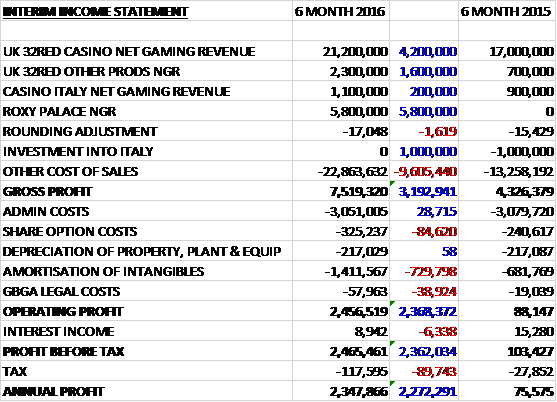
Revenue increased when compared to the first half of last year with a £5.8M maiden contribution from Roxy Palace, a £4.2M growth in casino product NGR and a £1.6M increase in other product NGR. Cost of sales increased by £9.6M which meant that the gross profit was up £3.2M. Admin costs were broadly flat but share option costs increased by £85K and amortisation was up £730K which meant that the operating profit grew by £2.4M. After interest saw a modest increase and tax charges increased by £90K, the profit for the period came in at £2.3M, a growth of £2.3M year on year.

ttrassets

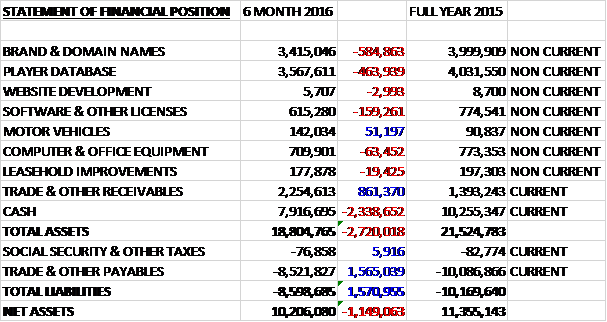
When compared to the end point of last year, total assets declined by £2.7M to £18.8M driven by a £2.3M fall in cash, a £585K decline in brand and domain names and a £464K decrease in the value of the player database. Total liabilities also declined due to a £1.6M fall in payables but this was not enough to prevent a £1.1M decline in net assets to £10.2M.

ttrcash

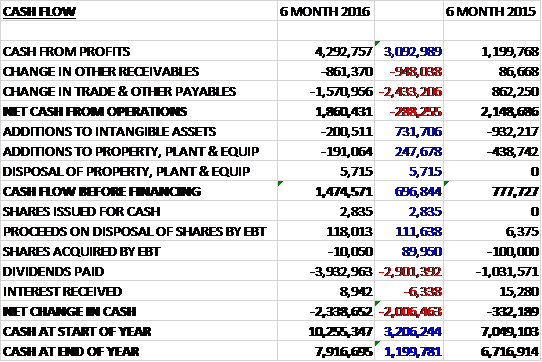
Before movements in working capital, cash profits increased by £3.1M to £4.3M. There was a working capital outflow with a reduction in payables and a growth in receivables so that the net cash from operations came in at £1.9M, a decline of £288K year on year. The group then spent £201K on intangible assets and £191K on property, plant and equipment to give a free cash flow of £1.5M. This did not cover the £3.9M paid out in dividends, however, so there was a cash outflow of £2.3M in the period and a cash level of £7.9M at the period-end.

The 32Red Casino brand continues to achieve strong growth (24%) in direct response to accelerated, returns-driven marketing investment. The launch of a new responsive website in April has also improved retention levels and new player conversion rates. Mobile remained the fastest growing platform, growing by 45%. The Roxy Palace brand will benefit from the roll out of the new website in the second half of the year, before marketing investment is increased to expand this brand.

The growth in revenues from other products is a direct result of increased trade in the sports betting product. In May, the group renewed its commercial arrangement with Kambi sports Solutions, allowing further funds to be allocated to marketing of the sports betting product. Sport betting, whilst still a small part of the overall group, continues to offer a strategic opportunity for the group in terms of customer acquisition, cross-selling and retention, and they will continue to exploit opportunities to leverage the brand in this area.

In August the group aired its first TV advert promoting the sports book and they have signed a twelve month deal to advertise around live sport on Sky, including a number of half time adverts in live Premier League matches. In May they announced a three year agreement to sponsor Leeds United which complements the existing shirt sponsorship of Glasgow Rangers.

The group continues to increase its market share in Italy with revenues up 33% and the business remains on track to break even this year, incurring minimal losses in the first half.

After the period-end, the group agreed a new and extended contract with its digital gaming solutions partner, Microgaming. Under the new agreement, the relationship is extended for a further five years and gives the group the flexibility to utilise alternative providers in order to enable they are able to attract the full spectrum of casino players to the brand.

The group also announced an extension of its exclusive license with ITV allowing them to operate an Ant and Dec Saturday Night Takeaway slot machine game in addition to their current I’m a Celebrity Get Me out of Here game. In addition they have agreed a three year deal to become the sponsor of the King George VI Chase run on Boxing Day and a three year deal to sponsor Haydock Park’s Group 1 Spring Cup run.

Current trading remains strong with like for like NGR up 4% on very strong comparatives in the second half to date, with a 9% growth including the contribution from Roxy Palace. Last time out the group stated that in July, they experienced an unusually weak casino gross win margin which has since started to return to more normal levels. The board remains confident of meeting its expectations for the full year.

At the current share price the shares are trading on a PE ratio of 125.2 which falls to 14.2 on the full year forecast – this is no longer the bargain that it once appeared. After an 18% increase in the interim dividend, the shares are now yielding 4.5% but this falls to 3.6% on the full year forecast as the effect of the special dividend works its way through.

Overall then this has been a good period for the group. Profits are up but net assets have declined. Although the operating cash flow fell with the free cash not covering the dividends, the cash profits rose. There is very strong organic growth here and the sports betting proposition looks like it is gaining traction. So far this year, things don’t seem to be racing along at the same pace. Like for like revenues are up just 4% and the gross margin has suffered in the casino business. This means that the forward PE is 14.2, which is not exactly value territory but the yield of 3.6% is decent. This is a bit tricky, I have a feeling the next set of results might disappoint so am tempted to get out of this for a while.

On the 1st February the group released an update for trading in the year. They delivered an annual NGR 28% higher than last year at £62.3M driven by a combination of a 19% organic growth in the core business and a full year contribution from Roxy Palace. Total casino NGR increased by 26% to £58.5M reflecting the increased marketing investment in the casino brand, a full year contribution from Roxy Palace and healthy growth from the Italian business. Revenue from other products continued to grow strongly, up 60%, primarily driven by the Sports business which is developing as an increasingly important customer acquisition and retention channel. Overall the results are expected to be in line with previous board expectations.

Early trading in 2017 has been strong across the group with revenues in January up 21%. The key contracts signed during the second half of 2016 will help the group deliver its stated growth strategy and the board remains confident of delivering continued progress in 2017.

This all sounds pretty good actually, no mention of margins or EBITDA, however.

On the 23rd February the group announced that they had reached an agreement with Kindred for them to take-over 32Red. Shareholders will receive £1.96 for each share and be entitled to keep the dividend of 4p. This represents a 16% increase on the closing price the previous day. The acquisition has already received irrevocable undertakings relating to 71% of the share capital. This looks to be a done deal which is a shame as I think it undervalues the company. Still, the directors don’t agree with me so I have taken my quick profit from this one.

Central Asia Metals Share Blog – Interim Results Year Ending 2016

Central Asia Metals has now released its interim results for the year ending 2016.

camlincome

Revenues increased by $561K when compared to the first half of last year. There was a $3.3M fall in depreciation relating to an increase in the useful life of much of the Kounrad assets, a $546K decline in amortisation and a $6.1M decrease in other costs of sales which meant that the gross profit increased by $5.7M. We then see the lack of a $715K inventory write-off that occurred last year but distribution costs increased by $208K, share based payments were up $282K and there was a $1.3M negative swing to a forex loss to give an operating profit $4.9M above that of last time. Finance costs were also down modestly but income tax charges increased to give a profit for the period of $10.6M, a growth of $5.2M year on year.

camlassets

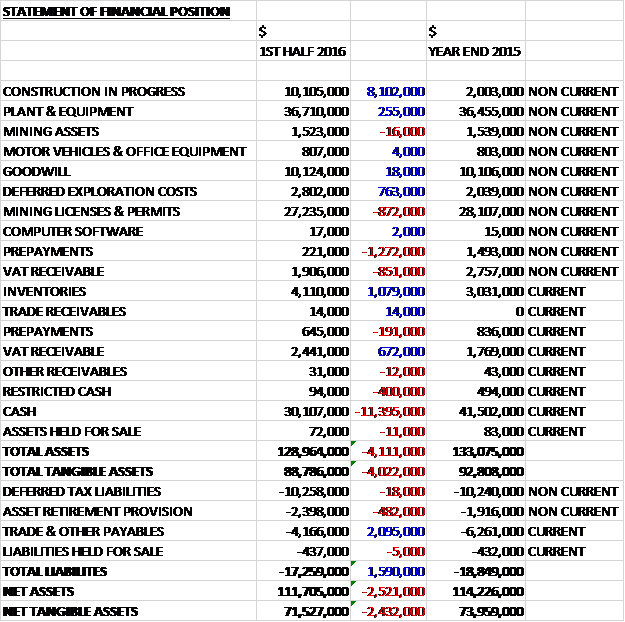
When compared to the end point of last year, total assets declined by £4.1M to £129M driven by an $11.4M fall in cash and a $1.3M decrease in prepayment, partially offset by an $8.1M increase in assets under construction and a $1.1M growth in inventories. Total liabilities also declined during the period due to a $2.1M fall in payables. The end result was a net tangible asset level of $71.5M, a decline of $2.4M over the past six months.

camlcash

Before movements in working capital, cash profits increased by $1.8M to £18.8M. There was a modest cash outflow from working cap but this was less than last time and after a $2.1M decline in the income tax paid, the net cash from operations came in at $13.8M, a growth of $6.4M year on year. The group spent $9.6M on property, plant and equipment, mostly relating on construction work for the Stage 2 Expansion, along with $780K on intangible assets relating to exploration costs incurred on the Copper Bay project, to give a free cash flow of $3.5M, of which $2.3M was spent on share options for directors and $12.5M went out in dividends to give a cash outflow for the period of $11M and a cash level of $30.1M at the period-end.

The copper production for the first six months of the year was 6,908 tonnes, a 27% increase year on year. This is due in part to a warmer winter and largely to Kounrad operating at increased capacity following the completion of the stage one expansion in May 2015. Copper Cathode sales of 6,355 tonnes represents an increase of 24% with 3,125 tonnes of that being sold at a fixed price of $5,025 per tonne and the average price received for all copper sales was $4,903 per tonne which compared unfavourably to the $5,936 per tonne achieved in the first half of last year.

The commercial terms of the off-take contract have been agreed and fixed for a three year period through to the end of 2018. This provided additional cost savings in the reported period due to a market reduction in the cost per tonne of exporting the copper from the site at Kounrad. The contractual commitment is for a minimum of 90% of the Kounrad copper cathode production.

The cash costs of production fell from 67c per pound last year to 40c per pound primarily as a result of cost savings from the local currency devaluation, increased production volumes and the reduction in off-take costs. The fully inclusive unit costs for the period were 97c per pound compared to $1.87 last time, mainly as a result of the decline in depreciation and amortisation and the depreciation of the local currency.

Much of the increase in profit was due to the reduction in depreciation and amortisation. Following receipt of the regulatory approvals required for the Kounrad Stage 2 Expansion in November, management has extended the useful economic lives of certain property, plant and equipment, and the fair value uplift of the Kounrad transaction. The original estimate of ten years has now been increased through to 2034 which represents the end of the subsoil use license. The depreciation charge has also been affected by the devaluation of the local currency which effectively halved the US dollar value of the balance sheet assets.

The Tenge devalued in August 2015 resulting in a total devaluation of about 85% during last year. The group responded by increasing salaries by 25% to compensate for this. Given that their operations generate income in US dollars, the immediate financial impact is positive as about 60% of the cost base is denominated in Tenge. There has been a desire on the part of the Government to contain any inflationary pressures caused by the devaluation but it is expected that some of the cost benefits seen during the period will be eroded by potential inflationary pressures during the second half.

Utilisation of the SX-EW facility remains at high levels with an average of 98% achieved during the period and in Q1 all the anodes within the original EW house were replaced with new ones of superior design and quality. Leaching of Dump 5 started in late Q1 and early results indicate good solution returns and leach rates in accordance with expectations. Following the organic reagent loss incident in June 2015, an insurance claim was submitted and in March 2016, the group received notification that the merits of the claim had been accepted and negotiations are ongoing as to the quantum, although no receivable has been recognised as of the period-end.

During the period, construction of the buildings, collector trenches, ponds and pipeline infrastructure to connect the SX-EW plant to the Western Dumps are progressed on schedule and under budget. Installation of the 12km overhead power line was completed, which has enabled site construction power to be provided by the permanent supply rather than generators. Construction of the main buildings consisting of pump houses and a boiler house is completed, with boilers in position and the chimney erected. The solution ponds have been excavated and lined, whilst the installation of the 24km solution transfer pipeline infrastructure for PLS and raffinate is progressing well.

The group completed an access ramp to the top of the initial leach area, which has enabled dozer preparation and levelling works to commence in readiness for the installation of the irrigation system. The water pipeline that will supply water to the site from Lake Balkhash is complete and commissioning is underway. The scheduled completion date of the Stage 2 Expansion remains Q4, with leaching operations on the Western Dumps planned to start in Q2 2017. Completion of this project will extend the life of the operation beyond 2030 and due to the devaluation of the Kazakhstan currency, the cost of completion of the overall project is now expected to be about 25% below the original $19.5M budget, although I presume this is open to volatility.

The feasibility study on the Copper Bay project that started in H2 last year is on track for completion in Q4. Results from additional infill drilling have been incorporated into resource and reserve estimates, geotechnical studies and mine design and scheduling. If the results are positive, a decision whether or not to advance the project to construction will be made taking into account both the fundamental outlook for the copper market and the availability of capital for construction.

In February the Kazakhstan authorities refunded a portion of outstanding VAT totalling $1.7M. As of the period-end, a total of $3.8M was still owed to the group relating to historical expenditure on site at Kounrad. A further $1.9M was refunded in August and the group remains confident of recovering the remaining $1.9M and is working closely with its advisers to achieve this. The planned means of recovery will be through a combination of the local sales of copper cathode to effectively offset VAT liabilities and by a successful appeal to the authorities.

Going forward, the group is on track to achieve their 2016 production guidance of between 13,000 and 14,000 tonnes and they will have a continued focus on operational cost discipline in the current challenging commodity price environment, although the local currency devaluation helps support this. The Stage 2 Expansion is on track for completion in Q4 with leaching of the Western Dumps to start in Q2 2017.

At the current share price the shares are trading on a PE ratio of 13.2 which increases to 13.9 on the full year consensus forecast. After an increase in the interim dividend, the shares are yielding 7.5% which reduces to 6.4% on the full year forecast.

Overall then this has been a fairly positive period for the group despite the headwinds around the price of copper. Profits increased due to the Kazakh currency devaluation and the reduction in depreciation but net assets did decline modestly. The operating cash flow also increased to produce some free cash, although not enough to cover the dividends. The group is producing record amounts of copper but this is being offset by the declining price which is currently slightly below the $4,903 average price achieved during the quarter.

Going forward the currency devaluation is likely to result in some inflationary pressures on costs but a forward PE of 13.9 and yield of 6.4% looks decent enough, I continue to hold here.

On the 5th October the group released an update covering trading in Q3. They produced 4,102 tonnes of copper cathode, a quarterly record which means the year to date figure of 11,010 tonnes is 31% up on last year and the board are confident of achieving annual copper production towards the upper end of the 13,000 to 14,000 tonnes guidance. Copper cathode sales of 10,646 tonnes year to date represents an increase of 38% year on year but there is no mention of prices achieved.

The stage 2 expansion is on schedule and nearing completion, about 25% under budget. Electrical aspects of the project are complete, including the overhead power lines and sub-station construction. The required solution ponds have been excavated and lined, and the collector trenches will be completed in October, as will the irrigation system on the initial leaching blocks. The pregnant leach solution and raffinate pipes from the Western Dumps to the SX-EW plant are now in position.

In the next quarter the group will complete the definitive feasibility study that is being concluded on the Copper Bay project. Overall this is a good operational update although there is no mention of copper prices of finances which does not bode well. Despite this I remain a holder.

On the 22nd November the group announced that it had signed a framework agreement to acquire an 80% interest in the subsoil use contract for the Shuak copper exploration property in northern Kazakhstan. The group will invest a total consideration of $2M in exploration activities and the property has a resource of 327,000 tonnes of contained copper at a grade of 0.66% Cu.

Shauk is a copper and gold exploration project in the Akmola Oblast region in the north of Kazakhstan, about 300 miles north of the capital. The license area is 197km2 and contains three target areas that warrant immediate and detailed exploration for copper and gold. The area hosts two mineralisation styles that are of particular interest: saprolite hosted oxide and enriched copper, gold and molybdenum mineralisation that may be amenable to copper production by solvent extraction; and copper, molybdenum and gold bearing dissemination and stockwork mineralisation of a porphyry nature.

In addition there are widespread copper, gold, silver and molybdenum geochemical anomalies within the license area. The property was explored between 1973 and 1991 and over 45,000 metres of diamond holes was drilled during that time which demonstrated a pre-GKZ resource at Mongol V of about 49.5MT at a grade of 0.66% Cu for about 327,000 tonnes of contained copper. Most recently, former owners of the property undertook small scale mining at Mongol V and sampling of the stockpile generated from these activities demonstrated copper oxide grades in excess of 2% in several cases. Column leach testing of this material at Kounrad has shown it to be amenable to processing by leaching with dilute sulphuric acid with recoveries of over 90%.

The group intends to start field-based exploration work in Q2 2017. During the 2017 exploration season, the group plans to design an approximately 1,800 metre trenching programme and to undertake approximately 8,000 metres of drilling at Mongol V and other priority areas. The exploration budget for 2017 for Shauk is about $1M.
Under the terms of the agreement the group will hold an 80% interest in Ken Shauk, the company which is to hold the Shauk SUC with the other 20% being held by local partners. The consideration for the acquisition is an investment in exploration activities of $2M over five years. The initial target would be to develop a SX-EW operation at Shauk and longer term they plan to explore the primary copper porphyry target at depth.

This looks to be a very sensible deal to me, I like it and continue to hold.

On the 5th January the group released a Q4 update. The Q4 output of 3,010 tonnes of copper cathode brings total production for 2016 to 14,020 tonnes, a 16% increase on 2015. Copper cathode sales for the year of 13,938 tonnes represents an increase of 16%. As of the year-end there was a cash position of $40M.

The stage 2 expansion project is now materially complete. This work comprised construction of buildings, a boiler house, collector trenches, electrical supply and infrastructure as well as ponds and pipelines to connect the SX-EW plant to the Western Dumps area. The total capital cost is expected to be about 30% below the original budget of $19.5M and copper production from the Western Dumps will start on schedule in Q2 2017.

The group is targeting 2017 copper cathode production of between 13,000 and 14,000 tonnes, so a slight reduction on this year. The majority of copper production will be leached from the Eastern Dumps but from Q2 onwards they expect an increasing percentage of overall copper production to be leached from the Western Dumps.

In an improved copper price environment and with all major capital at Kounrad expended, the board are optimistic about the future. This all sounds fine, albeit the moderately lower forecast for 2017 is a little disappointing – I remain a holder.

On the 18th January the group released the results of the Copper Bay feasibility study. The study has a total resource of 53,440KT at a grade of 0.24% which gives rise to 125,820 tonnes of contained copper. In addition, historical work in 2008 estimated a non-compliant resource of about 190,000 tonnes of copper.

The mineable resource comprises 34.8MT of tailings material at a grade of 0.24% containing 84,634 tonnes of copper. The overall mineable resource includes 7% of material that has been classified as an inferred resource and which forms part of the overall dredging production plan. The difference between the mineral resource and the mineable resource arises due to material remaining in-situ during the dredging process to form a berm between the operation and the sea, and due to removal from the mine of a high acid-consuming lower shell-rich horizon.

The study envisages a nine year project, comprising of two years construction followed by seven years of operation, which would process five million tonnes of material annually at a copper grade of 0.24%. Total copper recoveries in the processing plant are expected to be 72%, yielding an average of 7,080 tonnes of copper cathode and 1,560 tonnes of copper in concentrate grading 20%. The initial capex has been estimated at $88.5M which includes a contingency of $6.8M.

The study estimates a C1 life of mine cash cost of copper production in the lower half of the global cost curve at $1.37 per pound. On the current mine plan, the post-tax NPV of the project is $34.1M at a flat copper price of $3 per pound and the post-tax IRR is 19.1%.

Given the current uncertainty with regard to the near and medium term expectations for copper, however, the board has recommended that the project remains in their development pipeline while they review their options which is a little disappointing but probably prudent.

Dechra Pharmaceuticals Share Blog – Final Results Year Ended 2016

Dechra Pharmaceuticals has now released its final results for the year ended 2016.
dphincome

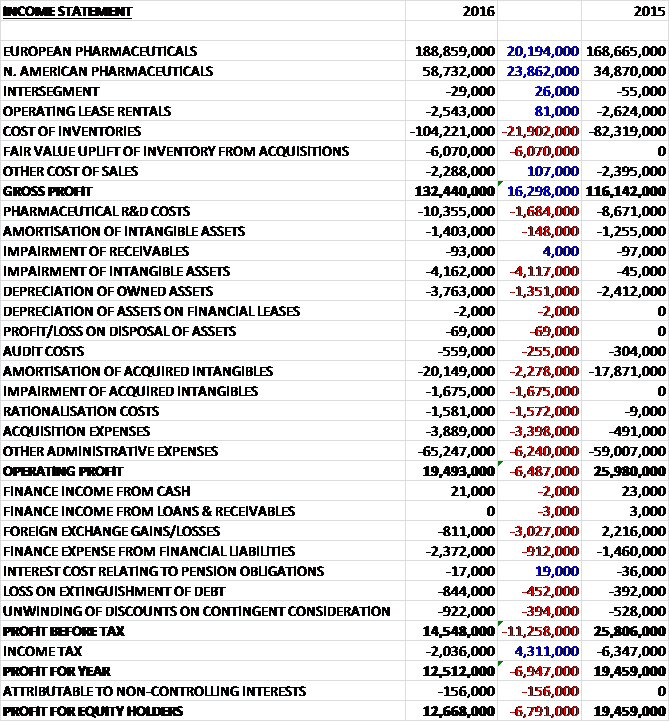
Revenues increased when compared to last year with a £23.9M growth in North American revenue and a £20.2M increase in European revenue. Cost of inventories increased by £21.9M and there was a fair value uplift of inventory from acquisitions which cost £6.1M to give a gross profit £16.3M above that of last year. R&D costs were up £1.7M, depreciation increased by £1.4M and there was a £4.1M increase in intangible asset impairments. We also see a £2.3M growth in the amortisation of acquired intangibles, a £1.7M impairment of acquired intangibles, £1.6M of rationalisation costs, a £3.4M increase in acquisition costs and a £6.2M growth in other admin expenses which meant that the operating profit fell by £6.5M. There was also a £3M negative swing to forex losses, a £912K growth in interest costs, a loss on extinguishment of debt and a £922K unwinding of discounts on contingent consideration, although tax charges declined by £4.3M. This all meant that the profit for the year was £12.7M, a decline of £6.8M year on year.
dphassets

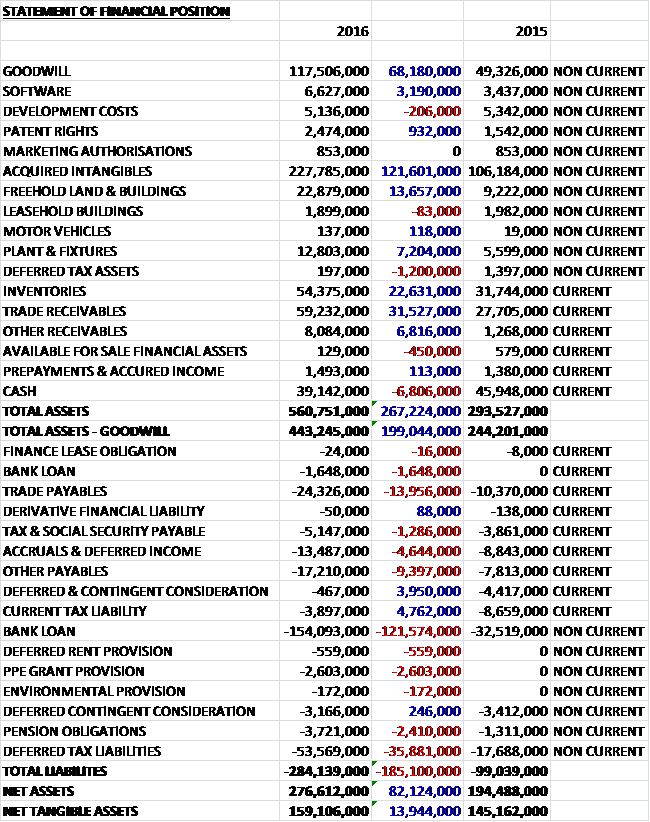
When compared to the end point of last year, total assets increased by £267.2M to £560.8M driven by a £121.6M growth in acquired intangibles, a £68.2M increase in goodwill, a £31.5M growth in trade receivables, a £22.6M increase in inventories and a £13.7M growth in freehold land and buildings. Total liabilities also increased during the year due to a £123M growth in bank loans, a £35.9M increase in deferred tax liabilities relating to an increase in value of intangible assets, and a £14M growth in trade payables. The end result was a net asset level (excluding goodwill) of £159.1M, a growth of £13.9M year on year.
dphcash

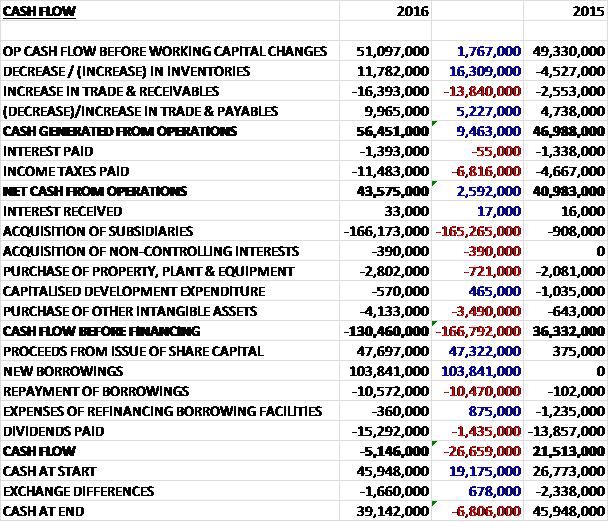
Before movements in working capital, cash profits increased by £1.8M to £51.1M. There was a cash inflow from working cap as an increase in receivables was more than offset by movements in inventories and payables. Tax payments increased by £6.8M to give a net cash from operations of £43.6M, a growth of £2.6M. The group spent £2.8M on property, plant and equipment and £4.7M on intangible assets but the big expenditure was the £166.2M spent on acquisitions to give a cash outflow of £130.5M before financing. The group received £46.7M from the issue of share capital and £103.8M in new borrowing proceeds but spent £10.6M on repaying loans and £15.3M on dividends. The end result was a cash outflow of £5.1M and a cash level of £39.1M at the year-end.

Excluding the losses from acquisitions, like for like profits increased by 5.1% at constant exchange rates but with growth adversely impacted by forex losses of £800K compared to forex gains of £2.2M last year, profits actually declined by 1% at actual exchange rates.

The operating profit in the European Pharmaceuticals division was £51.7M, a growth of £3.7M year on year on like for like revenues that were up 5.7%. The companion animal product sales were driven predominantly by a strong performance in endocrinology, and anaesthetics. Within endocrinology, Vetoryl continues to grow in all major territories and the launch of Zycortal into 14 countries has strengthened their position in that sector. The equine portfolio has also performed well with Osphos being launched across all major territories and performing to expectations. They are also re-positioning Equipalazone following palatability trials.

The recovery in farm animal products that was reported in the first half of the year has continued in the second half. The decline in antibiotic sales in Germany has slowed and after several years of decline in the Netherlands they are now seeing sales flatten. Against this background, overall growth has been achieved by increasing market penetration in Poland and in countries where they had a lower market share historically such as UK, France, Italy and Spain. They have also launched Solamocta, a new antibiotic lifecycle improvement which will be key to the recovery in Germany. Other new product registrations have been received in the division and are being prepared for imminent launch in Europe which should ensure that the positive momentum continues.

Diet sales have not fully returned to previous levels following the supply problems last year. Whilst there was growth in a number of markets, this was offset by the loss of a large corporate account in Scandinavia and palatability issues for some of the cat diet products. They have appointed an experienced manager to focus on developing the business and have recently won two new contracts with major vet groups which should ensure an improved position in the future.

The operating profit in the North America Pharmaceuticals division was £17.5M, an increase of £6.9M when compared to last year on revenues that increased by 37.9% on a like for like basis. The US has driven the majority of this growth as they continue to gain strong market penetration in their key focus areas of dermatology and endocrinology. This growth has been enhanced by a good performance from Phycox, a strong growth and traction with Osphos and the successful launch of Zycortal in March.

The biggest product, Vetoryl capsules, delivered double digit growth as the group has maintained its educational and marketing campaign and introduced a low dose 5mg capsule to increase flexibility on dosing options. The Canadian business delivered a good performance across the portfolio which was enhanced by the launch of Psphos and Zycortal. The business has also benefited from the acquisition and launch of HY-50 in the territory, a product that they have marketed in Europe since its acquisition in 2012.

The primary focus of the management team towards the end of the period was to integrate the commercial team from the recent acquisition of Putney. This enlarged team will give the group improved penetration and more direct contact with US vet practices to enhance sales.

During the year Zycortal, a novel canine endocrine product for the treatment of Addison’s disease, has received approval throughout the EU, US, Canada and Australia. Following the registration of Osphos last year in the US and UK, approval was subsequently received in 17 additional EU countries in September 2015. They have also had numerous successes in the farm animal product portfolio in Europe; two water soluble antibiotics, Solamocta and Phenocillin have been approved in 17 member states; a liquid antibiotic, Metaxol, was approved in 18 member states; and the existing antibiotic aerosol, Cyclospray, was extended into 12 new territories. The new Croatian facility has achieved approval for a poultry vaccine, Avishield ND, to treat Newcastle disease in 12 major European markets and has also achieved a number of other national registrations including Egypt and Ukraine.

In the period the group has terminated an early stage project for canine ophthalmology and a canine cardiology product. They have, however, initiated eight new projects across both markets and development has continued on the Genera vaccines and Putney generics since acquisition with significant filings being made from both businesses.

Geographical expansion is progressing well. In addition to the acquisition of Brovel, which creates a foothold in the Mexican market, the acquisition of Genera provides access to the smaller markets of Croatia, Bosnia, Serbia and Slovenia. A greenfield start-up subsidiary has been established in Austria which started trading in January and sales are progressing well. The subsidiaries in Canada and Poland, established in the prior year, are performing well, with Poland being above expectations.

Last year the group made an investment to upgrade the pre-mix department in Bladel to increase batch sizes and reduce the cost of goods. This department is now fully commissioned and product transfer to the new lines is underway. They have also invested in a new tablet and capsule blister packaging line in Skipton which will increase volumes and speed. This is currently being commissioned and it is anticipated it will be effective from the beginning of the new year. Other initiatives to reduce the cost of goods and improve efficiencies have been implemented, resulting in raw material price reductions, predominantly for the farm animal product division. They have also seen a small reduction in material wastage rates and batch reject rates are lower than the previous year.

Manufacturing volumes have increased overall due to internal sales increasing but like for like external sales have decreased by 4.8% due to reduced volume with some customers. Overall contract manufacturing has increased following the Genera acquisition. Service to customers has increased with on-time delivery ahead of internal targets and the previous year.

In October 2015 the group completed the acquisition of 92.26% of Genera for €36.6M which was funded from existing cash and debt facilities. The transaction generated goodwill of £4.5M. The business reports in the EU pharmaceuticals sector and contributed a £3.2M loss to the results in the period. In May 2016 the group acquired a further 1.13% for £400K which gives them an interest over 93.39% of the business. The acquisition enables the group to enter the fast growing poultry vaccines market. The group have already rationalised the business to improve efficiency and have integrated many of the teams into the global operations.

In January 2016 the group acquired Brovel, a veterinary pharmaceuticals company based in Mexico. They paid £3.3M on completion and a further £591K is contingent upon the business reaching registration milestones for the group’s products in Mexico. The transaction generated goodwill of £2.6M. The business reports under the North American Pharmaceuticals segment and contributed a £100K loss to results during the period. The board believe that this acquisition will help open the significant Mexican animal health market to the group and enable them to register and market their products in the country. Several products have been identified as suitable and the registration process with the authorities has started.

In April 2016 the group acquired Putney Inc, a veterinary pharmaceuticals company based in Maine for £134.2M in cash with the transaction generating £49.3M of goodwill. The business will report in the North American pharmaceuticals sector and contributed a £6.7M loss to results in the period. The acquisition was the most complementary US opportunity they had identified and provides significant scale and access to a strong drug pipeline in the North American market. They currently market eleven approved products and has a further ten generic products in its pipeline which are expected to be launched over the next five years.

There were a number of “non-underlying” items this year. Rationalisation costs of £1.6M relate to the integration and restructuring programmes implemented since the acquisitions of Genera and Putney. The fair value uplift of inventory acquired through business combinations accounted for £6.1M; the impairment of acquired intangibles and associated deferred consideration accounted for £1.7M and includes the impairment of a US generic pharmaceutical product following the acquisition of Putney, as Putney had already developed a similar product. It also includes the impairment of an acquired intangible due to the cessation of sales following a competitor registration in the US.

The roll out of the Oracle ERP system continues to be one of the primary operational objectives of the group. In April the core Oracle solution was implemented into the US business and they are currently targeting a roll out to most sites in 2017 followed by an upgrade to the current manufacturing Oracle system. During the year the group raised £47M from the issue of 4.4M shares in order to help pay for the Putney acquisition.

The current chairman, Michael Redmond, will step down from the board in October at the AGM and his successor will be non-executive director Tony Rice. Chris Richards also stepped down from the board as a non-executive director after nearly six years of service to further other opportunities. Anne-Francoise Nesmes, the CFO, has also resigned from the board. She left the company at the end of July to take up a role as CFO with a FTSE 100 business. Richard Cotton is expected to join the company in January 2017 as CFO.

Going forward, although the board anticipate a degree of uncertainty following Brexit, the business is naturally hedged by its geographical spread and international sourcing. Any significant downturn in the UK economy may impinge on growth rates but they do not anticipate any material effect on the group, although they are potentially susceptible to additional admin burden. Good progress has been made on the integration of the acquisitions. The pipeline has also been strengthened through both new internally generated ideas and the integration of acquired development programmes. The group continues to deliver growth and identify opportunities across all aspects of the strategy and they therefore look to the future with confidence.

At the current share price the shares are trading on a PE ratio of 100.2, mainly due to one-off cots but this reduces to 26.2 on next year’s consensus forecast which is not exactly cheap. After a 9% increase in the dividends, the shares are yielding 1.3% which increases to 1.4% on next year’s forecast. Net debt at the year-end was £116.6M compared to a net cash position of £13.4M at the end of last year and this was not helped by the Sterling depreciation following the Brexit vote due to the debt in Euros and dollars.

On the 9th September the group announced that it received approval from the US FDA for a generic antibiotic. The product is expected to be a first generic market entrant in a substantial antibiotic market and it is the first registration the group has achieved through Putney’s development pipeline since it was acquired.

On the 16th September the group announced that it had agreed terms to acquire Apex Labs, a privately owned vet pharmaceutical business which manufactures, markets and sells branded non-proprietary prescription and other related companion animal products in Australia and New Zealand. The acquisition will provide the group with direct access to the established and growing Australian companion animal product market, which they currently operate through partners. Last year the business made an operating profit of £3M. The total consideration is £31.3M which will be funded from existing debt resources. It is expected to be earnings enhancing in the first year.

Overall then this has been a year of progress that has rather obscured the underlying performance of the group. Profits declined as the numerous acquisitions took their toll, with like for like profits up at constant currency but down at actual exchange rates. Net assets increased, as did operating cash flow, although all the cash was used on acquisitions, leaving a big cash outflow before financing.

The European business performed fairly well, with the companion animal side showing growth from Vetoryl, Zycortal and Osphos, while it is encouraging to see the farm animal side halting the decline seen in previous years, in part as a result of increased penetration in to Poland. The diets side of the business still seems to be struggling, however. In North America, the business seemed to grow strongly but this year has been defined by acquisitions, with Putney and Apex Labs being particularly sizeable. I am starting to get a bit concerned that the group has gone a bit “acquisition-happy” and would prefer they bedded in the ones already completed before doing more.

They also seem to be getting more exposed to high debt levels so would really like to see this brought down a bit too. On top of this, the forward PE of 26.2 and yield of 1.4% makes the shares look expensive and prone to any issues. Despite this, I am continuing to hold for the time being.

On the 21st October the group released a trading update covering Q1 where performance was in line with management expectations with all of the recent acquisitions performing well. In September they announced that their generic antibiotic, Amoxiclav, had received approval from the US FDA. This registration is for two of four different dosage strengths of tablets and the remaining two are in the final stage of registration with approval expected before the end of 2016. This is the most significant product within the recently acquired Putney pipeline.

The £31.3M acquisition of Apex Labs was completed in October which provides access to the Australian market with a wide range of companion animal products and includes a new manufacturing facility and development pipeline. The group have three products registered in Australia which will also be sold through this business once approved. It was also announced that the Chairman of 14 years, Michael Redmond retired to be replaced with Tony Rice.

Not much to note really, things are going as they were it seems.

On the 5th December the group announced that director Tony Rice purchased 20,000 shares at a value of £250K which seems a fairly substantial investment.

On the 17th January the group released an update covering the first half of the year. Reported group revenue increased by about 34% at constant exchange rates (56% at actual exchange rates) and excluding the benefit of the acquisitions, it was 7% at constant currency and 22% at actual rates.

The European pharmaceuticals segment increased total reported revenues by 12% at constant rates. This was driven by contributions from both the Genera and Apex acquisitions and from a strong companion animal and equine performance.
Diet sales returned to modest growth in the period following two years of decline as they changed manufacturer and resubmitted the range. Revenue from food animal producing products also showed limited growth in the period which was constrained by the planned reduced production in the injectable antibiotics suite which was undergoing modifications.

Total reported North American segment revenue increased by about 112% at constant currency. The US business growth includes an uplift in sales from the stocking of the North American distribution chain with products from the acquired Putney business. Sales of Putney products have also benefited after the integration from sales and marketing efforts of the enlarged Dechra team. Both the companion animal and equine portfolios performed well during the period.

The group received FDA approval for their generic antibiotic Amoxi-clav during the period which was the first major approval from the Putney pipeline following the acquisition. Pipeline delivery continued with the approval of Altidox, a new FAP generic water soluble antibiotic, in 13 EU territories. Osphos, the equine lameness product, received approvals in Canada and Australia. Successful registrations were also gained from the Genera pipeline including Genoxytab, a FAP uterine antibiotic, in four EU territories, and Canihelmin, a CAP dewormer, in six EU territories. Apex labs received Australian approval for a liquid formulation of benazepril, a CAP cardiac medication.

This all seems fine to me and I continue to hold.

Safestyle Share Blog – Interim Results Year Ending 2016

Safestyle have now released their interim results for the year ending 2016.

sfeincome

Revenues increased by £9.6M when compared to the first half of last year and after cost of sales saw a more modest growth, the gross profit increased by £637K. There was a £947K LTIP exercise charge in the period mainly relating to national insurance contribution charges that did not occur last year but other operating expenses declined which meant that the operating profit grew by £762K. After finance costs were broadly flat and tax increased by £219K, the profit for the period came in at £7.6M, a growth of £558K year on year.

sfeassets

When compared to the end point of last year, total assets increased by £9.4M to £61.8M. This was driven by a £7.1M increase in cash, a £2.9M growth in receivables and a £1M increase in property, plant and equipment, partially offset by a £1.2M decline in deferred tax assets. Total liabilities also grew during the period, mainly as a result of the £11.3M of exceptional dividends accrued along with a £2.7M growth in payables, partially offset by a £1.2M decline in corporation tax liabilities. The end result was a net tangible asset level of £13.4M, a decline of £2.7M over the past six months.

sfecash

Before movements in working capital, cash profits increased by £863K to £10.2M. There was a modest cash outflow from working cap but this was less than last year and after tax payments increased by £134K the net cash from operations came in at £8.1M, a growth of £947K year on year. The group spent £1M on property, plant and equipment which was the only capex so the free cash flow was £7.1M to give a cash flow for the period of £7.1M and a cash level of £23.6M at the period-end, although of course the dividends have got to come off that.

The growth in revenue was due to both an increase in volume and price with a 5.7% growth in the volume of frames installed and a 6.9% growth in the average unit price. The price list increase implemented at the start of the year counterbalanced the additional costs of the new consumer finance products and unit prices have been further boosted by the sale and installation of 208 conservatory upgrades. Average sales prices increased steadily through the period as the pre-increase order book was installed, which suggests that gross margin will continue to improve in the second half of the year.

The market in which the group operates contracted by 2.2% by volume in the period, albeit with some recovery in Q2 which the board expect to continue into Q3. The group has continued to grow its market share, increasing from 9.5% to 10%. The second half of the year has started on plan, with the three new frame colours introduced at the start of June being well received and current order intake shows growth in line with board expectations. They remain encouraged by the demand for their conservatory refurbishment programme which remains on target.

Investment in the new factory extension at Wombwell has started and is currently on time and budget with the facility being scheduled to be operational in the summer of 2017. The group continued to invest in buildings its brand profile and spent an additional £600K in TV advertising and in addition, salary costs increased by £600K as a result of the annual pay award and continued investment in new staff. They have opened new offices in Guildford and Norwich.

So far in the second half they have seen no change in demand which might be attributed to the Brexit vote as order intake increased on the previous year, albeit at a lower rate than in the first half due to more challenging comparatives.

Going forward, the board expect the market will show some modest volume growth for the rest of the year. They expect to continue to gain market share, reflecting the strong order book at the period-end and their continued sales performance. In all they expect to deliver full year results in line with expectations.

At the current share price the shares trade on a PE ratio of 16.2 which reduces to 14.2 on the full year forecast. After a 10.3% increase in the interim dividend, the shares are yielding 6.2% which falls to 4% on the full year forecast assuming no further special dividends.

Overall then this has been another strong period for the group. Profit increased and operating cash flow improved with loads of free cash being generated. The net assets did decline but this was due to the special dividend. Both volumes and prices increased but the latter was just enough to cover the introduction of new consumer finance products to improve the former! Having said that, margin is expected to grow in G2. So far Brexit has had no effect on the company and this is one I’m glad I own. With a forward PE of 14.2 and yield of 4% this is no longer the bargain it once was. Still, happy to hold though.

On the 27th September the group announced that CEO Steve Birmingham purchased 17,500 shares at a value of £49.1K which seems to be a good sign.

On the 21st November the group announced that CEO Steve Birmingham purchased 50,000 shares at a value of £124.5K which is a good sign as far as I’m concerned – tempted to pick up a few more here.

On the 23rd January the group released a trading update covering the whole year. They have continued to trade well, with revenue for the year increasing 9.8% to £163.5M. In addition, pre-tax profit has shown good progress and is in line with board expectations. As expected, however, the second half showed slower growth than in H1 due to more challenging comparatives.

They have continued to take market share and the number of frames manufactured increased by 3.2% with the number of installations up 4.7%. Price increases implemented at the start of the year helped them deliver improved operating margins, offsetting consumer finance subsidy costs, which have become an established feature of the cost base.

Cash flow has continued to be strong and they ended the year with cash of £13.5M despite incurring £4.6M of expenditure on the new factory extension which continues to be on time and on budget. 2017 will see increases in the raw material costs primarily due to sterling weakness but they plan to offset such increases by improving the price they obtain for their products. Despite the uncertain macroeconomic outlook, they remain cautiously optimistic and believe they are well positioned to continue growing the business.

Overall then performance has been good this year but the concern is the increased raw material prices. The board state they will offset this by increasing prices but having already done this in response to the consumer finance costs, I am not sure there is much space for this. I continue to hold but this is not quite a solid as it was.

On the 13th February the group announced that Giles Richell will join the board in the newly created role of COO with immediate effect. He was most recently MD at Eminox, part of the Hexadex group.

IQE Share Blog – Interim Results Year Ended 2016

IQE has now released their interim results for the year ending 2016.

iqeincome

Revenues increased when compared to the first half of last year with a £3.3M growth in photonic revenue, a £2.8M increase in wireless revenue and a £3.5M maiden license income from sales to joint ventures. Depreciation was down slightly but amortisation increased by £413K and other cost of sales grew by £4.5M to give a gross profit £5M above that of last time. We then see a £2.1M income from the release of contingent consideration but a £1M growth in admin expenses and when finance costs fell by £343K and tax increased by £1.1M the profit for the period came in at £9.9M, a growth of £5.5M year on year.

iqeassets

When compared to the end point of last year, total assets increased by £28.9M to £247M driven by a £9.1M increase in intangible assets, an £8.2M growth in property, plant & equipment, a £2.8M increase in receivables, a £2.6M growth in inventories and a £1.5M increase in deferred tax assets. Total liabilities declined during the year as a £10.1M increase in bank borrowings was offset by a £10.6M growth in payables. The end result was a net tangible asset level of £75.9M, a growth of 15.7M over the past six months, mostly as a result of favourable forex movements.

iqecash

Before movements in working capital, cash profits increased by £4.4M to £13M. There was a modest outflow of cash from working capital but this was much less than last year and after tax payments increased by £492K the net cash from operations came in at £11M, a growth of £7.5M year on year. The group spent £4.3M on property, plant & equipment and £2.8M on development costs with another £755K going on other intangible assets. The group also paid £10.7M on deferred consideration for Kopin which gave a cash outflow of £7.3M before financing. The group then took out a net £6.5M of new borrowings which meant there was a cash outflow of £678K and a cash level of £4.3M at the period-end.

The operating profit in the wireless division was £5.1M, broadly flat year on year. The market has been more subdued over the past few years reflecting a lull in mobile handset innovation. As a result the group estimate that the materials market is currently growing at about 5% per annum. The supply chain has also been characterised by inventory corrections. The board expect the growth rate of the market to increase over the next few years, however as innovation in handset technology accelerates replacement cycles, along with some other factors such as the emergence of 5G communication.

The operating profit in the photonics business was £2.7M, a growth of £1.1M when compared to the first half of last year. The photonics market is being driven by a diverse range of applications, and it is at an early stage in the growth cycle and the board expect this business to continue to grow strongly for the foreseeable future. Their growth ambitions are underpinned by a pipeline of programmes with blue chip customers for high volume applications.

The operating profit in the infra-red division was £830K, a growth of £175K when compared to the first half of 2015. Sales are currently concentrated in defence related applications but through engagement in programmes in consumer, medical and industrial imaging, the group expect this segment to increasingly transition into new markets over the coming years. The operating loss in the CMOS++ business was £1.4M, an increase of £734K year on year.

There is currently little in the way of income from the power market but the size and scale of the markets are many times larger than the group’s existing markets so represent transformational opportunities for them. At present the power switching chips are made using silicon, which has performance limitations.

Likewise, there is currently little in the way of solar revenues. Due to the decline in energy prices, the group has switched its primary focus to penetrating the space market, where their technology is already embedded. The current pipeline of activities suggests that the group can expect to see good commercial progress in the next two to three years.

The group made a profit of £3.5M from license income from sales to joint ventures which was the first contribution from this income stream. The group recognised revenue of £800K and made purchases of £4.2M from its joint venture in Singapore. They recognised revenue of £2.8M, made purchases of £2M and recharged costs of £200K with their joint venture in the UK. For the year as a whole, revenue is expected to be lower than the £8M received last year and 2017 levels are expected to be similar to this year.

The group has developed a broad portfolio of IP for advance semiconductor materials. In addition to the £3.5M of license income generated in the first half, this IP portfolio is creating a platform for continuing growth across the current and emerging markets. They have a pipeline of new products and customer qualifications which underpin their growth ambitions with programmes expected to ramp up through 2017 and 2018. This includes new photonic applications, wireless base stations, advanced solar and power switching applications.

As usual, a number of “one-off” costs were incurred during the period with £800K of acquisition costs and £1M of share based payments – I don’t actually agree these are one-off! They also generated a non-cash profit of £2.2M arising from a reduction in the estimated remaining deferred consideration in respect of a previous acquisition.
The Kopin deferred consideration balance of £10.7M was settled in full in January and the remaining balance of deferred consideration of about £1.8M will be settled in full by the end of September.

Trading in the second half of the year started well, and with the benefit of a strong pipeline and increasing revenue diversification the board remains confident that the group is on track to deliver full year earnings in line with expectations.

At the current share price the shares are trading on a PE ratio of 13.1 but this reduces to 11.6 on Edison’s full year forecast. At the period-end the group has net debt of £33.6M compared to £23.2M at the start of the year, reflecting the deferred consideration payment made during the period. Including the deferred consideration, the leverage was £35.4M compared to £49M at this point of last year. There are no dividends on offer here.

Overall then this has been a good period for the group. Profits were up; net assets increased, albeit as a result of forex movements; and the operating cash flow improved. Once again no free cash was generated but this was due to the deferred consideration paid and should improve going forward. The wireless market was flat but still very profitable but the Photonics division is where the big improvement was made, with growth expected to continue. The group is also benefiting from license income and the IR division saw profits increase modestly.

The CMOSS division is still loss making and in fact, losses widened but the power market is expected to be potentially transformational going forward. Trading in the second half has started well and a forward PE of 11.6 still looks good value to me, I continue to hold.
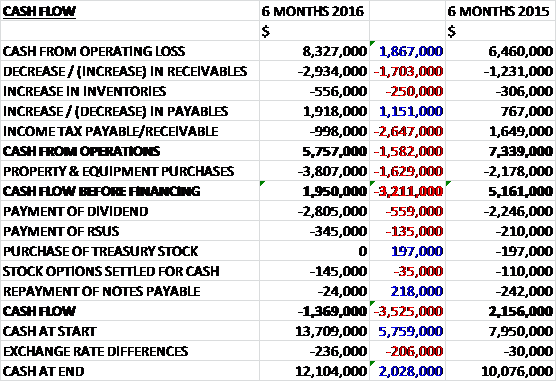
On the 25th October the group announced that Chairman Godfrey Ainsworth sold 119,958 shares at a value of £36.5K. Following this transaction, he holds 3,154,197 shares.

On the 14th December the group released a trading update. Since the interim announcement, trading has continued to be strong across multiple markets, especially in the photonics business. As a consequence, the group announced that it is on track to deliver 2016 revenue and adjusted operating profit ahead of expectations. It is expected that revenues will reflect a double digit rate of growth year on year and that H2 revenues will be up on H1.

The wireless business has largely performed as expected and remains on track for year on year growth. Photonics continues to be the fastest growing segment, enjoying a strong double digit growth year on year. Good progress with customer qualifications in photonics during the year provides a solid platform for continuing strong growth for this business. In response to this opportunity, the group has increased its capital investment in the second half. Infra-Red has performed in line with expectations, and license income has reduced from the front loaded income enjoyed last year.

Revenues also benefited from the devaluation of Sterling but the impact on profitability is largely presentational as the majority of the group’s costs are denominated in dollars. Furthermore, although the group has deleveraged its balance sheet during the year, in underlying dollar terms, the presentation of this is expected to be distorted adversely in sterling.

Overall pretty good, although debt looks to have increased and capex is up so not sure there will be a positive cash flow. Anyway, I continue to hold.