MartinCo Share Blog – Interim Results Year Ending 2016

Martin & Co has now released its interim results for the year ending 2016.

mcoincome

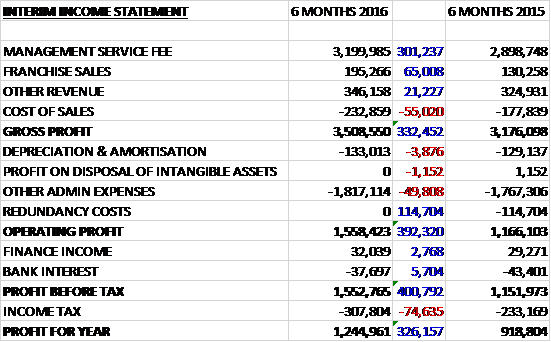
Revenues increased when compared to the first half of last year due to a £301K growth in management service fees, a £65K increase in franchise sales and a £21K growth in other revenue. Cost of sales increased modestly which meant that gross profit increased by £332K. Admin expenses increased by £51K but there were no redundancy costs that accounted for £115K last time to give an operating profit £392K ahead. Bank interest fell slightly but tax costs increased by £75K which meant that the profit for the period came in at £1.2M, a growth of £326K year on year.

mcoassets

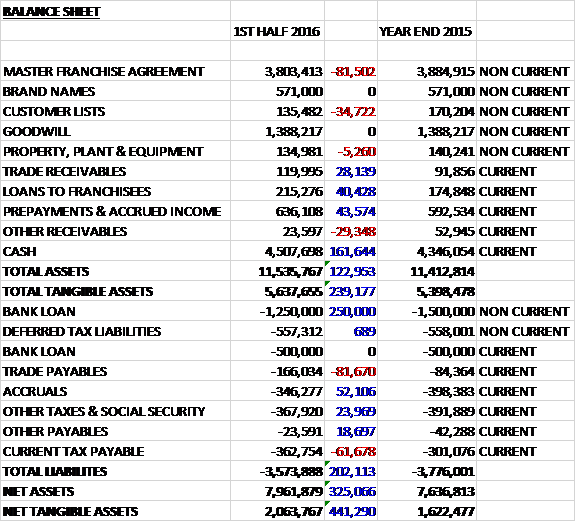
When compared to the end point of last year, total assets increased by £123K to £11.5M driven by a £162K increase in cash, a £40K growth in loans to franchisees and a £44K increase in prepayments and accrued income, partially offset by an £81.5K decline in the master franchise agreement. Total liabilities declined during the period as an £81.7K growth in trade payables and a £61.7K increase in current tax payables was more than offset by a £250K decrease in the bank loan. The end result was a net tangible asset level of £2M, a growth of £441K over the past six months.

mcocash

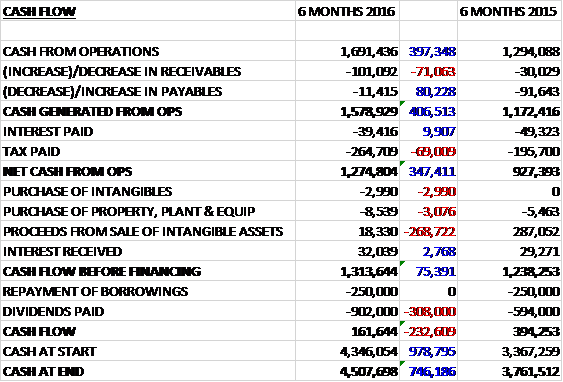
Before movements in working capital, cash profits increased by £397K to £1.7M. There was a cash outflow from working capital, although this was broadly similar to last year but tax payments increased by 69K to give a net cash from operations of £1.3M, an increase of £347K year on year. There was very little in the way of capex, indeed the group actually made more from asset sales than from purchases so there was a free cash flow of £1.3M. Of this, £250K was used to pay back loans and £902K was spent on dividends to give a cash flow of £161K for the period and a cash level of £4.5M at the end of the half.

Market conditions became challenging as the Brexit vote approached but, whilst uncertainty remains, there are now signs of recovery in lettings transactions. Estate agency activity is mildly depressed in London and the South compared to last year but activity in the Midlands and North remains in line with budgetary expectations.
Management service fees from lettings continued to grow steadily at 7% whilst management service fees from sales, driven by the stamp duty change in April and no general election, increased by 24%. The Brexit vote has had a dampening effect on house transactions whilst lettings appear to be recovering from a short lived downturn. Significant uncertainty still remains in the sector following the vote.

The integration of two property franchisors and the associated four property brands acquired as Xperience is now complete. In September, after the period-end, the group acquired EweMove for a total consideration of up to £15M. They paid £5M in cash on completion, drawing down £2M from their facility with Santander, and issued £3M of new shares to the owners. Up to a further £7M of deferred payment may be payable after the financial statements for 2018 are approved by the board, dependent on performance criteria linked to EBITDA for the enlarged group. This can be paid in cash or by the issue of new shares at the company’s discretion.

EweMove is an online estate and letting agent with 85 active franchisees as of the period-end. The agency operates a scalable central technology platform and operational hub to support local property experts/franchisees. The directors believe that there is capacity in the UK market for substantial growth in the number of local property experts. The business is now generating cash and future growth should be self-funding (current pre-tax profit is £120K). It will continue to operate from its own HQ in Yorkshire to preserve the brand identity and the two founders have taken up senior positions within MartinCo to improve online marketing and technology capacility across all brands.

Going forward, considering the current momentum the board remains confident of future progress and trading results for the full year.

At the current share price the shares are trading on a PE ratio of 18 which reduces to 13.6 on the full year forecast. After an 11% increase in the interim dividend, the shares are yielding 3.6% which increases to 4% on the full year forecast. At the end of the period the group had a net cash position of £4.5M compared to £3.8M at the same point of last year but obviously that changed following the acquisition after the period-end.

Overall then this was a very strong set of results from the group. Profit increased, net assets grew and operating cash flow was up on last time, with a decent amount of free cash flow generated. Unfortunately there are two events that change things somewhat, the Brexit vote supressed demand around that period and although lettings seem to have recovered, estate agency sales are still subdued. Also, the acquisition, although seemingly a shrewd move, does increase risk somewhat. This is a tricky one, I am minded to think that the forward PE of 13.6 and yield of 4% looks about right.

On the 2nd February the group released a trading update covering the whole year. Revenue increased by 15% to £8.2M and current trading is in line with expectations. Trading performance in the final months of 2016 was robust despite challenging market conditions during the immediate aftermath of the Brexit vote. This performance has been driven by organic growth in Management Services Fees, an expanding network of franchises and tight cost control measures.

EweMove made a modest contribution to group EBITDA with 96 franchisees at the year-end. It is currently targeting experienced estate agents and business proprietors as potential franchise recruits to rapidly expand its network in 2017. The group is also importing some of the intellectual capital of the business into its five traditional high street brands, and will be launching new websites with a facility for customers to book valuation appointments in real time.

There is no timetable for the implementation of the government’s proposal to ban or restrict the charging of fees to tenants in England. A total tenant fee ban in Scotland was successfully overcome by the group, winning market share at the expense of smaller lettings business, many of whom withdrew from the market.

The board do not envisage the government’s recent interventions in the buy to let sector significantly impacting their business. Early indications show that investors are beginning to incorporate their activities into trading companies to avoid the stamp duty surcharge and to retain the benefit of interest tax relieve on buy to let loans. The board remain positive about the outlook for their core lettings business and all of this sounds quite good to me.

On the 23rd February the group announced that they are changing their name to the Property Franchise Group which sounds very generic!

On the 16th March the group announced that it had changed its name to The Property Franchise Group. Great. That’s probably the most generic name I have ever seen!

Newmark Securities Share Blog – Final Results Year Ended 2016

Newmark Security has now released its final results for the year ended 2016.

nwtincome

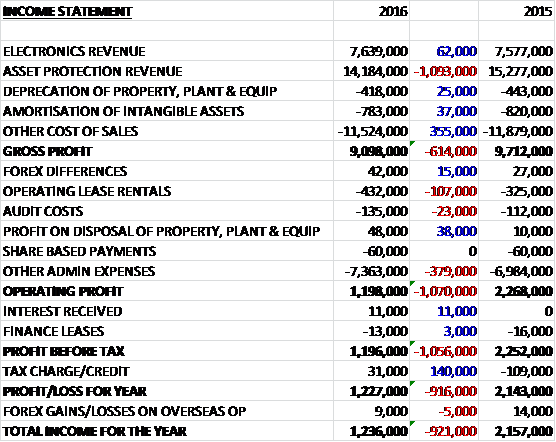
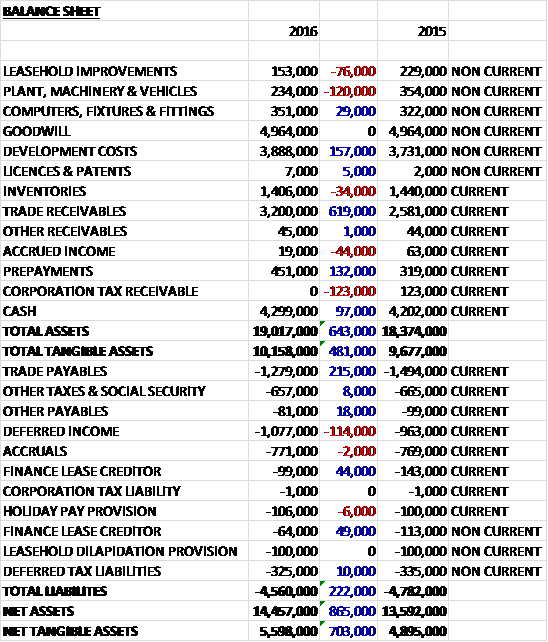
Overall revenues declined when compared to last year as despite flat electronics revenue, asset protection revenue decreased by £1.1M. Cost of sales were also down but the gross profit fell by £614K. Operating lease rentals grew by £107K and other admin costs also increased which meant that the operating profit declined by £1.1M. After finance costs were broadly similar to last year and there was a £140K positive swing to tax credits in 2016 due to tax losses brought forward, R&D allowances and the lower future UK tax rate reducing the deferred tax balance, the profit for the year came in at £1.2M, a decline of £916K year on year.

nwtassets

When compared to the end point of last year, total assets increased by £643K to £19M, driven by a £619Km growth in trade receivables, a £157K increase in development costs and a £132K growth in prepayments, partially offset by a £123K reduction in corporation tax receivable and a £120K fall in plant, machinery and vehicles. Total liabilities declined during the year as a £114K growth in deferred income was more than offset by a £215K fall in trade payables. The end result was a net tangible asset level of £5.6M, a growth of £703K year on year.

nwtcash

Before movements in working capital, cash profits declined by £1.1M to £2.4M. There was also an outflow from of cash from working capital compared to an inflow last year, mainly as a result in a growth in receivables due to the timing of sales in the months approaching the year-end, but there was a £300K positive swing in tax receipts so that the net cash from operations was £1.8M, a decrease of £2.8M year on year. The group spent £205K on property, plant and equipment along with £945K on development costs so that there was free cash flow of £649K. Of this, £182K was used to repay finance leases and £460K was paid out in dividends to give a cash flow for the year of just £96K and a cash level of £4.3M at the year-end.

The loss in the Electronic business was £452K, a detrimental movement of £500K year on year. Access Control saw a 6% growth in revenues with a clear divergence in sales of the JANUS and SATEON product lines. This was due to Microsoft’s discontinued support for the 32-bit and earlier operating systems which adversely affects the 16-bit operating system that JANUS runs on so revenues from the product continued to decline.

SATEON Pro and SATEON Enterprise both saw significant increases in revenue during the year and revenues were further bolstered by the trend for clients to migrate from JANUS to SATEON platforms. As legacy hardware can be used with SATEON there is no need to rewire a site when upgrading and end users can benefit from future-proofing without significant capex requirements. Technical and marketing tools have been developed and released to drive an upsell campaign and as a result a healthy pipeline of upgrade opportunities has been developed.

During the year SATEON version 2.9 was released which enabled on site facial recognition and verification along with further integrations. Integrations into SALTO and Aperio wireless locks launches SATEON into the wireless market and increases the chances of winning large hotel and education projects. This has been achieved by reducing the cost associated with hard-wired projects, allowing integrators to install systems into a large number of doors in a shorter amount of time.

Version 2.10 was launched in June 2016 and offers new installer and advanced search features which will streamline the management of the system. Overseas, SATEON was adopted by a major cruise line in the US with further revenues expected during this year as the roll out continues. Projects and pipeline continue to grow in the Middle East and it is expected that headcount will be increased locally to support sales. During the year a sales office was opened in Hong Kong which increased overheads.

Workforce Management revenues declined by 5.4% in the year with revenues in the UK business falling by nearly 10%, largely as a result of a decline in sales in the RS series of legacy hardware and the natural slowdown of the rollout across the estate of a large apparel retailer. New partners in the UK, US and Australia came on stream in the year and it is expected that revenues will increase as these channels begin to resell the Grosvenor proposition.

The group have scaled up their US sales and marketing resources, a new website has been launched and a number of business development activities are underway to leverage the position in the US market and attract new channel partners across North America.

The profit in the Asset Protection business was £2.8M, a decline of £568K when compared to last year. Revenues in the product division declined by 12.1% due to the forecast decline of the Post Office programme for installation of time delay cash handling equipment. Revenue from new Eclipse rising screens and screen reconfiguration work fell by 36% after the branch refurbishment programme for a long-term customer was completed during the year. Counter Shield revenue increased by nearly 45% as a result of a substantial order received from a Local Authority in London. Despite the declining Post Office contract, revenues of cash handling products to high street financial institutions increased by 71.5%.

Revenues of fixed glazing and counter protections systems increased by 45% and revenue for secure doors increased by 55% as a result of a large branch refurb programme by a long standing customer in the financial sector. Revenue for secure walling systems, however, decreased by 58% after a major supermarket chain cancelled plans to open new stores. Revenue for other non-standard products decreased by 43% after a branch closure programme by a large financial institution was suspended but export revenues increased significantly after receiving an order for 25 ballistic doors for a hotel project in Iraq.

Recertification of ballistic resistant products is planned for the current year and this will enable the group to be more competitive in local as well as international markets. Additional successful blast product testing was undertaken at the Government’s Centre for the Protection of National Interest in June 2016.
Revenue in the Service division was the highest in five years with an increase of 12% year on year. This was the result of pneumatic upgrade work on rising screens that have provided security to many financial institutions for over 25 years. The group still see an appetite to retain these systems with the benefit and safeguards they provide to staff in robbery situations. They continue to explore other revenue streams and whilst initial growth may be slow, they see cost benefits in clients using their multifaceted services. They are confident that they will be able to offer these broader services nationally over the next few years. The group have invested in improved IT over the last year and they anticipate a fall in admin costs whilst revenue capture systems improve.

Following the Brexit vote the group could be affected by a lack of confidence in the economy by their customers in the UK, potentially leading to delays in spending, but the benefit to exports should outweigh additional material cost of imports but overall it is too early to forecast the impact.

The operating profit for the current year will be significantly lower than last year. This reflected the fact the strategy of material investment in new products, new customer acquisition and new geographies has taken longer to be realised than originally expected. The opportunity pipeline continues to grow but the conversion into sales has been slower than hoped. A number of new products are to be launched during the current year including the SATEON advanced range and a new Android based terminal for workforce management, which the board are optimistic will resonate with potential customers.

At the current share price the shares are trading on a PE ratio of 9.3 which increases to 23.3 on next year’s consensus forecast. After the final dividend was kept the same, the shares are trading on a yield of 4.3% which is predicted to remain the same next year. Net cash increased from £3.95M to £4.14M.

Overall then this was a pretty difficult year for the group. Although net assets improved, profits declined and the operating cash flow reduced. Although they are still generating some free cash flow. The Electronic division is now loss-making, driven by reduction in workforce management sales as the roll-out to a large client slowed down. Asset protection profits declined in the year as the post office contract came to an end. It does seem as though the group is very susceptible to client refurb cycles so earnings are somewhat up and down.

In the coming year, profits are likely to be even lower with the forward PE predicted to be 23.3. The yield is likely to remain the same, at 4.3% but times are not easy at the moment and I am staying out for now.

On the 22nd September the group announced a trading update. Due to delays to the conversion of the opportunity pipeline and other operational difficulties, they now expect results for the current year to be materially below market expectations and they expect to report a loss for 2017.

Historically revenue in the asset protection business has varied substantially from one year to the next due to the timing of major refurbishment programmes in this financial year. The revenue stream within this division during the last few years has included substantial sales of cash handling equipment to the Post Office as part of their Network Transformation Programme. This revenue stream was expected to reduce during 2017 and the group has been seeking to replace it by broadening their product range.

Despite being appointed as UK distributor of a leading manufacturer’s doors and partitions range, new orders and sales have been considerably slower than anticipated in the first four months of this year and the pipeline and outlook for the rest of the year is not sufficient for the board to have confidence the recent slowdown will be reversed in the immediate future.

In the Electronic Division, sales of JANUS continue to decline year on year whilst SATEON revenues are increasing. SATEON revenues have nearly doubled compared with the same period last year but this has been offset by the decline in JANUS revenue. Whilst sales of SATEON enterprise level projects have outperformed expectations, penetration of the high volume mid tier market has been limited, partly due to a delayed release of the new variant SATEON. Significant revenues from this new release are now not anticipated until next year. In addition, some national systems integrators, key clients of the division, have recently issued profit warnings as projects have been delayed or postponed post-Brexit.

Workforce management sales in the UK have remained flat following the completion of the programmes in the last two financial years of roll out programmes for an apparel retailer and supermarket chain.

Further afield, performance in the Asia Pacific region continues to disappoint as the Hong Kong office tries to establish sales and distribution channels and conduct business development activities. The US office has shown 8% growth in workforce management revenue, however, which is in line with expectations. Focus remains on growing both existing customers share of wallet and establishing new channel partners, as the group prepares to launch a new Android-based WFM terminal next month.

This is a pretty dire profit warning and I am not touching this for now.

Colefax Share Blog – Final Results Year Ended 2016

Colefax has now released its final results for the year ended 2016.

cfxincome

Revenues increased when compared to 2015 as a £173K decline in decorating revenue was more than offset by a £170K growth in furniture revenue and a £100K increase in product revenue. Depreciation was up £159K but cost of inventories decreased by £1.3M to give a gross profit £1.3M above that of last year. Operating lease rentals increased by £461K and other distribution and marketing costs were up £316K. We also see a £669K negative swing to exchange losses but other admin costs fell by £248K which meant that the operating profit was flat compared to last year. Tax costs were slightly higher, however, so the profit for the year came in at £3.5M, a decline of just £67K year on year.

cfxassets

When compared to the end point of last year, total assets increased by £3M to £39.4M, driven by a £3.2M increase in cash and a £584K growth in screens and originations, partially offset by a £401K decline in other receivables. Total liabilities also increased during the year as a £772K decrease in trade payables was more than offset by a £604K growth in forward currency contract liabilities, a £269K increase in accruals and a £249K growth in payments received on account. The end result was a net tangible asset level of £26.3M, an increase of £2.6M year on year.

cfxcash

Before movements in working capital, cash profits increased by £135K to £7.2M. There was a broadly neutral working capital position compared to an inflow last year and after tax payments fell by £322K there was a net cash from operations of £5.9M, a decline of £1.2M year on year. The group spent £2.3M to give a free cash flow of £3.6M. Of this, £324K was spent on their own shares and £483K on dividends which meant that the annual cash flow was £2.8M and the cash level at the year-end was £10.1M.

The year has become progressively more challenging in all of the group’s major markets. Group profits for the first six months were up 13% to £3.3M but for the second half they were down 19% at £1.8M. Different factors have affected different markets, notably the forthcoming election in the US, higher stamp duty in the UK and weak consumer confidence in Europe. Since the year-end, the Brexit vote has created uncertainty in both the UK and Europe. At this stage it is too early to judge the extent to which the group will be affected but in the US they are experiencing more difficult trading conditions attributed to concern over the November presidential election.

In the product division, sales in the fabric business were flat but reduced by 3% on a constant currency basis and operating profit declined by 9.5% to £4.5M reflecting a generally challenging sales environment. Sales in the UK were flat during the year which was attributed to the ongoing impact of the increase in stamp duty on the high end housing market with group sales typically lagging activity. They believe that the slowdown in high end housing transactions has been partly offset by an increase in refurbishment activity on existing homes.

Sales in the US, by far the largest market, increased by 3% but were down 3% on a constant currency basis. There was a marked difference between the first and second half of the year with first half sales down 1% and second half down by 5%. The group are attributing the slowdown to concern about the forthcoming presidential election in November which has made consumer cautious at the luxury end of the market. In the current financial year they are planning to open their new showrooms in Boston and Atlanta which will give them direct control over these territories.

Sales in Continental Europe decreased by 8% on actual terms and 4% on a constant currency basis. The performance by country was very mixed but there was no overall sign of a strong recovery despite significant monetary easing by the Central Bank. In France the economy remained difficult and sales were down 8% and in Germany they were down 10% but in Italy they increased by 9%. In the smaller markets the picture was more encouraging but overall trading conditions were challenging.

Sales in the ROW increased by 4% to £2M. The Middle East, Australia, Russia and China are the largest markets but are still a relatively small part of overall sales and represent an opportunity if current market conditions improve.

Sales of furniture increased by 7% to £2.6M and operating profit increased by £92K to £263K, aided by a contract order at the start of the year. The majority of the sales are in the UK centred on London and as with the fabric business, market conditions were relatively difficult during the year.

Decorating sales fell by 2% to £7.9M but operating profits were £221K compared to a loss of £139K for the prior year. The improvement reflects a change in mix between decorating work and low margin antique sales where trading conditions have been very challenging. This autumn, the decorating division will be moving to new premises on Pimlico Road. This move represents a significant change for the business and the board are optimistic about the benefits of the new location. As part of the move they will significantly reduce the scale of their antiques operation which has experienced increasingly tough trading conditions in recent years. The decorating business had a healthy level of deposits at the end of the year.

With almost 75% of group sales made in overseas markets the devaluation in sterling represents a growth opportunity but for the current year and a portion of next, the group hedged their exposure and therefore will not benefit from the post-Brexit weakness in the currency. Despite the ongoing uncertainty the group will continue to invest in the business with confidence and have a significant year of capex with new US showrooms in Atlanta and Boston and a new Decorating division showroom and offices in London.

At the year-end, the net cash position stood at £10.1M compared to £6.9M at the end of the prior year. At the current share price the shares are trading on a PE ratio of 14.1 but this increases to 17 on next year’s consensus forecast. After an increase of 5% in the total dividend the shares are yielding 1%, increasing to 1.1% on next year’s forecast.

Overall then this has been a bit of a mixed year for the group. Profits were broadly flat but net assets did improve. The operating cash flow declined but this was due to an increase in inventories compared to a reduction last year and cash profits increased with a decent amount of free cash being generated. Unfortunately, after a strong start the performance deteriorated as the year progressed. The Furniture division gave a good performance after a contract order was received at the start of the year and the decorating division swung to a profit due to a better mix with reduced antique business.

The fabric division saw profits decline, however, which is being attributed to consumer concerns over the upcoming US elections, the UK stamp duty hike and general weak European consumer confidence. The depreciation of sterling will eventually be a bonus of currencies remain as they are but this will not be seen this year due to the fact the group has hedged against moves. The forward PE of 17 and yield of 1.1% don’t discount enough of the slowing market in my view and I am not rushing to buy the shares.

On the 15th September the group released an AGM statement where they stated that since the end of the year, trading conditions have remained relatively challenging in all of their main markets. In the core Fabric division, sales for the first four months of the year are up 4% but were down 7% on a constant currency basis. Overall this was broadly in line with expectations.

Gem Diamonds Share Blog – Interim Results Year Ending 2016

Gem Diamonds has now released its interim results for the year ending 2016.
GEMDincome

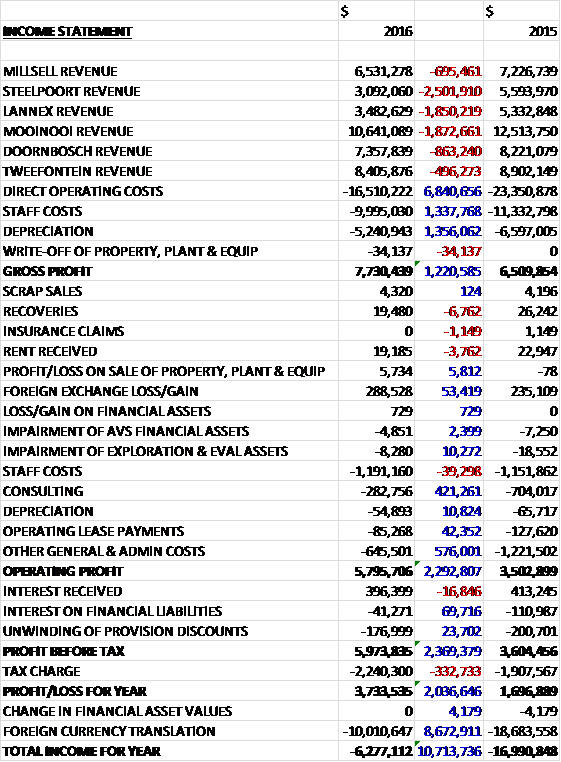
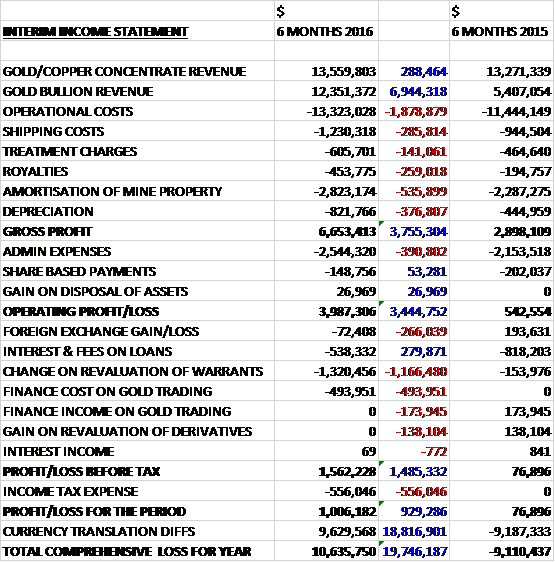
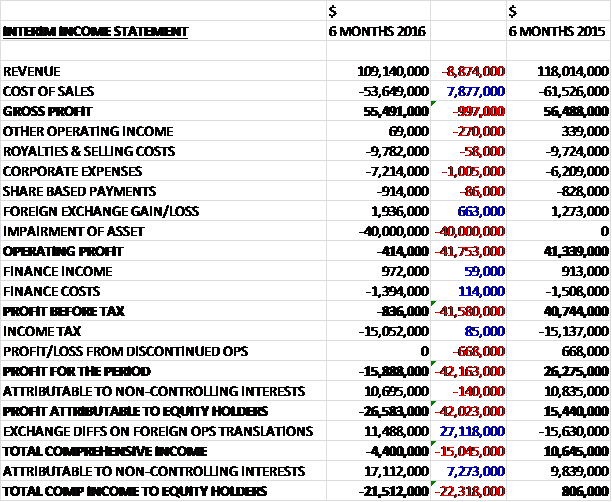
Revenues declined by $8.9M when compared to the first half of last year and after cost of sales also declined, the gross profit was down nearly $1M. Other operating income fell by $270K and corporate expenses were up $1M, although there was a $663K increase in the forex gain. After the $40M impairment at Ghaghoo, however, the operating profit fell by $41.8M to swing to a small loss. Finance costs were down somewhat and tax costs were broadly flat which meant that there was a loss for the period of $26.6M, a detrimental movement of $42M year on year.

GEMDassets

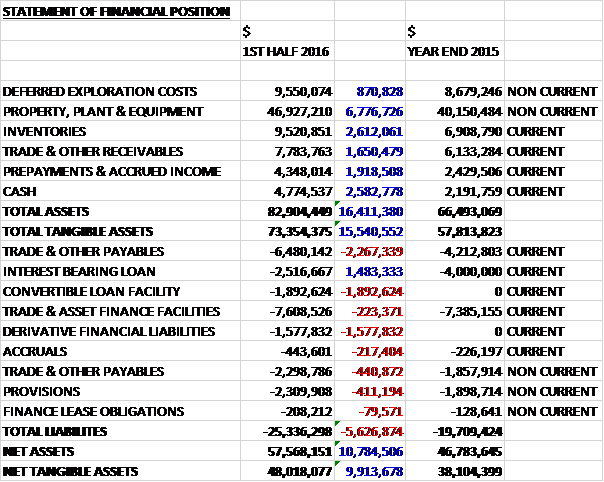
When compared to the end point of last year, total assets declined by $23.1M, driven by a £19.3M decline in cash levels and a $3.1M fall in inventories. Total liabilities also declined as a $7.9M growth in deferred tax liabilities and a $1.1M increase in provisions was more than offset by a $4.7M decline in payables, a $4.4M decrease in income tax payables and a $1.8M fall in the bank loan. The end result was a net tangible asset level of $308.1M, a decline of $22.1M over the past six months.

GEMDcash

Before movements in working capital, cash profits declined by $11.2M to $59.5M. There was a broadly neutral working capital position compared to a large outflow last time and after a $1.7M increase in interest paid was more than offset by a $9.7M decline in tax payments, the net cash from operations came in at $44.5M, a growth of $5.8M year on year. The group spent $31.3M on the mining of waste, $5.6M on commissioning costs, $6M on property, plant and equipment, and $2.8M on development costs so that before financing, there was a cash outflow of $1.1M. After dividends were paid out, there was a hefty $21.8M cash outflow for the period to give a cash level of $66.5M at the period-end.

The market for both rough and polished diamonds remained cautious. Liquidity constraints, high polished inventory levels and the uncertain macro-economic outlook continue to create challenges for the market.

The Letseng mine produced 57,380 carats during the period compared to 50,019 in the first half of last year and both waste tonnes mined and ore treated were up on H1 2015 driven by additional mining fleet being commissioned. The mine benefited from the plant 2 phase 1 upgrade project completed last year, realising an increased daily treatment rate through this plant. During the period the mine continued to implement the optimised life of mine plan, which enhances the mine’s net present value through optimising waste stripping and increasing the percentage of the higher grade, higher value satellite pipe ore available to be treated over the life of the mine.

The group achieved a grade of 1.72cpht compared to 1.61 last time. The high grades achieved are reflective of the area mined in the Satellite pipe that has historically produced higher than reserve grades, albeit at a slightly smaller average stone size. This also saw a decline in the number of 100+ carat diamonds recovered, impacting the $ per carat achieved. Since the start of July, however, two large diamonds of 104 carats and 85 carats have been recovered as mining moves to a different area.

Further optimisation of the Coarse Recovery Plant during the period included the refinement of the XRT sensitivities, improvement of feed quality and the installation of a high-tech glove box materials handling system to cater for the separation of ore concentrate streams from the two processing plant. The Coarse Recovery plant is currently operating at the designed >5mm cut off.

A capital project of $16.7M to relocate and construct a new mining fleet workshop is under review for the second half of the year. As Letseng continues to invest in the future of the operation, the new waste pushback which is required to extend the length of the open pit has been brought forward. The mining workshops, offices and related services, therefore, need to be relocated within the mining site and will allow the mine to effectively maintain the new and larger fleet of mining equipment. This project will be funded through additional external debt and an initial team sheet has been agreed with lenders.

In late July, extreme weather conditions were experienced in Lesotho where the mine is located, with excessive snowfall and severe winds limiting access to the mine. Following damage to the overhead power lines, standby generators previously installed at the mine were used to mitigate the impact, allowing the plants to continue to operate, albeit at reduced rates. The Lesotho Electricity Company repaired the damaged overhead power lines on the 10th August and the external power supply was fully restored. Given the strong performance in H1, waste tonnes mined and carats recovered remain within the original guidance and the Satellite pipe ore contribution has increased. Full year guidance for operating costs and tonnes treated have been revised, however, and stay in business capital has also been revised to account for the construction of the mining workshop.

Tonnes of ore treated will reduce to 6.6 – 6.8 million tonnes from 6.8 – 7 million tonnes and operating costs per tonne have increased from about 210 to 225 maloti. Stay in business capital has grown from around $9M to about $16M.

Four tenders were completed during the period with a total of 55,948 carats sold in Antwerp. The average price achieved was $1,899 per carat compared to a rolling twelve month total of $2,113 per carat and the figure of $2,264 per carat in the first half of last year. This was due to fewer large diamonds being recovered than usual as mining occurred in the lower value areas of the Satellite pipe.

Among the exceptional diamonds recovered during the period was an 11.8 carat pink diamond which sold for $187.7K per carat, the third highest price per carat for a Letseng diamond; and a 160.2 carat Type II white diamond which was sold into a partnership arrangement with additional participation in the final polished margin.

Going forward, the focus at the mine will be on continuing work streams on enhancing value through reducing diamond damage and progress feasibility studies for the next phase of plant enhancements; continue the implementation of a fleet management system to improve grade control, fleet optimisation and reduce operating costs; start construction of the mining workshop; extend the life of the tailings residue facility by an additional three years through lifting and strengthening the existing wall; and start the review and design of the next three-year CSI plan.

At Ghaghoo, the initial objectives of phase 1 of the development were to confirm the grade, diamond prices and recovery processes, including the use of autogenous milling, which were expected to increase diamond liberation. Based on the prevailing diamond market conditions, however, the operations has been downsized to 300,000 tonnes per annum from the planned phase 1 of 720,000 tonnes. It is anticipated that the planned output rate will be achieved in the second half of the year.

Following the cave-in which occurred in Block 1 at the end of 2015, a buffer zone was created during Q1 this year to prevent the ingress of sand into the production levels, resulting in the sterilisation of about 300,000 tonnes of ore which impacted the volumes of tonnes delivered to surface stockpiles during the period.

In all, 95,569 tonnes of ore was treated at a grade of 21.8cpht which recovered 20,876 carats. This compared unfavourably to the 132,125 tonnes at a grade of 26.7cpht and 35,283 carats in the same period of last year. The reason for this is that 77% of the ore was sourced from areas close to the contact zone of the Kimberlite pipe where there was dilution of ore as Block 1 was mined out. The establishment of Block 2 production stopes is progressing according to plan.

Work practices adopted to manage the water underground have proven effective and the development of the level 2 production level has started and is progressing in line with the plan to maintain production flexibility into 2017. During Q2, work was performed to optimise the performance of the mill which resulted in higher mill retention times and better diamond liberation. This increased the number of stones recovered in the smaller size fraction during the period and initiatives to further improve the overall efficiency of the processing plant continues. The downsizing activities progressed during the period with the operation now structured to produce at the targeted rate of 300,000 tonnes per annum.

Development of the Ghaghoo mine continues to progress with the implementation of the previously announced strategy to reduce the tonnage and associated cost structure. Despite some initial headwinds experienced in the retrenchment process where a court in Botswana ordered the reinstatement of twenty workers, and the costs associated with the premature caving experienced in 2015, it is expected that the targeted monthly cost rates will be achieved in the second half of the year. The sales of the mine’s diamonds have been impacted by the cautious state of the diamond market. Two sales were concluded during the period for $4.8M, achieving an average of $157 per carat compared to an average of $210 per carat in the first half of last year.

As a result of the continued market uncertainty, the ongoing difficult market conditions for Ghaghoo’s production, the recent strengthening of the Botswana pula against the dollar and the changes in the operation reaching targeted production rate, it was decided that an impairment of the Ghaghoo asset was appropriate. They recognised an impairment charge of $40M and although the group has taken a number of steps to respond to these conditions such as downsizing the operation and reducing cash spend, the impact and benefit of these steps have not yet been realised. The valuation remains sensitive to market conditions impacting price and any adverse changes could result in additional impairment.

Ghaghoo has still not reached commercial production so the costs are currently just capitalised, meaning the profits are probably overstated somewhat. Going forwards, the focus will be on further optimising the downsizing and managing costs to limit cash burn; continuing underground development on level 2 to ensure sustainable production at the planned rates; enhancing mineral resource data through sampling ore from VK Main; continuing plant efficiency initiatives to improve throughput; monitoring market conditions to assess expansion options; and continuous improvement of HSSE practice.

All of the group’s other major currencies were weaker against the US dollar during the period which positively impacted the dollar reported costs. The operating cost per tonne treated declined by 19% to $14.26 but in local currencies, these costs grew by 5% so it is having a substantial effect.

Letseng remained cash generative and as mining moves into the higher-value area of the Satellite pipe in H2, the cash generation is expected to improve. The focus at Ghahoo going forward will be on cost optimisation and a reduction in cash consumption.

At the current share price the shares are yielding around 5% which remains broadly the same on the full year forecast, although whether the group should be paying a dividend at all is debatable.

Overall then this has been a difficult period for the group. Even excluding the impairment profits were down, net assets fell and the operating cash flow reduced with no free cash being generated. The diamond market is cautious at the moment and Ghaghoo in particular has really been suffering. With sales prices falling from $210 per carat to $157, the mine is being downsized and has been partially impaired. There is still no sign of it entering commercial production.

Things have also been rather difficult at Letseng as moving to a different part of the satellite pipe meant that less large stones were recovered, meaning the average sales price fell from $2,264 per carat to $1,899. This was also coupled with some bad weather which increased costs as power supplies were interrupted. The good news is that the group are now mining a different part of the satellite pipe which is producing better diamonds. Despite this, the poor diamond market and the issues at Ghaghoo mean it is difficult to justify a purchase here.

On the 10th November the group released a trading update covering Q3. Whilst the overall mood of the market remains cautious, the demand for Letseng’s high quality large white diamonds has continued as prices achieved for them remained firm during the period. During the quarter, 6.6 million tonnes of waste was mined, down by 20% on last quarter as a result of the extreme weather experienced in July and August when the mining fleet was not able to mine waste for a ten day period.

Letseng treated a total of 1.4MT of ore during the period, 77% of which was sourced from the main pipe. The impact of the poor weather was partially mitigated by the ore being sourced from stockpiles on the surface, as access to the pits was unattainable, which led to a reduction in the grade recovered and the number of carats recovered fell by 17% year on year and 15% when compared to Q2 to just 24,388. These stockpiles are planned to be replenished before next winter.

Three tenders were held during the period with 37,990 carats sold for a total value of $61.54M, achieving an average price of $1,619 per carat. This lower price is a consequence of a continued deficiency of high quality large diamonds rather than a decrease in demand for these diamonds or a weakening of the market and overall, prices of the production sold during the sales period remained firm.

There were no sales of Ghaghoo goods during the period. The actions required to reduce tonnage have been completed and at the same time the costs are on a downward trend. Development of level two is continuing, however. The extension of the water bearing fissure has been encountered on level two as expected. The water has been contained by adopting practices implemented on level one and there has been no impact on production during the period.

Ore treated increased by 21% quarter on quarter to 54,337 tonnes. Planned changes to the mill configuration have been finalised and will be implemented in late November, during a planned three day shutdown. The expected improvements will have a positive impact on throughput, liberation and mill retention time.

The grade recovered during the period was 14.2 carats per tonne. This lower than forecast grade was impacted by several issues. Firstly, owing to the lower than expected tonnes treated, the mining mix was not what was planned, therefore, lower grade material was treated. Dilution was also a factor – the main source of the basalt dilution is from internal waste that has previously not been mapped. The amount of diluted material was significantly higher than anticipated but recently has seen a notable reduction in basalt dilution. Given the current market conditions for the type of diamonds that Ghaghoo produces, the ongoing development of the mine in the near term is under review.

Overall then these are fairly difficult times for the group. The Ghaghoo mine is just not financially attractive in the current market and although the price is holding up well, a lack of large diamonds at Letseng means less is being made of that mine too. Added to this the poor weather conditions, and this has been a rather weak quarter for the group and I am not rushing to buy these shares at the moment.

The overall mood of the diamond market continues to remain cautious. Demand for Letseng’s large high quality diamonds have remained firm throughout the period but the smaller commercial diamonds mined at Ghaghoo remain under pressure. The recent Indian demonetisation and high levels of polished inventory available, and because the supply of this category of diamonds will increase significantly from production of some 7M carats per annum from 2017 from several new mines, the group believes that prices for this category may remain constrained.

On the 6th February the group released an update covering trading in Q4. At Letseng, the total ore treated increased by 5% to 1,697,070 tonnes and the group recovered 26,438 carats, an 8% increase over last quarter. Seven diamonds sold for more than $1M and $109,677 per carat was achieved for a 12.31 carat pink diamond. The average price achieved per carat was $1,444, well below the $1,695 achieved in the year are a whole and a 5% reduction on last quarter as they recovered fewer large special diamonds than expected.

As mentioned, during 2016 the frequency of exceptional large diamonds being recovered was lower than expected. Following a review of the resource and operational processes, it was considered that the lack of these stones is due to the normal short term variability of the resource as was experienced during 2012. This is expected to revert to normal recovery levels in the near future. In addition, options are being assessed to further enhance recovery and reduce damage to these diamonds through a large diamond specific recovery plant. A review of the Letseng mine is currently being undertaken to further optimise the waste mining profile which will improve cashflow. This will be completed during Q1 2017 and is likely to lead to reduced waste tonnes mined.

At Ghaghoo, 67,466 tonnes of ore was treated and 12,380 carats were recovered, an increase of 60% over Q3 with a higher number of larger diamonds than typically found. During the period, 16,989 carats were sold, achieving an average price of just $142 per carat. The future of the operation remains under review with a decision scheduled to be made during Q1 2017 with regards to its current financial viability. Mill modifications yielded positive results with increased diamond liberation. They are not sufficient to sustain the operation, however, given current weak prices achieved for the diamonds.

At the year-end the group had a net cash position of $3.8M with $53.3M of undrawn available debt. So, things seem to be rather tough here. Letseng is going through a period of lower large diamonds – it is not exactly clear whether they are being found and broken or just not being encountered. Also, the bottom has fallen out of the commercial quality diamond market like those found at Ghaghoo and from the sound of it there is not much prospect of a recovery any time soon. It seems to be that this mine is likely to be mothballed with will no doubt lead to some hefty impairments. I am staying clear of this for now.

On the 16th February the group announced that they decided to put the Ghaghoo mine on care and maintenance with immediate effect. They will continue to monitor market conditions for a time when starting full production would make economic sense. It is expected that after the one-off settlement costs, this will result in an annualised care and maintenance cost of $3M. This is disappointing but not really that surprising to be honest.

Orosur Mining Share Blog – Final Results Year Ended 2016

Orosur Mining has now released its final results for the year ended 2016.

OMIincome

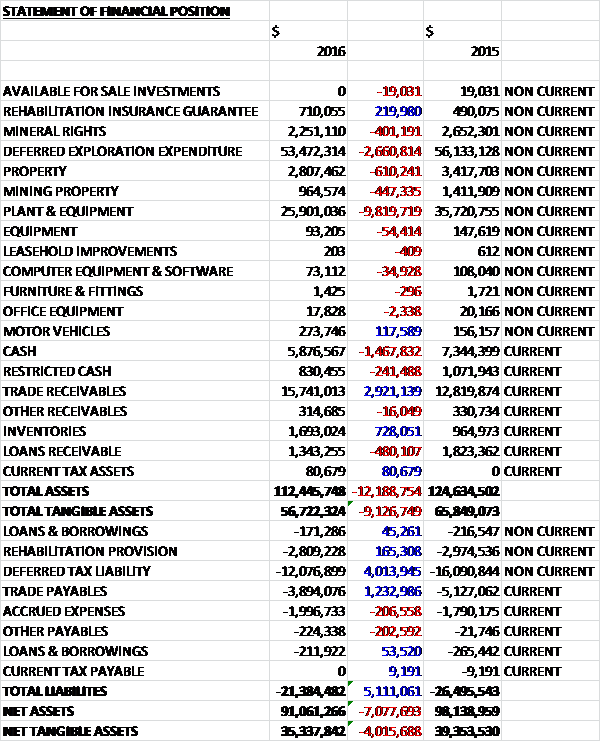
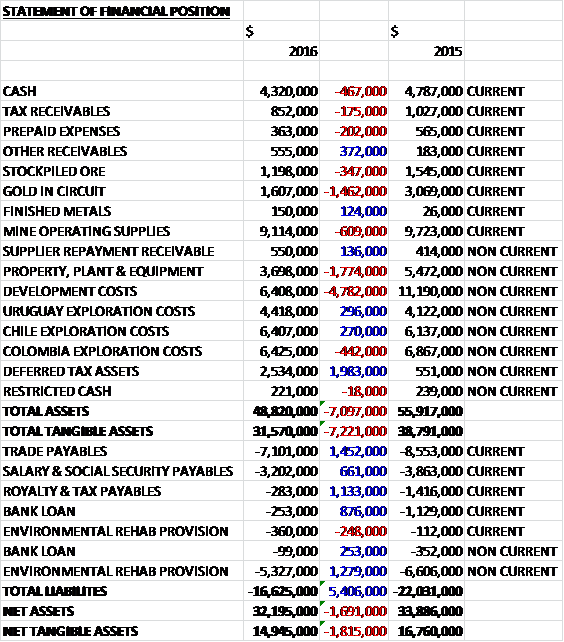
When compared to the end point of last year, total assets declined by $7.1M to $48.8M driven by a $4.8M decline in development costs, a $1.8M fall in property, plant and equipment and a $1.5M decrease in the value of gold in circuit, partially offset by a $2M growth in deferred tax assets due to increased fiscal losses. Total liabilities also fell during the year due to a $1.5M decline in trade payables, a $1.1M fall in royalty and tax payables, and a $1M decrease in the environmental rehabilitation provision. The end result was a net tangible asset level of $15M, a decline of $1.8M year on year.

OMIassets

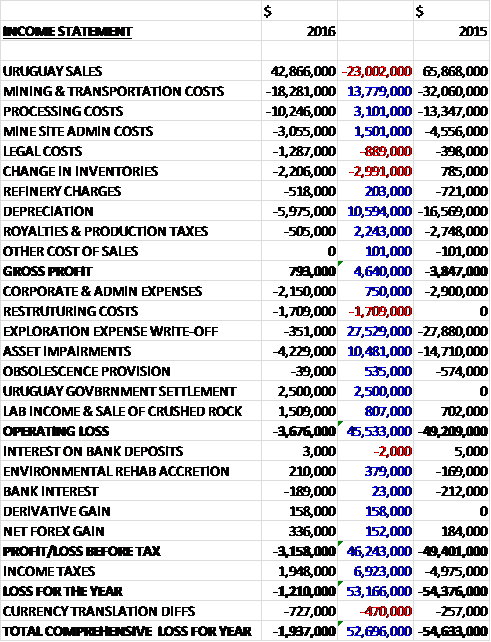
Revenues declined by $23M when compared to the prior year due to lower quantities sold and a reduced gold price, but costs were also down with mining costs falling by $13.8M, processing costs down $3.1M, mine site admin costs falling by $1.5M, depreciation down $10.6M due to the prior year impairments and lower production this year, and royalty costs falling by $2.2M due to the exemption granted during the year. This gave a $4.6M improvement to gross profit. Corporate expenses fell by $750K but there were $1.7M of restructuring costs. Offsetting this, there was a $2.5M government settlement and an $807K growth in other income.

The big movements, however, were a $27.5M reduction in exploration costs written off and a $10.5M decline in asset impairments to give an operating loss $45.5M lower than last year. We then see a forex gain, a derivative gain and a $379K positive swing in the environmental rehabilitation accretion. There was also a $6.9M positive swing to a tax credit relating mainly to deferred tax, relating to the depreciation of the Uruguayan Peso and the effect this has on the value of assets, along with the recognition of $2.5M of deferred tax losses on the basis that sufficient taxable profit will be generated in order to utilise the benefit of the losses, to give a loss for the year of $1.2M, a positive movement of $53.2M year on year.

OMIcash

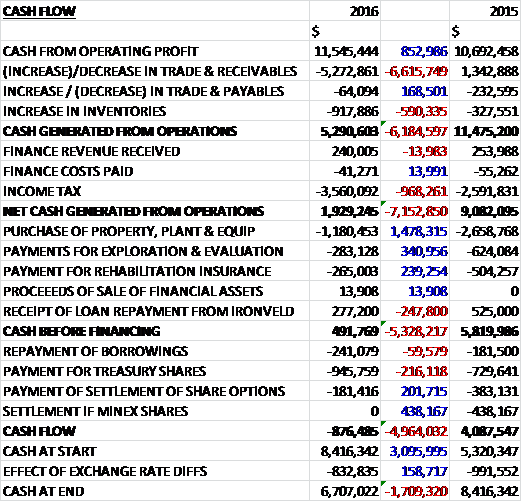
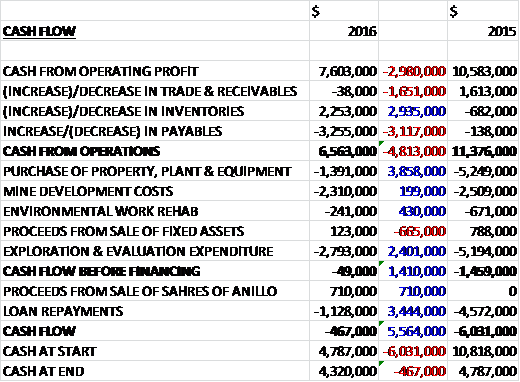
Before movements in working capital, cash profits declined by $3M to $7.6M. There was a modest cash outflow from working capital with a decrease in payables so the cash from operations came in at $6.6M, a decline of $4.8M year on year. The group spent $1.4M in property, plant & equipment; $2.8M on exploration expenditure and $2.3M on mine development costs to give a cash outflow of $49K before financing. The group brought in $710K from the sale of Anillo shares and repaid $1.1M of loans to give a cash outflow of $467K for the year and a cash level of $4.3M at the year-end.

Production for the year was 35,773 ounces of gold, above the stated guidance of between 30,000 and 35,000 ounces but below the 53,485 ounces produced last year as a result of the implementation of a new strategic plan in response to the lower gold price environment in H2 2015. During the year, 1,013,104 tonnes of ore was processed at a grade of 1.19g/t compared to 1,212,463 tonnes at 1.48g/t last year; and 925,583 tonnes of ore was mined at a grade of 1.24g/t compared to 1,182,457 tonnes at 1.5g/t last year. Some of the planned high grade stopes of Arenal could not be mined during Q4 and as a consequence, minor grade ore from other sources was processed, meaning the average grade processed in Q4 was just 0.96g/t. The high grade material of Arenal was delayed until June, which has already been recovered during this month.

The average gold price realised for the year was $1,154 per ounce, a decrease of 6% year on year. All-in sustaining costs were $1,069 per ounce, a reduction of 10% when compared to last year and in line with prior guidance. In the second half of the year, costs were $978 per ounce in Q3 and $971 per ounce in Q4 after the implementation of a strategic plan to reduce costs and ensure more profitable production.

During the year, geological and engineering development activities were mostly focused on the start-up of the SGW underground project, the second mechanised underground mine in Uruguay, after Arenal. It is a continuation of the San Gregorio open pit deposit which, to date, has produced more than 500K ounces at an average grade of 2.1g/t.

Capex is expected to be minimised and personnel and equipment have started to be shifted from Arenal to San Gregorio. By phasing the development with the closure of Arenal Deeps, the group intends to fund the development with internal cash and cash flow, although there are risks to this approach. It is anticipated to start production by the end of the first half of 2017. The plan for 2017 is to accelerate the definition of resources and reserves in areas such as San Gregorio East UK, SG West UG and Argentinita UG.

San Gregorio East is a sector contiguous to the SGW UG project where the group is aiming to drill a further 3,000m aimed at increasing and validating reserves. The group has completed the first drill hole in this programme, intercepting attractive mineralisation over a significant interval. They also aim to further explore a potential San Gregorio West underground extension located at depth, below the portion of the reserve base which will be put into production and mined in 2017. The deposit in this sector is open at depth and the group will conduct six dee drill holes to test the area below. Historic drilling at this location has demonstrated promising mineralisation and mineralised intervals. At the company’s Argentinita UG development project, 27K ounces of maiden reserves have been delineated and a drilling campaign is planned with the intention of increasing and upgrading this reserve.

The Veta Rey open pit remains in production. In recent months, the mine has supported plant ore feed while SGW UG is being developed. At the same time, Veta Rey provides waste material which is used in the construction of a new tailings dam phase, further optimising loading and hauling costs. The Veta Rey open pit has produced about 14K ounces over the past two years. As in the case of Veta Rey, the group’s suite of open pit projects in Uruguay are currently being re-evaluated for potential development and production activities in the higher gold price scenario present at the moment. Based on internal analysis, some targets at Santa Maria and Peru appear to be economic at or around $1,300 per ounce, which could result in additions to the mine plan of around 10K to 12K ounces.

During the year, exploration activity was concentrated on brownfield activity near the current mines, while some of the most promising exploration projects and targets were re-evaluated during the year. This work has enabled the group to put forward a solid work plan for 2017 with the objective of further consolidating and extending mine life. As a result of insufficient mineralisation encountered during exploration drilling, the previously announced Arenal Repetition exploration project has been discontinued.

In Southern Uruguay, a number of high grade, low tonnage targets were identified for treatment and processing in the San Gregorio plant, as part of the group’s approach to extend mine life. The permitting process for confirmatory and exploration drilling at these projects is currently underway.

As far as capex was concerned, the group invested $3.9M in capital and $2.8M in exploration. The construction of phase 3 of the second tailings dam was finalised during the year as well as additional investment in the repair of heavy equipment, and the development of Arenal Underground and the San Gregorio Deeps project. The efforts to meet the new guidance were accompanied by cost reduction measures across the group’s exploration activities. At the San Gregorio Deeps project, the fortification of the entrance to the main ramp was concluded at the end of the period and the preliminary system ventilation to the tunnel was in place. First blasting at the portal was started in May 2016.

Permits for San Gregorio Deeps were granted from the mining authority during February 2016 and the group is planning to have SGD operational during 2017 and therefore development work has already started in Q4. First blast took place in May 2016 and the company will not require sourcing of additional non-dilutive project funding for as it will be financed from cash from operations.

At the high-grade Anza project the group is currently evaluating a number of options in advance of the project. They are generating a geological model and carrying out some exploratory metallurgical tests. The project includes two small underground gypsum mines which have their environmental and mining permits already granted by the Colombian authorities. This constitutes a strategic element of the project as it gives the possibility to fast track an extension of those permits for a future gold mining operation. These gypsum mines have been operated by a contractor and the group is in the process of taking over operatorship.

At Anilo, in June 2015 the group signed the definitive option agreement for the funding of the next phases of exploration with Asset Chile. The agreement defines a non-dilutive financing of up to $3.5M to advance the exploration of Anillo and states that Asset Chile may earn up to a 40% interest in the project. In July 2015, Asset Chile invested $850K to funding of the phase 1 of the exploration while the group placed $100K to complete the budget.

A total of 21.5km of ground geophysics and 3.6km of reverse circulation drilling were carried in late 2015 to test five targets. The results demonstrated the presence and continuity of Au-Ag mineralisation in three zones related to high and low sulphidisation epithermal systems, which have been passed to the delineation stage. A pipeline of six Au-Ag opportunities have been defined at the property, including three areas coming from indicative old works of the company.

During July 2016, Asset Chile requested an extension until March 2017, which the company accepted, to allow them to decide on exercising their option to move to phase 2. In this period, Asset Chile will contribute $120K to cover the minimum expenditure in Anillo and they need to complete their contribution to phase 2 (up to $1.25M to fund 5,5km of RC drilling) in order to earn a 32.5% interest of the group’s share in Anillo. In the case that they do not complete this phase 2, they will lose their earn-in achieved to date.

At Pantanillo, none of the annual minimum amounts were paid as Anglo American granted an extension to December. Last year the group recognised an impairment charge with regards the project of $25.5M. The group decided not to fulfil the payment of advanced royalties totalling $1.6M due to Anglo by December which triggered a process for the properties to be returned to Anglo, a process that is ongoing.

At Talca, during the year the group conducted a property review to try to generate value from the asset. Some field work was undertaken to raise relevant information and the property was presented to potential partners and investors. At Noletir in Uruguay, as of the year-end the parties were waiting for the Government’s grant of new mining licenses in order to continue with the exploration campaign and on this basis, Noletir has requested an extension to the December 2015 deadline.

At the Chamizo gold project in southern Uruguay, in November 2015, Minerales Cala gave notice to the company of the completion of its expenditures and reporting obligation with respect to phase 2 of the option agreement thereby earning an additional 29% interest in the project for a total of 80%. Simultaneously, they requested and the company granted its consent to enter into an option agreement with Patagonia Gold to transfer in a phased manner their interest in the project. In January 2016, the agreement was exercised and as a result, Patagonia has been funding Minerales Cala’s expenditures for phase 3 of the project. As of the year-end the group retained a 20% interest and phase 3 of the option agreement had started and exploration work carried on based on a proposed programme submitted for the first half of 2016.

At the Isla Cristaline Belt, Gladiator has notified the group f its completion of the work contemplated by phase 2 and in June 2015 they submitted a statement of expenditures. In September 2015, due to a number of objections concerning these expenditures and an ongoing dispute between the parties, the group requested an audit of the statement. By the end of the month, Gladiator notified the group that they do not intend to complete phase 3 of the option agreement and therefore that phase 3 has expired. Once the audit of the phase 2 expenditures has been finalised, the parties will be required to renegotiate a new joint venture agreement in order to continue with the development of the project.

During the year the group completed an assessment of the carrying value of its CGUs and recorded an impairment charge of $4.2M relating to underground development costs and driven by changes in reserve estimations as the company enters the final stages of the Arenal Deeps project. It is expected to reach the end of its mine life by mid-2017. The group also undertook a sensitivity analysis to identify the impact of changes in long-term pricing. They believe a 10% change in the gold price assumption will not have an impact on the estimated recoverable amount, although a 10% reduction in the gold price would reduce profits by $4.2M with the opposite being true. The group have also hedged about 2,200 ounces of gold at a forward price of about $1,258 per ounce.

In April 2013 the group made a prepayment of $550K to a supplier to start the raiseboring of the Arenal underground. The supplier was unable to provide the services so as a result the group initiated actions to recover the amount and a positive arbitration award was received in April 2014. As defence the supplier filed for judicial review of the award offering as counter-guarantee equipment valued at $600K. In May 2016, the defence was dismissed and the court ordered the freezing of the supplier’s bank accounts and the valuation of the equipment to sell it at auction. The group expects to recover the amount in addition to damages and fines.

In December 2015, the president of Uruguay granted the group an exemption on the royalty payment to the government (3% of sales) covering the period from April 2015 to March 2016.

The group has $1.5M of undrawn line of credit with Santander available as of the year-end and the board believe this to be more than adequate given the current gold price environment.

The group’s forecast production guidance for 2017 is increased to between 35,000 and 40,000 ounces of gold at operating cash costs of between $800 and $900 per ounce. This is an improvement on this year as they expect to benefit from the savings generated by the ongoing optimised operations as well as higher grades from the underground project which will be offsetting external factors such as inflation in Uruguay. The group expects to maintain the level of savings achieved and plans to continue its operational improvement programme focused on sustainable cost cutting measures and driving ongoing operational efficiencies.

As the group is still loss-making, we can’t really get much from PE ratios but on next year’s consensus forecast, they are trading on a future PE ratio of just 2.4.

On the 23rd August the group announced that non-executive director, Pablo Marcet sold 1,000,000 shares at a value of £188K. He retains 1,215,338 shares in the company.

Overall this was a mixed year for the group. They are still loss making due to continued impairments but the performance has improved year on year. Net assets declined, however, as did the operating cash flow with no free cash being generated, although it should be noted that the group is not losing too much cash. Gold production reduced this year as expected due to the lower gold price environment at the time but the grade reduced in Q4 due to the higher grade stopes of Arenal not being able to be mined, although this has now been rectified.

The average gold price was below that of last year but it has since recovered and the reduced costs of $971 per ounce in Q4 look pretty decent. The forward PE of 2.4 looks very cheap but I am rather nervous over the phasing f the San Gregorio pit start-up. There is very little room for error and I would have thought there is some risk here. Probably a bit too much risk at these prices.

Empresaria Share Blog – Interim Results Year Ending 2016

Empresaria has now released its interim results for the year ending 2016.

EMRincome

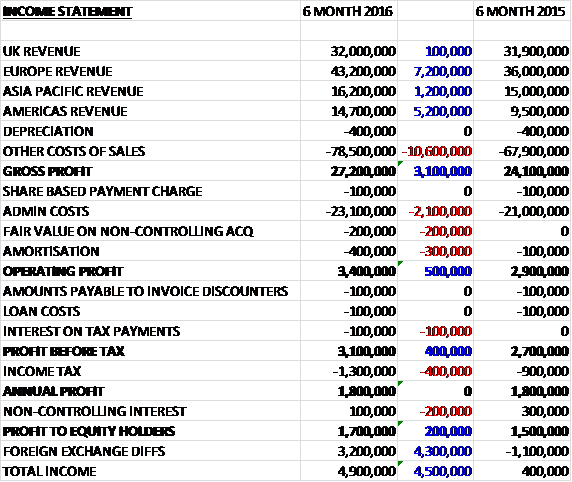
Revenues increased when compared to the first half of last year with a £7.2M growth in Europe revenue, a £5.2M increase in Americas revenue and a £1.2M growth in Asia Pacific revenue. Cost of sales also increased to give a gross profit £3.1M ahead. Admin costs grew by £2.1M, amortisation was up £300K and there was a £200K charge relating to a change in fair value on non-controlling interests so the operating profit grew by £500K. There was also a £100K interest charge on late tax payments and income tax increased by £400K reflecting higher levels of prior year charges and a change in profit mix from different tax areas which meant that the profit for the period came in at £1.7M, a growth of £200K year on year.

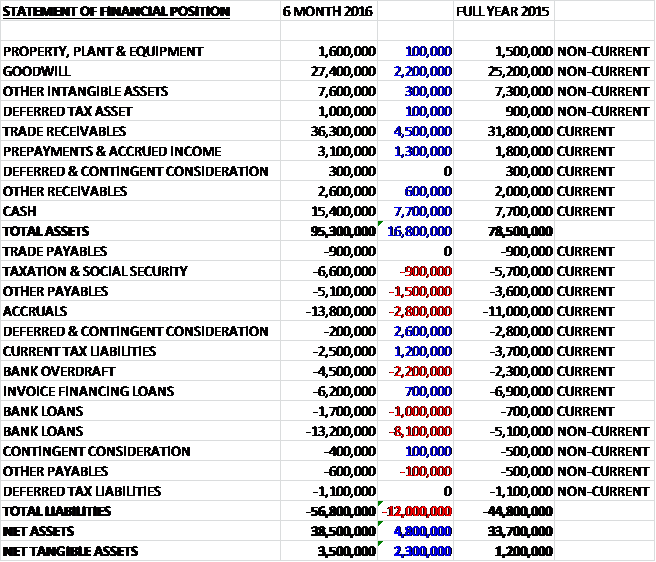
EMRassets

When compared to the end point of last year, total assets increased by £16.8M to £95.3M, driven by a £7.7M growth in cash, a £4.5M increase in trade receivables, a £2.2M growth in goodwill and a £1.3M increase prepayments and accrued income. Total liabilities also increased as a £9.1M increase in bank loans, a £2.8M growth in accruals, a £2.2M increase in the bank overdraft and a £1.5M increase in other payables was partially offset by a £2.7M decline in deferred consideration and a £1.2M fall in current tax liabilities. The end result was a net tangible asset level of £3.5M, an increase of £2.3M over the past six months.

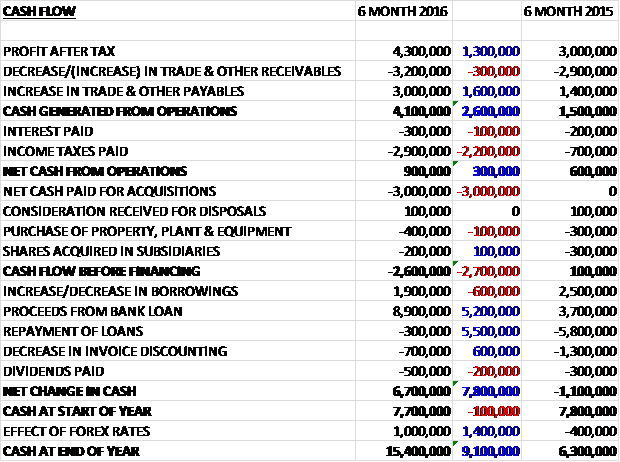
EMRcash

Before movements in working capital, cash profits increased by £1.3M to £4.3M. There was a slight cash outflow from working capital but a higher increase in payables than last year was offset by a £2.2M increase in income tax payment, partly relating to a German tax review, to give a net cash from operations of £900K, a growth of £300K year on year. The group spent £400K on tangible assets, £200K on acquiring non-controlling interests and £3M on acquisitions so before financing there was a cash outflow of £2.6M. We then see a net £8.6M brought in from new loans and a £1.9M increase in other borrowings to give a cash flow of £6.7M for the period and a cash level of £15.4M at the period-end.

The operating profit for the UK business was £500K, a decline of £500K year on year with temporary sales up 1% and permanent sales down 1%. The growth in temporary sales was helped by a good performance in the Technical and Industrial sectors. There was also temporary sales growth in Professional Services, although this was offset by falls in permanent sales. Since the global financial crisis the businesses in this sector have diversified away from a primary focus on financial services, so are now better placed to deal with any slowdown. In the IT & Digital sector, the group made changes to the senior management teams which is having a short-term negative impact on profitability but is necessary to reposition the business on a growth trajectory.

The build up to the EU referendum led to a slowdown in May and June as business confidence dropped and hiring decisions slowed. Following the Brexit vote, the market has stabilised and sales pipelines are holding up well, but it remains too early to see what impact this will have on the businesses for the rest of the year. The bulk of the fall in operating profit was due to increased costs in staff and rent so given the current market conditions, the board are closely monitoring the situation with a focus to reduce costs if trading levels drop in the second half of the year.

The operating profit for the Continental Europe business was £1.8M, a growth of £800K when compared to the first half of last year, helped by positive movements in exchange rates. Both divisions are up on the prior year with the logistics services division growing NFI by 12% through greater client penetration and the temporary division growing by 20% with a focus on investing in new staff and training to develop new sector coverage Market conditions in Germany remain positive.

As previously highlighted, new legislation has been announced in Germany to be implemented in January 2017, which will limit the time a worker can be a temporary worker at the same client to 16 months. The group are working on plans to address this. In the Finnish Healthcare business, results are following a positive trend but they continue to operate in a weak economic market. Cost reductions made last year are helping to improve profits with NFI flat on a constant currency basis.

The operating profit for the Asia Pacific business was £900K, an increase of £100K when compared to the first half of 2015 with both temporary and permanent sales up, aided by positive forex movements (constant currency revenue growth was just 0.5%). The best performers were in Japan, China and India. China has seen significant growth following a restructure of the team in the second half of last year, with a focus on the local Shanghai market and showing no signs of being impacted by the wider Chinese economic slowdown.

The economic conditions in SE Asia have been mixed, with the Executive Search brand in the Philippines and Malaysia seeing growth, but Indonesia and Thailand down year on year. The training business in Indonesia has stabilised, with cost reductions made last year offsetting a small drop in NFI. In the Middle East the fall in the oil price has negatively impacted business confidence and the market has seen a slowdown in the first half of the year. NFI in the region was down 27% in what is purely a permanent market, but costs have been reduced in line with the reduced trading and the board expect the business to remain profitable this year.
There are a number of important infrastructure projects that are expected to be started by the end of the year, being work to get Dubai ready for the Expo 2020 and in Qatar for the football work cup in 2022. Whilst some of this work has been postponed due to local economic conditions, the timetable requires work to start in earnest shortly which should provide a boost to the local staffing market next year.

The operating profit for the Americas business was £200K, a growth of £100K year on year reflecting a full contribution from the Pharmaceuticals Strategies business. The new business has performed in line with expectations and has started work with a number of new clients which should help generate growth over the next 18 months. In Chile the group have seen good growth in their seasonally stronger half year. Over the past couple of years the group have focused on developing temporary and permanent sales services to complement the traditional outsourcing business. This is progressing well, helping revenue grow 19% on a constant currency basis and the outsourcing business is growing through greater client penetration. The start-ups in Mexico and Chile in Executive Search are progressing, although it takes time to get tractions with new office openings.

During the period there was a positive impact on profits due to the relative weakness of sterling against various other currencies, although the currency was actually stronger against the Indian Rupee, Chilean Peso and Thai Baht. As of the period-end, all of the major currencies the group operate with had strengthened against Sterling, ranging between 9% in India and 28% in Japan. If currency rates remain at these levels throughout the rest of the year, there would be a greater positive translation effect in the second half of the year.

In April the group increased their interest in Ball & Hoolahan from 75% to 100%, acquiring from the founder who left the business as part of a planned transfer of ownership. The consideration was £200K, all paid in cash. In June they increased their shareholding in Monroe (Executive search in Thailand) by 10%, taking it up to 70%. The consideration of £200K was paid in cash and a £200K fair value charge has been recognised in the income statement. They have also finalised a second generation plan in Germany, with four managers buying up to 16% shares in their respective legal entities of Headway. These shares only create value if the profits exceed historic levels.

After the end of the period, in July, the group invested in an 82.6% share of Rishworth Aviation, an international specialist recruiter in the Aviation sector with offices in New Zealand and Sweden. The total consideration was £7.5M which was fully paid in cash on completion. The remaining 17.4% interest in the business is held by senior management. The business had net liabilities of £451K so the acquisition generated goodwill of nearly £8M. It is expected to be earnings enhancing on an adjusted basis this year.

At the period-end, net debt stood at £10.2M compared to £7.3M at the end of last year. During the period a new five year UK revolving credit facility of £10M was entered into. At the period-end, £6M had been drawn down in readiness for the investment in Rishworth Aviation. The bank loans include a £4.5M UK term loan which matures in October 2018. They also include a €5M term loan in Germany which expires in February 2018 and in total the group has £15.4M of bank facilities undrawn.

The group continue to look for suitable external investments to fill in gaps in their sector or geographic coverage with a pipeline of prospects. The board see strong growth opportunities across the group and remain confident in their ability to deliver increasing profits and their ability to meet market expectations in the current year.

At the current share price the shares are trading on a PE ratio of 11.7, falling to 9.5 on the full year consensus forecast. As usual there is to be no interim dividend paid which means the yield remains at 0.9%, increasing to 1% on the full year forecast.

Overall then this has been a fairly good period for the group. Profits were up, net assets increased and operating cash flow improved, although the group still seems unable to be able to make any free cash. The performance in the UK was not so good, being affected by extra costs associated with senior management change, and a slowdown in the run-up to the EU referendum, put the performance elsewhere was much better.

There was a strong result from the rest of Europe, in particular Germany, although the new legislation on temporary workers in the country is a concern as it looks likely to affect the group. The performance in Asia Pacific was good, with growth from Japan, China and India, although the low oil price is having an effect on the Middle East market. There was also growth in the Americas as Pharmaceutical Strategies started contributing. There are also currency tailwinds currently for the group as they benefit from weak Sterling.

I do think the debt is a bit high for my liking, however, especially following the Risworth acquisition and it concerns me slightly that they are already lining up more acquisitions. The forward PE looks good value at 9.5 but this probably excludes acquisition costs and amortisation etc. This is a tricky one, it looks pretty decent value and the diversification is great but I am concerned they are over-stretching the balance sheet a bit.

On the 6th October the group announced that it had purchased a 65% interest in ConSol Partners for a cash consideration of £9.4M. The remaining 35% will be held by the senior management team. The business is a specialist recruitment group in the IT sector with a focus on the niche sectors of communications & mobile, cloud technologies and the digital supply chain, operating in the US, UK, US and Continental Europe. They provide both contract and permanent staffing services with 57% of NFI coming from contract services.

The business made a pre-tax profit of £1.2M last year on revenues of £23.4M. The board believes the investment will be earnings neutral on adjusted basis this year and earnings enhancing in its first full year of ownership. The initial cash payment on completion is £4M with a deferred amount expected to be about £5.4M. The transaction has generated goodwill of around £6.7M. The investment will be funded by the existing revolving credit facility but debt levels have now increased above the board’s target. Both debt and the balance sheet are not too rich for me so I am not investing until this changes.

On the 24th January the group released a trading update covering the whole year. Full year profitability will be slightly ahead of market expectations. Adjusted pre-tax profit growth is expected to be 23% year on year, NIF 20% ahead and EPS up 12%.

There were strong performances across the group with Headway in Germany, Skillhouse in Japan and Monroe in SE Asia all delivering solid growth year on year. In addition, the group’s business in Finland, Australia, China, India, Chile and the technical and industrial brands in the UK performed well.
Following a short period of uncertainty in the UK prior to the EU referendum, the UK region has seen stable activity levels return. Overall in the UK this has led to profitability being down year on year but the group has reduced costs and is encouraged by the business activity as the move into 2017. In the Middle East, the weak economic conditions persisted in H2 and expected improvements did not materialise. The business has been restructured accordingly and the group expects an improved result in the coming year from the region.

The group’s US investment, Pharmaceutical Strategies, is integrating well having won a number of new clients and improved penetration across key clients. The decision during the year to invest in their management team and their largest client having reduced its overall spend on staffing requirements has resulted in a short-term impact on profitability. Despite this, the business continues to see good growth opportunities going forward.

In July they acquired Rishworth Aviation and ConSol in October. Both businesses are performing well and demonstrating positive growth potential for the coming years. This all sounds fairly positive but I want to see some actual figures to ascertain the state of the balance sheet which was one of my main concerns last time.

On the 3rd May the group released a trading update. They made a solid start to the year, delivering year on year growth in NFI in Q1 across all four regions. Both Rishworth Aviation and ConSol Partners are performing well and the board are pleased with their integration. They remain on course to meet market expectations for the full year.

On the 21st July the group released a trading update covering the first half of the year. NFI was up 26% with the strongest trading in the UK, Europe and Asia Pacific regions. The group is on course to meet market expectations for the full year.

The recent investments in Rishworth and ConSol have been integrated into the group and the board is pleased with their contributions so far. In Rishworth Aviation the group has invested in setting up new bases for key clients that are expected to deliver growth in terms of pilot recruitment in the coming years. At ConSol, they have invested in the US office which is expected to benefit the business in the second half.

Wentworth Resources Share Blog – Interim Results Year Ending 2016

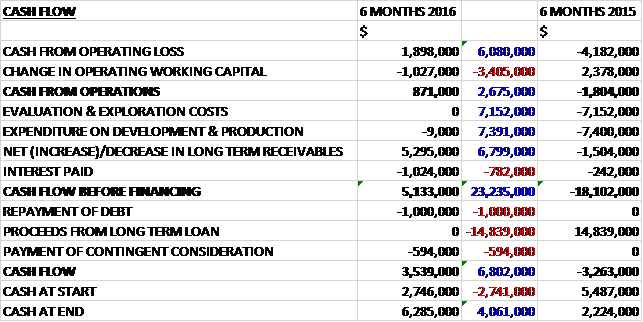
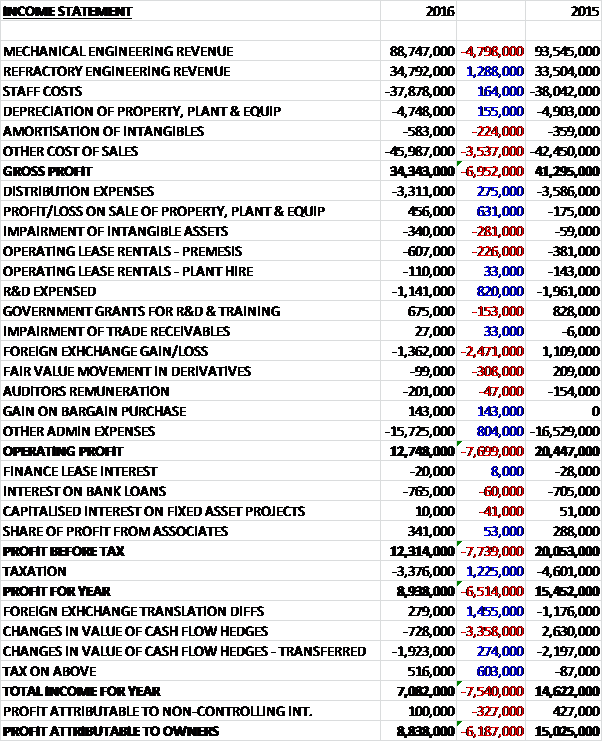
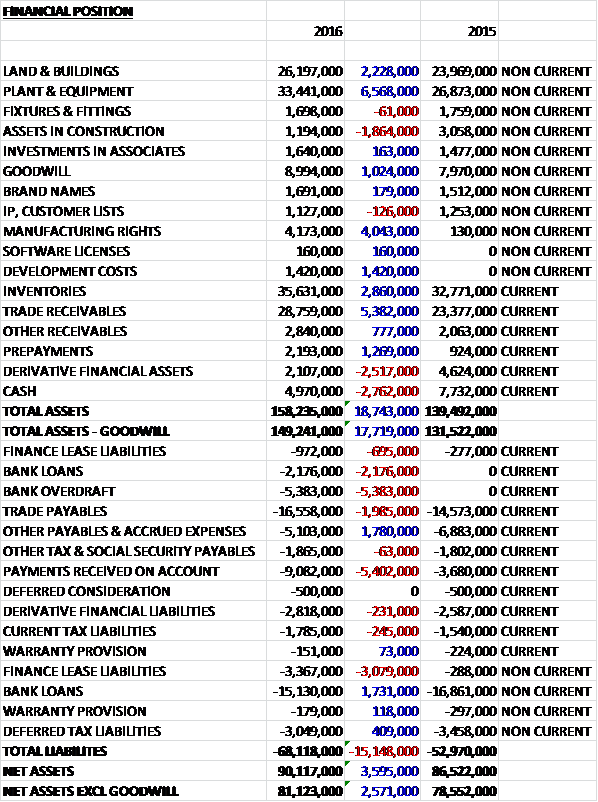
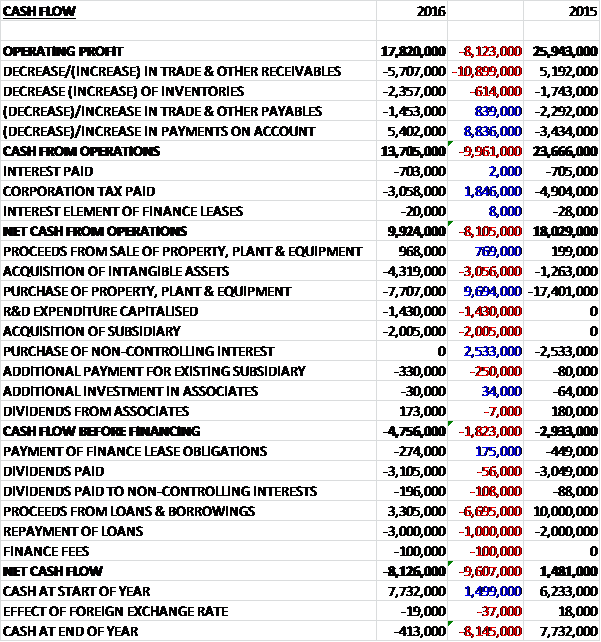
Wentworth Resources has now released its interim results for the year ending 2016.

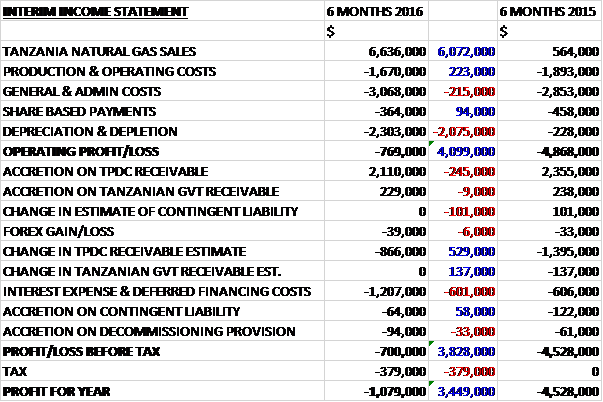
WRLncome

Revenues increased by $6.1M when compared to last year and a production cost decline was offset by an increase in admin costs before a $2.1M depletion charge due to the fact the group is now delivering gas to the pipeline meant that the operating loss declined by $4.1M to $769K and included a net expense of $600K relating to the estimated cost of settlement of ongoing TRA tax audits of historical years of operations. There was a $245K decrease in the RPDCC receivable accretion and a $601K increase in interest costs but the reduction in TPDC receivable estimate fell by $529K. After a maiden tax charge of $379K, the loss for the period came in at $1.1M, an improvement of $3.4M year on year.

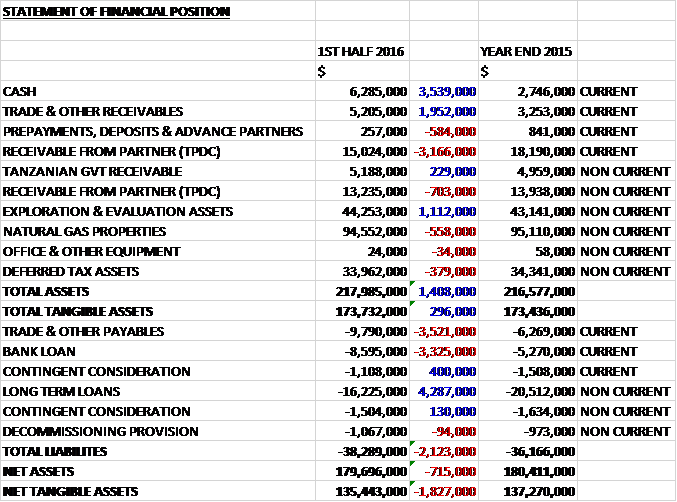
wrlassets

When compared to the end point of last year, total assets increased by $1.4M to $218M driven by a $3.5M growth in cash, a $2M increase in receivables and a $1.1M growth in exploration and evaluation assets, partially offset by a $3.8M fall in the TPDC receivable. Total liabilities also increased during the period due to a $3.5M growth in payables. The end result was a net tangible asset level of $135.4M, a decline of $1.8M over the past six months.

WRLcash

Before movements in working capital, cash profits increased by $6.1M to $1.9M. There was a cash outflow from working capital, however, so the cash inflow from operations came in at $871K, a positive movement of $2.7M year on year. The group also brought in $5.3M from a reduction in the long term receivable and paid $1M on interest payments, although there was no capex during the period. After a $1M debt repayment and a $594K contingent consideration payment, the cash flow for the half year was $3.5M and the cash level at the period-end was $6.3M.

The Tanzania operations showed a profit of $843K for the half year period compared to a loss of $2.6M during the first half of last year. The group achieved an average gross daily gas production of 51MMscf in Q2 compared to 48MMscf in Q1. In the period as a whole, gas sales to the pipeline was 2,037,502MMBtu compared to zero in H1 last year. Sales to the Mtwara power plant were 95,270MMbtu compared to 105,194MMBtu in H1 last year.

Commissioning of the four turbines at the newly built Kinyerezi-1 power station was completed during Q2. Ubungo II power generation facilities and the Mtwara power station were nearing full operational capacity at the end of June while Symbian power generation facilities were not in production at the end of the period. At full operating capacity, the Kinyerezi-1 power station is expected to utilise 25-30MMscf per day of gas, Ubungo II and Symbian power plants 45-50MMscf per day and the Mtwara power plant about 2.2MMscf per day, equating to a total average of between 70 and 80MMscf per day.

The Symbion power plant is an independent power producer and has been shut down since June due to a contractual dispute with the Tanzanian government. It is uncertain as to how long it will remain idle but as the onset of the hot season approaches, power demand is expected to increase and TANESCO is expected to require the station to be operational so hopefully the dispute will be resolved this year.

During the coming year, the remaining new field infrastructure will be completed, including the installation of two liquid separation units at the Msimbati gas processing facility which will allow Mnazi Bay gas to be delivered to the pipeline in accordance to agreed specifications. Most of the wells have already been tied into the pipeline but MB-1 is still producing just 2MMscf per day which fuels the TANESCO-owned 18MW Power Plant in Mtwara and will be tied into the pipeline infrastructure during H2.

Subject to further testing of deliverability from the existing wells and the drilling of additional development wells, as deemed necessary, the group expects gas sales into the pipeline to increase to 130MMScf per day to meet the anticipated growth in gas demand resulting from expanding gas to power generation infrastructure, primarily through the completion of Kinyerezi I expansion.

During Q2, work continued on the expansion of the joint venture owned processing facilities at Msimbatri and is expected to be completed in Q4. The board expect the cost of exploration activities in the country to be fully funded from internally generated cash flow.

The Mozambique operations incurred a loss of $384K, an increase of $167K year on year. In June the government approved an appraisal plan for the Tembo gas discovery. The plan covers a two year period with the group being approved as the operator of the Rovuma onshore block with a participation interest of 85%. State-owned ENH retained a 15% participation interest as a carried partner through the start of commercial operations. In addition, ENH has the right to acquire a further 15% participation interest in the block within 18 months from the date of submission for a development plan for consideration equal to the proportionate share of past costs incurred.

The plan includes the reprocessing and re-interpretation of existing seismic followed by further acquisition of seismic if warranted with the aim of identifying a suitable drilling location. The re-processing of existing seismic will focus on the sands encountered in the Tembo gas discovery and subject to the results of this work, additional seismic may be acquired in Q3 2017. Drilling of an appraisal well will start in 2018 subject to a suitable location being identified. It is expected that the work programme in the country will be funded through internally generated cash flow as available and through the addition of industry partners.

During the period, capital spending totalled $2.2M, primarily incurred in respect of field infrastructure and development capital activities within the Mnazi Bay gas field location. In Mozambique, exploration costs of $1.1M include the assumption of drilling materials upon assuming operatorship of the Rovuma block during Q2. There are currently no exploration capital commitments and budgeted development capital is limited to the completion of Mnazi Bay infrastructure tying field producing assets to the NNGIP. This development activity is expected to be completed in Q4 and cost about $3M. The near term obligations are expected to be funded from existing cash balances and future cash receipts from gas sales.

The Tanzanian government published a new finance bill into force in July. It introduces measures aimed at reducing tax evasion and plugging loopholes for tax avoidance. The bill introduces a number of changes to the tax regime which impacts the oil and gas sector. The group has ongoing discussions with industry participants and the Tanzania Revenue Agency to better understand how these changes will impact them. The company does not expect operations in Tanzania to be significantly impacted by the introduction of the bill but this sounds a bit ominous.

As of the period-end the group was owed $2.1M related to June gas sales to TPDC which was collected in full in July. Receivables of $1.3M from TPDC for filling and packing the pipeline in Q3 2015 were to start being paid in Q2 2016 but the partners have agreed to extend payment terms for this receivable and expect the full amount to be received within the next year. The long-term receivable from TPDC currently stands at $28.3M after $6.2M of retained gas revenue was used to offset them and the company paid another $1.1M of TPDC costs during the period. The recovery of this receivable is likely to inflate cash flow considerably over the coming year or so.

As of the period-end the partners were owed eleven months of gas sales for sales made to TANESCO, with $1.8M being owed to the group, of which $500K is expected to be collected during August. The group are engaged with TANESCO to accelerate payments of amounts past due.
The group repaid $1M if their loan debt during the period but this still leaves $24.8M outstanding, $8.6M of which needs to be paid back over the coming year.

Going forward, the board expect demand in Q3 to be constrained given the suspension by the Tanzanian government of the power purchase agreement with Symbion; the recently commenced major overhaul of one of the turbines at the Ubungo II power plant; and commissioning gas needed for the Songo Songo processing facility along the new transnational pipeline. Although gas deliveries depend on the gas demand from government organisation, production levels of 70 to 80MMscf per day are still considered achievable in 2016 if these issues are resolved – this seems like a big “if” to me.

Overall then this is a bit of a lacklustre set of results. The performance is improving but the group is still loss making at the operating level. Net assets also declined but the operating cash inflow increased and they are actually producing a decent amount of free cash flow, aided by the collection of the long-term receivable. The group seem to be generating enough cash for their immediate requirements but more will be needed at some point for the Mozambique drill. Going forward, near-term there are demand issues related to the Symbion dispute with the government so for now, I don’t think this is the right time to jump in here.

Goodwin Share Blog – Final Results Year Ended 2016

Goodwin has now released its final results for the year ended 2016.

GDWNincome

Revenues declined when compared to last year as a £1.3M growth in Refractory Engineering revenue was more than offset by a £4.8M decline in Mechanical Engineering revenue. Conversely, cost of sales increased which meant that the gross profit declined by £7M. Distribution expenses decreased by £275K, R&D expenses fell by £820K and there was a £631K positive movement to a profit from the sale of fixed assets but intangible impairments increased by £281K, operating lease costs were up nearly £200K, there was a £2.5M negative swing to a forex loss and a £308K detrimental movement in the fair value movement of derivatives before an £804K decline in other admin expenses meant the operating profit was down £7.7M. There was little in the way of movement in finance costs but tax expenses reduced by £1.2M to give a profit for the year of £8.8M, a decline of £6.2M year on year.

GDWNassets

When compared to the end point of last year, total assets increased by £18.7M to £158.2M, driven by a £5.4M growth in trade receivables, a £6.6M increase in plant and equipment, a £4M increase in manufacturing rights, a £2.9M growth in inventories and a £2.2M increase in the value of land and buildings, partially offset by a £2.8M decrease in cash and a £2.5M fall in derivative financial assets. Total liabilities also increased during the year due to a £5.4M increase in payments received on account, a £5.4M growth in the bank overdraft, a £3.1M increase in finance lease liabilities and a £2M growth in trade payables. The end result was a net tangible asset level of £81.1M, a growth of £2.6M year on year.

GDWNcash

Before movements in working capital, cash profits declined by £8.1M to £17.8M. There was a cash outflow from working capital with an increase in receivables but tax payments were down £1.8M to give a net cash from operations of £9.9M, a decline of £8.1M year on year. The group spent £4.3M on intangible assets, £7.7M on tangible assets, £1.4M on R&D and £2M on acquisitions which meant that before financing there was a cash outflow of £4.8M. Despite this we see a £3.1M dividend payment which meant that there was a cash outflow of £8.1M in the year and a cash level of -£413K at the year-end.

The profit in the Mechanical Engineering division was £11M, a decline of £5.4M year on year; and the profit in the Refractory Engineering division was £4.2M, a fall of £928K when compared to last year.

The severe contraction of the oil and gas industry and mining industries presented a challenge and the resultant reduced spending levels in the jewellery markets and the slowdown in China have all been unhelpful. Easat Radar has a record work load of £12.5M, however, and Noreva has a similar order book level for its nozzle valves which resulted from a combination of winning large orders in Saudi Arabia and from the US LNG industry, and also starts the new year with a record order book.

Steps have been taken at Goodwin International over the past two years to add additional market sectors to its portfolio of products by offering machining and high integrity fabrication for other customers. This has resulted in additional order input for the new financial year but as yet not enough to compensate for the drop off of the oil and gas sector where they are still winning some orders of the few that are available. Some of this new non-valve work will be spread out over multi-year contracts, but nevertheless it has in part allowed the group to mitigate some of the major damage from such a vast contraction of the oil, gas and mining industry activity where they will be unlikely to see significant signs of regeneration for another two years.

Goodwin refractory services benefitted from the asset purchase it made last year from a complementary French casting powder company, and grew its pre-tax profits by 47% to £1.5M. Similarly in the new financial year, following intangible asset purchases in October from Westland and having spent six months of last year constructing a new perlite plant at Hoben, both Dupre Minerals and Hoben are expected to significantly improve their profitability as compared to the financial year just completed.

All the above does not alter the fact that the steel foundry and UK valve manufacturing activity have less orders and the ones they do have are on tighter margins, but at least the new areas of business are softening the unwelcome severe downturn in the core industries.

The group order work load at the year-end is 16% higher than the end of the prior year and stood at £92M. Although some of this workload has tighter margins, it provides a better start to the new year which will be difficult with world trading conditions being less than buoyant.

Goodwin International will be launching its newly developed and patented axial piston control and shut off valve at the Dusseldorf Valve World Exhibition this coming November and, similarly in Dusseldorf, Goodwin Steel Castings will be presenting a paper at the Duplex Conference in October on higher performing duplex stainless steel castings and welding electrode wire and rod.

During the year the group acquired NRPL Aero Oy for a cash consideration of £1.5M plus 20% of the share capital of Easat, a group company. The acquisition gives the group the capability to supply complete radar systems to the air traffic control and coastal surveillance market. The group also acquired Shenzhen King Top Modern Hi Tech Company in January 2016 for a cash consideration of $600K which strengthens the group’s presence in the Chinese investment powder supplies market.

There were a number of additions to intangible assets. £3.5M was added relating to manufacturing rights and customer lists relating to the acquisition of vermiculite and perlite activities from Westland in October. £1.07M of goodwill was added relating to the acquisition of NPRL Aero Oy, a Finnish transceiver business. £640K related to the acquisition of the manufacturing rights and non-compete agreements in relation to a Chinese lost wax investment powder manufacturing business. £736K was capitalised in relation to transceiver development expenditure and £594K was capitalised in relation to the development of a new check valve range.

The lead up to the Brexit vote saw delays in the release of infrastructure investments and the outcome will impose new challenges and uncertainties. The review of trading agreements and legislation is still unknown but the immediate effect has been a weakening of sterling which is a major competitive advantage in the group’s favour as 60% of exports were to countries outside the EU.

At the current share price the shares are trading on a PE of 18.4. There doesn’t seem to be any broker forecasts but this doesn’t look all that cheap to me. After the dividends were kept the same, the shares are trading on a yield of 1.9%.

Overall then this has clearly been a difficult year for the group. Profits declined and although net assets increase, the operating cash flow fell and no free cash was generated. The main issue continues to be the collapse of the oil and gas market where the group makes most of their profits. They have been diversifying recently but it is not enough to compensate. The PE ratio of 18.4 and yield of 1.9% don’t seem to be fully justified in my view so I have sold out here.

On the 14th September the group announced its Q1 results. Revenues declined by £483K to £33M and pre-tax profit fell by £754K to £3M. Sales orders shipped in the quarter reflect the continued lack of capital project release in the energy industry, oil and gas in particular. The group remains confident its products and technology will in the long term produce growth in profitability but the current workload is similar to that seen last year.

On the 5th October the group announced that the new LTIP had been agreed at the AGM (not surprising given the ownership structure). In essence, management will be given shares in the company whereby for each 10% growth in TSR, shares equal to 0.05% of the share capital may be acquired, which in my opinion is a pretty scandalous redistribution of the company from the shareholders to management given this has been devised at a low point in the cycle. This has left a rather unpalatable taste in my mouth.

Serabi Gold Share Blog – Interim Results Year Ending 2016

Serabi Gold has now released its interim results for the year ending 2016.

SRBincome

Revenues increased when compared to the first half of last year with a $6.9M growth in gold bullion revenue and a $288K increase in concentrate revenue. Operating costs only increased by $1.9M due to higher labour costs and higher maintenance costs reflecting the use of generators to provide reliable power for the operations, with smaller increases in amortisation and depreciation to give a gross profit $3.8M higher. Admin expenses increased by $390K which meant that the operating profit was $3.4M higher than last time. We then see a $1.2M charge relating to the revaluation of warrants relating to the Sprott call option over gold, after the gold price increased, and there was a $494K finance cost on gold trading compared to a $174K gain last time reflecting short term movements in the gold price. Tax charges increased by $556K to give a profit for the period of $1M, a growth of $929K year on year.

SRBassets

When compared to the end point of last year, total assets increased by $16.4M to $82.9M driven by a $6.8M growth in property, plant & equipment, mostly as a result of the strengthening of the Peso; a $2.6M increase in inventories; a $2.6M growth in cash; a $1.9M increase in prepayments & accrued income and a $1.7M growth in receivables. Total liabilities also increased during the period as a $1.5M decrease in the interest bearing loan was more than offset by a $1.9M growth in the convertible loan facility, a $2.3M increase in payables and a $1.6M increase in derivative financial liabilities. The end result was a net tangible asset level of $48M, a growth of $9.9M over the past six months.

SRBcash

Before movements in working capital, cash profits increased by $4.3M to $8M. There was a modest outflow from working capital and the cash from operations came in at $5.9M, a growth of $3.6M year on year. The group spent $2.1M on tangible assets and $1.2M on development expenditure which still left $2.5M of free cash flow. After interest payments of $498K and finance lease payments of $381K and various movements in different borrowing facilities, the cash flow for the period was $2.7M and the cash level at the end of the half was $4.8M.

The average gold price received in the period was $1,216 per ounce compared to $1,182 in the first half of last year and the all in sustaining cost was $945 per ounce, compared to $967 last time. During the half, 71,152 tonnes of ore was mined at a grade of 10.33g/t (compared to 63,992 tonnes at 9.85g/t last year) which corresponds to 33,606 tonnes at 9.56g/t in Q2 and 37,546 tonnes at 11.02g/t in Q1. In all, 76,017 tonnes was milled at 8.37g/t in H1 (compared to 63,662 tonnes at 8.36g/t last year). This corresponds to 39,402 tonnes at 8.17g/t in Q2, producing 9,896 ounces of gold; and 36,615 tonnes as 8.58g/t in Q1, producing 9,771 ounces of gold. In all, 19,667 ounces was produced in H1, an increase of 4,041 ounces year on year.

Of the 33,606 tonnes of ore mined in Q2, 25,198 tonnes at a grade of 10.48g/t was mined from Palito and 8.408 tonnes at 6.81g/t was mined from Sao Chico. At Palito, management expect that output for 2016 will be between 105,000 and 110,000 tonnes at an average grade of between 8.5g/t and 8.9g/t. The ore from Sao Chico continued to be derived from development operations rather than from stoping, a situation that is expected to start to reverse in the second half of the year. At Sao Chico, in all, 8,408 tonnes of ore was mined in Q2 at a grade of 6.81g/t compared to 10,794 tonnes at a grade of 9g/t in Q1.

In the first half of the year, ore output from Palito was 5.5% less than in the first half of last year. This lower production level was expected, however, reflecting the limitations of the level of ore that can be processed and the availability of ore from the Sao Chico mine to supplement this production. The mine production for Q2 was 13% higher, however.

At Palito, during the year the group has focused on opening up new sectors as well as continuing to develop the existing ones. Up until this year, mining operations at the mine had focussed on the G1, G2 and G3 vein complex as well as the Palito West sector. This year they have continued to develop these two sectors but have also given increased priority to developing previously drilled but undeveloped sectors in the upper levels, namely Senna and Chico da Santa. The latter lies to the east of the G1, G2 and G3 vein complex whilst Senna is located to the west. With four sectors now being developed underground at the mine, the group completed about 3,800 metres of horizontal development in the first half of the year.
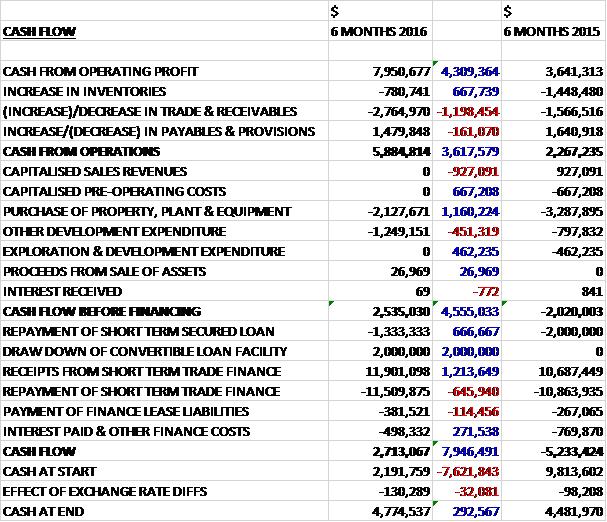
In the G1, G2 and G3 complex, the main ramp was further deepened and is now close to reaching the -50 metre relative level which will be the next production level. Currently the -20mRL is the lowest development level at the mine where the G3 vein is being developed and about 400m of ore development has been completed so far this year. In the Palito west sector, an internal ramp from the 61mRL to the 31mRL has been completed and about 100 metres of ore development on the 31mRL has been completed so far.

The Senna zone is not entirely new. It was mined during 2008 and 2009 as a small open pit where about 25,000 tonnes of oxide ore with a grade of 3g/t was extracted. Based on the ore grades recovered from the open pit operation and deeper exploration drill holes, management is hopeful of the potential of this zone. One exploration drill hole reported an intersection about 300m below the surface of 0.55 metres at a grade of nearly 51g/t. In December last year the Senna vein was exposed for the first time underground, since which time 570 metres of ore development and 410 metres of waste development have been completed on the 225mRL and 237mRL during the year. Internal ramps are currently being advanced to access the next development levels of 210mRL and 250mRL during August. The zone has independent access from the surface.

Further improvements undertaken within the process plant during the year have included the installation of additional flotation capacity and automation, along with new carbon screens within the CIP tanks to improve inter-tank flow rates. These improvements have been funded from the cash flow from the current operations. Processing rates for ROM ore have increased by 18% to 417tpd

It should be noted, however, that once the surface stocks have been consumed and with the group’s current understanding of the mining resources at both Palito and Sao Chico, management currently consider it unlikely that in the near term future mine plans can support the increased plant capacity. As a result the operation will then become limited by the tonnages that can be mined and the third ball mill will revert to its primary purpose of providing contingency in the plant. Since the plant started operating, the time available for essential maintenance has been scarce so the new mill means the operation can now comfortably accommodate much needed maintenance time as well as absorbing any unexpected interruptions to operations.

At Sao Chico, during the year the decision to implement sublevel open stoping as the principal mining method was taken, and this resulted in the development of sublevels with 12 metre vertical spacings. Each sublevel is advanced three metres at a time and channel sampled. The closer sample spacing that this allows has greatly increased the understanding of the orebody and this increased mine development has enabled the group to now define a clear two year mine plan.

The group has reported that the high grade mineralisation is dominantly hosted in a constant alteration zone that can be anything from two to ten metres wide. The zone itself is readily identifiable but the high grade gold zones within this alteration zone are much less so, and as a result the mining operations require on-lode development at regular vertical intervals with regular channel sampling and in-fill drilling between these levels to best define the high grade gold mineralisation. This approach allows the group’s mining personnel to readily identify stoping blocks and optimise mining of the high grade gold zones.

The main vein at Sao Chico has gold grades that are quite erratic and are hosted in four steeply plunging pay shoots. In these pay shorts the grades are often truly spectacular, often being in excess of 100g/t of gold. Outside the pay shorts the vein is continuous but with low gold grades and as a result it is unavoidable that, as the mine development passes between the pay shorts, lower grade ore has to be mined. The central pay shoot is the most established of these four high grade shoots and is some 100 metres long. The group will continue to focus, in the near-term, on developing this part of the main vein and some consistent higher grade development ore is being generated as a result. Access to other pay shoots along the strike will not be lost and these will be available for development later in the year.

During Q2, the group started underground exploration drilling of the central pay shoot targeting its down dip extension. The results from the first hold that has been completed were encouraging with an intersection about 100 metres below the current deepest workings and about 240 below the surface over a drilled width of 2.3m being made with a grade of 46.2g/t. Averaged mined grades for the quarter across both mines continued to be around 10g/t o gold which has been the case for the past two years. At the end of the period, combined ore stocks from Palito and Sao Chico were about 12,000 tonnes with an average grade of 5g/t of gold compared to the same period of last year when they were 11,900 tonnes at a grade of 4g/t.

As well as the potential that exists to grow resources at Sao Chico, the Palito south, Curretela and Piaui prospects close to the Palito mine still provide good opportunities for identifying additional resources which could both enhance current production levels and extend the life of the mine. The group is undertaking geophysical programmes within the vicinity of both working mines in the second half of the year. The objective of these programmes is to secure additional geological data to better plan the next stage of exploration drilling that is expected to be undertaken during 2017. At this time no surface drilling or other surface exploration activities are currently planned.

In the longer term, dependent on levels of cash flow, the group will step up its exploration activity and will be looking to add to its resource base and production potential by establishing additional satellite high grade gold mines in relatively close proximity to the current operation which would have a centralised processing facility. In this way the group expects to be able to grow its production base at low capital cost, avoid the need for major infrastructure improvements and have low environmental impact.

The forecasted gold production for 2016 is expected to exceed 37,000 ounces but reflecting the 22% strengthening of the Brazilian Real, the group has revised its cost guidance and now expects all in sustaining costs for the year will be between $950 and $985 per ounce.
Over the next year or so, the group has $5.4M of contractual obligations consisting of $4.9M of short term debt, $431K of capital lease obligations and $94K of operating leases.

In December 2015, the group’s major shareholder, Fratelli Investments, agreed to provide an interim unsecured short term working capital convertible loan facility of $5M to provide additional working capital facilities. The loan is for a period expiring at the end of January 2017. It can be drawn down in up to three separate instalments of an initial $2M and two further instalments of $1.5M each. Interest is chargeable at the rate of 12% per annum.

The first $2M of the loan is convertible at the election of Fratelli into new Serabi shares at an exercise price of 3.6p per share at any time. The remaining amount of the loan, if drawn down, could be repaid by the group at its option at any time before the end of June.
Thereafter, Fratelli would have the right to convert all or part of the remaining amount into new shares at 3.6p per share. In January the group made an initial draw down of $2M but not further draw down has been made.

In August, Fratelli exercised its right to convert its outstanding $2M convertible loan into shares at a price of 3.6p per share which means that they now own 55.3% of the total share capital.

At the start of the year the group granted Sprott a call option over 2,500 ounces of gold at a price of $1,125. Just after the period-end, at the start of July, Sprott exercised options over 1,250 ounces of gold, establishing a liability of $298K, of which $150K has been settled with the remaining amount due for repayment by the end of the year.

As of the period-end, Sprott held a call option exercisable over 2,500 ounces of gold exercisable at a price of $1,125 per ounce. In July they exercised options over half this amount, establishing a liability on the group of $298K of which $150K has been settled with the remaining amount due for repayment at the December.

Overall then the increase in gold prices has meant that this has been a fairly successful period for the group. Profits were up, net assets increased and a growth in operating cash flow gave rise to some free cash generation. The group achieved a price of $1,216 per ounce compared to $1,182 last time and costs per ounce fell from $967 to $945, although the appreciation of the Brazilian currency means that they are guiding towards annual costs of between $950 and $985 per ounce, which although not ideal, should still be profitable.

The process plant improvements have been completed which should give the group some much-needed back up. Grades being mined in Q2 did decline somewhat but this was due to Sao Chico where grades are more erratic. I have a lingering concern that Fratelli is becoming even more powerful with the recent convertible loan conversion and the Sprott call option is now looking fairly costly and I have decided to take profits here for now whilst the gold price takes a breather.