Aureus Mining Share Blog – Interim Results Year Ending 2016

Aureus Mining has now released its interim results for the year ending 2016.

AUEincome

Revenues increased when compared to the first half of last year with a $6.9M growth in gold bullion revenue and a $288K increase in concentrate revenue. Operating costs only increased by $1.9M with smaller increases in amortisation and depreciation to give a gross profit $3.8M higher. Admin expenses increased by $390K which meant that the operating profit was $3.4M higher than last time. We then see a $1.2M charge relating to the revaluation of warrants after the share price increased and there was a $494K finance cost on gold trading compared to a $174K gain last time. Tax charges increased by $556K to give a profit for the period of $1M, a growth of $929K year on year.

AUEassets

When compared to the end point of last year, total assets increased by $7.6M to $288.6M driven by a $9.2M growth in assets held under finance leases, a $6.4M increase in ore stockpiles, a $1.9M growth in consumables, a $1.6M increase in mine closure and rehabilitation and a $1.5M growth in Liberian evaluation costs, partially offset by a $7.8M decline in the value of mining and development properties, a $2.9M fall in cash and a $1.9M decrease in the value of gold in circuit. Total liabilities also increased during the period due to an $11.9M increase in promissory notes, a $3.2M growth in bank loans and a $4.4M increase in payables. The end result was a net tangible asset level of $98.4M, a decline of $13.1M over the past six months.

AUEcash

Before movements in working capital, cash losses widened by $2.5M to $4.6M. There was a large cash inflow from working capital, with a huge increase in payables, which meant that the cash from operations was $5.6M, a positive movement of $17M year on year. The group also received $14.8M in proceeds from pre-production gold sales but they spent $35.7M in property, plant and equipment to give a cash outflow of $16.1M before financing. After the issue of a promissory note which brought in $12.3M and $2.7M, which came from the issue of new shares, the cash outflow for the period was $2.9M to give a cash level of $4.2M at the period-end.

The additions to intangible assets included near mine exploration at New Liberty, Silver Hills, Cape Mount and Ndablama. Capex included $1.2M of deferred stripping costs, $800K of water diversion works, $200K of construction works at the RAP village, $300K for lifter bars and grates for the mill, and $100k for a new larger sized gravity screen.

During Q2, the group mined 2,747,266 tonnes including 201,774 tonnes of ore at a grade of 3.58g/t. There was 99,438 tonnes of ore milled at a grade of 2.5g/t which produced 8,274 ounces of gold. The group sold 11,731 ounces of gold at an average price of $1,253 per ounce with operating cash costs of $1,287 per ounce before the shut-down.

Excavation work continued on the flood diversion trench and bund along the southern final pit limit to prepare for continuing mining operations throughout the wet season, with an additional 259,501 tonnes of material moved during the quarter and leaving about 15,000 tonnes remaining. Mining operations continued to focus on the Kinjor and Larjor starter pits and opening access to fresh rock before the onset of the wet season.

During May, five new 100 tonne rigid haul trucks and one excavator were commissioned and added to the mining fleet. Despite this, mining activities throughout the period were hampered by low equipment availability, including poor drill rig availability affecting the rate of drilling and blasting ability. This had a knock on effect leading to a lack of broken ore stock ready for mining. A new drill rig and contractor rig arrived on sire in July to remedy this situation.

As previously reported, in May the group temporarily suspended processing operations at the mine as a consequence of operating problems with the detoxification circuit in the process plant. It had not been operating to original design specs and as a result, higher concentrations of Cyanide WAD were contained within the process effluent being discharged to the tailings storage facility. The onset of earlier than expected heavy rainfall in May inadvertently resulted in a small overflow of tailings effluent from the TSF onto the wetlands area.

As a result of the overflow, the process plant was shut down on May 7th and the group began conducting remediation work to rectify the issues in the detoxification circuit and to manage future water discharge from the TSF. Apparently there has been no adverse impact on any human settlement as the discharge took place some five km from the nearest settlement (whether water sources etc were contaminated is unclear).

During the suspension of processing operations the group focused on the completion of various modification to the process plant and detox circuit. Modifications included the optimisation of the performance of the gravity circuit, through to the replacement and installation of a new larger sized gravity screen which aims to separate and recover a higher proportion of gold and metal sulphides within the gravity circuit and increase the feed to the Falcon concentrator, a step which will reduce the level of metal sulphides reporting to the CIL and detox circuits of the process plant.

Additionally, adjustments were made to the pre-oxidation circuit to incorporate the addition of a further pre-oxidation tank to increase resistance time within the CIL circuit. The capacity of the pressure swing adsorption oxygen plant was increased to provide supplementary oxygen to both the CIL and detox circuits. The reagent dosing systems of the detox circuit were also redesigned and the optimisation of reagent consumption including copper sulphate and sodium metabishlphite within the circuit is ongoing following the restart of the process plant in July.

During the period of plant suspension the group also completed various preventative maintenance programmes including performing a full reline of the ball mill, which had previously been scheduled to take place at the end of June. This reline involved the mill being fitted with more heavy duty Weir-Polymet liners than those originally supplied as well as improved lifters and grates with the aim of improving mill liner life and reducing future mill downtime.

Alongside the process plant modifications the group developed a start-up plan to re-start processing operations as soon as the remedial actions on the detox circuit were completed. This plan was submitted to the relevant agencies. On June 6th they received a permit granting permission to restart discharges from the TSF which covers all discharge of TSF water into the wetlands, discharge from the wetlands and discharge outside of the mining lease. Additionally, approval to discharge existing water from the TSF was granted, which was started on the 9th. They received approval to start the plant restart process on June 17th.

The process plant restart procedure is currently underway and includes scheduled periods of plant downtime to allow for performance testing and further optimisation activities, and a gradual ramp-up in processing operations towards achieving plant name plate capacity of 146 tonnes of ROM ore per hour and steady state operations over a period of about two months. With the restart of the plant processing operations in July, it is expected that operating cash flows will fund the New Liberty Gold mine operations going forward.

During Q2, exploration activities focused on the near mine potential around New Liberty with pitting and regolith mapping undertaken around the Western portion of the Bea Mountain license which aimed to test major structures around the mine. Much of the soil sampling around the mine has been found to be in residual or depositional regimes and therefore pitting is needed to reach the saprolite sections. Pitting work has been undertaken in order to check underneath these regimes and sample representative saprolite. The focus of this work is along major and secondary structures identified by airborne geophysics.

The results from some of the pits along major structures have shown that there are several new targets with indicators of gold mineralisation which were not previously detected during soil sampling programmes. Further pitting is ongoing to follow this gold anomalism along with detailed field based geological mapping to constrain the anomalism, with the aims of finding concealed mineralisation along major and secondary structures close to the New Liberty plant site. Other areas of structural and regolith interest have been selected for detailed regolith and geological mapping throughout the rest of the year.

Throughout the quarter, pitting on additional soil anomalism was undertaken to the west of the Ndablama target to test additional areas of mineralisation which have not been previously identified. In Q2, mapping along the SW area of the Weaju project revealed the potential to increase the strike of mineralisation for a further 800m to the SW. Additional mapping and sampling will be completed to better define the surface expression of mineralisation.

Throughout the period, pitting work has been undertaken at Leopard Rock South to test the surface continuation of mineralisation following on from detailed mapping of the Ndablama project, the results of which will enable further follow up work in Q3. Pitting along the entire length of the Yambesei shear was continued in Q2 and has been completed over Gondoja, Musa and Gbalidee. Further follow up work will be completed later in the year once field activities recommence after the rainy season.

At Silver Hills, work focused along the strike of the Belgium target during the quarter with pitting and mapping exploration techniques undertaken along the strike extent of mineralisation. This is highlighted by a NE trending shear and has the potential to extend over 3km up to the Bruges target located in the NE. Detailed regolith mapping and pitting was undertaken during the quarter connecting the Belgium target to the Antwerp target, and locating several areas with subdued soils anomalism due to covering with ferricrete and residual soils. Channel samples highlighted the potential for high grade zones, associated with intense silicification along the strike of previously sampled areas.

During the quarter geological mapping covered the majority of the 15km Matambo gold corridor. The Bomafa, Bangoma and Saanor prospects were all mapped and sampled. Locating a main band of greenstone which underlies the soil anomalism with lithosamples confirming multiple bands of mineralisation at surface. Work on the area will continue after the rainy season on further testing the areas with identified mineralisation.

The group is still embroiled in the arbitration request from their civil and earthworks contractor. The board believes that the request is without merit and currently believe that no material amount will be found payable. They continue to defend themselves against the claims, however, which as can be seen is proving to be fairly costly.

Based on discussions and the support received to date, there is a reasonable expectation that an appropriate debt repayment schedule will be achieved but there can be no absolute certainty that the negotiations will be successful or that the company will be able to generate the necessary funds to repay the debt as it currently falls due. These conditions indicate the existence of a material uncertainty which may cast significant doubt about their ability to continue as a going concern and that the company may therefore be unable to realise their assets and liabilities in the normal course of business.

In June the group entered into an agreement for an equity financing with MNG Gold to strengthen the balance sheet and fund working capital as it completes the restart of the processing plant. They closed the initial tranche of the equity financing where they issued 59,533,674 new shares at a price of $0.045302 per share and a promissory note for the amount of $12.3M to MNG Gold, raising proceeds of $15M.

In July the company closed the final tranche of the equity fundraising where they issued 331,111,209 new shares at the same price, raising proceeds of $15M. Further, the promissory note converted into 271,577,546 shares upon closing of the final tranche. An aggregate of 662,222,429 shares have been issued which means that MNG Gold became a 55% shareholder of the company.

Following this transaction, the company received credit approval from their lenders for a four month default waiver and standstill agreement during which time the company will be will work with the lenders to reschedule the debt repayment profile. The waivers encompass all existing, as well as future breaches of the loan documentation that may occur during the standstill period, and a deferral by the lenders of all principal and interest payments during this time.
The group has submitted a number of mine plan scenarios at varying gold price levels to the lenders as the basis of discussions to mutually agree an appropriate debt repayment schedule which is expected to be concluded in October.

Going forward, the group remains committed to maintaining its listing on both the AIM and TSX markets but the immediate focus of the management team is to stabilise and then improve both operational and financial performance at the mine. The management team is currently undertaking a comprehensive review of the group’s cost base and following the completion of the operational and financial performance reviews and the achievement of steady state operations at New Liberty they intend to produce a new life of mine plan.

Notwithstanding the closing of the $30M equity financing transaction with MNG Gold in July, management believes that the company remains undercapitalised to deliver to its full potential and is likely to require further funding for capital investment activities. MGG Gold intends to be a long-term supportive shareholder for the company and fully expects to support them in any future funding endeavours that may arise from the conclusions of the ongoing performance reviews – it looks like there is some more dilution on the cards then.

Overall then this has been a very difficult period for the group. There was a gross loss even before the shut-down, net assets declined and although the operating cash flow improved, this was due to a delay in paying the payables and cash losses widened with a big cash outflow before financing. With a price received of $1,253 per ounce, the cash operating costs of $1,287 cause an obvious problem and when the shut-down from the cyanide leakage is also taken into consideration, the poor performance is clear.

After the recapitalisation from MNG gold, the finances are a little better but the debt is still at precarious levels and the board see further dilution is likely going forward. This really doesn’t look investment grade quite yet. Until the debt comes down further, I won’t be covering this anymore.

On the 6th September the group announced that the mining services contract with MonuRent has been novated to Atmaca Services, wholly owned by MNG, the group’s 55% shareholder. All other terms of the contract remain the same.

As part of the agreement with MonuRent, Atmaca will pay them cash of $15.4M to take ownership of the mining equipment, $7.1M cash for the inventory currently on site, $7.9M cash for invoiced receivables, about $2.5M for future uninvoiced receivables and $4.5M as a contract novation fee.

It is intended that upon completion of an equity fundraising by the company, which MNG Gold has agreed in principle to fully underwrite, the sale assets will be sold to the group at no gain or loss. They will also pay Atmaca a fee of $4.5M to terminate the contract. Management believes that the adoption of owner-operator mining will significantly reduce the ongoing costs of mining operations and improve the operational and financial flexibility of the company. This is certainly a good deal for MNG!

Following the restart of processing operations at New Liberty in June, the group continues to experience periods of unscheduled plant downtime. Average plant availability has been 66% over the past 65 days but better availability has been achieved in recent weeks. Plant modifications and optimisation activities continue with particular focus on optimising the ball mill grind size and also reagent consumption in the CIL and detox circuits of the process plant. Since the restart of processing operations to date, they have shipped about 8,100 ounces of gold.

The detox circuit has been operating at a stable level and performing to its design specs following recent modifications. All discharges from the TSF have been within permitted levels but the group is working in conjunction with consultants to modify the operation of the TSF, including using it as a source of plant make up water, to allow for an increased retention time for process effluent and more control over future discharges.

TT Electronics Share Blog – Interim Results Year Ending 2016

TT Electronics has now released its interim results for the year ending 2016.

TTGincome

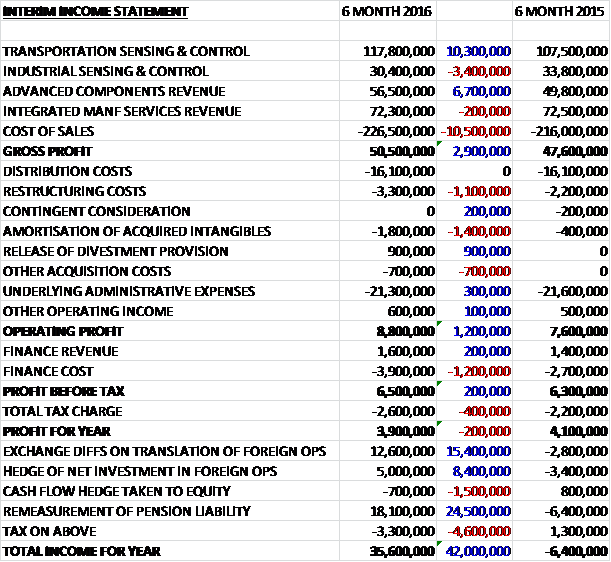
Revenues increased when compared to the first half of last year due to the contribution from Aero Stanrew and favourable currency movements (organic constant currency revenue declined). A £3.4M decline in Industrial Sensing & Control revenue and a £200K fall in Integrated Manufacturing Services revenue was more than offset by a £10.3M growth in Transportation Sensing & Control revenue along with a £6.7M increase in Advanced Component revenue. Cost of sales also grew but gross profit increased by £2.9M. We then see a £1.1M growth in restructuring costs and a £1.4M increase in amortisation of acquired intangibles due to the acquisition although a £900K release of a divestment provision offset a £700K increase in other acquisition costs and after underlying admin expenses saw a modest decline, the operating profit grew by £1.2M. Finance costs increased considerably due to the higher debt levels and tax charges were up £400K which pushes the profit for the period down £200K to £3.9M.

TTGassets

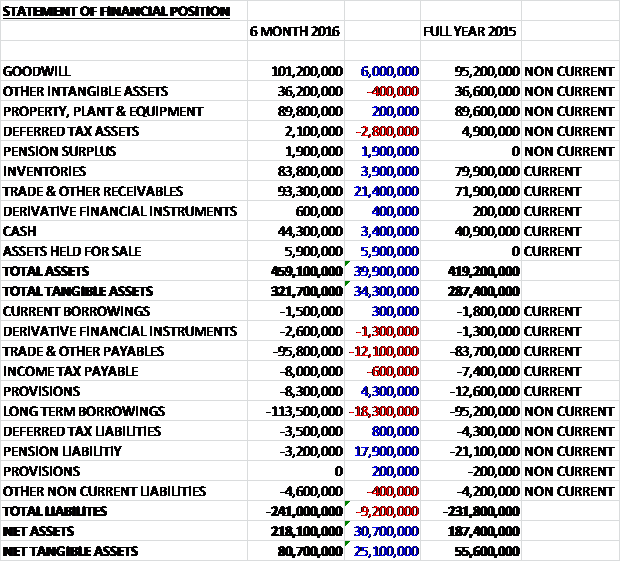
When compared to the end point of last year, total assets increased by £39.9M driven by a £21.4M growth in receivables, a £6M increase in goodwill, a £5.9M growth in assets held for sale, a £3.9M increase in inventories and a £3.4M growth in cash, partially offset by a £2.8M decline in deferred tax assets. Total liabilities also increased during the period as an £18.3M growth in long term borrowings and a £12.1M increase in payables was partially offset by a £17.9M decline in pension liabilities and a £4.5M fall in provisions. The end result was a net tangible asset level of £80.7M, a growth of £25.1M over the past six months.

TTGcash

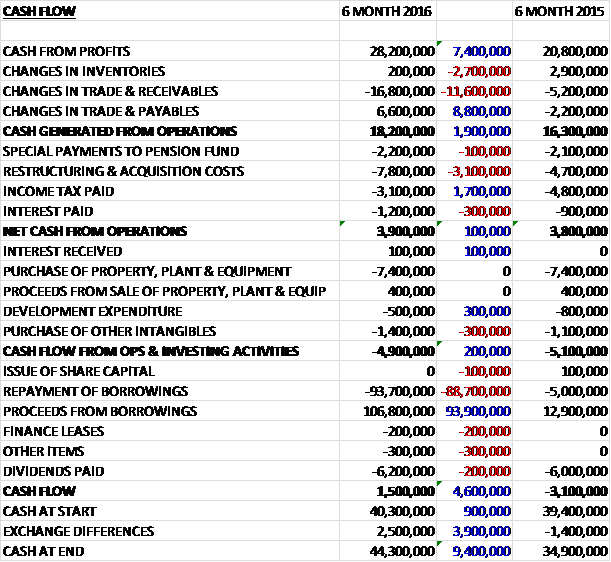
Before movements in working capital, cash profits increased by £7.4M to £28.2M. There was a cash outflow from working capital, apparently related to a very strong 2015 year-end performance, with a large increase in receivables and after £3.1M increase in cash restructuring and acquisition costs and a £1.7 fall in tax payments, the net cash from operations comes in at £3.9M, an increase of just £100K year on year. This was not enough to cover the net £7M spent on property, plant & equipment, the £500K of development costs and £1.4M of other intangible asset costs so there was a cash outflow of £4.9M before financing. The group still paid out £6.2M in dividends so took out more in borrowings to cover all of this which meant that there was a £1.5M cash inflow for the period and a £44.3M cash level at the period-end.

Overall the group’s order book remains sound but the order intake has been mixed across different markets. Strong demand from automotive markets benefited Transportation Sensing and Control and Advanced Components. North American industrial markets remained challenging, however, affecting the performance in Industrial Sensing and Control, Advanced Components and IMS.

The underlying operating profit in the Transportation Sensing and control division was £1.7M, a positive movement of £2.6M year on year on revenues that increased 5%. Organic growth was delivered earlier than anticipated as a result of strong demand in Europe as well as growth in the Chinese market where the business has won new contracts to service the growing domestic demand. The return to profit was supported by the benefits of the Operational Improvement plan as well as ongoing operational efficiencies together with the growth in revenue and a £200K forex benefit.

The division saw continued momentum in China following their strategy to target growth from the sizeable domestic market. They have seen increased production volumes with a large automotive customer for a pedal platform as well as increased volumes for speed sensor crankshaft components. The speed sensor is a redeployment of technology platforms originally developed by the European business. They have also converted two further opportunities for truck pedals into contracts.

They have started to make early progress in the US with their first development order from one of the big three automotive OEMs marking their re-entry into the large US market where they see opportunities to grow market share over the medium term. The development order is for a linear sensor on their SIMPSpad technology for a suspension damper application. These sensors provide car position and speed information using fewer parts than needed before, bringing accuracy, reliability and cost benefits to customer. In France they have won a three year LED project for five different head lamps for a large French OEM.

The underlying operating profit in the Industrial Sensing and Control was £5.5M, a decline of £900K when compared to the first half of last year on revenues that fell 15%. This decline was partly due to last year’s pull forward in demand resulting from a customer request ahead of a change in material supply. North American industrial weakness also had some impact. The profit also suffered from increased R&D expenses although there was a £400K forex benefit to profit.

The group continues with their approach for R&D, targeting industry segments which have an increased requirement for high specification sensors, requiring superior reliability and accuracy such as factory automation and medical equipment. In May, they launched a next generation optical presence and position sensor, Photologic V. The sensor is used in industrial printing and paper handling, factory automation and medical equipment. Collaboration between industrial sensing and control and transportation sensing has resulted in core electronic capabilities from the transportation division being deployed in the launch of a new pressure, TPM, developed in Klingenberg.

The underlying operating profit in the Advanced Components was £4.3M, a growth of £900K when compared to the first half of 2015 on revenues that increased by 11% although excluding the Aero Stanrew contribution there was a 7% organic decline with the base business performance stabilising following the downturn in North American demand experienced in H2 2015. Likewise, the increase in profit was due to the £1.6M contribution from Aero Stanrew and £100K of forex benefits.

The Aero Stanrew business continues to provide components and sub-systems for numerous aerospace and defence programmes where they have single source positions. This includes components for the Joint Strike Fighter programme which has begun to ramp up and volume growth for the Power Distribution Panel, a higher value sub-system designed alongside the customer. The order intake has been strong and is positioning the business well for the growth expected.

The group have seen good progress in their magnetics and connectors offerings, a key area of strategic focus for the division, including wins in the automotive and defence markets. They have also designed a new connector, the Mag-NET, which is being used in demonstration equipment in trials for a large customer in the defence industry.

The underlying operating profit in the Integrated Manufacturing Services division was £2.2M, an increase of £700K year on year on revenue that fell 2% on a constant currency basis as strong demand from China was offset by weakness in North American industrial markets. The increase in profitability was a result of strong cost discipline and ongoing operational efficiency.

The Chinese operation benefited from increased demand from an urban rail infrastructure customer in the country and a contract award for vacuum pumps for semiconductors in South Korea. Conversely the US operations are facing continued market headwinds and in the first half a defence project in the region reached the planned end of its cycle which is affecting volumes. In Europe there have been opportunities to collaborate in Romania with the Transportation Sensing and Control division on PCBs.

Following the acquisition of Aero Stanrew in December, the integration process was executed smoothly and is now complete. The business has performed well and early customer indications have reinforced its potential within the group. Opportunities for increased operational collaboration have been identified in addition to a growing pipeline of prospects in both existing TT and Aero Stanrew customers. During the early stages of integration, Aero Stanrew and IMS worked closely together to win a small initial order for test equipment in the aerospace and defence sector. More recently they have identified the opportunity to utilise their existing expertise and operations in Malaysia to build civil aerospace components for one of Aero Stanrew’s customers. Applicable skills for industrial markets are being adapted to meet the more rigorous testing requirements of their aerospace customers.

The group have announced the transfer of their remaining activities from Fullerton to Bedlington in the UK where they are creating a centre of excellence for power hybrid assemblies. The move is ahead of schedule and they will fully exit the Fullerton site in 2017. They have also announced the transfer of the last of their UK thick film production from Corpus Christi to Mexicali, utilising their lower cost capabilities and consolidating thick film production for the region into a single site. Finally they are closing their Basingstoke site, moving operations to Sheffield and engineering skills to Cambridge where a small team will support R&D efforts across three of the divisions.

As usual there was a decent chunk of non-underlying costs. Restructuring costs related to further costs incurred on the Operational Improvement plan initiated in a previous period as well as costs associated with other site restructuring. Acquisition related costs include a credit of £900K relating to the release of a provision established for warranty liabilities arising from a divestment that is no longer required.

The group is monitoring developments following the UK Brexit vote. Within the EU they have operations in Germany, Austria, Romania and the UK and revenues from the bloc accounted for 16.2% of the total. The board believe that the outcome will not have a significant impact on their ability to conduct business into the EU in the short to medium term but they recognise that they are entering a period of uncertainty as the exit process is agreed and they are monitoring political and macro-economic developments closely.

Whilst the uncertain macro-economic environment continues to impact some market segments, the group’s self-help actions are producing tangible benefits. The combination of the underlying business performance and the contribution from Aero Stanrew mean the board are confident of continued progress in 2016.

At the period-end, the net debt position stood at £70.7M compared to £56.1M at the year-end. They have available £54.4M of undrawn facilities and £53.3M of undrawn overdraft. At the current share price the shares are trading on a PE ratio of 21.8, reducing to 14.2 on the full year consensus forecast, although that would exclude the usual non-underling costs. After the interim dividend was kept the same, the shares are yielding 3.9% which remains the same for the full year forecast.

Overall then, this was a bit of a mixed period for the group. Profits declined but this was due to higher tax costs and pre-tax profit was up modestly. Net assets improved but the operating cash flow was broadly flat and no free cash was generated. Although this was not helped by a large increase in receivables and cash profits increased.

Advanced Components saw profit increase but this was due to the contribution from Aero Stanrew and organic profits declined due to weak North American industrial demand, which has now stabilised. Industrial Sensing also suffered from the North American industrial weakness and profits here declined. Advanced Components saw profits rise due to cost cutting and greater efficiencies but it was the Transportation Sensing division that saved the group really with a swing into profitability due to strong demand in Europe and China along with cost cutting.

Things certainly do seem to be improving here but continued US industrial weakness is an issue, as is the inability to make any free cash – although this should improve as the working capital position unwinds. A forward dividend yield of 3.9% is pretty decent but the forward PE of 14.2 is pretty uninspiring. A tricky one this, TTG is looking more attractive than it ever has since I have started covering it.

On the 17th November the group released an update for the first four months of H2. Overall the group has performed well. As expected, revenues have grown on an organic basis. The order book is marginally ahead of last year, before the additional contribution from Aero Stanrew where the order intake continues to be encouraging. They have secured the first contract win as a result of the integration of Aero Stanrew and the group.

Trading results have been favourably impacted by forex movements, increasing revenue and operating profit in the first ten months of the year by about £30M and £2.5M respectively. The cash generation of the business remains on track to see an improved performance in the second half of the year and in addition, the former head office site in Weybridge was sold in September, generating proceeds of about £6M.

Overall the business performance is in line with plans but is being enhanced by the favourable forex movements so the board expect to be ahead of market expectations for the year as a whole.

This seems pretty good actually, albeit mostly not of the group’s own doing.

Real Good Food Share Blog – Final Results Year Ended 2016

Real Good Food has now released its final results for the year ended 2016.

RGDincome

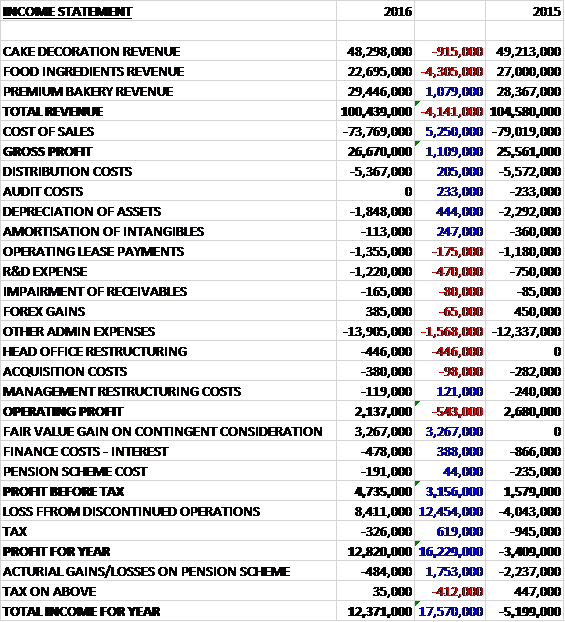
Revenues declined when compared to last year as a £1.1M growth in premium bakery revenue was more than offset by a £4.3M fall in food ingredients revenue reflecting low prices and a £915K decrease in cake decoration revenue due to the move away from low margin contract business. Cost of sales also decreased, however, so the gross profit was up £1.1M. Distribution costs were down modestly, as was depreciation and amortisation but there was a £470K growth in R&D expenses not capitalised and other admin costs grew by £1.6M which meant that the operating profit was down £543K. The group received a £3.3M fair value gain on contingent consideration as the contingent conditions were not met, and interest costs were down £388K which meant that after tax charges also reduced, down £619K, the profit for continuing operations for the year was £4.4M, a growth of £3.8M year on year.

RGDassets

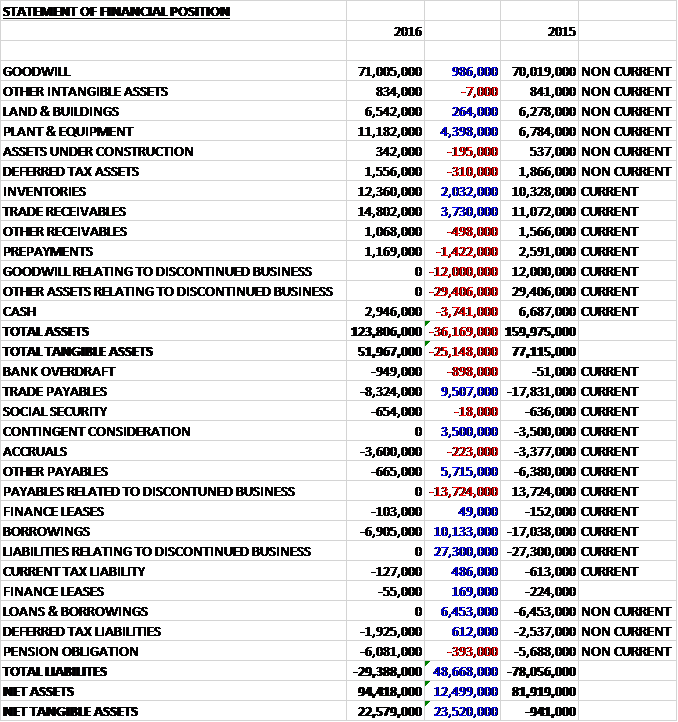
When compared to the end point of last year, total assets declined by £36.2M driven by a £41.4M decline in assets held for sale, a £3.7M fall in cash and a £1.4M decrease in prepayments, partially offset by a £4.4M increase in the value of plant & equipment, a £3.7M growth in trade receivables and a £2M increase in inventories. Total liabilities also declined during the year as contingent consideration payments fell by £3.5M and borrowings were down £16.5M. The end result was a net tangible asset level of £22.6M, a growth of £23.5M year on year.

RGDcash

Before movements in working capital, cash profits increased by £3M to £4.2M. There was a large cash outflow from working capital, however, due to an increase in inventories and receivables so that after tax payments were also up, there was a net cash outflow of £4.2M from operations, a detrimental movement of £7.8M year on year. The group also spent £6.4M on property, plant and equipment reflecting the modernisation of the group’s factories, of which £2.4M included the new group innovation centre, along with £1.7M on acquisitions but they received £37.2M from the disposal so that before financing there was a cash flow of £25.1M. This was used to repay borrowings to give a cash outflow of £4.6M for the year and a cash level of £2M at the year-end.

The operating profit in the Cake Decoration business was £6.5M, a growth of £979K year on year on sales revenue that was slightly down as Renshaw removed a manufacturing contact and Renshaw Europe lost a private label contract. Export sales outside Europe showed good growth. At Rainbow Dust Colours sales of Progel food colouring and metallic food paints in particular showed good growth. As the market matures, opportunities are appearing in more mainstream retailers such as Hobbycraft and John Lewis.

The new focus on developing a global branded range will take share during the course of 2016. A relaunch of the core sugarpaste range in upgraded packaging is already having a strong impact on the market as is the introduction of Renshaw Extra, a firmer and more elastic product designed for European tastes and also more effective in hotter climates. Further significant product initiatives will be launched in early 2017. At Rainbow Dust Colours, a number of major product initiatives are also in place; a relaunch of the food art pens, an upgraded recipe on matt food paints and new multi-lingual packs on Progel.

The operating loss in the Food Ingredients business was £451K, a detrimental movement of £711K when compared to last year as revenues were significantly down due to unprecedented commodity price deflation, particularly in sugar and dairy. Both these markets experienced record low levels of prices with sugar affected by the ending of quotas in Europe in 2017 and dairy impacted by the Russian export ban. Garrett Ingredients increased its traded dairy volumes but sugar sales fell slightly.

The acquisition of ISO2 Nutrition generated a modest amount of sales but set up costs led to a small overall loss in the year. Sales volume was slightly ahead of the previous year at R&W Scott but again price deflation led to a marginal revenue decline. Investment in management teams at both businesses led to higher costs and a decline in profits but they are now fully equipped to run on a stand-alone basis and develop their growth plans.

Garrett Ingredients is well placed to benefit from any upturn in sugar and dairy pricing and will build sales in sports nutrition. At R&W Scott a number of product initiatives such as soft fillings, fruit fillings, curds, mallows and premium jams have been developed and are being sold across all channels. The investment in jam capacity, which caused some disruption last year, should now begin to yield benefits. The business will also significantly increase its supply into other group companies.

The operating loss in the Premium Bakery division was £162K, a detrimental movement of £606K compared to 2015. There is one customer in this division that accounts for a huge 17% of the group’s overall external sales. Despite the narrowing of the product range, sales at Haydens actually grew with the growth rate quickening in H2 but there was a significant labour cost increase which led to the decline in profits. The extension of the customer base had a positive effect on sales but product complexity remains the challenge and is being addressed with an even greater focus on fewer product lines with the impact of this being seen already in Q4.

The process of further focusing on core lines and processes where the business has recognised product superiority will continue. Part of this will be the launch of a small range of branded premium sweet treats which will be sold to a range of customers and generate significant scale. The Chantilly acquisition has already highlighted a number of cross selling opportunities which will be pursued and there are a number of opportunities for automating non-added value, manual processes which will be prioritised against the scale achieved in each product sector.

The group has acquired two business during the year. In December it acquired the ISO2 Nutrition sports supplement brand from the administrators of Creative Health. This business has been integrated into Garrett Ingredients, part of the Food Ingredients sector and is seen as an enabler to the entry into a new product diversification. The total consideration was just £16K. In February it acquired Chantilly Patisserie which produces frozen desserts supplying the foodservice sector with customers such as Marston’s Brewery, Warner Leisure, Brakes and Country Range. The business complements the offering of Haydens and it is envisioned that significant commercial opportunities for both businesses will be identified as a result. The total consideration for this acquisition was £1.75M.

There were a number of non-underlying costs incurred during the year. The management restructuring costs reflect a number of fundamental reorganisations within Cake Decorating and Head Office. The acquisition costs relate to the purchase of Chantilly Patisserie (£306K) and additional costs for the acquisition of Rainbow Dust Colours (£74K).

The group is exposed to currency risk on purchases of almonds from the US. The risk associated with these purchases is mitigated by matching with sales in foreign currencies. The group is also exposed to currency risk on purchases of sugar from Europe which is also mitigated in the same way.

Since the year-end the group has negotiated extended borrowing facilities with Lloyds Bank to enable it to continue its acquisition and investment strategy. They have entered into an invoice finance facility of £20M on a revolving basis with an interest rate 1.5% above base rate. In addition a new term loan of £3M has been agreed to replace the loan taken out to finance the acquisition of Rainbow Dust Colours which has an interest charge of 2.75% above base rate. To aid the capex growth planned it has also entered into a £4M facility with an interest charge of 3.5% above base.

The food industry faces challenging times with diversifying sales channels, increasing legislative burdens, the growth in the minimum wage and ever-demanding customers. Trading in the first three months of the new financial year has been satisfactory with recent order intake positive, and with the investments the group are making the board are confident that they will deliver growth across all three divisions.

At the current share price the shares are trading on a PE ratio of 20.5 which falls considerably to 9.1 on next year’s consensus forecast. At the year-end, net debt stood at £5.1M compared to £30.1M at the end of last year as the proceeds of the disposal were received.

Overall then this was a bit of a mixed set of results for the group. Profits did increase, but this was due to the gain on contingent consideration as a prior acquisition did not hit performance targets – not really something to be cheered. Excluding that, profits were broadly flat. Net assets did improve due to the disposal and they not look much more healthy but there was an operating cash outflow, a deteriorating position when compared to last year, although the blame can be placed on less favourable working capital movements this year as cash profits grew.

The only profitable division is currently Cake Decoration and a better mix of sales meant that profits here increased. Both of the other divisions struggled with losses at Food Ingredients widening due to lower dairy and sugar prices, and the Premium Bakery business swinging into a loss which is being blamed on higher staff costs. The weak Sterling is unhelpful to the group and trading so far this year is described as merely satisfactory. Despite the forward PE ratio of 9.1 making these shares look cheap, I do not believe here to make me buy in just yet.

On the 12th September the group released a trading update for the first four months of the year. Overall the board are satisfied with the performance and remains confident in meeting market expectations for the full year. The order intake is strong, particularly in the premium bakery business which is showing double digit percentage revenue growth. The cake decorating business also has good order visibility which gives the board confidence in that area.

The group are conscious of the impact of the living wage increase and are undertaking a plan to make the most efficient use of their labour force across their operations but the board feel it is important to start to pursue a progressive dividend policy alongside this. It is currently anticipated that an interim dividend will be declared for FY 2017 which will be the start of regular payments.

They have not seen any material negative impact on any of their operations as a result of the Brexit vote, which is reassuring.

Portmeirion Share Blog – Interim Results Year Ending 2016

Portmeirion has now released its interim results for the year ending 2016.

PMPincome

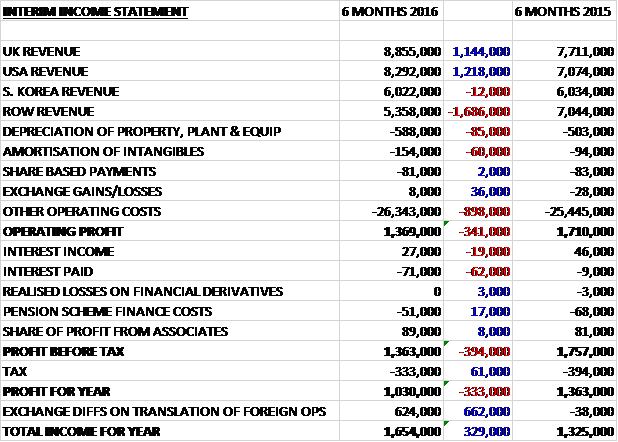
Revenues increased when compared to the first half of last year, although this was due to a £1.5M contribution of sales from Wax Lyrical as a £1.7M decline in ROW revenue and flat S. Korea revenues were offset by a £1.2M growth in US revenue and a £1.1M increase in UK revenue. Operating costs increased more (£170K were acquisition costs), however, which meant that the operating profit was £341K lower than last time. Interest payments increased by £62K but the tax charge was down £61K which meant that the profit for the period came in at £1M, a decline of £333K year on year.

PMPassets

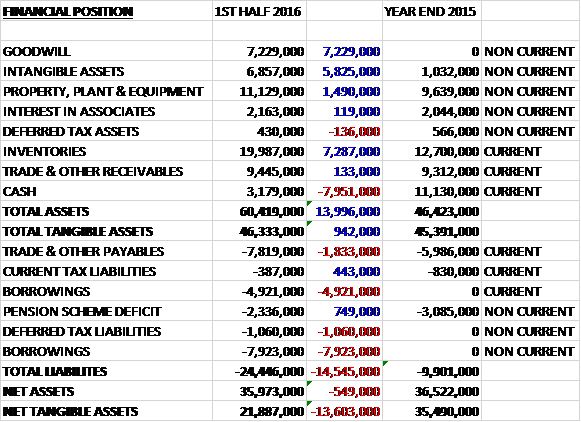
When compared to the end point of last year, total assets increased by £14M driven by a £7.3M growth in inventories, a £7.2M increase in goodwill, a £5.8M growth in intangible assets and a £1.5M increase in property, plant and equipment, partially offset by an £8M fall in cash. Total liabilities also increased during the period due to a £12.8M growth in borrowings, a £1.8M increase in payables and a £1.1M growth in deferred tax liabilities. The end result was a net tangible asset level of £21.9M, a decline of £13.6M over the past six months.

PMPcash

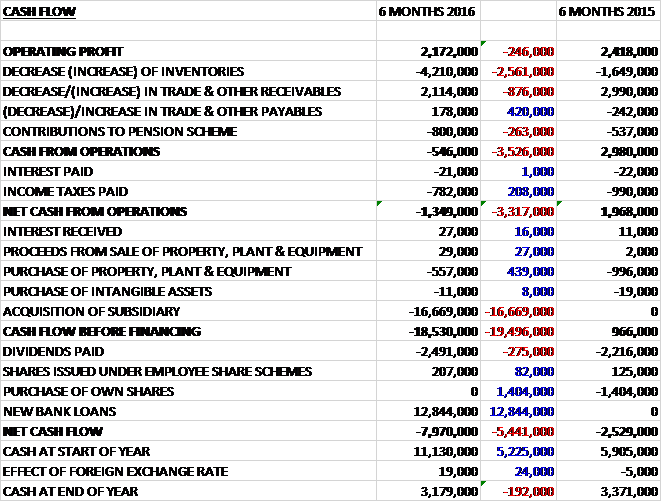
Before movements in working capital, cash profits declined by £246K to £2.2M. There was a cash outflow from working capital with a big increase in inventories, partly seasonal but partly due to the acquisition of Wax Lyrical, and despite tax payments falling by £208K, there was a net cash outflow of £1.3M from operations, a detrimental movement of £3.3M year on year. The group spent just £557K on property, plant and equipment but laid out £16.7M on an acquisition to give a cash outflow of £18.5M before financing. They then paid out a further £2.5M in dividends and took out £12.8M of new loans to give a cash outflow of £8M for the period and a cash level of £3.2M at the end of the half.

The group received a benefit from the favourable USD/GBP exchange rate but even on a constant currency basis, sales to the US also increased. Excluding the contribution from Wax Lyrical, sales to the UK saw a 1.5% decrease as the 19% growth in their own retail and online sales was more than offset by a 12.5% fall in wholesale sales. The South Korean market continues to be difficult. Revenues from the country are level on last year due to the timing of shipments and they expect full year revenues to be below those of last year. They are working with their distributor in this market on a number of new product ranges which they expect to start selling later this year.

Last year’s good growth in India has not been repeated this year as sales in the first half were some £2M below the same period of 2015. The group are taking corrective action, looking for additional distributors targeting specific distribution channels in India but they do not expect this to start bringing in sales until 2017. The group have strengthened their sales team. They have refocused their efforts on Europe and have just appointed a new sales manager to target the South American and Middle Eastern markets where they have historically sold little. They expect their sales in China, where they have a trading subsidiary and have appointed a number of distributors, to increase significantly from 2017.

First half profits are not a reliable indicator of full year profits and in particular, because of the recent investments in new factory capacity, they expect the imbalance to increase with the acquisition of Wax Lyrical exacerbating this effect.

The Anti-dumping case which the group have been challenging since 2012 has gone against them and they have abandoned their attempts to reclaim more than £2M which this has cost. It is expected that anti-dumping will expire in 2018.

As a result of the reduced demand from Asia, the group have pulled production back to levels just below last year. They remain confident that the demand for production will be recovered and the new kiln is a long-term investment.

On the 4th May the group acquired Wax Lyrical for a total cash consideration of £17.5M. The business is the UK’s largest manufacturer of home fragrances and is both a wholesaler and retailer of its home fragrance products, primarily scented candles and reed diffusers, to both UK and export markets. The acquisition generated goodwill of £7.2M and the business made a profit of £2.1M last year and is expected to be earnings enhancing in the current year, although the profit impact so far this year has been minimal. Significant growth opportunities for Wax Lyrical’s products are envisaged within the group’s existing market and in particular the group expect to be able to grow their sales through Portmeirion’s existing UK customers, websites and retail outlets as well as export markets.

The success seen in India last year has not been repeated in 2016 and sales to South Korea have not recovered as originally hoped. The board expect the adverse situation in both of these markets to continue in the short term. In addition they are starting to see a negative effect on wholesale demand from Brexit towards the end of the period. Despite this, they remain confident that the revised expectations of the full year profit will be met but are adopting a prudent forward view.

At the current share price the shares are trading on a PE ratio of 13.9 but this increases to 16.1 on the full year consensus forecast. After a 15% increase in the interim dividend, the shares are yielding 3.4% which increases to 3.5% on the full year forecast. At the period-end, the group had a net debt position of £9.7M compared to net cash of £11.1M at the prior year-end and a net cash position of £3.4M at the same point of last year.

Overall then this has been a difficult period for the group. Profits were down, net assets declined and the operating cash flow deteriorated with a cash outflow this time, not helped by adverse working capital movements. The US was the one area of growth but in the UK, wholesale sales deteriorated, apparently Brexit-related. South Korea remained difficult and despite sales being flat in the first half, they are expected to be lower for the full year. The real disappointment was India, with the strong showing last year not repeated.

The acquisition does seem to be a decent one and is probably the saving grace here – despite this, however, I am a little concerned that the board seem a bit over-confident of hitting full year targets. The dividend yield of 3.5% is decent enough but the forward PE of 16.1 fails to really price in the issues here I feel. This is not for me at this time, such a shame!

On the 19th January the group released a trading update covering the year where they stated that pre-tax profit was expected to be slightly ahead of market expectations. They expect to report record revenues for the year of over £76M, an increase of 11% year on year. The revenue contribution from Wax Lyrical was over £10M and the business performed in line with management expectations. At a constant exchange rate, the total group revenue increase would have been nearer 7%.

The Indian and South Korean markets have been challenging and total revenues from these two markets were over £7M below the reported revenue last year. Nevertheless, overall total revenue increased and the board look forward with confidence.

While it is good that profits will be slightly above expectations, I would have thought this is likely to have been forex-based. In addition it seems that much (if not all) of the revenue growth is due to the acquisition. I am not quite convinced that this company has turned around.

Keller Share Blog – Interim Results Year Ending 2016

Keller has now released its interim results for the year ending 2016.

KLRincome

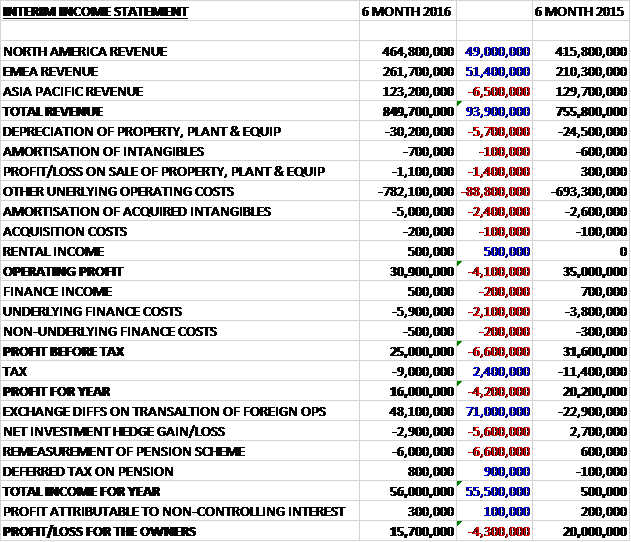
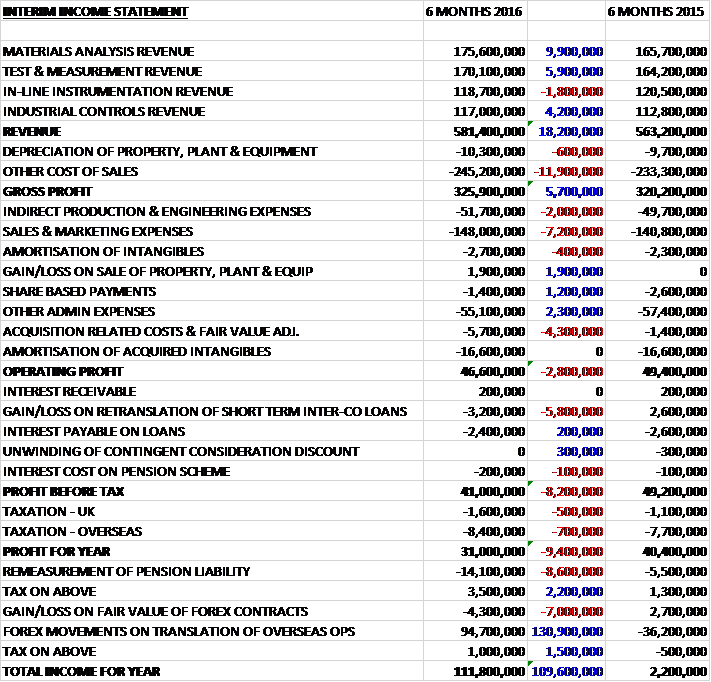
Revenues increased when compared to the first half of last year as a £6.5M reduction in Asia Pacific revenue was more than offset by a £49M growth in North America revenue and a £51.4M increase in EMEA revenue. Depreciation was up £5.7M, there was a £1.4M detrimental swing to a loss on the sale of fixed assets, and other underlying operating costs increased by £88.8M. We also see a £2.4M increase in the amortisation of acquired intangibles to give an operating profit £4.1M below that of last time. Finance costs increased by £2.5M but tax charges were down £2.4M which meant that the profit for the period came in at £15.7M, a decline of £4.3M year on year.

KLRassets

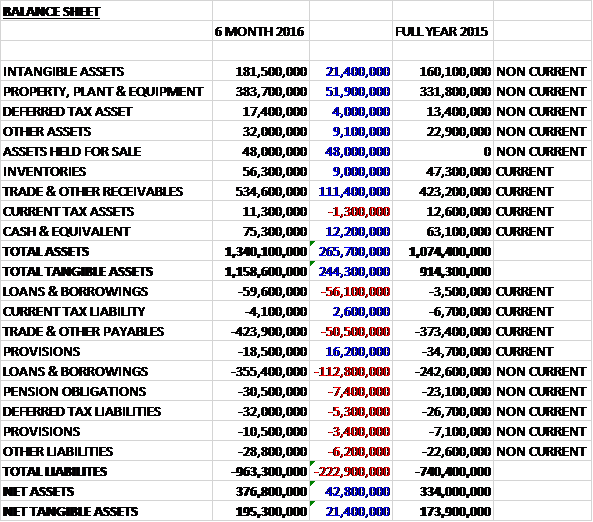
When compared to the end point of last year, total assets increased by £265.7M driven by a £111.4M growth in receivables, a £51.9M increase in property, plant & equipment, a £48M growth in assets held for sale, a £21.4M increase in intangible assets and a £12.2M growth in cash. Total liabilities also increased during the period as a £168.9M increase in borrowings and a £50.5M growth in payables was partially offset by a £12.8M decline in provisions. The end result was a net tangible asset level of £195.3M, a growth of £21.4M over the last six months.

KLRcash

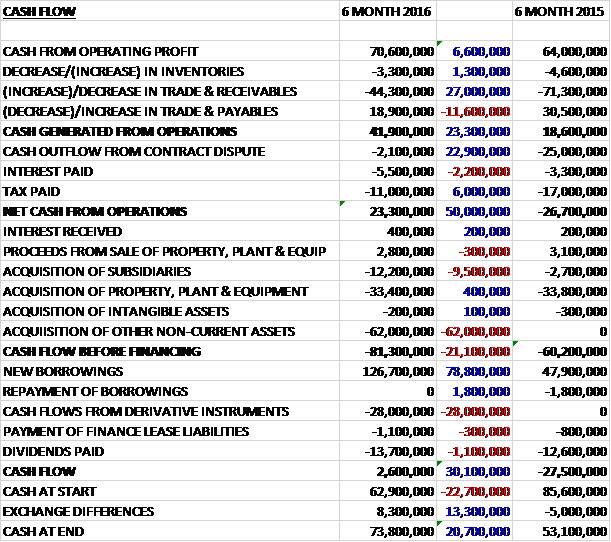
Before movements in working capital, cash profits increased by £6.6M to £70.6M. There was a cash outflow from working capital but this was less than last time due to a lower increase in receivables and after a £2.2M increase in interest payments was offset by a £6M decline in tax charges and a £22.9M reduction in cash outflows from the contract dispute, the net cash from operations came in at £23.3M, a positive movement of £50M year on year. The group spent £33.4M on fixed tangible assets and £12.2M on acquisitions but we also see £62M spent on other non-current assets relating to the freehold purchased in Bristol which meant that there was a cash outflow of £81.3M before financing. On top of this there was a £28M cash outflow from derivative instruments (I am not exactly sure what that relates to) and £13.7M spent on dividends which meant the group had to take out £126.7M of new loans to give a cash flow for the period of £2.6M and a cash level at the end of the half year of £73.8M.

The operating profit in the North American division was £33.6M, a growth of £5.2M year on year helped by the ongoing steady growth in US construction and beneficial currency movements. Bidding activity remains robust across the country and the group’s contract awards in the period were above the same period last year with the US order book at the period-end some 10% higher.

Howard Baker had a good first half across most sectors. Case and HJ Foundation also performed well, although HJ’s core Miami market is slowing after a very strong couple of years. Bencor has integrated well and is currently helping a number of group businesses outside the US in bidding D-wall work. Its $135M East Branch Dam job is on track and the business is just completing work on two major station boxes in San Francisco. Suncoast, which is mainly focused on residential construction, had an excellent first half, taking full advantage of the ongoing increase in housing starts. Whilst housing permits as a whole have flattened in recent months, those for single family homes which generate most of the business’ revenue continued to increase.

The Canadian business is operating in a very difficult market. It made a small loss in the seasonally weak first half, not helped by the delayed start of its major subway contract in Toronto. This $42M job was originally due to begin in April but is now not expected to start until November. Results will improve in the second half as revenues pick up, operating conditions ease and the business benefits from cost reductions made in the first half.

The operating profit in the EMEA division was £13.6M, an increase of £6.6M when compared to the first half of last year. Whilst a number of markets remain challenging, the group’s most significant European businesses in the UK, Germany, Austria and Poland have all had a good period and all of them enter the second half with strong order books and good prospects although the UK may be adversely impacted by a Brexit-related slowdown in Q4.

Elsewhere, the group made good progress on the major contract in the Caspian region. They have recently been awarded further work on this contract and expect more to be awarded in the second half which would extend the job well into 2017. Whilst some projects have been delayed in the Middle East as a result of the low oil price, construction activity has not abated and the order book is healthy. The market continues to slow in South Africa but there remain good opportunities in sub-Saharan Africa.

The operating loss in the Asia Pacific division was £9.6M, a detrimental movement of £14.4M when compared to the first half of 2015 with a very difficult period being driven by market conditions and project delays. About two thirds of the decline occurred in Australia, due in a large part to the non-recurrence of Wheatstone profits. The Asia and Australia divisions have been combined which has realised £3M of annualised cost savings through the rationalisation and the group expect to deliver a further £3M in operational efficiencies over the next year.

In Australia, dollar revenue was 28% down, in part due to delays to the start dates of the two largest projects and the business made a loss of around £6M as a result of the volume reduction and the deterioration of the pricing environment. In Asia, revenue was broadly flat but the Asian operations also recorded a loss in the period, largely as a result of the piling business in Singapore which suffered from very low volumes and some one-off costs relating to prior years. It is being restructured under a new management team.

Elsewhere in Asia, the large ground improvement contract at Changi airport has performed well and the Indian business had a good first half after a slow start to the year. Looking forward, despite the cancellation of the major Pluit City contract in Indonesia, which was due to start in September, the division’s order book is 10% ahead of the same period last year and revenue will improve significantly in the second half, particularly in Australia as its major projects pick up speed. The board expect the division to return to profitability in the second half of the year.

In February the group acquired Tecnogeo, a Brazilian business, for an initial cash consideration of £11.8M and contingent consideration of up to £12.3M, only £500K of which is currently provided for. In the period since the acquisition the business generated profit of £100K and the transaction generated goodwill of £5.4M. In April the group acquired Smithsbridge, a marine construction business based in Brisbane, for an initial cash consideration of £1.8M which reflects the fair value of net assets acquired. Early integration of both businesses is proceeding well, although the market in Brazil is currently tough.

In May the group acquired the freehold of a processing and warehouse facility in Bristol for a consideration of £62M. The group’s final liability with regards the historic contract dispute involving the property is in part dependent on the value of the property after some remedial works. In order to maximise its value, the group decided to acquire the property with a view to marketing it to third parties. During the period, £500K of exceptional income was received relating to rent at the property. This was offset by £500K of finance costs incurred to fund the acquisition.

Roy Franklin retired as Chairman in July after being in the role for seven years and was replaced by Peter Hill.

The UK Brexit vote is expected to lead to a period of prolonged economic and political uncertainty in the country. Whilst this is likely to impact the group’s operations in the UK, this business represents less than 4% of group revenue. Since the vote, Sterling has weakened considerably against most currencies. Most of the group’s earnings and all of its debt are in foreign currencies, mostly the US dollar. As a result, should sterling weakness persist, there will be a beneficial effect on the group’s profits but has increased the reported level of their net debt by nearly £40M since the end of the year.

Whilst conditions in a number of markets remain difficult, the US and most of the major European markets are healthy. On a constant currency basis, the order book for work to be undertaken over the coming year at the end of June was up 10% year on year. For 2016 as a whole, the board expects the underlying combined performance of the two largest divisions to outperform its original expectation. Asia Pacific has had a very difficult period but they expect it to return to profitability in the second half of the year but overall they expect the full year results to be at the lower end of board expectations.

At the current share price the shares trade on a PE ratio of 11.1 which falls to 9.3 on the full year consensus forecast. At the period-end, net debt stood at £339.7M compared to £183M at the start of the year. After a 5% increase in the interim dividend, the shares are currently yielding 3.1% which increases to 3.3% on the full year forecast.

Overall then this was a mixed period for the group. Profits were down but net assets increased. The operating cash flow also grew but the group was unable to make any free cash and there was a cash outflow before financing, not to mention the big loss from derivatives. The performance in North America and EMEA was good, benefiting from a strong US construction market and a good performance from the core European markets.

The performance of the group has been dragged down by the Asia Pacific businesses, however, which made a big loss in the period. This was mainly due to the Australian business which continues to struggle, suffering from delays to projects and strong competition driving down prices. The other poor performer was the Singapore piling business which suffered from low volumes, although the board do state that they expect the Asia Pacific performance to improve in the second half.

The other concern is the ongoing contract dispute which has now resulted in the group actually acquiring the warehouse building at the centre of the row! The profit for the year is likely to come in at the lower end of expectations but with a forward PE of 9.3 and dividend yield of 3.3% this is now priced in. I am tempted to re-enter here but it is not without risk and I am starting to get a little concerned over the ballooning debt and lack of free cash flow.

On the 9th August the group announced it had been awarded a major contract in Abu Dhabi. The work comprises ground improvement works and will be conducted in a 50/50 consortium. The total contract is valued at around £50M and the work is expected to start imminently to be completed by Q3 2017.

On the 11th October the group announced that it had been awarded a major contract in Egypt. The contract for ground improvement works forms part of the development by the Egyptian Government of the eastern shore of Port Said along the newly created navigation channels of the Suez Canal. The contract is for a value of around £60M with work expected to start imminently and to be completed by Q3 2017. This is the group’s second recent major award following the £50M contract in Abu Dhabi announced in August.

On the 20th October the group released a trading update covering Q3. The two largest divisions, North America and EMEA, have delivered steady results. In particular, trading in the US and Europe remained strong with expectations for the full year unchanged. Elsewhere the results were somewhat disappointing, notably in Canada and Africa where market conditions remain depressed and they have undertaken further restructuring.

In Asia Pacific, the continuation of the very difficult market conditions in the main markets has meant that the division incurred further operating losses in the quarter. They continue to experience some contract softness and the pricing environment remains challenging. The recovery in this division is likely to be more gradual than previously thought and it is expected to record a loss for H2, albeit with an improving trend in its performance.

As a result, the board now expects full year results to be around 15% below current market expectations, mainly due to the underperformance in Asia Pacific. In addition, second half results will include an exceptional restructuring charge in connection with further downsizing actions which is expected to be around £10M, much of which is non-cash. More positively, the quarter has seen a good order intake and like for like order book work for the next year is at an all-time high and 15% above that of last year. Looking further ahead, the strength of the order book and steadily growing construction markets in the US and Europe, together with actions already taken, mean that the group is well placed for 2017.

Things are certainly tough here and I am not rushing in just yet.

On the 22nd November the group announced that it had been awarded a major ground improvement contract in Durban, South Africa with the total contract being valued at over £40M. They will design and construct the complete ground improvement solution for over 350,000 square metres of warehouses and ancillary offices as part of the Clairwood Logistics Park development situated at the old Clairwood racecourse in Durban. The work will be executed over the next three years.

On the 9th December the group announced that Chairman Peter Hill acquired 6,000 shares at a value of £48K; CEO Alain Michaelis acquired 13,500 shares at a value of £107K; and Finance Director James Hind purchased 12,500 shares at a value of £99K. This is strong buying and I think I might go in for a few too.

Spectris Share Blog – Interim Results Year Ending 2016

Spectris has now released its interim results for the year ending 2016.

SXSincome

Revenues increased when compared to the first half of last year due to favourable forex movements as a £1.8M decline in in-line instrumentation revenue was more than offset by a £9.9M growth in materials analysis revenue, a £5.9M increase in test & measurement revenue and a £4.2M growth in industrial controls revenue. Cost of sales also increased which meant that the gross profit increased by £5.7M. Production & engineering expenses were up £2M whilst sales & marketing expenses increased by £7.2M but there was a £1.9M gain on the sale of fixed assets, a £1.2M reduction in share based payments and a £2.3M fall in other admin expenses. Acquisition costs did increase by £4.3M, however, which gave an operating profit £2.8M below that of last time. We then see a £5.8M detrimental movement to a loss on the retranslation of short-term inter-company loans and after tax also grew, the profit for the period came in at £31M, a decline of £9.4M year on year.

SXSassets

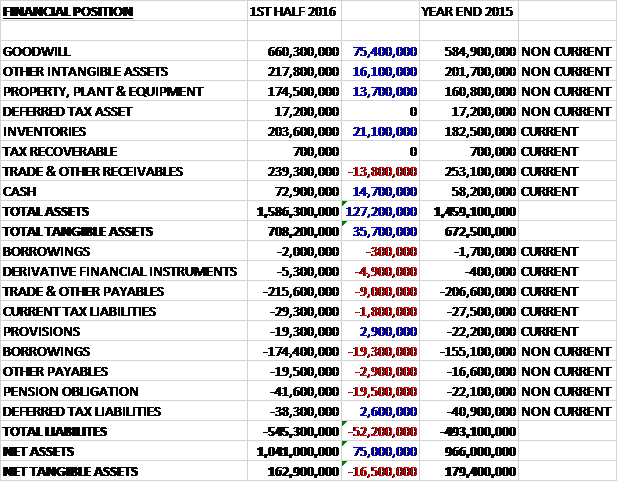
When compared to the end point of last year, total assets increased by £127.2M to £1.586BN driven by a £75.4M growth in goodwill, a £21.1M increase in inventories, a £16.1M growth in other intangible assets, a £14.7M increase in cash and a £13.7M growth in property, plant and equipment, partially offset by a £13.8M decline in receivables. Total liabilities also increased during the period due to a £19.6M growth in borrowings, a £19.5M increase in pension obligations and a £9M growth in payables. The end result was a net tangible asset level of £162.9M, a decline of £16.5M over the past six months.

SXScash

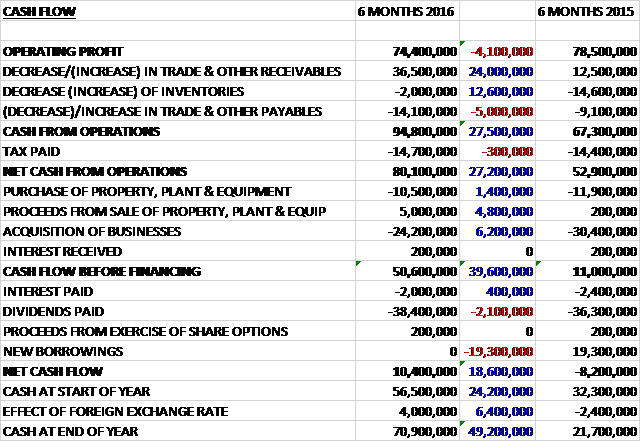
Before movements in working capital, cash profits declined by £4.1M to £74.4M. There was a cash inflow from working capital due to a decrease in receivables and after tax payments modestly increased, the net cash from operations came in at £80.1M, an increase of £27.2M year on year. The group spent a net £5.5M on capex and £24.2M on acquisitions to give a free cash flow of £50.6M. This was easily enough to pay for the £38.4M of dividends and £2M in interest payments to give a cash flow for the period of £10.4M and a cash level of £70.9M at the end of the half.

Trading conditions in the period continued to be challenging, particularly in the in-line instrumentation and industrial controls segments, both of which were impacted by weak global industrial demand. Like for like sales overall were down 3% with a 4% decline in North America reflecting weak industrial demand following the sharp fall in energy prices in 2014. Like for like sales grew in Asia, benefiting from growth of 5% and 8% in China and Japan respectively, although this was against a weak comparator last year. Like for like sales in Europe declined by 6% and a 15% like for like decline in ROW countries was largely due to the weak economy in Brazil.

The adjusted operating profit of the Materials Analysis division was £21M, a growth of £6.4M year on year reflecting an improved product mix with higher aftersales along with prior year restricting, on revenues that increased by 6% (flat like for like) with good growth in China, Japan and North America being offset by declines in Europe and Brazil.

Like for like sales in the pharmaceutical sector grew modestly in the period, despite the lack of Indian generic drug manufacturers being focused on FDA approvals for US export, reflecting a healthy underlying demand. After modest growth last year, sales to the metals, minerals and mining sectors suffered sizeable declines across all four regions. Large systems orders continue to be deferred or cancelled and the growth within the cement and building materials markets in North America and Europe has abated. Aftermarket sales remain strong in this sector, however, as customers prefer to repair and support existing equipment rather than replace or upgrade.

Sales to academic research institutes increased, reflecting strong growth in China and India after both markets had been weak in 2015 with growth also seen in North American and Germany. Outside Germany, European academic research expenditure remained subdued with significant weakness in the UK. Demand in the electronics, semiconductor and telecoms sector continued the growth trajectory that begun in the second half of 2014, reflecting good acceptance of the group’s new products and the acquisitions made of distributors in South Korea and Taiwan.

The board expect sales growth to continue in the second half of the year within the pharmaceuticals and electronics sectors. Demand from the metals, minerals and mining sector is expected to remain weak and to be primarily of an aftermarket sales nature. Sales to the academic research sector remain unpredictable as public sector budgets are likely to remain under pressure in many countries. The benefits of the prior year cost reduction measures, coupled with sales growth, are expected to lead to further improvements in profitability in H2.

The adjusted operating profit of the Test & Measurement division was £18.5M, a decline of £200K when compared to the first half of last year on sales that increased by 4% but fell by 4% on a like for like basis reflecting the difficult market conditions experienced by ESG Solutions in the North American unconventional oil and gas market. On a like for like basis, the profit declined by 9% as the positive pricing and mix effects of the two largest operating businesses were offset by the impact of negative operating leverage at ESG. Regionally there was good sales growth in Asia, driven by China, with declines in all other regions.

There was good sales growth to machine manufacturers, a significant proportion of which represented sales into the automotive supply chain, although direct sales to the automotive sector were flat. There was good growth from the sector in China and India but the market in Europe, in particular the UK and Germany, was weak. Sales to the aerospace industry decreased. Following several years of strong growth in Asia, sales to the region fell in the period despite growth in China and India. There were also lower sales to North American aerospace customers during the period but sales to European customers increased.

Sales to electronics and telecoms customers increased following declines in 2015 – sales in the category are lumpy. The underling business trends in this sector remain healthy and the group sees good opportunities to provide additional testing and calibration services. Sales of the environmental noise monitoring services declined in the period due to the end of a major contract secured last year with the Italian government for exhaust monitoring in vehicle inspection sectors. The underlying market conditions for the business remains healthy, however.

Ongoing weakness in the unconventional oil & gas and mining markets led to difficult market conditions for the microseismic monitoring solutions business, particularly in North America. The business continues to develop opportunities in its international markets and is making progress in this regard in Latin America and Australia, although the near-term focus remains on cost control.

Going forward, the board expects the automotive and aerospace sectors to remain subdued in the second half with growth focused on engineering software and services. The consumer electronics market is expected to remain attractive but the microseismic monitoring market is likely to remain challenging for the rest of the year.

The adjusted operating profit of the In-line Instrumentation division was £10.9M, a fall of £2.9M when compared to the first half of 2015 on like for like sale that declined 6%. On a regional basis, sales grew in North America but decreased in all other regions. This decline reflected ongoing weakness in capex across many heavy process industries such as hydrocarbon processing, chemicals, plastics and paper although certain niche markets remained robust such as emissions monitoring, healthcare, tissue and pulp and wind energy.

Like for like sales in the pulp and paper markets grew slightly reflecting the continued good progress the group are making in diversifying away from the graphic paper market. They increased sales to the tissue and pulp markets and their innovation in new solutions is helping to soften the decline in sales to the graphic paper industry. Sales to the web and converting industries declined slightly reflecting a lack of large projects in North America and Europe, with only the packaging and metals industries providing any respite from the significant reductions in capex being experienced across most process industries.

Sales to the energy and utilities market declined in the period. Sales of condition monitoring solutions to the wind energy sector decreased, although this primarily reflected the strong prior year comparison and the project nature of the business as underlying market conditions remain good. They continue to secure retrofit contracts in the wind energy market, including multi-year service agreement. There continue to be delays and cancellations of large projects in the hydrocarbon processing sector, particularly in North America and the Middle East, although there is investment in China to improve environmental quality which is leading to increased demand in emissions monitoring systems. There are also good levels of interest for the Vibration Interface Module, a system that enables data and signals from any machine protection system to be processed, stored and analysed on a single condition monitoring system.

There was good sales growth to the North American healthcare market. Following a large amount of acquisition activity amongst the customer base last year, which led to many investment decisions being postponed, there is now renewed investment from this sector in their gas sensing technology.

Going forward, management expect growth in sales to the pulp, packaging and tissue market to continue in the second half, helping to offset the structural challenges in the graphic paper market. Demand from the wind energy sector is also expected to remain healthy. Elsewhere, capex in many of the process industries that the group serves is likely to remain subdued.

The adjusted operating profit of the Industrial Controls division was £18.5M, a decline of £1.8M year on year on sales that fell 5% year on year reflecting continuing broad-based weakness in US industrial production with the business having a high exposure to the North American market. Outside that region, the segment performed well, notably in China where there was a strong demand for factory automation solutions.

Whilst the industrial networking business suffered from challenging market conditions, particularly in the core North American market, management believe this primarily reflects short-term cyclical softness and continue to view industrial connectivity as a key strategic market. The recently established industrial internet of things innovation centre in the US is progressing well and during the period the group held a productive cross-operating business workshop to share expertise on the topic.

Last year’s acquisition of Label Vision Systems has gone very well with strong sales growth of its products. There was also good sales growth in the core automatic identification and machine vision solutions business, particularly in China and they have continued to enhance the features of the Micro Hawk smart camera platform launched last year.

Going forward, progress for the segment in the second half will largely be determined by the industrial demand environment in the US, though management expect to see continued good growth in Asia and from their machine vision business. In the coming years the need for customers to improve efficiency is expected to result in increased demand for factory automation and industrial networking products, particularly in China where there is a drive to improve the return on previous capital ingestment.

There were a number of acquisitions during the period. In February the group acquired CAS Clean Air Service, a company based in Switzerland, for a total consideration of £12M, generating goodwill of £4.9M. This business extends the group’s capabilities in monitoring and calibration services within the life sciences market and is being integrated into the Material Analysis segment. In June they acquired Integrated Process Systems India for a total consideration of £900K, of which £200K was deferred. This acquisition generated goodwill of £500K and is being integrated into the Test and Measurement segment.

In June they acquired Capstone Technology, a company based in the US, for a total consideration of £14.6, generating goodwill of £9.4M. The business is a provider of software solutions for process control optimisation and decision support, serving multiple industries such as pulp, paper, chemical, utilities, oil & gas and good & beverage. It is being integrated into the in-line instrumentation segment. The profit contribution from these acquisitions was just £100K.

After the period-end the group acquired Sound & Vibration Technology for an initial consideration of £300K with an earnout based on future performance. This extends the group’s engineering services capability and offering of integrated solutions, primarily for the automotive market and the business is being integrated into the Test and Measurement segment. In late July they acquired DISCOM Elektronische Systeme und Komponenten, a company based in Germany, for an initial consideration of £13.3M with an earn-out based on future performance. The business is a provider of acoustical and vibration quality analysis, predominantly for powertrain production line testing within the automotive industry and is being integrated into the test and measurement segment.

Going forward, taking into consideration the potential net currency benefits at current exchange rates, the increased macro uncertainty and the limited visibility on trading in the second half, the expected overall outcome for the year is unchanged. The board believe that the Brexit vote presents only limited short term direct impact for the group. The main near term risk stems from broader uncertainty which could inhibit investment and increase market volatility. A Brexit risk committee has been established and the group will continue to monitor any additional exposure as the full implications become clearer.

The net debt position at the end of the period was £103.5M compared to £98.6M at the end of last year. At the current share price the shares are trading on a PE ratio of 19.5 which falls to 15.9 on the full year consensus forecast (likely to have been adjusted to remove certain items). After an increase in the interim dividend, the shares are yielding 2.7% which increases to 2.8% on the full year forecast.

Overall then this has been another difficult period for the group. Profits decreased, net tangible assets were down and although the operating cash increased with plenty of free cash being generated, this was aided by a decline in receivables and cash profits declined year on year. The Materials analysis business was the only segment to see growth, due to favourable product mix and lower costs (sales were flat). Test & Measurement was hit by a slow-down in the oil and gas market; in-line instrumentation suffered from weakness in capital expenditure in processing industries; and industrial controls declined due to a general weakness in US industrial production.

Going forward, this sluggish environment is unlikely to change any time soon and a forward PE of 15.9 and dividend yield of 2.8% doesn’t sufficiently account for these issues in my view.

On the 2nd September the group announced that it had completed the acquisition of Millbrook for a consideration of £122M, of which £3.4M is deferred for two years, which will be met from existing cash and bank facilities.

The business is a European test, validation and engineering service provider, primarily for the automotive and related markets. It was sold by General Motors to Rutland Partners and management in 2013 and from that point has been transformed from a GM dependent business to one with a broad base of UK and international clients. In September it acquired Test World, a winter vehicle and tyre testing business based in Finland. Their UK test tracks and facilities are located on a wholly-owned 665 acre site in Bedfordshire that has scope for further related commercial development.

The business has undertaken significant growth capital expenditure programmes in 2015 and 2016, from which trading this year is expected to benefit considerably. Last year, EBITDA came in at £5.4M but beyond this year the business has significant opportunities to accelerate its growth with a range of customers and in key areas of testing, through further customer-supported investment in facilities.

On the 22nd November the group issued a trading update covering the first four months of H2. Reported sales increased by 18% with acquisitions contributing 4% of that growth and forex movements contributing 18% so like for like sales declined by 4%.

Regionally like for like sales grew in Asia Pacific and ROW, and declined in Europe and North America. The performance in Europe has improved moderately since the first half of the year but North America saw a further deterioration. Materials Analysis delivered positive like for like sales growth but sales declined in the other three segments. At Omega Engineering the adverse profit impact from inventory adjustments mentioned at the half year stage has been quantified and ongoing process improvements continued to be implemented to remedy this.

Against this trading environment. The group continues its self-help actions to better align costs to sales performance and is on track to deliver £10M cost savings for the full year. They are making good progress in quantifying and planning the various productivity improvement initiatives included in “Project Uplift”.

During the period the group completed the acquisition of Millbrook for a consideration of £122M. The business is a European test, validation and engineering service provider, primarily for the automotive sector and related markets such as tyres, petrochemicals, defence and security. The integration is proceeding well and trading is in line with expectations. Following the acquisition, the net debt position was £180M.

In light of the challenging trading conditions, particularly in North America, and the continued weakness in the global oil and gas market, a review is underway of the goodwill associated with ESG Solutions and Omega Engineering which is likely to lead to a non-cash impairment charge in the full year accounts.

Trading conditions in the period have marginally deteriorated, particularly in North America, and the group’s performance continues to be impacted by weak industrial demand. This is offset by further strategic progress on acquisitions and the impact of forex movements. Accordingly the board expect the full year adjusted operating profit to be in line with current market expectations of between £179M and £209M.

Overall then times are tough but the group is being saved by the weakness in Sterling. I am not rushing in here just yet.

Games Workshop Share Blog – Final Results Year Ended 2016

Games Workshop has now released its final results for the year ended 2016.

GAWincome

Revenues declined when compared to last year due to a £646K fall in retail revenue, and a £462K decrease in mail order revenue. Amortisation fell by £1M and cost of inventories was down £412K but depreciation was up £245K, mainly as a result of the opening of the visitor centre last year, and other cost of sales grew by £1.6M to give a gross profit £1.5M below that of last year. We then see development costs up £709K and other operating expenses increasing by £2.7M, mainly relating to new store openings and higher staff costs but redundancy costs fell by £1M and royalty income grew by £4.4M, mainly due to the launches of Total War: Warhammer and Warhammer: End Times – Vermintide, which meant that the operating profit increased by £383K. Tax was down by £876K so that the profit for the year came in at £13.5M, a growth of £1.2M year on year.

GAWassets

When compared to the end point of last year, total assets increased by £2.4M driven by a £1.6M increase in computer software, a £688K growth in development costs, a £643K increase in fixtures and fittings and a £915K growth in inventories, partially offset by a £786K decline in cash. Total liabilities also increased during the year as a £753K growth in social security and other tax payments along with a £490K increase in current tax liabilities and a few other small increases was partially offset by a £698K decline in deferred income. The end result is a net tangible asset level of £41.2M, a decline of £601K year on year.

GAWcash

Before movements in working capital, cash profits increased by £2.6M to £28M. There was a modest cash outflow from working capital and after tax payments increased by £247K, the net cash from operations came in at £24.2M, a growth of £954K year on year. The group spent £5.3M on tangible fixed assets, £2.8M on software and £4.6M on product development which meant the free cash flow stood at £11.7M, all of which was paid out in dividends to give a cash outflow for the year of £883K and a cash level of £11.8M at the year-end.

The profit in the Trade business was £10.6M, a decline of £882K year on year. The new trade team for accounts in the UK and Europe has settled in well and made some progress during the year. Sales in North America were broadly flat. They have also updated their trade product range in June 2016 to ensure they provide their stockist accounts with the best sellers.

The profit in the Mail Order business was £13.7M, a fall of £685K when compared to last year. Sales of the Forge World range grew by 28% but there was a 12% decline in sales of the Citadel range. In the first half of the coming year they will be making a change to their home page; removing complexity and adding a deeper introduction to the worlds. During the year they migrated their web data centre to a new location in North America.

The loss from the Retail business was £3.4M, an increase of £1.9M when compared to 2015. The CEO has stated that the underlying performance of their own stores has not been good enough and the group made some changes to their retail support structure to address the decline. The flat management structure did not support the complexity of managing 149 stores across 14 countries in Europe and in January they moved to a country based solution. They now have four territory managers; Germany/Scandinavia, Netherlands, France and Spain/Italy.

The profit from the Product and Supply business was £7.1M, a decline of £1.5M year on year. The profit from Royalties was £5.3M, a growth of £4.3M when compared to last year. This has probably been the best year to date for licencing with launches of Bloodbowl 2, Warhammer: End Times, Warhammer 40,000: Freeblade, and probably most importantly, the launch at the end of May of Total War: Warhammer.

The year started with the launch of Warhammer: Age of Sigmar, one of the biggest changes ever made to a core universe. The simplified rules, supporting the models for those who like to play, made it much easier to get started. It didn’t all go smoothly, however, and the board learnt some lessons on how to deliver product system changes on this scale and they released more of the range in the second half of the year with sales of Sigmar at a higher rate than Warhammer has enjoyed for several years.

After a disappointing December, they carried out a review of their operational plan and performance improved since December, although not enough to prevent sales declines in most areas. Costs increased during the year, mainly as a result of the store opening programme and the full year effect of the depreciation of the visitor centre. The group now have a small retail sales HQ in Dallas and have opened 16 stores in the US during the year, taking the total up to 100. They are now targeting twenty store openings per year in the country which will be the main focus for store openings

The group now offer their models at a broader range of price points and have piloted a small “Start Collecting” range of models that have sold well. They have also introduced some stand-along high value box games, a gateway into Games Workshop products, which have also sold well during the year.

In Asia the group now have four new sales territory managers: in Singapore, Hong Kong, Japan and Malaysia, in addition to the existing business in China. They will grow the group by opening stockist accounts and their own stores.

The group now have 96 multi-man format stores and 355 one man stores. Due to the timing of the lease breaks, the opportunity arose to pilot some larger multi-man format stores placed to service a greater number of customers. The Tottenham Court Road store is on target to be the highest sales value store and the other pilots in Sydney and Copenhagen delivered their promises too. These successes give them more store options but the standard format will remain the one man store model.

To broaden their reach they are piloting a small range of products in new markets. They launched a dispenser of eight products called Battle for Vedros in toy shops in North American in June and will launch a small range called Build and Paint globally in modelling and toy shops later in the coming year. Currently all of the stores carry the same range but they will be looking at a matrix approach of broadening the product range in the higher volume stores and optimising their product range in some of the smaller stores. They will also continue to invest in core IP with product launched planned throughout 2017.

There are a number of risks for the coming year. The change of the core ERP system in the UK is a complicated project with the risk of widespread business disruption if not implemented well. Also, the change of the mail order warehouse system carries some risk. The board have avoided the Brexit issue, stating that they feel it is too early to tell what the effects will be.

During the year he group invested £7.5M in the design studio, including software costs, with a further £2.2M spent on tooling for new plastic models. A similar level of investment is expected in the coming year. They are also currently working on a significant project with a UK software supplier to upgrade the core IT systems that interface with the manufacturing equipment and systems. The project to upgrade the IT infrastructure and software for the warehouse that supports the mail order business will be delivered this autumn at a cost of £900K. The European ERP replacement has been more complex and costly than originally stated and will now launch in 2018 at an estimated cost of £6M, an increase of £1.5M.

At the current share price the shares are trading on a PE ratio of 11.6 which grows to 12.3 on next year’s consensus forecast. At the current share price the shares are yielding 8.2% in dividends which falls to 7.2% on next year’s forecast. Net cash at the year-end was £11.8M compared to £12.6M at the end of the prior year.

Overall then this has been a bit of a mixed year for the group. Profits were up, mainly due to lower redundancy costs but higher royalty income also had an effect. Net tangible assets declined but operating cash flow also increased with plenty of free cash being generated. The trade, mail order and retail divisions all saw performance deteriorate with new territory managers being appointed to try and stem the decline in the latter. The group was saved though but a large increase in royalty income following the success of the Total War video game.

The group is looking to the US for expansion and is also trying to tempt new customers with simplified rules but they have to be careful here as it is a balancing act between new customers and their existing fans. The ERP update is also something to watch as it has the potential to be disruptive. The forward PE of 12.3 looks OK but it is the dividend yield which is the real attraction here – the 7.2% yield looks decently covered by cash flow so is probably sustainable. I am tempted to go for this.

On the 16th August the group announced that non-executive director Elaine O’Donnell purchased 3,593 shares at a value of £19.5K. She now owns 5,093 shares in the company.

On the 6th October the group released a trading update covering the first four months of the year. In all, sales and profits are ahead of the board’s original expectations. Over the period, sales have grown in constant currency terms and have further benefitted from the favourable impact of a weaker pound.

On the 17th October the group announced a final dividend of 25p per share which equates to an annual yield of an astonishing 8.1%.

On the 2nd November the group announced that head of product and supply Max Bottrill acquired 3,500 shares at a value of nearly £20K.

Overall these updates all look decent to me and I continue to hold.

On the 1st December the group released a trading update covering the first half of the year where they stated that sales and profits are significantly ahead of those last year and head of the board’s original expectations with operating profit estimated to be around £13M. Over the period they have seen strong sales and profit growth in constant currency terms which have been further benefited from the favourable impact of a weak pound and royalty income is also expected to be ahead of last year.

This all sounds positive, I continue to hold.

XP Power Share Blog – Interim Results Year Ending 2016

XP Power has now released its interim results for the year ending 2016.

XPPincome

Revenues increased when compared to last year due to a £3.9M growth in North American revenue with EMCO contributing a £3.1M increase, a £1.1M increase in European revenue and a £1.1M growth in Asian revenues. Inventory costs were up £1M and other cost of sales increased by £2.5M to give a gross profit £2.9M above that of last time. Amortisation and depreciation showed modest increases, as did R&D expenses and with other operating costs increasing by £2.1M reflecting the strengthening dollar and contribution from the acquisition, the operating profit was just £300K up. Tax costs were down somewhat but more profit was attributable to non-controlling interests so the profit for equity holders came in at £9.8M, a growth of £200K year on year.

XPPassets

When compared to the end point of last year, total assets increased by £14.7M driven by a £4.9M growth in inventories, a £3.8M increase in trade receivables, a £2.3M growth in goodwill, a £1.8M growth in property, plant & equipment and a £1.4M increase in intangible assets. Total liabilities also increased during the period due to a £3.2M growth in borrowings and a £1.1M increase in current tax liabilities. The end result is a net tangible asset level of £46.6M, an increase of £5.7M over the past six months.

XPPcash

Before movements in working capital, cash profits increased by £3.7M to £18M. There was a cash outflow from working capital with an increase in inventories and receivables and after tax payments fell by £600K the net cash from operations was £8.2M, a decline of £300K year on year. The group spent £2M on R&D and £1.2M on fixed tangible assets to give a free cash flow of £4.9M. This did not cover the £7.5M paid out in dividends and the group repaid £1.2M of borrowings to give a cash outflow for the period of £3.7M and a cash level of £1.8M at the period-end.

Order intake of £61.6M was up 9% (4% on a constant currency). Compared to the same period last year, Asia increased by 5%, Europe increased by 1% and North America increased by 17% driven by a strong US dollar and orders of £4M from EMCO.

Industrial revenues increased by 20% to £28.8M driven by a strong performance in Europe and some recovery after the weakness seen in the industrial sector in North America last year. The technology sector grew by 11% compared to the first half of last year to £14M driven by semiconductor manufacturing and broadcast customers. Revenues from healthcare were up just 1% to £17.5M although the board expect growth in healthcare to improve over the medium term as new healthcare programmes enter the production stage.

Last year the group were able to raise their Euro pricing as the currency weakened against the dollar, on which the input costs are based, while still taking advantage of the euro forex hedges. This year they had the benefit of the previously raised prices but not the gains from the hedging programme. Revenue from own design products was £43.4M, up 20% year on year.
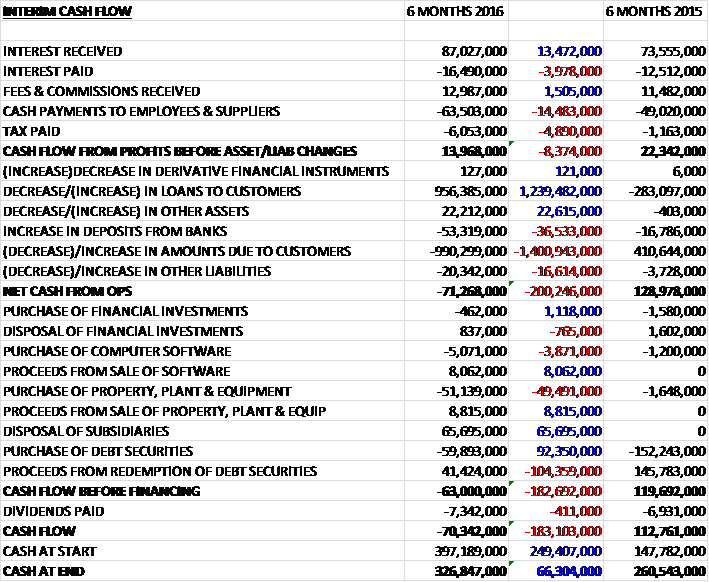
The operating profit in the North American business was £10.4M, a growth of £3M year on year; the operating profit in the European business was £6M, an increase of £2.2M on the first half of last year; and the operating profit in Asia was £1.1M compared to a break-even position in the first half of 2015.

The group enter the second half of the year with an order backlog of £50M compared to £48M at the year-end. The integration of the EMCO business has progressed well and in the period they received orders of £4M for EMCO products with £3.1M being shipped.

The group launched 27 new product families in the period compared to 13 in the first half of last year. This relatively high number of new product introductions was aided by the introduction of a new labelled product supplier to increase their offering of DC-DC converters. Examples of products released in the period include the ALM65 family and the XT16 three phase input version of the configurable fleXPower range.

The ALM65 family is an external 65 Watt AC-DC power converter that complies with the latest Level VI energy efficient standard which was only introduced in February 2016. This new standard ensures that much less power is consumed when the end unit is switched off or not connected, and seeks to increase average efficiency to reduce waste power when the load is connected. The products also meet the latest medical standards so can be designed into healthcare applications.

The XT16 is an addition to the existing modular fleXPower series which can be configured into a bespoke solution for quick delivery of samples, prototypes and production, with up to 1,600 Watts of output power. The product can be populated with up to seven output modules chosen from 44 single output and 16 dual output modules ranging from 3.3V at 66W to 60V at 750W. Introduced in response to customer demand, the product is the first three phase input version they have introduced to the fleXPower family.

The group manufactured 550,000 power converters during the period with 140,000 of these being produced in the Vietnam facility (compared to 24,000 in the first half of last year). They expect the proportion of power converters produced in the country to increase as they transfer more products there.

About ¾ of the group’s revenues are invoiced in US dollars so the change in the USD/GBP exchange rate has a significant effect on reported revenue. As the majority of the cost of goods sold and operating expenses are also denominated in USD, however, the change in profit is relatively minor with the impact in H1 being to increase profits by £500K.

In January, Polly Williams joined the group as a non-executive director. She is a former partner at KPMG and is also a non-executive at Jupiter Fund Management, TSB and Daiwa Capital. John Dyson stepped down from the board following the AGM after many years of service.

The Brexit decision resulted in a significant weakening of Sterling against the US dollar and a degree of economic uncertainty. About 20% of the group’s revenues derive from UK customers but it is difficult to judge how the business in the UK will be affected in terms of whether there will be a low down or whether customers might actually benefit in export markets from the depreciation of Sterling. If current rates persist in the second half of the year, it will have a favourable translation effect on reported revenues but a slightly adverse effect on UK margins if they can’t pass on price increases to the 67% of UK customers currently invoiced in Sterling.

While the global economic outlook remains uncertain and exchange rates are volatile, the board are encouraged by the strong order backlog. This, together with new programme wins gives them confidence that they can grow revenue in the second half of the year as designs won in 2015 enter their production phase.

At the period-end the net debt stood at £6M compared to £3.7M at the end of last year and £400K at the same point in 2015. At the current share price the shares trade on a PE ratio of 15.5 which falls to 14.9 on the full year forecast. After a 7% increase in the first half dividend, the shares are yielding 4.3% which increases to 4.5% on the full year forecast.

Overall then this has been a steady half year period for the group. Profits were up modestly but net assets showed a stronger increase. The operating cash flow did fall and the free cash flow was not enough to cover the dividend but this was mainly as a result of an increase in inventories and cash profits grew.

The industrial and technology markets performed well but the healthcare market was flat, although new programmes are coming on line in the second half of the year. The order back log is up slightly and although the economic outlook is uncertain, the group don’t seem to be that exposed to Brexit. The forward PE of 14.9 is rather pricey but the dividend yield of 4.5% is pretty good and I am happy to hold after this steady (nicely boring!) update.

On the 26th September the group announced that Chairman James Peters sold 120,000 shares at a value of just over £2M. He remains interested in just under 2M shares but this is a substantial sale.

On the 7th October the group released a trading update for Q3 where they stated that they continue to trade in line with board expectations. Revenues for the first nine months of the year increased by 13% to £92.6M and on a constant currency basis they were up 5%. Orders for the period increased by 19% to £95.8M (constant currency 11% increase). Q3 order intake was boosted as customer orders expected to be placed in Q4 were pulled forward into September. The momentum in the order intake is encouraging as they are starting to see their North American markets return to growth.

Net debt was £2.2M at the end of the period compared to £6M at the end of the first half of the year and a dividend of 16p will be paid which represents an annual yield of 4% at the current share price. Going forward, despite the challenging
macroeconomic backdrop, the board are reassured by the momentum in their order intake and expect trading to be in line with expectations for the full year.

They remain encouraged by new design wins and believe the group is continuing to take market share as its portfolio of power technology products is increasingly designed in to new equipment by their customers. These design wins will translate to orders as these projects move to production phase over the coming years. Overall this seems to be steady as she goes and I continue to hold.

On the 13th January the group released a trading update covering Q4. They had a strong finish to the year in line with board expectations as the acceleration in order intake reported in Q3 fed through to robust revenue growth this quarter. The momentum in order intake continued to strengthen in Q and was £37.1M compared to £35M in Q3 and £30M in Q4 last year. Revenues in the quarter were £37.1M compared to £32.3M in Q3 and £27.8M in Q4 2015. Net cash at the end of the quarter was £3.6M compared to a net debt position of £3.7M at the end of last year.

Going forward, the board are encouraged by the strong order intake they have experienced in the second half of the year. They enter 2017 with positive momentum and expect that they should be able to show further growth in revenues in 2017. This all looks good to me, I continued to hold.

Creston Share Blog – Final Results Year Ended 2016

Creston has now released its final result for the year ended 2016.

CREincome

Revenues increased when compared to last year (although like for like revenue was broadly flat) as a £1M decline in Health revenue was more than offset by a £6.8M growth in communications and insight revenue. Share based payments declined by £289K but intangible amortisation grew by £627K, there was no £384K positive movement in the fair value of contingent consideration, acquisition costs were up £1.5M, start-up losses grew by £327K, there was £497K of restructuring costs and other operating costs increased by £4.5M. We then see a £15.2M impairment of goodwill to give an operating loss of £7.3M, a detrimental movement of £17.1M. Finance costs increased somewhat but this was offset by a decline in tax. The end result was a loss of £9.7M, a detrimental movement of £17M year on year.

CREassets

When compared to the end point of last year, total assets declined by £12.8M to £136.5M driven by a £9.7M decline in goodwill and a £6.9M fall in cash, partially offset by a £2.6M increase in the value of customer contracts, a £1.2M growth in receivables and a £936K increase in investments. Total liabilities also declined during the year as a £1.4M fall in the provision for deferred consideration and a £1.3M decline in corporation tax payable was partially offset by an £847K growth in deferred tax liabilities. The end result is that, excluding goodwill, the group had a net tangible asset level of £10M, a decline of £1.9M year on year.

CREcash

Before movements in working capital, cash profits declined by £1.1M to £10.5M. Working capital was broadly neutral compared to a cash outflow last year and after tax payments increased by £1.3M, the net cash from operations came in at £7.4M, a growth of £711K year on year. The group spent all of this on acquisitions, along with £1M on investments, £1.4M on deferred consideration, £767K on property, plant and equipment, and £295K on intangibles to give a cash outflow of £3.9M before financing. The group also spent £209K on finance costs and £2.5M on dividends it could not really afford to give a cash outflow of £6.8M for the year and a cash level of £1.4M at the year-end.

The headline PBIT in the Communications & Insight division was £9M, a growth of £883K year on year on revenues that increased by 12% overall and 2% on a like for like basis. This growth was driven by the acquisition of How Splendid, the good new business performance and the broadening of services to key clients with two of the top five customers experiencing double digit revenue growth. The top twenty client list saw three new entrants following the acquisition – SSE, Boots and the recent Costa win.

This positive underlying revenue trend has been affected by client budget reductions and volatility due to weaker trading for certain clients, especially in the retail and consumer tech sectors, and a more cautious economic outlook for others. The insight companies have particularly been affected by these factors as well as the changing market research industry, and this has led to the closure of the group’s Fieldwork operation and a more difficult trading performance.

The growth in profit was offset by the weakening Euro to the tune of £400K, and an increase in operating costs to services an expected higher level of revenue earlier in the year. Actions have been taken to ensure operating costs are aligned with the revised levels of future revenues and to maintain margin.

Significant new business wins during the period include work for new and existing clients; CRM and data strategy advisor to BA, the CRM strategy for the Vodafone Customer Value Marketing account, global lead digital strategic agency for Sony Mobile, the local marketing of Bosch Home and Garden and the CRM and digital strategy for Weetabix. After the year-end, wins include Sony PlayStation Europe and additional work with L’Oreal.

In December the group announced the creation of new brand partnership specialist, Affinity, which helps clients negotiate long-term partnerships with sporting and live entertainment events. Since launch the business has won clients including Rolls Royce and Ocean Masters World Championship. The group also launched Navigate, which is involved in marketing technology. In the context of an ever-changing landscape of data platforms, the business has been set up to advise brands on the optimal technology to automate data-driven consumer marketing experiences. It now works with group clients such as Danone, Nissan and Sony. Other investments in existing agencies during the year includes the launch of Real Data and Reflected Life, data analytic and digital marketing tools respectively.

The headline PBIT in the Health business was £4M, a decline of £355K when compared to last year. On a like for like constant currency basis, given the strengthening of the US dollar, the decline increased. Revenue was lower predominantly due to a weaker performance in the UK Health business, and more specifically in the health advertising agency. As a consequence of this and the growing change in market opportunities, the group combined DJM and PAN to launch DJM PAN Unlimited. Cost initiatives have been enacted which have included disbanding the health regional restructure which will realise £500K in annual savings.

Significant new business wins during the period include work for Astellas, Astra Zeneca, CDC, Gilead, National Meningitis Association, Novartis and Sanofi with post period wins including AbbVie, Janssen and Orthimo.

During the year the division created Search Unlimited, a digital marketing search engine optimisation agency. With founding clients Astra Zeneca, Abbvie and Novartis, this SEO specialist works to support clients in building their online profile.

In the US, in April 2015 the group announced a partnership with Propeller Communications and also began a partnership with global consumer trends and insight consultancy Future Foundation. The international growth has been further supported by the existing partnership with Serviceplan in Europe and in January 2016 they entered a new partnership with Ariadna to grow their South American services.

On the 22nd April the group acquired a 51% share in How Splendid Ltd for a total cash consideration of £8.9M, generating goodwill of £5.1M. There is the potential of a further additional consideration payment of up to £7M in June 2017 relating to the 51% shareholding based on profitability up to that date. This payment would be considered deemed remuneration so is off the balance sheet. Currently there is zero deferred consideration due to project delays impacting 2016 performance but this will be re-assessed in future reporting periods, although no further consideration for the 51% of the business is expected.

The fair value of the non-controlling interest is deemed to be nil on acquisition due to restrictions on the 49% shareholding which links the ownership of those shares to continuing employment for two years from the acquisition date. As such a share based payment charge will be recognised to value this liquidity foregone to build up a balance in equity with this converting to non-controlling interest provided the sellers are still in employment at the two-year anniversary date.

For the remaining share capital, there are no put options but the group will have the option to acquire a further 24% from April 2017 for a maximum value of up to £8.6M and the remaining 25% from April 2019 for a maximum value of up to £11.9M. This consideration, payable on cash will depend on the average profit for the year in which the call option is exercised along with the two years prior. During the year the business contributed profit of £1.5M.

In June 2015 the group made an investment in 18 Feet and Rising, a London-based advertising agency for a consideration of £1M. The group acquired a 27% shareholding and in the period since the acquisition, a loss of £64K was recognised from the business.

As usual there are a load of non-underlying costs. Acquisition, accounting and deal related costs amounted to £1.3M comprising acquisition costs of £200K for Splendid United and 18 Feet; £700K of amortisation costs relating to the Splendid acquisition; and share-based payments of £300K in relation to Splendid for valuation of liquidity foregone for the non-controlling interest. In relation to the acquisition of DJM and Cooney Waters, £100K has been recognised as acquisition payments to employees deemed as remuneration.

Start-up related net losses of £400K have also been flagged up. This represents the net losses of five start-ups, being Reflected Life, Real Data, Affinity, Navigate and Search. Restructuring and closure related costs of £500K have been incurred in relation to the reorganisation of UK Health regional board, the combination of DJM and PAN to form DJM PAN and the closure of FieldworkUK.com.

A goodwill impairment charge of £10.7M was recognised against ICM Unlimited. This included £2M as a result of the closure of FieldworkUK.com with the rest due to a more conservative estimate of future operating profit growth rates following a poor performance in 2016. There is still £8.7M of goodwill against the business. The group also recognised a goodwill impairment charge of £4.5M against DJM PAN Unlimited due to a more conservative estimate of future operating profit growth following the business combination.

Richard Huntingford stepped down from the board as non-executive chairman and Nigel Lingwood is activing as Chairman on an interim basis. In February, Iain Ferguson joined the board as a non-executive director representing the company’s largest shareholder, DBAY Advisors.

The board remains confident that the group is well placed to deliver long term growth to shareholders on the basis of its strengthened offer, blue chip client relationships and positive cash position at the year-end.

At the current share price the shares are trading on a PE9.7 which falls to 7.6 on next year’s consensus forecast. After a 5% increase in the total dividend, the shares are yielding 4.8% which remains flat on next year’s forecast. At the year-end the group had a net cash position of £1.4M compared to £6.9M at the end of the prior year.

Overall then this has been a bit of a mixed year for the group. Excluding impairments, profits declined due to various acquisition costs, start-up costs and restructuring expenses, apart from these they were modestly up. Net assets declined and although the operating cash flow improved, this was due to a smaller fall in payables than last year and cash profits fell with no free cash being generated after acquisitions.

The communications & Insight division saw profits increase due to the How Splendid acquisition but the Health business saw a reduction in profits driven by difficult conditions for the UK Health advertising agency. The How Splendid acquisition looks a bit complex and expensive but it seems that a poor performance means that no further contingent consideration is expected on the bit they already own, although the future call options look potentially costly.

Offsetting the issues is a seemingly cheap valuation with a forward PE of 7.6 and yield of 4.8% probably pricing in a fair amount of pain. Overall though this does not strike me as a great investment at the moment, especially after the recent Brexit vote.

On the 6th September the group released an update covering the first four months of the year. They are trading broadly in line with expectations. The recent Brexit vote continues to cause some variability and uncertainty in budgets amongst the group’s UK clients but the subsequent movements in existing clients’ marketing budgets have largely been offset by the benefit of new business gains and during the period there has been marginal growth in revenue.

Headline pre-tax profit is well ahead of the same period last year, reflecting the benefit from the ongoing implementation of operational efficiencies started in the prior year, and some benefit from the weakening in Sterling. Overall this looks tentatively OK and I feel these look rather good value now so have taken a small position.

On the 17th November the group announced they had reached an agreement with largest shareholder DBAY regarding the terms of a cash offer for the group. Each shareholder will receive 126.42p per share, representing a 35% premium to the closing price of the shares the day before. This looks rather opportunistic to me and I would not be that happy if I was a long term shareholder but this represents a decent return for my recent purchase!

Arbuthnot Share Blog – Interim Results Year Ending 2016

Arbuthnot has now released its interim results for the year ending 2016.

ARBBincome

Net interest income was up £1.8M and net fee & commission income increased by £621K to give an overall operating income that grew by £2.4M. The group gained £1.7M from the Visa Europe transaction and received £265K from Secure Trust in the period that it was an associate following the sale of shares. There was a £554K increase in commercial banking investment, a £650K cost associated with increased office space and a £2.3M charge relating to staff bonuses following the sale (this could possibly be included in discontinued ops?). We also see a £162K growth in depreciation and amortisation along with a £2.9M increase in other operating expense to give a £2M detrimental movement before tax. After tax costs increased the loss for the year from continuing operations was £2.9M, an increase of £2.6M year on year although due to the disposals, the actual profit was £157.3M.

ARBBassets

When compared to the midway point of last year, total assets declined by £585.9M to £1.256BN driven by a £779.3M fall in loans & advances to customers, an £8.3M decrease in property, plant & equipment and a £4.1M decline in intangible assets, partially offset by an £86.2M increase in investments in associates relating to the shares in Secure Trust; a £68.7M growth in cash and a £50.2M investment property. Total liabilities also declined during the year due to a £665.4M fall in deposits from customers, a £10.9M decline in other liabilities, an £8.9M decrease in deposits from banks and a £5M fall in current tax liabilities. The end result was a net tangible asset level of £274.9M, a growth of £106.6M year on year.

ARBBcash

Cash profits declined by £8.4M to £14M and there was a large cash outflow from working capital due to a big fall in amounts due to customers so that there was a net cash outflow of £71.3M from operations (there was a total outflow of £43.7M from discontinued operations). The group spent £5.1M on computer software but managed to get £8.1M from the sale of software. They also spent £51.1M on property, plant and equipment and a net £18M or so on debt securities before a £65.7M gain from disposals and a £8.8M in proceeds from sales of property, plant & equipment meant that the cash outflow for the period came in at £70.3M to give a cash level of £326.8M at the period-end.

In December the group agreed to the conditional sale of its non-standard consumer lending business, Everyday Loans., to Non Standard Finance for £106.9M in cash and £16.3M in Non Standard Finance shares. The disposal completed in April and on completion, Non Standard Finance repaid intercompany debt of £108.1M to Secure Trust and after selling costs of £6.2M this resulted in a gain recognised on disposal of £113.3M.

In June the group sold 6M shares in Secure Trust Bank which reduced its shareholding from 51.92% to 18.93%. From this date they accounted for the remaining holding in STB as an associate and they retained board representation. As a result of this transaction the group recognised a gain of £100M.

The group will continue to invest in its remaining subsidiary to accelerate the growth in the Private and Commercial banking business. Given the current market conditions, they will also explore other opportunities to enhance and diversify its income streams. Meanwhile, Secure Trust will now explore the opportunity of achieving a listing on the main market and will be able to expand its horizon for growth opportunities that enhanced access to capital markets will allow and the group are looking to maintain a significant investment in the bank.

Due to the sale of shares, however, the profit from the Secure Trust Bank has had to be recorded as discontinued operations. Given that the group retains 18.9% of the shares and that Secure Trust is considered an associate, this does under-represent the profit from continued operations. On a pro forma basis, the continuing income from the associate for the first half of 2016 would have been £2.5M, an increase of £900K. (The reported earnings from the associate for the period after the disposal was £300K) so it could be argued that continuing profits are understated by £2.2M during the period.

Arbuthnot Latham reported a pre-tax profit of £4.5M, an increase of £800K year on year which includes the impact of the investment programme that commenced during 2015 with the building out of the commercial banking business and the banking infrastructure upgrade project which offset a 13% increase in revenues. Customer assets continued to grow, increasing by 14% to £657M while deposits increased by 23% as the bank continued to attract new clients. Assets under management increased by £96M to £797M.

The investment in the commercial banking activities totalled £600K in the period. Three sector teams have already been established in London while further teams are due to establish a presence in Manchester and Exeter to cover those regions. In June the business completed the purchase of a property in the West End for £50.2M. This is expected to initially be held as an investment property receiving about £1.8M rental income per year but in due course the bank will explore plans to establish a West End client office in the building.

Given the result of the EU Referendum, the UK economy faces short-term economic volatility. The board believe that the group is well positioned to prosper, however. It has divested its high margin lending business which is the more likely to experience increased impairments during a downturn and realised a significant proportion of the investment in Secure Trust. It is therefore highly capitalised and well place to take advantage of any opportunities that might arise.

After the interim dividend was increased by 1p and a special dividend of 25p was declared, the shares now have a yield of 3.8% although this is expected to fall back to 2.1% next year without the benefit of the special dividend.

Overall then this has been a transformational period for the group. The profit from continuing operations did decline but if we add back in the pro-rata £2.2M profit from the associate that is included in the discontinued operations and discount the £2.3M bonuses given out following the sale of Everyday Loans (the profit of which was included in discontinued operations), the performance of the group improved year on year. Net assets also grew but the operating cash outflow worsened.

The two large transactions are clearly the defining moments of this period with the Everyday Loan sale netting £113.3M in profit and the Secure trust share sale gaining £100M. In addition, customer assets and deposits both increased. Unfortunately looming over these results is the Brexit vote and while Arbuthnot do seem better placed than other banks, their performance could still be affected and with a forward dividend yield of 2.1%, I am not sure the risks are fully priced in. I am waiting on the side lines for a bit more clarity.

On the 13th October the group released a trading update covering Q3. The overall lending pipeline has shown good growth, although the period of time between approval and drawdown of loans has marginally increased. The commercial bank continues to develop at a good rate. The disruption in the larger UK banks has led to a number of direct approaches from experienced bankers who are interested in joining the group. They have therefore accelerated their expansion plans and are taking on new premises in Manchester to cover the NW region.

The recent reduction in the base rate will result in a short term fall in net interest margin but the longer term impact of this may be reduced depending on where rates in the deposit market stabilise. The significant transactions carried out in the first half of the year which resulted in a profit of over £225M have now been included in the capital base of the group so the board are now proposing to pay a further special dividend of £3 per share, which equates to about £45M.

Overall the group is confident that it can continue to exploit the opportunities that currently exist in the financial services industry. This seems like a pretty steady update, although the lower base rate is a bit of a concern. I will keep watch on this share for now.

On the 19th December the group completed the purchase of a private baking loan portfolio which is mainly secured against residential property. The loans are being purchased from Duncan Lawrie Ltd and has customer balances of around £44.9M spread over 83 customer accounts. The average loan to value of the property was 43% and the client yield was 5.21% in October.

On the 20th December the group announced that it had reached an agreement to acquire Renaissance Asset Finance from its founders. The business is a provider of finance for a range of specialist assets which includes vintage and expensive cars and SME business assets. By the end of November customer assets were £68M and the net assets of the business were £1.6M.

Consideration will be paid in four staged amounts, all of which will be in cash with the first amount being paid on completion being equal to the net assets. The remaining amounts will be made annually based on the profitability of the business in each of the following three years. The maximum amount payable for the performance based payments is limited to no more than £6.5M. Both consideration and the refinancing of RAF’s funding liabilities (about £66M) will be satisfied from cash resources. Last year the business made a pre-tax profit of £2.4M but this included a one-off amount of £1.75M.

On the 23rd January the group announced that finance director James Cobb purchased 1,000 shares at a value of £15K. Not a huge purchase but nice to see nonetheless.

On the 21st February the group released a trading update for the year. They continued their development as expected in Q4 and therefore will report profits for the year in line with market expectations. As previously announced they completed the purchase of the Duncan Lawrie loan portfolio which has now been transferred.

In December they also announced that they had reached an agreement to acquire Renaissance Asset Finance which was subject to the approval of the change of control by the Regulation Authorities. One of these approvals has now been received but the completion still remains conditional on the final receipt which is expected to complete before the end of Q1 2017.