Serabi Gold Share Blog – Q1 Results Year Ending 2016

Serabi Gold has now released its Q1 results for the year ending 2016.
SRBincome Q1

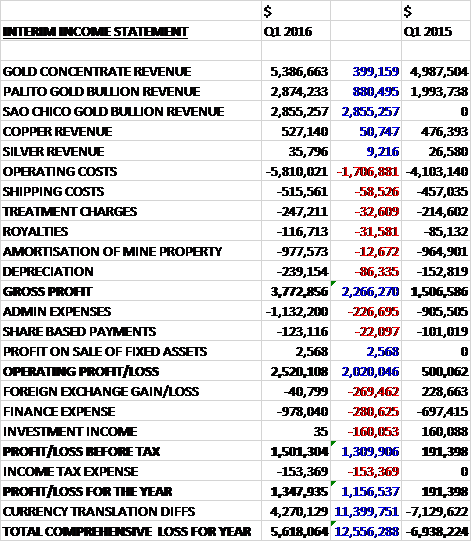
Revenues increased when compared to Q1 last year with a $399K increase in gold concentrate sales, an $880K growth in bullion sales from Palito and a maiden $2.9M contribution from Sao Chico. Operating costs increased by $1.7M, with the bulk of the increase coming from mining consumables and maintenance, and there were modest increases in other costs, with the biggest change being an $86K growth in depreciation due to an increase in mobile fleet acquired for both mines to give a gross profit some $2.3M ahead of last time. Admin expenses increased by $227K due to due diligence charges and an increase in director pension contributions with share based payments up $22K to give an operating profit $2M above that of last time. There was then a $269K detrimental forex movement relating to non-dollar denominated cash holdings and a $281K increase in finance expenses due to finance costs on gold trading and after tax was up $153K the profit for the quarter was $1.3M, a growth of $1.3M year on year.
SRBassetsQ1

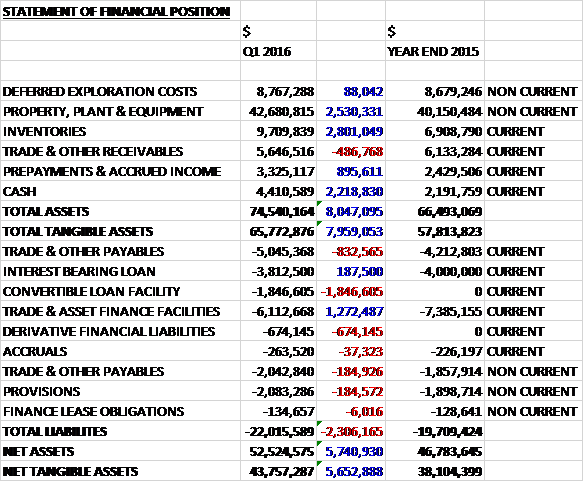
When compared to the end point of last year, total assets increased by $8M driven by a $2.8M growth in inventories manly due to a growth in finished goods, a $2.5M increase in property, plant and equipment relating mainly to forex movements, a $2.2M increase in cash and an $896K growth in prepayments and accrued income, partially offset by a $487K decline in receivables. Total liabilities also increased during the period as a $1.9M growth in the convertible loan facility, a $1M increase in payables and a $674K growth in derivative financial liabilities relating to warrants was partially offset by a $1.3M decrease in trade and asset finance facilities. The end result is a net tangible asset level of $43.8M, a growth of $5.7M over the quarter.
SRBcashQ1

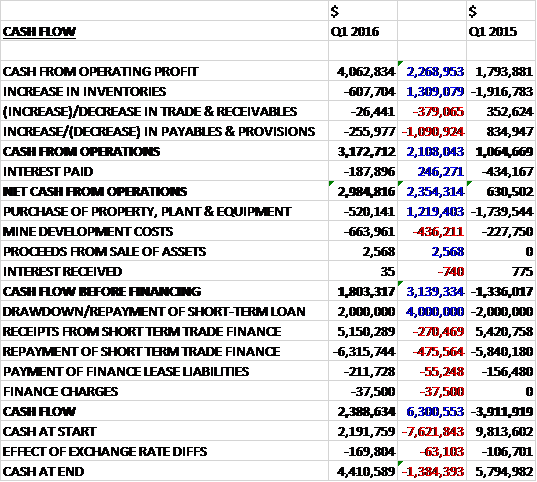
Before movements in working capital, cash profits increased by $2.3M to $4.1M. There was a cash outflow from working capital which was broadly in line with Q1 last year and after interest payments showed a modest fall, the net cash from operations came in at $3M, a growth of $2.4M year on year. The group spent $520K on property, plant and equipment along with $664K on mine development costs to give a free cash flow of $1.8M. A draw down on the short term loan meant that there was a quarterly cash flow of $2.4M and a cash level of $4.4M at the period-end.

During the quarter the group achieved an average gold price of $1,165 per ounce compared to $1,212 in Q1 2015. The total AISC cost of production was $858 per ounce, an increase from the $759 achieved in the same period last year with the increase attributable to Sao Chico entering commercial production. The current gold price is $1,256 so the company should be making some money at these levels.

The group mined 37,546 tonnes of ore at a grade of 11.02g/t compared to 32,204 tonnes at 10.51g/t last time. This represented 26,752 tonnes at 11.84g/t from Palito and 10,794 tonnes at 9g/t from Sao Chico. They milled 36,615 tonnes at a grade of 8.58g/t, an increase from the 36,6,15 tonnes at 8.52g/t in Q1 last year which just represented Pallito production. The lower production from Palito was expected, reflecting the limitations of the level of ore that can be processed and the availability of ore from the Sao Chico mine. The mine production for the quarter is consistent with the production levels reported for H2 2015.

They produced 9,771 ounces of gold in all, up from 7,389. The forecast gold production for the year as a whole is 37,000 ounces at an all in sustaining cost of between $840 and $870 per ounce. At the end of the period, the combined surface coarse ore stockpiles totalled 17,000 tonnes at a grade of 5.3g/t. In addition there are about 32,800 tonnes of flotation tails with an average grade of 2.5g/t waiting to be processed.

At Palito, management anticipate that mine output for 2016 will be between 105,000 and 110,000 tonnes at an average grade of between 8.5g/t and 8.9g/t. The gold production will be supplemented by the processing of the surface stockpiles of ROM ore and the flotation tailings that were generated in 2014. About 1,900 metres of horizontal development work has been completed at the mine during the quarter, of which 1,064 metres was ore development. This rate is consistent with the levels required to maintain an adequate level of production stoping blocks and reflects the rate at which they are depleted.

The installation of the third ball mill is almost complete, along with the second flotation line and enhancements to the carbon in pulp plant. The works are on schedule to be completed this month at a cost of $1.2M. Following their completion it is anticipated that plant processing capacity could be increased from the current levels of around 400 tonnes per day to over 500 tonnes per day. This will be in excess of mine production levels, allowing the stockpiles to be depleted and creating surplus capacity to catch up any lost production caused by unplanned stoppages. The plant expansion is expected to provide sufficient incremental capacity to process most of the stockpiled material of both coarse ore and flotation tails during the remainder of 2016. A carbon regeneration kiln is also being acquired which will assist in enhancing gold recoveries once it is operational in H2.

At Sao Chico, the development of the main ramp is continuing. The immediate priority is to evaluate and define stoping blocks on the first four levels to secure mine production for the next 12 to 18 months. Further ramp development will therefore be progressed to pursue the down-dip extension of the current areas that are in development. The rates of lateral development on existing levels will be increased when the group, through a combination of its current drilling programmes and on-lode development, has greater confidence in the distribution of the high grade mineralisation within the lateral strike extension.

At this time no surface drilling or exploration activities are panned on the group’s properties. Once adequate cash flow is being generated, however, they will step up their exploration activity and will be looking to add to their resource base and production potential by establishing additional satellite high-grade gold mines in relatively close proximity to the current Palito operation which would be a centralised processing facility. Management will continue to evaluate other opportunities in Brazil that it considers could increase the resource base.

The underground development of the Palito mine is being driven towards the Palito South area. In the second half of the year, the group intends to use down-hole geophysics in existing drill holes in the Curretela and Piaui prospects in particular. It is hoped that the results will better define a subsequent evaluation drill programme over these prospects. At Sao Chico, once adequate cash flow is being generated, the group intends to use some of it to advance the exploration opportunities. This is forecast to start early in Q3 when they plan to conduct a ground geophysical survey to the east and west of the Sao Chico deposit with a view to defining the projected strike extension of the main vein.

It is worth noting that after depreciating heavily last year, the Brazilian Real has shown some strength so far this year with the rate increasing by 9% from R3.9042 per dollar to R3.5583 as of the end of Q1.

The group has a $5M loan facility from its main shareholder, Fratelli, of which $2M has been drawn down to date with the rest available to be drawn down before the end of June. There is an additional secured loan facility which is repayable before the end of 2016 which has $4M outstanding against it with the group paying the first instalment at the end of April. The directors anticipate that the group has access to sufficient funding for its immediate needs.
They expect to have sufficient cash flow from their forecast production to finance ongoing operational requirements to repay its loan facilities and in part, to fund exploration and development activity on the other gold properties. The forecasted cash flow projections over the coming year include a significant increase from Sao Chico, however, and the group is of course exposed to changes in the gold price and forex rates. The $2M drawn down under the Fratelli facility is convertible at the election of Fratelli into new shares at an exercise price of 3.6p at any time (the share price is now 4.6p).

There are some 26M options vested but the exercise price is well above the current share price so they are probably not that dilutive. It is worth noting that 12,600,000 have an exercise price of 5p and 18,200,000 have an exercise price of 5.5p, however.

On the 17th May the group announced that it had awarded 15,650,000 new options to employees which represents over 2% of the entire share capital. I am fairly relaxed about this actually as the exercise price is 5p which is above the 4.6p the shares currently stand at.

Overall then this has been a pretty decent quarter for the group. They are now profitable, net assets increased and the operating cash flow grew with some free cash being generated. With costs per ounce of $858 and a sales price achieved of $1,165, the group seems to be decently profitable at these gold prices. The processing plant upgrade is nearing completion which will mean processing capacity is over mining capacity which is a good place to be.

It should be noted that the local currency is recovering which means that costs will be up somewhat but borrowings are not a worry here and as long as the gold price holds up, I think this company could be a good investment, although the potential dilution should they go ahead with a large acquisition should be kept in mind.

On the 16th June the group released an update covering Q2. Gold production from both Palito and Sao Chico followed the trend set by Q1 with gold production expected to be around 9,750 ounces which puts them well on target to achieve the full year guidance of 37,000 ounces.

At Palito, as well as expanding the mine horizontally, they have also had success with some smaller zones within the deposit that can be accessed from existing ramp development. These are adding further improvement to the levels of gold production that can be achieved from each vertical metre. This, in turn, allows them to slow down the rate at which further deepening of the mine is required, meaning that they can replace vertical development with horizontal development generating cost and efficiency benefits as well has helping to increase the life of the mine.

At Sao Chico the group have found a good solution to the geological complexity of the deposit that hindered the extraction rates last year. Mine production continues to focus on the central portion of the Main Vein where they have the greatest confidence in the down-dip extension and they are continuing to push the ramp down towards 84mRL, some 150m below the surface. From there they will establish underground drill locations to assess the further extension at depth as well as the potential strike extensions to the east and west of the Central Zone.

The short term plan at the mine has been to secure production for up to 18 months in advance which establishes an adequate cushion to alloy time for them to concentrate on assessing the potential strike extensions and parallel structures which ensure that they can maximise the benefit of existing development in the longer term. The group has purchased an underground exploration drill rig which has now arrived on site and following commissioning will start on this work.

A Similar programme will also be undertaken at Palito once the initial phase of work is completed at Sao Chico. Initially work will focus on the extension at depth of the main zone but will also look for parallel structures which lie between the main zone and Palito West and Chico da Santa with the expectation that a number of small but viable veins will be identified that can be easily accessed from the existing mine development.

During Q2 the board had anticipated to have a third ball mill commissioned and operating but the failure of a key component in one of the other mills has delayed this start up because they borrowed the bearing from the third mill. A new bearing has now been delivered and the commissioning of the third mill will start in the coming week. This was a lucky coincidence and illustrates the requirement for building contingency and flexibility when operating in remote locations.

Whilst the focus for 2016 is to use cash flow to retire the borrowings that the company has with Sprott, they have been able to set aside some funding for the start of the next stages of wider exploration activity at the two mines. This will involve a down the hole electromagnetic survey at Palito using the past drilling undertaken at the Curretela and Piaui prospects. The contractor is due to arrive on site in July and they anticipate that the programme and subsequent evaluation of results will take around three to four months to complete. It is intended that this work will allow the group to better plan the next stage of exploration drilling that is expected to be undertaken in 2017.

At Sao Chico a surface induced Polarisation programme will be undertaken over an area to the west of the original exploration tenement. Results are expected to be available towards the end of 2016. Borth geophysical programmes are using well established techniques to identify conductive bodies and sulphide mineralisation as pathfinders to locating gold occurrences which are associated with these features.

Whilst many economic commentators expected to see the Brazilian currency continue to decline during 2016, in the face of an uncertain political climate and a weakening economy, it has confounded expectation and strengthened. It appears that there remain strong inflows of currency into the country and while these may include investment from multinational companies to support their local businesses, this will place pressure on the group’s reported dollar costs should the situation continue. At this time it remains unclear how the political situation will resolve itself and how this will impact on the perceptions of Brazil but neither this, or the concerns over Zika are currently having an impact on group operations.

The board will continue to look at the opportunity for potential acquisitions of other projects. The recent surge in gold prices has started to change seller expectations. The board are keen to grow the company but will only consider acquisitions that they feel will genuinely increase value for shareholders. While a strong market is good for the group, they are concerned that some valuations and expectations may become unrealistic.

Overall then, it seems decent progress is being made. I am still a little concerned about an equity raise in the event of an acquisition and the situation in Brazil, in particular the strength of the Real need to be taken in to consideration but I have decided to take a position here.

On the 18th July the group released an operating update covering Q2. Total production was 9,896 ounces of gold, compared to 9,771 ounces in Q1, generated from the processing of the ROM ore from Palito and Sao Chico combined with the Palito surface coarse ore and stockpiled flotation tailings. The production came from the processing of 39,402 tonnes of hard rock ROM with an average grade of 8.17g/t which is a bit lower than the 8.58g/t in Q1 and the 8.36g/t in H1 last year. The total mined ore for the same period was 33,606 tonnes at 9.56g/t, lower than the 11.02g/t in Q1 and 9.85g/t in H1 2015, and this is split with 25,198 tonnes at 10.48g/t from Palito (10.17g/t in H1 2015) and 8,408 tonnes at 6.81g/t from Sao Chico (significantly lower than the 9g/t in Q1 and 8.47g/t in H1 last year). Additionally, 6,354 tonnes of flotation tailings with a grade of 2.7g/t was processed through the cyanidation plant.

At the period-end there were coarse ore stocks of about 12,000 tonnes with an average grade of 5g/t and about 25,000 flotation tails at 2.5g/t. The plant expansion, with mill number three now operational, is virtually complete and will provide sufficient incremental capacity to process most of this stockpiled material during the rest of the year. A second flotation line and enhancements in the CIP plant are also close to completion and the carbon generation kiln acquired earlier in the year is now being installed and will be commissioned in Q3. This kiln will regenerate fouled carbon and enhance gold recoveries.

There was a short delay in the commissioning of the third ball mill following the failure of a main bearing in mill number two, but they were fortunate to be able to use the identical bearing from the third mill to keep the plant at full operational capacity which delayed its commission by about a month. It is now operational – the group have been rather lucky here!

About 1,900 metres of horizontal development has been completed during the quarter at Palito, of which 943m is represented by ore development with the balance being on the development of ramps, cross cuts and stope preparation.

At Sao Chico, a total of 1,031 metres of horizontal development was completed, of which 598m represented ore development, with much of the balance being ramp development and cross cuts reflecting the ongoing deepening of the mine. Most of the 8,408 tonnes produced from the mine has been generated from development mining but there will be a greater contribution of ore coming from production areas during H2. They have now secured the source of production up to the end of 2017.

Additionally underground exploration drilling at Sao Chico has started. The purpose is to test the down dip continuation of the central ore shoot below the 100mRL as well as to the east and west along strike, areas which remain quite open. The first drill hole completed in the past week recorded an intersection of 46.2g/t over a drilled width of 2.32m, located about 240m from the surface and 100m down-dip from the current lowest developed level – this seems impressive.

The company expects to produce 28,000 ounces of gold during the year with the processing of Palito ROM and stockpiles. With the Sao Chico mine now under development, they also anticipate production of 9,000 ounces of gold from ore mined at Sao Chico so as a result, with nearly 20,000 ounces produced in the first half, the board remain confident of achieving its production forecast of 37,000 ounces.

Whilst they have forecast an all-in sustaining cost of between $840 and $870 per ounce, this guidance was predicted on a significantly weaker Brazilian Real at the beginning of the year. The currency has strengthened against the US dollar by about 20% since then, much of which occurred in Q2, and this will impact on reported costs. Apparently there is a prediction of a weaker Real in the second half of the year but this is something that needs to be kept an eye on.

Overall then things seem to be ticking a long OK, certainly as far as quantities are concerned. The fall in Sao Chico grades is a bit of a concern but more of a worry I think is the appreciation of the Brazilian Real which will likely increase costs. Thankfully the price of gold has also increased so if this can be sustained the group is set quite well. I now hold the stock.

Vertu Motors Share Blog – Final Results Year Ended 2016

Vertu Motors has now released its final results for the year ended 2016.

VTUincome

Revenues increased when compared to 2015 with a £121.3M growth in used car revenue, a £117.1M increase in new car revenue, an £89.1M growth in new fleet and commercial revenue, and a £20.9M increase in after sales revenue. Cost of sales also grew to give a gross profit £35.2M above that of last year. Wages & Salaries were up £17.3M, depreciation increased by £888K, operating leases were up £2M and other operating expenses grew by £9.4M which all meant that the operating profit grew by £5.5M. Vehicle stocking interest costs were up £735K and tax increased by £823K to give a profit for the year of £20.7M, a growth of £4.1M year on year.

VTUassets

When compared to the end point of last year, total assets increased by £205.8M, driven by a £121.7M growth in new vehicle inventory, a £24.7M increase in cash, an £11.8M growth in used vehicle inventory, a £14.3M increase in goodwill, a £6.6M growth in trade receivables and a £12.9M increase in the value of land and buildings. Total liabilities also increased during the year due to a £157.9M growth in trade payables, a £13.9M increase in long term borrowings, a £6M growth in advance payments from finance partners and a £5.6M increase in accruals, mainly relating to an increase in outstanding service plans. The end result is a net tangible asset level of £127M, broadly flat year on year.

VTUcash

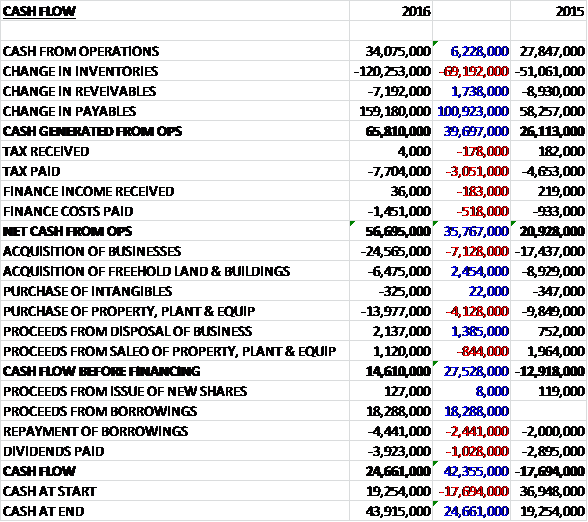
Before movements in working capital, cash profits increased by £6.2M to £34.1M. There was a cash inflow from working capital, with a very large growth in payables and after the group paid out £3.1M more in cash and £518K more in finance costs, the net cash from operations came in at £56.7M, a growth of £35.8M. The group spent £14M on fixed tangible assets, £24.6M on new businesses and £6.5M on freehold land and buildings and even after this there was £14.6M of free cash flow. Some £3.9M was spent on dividends but a net £13.8M of new borrowings was taken out to give a cash flow for the year of £24.7M and a cash level of £43.9M at the year-end.

The gross profit in the aftersales business was £102.9M, a growth of £13.5M year on year. The group now has over 89,000 customers paying monthly for service via the three year service plan product compared to 71,031 last year. In addition, significant numbers of service plans operated by manufacturers are also in place. The total of these plans are helping the group to take market share from the independent aftersales market in the service area and drive consistent servicing growth. Furthermore the group has sold over 30,000 Motability vehicles in the last three years, each of which is on a three year service arrangement, adding a further resilient income stream.

Service revenues rose 6.5% on a like for like basis and aftersales margins strengthened from 43.5% to 44.8%. The improvement in aftersales margins has been achieved in each of the service, parts and accident repair centre activities as a result of a focus on the detailed operational performance in each department. The accident repair centre sector delivered another year of improved revenue and margins as demand has started to outstrip supply in the channel. Accident repair centre revenues grew 8% on a like for like basis and margins improved to 66.2% with eleven accident repair centres now being operated. Supply of manufacturer parts continues to be a vital part of the franchised dealer model. Parts revenues rose 5.5% of a like for like basis and margins improved to 23.3%.

The gross profit in the new car retail business was £59.3M, an increase of £8.4M when compared to last year. New retail car volumes sold rose by 4% on a like for like basis compared to an increase of 3.9% in UK private car registrations. The outperformance was weighted to the second half of the year when the group’s new car registrations grew by 7.3% against the market which grew 4.7%. Volumes of sales on the Motability scheme rose by 1.6% on a like for like basis against a 2.9% decline in the UK market as a whole, helping to earn the group the title of Motability Dealer of the Year. Gross profit per unit rose to its highest ever level in the second half of the year due to the growing mix of premium sales and retail sales growing faster than the lower-margin Motability sales.

The gross profit in the new fleet and commercial business was £17.6M, a growth of £5.3M when compared to 2015. The group has significant fleet operations and a shift in sales mix away from supply to lower margin daily rental channels resulted in continued improved margins and slightly lower volumes. Consequently their like for like car fleet volumes fell by 4.2% while margins improved. In the light commercial vehicles sales channel, the group’s like for like volumes of commercial vehicles increased by 22% during the year reflecting continued market share gains against UK registrations up 13.2%. Margins in fleet and commercial sales improved from 2.5% to 3% and are now at record levels.

The gross profit in the used car business was £83.5M, an increase of £8M year on year. The strong like for like growth in used vehicle volumes of 8% was significantly ahead of the market. This strong growth in like for like volumes accelerated in the second half of the year, up 12.2%, reflecting both the inherent strength of the group in used cars through sales and stock management processes and the impact of more effective marketing, both on line and offline from October onwards. During the year the group adopted a more centralised approach to used car marketing and increased TV advertising and more nationally co-ordinated campaigns. The impact of this approach has been to improve sales volumes and profitability.

The group’s used car gross margin was 9.8% compared to 10.4% last year and gross profit per unit was down from £1,190 to £1,165. The slightly lower margin effect was more than offset by higher volumes and related to the increased premium content within the group.

The group increased its investment in like for like advertising expenditure during the year by £2M which saw a shift towards TV and online and away from press reflecting shifts in consumer behaviour.

As can be seen, there was a significant cash inflow through working capital during the year. The major components of this movement were lower VAT payments due to the increase in new vehicle consignment inventory levels leading to more input VAT being reclaimed (£14.4M), accelerated receipts from customer finance partners (£6M), reductions in fully paid vehicle inventories as manufacturers reconfigured their supply chains (£4.4M), and increase in service plan receipts from customers as the number of service plans increased (£2.2M). The board does not expect this to be the normalised position for cash generation and it is possible that some of these amounts may reverse in future periods as vehicle flows from manufacturers evolve.

Several of the group’s manufacturer partners are currently increasing their dealership size and facility requirements and are therefore encouraging retailers to redevelop dealership premises. Consequently the group anticipates that expenditure on current dealership redevelopment projects will be about £11M in 2017. In addition, planned new dealership developments including freehold purchases totalling £16.5M are also anticipated which will add further capacity to the group’s operations.

The company is currently rolling out a group-wide, in-house developed showroom system built around the use of computer tablet technology by sales teams. This will be rolled out by the end of September and has contributed to increased levels of IT expenditure in the year. The system is anticipated to increase the efficiency of the sales process and deliver enhanced customer service.

As usual there have been a number of acquisitions during the year. In May the group acquired the Bury Land Rover outlet from Pendragon for a total cash consideration of £7M, generating goodwill of £4.4M. Also in May they acquired Bradford Jaguar from Lancaster for a cash consideration of £825K, generating goodwill of £750K. In June they acquired Blacks Autos, who operated a Skoda dealership in Darlington, for a cash consideration of £1.8M, generating goodwill of £765K. Had this acquisition occurred in March, profits would have been £88K higher. In October they acquired SHG Holdings, who operate various VW outlets in Herefordshire and Gloucestershire.
There was a cash consideration paid of £12.9M with a further deferred consideration of £1.5M payable two years after the acquisition date. This acquisition generated goodwill of £7.8M and had the acquisition occurred at the start of the year, profits would have been £1.3M higher.

In December the group acquired Who’s Ace Holdings, an online vehicle parts business. There was no consideration paid but the business did have net borrowings so goodwill of £314K was generated. The business is still loss making so had the acquisition occurred at the start of the year, group profit would have been £154K lower. In January 2016 the group acquired three Honda dealerships in Stockton, Nottingham and Derby from Lookers for a total cash consideration of £2.1M, generating goodwill of £170K. Many of the acquisitions undertaken in recent periods are still to become fully established in margin terms which provides the group an opportunity to deliver improved margins and grow organic profit.

In April the group disposed of its petrol forecourt at Walkden and in September they disposed of a service station in Horwich. Both included freehold properties and were acquired with the Bolton and Wigan Ford businesses in November 2014. In July the group disposed of its Peugeot operation in Dunfermline. In all, these disposals brought in a consideration of £2.1M, broadly similar to the carrying value of their assets.

After the year-end the group acquired Sigma Holdings which operates three Mercedes dealerships in Reading, Ascot and Slough. The total consideration paid was £21.9M, consisting of about £18.4M settled in cash and £3.5M of deferred consideration due over the next year. In addition, vendor shareholder loans of £9M were settled in cash on completion with £13M of goodwill being generated. In March the group announced that they were raising £35M through a placing of 56M new shares at a price of 62.5p per share. Finally, in May 2016 the group acquired Leeds Jaguar from Inchcape for a consideration of £650K, including goodwill of £500K.

The group is somewhat susceptible to uncertainty surrounding the Brexit vote and is maintaining contact with its manufacture partners in Europe so this is something that should be considered.
The group have announced that Pauline Best is joining as a non-executive director. She is an HR professional who is currently the global people and organisation director of Specsavers.

The group has traded ahead of the current year financial plan, and last year, in March and April. Increasing sales and a strong aftersales performance, together with an increased contribution from recently acquired dealerships are enabling the group to drive profits. In the period since the year-end, aftersales margins rose to 46.7% with like for like revenue increases. Service like for like revenues rose 7% and continued to benefit from the successful customer retention initiatives being executed by the group and overall aftersales profitability increased on a like for like basis.

After the year-end there was a continuation of growth in the UK private new car market. In the period the group has seen stable new retail volumes and a slight decline in gross margin. They have seen strong growth in fleet and commercial volume margins, however, and overall the profit contribution from new vehicle sales in retail and business channels is flat on a like for like basis.

The group’s like for like used vehicle retail volumes were up 5.9% in the post year-end period. The impact of the changes made to the group’s marketing in the second half of last year along with a continued focus on the management of used vehicle inventory have contributed to this performance. Used vehicle margins were stronger during the post year-end period which has led to a significant increase in year on year profitability. Given trading in March and April and the improvements seen in the acquired businesses, the board remains confident about the group’s prospects for the current year.

If we add on the new shares placed after the year-end, at the current share price the shares trade on a PE ratio of 11.1 which falls to 9.7 on next year’s consensus forecast. After a 23.8% increase in the total dividend, the shares are yielding 2.3% which increases to 2.6% on next year’s forecast. At the year-end, the group had a net cash position of £23.1M compared to £15.7M at the end of last year, although given the timing of sales I suspect this figure is a rather flattering view of group cash.

Overall then this has been a good year for the group. Profits increased, net tangible assets were flat and the operating cash flow grew, and aided by favourable working capital movements that will likely reverse at some point in the future, there was plenty of free cash generated. All parts of the business performed well, particularly in the second half of the year as improved marketing drove a great performance in the used car business.

Going forward, there is a lot of manufacturer-driven capex requirements that need to be paid for and it is a bit disappointing to see the group having to resort to placings for their acquisitive needs – I would much rather see a company grow its business out of operating cash flow. In the start of this year, performance has been ahead of plan but this seems to be acquisition-led and new car sales were only flat which is a bit of a concern. Still, with a forward PE of just 9.7 and a fairly respectable dividend yield of 2.6%, these shares look decent value to me and I am tempted to get back in here.

On the 1st June the group announced the acquisition of Gordon Lamb for a total cash consideration of £18.7M which has been settled from existing cash resources. The business operates a Toyota, Land Rover, Skoda and Nissan outlets in Chesterfield along with a Skoda dealership in Derby. The transaction generated goodwill of £8.3M and last year the business generated pre-tax profits of £2.7M with the board expecting the deal to be earnings enhancing in its first full year of ownership. This looks to be a good acquisition to me.

On the same date the group announced that Pauline Best joined the board as a non-executive director. She has over thirty years of HR experience and is currently global people and organisation director at Specsavers.

On the 15th May the group announced that CEO Robert Forrester purchased 54,700 shares at a value of £29K which gives him a total of 6,767,673, so just a token buy it looks like then.

On the 29th June it was announced that Chairman Peter Jones purchased 117,000 shares at a value of about £50K. He now owns a total of 1,522,000.

On the 20th July the group released a trading update covering the first four months of the year where the board reiterated that they expect the performance for the full year to be in line with current market expectations.

Profitability in the four month period was ahead of the prior year and in line with board expectations. Group revenues have increased by 21.5%, aided by higher revenues from acquired dealerships and continued organic growth with like for like revenues up 8.4%. Total gross profit increased by 23.6% with like for like gross profit increasing by 8.7%.

The aftersales operations continued to grow strongly with gross profits up 25% in the period, an increase of 7% on a like for like basis. The group’s retention initiatives such as service plan sales, the focus on customer service, and increases in the overall vehicle parc positively contributed to these profitability trends. In vehicle servicing, the group increased total service revenues by 25% and like for like service revenues by 6% whilst improving like for like service margins from 75.8% to 76.6%.

Used vehicle performance also continued to be very strong in the period with the group delivering total volume growth of 19% and like for like growth of 10%. Performance was aided by continued investment in marketing and by the timing of sales events compared to the prior year. The gross profit generated from used vehicle sales rose 27% with a growth of nearly 18% on a like for like basis reflecting strong price discipline and the underlying strength of residual values in the UK used car wholesale markets. The increase in new car PCP business, where the manufacturer guarantees the residual value of the car has provided stability in prices.

During the period the UK new retail market has been stable after a period of sustained growth. Whilst private registrations saw growth in March, the market has softened with small declines seen in April, May and June. The group’s total new retail sales volumes grew by 9% but like for like sales reduced by nearly 4% with volume franchises seeing declines in volumes whilst premium franchises saw growth. The UK remained an attractive market for the manufacturers and supply push of product into the market continued, although whether this will be the case following the weakening Sterling remains to be seen.

The group has seen growth in its car fleet operations during the period, with total volumes higher by 7.5% and like for like volumes increasing by 3%, compared to an increase in UK fleet registrations of 6%. Group sales of new commercial vehicle sales volumes grew by 27.5% and like for like new commercial sales grew by 25%. UK commercial vehicle registrations grew by 4.3%, showing that the group continued to take market share in this market. They grew like for like gross profit from their fleet and commercial operations by nearly 18% with overall profitability in the channel up significantly.

In March the group purchased Greenoaks, which operates three Mercedes dealerships, for £21.9M alongside the settlement of £9M of shareholder loans. These dealerships in Ascot, Reading and Slough have historically underperformed but the board are pleased with the progress made to date to integrate and improve the performance of the businesses and they have traded in line with the performance targets put in place at the time of the acquisition.

In the period the group has undertaken three further transactions which represent a deployment of a substantial proportion of the raised capital. In May they acquired Leeds Jaguar for £700K, generating goodwill of £500K – this business broke even last year. In early June the group acquired Gordon Lamb, a group which operates five sales outlets in Derbyshire. This acquisition introduced the Toyota franchise to the group and added a sixth Land Rover dealership together with two Skoda and a Nissan outlet. Total consideration amounted to £18.7M including an £8.3M payment for goodwill. For 2015, the business showed adjusted pre-tax profit of £2.7M. In Late June the group acquired the freehold and long leasehold interests in two Honda dealerships they operate in Nottingham and Derby for a consideration of £3.2M.

Obviously the Brexit vote has led to some uncertainty for the economy and the motor retail industry in a number of areas. Regulations surrounding manufacturer franchise contracts are currently determined on an EU basis and reflect EU competition policy. The board doesn’t anticipate any major changes to this contract position resulting from the vote, however.

The UK represents the second largest market for new vehicles in the EU so the board believe that manufacturers are likely to be keen to support UK retailers through any period of uncertainty. The majority of the group’s new vehicle sales are imported from the EU. The manufacturing partners clearly have a vital interest in ensuring continued free trade access to the key UK market and negotiations will be monitored closely. The Euro/Sterling exchange rate is important to manufacturer profitability on the UK sales and is a factor in determining the level of supply push of vehicles to the UK market. Whilst sterling has declined against the Euro, it remains at levels above the lows seen in 2009 and throughout much of 2013, at levels which the board believes remain attractive for EU manufacturers.

It is likely that business and consumer confidence in the UK may also come under pressure. In line with trends in recent months, since the referendum new vehicles sales volumes have been behind last year but used cars and aftersales have mitigated any negative impact to date.

Overall then, this is an interesting situation. The performance of the group has clearly been very strong with growth almost everywhere – except new car sales which are suffering following the Brexit vote. Whether this will continue and filter down eventually to the other businesses at the group really define whether this is viewed as a good investment at the moment. I am starting to think the share price decline has been rather over-done and I am tempted to take a nibble here.

On the 1st September the group released a trading update where they stated that full year results are expected to be in line with market expectations. Aftersales and used cars have continued to grow but SMMT data has shown UK private new retail vehicle registrations softening since April and the board expects this trend to continue. September order intake levels on new vehicles reflect continued growth in the fleet and commercial sector and a continuation of the softening in the private retail new car channel.

The macroeconomic environment of low interest rates and high levels of employment provide a favourite backdrop for the sector but weaker exchange rate levels for Sterling create uncertainty around future manufacturer strategies towards new car pricing. The Brexit result has to date not impacted consumer confidence as adversely as some were predicting and the group has not experienced any significant change in customer behaviour. The board is pleased with the performance of the recently acquired dealership and with the integration of them into the group.

Overall, this is a fairly decent update although the slow-down in new car sales is a potential concern, along with whether European manufacturers will continue to target the UK now that Sterling has depreciated.

Wentworth Resources Share Blog – Q1 Results Year Ending 2016

Wentworth Resources has now released its Q1 results for the year ending 2016.

WRLQ1income

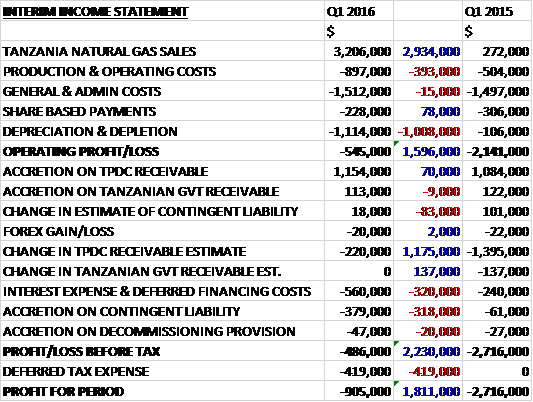
Gas revenues increased by $2.9M when compared to Q1 last year. Production and operating costs were up $393K due to increased field staffing levels to cope with the increase in production volumes, and depreciation/depletion grew by $1M as production levels increased to give an operating loss $1.6M lower than last time. The reduction in the TPDC receivable estimate was $1.2M lower than last time but interest expenses increased by $320K with the accretion on the contingent liability increasing by $318K to give a pre-tax loss some $2.2M better than last time which, after a deferred tax expense was incurred in the quarter, meant that the loss for the period was $905K, an improvement of $1.8M year on year.

WRLQ1assets

When compared to the end point of last year, total assets increased by $927K driven by a $1.7M growth in receivables, a $1.3M increase in cash and a $372K growth in prepayments, partially offset by a $1.7M reduction in the TPDC receivable, a $611K fall in the value of natural gas properties and a $419K decline in deferred tax assets. Total liabilities also increased during the period due to a $1.6M growth in payables. The end result was a net tangible asset level of $136.4M, a decline of $859K over the past six months.

WRLQ1cash

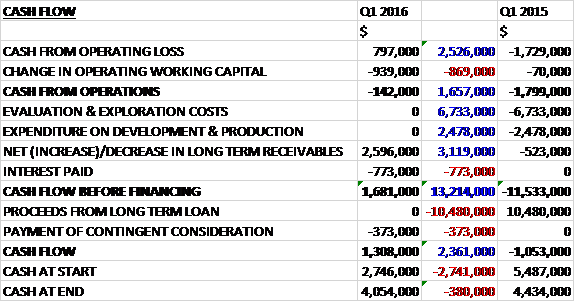
Before movements in working capital, cash profits of $797K represented an improvement of $2.5M on the cash losses of last time. A detrimental movement in working capital meant that there was an operating cash outflow of $142K, however, which was an improvement of $1.7M year on year. There was no capex and the $2.6M receipt on long-term receivables covered the $773K interest payment so that before financing there was a cash inflow of $1.7M. After the payment of contingent consideration, the cash flow for the period came in at $1.3M and the cash level at the end of the quarter was $4.1M.

Commissioning of the four turbines at the newly built Kinyerezi-1 power station continued during the period and the Symbian, Ubungo II and Mtwara power generation facilities were nearing full operational capacity at the end of March. At full operating capacity, Kinyerezi-1 is expected to utilise about 25 to 30MMscf per day of natural gas; Ubungo II and Symbian power plants about 45 to 50MMScf/d; and the Mtwara power plant about 2MMscd/d equating to a total average of between 70 and 80MMscf per day.

At the operating level, the Tanzania business is at a broadly break even stage compared to the $1.7M loss incurred in Q1 last year. During the quarter the Mnazi Bay gas field delivered 47.6MMscf per day, a modest increase over Q4 deliveries of 45.5MMScf/d. In March, deliveries averaged 55.9MMScf per day with production of 64.8MMscf by the end of the month. The wells are performing well and are capable of delivering volumes in excess of current production. The joint venture partners are contracted to supply up to 80MMscf per day for the first eight months after the commercial operations date which is expected to be reached in Q2.

The MB-1 well, which is currently producing just 2MMscf per day, fuelling the TANESCO-owned Mtwara power plant, will be tied into the pipeline infrastructure this year to join the other four wells already connected. The company anticipates gas sales to the pipeline to increase to 130MMscf per day in 2017 as market demand grows and gas deliveries could escalate up to 270MMscf per day should additional exploration success occur on the concession. During the period, minimal work was performed on the expansion of the processing facilities at Msimbati but the company are seeking to advance an exploration drilling programme in 2017, the costs of which are expected to be fully funded from internally generated cash flow.

The Mozambique operations incurred a loss of $155K in the quarter, up from the $114K in Q1 2015. During the period the group reached an agreement with the other partner, state-owned ENH, on assigning the participating interests of the relinquishing parties on the Romuva block. Wentworth were appointed operator and have an 85% interest in development and production of the block.

An appraisal plan has also been agreed which includes re-processing and interpretation of existing seismic data with specific focus on the sands relating to the Tembo-1 gas discovery. Should results of this reprocessing be encouraging, the proposed programme includes potential acquisition of new 2D seismic and, contingent on identifying a suitable appraisal target, drilling activity comprising an appraisal well. The programme is expected to take two to three years to complete, depending on the acquisition parameters and weather conditions.

An issue at this company continues to be the collection of receivables. They do seem to be being paid in a timely fashion by TPDC for the gas sales to the pipeline as the $2.2M owed at the period-end was collected in full in April but the same cannot be said for the gas sold to TANESCO relating to the small gas-fired power plant in Mtwara. They were owed $1.3M which is equivalent to eight months of gas sales and are engaged with TANESCO to try and accelerate payment. There also remains $32.9M outstanding from TPDC for its share of Mnazi Bay costs but this did come down by $2.4M as the group retained gas revenues to offset the receivable which seems as though it is a workable solution. Finally they don’t seem to be any closer to being paid the $6.5M outstanding from the Tanzanian government.

Tanzania elected its fifth president in November and in December a new cabinet was sworn in. The group believes that the re-election of the ruling party and the appointment of experienced individuals to key positions ensures stability and should encourage the continuation of key policies. The new government has placed an emphasis on eliminating wasteful expenditure, improving domestic revenue collection and directing investment to key infrastructure projects.
In the energy sector, the president followed up on his promise to commit funding for construction of the 240MW Kinyerez-2 power station and also pledged to provide funding for the expansion of the 150MW Kinyerezi-1 power station which provide a growth opportunity for the Mnazi Bay joint venture partners.

There group have fully drawn down on their loan facilities. Principal repayments will commence in June with the first of six semi-annual payments of $1M due and in July the first of six semi-annual principal payments of $3.3M will be made. As of the end of the quarter, they had cash on hand of $4.1M and as Q3 progresses, gas volumes are expected to stabilise at over 70MMScf per day. The expected funds from their share of gas deliveries to the pipeline combined with funds on hand and the collection of the long term receivable from TPDC should be sufficient to meet the current and ongoing obligations.

There is no exploration capital commitments and budgeted development capital is limited to the completion of Mnazi Bay infrastructure tying field producing assets to the NNGIP which is will cost around $3M. Current liabilities of $17.6M relate primarily to amounts due to the operators of the assets in Tanzania and Mozambique and principal repayment obligations on the debt.

Overall then this has been a quarter of steady progress for the group. The loss is improving but the company is still not profitable. Net assets reduced slightly and the there was an operating cash outflow, although this was due to working capital movements and there was a cash profit made and after some of the long term receivables from TPDC were received, there was actually a decent amount of cash being generated here.

There was an average of 47.6MMScf per day being generated in the quarter and by the period-end this has increased to 64.8MMScf with the level expected to stabilise at about 70MMscf in Q2 which should provide enough cash to pay back the upcoming $4.4M debt repayments (along with the $4.1M I cash already received – although trade payables also have to be paid). The receivables from TPDC seem to be being recouped and the company is still being paid in a timely manner for its gas sales to the pipeline. As long as this continues, this company seems like a decent investment to me at these levels.

On the 22nd June the group gave an operational update. In Mozambique, government approval for an appraisal plan as how been received. Under the two year appraisal period the group becomes the operator of the Rovuma Onshore concession and increases its participation interest from 12% to 85%. The state owned oil company retains a 15% interest as a carried partner through to the start of commercial operations. In addition, it has the right to acquire a further 15% interest in the concession within 18 months from the data of submission for a development plan for a consideration equal to the proportionate share of past costs incurred.

Implementation of a work programme will commence this year with the reprocessing of about 1,000km of existing seismic data, the cost of which will be funded from internally generated cash flow. Starting in H2 2017, the group plans to acquire a minimum of 500km of new onshore 2D seismic data. The drilling of an appraisal well is expected to occur in 2018 after the identification of a suitable drilling location based on the interpretation of the data.

In Tanzania, production volumes from the Mnazi Bay gas field have been ramping up and peaked at 74MMscf per day during Q2. Volumes were curtailed for a period of time in April, however, due to heavy rains when some natural gas power generation was displaced by hydro generated power.
Furthermore, and of more concern, sales volumes to the pipeline have been maintained at 50MMscf per day since the start of June due to a dispute between Symbion, one of the power plants and TANESCO. It is unclear how long it will be before the dispute is resolved and power generation at the plant resumes and until that time, volumes are expected to remain at this level, meaning production volumes were lower than expected in Q2.

The group is still receiving prompt payment for its gas delivered to TPDC at least, but this news is a set back and I will not be rushing out to buy shares now.

Easyjet Share Blog – Interim Results Year Ending 2016

Easyjet has now released its interim results for the year ending 2016.

EZJinterimincome

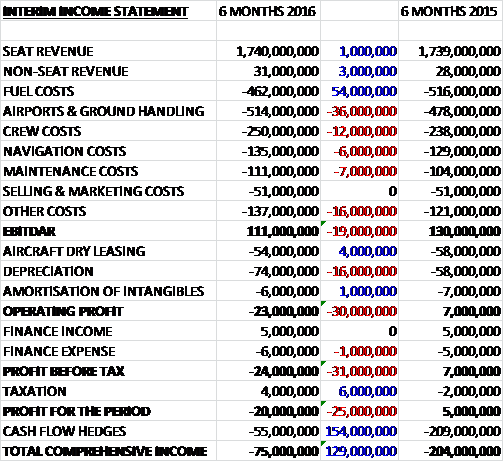
Revenues were broadly flat when compared to the first half of last year but costs increased as a £54M decline in fuel costs was more than offset by a £36M growth in airport and ground handling costs in Italy and Gatwick, a £12M increase in crew costs reflecting the greater number of flights, a £15M growth in navigation and maintenance costs and a £16M increase in other costs relating to disruption costs following events in Egypt, Paris and Brussels combined with industrial action and adverse weather conditions, to give and EBITDAR some £19M below that of last time. Depreciation increased by £16M due to the acquisition of new aircraft and a decrease in the number of leased aircraft in the fleet, but tax was down £6M which meant that the loss for the period was £20M, a detrimental movement of £25M year on year although it is worth remembering that Easy Jet traditionally reports losses/lower profits in the first half of the year and also at constant exchange rates, the group would have recorded a profit of £5M during the period, flat year on year.

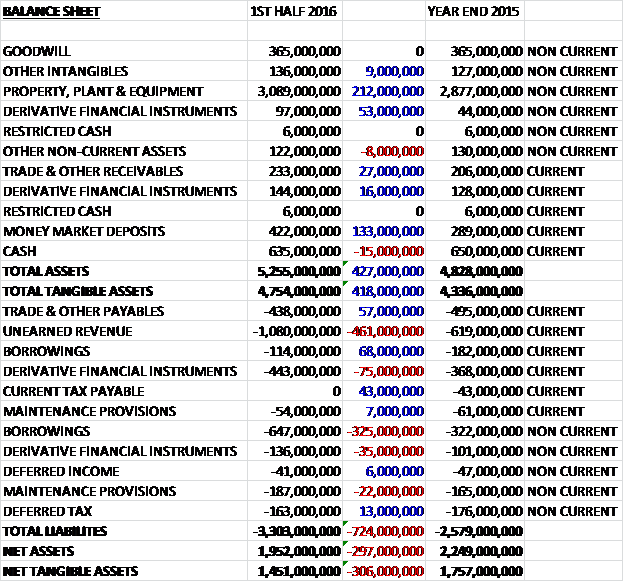
EZJinterimassets

Total assets increased by £427M when compared to the end point of last year driven by a £212M growth in property, plant and equipment mainly relating to the ten new aircraft, a £133M increase in money market deposits, a £69M growth in derivative financial instruments and a £27M increase in receivables. Total liabilities also increased during the period as a £461M growth in unearned revenue relating to flights paid for by customers but not yet flown with the increase due to the seasonal nature of the airline industry, a £110M increase in derivative financial liabilities relating to the adverse mark to market movement on jet fuel forward contracts, and a £257M growth in borrowings was partially offset by a £57M decline in payables and a £43M fall in current tax payable. The end result was a net tangible asset level of £1.451BN, a decline of £306M over the past six months.

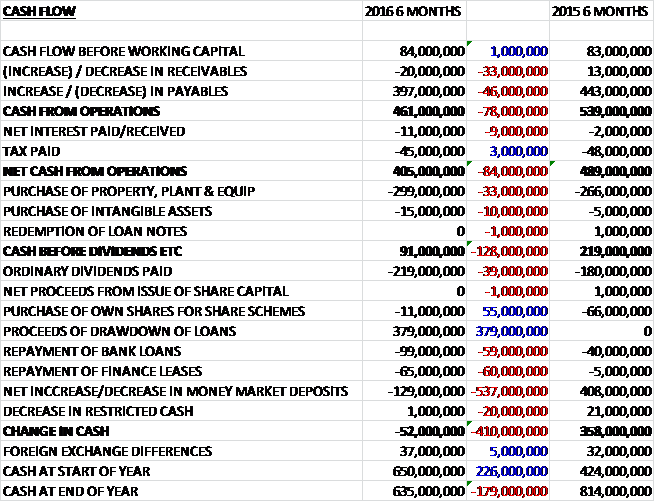
EZJinterimcash

Before movements in working capital, cash profits were broadly flat at £84M. A large increase in payables meant that the net cash from operations came in at £405M but the cash inflow from working capital was much lower than last time primarily due to unearned revenue with the variance arising due to differences in the timing of flight schedule releases and the Easter school holidays, so this represented an £84M decline year on year. The group spent £299M on property, plant and equipment including the acquisition of ten aircraft, the purchase of life-limited parts used in engine restoration and pre-delivery payments relating to aircraft purchases, along with £15M on intangible assets to give a free cash flow of £91M. This didn’t cover the £219M spent on dividends and the group drew down on their loans and after £65M was paid back on finance leases and there was a £129M net increase in money market deposits, there was a cash outflow of £52M and a cash level of £635M at the period-end.

Underlying consumer demand has been strong with UK beach traffic providing a healthy start to the half and the group’s biggest ever ski season helping to deliver increased passenger numbers. Fares decreased by 6%, however, as the benefits of lower fuel costs were passed on to customers although cost controls helped maintain margins.

Revenue per seat decreased by 4.2% year on year on a constant currency basis and by 6.6% on a reported basis to £51.29 and the load factor remained flat at 89.7%. It is also worth noting that Easter fell during the period this year which is not always the case. There was a 1.3% impact to revenue per seat due to the cancelation of flights to Sharm el Sheikh and a 2.7% impact due to the fall in demand after the terrorist events in Paris. The decline in fuel costs also led to a reduction in revenue per seat as competitors reduced prices.

Cost per seat excluding fuel grew by 0.5% and decreased by 4.3% including fuel on a constant currency basis with costs decreasing by 5% on a reported basis. This decrease was due to lower fuel costs with increased disruption costs offset by fleet up-guaging and cost cutting initiatives. There was an adverse forex impact of £33M, mainly due to the weaker Euro exchange rate on routes in Europe with £4M relating to balance sheet revaluations. Disruption events impacted the cost per seat by 65p and there were also additional costs due to increased airport charges offset by volume deals on airport contracts, savings as a result of renegotiated airport and ground handling contracts and a new maintenance contract together with unit cost savings arising from the fleet upgrades.

Demand for European short haul travel remains strong with the market growing by 6.4% year on year. This growth looks set to continue as a result of improved economic conditions and a lower oil price. In the second half of the year the board expects demand increase to slow somewhat, up 5.3%. The group’s competitors increased capacity by 6.9% in its markets and Easy Jet grew capacity by 7.4% in these markets.

In the UK the group increased its capacity by 9%, investing in core routes and markets such as London to Scotland, increasing their share of the UK regional market to 20% and maintaining their share of the total London market by 21%, with particularly strong growth at Luton. In France they increased capacity by 6.5%, almost double the rate of growth in the overall market. This was partly driven by upgrading the fleet from A319s to A320. The terrorist attacks in Paris significantly impacted trading, particularly on City to City travel but the group will operate thirty new routes during the summer and are adding two new aircraft in Lyon, as well as a night stop in Bordeaux.

In Switzerland the group increased capacity by 8% with a significant benefit from ski traffic, against overall market growth of 5%. In Italy, a new base was opened in February in Venice with four aircraft to serve the region’s large business community and major inbound market. They also added major business flights from Milan to London, Amsterdam and Paris. Whilst they still expect to fly over two million passengers to Rome this year, the aircraft previously based at the airport have now been transferred to Venice, Naples and Milan.

In Germany the group increased capacity by 7% against competitor capacity increases of 5%, maintaining load factor and consolidating their position in Berlin and Hamburg. New routes were added to reinforce a strong city network and brand awareness continues to increase. In Portugal they increased capacity by 21% as they continued to establish the Porto base. In Spain, they opened a new base in February in Barcelona and three aircraft was based there at the period-end. Another new base in Palma Mallorca is planned for 2017. In the Netherlands, they increased capacity by 27%, focusing on adding frequencies to existing destinations and capturing first wave demand from business passengers.

The group have a number of initiatives in order to keep control on costs. They are gradually upgrading their fleet, moving from 156 seats on an A319 to 186 seats on an A320 Neo aircraft which is expected to deliver a cost per seat saving of around 13% to 14% with the introduction of the new aircraft occurring from June 2017. As of the end of the first half of the year, the total fleet comprised 247 aircraft and during the period they took delivery of ten A320 aircraft with four A319s being retired. In the second half of the year, no aircraft will leave the fleet and a further ten A320 deliveries are planned so at the year-end the fleet should consist of 144 A319s and 113 A320s.

On time performance was 82%, impacted by French Air Traffic Control strikes, capacity restrictions from Brest ATC and ongoing congestion at Gatwick which has a major knock on impact on the rest of the network. This was in addition to cancellations and delays due to terrorism related events at Sharm el Sheikh and Brussels. During the period the group cancelled 1,374 flights compared to 683 flights in the first half of 2015. They are putting in place a number of initiatives in order to improve on time performance in future which include the roll out of auto bag drop, working with air traffic control to better manage ground and airborne congestion, enacting infrastructure improvements at Gatwick that include a new crew room and centralised ops room. Increasing investment in maintenance and resolving baggage handling arrangements with the Gatwick supplier.

The group have recently been targeting business passengers which grew by 6% ahead of overall business capacity growth of 4%. They have seen good momentum as they develop their capability further and sales of the dedicated business fares increased by 10%. They signed new three year distribution agreements with Sabre and Travelport to continue to leverage sales through global distribution systems. Some 58 new corporate agreements were signed during the period and their first local German Travel Management Company agreement has now been finalised.

Since adding a dedicated group booking capability for bookings of up to 40 passengers, revenue from this segment increased by 163%. Additionally, a third of those booking group travel were doing so for business reasons. The group are also looking at new revenue streams with a recent example being the launch of the Easyjet Holidays website last year. Some potential opportunities include exploring new distribution channels, partner agreements and structures such as connectivity with other airlines.

In the second half of the year the group have hedged some 87% of their fuel requirement at $793 per tonne and in 2017 they have 76% hedged at $626 per tonne with a 10% movement in the fuel price impacting profits this year by $1.5M. The average fuel price during the period was $409 per tonne. They are also susceptible to movements in exchange rates, particularly with the US dollar with a one cent movement impacting profit by £1.3M.

The group has continued to work with the Scottish government on its plans to halve passenger tax and they are campaigning against the recent €2.50 increase in taxes in Italy. Their primary focus on airport charges has been in Spain where charges for the next five years are being set and the company expects there to be no increase; and in Switzerland where the leading consumer body has made recommendations that are now being considered by the government.

The group appear to be susceptible to a potential Brexit vote at the upcoming referendum as European deregulation and being able to fly without restriction across Europe has great benefits for them.

As of the period-end, the group is contractually committed to the acquisition of 176 Airbus A320 family aircraft with a total list price of $15.5BN for delivery in 2016 (10 aircraft), 2017 and 2018 (36 aircraft) and between 2017 to 2022 (130 new generation aircraft).

At the period-end the group had a net debt position of £761M compared to £560M at the same period last year. In February they issued notes amounting to €500M for a seven year term with a fixed annual coupon rate of 1.75% which seems pretty good. To mitigate the foreign currency exposure on the Eurobond, they also entered into cross-currency swap contracts. Changes in the fair value of these derivatives are recorded in the income statement together with any changes in the fair values of the hedged assets or liabilities. They also signed a $500M revolving credit facility with a minimum five year term.

Taking into account the timing of Easter and the effects of terrorism in Brussels, the group expects Q3 revenue per seat to decline by around seven percentage points and revenue per seat on a constant currency basis for the second half of the year to decrease by low to mid-single digit percentage points. They expect cost per seat at constant currency excluding fuel to decrease by about 1% for the year assuming normal levels of disruption. The expected second half cost per seat decrease will primarily be driven by the savings programme, in particular in airport contracts and engineering and maintenance. Including fuel, cost per seat is expected to decrease by 5% in the year.

It is estimated that at current exchange rates and with jet fuel remaining between $350 and $450 per tonne, the fuel bill for the second half of the year is likely to decrease by between £85M and £90M compared to the second half of 2015. On a full year basis, it is expected that the full year fuel bill is likely to decrease by between £170M and £180M with costs estimated at £1.12BN. In addition, exchange rate movements are likely to have around a £20M adverse impact in the second half of the year and a £55M adverse impact for the year as a whole.

Forward bookings are in line with last year and the group is well placed to grow revenue and profit and passenger numbers this year and it is expected that profit for the year will be in line with market expectations which are currently around £721M.

At the current share price the shares trade on a historic PE ratio of just 10.4 and a dividend yield of 3.9% and the group have stated that they will grow the dividend from 40% of post-tax income as it is currently to 50% going forward.

An April the group saw passenger numbers increase by 6.1% year on year with a load factor that declined from 90.8% to 90.4%.

Overall then, this has been a bit of a mixed period for the group. Profits declined, although they were flat at constant exchange rates; net assets fell and the operating cash flow decreased due to timing differences relating to working capital receipts. There was some free cash generated, however, and cash profits were actually flat. Fares have declined due to lower fuel costs being passed on to customers and demand has been effected locally by the terrorist atrocities in Egypt, Paris and Brussels.

Costs have also reduced due to the decline in jet fuel prices, but the group is still hedged at quite a high price and this should come down considerably by next year. They are also benefiting from the move to larger A320 aircraft. The business passenger initiatives seem to be making modest progress and perhaps the big gains there have already been made and going forward the Brexit vote has the potential to be disruptive given their reliance on European markets. In Q3 revenue per seat is expected to fall, although costs should be lower too. At some point, this company will probably be a good investment but I feel there is just too much uncertainty around at the moment.

On the 6th June the group announced their passenger stats for May. Total passengers increased by 5.7% to 6,861,040 and the load factor fell from 91.6% to 91.5%. There were 173 cancellations for the month with French ATC strikes and weather conditions accounting for most of them.

On the 24th June the group released a response to the EU referendum vote. Overall it is confident that it will not have a material impact on its strategy or ability to deliver long term sustainable earnings growth. They have been preparing for this eventuality in the lead up to the referendum vote and have been working on a number of options that will allow them to continue flying in all of their markets.

Their initial focus will be to accelerate discussions with UK and EU governments and regulators to ensure that the UK remains part of the single EU aviation market. This would enable EU airlines to fly freely within the UK and vice versa and allow the group to operate as they do now.

On the 27th June the group announced that the operating environment in May and June has been extremely challenging. To date they have experienced 1,061 cancellations in Q3 due to the impact of continued strike action by French ATC, runway and congestion issues at Gatwick, severe weather and the knock on cancellations across the network. As a result, in June alone there have been over 700 cancellations to date compared to 487 in June last year (mainly relating to the Fiumicino fire).

These incidents, together with the Egyptair tragedy, resulted in some drop off in consumer demand leading to lower yield and impacted Q3 profit by about £28M and had a negative impact on revenue per seat of about 1.6 percentage points. This means that revenue per seat at constant currency in the quarter will fall by around 8.6% compared to the original guidance of 7% as disrupted passengers were allocated seats that normally would have been sold close to departure for a higher yield.

Following the outcome of the EU referendum, the group also anticipate that additional economic and consumer uncertainty is likely this summer and as a consequence it is expected that revenue per seat at constant currency in H2 will now be down by at least a mid-single digit percentage compared to H2 2015. In addition, recent movements in fuel prices and exchange rates are now expected to add about £25M of additional cost in the year to that guided at the half year results stage.

All in all, this is pretty desperate stuff – I am staying out for now.

On the 28th June the group announced that director Chris Brocklesby purchased 2,294 shares at a value of £25K and a day later Chairmen John Barton purchased 10,000 shares valued at £107K.

On the 6th July the group announced their passenger stats for June. Passenger numbers grew by 5.8% to 6.8M and the load factor increased from 92.7% last year to 94.1%. Cancellations nearly doubled to 852, however.

On the 21st July the group released a trading update covering Q3. Passengers carried increased by 5.8% to 20.2M, driven by an increase in capacity of 5.5% and load factor increasing by .3% to 92%. Total revenue per seat decreased by 8.3% on a constant currency basis, however, to £54.54 per seat. Total revenue in the quarter decreased by 2.6% to £1,196BN as increased seat capacity was offset by the impact of overall market capacity and cancellations as a result of significant external events.

In order to combat these issues the group has taken a number of steps. They have optimised their revenue management system. Individual flight profiles have been rolled out which enables the system to be more tailored to individual flight customer demand. Upgrades to the system have further increased its responsiveness to the very dynamic environment as thousands of automated pricing adjustments are being made each day.

They have become the first major European airline to launch an Apple Pay function for bookings and they have increased customer focused propositions such as a 24-hour cancellation capability, a new low deposit offer on holidays and the introduction of premium and European brands inflight which helped to drive a 12% increase in non-seat revenue. Business passengers grew by 9%, helped by 25 new corporate agreements and a higher proportion of business bookings through the mobile channel.

Commercial and operational performance during the period was impacted by the Brussels attack and Egyptair tragedy, significant disruption due to air traffic control strikes and congestion, runway closures at Gatwick and severe weather leading to 1,221 cancellations. June in particular was badly affected, suffering 852 cancellations with eleven ATC strikes taking place in the country.

While these issues have affected the entire industry, EasyJet has been particularly affected due to its high exposure to both London and French airspace. Gatwick has experienced a 350% increase in delay minutes in June due to air traffic and the group sustained further delays as a result of restrictions in the Brest control area.

The cost per seat including fuel reduced by 3.8% at constant currency due to low fuel prices and an underlying cost focus and the group’s cost per seat excluding fuel was broadly flat despite £20M of disruption costs incurred during the quarter. The cost improvements were achieved through maintenance savings, lower navigation charges and a focus on driving overhead cost savings.

Net cash stood at £368M at the period-end compared to £421M at the same point of last year and the group have recently issued a tender for 25 A319s as part of their sale and leaseback programme with strong indications of interest.

In the quarter the group took delivery of six A320 and all new deliveries will be in the 186 seat configuration, delivering a 13% unit cost and fuel savings against the older A319s. From September they will start the process to retrofit the existing A320 fleet which is expected to be completed by the summer of 2018. They will start taking delivery of A320neo aircraft from June 2017 which will drive further fuel efficiency savings.

Following the UK’s decision to leave the EU a team is now mobilised and actively engaging with regulators and government to secure European flying rights. The group has a contingency plan to obtain an EU Airline Operator Certificate in the event that the UK government negotiation does not achieve the desired outcome but they remain committed to the UK.

It is estimated that at current exchange rates and with jet fuel remaining within a $350 to $450 trading range, the group’s fuel bill for the second half of the year is likely to decrease by between £75M and £85M. Exchange rate movements are likely to have a £45M adverse impact.

Going forward, the economic and operating environment remains uncertain following the high levels of disruption and the UK’s decision to leave the EU along with the recent events in Turkey and Nice which have affected consumer confidence. This, combined with industry capacity growth in short haul, continues to have an impact on yields at a peak time of year. About 65% of expected bookings for Q4 have now been secured with booked average revenue per seat declining by around 7.5% at constant currency. As a result of events last week, the revenue per seat trajectory in Q4 remains uncertain and capacity is expected to grow by 6%.

Overall then, the shares now look rather cheap but there is unprecedented uncertainty in the market and now might be too soon to take a position.

On the 28th July the group announced that non-executive director Andreas Bierwirth acquired 1,480 shares at a value of nearly £15K.

On the 4th August the group released passenger stats for July. Total numbers increased by 6.7% and the load factor was up 1.5% to 95.8%. In total there were 350 cancellations compared to 318 in the same month last year. These figures don’t look all that bad to me.

On the 6th September the group announced their passenger stats for August. The total passengers increased by 6.4% and the load factor grew by 0.5pp to 94.9%.

On the 6th October the group released a trading update for the three months to September (Q4). Passenger numbers for the period were a record 22M with a load factor of 93.9% and revenues per seat at constant currency fell by 8.7%. Conditions have been challenging during the period with all European airlines being affected by major disruption, exchange rate fluctuations, terrorist attacks and the low cost of fuel increasing market capacity. During the period the group grew capacity by 6.1%.

Cost per seat excluding fuel on a constant currency basis is expected to decrease by 1.1% for the full year, slightly better than previous guidance. Including fuel, costs are expected to decrease by 4.6%. Significant forex movements since the Brexit cote have had a net adverse impact on Easy Jet with a £90M impact now expected for the year, although the unit fuel bill is expected to decrease by £75.5M.

Going forward, the full year pre-tax profit is expected to be between £490M and £495M and next year capacity is expected to grow by around 8%. About 45% of seats are now sold for Q1, in line with last year. Revenue per seat in Q1 continues to be down year on year and is currently expected to be broadly in line with the reduction seen in Q4.
Cost per seat excluding fuel and at constant currency is currently expected to grow by around 1% in 2017, reflecting increased investment in operational resilience as well as the timing of longer term cost savings. This excludes the impact of a number of aircraft sale and leaseback transactions, plus the one-off costs associated with the set-up of a European AOC and changes to the organisational structure as well as the outcome of ongoing union negotiations.

The group remains committed to its target of flat unit cost per seat in 2019 against 2015, however. The forex headwind will continue into 2017 mainly driven by weaker Sterling against the US dollar affecting the cost of fuel. The total expected impact for the year is expected to be around £90M.

Overall then there is no doubt that these are tough times for airlines like Easy Jet and I am not looking to invest just yet.

On the 4th November the group released passenger stats for October. Overall they increased by 6.9% but load factors declined from 93.3% last year to 90.2% this October.

Cambria Automobiles Share Blog – Interim Results Year Ending 2016

Cambria Automobiles has now released its interim results for the year ending 2016.

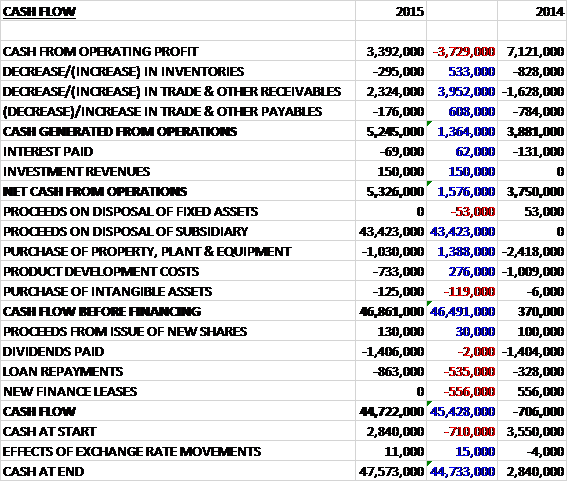
CAMBinterimincome

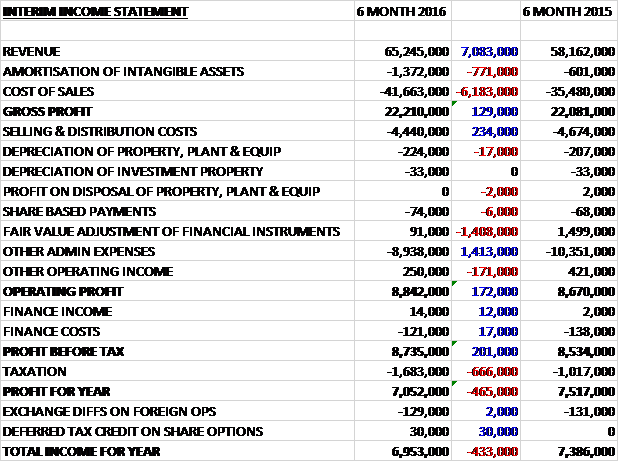
Revenues increased when compared to the first half of last year with a £21.5M growth in new car revenue, a £12.5M increase in used vehicle revenue and a £2.5M growth in aftersales revenue. Cost of sales also increased to give a gross profit £3.7M above that of the first half of 2015. The group made a £1.1M profit on the disposal of a branch, which did not occur last time but admin expenses grew by £2.4M to give an operating profit £2.4M above last time. Finance costs reduced modestly buy tax was up £449K to give a profit for the period of £4.6M, a growth of £2M year on year.

CAMBinterimassets

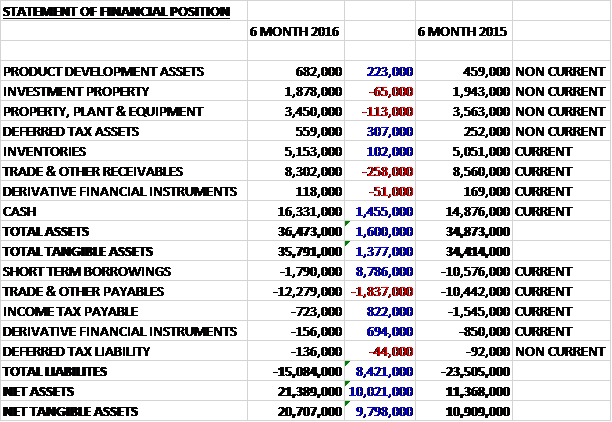
When compared to the end point of last year, total assets increased by £48.9M, driven by a £30.4M growth in inventories, a £10M increase in intangible assets and a £9.9M increase in cash, partially offset by a £1M fall in receivables. Total liabilities also increased due to a £33.7M growth in payables and a £10.6M increase in borrowings. The end result is a net tangible asset level of £19.3M, a decline of £6M over the past six months.

CAMBinterimcash

Before movements in working capital, cash profits increased by £1.3M to £5.9M. There was a cash inflow from working capital with a large increase in inventories more than offset by an even bigger growth in payables, and after tax and interest declined somewhat, the net cash from operations came in at £9.9M, a growth of £5.2M year on year. The group received £1.3M from the sale of a branch which, together with the operating cash, nearly exactly covered the acquisition of property, plant and equipment and new branches to give a cash flow before financing of £88K. The group then took out a new loan to give a cash flow of £9.9M and a cash level of £25.3M at the period-end.

The gross profit in the new vehicles business was £8.8M, a growth of £1.6M year on year on margins that increased from 6.6% to 6.7%. The average profit per unit sold increased by 15.4%, a combination of like for like increase and strengthening mix of the businesses acquired. On a like for like basis, new volume sales rose by just 0.1% with gross profit increasing by £700K as profit per unit increased by 9.7%.

The group’s sale of new vehicles to private individuals was 5.4% higher year on year at 4,832 units, supported by continued strong consumer offers from the manufacturers. New commercial vehicle sales reduced by 6.5% to 478 units due to the timing of the delivery of a commercial fleet order which concluded in March. New fleet unit vehicle sales increased by 22.9% to 327 units. The new registration data showed continued growth in registrations which were up 5.6% in the period, and they continued to benefit from favourable exchange rates and a low interest rate environment.

The gross profit in the used vehicles division was £11.3M, an increase of £1.4M when compared to the first half of last year on margins that increased from 9% to 9.3%. The profit per unit sold increased by 9.7%. On a like for like basis, used volumes increased by 2.4% and profit per unit increased by 8.1%. The group have increased the efficiency with which the source, prepare and market their used vehicles which has helped improve the profitability of the department.

The gross profit in the aftersales business was £13.1M, a growth of £700K year on year on margins that declined from 42.8% to 41.6%. On a like for like basis, service hours were up 1.7%.

The major redevelopment of the Barnet JLR site began in February and it is anticipated that it will be year-long project with full occupation of the facility expected in February 2017. The building and corporate identity fit out cost of the project will be £6.8M. The group have also begun the planning process for delivery of the new Swindon JLR development and it is the intention to be operating that completed facility by the end of 2017. The anticipated cost of the Swindon refurbishment is £6M. There will also be a number of other smaller refurbishment projects ending in the current year.

In January the group acquired the Land Rover dealership in Welwyn Garden City from Jardine Motors for a total cash consideration of £10.8M which generated goodwill of £10M. Also in January they disposed of the Jaguar dealership in Exeter for a cash consideration of £1.3M, resulting in a profit on disposal of £1.1M. The board are actively pursuing acquisition opportunities.

After the period-end, the group opened a third Aston Martin business, in Birmingham and they disposed Croydon Jaguar in line with the JLR strategy for a net cash consideration of £730K, resulting in a profit on disposal of £700K. This business occupied a joint franchise facility shared with Volvo and post-sale the buyer has relocated the Jaguar business to one of its own properties so Cambria will be continuing to operate the Volvo business form this location and will be undertaking a redevelopment of the site in line with Volvo’s corporate identity requirements.

The March registration data saw the largest single month of registrations since the turn of the century. The consumer offers from the manufacturers make new car purchasing much more affordable with strong accessibility programmes and a strong PCP product penetration in the new car market. PCP renewal activity is now becoming the norm and customers change their vehicles in a more structured manner, led by the finance product on a three to four year cycle which has structurally changed the new car market over the past four years. The board believe that the new car market is mid-cycle and registrations will continue above the 2.6m unit level for the foreseeable future.

Trading in the key plate change month of March was strong, ahead of plan and substantially ahead of last year. The board is confident that they will maintain this momentum in the second half of the year and will be ahead of current market expectations for the year as a whole, expecting to deliver an underlying pre-tax profit in excess of £10M.

At the current share price the shares trade on a PE ratio of 12.9 which declines to 9.3 on the full year forecast. At the period-end, the group had a net cash position of £300K compared to a net debt position of £900K at the same point of last year. After a 33% increase in the interim dividend, the shares are now yielding 1% which increases to 1.2% on the full year forecast.

Overall then this has been a pretty decent period for the group. Profits were up, as was operating cash flow, although after the investments in new branches, there was no free cash flow. Net tangible assets did decline, however. New vehicle profits were up and although like for like volumes were flat, an increase in profit per unit saw an underlying improvement in earnings. Used vehicle sales and aftersales also saw increases in profits, although the latter did see a modest decline in margins during the period.

There is some considerable capex planned with £6.8M due to be spent on the Barnet JLR site and a further £6M being spent on the Swindon JLR outlet so this might constrain further acquisitions (hopefully, at least). Trading in march has been strong, ahead of plan and considerably up on last year and a forward PE of 9.3 looks cheap to me so I have bought back in here.
On the 10th May the group announced that Chairman Philip Swatman purchased 10,000 shares for £7.5K to give him a total of 260,000 shares.

On the 14th June the group announced that Chairman Philip Swatman purchased 15,000 shares at a value of £10.4K which gives him a total of 275,000 shares.

On the 6th July the group announced that it had acquired a JLR franchise in South Woodford from Pendragon for a total cash consideration of £2.1M. The business has a sales facility in South Woodford and an aftersales facility in Hainault operating from leasehold premises. The acquisition generated goodwill of £2M and the business generated a pre-tax profit of £700K last year with the board expecting it to be earnings neutral this year and earnings enhancing in 2017

The group have committed to relocating the business to a new dealership facility that will be compliant with the JLR Arch Corporate Identity Concept. The lease on the current showroom facility has nine years remaining and therefore it will be necessary to sublet the facility for about six years while it is not occupied by the group. They have been advised that the passing rent on the showroom lease is over-rented when compared against the market rent (not sure what that means) and the directors have made a fair value assessment of the lease liability amounting to £1M which is being accounted for as an addition to the overall goodwill.

The group have also stated that they continue to trade well and the strong trading performance reported to March has continued through to the end of June which leaves them significantly ahead of last year and trading in line with current market expectations.

On the 11th July the group announced that Chairman Philip Swatman purchased 25,000 shares at a value of £16K.

On the 5th September the group released a trading update. Trading in the second half of the year continued strongly and in the first eleven months of the year it was substantially ahead of the same period of 2015 on a like for like basis. The board is confident of delivering results for the full year in line with market expectations.

New vehicle unit sales were up 3.8% on a like for like basis with gross profit per unit increasing. Used vehicle sales also performed well, with unit sales 2.6% ahead of last year. Gross profit per unit continued to increase and this improved performance has driven profit growth from the used car segment of the business. The group’s aftersales operations also continued to perform well, with profitability up 3.7%, although it was flat on a like for like basis.

The Swindon Land Rover business that was acquired in April 2015 has continued to perform in line with expectations and the Welwyn Garden City Land Rover dealership is integrating to plan. The Woodford Jaguar and Land Rover business acquired in July is being integrated into the group and the board is confident that this will show a positive contribution in 2017. The newly opened Aston Martin dealership in Solihull is now fully operational and a forward order bank is building.

Heading into the important September trading period, the new car order book for the group is building well and in line with expectations so the board expect to deliver another strong trading performance in this month. All in all, this sounds rather positive and the group seems a better bet than Vertu in my view.

Avon Rubber Share Blog – Interim Results Year Ending 2016

Avon Rubber has now released its interim results for the year ending 2016.

AVONinterimincmoe

Revenues increased when compared to the first half of last year with a £3.1M growth in dairy revenue following the acquisition of InterPuls, and a £356K increase in defence revenue. Cost of sales grew more modestly so the gross profit was up £3M. Depreciation increased by £549K, other selling and distribution costs were up £705K, and underlying amortisation increased by £150K. We also see a £703K detrimental movement in the pension cost, a £1.5M growth in the amortisation of acquired intangibles following the acquisition, and a £508K integration cost. After other general and admin costs were up £1.1M, the operating profit declined by £2.3M. The increase in loan interest was broadly cancelled out by a fall in the pension interest cost and a lower unwinding of the discount on provisions. There was a tax rebate this time due to the deferred tax impact, which represented a £2.1M positive movement over the first half of 2015 which meant that the profit for the period came in at £6.5M, a decline of £187K year on year.

AVGinterimassets

When compared to the end point of last year, total assets increased by £7.3M driven by a £4.2M growth in intangible assets, a £3.7M increase in inventories and an £882K growth in property, plant and equipment, partially offset by a £1.9M decline in receivables. Total liabilities also grew during the period as a £2.1M increase in pension obligations due to a fall in AA corporate bond rates, and a £1.9M growth in current tax liabilities was partially offset by a £1.4M decrease in bank loans. The end result was a net tangible asset level of £2.4M, a growth of £1.5M over the past six months.

AVONinterimcash

Before movements in working capital, cash profits increased by £532K to £12.7M. There was a cash inflow from working cap and a £1.7M tax rebate as opposed to a £1.2M tax payment last time so the net cash from operations was £15.6M, a growth of £6M year on year. The group spent £2M on property, plant and equipment, £1.8M on development costs and £3.5M on acquisitions to give a free cash flow of £8.3M. Of this, £1.5M was spent on dividends, £1.8M on the purchase of the group’s own shares and £4.6M was used to pay back loans. The end result is a cash flow of £422K and a cash level of £823K at the period-end.

In protection and defence, revenues for the first half of the year were weighted towards US DOD sales as planned with an additional order for 167,000 M50s, giving a strong order book for DOD mask systems. There is also a growing pipeline of higher margin non-DOD opportunities in the Americas and the Middle East and although the timing of order receipts is unpredictable, the board believe the time horizon for some of these orders is shortening. In dairy, whilst market conditions have reflected cyclically low milk prices, the own brand Milkrite products and Cluster Exchange service have continued to gain market share.

The operating profit at the Protection and Defence division was £5.3M, a decline of £963K year on year due to higher amortisation of acquired intangibles and integration costs that didn’t occur last year, discounting these, the operating profit rose by £201K to £6.6M. The underlying increase arose from the mix of products shipped, an improvement in DOD pricing and operational efficiencies. M50 respirator sales to the DOID were 107,000 compared to 112,000 in the first half of last year. During the period the group received a further order of 167,000 mask systems which means they exit the period with mask order coverage well into 2017 under this sole source long-term contract.

The group delivered 36,000 M61 filter pairs during the period compared to zero last time, and have secured an order for a further 85,000 pairs which they expect to deliver in the second half of the year. In the long term they believe the end user demand for this product will grow as fielding of the mask continues but the board recognise that in the current DOD procurement environment, obtaining short term visibility of future filter spares remains challenging.

Sales to foreign military, law enforcement and first responder customers increased year on year as the underlying portfolio continues to grow. In addition, the board have been encouraged by the level of international enquiries for their respiratory protection products and although the timing of converting some of the larger opportunities has not been in the first half of the year, they believe that the conversion timeline for some of these opportunities is shortening.

The group saw growth in sales to the fire market following the acquisition of Argus and the launch of the new Mi-TIC storm thermal imaging camera which has now received NFPA and CE approval. Other DOD spares sales were higher than in the same period last year, reflecting variability in the timing of orders and delivery schedules. AEF has experienced a softer first half, reflecting the variability in timing of certain DOD procurement programmes for hovercraft skirts and fuel and water storage tanks. Order intake for the first half totalled £55M compared to £47M last time and of the closing order book of £30M, £22M is for delivery in the second half of the year.

The funded development programme with the US Air Force to design and test the MM53 Joint Service Aircrew Mask has progressed well. This will provide respiratory protection to a wide range of operators on the DOD’s fleet of fixed wing aircraft. The testing phase of this development contract is expected to conclude at the end of this year and should lead to a production contract starting in 2017 which could be worth more than $70M.

The operating profit at the dairy division was £2.6M, a decrease of £709K due to an £871K amortisation of acquired intangibles following the acquisition that did not occur last year (although of course, profits from the acquired business were included this time). The modest increase in underlying profit was due to an increasing proportion of sales being the higher margin Milkrite profit and service sales.

Market conditions for dairy farmers, particularly in Europe, have been weak as milk prices have been low. This typically cyclical market dynamic has reduced demand for the group’s consumable products as farmers extend the life through over using the products. The capital nature of the InterPuls products makes the replacement cycle longer, meaning the business is more affected by the cyclical market dynamics than the group’s other businesses (not sure it was great timing on that acquisition, then!)

The existing dairy business has become less dependent on OEMs in recent years as it continues to grow sales of the Milkrite branded products and services which continues to increase market share. In Europe, where Avon-manufactured liners have a 61% market share, Milkrite’s market share has increased to 23% due to growth in traditional Milkrite products and the success of the Impulse Air mouthpiece vented liner, first launched in Europe in 2013. This product continued to gain traction, with its market share increasing to 4% from 3.5% at the year-end and 3% at the same period of last year. In the US, where Avon-manufactured liners have a 63% market share, the Milkrite Impulse Air mouthpiece vented liner also performed well with its market share increasing from 22% to 28% year on year.

The take up by farms of the Cluster Exchange Service, launched in 2014, remains at encouraging levels in both North America and Europe. By the end of the period it was servicing 446,000 cows on 1,411 farms, up from 342,000 cows and 1,100 farms at the same point of last year. This service enhances the value of each direct liner sale the group makes and should lead to a more robust and sustainable business model with the potential to grow a significant recurring revenue stream in the years to come as more farms continue to sign up. The board are pleased with the integration of InterPuls, acquired in August 2015, and are on track to realise the long-term strategic benefits that have been identified, in particular the sales synergies available in the North American market.

Plans for the rollout of InterPuls products in the US are underway, with dealers being trained, samples being issued through the extensive distributor network and products launched at the recent World Agricultural Expo in Tulare, California, positioning the business to start delivering additional revenue in 2017. The sales and distribution operations opened in China and Brazil are progressing to plan as the dealer and distribution networks are built up in these regions.

There was a £400K tailwind from forex translations but this was mostly offset by transactional losses where transactions covered by forward contracts at rates higher than the period rates gave rise to mark to market forex losses of £300K. If the currently stronger US dollar were to continue throughout the rest of the year, it would create further translation tailwinds for the full year with a 5c movement in the $/£ exchange rate giving rise to a £700K impact on operating profit.

During the period there were integration costs of £508K relating to the integration of Argus business and the relocation of the manufacturing to the Melksham site. The group also enjoyed some tax revenue as opposed to expense during the period as they were able to take the benefit of certain deductions allowed by legislation enacted after the 2015 financial statements were approved following the finalisation of the 2015 tax returns.

In October the group acquired the Argus thermal imaging business from E2V for a consideration of £3.5M, generating goodwill of £500K and other intangible assets of £2.3M. The business is a designer and manufacturer of thermal imaging cameras for the first responder and fire markets and strengthens the group’s product range and distribution capability in these markets.

In Dairy, whilst market conditions have reflected cyclically low milk prices, the own brand Milkrite products and Cluster Exchange service have continued to gain market share. Trading is normally second half weighted in the defence business and this is likely to be the case again this year. There is a strong forward order book for DOD M50’s and a growing pipeline of non-DOD opportunities. Going forward, the board expects to make progress as the year develops and meet market expectations for the full year.

After a 30% increase in the interim dividend, the shares are now yielding 0.9% which increases to 1.1% on the full year forecast. The current PE ratio is 19.7 but this reduces dramatically to 12.9 for 2016, partly as a result of the big reduction in tax charges. At the end of the period the group had a net debt position of £8.4M compared to £13.2M at the end of last year and there remains £21.1M of undrawn facilities available, although I have to say if this was all drawn down, the balance sheet would be looking rather stretched in my view.

Overall then this was a solid update given the circumstances. Profits declined slightly year on year but stripping out the non-underlying items it increased somewhat. Net assets improved but the balance sheet remains fairly weak and the operating cash flow increased aided by the tax receipt, generating plenty of free cash. The defence and protection business benefited from a better product mix and improved DOD pricing and the DOD mask orders seem well covered. It is encouraging to see an increase in sales to non-DOD applications and the MM53 mask project looks promising.

Underlying profits in the dairy division increased modestly due to higher sales of the Milkrite branded products. Reading between the lines, it seems that Interpuls may not be contributing much to the group at the moment in a very difficult dairy market. The net debt is coming down and the forward PE of 12.9 looks decent value although the yield of 1.1% is not that exciting. On balance I think these results were better than I was expecting so I have bought back in here.

On the 9th September the group announced a trading update covering the five months to August. Overall the board expect full year profit to be in line with current market expectations. In protection and defence, the CBRN/CO Escape Hood has received NIOSH approval and the group have received an order worth $9M from a major US city police department for this new product, the majority of which will be delivered this year.

Mask systems production has been focused on fulfilling deliveries to the US DOD but there are a number of export opportunities that are being progressed, although the timing of orders is unpredictable with the board expecting to receive them in 2017.

General market conditions for dairy farmers have been week for the majority of the period, as milk prices have been low. This has reduced demand for the consumable products as farmers look to extend the life of their current products. This has been more noticeable in the Interpuls business where the nature of the product is more capital than consumable. Milk prices in the major markets do seem to be starting to improve in Q4, however.

The programme for the roll out of InterPuls products through existing Milkrite distribution in the US has started with the first revenues seen in Q4. This, together with the expectation that the recent improvement in the milk price will continue leaves the board confident of the ability of the dairy business to make progress next year.

Overall this is a pretty decent update, but nothing really to get all that excited about.

On the 19th September the group announced that non-executive director Petrus Rudolf Maria Vervaat purchased 1,000 shares at a value of just under £10K.

Bioquell Share Blog – Final Results Year Ended 2015

Bioquell has now released its final results for the year ended 2015.

BQEincome

Revenues declined when compared to last year as a £339K growth in ROW revenue was more than offset by a £409K decrease in European revenues and a £319K decline in UK revenue. Cost of inventories fell by £261K, amortisation was down £361K and operating lease payments fell by £750K, but these costs were offset by a growth in other cost of sales to give a gross profit that was flat year on year. Sales and Marketing costs fell by £905K, however, and admin costs also decreased but there was a one-off £220K reorganisation cost relating to costs of redundancies in Q4, before the lack of development cost impairments, which were £3.9M last year, meant that the operating profit showed a £5.2M positive swing. The group then received £150K in interest and paid out less in finance costs before a £1M reduction in tax income, mainly due to changes in deferred tax, a £1.9M fall in profits from discontinued operations and a £33.6M gain on the disposal of a subsidiary gave a profit for the year of £35.1M, a positive movement of £35.1M year on year.

BQEassets

When compared to the end point of last year, total assets increased by £28.7M driven by a £44.7M growth in cash, partially offset by a £6.9M fall in fixtures and equipment, a £5M decline in trade receivables, a £1.4M decrease in land and buildings and a £961K decline in prepayments and accrued income. Total liabilities fell during the year due to a £1.8M decrease in accruals and deferred income, a £1.3M fall in bank loans and a £643K decline in deferred tax liabilities. The end result was a net tangible asset level of £56.1M, a growth of £34.8M year on year.

BQEcash

Before movements in working capital, cash profits declined by £3.7M to £3.4M. There was a cash inflow from working capital, however, with a particularly large fall in receivables so that after some interest income was received too, the net cash from operations came in at £5.3M, a growth of £1.6M. The group spent £1M on property, plant and equipment; £733K on development costs and £125K on other intangible assets and after the £43.4M cash receipt from the sale of the subsidiary, there was a cash flow of £46.9M before financing. Of this, £863K was used to repay loans and £1.4M was paid out in dividends to give a cash flow for the year of £44.7M and a cash level at the year-end of £47.6M.

Underlying demand from the Life Sciences and Healthcare sectors increased in the year. Micro-organism contamination remains an ongoing challenge in these sectors around the world and regulatory oversight is increasing. There was a significant increase in sales of Qube and the group launched a new, small and easy to use room decontamination technology designed for the healthcare market, the BQ-50 which saw encouraging levels of initial market demand. Cost reduction in the second half of the year resulted in annualised savings of about £1M.

Life Sciences revenues increased by 1% to £19.1M, in part reflecting a markedly improved performance from the Asia Pacific business offset by a year on year decline in the US. Healthcare revenues were flat at £4.2M but the prior year included a one-off order to the Middle East worth some £500k. Defence revenues declined by 14% to £3.5M and total services revenues fell by £400K to £10.9M reflecting some headwinds encountered in the US with the RBDS decontamination service business.

Geographically, the business in Asia Pacific improved significantly under different management and the start-up in Germany grew strongly reflecting the strength of the life sciences sector in the country. In addition, the Irish business started to show real progress towards the end of the year following a difficult first half. The US should be the group’s largest market and during the year they made changes to the way they take their products to market and have made further changes since the year-end to improve the performance of this business.

The board see substantial opportunities for their Qube product range, particularly on the back of developments associated with cell therapy. They continue to improve their Pod products, which enables them to convert open plan units in hospitals to single occupancy rooms in a matter of hours. To date they have focussed these activities on the UK but they intend to roll out internationally during 2016. The defence business remains lumpy. In the short term the order book is relatively low but the prospect list for 2017 and beyond is better than it has been for some time.

In May 2015 the group sold TRaC Global which carried out their testing, regulatory and compliance work. The business was profitable, making £3.5M in 2014 and the group made a £33.6M gain on disposal with a cash receipt of £44.5M.

The substantial phase of significant capital investment in new products and services is essential over and going forward the board would expect to see product line extensions and technology updates but a markedly lower requirement for investment in product development. Moreover, the bio-decontamination division generated cash in 2015 on a standalone basis. The Asian life sciences business has responded well but there is still more work to do in the US business, however the prospects for the group’s products and services in the life sciences sector look encouraging.

Going forward, the board believes that their product range is well positioned to benefit from strong underlying drivers of growth and underlying demand for the eradication of bioburdon and the provision of an aseptic environment remains strong in the life sciences sector. Antibiotic resistance and hospital acquired infections are increasing issues for healthcare providers globally and there remains ongoing geopolitical stress in a number of parts of the world which helps drive demand for the defence business. Overall, the new year has started steadily.

Given the huge £47.6M net cash level it is pretty much meaningless to try and value the company on a PE ratio, especially given that there does not seem to be any market forecasts. The board have decided that it would not be appropriate to pay a dividend for the year.

In addition to the results, the group have announced that the board have concluded that it would be helpful for the strategic review process and in the best interests of shareholders if a substantial proportion of cash was returned to shareholders by way of a tender offer. They intend to launch a tender offer in respect of 50% of the issued share capital at a price of £2 per share and they have 42.7M in shares in issue so they are returning the equivalent of £1 per share. I am not sure I fully understand why the cash on the balance sheet is making things difficult but the tender amount of £2 seems fairly good for shareholders although I am unsure as to exactly how the process works.

Overall then, this seems to be a fairly solid update. The remaining business now seems to be profitable on an underlying basis, net tangible assets increased following the disposal and the operating cash flow improved with a decent amount of free cash being generated, although this was due to a decline in receivables and cash profits fell year on year. The life sciences business recorded broadly flat revenues as growth in Germany and Asia offset declines in the US; the healthcare business was also flat, although this was a decent performance given the large one-off Middle East order received last year; the defence business performed less well with declining sales due to difficulties in the US.

The main event is obviously the TRAC sale and the fact the group is returning much of the cash to shareholders. Given the muted start to the year with “solid” trading and the fact a buyer for the rump of the business still does not seem to be forthcoming, I am wondering if I should sell my shares here after making a modest profit.

On the 21st June the group announced the results of its tender offer. A total of 20,405,814 shares were tendered by shareholders and purchased for £40.8M, representing about 47% of the total share capital.

Character Group Share Blog – Interim Results Year Ending 2016

Character has now released its interim results for the year ending 2016.

CCTinterimincome

Revenue increased by £7.1M when compared to the first half of last year but this growth was broadly offset by an increase in amortisation and other cost of sales so that the gross profit was £129K above that of last time. Selling and distribution costs fell by £234K and a lower fair value adjustment of financial instruments, reliant on exchange rates at the balance sheet date, was offset by a fall in other admin costs and after the other operating income declined by £171K, the operating profit was £172K ahead of last time. There was a modest fall in finance costs but the tax charge increased by £666K which meant that the profit for the period came in at £7.1M, a decline of £465K year on year.

CCTinterimassets

When compared to the end point of last year, total assets increased by £1.6M driven by a £1.5M growth in cash. Total liabilities fell during the period as an £8.8M fall in short-term borrowings, an £822K decrease in income tax payable and a £694K decline in derivative financial liabilities were partially offset by a £1.8M growth in trade & other payables. The end result was a net tangible asset level of £20.7M, a growth of £9.8M over the past six months.

CCTinterimcash

Before movements in working capital, cash profits increased by £2.4M to £10.5M. There was a cash inflow from working capital, although this was less than last time as the fall in receivables was less pronounced and after a £1.7M growth in tax payments, the net cash from operations was £12.4M, a decline of £3.5M year on year. The group spent £1.2M in intangible assets and £128K on fixed tangible assets to give a free cash flow of £11.1M, and after some cash was spent on dividends and the group received cash from new shares, the cash flow for the first half of the year was £10.2M and the cash level at the period-end was £14.5M.

The group have made good progress with overseas sales, particularly in the US and overseas sales now make up 24% of the total compared to 17% in the same period of last year. Underlying margins have remained consistent but the increase in international sales has led to a slight decrease.

The top performing brands during the period included Peppa Pig, Little Live Pets, Minecraft, Scooby Doo, Fireman Sam and Teletubbies. Peppa remains the lead brand but there has been strong demand for the Teletubbies product since launch in January, from which time it has performed well. New licenses secured in the period include Stretch Armstrong, a range of products will be launched on a global basis including the US where a new TV series is being developed by Netflix.

During the period the company acquired a total of 213,936 of its own shares at a cost of £1M with the average price of £4.70 per share but there have been no further buy-backs since the period-end. It remains part of the group’s strategy to continue to repurchase their own shares when appropriate under the current share buyback programme, although they don’t seem to be being cancelled so I’m not sure what the ultimate intention is.

In February, Kiran Shah and Jon Diver took on the sole role of joint MD. At the same time the group appointed CFO Mark Dowding to the board as group finance director, and Character Options MD Jerry Healy as group marketing director. Clive Crouch was also appointed as a non-executive director. Also, after being involved with the business since 1991 and the executive chairman since 1995, founding director Richard King relinquished his executive role on the board, however he will remain as non-executive chairman.

Current trading continues to be encouraging and the group remains on target to achieve market expectations for the full year.

At the end of the period the group was in a net cash position of £14.5M compared to £4.5M at the year-end and £4.3M at the same point of last year. After a 40% increase in the interim dividend, the shares are yielding 2.5% which increases to 2.7% on the full year consensus forecast and the forward PE ratio is 11.1 at the current share price.

Overall then, this was a solid set of results. The profit did fall but this was due to a higher tax charge and pre-tax profit increased. The net asset level showed strong growth and although the operating cash flow fell, this was due to working capital movements not being as strong as last time and cash profits increased with loads of free cash being generated.

The US seems to be working quite well with an increase in sales and both the Teletubbies and stretch Armstrong look interesting going forward. There is a fair amount of change at the board level which can be a risk so well worth keeping an eye on but with a strong net cash position, a forward PE ratio of 11.1 and yield of 2.7% these shares look good value to me.

On the 23rd June the group announced it had purchased and cancelled 45,000 shares at a value of £232K. It has the capacity to buy back a further 3,093,700 under the authority granted at the AGM.

On the 11th July the group announced that non-executive director David Harris purchased 3,000 shares at a value of £13.2K. He now owns 51,403 shares.

On the 14th September the group released a trading update where they stated that they had made solid progress and they expect to deliver results in line with market expectations. All of the major product ranges have performed well.

A recent extension to the portfolio is Stretch Armstrong, produced under a master license agreement with Hasbro and sold on a global basis. Sales in both the UK and international markets have started very well and the group is currently developing a wider range of interesting products within the brand. Another new product range launched recently is Twozies, a girls’ collectable item. Early results are promising and the board is confident that the product will become a top 10 brand in 2017.

A significant proportion of the group’s purchases are made in US dollars and the increasing strength of the currency against Sterling puts pressure on profitability. Nevertheless, the board believes that they can continue to mitigate the resulting increased costs through the expansion of the international business and active programmes of monitoring all costs and rationalising operations where possible.

On the 21st September the group announced that finance director Mark Dowding purchased 10,000 shares at a value of £43.5K which gives him a holding of 83,841 shares. Also, non-executive director David Harris purchased 4,597 shares at a value of £20K to give him a holding of 56,000 shares.

In addition, on the 22nd September the group purchased for cancellation 292,402 shares at a value of £1.3M. This represented about 1.36% of the total issued share capital.

Utilitywise Share Blog – Interim Results Year Ending 2016

Utilitywise has now released its interim results for the year ending 2016.

UTWinterimincome

Revenues increased when compared to the first half of last year with a £7.1M growth in Enterprise revenue and a £3.3M increase in corporate revenue. Cost of sales increased to a lesser degree and the gross profit was up £2.4M. There was a £5.7M contingent consideration release that did not occur last year, but this was partially offset by a £1.3M goodwill impairment, a £445K growth in amortisation charges, £341K of restructuring costs and a £1.4M growth in other admin costs so that the operating profit increased by £4.8M. Finance expenses decreased somewhat and tax payments were modestly lower which meant that the profit for the period came in at £10.4M, a growth of £4.9M year on year.

UTWinterimassets

When compared to the end point of last year, total assets increased by £8.2M, driven by a £10.2M growth in receivables, partially offset by a £1.3M reduction in the value of goodwill and a £756K fall in other intangible assets. Total liabilities declined somewhat during the period as a £5.6M decrease in payables was partially offset by a £4M increase in borrowings and a £1.2M growth in current tax liabilities. The end result was a net tangible asset level of £19.8M, a growth of £10.8M over the past six months.

UTWinterimcash

Before movements in working capital, cash profits increased by £6.5M to £15.M. As is always the case with Utilitywise, however, the problems occur in the working capital movements as once again a huge increase in receivables and a decline in payables along with a modest increase in tax payments meant that there was a cash outflow through operations of £1.4M, an improvement of £2.2M year on year at least. Capex was fairly negligible with a £199K purchase of property, plant and equipment along with a £229K spend on intangibles which meant that before financing there was a cash outflow of £1.8M. Strangely, despite not actually generating any cash, the group still paid out some cash in dividends so they had to take out a new loan of £4M to give a cash flow of £444K and a cash level at the period-end of £6.9M.

The profit in the Enterprise division was £4.1M, a growth of £203K year on year. The group have seen a consistent renewal rate of about 80% by meter volume of their Enterprise customers. During the period they continued to increase their contracted customers, increasing the total customer base by 33% to 28,384 and 77% of revenues came from new customers as opposed to 58% in the same period of 2015.

During the period the group appointed a new People Operations Manager with which they have focused on reducing the attrition rate which has increased throughout the year. This is now reducing with the focus on improving the quality of their hiring, building their recruitment strategy to match their multi-channel strategy and developing team manager capabilities. The group have also launched a new online switching platform.

In the period, they received £3.6M from a supplier who agreed to harmonise the payment terms on extension contract with that of newly acquired customers. The cash conversion of the division will continue to improve as they negotiate with suppliers to change their teams on extension contracts and the absolute proportion of extensions contracted reduces as it has in the period to 23%, down from 42% in 2015. European expansion continues to perform in line with expectations and they will continue to evolve their business model and expand their resources deployed on the French, German, Belgian and Netherlands markets in the coming year.

The number of customers benefitting from the “smartdash” data analytics software the group acquired with t-mac is currently 1,281 and a plan is in place to roll out the software to all customers as group arrange installation of their AMR Smart Meter. This data-led service enables a wider and more comprehensive dialogue around energy management with customers and includes the deployment of their Edd:e monitoring hardware alongside the t-mac controls hardware as a key part of this.

The profit in the Corporate division was £1.6M, an increase of £116K when compared to the first half of last year as the business incorporated the acquired t-mac business. This growth was supported by significant customer wins in the medium-sized business space, although the £2.2M of revenue from t-mac was at a lower margin than the core procurement business. The group have also benefited from good revenue growth in the non-procurement business specifically related to the ESOS which was also at lower gross margins than the procurement business.

As usual there were various exceptional items incurred during the period. There was £341K in relation to restructuring and reorganisation costs and £29K of onerous lease costs. There is also a credit of £5.7M which has arisen from the release of deferred consideration in relation to the acquisition of t-mac technologies where earn-out criteria were not met and a related goodwill impairment charge of £1.3M. The business is performing satisfactorily but the revenue streams to be derived from the full integration into the wider energy services offering are largely planned to fall outside the earn out period and the order book and business activity without these will not be sufficient currently to pay further sums to the vendors and the impairment charge reflects the timing changes to the revenue and profits arising from the business.

A key driver of growth has been the addition of revenue generating energy consultants and at the end of January the headcount had increased to 625 up from 449 at the end of the first half of last year. The secured pipeline at the period-end was £24.7M compared to £23.5M at the same point of last year and by the end of March, the secured pipeline had increased to £26.6M.

During the period the group bolstered their senior management team with the arrival of Brin Sheridan as COO and Adrienne McFarland as People Operations Director. Also, it was announced that founder and CEO Geoff Thompson will move to a new role as Executive Chairman. The board have already identified an external candidate to replace Geoff and will release further details once his/her start date is agreed.

The group have announced the immediate change to its existing payment terms with another key energy supplier. The supplier has agreed to amend its terms such that any future extension secured to a contract that has not expired receives the same cash payment terms as for a new contract, in this case 80% of the expected revenue from the contract falling due on the extension signing and the remainder at maturity subject to the normal reconciliation process. They have also agreed that this change of terms will apply to historic accrued revenue balances and the group will therefore receive £2.3M in cash from the supplier before the year-end.

Of particular focus going forward will be the continued implementation of the productivity initiatives and emphasis on the recruitment strategy within the Enterprise division. In addition they will continue to focus on the roll-out of their Utility Management Plan with the development of the Corporate division’s energy services offering alongside growth in the core procurement business. The productivity measures in their Enterprise division, with a lower attrition rate in the second half will see an improved second half of the year performance against the first half. Overall they remain on track to deliver revenue and EBITDA margins in line with expectations.

The net accrued revenue balance has a maturity profile which has about 34% due within one year and the balance of 66% extending into the future. This compares to 43% due within one year as of the end of 2015.

At the end of the period the group had a net debt position of £10.2M compared to a net cash position of £1.6M at the same point of last year with £6.4M of cash being spent on the t-mac acquisition and the board believe the second half will be a stronger cash period. After a 29% increase in the interim dividend, the shares yield 3.3% which increases to 3.9% on the full year forecast. The forecast forward PE ratio is 8.7.

Overall then, on the face of it this has been a decent period for the group. Profits are up, as are net assets but the age old problem here is cash generation and despite improving there was a cash outflow from operations due to continued increases in receivables. For what it’s worth, both divisions increased profitability but the group have been hit by high levels of staff attrition, which is apparently now under control. The group has made progress in signing up another supplier on improved terms and with a forward dividend yield of 3.9% and PE ratio of 8.7 the shares look cheap. The inability of the group to make any cash, however, means that I am not buying in here any time soon.

On the 8th August the group released a trading update covering the first half of the year. The group expects to report significant revenue growth in the period with revenues of at least £82M. Adjusted EBITDA is expected to be up £200K to £18M and net debt at the year-end was £200K compared to £6.7M at the end of last year with improved commercial terms in the Enterprise division yielding some improvement in cash flow. This is expected to continue into 2017.

The Enterprise division continued to grow its contracted customer base, increasing total Enterprise customer numbers by 21% to 30,552 with about 75% of revenues coming from new customers compared to 62% last year. Overall Enterprise revenue added to the order book during the period increased by 35% to £84.5M. Future secured revenue was £25.6M sat the year-end, an increase of £900K year on year and the energy consultant headcount was up 15 to 625.

Staff attrition has continued to be a challenge. Although the actions taken to address this are well underway, it has had an impact on the performance of this division in the period. The group are already seeing the benefits of these actions, however, and they therefore expect energy consultant headcount to increase in the new financial period. The investment in building the group’s multi-channel approach has increased costs in the short term but this will drive customer acquisition and assist the actions taken to reduce attrition.

The European business has performed well in the year and will achieve the break-even position targeted. The customer base has increased in line with board expectations and will be built upon whilst targeting and improvement in the revenue per energy consultant in the year ahead.

Steve Atwell who was brought in to the division to start its transformation has left with immediate effect to pursue opportunities in the technology sector and has been replaced by Chris Charlton who has been with the business for six years, holding a number of senior positions.

The corporate division has traded satisfactorily and as with enterprise, it is going through a major transformation as it builds upon the t-mac acquisition to provide the wider energy services capability. The roll out of the Smartdash data analytics software acquired with t-mac is continuing and a plan is underway to roll out the software to all customers as they arrange installation of their AMR Smart Meter. The partnership with Dell to introduce internet of things building automation solutions to customers is progressing well with trials underway and the group see a significant opportunity to roll this out to both new and existing customers.

On the 9th August the group announced the appointment of Brendan Flattery as CEO, effective from the start of October. He joins the group from Sage where he was European president. As previously announced, founder and CEO Geoff Thompson will become executive chairman and current chairman, Richard Feigen, will remain on the board as a non-executive director.