Telford Homes Share Blog – Final Results Year Ended 2016

Telford Homes has now released its final results for the year ended 2016.
TEFincome

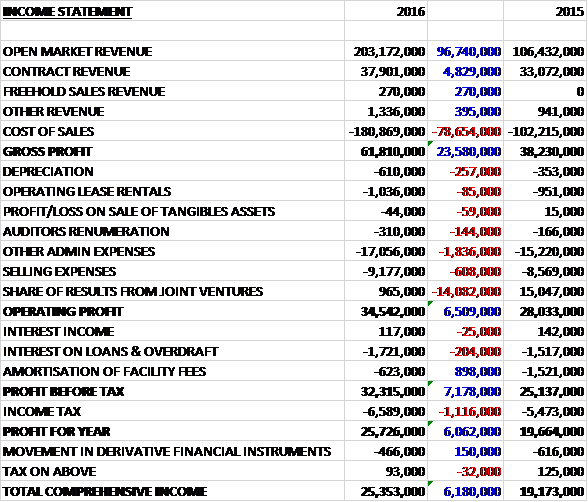
Revenues increased when compared to 2015 with a £96.7M growth in open market revenue and a £4.8M increase in contract revenue. Cost of sales also increased to give a gross profit £23.6M above that of last time. Depreciation was up £257K and selling expenses increased by £608K with a £1.9M growth in admin expenses. There was a £14.1M fall in the profit from joint ventures which meant that the operating profit grew by £6.5M. A £204K growth in interest on loans was more than offset by an £898K reduction in the amortisation of lending fees so that after a £1.1M growth in tax, the profit for the year came in at £25.7M, an increase of £6.1M year on year.
TEFassets

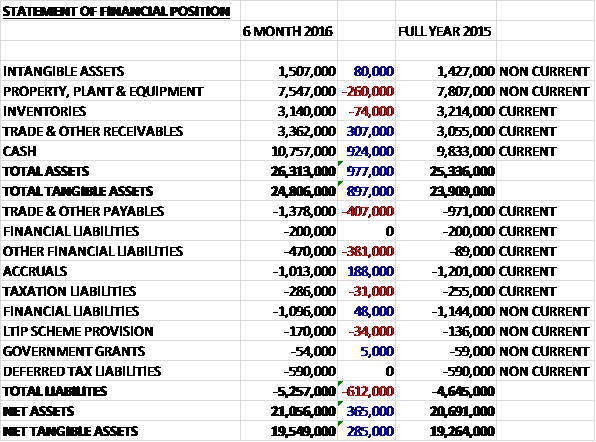
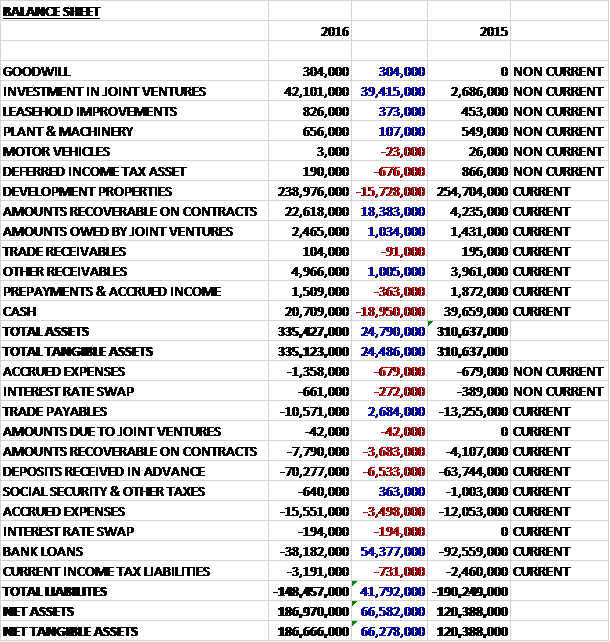
When compared to the end point of last year, total assets increased by £24.8M, driven by a £39.4M growth in investments in joint ventures relating to the acquisition of United Home Developments and the land purchase at Chobham Farm; and an £18.4M increase in amounts recoverable on contracts, partially offset by a £19M decline in cash and a £15.7M fall in the value of development properties. Total liabilities decreased during the year as a £54.4M fall in bank loans was partially offset by a £6.5M increase in deposits received, a £3.7M growth in amounts recoverable on contracts and a £3.5M increase in accrued expenses. The end result is a net tangible asset level of £186.7M, a growth of £66.3M year on year.
TEFcash

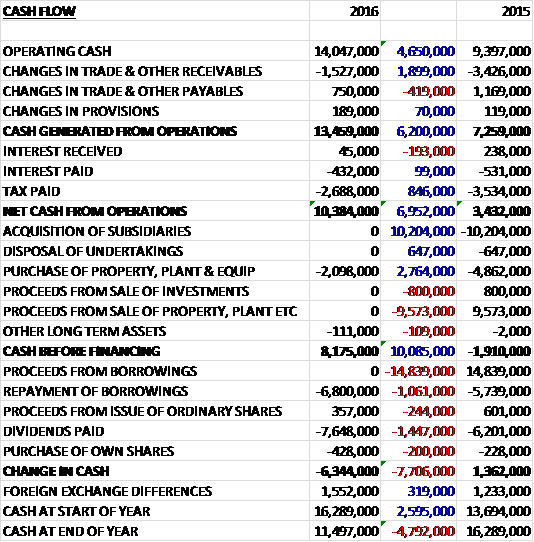
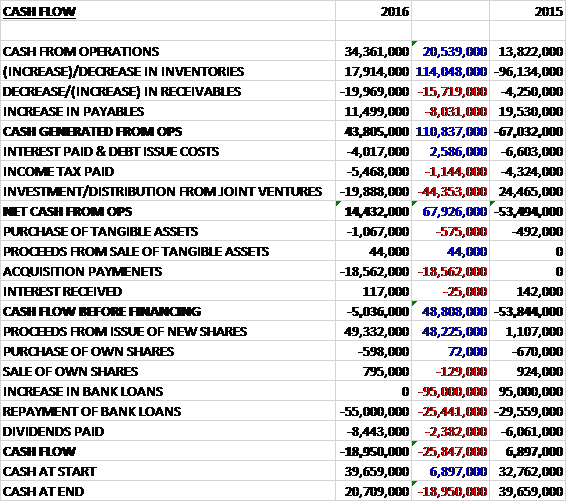
Before movements in working capital, cash profits increased by £20.5M to £34.4M. There was an inflow of cash from working capital compared to a large outflow last year so after interest costs fell, tax payments increased and there was a large investment into joint ventures, the net cash from operations came in at £14.4M, a growth of £67.9M. This did not cover the acquisition payments of £18.6M, however and after a £1.1M investment in other tangible assets, there was a cash outflow of £5M before financing. The group received proceeds of £49.3M from the placing and this was used to repay £55M of bank loans and pay £8.4M in dividends to give a cash outflow for the year of £19M and a cash level of £20.7M at the year-end.

Overall the number of completions increased from 374 to 482 but the average selling price of the properties reduced from £439K to £417K. This reduction was due to the mix of developments completing in the year in terms of their location and not an indication of a fall in underlying price.

During the year the group completed their first substantial Private Rented Sector (PRS) transaction with the sale of Pavilions for £66.75M to L&Q, one of the country’s leading housing associations. More recently they have also exchanged contracts on a second PRS sale of the open market homes at Carmen Street to M&G Real Estate for £63.2M in May 2016. These transactions are de-risking existing developments and mark the start of a new direction for the group in terms of customer mix and have the potential to become increasingly significant over the coming years. They are forward funding arrangements and involve regular payments during the construction process.

The transaction is accounted for as a construction contract and the group will recognise revenue on a percentage of completion basis over the life of the development with completion of the Pavilions transaction expected in mid-2018. This enables the group to recognise profits earlier than if the homes were sold on the open market. They are also forward funded by the investors which means an initial payment is made reimbursing the cost of the land then monthly construction payments and finally a substantial payment on completion. Very little equity is therefore used during construction but the transactions are at a moderately reduced margin.

The recent launch of the Liberty Building demonstrated that individual investor demand continued to be healthy. The group secured over £40M of future revenue across the launch in March and April with 68 of the 105 open market homes sold. A third of these were sold to UK investors and the remainder to international investors, particularly those from China. The development does not complete until 2019 and the average price achieved was around £900 per square foot, which is at the upper end of the typical price range and ahead of initial expectations.

In addition to the development specific launches throughout the past year, there have been more than forty sales with a combined value of over £25M secured through the new central sales and marketing suite in Stratford.

In total, the group exchanged contracts for the sale of 403 open market properties in the year and negotiated the contractual sale dates on a further 145 open market homes at City North which formed part of the acquisition from United House, which has effectively secured forward sales of more than £67M on this development, a joint venture with the Business Design Centre in Islington. In summary, the group have added 548 new sales in the year compared to 661 achieved last year.

The sales achieved in the year were split 28% to UK investors, 41% to overseas investors, 7% to owner-occupiers and 24% to institutional investors. This compares to 38%, 49%, 13% and 0% respectively in the prior year. The low percentage of sales to owner-occupiers is apparently down to the timing of sales and not a lack of demand. The group aspires to forward sell its developments to de-risk existing projects and investors tend to purchase much earlier in the development process than owner-occupiers. Despite recent tax changes, individual investors are expected to remain an important component of the group’s sales mix.

Since late 2014, sales prices have been tempered by affordability constraints and are now increasing at a more sustainable rate of 4-5% per annum, offset to some extent by overage payments to land vendors where they share in uplifted values. Build cost inflation has also been evident across the industry but has been controlled to a similar rate of increase and in accordance with forecasts. They group have still not experienced any significant shortages in supply in any of its subcontracted trades or materials.

The gross margin has reduced to 26.5% from 32.4% last time, although it remained above the 24% target. The board expected margins to trend towards this level given the similar rate of inflation of both prices and costs. PRS sales are also expected to reduce margins going forward.
During the year the group completed the sale of two smaller undeveloped sites for revenues of £6.7M. These sales are as a result of the change in strategic direction where smaller sites have become less attractive to build out.

On the 30th June the group acquired the regeneration business of United House Developments which consists of a group of companies that have various interests in four significant development opportunities in North and East London. An amount of £23M was paid which included an amount held in escrow relating to Gallions Quarter where completion is conditional on the business securing a legal interest in the site. The revenue and profit recognised since the date of the acquisition are minimal and not significant to the group.

In November the group issued 13,888,889 shares at 360p per share as a result of a placing which raised £50M before expenses. There is also headroom of £140M on the revolving credit facility. Immediately following the placing the group acquired the site in Carmen Street for £20M which was swiftly turned into a PRS sale in the following months. Many opportunities are being appraised and the board is confident of committing the remainder of the placing funds to site acquisitions before the end of the current year. Following the placing, the group has sufficient resources to fund its longer term growth plans.

In February 2016, the group appointed a new non-executive director, Jane Earl. She replaces David Holland who will retire in July after being with the group for fifteen years, including ten as Chairman.

The group started 2017 with a forward sold positon of £579M of revenue, up from £503M at the same point of last year. This will increase further as sales are achieved during the year and already represents more than double the total revenue reported last year. In total they have secured over 50% of the cumulative revenue expected in the next three years.

There have been some recent concerns over prime residential properties in London but this is a different market to that served by the group as they are focused on non-prime locations in London at a price point that continue to see strong demand. The board have a pre-tax profit forecast to exceed £50M by 2019 and the development pipeline now represents over £1.5BN of future revenue. The board expects 2017 to show no more than a slight improvement in profit compared to this year with substantial growth into 2018 and 2019 to become more than £50M by the end of 2019, ahead of previous expectations.

At the current share price the shares trade on a PE ratio of 10.1, reducing to 9.6 on next year’s consensus forecast which looks pretty good value. After a 28% increase in the total dividend, the shares are yielding 4.1% which increases to 4.6% on next year’s forecast.

Overall then this has been a strong year for the group. Profits were up, net assets increased (although the placing would have responsible for most of this) and the operating cash flow grew. Despite that, the group did not generate any free cash, however. Completions were up but the average selling price declined which is being put down to a change in product mix. The addition of PRS transactions mean that margins will come down but hopefully also mean that there is a healthier cash flow.

Investor demand at the price point where the group operate seems strong but they do seem to rely on Chinese investors, so the health of their economy is important. Build cost inflation seems to be being controlled well but the group had to rely on a placing to patch up its development cycle which is disappointing – I would much prefer companies to grow out of their own operational cash flow. Despite this, a forward PE of 9.6 and dividend yield of 4.6% seem good value and after the referendum outcome is known I might think about buying in here.

On the 23rd June, in a very well times sale just before the Brexit vote, Land Director James Furlong sold 100,000 shares at a value of £350K. It was also announced that group planning and design director sold 100,000 shares at the same value. James in now interested in 1,156,789 shares and David is interested in 1,192,357 shares.

On the 4th July the group announced that Land Director James Furlong purchased 48,917 shares at a value of £147K. This seems a canny trade considering he sold a chunk before the referendum result.

On the 14th July the group released a trading update. In recent months they have continued to build a substantial forward sold position, including £130M from two PRS contracts, and raised £50M of new equity. As a result they are in a strong financial position to manage the impact of market uncertainty following the Brexit outcome.

Total forward sales now exceed £640M which has been boosted by the PRS sales of the Pavilions, sold to L&Q in February; and Carmen Street, sold to M&G in May. As a result of these sales, the £50M of placing funds are largely uncommitted and in addition the group has significant headroom in its £180M revolving credit facility – one has to ask then whether the fundraising was necessary at all.

The EU referendum has created significant short-term uncertainty and it is too early to predict how long that will last. Due to the forward sold position, the group has now major sales launches planned until the autumn so they will monitor other market activity as a barometer of transaction levels and pricing. In addition, they continue to consider opportunities for further PRS sales, both on existing sites and potential land acquisitions.

Not really much to go on then – the group seems strong but it is too early to tell what effect the Brexit vote will have.

On the 29th July the group gave an update on the acquisition of the regeneration business of United House Developments. The group have completed the purchase of their interest in Gallions Quarter and have secured a £110M loan facility for its City North development. The purchase was deferred from the original acquisition of the regeneration business. The development is controlled by Notting Hill Housing Group and Telford has acquired a 50% interest in two of the phases to be developed. The first of the phases has a detailed planning consent for 292 new homes which are due for completion in 2020. The second phase, which will start after phase one has completed, has outline consent for a further 254 new homes.

The loan facility to finance the development of City North, a joint venture with The Business Design Centre, has been secured from the LaSalle Residential Finance Fund. This will provide funding for the mixed use development comprising 355 apartments and 109,000 square feet of retail, leisure and office space next to Finsbury Park station. The group have recently commenced work on site.

Since the acquisition the group has also made good progress on the other two developments purchased from United House. Planning consent has been secured at Balfron Tower, a 26 storey grade II listed building in Poplar consisting of 146 existing homes that being refurbished. In addition a planning application has been submitted for the regeneration of Chrisp Street market which, along with providing new homes, will transform the area around the existing market square into a new commercial and leisure destination.

On the 30th August the group announced that Land Director James Furlong sold 48,917 shares at a value of £156K. This is quite a heft sell and has been a very profitable trade.

On the 12th October the group released a trading update covering the first half of the year where they stated that they continue to hold a positive view of both the current and future housing market in non-prime areas of London and they have not revised their growth targets following the Brexit vote.

The group started the year with a substantial forward sold position that has subsequently exceeded £650M of revenue to be recognised in 2017 onwards. They have experienced increased sales activity in respect of residual availability across a number of developments. Since the start of September, greater interest levels and more visitors to the central sales centre have resulted in an increased number of reservations. This has included the sale of three of the remaining penthouses at Horizons where the average price is over £1M. The average price of open market homes in the group’s future pipeline is £517K.

The next significant launch will be City North in Finsbury Park, a joint venture development with the Business Design Centre which is planned for November. This development is now underway and the group recently announced the signing of a £110M loan facility with LaSalle which will fund this scheme of 355 homes, 140K square feet of commercial and leisure space and a new entrance to the underground station.

Build to Rent remains a significant focus for the group following the sale of the Pavilions to L&Q, and Carmen Steet to M&G. Following these two development sales, the group has recently progressed to detailed discussions on a third transaction. There has been a noticeable increase in institutional interest in these kinds of investments which complements the group’s desire to extend its involvement in the sector.

The group has an accelerated development pipeline as a result of the purchase of the regeneration business of United House in September 2015. They have resources to add to that pipeline and an increasing number of opportunities are being appraised with some sites now the subject of more detailed negotiations.

There were far fewer open market completions in the first half of this year compared to the first half of 2016 due to development timings despite completions proceeding with no unexpected delays. As a result of this, profits in the period will be lower than last year but in line with expectations. To date the group have secured 95% of the open market homes expected to complete this year and 87% of the gross profit expected in the year. The board’s expectations remain unchanged.

Victoria Oil and Gas Share Blog – Final Results Year Ended 2015

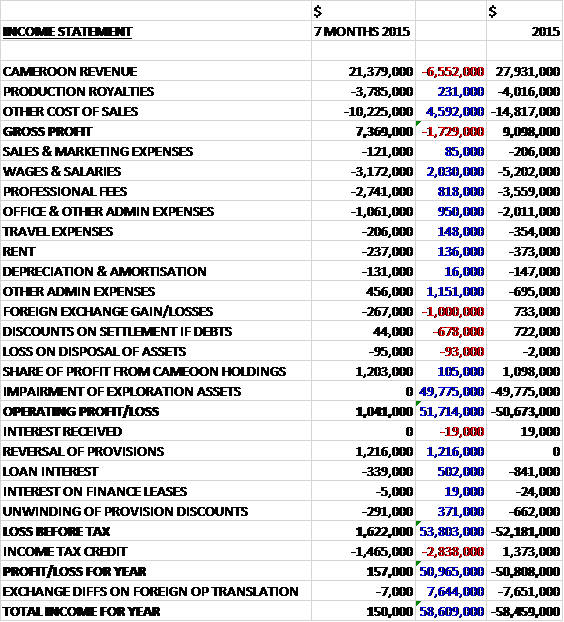
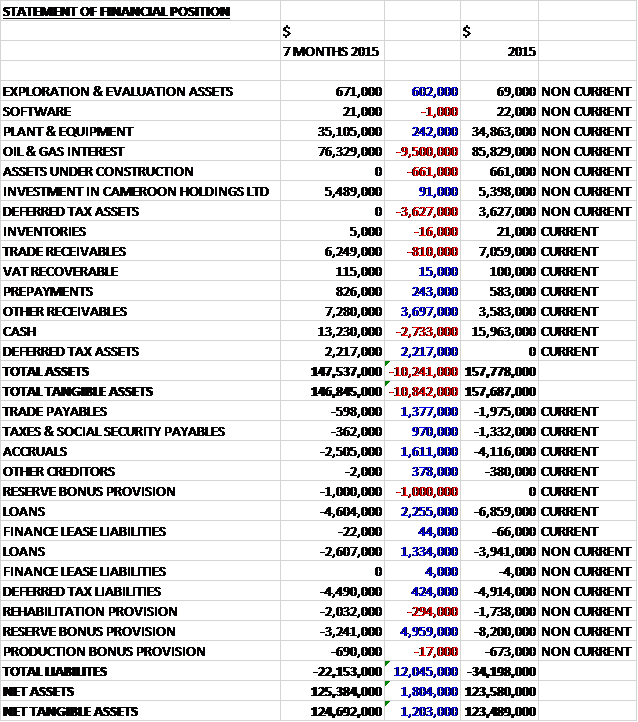
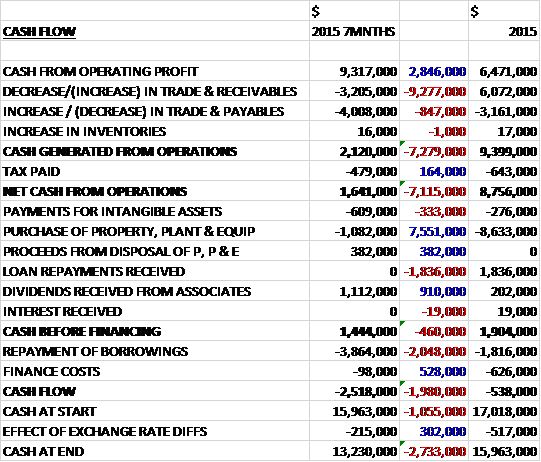
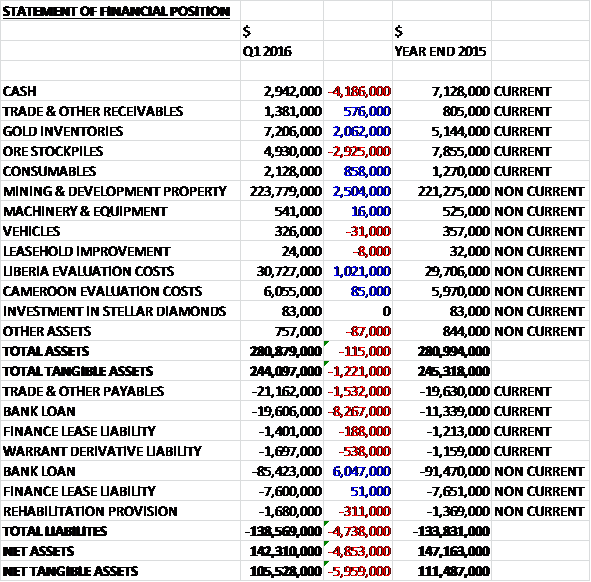
Victoria oil and gas has now released its final results for the year ended 2015. This only includes the months since the previous year end in May and sadly they have not included any seven month comparisons so many comparisons to last year are rendered useless.

VOGincome

Cost of sales declined less than revenues which meant that the gross profit was down by $1.7M. Wages and salaries reduced by $2M, professional fees declined by $818K and office and other costs decreased by $950K. A $1.2M decline in other admin expenses was mostly offset by a $1M detrimental forex movement and before last year’s impairment, the operating profit came in at $1M, an improvement of $1.9M year on year. We then see a $1.2M provision reversal and loan interest fell by $502K. After a $1.5M tax charge, mainly relating to the deferred tax relating from a change in estimate, the profit for the period was $157K.

VOGassets

When compared to the end point of last year, total assets declined by $10.2M driven by a $9.5M fall in oil and gas assets, a $1.4M decline in deferred tax assets which should be utilised in the coming year and a $2.7M decrease in cash, partially offset by a $3.7M growth in other receivables, mostly relating to RSM receivables. Total liabilities also declined during the period due to a $4M fall in the reserve bonus provision, a $3.6M decline in loans, a $1.6M decrease in accruals and a $1.4M decline in trade payables. The end result was a net tangible asset level of $124.7M, a growth of $1.2M over the period.

VOGcash

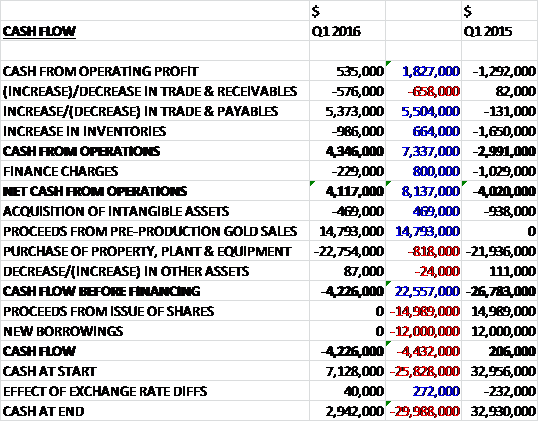
Before movements in working capital, cash profits increased by $2.8M to $9.3M. There was a large working capital cash outflow, however, with an increase in receivables and a decline in payables which meant that after tax the net cash from operations was $1.6M, a decline of $7.1M year on year. The group spent $1.1M on fixed tangible assets and $609K on intangibles but a dividend from the Cameroon royalty company meant that there was a free cash flow of $1.4M. This did not cover the $3.9M of debt repayments, however, and the cash outflow for the period was $2.5M and the cash level at the year-end was $13.2M.

During the period the group produced an average of 8.57mmscf per day of gas compared to 3.95mmscf in the same period of last year, with both the ENEO power stations consuming gas for grid power for the whole period. Condensate sales were 16,055bbls compared to 13,598bbls last year.

Dangote was commissioned in June 2015 and both Sic Cacaos and New Foods were commissioned in May with all three companies consuming consistently since. Both New Foods and Sic Cacaos are consuming at their expected levels while Dangote continues to increase production at its new clinker plant. The newly established sales team is focused on increasing the group’s reach into the Bonaberi area and during the period, eleven new thermal gas connections were signed.

The group has a contract price bracket of $9 to $16 per mmbtu for its gas sales and a sales price for its condensate based on the Brent oil price. The fall in the market price of alternate products to their gas has made them more price competitive than previously which has resulted in a small number of customers switching away from gas.

As far as the grid power is concerned, during the period the short-term genset equipment rental contracts with the industrial power customers came to an end, as did the related contract with the provider of the gensets although the group remains a gas supplier to these customers.

The phase II Bonaberi line extends the existing pipeline from Magzi 2 Industrial Estate to Maya Oil factory, a distance of about 8km. The two material customer connections on this phase are Maya & Cie and SMS Shal. The larger of the two is Maya & Cie, a cooking oil and soap producing company located on the Bonaberi road. Their initial estimated consumption is expected to be 380,000scf per day but demand is expected to increase. At the current time, 3.7km of pipe has been laid and an additional 1.3km of pipe has been welded and is ready to be laid. The customers on this phase are expected to come online during Q3 2016.

Beyond Maya Oil, upon completion of Phase II, the Phase II pipeline will start. This is planned to add an additional 5.5km to five new customers with 130,000scf per day of expected consumption. These customers are expected to be online by late 2016.

During the period the group has been preparing to drill two wells onshore at the Logbaba field to supplement the two existing production wells. The new wells are required to meet the demand for gas, to develop the Logbaba reserves and to move some of the 2P reserves into the 1P category. One of the wells will twin the La-104 well drilled in 1957 and the other well will be a step out well that will be drilled into a target that is intended to add to the probable reserves. Both of the wells will be drilled directionally from the one drilling pad adjacent to the Logbaba gas plant and they are to be tied into the production facilities immediately after they are completed. The La-104 well is almost vertical but the step out well will be drilled to intersect a target that is about 1,100m to the SE of the pad.

In addition to developing the gas reserves in the Logbaba formation, the La-104 twin has an optional additional objective of an exploration tail which can be drilled from the bottom of the Logbaba formation (at about 3,200m) down to 4,200m below the surface to test the hydrocarbon potential of the Mundeck formation which had gas shows in well La-104.

The group has sourced a drilling rig which is currently en-route to Cameroon. Petrofac is providing well design and project management services and they are now working on the design and programme preparation. Major site preparation work is underway including slope stabilisation, levelling for drilling rig tracks and drilling pad preparations. New warehousing for rig supplies, storage and camp civils are also under construction with long lead time orders being placed. The budget for the two wells is less than $40M, excluding the optional exploration tail.

Following the purchase of the gas processing plant in May 2015, the expansion study has been completed. Stage one of the expansion, from 20mmscf per day to 25mmscf capacity is in the preliminary engineering phase and with further expansion phased being tied in with the well results.

In February 2016, the group reached an agreement with Glencore to acquire a 75% participating interest in the Matanda Block. The group, as operator, will assume responsibility for carrying out a proposed work programme, to be agreed by the Cameroon government. There was no consideration for the acquisition but they group has assumed the work programme obligations which includes seismic work to be performed in the near term in a range of $8M to $10M to be spent over a two to three year period. The acquisition comes with some assets, which the directors estimate to have a value of over $4M.

The block is adjacent to the Logbaba operation and covers an area some sixty times the size of the Logbaba concession. It is highly prospective for significant natural gas and gas condensate resources. The North Matanda field is estimated to hold a P50 gas in place volume of 1.8tcf and condensate in place of 136mmbls. The remaining 25% interest is controlled by AFEX, a Bahrain based company and the first phase of seismic data acquisition is expected to start in Q4 2016. The existing Logbaba gas network infrastructure will allow for fast track development of any new discoveries made.

The board have stated that they are looking for other opportunities within Africa and they continue to assess some projects. The plan is to focus on the development phase of projects and enter at a point after the discovery of gas and prior to the development of the field. I have to say that I think it is a bit soon for that – I would rather they got to the point where Cameroon is consistently profitable and cash generative first. They have also stated that they continue to seek a partner or purchaser for the Russian asset (which has been fully impaired already).

It is very relevant that RSM will start to receive their 40% of revenues from the Logbaba concession from May, although there is still $2.6M of receivables not yet paid so in reality they probably won’t start getting anything straight away, but going forward this is going to be very significant.

The group is liable to pay a bonus determined four years after commencement of production by reference to the reserves of the field. The directors have previously provided $10M for this, being the bonus payable based on the expected reserves four years from first production. During the period the counterparty has initiated arbitration proceedings over the timing of the reserve bonus payments. Based on proceedings to date, management are of the opinion that the reserve bonus provision should be just $5M, a portion of which ($1M) is reflected as a current liability. A contingent liability of $5M exists, therefore, should the arbitration ruling favour the counterparty.

In March 2016 the group received a land claim amounting to $1.6M. This claim states that certain property rights have been infringed by the pipeline network laid by the company. The directors believe the claim is without merit and it is being challenged.
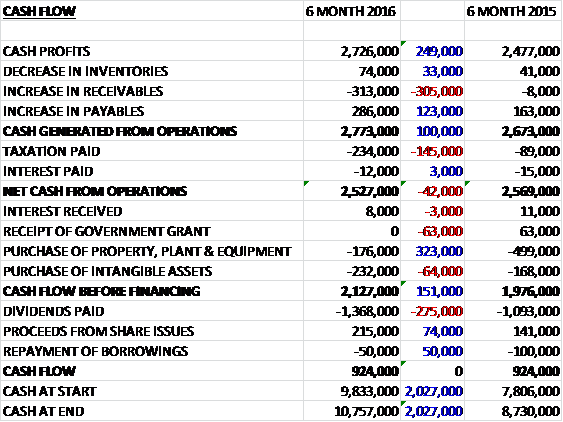
At the year-end, the group had a cash balance of $13.2M. In April 2016 the group secured a debt facility with BGFI of $26M to support the capital expansion and exploration programme planned for 2016. The facility is repayable over five years, bears interest which currently stands at 7.15% per annum. At the year-end, the group had spent $500K relating to the drilling programme in 2016. Since then, they have spent a further $4.9M, including $2M of mobilisation costs to get the selected drill rig to the Logbaba site. They have a further commitment of $12.2M which is expected to be spent during 2016.

The group has a net cash position of $6M as of the end of the year compared to $5.1M at the previous period-end. At the current level of profitability the shares look very overvalued with a PE ratio of 424.5 and unfortunately I can’t find any analyst forecasts.

Overall then this was a period of some progress for the group. They made a small profit compared to a small loss last time, their net assets increased and although the operating cash flow declined, this was due to movements in working capital and cash profits increased. Despite the fall in operating cash flow, some free cash was generated. The group have been hit by some customers moving away from gas as the declining oil price has meant some alternatives are better value, so this must be kept in mind.

The upcoming drilling programme also adds some risk here with the budgeted cost of $40M just about covered by the cash reserves and new $26M debt facility, although this does not leave much room for error. The Matanda acquisition looks to be a great opportunistic deal and the concession looks promising, although the $8M to $10M commitment is something else the company will need to spend cash on.

In conclusion, progress is being made but there remains some uncertainty.

On the 31st May the group announced that Deputy Chairman Grant Manheim has retired and current part-time finance director Robert Palmer was also stepping down, to be replaced with the group financial controller, Andrew Diamond.

On the 23rd June he group announced that CEO of GDC Ahmet Dik was promoted to CEO of the whole group – this has been coming for a while I think.

On the 29th June the group announced that the rig had arrived at Douala port and is ready for customs clearance. The schedule is to commence drilling in early Q3 and complete by the end of 2016.

On the 14th July the group announced the appointment of Roger Kennedy at a non-executive director with immediate effect. He is currently chairman of KPC, a family owned company investing in public and private equity. He has also served as a director and head of business development for Star Petroleum.

On the 26th July the group released an update covering Q2. During the quarter, revenue declined by $300K to $12.5M and the net cash position at the end of the period stood at $1.7M compared to $4.6M at the end of Q1, with gross cash reserves of $13.9M.

Total gas sales were 1,151.2mmscf , an increase of 31.2mmscf year on year as a 66.2mmscf decline in retail power sales was more than offset by a 4mmscf increase in thermal power and a 93.4mmscf growth in grid power. The amount of condensate sold declined by 1,010bbls to 12,457bbls. The quarter marks the second half of the dry season which enjoys higher gas consumption than in the wet season.

As of the start of June, the group had received all of the income to satisfy RSM’s portion of the initial exploration costs carried out at the Logbaba gas project. As a result, RSM will now receive 40% of Logbaba revenues which will be net of their 40% contribution to all operational and capital expenses including well drilling, pipeline construction, gas delivery and operating expenses. Through this year it is expected that all revenues from the project will be expended on operational and capital expenses, including the drilling programme. The group has also secured at debt facility with BGFI Bank of up to $26M which it can draw upon at any time to fund ongoing operations.

As previously stated, the group will be drilling two wells to move some of their 2P reserves into the 1P, proven, reserve category. One of the wells will twin the La-104 well drilled in 1957 and the other will be a step-out well that will be drilled into a target that is intended to prove up more of their probable reserves. Both wells are intended to be production wells at depths of up to 3,200m. The budget for these wells is less than $40M and the schedule for the full drill programme is expected to be 187 days from spudding.

The rail-mounted drilling platform has now arrived in Douala and has been offloaded, cleared through customs, transported to site and assembly is now underway. A major task to remove the cliff at the end of the drill pad and stabilise the surface as completed at the drill site; drill pipe levelling and preparation was completed together with three cellars, one for each of the two wells plus a spare were also driven in preparation for spudding. All storage tanks for mud and cuttings were established together with treatment pits. Fly camp and main camp areas have been prepared and both camps were delivered to site and installation has been completed. New warehouse facilities, secure perimeter fencing and upgraded access controls for site have all been installed and completed.

Significant progress was made on the 8km phase 2 Bonaberi pipeline extension during the quarter, adding to the 2.1km of pipe laid in Q1. This follows the commissioning of the phase 1 expansion last year that currently supplies gas to three thermal customers. During the period the phase 2 pipeline was extended with a further 4.7km trench completed and pipe laid.

The group has also started the phase 3 pipeline extension. This is a 5.5km extension reaching out to Bekoko junction. During the period 2.3km of trench was completed and pipe laid. Both phase two and three are on target for commissioning by the end of 2016 and expected to connect a total of twelve additional customers who have already signed gas sales agreements.

So, progress is certainly being made but it has been made clear that there will be no income after capital and operating costs over the coming period.

On the 26th August the group announced that RSM filed a request for arbitration with the ICC regarding the rig and drilling contractor selected by the group to conduct the drilling of two new wells at the Logbaba project. They also filed a complaint and application for injunction with the US District Court in Texas in which they sought a temporary court order to halt the drilling operations while the arbitration proceeds. The group pointed out that RSM has approved the operations including the rig and drilling contractor and therefore RSM withdrew the request for injunction.

The arbitration is still pending, however and the group is well placed to continue funding these operations and the drill programme with project revenue and bank debt until such a time as the arbitration with RSM concludes. This is all a bit ridiculous, I can only assume that RSM has run out of cash and is trying to stall the drill as they can’t afford it.

On the 8th September the group announced that it entered into a settlement that resolves all outstanding issues concerning the previously disclosed Reserve Bonus Payment Agreement and a 1.2% royalty due pursuant to the CPA agreed prior to the group’s involvement with the Logbaba gas project. The commercial terms are not materially different from the combined provision and contingency announced in the accounts of 2015.

President Energy Share Blog – Final Results Year Ended 2015

President Energy has finally released its final results for the year ended 2015.

PPCincome

Revenues fell during the year as a $940K growth in Argentina revenue was more than offset by a $3.4M decline in US revenue. Depreciation was down somewhat but well operating costs increased by £1M which meant there was a small gross loss, a detrimental movement of $3.2M year on year. Staff costs fell by $944K but other admin expenses grew by $2M reflecting lower levels of capitalisation last year and a $600K legal cost relating to the dispute over the Pirity concession which meant that the operating loss increased by $4.2M before impairments and revaluation gains. After no gains were made this year and impairments remained roughly the same, the actual operating loss saw a $33M detrimental movement. There was then a $499K growth in realised gains on forex translations and a $762K reduction in loan fees, offset by a $1.2M increase in loan interest. This all meant that the loss for the year was $18.5M, a detrimental movement of $33.1M year on year.

PPCassets

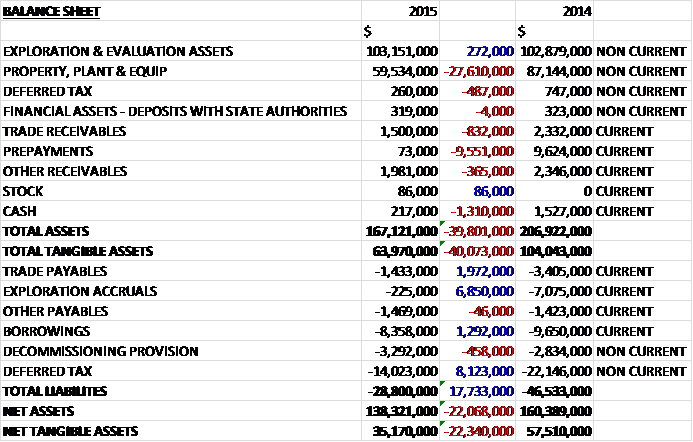
When compared to the end point of last year, total assets declined by $167.1M, mainly as a result of forex differences and driven by a $27.6M decline in property, plant and equipment, a $9.6M fall in prepayments following the end of the Paraguay drilling programme, and a $1.3M decrease in cash. Total liabilities also declined during the year due to an $8.1M fall in deferred tax liabilities, a $6.9M decrease in exploration accruals, a $2M decline in trade payables and a $1.3M fall in borrowings. The end result is a net tangible asset level of $35.2M, a decline of $22.3M year on year.

PPCcash

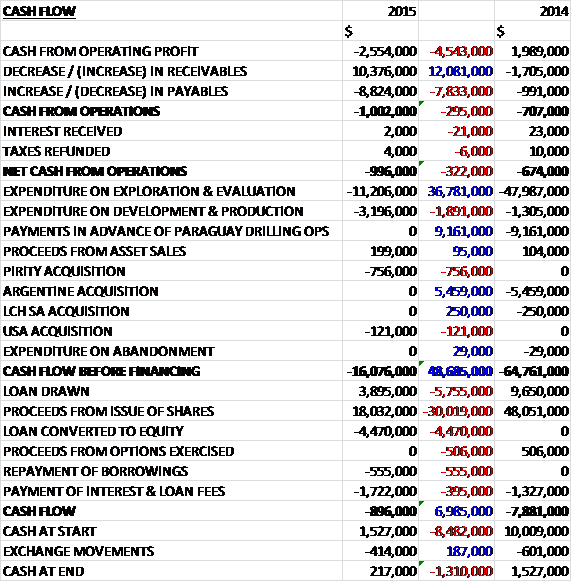
Before movements in working capital, cash losses were $2.6M, a detrimental movement of $5.4M over last year. There was a cash inflow from working capital due to a decline in receivables and the net cash outflow from operations came in at $996K, an increase of $322K year on year. The group spent $11.2M on exploration and evaluation relating to the Pirity drilling and Hernandarias seismic survey, along with $3.2M on development and production relating to workovers in Argentina with a further $756K being spent on the Pirity acquisition to give a cash outflow of $16.1M before financing. The group then received $18M from share placings and after loan fees and interest, along with a portion of the loan being converted into equity meant that there was a cash outflow of $896K for the year and a cash level of just $217K at the year-end.

Overall production at Puesto Guardian in Argentina increased by 23,925bbls to 98,781 due to the consolidation of the remaining 50% not already owned at the concession in July 2014. In the US, oil production at East Lake Verret increased by 9,723bbls to 14,846bbls with natural gas production up 39.8mmcf to 45.6mmcf. Conversely, oil production at East White Lake declined by 19,604bbls to 44,652bbls but natural gas production increased by 14.9mmcf. This production was offset by a 1,967mboe increase in Argentine reserves following the extension of the license term and the latest reserve report, to give a total proved reserves of 11,192.8mboe.

The operating loss in Argentina was $2.1M, an increase of $1.1M year on year on gross production that decreased by about 33boepd to 271boepd with the average in the second half of the year reaching 312bopd due to the subsequent workovers. This increased further to 500bopd after the workovers in March 2016. During the year the group averaged $67 per barrel compared to $76 last year and it now stands even lower, down at $58 per barrel, although the full effect the reduction has been cushioned by the recent depreciation of the Argentine Peso but well operating costs were still high at $64 per boe.

During the year the 2P oil reserves in these fields were assessed to be 18.1mmbls, of which 11mmbls were proven reserves with a 2P NPV10 value of $329M representing an increase of 28% in 2P oil reserves over the prior year. During the year two sets of workovers of old wells were completed and the improvements in the Argentine economy along with the improving international perception of the country to investors gives the board confidence in building on the work carried out this year.

The operating loss in Paraguay was $461K, an increase of $421K when compared to last year. The main work carried out in the year was the 607km of new 2D seismic acquired over the Hernandarias block the results of which identified several drillable Palaeozoic prospects at 2,500m to 3,000m depth (about 1,000m shallower than the two exploration wells drilled in 2014). The first candidate for a well has been determined to be the Boqueron prospect.

In January 2016 the time for fulfilment of the exploration work programme at the Pirity concession was extended to September 2017 with the possibility of a further extension of six months. The Hernandarias concession, in line with legal requirements, was narrowed down to an area of about 7,982 km2 with the balance of 2,455 km2 being hived off into a new Don Quijote contract area for which President is the contracting party. The group has further been awarded a prospection contract for a small 610 km2 area between Hernandarias and Pirity named Pilcomayo.

In April 2016 the term of the Dermattei concession expired with no extension being granted. The group had previously relinquished its right to further farm in to that area and whilst on expiration they hold 10%, they do not consider this to be a material event. It is understood that the operator of that block has made certain claims in the Paraguay courts against the government in relation to the concession but President is not party to any such litigation. The $10.9M spent on the concession has been fully impaired during the year. After the upcoming drilling programme in Argentina gains traction, the group will once again re-focus on exploration activity in Paraguay.

The operating profit in the US was $971K, a decline of $1.6M when compared to 2014 with the average price of oil in Louisiana falling from $43 per boe compared to $85 last year and the production remaining broadly flat at 219boepd. At the time of writing the sales price has fallen further to $40 per barrel but well operating costs remain low, at $15.4 per barrel. This level of production was supported by small accretive acquisitions of production and revenue interest in the operated Simmons well and the processing facility. Natural declines occurred in all wells in the East Lake Verret and East White Lake fields which was in part mitigated by those small acquisitions and the revenue interest in the Eagle Crest well starting in mid-2015.

The profitability in the region was materially impacted by the fall in oil prices. Oil prices remain volatile and the reduced contribution to the group from Louisiana is set to continue as natural field decline rates continue. With increased focus on Argentina, the group is no longer considering Louisiana a core contributing asset in the medium or longer term.

No material events took place in Australia, although the PEL82 license term was extended to March 2017. Whilst this is not a core asset and it has been written off on the books, it may have a potential future value to the company in a recovering market environment.

The litigation claims by the group’s former partners in the Pirity concession in Paraguay were settled and subsequently the group acquired their residual 36% ownership in the concession for $500K and the time for completion of the exploration work on the block was extended.

During the year the group raised $18M in a placing to fund new seismic acquisition in Paraguay, work in Argentina and for other general costs.

At the end of the year, the group had cash balances of just $200K. In addition they had $5.6M in undrawn loan facilities, although it should be noted that because the lender is owned by the executive chairman and CEO, it is likely to remain supportive.

The year has seen the departure of John Hamilton, Ben Wilkinson, Richard Hubbard, David Jenkins, David Wake-Walker and Alistair Burt from the board, and the appointment of Rob Shepherd and Jorge Bongiovanni as non-executive directors and Peter Levine becoming CEO as well as executive Chairman. Whilst this doesn’t seem great on a corporate responsibility point of view, it should help save money.

The Q2 2016 workover campaign raised Puesto Guardian production to an initial level of 500bopd with a further workover programme currently being conducted on another two producing wells. Planning continues for the drilling of three new production wells in the second half of 2016, targeted to materially uplift production with loan funding in principle in place. The emphasis in 2016 will be to increase production, cash generation and margins so the focus is on the new drilling programme in Argentina in H2.

The company is still loss making so an analysis of PE ratios wouldn’t reveal much.
A three well drilling programme is expected to start before the end of July. The programme is currently planned to be completed with the wells being brought on stream in stages throughout H2 2016. The results will then be analysed with a view to considering a further drilling programme in 2017. The wells will be side tracks from existing shut in wells with horizontal producing sections, will comprise one well each from the Dos Puntitos, Pozo Escondido and Puesto Guardian fields, and will target both proven and provable oil reserves. Planning is advanced and discussions with contractors ongoing with long lead tie items in the process of being ordered. There is an agreement in principle with the lender to provide the entire financial support for the programme by way of an unsecured senior debt facility.

Overall then, this has been a very difficult year for the group as the oil price continued to tumble. They were loss making and losses increased year on year. Net assets declined and the operating cash outflow deteriorated further with cash levels of just $217K at the year-end. The Argentinian business was loss-making as high production costs mitigated the $67 per barrel the group is receiving for their oil. With average production of 312bopod in the second half, production has now increased further to 500bopd since the year-end so at some point hopefully the business will break-even, although I am not sure where that point is. The uptick in reserves is very pleasing, however.

Progress in Paraguay was slow and it seems as though the Demattei costs have been wasted. The US is still profitable due to the low cost of production, with production levels remaining flat. In the short term, however, the investment case here is based on Argentina. Production is definitely being increased here so it really depends on how profitable that is. Another point to note is the cash levels. These were very low at the year-end and the group is having to spend more money on new wells. The financing is being provided by the Chairman and CEO but at what cost us currently unclear.

On the 28th June the group released an operating and funding update. In Argentina the drilling rig is currently being readied and will then be mobilised on sire with drilling of the first well planned to start at the end of July. The first well will be at Dos Puntitas with a 500m horizontal section and the subsequent two wells will be at Pozo Escondido Este and Puesto Guardian. It is estimated that each well will take about one month to drill and complete with the first two wells being drilled back to back and the third to be drilled in the autumn after the rig is used by a neighbouring operator.

To finance the drilling programme, the group have entered into revised funding arrangements with the Chairman’s investment group. This will be an increased facility of $20M comprising an additional $5M to the company’s existing loan facility of $10M and a $1M extension to the existing convertible loan of $4M.

Interest on the enlarged convertible loan will accrue but will not be payable until June 2017. In addition, a 3% net profit interest based on profits over the life of the three new wells will be payable! Ouch, that is a bit of a kicker!

On the 11th July the group announced that Chairman Peter Levine purchased 503,750 shares at a value of £37.6K and then on the 18th he purchased a further 150,000 shares at a value of £11.8K. He now owns 122,488,336 shares in the company equal to about 23% of the total share capital.

On the 26th July it was announced that Chairman Peter Levine purchased another 300,000 shares at a value of £28.5K and now owns 122,788,336 shares in the company.

On the 8th August the group released a drilling update. Drilling of the DP1002 S/T development well at Dos Puntitas in Puesto Guardian has now commenced with the estimate drilling time considered to be about one month.

The group also announced that drilling of the A55 S/T well at the 22% owned East White Lake field in Louisiana has taken place. Results of the logs and side well cores show good quality sand with aggregate net oil pay in excess of forty feet with one sections being 28 feet of Y2 sand at a depth of between 9,360 and 9,390 feet with 25% porosity. The well is now being completed as a producer and is expected to be online in September. The well will make a positive contribution to the group’s net production in the region. They expect initial production to be in line with similar wells which have had initial gross flow rates of at least 250bopd.

On the 2nd September the group released an operational update. In Argentina, drilling operations are ongoing, albeit with certain delays. Five days were lost due to electro-mechanical issues relating to the drilling rig. This is substantially at zero cost to the group and after the issues were resolved, the rig has delivered drilling rates of penetration ahead of expectations.

The well reached 3,475m before a material metal failure in a drill pipe of the drilling contractor caused loss of the bottom hole assembly, for which the group has in place insurance cover. A cement plug is now being set and the well will continue to be drilled out from 2,920m. Up to the date of the failure the well was being drilled on plan with oil based mud and with no material surprises in the geological formations encountered.

The side track out from 2,920m will be drilled to the casing point at the start of the Yacoraite section being at 3,850m. On casing, the horizontal leg will be drilled, the well tested and then hooked up with full production targeted for the first half of October. The base case initial projected production for this well is 500bopd, which would double the existing production levels at the concession.

Current daily production in Puesto Guardian is now at 510bopd having had an average of 440bopd in July. A workover of four old shut in wells will start in September and are designed to achieve a helpful increment to overall production as well as to expand the group’s inventory of producing wells to give a more stabilised field production rate.

Having suffered from well declines and shut-ins in the year to date, Louisiana production is projected to be back in the region of 200 to 250boepd by the end of September as a result of two wells coming on stream. The business continues to generate free operating cash flow despite the prevailing low oil price.

Harvey Nash Share Blog – Final Results Year Ended 2016

Harvey Nash has now released its final results for the year ended 2016.

HVNincome

Revenues declined when compared to last year as a £4.1M growth in UK & Ireland revenue, a £6.9M increase in USA revenue and a £4.6M growth in Asia Pacific revenue was more than offset by a £10.3M decline in French and Benelux revenue and a £7.5M fall in Central European revenue. Staff costs increased by £3.6M but other cost of sales decreased by £10.5M to give a gross profit some £5.4M above that of 2015. Depreciation was up £251K and there was a £128K increase in forex losses with a £4.6M growth in other underlying admin costs. A £228K expense related to the settlement of deferred consideration was offset by the non-recurrence of a £500K Norwegian restructuring cost and £200K of acquisition costs that occurred last time which meant that the operating profit increased by £866K. The interest was up £295K but tax was down £71K so that the profit from continuing operations came in at £6.8M, a growth of £642K year on year. After losses on disposals are taken into account, however, the loss from the year was £7.6M, a detrimental movement of £12.9M when compared to 2015.

HVNassets

When compared to the end point of last year, total assets increased by £8.5M driven by a £26.3M growth in trade receivables, mainly due to the timing of invoicing in the Netherlands, a £1.8M new loan receivable and a £1M increase in goodwill, partially offset by an £18M decline in prepayments and accrued income and a £1.7M fall in capitalised development costs. Total liabilities also increased during the year as a £7.3M increase in “other payables”, mainly relating to payment obligations incurred with the NT disposal; a £6.9M growth in accruals and deferred income; a £4M increase in other tax and social security payables; a £2.7M growth in trade payables and a £1.5M increase in invoice discounting facilities, partially offset by a £2M reduction in deferred consideration and a £1.1M fall in current tax liabilities. The end result was a net tangible asset level of £3.4M, a decline of £9.8M year on year.

HVNcash

Before movements in working capital, cash profits increased by £635K to £10.8M. There was a large working capital cash inflow, mainly due to an increase in payables and after interest and tax payments both increased, the net cash from operations came in at £12.2M, an increase of £5.4M year on year. The group spent £2M on fixed tangible assets, £2.1M on software costs, £2.1M on deferred consideration and £2.7M on getting rid of a subsidiary to give a free cash flow of £3.3M. This just about covered the dividends, and after an £898K reduction in borrowings, the cash flow for the year was £241K to give a cash level of £18.5M at the year-end.

Overall these results were in line with expectations. The operating profit in the UK and Ireland was £3.5M, a growth of just £66K year on year. During the first half of the year the UK contingent recruitment business saw strong growth and experienced robust demand, especially for permanent hires. During the final two months, however, client decision making processes slowed and a swing from permanent recruitment to contract reflected a more cautious approach. Trading conditions in the market for executive and leadership roles tightened up considerably compared to the prior year, impacted by the UK election in May and global uncertainty in relation to China and energy markets in the second half the year. The offshore business appeared to benefit from these variable conditions, however, and reported a record year in the UK.

Overall the division had a solid performance as the business capitalised on market share gains and continued to invest in capacity expansion. The sluggish performance was due to the swing from permanent to temporary recruitment in the UK in Q4, a weaker market for senior executive search and a decline in contribution from Ireland. Offsetting this was strong growth from the UK regions and Scotland driven by organic investment in headcount and newly established offices in Glasgow and Bristol. New client wins and increased market share resulted in a 17% increase in gross profit for the year. London was weaker with exposure to the oil and gas slowdown affecting numbers of contractors. The decline in the energy market also impacted executive recruitment and the group decided to close their oil and gas business.

The operating profit in the Mainland Europe division was £5.2M, a reduction of £400K year on year, although on a constant currency basis there would have been an increase of £100K. The operating profit in Benelux and France was £3.8M, a decline of £542K when compared to last year. Results from the Benelux was solid with a 3.1% increase in gross profit on a constant currency basis. In the Netherlands, uncertainty over new legislation in relation to temporary recruitment impacted demand and resulted in delays in clients hiring. In Belgium, the group made further progress with its relatively new location in Ghent with a good contribution for the year and the new service of providing teams of permanently employed technical apprentices reported an increase in gross margin of 10%. The acquisition in Antwerp delivered excellent results throughout its three year earn-out period.

The operating profit in the Nordic business was £409K, an increase of £58K when compared to 2015. The business in Sweden reported strong results with overall gross profit up 7% despite challenging trading conditions. The reported results were materially impacted by weak currencies, recession in Finland and uncertainty linked to the decline of the oil price in Norway. The business in Finland saw NFI down 14% although the office was broadly breakeven. The Norwegian business remained loss making but the performance improved year on year.

The operating profit in Central Europe was £963K, an increase of £40K year on year. Germany saw gross profits up 6% but in Switzerland results were down 9% mainly due to the decline of managed services revenues in the financial services sector. Whilst Poland Technology recruitment reported a slightly higher loss than the prior year, this was mainly due to restructuring and the business will serve as a near shore recruitment centre for the Swiss business with the benefits of lower costs and higher productivity.

The operating profit in the US was £1.4M, a growth of £521K when compared to last year following the investment in fee-earning staff in the prior year. The US economy was once again the strongest market across the group. All services grew strongly with demand for enterprise recruitment the strongest with gross profit up 79% at constant currency. Executive search also reported a record year with NFI up 19% to $3M. Permanent IT recruitment was also strong with gross profit up 17% in a buoyant market for technology specialists. The swing from temp to permanent affected contractor numbers but higher margins resulted in an overall increase in gross profit. Offshore solutions also posted good growth of 11% in gross profit.

The operating profit in the Asia Pacific business was £131K compared to a loss of £304K in 2015. There was particularly strong growth in the second half of the year with the business benefiting from demand in offshore services in the US and UK. Executive search fees grew 72% in Hong Kong and Japan and the new office in Singapore resulting in a profit being recorded before the Singapore investment. Professional recruitment fees in Vietnam were up 41% and delivered good business contribution growth. Gross profit from offshore services grew 48% as results from the Japanese market improved. Whilst Australia remained challenging throughout the year, revenues were up 5% and the loss reduced when compared to 2015.

If we discount the discontinued operations, there was not much in the way of non-recurring items with £200K relating to the excess consideration payable over the previously recognised deferred consideration on the Talent IT acquisition being the only item of note. In discontinued items, there was a huge £13.6M cost of disposal for the NT Group and £200K relating to the closure costs for the oil and gas division.

In December the group sold the German telecoms outsourcing business Nash Technologies to a management buy-out. The initial consideration is just €28K with possible further earn-out consideration dependent on the performance of the business from 2016 to 2020 with a maximum cap of €9M and a fair value of zero. The group also provided a loan to NT of £1.8M for product investment, although so far nothing has been drawn down. The business made a loss of £420K in the year and the loss on disposal was a massive £13.6M, further split into £11M of disposal related costs relating to £6.8M of loans written off and £4.2M of payments accrued in respect of the agreement to indemnify the buyer in relation to certain liabilities of the NT group.

There was also a ridiculous £2.6M on advisory and deal related costs. The business had negligible net assets but there was £6.8M of balances with other group companies that were waived on disposal which makes up part of these costs. As if this wasn’t enough the group capitalised £2.1M of software development this year, all of which was given away with the NT disposal! This disposal seems to have been a bit of a disaster to me, although I don’t really understand exactly what has happened.

Also during the year a decision was made to close the oil and gas business which focused on recruiting international engineering and technology candidates for mainly Middle East based companies in the energy sector. There were no assets or liabilities attributed to the business and it made a small loss during the year.

Going forward, the UK experienced a slowdown in permanent recruitment in the final two months of the year as uncertainty surrounding the Brexit vote affected clients’ decision making processes, which is likely to continue until the referendum on Europe concludes. In the current year, uncertainty in Asia as a result of economic challenges in China continues but trading in Europe has been broadly on track. Visibility is undoubtedly limited whilst global economic and UK political volatility persists but the group’s performance so far this year is in line with expectations.

At the year-end the group had net cash of £200K compared to £2.1M at the end of last year. At the current share price the shares are trading on a PE ratio of just 7.5, although this is expected to remain flat on next year’s consensus forecast. After an 8.7% increase in the final dividend, the shares are yielding 5.5% which increases to 5.7% on next year’s forecast.
On the 29th April the group announced that it had granted share options over nearly 1.2M shares. These reward require the company’s compound annual growth in adjusted EPS to be at least 15% in the three years to 2019 in order to vest in full.

Overall then, this has been a bit of a mixed year for the group. There were large losses but if we discount the loss on the disposal, underlying profits increased. Net assets were down and the balance sheet isn’t looking that great but the operating cash flow improved, albeit helped by a growth in payables which doesn’t bode that well for next year. Nevertheless, a decent amount of free cash flow was generated which just about covered the dividends.

Operationally, the UK and Ireland was flat as growth in market share was offset by declines in senior exec search, oil and gas markets and a poor performance in Ireland. Worryingly the division was weaker in the final two months of the year. European profits declined, but this was as a result of detrimental forex movements and underlying profits increased modestly. Over the region we saw a decent performance in Germany and Sweden offset by difficulties in Switzerland, the Netherlands due to uncertainty surrounding new employment legislation, and Finland due to a recession there. The performance in the US was good, reflecting a strong market, and there was also a strong performance in the Asia Pacific regions with growth in all areas.

I am very uncomfortable about the NT disposal, as this seems to have been a very bad deal for the group – they must have been desperate to get rid of it. Also, the start of this year looks a bit uncertain with Brexit uncertainty in the UK and Chinese problems affecting some Asian markets. Nevertheless, the year has started in line with expectations and it would seem that a forward PE of 7.5 and dividend yield of 5.7% take these risks into account.

On the 30th June the group announced that they had traded in line with board expectations in the first four months of the year under challenging conditions, achieving a 4% increase in gross profit on a constant currency basis (8% on actual terms). While mindful of economic uncertainty following the EU referendum and an associated lack of visibility, the board believe that the group, due to their high proportion of non-sterling earnings, are well placed to deliver further resilient performances through uncertain times.

Within that 4% growth, the US was up 17%, Mainland Europe increased by 4%, Asia Pacific was up 1% and the UK and Ireland were flat. Also, temporary and offshore saw an 8% increase whilst permanent recruitment saw a 2% fall.

Air Partner Share Blog – Final Results Year Ended 2016

Following acquisitions in the year the group has four operating segments: Commercial Jet Broking, Private Jet Broking, Freight and Baines Simmons. Cabot Aviation services results are aggregated into Commercial Jet Broking. Air Partner has now released its final results for the year ended 2016.

AIRincome

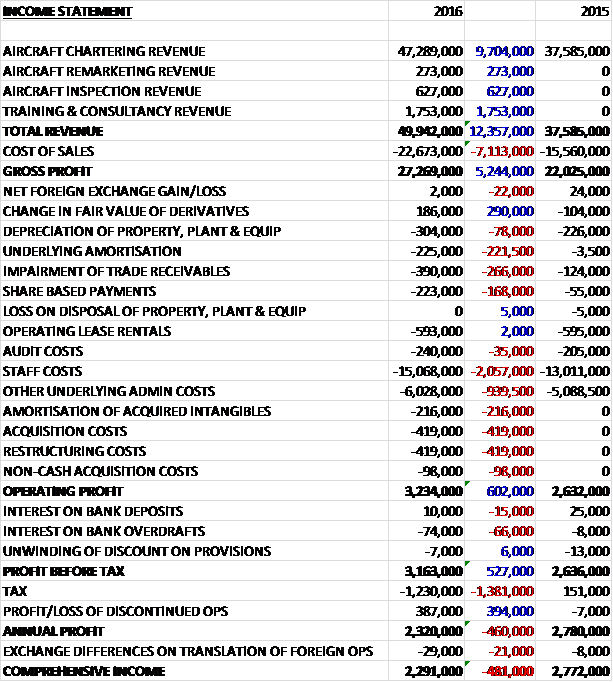
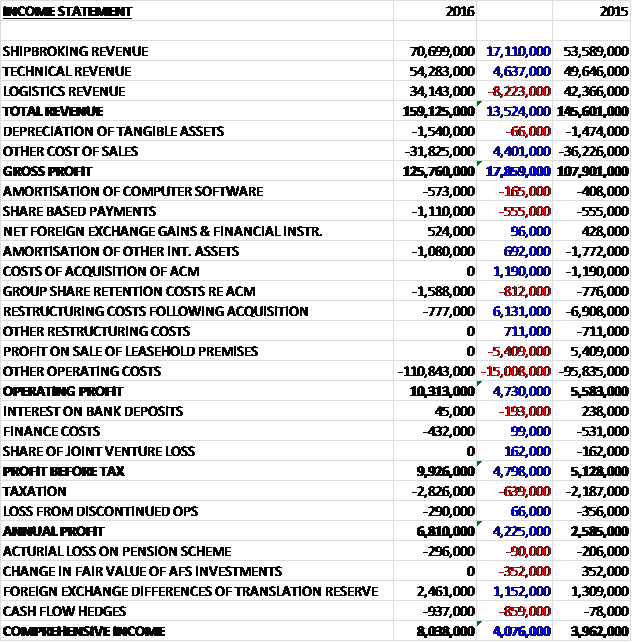
Revenues increased when compared to last year with a £9.7M growth in aircraft chartering revenue and a £1.8M increase in training and consultancy revenue. Cost of sales also increased to give a gross profit £5.2M above that of 2015. The group benefited from a change in the fair value of derivatives but this was offset by a £222K growth in underlying amortisation, a £266K increase in the impairment of trade receivables, a £168K growth in share based payments, a £2.1M increase in other staff costs and a £938K increase in other underlying admin costs. We also see some non-underlying admin costs such as £517K of acquisition costs, £419K of restructuring costs, and £216K of amortisation of acquired intangibles to give an operating profit £602K above last year. There was a modest increase in finance costs but tax costs grew by £1.4M due to last year’s US tax credit not being repeated which meant the profit for the year came in at £2.3M, a decline of £460K year on year. The profit from discontinued operations relates to the release of a provision for claims by former employees which have lapsed.

AIRassets

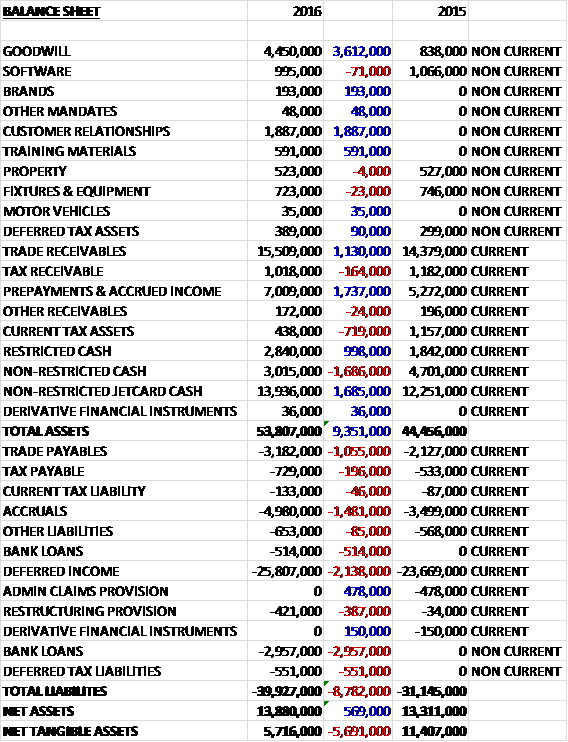
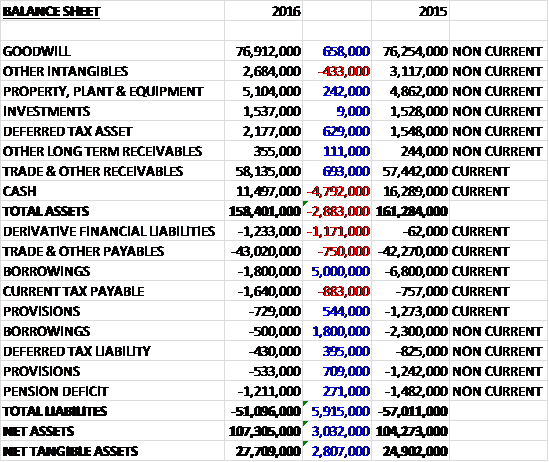
When compared to the end point of last year, total assets increased by £9.4M driven by a £3.6M increase in goodwill, a £1.7M growth in prepayments and accrued income, a £1.9M increase in customer relationships and a £2.7M increase in jetcard cash, partially offset by a £1.7M decline in other cash and a £719K fall in current tax assets. Total liabilities also increased during the year due to a £3.5M growth in bank loans, a £2.1M increase in deferred income, a £1.5M growth in accruals and a £1.1M increase in trade payables. The end result is a net tangible asset level of £5.7M, a decline of £5.7M year on year.

AIRcash

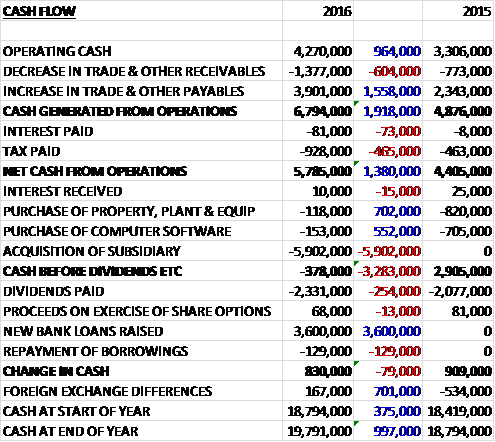
Before movements in working capital, cash profits increased by £964K to £4.3M. There was a cash inflow from working capital due to an increase in payables and after tax and interest both grew, the net cash from operations was £5.8M, a growth of £1.4M year on year. The group spent all of this on the acquisitions so with negligible capex elsewhere, there was a cash outflow of £378K before financing. The group then raised £3.6M from a new loan which paid for the £2.3M in dividends which gave a cash flow for the year of £830K and a cash level of £19.8M at the year-end.

The underlying operating profit in the Commercial Jet Broking business was £3M, a growth of £259K year on year driven by strong trading in the UK and Europe which benefited from a larger tour operating programme compared to the prior year. During the period the group was a beneficiary of a guarantee from one of its Tour Operating clients in Southern Europe and in the latter part of the year, following late payment from the client, they claimed against the guarantee. The claim was disputed by the guarantor and is now subject to court action which led to a £400K provision in H2.

Within the UK commercial jet team the group focused on developing a clearer sales strategy, invested in new staff and focused on improving the service levels they provide. There was a strong contribution in the oil and gas and sports sectors along with continued government work. Trading in Europe benefited from a larger tour operating programme as well as a strong performance in Germany. Austria delivered a stable performance while results in Italy were down year on year due to government related work in the previous year not being repeated. Despite some new customer gains, the performance in the US was below management expectations due to a lower number of one-off charters as well as less activity than expected from a key customer.

Cabot Aviation results are included in this division with their main business being acting as an agent and broker to airlines and other aircraft owners such as banks, operating lessors, manufacturers and insolvency practitioners, to dispose of their surplus aircraft. The business also advises clients on the acquisition of aircraft and their fleet management process. The integration has gone well and the group have extended their remarketing product range to include private jets. They have also placed their wet lease operations within the remit of the Cabot management team. In the second half of the year the business was appointed as exclusive marketing agent by China Airlines for two B747s and by Kenya Airways for four B777s, two of which have been delivered at the start of the coming year.

The underlying operating profit in the Private Jet Broking division was £2.4M, an increase of £1.6M when compared to last year, aided by prior year profits being impacted by increased investments into Jet Card. The increasing profitability was largely driven by a very strong performance in the UK, a solid performance in Europe, but somewhat offset by a weaker performance in the US. The ad hoc broking performance has been mixed. While the performance in the UK was strong, the US and European businesses have experienced a decline in profit which is being addressed this year.

Jet Card cash deposits at the year-end stood at £16.8M, up on the prior year balance of £14.1M and the number of Jet Cards stood at 209, an increase of 12 year on year. Jet Card profit is not recognised until the client has flown hours and the focus has been to increase the number of cards and to improve the frequency of use which is reflected in the utilisation rate which has increased by 33%.

The underlying operating profit in the Freight Broking business was £767K, a growth of £399K when compared to 2015. The business has continued their work with government aid agencies to assist in a number of geopolitical crises and in addition, strong growth has been seen in the German and US businesses. They have benefited from their focus on developing stronger relationships and a good reputation with freight forwarders. In addition, their Red Track technology has contributed to the success of their aircraft on ground business.

The underlying operating loss in the Baines Simmons business was £99K which represents a maiden contribution which reflected the disruption caused by the sale processed and the costs associated with the change of ownership. Good integration progress has been made across central functions and an interim MD has been appointed to drive integration with the group with the business being restructured into training, consulting and outsourcing. They have implemented a new leadership and executive team and begun the roll out of the Customer First programme. Since the end of the year, the business has been awarded a ten year contract to provide aviation support services to the Isle of Man Aircraft Registry.

During the year the group embarked on their “Customer First” programme to improve their customer service proposition. Certain components of customer’s interaction with the group were identified that could be improved. Phase one of the programme was completed with the roll out of across the entire booking and Customer First principles were applied to the acquired businesses.

In May the group acquired Cabot Aviation Services, a global aircraft remarketing broker which adds significant aircraft sales and dry lease expertise to the group. In August they acquired Baines Simmons, an aviation safety consultant which will enable the group to extend their service and product capabilities with offerings complementary to their existing broking business. The total consideration for Cabot was £814K, consisting of £514K of cash and £300K of equity which generated goodwill of £787K. The total consideration for Baines Simmons was £5.7M, satisfied entirely in cash and generating £2.8M of goodwill. Cabot contributed a loss of £95K and Baines Simmons a loss of £74K but had they both been contributing for the full year, they would have generated a loss of £15K and a profit of £117K respectively.

At the start of May, Amanda Wills and Shaun Smith joined as non-executive directors. Amanda was previously CEO of Virgin Holidays whilst Shaun was finance director at Aga Rangemaster and is currently finance director at Norcros. At the AGM, non-executive director Andrew Wood stepped down from the board after five years in the role.

Trading in the current financial year is encouraging and given the full year contribution expected from the two acquisitions, the board enter the year with a degree of optimism. Operational challenges remain, however, particularly the performance in the US and the sluggishness of Private Jets in Europe with improvements needed in those areas. In addition, ad hoc charters are likely to continue to be impacted by economic instability in the major world markets for the foreseeable future.

At the current share price the shares are trading on an underlying PE ratio of 13.7 which reduces to 10.4 on next year’s consensus forecast. After a 10% increase in the final dividend, the shares are yielding 6% which increases to 6.2% on next year’s forecast with the board stating that it is looking to build a dividend cover to between 1.5 and 2 times underlying EPS. Not including the Jetcard cash, the net debt position is £500K compared to a net cash position of £4.7M at the end point of last year.

Overall then this has been a decent year for the group. Profits did decline but this was entirely due to the non-recurrence of last year’s tax credit and pre-tax profits rose. Net tangible assets declined but operating cash flow improved, although after acquisitions there was no free cash flow. All parts of the business saw operating profits improve with a notable performance from the Private Jets broking division. Overall the performance in the UK and Germany was good whilst it was more disappointing in the US and Italy.

The acquisitions are yet to really contribute to the business but they seem sensible enough. So far this year, the market seems to be rather difficult but the board remain confident and with a forward PE of 10.4 and dividend yield of 6.2% these shares continue to look good value and I remain a holder.

On the 25th August the group released an update covering the first six months of the year. Trading has been strong and as a result, underlying pre-tax profit is expected to be at least £3M compared to £2.2M in the first half of last year, with a strong net cash position. The broking division has seen a strong like for like performance and the trading & consultancy division has started the year well, winning a number of new commercial and government contracts.

The board remains optimistic about their prospects for the remainder of the year. This all seems positive for me, I have bought back in here.

E2V Share Blog – Final Results Year Ended 2016

E2V has now released its final results for the year ended 2016.

E2vincome16

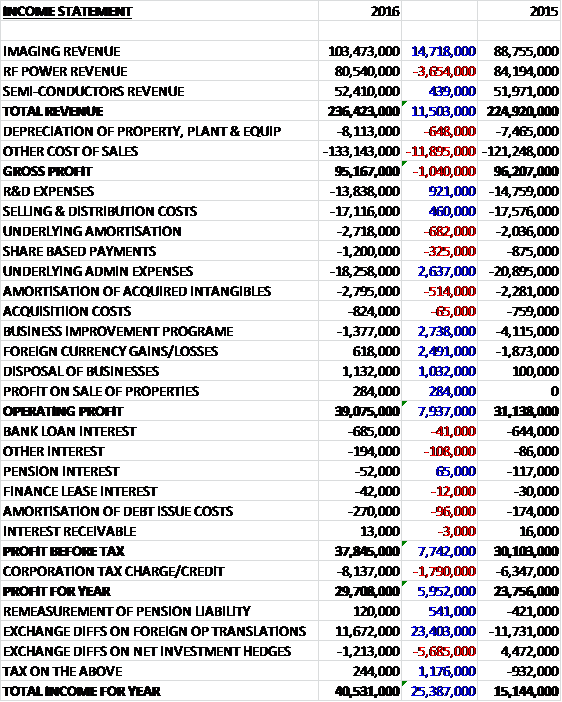
Revenues increased when compared to last year as a £3.7M decline in RF Power revenue was more than offset by a £14.7M growth in imaging revenue with semi-conductor revenue remaining broadly flat. By geographical spread, revenue was up in Asia Pacific and steady in North America and Europe. Cost of sales grew at a faster rate, however, due to a £5.5M swing to forex losses on the retranslation of working capital and realised losses on forex contracts (although this was offset by a 2.4% increase in revenues through beneficial forex movements), so gross profit fell by £1M. R&D expenses fell by £921K and selling & distribution costs reduced by £460K but underlying amortisation grew by £682K and share based payments increased by £325K, offset by a £2.6M decline in other underlying admin expenses.

Overall, non-underlying costs were much more favourable than last year as a £514K growth in the amortisation of acquired intangibles was more than offset by a £2.7M decline in restructuring costs and a £2.5M positive swing in forex relating to the hedging instruments. The group also benefited from a £1.1M gain from the disposal of the thermal imaging business and a £284K profit from the sale of properties to give an operating profit some £7.9M above that of last year. Interest costs increased modestly and there was also a £1.8M growth in tax charges relating to deferred tax gains last year following the government’s announcement of a reduction in corporate tax rates, which meant the profit for the year came in at £29.7M, a growth of £6M year on year.

E2Vassets16

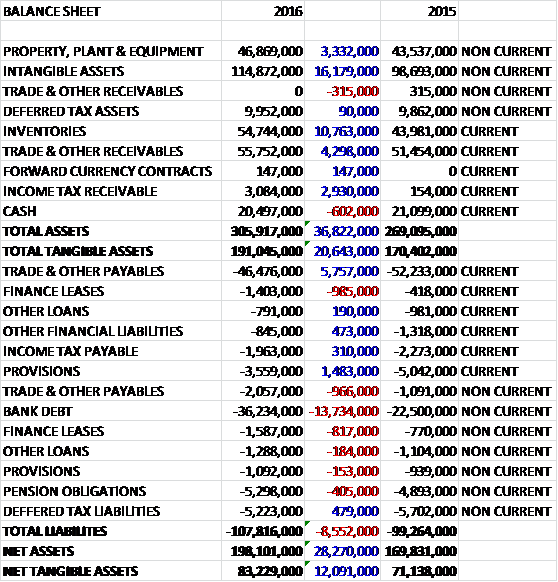
Total assets increased by £36.8M when compared to the end point of last year, driven by a £16.2M growth in intangible assets, a £10.8M increase in inventories, a £4.3M growth in receivables, a £2.9M increase in income tax receivable and a £3.3M growth in property, plant and equipment. Total liabilities also increased during the year as a £13.7M growth in bank debt as partially offset by a £4.8M decrease in payables and a £1.3M fall in provisions. The end result is a net tangible asset level of £83.2M, an increase of £12.1M year on year.

E2Vcash16

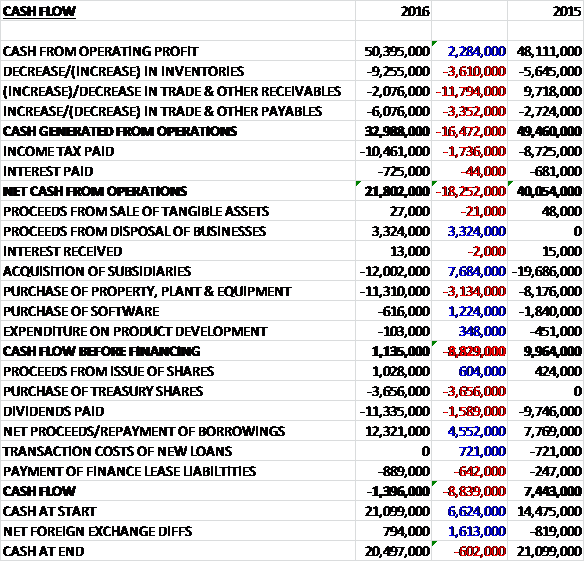
Before movements in working capital, cash profits increased by £2.3M to £50.4M. There was a large outflow of cash through working capital, however, in particular a decrease in payables and a growth in inventories which meant that after tax payments also grew by £1.7M, the net cash from operations came in at £21.8M, a decline of £18.3M year on year. The group spent £11.3M on property, plant and equipment along with £616K on software and after the thermal imaging business sale is taken into consideration, they spent a net £8.7M on acquisitions with left them with just £1.1M before financing. This didn’t even cover the £3.7M spent on shares for the director awards let alone the £11.3M of dividends so the group took out new loans of £12.3M to give a cash outflow of £1.4M and a cash level of £20.5M at the year-end.

The adjusted operating profit in the Imaging division was £15.7M, a growth of £6.4M year on year on revenues that increased by 17%, although when the contribution from the acquired business and the favourable forex movement is excluded, like for like revenues were up 12%. Underlying growth came from strong demand in automatic data collection, machine vision sensors and optical inspection CMOS cameras. Life sciences delivered modest growth reflecting stronger end user demand. In Space, revenue growth came through delivery on programmes, although these programmes remain technically challenging and the group is continuing to commit the resources needed to improve delivery to their customers (read: probably not profitable contracts then).

The overall profit growth reflects the contribution from the revenue growth with professional imaging delivering improving margins and in space margin improvement reflects the benefit of improving operational performance. R&D activities have been increased to drive future growth, focusing on areas of strong customer demand such as industrial automation and space. The business has widened its scope of services with the integration of AnaFocus that provides customer specific CMOS sensors for a wide range of applications, although the thermal imaging was sold during the year.

In Space, the group have established a new management team under a new divisional president and they have seen the start of some operational improvement and better delivery to customers. The recovery programme being addressed by the management team is complex, however, and will take some time. The board are pleased with the pace of progress though as a year ago they had ten larger problem contracts and in the year fur of these have been delivered and their financial position improved with a further five due for delivery in the coming year.

At the year-end, the order book stood at £93M compared to £90M at the end point of last year and the orders for delivery over the next year are £60M compared to £70M, reflecting delivery on space programmes and the shorter order cycle nature of the professional imaging business. The focus for the coming year in professional imaging is to make new markets and take market share whilst in space the focus is on embedding the operational changes and deliver ongoing margin improvement.

The adjusted operating profit in the RF Power business was £17.8M, a decline of £670K when compared to last year on revenues that fell by £3.7M. This decline came about as a modest growth in radiotherapy reflecting increased demand from key OEM customers along with growth in commercial and industrial markets was more than offset by weakness in defence with slower than anticipate programme wins and a pause in industrial processing systems.

The decline in profit reflected a modest improvement in the margin to 23.2% due to cost control and the alignment of the cost base in defence to the expected activity level. R&D activities continue to be focused primarily on radiotherapy applications. The board continues to expect that spares revenue will grow in line with the past expansion of the installed base which should account for about two thirds of growth with the rest expected from continued new build demand. In defence, the key driver of growth is the level of NATO defence spending. Defence budgets across the NATO countries are currently constrained and the board do not expect this to change in the short term despite global and regional threats.

The majority of the growth in the division is anticipated to come from radiotherapy where the group continue to prioritise their investment. Their other applications continue to be driven by the general industrial cycle and as discussed, defence will remain subdued reflecting defence budgets. During the year the group made progress on their site restructuring programme and it is anticipated that it will be completed over the next two years. They have also established separate units for the Lincoln-based defence activities.

The adjusted operating profit in the Semi-conductors division was £14.2M, an increase of £3.9M when compared to 2015 on revenues that were broadly flat when the £600K contribution from the acquired SP Devices business is excluded. US legacy product lines saw revenue increase from flow down on programmes, along with good growth coming from their own design high speed data converters for space applications. This was offset by lower demand for microprocessors. In other applications there was the anticipated decline in the legacy ASIC business as those products approach the end of their life cycle.

The profit growth represents a significant improvement in the margin due to an improved product mix, good cost control and an improved operational performance. The board see continued ongoing market growth for high reliability products in civil aviation production rates which have seen high single figure growth rates. Their own designed space qualified data converters are winning market share as they enable their customers to reduce the size and weight of their satellites and at the same time increase the number of communication channels. The steady demand for products that are provided primarily into defence applications is driven by the flow down of funds into the large defence OEMs.

The SP Devices business provides sub-system solutions for analogue to digital conversion applications. These are used by customers including leading OEMs across a number of sectors including industrial test and measurement, healthcare, communications and science. It also brings proven patented technology in software and board level sub-systems and services.

The order book at the year-end was £20M, flat year on year with orders for the next twelve months down £3M to £15M reflecting the anticipated decline in the legacy ASICs business and some delays to anticipated orders in Q4. The focus for the coming year is on delivering growth from the product line acquisitions and announced microprocessor last time buys. They will continue to invest in cards, subsystems and their own IP development moving up the value chain.

The customer service seems to be improving at the group with their customers providing improved scores in their most recent customer survey. Although, as part of the recent focus on customers and to improve responsiveness, the group have increased their inventory levels which has contributed to the cash outflow seen in working capital. It is worth noting that in the second half of the year the group cut capex to the same level as depreciation to try and offset the working capital cash outflow. In the coming year, however, it is expected that capex spending will be some £14M higher than depreciation as the Chelmsford reorganisation continues.

Towards the end of January the group acquired Signal Processing Devices Sweden, a company specialising in the design and development of analogue to digital processing technology. The business brings proven patented technology in software which complements E2V’s existing broadband data converter business. It is reporting in the semiconductors business segment. The group paid a total consideration of £12.6M consisting of £9.8M in cash and £2.8M in contingent consideration with a total goodwill of £10.2M being generated on the transaction. In the two and a bit months since acquisition, the business contributed operating profit of £92K and had the acquisition taken place at the start of the year, it would have contributed £300K.

As can be seen there were a number of non-underlying costs. The group completed the acquisition of SP Devices in January which incurred transaction costs of £232K. There were also exchange losses of £199K relating to the outstanding contingent consideration for both SP Devices and last year’s acquisition, Anafocus. In addition there were costs of £393Km relating to payments from the acquisition dependent upon future employment.

During the year the group repositioned its regional teams in the US and Asia so that they are aligned with the group divisions, and they have also reorganised RF’s defence business into three distinct units. Costs of £1.2M have been recorded principally relating to staff costs and including £214K to establish a new facility in Lincoln for the microwave business unit. The reorganisation of the Chelmsford facility continued in the year with costs of £441Km incurred in the period.

Last year group have also announced that they will cease manufacturing in China in the first half of the coming year and they also started a consultation process regarding the planned closure of the sales office in Bievres in France. As these programmes progressed during this year, a credit of £269K was recorded due to an onerous lease provision that is no longer required.

In October the group sold its thermal imaging business. The net proceeds on the transaction were £2.9M and a gain on the sale of £1.1M was recorded. The £284K recorded for the property sale relates to the 2010 disposal of a former Lincoln site whereby further payment was received depending on the square footage of the new properties built on the site.

The prevalent exchange rates at the end of the year would give rise to a 7% revenue tailwind going forward and the net benefit on adjusted operating profit is estimated at 4%, although exchange rates do of course remain volatile as always.

Going forward, whilst the board remain cautious about the broader economic environment, their outlook for 2017 remains unchanged with a similar first half/second half weighting to that seen in 2016. The group closed the year, as expected, with a 12 month order book of £130M, a decrease of 11% when compared to the end point of the prior year. This reflects the changing composition of the group’s revenues with growth coming from shorter order cover businesses, delivery on programmes in space and the cycle of the radiotherapy business along with the anticipated decline in RF Defence.

The goal remains to double the adjusted operating profit in the five years from 2015. This seems dangerous to me as some of the sluggish markets the group is involved in means that this will have to come from acquisitions with the associated increase in gearing or shareholder dilution.

At the year-end the group had a net debt position of £20.8M compared to £4.7M at the end point of last year. At the current share price the shares are trading on a PE ratio of 14.4 which falls to a decent looking 12.8 on next year’s consensus forecast. After a 5.9% increase in the total dividend the shares are yielding 2.8% which increases to 3% on next year’s forecast.

Overall then, this has been a fairly solid year for the group. Profits were up and net assets increased along with cash profits. Due to a large build-up of working capital, the operating cash flow declined, however, and the group did not manage to produce much free cash, certainly not enough to cover the dividends. The imaging business performed well, driven by growth in automatic data collection, machine vision sensors and CMOS cameras. The Semi-conductors business also saw an increase in profits but this was due to an improved product mix and cost cutting rather than top line growth.

The RF Power business fared less well, however, with the poor performance driven by reduced demand from the defence sector. It is worth noting that capex is going to increase in the coming year and the closing order book has deteriorated, although this is put down to an increase in business with shorter order cover. With a forward PE pf 12.8 and dividend yield of 3%, the shares are probably priced about right.

On the 7th June the group announced that director Stephen Blair purchased 10,000 shares at a value of about £20.5K. This transaction gives him 129,338 shares in total so a good sign despite not being a massive purchase.

On the 13th July the group released an update covering Q1. Activity in what is typically a quiet period was muted but they expect to deliver a strong improvement in Q2, supported by order intake secure during June. Cash collection has been in line and they have targeted inventory reductions to improve on the planned year-end net debt reduction. The outlook for the current year, subject to the broader economic environment remains unchanged with 60% of revenues to be made in the second half.

Professional imaging is seeing demand continuing to grow for industrial automation, particularly in Asia. Order intake across its activities increased in June for delivery in Q2and there is a good pipeline of opportunities which support the anticipated revenue profile for the rest of the year. Space Imaging has good order cover in the short term and the board are confident of securing the follow-on production orders where they are designed into major programmes. This underpins a significant step-up in revenue anticipated in H2 and builds the order book cover for the next year. Space Imaging is along cycle business and continues to experience challenges on its technologically demanding programmes.

RF Power is seeing improving demand in radiotherapy and continues to deliver to its OEM customers under the existing contracts, which are expected to be renewed before the year-end. In commercial and industrial, they expect demand to remain steady. The defence business has the opportunity pipeline to support its anticipated revenue profile but there have been some recent delays in programme awards. In Semiconductors, the group achieved strong order intake in June for the component portfolio and this supports the Q2 revenue delivery. The anticipated revenue profile is expected to be supported by their partnership with Peregrine Semiconductors, product line acquisitions made in the prior year, NXP last time buy and SP Devices.

Cash generation in the quarter reflected the expected collection of year-end receivables and net borrowings decreased by £11.2M to £9.9M. It is expected that net borrowings at the half year to be broadly in line with the position at the prior year-end, however.

They have increased their focus on working capital management. They have reduced manufacturing cycle time in space imaging and they have made good progress with their reorganisation of the Chelmsford site. When completed within the next two years, it will provide further reductions in manufacturing cycle time and associated working capital. Semiconductors has implemented an inventory reduction plan, which is expected to deliver a reduction in inventory by the end of the year and represents most of the incremental inventory improvement of £5M to enhance the planned year-end net debt reduction. Over the next two years the board see the opportunity for further reduction in working capital by £10M coming from delivery of a more even revenue profile and further shortening of manufacturing cycle time.

A 1c strengthening in the US dollar relative to Sterling is expected to increase revenues by about £1M with a 40% drop through to operating profit so the group should be benefiting from the recent forex movements.

The group have also announced that Finance Director Charles Hindson will not stand for re-election at the next AGM after being in the role for the past seven years.

Overall then, this is a decent update. The slow-down in Q1 is concerning, however, and I am a bit nervous when companies have to increase their performance in the rest of the year to hit targets – although the increased orders suggest this is possible for E2V. The recent weakness in Sterling is also a positive for the group but there just seems to be a bit of uncertainty at the moment and I think a clearer picture of group performance should have emerged by the interim results stage so I’m holding back for now.

Aureus Mining Share Blog – Q1 Results Year Ending 2016

Aureus Mining has now released its Q1 results for the year ending 2016.

AUEQ1income

Now that New Liberty has entered commercial production, the group has earned $8.3M in revenues with mine operating costs coming in at $7.7M. With a $2.6M impairment of ore stockpiles and $1.9M of depreciation, however, the group incurred its maiden gross loss of $2.9M. Legal and professional expenses increased by $132K but there was a $292K positive forex movement when compared to Q1 last year and after other expenses fell by $96K the operating loss grew by $2.6M. There was a $495K reduction in the warrant derivative loss but interest expense was up $867K to give a loss for the period of $5.6M, an increase of $2.9M year on year.

AUEQ1assets

When compared to the end point of last year, total assets declined by $115K driven by a $4.2M decline in cash and a $2.9M decrease in the value of ore stockpiles due to a $2.6M impairment, partially offset by a $2.5M increase in the value of mining and development property, a $2.1M growth in the value of gold inventories as a result of restrictions in moving gold through Brussels airport, a $1M increase in Liberian evaluation costs, an $858K increase in consumables and a $576K growth in receivables mainly relating to prepaid insurance costs. Total liabilities increased during the quarter due to a $2.2M increase in bank loans, a $538K increase in warrant derivative liabilities and a $1.5M growth in payables. The end result is a net tangible asset level of $105.5M, a decline of $6M over the quarter.

AUEQ1cash

Before movements in working capital, cash profits came in at $535K, an improvement of $1.8M when compared to Q1 2015. There was a large increase in payables, however, and even after finance charges there was a net operating cash flow of $4.1M, a positive movement of $8.1M year on year. The group spent $469K of this on intangible assets and $22.8M on property, plant and equipment and after $14.8M of proceeds from pre-production gold sales, there was a cash outflow of $4.2M in the period and a cash level at the period-end of $2.9M.

During the quarter, the group mined 264KT of ore at a grade of 3.32g/t. Of this, the group milled 252,578 tonnes of ore at a grade of 3g/t which produced 22,706 ounces of old. They sold 19,249 ounces and the average realised price was $1,198 per ounce. Since the mine entered commercial production in March, the all in sustaining cash cost was $1,153 per ounce due to the low mining rates so there is still much work to do. Gold sales were impacted in March by restrictions on transporting gold through Brussels airport following the terrorist attacks with the gold stockpiled being shipped through a different route in April.

Excavation work continued to focus on the flood bund along the south of the final pit limit to prepare for the rainy season with an additional 456,648 tonnes of material moved during the quarter. Mining operations were focused upon both the Kinjor and Larjor starter pits and opening access to fresh rock before the onset of the wet season in late Q2.

Mining during the period was hampered by low excavator availability due to undercarriage problems with both of the excavators. Replacement undercarriages for these units were sourced and shipped to the mine in March. To improve production levels at the mine five new 100 tonne capacity haul trucks and one excavator were delivered in April and mobilised ready to start mining operations in May.

During the period, process plant optimisation activities continued with a particular focus on improving recoveries from the gravity circuit and in delivering operational improvements in CIL leach kinetics. Additionally, preventative maintenance activities were undertaken around the process plant with a view to improve plant availability. These activities resulted in more stable operating conditions being experienced in the process plant towards the end of the quarter.

As part of these optimisation activities, a fresh carbon supply was introduced into the Carbon in Leach tanks of the process plant. This resulted in an increase in overall gold recovery to levels in line with overall plant operating specs of about 90% recovery.

During the quarter exploration work focused on the near mine potential around the New Liberty mine with pitting and regolith mapping around the western portion of the Bea Mountain license. This work aimed to test for concealed mineralisation along major and secondary structures close to the New Liberty plant. Much of the soil sampling around the mine has been found to be in residual or depositional regimes and therefore pitting is needed to reach the saprolite sections. Pitting has been undertaken in order to check underneath these regimes and sample representative saprolite. The focus of this work is along major and secondary structures identified by geophysics.

The results from some of the pits along major structures have shown that there are some indicators of gold mineralisation which soil sampling did not detect. Further pitting is ongoing to follow this gold anomalism and define targets for further work. Other areas of structural and regolith interest have been selected for geological mapping in Q2.

At Ndablama, throughout the quarter pitting on additional soil anomalism was undertaken to the south and to the west in order to gain a better understanding of the geology of the area and testing additional areas of mineralisation which have not been previously identified. At Weaju, in Q1 mapping along the SW of the project shows the potential to increase the strike of mineralisation for another 800m to the SW. Further mapping and sampling will be done going forward to better define the surface expression of mineralisation.

At Leopard Rock, pitting has been undertaken to test the surface continuation of mineralisation following on from detailed mapping of the Ndablama project the results of which will enable further follow up work in Q2. Detailed mapping of the 8km extent of the Yambesei shear zone was completed during Q4. Pitting along the entire length of the Yambesei shear was started in Q1 and has been completed over Gondoja, Musa and Gbalidee. Further pitting will be undertaken in Q2 focusing on Welinkua and Koinja.

At Silver Hills, work focused on the Belgium target during Q1 with pitting and mapping having increased the strike extent of mineralisation to 1km. This mineralisation which is highlighted by a NE trending shear has the potential to extend over 3km up to the Bruges target located in the NE. Detailed soil sampling and pitting was undertaken during the quarter connecting Belgium target to Antwerp. Channel samples highlighted the potential for high grade zones, associated with intense silicification and shearing. Further pitting, mapping and soil work is ongoing at this target to further trace the mineralisation along strike.

At the Matambo Corridor, during the quarter geological mapping started in the eastern part of the 15km gold corridor. It covered the area around the Bomafa prospect and resulted in locating a main band of greenstone which underlies the soil anomalism with lithosamples confirming the trace mineralisation at surface. Mapping will continue during Q2 with the aim to cover the remaining part of the corridor towards Bangoma and Saanor.

The latest Ebola flare-up occurred in Guinea in March and resulted in a high risk contact travelling to Liberia resulting in three confirmed cases. On 29th April, Liberia began a 42 day period of increased surveillance and following this period if there are no new cases the country will once again be declared Ebola-free.

As previously announced, the process plant detoxification circuit has now been operating to original design specs resulting in higher concentrations of cyanide WAD in the process effluent. The group had therefore been operating with process water in a closed circuit.
Recent heavy rainfall resulted in a small overflow of effluent from the Tailings Storage Facility onto the wetlands area. The group is conducting remediation work to rectify the issues in the detoxification circuit and to manage future water discharge from the TSF in order for processing operations to restart in the near future. The investigations to date indicate that there has been no adverse impact on any human settlement but further investigations are in progress and in view of this leakage, a decision was taken to suspend processing operations on May 7th.

The group is working with the appropriate authorities and local communities in order to mitigate against any environmental related risks. The EPA is in the process of reviewing and approving the proposed remediation work required to rectify the detoxification circuit and to manage future water discharge from the TSF. Approval from the EPA and MLME is required before gold processing operations cam restart and the company is working to develop a start-up plan to recommence processing as soon as possible.

During this temporary suspension of processing operations the group is taking the opportunity to effect a mill reline, undertake other preventative engineering maintenance and repairs as well as modifications to the detox circuit proposed by the expert consultants. Furthermore mining operations are continuing at New Liberty in order to build up ore stockpiles and undertake waste stripping.

In January the company completed the acquisition of Sarama Investments which holds the Cape Mount licenses for a total consideration of 5,648,310 Aureus shares. The acquired licenses are contiguous to the company’s Bea Mountain license and are located close to the New Liberty mine. As a result of the acquisition, the group’s total land portfolio in Liberia has increased to 1,683km2 from 1,402km2.

The company has net current liabilities of $25.3M and has about $19M of debt repayments due over the next year. Based on discussions with the lenders to date, there is a reasonable expectation that they will be able to agree a debt repayment schedule but there is material uncertainty which may cast significant doubt about their ability to continue as a going concern. The loan facilities are fully drawn and the senior facility’s first repayment of $3.1M was originally supposed to be in January. This has so far been deferred to the end of this month but I would have thought it would have to be deferred again. The company currently has $5.5M of cash and is monitoring its working capital position closely.

On the 23rd May the group released an update. They have made good progress towards its objective of achieving a controlled start-up of the gold processing plant within the next two weeks subject to final approval of the MLME. The EPA has granted permission to proceed with the construction of holding zones within the wetlands area downstream of the tailings storage facility which will enable better aeration of surface waters and improved retention times. They have engaged technical experts to assist with various modifications within the process plant and detoxification circuit to ensure that discharges into the TSF comply with environmental and operational permits.

A number of technical studies by international consultants are underway, to review the company’s environmental and social actions plans and ensure compliance with the IFC’s performance standards. Ore stockpiles currently stand at about 73,431 tonnes at a grade of 3.78g/t. Total production for the year to date is 30,000 ounces.

Overall then this was another difficult period for the group although in some ways some progress has been made. They are still loss making and net assets fell over the quarter but there was a cash profit made and the delay in making payments to suppliers meant that there was actually a decent amount of free cash produced. Unfortunately it is not enough to keep the lenders at bay and the most recent repayment deadline is looming.

There were further operational problems during the period with issues associated with the excavators and after the end of the quarter, the released of cyanide into the local environment has caused processing operations to be suspended for much of May. With the debt repayment looming, this is very poor timing and this company seems far too risky to invest in at the moment.

On the 1st June the group announced that it had received approval from its lender group to further defer its first debt repayment to the end of June. The company continues to progress towards its objective of achieving a controlled start-up of the gold processing plant with plant modifications and remediation measures to optimise the detoxification circuit meeting completion. The board expects to receive approval to recommence processing operations in the coming days but for now they are still on stand-still and I can’t see any other outcome other than a large placing to clear the debt here.

On the 9th June the group gave an update regarding production. The EPA has granted the company permission to discharge from its Tailings Storage Facility and issued a permit for future discharges in compliance with the International Cyanide Management Code limits. A detailed start-up plan has been submitted to the ministry for formal approval and modifications to the gold processing plant and detoxification circuit are nearing completion.

The re-start of gold processing operations is currently targeted for mid-June following the completion of gravity circuit screen replacement works and a full mill reline. Mining operations have continued with a current run of mine ore stockpile balance of about 105,694 tonnes at a grade of 4.02g/t.

Prior to the re-start of processing operations, the group intends to complete a full reline of the ball mill which was previously scheduled to be undertaken at the end of June. This reline involves the mill being fitted with more heavy duty liners than originally supplied and improved lifters and grates.

The detailed start-up plan submitted includes a gradual ramp up in operations with waste and low grade ore towards name plate capacity at ROM grade ore, and including scheduled periods of plant downtime to allow for performance testing and additional modifications to be made within the process plant. It is anticipated that this controlled start up process will be started with the support of staff from the MMSA.

Investigations to date have shown that cyanide discharge exceeding ICMC compliance guidelines and the environmental laws of Liberia have been recorded on the TSF and downstream from the TSF periodically since mid-December. These exceedances can be attributed to operational issues at the plant, including complications with the oxygen plant, the detoxification circuit and on site lab resulting in a lack of stable operating conditions.

On the 15th June the group announced that it had entered into an agreement for an equity financing with MNG Gold. The $30M equity investment at 3.21p per share represents a premium of 22% to the closing price of the previous day. MNG will become a 55% shareholder in the group and will appoint three representatives to the board. Serhan Umurhan will be appointed CEO and Geoff Eyre as CFO.

MNG Gold has assets in Turkey, Burkina Faso and Liberia and is owned by Mehmet Gunal. Funds raised will be used to reduce outstanding creditor balances, increase working capital and facilitate the ramp up of the processing plant. The group has also received credit approval from its lender group for a four month default waiver during which time they will work to reschedule the debt repayment profile.

The financing will be completed as a private placement with two tranches. The first will be 59,533,674 shares and a promissory note of $12.3M to MNG. Tranche 2 will be 331,111,209 shares at a price of 3.21p for aggregate gross proceeds of $15M. The promissory note will be unsecured and will bear interest at 12% per annum. The principle amount will be converted into shares at 3.21p per share and will automatically convert into shares with the closing of tranche 2 of the offering as long as the required PIFs are cleared by the TSX. Should they be rejected, the promissory note will be payable six months from the date of issue.

Current CEO and CFO David Reading and Paul Thomson will resign, although Paul will continue for another year in a consultancy role. With the price now at 3.87p, I am very surprised it has held up so well.

On the 23rd June the group announced that it has received approval for the plant start up process. They also stated that they now have adequate funding available to support working capital needs and preparations are underway for the commencement of the plant pre-start procedure which will be initiated following the arrival of a consignment of additional reagents that they are working to expedite to the site.

On the 15th July the group announced that it had closed tranche 2 of the equity financing with MNG Gold pursuant to which the company has issued 331,111,209 new shares at a price of 3.21p per share to MNG, raising proceeds of $15M. The promissory note in the principal amount of $12.3M automatically converted into 271,577,546 shares so an aggregate of 662,222,429 shares have been issued.

Braemar Shipping Share Blog – Final Results Year Ended 2016

Braemar Shipping has now released its final results for the year ended 2016.

BMSincome

Revenues increased when compared to last year as an £8.2M decline in logistics revenue due to a fall in freight forwarding was more than offset by a £17.1M growth in shipbroking revenue and a £4.6M increase in technical revenue. Cost of sales declined year on year which gave a gross profit £17.9M above that of last year. Share based payments increased by £555K but this was offset by a fall in amortisation. Other underlying operating costs increased by £15M, however. We then see a reduction in non-underlying costs as the lack of the £5.4M profit on last year’s building sale and an £812K increase in share retention costs relating to the ACM acquisition was more than offset by a £6.1M reduction in other acquisition costs and the lack of £711K of restructuring costs that occurred last year to give an operating profit £4.7M ahead. There was a small increase in finance costs and after the lack of losses from discontinued operations was more than offset by increased tax charges the profit for the year came in at £6.8M, a growth of £4.2M year on year.

BMSassets

When compared to the end point of last year, total assets declined by £2.9M driven by a £4.8M fall in cash levels and a £433K decrease in other intangible assets, partially offset by a £693K growth in receivables, a £658K increase in goodwill and a £629K growth in deferred tax assets. Total liabilities also decreased during the year as a £1.2M increase in derivative financial liabilities, an £883K growth in current tax payables and a £750K increase in payables were more than offset by a £6.8M fall in borrowings and a £1.3M decline in provisions. The end result was a net tangible asset level of £27.7M, an increase of £2.8M year on year.

BMScash

Before movements in working capital, cash profits increased by £4.7M to £14M. There was a small cash outflow from working capital, although this was lower than last year and after less tax was paid out too, the net cash from operations came in at £10.4M, a growth of £7M year on year. The group spent just £2.1M on capex to give a decent free cash flow of £8.2M. This only just covered the £7.6M spent on dividends, however, so the £6.8M repayment of borrowings meant that there was a cash outflow of £6.3M for the year to give a cash level of £11.5M at the year-end. I think I would have preferred to see a dividend reduction or holiday whilst the group acquitted ACM as pretty much all of the cash is going out in dividends.

The underlying operating profit in the shipbroking division was £9.7M, a growth of £4.1M year on year reflecting the ACM shipbroking merger. The tanker teams delivered a strong performance driven by increased oil production which stimulated demand for tankers and served to increase freight rates to levels not experienced since 2008.

Crude oil trade surged during the year as refineries increased activity to meet demand for transport fuels and petrochemical feedstock. This increased consumption of oil and the demand for seaborne crude particularly stimulated the VLCC market. The global rise in supply of oil led to increased competition for tonnage which was further enhanced as Far Eastern countries diversified their crude intake from the Middle East to include the Atlantic Basin producers, thus increasing tonne miles and keeping freight rates strong. The rise in supply also allowed contangos to develop which created an incentive for oil traders to store oil, increasing the levels of land-based storage and leading to some discharge delays and a reduction in available tonnage.

Despite China’s economic slowdown, it continued to fill its strategic petroleum reserves. The market also benefited from relatively low growth in the global tanker fleet with a small number of new ships coming into the market. Ship owners also chose to defer demolition of other vessels to capitalise on the strong freight rates, however. The strong spot market had a positive effect on the long term period charter market and the freight futures market and the group’s teams were able to help clients in managing their exposure to volatile freight markets.

The fall in oil prices also boosted clean product demand globally, particularly in developing countries that lacked the refining infrastructure to meet their own product needs. Having started 2014 significantly underutilised, the world’s refineries were able to meet this new demand and this rising demand was supported by rising average voyage duration.

The market in the coming year looks to remain uncertain. Low crude oil prices and longer voyage distances are expected to continue which may drive further growth in demand, but this could be offset by the effect of the delivery of new ships and an unexpected low level of demolition. With the lifting of sanctions against Iran, more Iranian crude oil volumes are expected but the effect on the market is unclear and may be offset by the utilisation or Iranian-owned crude tankers in the international market.

Specialised Tankers performed well and delivered growth. The LNG and LPG markets have experienced overall fleet growth during recent year, with investment in VLGCs leading expansion. This growth in fleet sixe has generated an oversupply of freight against a lack of world-wide demand which has resulted in low rates in the spot market and a diminishing need for time charters.

This year was a tough one for the offshore business with exploration activity significantly curtailed as major oil companies sought cost reductions. Reduced exploration activity led to decreased demand for vessels while supply increased as time charter contracts came to an end resulting in a reduction in spot rates. It is likely that these market conditions will continue until there is a period of higher and more stable oil prices stimulating new exploration activity. Against this challenging backdrop, the offshore team has still managed to deliver a profitable performance.

Despite increased transaction volumes, the year was one of the poorest dry bulk freight markets on record due to the oversupply of tonnage combined with weaker commodity demand. This was largely driven by the slowdown in the growth rate in China where iron ore and coal demand remains a significant influence on the Capesize market and cape rates reached lows not experienced since the mid-1980s.

Going into the coming year, the projected volume of new ships coming on to the market is expected to put further pressure on the current imbalance between oversupply of tonnage and dry bulk demand. The full unwind of excess supply is likely to take some time and an increase in layup and demolition for the older vessels will be needed to correct the imbalance. In recent weeks freight rates have recovered somewhat, as measured by the increase in the Baltic Dry Index from its historic low in February, and the group are seeing increasing interest in investment in the sector. Nonetheless, market weakness presents opportunities to build the group’s business and they are selectively hiring experienced brokers to build their global reach in the Dry Bulk sector.

The Sales and Purchase team achieved a strong performance with second hand activity in the dry cargo market particularly strong. This was predominantly driven by the oversupply of tonnage and pressure on ship owners to sell. The opposite was true in the tanker market, however, as higher charter rates limited owners desire to sell vessels. The board expect that increased regulation will lead to more investment in fleet renewal and an acceleration of demolition of certain ships which will be replaced with new designs. The timing of this activity is currently uncertain, however.

The underlying operating profit in the Technical business was £5.2M, a decline of £1.1M when compared to last year reflecting margin pressure and lower activity in the offshore market. Revenues in the division actually increased mainly as a result of strong growth in Braemar Engineering.

At Braemer Offshore the fall in the oil price resulted in markedly lower exploration and construction activities in the offshore energy sector as oil companies seek to reduce their own costs. A number of forecast large projects have either been shelved or delayed and many existing projects have been scaled down. Despite the challenging market environment, the business performed relatively well due to a proactive approach to retain existing business and by expanding its service offering.

Braemar Engineering continued to benefit from its market leading position in the LNG sector and reported a strong result in the year based on both marine and shore-based LNG consulting for long term investment programmes. The team in the UK progressed with a major three year project for the design, site supervision and crew training for six LNG carrier newbuildings. The project has now delivered five of the six vessels with the final vessel due for completion in mid-2016. The office in Houston has also seen solid growth from its involvement in a significant project aimed at supplying LNG to vessels for use as a bunker fuel. At the end of 2015, they announced their exclusive involvement in the development of a new cost-effective technology for the containment of LNG.

Braemar Adjusting was also affected by reduced activity in the oil and gas sector. Output from the four US shale basins declined with construction projects and major field development being postponed or experiencing significant regulatory delay. The active worldwide drilling fleet also reduced significantly during the last year, impacting all oil and gas service industries.
Over the last few years, however, management took several strategic decisions which have helped build and shelter the business. These were to establish a strong presence in the Middle East, expand North American operations and to diversify the business to include refining, petrochemical, power and mining as well as upstream oil and gas. The business continues to recruit and develop staff and focus on growing its market share through the current market cycle to position the business for the future.

Braemar incorporating the Salvage Association performed well in the year against a backdrop of fewer casualty claims. Although the number of surveys undertaken was lower than the previous year and increase in the number of consultancy assignments, project cargo surveys and complex Hull and Machinery cases contributed to a higher level of revenue. This increase reflects the group’s desire to expand the business into new areas of marine consultancy. There was an improvement in the Middle East and Americas offset by lower level activity in SE Asia where trading conditions are challenging.

Despite the challenges faced in most marine and offshore sectors, Braemar Howells operated at a similar activity level to the prior year and achieved a higher operating profit due to cost savings flowing from a restructuring at the end of the previous year. The results benefited from a flowing from a number of projects including a project to handle bitumen and the removal of the wreck of a vessel of the Pembrokeshire coast.

The underlying operating profit in the Logistics business was £1.6M, a fall of £698K when compared to 2015 largely due to the set-up costs of their new office in Houston and the lead tome to the start of new contracts. The profitability of the freight forwarding and bespoke projects departments was also affected by delays to specific infrastructure projects in the UK.

Cory Brothers had a challenging year reflecting the tough ship agency and logistics markets. Their strategy has been to focus on higher value work together with geographic expansion into European and US markets. In the Port Agency division, the global hub business continued to grow through their customer base. The underlying UK port agency market has been difficult, but their market share has increased and ship numbers have been maintained. Markets continue to be challenging but there are signs of improvement in 2016. The group are seeking to build their UK market share in the coming year as well as continuing to growth the global hub business and their presence in North America.

Cory logistics revenue fell during the year due to delays in major infrastructure project cargoes and the impact of lower activity in the oil and gas markets. They were able to sustain their position in key business areas through growth in new services as well as the existing contract business. This was achieved despite a market backdrop of volatile freight rates. The introduction of new logistics teams in Houston, Atlanta and Singapore have provided new opportunities of growth.

The US dollar exchange rate relative to Sterling moved by 10% in the year. A significant proportion of the group’s revenue is earned in US dollars and the movement of the exchange rate has had a positive impact on earnings. The group has mitigated the full impact of this movement, however.

The group has new financing arrangements of up to £30M with HSBC to provide flexibility for future acquisitions so I would have thought something has already been identified.
The total shipbroking forward order book was about $49M, of which $26M relates to the coming year. The board anticipate that the group’s markets will continue to experience volatility and uncertainty and their expectations for the coming year is for a broadly similar activity level overall.

At the current share price the shares trade on a hefty PE ratio of 21.3 which reduces to 13 on next year’s consensus forecast. After the dividend remained the same, the shares are yielding 5.8% which remains the same for next year too. At the year end the group had a net cash position of £9.2M compared to £7.2M at the end of last year.

Overall then this has been a mixed year for the group. Profit was up, although I suspect this was mainly due to the contribution from ACM. Net assets increased and operating cash flow also grew, with a decent amount of free cash being generated. Unfortunately this only just covered the dividends and I think progress has been hampered here somewhat by the high level of pay outs. The shipbroking business performed well as lower offshore and dry bulk activity was more than offset by growth in tankers due to the increase in demand for oil. The Technical business saw profits decline due to lower offshore and adjusting activity following the slow-down of the oil and gas market.

The logistics division performed poorly, being affected by lower oil price, a decrease in freight forwarding, not helped by the delay in some UK infrastructure projects and the cost of the new Houston office. Going forward, the logistics division is expected to show some improvement but I am not sure about the technical division as the large LNG tanker project is coming to an end, and who knows what’s ahead for shipbroking. Overall, the board expect the next year to be broadly in line with this one and with net cash on the books, a forward PE of 13 and yield of 5.8% these shares are probably fairly valued.

On the 30th June the group released a trading update and as anticipated, market conditions have continued to be challenging. The board do not believe that demand for their services will be materially impacted by the Brexit vote and the associated market volatility but there may be second order economic effects that are difficult to foresee at this time. At present, they do not believe that the referendum result will affect their long term strategy.

Trading for Q1 in the shipbroking division followed the wider market patterns. The tanker markets have continued to experience high trading volumes as a result of increased worldwide oil production and refining activity but as expected, tanker freight rates have been lower. The sale and purchase desk remains good, with similar levels of activity to the prior year. The dry cargo market continues to suffer from a surplus of tonnage and a slow-down in demand and while the volume or transactions remains good, the rates remain low. The offshore desk remains weak due to low activity levels in the sector. The board expect the difficulties in these markets to take some time to correct and they will continue to ensure that they are appropriately structured to respond to these market conditions.

The performance of the technical division was behind the first quarter of last year. In particular, Braemar Offshore and Braemar Engineering are suffering the consequence of project delays and reduced activity which are currently impacting most service providers to the energy sector. The ship agency business started the year well as a result of new client business and an active tanker market. Although this was partially offset by a slower freight forwarding result, overall divisional performance is in line with board expectations.

Overall the short term outlook remains difficult and it looks as though the group is looking for another acquisition as its underlying business doesn’t seem to be growing at the moment – I remain uninvested but interested!

On the 30th August the group released a trading update. In shipbroking, over the summer tanker markets have seen both lower activity levels and freight rates which is resulting in reduced revenues. While the group expected the tanker market to soften after the high levels experienced last year, there has been a market slowdown. In the dry cargo markets, despite healthy demand and good transaction volumes, overcapacity continues to suppress freight rates. Accordingly the group have put in place a programme to reduce their costs in this area and ensure they are appropriately structured.

The sale and purchase and offshore desks continue to perform in line with expectations, with similar levels of activity to the prior year. In addition, the US dollar earnings will benefit from the weakness of sterling if the exchange rate is sustained at current levels; but the full beneficial impact will be felt in the next year due to the rolling hedging policy.

In the Technical division, to respond to the tough market conditions, the group have already made a number of senior management changes in the Braemar Technical business. The new leadership team have implemented a restructuring programme to reduce costs, create regional hubs with responsibility for division-wide service delivery, and improve the utilisation of the professional staff. This has particularly been focused on engineering services and Asia-related businesses which are most exposed to reduced industry activity. The logistics division is performing well and in line with board expectations.

While results for the current year will be materially lower than 2016, the structural management changes and cost reduction measures put in place will result in an improvement to business performance. Overall though, things seem to be tough here and I am not rushing to buy back in.

Zytronic Share Blog – Interim Results Year Ending 2016

Zytronic has now released its interim results for the year ending 2016.

ZYTinterimincome

Revenues declined by £136K when compared to the first half of last year but cost of sales also fell and the gross profit was £187K above that of last time. Distribution costs increased by £83K and depreciation was up £43K but these increases were partially offset by a £53K fall in share based payments. We then see a £148K increase in the loss from forex movements offset by a £150K decrease in other admin costs to give an operating profit £130K above that of the first half of 2015. Tax expenses fell slightly and the profit for the six month period came in at £1.5M, a growth of £149K year on year.

ZYTinterimassets

Total assets increased by £977K when compared to the end point of last year, driven by a £924K growth in cash and a £307K increase in receivables, partially offset by a £260K decrease in property, plant and equipment. Total liabilities also increased during the period as a £407K growth in payables and a £381K increase in other financial liabilities were partially offset by a £188K decline in accruals. The end result was a net tangible asset level of £19.5M, a growth of £285K over the half year period.

ZYTinterimcash

Before movements in working capital, cash profits increased by £249K to £2.7M. There was a broadly neutral working capital position but tax payments increased by £145K to give a net cash from operations of £2.5M, a decline of £42K year on year. The group spent £176K on property, plant and equipment along with £232K on intangible assets so there was a free cash flow of £2.1M. Of this, £1.4M was spent on dividends which meant that there was a cash flow of £924K for the half year and a cash level of £10.8M at the period-end.

Whilst revenues were slightly lower, this was to some extent expected and consistent with the strategy of moving away from the traditional glass displays and growing the touch product business as sales of touch products increased by £400K to £8.3M and sales of glass displays and filter products reduced by £500K to £1.6M with ATM display filters falling by £600K. The group has continued to see growth and opportunities in areas that require larger size touch sensors in particular demand for large format curved products developed for the gaming industry.

By market, there were lower volume requirements from China based OEM sites for financial products. In gaming, there was a continuation of the strong H2 2015 demand which was considerably above that in the first half; in the vending market the forecasted reduced demand from Coca Cola, fuel payment system project end of life in H1 last year and lower fuel vending demand from Korea gave rise lower sales; and in industrial markets sales reduced due to lower oil and gas demand for HM1 panels.

The second half of the year has so far experienced a similar trend with touch product revenues continuing to increase relative to the traditional products, and the consequent improved margins from this change in mix and the move towards the more niche larger touch sensors. The board expect to continue to make progress in the coming year.

After a 10% increase in the interim dividend the shares are yielding 3.2% which increases to 3.4% on the full year forecast. At the current share price the company is trading on a forward PE ratio of 15. At the period-end, the group has a net cash position of £9.5M, an increase of £1M over the past six months.

Overall then, this was a solid if rather uninspiring update from the group. Profit was up but this was due to an improvement in the product mix and revenues declined, net assets increased but the operating cash flow declined due to an increase in tax payments. Cash profits did improve, however, and some decent free cash was generated.

There has been an increase in touch products for the gaming industry at the expense of ATM filters, Korean fuel vending products, an expected reduction in demand for vending products from Coca Cola and a reduction in industrial products due to the collapse in the oil and gas industry. The outlook statement seems a little subdued but there is a decent 3.4% forward yield on offer here and the forward PE ratio of 15 doesn’t seem too bad when the large net cash position is taken into account.

In conclusion, I think the price is about right so I continue to hold but my convictions is not quite as strong as it was.

On the 17th October the group released a trading update for the full year. The second half of the year has shown a continuing trend to that reported in the first half, with touch products increasing relative to both traditional products and year on year. Pre-tax profit for the full year will reflect the impact of a £900K provision arising from the forex policy but the underlying profit is expected to be significantly ahead of last year and at least in line with market expectations.