

Bonmarche has now released their final results for the year ended 2017.
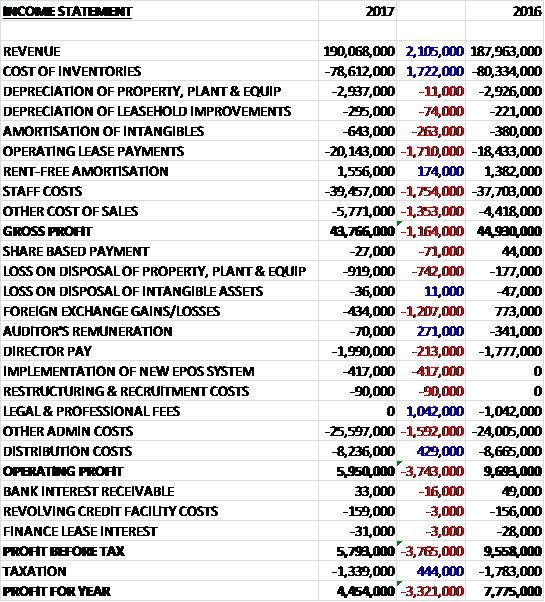
Revenues grew by £2.1M when compared to last year and cost of inventories declined by £1.7M. Amortisation increased by £263K, however, and operating lease payments grew by £1.7M, staff costs were up £1.8M, and other cost of sales grew by £1.4M to give a gross profit £1.2M below last year. The loss on disposal of property, plant and equipment increased by £742K, there was a £1.2M negative swing to forex losses, and £417K was spent on the implementation of the new EPOS system. There were no legal and professional fees, which accounted for £1M last year but other admin costs were up £1.6M, mainly due to the national TV advertising campaign. Distribution costs then declined by £429K to give an operating profit £3.7M below last year. Finance costs were only slightly up and tax charges decline by £444K which meant that the profit for the year came in at £4.5M, a decline of £3.3M year on year.
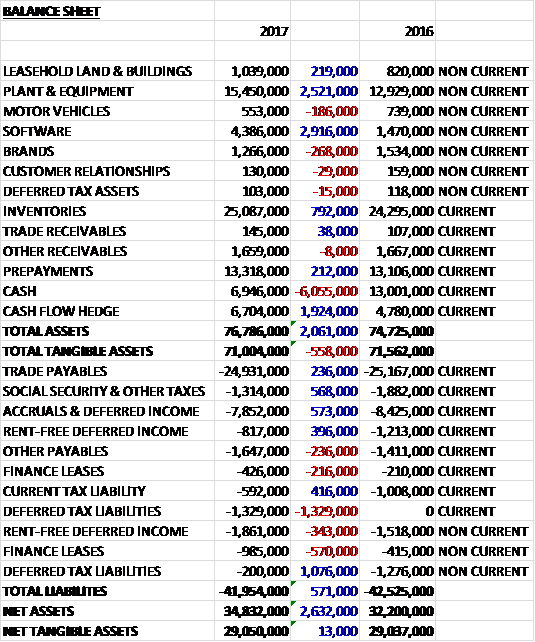
When compared to the end point of last year, total assets increased by £2.1M driven by a £2.9M growth in the value of software, a £2.5M increase in plant and equipment, a £1.9M growth in the value of the cash flow hedge and a £792K growth in inventories, partially offset by a £6.1M decrease in cash. Total liabilities declined during the year as a £1.1M decrease in deferred tax liabilities, a £573K decline in accruals and deferred income and a £568K fall in social security and other tax payables, partially offset by a £1.3M growth in deferred tax liabilities and a £570K increase in finance leases. The end result was a net tangible asset level of £29.1M, broadly flat year on year.
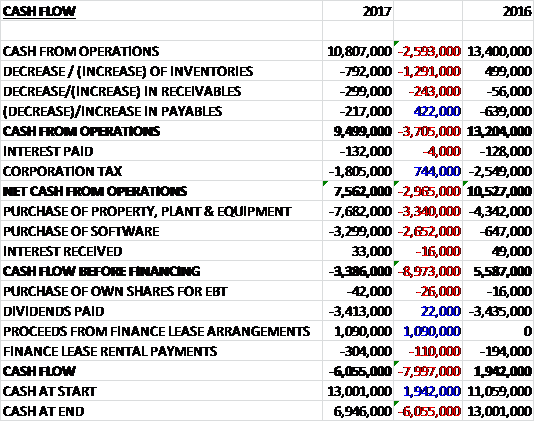
Before movements in working capital, cash profits declined by £2.6M to £10.8M. There was a cash outflow from working capital but corporation tax payments declined by £744K to give a net cash from operations of £7.6M, a decline of £3M year on year. The group spent all of this on £7.7M-worth of property, plant and equipment along with £3.3M on software but £4M of this capex was left over from last year which caused a cash outflow of £3.4M before financing. Despite this the group still paid out £3.4M in dividends and received £1.1M from finance lease arrangements relating to the new tills for the new EPOS system, to give a cash outflow of £6.1M and a cash level of £6.9M at the year-end.
Overall store like for like sales were down 4.3% or 4.7% on a 52-week basis compared to the general market which fell by just 4.1%, and online sales were up 2.2% which means that total like for like sales have declined by 3.8%. 2017 was a challenging year. The apparel market has been in decline with demand affected by consumers’ response to factors such as inflation, the Brexit vote and unseasonal weather patterns but the group’s objective was to grow by gaining market share which they have not achieved.
The group have identified a number of areas where they have not performed as well as they should. Long lead times and a supply base heavily dominated by China as a country of origin restricted their ability to react to changes in seasonal demand and offer diversity of product handwriting. Too significant a shift towards ranges with a casual end use did not perform well during the year due to the weather and this year’s casual ranges were no sufficiently appealing to their customers. Also, there was not enough focus on innovation which will be a key focus in the coming year.
The loyalty scheme did not contribute to sales growth during the year as the level of membership has not grown as the focus had drifted away from signing up new customers, certain elements of the scheme need modernising such as the online experience which is not seamlessly linked to the store experience, and the group are not fully utilising the data which the scheme provides. Also, they have said that basic retail disciples have not been maintained to a consistently high enough standard. A significant change to the retail management structure was completed just after the year-end.
They also identify some external factors which have not helped. BHS went into administration in April 2016 and cleared its residual stock at reduced prices which affected sales in April and May. During the second half of the year, however, their sales benefited and the board estimate that the net effect of BHS’s closure was neutral and during the coming year it should have a slightly positive effect on sales. Likewise, the weather pattern in the first half proved a disincentive for consumers to shop for seasonal clothing but the impact in the second half was neutral, if not a bit favourable.
During the year the group ceased trading through the shopping channel, ebay and Amazon as these channels generated insignificant profits. Although online sales grew, the board considered the low rate of growth to be a poor performance given the general trend of consumers increasingly switching channels. The performance did improve significantly during the year, however, with Q1’s 4.1% sales decline contrasting with the 15% growth in Q4. The board expect to see this trend continue as the benefits of the new Demandware web platform are realised.
As well as the general improvement seen across the group, the improvement in the online performance throughout the year reflects the steady progress made to improve the online offering, most notably launching a new site on a Demandware platform at the end of September, with no disruption as a result of this move. Having introduced the new platform, during the second half of the year, they began to unlock the benefits of the new features and the board believe the improved performance since Christmas is partly as a result of this.
The gross product margin was 58.6% in the year compared to 57.3% last year as a result of a higher bought in margin as the markdown level was slightly higher than in the previous year ad better than expected at the beginning of the year. Most of the stock is paid for in US dollars which were slightly more expensive this year which, on its own, would have reduced BIM. It is worth noting that the sharp fall in the value of Sterling did not significantly affect the group as they had contracted for the currency they needed when rates were higher. It will begin to affect them next year, however, and the full effect will be felt in 2019. This, in isolation, would represent a significant cost increase but the additional time in which to react will help the group mitigate the effect as much as possible.
In the autumn the group ran a three-week national advertising campaign using TV, radio and print media but the results were not conclusive enough to justify further expenditure so it looks like this will not be repeated in the immediate future. They have, however, improved both the effectiveness of their online marketing and their catalogue.
Shortly after the year-end the group introduced a proof of concept trial in 70 stores to test in-store online ordering through which a store colleague can order an item for a customer if it is not available at that time at the store. This appears to have been a success, proving popular with both staff and customers. They will roll this capability out to the remaining stores during H1 2018. They are also monitoring customer footfall and gauging the effectiveness of window displays.
In August Helen Connolly joined the group as CEO having most recently worked at Asda where she was senior buying director for the George clothing business.
There were a couple of exceptional items incurred during the year. The main one was £417K relating to training expenses incurred in relation to the implementation of a new EPOS system across the store estate. Other costs in relation to implementing this project have been treated as capex. There was also £90K of costs relating to the recruitment of the new CEO.
Going forward, trading since the start of the year has been in line with expectations. The board believe that the challenging market conditions are likely to continue but they are confident in their strategy and remain focused.
At the year-end the group had a net cash position of £5.5M compared to £12.4M at the end of last year. At the current share price the shares are trading on a PE ratio of 10.3 which falls to 7.5 on next year’s consensus forecast. After the final dividend was kept the same the shares are yielding 7.6% which increases slightly to 7.7% on next year’s forecast.
Overall then, this year has clearly been a difficult one for the group. Profits were down, net tangible assets were flat and the operating cash flow declined with no free cash being generated. Like for like sales from the stores fell and the online sales disappointed. There is evidence that this is being turned around, however. The board have identified a number of issues that are being addressed and most promising in my view is the fact that the disappointing online sales at the start of the year have reversed following the new IT systems. With a forward PE of 7.5, net cash on the balance sheet and dividend yield of 7.7%, these shares are certainly not expensive and I am inclined to continue to hold to see if the recovery has legs.
On the 27th July the group released a trading update covering Q1. Total sales increased by 7.6%. Store like for like sales were up 4.2% and online sales grew by 39%. This is in line with the board’s expectations so the full year forecast is unchanged.