

Hansard Global has now released their final results for the year ending 2013. The group make money in a number of ways. One of the most obvious are the fees charged for policy administration services, investment management services and other services related to the admin of investment contracts. This is the main source of income for the group and it is generally rather fixed in nature. Another source of income is the commission received from fund houses with which investments are held. Investment income includes dividends and interest along with realised gains and losses on investments as well as unrealised gains and losses. Only about 30% of revenues are based on the value of assets under administration.
There were a number of terms that I was unfamiliar with when starting the analysis of this company. One was Frictional Costs which are the additional taxation and investment costs incurred by shareholders through investing the required capital in the company rather than directly. New business strain are the costs involved in acquiring new business (such as commission, payments to intermediaries and expenses) affecting the insurance company’s financial position at that point and where all of the income from that new business has not yet been received. To begin with strain may be created where cash outflows exceed inflows. Origination costs are expenses related to the procurement and processing of new business written including a share of overheads. Value of In-force covered business (VIF) is the present value of expected future shareholder profits, less the present value cost of holding capital required to support the in-force business.

Compared to last year there has been a £2.1M increase in contract fee income and a £400K hike in fund management charges. A decrease in interest income is exactly counteracted by an identical increase in dividend income. Unfortunately there was a £10.2M loss on the realisation of investments which was £7.9M worse than last year but this was completely dwarfed by a favourable £80.5M movement in unrealised investment value compared to a £148.6M paper loss last year. This has caused the income to be a massive £223.5M higher at £132.7M before a £73.4M loss relating to changes in provisions for investment contract liabilities comes into play.
As far as other costs are concerned, employee costs were £700K lower than last year due to a smaller work force but almost every other cost was up with a £1.8M increase in origination cost amortisation, a £1.2M increase in litigation fees and settlements and a £1M hike in other admin costs, which included £600K of provisions for policy fees that are not expected to be collected due to reductions in asset values, £400K of which related to costs following the closure of Hansard Europe to new business. This all meant that after tax the profit for the year was down £800K to £10.4M. Discounting the one-off litigation settlements and discontinued activities, however, profit was £12.7M, up by £1.6M on last year.

Overall the value of investments fell by £5.7M to £1.050B as a £14.6M increase in investments in collective investment schemes was counteracted by a £11.7M fall in fixed income securities, a £5.4M reduction in equities and a £3.2M reduction in deposits and money market funds. The investments in collective investment schemes make up by far the largest chunk of investments and £22.8M of these investments (4.7M more than last year) were classified as level 2 which means the value of the investments are determined not just by quoted prices but also other observable inputs are used to determine value. During the year £10.9M of assets were re-classified as having a value of zero which is clearly not great, although better than last year when £29.3M of assets were classified as having no value. As far as non-investment assets are concerned, there was a fall in contract fees receivable and outstanding investment trades but this was more than counteracted by a £9.8M increase in deferred origination costs and a £3.1M hike in cash levels. Origination costs are all expenses related to gaining new contracts (commission etc) and they are deferred for the length of the contract in question and amortised throughout the life of the contract. The small increase in other debtors was due to the company already paying for a new freehold property (£500K in all).
Investment contracts are unit linked contracts and the liabilities are measured on a fair value basis. Compared to last year there was a small fall in liabilities tied up in investment contracts as some deductions from the contracts took place during the year but every other liability increased. The largest increase was in deferred income reserve presumably as more income is received for future investment admin, but there were also comparatively large increases in amounts due to contract holders, commission payable and other accruals. The result of this was that net assets fell by £5.1M to £39.8M which was rather disappointing.
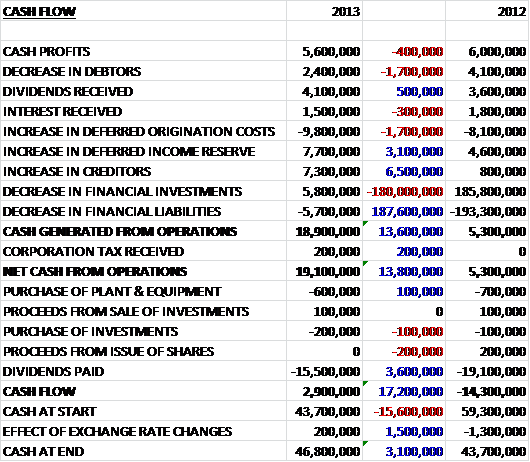
Cash profits were at a similar level to last year but increases in the deferred income reserve and creditors pushed this higher before a decrease in financial liabilities were broadly counteracted by a decrease in financial liabilities to make the cash generated from operations £18.9M, £13.6M up from last year mainly due to the increase in creditors and a more favourable distribution of financial assets and liabilities. The largest change in non-operating activities was the £3.6M fall in dividend payments to leave a positive cash flow of £2.9M compared to an outflow of £14.3M last year.
Apart from the financial items mentioned above, the group also use something called European Embedded Value (EEV) to attempt to estimate the value of the shareholders’ interest in the group. It is the value to shareholders of the net assets plus the expected future profits on in-force business from a life assurance business. The EEV comprises net worth and the Value in force (VIF is future profits from business in force at the valuation date). It excludes the value of any future new business that the group may write after the valuation date and all results are calculated net of corporation tax. The idea is that the embedded value reported on one year will emerge as cash in future years.

So, EEV profit is listed at £17M, a whole £30.7M higher than last year. This sounds good but to me there seems like there are a lot of fairly abstract assumptions here. New business contribution is fairly straightforward, being the value of new business written during the year at the point of sale. The expected return on business is based on assumptions made at the start of the period to convert VFP to Net Worth in the year and the time value of both existing business and non-market risk. Experience Variances arise where the actual experience differs from that assumed in the last year’s EEV. These seem to be constantly negative for the past two years and the bulk of the negative figure this year comes from the one-off expense of £3.3M that has arisen from action taken to conclude litigation. Operating Assumption Changes reflect changes in management’s view of the behaviour of the existing business and the negative value is predominantly due to premium reductions & underpayments; and partial encashments. The Expected Return on Net Worth reflects the anticipated increase in shareholder assets during the period due to the time value of money.
Model Changes reflected the refinement in the approach to the selection of discount rates, moving from a single rated average rate to an approach which applies the actual currency denominated risk-free rate by term to liabilities. The result was a small increase in VFP. Conversely the simplification to modelling unit pricing margins and certain foreign exchange margins reduced VFP which had the effect of the overall £2.6M reduction seen above. The impact of market and economic conditions led to the £7.9M increase in investment return variances which was driven by the performance of investments chosen by policy holders. The Economic Assumption Changes reflected reduction in government bond yields for the currencies in which the group is exposed and the revaluation of policy holder assets that are subject to restrictions on normal pricing.
The EEV balance sheet shows that EEV assets were £225.7, a small increase on the year before. The new business margin for the year was 12%, an increase from the 9.6% last year primarily due to the change in mix of sales towards higher margin regular premium business. The average break-even point for new business written during the year was just 2 years, reduced from 2.6 years and again reflecting the change in mix to regular premium business.
The assets under administration at the year-end were £1.028B, £5.7M less than last year, mainly due to increased withdrawals. Due to the financial crisis and increased regulation meaning that some asset classes are no longer suitable to be held by retail investors, the group had to write down assets by the tune of £16M. This is much less than last year, but still quite a large amount. The net asset value per share is 32.5p, which is a very small drop from the 32.7p recorded last year.
As touched on before, the group is fighting a number of writs from policy holders who are unhappy at the performance of their investments. Despite Hansard not offering any investment advice themselves and the group allowing the investors to pick their own investments the group are settling some of the claims for £300K. There are still £3.9M worth of claims outstanding but this is a vast improvement over the £11M of claims outstanding last year. No provisions have been made for these claims as the group suggest there is no merit in them.
As touched on previously, the group has decided to close Hansard Europe, based in Ireland, to new business. This decision was taken due to the long term decreased prospects in the Eurozone, and reading between the lines it seems that the legal challenges that the group has been facing in Europe has had an effect on this decision. They will now be concentrating on emerging markets. Next year the group expects to make a number of Irish staff members redundant which will create savings of £400K going forward
As Hansard provides unit-linked contracts only, much of the surplus cash can be distributed to shareholders but conditions imposed by the Central Bank or Ireland as a result of the implementation of the revised operating model have the effect of delaying dividend distributions from the subsidiary until such a time that the operating model is fully implemented and the legal cases the group faces are concluded. Currently the amount of capital the group needs to keep back to cover the regulatory requirements is £12.8M. Of this value £9.3M is related to the additional required capital following the closure of Hansard Europe to new business and it is thought that this will be constrained for three years.
Also touched on briefly above is the new regulatory environment facing all financial service groups by the EU and management expect the implementation of Solvency II, FATCA and other legislation to tie up a significant amount of the group’s resources over the next years, which is clearly not a good sign.
New business flows this year were 15% ahead of last year and represented a record amount since the business was floated. It should be mentioned, however, that the amount the group spent on obtaining new business rose £2.7M to £28.8M. It is still impressive, however, when the difficulties the group faced in Latin America and Europe are taken into account and it is in the Far East that the group has been most successful. Although regular new premiums did well, the value of new single premiums fell by nearly 37% due to the difficulties in Europe and the closure of Hansard Europe to new business. Overall, the present value of new business premiums were split as follows:
Far East premiums were £114.3M, up 65%; Latin America is £30.6M, down by 18%; EU is £26.3M, down by 44% and the rest of the world was valued at £17.5M, down by 23%.
The Online system now accounts for 90% of new business compared to 60% in the previous year. The system is an administration tool used by intermediaries to make it easier for customers to invest in Hansard’s products.
Overall then, this seems like quite a mixed set of results. Although profits were down, underlying profits before the litigation settlements are taken into account were actually up and the cash flow certainly seems to have improved over last year. It seems the assets under administration did ok, despite quite a few withdrawals and the EEV is also up on last year. There are certainly some headwinds, however. The only region where value increased was the Far East and the closure of Hansard Europe to new business is a bit of a blow. Also, the spectre of litigation is still hanging over the group, although this is much improved since last year.
At the current share price, the P/E ratio is 13.7, which is predicted to fall to 12.6 next year which is probably about right given the headwinds facing the group. The group announced a final dividend that was nearly half that of last year but at the current share price the yield is now 7.7% which, if sustainable is rather impressive. The major problem I think I have with this company, however, is that I just don’t really understand it. Reading the annual report requires some sort of financial dictionary to get anything out of it and I am unsure how to value the company or which of the numerous measures I should be using to determine whether they are doing well. For this reason, despite the (falling) dividend yield I may look to exit if an opportunity presents itself. Until that time I will still attempt to cover the group in this blog, however.
On 8th November the group released an interim management statement covering Q1 2014. New business premiums for the international business increased by 4.2% over the first quarter of last year but regular premium flows of £27.8M were lower than the £28.4M received last year. Single premium flows increased on the same period, however. The group apparently generated strong cashflows during the period but decreases in the capital market values caused the value of both policy holder assets and embedded value to reduce on the end of last quarter. The real bad news was the collapse of a large distributor for the group which will have the effect of reducing new business next quarter.
The plans to move the admin processes from Ireland to the Isle of Man following the closure of Hansard Europe to new business seems to be progressing on target and all admin processes have already been transferred and all affected personnel have either been made redundant or will be before the end of the calender year. Hansard has taken a £300K hit to implement this and is not expecting any future costs. There are still a number of writs totalling £3.9M outstanding and there have also been a number of customer complaints that may become future litigation. EEV has been hit because oft he decreases in major capital market levels in the quarter, which is another blow. The value of new business seems to have reversed the trend of last year with Far East premiums falling and Latin America and European premiums increasing. Assets under administration fell to £1B from £1.048B. Overall this is not a good update, the group seem to be suffering a number of headwinds, in the shore term the most concerning is the failure of a major distributor. I am struggling to see any potential upside this year and may up my attempts at a withdrawal here. A good opportunity to come out with a profit did not occur here but I am getting very nervous about prospects so I am out.
On the 27th January the group gave a statement regarding new business for the first half of the year. New business fell by 24% on the same period of last year due to the cessation of a large distribution relationship in the Far East. H2 is also expected to come in significantly under the same period of last year so full year results are likely to be pretty dire. The one bit of good news is that they will keep the dividend payment. Having sold out last week (lucky timing rather than anything else) I no longer have a position here. I must say I am quite pleased as the prospect of doing another write-up was pretty daunting. The bottom line is I don’t really understand this business and I should not have taken a position here in the first place. I have left with a bit of a loss but this will probably be my last update on Hansard.