

Tesco has now released their half year results for the year ending 2014.
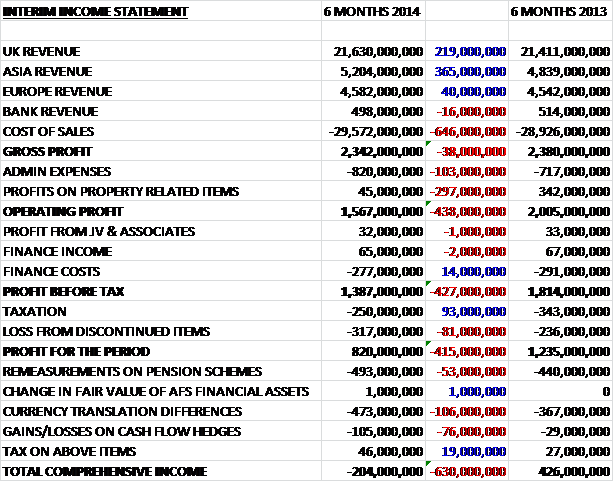
Revenues were up with Asian revenue in particular doing well, up £365M in the half year. UK revenues were also up, increasing by £365M. Europe fared less well, up £40M and bank revenues actually fell in the period, down by £16M. The increase in cost of sales dwarfed the increased revenues which meant that gross profit fell marginally on last year. Higher admin expenses and a fall in profit from property, due mainly to the slow-down in the sale and leaseback programme, drove the operating profit down by a hefty £438M. A slightly reduced finance cost (due to better average working capital and the lack of pre-debt financing costs that occurred last year) and a much lower tax bill were counteracted by increased losses from discontinued items (which now includes the Chinese business) meant that the profit for the half year was £415M down at £820M. Underlying profit was down by over 7% to £1.466B.
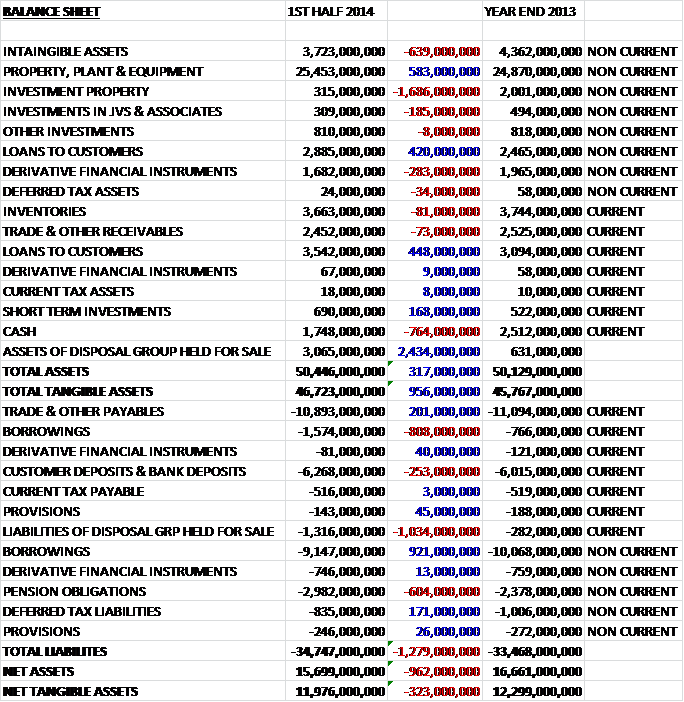
Total assets increased when compared to the end of last year driven by a £583M increase in property plant and equipment, a total of £868M increase in loans to customers and a £2.434B increase in the value of assets held for sale as the US and Chinese businesses were moved to this category following the agreement with China Resources Enterprise. There were a number of large falls in the asset base too with a £639M decrease in intangible assets, a £1.686B fall in the value of investment property which is related to the fact that malls to the value of £1.623B were removed from investment property and reclassified as property, plant and equipment because it was decided that the level of service provided to the tenants was significant, and a £764M fall in the cash levels.
Liabilities also increased during the year with a £1.034B increase in liabilities held for sale, again following the agreement in China the liabilities of the Chinese subsidiary were moved here. There was also a £253M increase in customer deposits and a nasty looking £604M increase in pension obligations due mainly to a reduction in real corporate bond yields. This led to a net asset figure almost a billion pounds lower than the end of last year but taking out that fall in intangible assets, net tangible assets were down £323M to £11.976B.
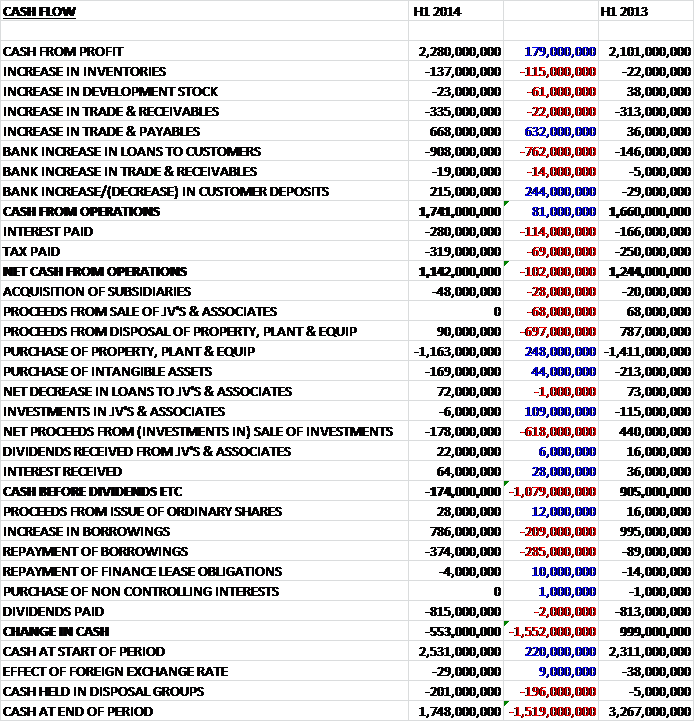
The cash profits were up £179M on the first half of last year and a large increase in trade payables and customer deposits in the bank was counteracted by nearly a billion pounds in bank loan increases to customers and a 335M increase in trade receivables. This meant that cash from operations was £81M higher at £1.741B. A substantial amount of increasing interest paid and a higher tax payment, however, meant that the net cash from operations was £102M lower than the first half of last year at £1.142B, although without the effect of the bank cash flows, this would have been higher than in the first half of last year. The main sink for the cash was the £1.163B spent on property, plant and equipment (more than the cash flow from operations) and when compared to the first half of last year, the biggest differences were the £697M fall in proceeds from the sale of property, plant and equipment due to the slow down of the sale and leaseback of stores; and the £618M swing from proceeds received from investments to a net increase in investments. This caused the cash flow before financing items to be over £1B worse than the same period of last year and an outflow of £174M.
There was then a net increase in borrowings of £412M counteracted by £815M spent on dividends. The net result was a cash outflow for the period of £553M compared to an inflow of nearly £1B last time round. This is clearly not good and a net cash from operations that does not even cover capital expenditure is something that will need to be turned around but when it is compared to last year and the net difference of new borrowings, sales of property and sales of investments are discounted, the result is broadly the same.
On 1st October the group entered into definitive agreements with China Resources Ltd to combine their retail operations into a joint venture. Tesco will only have a 20% stake in the resulting group but it will apparently be the largest retail store in China. The deal will cost Tesco £265M initially and another £80M on the one year anniversary. Also, during the period the group agreed the sale of the majority of the US operations to YFE holdings. YFE will acquire 150 stores and the Riverside distribution and production facilities and stores not involved in the transaction will be closed. As part of the deal, Tesco will also make a loan to the new business.
In the last annual report, the group set out their intention to radically overhaul the UK business. One of the largest changes was the improvement in quality of many own-brand products, another change has been the refresh of many stores around the country. The group are also looking to drive online sales by introducing the Hudl which is a tablet computer created by Tesco that offers instant access to all of Tesco’s digital products by use of pre-installed aps along with the usual Google offerings . Three new formatted Extra stores were introduced during the period, bringing together the changes Tesco have made to their general merchandise offering along with casual dining restaurants (presumably Giraffe and Harris and Hoole). These three stores are currently trading ahead of expectations which looks like a good sign.
A lot of the work the group has done on the UK business is to make investments in the provenance of their products and fresh chicken is now all UK sourced and ready meal beef is now sourced from the UK and Ireland. Investments have also been made in the quality of fresh food. This seems to be a response to Sainsbury running away with the UK market share stats, and the horse meat scandal. This has led to a 1% increase in like for like food sales in the second quarter. Overall UK trading profit was up by 1.5% in the first half at £1.131B. As well as fresh food, the group has substantially completed the re-formulation and re-packaging of their own brand products and over 1,750 new products were introduced. It is not just their products that have been targeted by Tesco, they have also refurbished many stores and invested in staff training. These changes do seem to be having an effect on customer perception as customer viewpoint scores were up by 5% in perceptions of customer service.
Tesco have been re-arranging the products they sell in general merchandise by moving away from consumer electronics and although this process has started, it is thought that it will continue well into next year and this has caused a slight drag on like-for-like sales. The group has been moving more towards homeware, cooking & dining and celebration products that are more resilient to the threat of online trading. Clothing has also performed rather well and sales improved in the second quarter. Although there was a slow-down of new store openings, more is being put into convenience stores with 70 new openings during the period. As touched on previously, the new Extra stores are designed to be destinations in themselves including the Tesco owned casual dining and coffee shop brands. There is also the intention to generate rental income from other operators. Scan as You shop has been introduced to some of the larger stores which allows the group to invest man hours into other areas of the store.
Although sales and revenue in Asia both increased compared to the first half of last year, profits actually fell 7.4% to £314M. Performance for the first half was held back by the regulatory restrictions introduced in South Korea which affected profits by £40M. Another issue is that the Thai economy fell into recession during the period which affected performance there and the measures by the Thai government to try and stimulate the economy for offering finance for big ticket items such as cars has also had a knock on detrimental effect on the food industry. As if this wasn’t enough, Tesco has also been hit by increased competition in the Thai convenience sector. The group have taken some steps to address the poor performance in Thailand, one of which was to remarket the “Clubpack” range of bulk buy products marketed to small traders who shop with Tesco. Despite these issues, Thailand remains an important and profitable market for the group.
Market conditions in Malaysia were relatively stable but the group has suffered lower sales growth which is being blamed on lower consumer confidence following the recent elections there. During the period the group launched home shopping in the country which is being received well by customers. A lot of the income from Asia comes from malls and Tesco is one of the largest mall operators in Asia. There was 700K square feet of new space opened in Asia and much of this was concentrated in South Korea and Thailand.
In Europe, sales increased by 1.2% but this was due to exchange rate differences and at constant rates sales actually fell by 3.1% and like for like sales fared even worse, down by 5%. Trading Profit in the region crashed, down by nearly 71% to be just £55M. This was mainly due to the continued economic problems affecting customer confidence and the continued preference for smaller convenience format stores. The worst affected country was Turkey where the level of losses increased significantly due to their exposure to larger format stores. In response, the group have focused the business on driving growth in their heartland around Izmir which is apparently leading to an operational improvement. Tesco are also introducing home shopping in Turkey in 2014. Although Turkey was worst hit, profits fell in all European regions. The fall in Polish profits was due to increased investment in that country, Ireland slipped back into recession during the period which drove customers to discounters. 200k square feet was added in Europe during the half year and apart from three previously committed hypermarkets in Poland, all were convenience style stores.
As with other sectors, the bank profits were also down, this time by 6.4%. This was due to the legacy insurance distribution agreement last year (that was worth £17M in the first half of last year) and fair value releases. Without these two effects the profit would actually have increased by 21%. As has been seen under the asset table, customer lending increased strongly with loans up 11% and card balances up 16% since the year end. The mortgage product also did well with balances growing to £500M. It is expected that current accounts will be launched in next year. The motor insurance business suffered some headwind during the period with the group sticking to a disciplined approach to pricing which contributed to a 5% reduction in motor policies since the year end. Home insurance was re-launched during the period and new business grew by 40%. Despite this overall insurance customer numbers fell by 4% to 1.8M.
Going forward the group have made decent progress improving perceptions in the UK and investments made in the international business are apparently feeding through to an improved trading performance in the second half. Challenging economic conditions remain in Europe, however, which is holding back consumer confidence and causing a drag on Tesco’s results.
Profits have fallen across every single one of the group’s territories with the best performing countries being Malaysia, UK and Hungary with profits falling by 0.4%, 0.5% and 0.8% respectively. The worst performances were seen in Turkey, down 12.8%; Czech Republic, down 6.9% and Poland, down 6.4%. Possibly just as disappointing is that Hungary and Malaysia actually showed profit growth in Q1 only for poor Q2 figures to drag profits down.
So, profits were down considerably during the period due to operational issues in many of the group’s markets and exacerbated by the slow-down in the sale and lease back programme. Net tangible assets also fell, but this is accounted for by the increase in the pension deficit. Cash flow was also negative with operating cash flows not covering both capital expenditure and dividend payment, even when the increase in bank loans to customers is taken into account and net debt at the end of the period increased by £443M to £7.04B. There is not much good news here at all really and the problems facing Tesco are probably a little harsher than I originally thought. The one slight ray of light is that the investment in the UK business seems to be starting to bear fruit and the agreements in the US and China should help in some difficult territories although I still find it disappointing that the group has had to exit some of the largest markets in the world. The interim dividend remained unchanged on last year and the yield currently stands at a solid 4.1%. I am going to hold on to the final results to see if any progress is made in the second half.
On the 4th December Tesco released a statement covering trading in Q3 of this year. Once again it is a disappointing update and like for like sales declined in all countries. The best performers (relatively speaking at least) were Poland, down by less than 1%, Malaysia, down by 1.1% and the UK, down by 1.5%. Although like for like sales in Hungary were recorded as only falling by 1.3% this was discounting the sales of tobacco which was banned from being sold in large retailers during the period. The worst performers were Ireland, down by 8.1% due to very tough retail conditions and increased competition – Tesco have just introduced price promise into the country in an attempt to stem the tide; Thailand, down by 6.9% due to increasingly tough conditions for their customers and Slovakia, down by 5.7%. The Korean business continued to be affected the new regulations in that country and sales there fell by 4.8%. The measures introduced in Turkey and Poland seem to be slowing down the decrease in sales, having fallen 3.5% and 0.7% respectively.
Work is continuing to reposition Tesco in the UK market and some examples during the quarter were the re-launch of the Tesco Finest range; the individual tailoring of the Tesco Express stores to the needs of the local areas and the continuing refresh of the older stores. The realignment of the general merchandise range to higher margin products is also ongoing. The UK results were somewhat held back by this work in the short term. One success story is the sales of the Hudl tablet device which have been very strong at over 300,000 units which is above management expectations. The tablets have also attracted some favourable reviews. The bank had a decent performance as sales increased just under 1% due to increases in interest income from a strong lending performance being mitigated somewhat by a reduced fee income across the insurance business. The group also confirmed that the sale of the US business to Yucaipa had been completed. Overall then, this was a disappointing update with the international performance being particularly poor in some regions but it was not entirely unexpected.
On 21st March, the group announced that they had completed a joint venture with Tata in India. The joint venture, named Trent Hypermarket Ltd will operate under the Star Bazaar and Star Daily banners and will initially have 12 stores. Tesco’s investment will be around £85M.
On 4th April, the group announced that Chief Financial Officer, Laurie McIlwee was stepping down and resigning from the company. He had been in the post for 14 years so perhaps felt it was time to move on. It still does not bode well for the financial results this year, however.