

Ricardo has now released their final results for the year ended 2018.
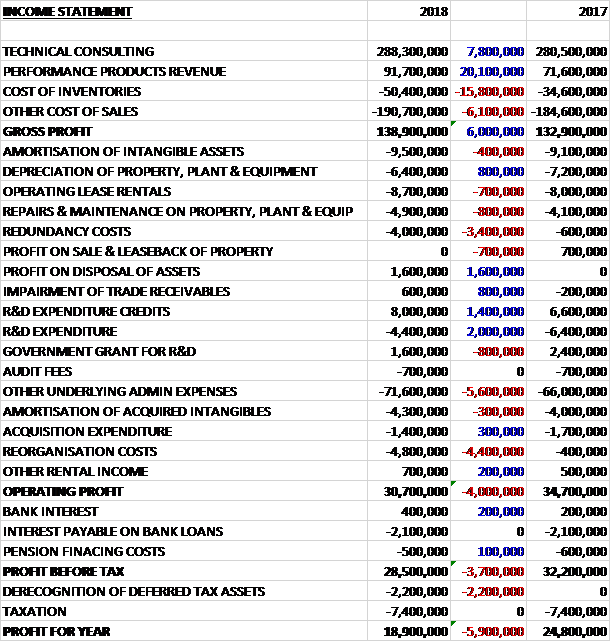
Revenues increased when compared to last year due to a £20.1M growth in performance products revenue and a £7.8M increase in technical consulting revenue. Cost of inventories were up £15.8M and other cost of sales increased by £6.1M to give a gross profit £6M higher than last time. Depreciation fell by £800K but operating lease rentals were up £700K, maintenance costs increased by £800K and redundancy costs increased by £3.4M. Offsetting this was a £1.6M profit on disposal of assets, a £800K reduction in receivable impairments and a £3.4M increase in R&D credits. Other underlying admin expenses were up £5.6M. There was a £4.4M growth in reorganisation costs which meant the operating profit declined by £4M. There was a small reduction in finance costs but there was a £2.2M de-recognition of deferred tax assets to give a profit for the year of £18.9M, a decline of £5.9M year on year.

When compared to the end point of last year, total assets decreased by £700K driven by a £6.7M fall in deferred tax assets, a £6.4M decline in amount receivable on contracts, a £2.8M decrease in assets held for sale and a £2.7M decline in land and buildings, partially offset by a £5.2M increase in cash, a £5.6M growth in trade receivables, a £3.5M increase in goodwill and a £3.3M growth in other receivables. Total liabilities also declined during the year as a £4.2M growth in accruals and deferred income and a £3.4M increase in the bank overdraft was more than offset by a £17.6M reduction in pension obligations and a £10M decrease in the bank loan. The end result was a net tangible asset level of £79.3M, a growth of £18M year on year.

Before movements in working capital, cash profits declined by £1.5M to £47.2M. There was a cash outflow from working capital but this was much less than last time and after finance costs increased by £800K the net cash from operations was £34.5M, a growth of £19.2M year on year. The group spent £7.8M on property, plant and equipment but bought in £6.4M from the sale of assets. They also spent £6.6M on intangible assets and £4.6M on acquisitions to give a free cash flow of £21.9M. Of this, £10.5M was paid out in dividends and £10M was used to pay back some loans to give a cash flow of £1.8M and a cash level of £23.8M at the year-end.
The group increased its order intake by £47M in the year with growth across both divisions. The year ended with a record closing order book of £288M, an increase of £40M with £5M of this relating to the Control Point acquisition. On an organic basis, the underlying profit reduced by 1%. There was a good performance in performance products but in technical consulting growth in most areas was offset by a reduced performance in the UK automotive and energy and environment businesses.
The operating profit in the Technical Consulting division was £22M, a decline of £5.8M year on year. The order intake in the year stood at £324M and there has been a good balance of new orders across all core regions. Margins were affected by the mix of orders, an increase in the level of material content and some disruption in the flow of orders into the UK automotive operation which led to operational inefficiency. In addition, the delivery of a small number of difficult, complex projects impacted margins.
The rail business delivered another year of strong performance and won one of its largest ever assurance projects in Taiwan which is set to last through to 2025. The global rail market continues to show positive growth trends particularly in the Middle East and Asia. The industry is striving to exploit new digital technology to improve operational efficiency, availability and overall cost and to help meet the demand for more efficient public transport.
Other notable assignments during the year included providing technical support for the introduction of bi-mode Hitachi rolling stock to the UK network, system integration testing of a new tram system for the city of Utrecht in the Netherlands and the approvals for a new rail freight service across Saudi Arabia. The certification business expanded its accredited activities into Dubai and Qatar.
In the Automotive business new European emissions legislation has resulted in more extensive engine calibration requirements, the scope of which is proving challenging for the industry. The strategic consulting business had a busy year assisting its clients within this changeable market.
The group are seeing a strong market in China and Japan and in the year they have acquired new customers in the US which are new to the automotive market and are focused on rapid product development. They have also worked with traditional customers in new areas such as electric and hybrid vehicle development, battery development and systems integration. They have, however, seen some disruption of order flows from some traditional customers who are looking to navigate industry change. This was particularly noticeable in the UK during the second half of the year when the effects of the reduction in sales of diesel vehicles were magnified by the continued uncertainty surrounding Brexit.
The disruption in UK order flows, together with the project challenged discussed above, led to inefficiency and some over-capacity in the UK operations which had an adverse effect on margins. They saw a return to more normal levels of orders towards the end of the year, however. The US automotive business improved markedly in the year with a significantly reduced loss which offset the weakness in the UK business. It broke even in the second half of the year. The automotive business based in China performed well, doubling order intake, much of which was related to electrification.
In the off-highway and commercial vehicles market growth continued in the medium and heavy duty sectors, particularly in Asia, and they have secured several large engine and transmission projects across both sectors. The order book and pipeline of opportunities across Europe and Asia includes a broad mix of largely engine and transmission programmes. In the US there was continued focus on powertrain and trailer efficiency, emissions control and the use of hydrogen fuel cells. In the medium-duty market compliance requirements for in-service on board diagnostics has driven increased engine test activity.
In the off highway market Asia is showing renewed growth, especially in transmissions and drivelines, and activity is increasing in Europe. In the medium term they expect solid customer demand for their services to meet EU, US and Asian emissions regulations and 2020 emissions targets.
The energy and environment business continued its focus on international CO2 reduction and the future impacts of climate change, and on climate mitigation plans. Projects included the preparation of plans for rising sea and river level defence systems and the protection of residential properties and ecologies in the UK as well as applying their consultancy expertise to assist a wind turbine manufacturer with production planning and their business improvement plans.
The have seen an increased focus on waste and recycling, with plastics and the reduction of their use becoming a very productive area of business. The water consulting activity benefited from the current asset management planning cycle in the UK which ensures water supply and resilience for coming decades against rising populations and temperatures, and from the 2019 price review, driven by the focus of the UK water services regulation authority on leakage reduction and the resilience of the water network.
They continue to support customers around the world with their air quality services and products. In China they are providing support to a number of cities to establish long-term, cost effective air quality action plans to bring about significant improvements in air quality and health whilst maximising co-benefits such as reductions in greenhouse gas emissions. A key project, commissioned by the Asian Development Bank is providing detailed evaluation of policy options using their Rapid Air air quality modelling system and is designed to support the investments being made by the ADB in NE China.
The group is working with nine cities in six countries in Sub-Saharan Africa on behalf of the C40 Cities Climate Leadership group, to build capacity within local government and develop common tools and frameworks. This will enable action planning for transformational, long term development. The group have also seen a steep increase in their work on water resource management, attributable to the plans that the UK’s water companies are required to produce every five years. They have provided strategic environmental assessment and planning for the delivery of those plans for 12 companies.
The group’s National Chemical Emergency Centre has further broadened its offering by creating a service for businesses outside the chemicals sector to report different types of incidents such as fires, floods, explosions and break-ins. The business also offers planning and training on crisis and business continuity. The new offering has been successful and the business has seen increasing customer demand for these new services.
Order intake in the business was similar to last year but performance was impacted by recruitment for higher levels of growth than was achieved.
The defence business has won a number of new contracts across the globe in land defence and in the marine sector, both surface and subsurface. The integration of the acquisition is performing well
The operating profit in the Performance Products division was £9.3M, a growth of £1.3M when compared to last year. The growth was mainly due to increased volumes in respect of the engine supply contract for McLaren, a full year of production of transmissions for the Bugatti Chiron and an increased demand for Porsche Cup transmissions. Order intake in the year increased by 14% to £89M with the Aston Martin order received in the prior year being more than offset by the increased demand this year from McLaren, Bugatti and Porsche.
In the higher performance vehicles and motorsport business, demand for the production of McLaren engines continued to grow in line with expectations. This year they delivered over 4,300 engines across an increased number of engine variants. They made good progress in the preparations for the supply contract for the Aston Martin Red Bull Valkyrie hypercar transmission. They also continued to support Bugatti with the supply of the complete driveline system for the Chiron together with the supply of transmissions for the Porsche 991 Cup race cars.
This year the business developed the transmission for the M-Sport Bentley GT customer racing programme and continued to support key manufacturers within the Formula E Championship for the second consecutive season. They continue to manufacture for Formula 1, the Japanese Super Formula Championship, Indy Lights and the World Series Formula V8. They also operate supply programmes of Ricardo-designed transmissions for BWM, the Ford GT3, the M Sport World Rally Ford Fiesta and the Hyundai R5 Rally car.
In the defence business in the US they have received their first orders and started production of their anti-lock brake and electronic stability control system for the HumVee. The system is proven to be effective at reducing the loss of control and the occurrence of single vehicle crashes.
There were a number of one-off items like usual. Acquisition related expenditure comprised £100K of costs incurred from the Control Point acquisition, £200K on its subsequent integration and £500K on associated earn-out arrangements. Costs of £400K were incurred to finalise the integration of the LR Rail and Motorcycle Engineering businesses together with £200K of professional fees incurred in relation to an aborted acquisition.
The sale of the test assets at the Chicago Technical Centre in the US was completed in April for £4.1M which led to a profit on disposal of £1.4M. In addition £700K of professional fees, contractor costs and redundancy costs were incurred as a result of the asset sale. The sale of the Schechingen Technical centre in Germany was completed in June for £4.4M which generated a profit of £200K with £300K of redundancy costs incurred. There were also redundancy costs of £2.7M in relation to downsizing the footprint in Schwabisch in Germany and additional costs of £1.8M were incurred as a result of the downsizing activities in Germany. Costs incurred of £500K in relation to the set-up of their new shared service centre in Prague including dual running costs and contractor costs and UK senior management redundancy payments of £400K were made as a result of restructuring.
A net deferred tax asset of £2.2M, comprising historical losses in Germany was brought forward from the prior year. Due to the various restructuring actions taken in Germany, the directors now consider it unlikely that sufficient future profits will be available against which the tax asset can be used so it was derecognised in the year.
In September 2017 the group acquire Control Point Corp for an initial cash consideration of £6.3M and a contingent cash consideration of £1.7M. The acquisition expands on the group’s vehicle engineering capabilities in the Defence sector and adds expertise in the distributed software-based systems and fleet management technologies. The acquisition generated goodwill of £3.4M and the business generated a profit of £1M during the period. Had it been part of the group for the full year, it would have generated profit of £1.2M so this looks to be a good acquisition.
The test facilities in Chicago and Southern Germany were sold during the year to ensure they continue to move with the trend towards electrification. Actions were takin in their UK Automotive business to respond to issues relating to a disrupted flow of orders in the second half of the year and a small number of challenging projects relating to the new emissions legislation. Together with the strong order book, the board believes this all provides a solid foundation for continued growth.
At the current share price the shares are trading on a PE ratio of 17.2 which falls to 10.4 on next year’s consensus forecast. After a 6% increase in the final dividend the shares are yielding 3.2%, increasing to 3.4% on next year’s forecast. At the year-end the group had a net debt position of £26.1M comparted to £37.9M at the end of last year.
On the 20th November the group announced that COO Mark Garrett sold 73.5K shares at a value of nearly £500K. Following this transaction he now owns 59,723 shares.
On the 2nd January the group released a trading update covering the first half of the year. The group as a whole traded I line with expectations. Total order intake was good at just over £200M, the order book at the period-end was £300M and revenue was slightly ahead of last year. Net debt was £27.5M.
The challenging US and UK automotive market conditions were balanced by good performances in their performance products business and in all other technical consulting businesses with energy and environment, defence, China automotive and strategic consulting performing particularly well.
Overall this was a rather mixed performance for the group. Profits declined and although the operating cash flow improved, this was due to working capital movements and cash profits fell. There was an increase in net assets, however. The performance products business and most of the technical consulting business performed well but the UK automotive business struggled as did the environment business, due to an increase in staff which didn’t correspond to growth levels. Going forward, both the UK and US automotive markets are difficult but the shares seem to have priced this in somewhat, with a forward PE of 10.4 and yield of 3.4%. These are looking decent value at the moment.