

Gem Diamonds is split into segments where mining takes place (Lesotho and Botswana); where diamonds are manufactured (Mauritius) and sales and marketing, which takes place in Belgium. The group currently only has one producing mine, the Letseng mine in Lesotho and the Ghaghoo mine in Botswana is currently under construction. The Letseng mine is renowned for its regular production of large, good quality diamonds and is the highest average dollar per carat kimberlite diamond mine in the world. The mine is 70% owned by the group with the other 30% being owned by the government of Lesotho. The mine has total resources of 5.3M carats and the rough diamonds are sold on tender in Antwerp. The Ghaghoo mine is 100% owned by the group, where they hold a 25 year mining licence and has a total resource of 20.5M carats. In Belgium the group sorts, values and sells the diamonds over 10 tenders per year and some diamonds are selected for polishing and sold through direct selling channels to high end clients. Gem Diamonds have released their full year results for the year ending 2013.

Revenues were up $10.7M when compared to last year and although costs of inventories grew by $17.8M, a similar decrease in other cost of sales meant that gross profit was $11.1M higher than in 2012. Admin costs saw decreases in both corporate expenses and share based payments but a $3.2M fall in the foreign exchange gain counteracted these. The lack of $16.2M worth of impairments that occurred last year (mainly related to the failed project in Angola), however, meant that operating profit increased by some $27.2M before a decrease in the income from bank deposits and increased interest on debt meant that profit before tax was some $24.3M higher at $59M. Income tax this year was up by $2.4M and last year there was a massive $118.7M loss from discontinued operations ($48.4m of which was related to the recycling of foreign currency translation reserve on disposal and $63.7M on remeasurements to fair value) which was not repeated this year and the overall profit for the year was $38.2M, $140.5M better than in 2012.

Total assets were down by just under $50M. This was driven by a $23.2M fall in plant & equipment, a $16.4M reduction in financial assets, a $5.9M fall in decommissioning assets and a $4.6M decline in the value of goodwill, only partially mitigated by a $6.7M increase in inventories and a $3.9M clime in the value of exploration and development assets. The investment property relates to a commercial unit located in the Almas Towers in Dubai which is being let out on a rental agreement that terminates in 2015. The value of liabilities also fell, with the highest fallers being a $6.5M reduction in deferred tax liabilities (although this was still very high at $64.8M), a $6.3M decline in rehabilitation provisions, a $3.8M fall in accrued expenses and a £3.3M reduction in trade payables. This was not enough to really halt the decline in net assets values, with net tangible assets down by a disappointing $26.6M at $350.7M.
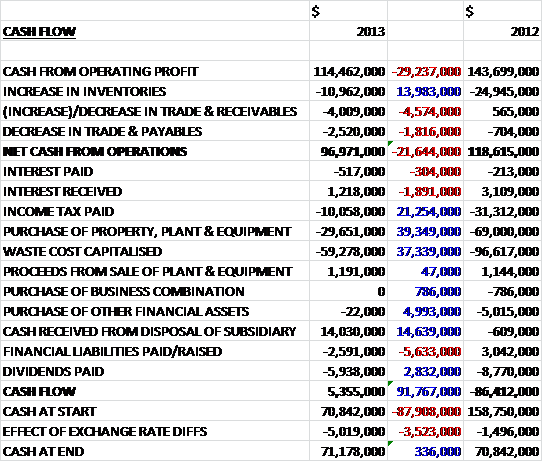
Before movements in working capital, cash profits were down by $29.2M. A smaller increase in inventories than last year meant that net cash from operations was down by $21.6M to just under $97M, which was a little disappointing. All of this cash was spent on the purchase of property plant and equipment ($39.3M less than in 2012) which included just under $10M spent on the new ore crushers, new modular coarse recovery and other costs at Letseng whilst $19.2M was spent on the phase 1 development costs at Ghaghoo; dealing with the waste ore ($37.3M less than last year); and income tax ($21.2M less than last year). A receipt of $14M from the disposal of a subsidiary (the Australian business) then paid for $2.6M of financial liabilities paid and just under $6M of dividends paid to the Lesotho government before leaving a positive cash flow of $5.4M, which was some $91.8M better than the huge cash outflow last year. Not bad, but the operational cash flow does not seem to be covering the capital expenditure at the moment, although this will probably change once the Botswana mine gets underway.
In 2007 the group entered into an agreement in relation to the Chiri Concession in Angola, which is believed to be a diamondiferous Kimberlite. Last year the group decided not to continue with the project which led to the total resource and development costs being written off to the value of $14.8M. There was also a write-off of some capital expenditure to expand the Letseng mine, which cost $1.4M. Also last year the group entered into a sale agreement for the disposal of its Australian mining activities, the Ellendale mine. The sale was finalised in January and the proceeds of $14.8M were received during the current year. There is also a dispute over the amount of tax owed and possible disputes have been identified over $3.6M.
The demand for diamonds in the coming years is expected to outpace supply. The growth in demand, particularly in China and India, is being fuelled by urbanisation and a growing middle class. At the same time, the supply from the world’s mines is diminishing and is unlikely to reach previous levels of production primarily due to the continued depletion of existing deposits and the scarcity of economically viable global diamond deposits. This, together with the capital intensive nature of developing and operating a diamond mine creates high barriers to entry. Despite the increased importance of China and India, the US remains the world’s dominant diamond consumer and ongoing economic recovery has resulted in improved demand from this region since 2008. Meanwhile diamond prices are now above pre-economic crisis levels and the rough diamond market was relatively stable in 2013. Looking ahead, the group expects diamond prices to remain stable in 2014 with the potential for modest price increases.
In 2013 the Letseng mine produced 95,053 carats, down from the 114,350 carats produced last year. During the year, the group recovered a 12.47 carat blue diamond from the mine which sold for $7.5M and helped the mine achieve a $2,043 per carat average price compared to $1,932 last year. The total tonnage of ore mined was 6.2MT and 84% was sourced from the Main Pipe with 16% coming from the Satellite pipe (this compares to 76% from the main pipe in 2012). This, together with some internal basalt dilution that took place resulted in the reduced number of carats produced. The plan going forward is to achieve a 75:25 split from the two pipes. Waste tonnes in 2013 was up 10%, according to plan, and the requirements to access the higher grade satellite ore. During 2014 the mining contractor will deliver four new 100 tonne dump trucks and two new 300 tonne hydraulic excavators which will improve the waste mining efficiency in line with the anticipated waste mining in future.
A number of initiatives to reduce diamond damage were embarked on during the year. A test was undertaken to determine whether plant tonnage throughput was related to diamond damage but despite testing during the first quarter of the year, no correlation was found. In the second quarter, the secondary and tertiary crushers were replaced with more diamond friendly technology and the overall size fragmentation of blasted ore was reduced. These initiatives resulted in a marked reduction in diamond breakage in the larger diamonds in the latter part of the year.
Also during the year a new resource drilling campaign was commenced, which aimed to improve the geological knowledge of the Letseng kimberlites. A total of 9,400 metres of drilling was planned, 30% of which in kimberlite with the remainder in Basalt. So far, 4,700 metres of drilling has been completed with the remainder to be finished in Q1 2014. After the new crushers were installed, a plant upgrade has been mooted in order to expand the production capacity and a pre-feasibility study should be completed in Q1 2014. During the latter part of 2013, a project to upgrade the existing recovery process through the construction of a new coarse recovery plant was developed and approved and should include new X-Ray technology to pick up the high value type II diamonds.
Also during the year, the group signed a new processing contract where the plant contractor will operate the two processing plants until 2017. The contract includes a lower margin paid to the contractor but makes provision for performance based payments. Next year at the mine the group will focus on the design of the new coarse recovery plant with a view to commissioning in 2015; the refinement of the expansion project; the continuation of test work with new waste sorting technology; revisiting the optimal timing of moving from open pit mining to underground mining in the satellite pipe; additional exploration drilling to increase the knowledge of the resource and continued cost management.

During the year good progress seems to have been made on the Ghaghoo mine. The mine is quite a challenge because it has 80 vertical metres of sand overburden before reaching the rock. The 473 metre long sand portion of the access decline was completed in July with a further 500 metres of basalt development being completed during the year. Kimberlite ore was intersected in November some 134 metres below the surface. As of the end of the year, the access decline had reached a depth of 145 metres and a further 50 metres of decline development is required to reach the first production level break-off at a depth of 154 metres below the surface. The sinking of the ventilation shaft was delayed to 2015 as a redesigned ventilation system has allowed the group to sink smaller holes. These should be complete by the end of Q1 2014.
The processing plant will be fully commissioned well ahead of a sustainable feed of run of mine ore becoming available from underground and a build-up to a steady state production rate of 60,000 tonnes per month is planned by the end of next year. It is expected that about 200,000 to 220,000 carats will be extracted from 720,000 tonnes of ore per annum. All mining infrastructure has been completed and is operating satisfactorily. During the year, $19.2M was spent on the project and due to the delays associated with the development of the sand portion of the access decline, the total phase 1 capital budget increased to $96M, of which $71.2M has been spent to date.
Going forward, work will continue on the development of the access decline and subsequent access to the orebody, followed by commercial production in the second half of 2014 and activities related to the sinking of the ventilation holes will be completed in the first quarter with the processing plant being fully commissioned by May.
During the year a 164 carat diamond resulted in 11 exceptional polished diamonds with a total weight of 83 carats. Operating costs per tonne treated increased to LSL 152.92 from LSL 125.57 due to the weighting of the amount of ore mined from the Main pipe. Overall the group has 3.46 million carats of provable reserves with 1.38 in Lesotho and 2.08 in Botswana. Indicated resources for the two mines are 1.42 million carats in Lesotho and 15.49 in Botswana. Both reserves and resources increased at Lesotho due mainly to depth extension in both ore bodies.
At the current share price the P/E ratio is a pretty good value 13.5, falling to an even better value 12 on next year’s broker estimates. There is currently no dividend paid to shareholders but the board intend to pay a maiden dividend at the end of the 2014 financial year based on continued strong performance. In some ways these results were quite disappointing – net assets fell by quite a substantial amount due to reductions in plant & equipment and financial assets. Cash flow, although positive, was only so good because the group received the cash balance from the prior disposal and as it stand, operating cash flows did not cover all the expenditure. Having said that, Letseng mine is clearly a great assets, with so many good quality diamonds produced and once the capital expenditure calms down, the cash flow should improve. Add to this, the improving long term market for diamonds and Gem Diamonds starts to look like a good investment. I will probably buy in here with further visibility of how the Botswana mine is progressing.
On the 12th May the group released a statement covering trading for Q1 2014. It was noted that the net cash position at the end of the quarter stood at $89.1M which as an improvement from this time last year. The demand for rough diamonds continued the positive trend seen in Q4 last year with increased buying activity and strong prices. Trading activity in the polished market also remained positive. At Letseng, 26,055 carats were recovered compared to just 18,775 in the same quarter of last year and 27,227 in Q4 2013. Waste stripping increased due to the shorter haul distance on the new cutback that started in January. 35% of the ore was sourced from the satellite pipe during the quarter compared to 0% in Q1 2013 and 56% last quarter with half the remainder being sourced from the main pipe and half from old stockpiles which, along with some power outages during the quarter, caused the reduction in the carats obtained when compared to Q4 2013.
The average price achieved for the rough diamonds during the quarter was $2,723 which took the 12 month rolling average to $2,383. As previously reported, there were two exceptional large diamonds recovered, the 162.02 carat diamond sold for $11.1M and the 161.31 carat diamond sold for $2.4M. The new coarse recovery plant project is on track for the scheduled commissioning in Q2 2015 which will improve the recovery of high value type II diamonds. Construction on the plant is due to commence in Q3 of this year. The development of the Ghaghoo mine is progressing well and it remains on schedule for commercial production in the second half of the year. Kimberlite was intersected in the first production tunnel on level one in May and drilling of the first ventilation holes was completed with the second hold 80% complete. So far, $76.3M of the $96M capital budget has been spent. This seems to be a decent update on the whole.
On the 16th July the group released a revised Resource and Reserve statement. The updated statement reflects a significant increase in the Letseng Indicated Resource category of 127% to 3.23M carats. This is as a result of a 100 metre depth extension beneath the current pit bottoms to a new depth classification of approximately 350 metres below the current mine pits on both the satellite and main pipe ore bodies. The extension has not only resulted in a significant increase in Indicated Resources but also shows an increase in the Letseng Probable Reserves, up 64% to 2.26M carat which means that the entire 22 year life of mine plan is now classified as a Reserve. In addition to this the average diamond price for the mine has increased by 19% due in part to the improved recovery of large stones. This all seems very good to me I have taken a position here.
On the 29th July the group released a statement covering trading in the first half of the year. The cash position has improved further to $114M and the board remains on track to pay a maiden dividend at the end of the financial year. At Letseng, the number of carats recovered was up 29% on the same period of last year at 54,678. This was driven by the higher percentage of ore from the Satellite pipe and technical improvements in plant throughput. Waste mining for the period was 2% higher and new, larger mining equipment was commissioned in May which will ensure access to adequate ore in both pits and improved unit costs. During the period, 36% of the ore was sourced from the Satellite pipe and the Alluvial Ventures plant continued to run and the contract has been extended to the end of 2015.
During Q2 a large diamond of 132.55 carats was sold for $7.5M which took the exceptional diamonds to three for the half year. The new coarse recovery plant remains on track for completion in Q2 2015 and work to identify improvements to throughput and diamond breakage has progressed to the point that the first phase of the upgrade at Plant 2 has been approved. Phase one of the project will commence in Q3 2014 and is planned to complete by Q1 2015. It will deliver an increase in treatment capacity of 250,000 tonnes per annum as well as further reducing diamond damage at a cost of approximately $5M.
In Botswana the development of the Ghaghoo mine is progressing well and on schedule with 2,400 carats having been recovered to date during the commissioning of the plant. These included a 20 carat and two 10 carat stones, all larger than the 7 carat diamond recovered during the exploration phase. Optimisation of the treatment plant process is ongoing during the commissioning phase and the production build-up to 60,000 tonnes per month is still anticipated before the end of this year. To date, three production tunnels are progressing within Kimberlite on the first production level, 154 metres below the surface whilst and exploratory tunnel and training slope have been developed in the kimberlite on level zero at 130 metres below the surface. High volumes of water from basalt fissures have been encountered on one area which contributes to difficult mining conditions and necessitated the procurement of additional pumping capacity and the drilling of additional bore holes. Drilling of the second ventilation hole is complete and the third and final hole has been drilled to a depth of 121 metres and is due for completion in July. The first tender for Ghaghoo’s production is scheduled to take place before the end of the year and so far $82M of the total $96M budget has been spent.
The extension of the Alluvial Ventures contract, the new larger mining fleet and improved plant availability have contributed to a positive revision of full year 2014 production with an expected 95,000 to 100,000 of carats now expected to be mined. This is certainly a positive update and all seems to be progressing well, although the water encountered in Ghaghoo should be watched. Happy to continue holding.
On the 5th August the group announced that it had recovered a whopper of a diamond! It is 198 carats white type IIa diamond and shows no florescence. I am not sure what most of that means but it is huge and expected to achieve a good price when sold later in the year.