

Tesco has now released its full year results for the year ending 2014.

Revenue was up overall due to a £256M increase in Asian sales, counteracted by falls in UK, Europe and Bank revenue. Employee costs increased by £386M but operating expenses on retail property, and cost of inventories fell considerably, by almost £600M in the case of the latter. There was no return of the near half a million pound goodwill impairment seen last year but other cost of sales picked up this slack. Overall, gross profit was down by £144M when compared to 2013. Admin expenses were up slightly but the group made a £278M profit on property items compared to a £290M loss last year which caused the operating profit to increase by £249M. An increase in pension costs and the reduction of joint venture profits gave a profit before tax and discontinued operations some £202M better than last year. Tax was down £182M and the loss from discontinued operations (this year classified as the Chinese and US operations) fell by £562M, which included a £540M write-down of goodwill in the Chinese operation. This meant that overall profit for the year was up by £946M to £970M.

Total assets were pretty much on a par with last year. During the year the largest increases were a £1.856BN hike in assets of a disposal group held for sale, relating mainly to the Chinese business, a £1.356BN increase in loans and advances to customers and a £494M increase in short term investments. These were counteracted by a £1.774BN reduction in the value of investment properties as £1.623BN of investment property was reclassified as property, plant and equipment due to the level of service provided to some mall tenants in Asia (there was a £707M impairment on some European property), a £668M fall in goodwill as Chinese goodwill was moved to assets held for sale and a £469M decline in the value of derivative financial instruments (possibly moved to “short term investments”?).
Liabilities, however, increased by just under £2BN due to a £911M hike in liabilities of the disposal group, an £843M increase in customer deposits, an £815M growth in pension obligations and a net £379M increase in borrowings. These were somewhat mitigated by reductions in deferred tax liabilities, trade payables and deferred income. Overall, net tangible assets fell by a substantial £1.372BN to £10.927BN.
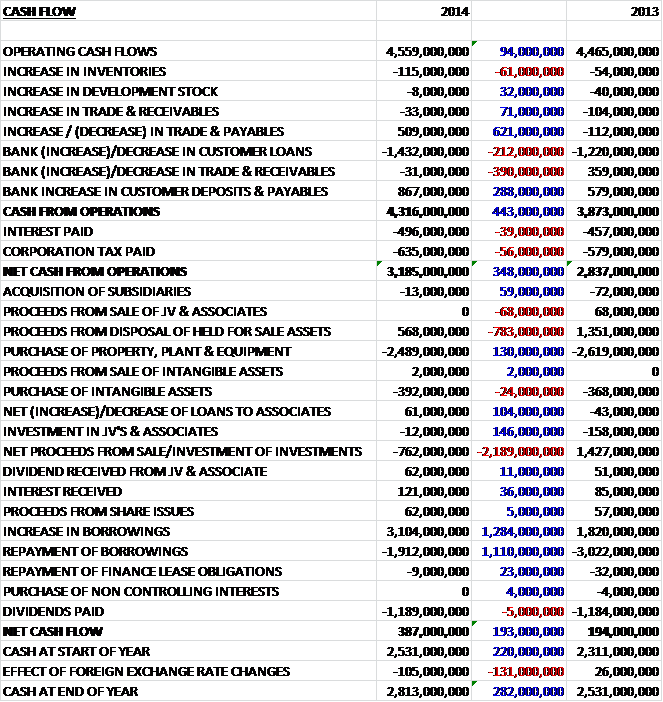
Before movements in working capital, cash profits were broadly flat on last year, up by just £94M. An increase in payables drove the cash from operations up by £443M when compared to last year before slight increases in interest payments and tax paid meant that net cash from operations was £348M better than in 2013 at £3.185BN. The bulk of this was spent on capital expenditure with £2.489BN going on new property, plant and buildings (£130M less than last year) and £392M on intangible assets. The group also spent £762M on investments but did get £568M from the sale of disposal assets. This is pretty much all the cash accounted for so the £1.189BN of cash spent on dividends is paid for by a net £1.192BN increase in borrowings with a few other smaller items giving a net cash flow of £387M. It is clear, therefore, that the dividends are being paid entirely from new loans.
Trading profit for the UK business was £2.191BN, an £81M fall when compared to last year mainly due to the drag from the larger stores and the continuing competition from the discounters.
Trading profit for the Asian business was £692M, a £41M decline when compared to 2013. Regulatory restrictions in South Korea continue to be a drag on sales but the work done to refresh some of the stores has delivered some encouraging results and 71 new convenience stores were opened during the year. It has been a challenging year in Thailand as the recession and political unrest in the country took its toll. Performance in Malaysia was more resilient with two new stores opening and the home shopping business starting up.
Trading profit for the European business was £238M, a £91M collapse on last year. The group faced weak momentum from the end of last year and larger stores particularly underperformed, although performance has been improving throughout the year. In particular, Turkey faced very challenging economic and competitive conditions and the group continues to try and find a way to turn a profit from the country and in order to try and achieve this, they are in negotiations with some potential partners. Poland was a particular focus this year and the group’s plans has caused an improved like for like sales trend during the year. Ireland was a difficult market with severe pressure on consumer spending and aggressive competition from the discounters. Capital expenditure in Europe was reduced by 40% and it is expected that this will be the level going forward.
Trading profit for the bank was £194M, a £3M increase when compared to last year. This increase was despite the loss of legacy insurance distribution income. The group also set aside another £20M provision for payment protection insurance. Customer accounts for credit cards, loans, mortgages and savings were up 14% and in its first year of trading, mortgages reached a balance of £700M. Profit from the insurance business was down 17% reflecting increased competition driving premiums down. The current account remains on track to be launched during 2014.
There is clearly a lot of work to be doing and management seem to be concentrating on the UK business for now. So far, £1BN has been invested into the brand in six key areas: staff, stores, range, price, branding and online. The investment is long overdue as acknowledged by the CEO but some progress has been made. More staff have been employed and they have been trained in customer service and customers have reported some improvement. During the last two years about a third of the UK stores have been refreshed with improvements made to store environments. Up to now most of the focus has been on the smaller stores but since the large stores have been such a drag on results, the focus is now on the superstores. Next year, 110 of the Extra stores will be improved aiming to use the restaurant and food brands to make the stores more of a destination in their own right. Clearly this refresh will result in a short term increase in costs but should be worth it in the long term.
Both the premium own brand and the healthy living brand have been relaunched during the year and again, customer feedback has been good. After the horse meat fiasco, the group has also spent more money improving the supply chain. Price is clearly another area that Tesco has been losing out on following the rise of Lidl and Aldi. The group is making an initial £200M investment in reducing prices, starting with staples such as milk, carrots, onions and eggs. Tesco now offer one hour delivery slots for their groceries and non-food items which is better than most retailers. Capital expenditure for the group is going to be capped at £2.5BN for the next three years which seems like a sensible idea.
During the period the group entered into an agreement with China Resources Enterprise ltd to combine Chinese retail operations which will leave the group with a 20% share. The difference between the carrying value and the sale value has meant that the group has taken a £540M hit to remeasure the net assets, which is rather substantial. In November the group completed the sale of most of its US assets to YFE Holdings and the remaining assets in the country are in the process of being disposed of. The exit of Japanese operations was completed in January 2013.
After the end of the reporting date, the group entered into an agreement with Tata to form a 50:50 joint venture in India. Tesco will initially invest £85M. The group also acquired Sociomantic Labs, a Berlin based digital advertising company for £124M. Sociomantic operates in 14 countries worldwide. The group is now without a Chief Finance Officer as Laurie McIlwee resigned from his position after 14 years at the company. The group welcome Mark Armour as a new non-executive director.
Net debt remained unchanged and finished the year at £6.597BN. At the current share price the P/E ratio is a rather expensive 20.4 but when discontinued operations are discounted, this falls to 10.3 with a figure of 10.4 predicted for 2015. At the current share price the yield is an impressive 6% but as we have seen, this is currently being covered by new debt. These are difficult times for Tesco. They seem to be having problems in the majority of their markets and in the UK and Ireland the relentless rise of the German discounters and the migration of customers away from the large super stores is really starting to hurt. It was disappointing to see net assets fall by well over £1BN and even with the £2.5BN cap on capital expenditure, there will not be enough of the cash from operations (£3.185BN) to cover the dividends at the current level and it is hard to see where any growth is going to come from in the short term. The headline P/E is very expensive but this is mostly due to the write-down of the Chinese assets which seems to have been a costly mistake. Overall, it is hard to justify buying any more shares, even at these depressed prices.
On the 29th May the group released a quick statement to confirm that the joint venture agreement with CRE in China had been approved.
On the 3rd June the group released a statement confirming that the 50:50 joint venture with Tata in India had been approved. The business will be known as Star Bazaar and already has a small number of stores.
On the 4th June the group released a statement covering Q1 trading. So far this year prices have been cut on some products and delivery charges whilst the store refresh programme is steaming on ahead, with 100 now completed and 200 more expected before the end of the year. As expected, this has impacted short term sales performance but with volumes on the lines where investment has been focused up 28%, there seems to be some success in the strategy. Q1 saw a continuation of the challenging consumer trends in the UK and the deflationary impact from lower price, along with a reduction in the level of untargeted promotions (responsible for more than half of the underperformance relative to the last quarter) which led to a 3.7% fall in like for like sales in the country.
International sales increased by 0.5% at constant exchange rates but in a reflection of the strengthening pound, there was an 8% fall at actual rates. Like for like sales in Asia fell by 3.2%, an improvement on the 5.6% fall recorded last quarter but the difficult conditions in Thailand continued, with a 5.3% fall and disappointingly sales in Malaysia recorded a fall having shown an increase last quarter. In Europe like for like sales decreased by 1% as increased sales in Turkey, Hungary, Czech Rep and Poland were counteracted by large declines in Slovakia and Ireland where there is intense competition. These figures are not great and are not enough to tempt me at these bargain levels.
On the 10th July, Tesco announced they had found a replacement CFO. Alan Stewart will join the group having gained experience as CFO for M&S and Thomas Cook.
On the 21st July the group made a surprise announcement that Philp Clarke will be stepping down as CEO to be replaced by Dave Lewis in October of this year. Dave joins from Unilever where he is Global President, Personal Care. He has been at Unilever for 28 years and has experience in business turnarounds. It seems a new direction was needed and it will be interesting to see how Dave applies his experience to the retail sector. Also hidden in the announcement was a profit warning. Current trading conditions are more challenging than anticipated. The overall market is weaker and combined with increasing investments to improve the customer offer, trading profit of the first half of the year will be somewhat below expectations. It seems to me that the turnaround for Tesco is still some way off.
On the 29th August, Tesco released yet another profits warning and have guided trading profit expectations next year to be below £2.5BN with profit in the six months to August 2014 to be £1.1BN. It was also announced that Dave Lewis will be starting his job as CEO a bit earlier than expected, on the 1st September, hence the timing of this update I suppose. Reflecting the current trading and expectations going forward, the interim dividend has been cut by 75% to 1.16, which as I have mentioned previously, seems like a prudent step. Additionally, they are implementing further reductions in capital expenditure and for the current financial year, it will probably come in at around £2.1BN, some £400M less than originally planned with IT and the roll out of the store refresh programme facing the brunt of the constraint. It will be interesting to see how the new CEO copes and I will be watching with interest.
On the 22nd September, Tesco announced that it had identified an overstatement of its expected profit for the half year due to accelerated recognition of commercial income and delayed accrual of costs. As a result group profits will be £250M less than the guidance posted previously. Oh dear.
On the 23rd September the group announced that the new CFO, Alan Stewart, will join Tesco from today and not the start of December as previously announced. I would hazard an opinion that he is badly needed and if there was a CFO in place, some of these problems would not have occurred.
On the 1st October it was announced that the FCA had commenced an investigation following the overstatement of expected profit. This was to be expected I guess.
On the 6th October the group announced that they had appointed two new much needed non executive directors. Richard Cousins has been CEO of Compass for the last eight years and he sounds like a very good appointment. Mikael Ohlsson is currently non executive director at Volvo, Ikano ans Lindengruppen having previously been CEO of IKEA group.
On the 16th October it was announced that Berkshire Hathaway, Warren Buffet’s investment vehicle, had sold down to below 3% of the company equity. He has taken quite a hit with this sale so must really not see much of an investment case here.