

Braemar Shipping has now released its final results for the year ending 2015.
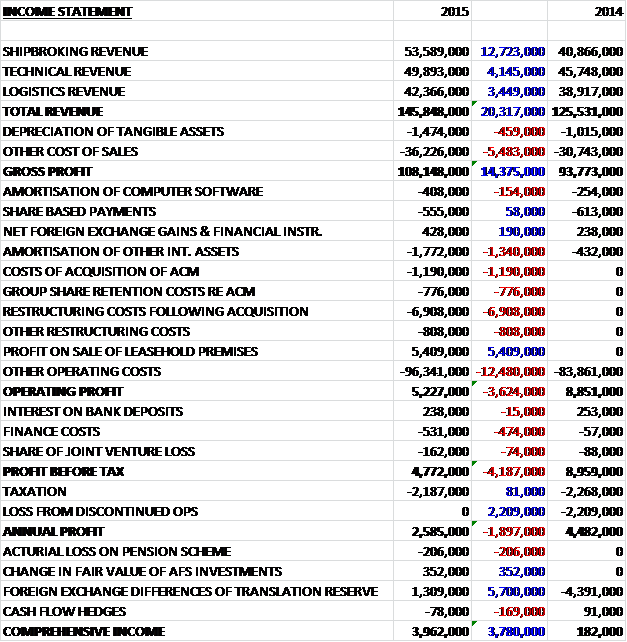
Revenues were up across all sectors with ship broking up £12.7M, Technical increasing by £4.1M and Logistics some £3.4M higher. Cost of sales increased considerably less, however, to give a gross profit £14.4M higher than last year. Underlying operating costs then increased by £12.5M, partly as a result of the larger board following the ACM acquisition, and amortisation of intangibles increased by £1.3M but there are some sizeable one-off items to take account of. The £5.4M profit from the sale of the old head office was more than offset by £6.9M of restructuring costs following the acquisition, £1.2M in actual acquisition costs, £808K of other acquisition costs and further charges of £776K relating to a share plan to retain key ACM staff that will bear a cost for the next few years, which all meant that operating profit fell by £3.6M year on year. It could be argued that the intangible amortisation was not a one-off but if we take off all the other non-underlying costs, operating profit came in some £649K ahead of last year. We then see higher finance costs but the lack of a £2.2M loss from discontinued operations last year meant that the profit for the year stood at £2.6M, a fall of £1.9M year on year.
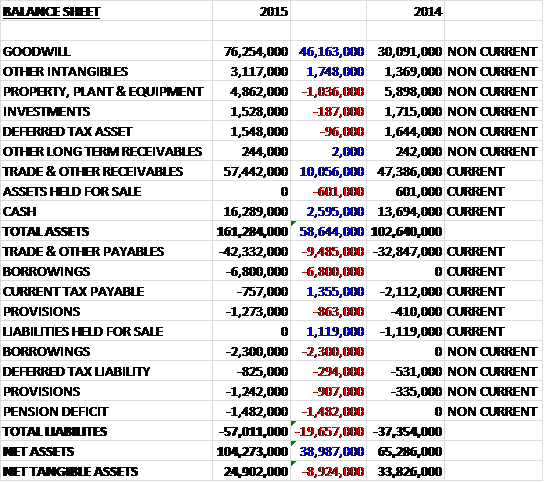
When compared the end point of last year, total assets increased by £58.6M driven by a £46.2M growth in goodwill, a £10.1M increase in receivables, a £2.6M increase in cash and a £1.7M growth in other intangible assets, partially offset by a £1M decline in the value of property, plant and equipment. We also see liabilities increase as a £9.5M increase in payables, a £9.1M hike in borrowings and a £1.5M increase in the pension deficit (inherited from ACM) was offset partially by a £1.4M fall in current tax payable and the loss of £1.1M worth of assets held for sale. The end result is an £8.9M decline in net tangible assets to £24.9M.
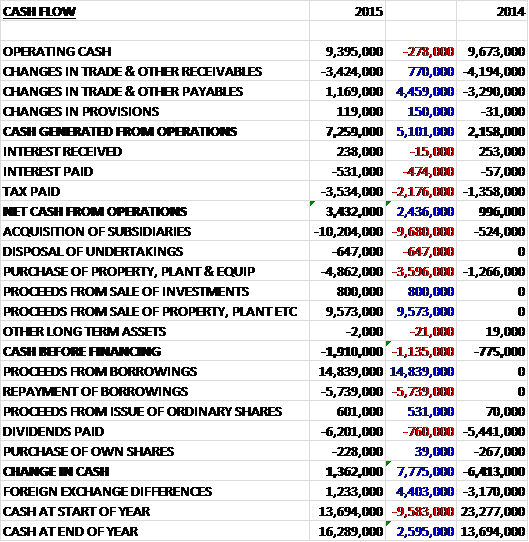
Before movements in working capital, cash profits were £278K lower at £9.4M before an increase in receivables was partially offset by favourable movements elsewhere to give a cash flow from operations some £5.1M higher at £7.3M. There was a greater amount of interest paid and the tax was much higher, more than double that of last year, which meant that the net cash from operations was just £2.4M ahead of last year at £3.4M. Unfortunately this was not enough to cover the £4.9M spent on capital expenditure but the £9.6M head office sale did nearly cover the £10.2M spent on the acquisition. Before financing then, the cash outflow stood at £1.9M. The group then took out a net £9.1M which paid for the dividends (I don’t usually like a company borrowing to pay dividends) and left the group with a cash inflow of £1.4M for the year and a cash pile of £16.3M at the year-end.
The shipping markets generally worked in the group’s favour during the year with the sharp fall in oil prices giving rise to increased activity and freight rates in the tanker markets. On the other side of the coin, the falling oil price led to a significant fall-off in rates in the offshore market which offset some of these gains. The effects were also felt in a the Technical division where some slow-down of activity in SE Asia was seen, but again this was offset by increased demand for LNG services.
Underlying operating profits at the ship broking business increased by nearly £3M to £5.6M following the merger of ACM. The operating margin increased from 6.4% to 10.4%. The acquired tanker desks have now been fully integrated as planned which has enhanced world-wide market coverage. During the year, the well-publicised fall in the price of oil meant that oil supply improved and the demand for large crude tankers in particular was strong in the second half of the year with the highest freight rates for more than five years. The clean trades have also enjoyed a significant improvement in product carrier demand as refinery margins improved. The renewed strength in the tanker markets along with an expectation of future volatility has also acted as a stimulus to the long term period market with the group concluding some business for the forward order book.
The LNG team performed well, increasing transaction numbers and concluding significant newbuilding business and the gas and small tanker teams now have a wider market coverage following the acquisition. During the year the LPG team was involved in special long term projects to assist petrochemical companies securing their future feedstock needs but European spot activity was quite soft for much of the year, although refinery activity was stronger in the final part of 2015. In the offshore department, both chartering activity for anchor handlers and platform supply vessels, and project business was good but the decline in the oil price caused the exploration and production industry to cut back, leading to a fall in freight rates. The outlook for the offshore market remains challenging for the new year with an expectation of lower activity, partly cushioned by a good forward order book.
In dry bulk, freight rates were more reasonable in most sectors. Chinese iron ore demand is a key driver of the Cape market which is fairly strong despite faltering steel production in the country but the over-supply of dry bulk tonnage, particularly in Q4 when freight rates fell by 20%, took its toll on the market. Management have apparently begun to see an increase in scrapping of old vessels in 2015 but the full unwinding of oversupply is likely to take some time leading to subdued freight rates going forward. Sale and Purchase income was higher than last year, mainly due to an increase in second hand business across the tanker, bulk carrier and container vessel categories. Second hand tanker values have appreciated quite significantly over the last year in line with the growth in earnings but the reverse trend was evident in bulk carriers, especially in the last six months as their earnings dipped. Newbuild prices fell somewhat over the course of the year and demolition was steady for much of 2014 before picking up strongly in 2015 as older bulk carriers were scrapped.
Underlying profits at the technical division were £6M, a decline of £900K year on year reflecting margin pressure, falling from 15.1% last year to 12.1% this year, and lower activity in offshore. This division now includes the Environmental business which is no longer a separate business segment. The lower amount of oil and gas exploration activity caused revenues at Braemar Offshore to reduce despite the fact that they have continued to win important new business through the downturn but several long term energy projects helped underpin performance to some extent.
Braemar Engineering reported higher revenues and profits which are attributable to an increase in both the marine and shore based LNG consulting as the three year project for the design, site supervision and crew training for six new LNG carriers progressed well with the project moving to the construction supervision phase as planned. The office in Houston also saw solid growth and was appointed to the role of Owner’s Engineers to a significant LNG bunkering and fuelling project which is aimed at supplying LNG vessels for use as bunker fuel. Towards the end of the year, the group announced their involvement in the marketing and development of a new technology for the design of an LNG containment system and they will derive revenue from the initial development phase of this project from next year.
The adjusting business performed well during the year despite the fall in the oil price affecting activity in that sector in the latter part of the year as revenue from adjusting increased when compared to previous years. This improvement is achieved from retaining and expanding market share in existing markets as well as increasing its presence in new areas of operation. There has been some restructuring and a significant recruitment drive over the period which resulted in a higher level of professional staff. In the US, the adjusting business has expanded in the Northeastern states to capitalise on the existing refining, petrochemical and power sectors. The underperforming Brazilian operation was restructured with improvements already showing through and the office in Dubai had a particularly good second half of the year.
Braemar SA reported a 15% improvement in profitability with an increase in revenues as a lower number of surveys being undertaken due to fewer casualty claims in the hull and machinery market was offset by an increase in the number of consultancy assignments and project cargo surveys. Geographically there was a lower level of business in South East Asia where trading conditions were challenging offset by an improved performance in Europe. Braemar Howells carried out a routine level of business during the year with no major incidents undertaken and has opened in a new office in Western Australia to provide consultancy services such as the design and implementation of MARPOL waste reception facilities which are aimed at preventing and minimising the pollution from ships.
Underlying profits at the logistics business were £2.3M, an increase of £294K when compared to last year with operating margins up from 5.1% to 5.4%. Cory Brothers increased revenue and profit due to stronger than expected volumes from the freight forwarding business despite the competitive market place. During the year a cost reduction programme was carried out with some management restructuring and in the first half of the year, the non-core tours business was disposed of. In Port Agency, the Global Hub business continued to grow but the underlying UK port agency market has been challenging. Despite this, market share has increased and profitability was maintained. In the second half markets showed signs of improvement and the business is looking to build market share over the next year as well as growing a presence in North America and the continued growth of the Global Hub business.
Cory Logistics was able to sustain its position in key business areas, with growth in new services as well as the existing contract business which was achieved despite volatile sea freights. The number of forwarding jobs increased by 20% and the Liner business supported 533 calls during the year. The strategy going forward is to expand into European markets, continuing growth of existing core areas and building on newer services such as refrigeration containers.
It was announced that after 12 years at the group, Graham Hearne was stepping down as chairman and he will be replaced by David Moorhouse who has experience serving on the boards of companies in the shipping and energy fields, most recently as Chairman of Lloyds Register. Also, Dennis Petropoulos, Johnny Plumbe and Tim Jacques will all be stepping down at the AGM with Denis becoming president of Braemar Asia and Johnny retiring in order to pursue his independent consultancy interests. Finally, Martin Beer is stepping down after just two and a half years to be replaced by Louise Evans as Finance Director having joined from the Williams Grand Prix team where she held the same position.
Clearly one of the major events of the past year has been the acquisition of ACM. The group spent £10.1M in cash and £40.3M in shares issued and ACM came with just £4.6M of net assets so thwr acquisition generated a rather hefty looking £45.9M of goodwill, apparently attributable to staff. The results are now included in the ship broking division but in the five month period before the acquisition, ACM reported an operating profit of £1M on revenues of £9.8M.
The group currently has bank facilities of £15M relating to a revolving facility of £10M and an amortising term loan of £5M that is repayable at £450K each quarter. As part of the acquisition of ACM, the group did inherit a small pension scheme with a deficit of £1.5M. It is now closed to new members and has only four active members. The current level of contributions from the group is £300K per annum and they are currently in the process of agreeing funding with the trustees that will result in a further annual cash contribution.
Going forward, the ship broking division will benefit from a full year of contribution from ACM, along with the synergy savings that will take place and the board believe that the benefit of the improved tanker markets and the strength of the US$ will balance the effect of the lower oil price on the division. The technical business will see a continued strong contribution from LNG related projects, likely offset by the impact of slower offshore markets, and the logistics division is expected to benefit from a lower cost base and some improvement in activity. Overall the group is expected to make further progress in the coming year and the performance since the start of the new year is in line with expectations.
At the current share price, the underlying P/E ratio stands at a rather expensive looking 17.8 although this is expected to reduce to 14.7 on next year’s consensus forecast. The dividend was kept the same this year despite the higher number of shares in issue and at current prices the yield stand at an impressive 5.1%, although this is not expected to change over the next two years. At the year end the group has a net cash position of £7.2M compared to £13.7M at the end of last year.
Overall then this has been a decent year for Braemar. Underlying profit is marginally ahead of last year despite actual profits falling due to the acquisition related restructuring. Net tangible assets were also down as the group paid hard cash for goodwill, but operational cash flow improved due to less unfavourable movements in working capital. There was, however, no free cash flow and the group had to borrow to pay the dividend, which is not a great sign. Operationally, ship broking had a good year, no doubt due to the contribution from ACM, along with higher tanker rates stimulated by the decline in the price of oil. Bulk shipping is doing less well, suffering from considerable over capacity that is unlikely to be resolved any time soon.
The engineering division had a harder year as good LNG income was more than offset by lower activity in the off-shore oil and gas market. The logistics business had a solid year. The acquisition seems rather expensive to me but there is no doubt that it has rejuvenated the group and should lead to some growth next year as the results benefit from a full year of contribution. The shares do not look great value on a P/E level but the yield is mightily impressive. As we have seen, however, this is no where near covered by free cash flow and it could be in danger if cash generating performance does not improve. Overall I see these shares as fairly valued and will continue to hold.
Braemar Shipping has now released its annual report.
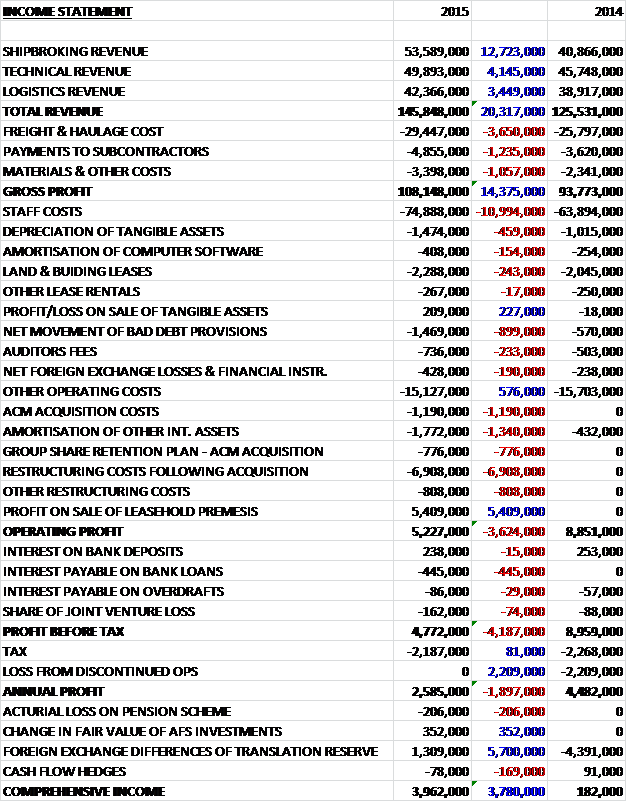
We can see some more detail of the costs. All aspects of cost of sales grew with freight costs up £3.7M, subcontractor payments increasing by £1.2M and material costs up £1.1M. By far the largest increase in admin costs was staff costs, increasing by £11M year on year but we also see a hefty £899K growth in bad debt provisions. Finally, we can see that the increase in finance costs was mainly due to the £445K interest payable on bank loans.
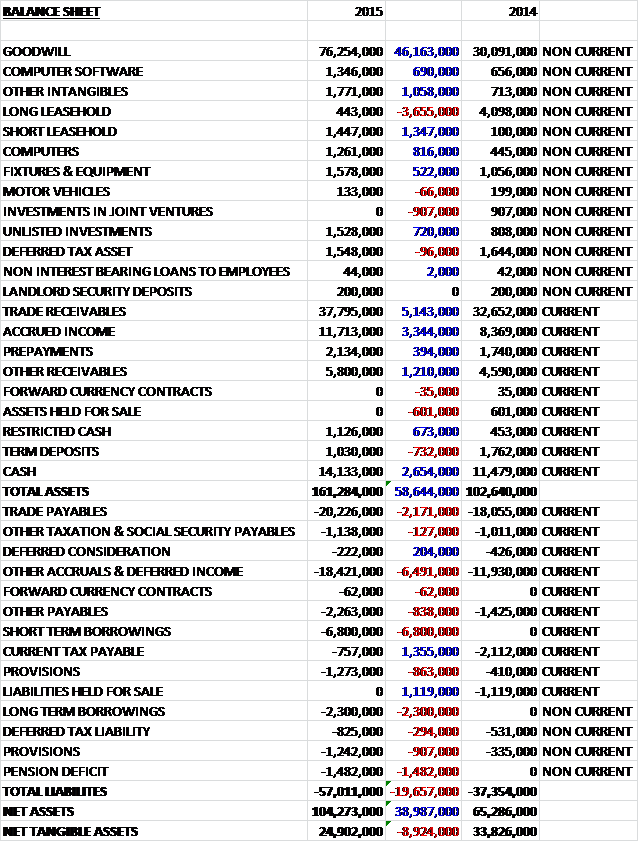
As far as assets are concerned, we can see that the decline in property plant and equipment was due to the £3.7M fall relating to the sale of the long leasehold property and within receivables, increases included a £5.1M hike in trade receivables, a £3.3M increase in accrued income and a £1.2M growth in other receivables. Within payables, the increase was driven by a £6.5M growth in accruals and deferred income along with a £2.2M increase in trade payables. It is also worth considering that as a result of the move to the new office, the forward operating lease payments increased by some £10.6M to £16.6M. Of this, £2.8M was due in the next year.
One thing that I did notice is that the executive directors all enjoyed hefty bonuses this year. They are still not paid ridiculous amounts but the £549K paid to CEO James Kidwell is on the heavy side – I don’t really like to see directors being awarded bonuses for mediocre performances.
As alluded to above, the provision for trade receivable impairment has increased considerably. This year some 11% of the total were impaired compared to 8% last year which seems like a lot to me.
On the 24th June, the group released a statement covering trading in Q1. Overall, trading was in line with the board’s expectations. In the tanker market, they have continued to experience high rates and activity supported by increased worldwide oil production and refining activity. They have also been involved in some good tanker and LNG second hand sale and purchaser business. The dry cargo market remains more challenging, suffering from a surplus of tonnage and a slow-down in demand and the board expects the market to take some time to return to a more reasonable balance. Although beneficial for the tanker business, the falling oil price has led to a reduced offshore activity but the breadth of market coverage means that the group is fairly resilient in changeable markets.
The performance of the technical division has been in line with expectations and head of Q1 last year. Braemar Engineering, which specialises in LNG consultancy and design performed particularly strongly, as expected, tempered by some reduction in offshore related business. The ship agency business started the year well as a result of buoyant tanker market activity but this was offset by a slower freight forwarding performance. Overall then, nothing much has really changed and the outlook for the full year remains as it was at the last update.