

Dechra Pharmaceuticals is an animal pharmaceuticals company who sells products to both the companion animal and farm animal markets. These results will be dominated by the recent acquisition and I will start by looking at the income report.
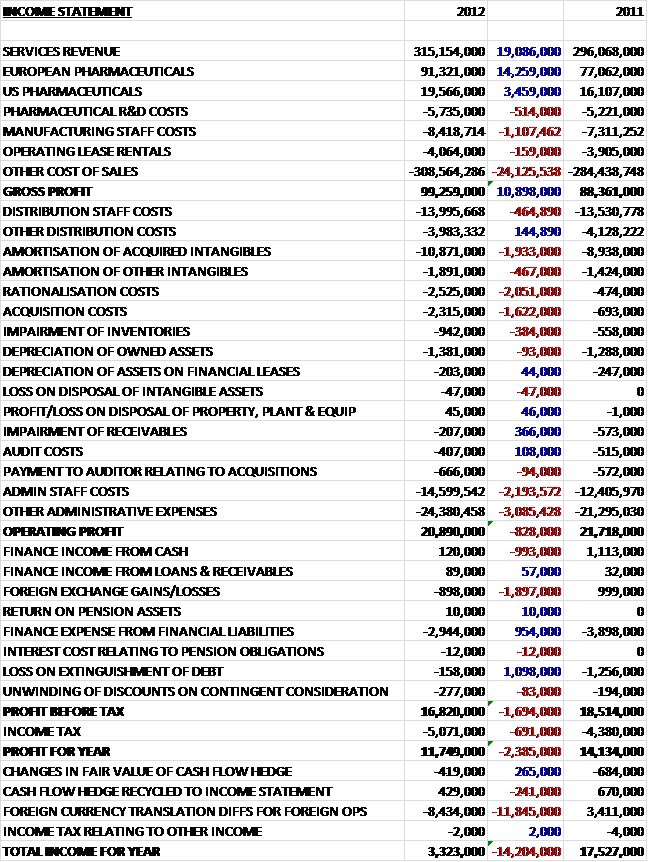
The total income for the year seems to have taken a big hit, down £14.2M to £3.3M but let’s see how that took place. The Gross Profit figure of £99.3M (up nearly £11M) is very healthy and although costs are up, revenues are up even more. Service revenues increased by £19M, European Pharmaceuticals did very well, up £14.3M and US Pharmaceuticals were up a more modest £3.5M.
Operating profit for the year fared a little less well and was just under £1M off last year’s amount at £20.9M. The reason for this seems to be predominantly the effect of the acquisition and we see that Amortisation of Intangibles and Rationalisation costs are both up £2M, with Acquisition costs up £1.6M and Admin Expenses up £5M.
The profit for the year has fallen further when compared to last year, down £2.4M to £11.7M. This is mainly caused by the effect of foreign exchange differences as the Euro has weakened against Sterling. Finally, huge negative swing in the Total Income I mentioned above has also been caused by exchange rate differences with the currency translation on foreign operations taking a huge swing of £11.8M to the negative. The group does not hedge against foreign currency differences, but looking at this, perhaps they should consider it. Apparently a 10% appreciation in the pound against Danish Krone would cause losses of £4M, but appreciation against other currencies does not seem to have much of an effect.
Although, when compared to last year these results are not that great, I think it is important to realise that the main causes of the negative swings are one off costs relating to the acquisition and the unfortunate changes in currency values.
| EPS |
2012 |
2011 |
|
| PROFIT AFTER TAX |
11,749,000 |
-2,385,000 |
14,134,000 |
| UNDERLYING PROFIT AFTER TAX |
24,302,000 |
22,748,000 |
|
| NUMBER OF SHARES |
75,306,859 |
2,928,205 |
72,378,654 |
| EPS |
15.6 |
19.5 |
|
| UNDERLYING EPS |
32.3 |
31.4 |
|
| SP |
486.0 |
-5 |
490.8 |
| P/E |
31.2 |
6 |
25.1 |
| UNDERLYING P/E |
15.1 |
15.6 |
|
This year the EPS is 15.6 but when we take out the one-off costs, the EPS becomes 32.3. This translates to a P/E of 15.1 for the end of the year. However, if we take the share price as I write this, the underlying P/E is 18.5, which seems a little high to me. The consensus for the EPS next year is 40, giving a future P/E of a more reasonable 14.9.
Moving on to the Financial Position Statement
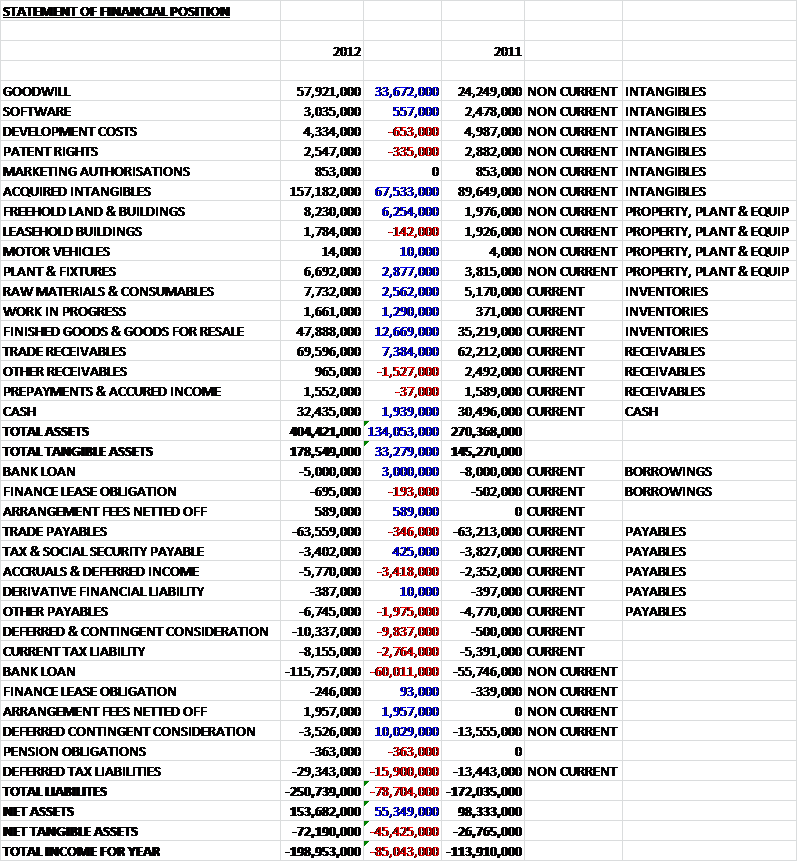
Looking at assets first, we can see that this is up a huge £134M to £404M but tangible assets are only up £33.3M. The largest increase in assets has come from Acquired Intangibles, up £67.5M to £157.2M. I am always wary about these kinds of assets as they can be used to put a bit of a positive spin to a balance sheet. I have no idea whether the intangibles are worth this much, but by definition they cannot be realised by the group in times of need. In this case, the bulk of the acquired intangibles relate to the development costs and product rights of the products made by the acquired companies. The next largest increase is seen in inventories, and particularly finished goods. No doubt gained as part of the acquisition. Similarly we also see that the value of freehold land and buildings increased £6.3M to £8.2M – traditionally Dechra has not really held much in the way of property. Cash remains fairly stable, up £2M to £32.4M. The Patent rights mentioned here relate to the payments in order to acquire and market Trilostane, the active ingredient in Vetoryl, an important product for Dechra.
It should be noted that 13.4% of those trade receivables are owed by just one company. This is a little high considering no company accounts for more than 10% revenues so hopefully the group have an eye on this.
We can see that liabilities have also increased, up £78.7M to £250.7M. This is almost entirely due to the £60M hike in the bank loan – that will take some time to pay off! £15M is due to be paid off within 2 years, and the rest is due before 5 years – presumably the loan will have to be re-negotiated before that point. Otherwise we see a £15.9M jump in acquired tax liabilities – I am not sure exactly what would have caused this, but my guess would be that these were inherited in the acquisition too. We can also see that a large chunk of contingent consideration has been moved from non-current to current, so this will have to be paid off quite soon.
Overall, net assets are up £55.3M to £153.7M but when we strip out intangibles, there is a less rosy picture with the net tangible assets falling £45.4M to -£72.2M, which makes me a little nervous.
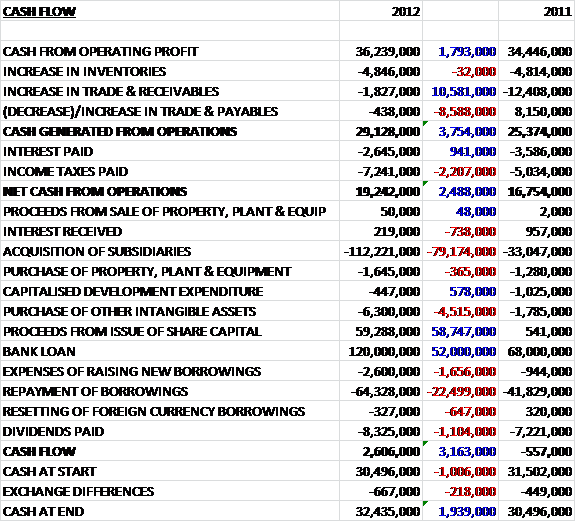
During 2012 the cash generated from operating profit was up £1.8M to £36.2M. The group seems to have done very well in raining in the increases in money owed, and through this has enabled the cash generated from operations to increase by £3.8M to £26.1M. An increase in tax paid then caused the net cash from operations to increase by slightly less, but still up by £2.5M to £19.2M
The actual cash flow is pretty meaningless in this context. £112M of cash was paid for the acquisition, which is balanced against £56M of net new bank loans and £59M received through the issue of new share capital. Cash was also spent on some assets to leave the cash flow at a positive £2.6M. As I say, however, this will be much more meaningful next year when we see how the new group settles down.
Overall most of the segments seem to be performing well with solid organic growth seen from licensed pharmaceuticals, there was also modest growth seen in the pet diet segments and third party manufacturing. Margins in the services segment suffered somewhat from the competitive market.
In Europe, sales have been increasing in line with inflation as consumers continue to treat sick animals but the high level of growth has slowed somewhat due to the economic issues and spending on discretionary items (such as diets) has reduced. In the US, revenues were about 26% higher than last year. The US is the world’s largest veterinary market and offers a good prospect of growth for the group. Service revenues increased by 6.5% where operating efficiencies counteracted the effect of more customers buying cheaper alternatives from the internet, but profits were actually down due to the squeezed margins brought about by the competitive nature of this segment at the moment.
This year for Dechra is one that is characterised by acquisitions. The world-wide rights for HY-50, a treatment for lameness in horses, was acquired for £5.1M and should be earnings enhancing from the off. The biggie, however, was the purchase of Eurovet for €135M. This is a company that in some ways is quite similar to Dechra and offers a quick route for expansion into mainland Europe and the farm animal market. Hopefully after the synergies have been realised and the new markets have an effect, Dechra won’t have overpaid. It was a lot of money, but the acquisition does seem to be a good one. I would like them to focus on organic growth for a couple of years, however.
The group continues to develop new products, some new pharma registrations were Libromide in 11 Euro countries, Vetoryl in Brazil and Methoxasol in the EU. As far as diets are concerned, the group developed endocrine diets, diets for cats with gastrointestinal disorders and a diet to support cats with reduced joint function. The product pipeline also looks healthy-ish with the next novel pharma product due to enter production in 2014 (equine lameness). In 2015 a canine and feline endocrine product should enter production too but a feline gastrointestinal product has been terminated due to high costs and negligible market, which is a shame.
In 2013, three new diet products should be developed (orthopaedic, critical care and urinary for cats/dogs), and in 2014 there is a dental diet and an allergy diet for cats and dogs (nothing after this, though so far).
The UK still accounts for the majority of revenues, at £322M but revenues from Europe (£72M) and the US (£26M) are both increasing rapidly due to acquisitions. Revenues to other parts of the world are down, however. I like to see the company diversifying away from the UK but also think it should consider expanding outside of the traditional markets.
Overall then, I feel the underlying performance of Dechra has been quite good. Revenues are up nearly across the board but profits were hit by the costs associated with the acquisitions, and problems in currency exchange rates seems to have had quite an effect on the actual income received. The P/E at the moment is quite a high 18.5 but the predicted earnings for next year means the ratio on the current share price for 2013 is 14.9, which is not mega-cheap but not a bad valuation.
The dividend yield at the current share price at 2.1% is not exactly that exciting but it is steady and is covered 2.2 times.
Assets increased as would be expected with the acquisition but most of the increase was from intangibles while the new bank loan meant that liabilities increased considerably too. This led to the net tangible assets falling further into negative territory. The cash flow is pretty meaningless as cash was raised to pay for the acquisition but the underlying cash flow was positive and improved from last year.
Overall, given the fairly high current valuation and slight uncertainty over the bedding in of Eurovet, I would rate these a Hold
On the day of the AGM, the group released an interim management statement which stated that they are trading within expectations. Overall, revenue in Q1 was up 24.9% on the same period of last year, excluding Eurovet this was a lower increase (6%). In Europe, excluding the contribution from Eurovet, revenues were up by 3.2% (16.7% at constant levels). This increase is due to both pharmaceuticals and diets. It also looks like they are being hit by some adverse exchange rates.
In the US, revenues were up 24.8% on the same quarter, which is pleasing growth and services were up 6%, at a constant margin.
Overall, this does not contain any surprises and I continue to hold this share.
On the 30th November, the group announced that they had paid an extra £9.4M consideration to the vendors of Dermapet which was triggered revenues from Dermapet products exceeding $15M in a year. Although it is positive news that the products are performing well, £9.4M is a lot of money that will make a considerable dent in the cash flow for this year. Another payment of $5M will be paid should revenues exceed $20M over a year.
On 8th January 2013, the group issued a statement covering trading in the first half of the year. They state that trading has been in line with expectations, up 20.2% on the year before. European pharmaceuticals grew revenues by 61.4% but taking out the effect of Eurovet, revenues declined by 2.4%. This was blamed on changes to distribution arrangements in France and Germany but these new arrangements should lead to improved margins in the medium term. US Pharmaceutical revenue grew by 10%, which is a decent result with Dermapet, Vetoryl and Felimazole performing particularly well. Services revenue over the period was 5.1% up on the previous year.
Overall, this seems to be a good update and I will continue to hold, waiting for some figures coming out in the next month.
On 31st January 2013, Dechra announced the appointment of Anne-Francoise Nesmes as CFO. She has joined from Glaxo Smithkline where she worked as senior vice president, finances of vaccines. She is a French national who has had work experience in the UK (although with Glaxo she was working in Belgium). I do not know much more about the woman but this looks like an interesting position for her.