

Paypoint has now released its final results for the year ended 2016.
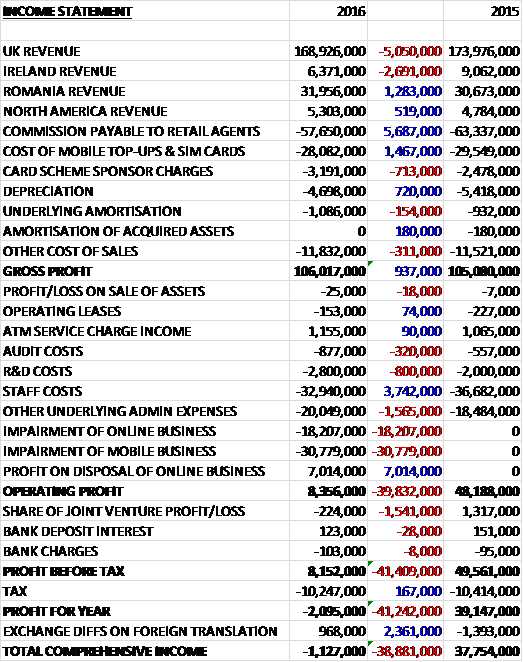
Revenues declined when compared to last year as a £1.3M increase in Romania revenue and a £519K growth in North American revenue was more than offset by a £5.1M decrease in UK revenue and a £2.7M fall in Irish revenue. The commission payable to retail agents fell by £5.7M, the cost of mobile top ups and sim cards was down £1.5M and depreciation fell by £720K as the estimated useful life of the automatic teller machines was increased, but card scheme sponsor charges were up £713K and other cost of sales increased by £311K which meant that the gross profit was £937K higher than last year. Staff costs decreased by £3.7M but R&D costs increased by £800K and other underlying admin costs increased by £1.6M but there were some large one-off costs this year. There was a £30.8M impairment of the mobile business and an £18.2 impairment of the online business offset by a £7M profit on the disposal of the online business to give an operating profit £40M below that of last time. The joint venture sunk to a loss, a £1.5M detrimental movement and after tax costs were down modestly, the loss for the year came in at £2.1M, a detrimental movement of £41.2M year on year.

When compared to the end point of last year, total assets declined by £71.1M, driven by a £58.5M reduction in items in the course of collection, a £52.8M decrease in intangible assets held for sale and a £1.5M reduction in other assets held for sale, partially offset by a £19.2M increase in cash, a £17.8M growth in cash collected on behalf of clients, a £3M increase in trade receivables and a £1.9M growth in development costs. Total liabilities also declined during the year as a £56.7M decline in settlements payable and a £1.9M fall in trade payables was partially offset by a £17.8M increase in the amount owed in respect of client cash. This all meant that net tangible assets were £71.8M, a growth of £23.3M year on year.

Before movements in working capital, cash profits increased by £762K to £57.1M. There was a large cash inflow from working capital due to a large increase in payables and after tax payments increased by £1.3M the net cash from operations came in at £59M, a growth of £14.1M year on year. The group spent £8.2M on property, plant and equipment but received £12M from the disposal of a subsidiary to give a free cash flow of £62.9M. Of this, £576K was spent on share based payments and £27.4M was spent on dividends to give a cash flow of £34.9M and a cash level of £83.2M at the year-end.
Overall net revenue increased by just 0.4% with a 1.9% increase in the retail networks but a fall of 10.7% in mobile and online. The increase in retail networks reflects a fall in commission payable to retail agents as the group adjusted the share of commission in response to competitor rates.
The Bill and general net revenue increased by 0.9% to £59.M, benefiting from changes to retail terms in response to competitor rates. Transactions were lower with UK and Irish transactions down 4.1% due to lower energy transactions. An apparent decrease in consumption, together with the effect of higher average transaction values on prepaid energy transactions and lower energy prices exceeded the impact of meter growth. Although not yet material, the multi-channel payment solution, Multipay, continues to grow strongly and sales to further clients have been agreed, including the first big six energy client. The business is also attracting interest from other sectors. Romanian bill payment transactions grew by 12.7% as a result of increasing market share, new clients and road tax payments.
The Top-up net revenue declined by 9.8% to £20.9M. Transactions decreased as a result of the continued decline in mobile top-up volumes in the UK and Ireland of 12.9%, partly offset by an increase in other top up transactions and Romanian mobile top ups. There was a reduction in transaction value as the average value of mobile top ups.
Retail services net revenue increased by 14.3% to £30.3M driven by the increases in parcels, ATM transactions, payment card and money transfer. Transaction volume increased across all products. ATM transactions increased by 22%, payment card transactions by 17%, money transfer transactions by 26% and parcels by 10% over the year. Higher average ATM transaction and money transfer values have driven an increase in total transaction value in excess of the increase in transaction volume.
The Collect+ business produced a loss of £448K compared to a profit of £2.6M last year. Within the consumer send market, there continues to be substantial price competition and consequently the Collect+ management team has focussed on developing Click and Collect and returns. Following Yodel’s proposed increase in charges to Collect+ the board have continued to discuss the future of the joint venture. A temporary increase in Yodel’s charges during these negotiations has resulted in the loss being reported.
The net revenue in the Mobile and Online business was £13M, a decline of nearly 11% year on year. The last year included mobile payments for the full duration and the online business up to January. Transactions increased by 3.6% with parking transactions up 29.8% and online processing transactions down 6.2%.
The business has continued to add parking contracts with councils and parking authorities as they provide them with a more convenient and cost effective method for collecting parking charges. They have fully rolled out the parking payment services in Paris during the year and a contract has been signed to service a number of London underground car parks as part of a TfL initiative, whilst local authorities such as Brighton and Manchester have significantly reduced the use of pay and display machines.
Online revenues decreased by 33.5% including the impact of its inclusion for only part of the year but revenue in Mobile increased by 23.6% with net revenue up by 21.4% with French transactions increasing considerably where parking transactions were up 155%.
Terminal sites overall have increased by 4.5% to 39,228. In the UK and Ireland, site numbers have expanded by 780, an increase of 2.8%. During the year they continued to roll out their PPoS integrated solution to retailers which combines a virtual terminal with a plug in reader, to provide the service at lower cost across all till lanes. As well as enhancing their service to retailers, this allows them to redeploy terminals for use in Romania. In Romania the group increased the number of terminal sites by 907, a growth of 9.8%. They increased the number of sites offering the Collect+ parcels in the year by 105, bringing the total to 5,936 sites, although this growth has been constrained during the discussion of the future of Collect+ with Yodel.
The mobile payments business continues to be held for sale. The group continues to pursue the sale of the business but it has proved challenging. In light of this, they have re-evaluated its fair value which has given rise to an impairment charge of £30.8M. In addition, the group also recorded an impairment of all goodwill in the online payments business of £18.2M before it was sold in January for £12.3M of cash, generating a profit on disposal of £7M. The impact of the online payments business on the group’s results was a net loss of £200K.
After twelve years of success with their current terminal, their next generation point of sale terminal named PayPoint One, which will provide everything needed to run in store technology within one compact device, is currently in commercial trials. The new terminal is based on cloud-enabled Android tablet technology, which transforms the flexibility and ease of use of the device. It has a full range of connectivity options including WiFi, Bluetooth and beacon. It will also introduce EPoS which will enable retailers to use the terminal for product and price scanning, replacing their tills, and later to run their full back office stock control and replenishment.
MultiPay has been in development and introduced with encouraging early success. The service combines payments in store with web, app, IVR and SMS payments. The pilot client, Ultima, is growing very strongly and is proving their strategic intent to serve customers with a balance of retail and digital payments, currently in a 70:30 ratio. Ultima’s growth has been based on a particular prepay specialism which is taking share from the big six.
The group have also signed several smaller energy companies and a framework agreement with Procurement for Housing, which should also serve smaller clients. They have now secured their first Big Six energy client for MultiPay, in Scottish and Southern Energy, the UK’s number two by size, which will go live in the next few months. They are also pursuing further Big 6 clients and already have an agreement with N Power to support smart meter code generation.
It is notable that cash usage is in slow but long term decline. To address online and cashless payment growth, the group have developed solutions for multi-channel payment systems for non-retail and card and contactless payments in store as sources for future growth. They will continue to extend in store card payments functionality. They will also use MultiPay to establish a strong position in digital payments for smart meters and other payments to complement their strength in cash.
The board are looking to further extend their geographic footprint, potentially into new countries, although international prospecting will be of lower priority in the immediate future. This is in addition to growing their existing retail services portfolio that has performed well over many years such as ATMs, card payments, Western Union, Parcels and SIM card sales.
During the year Eric Anstee and Stephen Rowley stepped down from the board having been with the company since 2008. They have been replaced as non-executive directors by Gill Barr and Giles Kerr. Gill brings experience in marketing and Giles is a seasoned finance director. In the coming year, David Morrison will retire.
The group are planning a cautious return of capital and plan to release the surplus over a period of five years at £25M per annum and they do not intend to borrow more than one times EBITDA. If there is a potential acquisition which offers better returns, however, they may defer the special dividend. In addition they will distribute the sale proceeds from the sale of the online payments business together with the final dividend from the current year. They also intend to distribute sale proceeds from the mobile payments business once it is completed.
The bill and general payments service has continued to be resilient as consumers’ discretion in expenditure is limited for essential services and their service continues to be popular.
Utility providers continue to install new prepay gas and electricity meters which should have a beneficial impact on transaction volumes. There has been an adverse impact on mobile top-ups as mobile operators continue to offer more airtime at lower cost and to promote prepay less than contract.
For the current year, trading is line with board expectations but the continuing losses of Mobile will lower earnings until sold. The retail networks in the UK and Romania should continue to deliver profitable growth from the breadth of services offered and extensive client base. The group will continue to invest in network expansion, the roll out of PayPoint One and new services to improve network quality further.
At the current share price the shares are trading on a PE ratio of 16.3 which falls to 14.8 on next year’s consensus forecast. After a 10.1% increase in the total dividend, the shares are yielding 4.4% which increases to 6.8% on next year’s forecast reflecting the increased special dividend expected in 2017.
Overall then this has been a mixed year for the group. Profits were down but this was due to impairments and underlying profits were modestly higher. Net tangible assets increased, as did the operating cash flow, aided by a large increase in payables, to give plenty of free cash. Bill and General payments were broadly flat as lower energy transactions in the UK and Ireland were offset by other payments and strong growth in Romania. Retail Services performed well due to a rise in ATM transactions and a positive performance from payments cards and money transfer.
Top-ups performed less well due to a continued reduction in mobile top-ups in the UK as customers move to contracts, and the Collect+ joint venture is now loss making after Yodel put their charges up. The Mobile Payments business continues to cause a drag on results and is looking hard to shift but the group does seem to have a number of initiatives for growth in the rest of the business going forward. The forward PE of 14.8 does not look that good value given the sluggish market, but I suspect the share price is being held up by the forward dividend yield of 6.8%. I have taken profit.
On the 5th July the group announced that Finance Director George Earle will retire from his role in 2017 having been in the post since 2004. He will be replaced by Rachel Kentleton who is currently group director Strategy and Implementation at Easy Jet.
On the 28th July the group released a Q1 trading update. Transactions increased by 1% and revenue increased by 3% with net revenue up 8% to £29M. In the UK and Ireland, retail services transactions were up 11.7% but bill and general transactions were 5% lower than last year due to reduced levels of energy consumption. Top-ups decreased 17.3% from last year as a result of the decline in top-ups other than e-money. UK and Irish retail sites declined by 191 over the quarter due to the decision to pause the roll out of sites pending the introduction of the new Paypoint One terminal. Sites are expected to increase in the rest of the year.
In Romania, profitable growth continued. The business processed 16M bill payments, up 10% on last year and the terminal estate increased by 197 sites over the quarter with new clients and services being added. Collect+ volumes increased by 5.8% but there was a small decrease in the number of sites. The discussions with Yodel are apparently progressing. In the mobile payments business, transactions increased by 35%, mainly as a result of additional volumes from existing clients and the sale of the business is ongoing. Net cash at the period-end was £74M compared to £81M at the start of the quarter.
Overall trading remains in line with management expectations and the commercial trial of PayPoint One is encouraging. Together with multipay, which is also progressing well, the board are confident they have the platforms for extending and enhancing their proposition. Overall this update seems fairly decent and I am tempted to get back in here.
On the 28th September the group announced the launch of PayPoint One, a new retailer terminal. The platform is designed to help retailers run their whole store from one device and will, over time, replace the existing second generation terminal after twelve years of use. The new terminal combines EPoS, card payments and PayPoint services in a single platform and features include quick payments with integrated contactless, Apple Pay and Android Pay. In addition, they have stated that trading is in line with their expectations.