
Unit 1B, Lynx Business Park, Fordham Road, Snailwell, Cambs, CB8 7NY

After initial gains my Tristel shares are now below the price I paid for them. Could this be a buying opportunity or signs of problems to come?
The core business of Tristel is hospital infection control. They manufacture and market products designed to disinfect hospitals and control the spread of superbugs. They now also manufacture disinfectants for use in animal healthcare and recently started manufacturing disinfectants for the pharmaceutical and personal care industries.
Within the hospital control sector, there are the following vectors:
Instruments – This is how Tristel started out. Their devices disinfect instruments used in hospitals. The largest area within this is the endoscope sector but this is now declining, mainly because instrument manufacturers are introducing their own disinfectants.
Water – This disinfectant is produced by Bio-Cide Inc, and sold by Tristel in Europe. It combats the bacterium Legionella (found in potential drinking water) and also used to reduce spoilage of plants in horticulture, such as Orchids. This is not a growing market, but stable.
Surface – This is a disinfectant that is used on hospital surfaces, it needs to be powerful as these disinfectants dry out quickly on surfaces. If the company can continue to increase sales abroad, this is a potential grown market.
In the Animal Healthcare market, Tristel manufactures products for a company called Medi-Mark. I am not sure the margin Tristel makes on these products, but income is increasing and Tristel has no control over the sales strategy.
The Pharmaceutical business is named Crystel and the products are used to disinfect manufacturing plants and clean rooms. This is a very new business and Tristel are looking to develop relationships with international distributers over the year.
The company has only been trading on the AIM exchange for 7 years so is still quite a new entity.
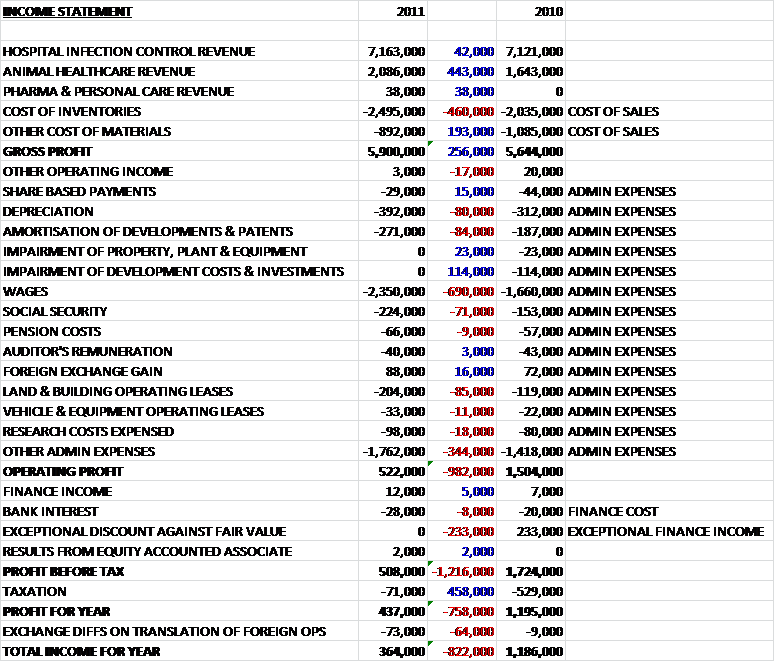
So, this doesn’t look to be a particularly good set of results at first glance. The deadline income of £364K has tumbled £800K from last year’s figure, and is the first reduction of profit the group has experienced in recent history. The income figures are a little more encouraging. The Hospital Infection Control segment remained static because of the reduction in sales of the endoscope disinfectants. The sales of the Animal Healthcare are up, apparently due to the fact that Tristel is now manufacturing the whole products range. Finally, we see that the Pharma and Personal care segment has made its first sales – more hopefully to come from this in future.
The main reason for the reduction in profit is the increased costs. Wages are up £700K, operating leases are up slightly and other expenses are also up. This is due to the increased investment in the new product line of Pharma and Personal care – particularly the hiring of more staff. As an aside, there was an impairment last year for development into new delivery systems for their chemistry that it was not considered viable to continue. The impairment of property, plant and equipment was due to non recoverable leasehold improvements on an early vacation of the property. During the year, £700K was paid to Bruce Green as a partial settlement of royalty fees. There is no indication of whether this deals with most of the consideration or not, but it is a lot of money (presumably recorded under admin expenses)
These results, then, although they are not great, they are not as bad as they initially seem. Of more concern, I think, are the reducing revenues from the endoscope disinfecting business (hidden somewhat here by the increase in revenues from other vectors).
EPS and P/E Ratio
Something linked with the income statement and the performance of the company is the Earnings Per Share (EPS). This can be a good way of comparing performance on a like for like basis, taking into account acquisitions etc . Related to this is the P/E Ratio. This is calculated by dividing the share value by the EPS, thereby giving an indication of how much the market is willing to pay for the earnings. Apparently a value of 15-20 is about average, and one lower than this can indicate that a stock is undervalued or that the market does not expect future earnings to improve. The figures for Tristel are below:
| EPS |
2011 |
2010 |
|
| PROFIT AFTER TAX |
437,000 |
-758,000 |
1,195,000 |
| NUMBER OF SHARES |
39,290,000 |
6,127,000 |
33,163,000 |
| EPS |
1.1 |
3.6 |
|
| SP |
47.5 |
52.5 |
|
| P/E |
42.7 |
14.6 |
Taking the share price for today, the P/E is 28. This is certainly a high P/E, which seems to suggest that the share is overvalued. I suspect that it indicates that the market thinks the problems with the profit are a one off due to the investment made, detailed above. In fact, the consensus among brokers is that the EPS next year will be 3.15, giving a forward P/E of 12.9. We can also see that the company has issued a lot more shares, thereby devaluing those already in existence.
Now to look at the Balance Sheet:
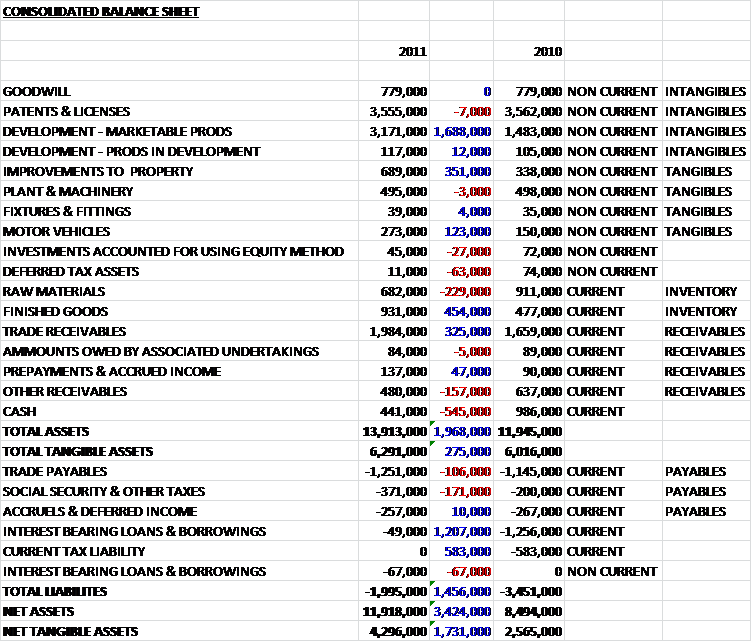
Net assets overall are up considerably to just under £12M, within this we see a large increase in development capitalised as an asset and overall, a large amount of the asset make up is intangible. Moving on to tangible assets, apart from an investment in motor vehicles, we a reduction in raw materials, and an increase in finished goods suggesting progress has been made on the production of goods. It can also be seen that trade receivables are up – could this indicate an increase in customer orders or a worsening in credit terms? Sadly we see that cash has almost halved to leave it at £441K. The £84K for amounts owed by group undertakings relates to Tristel Italia, which the group owns 20% of.
As far as liabilities are concerned, the only thing I think is of interest is the reduction in bank loans – over £1.2M have been wiped out, which is an encouraging sign.
On to cash flow…
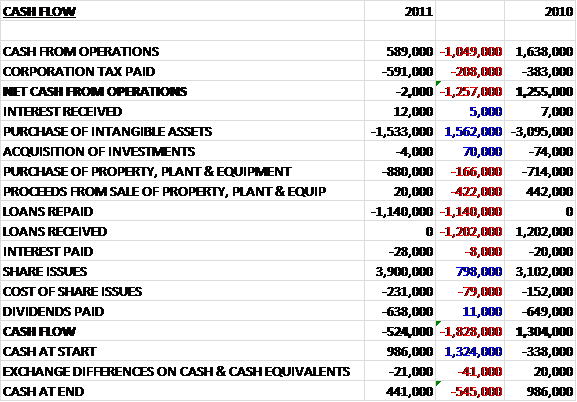
Looking at the cash flow, we see that there is a negative cash flow of about £500K. This isn’t that bad, but it is a little concerning that the cash level at the end of the year was £441K so this would not be sustainable for another year. The cash from operations, at -£2K is not great. As mentioned under the income statement, this is caused by slack increases in revenue and a large investment in staff and new products. There was a tax bill a lot higher than last year. Apparently a refund of £325K due from HMRC for R&D work done was not received during the period, as expected but was received in August of the year (after year end)
There was less money spent on intangibles, probably lower R&D and no more money spent on acquiring patents. It’s also worth noting that Tristel paid off its loan during the year. Finally it should be noted that this cash flow is flattered by the floating of new shares. Nearly £4M was made doing this, and without it the cash flow would be heavily negative.
The cash flow, then is not bad but is only being kept respectable by new share issues or, in previous years, loans. This is not sustainable long term and the company needs to start making some proper cash.
I will now have a quick look at the shareholder make up.
Largest Shareholders
Amarti Global Investors 6.4%
ISIS EP LLP 5.4%
Downing Corporate Finance 5.3%
Uniform Asset Management 4.1%
Williams De Boe 4.0%
Not really much of interest here. These are all asset management companies. However, it should be noted that the chairman, through many different vehicles and family members owns 20% of the shares after he purchased some more after the date of this report.
In conclusion, these results are not great but they are not that bad either. The company is undergoing somewhat of a change as its traditional revenue sources are running out and they are investing in new markets. Of course there is no guarantee that these markets will be fruitful but I have faith.
I have some concern that the company cannot make any cash without raising more capital by issuing shares or taking out loans. The lack of debt is a good sign, but there needs to be some sign that Tristel can accumulate some cash. Perhaps with this in mind, and with one eye on investing more in the group, management have decided to increase dividend cover to 2.3 times earnings (now it is 1.5 times) until such a time that the company can return to profit levels seen in 2010. After which, it will reduce it to 2 times earnings. This is a prudent move even if it does mean less money for shareholders in the short term.
During the year we saw almost £1M invested in developing new products and £530K on obtaining new patents and gaining regulatory approval which, presumably are one off costs. There seems to be no borrowing to speak of and net cash stands at £441K so gearing is not an issue here. Also, the board have stated that the German operation has established a foothold in hospitals there, which would be a great new market and that the Chinese subsidiary gained regulatory approval to sell goods there.
At this point I am going to quickly look at trade payables overdue, which is summarised in the following table:
| TRADE RECEIVABLES |
2011 |
2010 |
|
| CURRENT |
1,444,000 |
164,000 |
1,280,000 |
| OVERDUE 0-30 DAYS |
437,000 |
9,000 |
428,000 |
| OVERDUE 31-120 DAYS |
259,000 |
158,000 |
101,000 |
| OVERDUE 120+ DAYS |
65,000 |
36,000 |
29,000 |
| TOTAL |
2,205,000 |
367,000 |
1,838,000 |
In my opinion there seems to be quite a lot here that is overdue, and the amount overdue seems to be increasing more than that not overdue so the board should keep an eye on this.
There are some potential risks ahead. One customer accounts for nearly a quarter of all revenues so a collapse of this customer would be disastrous. One disappointing announcement was that the US distributer of the surface disinfectants, Clorox, has terminated an agreement to distribute Tristel’s products which is definitely a set back. Finally, considering the sector, Tristel is susceptible to NHS cuts. It must be said, however, that the current government does not seem to be earmarking the NHS to undergo cuts as much as other public sectors.
Overall then, despite the disappointing headline figures, I agree with the board in their assessment that this is mainly due to investment in the future and these are products that should only become more popular as hospitals and other areas consider sterile environments to be important. As mentioned above, however, I am a little concerned about the inability of the company to make cash which is preventing me investing more in this company, despite the depressed share price. Therefore they are a HOLD for me.