

Aureus Mining has now released its Q3 results for the year ending 2015.
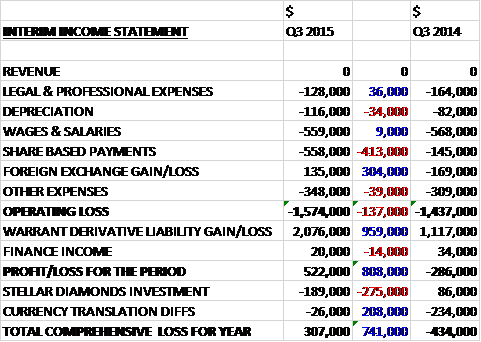
As the mine has not yet entered commercial production, there was no revenue generated but operating costs did increase during the period, mainly as a result of a $413K growth in share based payments due to bonuses following the first production of gold which meant that the operating loss was $137K higher at $1.6M. We then see a big increase in the gain from the reduction in the warranty derivative liability as the company’s share price fell which meant that, bizarrely there was a $522K gain during the quarter, an improvement of $808K year on year.
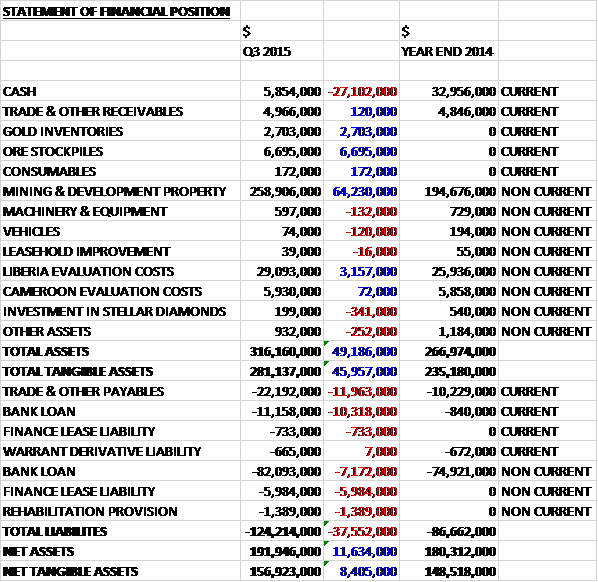
When compared to the end point of last year, total assets increased by $49.2M driven by a $64.2M growth in the value of mining and development property, a $6.7M increase in ore stockpiles, a $2.7M growth in gold inventories and a $3.2M increase in the Liberian evaluation costs capitalised, which was partially offset by a $27.1M fall in cash. Liabilities also increased during the period due to a $12M growth in payables relating to the development and commissioning of the New Liberty mine, a $17.5M increase in the bank loan, a $6.7M increase in finance lease liabilities and a $1.4M growth in the rehabilitation provision. The end result is a net tangible asset level of $156.9M, an increase of $8.4M over the past nine months.
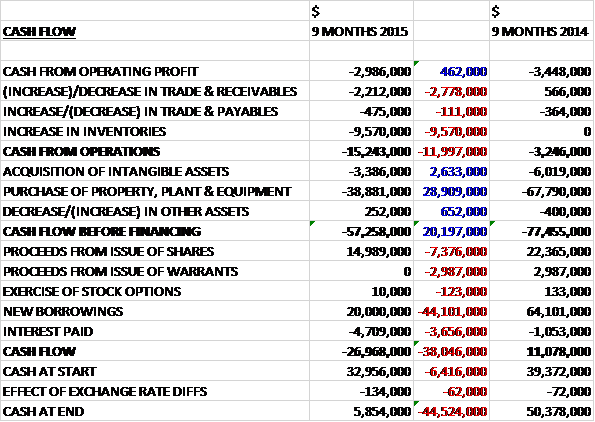
Before movements in working capital, cash losses fell by $462K to $3M. There was then a large outflow of cash related to working capital, in particular a $9.6M increase in inventories so that the cash outflow from operations was $15.2M, an increase of $12M year on year. The group then spent $38.9M on property, plant and equipment along with $3.4M on intangible assets so that before financing there was a cash outflow of $57.3M. The company covered some of this with $15M from the issue of new shares and $20M from new borrowings so that after a hefty $4.7M interest payment the cash outflow for the period was $27M to give a cash level of $5.9M at the period-end. This is getting a little precarious and the company seems quite some way from being cash neutral.
The quarterly profit at New Liberty was $158K compared to no profit in the same quarter of last year. A key focus in the quarter was to continue to ramp up the process plant to name plate capacity of 95KT of run of mine ore per month. In July the process plant underwent a period of 24 hours performance testing, during which the plant was operated at a feed rate of 152 tonnes of ROM ore per hour at a plant availability of 96%, with all other equipment operating within or exceeding their design parameters over a continuous 12 hour period.
Construction activities during the period focused on the completion of the operational water management system, which aimed to ensure that efficient mining could be continued during the rainy season. All mitigations including a flood bund around the pit, pump stations and creek diversion function as planned and mining operations continued to progress through the wet season. Mining operations were hampered due to a lack of a regular and consistent supply of explosives caused by shipping restrictions to Ebola affected countries. In order to alleviate this situation, a supply chain was set up through Ghana and Ivory Coast to transport explosives by road, although this continued to be problematic due to border control measures and was also disrupted by the heavy rains experienced during September.
Mining, road construction and the development of the ROM pad were hampered by the lack of hard rock resulting from the delay in the delivery of explosives but the mining tem stripped over 6MT of waste rock and mined 300KT of ore in the year to date. Mining during the period predominantly focused below the weathered oxide zone in the Larjor starter pit and moved into fresh rock within the Kinjor pit. The primary focus was to push back waste to access more ore and increase face length. Grade control drilling and mining reconciliation undertaken during the period have continued to show that the ore body is robust and representative of the resource model.
During commissioning activities in July, it was noted that the discharge grates on the bar mill were not optimum for the ROM ore and therefore required replacing. The company worked with the OEM and DRA to install more robust, heavy duty grates. As a consequence of the discharge problem, the mill could not be operated at full design capacity at all times causing undue deterioration on some of the mill liners and lifters, which also required replacing which was completed by the OEM at no cost to the group and a full mill re-line took place in September.
Plant processing operations are now focused on optimising reagent consumption, grind size and gold recoveries. The remaining staff members from DRA and other third party contractors that were involved in construction and commissioning began to demobilise from New Liberty with the Aureus owner team now taking full control of the process plant operations. During the quarter the on-site mine lab operated by ALS Global became fully operational and began processing samples. It has the capability of preparing 200 samples per day and is equipped with two furnaces for fire assay analysis. As well as servicing the New Liberty mine, this lab also has the capability to service other third party customers across the region.
After the period-end, in October, a mechanical failure occurred within the secondary crusher resulting in the temporary suspension of processing activities at the New Liberty process plant. After a stoppage of nineteen days, ore crushing activities recommenced following the installation of a temporary 200 tonne per hour mobile crushing unit. The mobile crusher will be retained on site for a period of six months to provide additional operational flexibility during the final testing and commissioning phase of the plant, an also to provide additional crushed rock material for use on haul roads and other infrastructure. Specialists from DRA and technicians from the crusher’s OEM completed the repairs on October 29th allowing resumption of milling and processing operations the next day. During the stoppage of crushing and processing operations, mining operations continued.
In better news, the company made its first gold sale from the New Liberty mine in July and during the quarter, they sold a total of 8,519 ounces at an average price of $1,124 per ounce.
The quarterly loss at the Liberian exploration projects was $104K, an increase of £63K compared to Q3 last year. Regolith mapping over the western portion of the Bea Mining Licence continued during the quarter with the aim of defining concealed mineralisation. Re-interpretation of the regional structural setting shows that most soil anomalies are located along the east-west structures that might represent splays off the Todi shear zone. The shear zone is striking northwest and known to host mineralisation in several locations outside the company’s licence area. A pit dug on an isolated soil anomaly close to the zone near West Mafa target returned bedrock mineralisation, confirming the prospectivity of the structure which has the propensity to be covered west of the New Liberty area with depositional regimes.
Soil anomalies at the West Mafa and Goja targets, located six and nine km NW of New Liberty respectively, occur in erosional and residual terrains and so are representative of in situ mineralisation. At West Mafa, gold is associated with thin discontinuous quartz veins related to third order structures. Trench and pit results from the Goja target show broad mineralisation developed in close proximity to intrusives with better grades found at depth. On anomaly C, regolith mapping shows that depositional regimes potentially mask a large portion of the target strike extent. Regolith mapping will be completed during Q4 over the western portion of the Bea Mining license and follow up work will be carried out on prioritised targets.
At the Ndablama gold project, further mapping is currently being undertaken to gain better understanding of the nearby targets within the pressure shadow one which hosts Ndablama. At the Weaju gold prospect, the group made a second payment of WHMC of $445K and 1,148,611 new shares per the settlement agreement. This total amount equates to the equivalent of $5 per ounce of measured, indicated and inferred resources, within the claims area and the surrounding 200 metre perimeter. If commercial production is achieved within the payable area, WHMC will receive a one-time payment equivalent to 2.5% of the net present value of a project within the payable area, and also receive a 7.5% net profit interest on life of mine production within the payable area.
At Leopard Rock, to date 4,294 metres of drilling has been completed and further mapping is being undertaken to gain better understanding of the area ready for a phase two drilling programme planned for the future. Work has been ongoing with regolith mapping around the Gondoja area to better interpret soil anomalies. The target will be mapped into details during Q4 along with the other targets of the Yambesei shear zone.
Detailed mapping started along the Yambesei shear zone with Koinja and Gbalidee targets covered to date. Mineralisation is located within sheared mafics and ultramafics located between granites and can be followed over a strike length of more than 3.8km which remains open at both ends. This geological mapping which follows the regolith mapping completed during Q1 will continue eastwards so that it covers by year end all the targets up to Welinkua. The mapping will bring the geological knowledge of the 8km corridor to the same level as for the Ndablama pressure shadow zone. Along with the detailed geological mapping, pitting and trenching will be completed to bring all the Yambesei shear zone targets to an advanced stage by the end of the year.
At Silver Hills, during the quarter work focused on the Belgium target located in the central zone. Pitting confirmed the presence of mineralisation over a strike length of 800 metres. This mineralisation which is controlled by the NE shear has the potential to extend over 3km up to Bruge target located in the NE. Pitting and mapping are ongoing at this target to trace the mineralisation along strike and to bring Belgium target and other potential targets to an advanced stage.
During the quarter work on the Yambesei license consisted of in-filling the soil grid to cover the area between Welinkua and Jenemana where several BLEG anomalies were found. Further reconnaissance trips were undertaken to the Archean West license and for the Mabong licence, field data collected during the previous quarter was complied. This showed a complex lithological suite of gneisses, amphibolites, mafics, ultramafics and BIF cut by dolerite dykes as well as two parallel NE trending shear zones.
The quarterly loss in Cameroon was $3K compared to $2K in Q3 last year. Exploration work continued on the interpretation of the mineralised systems of Kambele and Dimako targets following on from the core reclogging. The work was recommended in order to produce a new interpretation of the mineralisation models and determine their potential to host economic deposits. A GIS study was undertaken over the licence area and resulted in the identification of structural lineaments along which field verification has shown the presence of artisanal sites. A ground induced polarisation or ground magnetic survey is planned to be conducted at the Amndoni prospect followed by a first pass RC drill programme.
Liberia was declared Ebola free for a second time at the start of September and has entered into a further 90 day period of heightened surveillance but this is a good sign.
The group has an $88M project finance loan referred to as the “senior facility” and a subordinated loan facility for $12M with RMB Resources. The senior facility’s first repayment is at the end of January 2016 and is repayable in nine semi-annual payments. It bears interest at the US LIBOR rate plus 1.8% along with a 2.5% ECIC premium for a six year term. The subordinated facility bears interest at US LIBOR plus 7.5% for a six and a half year term and is repayable in full six months after the final senior facility repayment. During the nine month period, $8M was drawn down from the senior facility and $12M from the subordinated facility. There appears to be very little left in the way of headroom here.
Cash flows from operations began during the quarter and it is expected that commercial production will be declared at New Liberty in January 2016. As of the end of September, the company had cash of $5.9M and a net current liability position of $14.4M. New Liberty is currently in the ramp up stage to steady state production and working capital is at an expected low point. Management expects the working capital position to improve as gold production increases and operating cash flows are generated. They are considering potential options to strengthen the working capital position.
As previously reported, in November the company acquired three exploration licences contiguous with the Bea Mountain Mining licence through the purchase of Sarama Investments in exchange for the issue of 2,600,000 new shares in the company. It does seem to me that the group probably has enough exploration licenses now and should probably start to concentrate on bringing the current ones through to production.
Overall then this has been a bit of a difficult quarter for the group. They did manage to post a profit but this was entirely due to a reduction in the value of the warranties due to the fall in the share price as there is not yet any commercial production. Taking this effect off, losses widened due to increased share based payments after the first gold pour. Net assets did improve but the operating cash outflow increased due to a growth in inventories and we see that the large interest payments are now very material for the group. Indeed, borrowing headroom is very limited and I think it will be tight as to whether the $5.9M of cash that is left will cover the group until reliable cash flows come in from gold sales.
The period was hit by a number of operational problems including the supply problems for explosives as shipments to Ebola-hit Liberia were ceased and the group had to transport the explosives overland. Now that the country has been declared Ebola-free, this should improve. Also there was a mechanical failure at the secondary crusher which has now been resolved and the discharge grates on the bar mill had to be replaced. All of these issues have meant that commercial production has been pushed back to January 2016. All in all, I do think this is an exciting prospect but the recent weakness in the gold price, seeming mainly related to the strength of the US dollar and the issues surrounding the start-up of commercial production means that I do not feel now is the right time to invest here.
On the 30th November the group released a statement covering the refinancing including a very heavily discounted placing. The additional funding includes an additional $10M liquidity facility to be provided by Rand Merchant Bank and Nedbank and an $11.5M (£7.65M) equity financing which involves a private placing of 153M new shares of the company at a price of just 5p per share. These funds will be used to strengthen the balance sheet, allowing the company to reduce its accounts payable, and procure new mining equipment.
Mining operations to date have been hampered by the lack of available explosives during the Ebola outbreak and inconsistent supply afterwards. As a consequence of this shortage, the mining programme is currently about 9.5M tonnes behind schedule and mining activities have predominantly been focused on keeping the plant supplied with sufficient feed levels of ore which has caused slippages in the waste mining schedule.
A 100 tonne delivery of explosives arrived on site on the 18th November and a further 330 tonnes, equivalent to one month’s supply) is currently being shipped from Ghana. Arrangements are currently being finalised for a further 600 tonne supply to be shipped in December. Following the receipt of the funds from the placing and the reduction in the creditor balance, the group will procure additional mining equipment for delivery during H1 2016 to enable the mining rate to be accelerated which should result in the planned life of mine production profiles being achieved and a reduction in the current shortfall in waste mining operations.
It is expected that the addition of the extra fleet equipment from H1 2016 will allow the rescheduling of the mine plan. Although the pit design remains the same, mining operations are planned to be completed four months earlier than the previous schedule and are now scheduled to finish in February 2022. Processing operations at the mine are expected to continue unchanged until October 2022 and still result in the life of mine production of 859,000 ounces of gold. To date the process plant has processed 223,659 tonnes or ROM ore at an average grade of 3.2g/t. There have been twelve shipments of gold dore from New Liberty for smelting and refining at the MKS PAMP refinery in Switzerland, resulting in sales of 13,500 ounces of gold at an average price of $1,120 per ounce.
Over the past 27 days since the secondary crusher was re-commissioned, the process plant has been operating at an average of 92% of its designed capacity, including planned downtime for ongoing optimisation activities. Commercial production can be declared following the mill having operated at an average for 60% or more of the designed capacity over a period of 60 days – so that at least is looking OK. Whilst operating costs, plant feed grades and plant performance are largely in line with the company’s expectations, gold production is behind target with a shortfall of 27,000 ounces which has impacted the working capital position.
Of the net proceeds of $20M, some $15M is earmarked for the payment of accounts payable and $5M is to be used for working capital during the production ramp. Of the accounts payable, $9M is due to the mining fleet supplier and once this has been cleared, the additional mining equipment can be delivered.
The company believes it can deliver on the production and cost estimates which at the current gold price, should see it generate enough cash flow to meet its continuing obligations, including its debt repayments until the end of 2016. There is a $6.6M debt repayment due in January 2017 which, should the gold price remain at current levels, the company may be unable to meet so may require another placing. This is pretty desperate stuff.
With the benefit of the accelerated mining rate due to the addition of the new mining fleet, all in sustaining cash cost is now estimated at $820 per ounce over the life of the mine with cash costs higher in earlier years due to higher stripping ratios. The company expects to meet production guidance for 2016 of approximately 125,000 ounces at a cost of about $959 per ounce.
In consideration for the granting of the new debt facility, the company will issue options to purchase up to 20.4M shares with a term of five years from closing and exercisable at a 20% premium using a share price of the lesser of the five day weighted average price at the date of the acceptance of the new facilities (14.05p) the date that is two days before the signing of the facility agreement. In addition the existing 11.1M warrants issued to RMB in 2014 will be re-issued on the same terms.
Overall then, this is terrible news for existing shareholders, the placing is less than half the share price before the announcement and the mine seems to be barely profitable at these gold prices with the first debt repayment unlikely to be met. What happens if the price of gold continues to fall? These shares are pretty much not investible at the current time in my opinion although I will keep watching in interest.
On the 8th December the group announced that it had received a request for arbitration from International Construction and Engineering with respect to their contract to carry out civil and earth works at the New Liberty mine. Their contract was terminated in August 2014, having taken legal advice, when works were approximately 70% completed. The earthworks were completed by directly engaged labour and contractors supervised by the project’s construction management contractor, DRA Projects. The management believe that no material amount will be found payable to ICE but nonetheless this is yet another distraction that they could do without.
On the 21st December the group announced an amendment to the Samara acquisition. The previous agreement was for the payment to be 2,600,000 Aureus shares. Now that the shares have nosedived, they have increased the payment to 6,645,070. Nice.
On the 22nd January, at a quarter past four on a Friday afternoon no less, the group released an operational update.
Since the resumption of processing operations at New Liberty at the end of October, the ball mill has been operating at an average of 82% of its designed capacity, including planned downtime for ongoing optimisation. They have experienced issues during the final phase of commissioning in the gravity and CIL circuits of the plant, affecting plant recoveries and resulting in an impact on cash flow and therefore they do not feel it is prudent to officially declare commercial production at this point. The company continues to focus on improving the operational performance of the gravity circuit and further optimising CIL leach kinetics in order to improve overall plant performance. It is anticipated that performance will improve to design levels by the end of Q1 which should be when commercial production at the plant is declared.
Fresh ROM stockpiles are currently standing at 83,509 tonnes at a grade of 2.78g/t and transitional stockpiles currently total 75,248 tonnes at a grade of 1.35g/t. To date, the process plant has processed 386,262 tonnes of ore resulting in 19 shipments of gold dore for smelting and refining in Switzerland, totalling 20,835 ounces of gold with an average price achieved of $1,113 per ounce. Gold production achieved in 2015 was 17,172 ounces against a target of 27,000 ounces and 3,663 ounces have been produced so far in 2016.
The group are looking at new LOM options given the current gold price environment with the review process expected to be complete by the end of February – this sounds ominous.
The company is also attempting to get a deferral of the debt repayment scheduled for the end of January and thereafter a new plan for the repayments as it has insufficient cash resources available to pay both this first repayments and to pay all of its suppliers. It is expected that revenue generated from future gold production should ensure that suppliers continue to be paid and operations can continue. The group is appointing a financial advisor to conduct a strategic review to assess potential options that may be available.
Oh dear, this is desperate stuff. They still have not managed to achieve commercial production, the low gold price looks like it is going to lead to impairments at the mine and it sounds like cash is tight to pay the suppliers let alone the debt repayments. What is worse in my view, however, is that this was slipped out last thing on a Friday. What are they playing at?
Following the sour taste left when after watching a presentation from the company that was swiftly followed by a placing, this reinforces my view that the board here care very little for private investors. I think anyone investing here is asking for trouble and I would not touch it with a barge pole. OMI and SRB look much better placed to me if one wants to invest in a small gold producer.
On the 27th January the group announced that it has received final credit approval from its lender group to defer its first debt repayment which was due on the 31st January. The lenders will not commence discussions with the company to agree upon an appropriate debt repayment schedule following the review of various mine plan scenarios with a final mine plan selected by the end of February.
On the 18th February the group released an operations update. Since the start of the year, total gold production was 11,001 ounces compared to 17,172 ounces produced in the second half of last year. This consisted of 5,478 ounces of gold produced in January and 5,523 ounces produced in the first three shipments of February. Run of mill stockpiles are currently standing at 79,525 tonnes of fresh ore at a grade of 2.4g/t and oxide and transitional stockpiles standing at 74,014 tonnes at a grade of 1.31g/t.
As a result of the ongoing process plant optimisation activities started in mid-January, overall plant recoveries have increased towards design specifications. Continued optimisation of the gravity circuit has shown incremental improvements and there have been further operational improvements in CIL leach kinetics. Additionally, ongoing preventative maintenance activities have allowed plant availability to improve and have resulted in more stable operating conditions.
Throughout the year to date, the ball mill has been operating at an average of 82% of its designed capacity, including planned downtime for ongoing optimisation. It is expected that overall plant performance will continue to improve towards design levels throughout the coming weeks, with commercial production expected to be declared by the end of March. As a direct result of the operational improvements achieved within the process plant, gold recovery levels have steadily increased from about 73% in mid-January to reach an average recovery of 85% throughout February, and has continue to increase to more than 87% during the last week. Further improvements of gold recovery are expected following the introduction of new carbon into the CIL circuit of the processing plant.
So, it looks like progress is being made here but until the financing issues have been properly sorted, these shares are pretty much not investable in my view.
On the 1st March the group announced that it had received credit approval from its lenders to further defer its first debt repayment to 4th April 2016. They are currently finalising an updated mine plan which will form the basis of discussion with the lenders to agree an appropriate debt repayment schedule – a stay of execution then.
On the 2nd March the group announced that they have declared commercial production at the mine as the process plant is now operating in line with design specifications. Over the past sixty days of operation the process plant has achieved an average of 88% of design throughput capacity. During February, throughput totalled 90,099 tonnes of ore milled, resulting in the recovery of over 9,000 ounces of gold with operating recovery levels of 90% achieved by the end of the month. Gold production for the calendar year is currently over 14,000 ounces and to date there have been 25 shipments resulting in sales of about 31,500 ounces of gold.
Run of mine stockpiles are currently standing at 70,844 tonnes of fresh ore at a grade of 2.59 g/t and oxide and transitional stockpiles are standing at 81,881 tonnes at a grade of 1.32 g/t. MonuRent, the fleet provider have purchased and shipped five new 100 tonne capacity Komatsu HD785 rigid haul trucks and one PC1250 excavator. This new fleet equipment is scheduled to be delivered to New Liberty and mobilised ready for operations during April.
So, this is a good milestone to have reached buy given the first debt repayment has just been kicked a little bit down the road, this could be too little too late. Who knows, but this is just a punt at the moment for me so I’m staying out for now.
On the 17th March the group released a gold production update. They announced that in the first two weeks of March operations, the mine produced 4,500 ounces of gold with gold production for the year now totalling 19,200 ounces so far. The process plant continued to operate at a stable run-rate in line with original design specifications, and recovery levels in excess of 90% continue to be achieved. Mining operations at New Liberty will continue to focus on both the Kinjor and Larjor pits and excavation work continues to focus on the completion of the protective flood bund along the southern boundary of the pit limits in preparation for operations throughout the wet season.
So, this is all fairly positive but is just window dressing until the financing is sorted out as far as I’m concerned.