

Ricardo has now released its interim results for the year ending 2018.

Revenues increased when compared to the first half of last year due to an £8.4M growth in technical consulting revenue and a £7.2M increase in performance products revenue. Cost of sales also increased to give a gross profit £4.2M higher. Admin expenses were up £3.1M, there was a £300K increase in the amortisation of acquired intangibles and a £1.1M charge for reorganisation costs. Offsetting this was a £600K decrease in acquisition costs to give an operating profit £300K higher. Finance coasts were down £100K, underlying tax charges fell £200K but there was a £1.1M charge relating to the impact of the change in US tax rates which meant that the profit for the period was £8.9M, a decline of £500K year on year.
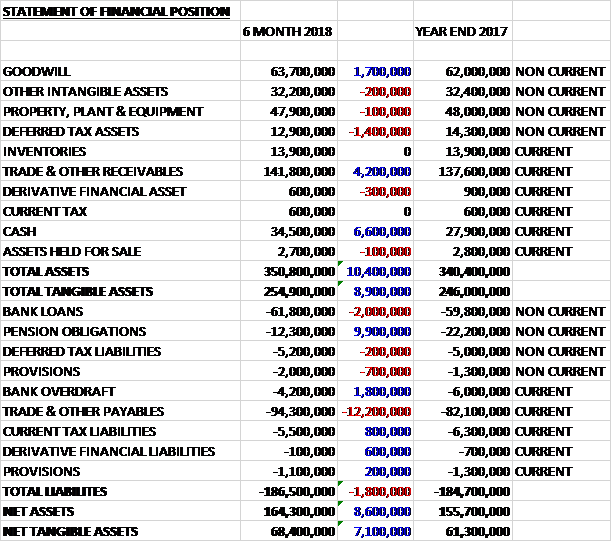
When compared to the end point of last year, total assets increased by £10.4M driven by a £6.6M growth in cash, a £4.2M increase in receivables and a £1.7M growth in goodwill, partially offset by a £1.4M decline in deferred tax assets. Total liabilities also increased during the period as a £9.9M fall in pension obligations and a £1.8M decrease in the bank overdraft was more than offset by a £12.2M increase in payables and a £2M growth in bank loans. The end result was a net tangible asset level of £68.4M, a growth of £7.1M over the past six months.

Before movements in working capital, cash profits increased by £4M to £23.1M. There was a cash inflow from working capital, and this was much larger than last year so despite interest payments increasing by £400K and tax payments growing by £700K the net cash from operations was £24.3M, a growth of £20.4M year on year. The group spent £5.7M on acquisitions, £3.2M on property, plant and equipment, and £1.9M on intangible assets to give a free cash flow of £13.8M. The group then took out £2M of new loans and paid out £7.4M in dividends to give a cash flow for the half year of £8.4M and a cash level of £30.4M at the period-end.
The underlying operating profit in the Technical Consulting division was £13.5M, a growth of £600K year on year which included a £300K contribution from the acquired CPC business. The global business, operating across the automotive and commercial vehicles sectors, delivered a record order intake in the period, securing significant multi-year orders from a number of clients across Europe, Japan and China. This has extended the ageing of the order book which also contains a greater degree of material content than in the prior period. The improvement in the flow of orders in the period has enabled a return to more efficient levels of operation, leading to a more profitable business.
The market in Detroit remains challenging and this is reflected in the order intake during the period. The group are implementing plans to reposition the business and enhance their electrification and autonomous vehicle service offering. Although the US automotive business ended the period with another loss, the level of losses have reduced.
The rail business saw strong order intake across key markets and significant growth in the closing order book, particularly in Asia. Activity in Europe was buoyant with the operations in the UK, Netherlands, Spain and Denmark securing new assignments. The Asian market is very strong, with a notable increase in demand for systems engineering expertise, human factors engineering and ensuring electromagnetic compatibility. The business has recently forged new partnerships with Asia’s major rolling stock OEMs where they are supporting the introduction of railway vehicles into service in cities such as Boston, Chicago, Tel Aviv and Melbourne.
Order intake for the Energy and Environment business was in line with the prior period. The closing order book includes a number of multi-year orders for UK government programmes and reflects a broad private sector and international customer base.
There has been growth and the group have secured a number of large engine, transmission and vehicle integration projects for both medium and heavy duty vehicles. They continue to see demand for their capabilities in the commercial vehicles sector across Asia in particular. The order book and pipeline is based around a broad range of opportunities with a growing proportion of electrification and autonomous vehicle development programmes. In the US, greenhouse gas and nitrogen oxide standards are driving interest in powertrain efficiency as well as the latest requirement for in-use compliance testing in support of their customer’s existing fleets.
In the off-highway business, activity remains at a relatively low level in Europe following the recent implementation of Stage IV emissions standards, while in Asia the industry is showing renewed growth, especially in the transmission and driveline areas. Here, the group is securing an increasing number of projects. They see increasing demand for high speed diesel generator sets and main propulsion systems for marine vessels, and for the conversion of engines for gas or dual fuel operation. The majority of their activities in this industry have been based around failure analysis, investigations, specialist design and development.
The newly acquired Control Point business is performing well. In the UK the group have grown their marine defence business, both surface and sub-surface, and in Europe and Asia they have secured contracts to deliver new engine and transmission designs for land vehicles and they are pursuing other large opportunities.
The underlying operating profit in the Performance Products division was £3.9M, an increase of £500K when compared to the first half of last year. This performance was principally driven by increased volumes of engines for McLaren, particularly for the higher value 720S engine, together with increased volumes of transmissions for both Bugatti and Porsche. These have been partially offset by a reduction in sales to the motorsport and defence sectors. The software business also continues to perform well.
During the period the group expanded their Santa Clara Technical Centre and opened a new electrification and vehicle lab to support innovation in the next generation of clean, electrified and autonomous vehicles. In addition they have extended their collaboration with Roke to develop robust solutions for autonomous and connected transport systems against cyber attacks.
As usual there were a number of non-recurring costs in the period. Acquisition related expenditure of £500K comprised costs incurred for services rendered o the group to effect the Control Point acquisition together with a proportion of the cost incurred to retain specific individuals.
Reorganisation costs of £1.1M relate to the restructure of the automotive business in Europe, China and North America to combine their operations into a single global automotive business. The costs comprise redundancy costs. In addition, further activities were also undertaken to prepare the test cell facilities and related equipment at the technical centre in Chicago for disposal. Further restructuring activities are planned in order to complete the reorganisation of the automotive business. The changes to the US tax rate resulted in a £1.1M deferred tax charge which reduced the value of deferred tax assets held in the US.
In September the group acquired Control Point for an initial cash consideration of £6.3M and a contingent cash consideration of £1.4M, generating goodwill of £1.6M. The acquisition expands on the group’s vehicle engineering capabilities in the defence sector and adds expertise in distributed software-based systems and fleet management technology.
Going forward there was a strong order intake which resulted in an increase of 31% when compared to the first half of last year. There has been a good spread of orders across both the Technical Consulting and Performance Products divisions which provides a good base as the head into the second half of the year.
At the current share price the shares are trading on a PE ratio of 19.5 which falls to 17 on the full year consensus forecast. After a 6% increase in the interim dividend, the shares are yielding 2% which increases to 2% on the full year forecast. At the period-end the group had a net debt position of £31.5M compared to £37.9M at the prior year-end.
Overall then this was a decent period for the group. Profits did decline but this was due to the reduction in the deferred tax asset in the US following the changes to the tax rate there. Net assets increased and the operating cash flow was strong with plenty of free cash being generated, although this was bolstered by an increase in payables which will have to unwind at some point.
Both divisions are performing well with weakness in the Detroit business being offset by strength in rail and commercial vehicles and an increase in deliveries to McLaren, Bugatti and Porsche. This decent performance is now reflected in the share price, however, and a forward PE of 17 and yield of 2% is not that cheap. I am tempted to take profits and buy back lower.
On the 5th March the group announced that is has signed an agreement to sell its Chicago technical facility to Power Solutions International, a US manufacturer of engines and power systems, for a consideration of $5.5M. They will relocate their heavy duty test operations to its existing facilities in Detroit. In addition, they have entered into a strategic technology relationship with PSI whereby their expertise in engine developments, electrification and autonomous vehicle controls will support PSI’s expansion into these areas.
On the 25th July the group released a trading update covering the full year. Order intake was up £44M to £410M, which included £10M from Control Point. The order book at the year-end was £285M, an increase of £37M.
In the second half, in the technical consulting business, they have continued to see strong order intake from Asia from both rail and automotive customers while in the UK, orders from their automotive customers have seen a further decline driven by current uncertainty in the market. The performance products business performed well with further increases in orders in the second half of the year.
Overall they have a good pipeline which includes a number of significant opportunities. They have now received the first orders for the HMMWV brake kit programme in respect of new vehicles in the US and delivery started in July. Total group revenue increased by £28M to £380M, of which £10M related to Control Point.
Despite the good order intake and revenue, the board expect pre-tax profit to be towards the lower end of analyst forecasts. This is mainly due to a reduced performance in the EMEA automotive business following the low level of UK orders in the second half of the year, together with some difficult projects which were delivered in the year. Actions have been taken to improve project delivery in the future and in June they saw orders for the EMEA business overall recover to a good level. In addition, the energy and environment business recruited in anticipation of a higher level of growth in orders than actually achieved.
Further progress has been made in reducing fixed costs and improving the efficiency in the international test operations. Following the disposal of their test assets in Chicago earlier in the year they have now completed the disposal of their test facility in Germany for €5M. The first tranche of the proceeds was received in June with the remainder in July.
Net debt at the year-end was £26M compared to £38M at the end of last year.
Looking forward to 2019, the group enter the year against a backdrop of uncertainty surrounding Brexit and assuming that UK market conditions remain as they are, they are planning for revenue growth of between 3% and 5% in the year ahead.
Overall then, it seems that Brexit is starting to affect the group and the sluggish revenue growth for next year makes me a little cautious over these shares.