

Bonmarche has now released its interim results for the year ending 2018.
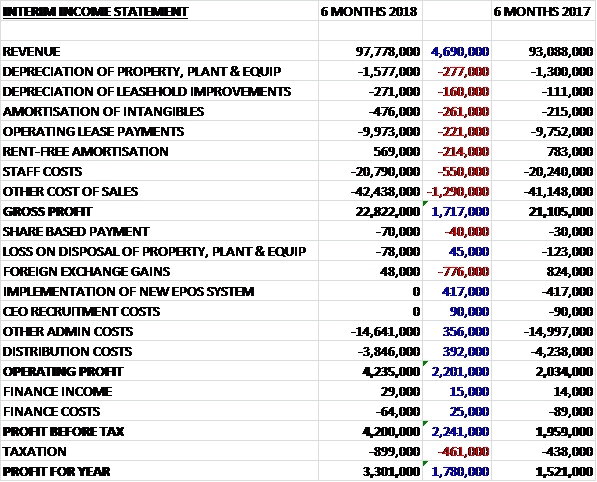
Revenues increased by £4.7M when compared to the first half of last year. Depreciation was up £437K, amortisation increased by £261K, operating lease payments grew by £221K, staff costs were up £550K and other cost of sales grew by £1.3M to give a gross profit £1.7M ahead of last time. There was a £776K reduction in forex gains but this was offset by the lack of any EPOS system costs, a £356K reduction in other admin costs and a £392K fall in distribution costs to give an operating profit £2.2M higher. Finance costs reduced slightly but tax charges grew by £461K which meant that the profit for the period was £3.3M, a growth of £1.8M year on year.

When compared to the end point of last year, total assets increased by £708K, driven by a £9.2M growth in cash, a £774K increase in intangible assets and a £662K growth in property plant equipment; partially offset by a £5.2M fall in the cash flow hedge, a £3.6M decrease in receivables and a £1.6M fall in inventories. Total liabilities also increased during the year as a £991K fall in deferred tax liabilities was more than offset by a £4.2M growth in payables and a £2.8M increase in derivative financial liabilities. The end result was a net tangible asset level of £22.9M, a decline of £6.1M year on year.

Before movements in working capital, cash profits increased by £2.9M to £6.7M. There was a cash inflow from working capital and after tax payments fell by £462K, the net cash from operations was £14.8M, a growth of £7.7M year on year. The group spent £1.9M on property, plant and equipment along with £1.3M on intangible assets to give a free cash flow of £11.6M. Of this, £2.3M was spent on dividends and £211K on finance lease repayments which meant that the cash flow for the half year was £9.2M and the cash level at the period-end was £16.1M.
Within the 5% increase in revenues, store like for like revenue growth was 1.6% and online sales grew by 39%. Q1 was stronger than Q2, however, with total sales up 7.7% and 2.1% respectively and like for like store sales falling 1.2% in Q2. The group have pointed out, however, that the weather was more favourable this year than last so there were some fairly easy comparisons.
As expected, due to the weaker pound, the bought in margin was lower than last year but the reduction has been offset by savings from a lower level of discounting. In H2 last year, the group reduced the level of discounting and they have continued to make progress on this front. During the period, planned promotional discounts and the discounts stemming from the operation of the Bonus Club loyalty scheme have both been lower, as have online promotions.
Operating costs increased overall due to the National Living Wage and the costs of three extra stores. This was mitigated by a reduction in marketing coats, lower logistics costs due to improved efficiency, a reduction in business rate costs and a reduction in head office staff numbers.
Denim was relaunched in all stores following a trial and the new ranges are of a much higher quality and styling credibility and the new range has achieved a 50% increase in sales. Other highlights include an improved leisurewear offer, blouses and swimwear. The discontinuation of peripheral product categories such as Ann Harvey and menswear have helped to make better use of space and drive improved product sales.
The group have begun to use suppliers who can deliver with a shorter lead time. This has increased their ability to trade within the season and respond more quickly to customer demands. An example of this was in the leisurewear category, which they were able to support through an increased level of stock purchasing at the expense of jersey tops, which were performing less strongly. The weakness of Jersey tops was due to an over reliance on this type of garment and is an example of a category in which they have scope to improve their offer.
As has been seen, online sales growth was strong throughout the period. The improvement began in Q4 last year and gathered pace as they began this year. There are a number of factors that have contributed to this improvement. Online marketing is now much more efficiently targeted and they have switched to a new marketing agency which they believe will be more supportive of their objective of growing sales profitably. They have improved their delivery offer so that customers now benefit from free delivery above a certain spend threshold; the level of online discounts have been more tightly controlled; and the look and commerciality of the catalogues has been improved.
Looking ahead, there remains significant scope to improve the customer experience as new systems are introduced in other parts of the business. These will make the interaction between online and store shopping more seamless, improve the delivery options for customers, and improve the engagement with customers from marketing communications.
The most significant development in the stores in the period has been the roll out to all sites of instore online ordering. Also, the installation of cameras to monitor footfall was completed in the period and they will now begin to explore how the data may be used effectively. An early benefit has been to give the retail team a better understanding of the real peaks and troughs in customer flow. The group have cut terminal stock levels to their lowest level in five years as a result of a concerted effort to clear stock during the summer sale.
The group have opened five new stores in the period, which are trading in line with expectations. Three of these were relocations of existing stores and seven marginal garden centre sites were closed at their natural lease breaks, so overall store numbers fell by five. In light of the continued difficult market conditions and the upsurge in online performance, they are being particularly selective in opening new sites which means that the net trading square footage at the end of the year is likely to be similar to the opening position.
The group expect to begin to see benefits from the new ERP system late in the next financial year, although some benefits will come through sooner. For example, since the period-end, a further phase of the project has been implemented and is already making the jobs of some staff easier by removing the need to undertake manual processes.
Going forward, the group continue to face considerable uncertainty as to future market conditions but the profit for the year is expected to be in line with board expectations.
At the period-end the group had a net cash position of £14.9M compared to £5.5M at the end of the year. At the current share price the shares are trading on a PE ratio of 14 which falls to 9.9 on the full year forecast. After the interim dividend was kept the same, the shares are yielding 5.6% which increases to 5.7% on the full year forecast.
On the 19th January the group released a trading update covering the Christmas quarter. Overall the board’s profit expectations for the year remain unchanged. Sales for the quarter decreased by 5.5% with store like for like sales down 9.7% and online sales up 29%. Anticipating the continuation of difficult market conditions during Q3, the board adjusted their stock purchasing plans and the level of discounting was reduced, resulting in a slight improvement in the gross margin.
The clothing market became more challenging during the quarter. The 50+ women’s outer and sportswear market declined but the group grew its market share. There remains uncertainty as to how trading conditions will evolve as the group enters their final quarter. The do not anticipate material changes in the underling market conditions with the weather representing the most significant uncertainty.
Looking further ahead, whilst they expect the market to remain difficult, the group have a number of self help initiatives in progress for 2019 which are expected to deliver profitably like for like sales growth. Overall this was a disappointing update but the poor performance is probably now factored in to the share price.
On the 20th April the group released a trading update covering the year ended 2018 with pre-tax profit in line with board expectations and above last year. Online sales maintained the strong growth seen throughout the year against comparatives that become more difficult in Q4. Store sales performance was disappointing, however, reflecting the issues more widely reported in the clothing market.
Total sales for the year declined slightly but the gross margin was resilient. The lower headline gross margin that was expected due to adverse forex movements was largely mitigated through tight stock control and improvements to the loyalty scheme which led to lower discounting. There were also significant overhead cost savings delivered through improved operational efficiency and reduced marketing expenditure.
In Q4, total like for like sales were down 7.4% with store sales down 11.1% and online sales up 31.2%. This compared to an annual total which was 0.5% down with store sales down 4.5% and online sales increasing by 34.5%.
Overall then, it is good to see that profits are as expected but the acceleration of a decline in store sales is rather disappointing.