
Dechra have now released their half year results for the year ending 2014.

European revenues increased by a rather meagre £4M with US revenues remaining roughly flat. The cost of sales, however, also reduced, by £2.4M to give a Gross Profit up by the tune of £6.4M. There was an increase in admin costs, due in part to the reallocation of corporate costs following the divestment of the services segment, and a slight clime in R&D expenses, somewhat counteracted by the lack of a £900K expense relating to rationalisation costs that occurred last year. This meant that operating profit was £4.5M higher at £13.9M. The rather high finance liabilities came down somewhat, presumably due to the reduction in the debt level but there was a one-off £1.2M loss on the extinguishment of the debt. Therefore the profit from continued operations before tax was £10.3M, £4.5M up from the same period of last year. The tax expense was nearly £1.2M higher and the profit from the operations of the disposed segment took in £1M, down from £4.3M the year before. All this was dwarfed, however, by the £38.6M profit on the disposal which meant that profit for the year was up £38.7M to £38.6M. I believe the profit before tax gives a more accurate picture this time, however.
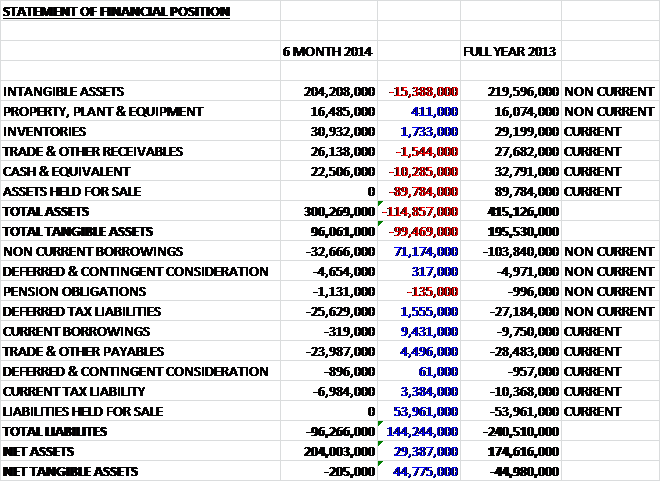
Overall, assets were down an incredible £115M, mainly due to the £89.8M reduction in assets held for sale relating to the disposal. We also saw a £15.4M fall in intangible assets and a £10.3M reduction in cash levels. Thankfully this was counteracted by an even larger £144M fall in liabilities. £54M of this were the liabilities held for sale but the largest fall was a £80.6M reduction in borrowings as the group used the cash from the disposal to reduce debt. There was also a £4.5M fall in Trade payables and nearly £5M less in tax liabilities. This all led to a £29.4M improvement in the net asset situation and a net tangible asset base that was pretty much at zero; so the balance sheet now looks much more healthy that last year.
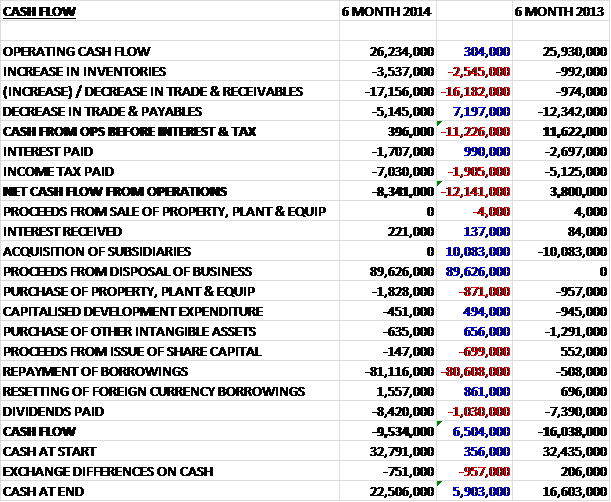
Cash profits were fairly flat at £26.2M but large adverse movements in working capital, particularly a big increase in receivables, meant that cash before tax was down a substantial £11.2M to just £400K. (this was being blamed on the phasing of working capital at the services segment). Due to the play down of debt, the interest paid was down by nearly £1M but there was a large tax bill of £7M, which was a big increase from last year so net cash from operations for the first half of the year was a disappointing outflow of £8.3M, £12.1M lower than in the same period of last year. Capital expenditure was a bit higher than in 2013 but the big differences were one-offs. The £89.6M received from the disposal of the services segment was used to pay back £81.1M of borrowings and increase dividend payments by £1M to £8.4M. The group also benefited from not paying out any more contingent consideration on the US acquisition, which meant the lack of a £10.1M payment that occurred last year. Overall, there was a cash outflow of £9.5M which, given the scale of the one-off receipts, is actually a little disappointing, although management expect this to improve in the second half of the year.
The operating profit for European pharmaceuticals was up by £4M to £25.2M. Without the effect of favourable currency exchange rates, however, revenues actually declined by just under 1%. This was partly due to the phasing of export orders, the ongoing pressure on antimicrobial usage in animal medicine due to concerns of over-resistance and the introduction of new dosing guidelines in the Netherlands, where the group did particularly badly over the period. This meant that the mix of sales was slightly more skewed to higher margin companion animal drugs. During the period, a number of advances were made in the drug portfolio, including the launch of a 1.25mg version of Felimazole to try and counteract generic completion for the larger doses; the launch of Sedator, Atipam and Domidine, three sedatives from the Eurovet portfolio, into Norway and Sweden; the preparation of Forthyron, a canine endocrinology product for launch in France and Sweden following the termination of distribution agreements with previous marketing partners; and the rights have been secured to market two new in-licensed products: Alfaxan, a cat sedative from Jurox and Sporimune, an oral dermatological product from Le Vet.
The other focus for growth has been geographical and the group have established a subsidiary in Italy that will commence trading in March. Third party contract manufacturing continued to perform well with a strong order book and new contracts being secured during the period. Work has been commenced on the expansion of the liquid, creams and ointments suite at the manufacturing site in Skipton which should increase capacity, improve quality systems and help the group achieve FDA (US) approval for these dosage forms.
Profit for US pharmaceuticals increased by just £316K to £3.3M. Although nothing was paid during the period, the group still has a potential $6M to spend on the US acquisition, $5M is dependent on reaching a certain revenue and this does not expire until the 6th anniversary of the completion date. Revenues decreased during the period, however, due to ongoing supply problems with Animax and it looks as though it will not return to normal until the end of the year at the earliest. Having said that, key products Vetoryl, Felimazole and the dermatology range all performed well with double digit revenue growth. A new dermatological product, Miconahex + Triz was launched during the period which is competition to an established brand whose patent has recently expired.
During the period, a couple of milestones were achieved on the product pipeline with a positive response from the FDA regarding a novel equine product and the successful completion of a clinical trial for a new canine endocrine project. The most notable new registration was for Felimazole 2.5mg and 5mg in South Korea.
It does seem as though the group is experiencing a number of headwinds at the moment. As well as the previously mentioned guidelines for antimicrobial products in the EU and supply issues from third parties in the US, a generic competitor has launched a product targeting Felimazole, one of the group’s key brands, in a number of EU territories; since the end of this update, Sterling has strengthened considerably against the Euro which will have an adverse effect on earnings; and a drug that is needed to diagnose Cushing’s disease in dogs that is manufactured by a third party is currently in short supply which impacts the use of Vetoryl. Despite all this, management still expect to hit earnings targets but are cautious about the overall economic environment as well as these issues going forward.
Net debt at the end of the period was a modest £10.5M, down from the £81M recorded at the end of the last year due to the previously mentioned pay-back of debt using cash from the disposal. The interim dividend was increased by just over 9% to give a full year dividend yield of 2.1% at the current share price, which is OK but nothing spectacular. The profit this half was pretty decent, but this may have been due to favourable exchange rates which are no longer present. The balance sheet has been substantially improved with the cash received from the disposal being used to pay back debt. The operating cash flow was disappointing. This is being blamed on the phasing of working capital at the disposal group but I remain slightly sceptical. These issues, along with the headwinds described above make me a little hesitant about Dechra for the first time. I am going to stick with it for the time being but I do not feel confident enough to add at these levels.
On the 30th April the group released a statement covering Q3 of this year. Overall revenues in the quarter were 4.7% ahead of the same period of last year and for the first nine months of the year they were up by 2.8%. In Q3 European pharmaceutical sales were up 3.3% against a comparitor period affected by poor weather. On the constant currancy level, sales were up 2.9%, driven by a 9% increase in sales of companion animal products, counteracted by flat revenues for food producing animal products as improved equine product sales were mitigated by a decrease in large animal antibiotic sales. US revenues were up a promising 16.3% in the quarter, and this would have been even more were it not for currency headwinds in the region. Momentum in the endocrinology and dermatology areas in the US was strong with Veroryl and Felimazole performing ahead of expectations. During the quarter the group opened an Italian subsidiary and they are on track to open a Canadia subsidiary in the Autumn of this year. Overall, group trading was in line with management expectations which is a bit of a relief given the problems highlighted at the half year stage.
On the 2nd May, Dechra released an update covering a number of their different drugs. They have received approvals from both the US Food and Drug Administration and the UK Veterinary Medicines Directorate for Osphos, a clodronate injection for to control navicular syndrome in horses, a leading cause of equine lameness. The drug is not yet approved for use in the rest of the EU as horses are classed as a food producing species which means additional studies needed to be undertaken. These extra studies are now complete and the group are filing for approval in the EU immediately. The product will be manufactured from June and should be launched in the US and the UK at the start of the next financial year.
It was also announced that Vetropolycin and Vetropolyin HC, two major sterile ophthalmic products received market approval for re-launch in the US following their transfer to a new manufacturing site. At their peak these products had sales of about $2.2M. In October 2012 Dechra took ownership of the marketing authorisations and they spent the subsequent period identifying a suitable manufacturer and seeking approval for the new site. The group had already manufactured a quantity of this product and it will be sold through distributers immediately although the group don’t expect them to have a material effect on profitability this financial year. Additionally, the group has recently submitted the dossier for approval in the EU and to the FDA for a canine endochrine product. It is targetted for approval in 2016.
It is good to hear that some of the manufacturing problems in the US seem to have been solved and the new equine drug also seems promising. This is a good update for the group.
On the 20th May the group announced the acquisition of the trade and assets of PSPC Inc for $10M. Of this $10M, $8.5M is due on completion and the remainder is contingent on the successful registration of a new product in development. Dechra will also pay a royalty of 10% on total net sales on the products, increasing by 2.5% if annualised sales are more than $7.5M and a further 2.5% if annual sales exceed $12.5M for the life of the Phycox patent. The principle asset is Phycox, vet joint supplement for dogs and horses that contains an algae extract that alleviates pain and inflamation without many of the side effects that can occur with other similar drugs. Phycox currently has annual US sales of $4.5M. The acquired group have also launched a Vitamin K soft chew that is used to treat dogs and cats poisoned by rat poison. This seems very niche indeed but has potential sales of up to $1M. Finally, the group also has a product in the final phase of development that is due to be released next year and should bolster the endochrinology category.
Overall, this is quite a small acquisition with a number of conditions attached but should enhance Dechra’s US products.
On the 8th July, Dechra released a statement covering trading for the full year. Overall revenues were up 1.6% at the constant currency rate as a second half growth rate of 3.7% compensated for a 0.7% decline in the first half. European revenues increased by 0.7% compared to last year and all countries showed growth except for the Netherlands where increased competition and antimicrobial reduction continued to create a drag on sales. Sales of Companion animal products increased 3.4% and equine sales were up 13% but food sales for food producing animals fell by 7.5% due to the above issues. In the US, revenue grew by 7.1% at constant currency rates and included a 22.9% increase in Vetoryl sales and a 17.4% growth in sales of Felimazole but these results were still affected by the supply issues reported previously.
During the year the group received market authorisation to launch Osphos, a major new equine product into the UK and US which should start to contribute by Q1 2015. They also submitted a novel canine endocrine product for approval in the EU and US and extended their US portfolio through the acquisition of PSPC in June. In Europe a new Italian subsidiary was established and there is a planned entry into Canada in the second half of next year. Overall, no real surprises here but it is a shame to see no end to the supply issues plaguing the US sector. I will continue to hold.