

E2V has now released their interim results for the year ending 2015.
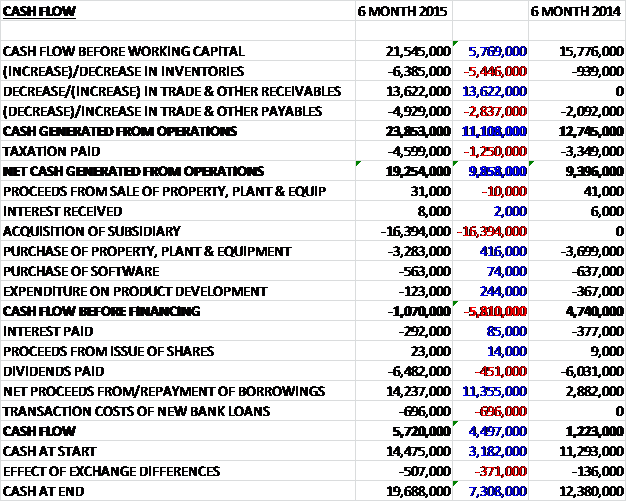
Revenues increased when compared to the first half of last year as a £4.3M growth in RF Power sales and a £1.9M increase in imaging revenue was counteracted by a £2.1M fall in semiconductor turnover. Conversely, cost of sales fell so that gross profit was some £7.6M higher at £43.3M. A fall in R&D costs was counteracted by an increase in operating costs due to continued expansion into the US and Asia, and admin costs were £2.1M higher than last time reflecting changes in the US and increased IT activity. There was also a £2.3M swing to the negative as far as foreign currency changes on fair value adjustments are concerned relating to the foreign exchange hedging instrument and a £1.7M of restructuring costs relating to the space imaging and Chelmsford teams which meant that operating profits were only £2.1M higher. Slightly lower loan interest charges and amortisation of debt issue costs were counteracted by a higher tax charge so that profit for the year was £1.8M higher at £9.9M and adjusted profit was £4.5M higher at £13M.
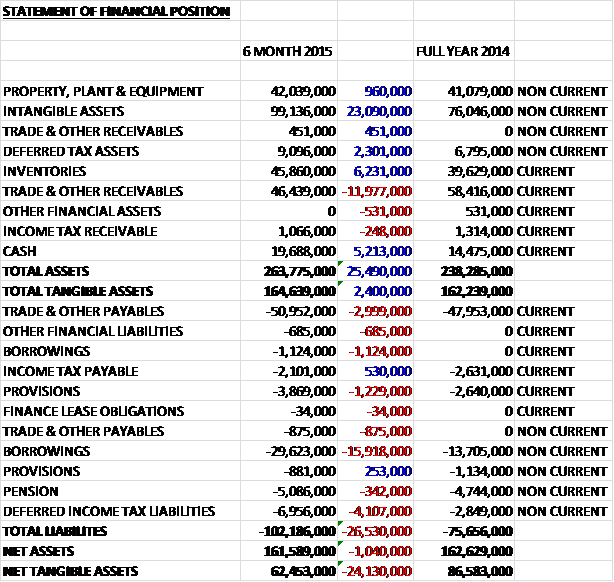
When compared to the end point of last year, total assets increased by £25.5M driven by a £23.1M increase in intangible assets obtained with the acquisition. Other drivers were a £6.2M growth in inventories and a £2.3M increase in deferred tax assets, somewhat offset by a £12M fall in trade and other receivables. Liabilities also increased during the year due to a £17M growth in borrowings, a £4.1M increase in deferred tax liabilities, a £3M growth in trade & other payables and a £1.2M increase in provisions. The result was a £24.1M decline in net tangible assets as the borrowings were used to purchase intangibles.
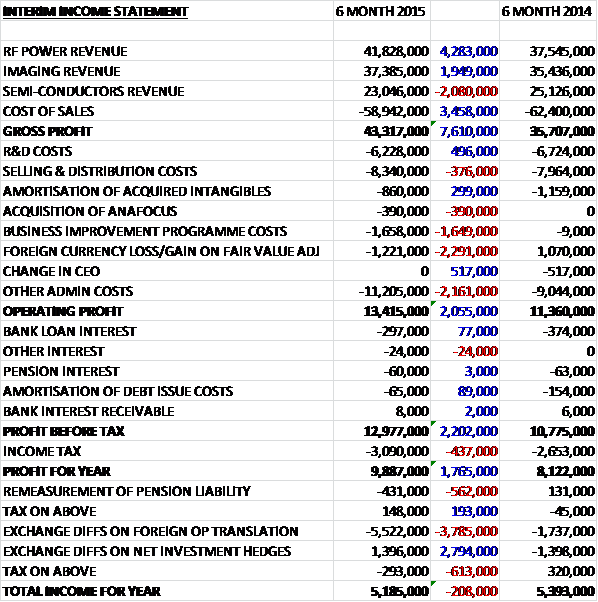
Before movements in working capital, cash profits were £5.8M higher than during the same period of last year before a decrease in receivables was broadly cancelled out by adverse movements in other working capital and after tax was paid, net cash from operations was some £9.9M higher at £19.3M. The vast majority of this cash was spent on the acquisition of a subsidiary with most of the rest going on property, plant and equipment and before financing, the cash outflow was £1.1M. The group then received £14.2M from new borrowings so that it could pay the dividends of £6.5M. The end result was a cash inflow of £5.7M which considering there was only £14.2M of new borrowings and the acquisition cost £16.4M, this is not a bad performance at all.
Results in the first half of the year were in line with expectations in a market that provided challenging trading conditions in some of the group’s markets with operating margins increasing from 12% to 17% reflecting the increased gross profit levels, partially offset by increased costs from the continued expansion in the US and Asia. A wide ranging customer interview programme revealed that customers value the group’s technology but are seeking greater reliability and consistency from them.
RF Power adjusted operating profit was £9.4M for the half year, an impressive £3.3M growth on the first half of last year reflecting strong growth in demand in radiotherapy and good growth in commercial, industrial and defence. Demand from OEMs in radiotherapy was strong in the first half and the 12 month order book reflects a number of multi-year contracts which were renewed during the last couple of years. Revenue in electronic countermeasures was lower than during the same period of last year reflecting the timing of programmes. The group has completed the development programme for a microwave power module for the SAAB Gripen but there are a number of defence programmes to be secured in the second half of the year.
Work is continuing on the next phase of the development contract with Rio Tinto covering the design and supply of large scale microwave generators for use in projects to improve the efficiency of mineral recovery and management anticipates this project continuing throughout the second half of the year. The rest of the portfolio of businesses in the division is focused on applications in commercial and industrial markets and good growth has been seen here, particularly in marine radar. Overall profit margin for the division reflects the change in revenue mix with the growth being delivered in the higher margin product lines and improved product delivery.
Imaging adjusted operating profit was £3.8M for the first half of the year, a decline of about £800K when compared to the first half of last year. Space imaging delivered strong growth on the same period of last year reflecting progress in the projects portfolio. Order intake in space imaging was also strong with new orders for sensors from the US for the Large Synoptic Survey Telescope; from the European Space Agency for Planetary Transits and Oscillations of Stars, and further orders from the Lebedev Physical Institute of the Russian Academy of Sciences at the system level. The group has implemented restructuring in the UK space imaging business to ensure that the cost base is aligned to the level of growth being delivered. This confuses me somewhat, as growth in this division seems to be strong so I suppose more was expected this year and possibly less growth is expected going forward.
Industrial vision demand experienced good growth in Asia reflecting some recovery of the industrial markets, as well as the growth driven by recent product introductions with further growth anticipated from new product introductions in the second half such as the new CMOS based camera, the “Uniiqa+”. Demand in scientific imaging was steady with a similar level expected during the second half of the year. There has been steady demand for industrial sensors for automatic data collection systems, including 2D barcode reading. Thermal imaging has seen revenue significantly lower than during the same period of last year due to lower end user demand, particularly in the core UK market and there has also been a modest decline in dental imaging. Overall profit margins reflected the contribution from the additional revenue, lower provisions on space programmes and product warranties, offset by increased R&D spending and increased resources in the US and Asia.
Adjusted operating profit for Semiconductors was £5.1M for the first half of the year, an increase of £1M compared to the same period of last year. This is despite the 8% fall in revenues that reflected lower demand for microprocessors and assembly, and test services in Europe along with the continued decline in the smart sensor business. This was partially offset by good growth in the US legacy lines and growth in sales of the own design analogue data converters into space applications. Current trading includes the anticipated decline in the smart sensor business with the group’s planned exit from the sector. Order intake was lower than the comparable period last year in part reflecting the timing of last time buy orders which were secured in the first half of last year. Management anticipates securing last time buy orders for the Freescale 68040 family of microprocessors in the second half of the year. Additionally, the group are expecting to introduce new products in the US to expand the range of multi-chip modules during the second half. Overall profit margins for the division reflected the mix of revenue with growth in higher margin segments including legacy products in the US and data converters.
As touched upon before, during the year the group commenced a restructuring of management and the space imaging teams which incurred a £1.4M charge and further restructuring at the Chelmsford facility incurred a charge of £281K. It seems a little strange to me that one of the fastest growing businesses is being restructured but imaging as a whole seemed to struggle during the year. The RF Power restructuring was completed during the year with a small credit to the group. In the second half of the year, further restricting costs of £3M are expected.
During the period the group acquired Innovaciones Microelectronicas (AnaFocus), a Seville based company specialising in the design and development of customised CMOS image sensors. The group paid a total of £21.7M which consisted of £15.1M in cash, £2.8M of accrued consideration that will be paid into escrow and £3.7M contingent consideration which is payable on the achievement of a number of targets over the next 18 months. There was also an additional £2.1M paid to AnaFocus employees as a result of the acquisition. The acquired group came with £15.7M of intangible assets, mainly relating to customer contracts and relationships, and current technology. A total of £10.6M was paid in goodwill on the acquisition. The group contributed £400K in operating profit in the month that it was part of E2V which sounds pretty decent, but the acquisition does seem rather pricey to me.
Going forward, management see industrial vision, space imaging and radiotherapy as the main growth areas where they will be making investments; semiconductors, scientific imaging and industrial processing systems are seen as important markets where investment will be maintained, with other segments being managed for their cash contribution. They have the goal of doubling operating profit by 2020, which seems rather ambitious, and see about two thirds of the growth coming from organic growth and the rest coming from acquisitions. The order book at the end of the half stood at £190M, an increase of just £1M compared to the same point of last year as a strong order intake from space imaging was offset by the cycle of certain radiotherapy contracts but in the last six months, the 12 month order book increased by £10M. In the second half underlying growth is anticipated with specific orders to be secured in space and RF defence. Management continues to be cautious over the broader economic environment, including further adverse movements in exchange rates but assuming no further deterioration in market conditions, expectations for the group’s full year trade performance remains unchanged, which doesn’t sound particularly bullish.
An interim dividend of £1.5p per share makes the total yield 2.4% at the current share price which increases to 2.6% on next year’s forecast. At the end of the period, net debt stood at £11.1M compared to a net cash position of £770K at the end point of last year. The group entered into a new revolving credit facility and still has £62.9M undrawn.
Overall then, this was a decent updates. Profits were up compared to the same period of last year and the operational cash generation was good. The acquisition has weakened the balance sheet somewhat and although it seems profitable, the group did pay quite a lot for it considering they suggested they were only looking for bolt on acquisitions in last update. The restructuring in the space imaging department is disappointing – it seems like it will cost quite a bit of money and considering this is one of the core growth areas, comes as a bit of surprise. Again, this seems like a decent company but there does not seem to be much in the way of earnings momentum with the order book remaining fairly constant. I will continue to monitor things here.
On the 30th January the group released a Q3 update. Trading during the quarter was positive with modest volume growth and benefits being seen from the acquisition of AnaFocus. Pleasingly it was announced that subject to Q4 trading, there is some potential for outperformance which means that the shares may be now worth a look.
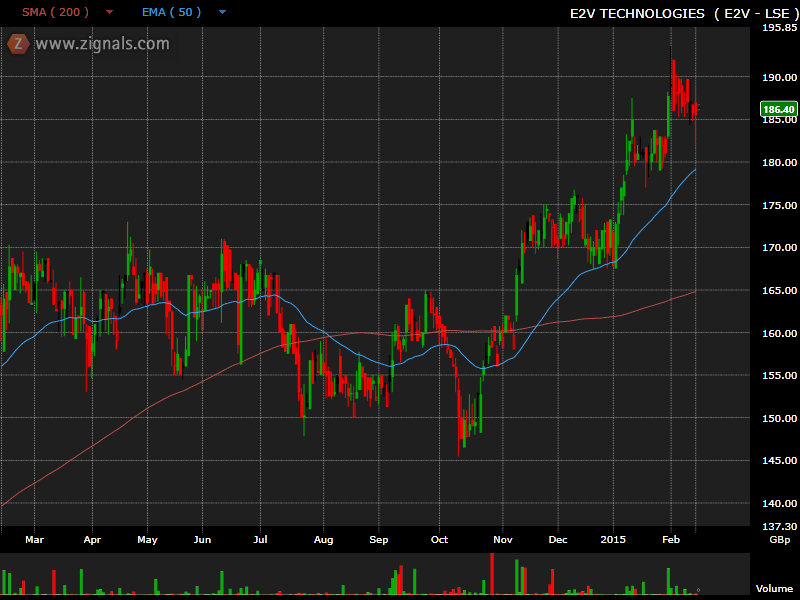
Looking at the chart, after the shares had a difficult few months between July and November last year, they have since been on a bit of a good run. The 50 day moving average is well ahead of the 200 day one with the share price above both. In recent weeks, however, there has been a bit of a pullback so I might look to enter when this recent pull back has been reversed.
On the 26th March it was announced that GVO Investment management purchased 500,000 shares at a value of about £1M which gives them control over 5.2% of the total share equity. I have also purchased shares here.
On the 16th April the group released a trading update for the full year 2015. The group delivered modest volume growth and benefited from the acquisition of Anafocus. They expect to deliver a strong fourth quarter result and now anticipate that trading performance for the year will be above the previous expectation, which is nice to hear.