

The group acquired Ashley Facades during the year and that business engages in the provision of long term contracts. Revenue from contracts is measured based on the stage of completion which is measured by qualified chartered surveyors. Where amounts have been billed to customers in excess of the stage of completion of contracts, revenue is deferred and is recognised as the contracts progress. Where the stage of completion has exceeded the amounts billed to customers, revenue is accrued in line with contractual terms.
Entu has now released its final results for the year ended 2015.
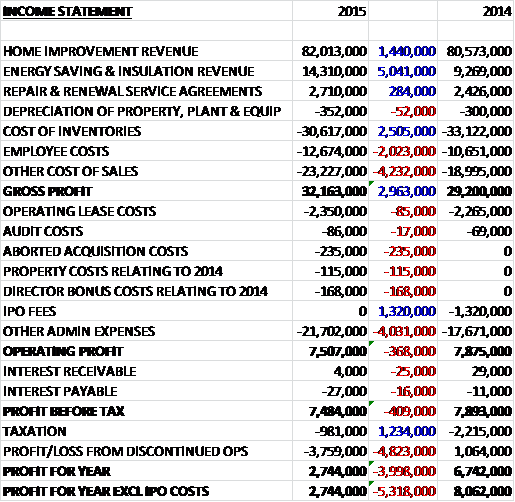
Continuing revenues have increased when compared to last year with a £5M growth in energy saving & insulation revenue; a £1.4M increase in home improvement revenue; and a £284K growth in repair & renewal service agreement revenues. Cost of inventories fell by £2.5M but employee costs were up £2M and other cost of sales grew by £4.2M to give a gross profit some £3M above that of last year. Aborted acquisition costs, historical property costs and historical director bonus costs were more than offset by the lack of £1.3M of IPO fees but a £4M growth in other admin expenses meant that operating profit fell by £368K. Interest was slightly higher but tax payments were much lower, although there was a loss of £3.8M from discontinued operations compared to a profit of £1.1M last year to give a profit for the year of £2.7M, a decline of £4M year on year.
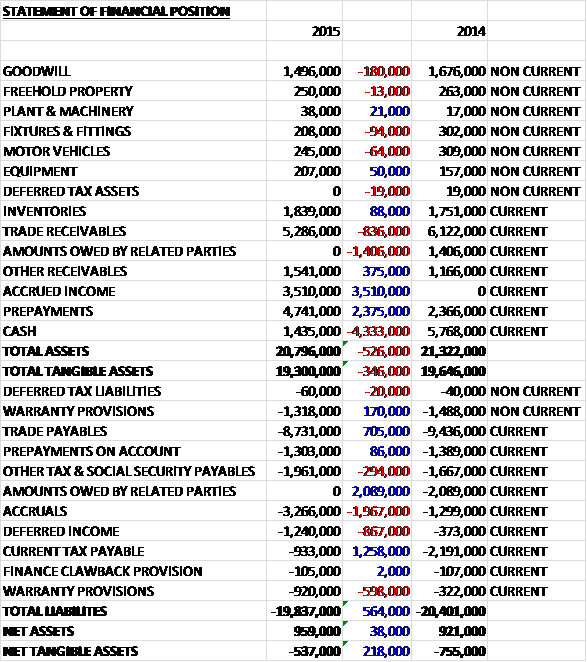
Total assets declined by £526K when compared to last year, driven by a £4.3M decrease in cash, a £1.4M decline in amounts owed by related parties and an £836K fall in trade receivables, partially offset by a £3.5M increase in accrued income and a £2.4M growth in prepayments. Total liabilities also declined as a £2.1M fall in the amounts owed by related parties, a £1.3M decrease in current tax payables and a £705K decline in trade payables was partially offset by a £2M increase in accruals, and an £867K growth in deferred income. The end result is a net tangible asset level of -£537K, an improvement of £218K year on year.
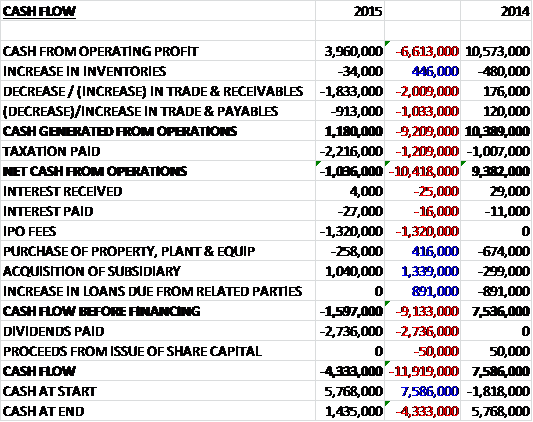
Before movements in working capital, cash profits collapsed by £6.6M to £4M. There was also a cash outflow from working capital, in particular a growth in receivables attributed to the Astley acquisition, and this combined with a £1.2M increase in tax paid meant that there was a £1M net cash outflow from operations, a deterioration of £10.4M year on year. For some reason there was also £1.3M in IPO fees this year and we also see £258K paid on property, plant and equipment, partially offset by a £1M income of cash through the acquisition. After dividends of £2.7M which don’t look very sustainable were paid, there was a cash outflow of £4.3M for the year and a cash level of £1.4M at the year-end.
The operating profit at the Home Improvement business was £4M, a decline of just £98K year on year. Although market share has held up, margins came under pressure (down from 5.1% to 4.9%) in common with the industry as a whole but also as the division began to rationalise its financial offering in the second half of the year, resulting in lower finance commission in the run up to a full reset of the division’s finance offering in light of the recent FCA guidance. The order book continued to remain strong at approximately £9M throughout the year and the board continue to sense increasing consumer confidence as home owners decide to make improvements to their homes.
The operating profit at the Energy Saving and Insulation business was £1.9M, a fall of £1.3M when compared to last year. The shortfall is almost entirely attributed to insulation products as a result of the reduction of carbon offset funding through energy suppliers, although volumes have increased.
The board consider that a significant opportunity is the area of energy saving and efficiency. The group covers this area with cavity wall insulation, loft insulation, high efficiency boilers and the growing use of technology in controlling energy usage in the home. Another significant opportunity is the cross selling of the group’s products and services into the base of customers such as in energy switching, they are beginning to offer all customers the opportunity to switch their energy supplier to the most cost effective option and while this is a new area, the early signs are encouraging. They are also currently at an early stage of promoting products that will allow consumers to monitor their energy usage online and also to control remotely their use of energy within the home. Finally there is a major push on replacing older and inefficient boilers with new energy efficient ones, making savings on household bills.
The operating profit at the Repair & Renewal Service Agreements business was £2.1M, a growth of £226K when compared to 2014. During the year the installation service business has sought contracts to build on its installation network across the UK with corporate customers and national retail chains. For one national chain, after successful trials, the business has been appointed as national installation partner for its energy efficient windows and door products. Whilst it is still early days, there are good signs that the partner installation process is working well, quantity levels are being maintained and that the retailer is pleased with the progress made to date.
It is notable that the group has a real problem with trade receivable impairments. This year a provision of £861K was made which accounted for an incredible 14% of receivables. This is likely not to have been helped by the £324K of provisions against recoverability of Astley’s receivables.
In March the group acquired Astley Facades, a company that provides commercial cladding operations across the UK. Bizarrely there was no consideration paid and the net asset value of the business was zero. The initial purchase consideration of £200K was reduced as a result of an adjustment in the level of net assets existing at the date of acquisition and the initial cash consideration was repaid to the group before the year-end. The total operating profit at Astley for the past year was £102K so with the liabilities acquired notwithstanding, this seems to have been a good deal.
The UK market for solar PV had become increasingly competitive and despite a continuing fall in the cost of solar panels year on year it was becoming difficult to foresee how margins could be maintained in the future, not helped by a competitor poaching much of the group’s sales staff! Subsequently the dramatic cut in feed in tariffs announced by the government rendered the Solar PV product in the UK unattractive to customers. Against this backdrop, the group closed the business of selling solar products to retail customers in the run up to the year-end. Additionally, on the 2nd October they completed the disposal of its kitchen retail operation, Norwood Interiors as it did not form part of their core strategy. The business was loss making, making a pre-tax loss of £620K this year.
As the year progressed it became apparent that the group needed to invest further in infrastructure and senior management resource in order to fulfil its obligations as a public company and there have been a number of changes to the board during the year. In May, Geoff Stevens was appointed as CFO and at the same time Darren Cornwall assumed the position of Corporate Development Director. The board had intended the CFO role to be part time but they have now seen sense and appointed Neill Skinner as CFO on a full time basis. Neill was previously CFO at AIM-listed Clean Air Power having held senior financial roles at British Nuclear Fuels. On the same date Geoff Stevens stepped down as CFO and assumed the role of non-executive director, replacing David Grundy who resigned during the year. This January the group announced the appointment of Andrew Corless as COO. He is currently MD of Entu Energy Services and has been with Entu since September 2015 during which time he led Job Worth Doing.
The closure of the solar business and the required investment in infrastructure has affected the profit potential of the group over the next couple of years and it may take some time for them to find alternative sources of profit to completely replace those lost through the solar closure. The board are now taking a more prudent view of the outcome for the year to come than it had previously and now expects that the results for 2016 will be marginally below those reported this year for continuing operations.
At the year-end the group had net cash of £1.4M compared to £5.8M at the end of last year. At the current share price the shares trade on a PE ratio of 6.9 which falls to 6.1 on next year’s consensus forecast (presumably old forecasts). After a final dividend of 2.67p was declared, the shares have a yield of 7.8% which increases to a hefty 8.8% on next year’s forecast.
Overall then this has been a poor year for the group. Profits fell and although net tangible assets increased slightly, they remained negative and the cash pile seems to be dwindling. The cash flow statement is a real mess. There was an operating cash outflow and the cash profits collapsed when compared to last year. Operationally, the service side is doing fairly well on the back of some new corporate clients; the home improvement business was flat not helped by lower finance commission following recent FCA guidelines but it is in the Energy Saving and Insulation business where the real problems lie.
Not only has the solar business been discontinued but the cavity wall insulation business also suffered due to the reduction of carbon offsetting. The board now do not expect to be able to replace the lost business and profits in the coming year are likely to be down on this year. So, this is a pretty poor business operating in a market that seems to be shrinking but the one thing going for it is the valuation. At a PE ratio of 6.9 and dividend yield of 7.8% these shares are definitely cheap but I think they are cheap for a good reason and they are not for me. I will not be updating here again until something drastically changes.
On the 25th August the group announced that they were calling in the administrators. What a terrible mess.