
Fairpoint has now released its final results for the year ended 2015.

Revenues increased when compared to last year as a £2M decline in IVA revenue, a £1M fall in debt management revenue and an £879K reduction in claims management revenue was more than offset by a £19.7M growth in legal services revenue. Staff costs increased by £10.2M but other cost of sales fell by £2.6M to give a gross profit £8.2M above that of 2014. The amortisation of acquired intangibles increased by £1.5M, marketing costs were up £2.7M and operating lease expenses increased by £866K, although the credit impairment on IVA revenues declined by £560K with other underlying admin expenses up nearly £3M. We then see a £9M goodwill impairment of the IVA business, however, which meant that the operating loss took an adverse swing of £7.4M when compared to last year. As far as finance costs are concerned, we see an £881K unwinding of the discount on contingent consideration which did not occur last time, and a £751K reduction in the unwinding of the discount on IVA revenues and a small increase in tax. The loss for the year stood at £6.3M, a negative swing of £9.2M, although this should be seen in the context of the £9M goodwill impairment.

When compared to the end point of last year, total assets increased by £15.3M driven by a £6.8M growth in other receivables, a £3.9M increase in the value of customer relationships, a £3M increase in trade receivables, a £5.3M growth in unbilled legal services income, a £2.4M increase in cash and a £2M growth in the value of software development, mainly relating to the acquisition of Colemans. This was partially offset by a £4.3M reduction in the amounts recoverable on IVA services, a £2.9M fall in the value of acquired back books and a £1.8M reduction in goodwill. Total liabilities also increased during the year due to a £13.8M growth in trade payables, an £8.4M increase in bank borrowings and a £2.6M growth in contingent consideration. The end result is a net tangible asset level (including some selected intangible assets!) of £14.5M, a decline of £10.7M over the year.
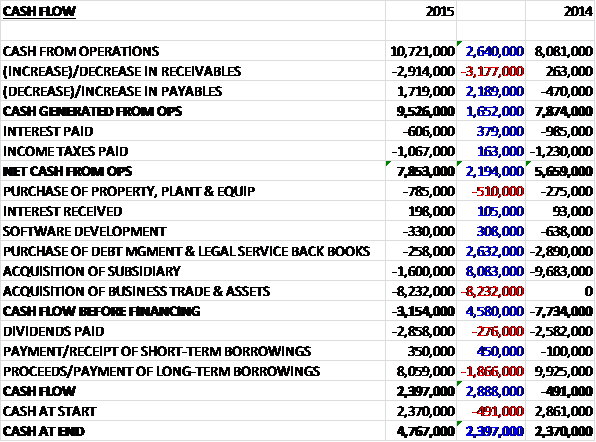
Before movements in working capital, cash profits increased by £2.6M when compared to last year. There was a cash outflow through working capital, with an increase in receivables, but interest and tax were both lower than last time, with the previous year including re-financing arrangement fees, to give a net cash from operations of £7.9M, a growth of £2.2M year on year. The group spent £785K on property, plant & equipment, £330K on software development, and £258K on the purchase of debt management and legal service back books. There was also £1.6M spent on the acquisition of a subsidiary relating to the contingent consideration paid for Simpson Millar and £8.2M spent on the acquisition of Colemans to give a cash outflow of £3.2M before financing. The group also spent £2.9M on dividends so needed to take out more borrowings (£8.1M) to give a cash flow of £2.4M for the year and a cash level of £4.8M at the year-end.
The adjusted pre-tax profit in the IVA division was £2.9M, a decrease of £500K year on year on revenues that also reduced. This decline was largely as a result of fewer newly incepted cases in a declining market. Continued low interest rates and high levels of employment have reduced the demand for debt solutions such as IVAs. The group continues to avoid exposure to fee levels which it considers uneconomic and in light of these market conditions, they have focused on profit margin management through tight cost management which meant that profit margins reduced by just 1% to 24%.
The total number of fee paying IVAs under management at the year-end was 14,841 compared to 17,628 at this point of last year. The number of new IVAs written during the year was 1,268 compared to 2,716 in 2014 and the average gross fee per new IVA was £3,045, down from £3,437.
The adjusted pre-tax profit in the Debt Management division was £2.9M, a fall of £400K when compared to 2014 on declining revenues, reflecting the absence of acquisition activity in this segment, in line with the group’s previously outlined strategy in respect of new back book acquisitions following the FCA’s clarification on the subject. The total number of DMPs under management fell from 25,462 to 16,925 during the year.
The adjusted pre-tax profit in the Claims Management division was £865K, a decline of £519K when compared to last year on a decline in revenue as the business transitions from maturing IVA PPI claims to newer lines of activity. In addition, the margin has fallen from 31% to 24% to reflect this mix change.
The adjusted pre-tax profit in the Legal Services division was £4.4M, a growth of £2.8M year on year, including an £800K contribution from Colemans and further contribution from the full year of ownership of Simson Millar which was acquired in June 2014. There was also underlying organic revenue growth of 4% and good progress has been made on integration, including office rationalisation, unified branding as Simpson Millar and the first phase of migrating the case management processes to a single IT platform.
Following the retirement of the Colemans brand, a new marketing campaign has been developed in order to improve organic growth. Product development continued with the launch of around 70 fixed fee legal services in personal, family, employment and travel law. The first unified marketing campaign is being launched in Spring via a mixture of print and on-line media. In addition, the business expects to make a small number of WIP acquisitions and is considering other commercial opportunities.
Following the proposed changes announced by the chancellor in the autumn statement relating to small claims limits and whiplash claims, the group believes that they are intended to be focused on whiplash claims relating to road traffic accidents; they are subject to consultation with anticipated implementation from April 2017 should the current timetable be met; and they are expected to follow previous precedent and apply to cases introduced post implementation and not retrospectively.
This category of business, on a pro-forma basis, represented about 8% of the group’s revenues in 2015. The group believes that its recently acquired legal processing centre positions them advantageously to manage such legal work at low cost should other providers chose to outsource this work. They also believe that the changes proposed by the chancellor may provide interesting acquisition opportunities. Still no idea what effect it may have on profits then.
In addition, the CMA announced a market study into legal services to examine concerns over affordability, service and complexity. The group apparently welcomes such a study, given its strategy in this area of transparency and value, through deploying its core skill of applying process to legal services.
Market conditions for the group’s debt solutions remain challenging. During the year the volume of new IVA solutions in England and Wales decreased by over 23% to 39,992 and the level of new IVA solutions were at their lowest level since 2008. Given these challenging market conditions and uncertainty over the likelihood of raised interest rates, which is expected to have a positive impact on the IVA market, the group assumed a growth rate of 0% in its impairment calculations. As a result, the recoverable amount for the IVA segment was insufficient to cover the carrying value of total net assets, resulting in an impairment charge of £9M which has been recognised in the income statement.
In the debt management sector, a rigorous regulatory agenda has been driven by the FCA since it assumed responsibility for the regulation of this sector. As with all firms operating in this sector, the group has traded under an interim regulatory permission, having submitted an application for full permission. Following clarification from the FCA regarding new debt management back book acquisition, the group don’t intend to resume acquisition activity in this field.
In August the group acquired Colemans, along with Holiday Travel Watch. Colemans is a provider of consumer focused legal services with particular expertise in volume personal injury, conveyancing and travel law. The total consideration was £13.6M which was satisfied by £8.3M in cash, £1M in issued shares, and £4.5M in contingent consideration with the acquisition generating £6.7M of goodwill. In the four months since the acquisition, the business contributed £800K to adjusted profit of the group.
The group incurred “exceptional” costs of £1.4M during the year. This comprised acquisition, restructuring and professional services costs associated with the Colemans acquisition and costs associated with the application for full regulatory permissions with the FCA regarding DMP activities. I don’t actually think either of these are exceptional – the acquisition costs are ongoing given the group’s acquisitive strategy and the regulatory applications are probably a normal business expense.
Going forward, the coming year will benefit from a full year contribution from the acquisition of Colemans and the integration, marketing and new product initiatives. In addition, they are targeting further value enhancing acquisitions to further consolidate their market. They anticipate the market conditions in the IVA and DMP segments will remain challenging given the benign interest rate and employment outlook. The group will therefore continue to focus on margin management and cash generation and expect these businesses to continue to make a useful contribution to group earnings. As a result of this, the board expects to make good progress in 2016.
Net borrowings at the year-end stood at £13.6M compared to £7.6M at the end of the prior year, not including the contingent consideration of £7.3M outstanding. If we take off the goodwill impairment, at the current share price the shares are trading on a PE ratio of 42 but this falls to 7.9 on next year’s consensus forecast, adjusted for a load of “non-underlying” items I suspect. After a 6% increase in the total dividend, the shares are yielding 4.3% which increases to 4.4% on next year’s forecast.
Overall then, this has been a bit of a mixed year for the group. They swung to a loss, but this was due to the goodwill impairment and excluding this, profits were broadly flat. Net assets declined as we see a large growth in payables and borrowings, both presumably acquisition related, but the operating cash flow did improve with some decent amounts of cash being generated, albeit not enough to cover the acquisition let alone the dividends.
The main issue is that with the exception of legal services, all of the group’s markets are declining. The IVA market is likely to remain subdued as long as interest rates remain low, Claims Management is suffering from a slow-down in PPI claims with other lines of business carrying lower margins, and the Debt Management business seems to be in terminal decline following the FCA’s ruling over acquisitions in this area.
Going forward, the group should benefit from the full year contribution from Colemans but I suppose the question is whether this will be enough to offset the declines elsewhere. The forward PE of 7.9 and yield of 4.4% both make the shares look cheap but that PE excludes a load of “exception” costs that occur each year and the yield is not covered by cash after the acquisitions, of which the board have indicated there will be more. A tricky one this, I might be tempted to take a small position on weakness.
On the 9th May the group released a trading update covering Q1 2016. Overall they are performing in line with management expectations during the quieter first three months of the year. The half year as a whole is expected to feature growth in the legal services division to reflect the additional contribution from the acquisition of Colemans and CT Support Services; good progress on the integration of Colemans and Simpson Millar, albeit with a quieter than anticipated start to the year in conveyancing giving housing transactions have not been as expected. The core debt solutions market is expected to remain challenging and focus remains on cost control.
In addition, CFO John Gittins is stepping down from this position after five years to pursue a portfolio career of non-executive positions. So, they are in line with expectations during the quietest part of the year but the decline in conveyancing gives cause for a bit of concern. There is no mention as to whether the full year is still on track to deliver to expectations so this is a bit of a clumsy update (again from this company) so there is nothing here to tempt me back in.
On the 20th July the group released a trading update covering the first half of the year. Overall trading has been in line with the board’s expectations and revenues have increased by 20% year on year. Adjusted pre-tax profit is expected to be flat, however, at £4.1M, reflecting the continued transition from a low-growth, higher margin debt solutions company towards a lower-margin higher growth legal services business. The decision to exit the Debt Management Plan business due to regulatory changes will impact on second half expectations.
In Legal Services, strong progress has been made on the integration programme with some 80% of revenues now administered on a common IT platform and encouraging early results are being generated from the new marketing approach. During the period the group acquired a small market leading practice specialising in child abuse actions in order to expand its range of legal services – this resulted in one-off transaction costs of £300K.
Conveyancing represented 6% of first half revenues and as reported previously, it has experienced quieter trading compared to original expectations. Consultation regarding the Chancellor’s proposed changes to small claims limits on whiplash claims has yet to commence. As a consequence it is not anticipated that any changes will be implemented before Autumn 2017 – small whiplash claims represent 9% of group revenues.
In the IVA business, as expected, market conditions in the group’s debt solutions market remain challenging. The group continues to focus on delivering good margins and cash generation and avoiding uneconomic business. Given the reduced prospect of upwards interest rate movement, the group has put marketing activity in support of this segment on hold.
As reported previously, the FCS is driving a rigorous regulatory agenda in the DMP sector. This resulted in the board’s decision to halt acquisition activity last year. The regulatory regime has already severely impacted the commerciality of the whole of the industry and has resulted in a reduction in profitability in the first half of the year. The ultimate outcome of the revised regulatory regime is expected to transfer competitive advantage to the charitable DMP sector from the commercial sector thus rendering the commercial DMP business model unsustainable. As a consequence, the group has decided to complete an orderly wind down of its DMP operations during the second half of the year.
This will materially affect the results of the group’s DMP segment in the second half as well as those of the claims segment given its dependency on selling services to DMP clients. The DMP business is now expected to make little or no profit for the second half of the year. The board expects the restructuring will give rise to exceptional charges in H2 of about £2M, half of which will be cash costs this year, and a non-cash impairment of the intangible asset of £5M.
Progress has been made on the recruitment of a new CFO with David Broadbent joining in August. He was previously on the board of International Personal Finance from its initial listing in 20007 to 2016, serving as finance director and chief commercial officer.
Overall then, this seems to be another sorry state of affairs with the more profitable parts of the business seemingly undergoing structural decline. At some point, these shares might be cheap but it seems like the decline might not year be over here.