

Ricardo has now released its final results for the year ended 2017.
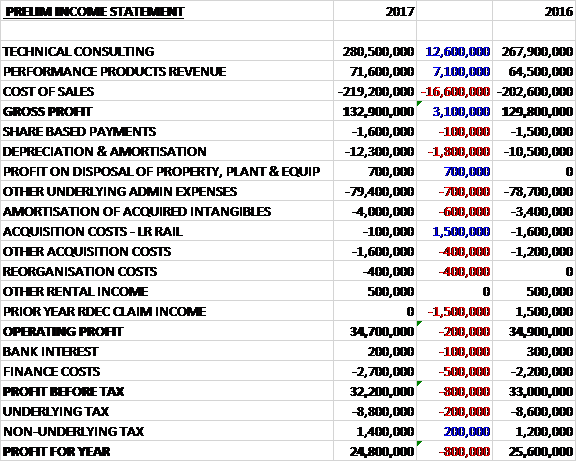
Revenues increased when compared to last year with a £12.6M growth in technical consulting and a £7.1M increase in performance products. Cost of sales also grew to give a gross profit £3.1M above that of last year. Depreciation and amortisation increased by £1.8M but the £700K profit on disposal of fixed assets offset the growth in other underlying admin expenses. There was a £400K increase in other acquisition costs, a £600K growth in the amortisation of acquired intangibles and £400K of reorganisation costs. There was a £1.5M reduction in LR Rail acquisition costs, however, which was counteracted by the non-repeat of last year’s £1.5M RDEC claim income. All of this gives an operating profit £200K below last time. Finance costs increased by £500K but tax levels were flat to give a profit for the year of £24.8M, a decline of £800K year on year.
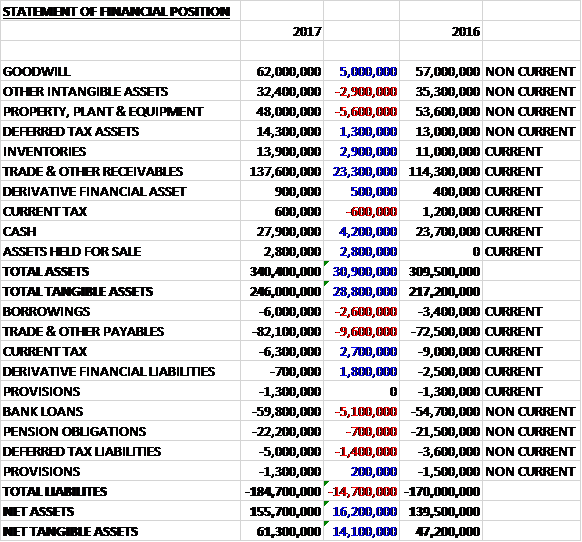
When compared to the end point of last year, total assets increased by £30.9M driven by a £5M growth in goodwill, a £23.3M increase in receivables, a £4.2M growth in cash, a £2.9M increase in inventories and a £2.8M increase in assets held for sale, partially offset by a £5.6M reduction in property, plant and equipment and a £2.9M fall in other intangible assets. Total liabilities also grew during the year due to a £7.7M growth in borrowings and a £9.6M increase in payables. The end result was a net tangible asset level of £61.3M, a growth of £14.1M year on year.
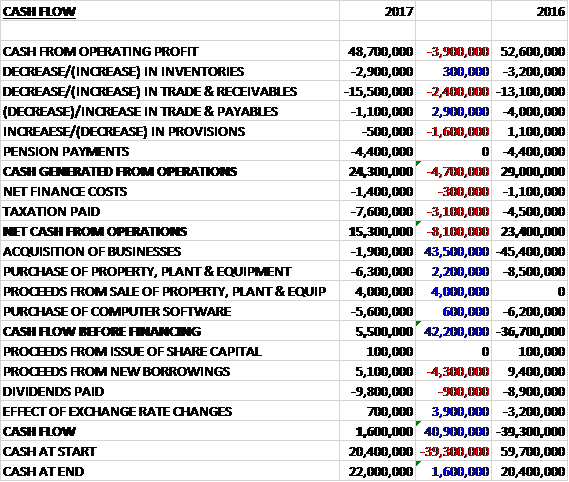
Before movements in working capital, cash profits declined by £3.9M to £48.7M. There was also a cash outflow from working capital and after tax payments grew by £3.1M there was a net cash from operations of £15.3M, a decline of £8.1M year on year. The group spent £5.6M on computer software, £6.3M on property, plant and equipment and £1.9M on acquisitions but also received £4M from the sale of assets to give a free cash flow of £5.5M. Sadly this didn’t cover the dividends so the group took out £5.1M in new loans to give a cash flow of £1.6M and a cash level of £22M at the year-end.
The operating profit in the Technical Consulting division was £27.8M, a decline of £300K year on year. The businesses in the automotive and commercial vehicles sectors in Europe experienced a disrupted flow of orders in the year as customers evaluated their product plans in light of the unsettled political climate and change in the industry. This was particularly evident in the first half of the year. In the second half they saw order flow return to normal patterns with orders at the end of the year being slightly ahead of the prior year. This led to a less efficient business operation during the year, impacting margins but with a good order book the business is in a good position to grow.
Elsewhere in the automotive and commercial vehicles sectors, the business in Asia has become a more profitable operation than last year and continues to make good progress. The market in Detroit remains challenging, however, where solid levels of activity in the commercial vehicles business, driven by new legislation requiring in-use compliance testing, did not compensate for the reduced levels of work elsewhere, and the US business ended the year with a loss. This was due to the Detroit automakers consolidating to fewer powertrain platforms whilst at the same time increasing in-house testing and resources. Order intake has been below historical levels and the board are taking steps to reposition the business and enhance their electrification and autonomous service offering.
China remains a key market for the business and this year they secured a number of contracts in the automotive sector, some of which are being delivered locally through the testing centres in Beijing and Shanghai. These contracts have included a mixture of work for hybrid vehicles, engines and transmissions.
In the off-highway and commercial vehicles division, they have seen growth and secured a number of large engine and transmission projects across the medium and heavy duty sectors. They continue to see interest across Asia, in particular for the group’s capabilities in the commercial vehicles business. The order pipeline is based around a broad mix of largely engine and transmission opportunities. In the US, greenhouse gas and low NOx standards are driving interest in powertrain and trailer efficiency, emissions control and the use of alternative fuels. Commercial vehicle platooning is also a fast growing area of opportunity.
Strong engagement in this sector has driven increased engine test activity, especially in North America, where new regulations requiring in-use compliance are now creating significant demand for powertrain testing and analysis. They have also seen growing interest in their fuel cell capabilities at their technical centre in California. They have focused on developing their product offering in the areas of ultra-low emissions, fuel economy improvement, system optimisation, platooning and hybridisation.
In the off-highway business, activity remains at a relatively low level in Europe following the recent implementation of Stage IV emissions standards, while in Asia the industry is showing renewed growth, especially in the transmission and driveline area. The group is securing an increasing number of projects, including large multi-year programmes.
The rail business is now completely integrated with the rest of the group and has performed well with strong order intake in the year from a wide geographical spread of customers. The profit reported in the year also benefited from favourable forex movements.
The energy and environment business also had a good year, with good levels of growth across its practice areas. The business has extended its order book heading into the new financial year by winning a number of multi-year orders for UK Government programmes, whilst also continuing to broaden its customer base in the private sector. The air quality team delivered projects such as the implementation of new technology to monitor driving emissions at the roadside, both in the UK and internationally, and they have expanded the offer of their services to a number of infrastructure businesses outside the water and energy practice areas.
In the defence sector the business won a number of new contracts on land defence, including further contracts to develop safety of the US Army’s HMMWV. In the US the business has won a number of new contracts, mainly in the land domain, and is focused on growth into new areas of the US defence market. In the UK they have grown their marine defence business, both surface and submarine. In Europe and Asia, they have secured contracts to deliver new engine and transmission designs for land vehicles and are pursuing other large opportunities.
The operating profit in the Performance Products division was £8M, a growth of £700K when compared to last year. This performance was driven principally by increased volumes of engines in respect of the contract for McLaren, together with increased transmissions for both Bugatti and Porsche. This has been partially offset by lower application engineering work within the software business. Order intake in the year stood at £78M, which was £25M lower than last year, however, when they secured a multi-year transmission supply contract.
The new expanded engine assembly facility is now fully operational, doubling capacity and generating the capability to deal with an increased number of engine variants. Production of engines for the McLaren 540C, 570S, 675LT and P1 GTR continued during the year in line with expectations, and full production engines for the new 720S has been added. They also secured the transmission supply contract for the Aston Martin Red Bull Valkyrie whilst continuing to support Bugatti with supply of the complete driveline system for the Chiron.
The group is now supporting a key manufacturer in the Formula E Championship with a collaboratively designed and tested product. They also continue to manufacture for Formula 1, and they supply products such as the transmissions for BMW and Ford GT3 programmes, the M-Sport World Rally Championship Ford Fiesta, the Hyundai R5 Rally programme, the Japanese Super Formula Championship, Indy Lights and the World Series Formula V8 3.5.
The group continues to supply spare parts to the UK MOD to support the Cougar and WMIK vehicle fleets. The group are working with Lightweight Innovations for Tomorrow, to identify a new reliable solution to documented braking and stability problems in the current HMMWV configuration.
As is usual these days there are a number of non-underlying items. The £100K expense on the LR Rail acquisition represents expenditure incurred of £500K offset by £400K of fair value provisions recognised on acquisition which have been released within specific adjusting items where those risks will not crystallise as originally anticipated.
Other acquisition related expenditure of £1.6M primarily comprises costs incurred for the services rendered to and consumed by the group regarding the Exnovo and Control Point Corp acquisitions. It also comprises costs associated with the integration of Exnovo and Cascade since acquisition. In addition, costs of the associated earnout agreements of prior acquisitions have also been included. Reorganisation coasts of £400K relate to expenditure incurred in the formation of the new Global Automotive structure from the operations of the automotive technical centres. They comprised the initial planning activities to implement a reorganisation of Europe Technical Consulting into Automotive EMEA to align with the new global automotive structure.
In July 2016 the group acquired Motorcycle Engineering Italia for a cash consideration of £1.9M. The business had negative net assets and the acquisition generated goodwill of £3.2M. The business is now reported in the Technical Consulting segment and it broke even in the period on revenues of £3M.
After the year-end, in September, the group acquired Control Point Corp for an initial cash consideration of £5.3M, rising to a total of £7.8M subject to the achievement of certain performance targets. The business is a US-based engineering firm which operates in the defence sector and has expertise in distributed software-based systems, fleet management technology and vehicle engineering capabilities. The acquisition generates goodwill of £2M.
Going forward the year ended with another record closing order book of £248M, which is a 7% increase on the prior year. This closing order book, together with a good pipeline of further opportunities continues to represent a diversified spread of orders across market sectors, customers and geographies.
At the current share price the shares are trading on a PE ratio of 15 which falls to 13 on next year’s consensus forecast. After a 7% increase in the dividend the shares are yielding 2.5% which grows to 2.6% on next year’s forecast. At the year-end the group had a net debt position of £37.9M compared to £34.4M at the end of last year.
Overall then this has been a bit of a mixed year for the group. Profits were down with a reduction in the RDEC claim income offsetting a decline in acquisition costs. Net assets increased but the operating cash flow fell and although some free cash was generated, this did not cover the dividends. The Technical consulting division saw profits decline as the order flow was disrupted from European auto producers, which has now mostly reversed. The other main driver of the fall was a reduction in orders from US auto companies as they brought more production in-house, which is a little more concerning.
The product division saw profits rise due to increased deliveries to McLaren, Bugatti and Porsche but it should be noted that the order book declined. With a forward PE ratio of 13 and yield of 2.6%, the shares are not bad value but the company does seem to have lost some momentum. I think I will wait on the sidelines for now.
On the 3rd October the group announced that MD of the Strategic Consulting division sold 13,447 shares at a value of £110K to leave him with no shares in the company.
On the 8th November the group released a trading update on order intake in Q1 which was £33M higher than last year at £106M including £6M in respect of the Control Point acquisition. Significant orders include two large multi-year Chinese customer programmes in respect of the engineering of an electric vehicle and the transmission for a hybrid vehicle. In addition, EMEA Automotive has secured an order for road trials for a commercial vehicle platooning project in the UK.
This all sounds positive to me – tempted to make a purchase.
On the 17th January the group released an update covering the first half of the year. Order intake was strong, more than £50M higher than last year and representing an organic growth of over 25%. The orders have been generated from a broad range of sectors including the development of electric vehicle battery systems for a customer in China, passenger car new engine design work from Japan, a European car battery testing programme, a large multi-year order for the independent verification and validation of a Taiwanese rail line and further air quality work for the UK government. The order intake relating to electric or hybrid vehicles has been particularly encouraging and is in the region of 24% of total order intake compared to 17% last year.
Cash performance in the period has been strong with net debt reducing from £38M to £32M despite paying a £6M consideration for Control Point.