

Shaft Sinkers have suffered quite a torrid time since I made the decision to buy the shares. I will start the analysis with the income statement.
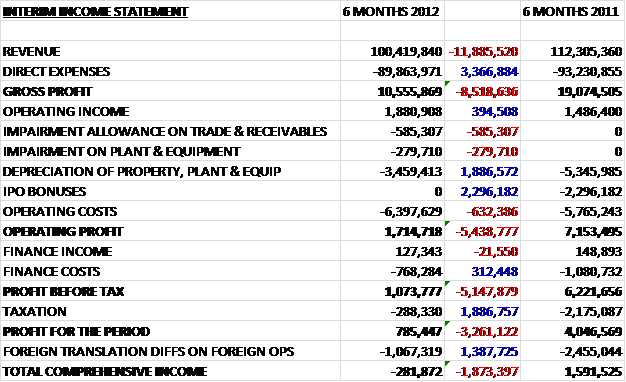
So, this doesn’t look too good when compared to last year. Revenues have taken a tumble, down nearly £12M to just over £100M, while expenses have been reigned in a bit to leave the gross profit a rather disappointing £10.6M for the first half of the year, which is down £8.5M on the same period of last year. The revenue loss has been put down to the weakening Rand against Sterling and 89% of the revenues were earned in South Africa.
Operating profit, at £1.7M is £5.4M lower than the first half of last year and is better relative to the Gross profit due to the lack of IPO bonuses paid out. After a lower taxation than last year is taken into account, the resulting profit for the period was £785K, down £3.3M on last year. Unfortunately exchange rates were once again unkind to Shaft Sinkers, wiping another £1M off the value of the profits to leave a negative income for the year of -£282K.
Not great then, but not a total disaster I suppose.
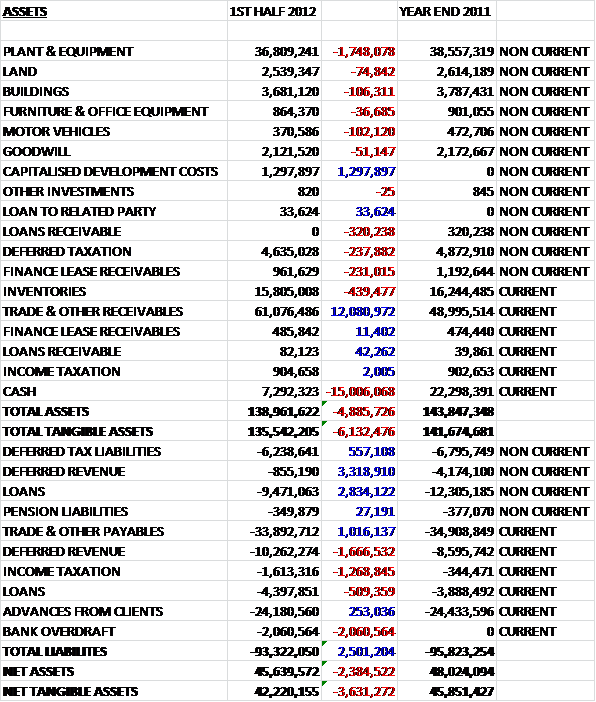
Looking at the total assets, we see these have reduced marginally (nearly £5M) to £138.9M. Within this figure, we see £1.3M of capitalised development costs (intangibles) that were not present last year (these are funds invested in IP being developed by Sight Power for the group for use in mine inspection tech) but the big movers are the increase in Trade and receivables – which were £12M higher at £61M and a £15M reduction in the cash level, to a more precarious £7.3M. The increase in receivables relate mainly to the failed Eurochem project. The big reduction in cash levels is a worry.
Liabilities are also slightly down on last year, with small reductions in deferred revenue and the loans outstanding. A new bank overdraft of about £2M has appeared and in general current liabilities have increased, while non-current liabilities have fallen off a bit. Overall, net assets are down £2.4M at £45.6M and net tangibles are down a bit more, £3.6M to £42.2M. On to the cash flow statement:
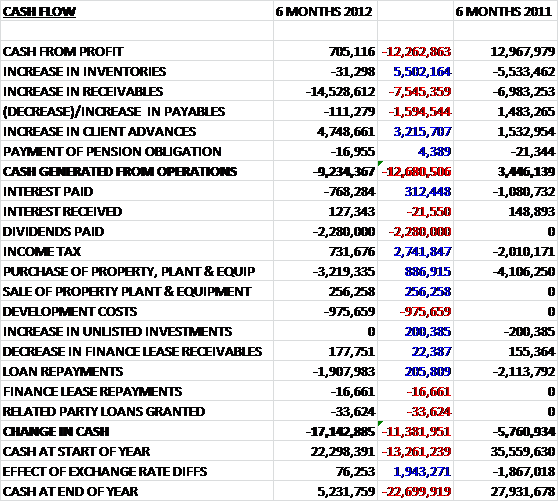
This cash flow statement does not make pleasant reading. The cash received through profit has crashed from nearly £13M in the first half of last year to just £700K in the same period of this year. Despite almost £5M in client advances, a big increase on the money owed Shaft Sinkers in receivables means that the actual cash lost in operations is a massive £9.2M, compared to a positive cash inflow of £3.4M last year (a negative swing of £12.7M). The increase in trade receivables were due to the money owed by Eurochem that has not been paid following the termination of that contract. The management are confident of receiving these outstanding receivables before the year end, I wish I could be so confident about that…
Other than this, the group also spent £2.3M on dividend payments, which it could ill afford really. In addition, we see nearly £1M of development costs during the half year, which relate to developments in technology for automated mine shaft inspection, and nearly £2M paid back in loans. However, slightly less paid on capital expenditure due to the late starting of some of the projected work, and income tax mean that the rate of increase in the loss of cash is £11.4M, which gives a terrible cash out flow of £17.1M, which in turn leaves just £5.2M of cash left at the end of the half year. Clearly the group cannot have another 6 months like they have just had with regards to the cash position but thankfully they have received a £16.3M cash advance from Hindustan Zinc after this balance sheet was signed off.
I felt at this point it would be an interesting exercise to look at the order book as it stands.
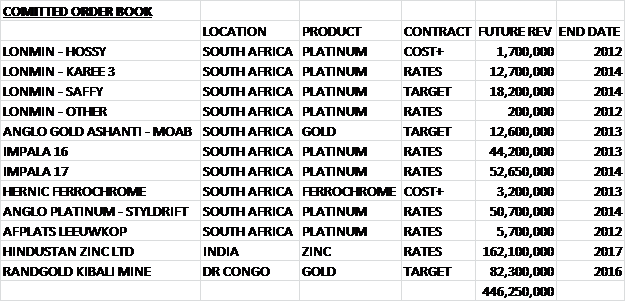
*This list includes some of the post report contract awards.
The value of the future order book is similar to this point of last year, but we have lost the Eurochem business and replaced it with the Hindustan Zinc. This shows just how important that Hindustan Zinc contract win was – it accounts for nearly half of all future revenues and diversifies the project portfolio away from South Africa and Platinum. The order book now stands at £347.7M, compared to £301.1M at the end of last year, and £425.3M at this point last year. There is currently £1.1Bn on tenders, which shows quite a healthy potential pipeline.
The margins have been hampered by issues at Lonmin Karee 3 and Impala 16 and 17 which is partly why profit fell short of management expectations. At Impala 16, there were delays due to the main shaft being serviced through the ventilation shaft and in Impala 17, a fatality caused work to shut down for a lengthy stoppage. The Lonmin Hossy and Saffy shafts are progressing well but the Karee 3 contract is currently under review as it seems the group offered it on very low rates. Work at Afplats is progressing and should be complete during the year and the Anglo Platinum Skyldrift project is improving performance. Likewise the Anglogold Moab and the Hernic Ferrochrome projects are also progressing well.
Outside of South Africa, a Hydroelectric project was completed in India, which had particularly high margins and the Hindustan Zinc shafts are due to be commenced in the second half of this year. In Russia, the Eurochem project was demobilised and the group still expect to receive all of the amounts owed on this contract. It has to be said, though, that the loss of this contract is a real blow for the group’s efforts to diversify its business. A project was started in Poderosa (Peru) for METS (Mining Engineering & Technical Services). I am not sure if this will have much of a material earnings bonus but it does give the group some presence in the important South American market.
Apart from the Eurochem problems, other issues have been holding the group back in the first half of the year. The well publicised unrest in South African mines will affect the group, if not directly, then indirectly considering their exposure to the South African mining sector. The weakening Rand is also causing issues and has apparently been responsible for the loss of £12.5M of revenues.
Net debt is currently at £8.7M, which is a negative £14.7M swing and something the group will want to keep an eye on.
Overall then, this is a real mixed bag. These results are not good, the profit of just £785K was down by £3.3M with revenues of 100.4M down by nearly £12M that were put down to the weakening Rand. Net assets remained fairly stable but this was only because the crash in the cash level was counteracted by an increase in the value of receivables. Indeed, this has been the story for Shaft Sinkers over the first half of the year, with the group suffering a £17.1M cash outflow for the period. This was predominantly caused by the Eurochem termination as the client refuses to pay the receivables owed, hence causing the issues with the cash flow. As mentioned, the unrest in South African mines also has an effect on the group. However, there is one shining light and that is the Hindustan Zinc contract being awarded. I cannot stress enough how important this was – after the Eurochem debacle the group needed another large foreign contract to diversify away from South African precious metals.
The share price has taken a bit of a hit recently which seems to make these shares good value. At the moment, however, I feel there is a bit of risk here so I hold.
Since the date of this report, the unrest in the South African mining sector started to take its toll on the group. The strike affected AngloGold’s Moab project which delayed the work here. It did not account for a large proportion of the group’s order book, though. Additionally, on the 17th October some of its workers at Lonmin’s Saffy shaft embarked on an unprotected strike which the group were trying to find a solution for. On 30th October, staff returned to work at both sites so there does not seem to have been a huge amount of disruption, with just two locations affected for a few weeks.
Also in October, the group mentioned that Eurochem are filing a claim against Shaft Sinkers for the termination of the contract. Conversely Shaft Sinkers are also filing a claim against Eurochem over amounts owed due to the termination of the same contract. This looks to rumble on for a while, but in my opinion, the group are very unlikely to see any of those “receivables” relating to this project for a long time (if at all), which will likely result in a large write-down of those trade receivables mentioned earlier.
There is not just bad news, however, as in the same month the group announced additional work on both the Impala 16 and 17 mines. The work on the 16 mine should add a further £5.9M to the order book and at 17, there should be a further £10.3M added. This work is due to be completed in H2 2013.
More significant, however, was the announcement in November that Shaft Sinkers has won the vertical shaft contract at the Randgold Resources Kibali gold mine in the DR Congo. This contract should add £82.3M on to the order book and should be completed by 2016. Although this addition is still an African precious metal contract, it does diversify somewhat from South African platinum. It is also good to have some long term project work nailed down.
The share price is still very depressed and I am tempted to add a few more given this new contract win. The main issue as I see it, is still the cloud of the Eurochem failed project and the related legal issues and costs.
On 15th November, the group issued an interim management statement which outlines the performance in the past few months. A big mention goes to the unrest in the South African mining sector but they confirm that all projects are being worked on again. 11 days were lost at the Lonmin shaft and 25 lost at the AngloGold shaft which will have a negative effect on the margins on these projects.
Elsewhere, the group continues to be in discussions with Lonmin over the Karee 3 rates. At the Impala shafts, Impala 17 is back to normal working levels but the Impala 16 shaft still has issues and Shaft Sinkers have replaced the management at this mine to help improve things. The Afplats Leeuwkop project is progressing well and the group are in discussions with the client about the next phase. The Styldrift and Hernic Ferrochome projects are both progressing well.
The Hindustan Zinc project has been started and the group have received a cash advance to help with the capital expenditure involved. The Eurochem situation rumbles on. Shaft Sinkers still think that the claims against them have no legal merit and are hoping to receive $15M from Eurochem for outstanding payments. This is not actually that much but would be a great help to the cash flow if they could get it. Honestly, however, I am not hopeful about this and think all they can realistically expect is not to pay any damages to Eurochem.
Most of that cash advance from Hindustan Zinc has gone and Shaft Sinkers only have £8M of cash balances left, with a net debt of £14M. Apparently in this industry, variation orders are quite common and they require extended debate with the client before agreement is made on the payment of the order. At the moment, the group is carrying about £21M of these orders in receivables. This is a bit of a worry as I was under the impression that the high level of accounts receivable was from the terminated Eurochem project. It now seems that receivables will be even higher than at the half year point which will further pinch cash flow.
At the end of the update, the group issued a profit warning and indicate that they expect the results for the financial year will be below market expectations. This is disappointing as market expectations were already at quite a low level due to previous issues with Eurochem and the strikes. It seems the continued weakening of the Rand is also having an effect but it is good to see the group pushing for new contracts in USD.
Although this update is not what I hoped for, the future order book is still looking much better than a few months ago. I will not look to buy any more of these shares before the issues have been worked through and the cash flow situation is sorted out but I will hold on to them for now.
On 20th November the group announced that it had secured £7M of extra work at the Afplats Leeuwkop site to continue the main shaft from 325m to 700m. The work is expected to be completed in 2013. It would have been a surprise if the group did not secure this as it seems to be part of the same contract they already have with Afplats but none the less, it is nice to be kept informed about such things.
On 13th February 2013, the group issued a trading update covering the full year of 2012. The issues that Shaft Sinkers faced during the year have been fairly well documented and revenue is expected to be 13% lower than last year at £197M. This translates to a profit before tax of about £3.5M, compared to £13.5M in 2011. The main reasons for this have been the labour strikes in South Africa and the late starting projects elsewhere. Net borrowings are due to be about £2.8M, compared to £8.6M at the end of the first half of the year and that is actually a pretty good performance considering the issues.
There seem to have been a number of problems in each of the projects. For Lonmin, work at the Saffy shaft progressed within expectations but the margin was impacted by increases in wages following the strikes. The work at the Hossy site was deferred due to austerity measures in the client’s business (A bit of a concern, but there was not that much extra to go). Work at Karee 3 has been progressing well but the group are in discussions to restructure the contract (not sure why).
For AngloGold, the Moab project was negatively affected by strike action but progress in now going according to plan.At Impala, performance was below plan at 17 shaft towards the end of the year which meant that costs overran and there was a similar issue at 16 shaft where the group have introduced a new management team and seeking other efficiency savings. The Leeuwkop project seems to be progressing well.
At Styldrift, full production rates were achieved by November. Margins here were adversely affected by certain heavy equipment failures, however. The Hernic Ferrochrome shaft performed within expectations. Outside of South Africa, the Hindustan Zinc project suffered delays due to issues with a subcontractor. This is a bit of a disappointment because this particular project is very important for the future of Shaft Sinkers so it needs to go well. Mobilisation activities are underway at the Kibali Goldmine.
The Eurochem issue rumbles on, there are no new developments but apparently Shaft Sinkers are being sued for $800M. I was not aware of the figure before now and this seems like a huge amount and would destroy the company if EuroChem were successful. There is a counter claim for $15M which seems like chicken feed in comparison!
Going forward, the order book is at £361M, an increase from the end of the first half and had the same value of outstanding tenders waiting to be awarded as before, 60% of which are outside of South Africa. Next year, the board expect that profitability will have improved as the Hindustan Zinc and Kibali contracts start contributing properly and with some potential new contracts in the pipeline. This will depend somewhat on conditions in South African employment and the avoidance of future strike action.
Overall, this is an interesting update. The full extent of the claim against Shaft Sinkers was a bit of a shock and there seems to be operational issues at a lot of the projects the group is involved in. The Hindustan Zinc contract in particular is so important as it is diversified from the traditional South African platinum projects. The board expect next year to be better going forward but a lot depends on the smooth running of these sites. The debt level is improving but I suspect this is due to the advance payment received from some of the new contracts. Overall, I still rate these as a cautious hold.