

Tristel have released their full year 2012 results now so I will start with the income statement.
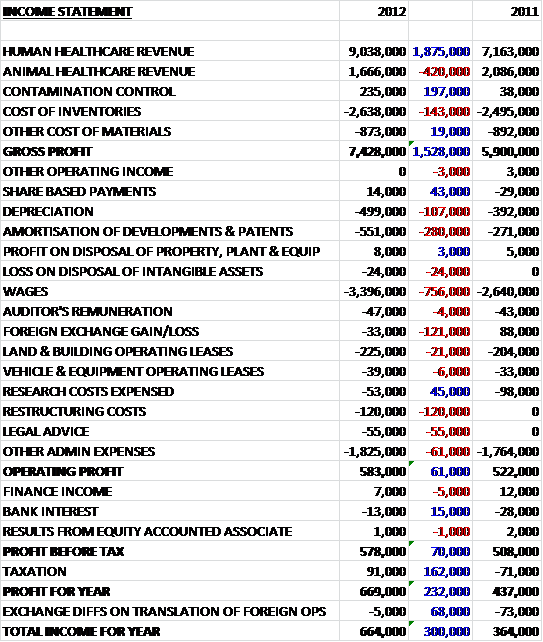
This does not look too bad on first appearance. We can see that the largest segment, Human healthcare is progressing well, with revenues up by £1.9M to £9M. Contamination control is starting to record a small amount of revenue but disappointingly Animal Healthcare suffered a decline in revenues of £420K to £1.7M due to the termination of the agreement with Medichem. Costs were down slightly to leave the gross profit at £7.4M (£1.5M higher than last year).
This year we can see that other admin costs have increased. Depreciation and Amortisation are up, partly because development costs were revised from unit sale basis to straight line basis from when the asset was available for use of Stella production tooling, which resulted in an amortisation cost of £60K.
Possibly more significantly, we see staff costs up £760K to £3.4M, which presumably includes new staff to directly market the animal healthcare products and some one-off costs relating to redundancies in some underperforming areas. There were also some costs relating to restructuring and legal advice, and provisions of £72K were made against inventories relating to 25% of the Tristel Shine machines which were either slow moving or obsolete.
All of this means that the profit before tax was only £70K higher than last year at £578K. The group, however, benefited from a tax rebate and actually made £91K here to make the profit for the year £669K, £232K up from last year. Finally a smaller loss due to the exchange rate meant the total income for the year was £300K up on 2011.
On to the balance sheet:
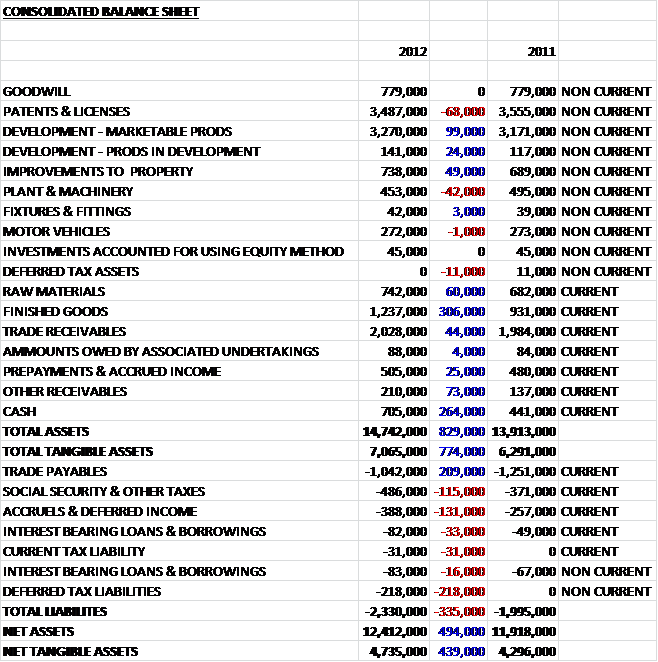
Total assets ticked up £829K to £14.7M. The largest increases were for inventories, which were up £350K, and cash, which was up £260K. There were other small increases but these were not significant. Liabilities were also up, with the largest increases seen in tax liabilities and deferred income. Overall, this caused net tangible assets to increase by £440K to £4.7M.
Trade receivables were up slightly at £2M but there were less overdue receivables than last year, which has got to be a positive thing. That goodwill amount was acquired with the previous purchase of Newmarket Technologies Ltd and the other Intangible assets include the marketing rights & know-how to a range of disinfectants in animal healthcare (£2.5M). The amount owed by associate undertakings relates to Tristel Italia.
Next, I will look at the cash flow:
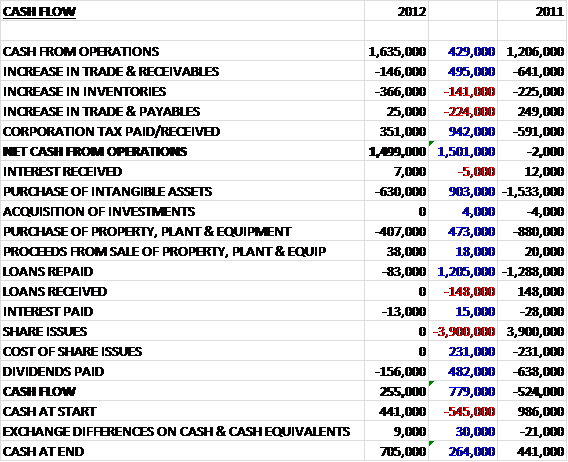
This cash flow statement shows that Tristel has a small positive cash income for the year of £255K (£779K better than last year). Again, probably the main driver of this was the money they made on tax, which was £351K, almost a £1M swing to the positive which included a £354K adjustment in respect of prior years where previous year R&D claims were received during this year.
Aside from this, the group also made more cash on the revenues and slowed the rate of increase in receivables somewhat. Compared to last year, much less was spent on capital expenditure as the significant capital investment in new facilities came to an end and the group did not pay back any loans (£1.3M paid back last year).
We also see that there was no cash received from any rights issues, compared to nearly £4M last year and the dividends have been set at a more sensible level. I am quite pleased by this cash flow, it is fairly decent for a company the size of Tristel and much better than last year – not sure if they can repeat this without the tax rebate, though.
| EPS |
2012 |
| PROFIT AFTER TAX |
669,000 |
| NUMBER OF SHARES |
39,985,000 |
| EPS |
1.7 |
| SP |
29.5 |
| P/E |
17.6 |
At the year end an earnings per share of 1.7 gives a P/E value of 17.6, which is not particularly good value. Currently the share price is at a similar level but going forward, the group’s broker (never sure how independent they are) has given a forward EPS of 2.2, thereby giving a forward P/E of 14.1 which is bit better but still not amazing value.
The dividend has been increased slightly from the savage cut last year which gives the shares a 2% yield at current prices – not exactly amazing but could be worse. This dividend level is quite conservative though, and is covered by post tax profit 2.7 times so there is scope for an increase at current trading levels.
The group’s revenues are divided into 3 segments, which are the manufacture, development and sale of infection control and hygene products using Chlorine Dioxide. This is mainly used in hospitals and makes up 83% of revenues; the manufacture and sale of cleaning prods to vet & animal healthcare, which makes up about 15% of revenue; and pharmaceutical and personal care products (contamination control), which is a new business and accounts for just 2% of revenues.
In the human healthcare segment there are a large number of customers, but £3.692M is received from just one customer (40.2% of revenues). Within Animal Healthcare, one customer pulls in revenues of £1.404M (84.3% of revenue) and 33.2% of total group revenues are received from just the one customer, which clearly leaves Tristel somewhat dependent on these clients.
There seems to be a lot of transactions between Tristel and a number of different individuals who are on the board. During the year, £160K of royalties were paid to Bruce Green. Last year, Tristel paid £700K to this individual in order to terminate the consultancy agreement and settle royalties, which is why I am a bit surprised to see that they are still paying money to him. For a company the size of Tristel, this is quite a substantial amount of money. Margins have increased due to this arrangement, however. It doesn’t end there though, as £144K was paid to Tom Allsworth, director at Medichem and a small amount was paid to Mark Fraundorfer.
Although the group has grown both income and profit from last year, the board have stated it is far from where they want to be. In the past couple of years, Tristel has been investing in new products and technologies but so far the returns have not been there. Now that the investment has finished, the group are concentrating on increasing returns from these investments.
During the year, the group terminated their agreement with Medichem and is now marketing their own product in the animal healthcare segment themselves. There is a real effort to increase export markets for all products, which is a sensible strategy in my view.
As mentioned above, the group reports in 3 different segments. In the Human Healthcare sector, there are a number of different vectors in which Tristel products are used. One of the biggest is hospital instruments, within which Tristel wipes are now sold into the UK, Europe, Russia, Turkey, UAE, South Africa, Malaysia, China, Australia and New Zealand. Also in the instruments sector is Stella, which is an immersion technique to kill the organisms. Stella is battery powered and does not need a water source or electricity source to be used, making it very suitable for the developing world. So far though, it has been sold in UK, Ireland, Benelux, Romania, Spain, Germany, Italy, Russia, UAE, Israel and China.
Multi channelled endoscopy products are only sold in the UK and had revenues of £3M (£2.9M in 2011), whereas Non and Single lumened products had revenues of £4.4M (£2.6M in 2011) and saw overseas growth in sales of 154%. Management expect this side of the business to continue growing.
Tristel’s products for disinfecting surfaces grew revenues to over £1M from £867K the previous year. They are mainly sold in the UK but the export market seems to be gaining traction. For water disinfectants, Tristel is the exclusive European distributer for Bio-Cide, a US company that makes products used to control Legionella. The group has a 20 year agreement, ending in 2028. Sales of this product were £482K in 2012, compared to £611K last year and is not considered a growth market.
Things were all change in the Animal Healthcare segment. Traditionally, Tristel supplied this product to Medichem International who sold them to vet surgeries. In March of this year, a dispute arose (the details of which were not divulged) which terminated the agreement. The group then set up its own brand to market the products directly, which incurred some one–off costs. Sales to Medichem during the year totalled £1.4M and direct sales totalled £272K. This represents a 20% reduction on the levels last year, when Medichem was the sole customer. Hopefully this will improve going forward but it remains to be seen what affect this will have on next year’s animal healthcare sales.
The third segment is that of Contamination control. These products are used in the clean rooms of pharmaceutical manufacturers and production units of manufacturers of personal care products. Sales this year were £235K (£38K in 2011) and management expect significant increases in sales this year.
Internationally the group is expanding and is seeing good sales in New Zealand (281% up at £335K), China (324% up at £521K) and Germany (382% up at £212K). Italy fared less well, being 9% down at £137K. A branch in Russia has just been opened. I believe this international growth is an exciting opportunity for Tristel.
One thing I have noticed is that the CEO & former chairman own a lot of shares but the finance director owns next to nothing, which is a little disappointing, particularly given the depressed nature of the share price at the moment and doesn’t totally inspire confidence.
So, not a bad year for Tristel, certainly better than last year. Profits were up a modest amount to £669K and revenues were up overall, although a good increase in the Human Healthcare division masks reduced revenues in Animal Healthcare. The reduction in Animal Healthcare revenues was due to the termination of the Medichem contract. This was a bit of a shock at the time and I am not sure whether marketing their own product instead will give immediate returns for the group. The cash flow was positive but would not have been were it not for the tax rebate in respect of previous years. In fact that tax rebate rather flattered the results this year so it would be interesting to see how the group does without it this year.
The high level of capital expenditure of the past couple of years seems to be coming to an end and the sales of Tristel products overseas really seems to be booming so I see no reason, Animal Healthcare not withstanding, why the group can’t build on the result this year. The P/E of 17.6 suggests that the shares are not cheap, but a forward P/E of 14.1 puts them at rather better value. Likewise the dividend yield of 2% is not exactly amazing but is quite well covered. Also there is no real debt to worry about and the group is in a net cash position. I have to say that I am not too pleased with all the money that seems to be paid out to related parties but the board really seem to be behind the push for better results.
On current form I think the shares are a hold but I will stick my neck out here and say that I can see enough reasons to suggest that profit will improve this year so I am very tempted to add a few more of these.
On 14th February, the group released an update covering the half year period and it does not make good reading. The endoscopy business is falling off at a much greater rate than originally thought due to new department of health guidelines and Tristel are now expecting a half year loss of £0.6M. There were also problems in China, where the acceleration of sales were slower than expected and the vet market in the UK is making solid progress, but is behind forecasts. A small dividend has been announced, but it doesn’t sound like the group can afford it!
Given the above, it has been decided that the group will exit the endoscopy business and this will entail an exceptional charge of £2M for the write off of some assets. Operations in China have been streamlined and the sales structure in the UK vet market has been changed somewhat which reduced costs by about £0.6M.
So, this is not a good update at all. The board are still confident of making a profit in the second half and beyond but I now feel this is a bit of a risky share so am not looking to buy and more and will instead hold what I have got.