

Sylvania Platinum has now released its interim results for the year ending 2016.

Revenues declined across all plants when compared to the first half of last year, both due to a declining price of platinum and palladium along with the weakening Rand. Included in this fall was $2M fall at Steelpoort, a $2.5M decline at Lannex and a $2M decrease at Doornbosch. Depreciation fell by $601K and direct operating costs were down $4M to give a gross profit some $4.4M below that of last time. There was an $87K increase in the forex gain and we also see consultancy fees down $182K with share based payments falling by $226K which gave an operating profit that was $3.9M lower than in the first half of 2015. Income tax was considerably lower, as would be expected, which meant that the profit for the half year came in at $281K, a decline of $2.7M year on year.
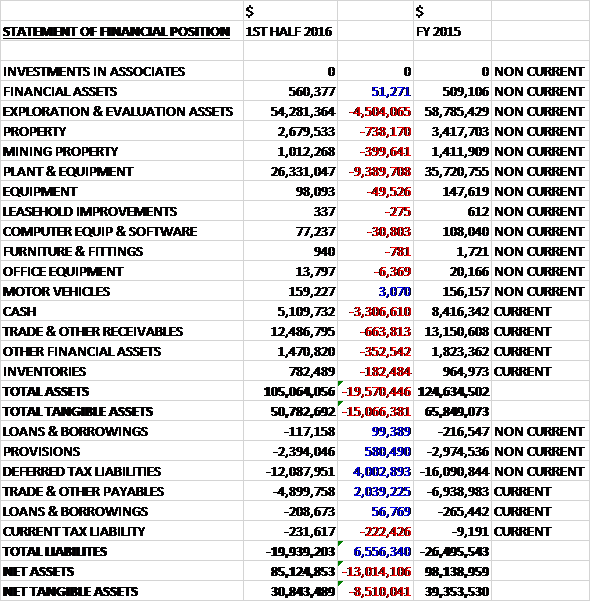
When compared to the end point of last year, total assets declined by $19.6M, driven by a $9.4M fall in plant & equipment, almost entirely due to the depreciation of the Rand, a $4.5M decrease in exploration assets, again due to Rand depreciation, and a $3.3M decline in cash. Total liabilities also fell during the period, due to a $4M decrease in deferred tax liabilities and a $2M fall in payables. The end result was a net tangible asset level of $30.8M, a decline of $8.5M over the past six months mainly as a result of the depreciation in the South African Rand.

Receipts from customers fell by $10.8M but payments to suppliers and employees only declined by $3.6M which meant that despite a $633K lower tax payment, there was a net cash outflow of $317K from operations. The group then spent $183K for the rebab guarantee, $667K on property, plant and equipment which represented stay in business capital, and $172K on exploration which meant that before financing there was a cash outflow of $1.3M. The group also paid $144K to repay borrowings and $833K on shares to pay its employee schemes to give a cash outflow for the six month period of $2.3M. This was exacerbated by a $1M detrimental effect of the exchange rate, as most of the cash is held as Rand, which meant that the cash level at the period-end was $5.1M.
In light of the declining commodity prices and challenging industry conditions during the period, the main operational focus of the company has been on maintaining and improving production stability and ounce production, combined with disciplined operational cost control. The dump operations produced 29,519 ounces for the six month period, down from the 31,341 ounces in the first half of last year but an improvement on the 26,246 ounces in the second half of last year. Likewise, EBITDA of $3.6M was well down on the $8.1M in the first half of 2015 but above the $2.3M recorded in the second half. The gross basked price dropped 26% to just $829 per ounce and plant cash costs are 18% lower at $471 per ounce due to cost controls and the depreciating Rand with the group cash cost falling by 17% to $508 per ounce.
Four of the plants remained profitable during the period with the best being Millsell, showing a profit of €1.2M, a decline of $186K year on year. Tweefontein has a profit of $1.1M, a growth of $158K when compared to the first half of last year; Doornbosch had a profit of $998K, a fall of $1.4M when compared to the first half of 2015; and Mooinooi had a profit of $238K, a decline of $59K year on year with the plant affected by a week of downtime following an electrical substation fire. The two unprofitable plants were Lannex with a $995K loss, a detrimental movement of $1.3M year on year; and Steelpoort with a loss of $693K, a negative swing of $1.7M as both operations were affected by three weeks of violent community protests regarding demands for improved infrastructure and jobs.
Plant feed grades were slightly lower than both halves of last year but PGM recovery efficiencies were higher with plant feed tonnes being similar to H1 last year and 13% higher than H2 due to higher plant utilisation.
At Volspruit Platinum, the company was requested by the Limpopo Department of Economic Development to submit a biodiversity and wetland offset strategy as an addendum to the Environmental Impact Assessment report. This was submitted to the DMR in September and the company continues to await the decision from them whether to award the mining right.
At Grasvally Chrome, the Mining Right application to mine chrome at the project was submitted in Q1 and a public participation meeting is scheduled for February. The company intends to sell the chrome deposit and an agent has been appointed to handle its marketing to potential ferrochrome smelters. The intended marketed cost is not yet known but a ballpark figure would have been nice.
At Harriet’s Wish, Aurora and Cracouw, notional execution of the Mining Rights occurred in December after the DMR’s decision to reduce the amount of financial provision for rehabilitation was finalised. An application for ministerial consent to transfer the right to mine iron ore, vanadium and heavy metals to a subsidiary of Ironveld has also been submitted to the DMR and the company awaits their decision in this regard. Cracouw will proceed with the Water Use Licence Application subsequent to permissions obtained from the land owners but this is delayed as the original land owners are deceased and the company will need to facilitate transfer of the title deeds to the lawful land occupants and descendants of the original owners.
During the year the company reduced the par value of each share from 10c to 1c per share as the share price was precariously close to being at par value which meant that it would not have been possible to issue shares at prices below the trading price with the immediate issue being any new options the poor directors would have been issued would be underwater but I suppose this would also have been an issue if the company needed to raise capital through the issue of more shares.
Overall then this was a fairly poor period for the group. Profits were down, net assets fell and there was an operating cash outflow. This is mostly due to the basket price of platinum group metals falling to $829 during the period. Unfortunately things got worse in Q2 with a decline to $785 per ounce. The reduction in assets is due to the depreciation of the Rand but this, together with some tight cost controls meant that costs dell to $508 in the period.
The production figures were down on H1 last year but an improvement on H2 with the main issue being continued violent protests at Lannex and Steelpoort which meant those two plants were loss making. Things did improve in Q2, however, with much less downtime and therefore better production figures. Progress is painfully slow with the regulatory hoops the company seemingly has to jump through in its exploration licenses but a potential sale of Grasvally Chrome is rather exciting. I took a position before this update and will tough it out for now I think.
On the 26th April the group released an update covering Q3 2016. The SDO continued on a steady production trend, producing 14,905 ounces during the quarter, bringing the total production for the year to date to 44,424 ounces. Although PGM feed tons were slightly lower than the previous quarter, higher feed grades and recovery efficiencies contributed towards the good ounce production. Based on year to date performance and recent production trends, annual PGM ounce production is expected to be in the range of 57,000 to 58,000 ounces, exceeding the previously stated guidance of 55,000 ounces for the current year.
The cash costs for the SDO decreased by 5% to $399 per ounce as a result of the weaker Rand. Revenues increased by 4% to $10.1M and the gross basked price recovered somewhat, up 10% to $860 per ounce. The group’s cash balance at the period-end was $7.2M, a $2.1M increase in the previous quarter. Cash generated before working capital movements was $3.8M with changes in working capital giving rise to a cash outflow of $1.7M. Some $300K was spent on business capital for the SDO plants and $300K was received from Ironveld as partial repayment of their loan. EBITDA increased by 63% when compared to Q2, to $3.7M.
The SDO production of 14,905 ounces was 6% below the record previous quarter performance due mainly to a 9% decrease in PGM plant treatment tons and a 6% decrease in feed grades as a result of lower current run of mine ore from the host mines. The community protests regarding demands for improved infrastructure and jobs at the Eastern operations significantly reduced during the quarter and no significant downtime was experiences at any of the operations.
The group was informed by the Limpopo Department of Economic Development that the application for Environmental Authorisation at Volspruit for various reasons. Upon assessment of the communication it is the opinion of the company advisors that LEDET has not given due consideration to the study documentation and additional work done at their request last year. As such the company has taken the decision to appeal the refusal.
At Grasvally, the final EIA, with all comments and responses, as well as the additional work will be submitted during May. With regards to the sale process of the Chrome deposit, the international agent appointed to handle the marketing of it finalised a marketing teaser during March.
At Hariet’s Which, the group was informed that the DMR granted the application in terms of section 11 of the mineral and petroleum resources development act for ministerial consent to transfer the right to mine iron ore, vanadium and heavy minerals, to a subsidiary of Ironveld in April. They will now take steps to execute the cessation of the right in favour of Ironveld’s subsidiary and lodge this with the Mining Titles Office for registration.
Overall then, the operational performance has been quite encouraging with a decent quantity of PGMs being processed, a slightly higher sales value and a reduction in costs. The refusal of the permit at Volspruit is a concern, however, and has likely kept a cap on the price. Overall though, I will continue to hold.
On the 29th July the group released an update covering trading in Q4. The SDO produced 16,219 ounces, 9% higher than in the previous quarter. The feed tonnes and grades improved and contributed towards the higher figure. The solid performance during Q4 enabled the group to exceed the previously stated guidance of 57,000 to 58,000 ounces for the year, instead producing 60,643 ounces.
The cash costs for the SDO in Rand terms decreased by 4% but increased slightly in dollar terms from $399 per ounce to $404 per ounce due to a stronger Rand/Dollar exchange rate. Revenue increased 5% in dollar terms to $10.6M but decreased by 1% in Rand terms. The gross basket price remained unchanged at $859 per ounce, which is rather disappointing.
The cash balance at the year-end was $6.7M, a $500K decrease on the previous quarter. Cash generated from operations before working capital movements was $3.6M with net changes in working capital amounting to a reduction of $1.3M, mostly attributable to the repayment of the three month pipeline financing on the sale of concentrate. A further $2.7M was paid in income taxes, $200K spent on the stay in business capital and $100K on share transactions. The group generated EBITDA of $3.4M, a decline of 9% on the prior quarter.
Wage negotiations for the Western operations are underway and the board anticipate a decision before the end of Q1, whereas the Eastern operations were negotiated as applicable for two years and as such remain in force until 2017.
The higher than planned PGM production can be attributed primarily to increased PGM feed tonnes and higher than expected grades with stable production at all operations. The group recovery efficiency was slightly down from the previous quarter due to a combination of higher PGM ounce contributions from lower recovery operations and the impact of PGM concentrate stock movement at the end of the quarter.
At Volspruit, an appeal against the decision by LEDET to refuse the Environmental Authorisation was submitted to the relevant authority and the outcome is awaited.
At Grasvally, the final Environmental Impact Assessment was submitted to the DMR in May. The Water Use License application was submitted to the DWS in June and the group now awaits the DWS review process to commence. The international agent handling the sale of the deposit is in the process of setting up meeting with interested parties in order to explore options and share more information. The process has taken a little longer than anticipated due to a downturn in the chrome markets in recent months but prices have recovered somewhat and the group remains optimistic that potential buyers will understand the value of the project.
Elsewhere, the notarial cessation of the right to mine iron ore, vanadium and heavy metals in favour of Ironveld has been attended to and the documents were lodged.
Overall then, operationally things seem to be going well but the cash performance and basket price for platinum is rather disappointing given the good performance of the metal recently. I will continue to hold for now but will monitor the situation