

Sylvania Platinum has now released its interim results for the year ending 2017.
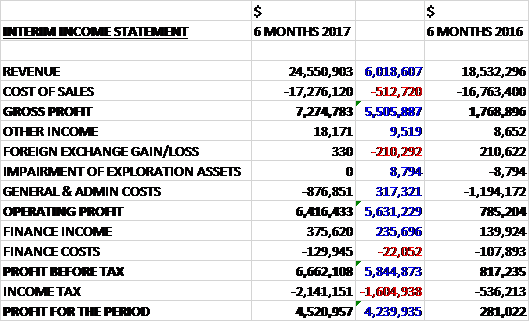
Revenues increased by $6M when compared to the first half of last year and cost of sales grew by $513K to give a gross profit $5.5M higher. There was a $211K reduction in the forex gain but other admin costs declined by $317K which meant that the operating profit grew by $5.6M. The finance income was up $236K but tax charges grew by $1.6M to give a profit for the period of $4.5M, a growth of $4.2M year on year.

When compared to the end point of last year, total assets increased by $13.7M driven by a $7.6M growth in cash ($500K of which was due to forex movements), a $5.2M increase in receivables and a $1M growth in inventories. Total liabilities also increased as a $1.3M growth in current tax liabilities and an $868K increase in provisions was partially offset by a $765K decline in payables. The end result was a net tangible asset level of $42.3M, a growth of $11.5M over the past six months.

After movements in working capital, cash profits increased by $6.2M to $6.7M. Finance costs and tax were broadly similar to last year so the net cash from operations came in at $5.9M, an improvement of $6.2M year on year. The group spent £693K on property, plant and equipment along with $118K on exploration but received $476K in relation to the rehabilitation insurance guarantee and $568K from Ironveld to give a free cash flow of $6.1M. Of this, $166K was used to repay borrowings and $458K on shares for the employee scheme so the cash flow for the period was $5.5M and the cash level at the period-end was $12.7M.
SDO production for the period totalled 35,819 ounces compared with 29,519 in H1 last year and group cash costs decreased 16% to $425 per ounce (SDO cash costs were broadly flat when compared to H2 last year at $405 per ounce). The gross basket price was very close to that of H2 2016 but increased 7% when compared to H1 last year to $883 per ounce.
The operations performed very well during the period with Lannex, Mooinooi and Tweefontein achieving the best quarterly production figures in their history. This can be attributed primarily to higher PGM recoveries, while the PGM plant feed tonnes and grades were only marginally higher than last time. The higher recovery was due to a combination of improved plant stability at Steelpoort and Lannex and floatation and mass pull optimisation at Doornbosch, Tweefontein and Mooinooi during the period as well as higher recovery efficiencies at Mooinooi associated with improved flotation residence times due to lower PGM feed tonnes during Q1.
Based on solid year to date performance and the outlook for the remainder of the year, the group expect to exceed the previously stated guidance of 60,000 ounces by about 3,000 to 5,000 ounces.
Project Echo has started during the period and the group is on track to deliver the PGM ounce profile as communicated. This secondary milling and flotation technology roll out will lead to improved PGM recovery efficiencies, lower PGM production unit costs, increased cash generation, and enable them to extend their profitable operating life together with sustaining a production profile of about 55,000 ounces and 60,000 ounces going forward.
The current SDO operations output decline after 2017 due to Steelpoort and Lannex operations reaching end of life in 2017 and 2019 respectively and without project Echo, production would settle around 45,000 ounces by 2020. The project will require $12M over the next four years and project Echo ounce costs come in below $300.
At Volspruit the group continues to await a decision on the application for the Environmental Authorisation. The MRA to mine PGMs is still pending and it is believed that it will only be forthcoming upon finalisation of the EA appeal process. Once a decision is given, the group will need to start detail design of civil infrastructure as called for in the National Water Act and start with its integrated waste and water use application for this project.
At Grasvally Chrome the group continues to await the MRA to mine but the DMR granted an amendment to the existing prospecting right to include the processing of the old waste rock dumps during Q1. The IWWULA for processing the waste rock dumps applied for in Q4 last year continues to be awaited but the group remains positive that this will be finalised shortly. The group received word that the EA for the project had been approved by an appeal by interested and affected parties was received in January which they are looking to respond to.
A notarial cession of the right to mine iron ore, vanadium and heavy minerals in favour of Ironveld was registered during the period. The first phase of project Echo started during the period which will lead to several more years of sustainable production and the board look forward to the remainder of the year with confidence.
Overall then this has been a successful period for the group. Profits were up, net assets increased and the operating cash flow grew with plenty of free cash being generated. The group is making a healthy profit on each ounce sold with cash costs of $425 per ounce comparing favourably to the $883 basket price. The increased profit though is mainly down to a growth in production due to higher PGM recoveries at various plants. Project Echo is underway and the cost of $12M doesn’t seem too onerous, although it should be remembered that this is just to maintain the current production level and the other various projects all seem to be hitting regulatory hurdles.
This looks tempting but there is definitely the potential for some unforeseen issues with any large capital commitment such as that which is underway here.
On The 26th April the group released an update covering Q3. The SDO produced 17,096 ounces, 8% lower than last quarter but the third highest quarterly level on record which means they are well placed to meet and maybe exceed the revised guidance of between 63,000 and 65,000 ounces for the year.
The cash costs of the SDO in Rand terms have increased by 11% due to a combination of lower production and slightly higher maintenance costs during the period. A strengthening of the Rand meant that there was a 17% increase in cash costs to $471 per ounce. Revenue increased by 10% in US dollar terms to $12.8M and 5% in Rand terms. This increase was partly due to an 8% increase in the basket price to $951 per ounce. Capital expenditure increased 144% primarily due to the rollout of Project Echo but the cash balance increased by $3.9M to $16.6M.
Whilst production for the quarter exceeded the forecast, ounces produced were lower than in Q2 due to lower PGM recovery efficiencies. Comparatively, PGM feed tonnes were stable and feed grades were slightly higher. The recovery efficiencies were lower at Tweefontein and Doornbosch due to a lower ratio of fresh current arisings from the host mines during January and lower flotation feed stability and efficiency, which has since been resolved.
Cash cost of production increased by $69 per ounce to $471 per ounce, primarily as a result of the decrease in production, a strengthening of the Rand and slightly higher maintenance costs. EBITDA for the group increased by $476K to $4.1M. Project Echo is well underway and the budget remains $12M. So far, $1.4M has been spent with a further $2.4M already committed.
The group continues to await a decision whether to accept their appeal and set aside the initial refusal of the EA for the Volspruit Platinum Project.
The group have started with extraction of a chrome bulk sample at Grasvally and approval of the water use license for processing the waste rock dumps is awaited. All documents necessary to finalise the appeal against granting of the EA have been filed and they now await the decision of the DMR whether to uphold the appeal or set it aside.
At Nonnenworth, La Pucella and Altona, the rights to mine copper, gold, nickel and PGMs as well as Iron and Vanadium were granted in March. The next step is to formally execute the mining rights at the offices of the DMR and an application will be made for consent to transfer the right to mine iron and vanadium to Ironveld, which will be the final transfer of rights to fulfil the transaction with Ironveld announced in 2012.
During the quarter a joint venture was formed to pursue a chrome beneficiation project which was brought to the company by a director who holds an interest in the project. To date an amount of $200K has been contributed to ongoing research.
Overall then, this seems to have been a pretty decent quarter but I remain aware that the bulk of Project Echo, and therefore most of the risk, is yet to come.
On the 31st July the group released a trading update covering Q4. They produced 17,954 ounces in the quarter, an increase of 5% on Q3 which meant that they exceeded the upper end of the revised guidance range of 65,000 ounces by achieving 70,869 for the year. Cash costs have decreased 10% to $422 per ounce and the Rand/USD exchange rate remained relatively flat. The basket price has not moved significantly for some time.
Cash generation from operations before working capital movements was $2M, despite an income tax payment of $3.2M at the end of the quarter. Group cash balances decreased by $1.3M over the quarter to $15.3M, however, due to working capital movements and capex.
While the PGM feed grades were around 2% lower for the quarter, based on the blend of material treated, the feed tonnes and recovery efficiencies were 6% and 5% higher respectively than the previous quarter and contributed significantly towards the higher production. Overall the SDO continued to perform well and delivered results better than forecast which contributed towards the new annual production of 70,869 ounces.
Project Echo is progressing well with both the Millsell and Doornbosch secondary milling and flotation technology modules under construction as the first phase of the programme and will be commissioned during the next six months to fill the ounce gap after the planned closure of the Steelpoort operation that reached its end of life during June.
With regards Volspruit, the group received notification from the DMR that the Mining Right was granted at the end of June. They will now take steps to execute and register the right of the mining titles office. Mining activities at the project can’t commence until the group receives a decision by executive council on their appeal against the initial refusal of the Environmental Authorisation. Once this is received the next step will be the application for a Water Use License.
At Grasvally, the group received communication from the DMR that the appeal against the granting of the EA lodged by interested parties was set aside in June. Accordingly the EA for processing the waste rock dumps stands but activities can’t yet start until such as time as the approval of the WUL from the Department of Water is received and MR is granted.
The bulk sampling of a planned 15,000 tonnes of ROM is well underway. A total of five bulk sample open pits has been blasted with total excavated ROM stockpiles currently measuring 6,167 tonnes. The extraction of the remaining tonnage has been halted pending the beneficiation testing of the initial 6,167 tonnes. Although the plant was not tailored to process the ore typical of the Grasvally deposit, the initial results look positive. A sample of more than 6,000 tonnes will be beneficiated in a more suitable plant in Steelpoort to better liberate the chrome from the ore. Following the beneficiation testing, a further 9,000 tonnes will be extracted from the already blasted and stripped open pits to complete phase 1 of the Grasvally Bulk sample.
Also on the 31st July the group announced that they had entered into an agreement with Pan African Resources to acquire Phoenix Platinum for a price of $6.6M, settled in cash. Phoenix is a PGM dump operation with an operational PGM concentrator plant and about 2.54M tonnes of tailings dump resources of a similar grade and recovery potential as the neighbouring Mooinooi operation. Due to the close proximity of Phoenix to some existing operations, certain synergies are expected to be achieved by the combined operations.