

Revenue is derived from the manufacture and logistical supply of industrial fasteners and category C components. The automotive sector is the most important market, representing 31% of group turnover, with other markets including electronics and domestic appliances. The group still only has less than 1% of the global industrial fastener market.
Trifast has now released its final results for the year ended 2015.
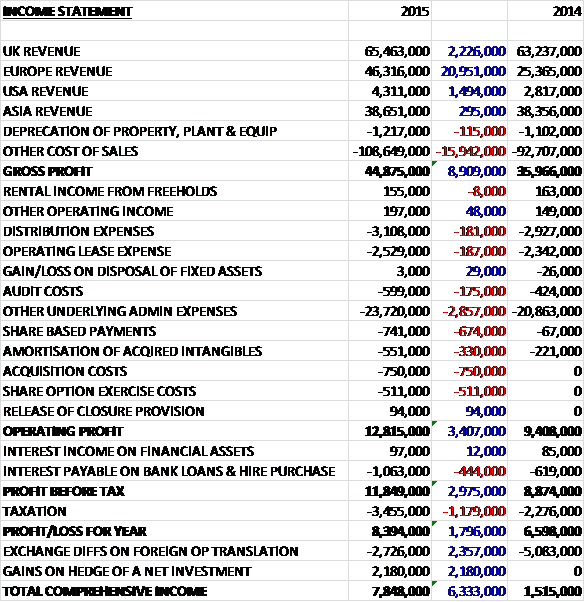
Revenues increased when compared to last year with a £21M growth in European revenue, a £2.2M increase in UK revenue, a £1.5M growth in North American revenue and a £295K increase in Asian revenue (although £19.6M of the increase is from the acquired business). Cost of sales also increased which meant that gross profit grew by £8.9M. There was a modest increase in operating lease expenses, distribution costs and audit expenses along with a £2.9M increase in other underlying admin expenses. We also see share based payments up £674K, a £330K increase in the amortisation of acquired intangibles, a £750K acquisition cost and a £511K share option exercise cost which gave an operating profit some £3.4M ahead of last time. Interest costs increased by £444K, mainly relating to the acquisition, and tax was £1.2M higher, again blamed on the acquisition as the tax rate is higher within that business, so that profit for the year came in at £8.4M, an increase of £1.8M year on year.
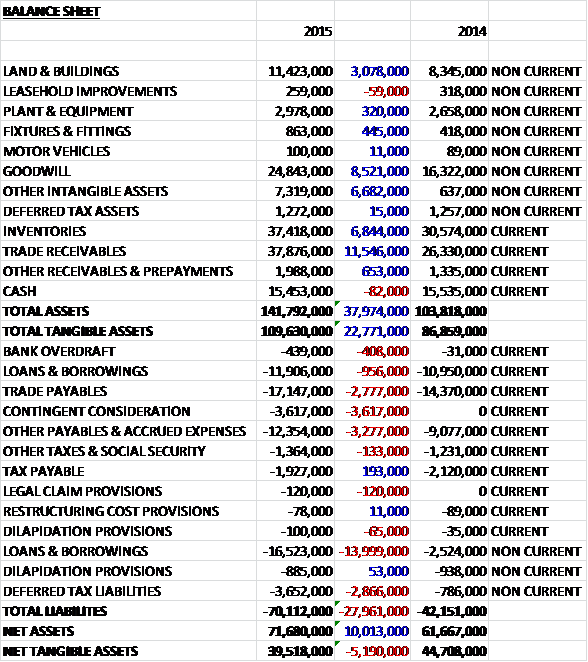
Total assets increased by £38M when compared to the end point of last year, driven by an £11.5M increase in trade receivables due to the acquisition, an £8.5M growth in goodwill, a £6.8M increase in inventories, a £6.7M growth in other tangible assets and a £3.7M increase in land and buildings. Total liabilities also increased during the year due to a £14.1M growth in borrowings, a £3.6M growth in contingent consideration, a £3.3M increase in other payables and accrued expenses, a £2.9M increase in deferred tax liabilities and a £2.8M growth in trade payables. The end result is a net tangible asset level of £39.5M, a decline of £5.2M year on year.
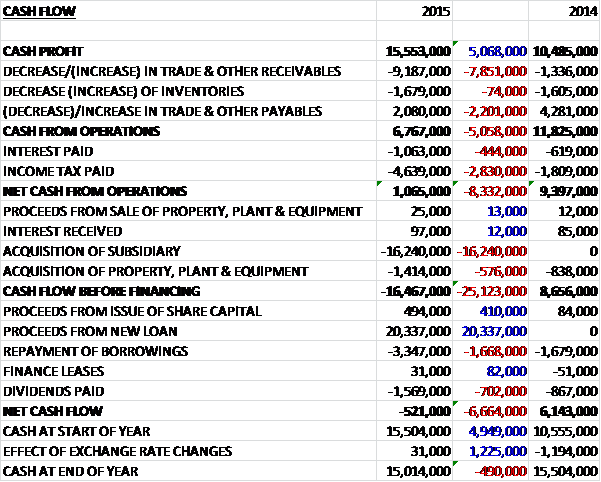
Before movements in working capital, cash profits increased by £5.1M to £15.6M. There was a large cash outflow form working capital, in particular a £9.2M increase in receivables, an increase in interest and a more than doubling of tax which meant that the net cash from operations was just £1.1M, a decline of £8.3M year on year. This did not cover the £1.4M spent on tangible fixed assets, a level of capex that is expected to continue going forward, let alone the £16.2M spent on the acquisition so that there was a £16.5M cash outflow before financing.
There was a net £17M received from new loans but £1.6M was spent on dividends which gave a cash outflow of £521K for the year and a cash level of £15M at the year-end.
The UK underlying operating profit was £5.8M, an increase of £300K year on year driven from the automotive sector as new products that were under development with customers in previous years came into production and this momentum is expected to continue. The electronics sector has also performed well, benefiting from an increase in demand from businesses supporting 4G technology. This year operating efficiencies have been achieved through the streamlining of the management structure and the investment of two automated storage systems at the Uckfield site.
These storage systems have had the added benefit of more than halving pick times in the warehouse and improving productivity. More units are expected to be rolled out in the UK in the medium term. During the new year, additional investment in people and equipment will be made to further enhance productivity.
The Europe underlying operating profit was £6.5M, a growth of £4.8M when compared to last year with £4.43M attributable to the acquired VIC business and a 30% increase on a constant currency basis. During the year, Hungary continued its strong growth, further increasing the group’s presence in the electronics sector. Holland saw its prior years’ momentum continue with a number of new automotive projects where production has commenced but the performance in Norway has been affected by the challenging conditions in the oil and gas industry.
The USA underlying operating profit was £327K, a growth of £80K when compared to 2014 reflecting the group’s strategy to grow its presence in the multinational OEM arena in the automotive sector with some automotive platforms in Europe moving over to the US.
The Asia underlying operating profit was £5.7M, an increase of £400K year on year with the growth driven by the Singapore and Taiwan business. The Singapore manufacturing plant has seen strong growth from its customers within the domestic appliances and electronics sectors and trading in Thailand and India has been in line with expectations with potential identified for further growth in these sites. In Taiwan, following the surge in growth experienced over the last few years, the local manufacturing site is now close to capacity. In January the board approved a capital investment project to extend and existing building on site and purchase new plant which is expected to become operational in Q3 2016 and will increase capacity by 15%.
China has recovered from the setback recorded a couple of years ago when one of its largest customer went into bankruptcy which resulted in losses at the business. It has subsequently been able to develop relationships with existing and new customers which is giving them a more evenly spread sector base and going forward they have already secured a strong automotive pipeline. In Malaysia, the business experienced a slight softening in its key markets during the year but in the medium term the board see this trend reversing as the development work put in with some major automotive OEMs bears fruit.
At PSEP the group are expecting to take delivery of a new large diameter cold forging machine. Costing some £1M, which is expected to become operational during the latter part of the new year and will provide a quantum leap in production capability, in particular with regard to the complexity and accuracy of customised components.
At the end of May the group acquired Viterie Italia Centrale (VIC) for an initial consideration of £22M satisfied by way of £19.65M in cash and £2.37M by the issue and allotment of 3M shares to the 30% owner of the business, Carlo Perini. At the date of the acquisition, a further £3.62M was due to the vendors based on performance criteria that was met during the year and this payment will be made in June. VIC is a manufacturer and distributer of fastening systems for the domestic appliances sector and significantly strengthens the group’s presence in that market and provides an additional manufacturing facility in Europe. In the ten months since the acquisition, the business contributed £4.4M to the operating profit of the group.
There are a large number of supposed non-underlying items at this company. The share based payment charge increased significantly, reflecting the new employee share plan and SAYE schemes approved in 2014 with £600K associated with the deferred equity bonuses awarded to the directors for this year and last, and £140K in relation to SAYE. The increase in the amortisation of acquired intangibles was due to the purchase of customer relationships, technology know-how and technology patents on the acquisition of VIC.
The total acquisition costs in relation to VIC amounted to £1.2M but after an exchange gain of £450K was recognised on the deferred consideration due to the weakening of the Euro, the net acquisition costs were £750K. The £511K costs on the exercise of executive share options related to national insurance costs in relation to the exercising of the shares, and finally there was a £94K release of the closure provision for TR Formac Shouzou after the closure process was completed. At the start of the year there were a lot of options outstanding after they were awarded following the financial crisis to further incentivise the directors to turn the company around. Some 4.5M were exercised during the year with another 3.6M outstanding at the year-end.
The group has quite a bit of debt with banking facilities with HSBC consisting of a term loan facility of €25M used to fund the acquisition of VIC – the balance of this loan is €23.75M at the year-end. There is also a revolving credit facility of up to £10M, none of which has been drawn down; asset based lending of £8.6M outstanding and a PSEP acquisition loan of £2.6M still outstanding. In total there is £18.6M of undrawn facilities relating to the full amount of the revolving credit facility and £8.6M in the asset based lending facility. A change of one point in interest rates would change profit by £250K.
It has been announced that CEO Jim Barker will step down in September but will remain on as a consultant until June 2016. The current Finance Director, Mark Belton will take over as CEO and Clare Foster will step up from her role as Financial Controller to CFO.
At this early stage of the year, the forward order book remains solid and the group’s trading performance has been good as it continues to benefit from the positive momentum seen in the second half of the year. The board are encouraged by the future growth profile of the business and the commercial progress looks set to continue positively over the next year.
At the current share price the shares trade on a PE ratio of 16.2 which falls to 12.2 on next year’s consensus forecast. After a 50% increase in the dividend, the shares are currently yielding 2.1% increasing to 2.4% on next year’s forecast.
Overall then, this has been a fairly decent year for the group but it has been dominated by the acquisition of VIC. Profits increased, mostly as a result of the new subsidiary, but net tangible assets declined and operating cash flow fell, although this was due to the large increase in receivables and cash profits grew. There was a good performance in all regions with the UK benefiting from growth in the automotive and electronics sectors. The growth in Europe was mostly due to the acquisition but there was some organic growth as a decline in the performance in Norway was offset by improvements in Hungary and the Netherlands with the latter benefiting from new automotive projects.
Progress is being made in Asia with Singapore doing well due to the electronics and domestic appliances markets; and Taiwan also performing well, although the factory there is pretty much at capacity and is undergoing investment to increase this somewhat – long term it might need more investment to cope with demand. The acquisition was not cheap but given VIC’s performance since it was acquired, it actually does look to be decent value and has been substantially earnings enhancing for the group. It is worth keeping an eye on share based payments as these do seem to be rather high and increasing, and the loss of the CEO might cause some disruption in the near term. The Forward PE of 12.2 looks rather cheap, however and there is a decent enough 2.4% forward yield on offer here, although it should be noted that there is now quite a lot of debt.