

Trifast have now released their interim results for the year ending 2019.

Revenues increased when compared to the first half of last year due to a £3.6M growth in UK revenue, a £2.2M increase in European revenue, a £991K growth in US revenue and a £436K increase in Asian revenue. Cost of sales increased by £5M to give a gross profit £2.2M higher. Distribution expenses were up £180K and “underlying” admin expenses increased by £1.3M. Share based payments were £164K higher, amortisation of acquired intangibles was £176K higher, acquisition expenses were up £177K and project Atlas costs came to £1.5M to give an operating profit £1M lower. Interest costs increased by £110K and tax charges were up £1.1M, in part due to a settlement last year, which meant that the profit for the year was £5.9M, a decline of £2.2M year on year.
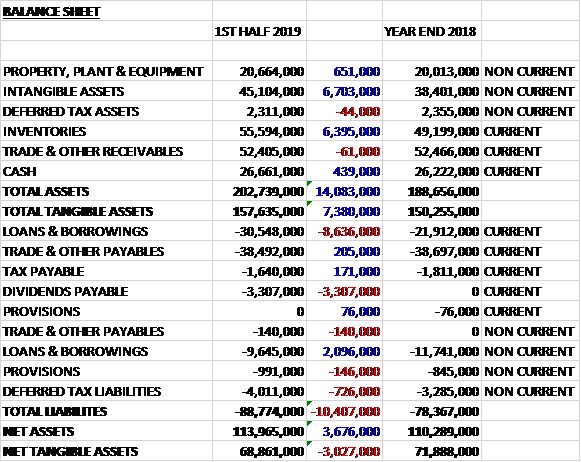
When compared to the end point of last year total assets increased by £14.1M driven by a £6.7M growth in intangible assets and a £6.4M increase in inventories. Total liabilities also increased due to a £6.5M growth in borrowings, a £3.3M increase in dividends payable and a £726K growth in deferred tax liabilities. The end result was a net tangible asset level of £68.9M, a decline of £3M over the past six months.

Before movements in working capital, cash profits declined by £396K to £11.3M. There was a cash outflow from working capital but this was less than last time and after interest payments increased by £109K and tax payments were up £994K the net cash from operations was £4.6M, a growth of £1.2M year on year. The group spent £1.3M on fixed assets and £8.2M on acquisitions which meant that there was a cash outflow of £4.8M before financing. The group paid out £1.3M in dividends and took out £6.2M of new loans which gave a cash flow of £111K and a cash level of £26.7M at the period-end.
The pre-tax profit in the UK division was £4.5M, a growth of £351K year on year with the PTS acquisition contributing £500K with revenue up 10.8%, almost entirely due to the PTS acquisition. Strong organic growth in the distributor and other sales has been tempered by reductions in automotive volumes due to diesel-led transitory changes to product cycles and model builds. The temporary impact of these challenges is expected to continue into the second half of the year whilst platforms at a number of their key customers go through production changeover.
The pre-tax profit in the European division was £4.5M, an increase of £555K when compared to the first half of last year with revenues up 6.6%. This has arisen across a number of sectors with double digit growth in the automotive sector in the Netherlands; in the electronics sector in Hungary and in the general industrial sector in Germany. In Italy, ongoing volume reductions at a large domestic appliances customer have offset some of these gains.
The revenue gains have been tempered by increased costs as the group invests in future growth. Key investments have been made to their Dutch operations where they have expanded the warehousing; in Sweden where they have opened their Technical and Innovation centre in Gothenburg; in Hungary where they have been investing in cross-functional headcount to support the trading increase and in Spain where their newest greenfield site is continuing to develop and build the local market.
The pre-tax profit in the US division was £199K, a growth of £83K when compared to the first half of 2018 with revenues up 31% driven largely out of their ongoing penetration into the group’s existing automotive multinational OEM customers. The low underlying margins are to be expected in this region for the medium term given the level of investments for future growth being made.
The pre-tax profit in the Asian division was £4.9M, an increase of £538K when compared to the first half of 2018 with revenue up 3.9%. This has largely been driven out of the domestic appliances business in Singapore as well as an increase in distributor sales from Taiwan. In China, ongoing automotive wins have offset a decline in electronics sales following the local factory closure of one of their multinational OEMs operating in the region. Production volumes are now shifting to India and the group have already started to see some of this business coming back on line through their operations there.
In April the group acquired Precision Technology Supplies for an initial consideration of £8.5M with contingent consideration of £2.5M in cash payable depending on certain earn out targets. The acquisition generated goodwill of £2M. The business is based in the UK and is a distributor of stainless steel industrial fastenings and precision turned parts, primarily to the electronics, medical instruments, petrochemical, defence and robotics sectors. Last year the business made a pre-tax profit of £700K and since the data of acquisition at the start of the period it has contributed £500K to group pre-tax profits.
In Asia, over the course of this year the group will be completing the expansion at the Singapore facility through the acquisition of additional forging, packing and inspection equipment to bring that additional capacity fully online. In Europe, the Spain site continues to grow with revenues of £500K so far this year. In Italy investments have been made in plant and machinery to expand their manufacturing capacity. A warehouse expansion in the Netherlands is up and running and the new innovation and technical centre in Sweden is helping the group access the additional opportunities that the roll out of electrical vehicle technologies is providing.
Going forward, the second half of the year has started well with a healthy pipeline in place and the board remains confident on delivering their expectations for the year. Around 90% of the group’s automotive supply is outside the combustion engine, mainly in seating, console, dashboard and lighting systems which means that the increase in electric vehicle production is acting as a further growth opportunity although in the short term they expect reductions in automotive volumes in the UK due to diesel-led transitory changes to product cycles that will continue in the second half.
The more muted performance in domestic appliances and electronics this year reflected customer specific factors in Italy and China but the strong growth in these sectors in other regions provides confidence that these markets also continue to have attractive long term potential for the group.
As expected in the UK business they have seen the impact on their gross margins of input cost inflation as a result of the weak pound but notwithstanding the wider potential long term implications of Brexit on the UK economy, they believe that the shorter term operational and financial impact of any Brexit scenario will be manageable.
At the current share price the shares are trading on a PE ratio of 16.2 which falls to 14 on the full year forecast. At the period-end the group had a net debt position of £13.5M compared to £7.9M at the same point of last year. After a 9% increase in the interim dividend, the shares are yielding 2% which increases to 2.1% on the full year forecast.
Overall then this has been a bit of a mixed period for the group. Profits declined due to the Project Atlas costs and increased tax payments, net tangible assets declined and although the operating cash flow increased, this was due to working capital movements and cash profits fell, likely due to Project Atlas costs again. There was no free cash generated due to the acquisition. The European, US and Asian businesses are all performing well but there was no organic growth in the UK due to lower automotive production and increased costs relating to forex movements.
The second half has started OK and the shares are not cheap but probably priced about right with a forward PE of 14 and yield of 2.1%. I remain a holder but they aren’t really the strong hold for me that they were before.
On the 26th November the group announced that sales director Glenda Roberts sold 173,010 shares at a value of £354K. Following the sale she now owns 237,571 shares.
On the 14th February the group released a trading update. Despite the macroeconomic backdrop impacting the outlook for industry as a whole, the group continues to trade in line with expectations. Recent contract wins, and a strong pipeline gives them confidence as they look to the future.
As expected, the weakness in the UK automotive markets have remained, temporarily impacting revenues and profitability at a regional level. Outside the UK, however, they are continuing to build their market share with both existing and new global Tier 1 and OEM customers. Across the wider group, the sector and regional trends experienced in the first half have largely continued through the period.
PTS, which was acquired at the start of the year, has settled in well and is delivering strong year on year growth. Project Atlas remains on track and on budget. The board currently consider that both the operational and financial impact of any Brexit scenario will be manageable in the short term. Longer term implications for the UK economy are harder to predict.