Central Asia Metals has now released its interim results for the year ending 2016.

Revenues increased by $561K when compared to the first half of last year. There was a $3.3M fall in depreciation relating to an increase in the useful life of much of the Kounrad assets, a $546K decline in amortisation and a $6.1M decrease in other costs of sales which meant that the gross profit increased by $5.7M. We then see the lack of a $715K inventory write-off that occurred last year but distribution costs increased by $208K, share based payments were up $282K and there was a $1.3M negative swing to a forex loss to give an operating profit $4.9M above that of last time. Finance costs were also down modestly but income tax charges increased to give a profit for the period of $10.6M, a growth of $5.2M year on year.
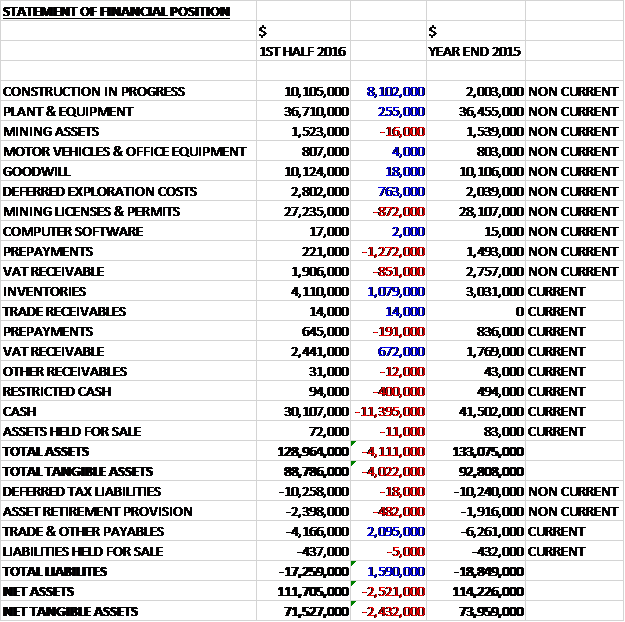
When compared to the end point of last year, total assets declined by £4.1M to £129M driven by an $11.4M fall in cash and a $1.3M decrease in prepayment, partially offset by an $8.1M increase in assets under construction and a $1.1M growth in inventories. Total liabilities also declined during the period due to a $2.1M fall in payables. The end result was a net tangible asset level of $71.5M, a decline of $2.4M over the past six months.

Before movements in working capital, cash profits increased by $1.8M to £18.8M. There was a modest cash outflow from working cap but this was less than last time and after a $2.1M decline in the income tax paid, the net cash from operations came in at $13.8M, a growth of $6.4M year on year. The group spent $9.6M on property, plant and equipment, mostly relating on construction work for the Stage 2 Expansion, along with $780K on intangible assets relating to exploration costs incurred on the Copper Bay project, to give a free cash flow of $3.5M, of which $2.3M was spent on share options for directors and $12.5M went out in dividends to give a cash outflow for the period of $11M and a cash level of $30.1M at the period-end.
The copper production for the first six months of the year was 6,908 tonnes, a 27% increase year on year. This is due in part to a warmer winter and largely to Kounrad operating at increased capacity following the completion of the stage one expansion in May 2015. Copper Cathode sales of 6,355 tonnes represents an increase of 24% with 3,125 tonnes of that being sold at a fixed price of $5,025 per tonne and the average price received for all copper sales was $4,903 per tonne which compared unfavourably to the $5,936 per tonne achieved in the first half of last year.
The commercial terms of the off-take contract have been agreed and fixed for a three year period through to the end of 2018. This provided additional cost savings in the reported period due to a market reduction in the cost per tonne of exporting the copper from the site at Kounrad. The contractual commitment is for a minimum of 90% of the Kounrad copper cathode production.
The cash costs of production fell from 67c per pound last year to 40c per pound primarily as a result of cost savings from the local currency devaluation, increased production volumes and the reduction in off-take costs. The fully inclusive unit costs for the period were 97c per pound compared to $1.87 last time, mainly as a result of the decline in depreciation and amortisation and the depreciation of the local currency.
Much of the increase in profit was due to the reduction in depreciation and amortisation. Following receipt of the regulatory approvals required for the Kounrad Stage 2 Expansion in November, management has extended the useful economic lives of certain property, plant and equipment, and the fair value uplift of the Kounrad transaction. The original estimate of ten years has now been increased through to 2034 which represents the end of the subsoil use license. The depreciation charge has also been affected by the devaluation of the local currency which effectively halved the US dollar value of the balance sheet assets.
The Tenge devalued in August 2015 resulting in a total devaluation of about 85% during last year. The group responded by increasing salaries by 25% to compensate for this. Given that their operations generate income in US dollars, the immediate financial impact is positive as about 60% of the cost base is denominated in Tenge. There has been a desire on the part of the Government to contain any inflationary pressures caused by the devaluation but it is expected that some of the cost benefits seen during the period will be eroded by potential inflationary pressures during the second half.
Utilisation of the SX-EW facility remains at high levels with an average of 98% achieved during the period and in Q1 all the anodes within the original EW house were replaced with new ones of superior design and quality. Leaching of Dump 5 started in late Q1 and early results indicate good solution returns and leach rates in accordance with expectations. Following the organic reagent loss incident in June 2015, an insurance claim was submitted and in March 2016, the group received notification that the merits of the claim had been accepted and negotiations are ongoing as to the quantum, although no receivable has been recognised as of the period-end.
During the period, construction of the buildings, collector trenches, ponds and pipeline infrastructure to connect the SX-EW plant to the Western Dumps are progressed on schedule and under budget. Installation of the 12km overhead power line was completed, which has enabled site construction power to be provided by the permanent supply rather than generators. Construction of the main buildings consisting of pump houses and a boiler house is completed, with boilers in position and the chimney erected. The solution ponds have been excavated and lined, whilst the installation of the 24km solution transfer pipeline infrastructure for PLS and raffinate is progressing well.
The group completed an access ramp to the top of the initial leach area, which has enabled dozer preparation and levelling works to commence in readiness for the installation of the irrigation system. The water pipeline that will supply water to the site from Lake Balkhash is complete and commissioning is underway. The scheduled completion date of the Stage 2 Expansion remains Q4, with leaching operations on the Western Dumps planned to start in Q2 2017. Completion of this project will extend the life of the operation beyond 2030 and due to the devaluation of the Kazakhstan currency, the cost of completion of the overall project is now expected to be about 25% below the original $19.5M budget, although I presume this is open to volatility.
The feasibility study on the Copper Bay project that started in H2 last year is on track for completion in Q4. Results from additional infill drilling have been incorporated into resource and reserve estimates, geotechnical studies and mine design and scheduling. If the results are positive, a decision whether or not to advance the project to construction will be made taking into account both the fundamental outlook for the copper market and the availability of capital for construction.
In February the Kazakhstan authorities refunded a portion of outstanding VAT totalling $1.7M. As of the period-end, a total of $3.8M was still owed to the group relating to historical expenditure on site at Kounrad. A further $1.9M was refunded in August and the group remains confident of recovering the remaining $1.9M and is working closely with its advisers to achieve this. The planned means of recovery will be through a combination of the local sales of copper cathode to effectively offset VAT liabilities and by a successful appeal to the authorities.
Going forward, the group is on track to achieve their 2016 production guidance of between 13,000 and 14,000 tonnes and they will have a continued focus on operational cost discipline in the current challenging commodity price environment, although the local currency devaluation helps support this. The Stage 2 Expansion is on track for completion in Q4 with leaching of the Western Dumps to start in Q2 2017.
At the current share price the shares are trading on a PE ratio of 13.2 which increases to 13.9 on the full year consensus forecast. After an increase in the interim dividend, the shares are yielding 7.5% which reduces to 6.4% on the full year forecast.
Overall then this has been a fairly positive period for the group despite the headwinds around the price of copper. Profits increased due to the Kazakh currency devaluation and the reduction in depreciation but net assets did decline modestly. The operating cash flow also increased to produce some free cash, although not enough to cover the dividends. The group is producing record amounts of copper but this is being offset by the declining price which is currently slightly below the $4,903 average price achieved during the quarter.
Going forward the currency devaluation is likely to result in some inflationary pressures on costs but a forward PE of 13.9 and yield of 6.4% looks decent enough, I continue to hold here.
On the 5th October the group released an update covering trading in Q3. They produced 4,102 tonnes of copper cathode, a quarterly record which means the year to date figure of 11,010 tonnes is 31% up on last year and the board are confident of achieving annual copper production towards the upper end of the 13,000 to 14,000 tonnes guidance. Copper cathode sales of 10,646 tonnes year to date represents an increase of 38% year on year but there is no mention of prices achieved.
The stage 2 expansion is on schedule and nearing completion, about 25% under budget. Electrical aspects of the project are complete, including the overhead power lines and sub-station construction. The required solution ponds have been excavated and lined, and the collector trenches will be completed in October, as will the irrigation system on the initial leaching blocks. The pregnant leach solution and raffinate pipes from the Western Dumps to the SX-EW plant are now in position.
In the next quarter the group will complete the definitive feasibility study that is being concluded on the Copper Bay project. Overall this is a good operational update although there is no mention of copper prices of finances which does not bode well. Despite this I remain a holder.
On the 22nd November the group announced that it had signed a framework agreement to acquire an 80% interest in the subsoil use contract for the Shuak copper exploration property in northern Kazakhstan. The group will invest a total consideration of $2M in exploration activities and the property has a resource of 327,000 tonnes of contained copper at a grade of 0.66% Cu.
Shauk is a copper and gold exploration project in the Akmola Oblast region in the north of Kazakhstan, about 300 miles north of the capital. The license area is 197km2 and contains three target areas that warrant immediate and detailed exploration for copper and gold. The area hosts two mineralisation styles that are of particular interest: saprolite hosted oxide and enriched copper, gold and molybdenum mineralisation that may be amenable to copper production by solvent extraction; and copper, molybdenum and gold bearing dissemination and stockwork mineralisation of a porphyry nature.
In addition there are widespread copper, gold, silver and molybdenum geochemical anomalies within the license area. The property was explored between 1973 and 1991 and over 45,000 metres of diamond holes was drilled during that time which demonstrated a pre-GKZ resource at Mongol V of about 49.5MT at a grade of 0.66% Cu for about 327,000 tonnes of contained copper. Most recently, former owners of the property undertook small scale mining at Mongol V and sampling of the stockpile generated from these activities demonstrated copper oxide grades in excess of 2% in several cases. Column leach testing of this material at Kounrad has shown it to be amenable to processing by leaching with dilute sulphuric acid with recoveries of over 90%.
The group intends to start field-based exploration work in Q2 2017. During the 2017 exploration season, the group plans to design an approximately 1,800 metre trenching programme and to undertake approximately 8,000 metres of drilling at Mongol V and other priority areas. The exploration budget for 2017 for Shauk is about $1M.
Under the terms of the agreement the group will hold an 80% interest in Ken Shauk, the company which is to hold the Shauk SUC with the other 20% being held by local partners. The consideration for the acquisition is an investment in exploration activities of $2M over five years. The initial target would be to develop a SX-EW operation at Shauk and longer term they plan to explore the primary copper porphyry target at depth.
This looks to be a very sensible deal to me, I like it and continue to hold.
On the 5th January the group released a Q4 update. The Q4 output of 3,010 tonnes of copper cathode brings total production for 2016 to 14,020 tonnes, a 16% increase on 2015. Copper cathode sales for the year of 13,938 tonnes represents an increase of 16%. As of the year-end there was a cash position of $40M.
The stage 2 expansion project is now materially complete. This work comprised construction of buildings, a boiler house, collector trenches, electrical supply and infrastructure as well as ponds and pipelines to connect the SX-EW plant to the Western Dumps area. The total capital cost is expected to be about 30% below the original budget of $19.5M and copper production from the Western Dumps will start on schedule in Q2 2017.
The group is targeting 2017 copper cathode production of between 13,000 and 14,000 tonnes, so a slight reduction on this year. The majority of copper production will be leached from the Eastern Dumps but from Q2 onwards they expect an increasing percentage of overall copper production to be leached from the Western Dumps.
In an improved copper price environment and with all major capital at Kounrad expended, the board are optimistic about the future. This all sounds fine, albeit the moderately lower forecast for 2017 is a little disappointing – I remain a holder.
On the 18th January the group released the results of the Copper Bay feasibility study. The study has a total resource of 53,440KT at a grade of 0.24% which gives rise to 125,820 tonnes of contained copper. In addition, historical work in 2008 estimated a non-compliant resource of about 190,000 tonnes of copper.
The mineable resource comprises 34.8MT of tailings material at a grade of 0.24% containing 84,634 tonnes of copper. The overall mineable resource includes 7% of material that has been classified as an inferred resource and which forms part of the overall dredging production plan. The difference between the mineral resource and the mineable resource arises due to material remaining in-situ during the dredging process to form a berm between the operation and the sea, and due to removal from the mine of a high acid-consuming lower shell-rich horizon.
The study envisages a nine year project, comprising of two years construction followed by seven years of operation, which would process five million tonnes of material annually at a copper grade of 0.24%. Total copper recoveries in the processing plant are expected to be 72%, yielding an average of 7,080 tonnes of copper cathode and 1,560 tonnes of copper in concentrate grading 20%. The initial capex has been estimated at $88.5M which includes a contingency of $6.8M.
The study estimates a C1 life of mine cash cost of copper production in the lower half of the global cost curve at $1.37 per pound. On the current mine plan, the post-tax NPV of the project is $34.1M at a flat copper price of $3 per pound and the post-tax IRR is 19.1%.
Given the current uncertainty with regard to the near and medium term expectations for copper, however, the board has recommended that the project remains in their development pipeline while they review their options which is a little disappointing but probably prudent.