
Origin Enterprises has now released their interim results for the year ending 2017.
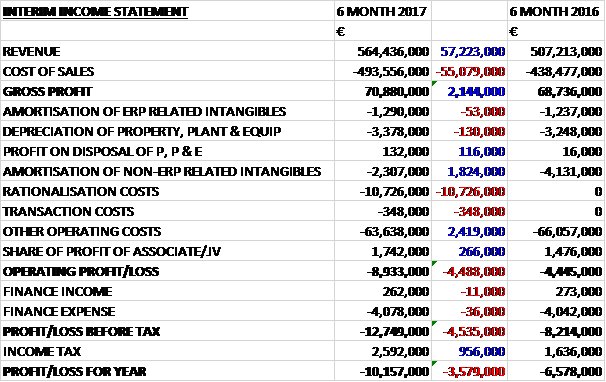
When compared to the first half of last year, revenues increased by €57.2M reflecting increased agronomy revenue and crop input volumes and cost of sales grew by €55.1M to give a gross profit €2.1M higher. Depreciation was up €130K and there were rationalisation costs of €10.7M but the amortisation of non-ERP related intangibles declined by €1.8M and other operating costs fell by €2.4M with the share of profit from associates increasing by €266K to give an operating loss €4.5M above that of last time. The tax income increased by €956K which meant that the loss for the period came in at €10.2M, an increase of €3.6M year on year.
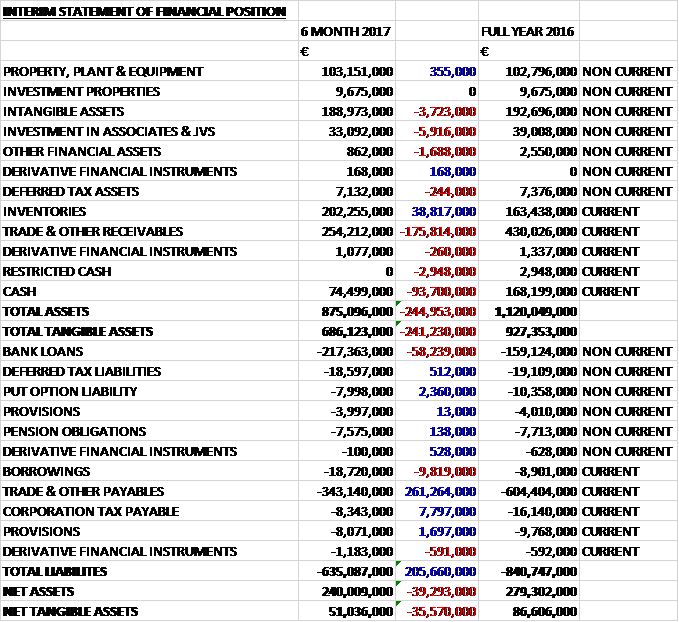
When compared to the end point of last year total assets declined by €245M driven by a €175.8M fall in receivables, a €93.7M decrease in cash, a €5.9M decline in investments in associates and a €3.7M decrease in intangible assets, partially offset by a €38.8M growth in inventories. Total liabilities also declined as a €68.1M growth in borrowings was more than offset by a €261.3M fall in payables and a €7.8M decrease in corporation tax payables. The end result was a net tangible asset level of €51M, a decline of €35.6M over the past six months.
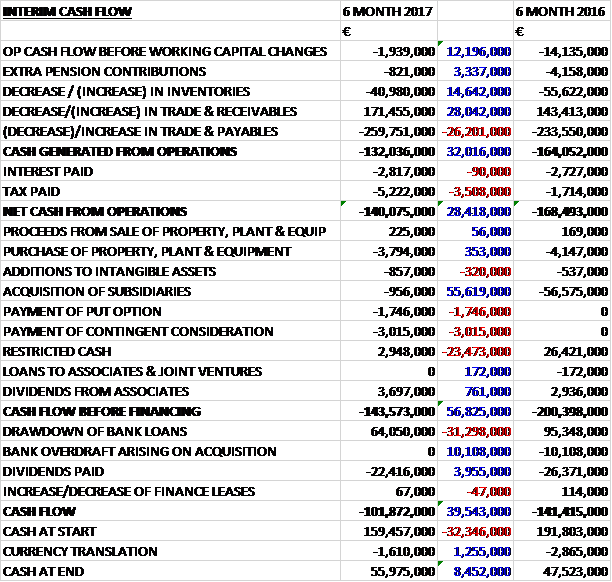
Before movements in working capital, cash losses improved by €12.2M to €1.9M. There was a big cash outflow from working capital, as usual in the first half of the year, but this was less than last time and even after tax payments increased by €3.5M the net cash outflow from operations came in at €140.1M, a €28.4M improvement year on year. The group spent €3.8M on property, plant and equipment, €857K on intangible assets and €956K on acquisitions along with €1.7M paying a put option and €3M on contingent consideration. They did get a €3.7M dividend from an associate, however, and the cash outflow before financing was €143.6M. The group drew down €64.1M in bank loans and paid out €22.4M in dividends which meant that the cash outflow for the period was €101.9M and the cash level at the period-end was €56M.
The segment result in the Agri-Services business was €2M, a positive movement of €3.8M year on year. In the UK and Ireland, volume growth was 12.6% in the period. A more favourable short term outlook for farm incomes is principally reflecting the positive impact on output prices of sterling weakness and tighter global dairy supply. This, together with generally settled autumn and winter weather supporting good crop establishment, drove good early season demand in advance of the main application period in the second half.
The agronomy services business performed very satisfactorily in the period, achieving volume growth and margin recovery across all service and input portfolios. On-farm activity was robust in the period, with the planted area for the principal autumn and winter crops at 2.95m hectares compared with 2.96m ha last time. In the case of winter wheat there is an estimated 1.4% increase in plantings. Winter oil seed rape sowings are currently estimated at 500K hectares, a reduction of about 10% due to rotational crop planning decisions. The total planted area for spring crops is expected to be about 1.4M hectares compared to 1.3M last time.
The business to business agri-inputs delivered a good result in the period with an improved performance principally underpinned by year on year growth in fertilizer volumes in the UK. Against the backdrop of highly competitive trading conditions, the fertilizer business recorded higher volumes and improved margins in the period. Strong early season demand reflected greater certainty in fertilizer raw material pricing which provided confidence to primary producers to fix a proportion of their nutrition requirements ahead of the main application period in the second half of the year.
Performance in Ireland was satisfactory and the board anticipate higher market volumes for the year as a whole with application expected to be positively influenced by higher livestock numbers and improved returns for primary dairy producers.
The amenity business delivered a good performance in the period, underpinned by further development momentum within the professional sports channel. Headland Amenity, acquired last year, is performing in line with expectations and the integration is progressing as planned. Feed Ingredients achieved a satisfactory result in the period underpinned by a stable volume performance. Spot demand was generally robust throughout the period while currency volatility impacted customer forward buying momentum.
In Central and Eastern Europe, underlying volume growth was 13.6% in the period. Overall there was a satisfactory performance in the seasonally quiet trading period, with good early season momentum in the case of value added crop technologies. Sentiment on farm is generally cautious as a result of the challenging year experienced by primary producers in 2016. A more concentrated or just in time demand profile for services and inputs is anticipated in the second half of the year.
The group’s Polish farm services business performed satisfactorily against lower demand in the period reflecting the impact of a very difficult growing season in 2016 and delayed autumn harvest conditions. The integration of Kazgod is substantially complete with strong profess achieved to date in relation to customer channel and service portfolio alignment. Autumn and winter crop plantings are equivalent to last year at about 5.3M Hectares with no significant establishment issues arising at this stage. The expansion of the seed processing and input formulation capacity started during the period with the €6M capital project expected to be operational early 2018.
The Romanian operations delivered a very satisfactory result in the period. Performance reflected increased volumes supported by new customer gains together with the benefit of higher margins. Autumn and winter crop establishment is generally satisfactory against the backdrop of weather related delays to cereal and oil seed rape plantings which is expected to result in a larger area devoted to spring cropping this year. Total plantings for the principal winter crops are estimated at 3.3M hectares compared to 3.25M last time. Integration is progressing to plan with the primary focus concentrated on the development of enhanced technical sales support together with the further development of trial demonstration farms and knowledge transfer infrastructure.
The group’s Ukrainian farm services business achieved higher revenues and margins in the period with performance underpinned by good momentum in the sale of value added technologies. Autumn and winter crop plantings are estimated at 7.6M hectares compared with 5.8M last year. Crops are generally well established and in good condition. Total crop plantings for the 2017 production year are expected to be in line with last year at about 22M hectares. The financing environment for primary producers is currently more favourable and is generally reflective of an improved macro-economic backdrop.
The segment result in the associates and joint ventures business was €1.7M, a growth of €266K when compared to the first half of last year with John Thompson delivering a satisfactory result in the period.
The rationalisation costs incurred during the period primarily comprise termination payments arising from the restructuring of Agri-Services in the UK.
In December the group announced the establishment of a dedicated digital, precision agriculture and crop science research partnership with University College Dublin. The five year development programme underpinning the research partnership will be financed by a €17.6M investment which is co-funded by Origin and Science Foundation Ireland. The aim of the programme is to build digitally based and user driven advisory tools that provide rapid and localised decision support for agronomists and farmers.
In March 2017 the group announced it has reached an agreement to acquire the fertilizer activities of Bunn Fertilizers for a consideration of £14.2M in cash which is less than the value of the assets acquired. The acquisition is expected to be earnings enhancing in the first full year of ownership. Also in March the group announced the acquisition of digital agricultural services group, Resterra, for a consideration of £11.4M and an additional deferred consideration of £4.8M.
Going forward the board believes that the performance in the period provides a solid foundation for the seasonally more important second half of the year when over 90% of earnings are typically generated.
At the current share price the shares are trading on a PE ratio of 18.3 which falls to 15.4 on the full year consensus forecast. At the period-end the group has a net debt position of €161.6M compared to a net cash position of €174K at the start of the year and €168.3M at the same point of last year. With the interim dividend staying the same, the shares are yielding 3% which is forecast to remain the same for the year as a whole.
Overall then this has been a bit of a mixed period for the group. Losses did increase but this was due to the rationalisation costs, without which there would have been an improvement. Net assets also declined during the period, as they usually do in the first half of the year. The operating cash outflow improved, however.
Conditions in the UK and Ireland continued to improve as sterling weakness, tighter global dairy supply and better weather all combined to see the market improve. Poland struggled a bit with lower demand and a delayed autumn harvest and while weather delays also affected Romania, new customer gains saw the performance improve. The Ukrainian business continued to recover. This actually all sounds rather positive for the second half of the year, although this could be baked into the share price already with a forward PE of 15.4 and yield of 3%. Tempted to buy in here.
On the 25th May the group released a trading update covering the first nine months of the year. Generally settled weather throughout the first nine months of the year combined with an improved short term planning environment for primary producers has supported higher demand for agronomy services and inputs across the group’s operations. The Q3 comparison was adversely impacted by weather and late spring growing conditions.
Overall there was a 4.1% increase in underlying revenue in Q3. Full year earnings guidance in adjusted EPS of between of between 44% and 46% reflects an underlying growth in group operating profit of between 8% and 11% on a constant currency basis.
In Agri-services revenues for Q3 were 1.2% lower at €548.7M due to forex movements with an underling increase of 4.1% reflecting increased demand for agronomy services and inputs. In the UK and Ireland the positive impact of sterling weakness on crop output values combined with a favourable year on year backdrop to global dairy markets were the principal drivers of an improved short term outlook for the incomes of crop and grassland farm enterprises. The generally settled weather for the majority of the period has supported good crop planting conditions resulting in favourable demand for agronomy services and crop inputs.
Underlying volume growth was 3.3% for the quarter due to higher crop protection volumes somewhat offset by a reduction in fertilizer volumes due to the earlier timing of sales in the first half of the year.
Integrated on-farm agronomy services recorded an improved performance in the quarter, achieving higher volumes and margins across all service and input portfolios. Core agronomy service revenue and crop protection volumes grew by over 20% in the quarter, albeit against an easy comparator. Trading conditions continue to remain highly competitive as the business prioritises its value added solutions approach.
Primary crop producers are experiencing a more stable short term planning environment with their margins currently supported by lower unit costs for key macro inputs and the positive impact of sterling depreciation on output values. Against this backdrop, together with the benefit of favourable weather, on-farm activity was robust during the quarter, resulting in a 7% increase in spring plantings. Business to business agri-inputs performed in line with expectations following a strong early season demand in the first half of the year.
Fertilizer performed solidly with lower volumes but improved margins. The reduction in volumes is mainly timing related as primary producers purchased a greater proportion of their overall full season nutrition requirements during the first half of the year. Speciality and bespoke nutrition applications continued to maintain a solid development momentum during the period. The board expect an overall increase in market volumes for the full year with application expected to be positively impacted by higher livestock numbers combined with improved profitability and returns in primary dairy enterprises.
Amenity delivered a satisfactory result in the period. The combination of a good business development performance and continuing momentum within the professional sports turf channel supported higher revenues and margins in Q3. Headland Amenity, acquired last year, is performing as expected.
Feed ingredients achieved a satisfactory performance supported by higher volumes. Increased feed consumption in the current year is largely being driven by a combination of higher dairy herd numbers along with improved returns and profitability in grassland farm enterprises.
Poland achieved a satisfactory result in Q3, recording higher volumes and margins against a weak comparative. Trading conditions remain highly competitive reflecting subdued farm sentiment and demand following a challenging 2016 season. Agronomy service and input demand is expected to be higher in Q4 due to greater seasonality and the more just in time demand profile in the current year.
Romania achieved a good result, recording higher revenue and margins. Performance in the quarter reflected good demand momentum across all service and product portfolios. Generally mild conditions throughout March and early April positively supported farmers crop planting programmes resulting in a 4% rise in spring plantings. Overall crop establishment and development remains satisfactory across most growing regions notwithstanding the impact of a brief period of low temperatures during late April.
Ukraine delivered a good performance recording higher revenues and margins. A general improvement in the macroeconomic backdrop in the country has led to a more stable economic environment which has benefited primary producers and supported demand for agronomy services and crop inputs. A combination of new customer gains, improved supply chain and customer fulfilment execution together with generally favourable weather conditions has supported good momentum in the sales of value added technologies. Autumn and winter crops are generally well established and in good condition with an increase in spring plantings of 4.8%.
In March the group announced the acquisition of the digital agricultural services group, Resterra. The business specialises in the delivery of bespoke precision agronomy applications and is a leading provider of agri-tech services to primary producers, input manufacturers and agri-services companies. Also in March they reached an agreement to acquire the fertilizer activities of Bunn, a provider of subscription fertilizer blends and nutrition management systems.
Based on a good Q3 performance and a normal profile for agronomy services and crop input activity in Q4, the group expects to achieve full year earnings guidance in adjusted EPS of between of between 44% and 46% reflects an underlying growth in group operating profit of between 8% and 11% on a constant currency basis.
This all sounds very positive.
On the 14th July the group announced that the CMA investigation into their acquisition of Bunn Fertilizer has found that it could reduce competition to supply fertilizers in certain regions of Scotland. The group is now considering the implications of the findings.