Solid State has now released their final results for the year ended 2019.
Revenues increased when compared to last year as a £1M decline in communications products revenue and an £833K decrease in power products revenue was more than offset by a £10.7M growth in electronic components and modules revenue and a £1.2M increase in computing products revenue. There was a £315K beneficial swing to a forex income but depreciation was up £209K, amortisation increased by £545K and other cost of sales grew by £5.8M to give a gross profit £3.6M higher. Admin expenses also increased ogive an operating profit £406K higher. An increase in interest was offset by a reduction in tax charges so the profit for the year came in at £2.7M, a growth of £415K year on year.
When compared to the end point of last year, total assets increased by £12.3M driven by a £3.1M growth in cash, a £2.8M increase in inventories, a £2.4M growth in trade receivables, a £1.8M growth in goodwill and a £1.1M increase in other intangible assets. Total liabilities also increased during the period due to a £5.7M growth in borrowings, a £1.5M increase in trade payables, a £1.3M increase in accruals and a £1.2M growth in contract liabilities. The end result was a net tangible asset level of £11M, a decline of £842K year on year.
Before movements in working capital, cash profits increased
by £1.1M to £4.6M. There was a cash
inflow from working capital and after interest payments increased by £76K and
tax payments were up £276K there was a net cash from operations of £4.6M, a
growth of £3.2M year on year. The group
spent £600K on property, plant and equipment, £300K on intangible assets and
£3.8M on an acquisition, although they recouped £113K from the sale of assets
to give a cash outflow of £34K before financing. They took out a net £4.2M of new borrowings
and paid out £1M in dividends which gave a cash flow for the year of £3.1M and
a cash level of £3.7M at the year-end.
The pre-tax profit in the Distribution division was £1.7M, a
growth of £382K when compared to last year with an organic sales growth of around
25%, gaining market share, although there was some benefit from Brexit stocking
in Q4 along with a one-off order for around £1M. The addition of the VPT franchise to the
product portfolio in Q1 had a major impact with sales well ahead of budget. This product line represents a continuing
opportunity for the division with the leading edge indicator of design-in
activity showing high levels of activity.
Following the acquisition of Microsemi by Microchip, the
distribution franchise with Microsemi has been extended to include all
Microchip products after the year-end.
This provides significant new product lines and opens up an opportunity
to sell the extended offering to their customers. Additionally the Pacer acquisition adds yet
more expertise and marketing activity increased towards the end of the year to
promote the broader product offering of the enlarged division. The management of the division remain
optimistic about prospects in 2020 and expect it to be another strong
year.
The pre-tax profit in the Manufacturing division was £2.7M,
an increase of £332K year on year despite a marginal fall in revenues
reflecting a favourable change in mix with a greater proportion of high value
added projects. Within the division they
have established three business units – Computing, Power and
Communications.
The Computing business has seen a continued increase in
demand for AI and Internet of Things solutions that are image and video
centric. They have secured an important
order for a new security accredited product for a UK government client that
will deliver revenue in 2020 with additional associated prospects. During the year they introduced a new series
of own brand 19” rack mount servers including entry level and high end chassis
solutions with respective features and pricing competitively matched. In addition they have resolved and delivered some
long standing technically challenging military projects that they were committed
to deliver against the customers’ requirements, maintaining a strong
relationship that will bode well for future co-operation.
In the Power business, they have made some initial sales
into the retail technology and medical sectors where they have not been
traditionally strong, to complement the oil and gas and aerospace sectors. Battery cell manufacturers continue to limit
the supply of product to third part providers and are extending lead times
across the industry in order that they can service the needs of the electric
vehicle market. The focus for future growth remains on harsh environment applications
where they can add value. New
applications in robotics solutions are being targeted in varied market sectors.
In the communications business, the level of business has
fallen over the prior year but they have made significant progress in
developing a portfolio of more standard off the shelf antenna products which
are underpinning more sustainable revenues to augment the bespoke programmes
which the business has traditionally undertaken. This includes provision of antennas for test
and measurement applications within the burgeoning 5G market.
The radio team has established business relationships with
complementary companies providing mission planning computers, digital mapping
solutions and optical sensors, positioning the business as a subsystem provider
of both the data links and situational awareness product. This will allow them to move up the value
chain, generating larger contracts. This
year they have made progress in the early stages of developing the pipeline of international
opportunities for an integrated communications solution.
The group continued to make investments in inventory, in
particular battery cells and processors, to exploit opportunities and mitigate
the risks associated with extended lead times, Brexit and the US/China trade
dispute. The closing stock position also
reflects the Pacer acquisition.
In November he group acquired Pacer Technologies for a cash
consideration of £3.8M. The business was
established in 1989 to specialise in the distribution and custom design of
optoelectonic components, lasers and displays to the OEM market in the medical,
military, commercial, industrial and security sectors. Products include industrial LEDs, lasers,
photon detection and counting equipment.
The business has offices in the UK and the US. During the year Pacer invested in a new value
added facility in Weymouth which includes a clean room.
Going forward, the group’s open order book was up 56% on the
prior year. The acquisition of Pacer has
been a large contributor to this but like for like the order book was still up
20% which gives the board confidence that they remain on track to deliver in
line with expectations. The
macroeconomic environment from the US China trade war to the ongoing Brexit
uncertainty present a level of risk, however.
Current year trading has been ahead of the same period last
year but order intake during Q1 has been softer than expected, likely as a result
of the unwind of Brexit stocking. The open order book remains solid,
however.
At the current share price the shares are trading on a PE
ratio of 15 which falls to 12.6 on next year’s consensus forecast. After a 4% increase in the dividend, the
shares are yielding 2.7% which increases to 2.8% on next year’s forecast. At the year-end the group had a net debt of
£2M compared to a net cash position of £600K at the end of last year.
Overall then this has been a decent year for the group. Profits were up, although net tangible assets declined. The operating cash flow improved but no free cash was generated after the acquisition. The distribution division did well partly due to stock build before Brexit and a large one-off order, although the underlying performance looks good too. The manufacturing division improved due to a focus on higher margin products. Going forward, there are plenty of macroeconomic risks and indeed Q1 orders have been soft, although this is thought to be temporary. The forward PE of 12.6 and yield of 2.8% look about right and I continue to hold.
On the 3rd September the group released a trading
update where they stated that as a result of a strong start to the year the
board is confident that profits for the year will be significantly ahead of
expectations. Revenue is expected to be
in line with forecasts.
Trading in the first four months has been very strong. Generally revenues have been in line with
budget but there has been an acceleration of certain project work into the
first half that had been expected in the second half.
Gross margins are stronger than expected as a result of a favourable sales mix in the manufacturing division and continuing production efficiencies, Pacer continues to perform ahead of expectations and also the group is expecting to benefit from forex movements in the first half.
On the 24th October the group released a trading
update covering the first half of the year.
The record trading performance achieved last year has continued in the
first half of this year and the group is on track to deliver full year earnings
in line with board expectations. Group
sales are expected to show organic growth of 7.5% despite the heightened macroeconomic
uncertainties of recent months.
Gross margins have benefited from £300K of forex tailwinds
with underlying group margins having seen a slight improvement over the prior
period and the pre-tax profit is expected to be around £2.5M. The open order book stood at £36.5M at the
end of the period compared to £36.2M at the same point of last year.
Amino Technologies have now released their interim results for the year ending 2019.
Revenues declined when compared to the first half of last year as a $557K growth in ROW revenue was more than offset by a $3.1M decline in North American revenue, a $2.2M decrease in European revenue and a $1.8M fall in Latin American revenue. Cost of sales also decreased to give a gross profit $1.4M lower. Operating expenses fell by $3.5M, amortisation was down $730K but there was a $305K escrow release paid to employees and redundancy costs grew by $351K to give an operating profit $2.6M higher. After tax charges were up $433K the profit for the period came in at $2.4M, a growth of $2.2M year on year.
When compared to the end point of last year, total assets decreased by $11.8M, driven by an $8.1M fall in receivables, a $1.8M decline in intangible assets and a $984K decrease in cash. Total liabilities also decreased during the period due to a $9.3M fall in payables. The end result was a net tangible asset level of $18M, a decline of $761K over the past six months.
Before movements in working capital, cash profits increased
by $1.9M to $7.2M. There was a cash outflow from working capital and after a
small increase in tax payments then net cash from operations was $6.2M, a
growth of $1M year on year. The group
spent $1.8M on intangible assets to give a free cash flow of $4.4M which did
not cover the dividends so the cash flow for the half year was an outflow of
$974K and the cash level at the period-end was $19.3M.
The performance in the North American market has been on
target which was a good result given the US tariffs delaying and disrupting
purchase decisions. Contract wins in the
region included Waverly Utilities who selected their Multimedia over Coax capabilities. It delivers IP over existing coaxial cable
deployed to the home. They also saw good
momentum in existing customers migrating to their next generation devices.
Latin America continues to be an important market. They have made good progress with follow on
orders from key customers and also secured a significant new contract with
Entel, the national telecoms operator in Bolivia, supporting a major
country-wide fibre roll out.
In Europe the group has seen significant growth in active
subscribers across its customer base with a 22% increase in the period. They have also rolled out AminoTV across
Delta and Caiway on a multi-tenanted platform and therefore expect this growth
to continue into the second half. The
territory has also been strengthened by the creation of a new distribution
agreement with Scansource to cover all EMEA.
During the period they officially certified the next generation of these
devices with Google on their Operator Tier Android TV platform.
Software and service revenues decreased by 22% in the first
half, primarily as a result of lower AminoTV professional services for their
largest customer as part of the natural cycle to a shift to project maintenance
after implementation. Device revenue
declined as expected as a result of the focus on higher margin accounts.
The group exceeded their $5M annualised cost saving target
through the transformation programme.
They are starting to see pricing and supply constraint pressures on key
components easing, which remain dependent on external market forces.
In May the US added Huawei to the BIS entity list. Subject to the outcome of recent discussions
between the US and China, this may mean that certain US companies are unable to
trade with Huawei. Whilst the outcome of
these talks is not yet clear, there is a risk that this may disrupt discrete
elements of their supply chain for a small number of products. The board do not believe that this will have
a material impact on their performance but they have taken mitigating steps by
dual-sourcing key components.
Going forward, ongoing progress with their transformation
strategy allied to their strong order book, backlog and sales pipeline coverage
underpins the board’s confidence in guidance for the full year despite the
expectation that the challenging market conditions will continue into the second
half.
At the current share price the shares are trading on a PE
ratio of 14.2 which falls to 12.3 on the full year forecast. At the period-end the group had a net cash
position of $19.3M compared to $15M at the same point of last year. After the dividend was kept the same the
shares are yielding 5.8% which is forecast to remain the same for the full year.
On the 15th July the group announced the
acquisition of 24i Media, an online video specialist providing Apps as well as
user experience, solutions and services for a total consideration of €21.4M.
The acquisition will enable the group to deliver full end to
end and on-demand personalised content to its customer base and will build
momentum in their software and services revenues, as well as recurring
revenues. The business has an HQ in
Amsterdam and has a presence in the Czech Rep, Brazil, the US and Spain. It had revenues of €7.1M last year and a
pre-tax loss of €100K. Double digit
revenue growth is expected to continue.
The business has net assets of €3.6M so the acquisition generates
goodwill of €17.8M.
The initial consideration of €19.3M comprised €16M in cash
and €3.3M in Amino shares comprising 3.2M shares to the founders. The deferred consideration of €2.1M comprises
€1.1M in cash payable on the first anniversary of the transaction subject to
the founders remaining managing the group and €1.1M in cash payable on the
second anniversary subject to the founders remaining.
The acquisition is expected to be earnings accretive in the
first full year of ownership.
Overall then this has been a fairly decent period for the group. Profits increased due to lower expenses and the operating cash flow improved. Some free cash was generated but not enough to cover the dividends, however, and net assets did decline. There are a number of issues affecting the market at the moment such as US tariffs and the issues with Huawei but despite these all markets seem to be performing fine. The forward PE of 12.3 and yield of 5.8% doesn’t look too taxing and I am thinking of buying in, although the acquisition does add some risk.
On the 9th December the group released a trading
update for the year. They expect to
report a performance in line with expectations.
They have a net cash position of $1.4M.
The integration of 24i with the group acquired in July is complete and
it continues to make good progress. They
have announced their first joint contract, an agreement with Dutch mobile
virtual network operator Youfone to provide a fully integrated end to end video
solution to refresh and expand its TV and OTT offering. Youfone will deploy a solution that combines
the group’s IPTV and TV Everywhere expertise with 24i’s video experience
design.
Trifast have now released their final results for the year ended 2019.
Revenues increased when compared to last year with growth across all regions. Depreciation was up £316K and other cost of sales increased by £8.6M to give a gross profit £2.4M higher. Distribution expenses were up £200K, operating lease expenses increased by £749K, share based payments were up £260K and other underlying admin expenses grew by £425K, offsetting this was a £512K improvement to a forex gain. We also see a £2.7M increase in Project Atlas costs and the non-repeat of a £556K profit from the sale of fixed assets, all of which meant that the operating profit was £1.9M lower. Interest costs increased by £215K and tax charges grew by £760K due to a prior year tax adjustment relating to EU loss relief claims, to give a profit for the year of £12.2M, a decline of £2.8M year on year.
When compared to the end point of last year, total assets increased by £15.9M, driven by an £8.4M increase in inventories, a £3.2M growth in other intangible assets, a £2.2M increase in goodwill and a £1.2M growth in trade receivables. Total liabilities also increased as a £2.4M decline in other payables and accrued expenses was more than offset by a £5.7M growth in loans and borrowings. The end result was a net tangible asset level of £77.2M, a growth of £5.3M year on year.
Before movements in working capital, cash profits declined
by £278K to £23.2M. There was a cash
outflow from working capital, and interest payments increased by £218K,
although tax payments were down £972K to give a net cash from operations of
£9.1M, a decline of £427K year on year.
The group spent £4.2M on capex and £8.2M on acquisitions which meant
there was a cash outflow of £3.1M before financing. The group took out a net £6.2M to pay £4.6M
dividends and the cash outflow for the year was £1.2M to give a cash level of
£25.2M at the year-end.
The profit in the UK division was £8.6M, a growth of £257K
year on year with revenue growth of 8.4% reflecting the acquisition of PTS in
April 2018. The business has integrated
well, achieving double digit growth.
Organically they have seen a slight reduction in overall trading levels
due to the downturn in UK automotive manufacturing volumes. Gross margins in the organic business reduced
by 150 basis points as a result of deferred purchase price inflationary
pressures coming out of the extended weakness in Sterling.
The profit in the European division was £8.4M, a decline of
£652K when compared to last year despite revenues increasing by nearly 5%. A key driver for the revenue growth was the
double digit increases across six of their operations including automotive in
Holland, electronics in Hungary and general industrial in Germany. Reduced domestic appliances volumes as the
result of trading conditions in their Italian operations have offset some of
these increases. Whilst the Spanish
greenfield site continues to grow, securing its first £1M of annual sales in
the year.
The decline in profit is put down to overhead investments to
support growth in Holland, Sweden, Hungary and Spain. In Italy, investments to build their
manufacturing capacity ahead of volume increases have continued to restrict
short term margins there which is expected to reverse over the longer term.
The profit in the US division was £427K, an increase of
£375K when compared to 2018 with revenue growth of 38% following a site move at
the start of the year. This reflects
ongoing gains in both the automotive and electronics sector as their US
business makes good use of the group’s existing customer relationships.
The profit in the Asian division was £9.5M, a growth of £1M
year on year with revenue growth of 3.6%.
There was strong domestic appliance sector increases in Singapore being
offset to some extent by the local factory closure of one of their
multinational OEM customers in China, as well as the knock on effect of
additional US tariffs to a small number of their multinational customers
operating in the region.
The largest source of organic growth (organic revenue growth
was 2.2%) continued to be from the multinational tier 1’s in the automotive
sector, with strong global automotive sales of 6.4%. Excluding the impact of the reductions of
volumes in the struggling UK automotive market this growth would have been 8.7%
as they continue to win market share via new platform builds despite the
reduction in global manufacturing volumes.
There was a £2.5M increase in inventories as a result of
Brexit planning. Outside of Brexit,
additional stock investments of £1.9M have been made at their US operations to
support their strong ongoing growth and to ensure buffer stocks are held as new
platform wins go into production. Going
forward, they expect the negative impact of this to settle.
On the manufacturing side the capex plans will continue,
albeit at a reduced level to increase capacity, most noticeably at the Taiwan
site. This will reduce the per part
production costs by bringing more manufacturing in house. On the distribution side they will be
extending their warehouse facilities in Lancaster in 2020, supporting the
double digit growth they have seen there over the last three years. Looking longer term, the board has approved a
more substantial site move in Hungary for the summer of 2020. This relocation to a purpose built warehouse
will more than double capacity to future proof the business for further
growth. In Europe they will continue to
invest in their expanding distribution site in Spain.
In April the group acquired PTS for an initial consideration
of £8.5M and contingent consideration of up to £2.5M in cash. Based in the UK, the business is a
distributor of stainless steel industrial fastenings and precision turned
parts, primarily to the electronics, medical instruments, petrochemical,
defence and robotics sectors. Over the
last year the business contributed £1.2M to group pre-tax profit.
There were a number of one-off items during the year. Net acquisition costs of £100K were incurred
in relation to the acquisition of PTS but this was offset by a £100K fall in
the contingent consideration. As a
consequence of the work undertaken on Project Atlas, the group have incurred
direct costs of £3.1M largely relating to project team and consultancy costs. A factory, previously rented to an automotive
OEM was sold in the prior year for £1.7M which generated a one-off profit of
£600K.
Despite the global reduction in vehicle volume production
through the latter part of 2018 and start of 2019, the group has made
significant market share gains so that so far they have not been too badly
affected despite earning around a third of their revenues from Tier 1 and 2
automotive suppliers with a 6% organic revenue growth.
Going forward there can be no doubt that the macroeconomic
environment has become more challenging over recent years. With the uncertainty of Brexit weighing on
the UK economy, the continuing trade tensions between the US and China and the
heightened risk of a Eurozone recession.
Despite this the group have entered the year well positioned with a
solid pipeline in place and their expectations for the year ahead remain
unchanged.
After a 10% increase in the dividends, the shares are
yielding 1.9% which increases to 2% on next year’s forecast. At the current share price the shares are
trading on a PE ratio of 22.7 which falls to 14.7 on next year’s forecast. At the year-end the group had a net debt
position of £14.2M compared to £7.4M at the end of last year.
Overall then this was a fairly decent update in a difficult market. Profits declined due to the costs associated with Project Atlas, net assets grew but the operating cash flow declined somewhat with no free cash being generated after the acquisition. Most regions saw profit growth, although in the case of the UK it was due to the acquisition. Profits declined in Europe due to an increased investment in overheads. Going forward, there are growing macroeconomic risks including Brexit, increased barriers to trade and a faltering automotive market in some areas. The shares are not exactly cheap either with a forward yield of 2% and PE of 14.7. This remains a quality company though so I am minded to hold on for the moment.
On the 24th July the group released a trading update. The macroeconomic environment has become more volatile over the last twelve months and the uncertainty has manifested in lead times on production schedules moving out on a number of new business wins. This has impacted the start of 2020, also marked by some instances of subdued demand in certain geographies as well as the ongoing automotive slowdown. The pipeline remains solid, however, and activity levels around the group continue to be encouraging. At this early stage, however, the board’s expectations for the year remain unchanged.
On the 21st October the group released a trading
update for the first half of the year. The
challenging market environment has continued into Q2 with end markets across a
number of sectors remaining weak, particularly in automotive. This has led to some reduced volumes to
existing builds across the UK, Europe and Asia.
As well as lead times on production schedules moving out on a number of
new business wins.
The impact of this has reduced revenue levels with a
corresponding reduction in gross and operating margins against a semi-fixed cost
base. As a result, following a review of
their year to date results and an update in forecasts for board have concluded
that in the absence of further market deterioration, their underlying pre-tax
profit in 2020 is expected to be around £22M.
The pipeline of new wins remains solid and activity levels
around the group continue to be encouraging across all sectors. Both their US region and the latest UK
acquisition, PTS, have continued to perform well, delivering double digit
revenue growth.
Somero have now released their final results for the year ended 2018.
Revenues increased when compared to last year as a $2.4M reduction in Canadian revenue was more than offset by a $9.2M growth in US revenue and a $1.6M increase in ROW revenue. Depreciation was down $925K but other cost of sales increased by $4.4M to give a gross profit $4.9M higher. Selling expenses were up $633K, engineering expenses increased by $135K and admin expenses grew by $354K which meant the operating profit was $3.7M higher. There was a $519K detrimental swing to a forex loss but other expenses reduced by $163K before a $209K increase in tax charges meant that the profit for the year came in at $21.5M, a growth of $3.1M year on year.
When compared to the end point of last year, total assets increased by $8.7M, driven by a $9.2M growth in cash and a $2.1M increase in inventories partially offset by a $1M decrease in prepaid expenses and other assets, a $795K fall in accounts receivable and a $746K decline in deferred tax assets. Total liabilities also increased as a $1M fall in accounts payable was more than offset by a $1.3M increase in income tax payable. The end result was a net tangible asset level of $52.2M, a growth of $8.2M year on year.
Before movements in working capital, cash profits increased
by $2.5M to $25.3M. There was a cash
outflow from working capital but this was less than last year and after the tax
income increased by $705K the cash from operations came in at $23.8M, a growth
of $3.8M year on year. The group spent a
net $756K on capex to give a free cash flow of $23.1M. Of this, $12.3M was paid out in dividends and
the cash flow from the year came in at $10.1M to give a level of $28.2M at the
end of the year.
Sales in North America grew 12%. That was driven by strong H2 trading in which
sales grew 16%. The high level of
non-residential construction activity alongside a shortage of skilled labour
increased the demand for the group’s products.
They see continued strength in the underlying non-residential
construction industry in the US and an extended pipeline of projects that
remain in front of their US-based customer base. Going into next year, market drivers in North
America continue to demand for replacement equipment, technology upgrades,
fleet additions and new products.
In Europe, 2018 sales grew by $300K driven by a solid
performance throughout the year. The
most significant markets were the UK, Germany, France, Spain and Portugal. European market conditions and activity
levels remain positive with well-balanced demand.
In China sales declined by $200K. The board believe they are taking the
appropriate steps to position themselves for future growth in the region. This includes a narrowed product line focus
supported by marketing and demand generation initiatives, combined with the
expected increasing benefit from the in-country sales leadership. They will continue to pursue market
development efforts to drive he acceptance and demand for quality concrete
floors by building owners and end users.
Sales in the Middle East increased by $300K. Activity levels were solid throughout the
year with meaningful contributions from Turkey, UAE and Egypt. In Latin America sales were down $600K as
project activity remained solid but did not translate into equipment sales as
expected due in part to the impact of election cycles in the region. During the year, the most significant
contributors came from Mexico and Chile.
They remain encouraged by the activity seen throughout the year,
particularly in Mexico and see improvement in 2019.
In the ROW region sales were strong, up $1.7M. The most significant contributors to growth
were Australia and India. They are
particularly encouraged by early signs of increasing demand for concrete floors
in India and the investments they have made with in-country leadership and
resources are helping to drive these results.
During the year the group completed the design and
development of the SkyScreed 25, the world’s first Laser Screed machine for use
in structural high rise applications.
This opens up a new market segment.
The board are pleased with early interest in the product but also
understand this only represents the first step in a long journey of product
development. They have therefore made
the decision to moderately increase investment to enable them to accelerate
product development initiatives in this market.
They are confident in their ability to deliver on these initiatives
alongside continuing to deliver profitable growth for shareholders.
The group is also moving forward with plans for a $3.5M
expansion of their Michigan facility.
This will add 35,000 square feet to the facility, providing their
assembly operations with needed space to accommodate their broadening product
line. In addition the expansion will add
needed office space and engineering testing areas. They will not, however, be proceeding with
the planned $1.3M expansion of the Florida facility in light of this. They now will review options to modestly
expand training and office space in Florida at a significantly lower cost.
After the year-end, in January, the group purchased the
business assets of Line Dragon, a US-based provider of concrete placing and
hose dragging equipment to the concrete industry. The acquisition was for $2M in cash with
ongoing performance payments.
Going forward, the board believes the group has numerous
meaningful growth opportunities next year that is supported by positive
non-residential construction market conditions and reinforced by customers reporting
project backlogs that extend beyond 2019.
Based on this, they are confident that they will deliver another year of
profitable growth.
At the current share price the shares are trading on a PE
ratio of 9.8 which increases to 10.9 on next year’s forecast. After a 23% increase in the dividends, and
including a supplemental dividend, the shares are yielding 6.8% but this falls
to 5.2% on next year’s forecast. At the
year-end the group had a net cash position of $28.2M compared to $19M at the
end of the prior year.
On the 7th June the group released a trading
update covering the first five months of the year. Trading in the period has fallen below
management expectations, primarily due to adverse weather conditions in the US
where broad sections experienced the highest levels of rainfall on record. This has delayed project starts which has
slowed the pace of equipment purchases, the impact of which was seen in March
and April. Whilst there was an
improvement in trading towards the end of May and they expect trading in the US
will improve through the rest of the year, they now do not expect to fully
recapture the shortfall in the current year.
As such they now expect to deliver revenues of $87M, EBITDA
of around $28M and expect to have year-end net cash of $18M. The positive US market conditions have not
changed and whilst they expect it will take some time for momentum to rebuild,
the level of work in front of their customers remains significant.
In the group’s other main markets, Europe and China, as well
as in the ROW territories, trading has been comparable to 2018 and they
continue to see opportunities for growth in the second half. Growth in India
has been steady. The Middle East and
Latin America are trading below 2018 levels, but they expect to see
improvements in the second half notwithstanding the political uncertainty and
economic challenges in these regions.
Overall then 2018 has been a good year for the group. Profits were up, net assets increased and the operating cash flow improved with plenty of free cash generated. Unfortunately this performance has not transferred into 2019. The main problem is being blamed on the weather in the US, by far the most important market. Elsewhere Europe, China and ROW seem solid if not great but the Middle East and Latin America is not doing well. With an improvement in the weather in the US, sales have improved but not enough to offset the shortfall. It does appear that global markets in general are more subdued but as long as the US market remains robust, this should be temporary. With a forward PE of 10.9 and yield of 5.2% this still seems decent value.
Avon Rubber have now released their interim results for the year ending 2019.
Revenues declined when compared to the first half of last year due to a £3.8M fall in protection and defence revenue and a £300K decrease in dairy revenue. Cost of sales also fell to give a gross profit £2M lower. Depreciation was down £400K but other selling and distribution costs were up £900K. Amortisation increased by £900K and there was a £2.9M charge relating to the GMP equalisation. This meant that the operating profit declined by £6.1M. Finance costs were slightly lower and tax charges fell by £300K to give a profit for the period of £2.8M, a decline of £5.7M year on year.
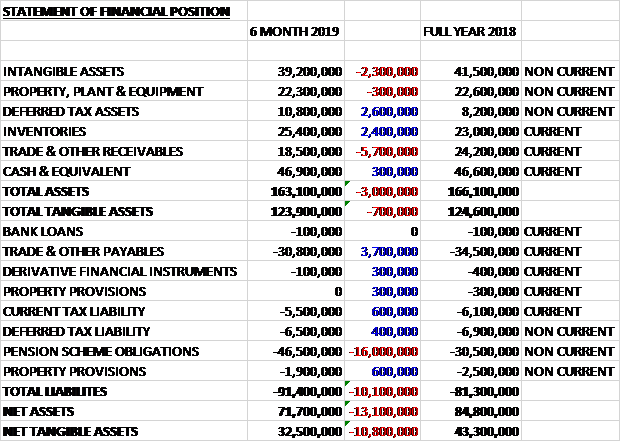
When compared to the end point of last year, total assets declined by £3M, driven by a £5.7M fall in receivables and a £2.3M decline in intangible assets partially offset by a £2.6M growth in deferred tax assets and a £2.4M increase in inventories. Total liabilities increased during the period as a £3.7M decrease in payables was more than offset by a £16M increase in pension obligations. The end result was a net tangible asset level of £32.5M, a decline of £10.8M over the past six months.
Before movements in working capital, cash profits declined
by £3.4M to £12.7M there was a cash outflow from working capital which was
higher than last time but both tax and interest charges reduced slightly to
give a net cash from operations of £8.9M, a decline of £7.3M year on year. The group spent £2.3M on fixed assets and
£1.8M on purchased software so the free cash flow came to £4.8M. Of this, £3.3M was spent on dividends and
£1.3M on their own shares to give a cash flow of £200K and a cash level of
£46.9M at the period-end.
The operating profit in the Avon Protection division was
£6.1M, a decline of £2.6M year on year.
Military revenues rose but both law enforcement and fire revenues
declined. The group were awarded two
significant long term contracts with the US DOD. The M53A1 framework contract, which also
covers additional products has a maximum value of $246M and a minimum five year
duration. This framework is accessible
to a number of different customers within the DOD including all four military
service branches. The first order under
the contract worth $20.2M was received in March with deliveries starting in the
second half of the year.
The M69 sole source contract to supply the DOD with the M69
Joint Service Aircrew Mask for Strategic Aircraft, related accessories and
engineering support extends their portfolio reach into the aviation sector for
the first time and has a maximum value of $93M and a minimum five year
duration. The first orders, worth
$17.8M, were received in February with deliveries also starting in the second
half.
These contract awards support their portfolio as it
transitions from being historically focused on the M50 mask system to becoming
a multi-product portfolio. Having grown
orders ahead of revenue, these contracts together with a broadening ROW
military and law enforcement customer base provide the group with greater flexibility
to manage order fulfilment scheduling.
The extended US government partial shutdown has impacted
profit in the period from their ROW military and law enforcement
customers. The admin backlog created
continues to reduce and with a strong opening order book, the recently
announced mask system contract and a pipeline of other opportunities they have
good visibility for the second half of the year.
The military order book of £44.2M has grown significantly in
the period driven by the first orders for the M69 aircrew mask and the M53A1
mask and powered air system contracts.
Military revenues of £30.9M were 7.2% higher. DOD revenues of £22.9M were lower than last
year with lower shipments of M50 mask systems and a different phasing of
filters, spares and accessories. This
was offset by a £6M increase in revenue from ROW customers reflecting
completion of the Norwegian military MCM100 underwater rebreather order.
Law enforcement revenue reduced by 38%. This was significantly impacted by the
extended US government partial shutdown.
Delays in the timing and shipment of orders resulted in a carryover of
revenue into the second half with an opening order book of £8.3M compared to
£3.6M at the end of last year. They
expect a much stronger second half for law enforcement as a result, the impact
of delays in H1 mean that they do not expect to show year on year growth for
the business, however.
Fire orders received reduced by 2.3% to £8M. The timing of shipments resulted in revenue
decreasing by 11.4% which is offset by the growth in the order book of £1.3M,
supporting expectations of a return to growth in the second half. Delays in the NFPA approval process mean they
are now expecting to be able to launch their upgraded Magnum SCBA in Q4.
The operating profit in the Dairy division was £1.9M, a
decrease of £700K when compared to the first half of last year. After a weaker environment through Q1 in the
key North American and European markets impacted all business lines, Q2 has
seen a rebound in dairy market conditions, with improving milk prices reflected
in increased farmer confidence which has resulted in improved order intake and
a strong opening order book for the second half.
Revenue decreased by 2.6% which was more than offset by a
£1.2M growth in the order book to carry into the second half. Interface revenues increased by £200K and
were impacted by weaker market conditions in Q1 although order intake increased
by 2.7% due to improved market conditions in Q2. Precision, control and intelligence revenue
fell by 9.5% reflecting the caution of dairy farmers to commit to capital
investment over the period. Strong order
intake over Q2 resulted in 11% growth in order intake over the period. There remains a growing pipeline of other
opportunities in this market as the improving trading conditions support
farmers looking to invest and deliver improved farm efficiency.
Farm Services revenue remained broadly flat. They are more resilient to the dairy market
cycle but during the period they have seen a greater level of farm
consolidations and closures. They have
continued to convert farms to Farm Services but this has been offset by wider
market dynamics. They anticipate a
return to growth in the second half.
During the period they have taken the opportunity to
consolidate all EU commercial operations into the existing Italian
facility. This provides a single
customer service point for all three lines of the business and at the same time
they have also transferred the European liner production in house to support
their operational efficiency.
The main on-recurring item relates to the £2.9M increase in
pension liabilities following the GMP equalisation ruling.
As a result of the strong momentum in Avon Protection and
despite the performance in the first half being adversely affected by the US
government partial shutdown and challenging dairy market conditions, the board
remains confident in delivering full year expectations. The opening order book for the second half of
£59.1M represents a 38% increase compared to the same point of last year. The opening order book and mask system
contract provide strong visibility into the second half of the year and the
board remain confident in delivering full year expectations. Avon Protection revenues are expected to
grow mid-single digit basis and with rebounding milk prices a stronger second
half for the dairy division should result in flat revenues for the year.
At the current share price the shares are trading on a PE
ratio of 21.8 which falls to 18.5 on the full year consensus forecast. At the period-end the group had a net cash
position of £46.8M compared to £46.5M at the end of the year. After a 30% increase in the interim dividend
the shares are now yielding 1.2% which increases to 1.5% on the full year forecast.
On the 2nd May the group announced that
non-executive director Petrus Vervaat purchased 2,500 shares at a value of
£36K.
Overall then this has been a difficult period for the group. Profits declined, net assets reduced and the operating cash flow fell, although there remained a decent amount of free cash generated. There were problems across both divisions. Protection was affected by the US government partial shutdown and the dairy division by a poor milk market and prices. For the second half, these issues seem to have mostly been resolved and there is a good opening order book. A forward PE of 18.5 and yield of 1.5% is not cheap but this is a quality company and I am minded to hold on.
On the 7th August the group announced that it had
signed an agreement to acquire 3M’s ballistic protection business and the
rights to the Ceradyne brand for an initial cash consideration of £75M and a
further contingent cash consideration of up to £21M.
The business is a leader in critical personal protective
equipment with established positions with the US DOD and has existing contracts
for next generation ballistic helmets and body armour. It operates from three sites in the US and
last year made an EBITDA of $10.8M.
Recurring annual cost synergies of around £4M are expected to be
delivered in the first full year of ownership from integrating IT systems and
back office functions. The one-off costs
to implement this are expected to be around £8M.
The acquisition is expected to close in the first half of
2020.
On the 16th September the group released a
trading update covering the year where they noted that trading in the second
half continued in line with expectations.
Revenues are expected to grow by 4% on a constant currency basis with
the EBITDA margin modestly ahead of last year.
The protection division had a strong year, underpinned by the
performance of the military business.
They have completed the planned initial deliveries of the M69 aircrew
mask and the M53A1 mask and powered air system to the US DOD. They have also completed the $16.6M ROW mask
system contract announced in April.
Law Enforcement performance has been stronger in the second
half but the impact of delays resulting from the extended US government partial
shutdown in the first half will result in a year on year revenue decline. Fire performance in the second half has been
further impacted by delays in the NFPA approval process for the new safety
standard, which has prevented the launch of their upgraded Magnum SCBA. They now expect to launch it in the first
half of 2020.
The improved global dairy market conditions experienced in
Q2 have continued into the second half, resulting in improved trading
conditions. This has resulted in the business
returning to revenue growth across all lines.
The US DOD contract awards totalling $340M for the M53A1 and
M69 mask systems along with the acquisition of 3M’s ballistic protection business
has strengthened the medium-term outlook which leaves the group well positioned
to deliver further growth.
Photo-Me has now released their interim results for the year ending 2019.
Revenues decreased when compared to the first half of last year as a £4.3M growth in European revenue was more than offset by a £6M decline in UK and Irish revenue and a £745K fall in Asian revenue. Depreciation and amortisation grew but other cost of sales declined to give a gross profit £2.7M lower. The group did not make the £2.2M sale of land that occurred last time, there was a £1.2M detrimental swing to forex movements and other admin expenses grew by more than £1M which meant that the operating profit was £7.2M lower. The group did gain £3.2M on the disposal of Stilla Tech but suffered a £2.7M mark to market loss on the Max Sight valuation. Other finance costs also increased but tax charges were down £2.8M to give a profit of £20.1M, a decline of £4.1M year on year.
When compared to the end point of last year, total assets increased by £20.1M, driven by a £29.9M increase in cash, a £4.5M growth in goodwill, a £1.6M increase in financial instruments and a £1.3M growth in property, plant and equipment, partially offset by a £4.5M decline in current tax assets, a £6M fall in financial assets, a £3.8M decline in receivables and a £2.5M fall in inventories. Total liabilities also increased during the period due to an £23.5M growth in borrowings and a £10.5M increase in payables. The end result was a net tangible asset level of £103.1M, a decline of £14.3M over the past six months.
Before movements in working capital, cash profits declined
by £992K to £39.2M. There was a cash
outflow from working capital so the net cash from operations came in at £31.1M,
a decline of £3.7M year on year. The
group spent £4M on acquisitions but received £4.4M from the disposal of an
associate and £1.6M from the repayments of loans advanced to the
associate. They spent £1.3M on
intangible assets and £12.8M on property, plant and equipment to give a free
cash flow of £19.5M. Of this, £14M was
paid out in dividend and again the group took out a large chunk of new
borrowings (£26.7M) to give a cash flow of £29.4M and a cash level of
£88.6M. It is quite hard to understand
the reason for the new borrowings in my view.
The operating underlying profit in Asia was £2.7M, a growth
of £348K year on year, although Japanese restructuring costs were £1.2M which
meant the actual profit was £1.5M, a fall of £859K. Revenue reduced by 3% which was a decent
performance given the challenges in the Japanese market. Admin functions were streamlined, low revenue
machines were relocated and unprofitable units removed. The business recovered faster than expected
and is now performing well. Trading in
the other countries in Asia remains strong.
In the second half the group will see the full benefit from
the restructuring programme. Whilst the
market in Japan remains highly competitive, the board continue to believe there
are growth opportunities and they intend to start the deployment of their new
units which have a significantly lower production cost than the units deployed
previously and will offer a 35% faster return on investment.
The operating profit in Europe was £20.7M, a decline of £1.8M
when compared to last year which is being put down to last year’s French litigation
outcome. The group remains in
discussions with the French government regarding the extension of its secure
photo ID transfer technology to include photo ID for new passports and ID
cards. Advanced discussions continued
with the Dutch government regarding deployment of their technology for use in
driving licences in the Netherlands. The
laundry business continued to perform well, including a first time contribution
from La Wash.
The operating profit in the UK and Ireland was £4.5M, a
decrease of £2.8M year on year. This was
due to large order lags in B2B and third party sales activities which should be
recovered in the second half. The
restructuring of Photo-Me retail had a negative impact on revenue and there was
some impact on revenue from the removal of unprofitable children’s rides The group diversified its photobooth services
with the roll out of secure digital upload technology for Irish Online passport
renewal and British passport renewals.
In total, 2,950 photobooths are now enabled for UK passport renewals
with a target of 4,000 by the end of December.
The acquired business made a pre-tax profit of £315K during
the period.
ID revenue increased 1% with a 1% growth in the number of
units in operation. The group now has
more than 10,000 photobooths connected to government organisations for the
secure upload of photo ID and it is expected that this number will continue to
grow as discussions with Governments progress.
New services have been introduced to a small number of booths in the UK,
Ireland and France, enabling customers to scan and copy documents. They are monitoring customer response.
Total revenue from laundry increased by 26%. The rollout of Revolution machines continues
with the estate increased by 30%. The
UK, Ireland, Portugal, France and Spain remain key geographies for growth and the
group is looking to extend operations into Germany and Austria. They are still on track to deploy 6,000 units
by the end of 2020.
The number of kiosks in operation have reduced by 7% and
revenue from kiosks was down 27%. This
was primarily due to the restructuring of Photo-Me Retail, which resulted in
the removal of machines located in shops which were closed. These units were transferred to Photomaton in
France and have been refurbished prior to being deployed to replace previous
generation machines in the country.
While the machines have improved revenue following relocation to France,
there was a period of time when the machines were not operational.
The board foresees that in the short term the negative
impact of the uncertainty surrounding Brexit and the UK economy could also
spill over into their UK operations. In
the long term, potential re-nationalisation of UK ID documents as well as
strengthened immigration regulations could lead to increased requests for the
group’s secure ID products.
After the period-end, the first banking booth which provides
retail banking services to customers was launched in partnership with
Anytime. The first ten booths were
opened in Paris, allowing customers to open a bank account and scan in
supporting documents. It then takes two
days for a new account to be opened once compliance checks have been
completed.
In May the group acquired La Wash group, for a consideration
of €5M. It is a Spanish business to
business laundry service company based in Barcelona. The acquisition generated
goodwill of £4.4M. A further £219K of
consideration is payable to the vendor of the acquired business.
During the period the group made net gains of £560K which
included the gain of £3.2M on the disposal of Stilla Technologies, an
associate, and the market to market loss of £2.7M arising on the fair valuation
of Max Sight Holdings.
During the period the group has been impacted by reduced B2B
revenue and machine sales activity, especially in the UK, where they have
suffered from large order lags. They
expect this to recover in the second half of the year. The strong performance in Japan and the
continued positive momentum of their high margin laundry business gives the
board continued confidence in their pre-tax guidance of £44M for the year. Their ability to meet guidance will be
reliant on normalised trading conditions in their key markets.
At the current share price the shares are trading on a PE
ratio of 10.5 which falls to 10.4 on the full year consensus forecast. After the interim dividend was kept the same,
the shares are yielding 8.9% which is forecast to remain the same for the full
year. At the period-end the group had a
net cash position of £32.4M compared to £26.7M at the year-end.
On the 3rd April the group released a trading update
covering the year. Their operations in Europe and Asia are continuing to grow
in line with expectations. The strong
performance in Japan has continued into the second half of the year, following
the reorganisation.
Overall trading in the UK has become more challenging than
expected reflecting the slowdown in consumer activity as a result of continued
uncertainty around the Brexit negotiations.
This has meant that the expected recovery in B2B machines revenue is not
now expected to materialise this year.
As a result, the board believes that pre-tax profit will be slightly below
previous guidance of £44M and will instead be just above £42M.
On the 25th April the group announced that it had
acquired a 96% share in Sempa, a French company that specialises in commercialised
self-service fresh fruit juice equipment.
The gross consideration payable for the acquisition is €20.6M, funded by
a new debt facility of €20M (why isn’t
the group using its existing cash resources?).
The business is the leader in France for the
commercialisation of self-service fresh fruit juice equipment. They operate via a lease model whereby they
sell equipment to customers via lease finance agreements. They receive full payment on sale of the equipment
and the lease finance contracts are then subject to renewal every year.
Sempa’s pre-tax profit last year was €3.7M and it had gross
assets of €9M. The acquisition is
expected to be earnings enhancing in 2020 and is expected to contribute around
€3.7M in pre-tax profit.
Overall then this has been a bit of a tricky period for the
group. Profits were down, net assets
decreased and the operating cash flow declined.
The group apparently made a decent amount of free cash but the cash position
here continues to confuse me. Why take
out more loans when there appears to be a huge amount of cash on the balance
sheet. I don’t understand. The underlying business in Europe seems to
be performing decently, and the performance in Japan seems to be recovering
more quickly than expected.
Brexit-related uncertainty is putting a drag on UK results,
however. The Sempa acquisition seems
good, but again why take out more loans when the group could easily afford it
out of their cash reserves? The shares
look good value, with a forward PE of 10.4 and yield of 8.5% but I just feel a
little uneasy.
James Halstead has now released its interim results for the year ending 2019.
Revenues declined by £238K but costs of sales were down £852K to give a gross profit £614K higher. Finance costs declined by £177K by tax charges were up £182K which meant that the profit for the period was £19M, a growth of £609K year on year.
When compared to the end point of last year, total assets increased by £343K, driven by a £12.1M growth in cash partially offset by a £7.4M decline in inventories and a £5.1M decrease in receivables. Total liabilities increased during the year, mainly due to a £3.6M increase in the pension obligations and an £855K growth in current tax liabilities. The end result was a net tangible asset level of £121M, a decline of £4.6M over the past six months.
After movements in working capital the operating cash flow
increased by £18.2M. After an increase
in tax payments the net cash from operations was £34M, a growth of £18.1M year
on year. The group spent £2M on capex to
give a free cash flow of £32M. Of this,
£20.1M was spent on dividends to give a cash flow of £12M and a cash level of
£62.8M at the period-end.
In terms of sales, every month showed an increase on the
comparative except December when larger customers were exercising stock
control. Despite this, sales overall
were 3.9% ahead. Export markets were
mostly strong but with Central Europe showing a decline of 1.7% but the start
of the second half has shown a return of solid growth.
Gross margin improved as a result of a better product mix
and favourable plant performance, although it was impeded to some extend by raw
material price increases. Raw material
inflation was only around 3%, whereas last year it was 18%. The group made a significant investment in
new sheet vinyl ranges and in Germany they are taking market share with 15%
growth in homogenous sheet vinyl.
Palletone, launched in May 2018, continues to gain traction. Investment continues with new showroom
facilities having been opened in Cologne to provide greater market support to
customers.
Going forward, obviously Brexit hangs over everything and
there are many complications beyond the practicalities of port entry
delay. Management has spent extensive
time considering the possible implications and they have made appropriate stock
adjustments as a contingency. The start
of the second half has seen a good increase in sales and their newer ranges
continue to increase their market penetration.
In January they introduced further ranges to the market which have been
well received. The board have confidence
in their continued progress through the year.
At the current share price the shares are trading on a PE
ratio of 29.6 which falls to 27.8 on the full year consensus forecast. After a 3.9% increase in the interim dividend
the shares are yielding 2.6% which increases to 2.9% on the full year forecast. At the period-end the group had a net cash
position of £62.8M.
Overall then this has been a bit of a subdued but steady period. Profits were up due to good controls on costs, and the operating cash flow improved with a good amount of free cash being generated. Net assets saw a decline, however. Raw material cost inflation has become much more manageable and most markets seem stable despite Brexit looming. All this stability comes at a price, however, and the forward PE of 27.8 and 2.9% yield is certainly not cheap. Would definitely be worth an investment if the price is right.
On the 10th May the group announced that non-executive director Michael Halstead sold 100,000 shares at a value of £510K. On the 15th May it was announced that non-executive director Michael Halstead sold 120,000 shares at a value of £610K.
On the 30th July the group released a trading
update covering the year as a whole.
Sales were ahead of last year despite difficult trading conditions. Flooring installations throughout the year were
wide ranging such as Harrow School, Euro Disney’s Hotel and Chanel concessions
across the globe. The healthcare
business continues to make good progress and projects completed included Poissy
Hospital in France and the Quillota Hospital in Chile. UK turnover was 7% up in a market that seems
to be quite robust despite the high street retail issues.
In Europe competition is ever increasing with new entrants
selling an increasing array of flooring.
In the German market the group have retained market share but turnover
was at a lower level. There are markets
with double digit growth, however, and France, South America and the
Netherlands are examples.
Raw material prices are stable and the availability problems
of last year have ameliorated and working capital remains robustly managed with
their cash generation secure.
AG Barr have now released their final results for the year ended 2019.
Revenues increased when compared to last time as a £5.7M decrease in still drinks revenue was more than offset by a £7.2M growth in carbonates revenue. Cost of inventories grew by £10M to give a gross profit £8.2M lower. Depreciation was up £700K but other operating expenses fell by £10.2M. There was no gain on the sale of a distribution site, which netted £2.5M last time and there was a £700K GBP pension equalisation charge. Offsetting this was £900K fall in the sugar reduction programme costs and £300K less reorganisation costs which meant the operating profit was £800K lower. Finance costs reduced by £400K but the tax charge was up £1M to give a profit for the year of £35.8M, a decline of £1.4M year on year.
When compared to the end point of last year, total assets increased by £10.3M driven by a £6.8M growth in cash, a £5.9M increase in plant, equipment and vehicles, a £2.4M growth in inventories and a £1.2M increase in trade receivables, partially offset by a £4.6M decline in assets under construction and a £1.2M decrease in software assets. Total liabilities also increased during the year as a £1.7M decline in pension obligations was more than offset by a £2.4M increase in trade payables. The end result was a net tangible asset level of £163.5M, a growth of £10.1M year on year.
Before movements in working capital, cash profits increased
by £2.5M to £55.1M. There was a cash
outflow from working capital but this was less than last time so after tax
payments increased by £1.6M, the net cash from operations was £44.4M, a growth
of £2.3M year on year. The group spent
£8.9M on capex to give a free cash flow of £35.5M. Of this, £10.3M was used to buy their own
shares and £17.9M went on dividends to give a cash flow for the year of £6.8M
and a cash level of £21.8M at the year-end.
The gross profit in the carbonates division was £100.1M, a
growth of £6M year on year, driven by Irn-Bru, Barr Flavours and Rubicon Spring. The Barr flavours range has made excellent
progress and the board expect to deliver further progress in 2019 due to
increased levels of distribution gained in the second half of 2018
The gross profit in the still drinks and water division was
£14.7M, a decline of £1.4M when compared to last year. While the performance of Rubicon still juice
drinks has been impacted by the overall decline in the fruit drinks category,
the brand as a whole has grown by nearly 8% in volume terms reflecting the
significant growth of Rubicon Spring. Strathmore
gained less benefit from the significant weather related demand across the hot
summer months and was impacted by competitive pricing.
The gross profit in the other division was £7.7M, an
increase of £300K when compared to 2018.
The Funkin business continued its strong growth trajectory with revenue
growth of 9%. They made significant
progress across core business development in the on-trade along with the
exciting launch of draught cocktails, initially focused on outdoor events and
now expending into higher volume on-trade pubs, bars and restaurants. Following their initial entry into the home
cocktails market with the growing Shaker Pack product, the next step will be
the launch of nitro cocktails in can format which will be launched into the
market in the first half of 2019, further supporting their strategy of building
the brand from its existing strong base in the on-trade into the wider consumer
market.
This was a tricky year for the market. Carbon dioxide shortages during a period of
hot weather, snow disruption and a number of customer business failures
together with the implementation of the soft drinks levy led to significant
changes in pricing, promotional and demand factors in the wider market.
The implementation of the levy has led to distortions in
both value and volume performance in the market. Unit pricing changes and
shifts in promotional dynamics have been evident across the full year. The total UK soft drinks market saw value up
8.1% and volume up 3%. This was
particularly evident in the carbonates category where value grew 11.6% and
volume increased by 2.7%. In regular
colas, value grew 1.9% while volume declined by 22%. The only sector in decline was juice drinks
which continues this long term trajectory as consumers choose water, flavoured
water or traditional carbonates. Overall
Barr soft drinks volume share grew by 11%.
Last year saw the reformulation of the group’s biggest
brands and the implementation of the soft drinks levy. The group placed an intentional short term
trading focus on volume across the core carbonates business as they established
where market pricing and promotions would sit after the levy came in. This has given some short term boosts to their
volume growth.
The group expect to see the overall soft drinks market
performance stabilise in 2019 as the comparisons start to include the
levy. They expect to revert back to
their long-term strategy of value over volume as they do so.
They have seen a significant amount of change in their
partnership brands across the period.
They launched new partnerships with Bundaberg and San Benedetto in early
2018 which have got off to a strong start with the brands making good progress. The Snapple brand has not made as much
progress as they would have liked but the change in ownership of the parent
company has led to a positive change which they hope will lead to a more
autonomous position for the group allowing them to focus on growth over the
long term.
Rockstar progress has slowed in the period, down 3.1% in
volume terms in a challenging marketplace where significant competitive
investment and activity have dented the strong prior year performance. The group expect to launch a number of new
Rockstar products in order to regain sales momentum. They have regained momentum in their
international sales performance with revenue growth of 8.6% as their business
development plans delivered strongly in Ireland, Sweden and Germany.
The board forecasted that operating margin would see a
moderate reduction as they continued to support brand development, innovation,
customer service and flexibility. They
were also impacted by unplanned CO2 shortages, unprecedented seasonal demand
which led to suboptimal operating conditions and additional operating costs
during the summer months. Going forward
they expect moderate cost inflation in the coming year which they expect to
offset through “management actions” (whatever that is) which should see margins
stabilise.
Given the largely UK-based sales profile, the current
assessment is that the specific issue of the Brexit will not have a significant
impact on the business other than through its effects on forex and the
procurement of raw materials
During the year there was a charge of £700K for the past
service cost in respect of the equalisation of GBP benefits following a high
court judgement.
As far as capex is concerned, the major project this year
has been the replacement and upgrade of the liquid to line processes in the
Cumbernauld factory. Cash spend on this
£13M investment was lower than originally planned due to rephrasing of both
operational activity and supplier payments, however the project remains on
schedule with commissioning planned for 2020.
As a consequence, capex in 2020 is expected to be higher than previously
guided.
For Brexit, a steering group has considered the implications
both for transition disruption in the 3-4 months after an exit and for the
longer term strategy. Action has been
taken to mitigate short term transitory issues by increasing forex coverage and
inventory levels of strategic raw materials.
Given the UK focus of the commercial activities and the largely UK
sourced supply base, the current assessment is that an exit from the EU will
not have a significant strategic impact on their business and is not a
principal risk.
Going forward, the political and economic climate in the UK
indicates that 2019 will be another uncertain year for UK-based
businesses. For soft drinks this is
likely to be made all the more challenging by further regulation and ever
changing consumer dynamics. Despite
this, the board have confidence in their growth strategy.
At the current share price the shares are trading on a PE
ratio of 26.3 which reduces to 25.2 on next year’s consensus forecast. After a 7% increase in the dividend the
shares are yielding 2% which is forecasted to remain the same next year. At the year-end the group had a net cash
position of £21.8M compared to £15M at the end of last year, which was higher
due to the change in timing of the capex investments and share buy-backs.
Overall then this seems to have been a decent year in a fairly tricky market. Profit was down but this was due to last year’s distribution site sale, otherwise it would have increased. Net assets grew and the operating cash flow improved with good free cash generation (although capex will rise next year). The carbonates and other business is doing well but the stills sector is struggling somewhat due to a general fall in the juice market. The group seems to have successfully overcome Co2 shortages and the soft drinks levy but this performance comes at a price and the shares look pricey with a forward PE of 25.2 and yield of 2%. This should be a great investment at the right price.
In May it was announced that commercial director Jonathan
Kemp sold 4,000 shares at a value of £33K.
On the 7th June the group announced a minority interest investment in new business start-up Elegantly Spirits, owner of the Stryyk brand which has a portfolio of zero proof spirits. As part of the investment, Funkin has entered into a long term agreement on normal market terms to act as a distributor for all Elegantly Spirit products and the group are investing £1M for a 20% stake. The business was recently formed by the original founders of Funkin….
On the 16th July the group released a trading
update covering the first half of the year.
Trading so far has been below management expectations. This has been exacerbated by some specific brand
challenges, particularly in Rockstar energy and Rubicon juice drinks, as well
as some disappointing spring and summer weather.
They have taken action to address the specific brand issues,
including the planned launch of three new Rockstar products at the end of the
summer, and recipe improvement activity for Rubicon but the benefit of these
actions will not be felt until later in H2.
In a transitional pricing year for their core carbonates
portfolio, they are seeing positive indications of acceptance of the new price
positioning. Funkin continues to perform
strongly and the recent launch of nitro-infused premium cocktails in cans is already
exceeding expectations.
Revenue is expected to be 10% down on last year. Despite the strong second half plan, it is
not expected that they will fully recover from the volume impact in the first
five months of the year and the current trading they are experiencing. As a result the board expect profit to be 20%
lower in the full year. It is also expected
that there will be some exceptional costs incurred in the current year as they
take action to regain momentum.
Spectris have now released their final results for the year ended 2018.
Revenues increased when compared to last year as a £34.2M decline in industrial controls revenue was more than offset by a £76.2M growth in materials analysis revenue, a £35.3M increase in test and measurement revenue and a £1.3M growth in in-line instrumentation revenue. Depreciation was up £4.7M and other cost of sales grew by £34M to give a gross profit £39.9M higher. Indirect production and engineering expenses declined by £10M but sales and market expenses were up £15.7M, acquisition related costs increased by £11.8M and other admin costs also grew which meant that the operating profit was £6M lower. There was a £44.2M reduction in the profit on business disposals and an £8.5M increased loss on retranslation of intercompany loans arising from Sterling’s strengthening against the dollar, along with a £2.4M increase in interest payable on loans. Tax charges were down £10.8M, however, to give a profit for the year of £185.2M, a decline of £49.6M year on year.
When compared to the end point of last year, total assets increased by £294.3M driven by a £138.8M growth in goodwill, a £40.4M increase in inventories, a £38.9M receivable from a joint venture, a £42.6M growth in trade receivables, a £35.1M increase in the value of trade names, a £30.9M increase in freehold properties and a £23.8M growth in plant and equipment, partially offset by a £64.8M decline in cash and a £28.6M decrease in assets held for sale. Total liabilities also increased during the year due to a £177.2M growth in bank loans and a £36.7M increase in contract liabilities. The end result was a net asset level (excluding goodwill) of £277.5M, a decline of £155.9M year on year.
Before movements in working capital, cash profits increased
by £12.2M to £267.2M. There was a cash
outflow from working capital and after interest payments increased by £4.7M but
tax payments reduced by £9.3M the net cash from operations declined by £17.2M
to £168.7M. The group spent £97M on
fixed assets and spent a net £152.6M on acquisitions to give a cash outflow of
£72.7M before financing. The group also
paid out £68.2M in dividends and £100.5M on share buy-backs and to finance this
they took out new loans of £175.5M. The
end result was a cash outflow of £65.2M and a cash level of £67.3M at the end
of the year.
The operating profit in the Materials Analysis division was
£72.1M, a growth of £3.5M year on year on sales that increased by 16%
reflecting an 8% increase in like for like sales, a 10% contribution from
acquisitions and a 2% negative impact from forex movements. Sales growth was driven by strong demand in
Asia, particularly in China, South Korea and India with a notably stronger
performance in the second half. In North
America and Europe, like for like sales were also up with a stronger
performance in the first half.
Sales at Malvern Panalytical have continued to benefit from
the reorganised sales and marketing functions following the merger and are
being aligned with three market sectors: advanced materials, pharma and food,
and raw and bulk materials. Alongside a
key account structure these are focused on value based selling in order to
create differentiation from the competition.
They have continued to generate orders from cross selling the Malvern
and Panalytical branded product lines, with incremental sales into various
universities and industrial customers recognising the benefits of the combined
business.
Several new products were launched in the year including a
new high performance benchtop analytical tool for determining the chemical composition
of different materials. It is applicable
to industries such as mining, pharmaceuticals and oils which need to comply
with international regulations. Also
launched were the Zetasizer Ultra and Pro systems which deliver significant
improvements in the quality and speed of the characterisation of nanomaterials
and proteins.
Particle Measuring Systems benefited from growth in the
semiconductor industry as well as continued good demand for both its
contamination monitoring hardware and high level consulting services into the
pharma industry. Demand for these
services is motivated by regulatory compliance, which is becoming more
stringent, and the business is well placed in a growing market for aseptic
processing and sterility assurance.
Performance at Concept Life Sciences was below expectations
due to a range of factors including a reduction in project work from two major
clients, delays in gaining new lab and manufacturing accreditations as well as
a period of sub-optimal performance at one of its analytical labs. These issues largely reflected the state of
the business on acquisition as well as disruption caused to the commercial
organisation from the acquisition.
Remedial action to improve effectiveness is already having an impact;
the preparatory work for the manufacturing accreditations has progressed well
and the funnel of opportunities has developed strongly.
Sales to the pharmaceuticals and fine chemicals industries
rose notably on a like for like basis with North America seeing particularly
strong growth. LFL sales also increased
in Europe and Asia with growth in the latter driven by strong demand in China
and India as rising disposable incomes in these countries bring increased
demand for effective healthcare. This
has led to a greater investment in generic pharmaceutical development and
manufacturing.
The metals, minerals and mining sector saw an increase in
like for like sales with North America and Europe broadly flat and growth in
other regions. The improved investment
climate has seen an increase in market activity as well as a focus on safety
and productivity. The sector has focused
on delivering improved yields, productivity, product quality and cost
minimisation in the extraction and processing of raw materials fundamental to
the manufacturing industry.
After a weak 2017, sales to academic research customers were
much improved last year with good like for like growth across all key
regions. The year started slowly but
improved in the second half with a significant pick up in demand in North
America and Asia as improving economic conditions and increased government
funding led to greater market activity.
In China the government has a number of initiatives and investments
underway to help develop the country’s technology and pharmaceutical
industries. In Japan, the government
aims to increase spending on science and technology to support significant
industry and academic partnerships in established research areas. In North America sales benefited from an
increase in university funding and the group’s improving win-rate.
Sales to the semiconductor and electronics industries
recorded another year of good like for like growth, particularly in Asia where
they have seen strong demand from battery and electronics customers in China,
Taiwan and Korea as Asian demand for consumer electronics has increased. Semiconductor capital spending has continued
to rise as new fabrication plants are developed, although they have seen a
slower pace of growth this year. Notable
customer wins include a well-known semiconductor manufacturer and memory
supplier.
Going forward, in the pharmaceuticals sector, the demand for
effective healthcare has resulted in sustained investment in R&D and the
board expect this trend to continue.
Alongside this, an increasing awareness of total lifecycle cost
awareness is pushing customers to reduce both development costs and time to
market for new products, underpinning an increased need for new solutions and
services. They expect steady growth in
the mining and materials sector to continue.
With its dependence on government spending, they expect
growth in the academic research market to be variable, although demand in Asia
is benefiting from a number of government initiatives. Within the semiconductor industry, after another
year of strong demand, they expect the pace of investment to be at more muted
rates in 2019.
The operating profit in the Test and Measurement division
was £42.8M, a decline of £12.8M when compared to last year despite sales
increasing by 7% which included a 2% contribution from acquisitions and a 1%
negative impact from forex movements.
All key regions delivered similar levels of LFL sales growth with the
UK, China and Japan being the key countries positing higher growth.
The decline in margins reflected the higher sales volumes in
ESG and Millbrook which have higher overheads.
The overheads increased from the HNK-related merger costs, higher
employee costs and higher depreciation at Millbrook. At the end of May they completed the disposal
of ESM Bruel & Kjaer into a joint venture with Macquarie Capital.
Preparatory work continued ahead of the merger of BKSV and
HBM. The businesses are being combined
in order to leverage the strengths and complementary expertise across the
measurement chain. An integrated model
for the joint sales organisation has been established and the development of
joint products has started. During the
year both businesses launched new software products which aim to streamline and
simplify data acquisition and monitoring.
Overall sales growth was held back by supply shortages and
constraints at HBM, by internal staffing issues at BKSV, which have now been
resolved, and by some interruption from pre-merger related activity. Orders for their traditional hardware
products have remained strong, however, particularly for BKSV’s shaker business
and for HBM’s core torque, load sensor and strain applications and data
acquisition products. OEM sensors have
seen significant growth both with existing and new customers in applications like
agriculture, medical devices, textile machines and spectrometry devices. HBM’s
DAQ instrument business has grown significantly, a notable order being from
ITER for their experimental fusion reactor project. Going forward, they see a solid pipeline of opportunities
for ground vehicles, aircraft and other end markets.
At Millbrook they continued to expand their testing
capability. They increased their
capacity for testing driver assistance systems and CAV vehicle technologies via
modifications to existing track infrastructure plus investment in
instrumentation and soft targets that allow contact without damage. A new battery test facility started in
January and all chambers will become operational during the first half of
2019. The refurbishment of the full
scale crash lab has increased efficiency and enabled additional tests to be
offered. At Test World in Finland,
additional indoor tyre testing capacity has come into commercial use through
the year. The acquisition of
Revolutionary Engineering in Detroit in April expanded their position into a
new region, market and services offering and they have seen good demand for its
services.
In the automotive sector, sales grew strongly during the
year with the UK, China and Japan being the main contributors to growth. Growth reflects robust demand for electric
and hybrid vehicles globally and policy changes in certain markets such as
China and Europe. They also had a year
of strong growth in their eDrive applications.
In machine manufacturing, a significant proportion of which
goes into the automotive supply chain, sales rose in Europe and Asia. Germany and China both saw good growth with a
continued increase in exports from Germany.
Sales of their weighing sensors benefited from a strong machine maker
demand globally and customer wins.
In the aerospace and defence sector, sales declined in all
regions, though sales can be lumpy. In
addition the prior year was a tough comparison due to a sizeable one-off order
and they have seen some projects being delayed into 2019. They continue to see good R&D investment
in the industry, however, and have been building their pipeline of
opportunities. They have been working with Mitsubishi Regional Jet on Japan’s
first commercial jet aircraft during its certification phase to ensure exterior
take-off and landing noise meets requirements.
BKSV’s acoustic products were used to perform noise source id to help
identify areas of the aircraft that need continued analysis or further design
enhancements.
Sales to their consumer electronics and telecoms customers
were slightly higher with growth lower than in previous years reflecting fewer
new product launches by customers. Sales
of the high frequency head and torso sim which was launched in 2017 have been
above expectations, particularly into consumer electronics companies, and they
have a strong pipeline. Underlying
demand for their electro-acoustics products is still good as manufacturers
strove to deliver higher sound quality.
Sales into academic research institutes were flat, with
lower sales in Europe and North America.
Sales were strong in Asia driven by very good growth in China,
reflecting the increased government funding and continuing investment to move
the country towards being a technology-driven economy.
Improved conditions in the oil and gas and mining markets
continued into 2018 and sales growth was again strong, particularly in North
America. A rising rig count and the
launch of new oil and gas and mining projects saw demand for ESG’s microseismic
monitoring solutions increase notably.
Sales of the new microseismic data acquisition, processing and analysis
product which was launched in the year have been good.
The board expect demand in the automotive sector to continue
to grow and new capacity coming onstream at Millbrook will enable them to
better access this sector. In aerospace
demand will be driven by new development programmes and while their pipeline
remains strong, the ability to convert these into orders will be key. The underlying trends in the consumer
electronics and telecoms market remain healthy with continued consumer demand
for phones with high quality audio.
Market conditions in the oil and gas industry are harder to predict,
with continued volatility in oil and gas prices.
The operating profit in the In-line Instrumentation division
was £32.2M, an increase of £2.7M when compared to 2017. Sales were broadly flat with a like for like
increase of 1%. Servomex and BTG
performed well, with NDCT’s sales contracting and Bruel & Kjaer Vibro
having a tough comparison against high one-off sales in 2017. A 1% negative forex impact was compensated by
a 1% contribution from acquisitions. On
a regional basis, sales rose strongly in Asia, particularly in China, but
declined in North America and Europe.
In the pulp and paper markets, sales increased with similar
growth in all the key regions and notably strong growth in China driven by
robust capital project activity. BTG’s
process solutions business unit has continued to gather momentum with several
customers placing orders for integrated solutions. Orders were placed in the Americas and Europe
for pulping solutions, including instrumentation and MACS advanced process
control content. These solutions are
designed to deliver sustainable gains in business performance for their
customers, including cost savings and productivity enhancements.
In the energy and utilities market, sales rose with notably
strong growth in Asia more than offsetting lower sales in North America and
Europe, with the higher year on year oil price supporting steady project
development. In addition, waste to
energy projects in the Americas and combustion control in power plants in Asia
continued to drive opportunities.
With the strengthened sales and marketing organisation at
Servomex, they have continued to capitalise on this improved backdrop in the
industrial gas and hydrocarbon processing sectors and benefited from sales of
new products launched in recent years.
Also sales of their analysers into the semiconductor market to ensure
gas purity during the manufacturing process have been buoyant as activity there
remains strong. They had a notable order
in the year from a major player in semiconductor technology to deliver 135
analysers for their new semiconductor fabrication facility in South Korea.
In the wind energy sector, although market conditions
continue to see growth, they have seen lower sales at Bruel & Kjaer Vibro
dye to a tough comparator in 2017 when they had very high sales to wind turbine
manufacturer Vestas. During the year
they delivered their 20,000th wind turbine condition monitoring
system and have further expanded the number of wind farm owners and operators
to whom they provide remote turbine monitoring services. Early sales of a new condition monitoring
unit included the selection as a preferred supplier with a large wind turbine
manufacturer in China and new customers are also showing keen interest in their
new third generation product.
At NDCT, sales to web and converting industries were down
notably across all key regions. In the
film extrusion and converting segment, they have seen demand softness in all
regions, in particular in the Americas where they have seen fewer upgrades
compared with last year, driven by industry consolidation and customers
delaying projects to focus on consolidating production lines.
An important development opportunity has been their work on
lithium-ion batteries and the business continued to progress activities to
further penetrate this market. They have
had a notable order with a battery manufacturer in Taiwan and are currently
working on projects with American, Chinese, Japanese and Thai battery
manufacturers. In the food and bulk
materials segment, manufacturers continue to seek higher performing measurement
solutions for example NDCT’s Infralab product introduced a degree of roast
measurement that allows coffee manufacturers to perform moisture and degree of
roast measurement at a single station.
Going forward the market environment in oil and gas is
difficult to predict but in the wind energy sector, investment is expected to
continue to grow and in the medium term there remains the potential for
additional capabilities beyond vibration.
The demand softness seen in the film extrusion and converting segment is
likely to persist into 2019 and they continue to look at cost containment
measures to offset this. In the food and
bulk materials market, activity is expected to remain robust.
The operating profit in the Industrial Controls division was
£29.3M, a growth of £600K year on year.
Like for like sales were up 3% but there was a negative impact of 3%
from forex moements and 13% due to the disposal of Microscan. North America recorded solid sales growth,
Asia recorded good growth but in Europe sales were lower due to a tough
comparative from good project sales in 2017. Profits improved due to better
margins At Omega and Red Lion.
Operational performance improved at Omega with higher margins. This has been achived by a focus on lean
operations, tighter inventory management and consolidation of its global
distribution centres. During the year
the business did experience some product availability and lead time issues,
impacted by the tight US labour market and raw material availability. The business has been introducing newer
products to offset the lower growth of its traditional thermocouple business.
In December a new e-commerce platform was introduced to
enhance the digital experience for customers.
It was initially launched in Canada and will be rolled out during
2019. It has supplemented this with more
precisely targeted digital campaigns and enhanced organic search engine
optimisation performance which are expected to translate into higher conversion
of website traffic to sales.
Going forward, given the predominance of sales in the North
American market, the performance of this segment will be influenced by
industrial markets in that region where growth in 2019 is likely to be more
subdued. The enhanced digital platform
and refresh of their product portfolio is expected to drive enhanced medium
term growth at Omega, however.
In January the group acquired Concept Life Sciences for a
consideration of £166.9M. The business
is a UK-based group providing integrated drug discovery, development,
analytical testing and environmental consultancy services mainly in the
pharmaceutical, biotechnology, agrochemical and environmental sectors. The acquisition generated goodwill of
£105.5M. The business has not performed
in line with management expectations but they have decided that none of the
goodwill has been impaired.
In April the group acquired Revolutionary Engineering Inc
for a consideration of £8.7M. The
business is an automotive test system and service provider based in the US. And
the acquisition generated goodwill of £3.3M.
In August they completed the acquisition of VI Grade for a consideration
of £28.3M. The business is a global
provider of vehicle simulations and the acquisition generated goodwill of
£12.8M. The above acquisitions generated
operating profits of £1.5M during the year.
In May the group disposed of their environmental monitoring
business, EMS Bruel and Kjaer into a joint venture with Macquarie Capital in
exchange for a cash consideration of £45.1M and a 45% interest in the joint
venture. This generated a profit on
disposal of £56.3M.
The group spent £94.1M on capex compared to £73.1M last
year, of which £43.1M related to spend by Millbrook on capacity expansion as
the business invested to access high growth opportunities in support of
customer project demand.
The implementation of phase one of project uplift continued
as planned with savings derived predominantly from improvements in procurement
as well as benefits from simplifying their property portfolio. During the year
the gross recurring benefit was £17.3M and the one-off costs were £10.8M. They remain confident of saving £25M by the
end of 2019. In addition they have
identified more than £30M of annualised benefits, of which £15M are planned to
be realised in 2019 which will help to offset inflationary pressures in the
cost base. Delivering these savings will
result in one-off restructuring costs of £35M.
Going forward, the board expect sales growth to moderate in
2019 given the more cautious macroeconomic outlook. Consequently they are focusing on increasing
productivity and operational efficiency.
Their profit improvement programme is expected to deliver benefits of
£15M to £20M during the year, helping drive margin expansion.
At the year-end the group had a net debt position of £297.1M
compared to £50.5M at the end of last year.
At the current share price the shares are trading on a PE ratio of 17.6
which falls to 15.9 on next year’s consensus forecast. After an 8% increase in the dividend the
shares are yielding 2.2% which increases to 2.3% on next year’s forecast.
Overall then this was a bit of a mixed year for the
group. Profits were down, mainly due to
higher acquisition costs, net tangible assets declined and the operating cash
flow deteriorated, although this was due to working capital movements and cash
profits increased. This did not cover
the amount spent on acquisitions, however, so there was no free cash
generated. Most divisions performed
fairly well with Asia, particularly China showing good growth. The exception was in Test and Measurement
where increased overheads and staff costs led to a reduction in profit.
Going forward the board believe that sales will moderate due to the tricky macroeconomic conditions but this should be offset by the acquisitions and increased efficiency. Still, I feel a forward PE of 15.9 and yield of 2.3% make these shares a bit pricey given the market conditions.
On the 24th May the group released a trading
update covering the first four months of the year where group performance was
in line with expectations. Like for like
sales increased by 3% despite the anticipated moderation in certain end
markets. Growth from acquisitions
contributed a further 1% and forex movements increased sales by 2%. Net debt at the end of April was £265M, a
decrease of £32M from the end of last year.
There was strong like for like growth from in-line
instrumentation and materials analysis despite continued challenges at Concept
Life Sciences. Sales declined in Test
and Measurement and Industrial Controls.
The decline in sales in Test and Measurement reflected a tough
comparison in sales to the automotive industry in Europe and Industrial
Controls was impacted by the US-China trade war and a slowing US industrial production. Growth was driven by demand from the energy
and metals, minerals and mining industries as well as sales into academic
research and semiconductor customers.
Like for like sales increased notably in Asia partly offset by lower
sales into North America with Europe remaining flat.
Portmeirion have now released their final results for the year ended 2018.
Revenues increased when compared to last year as a £964K fall in ROW revenue was more than offset by a £2.7M growth in UK revenue, a £1.5M increase in US revenue and a £1.6M growth in Korean revenue. There was a £199K negative swing to a forex loss and other operating expenses were up £3.7M to give an operating profit £824K higher. Interest payments fell by £53K and interest payments on the pension scheme declined by £141K before a £115K reduction in the share of profits from associates and a £79K increase in tax charges meant that the profit for the year was £7.7M, a growth of £813K year on year.
When compared to the end point of last year, total assets increased by £1.9M driven by a £2.9M growth in trade receivables, a £1.1M increase in inventories and a £489K growth in prepayments and accrued income, partially offset by a £1.3M decrease in cash and a £530K fall in the value of intellectual property. Total liabilities also decreased during the year as an £862K growth in trade payables and a £435K increase in other payables was more than offset by a £2M decline in borrowings and a £1.7M fall in the pension deficit. The end result was a net tangible asset level of £35.7M, a growth of £4.3M year on year.
Before movements in working capital, cash profits increased
by £1.1M to £12M. There was a cash
outflow from working capital, to some extent due to Brexit preparations, but
tax payments reduced by £655K to give a net cash from operations of £6.6M, a
decline of £108K year on year. The group
received a £115K dividend from an associate but paid out £879K on fixed assets
and £213K on intangible assets to give a free cash flow of £5.7M. Of this, £3.8M was paid out in dividends and
a net £1.3M on share purchases. They
also paid back a net £2M of loans to give a cash flow of £1.3M and a cash level
of £7.2M at the year-end.
In the UK there was sales growth of 9.2% in the year driven
by increased online and home fragrance sales.
The UK ceramics business saw growth of 4.3% driven by new product
launches, aided by the increase in e-commerce sales, particularly Sara Miller
and Royal Worcester. The UK factory
expanded production in the year and they are capable of further growth in 2019
to support key product launches being manufactured in Stoke. They continue to experience inflationary cost
pressures in labour and energy but have been able to mitigate these with
efficiency savings and technological innovations. The UK market continues to remain robust
despite the continuing uncertainty of Brexit.
Home fragrance sales grew by 11%. There is a plan to increase manufacturing
capacity and output in 2019 and the board continue to believe that his business
has strong potential for growth in the UK and export markets.
In the US, sales grew by 6% on a constant currency basis and
10% in local currency. This has been driven by both new product development and
increased sales of heritage patterns such as Botanic Garden and Spode Christmas
Tree. The board anticipate further
growth in 2019.
Sales into South Korea increased by nearly 25%. As a result of ongoing new product
development work they were able to reverse the recent trend of declining sales
and remain confident of the future in this market.
Sales to ROW countries decreased by 4%, largely driven by a
planned reduction in sales to India.
Performance in Europe and Asian market is still encouraging. They have continued with their plan of
reducing their reliance on sales in their three major markets despite the
fall.
There was sales growth of 24% online and the group continues
to invest in their online fulfilment capabilities so they are able to cope with
the dramatic growth of their own e-commerce site.
Going forward the board look forward to 2019 with confidence
and at this very early stage of the year expect trading to be in line with
expectations for the full year.
At the current share price the shares are trading on a PE
ratio of 16.3 which falls to 15.2 on next year’s consensus forecast. After an 8.2% increase in the dividend the shares
are yielding 3.2% which grows to 3.3% on next year’s forecast. At the year-end the group had a net cash
position of £2.3M compared to £1.6M at the end of last year.
Overall then this has been a pretty good year for the
group. Profits were up and net assets
increased. The operating cash flow did
decline somewhat but this was due to working capital movements related to
Brexit preparations and cash profits grew.
There was a decent amount of free cash generated with dividends being
covered. Most regions saw growth, with
the exception of India, which is a bit of a shame as it increases the group’s
reliance on the three main markets, something they have stated they want to
reverse.
The year has started well but there are Brexit related uncertainties on the horizon. Still, this is a quality company and the shares are probably valued about right with a forward PE of 15.2 and yield of 3.3%.
On the 14th May the group released a trading
update covering the first four months of the year. They saw sales growth in the
UK (up 5%) and the US (up 8%). Having
had a strong end to 2018 they expected slower demand in their export markets
but actual export market sales, particularly for South Korea, have been lower
than expected.
They have been working with their Korean distributor on new
product development but this will take time to bring to market and optimise for
manufacturing efficiency. As a result,
group sales are down 10% against last year and the board now expects pre-tax
profit for the full year to be significantly below market expectations.