Sylvania Platinum Share Blog – Interim Results Year Ending 2019

Sylvania Platinum have now released their interim results for the year ending 2019.

Revenues increased by $3.9M and after cost of sales was up $2.2M, including a £493K increase in depreciation the gross profit grew by $1.7M.  General and admin costs grew by $226K but other income was up $29K and the operating profit was $1.5M higher.  Finance income was down $46K and finance costs were up $45K but the tax charge reduced by $137K to give a profit for the period of $7M, a growth of £1.6M year on year.

When compared to the end point of last year total assets declined by $405K driven by a $14.5M decrease in receivables, a $6M decline in property, plant & equipment, a $1.3M decrease in exploration and evaluation assets, a $573K fall in loans to Ironveld and a $571K elimination of the rehabilitation guarantee investment, partially offset by a $14.1M growth in contract assets, a $7.6M increase in cash and a $922K increase in loans receivable.  Total liabilities have declined during the period due to a $1.7M fall in deferred tax liabilities.  The end result was a net tangible asset level of $57.5M, a growth of $2.7M over the past six months.


Before movements in working capital, cash profits increased by $6M to $14.1M.  Tax payments increased by $1.1M to give a net cash from operations of $11.9M, a growth of $4.8M year on year.  The group received $692K as a refund for rehabilitation insurance but spent $3.7M on property, plant and equipment to give a free cash flow of $8.5M, an improvement of $11.1M year on year.  They then spent $1.3M on dividends and $120K on their own shares to give a cash flow of $7M and a cash level of $20.2M at the period-end.

The SDO achieved 34,045 ounces for the first half of the year under very difficult operating circumstances.  This was a slight improvement on the 33,892 ounces in the same period of last year.  The operational challenges experienced in Q2 had a direct impact on ounce production resulting in al lower than expected production performance. 

The Lesedi operation experienced significant downtime during November and December due to water shortages in the area, resulting in the plant only being able to treat 52% of its planned treatment tonnage in Q2.  In addition, Doornbosch’s dump re-mining, where the current dump is reaching its end of life, experienced significant downtime and feed instability that impacted negatively on plant throughput and recovery efficiencies.  Other contributors to lower than planned PGM production for the period were the lower percentage of fresh arisings feed received from the host mines at both Tweefontein and Millsell during the last quarter, following safety stoppages related to underground incidents external to the group’s operations, as well as oil contaminated feed material impacting on recoveries in Q1 at Mooinooi.

Cash costs per ounce increased by 16%, primarily as a result of Lesedi’s larger contribution of PGM ounces which remains higher cost than the other operations.  The unit cost was particularly high though due to low PGM production brought about by the water shortages.  Additional re-mining cost at Doornbosch related to the re-mining challenges on the current dump.  With most of the challenges now resolved and mitigation measures implemented, it is expected that cash costs will improve in line with the forecast increased ounce production in H2 2019.  In USD terms, this increase in cash costs was limited to 10% as a result of the weaker ZAR exchange rate.  Cost saving initiatives continue at Lesedi and the cost per ounce is expected to reduce going forward as Project Echo and optimisation project ounces come on stream in the second half of the year

The gross basket price was $1,201 per ounce compared to $1,057 per ounce in the first half of last year.  Although the price of platinum dropped, the steady increase of both Palladium and Rhodium has had a favourable impact on the basket price.  Revenue from by-products increased by $1.4M from the comparative period in the prior year.  Ruthenium increased from an average for the period of $98 per ounce to $262 per ounce and Iridium increased from $969 to $1,452 per ounce. 

The project Echo MF2 modules are progressing well with the Millsell and Doornbosch modules in operation since early 2018 and Mooinooi module under construction and expected to be commissioned during the last quarter of the year.  Doornbosch MF2 performed according to design since commissioning, but Millsell was performing below design and had some initial challenges related to new fines flotation technology which was only resolved with the retrofit and commissioning of new high intensity flotation mechanisms in the circuit towards the end of 2018.  The plants at both operations are expected to deliver to full potential going forward. 

The Tweefontein MF2 is still delayed due to the constraints on the national power utility’s electricity supply infrastructure to the Tweefontein mining complex.  The upgrade by the power utility has started but the completion date is currently undetermined.  The Lesedi chrome plant project, comprising of the dismantling and relocation of the redundant Steelpoort chrome circuit, has commenced and is expected to be completed in the second half of the year.  This will enable chrome removal ahead of Lesedi’s PGM plant, aligned with the standard SDO operating model employed at existing operations in the group and will contribute towards higher PGM feed grades and ounce production at the operation.

During the period monthly instalments of R222K were paid to the investment linked to the rehabilitation insurance guarantee.  These guarantees have been moved to a new facility and the investment was withdrawn and the account closed.  The investment is no longer required as the method of funding the rehabilitation has changed.  The balance of the funds were transferred to the company in January.

Going forward, management have taken corrective action and implemented various improvement measures to address challenges experienced during the period in order to mitigate the impact and to ensure that planned production targets are met for the remainder of the year.  Although the SDO team is looking for alternatives to compensate for H1 losses in the second half, they have revised the current PGM production guidance for 2019 to between 73K and 76K ounces.

At the current share price the shares are trading on a PE ratio of 9.1 which falls to 5.5 on the full year consensus forecast.  The shares are yielding 1.3% which increases to 2.9% on the full year forecast. 

Overall then, operationally this has been a very difficult period but this has not translated over to financial performance with profits up, net assets increasing and the operating cash flow improving with plenty of free cash being generated.  Production was slightly up but the performance seems to have been down to the rise in the basket price for PGM products with the more minor products all increasing to more than offset the weak price of platinum. 

Lesedi has struggled with continued high costs and water shortages, and it doesn’t seem as though these have been fully sorted yet.  Doornosch is also struggling with feed instability at the end of life dump and both Tweefontein and Millsell have suffered lower arisings due to safety stoppages.  This has caused production guidance to be lowered for the year.  Despite this the shares are still looking decent value with a forward PE of 5.5 and yield of 2.9%.  I continue to hold as long as the basket price remains favourable.

On the 29th April the group released a trading update covering Q3.  They delivered 16,256 ounces for the quarter, a 9% increase on Q2’s total.  This was due to a 7% improvement in feed tonnes and a 3% increase in recovery efficiencies with the feed grade at similar levels.  The total cash costs decreased by 4% in ZAR terms and 1% in USD terms to $599 per ounce.  The capex decreased by 21%, aligned to the forecast project Echo schedule.

The drought conditions continued to impact water availability to the Western operations, particularly Lesedi.  Measures to mitigate the impact such as additional boreholes and water transfer from neighbouring operations have helped improve supply but Lesedi still experienced significant downtime during the quarter.  The final upgrades to the water supply system were completed in March and the plant has since been running with limited downtime.

Management continued to focus on the Doornbosch re-mining operation at the current dump, which is at the end of its life.  This improved PGM feed tonnes but the significantly lower than planned current arisings from the host mine still negatively impacted the feed grade.  The overall chrome mining and treatment rate of the host mine did not deteriorate but the specific ratio of current arisings to other products reduced which led management to investigate and implement process improvements at the host mine operation.  As a result, since March, current arisings tonnes and feed graded have been improving.

Optimisation of the enhanced process circuit modifications that utilise improved fine screening technology needed for more efficient upgrading of PGMs at Doornbosch, Millsell and Tweefontein was commissioned during the previous quarter and will help improve grades and ounce production.

The Mooinooi module which is part of Project Echo was commissioned earlier than planned, in March. It is currently being optimised and is expected to boost PGM ounces from Q4.  The construction of the Lesedi chrome plant project is progressing well and is on track to be completed in H2.  This will enable chrome removal at Lesidi’s PGM plant in line with the standard SDO operating model. 

The higher basket price coupled with the increase in ounce production meant that there was a net revenue increase of 23% to $18.3M.  The basked price improved 15% to $1,383 per ounce due to the continued upward trend of Palladium and Rhodium.  Total operating costs increased 6% in ZAR terms mainly due to the increase in electricity costs following a rebate received from the host mine last quarter and planned transport to costs to transport dump material to the Lannex operation.  Group cash costs decreased 2% to $624 per ounce due to the higher ounce production.  All in sustaining costs decreased 8% to $756 per ounce.

EBITDA increased 55% to $8.2M due to the higher production and basket price. The group cash balance increased by $3.5M to $23.7M.

The board are forecasting 21,800 ounces for Q4, up marginally on Q4 last year provided there are no unforeseen disruptions.  They are revising their production guidance to 72,000 ounces for the year which would mean record production being attained in Q4.  With Mooinooi MF2 now added, grade improvement at Doornbosch and more consistent production at Lesedi, this should be achievable. 

On the 31st July the group released a trading update covering Q4.  The SDO delivered a record 21,789 ounces for the quarter, a 34% increase on Q3.  This increase was due to a 10% improvement in feed tonnes and a 12% improvement in recovery efficiencies as well as a 9% increase in the feed grade.

Improved running times as Lasedi which experienced less water shortages than in the previous quarter, and increased and more stable re-mining performance at Doorbosch in particular assisted to increase the PGM feed tonnes for the period.  The feed grade was assisted by improved current arisings and ROM fines at operations after Q3 saw fresh feed sources being impacted by the host mines operating schedule after the Christmas break.  Higher grade feed material was also treated at both Lannex and Lesedi.

The improvement in the PGM recovery efficiency can be attributed to a more stable feed into operations at Lesedi and Doornbosch as well as the improved efficiencies associated with the commissioning of the MF2 module at Mooinoi in May and June, as well as better quality feed material being used at Lannex since May. 

The total SDO cash costs decreased 17% in ZAR Terms and 19% in USD terms to $485 per ounce.

Based on challenges experienced with the water shortages at Lesedi during the past year and re-mining challenges at Doornbosch where the current dump reached its end of life in Q3, significant management focus went into exploring and implementing alternative measures to supplement water to operations and to optimise the current re-mining strategy for historical dumps.

Although minimal disruptions were experienced during Q4 due to water shortages, water availability at certain operations remains a concern and an ongoing focus area.  While the water supply system to Lesedi has already been upgraded, more boreholes are being drilled in consultation with experts and process options are being explored to minimise consumption.

With the third project Echo MF2 module now commissioned at Mooinooi and the new chrome beneficiation circuit commissioned at Lesedi the respective management teams will now focus on optimising these circuits to unlock the full potential of these projects going forward.

The Mooinooi MF2 module will assist to further improve PGM recovery efficiencies while the Lesedi chrome plant project, utilising the dismantled and relocated chrome circuit from the old Steelpoort operation will enable chrome removal at Lesedi’s PGM plant.  The circuit will enable the operation to have more flexibility and will contribute towards higher PGM feed grades and ounce production.

Revenue for the quarter increased 10% to $20.2M mainly due to the increase in ounces produced, offset by a 4% drop in the basket price to $1,328 per ounce.  Total operating costs increased 10% as higher production resulted in higher lab costs and concentrate transport costs.  Transport costs at Lannex increased due to the change in feed source and the annual electricity increase.  Group EBITDA increased 14% to $9.3M but net profit decreased 2% to $4.8M due to a higher amount of income tax paid in South Africa.  Cash balances were $21.8M, a $1.9M decrease.

Wynnstay Share Blog – Final Results Year Ended 2018

Wynnstay has now released their final results for the year ended 2018.

Revenues were up year on year due to a £53.5M increase in agriculture revenue and an £18.5M growth in specialist retail revenue.  Staff costs increased by £3.2M and other cost of sales were up £60M to give a gross profit £8.8M higher.  Operating lease rentals grew by £616K and other manufacturing, distribution and selling costs were up £6M with admin costs up £533K.  There was a modest £277K profit on the disposal of a property to give an operating profit £1.8M higher.  There was a small increase in finance costs and a growth in profits from joint ventures so after tax, the profit for the group was £7.7M, a growth of £1.4M year on year.

When compared to the end point of last year, total assets increased by £31.1M driven by a £22.2M growth in inventories, a £6.8M increase in trade receivables and a £1.3M increase in plant, machinery and office equipment, partially offset by a £2.2M decline in cash.  Total liabilities also increased during the period due to a £19.9M growth in trade payables.  The end result was a net tangible asset level of £76.2M, a growth of £5.3M over the past six months.

Before movements in working capital, cash profits increased by £2.2M to £12.5M.  There was a cash outflow from working capital and after tax payments increased by £178K and interest payments were up £64K, the net cash from operations was just £966K, a decline of £3.7M year on year.  The group spent a net £1.8M on capex and £1M on acquisitions, although they did receive £755K of dividends from an associate to give a cash outflow of £1M before financing.  The group took out £3.5M of new loans in order to pay the £1.5M of finance lease payments, £2.5M of dividends and £1.2M loan repayments to give a cash outflow of £2.2M and a cash level of £6.7M at the year-end.

Feed sales set a new record and the Glasson business turned in an exceptional performance.  Both operations benefited from the prolonged dry weather conditions in 2018, which drove unseasonal demand for animal feed in the second half.  Sales of herbage seed also reached a new high with the same weather factors driving demand as farms replaced dried, worn out pasture.  The specialist agricultural merchanting division performed above expectations with most product categories benefiting from improved farmer sentiment. 

The profit in the Agriculture division was £4.3M, a growth of £949K when compared to last year with revenues up 19%.  This was driven mainly by increased demand across most product groups and commodity price inflation.  Both feed and arable activities performed above expectations with record sales of feed, milk replacers and herbage seeds.  Grain and fertilizer volumes were above last year’s levels but margins were squeezed as competitors chased market share. 

Within feed products, volumes reached a record level, some 6.4% ahead of last year.  This reflected strong demand, especially in the second half when the long dry summer limited farmer-grown forage, causing them to buy extra feed.  The increase in demand was seen across all sectors with an especially strong demand for poultry feed as many egg producers increased the size of their business.  They also experienced record sales of their calf feed and milk replacer products.  In addition, Bibby benefited from these trading conditions. The dry weather has caused a shortage of fodder for the winter months and they expect this to support ongoing feed demand.  The outlook for feed products remains strong. 

Glasson Grain delivered an exceptional performance with all activities outperforming budget.  The fertilizer operations benefited from the acquisition of a blending facility in Montrose and the integration of the FertLink joint venture manufacturing business. The addition of Montrose allowed them to trade with a new customer base and the business is now the second largest fertilizer blender in the UK.  Raw material commodity trading benefited from increased feed demand as a result of the dry weather and feed manufacturers achieved record production as a demand for the specialist feed products increased.

Within arable products. Overall seed sales for the year were very good.  While the first half of the year saw reduced activity in the seed operations due to the late wet spring delaying planting, the extended dry summer helped drive record herbage seed sales.  During the year they refocused the activities of Woodhead seeds and have brought it under the management of the main seed operation in Shropshire which resulted in lower cereal seed tonnage but a higher overall contribution. 

Fertilizer sales for the year were above budget and ahead of the previous year but there was downward pressure on margins.  The increase was driven by the busy spring period and the late summer surge as farmers strived to grow grass and forage following months of prolonged dry conditions.  A significant increase in fertilizer prices in the autumn reduced forward purchasing but they would expect this to translate into higher activity in Spring 2019.

They continue to develop their in-house grain marketing business, Grainlink, and have expended into Lincolnshire, opening a grain trading office in Grantham.  The new office markets grains and oilseeds, and also sells fertilizer and seed.  Trading volumes at the business were above last year and it has performed well in tougher trading conditions with the late spring and dry summer reducing yields and resulting in strong competition for the UK tonnage which put pressure on margins. 

The dry autumn has resulted in excellent drilling conditions across most of the country which bodes well for the seed and grain trading activities in 2019.  The warehouse expansion project in Shrewsbury has now been completed and the new facility is expected to become operational in the coming weeks.  It gives them additional capacity for both their seed processing activities and their depots and will improve operational efficiencies. 

The profit in the Specialist Agricultural Merchanting division was £5.5M, an increase of £796K year on year with revenues up 17%.  Acquisitions accounted for £7.8M of the increase and like for like sales were up £10.7M.  The acquisition of the eight former Countrywide depots in April have further extended the group’s geographic trading presence, particularly in the West country.  The integration of these are now substantially complete and their overall performance in the period was in line with budget.  They expect them to make a positive contribution to the division’s profitability in 2019.

Like for like sales across the depots increased by nearly 10%.  In particular feed, hardware, milk replacers and animal health products sales were very strong, reflecting improved trading conditions for farmers and weather-related purchases, particularly of bagged feed in the second half of the year.

The depots continued to benefit from sales driven by the increasing popularity of their specialist catalogues for dairy, beef and sheep farmers.  These have now been complemented by the recent launch of a poultry catalogue which will appeal to the growing number of egg producers in their trading area.  An online option is available for customers but currently the vast majority choose other purchasing routes.

During the year they relocated their Ruthin depot which resulted in increased trade.  They will continue to invest next year and to introduce new products.  In Youngs Animal Feeds they reorganised the business, transferring some feed manufacturing to Glasson.  Their Molichop branded feed range continues to be manufactured at Standon, however, and remains a market leading product. 

In May the group transferred the manufacturing operations of a joint venture business, FertLink, into Glasson Grain, and In June they sold their share of the business in Wynnstay Fuels.  As a result they now have three joint venture businesses, Bibby, Wyro and Total Angling, and one associate business, Celtic Pride.  The contribution from these businesses was higher than the previous year mainly because of an exceptional performance by Bibby Agriculture. 

Last year the group disposed of Just for Pets, the loss on disposal was £6.6M and the net cash outflow was £678K. 

Average UK grain prices were above the previous season, with milk prices stabilising to more realistic levels, and sheep and beef prices increasing significantly year on year.  The weaker pound has also benefited exports.  Against this, farmers faced rising costs, including fuel and fertilizer, and unexpected feed requirements driven by the dry weather. 

In November the group acquired a mill and related processing facilities in Montrose.  The acquisition will enable Glasson Grain to better service its customers in Scotland.  The consideration was £550K which will be payable by November 2020 contingent on the resolution of certain conveyancing issues which management expect to be resolved within the three year period.  The mill made a profit of £318K in the time since the acquisition. 

In April the group acquired eight former Countrywide Farmers agricultural retail stores for a consideration of £681K.  The stores made a combined loss of £182K in the period since acquisition.  In May the group acquired 50% of Fertlink, a joint venture between Glasson and NW Trading, for £100.  The acquisition will increase the fertilizer business’ sales volumes and allow it to better service the market in the East of the UK.  Since acquisition the business made a profit of £110K. 

In July Gareth Davies assumed the role of CEO, succeeding Ken Greetham who retired after ten years in the role.  Gareth joined the group in 1999 and over the past five years he has been joint MD of Wynnstay Agricultural Supplies.

Going forward, trading at the start of the new year is in line with management expectations.  The agricultural trading backdrop remains robust although farmers have seen higher costs, particularly in feed, mostly driven by the long dry summer weather.  While Brexit uncertainties remain, they are confident that British agriculture has positive long term prospects.

At the current share price the shares are trading on a PE ratio of 11.4 which is forecast to remain flat on next year’s consensus forecast.  After a 6% increase in the dividend the shares are yielding 3% which increases to 3.1% on next year’s forecast.  At the year-end the group had a net debt position of £977K compared to a net cash position of £4.5M at the end of last year.  

On the 29th January the group announced that non-executive director Steve Ellwood purchased 4,700 shares at a value of £20K.  This was his first purchase.  It was also announced that Chairman Jim McCarthy purchase 4,700 shares too and now owns 9,700 shares. 

On the 20th February the group announced that CEO Gareth Davies purchased 5,000 shares at a value of £21K.  He now owns 13,992 shares.

Overall then this has been a strong year for the group.  Profits were up, net assets increased and although the operating cash flow declined with no free cash being generated, this was due to working capital movements and cash profits improved.  Many of the businesses performed well due to the prolonged dry weather and improved farmer sentiment, although there was some pressure on fertilizer margins.  The old Countrywide Farmer stores made a loss but should start contributing going forward.  This company is always at the whim of the weather to some extend and Brexit is not helping sentiment but a forward PE of 11.4 and yield of 3.1% looks OK to me.

On the 21st March the group released a trading update.  Market conditions in Q2 have significantly weakened and trading is now behind seasonal norms.  This mainly reflects the abnormally warm winter months, which reduced the requirement for feed and other weather-related products.  It also contrasts significantly with last year, when the winter season was unusually long and harsh.  The recent weakening in farmgate prices, partly believed to be the result of Brexit, is also undermining farmer confidence.  The impact has been felt across both of the group’s divisions.  Results for the first half of the year are therefore expected to be substantially behind those of last year.  Given these prevailing uncertainties, the board currently believes it is prudent to anticipate the full year outturn is likely to be substantially below current market expectations.

Demand for arable products has gained momentum over recent weeks.  Margins for spring cereal seed are expected to be higher than last year although volumes will be lower because of the increased acreage sown to winter cereals.  Grain trading volumes continue to grow, but the expected margin pressures remain.  The Glasson business continued to perform well and the integration of the Countrywide operations is progressing as planned.  Some additional Brexit-related costs have been incurred during the period, mainly to ensure continuity of supply in certain sectors such as specialist imported raw materials.

This is a brutal profit warning and I’m out.  I should have heeded what the market was trying to tell me with the poor performance of the shares despite the recent good trading updates.

On the 4th April the group announced that Chairman Jim McCarthy acquired 25,000 shares at a value of £75K.  He now owns 34,700 shares.

On the 10th April it was announced that CEO Gareth Davies purchased 6,500 shares at a value of £19K.  He now owns 20,492 shares.

On the 30th April it was announced that non-executive director Howell Richards purchased 6,460 shares at a value of £16K.  This is his first share purchase.

IG Design Share Blog – Interim Results Year Ending 2019

IG Design Group have now released their interim results for the year ending 2019.

Revenues increased when compared to the first half of last year due to a £31M growth in US revenue, a £5.1M increase in European revenue and a £2M growth in Australian revenue.  After an increase in cost of sales the gross profit was £8.1M higher.  Selling expenses were up £1M, transaction costs increased by £1.6M and share based payments were £628K higher, although other admin expenses saw a small decline to give an operating profit £4.7M higher.  Transaction finance costs were up £280K but other finance expenses fell by £113K before a £1M increase in tax charges meant the profit for the period came in at £10.3M, a growth of £3.5M year on year.

When compared to the end point of last year, total assets increased by £158.2M driven by a £63.1M growth in receivables, a £45.3M increase in intangible assets, a £40M growth in inventories and a £12M increase in property, plant and equipment, partially offset by a £1.7M decline in deferred tax assets.  Total liabilities also grew during the period as the £3.9M decrease in the bank overdraft was more than offset by a £33.1M growth in other loans and borrowings, a £45.7M increase in payables and a £3M growth in other financial liabilities.  The end result was a net tangible asset level of £93.4M, a growth of £32.7M over the past six months.

Before movements in working capital cash profits increased by £6.1M to £19.6M.  As usual for this time of year, there was a huge cash outflow from working capital, and this was higher than last time so that after tax payments increased by £735K the net cash outflow from operations came in at £79.4M, an increase of £12.6M year on year.  The group also spent £67.1M on acquisitions, £2.5M on property, plant and equipment, and £1M on intangible assets to give a cash outflow of £150M before financing.  The group received £48.3M from the issue of new shares and £94.9M from new bank loans so after £2.6M was paid out in dividends there was a cash outflow of £9.4M in the half year which left a negative £907K of cash at the period-end.

The most significant factor driving the profit improvement was an increase in group margins from 6.7% to 9.3%.  This was driven in part by the timing of the Impact acquisition during its peak trading period.

The profit in the UK and Asian division was £4.9M, a growth of £266K year on year.  Sales increased by 2.3% despite the volatility of the UK retail market.  Margin increases have started to flow through following the unification of the previously separately managed businesses.  The not for resale bags initiative has performed strongly with brands such as Superdry and Joules using their facilities for production, leading to the business committing to investing in a second bag line to go live late in 2019.

The effects of Brexit are currently expected to be limited to its impact on movements in sterling and the operational effects it might have on the UK business.  They have developed a number of contingency strategies which include moving to UK based suppliers, re-routing imports to western ports and limited stock build in relation to ram material paper supplies. 

The profit in the European division was £3.4M, an increase of £1.5M when compared to the first half of last year.  An increase in margins is reflective of an improved sales mix into higher margin product categories and the new printing press in the Netherlands.  Furthermore the bespoke gift product offering in Europe continues to achieve record sales levels and strong year on year growth.

The profit in the US division was £10.6M, an increase of £5M when compared to the first half of last year which was entirely due to the acquisition of Impact with organic growth flat.  The subdued performance in organic sales was due to the timing of shipments of customers’ orders which are later in the peak season this year.  As customer orders are now due to be fulfilled in the second half, the business is set to achieve strong year on year growth.

Already, Impact has contributed considerable profits.  This reflects the success of the business during its peak sales period.  The first significant step in the integration process is the consolidation of manufacturing facilities in the US into the Memphis facility with the closure of the operations in Georgia which will pave the way for the sale of the freehold property there which is now under offer ahead of expectations.  In addition the US business launched a new enterprise IT system which will provide the capacity for further growth.  

In October the US government introduced a tariff on certain product imports from China but this is expected to have no material impact to the 2019 buying cycle.  There are a number of product categories that are affected by these tariffs, however, and the team in the US is developing plans to mitigate the impact on the business.  As they enter the 2020 buying season they are confident that these actions will ensure the group is able to continue to deliver its plans in line with expectations.

The profit in the Australian division was £2.1M, a growth of £889K year on year reflecting the acquisition of Biscay in January and the strong market position the business has secured in the higher margin category of greetings cards, along with the synergies achieved from the integration of the acquisition. 

Investment in the new printing press in the Netherlands which was installed in March is already supporting record levels of production and increased efficiencies.  Innovation in product design and the introduction of new licenses continues across the group, highlighted by the recent launch of the new Ferrero Rocher cracker range and augmented reality creative play products. 

In August the group acquired Impact Innovations, a supplier of gift packaging and seasonal décor products in the US, for a total consideration of £82.4M, of which £67M was paid in cash with the rest in shares.  The acquisition should create the world’s largest consumer gift packaging business, deliver significant earnings accretion in each of the next three years, deliver annual synergies in excess of $5M by year three and enable expansion into the seasonal décor product category.  In the month since the acquisition, the business generated net profits of £3.2M and the acquisition generated goodwill of £22.1M. 

Transaction costs of £2M related primarily to the acquisition of Impact Innovations and include the charge relating to the unwind of inventory fair value adjustment.  Restructuring costs of £960K are also linked to the acquisition of Impact, along with the final charges in relation to the Lang integration.  As the group focuses on delivering the synergies targeted at the time of the Impact acquisition, it is expected that between £7M and £8M of exceptional costs will be incurred by the end of the integration with the majority incurred this year. 

Going forward, the order book for the group is ahead of last year.  The board expect all regions to achieve year on year growth (they should given the first half performance).  Underpinned by organic growth and stronger performance from Impact, the board now expect full year earnings to be ahead of management expectations. 

At the current share price the shares are trading on a PE ratio of 29.1 which falls to 21.3 on the full year forecast.  After a 25% increase in the interim dividend the shares are yielding 1.1% which increases to 1.3% on the full year forecast.  Net debt increased from £70.2M at the same point of last year to £100M at the period-end, reflecting the acquisitions. 

On the 11th December the group announced that non-executive director Mark Tentori purchased 3,707 shares at a value of £20K.  As a result of this purchase he now holds 11,111 shares. 

On the 22nd January the group released a trading update covering the first nine months of the year.  Reported revenues were up 36% and like for like revenues increased by 9%.  They have seen growth in profit across all regions. 

The integration of Impact is progressing ahead of expectations and is on schedule to deliver the expected $5M of annual synergies by the end of 2021.  The US manufacturing operations are now fully consolidated and the proposed sale of the Midway site has now been completed ahead of schedule with gross proceeds of $7M.

Overall they are on track to deliver EPS in line with current marker expectations with year on year growth expected to be in excess of 20%.  The UK-based not for resale bags business continues to grow ahead of expectations with the order book now consisting of over 30 million bags, including having won contracts with new retail brands.  In addition, they have already secured new business in everyday cards in the UK, renewed card contracts in Australia and have concluded new licensing deals such as Disney’s Frozen 2 and Toy Story 4 in the UK and Australia. 

On the 30th January the group announced that CEO Paul Fineman sold 2,084,200 shares at a value of £11.5M.  He now owns 2,369,334 shares in the company.  This is quite a hefty sale by any standards!

Overall then this has been another good period for the group.  Profits were up, net assets increased and although the operating cash outflow deteriorated, this was due to working capital movements and cash profits increased.  The good performance is mainly down to the acquisition of Impact, which was acquired during its busy period.  There was organic growth too, aided by the new printing press in the Netherlands.  This good performance is reflected in the share price which is not cheap with a forward PE ratio of 21.3 and yield of 1.3%.  Also of concern is the CEO share sale.  Despite this, I continue to hold.

There are a lot of potential pitfalls coming up but these shares are starting look a bit cheap again. 

On the 21st February the group announced that non-executive director Elaine Bond purchased 3,485 shares at a value of £20K.  She bow owns 19,301 shares.

On the 15th April the group released a trading update covering the year as a whole.  Their strong trading performance continued into Q4 delivering revenue and profit growth across all regions in the year.  As a result the board expect the performance to be in line with expectations and significantly up year on year.

Revenue is expected to increase 37% driven by the acquisition of Impact with organic revenue up 9.8%.  Operating profit is expected to be significantly ahead of last year as a result of the acquisition and improved operating margins.  Net cash at the end of the year was significantly ahead of last year and exceptional costs remain in line with expectations at £8-9M. 

In the US the business continues to deliver strong organic growth alongside increase sales from the Impact acquisition.  The integration of the business has proceeded on plan with giftwrap manufacturing operations now fully integrated into one facility in Memphis.  As such, the delivery of the $5M of operational synergies from 2021 is being delivered in line with expectations.  A new ERP system has gone live and is currently being rolled out across the region, driving further efficiencies and providing a platform for significant growth. 

In the UK, although faced with a challenging market environment, the business continued to grow both revenues and profits benefiting from the success of their recently developed not for resale bags initiatives and the unification of their businesses under one leadership team. 

In Europe a record overall performance was achieved as a result of strong sales, increased margins and improved efficiencies, driven by an increase in the mix of revenue towards higher margin product and the operational benefits delivered following the installation of their new high speed printing press in March 2018.

In Australia, despite market headwinds, growth in sales and profits has been achieved, driven from existing and new customers.  The fully integrated Biscay acquisition, completed in January 2018, is delivering the planned synergies.

Goodwin Share Blog – Interim Results for the Year Ending 2019

Goodwin has now released their interim results for the year ending 2019.

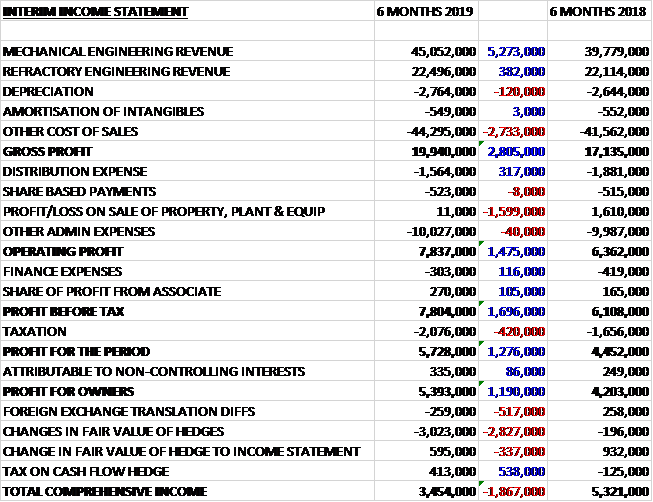
Revenues increased when compared to the first half of last year due to a £5.3M growth in mechanical engineering revenue and a £382K increase in refractory engineering revenue.  Depreciation was up £120K and other cost of sales increased by £2.7M to give a gross profit £2.8M.  Distribution expenses declined by £317K but there was a £1.6M reduction in profits from the sale of property relating to last year’s sale of land in India, plant and equipment which meant the operating profit was £1.5M higher.  Finance expenses were down £116K and there was a £105K growth in profits from associates and after tax charges increased by £420K the profit for the period came in at £5.4M, a growth of £1.2M year on year.

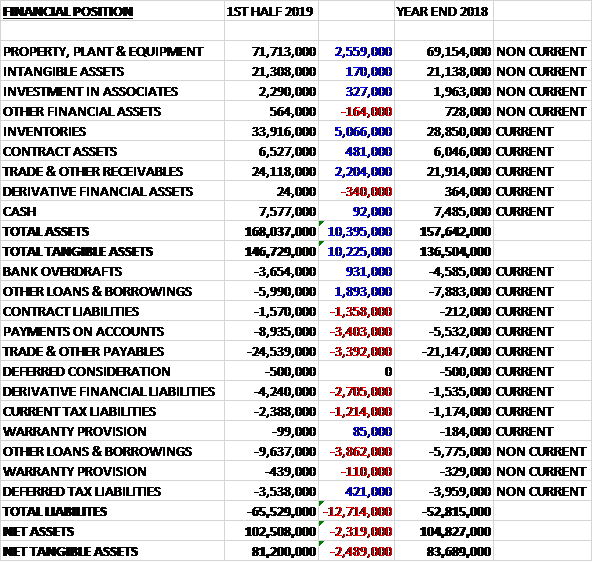
When compared to the end point of last year total assets increased by £10.4M driven by a £5.1M growth in inventories, a £2.6M increase in property, plant and equipment and a E2.2M increase in receivables.  Total liabilities also increased due to a £3.4M increase in payments on accounts, a £3.4M growth in payables, a £2.7M increase in derivative financial liabilities, a £2M growth in loans and a £1.4M increase in contract liabilities.  The end result was a net tangible asset level of £81.2M, a decline of £2.5M over the past six months.

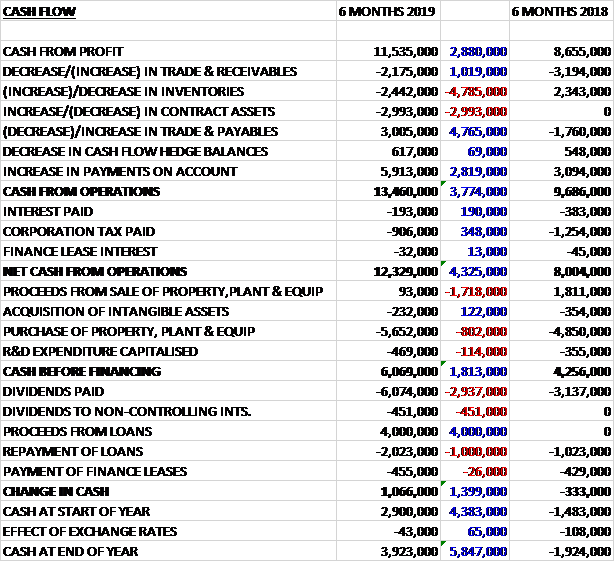
Before movements in working capital, cash profits increased by £2.9M to £11.5M.  There was a cash inflow from working capital which was slightly better than last time and after interest declined by £190K and tax payments fell by £348K the net cash from operations was £12.3M, a growth of £4.3M year on year.  The group spent £5.7M on property, plant and equipment, £469K on R&D and £232K on acquisitions to give a free cash flow of £6.1M.   This was all paid out in dividends so a new £2M loan offset £455K of finance lease payments to give a cash flow of £1.1M and a cash level of £3.9M at the period-end.

The profit in the mechanical engineering division was £4.5M, a growth of £1.8M year on year.  The profit in the refractory engineering division was £4.9M, a decline of £459K when compared to the first half of last year.

The current work load stands at £99M compared to £84M a year ago.  The order book continues to improve in both quantity and quality of earnings in both divisions.  The oil and gas order input is stable and the increase on the mechanical engineering side of the business relates to new markets such as naval shipbuilding and nuclear waste reprocessing.  Prior to the end of the first half of the calendar year the group expects to win some substantial orders that will allow activity to take a step forward.

Going forward, group activity and profitability levels are expected to increase over the next year. Whilst there is an increased workload the board expect the second half profits to be similar to the first half as it will take about six months to ramp up the activity levels and take the work through first piece sample approvals.  Subject to significant new business being won, however, they expect 2020 to be busier and more profitable than 2019.

The activities in India continue to grow and to accommodate further growth of their pump and investment casting powder manufacturing activities there they have purchased 2.6 more acres of land adjacent to their four acre site to accommodate the further expected growth over the next three years.

At the current share price the shares are trading on a PE ratio of 28.3.  I can find now forecasts but if we assume the second half will come in close to the first we are looking at a PE ratio of 20.6 for the year.  Last year the shares yielded a dividend of 2.7%.

Overall then this has been a good period for the group.  Although net assets declined, profits were up and the operating cash flow improved with enough free cash generated to just about cover the dividends.  The good performance is due to mechanical engineering markets such as shipbuilding and nuclear waste decontamination.  In addition, the work load is increasing and some substantial orders are expected to be received shortly.  Business seems to be booming but this is reflected in the price of the shares with a PE of 20.6 and dividend yield of 2.7%.  They look to be priced about right to me.

On the 2nd April the group announced that it had finally developed a silica free investment casting powder for which it has applied for a patent.  This new powder can be used by jewellery manufacturers to cast gold, silver and brass jewellery castings without them having to change any of their existing equipment.  This is the conclusion of over six years of R&D work and will allow casting manufacturers to work in an environment free of respirable silica. 

This will allow the group to address the jewellery investment casting manufacturing market in the US as until now it had been forbidden for any group business to sell products containing respirable silica into the country.  As the product is a premium one, it should allow an improvement in gross margin and profits earned in the refractory division over the coming years.

Redrow Share Blog – Interim Results Year Ending 2019

Redrow has now released their interim results for the year ending 2019.

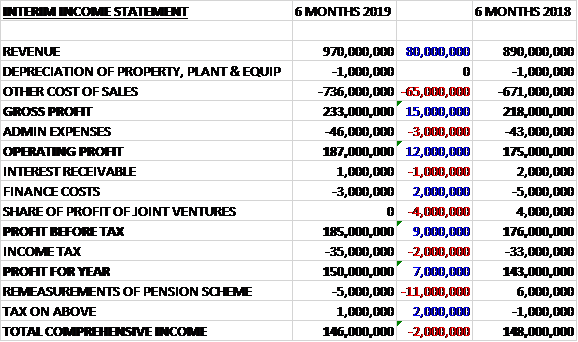
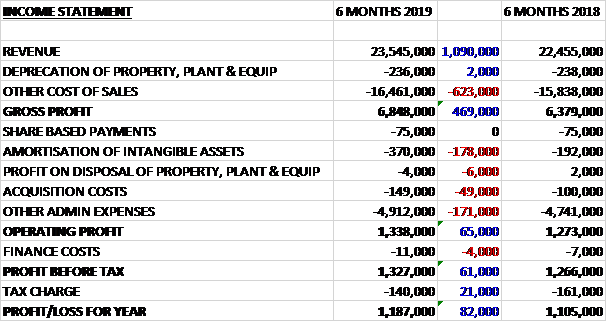
Revenues increased by £80M when compared to the first half of last year.  Cost of sales also increased to give a gross profit £15M higher.  Admin expenses were up £3M but net finance costs reduced by £1M.  After a £4M reduction in joint venture profits and a £2M increase in tax charges, the profit for the period came in at £150M, a growth of £7M year on year.

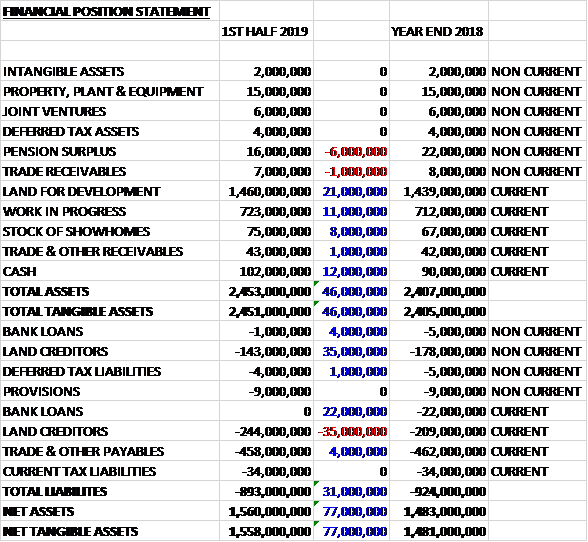
When compared to the end point of last year, total assets increased by £46M driven by a £21M growth in land for development, a £12M increase in cash and an £11M growth in work in progress.  Total liabilities declined during the year due to a £26M reduction in the bank loan.  The net tangible asset level was £1.558BN, a growth of £77M over the past six months.

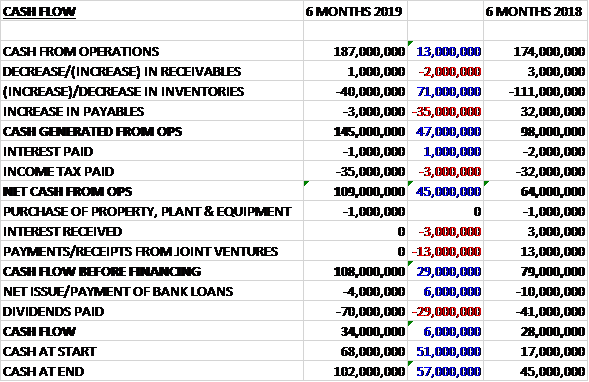
Before movements in working capital, cash profits increased by £13M to £187M.  There was a cash outflow from working capital but this was lower than last year and after tax payments increased by £3M the net cash from operations was £109M, a growth of £45M year on year.  The group spent just £1M on capex to give a free cash flow if £108M.  They then spent £4M on paying back bank loans and £70M on dividends to give a cash flow of £34M and a cash level of £102M at the period-end.

Revenue from private legal completions increased by 4% and from affordable completions nearly doubled.  The average selling price of their private homes increased by 4% and affordable homes by 15%, mainly due to the growth of the Southern business. 

The sales rate per outlet per week for the period was 0.61 compared to 0.64 in the first half of last year.  Sales were negatively affected towards the end of the year as a result of the political uncertainty surrounding Brexit and the effect of high stamp duty, which has disrupted the normal trade up/down sizing market.  Despite this the value of reservations in the period was in line with last year.

At the end of the year they had a record order book of £1.2Bn, up 11% on December last year and over the period they have experienced a reduction in cost pressures with sub contract, materials and labour markets all easing. 

They continue to see good opportunities in the land market but have taken a cautious approach to land acquisition, preferring to concentrate on select sites.  Their owned and contracted current land holdings are in line with the end of last year at 27,540 with the forward land holdings of 30,500 also in line. 

The market during the run up to the festive period and the first two weeks of 2019 was subdued by macroeconomic and political uncertainty but sales over the last three weeks have bounced back with reservations running at similar levels to last year’s strong market activity.  Overall private sales for the first five weeks of 2019 were down £10M but given the record £1.2BN order book the board are confident that this will be another year of significant progress for the group. 

The board are proposing a 30p per share cash return through a B share scheme.

At the current share price the shares are trading on a PE ratio of 7.1 which falls to 6.8 on the full year consensus forecast.  After an 11% increase in the interim dividend the shares are yielding 4.9% which increases to 6.3% on the full year forecast.  At the period-end the group had a net cash position of £101M compared to £63M at the year-end.

Overall then this has been a strong period for the group.  Profits were up, net assets increased and the operating cash flow improved with plenty of free cash being generated.  Both completions and prices were up in the period but Brexit has caused the market to slow down over Christmas.  It seems to be back to normal now though, the order book is good and cost pressures are down.  The forward PE of 6.8 and yield of 6.3% also looks good value.  Of course, Brexit is looming large and buying a housebuilder at this time carries some risk but these shares look too cheap to me and I think I might buy back in.

Solid State Share Blog – Interim Results Year Ending 2019

Solid State has now released their interim results for the year ending 2019.

Revenue increased by £1.1M and cost of sales was up £623K to give a gross profit £469K higher.  Amortisation charges grew by £178K, acquisition costs were up £49K and other admin expenses rose by £171K which meant that the operating profit increased by £65K.  Finance costs were up £4K but tax charges declined by £21k to give a profit for the period of £1.2M, a growth of £82K year on year.

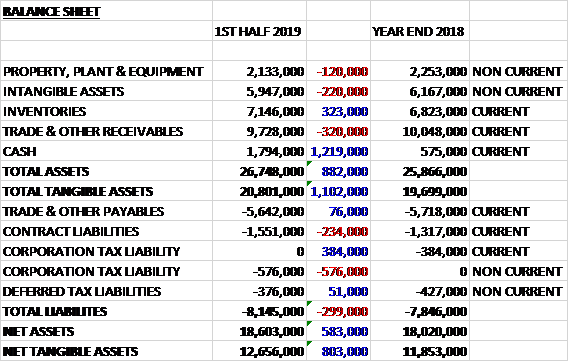
When compared to the end point of last year, total assets increased by £882K driven by a £1.2M growth in cash and a £323K increase in inventories, partially offset by a £320K decline in receivables, a £220K fall in intangible assets and a £120K reduction in property, plant and equipment.  Total liabilities also increased during the period due to a £192K growth in tax liabilities and a £234K increase in contract liabilities.  The end result was a net tangible asset level of £12.7M, a growth of £803K over the past six months.

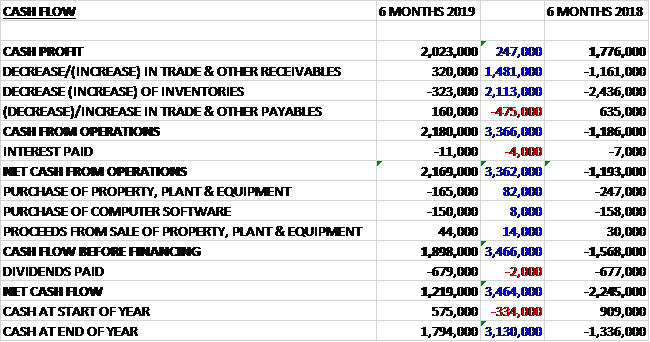
Before movements in working capital, cash profits increased by £247K to £2M.  There was a small cash inflow from working capital compared to a large cash outflow last time and after interest payments remained broadly flat the net cash from operations was £2.2M, an improvement of £3.4M year on year.  The group spent £165K on property, plant and equipment and £150K on computer software to give a free cash flow of £1.9M.  They then paid out £679K in dividends to give a cash flow for the period of £1.2M and a cash level of £1.8M at the period-end.

The distribution division has had a particularly strong period, delivering 26% organic growth in revenues to £12M with slightly improved margins.  The have benefited from a one-off client order of £1M and the military market showed particularly strong growth.  The increased revenues attest to the wider range of products and recognise the increasing value of the division to its customer base.  Examples of the value added services are sourcing and obsolescence which have started to contribute at meaningful levels.  Securing the exclusive VPT franchise is expected to positively impact the second half and the division is well positioned for a strong period. 

Revenues in the manufacturing division declined by £1.4M to £11.5M but the gross margin improved due to a richer sales product mix.  The order book going into the year was second half weighted which is expected to result in an improvement in sales performance in H2.  The sales emphasis has been on winning more complex value added business.  They have continued to implement the planned investments in the Power business in Crewkerne with a focus on automation to pave the way for higher sales volumes in the second half and improved efficiency. 

Group order intake increased by 38% to £33.3M and as of the period-end the open order book amounted to £29.4M, the majority of which is expected to be delivered in the next year.

After the period-end, in November, the group acquired Pacer Technologies for a cash consideration of £3.7M.  Last year the business reported a pre-tax profit of £430K and the acquisition generated goodwill of £2.7M which seems fairly decent value.  The business distributes and designs optoelectronic components, lasers and displays to the OEM market in the medical, military, commercial, industrial and security sectors.  They operate in components and displays and products include industrial LEDs and light sources, lasers and laser range finders, photon detection and counting equipment.  It is an established US business based in Florida with offices in the UK. 

Going forward the strength of the order book and the acquisition of Pacer gives the board confidence in being able to deliver a stronger second half and continued growth.  The board is confident of meeting market expectations for the year as a whole. 

At the current share price the shares are trading on a PE ratio of 15.4 which falls to 11.7 on the full year forecast.  After a 5% increase in the interim dividend the shares are yielding 3% which remains the same on the full year forecast.

On the 30th January the group released a trading update where they stated that they expect trading results for 2019 will comfortably exceed current market expectations.  Revenues are expected to be above current guidance and adjusted profits significantly ahead.  The strong demand seen in the first half in the distribution division has continued into the second half.  With increased revenues and the impact of operational gearing, the division is now expected to deliver results well ahead of management’s previous expectations.

Sales in the manufacturing division are second half weighted.  Some of the first half shortfall is expected to be mitigated in the second half, delivering revenues broadly in line with management expectations, although slightly lower than last year.

The focus in the manufacturing division has been on improving the mix of sales.  The second half has benefited from the initial shipments of the new power packs for the industrial smart warehousing contract announced in June 2018, and the resolution of a technically challenging specification on a high value-added contract enabling product shipment.  The improvement in gross margins seen in the first half has been maintained in the second half of the year and as a result a significant improvement in the full year gross margin is now expected.

The integration of the Pacer acquisition is progressing well.  In addition to current year trading the order book now gives them confidence in an improved outlook for 2020.

Overall then this has been a good period for the group.  Profits were up, net assets increased and the operating cash flow improved with a decent amount of free cash being generated.  The distribution division is outperforming considerably whereas the manufacturing division is more subdued.  We have now been told to expect an outperformance for the year and the forward PE of 11.7 and yield of 3% both look decent to me.  I have bought more.

On the 30th April the group released a trading update covering the year.  Profit will be slightly ahead of market consensus forecasts which are £3.5M.  Revenue is expected to be ahead of expectations at £56M representing a 10% organic growth with the group benefiting from particularly strong value added distribution sales in Q4. 

In the manufacturing division, progress in enhancing operating margins has been maintained and efficiencies in the power business are being delivered as a result of the capital investment in plant and equipment.  The integration of Pacer is progressing as planned.  The new facility in Weymouth began production in March.

Cash generation in Q4 has been much stronger than expected.  Some of this strength is due to timing benefits resulting from proforma payments from customers, but the underlying cash generation was also pleasing.  As a result, in April they made an early repayment of £2M of the highest price element of the term loan taken out for the acquisition. 

The open order book of £35.9M is above the £25.6M of last year.  The board is confident that its strategy will continue to deliver organic growth and that this can be complemented by further acquisitions. 

Colefax Share Blog – Interim Results Year Ending 2019

Colefax have now released their interim results for the year ending 2019.

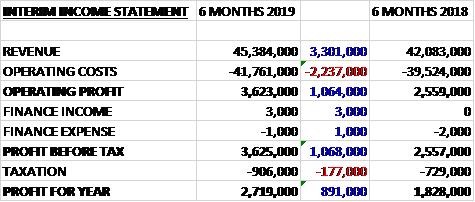
Revenues increased by £3.3M when compared to the first half of last year.  After operating costs were up £2.2M the operating profit grew by £1.1M.  A £177K growth in tax charges gave a profit for the period of £2.7M, a growth of £891K year on year.

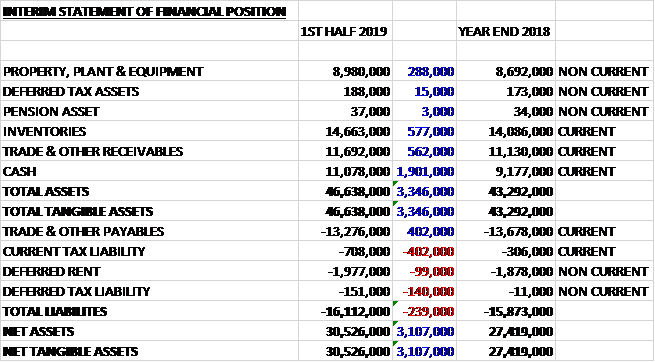
When compared to the end point of last year, total assets increased by £3.3M driven by a £1.9M growth in cash, a £577K increase in inventories, a £562K growth in receivables and a £288K increase in property, plant and equipment.  Total liabilities also increased during the period as a £402K decline in payables was offset by the £402K increase in current tax liabilities along with a £140K increase in deferred tax liabilities and a £99K growth in deferred rent.  The end result was a net tangible asset level of £30.5M, a growth of £3.1M over the past six months.

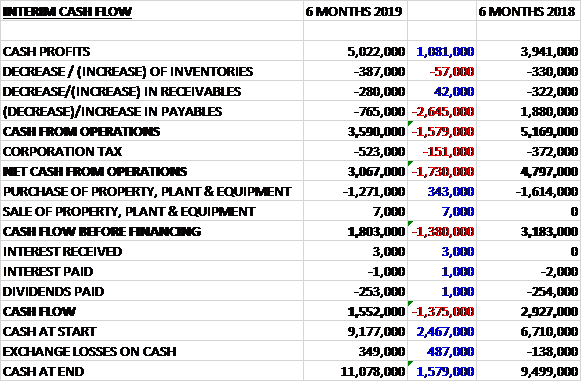
Before movements in working capital, cash profits increased by £1.1M to £5M.  There was a cash outflow from working capital and after tax charges increased by £151K the net cash from operations came in at £3.1M, a decrease of £1.7M year on year.  The group spent £1.3M on property, plant and equipment to give a free cash flow of £1.8M.  Of this, £253K was spent in dividends to give a cash flow of £1.6M and a cash level of £11.1M at the period-end.

The main reason for the increase in profits was a strong first half performance from the decorating division.  In addition hedging losses reduced by £522K due to the absence of contracts put in place before the Brexit referendum.

Sales in the fabric division increased by 1%.  Excluding hedging losses, operating profits reduced by 2% to £2.9M reflecting challenging market conditions in the UK and Europe.  Sales in the US increased by 2%.  Trading became more difficult towards the end of the period with sales down 0.3% in Q2 despite relatively strong economic conditions.  The board believe the confidence in the sector has been impacted by rising interest rates and stock market volatility.  They are about to start the refurbishment of their LA showroom and expect this project to be completed by July.  Currently they lease and operate eight company owned showrooms in the US.

Sales in the UK were flat during the period.  The high end housing market remains very weak and the board believe conditions in the UK will remain difficult until the uncertainty of Brexit is resolved.  In August they completed the refurbishment of their showroom in the Chelsea Harbour Design Centre and they are pleased with the positive reaction from customers.

Sales in Continental Europe decreased by 1%.  Trading in most major markets has been weak.  In France sales were flat but were helped by a significant contract order.  In Germany sales were down 8% and Italian sales were down 15% reflecting very challenging economic conditions.  They do not expect any short term improvement in trading conditions in most European markets.  Sales in the ROW decreased by 2%.  In Russia they changed their method of distribution from a distributor to an agent and are optimistic about growth prospects there.

Sales in the furniture business increased by 14% and the operating profit increased by £80K to £102K.  This reflected a strong order book at the start of the year which is currently in line with last year.

Decorating sales increased by 16%.  This was a strong performance reflecting the completion of a number of major projects during the period.  As a result the business made a first half profit of £738K, an increase of £525K.  Decorating sales can vary significantly between periods according to the timing of contract completions.  For the current year sales will be weighted to the first half and they expect sales for the full year to be below the exceptional performance last year.  Customer deposits remain at a healthy level and they remain optimistic about trading from the new Pimlico Road showroom which is performing well in its second year. 

Going forward, in the US market the group continue to benefit from the strength of the US dollar but the confidence seen at the start of the year has slowed recently and the board are therefore more cautious about growth.  In the UK, trading remains challenging, partly due to the high level of uncertainty surrounding Brexit, and in Europe they expect trading to remain difficult.

At the current share price the shares are trading on a PE ratio of 13.9 which falls to 13.7 on the full year forecast.  After a 4% increase in the interim dividend the shares are yielding 1% which remains the same for the full year forecast.  At the period-end the group had a net cash position of £11.1M compared to £9.5M at the same point of last year.

Overall then this has been a good period for the group.  Profits were up, net assets increased and although the operating cash flow declined, cash profits increased and plenty of free cash was generated.  The good performance looks unlikely to be repeated in the second half, however, as the improvement is mainly due to a lack of hedging losses and some large projects in the decorating division.  The furniture business is performing well but it remains small, and excluding hedging movement, the fabric division suffered in all regions.  Of some concern is that after the first quarter, the US market is now also suffering.  The forward PE of 13.7 is decent enough but the dividend yield of 1% is nothing to write home about.  On balance I feel like the risks are to the downside here.

Newmark Securities Share Blog – Interim Results Year Ending 2019

Newmark Securities have now released their interim results for the year ending 2019.

Revenues increased with a £1.1M growth in electronics revenue and a £508K increase in asset protection revenue.  Depreciation and amortisation was down £148K but other cost of sales increased by £1.1M to give a gross profit £635K higher.  Admin expenses fell by £179K, finance costs remained flat and the tax charge reduced by £67K to give a profit for the period of £432K, an improvement of £881K year on year.


When compared to the end point of last year, total assets increased by £1.8M driven by a £1.5M growth in receivables, a £591K increase in inventories and a £108K growth in property, plant and equipment, partially offset by a £411K decline in cash.  Total liabilities also increased during the period due to a £763K growth in borrowings and a £616K increase in payables.  The end result was a net tangible asset level of £2.6M, a growth of £430K over the past six months. 

Before movements in working capital, cash profits increased by £667K to £823K.  There was a cash outflow from working capital and after interest and tax payments remained broadly flat there was a net cash outflow from operations of £726K, an increase of £576K year on year.  The group spent £173K on development costs and a net £97K on capex to give a cash outflow of £996K before financing.  They received £616K from invoice discounting and paid £31K in finance leases to give a cash outflow for the period of £411K and a cash level of £658K at the period-end.

Revenues in the Electronic division rose by £1.1M to £5.1M.  Within this division, revenues in the Human Capital Management business rose by 53% to £3M.  Much of this was due to a 264% increase in revenues in the US with growth seen across all variants of the proprietary Linux based IT series terminals in addition to the first significant sales of the Android based Gt-10 terminal.  Excluding the US operation, revenue increased by 10%.  Revenue from the legacy range of RS terminals declined, but this was more than compensated for by an increase in revenues in the contemporary IT series.  There were no significant end user projects completed in the period, the growth coming organically across a number of well-established customers. 

In the US, the investment made in products and business development in prior periods has continued to take effect and the growth seen last year has continued.  Revenues were driven by two major clients, Workforce Software and Ultimate Software, both of whom entered into supply agreements for their terminals as reported in previous periods.

In addition, a new project for another new customer saw orders placed for 1,000 units of the IT51 terminal complete with a five years SaaS bundle.  The SaaS element of this deal will contribute towards the group’s recurring revenue ambitions, which remain a key goal in the longer term.  Negotiations are underway with that customer, which is a Tier 1 HCM software vendor, with a view to that client taking an OEM variant of the GT-10 terminal.  These negotiations are likely to conclude during the second half of the year. 

In the HCM markets generally, growth continues to be enabled through the technological drivers of high speed internet availability and the subsequent mass shift to Cloud based computing.  This shift means that the traditionally challenging to serve and fragmented SME business market is well within the reach of HCM providers leveraging a SaaS based business model.

Access Control revenues remained relatively stable, increasing by 2.4% to £2M.  The Janus product is no longer installed in new systems as the platform used an historic and unsupported version of the Windows operating system.  As expected the Janus revenues fell by 14% to £570K.  The Janus to Sateon upgrade programme was very busy as this initiative reached its conclusion at the end of the period.  In addition, the Sateon Advance hardware and software offering continued to show strong growth as an increasing number of security installers became repeat customers, as they chose to adopt the platform as their standard access control offering. 

Sateon revenues were also positively affected by sales of the OEM variant of the Advance hardware which allows third parties to utilise the hardware in a non-proprietary way on their own access control platforms.  To date, sales of the OEM variant have been limited to one major client, although exploratory conversations continue with a number of global third party access control providers in the US and EMEA.  As a consequence of the above, sales increased 11% to £1.5M. 

Development in the period was focused on pre-launch work for the new Security Management System which is being developed in conjunction with Slovakian-based Gamanet.  The new platform is intended to be launched in the second half of the current year.  The market is moving away from stand-alone Access Control solutions towards integrated access control, intrude, CCTV and fire and building management into a single platform, such as with the SMS.  This solution will offer a number of third party integrations at launch.

Revenues in the Asset Protection division rose by 12% to £4.8M mainly as a result of the contribution from projects completed by the Service division.  Trading conditions remain challenging in this market and the increased uncertainty of Brexit continued to result in budget cuts and the cancellation of planned work, including the government departments that the business has traditionally supplied.  Cost saving initiatives implemented resulted in margins being maintained.

Products division revenue was 2% lower as a result of the delayed completion of a major project.  Despite delays in the Post Office Network Transformation programme, revenue from that source was only 1.3% lower.  Overall cash handling revenue increased by 13% due to increased sales to new customers.  The products division’s work is mostly customer project base and revenue of non-cash handling equipment decreased by 6.5% as a result of fewer customer programmes.

Revenues from Eclipse Rising screens was 26% lower as a result of continued branch closures by long standing financial institution customers.  Revenue for fixed glazing products increased despite clients moving away from ballistic protection counters and screens to less secure open counter trading to improve customer relations.  The second half of the year is expected to be challenging for the division as there are no large projects in the pipeline and revenue will rely on smaller repeat orders from long standing customers and new smaller projects. 

During the period, the service division revenue was 34.5% higher.  Revenue growth was partly attributable to timing of work with some programmes concentrated in the first half of the year.  Annual contracts were renewed as expected.  The group continue to explore and develop other product and service offerings and these will reduce their reliance on rising screen and cash handling products in the future.

Going forward the higher level of revenue within the electronic division is expected to continue in the second half of the year but revenue in the asset protection division is expected to be lower due to seasonality factors as in previous years, and for other reasons set out above. 

The group was loss making last year so the historical PE is in negative territory.  I can’t find any forecasts for this year.  No dividends are being paid here. 

On the 5th February the group announced that non-executive director Robert Waddington acquired 750,000 shares at a value £7.5K.  This was his first purchase. 

Overall then this has been quite a positive period for the group.  Profits were up, net assets increased and although the operating cash flow was down, this was due to working capital movements and cash profits increased.  There is an issue with cash, however.  There was a cash outflow at the operating level and it seems the group only managed to carry on going due to invoice discounting.

The Electronics division performed well, with human capital management being a good area but the product division was a bit more mixed due to project delays and the seemingly structural decline of the high street bank market.  There are no forecasts but are told that the electronics division will continue to perform well but the product division will see revenues reduce.  Unfortunately there is no profit split by division but if we assume a rough 50/50 split then profits might come in at around £600K this year?  This suggests a PE of about 11 which is probably a bit high given the risks.

On the 5th February it was announced that non-executive director Robert Waddington, acquired 150,000 shares in the company at a value of £1,635 (!) He now owns 900,000 shares.

Ashley House Share Blog – Interim Results Year Ending 2019

Ashley House has now released their interim results for the year ending 2019.

Revenue declined by £2.2M and cost of sales were down £2.1M to give a gross profit £117K lower.  Admin expenses fell by £392K but there was a £470K detrimental swing to losses from the joint venture so the operating loss widened by £202K.  Interest costs fell by £227K, however, to give a loss for the period of £1.7M, broadly flat year on year.

When compared to the end point of last year, total assets declined by £1.3M driven by an £827K fall in receivables and a £595K decline in the value of investments in joint ventures, partially offset by a £192K growth in work in progress.  Total liabilities increased during the period due to a £500K growth in payables.  The end result was a met tangible asset level of £3.4M, a decline of £1.7M over the past six months.

Before movements in working capital, cash losses improved by £435K to £977K.  There was a cash inflow from working capital and after interest payments fell by £227K the next cash from operations was £43K, an improvement of £1.2M year on year.  The group spent £66K on capex to give a cash outflow of £23Kbefore financing.  They repaid some loans which meant the cash outflow was £99K and the cash level at the period-end was £151K.

The development business of the group, the major part of which sits in the joint venture, is reliant on schemes reaching financial close.  They have a large pipeline of schemes but the speed of financial closes has not been as fast as the board would have liked.  The first Morgan Ashley scheme, on the Isle of Wight, reached financial close towards the end of the year last year and construction is now well advanced.

No financial closes were achieved during the period, however, the pipeline having been significantly affected by the Government’s threatened Local Housing Allowance Cap, which was not finally removed until August 2018.  Since that time, clients have re-engaged and there has been real progress with an extra care scheme in Grimsby reaching financial close in November and further schemes are expected to reach financial close in the coming months.

Morgan Ashley’s most advanced extra care schemes include two developments in Leicester which will provide 155 extra care apartments over two sites; a 54 apartment scheme in Romsey and a 65 apartment scheme in Freshwater.  In addition, contracts for an 80 bed care home in York are all but complete with the funding documents for this scheme to be signed shortly and with work on site due to start in February.  Most of the extra care developments have a gross development value of around £10M.

The majority of future pipeline schemes are with parties with whom Morgan Ashley now has established contractual structures which should significantly simplify and speed up the legal process.  They are also looking to further cement some of these relationships to reduce the time and cost taken to bring schemes to financial close.  They find that schemes are taking a longer period to reach close than initially expected which has a knock on effect on profitability. 

Since the period-end the business has won contracts for extra care schemes in Hampshire and Yorkshire with a combined GDV of £60M.  Two 60 apartment schemes in New Milton and Gosport were secured in conjunction with Places for People, whilst the business worked with another major national registered provider, Home Group, to win four schemes in Leeds providing around 240 new affordable extra care apartments.  These Leeds schemes have a combined GDV in the region of £40M with work on the first site starting towards the end of 2019 and all four sites to be completed and operational by 2021.

The business is currently on site in Ryde on the Isle of Wight and the scheme in Grimsby is now commencing.  They are on site and building in Scarborough and Peterborough.  Peterborough is a modular construction with the modules being manufactured by F1M.  Furthermore on land adjoining both the Scarborough and Ryde sites, they are working up two additional schemes of bungalows for elderly occupation for private sale, thus further diversifying the activities of the business with some private sector activity. 

Within F1M, this week marked the start of the transportation to site of the first modules for the 40 apartment extra care scheme in Aberdare.  The scheme is for Linc Cymru Housing and is the largest scheme undertaken to date.  The development consists of 36 one bedroom and four two bedroom apartments for people aged fifty and over.  A total of 94 modules are being built in the factory and works have been undertaken to prepare the site for delivery of the modules.  The scheme is expected to complete in summer 2019.

Since the period-end the business has completed school classrooms in Egham and retail units for Costa, Greggs and Evans Halshaw.  Current schemes in the factory in addition to Aberdare and Peterborough include a second school under the Education and Skills Funding Agency framework and further Costs units to be housed in Moto service stations and a small modular housing pilot for a registered provider in North Wales.  The next major scheme will be a 75 module hotel in Doncaster where the business is currently appointed to provide a pre-construction design service with the full order expected shortly.

Despite the loss in the first half, the group is expected to become profitable for the full 14 month period ending 2019, albeit uncertainty on timings of some scheme closures might result in revenue slipping in to the next year.  Overall the board expects profitability to be below current market expectations.

At the current share price the shares are trading on a PE ratio of 4.1 which increases to 10.5 on the full year consensus forecast.  There are no dividends on offer here.  At the period-end the group had a net debt position of £1.5M compared to £3.5M at the same point of last year. 

Overall then this has been a disappointing period for the group.  Losses were flat due to lower interest payments, operating losses worsened.  Net assets declined, but the operating cashflow did improve, albeit with no free cash being generated.  The problem was no schemes reached financial close during the period and although some now seem to be coming through, they are slower than expected which is affecting future performance.  This share has promised quite a bit for a while but I am losing patience of seeing much of a return.  The forward PE of 10.5 isn’t too expensive but doesn’t altogether factor in the risks in my view.

On the 9th May the group released a schemes update.   They have signed contracts to start works on two community care scheme and have been awarded further schemes.  Financial close has been achieved on two Morgan Ashley schemes, being a 75 apartment extra care scheme on the Isle of Wight and an 80 bed care home in York. 

Morgan Ashley now have four schemes contracted and on site, being Ryde, Grimsby, Freshwater and York.   The group is on site with schemes in Scarborough and Peterborough.  They are also working to achieve financial close in the current quarter on three more pipeline developments.  Morgan Ashely has recently been awarded new schemes in two locations. 

Within F1 Modular, all 94 modules have now been delivered to F1M’s 40 apartment extra care housing scheme in Aberdare and is expected to complete in late summer.  They have also secured a place on the NH2 Framework for Modular Housing development operated by the procurement body LHC.  This framework provides local authorities, housing associations and other social landlords with easy access to pre-qualified offsite manufacturers for use of modular construction in new build housing projects.

The board continues to be frustrated at the length of time it takes to progress schemes to financial close, however.

On the 25th June the group announced that some uncertainties remain regarding the final result for the year, predominantly centred around the timing of the financial closure of three schemes.  Morgan Ashley has three extra care schemes on which it is trying to achieve financial close.  They fully expect them to reach financial close but the precise timing is unclear and may fall into next year.  Should these not close prior to the end of June, they will likely show a loss for the year, not meeting market expectations.

On the 5th July the group confirmed that the schemes did not reach close, although one of them is all agreed, awaiting signatures.  The board believe that these schemes will provide a strong start to 2020.

On the 1st August the group advised that due to reasons outside their control, all three of the schemes have not yet reached financial close, although they are still expected to close over the next couple of months.  As a result, inflows of cash are delayed and the group is managing its cash carefully.  The board are exploring a number of sources of further funding to best manage this.  Oh dear, this doesn’t sound good.

On the 2nd September the group announced that the Morgan Ashley scheme at Romsey has reached a financial close.  The 54 apartment extra care facility has a gross development value £13.5M and is one of the schemes mentioned in previous updates that had been delayed. 

On the 21st October the group has completed on a sale of its 50% interest in Morgan Ashely to its joint venture partner.  Consideration for the transaction is £2M in cash, £500K of which is to be deferred.  In addition they have signed an agreement with Morgan Sindall for the group to work on a pipeline of health, wellbeing and primary care developments.

Delays to the schemes reaching financial close have had a significant impact on the cash requirements of that business and the transaction will satisfy the short term cash requirements and enable the group to restructure and return its focus to its key strengths as a developer of health and wellbeing buildings.  Unfortunately they will lose out on the profit of the joint venture, which contributed £310K last year.

The terms of the transaction restrict the group from working in the elderly care housing sector for a period of three years, but the board is developing a strategy to enable it to broaden its sphere of activity to adjacent markets such as affordable housing and healthcare.

Ricardo Share Blog – Final Results Year Ended 2018

Ricardo has now released their final results for the year ended 2018.

Revenues increased when compared to last year due to a £20.1M growth in performance products revenue and a £7.8M increase in technical consulting revenue.  Cost of inventories were up £15.8M and other cost of sales increased by £6.1M to give a gross profit £6M higher than last time.  Depreciation fell by £800K but operating lease rentals were up £700K, maintenance costs increased by £800K and redundancy costs increased by £3.4M.  Offsetting this was a £1.6M profit on disposal of assets, a £800K reduction in receivable impairments and a £3.4M increase in R&D credits.  Other underlying admin expenses were up £5.6M.  There was a £4.4M growth in reorganisation costs which meant the operating profit declined by £4M.  There was a small reduction in finance costs but there was a £2.2M de-recognition of deferred tax assets to give a profit for the year of £18.9M, a decline of £5.9M year on year.

When compared to the end point of last year, total assets decreased by £700K driven by a £6.7M fall in deferred tax assets, a £6.4M decline in amount receivable on contracts, a £2.8M decrease in assets held for sale and a £2.7M decline in land and buildings, partially offset by a £5.2M increase in cash, a £5.6M growth in trade receivables, a £3.5M increase in goodwill and a £3.3M growth in other receivables.  Total liabilities also declined during the year as a £4.2M growth in accruals and deferred income and a £3.4M increase in the bank overdraft was more than offset by a £17.6M reduction in pension obligations and a £10M decrease in the bank loan.  The end result was a net tangible asset level of £79.3M, a growth of £18M year on year.

Before movements in working capital, cash profits declined by £1.5M to £47.2M. There was a cash outflow from working capital but this was much less than last time and after finance costs increased by £800K the net cash from operations was £34.5M, a growth of £19.2M year on year.   The group spent £7.8M on property, plant and equipment but bought in £6.4M from the sale of assets.  They also spent £6.6M on intangible assets and £4.6M on acquisitions to give a free cash flow of £21.9M.  Of this, £10.5M was paid out in dividends and £10M was used to pay back some loans to give a cash flow of £1.8M and a cash level of £23.8M at the year-end.

The group increased its order intake by £47M in the year with growth across both divisions.  The year ended with a record closing order book of £288M, an increase of £40M with £5M of this relating to the Control Point acquisition.  On an organic basis, the underlying profit reduced by 1%.  There was a good performance in performance products but in technical consulting growth in most areas was offset by a reduced performance in the UK automotive and energy and environment businesses.

The operating profit in the Technical Consulting division was £22M, a decline of £5.8M year on year.  The order intake in the year stood at £324M and there has been a good balance of new orders across all core regions.  Margins were affected by the mix of orders, an increase in the level of material content and some disruption in the flow of orders into the UK automotive operation which led to operational inefficiency.  In addition, the delivery of a small number of difficult, complex projects impacted margins.

The rail business delivered another year of strong performance and won one of its largest ever assurance projects in Taiwan which is set to last through to 2025.  The global rail market continues to show positive growth trends particularly in the Middle East and Asia.  The industry is striving to exploit new digital technology to improve operational efficiency, availability and overall cost and to help meet the demand for more efficient public transport.

Other notable assignments during the year included providing technical support for the introduction of bi-mode Hitachi rolling stock to the UK network, system integration testing of a new tram system for the city of Utrecht in the Netherlands and the approvals for a new rail freight service across Saudi Arabia.  The certification business expanded its accredited activities into Dubai and Qatar. 

In the Automotive business new European emissions legislation has resulted in more extensive engine calibration requirements, the scope of which is proving challenging for the industry.  The strategic consulting business had a busy year assisting its clients within this changeable market. 

The group are seeing a strong market in China and Japan and in the year they have acquired new customers in the US which are new to the automotive market and are focused on rapid product development.  They have also worked with traditional customers in new areas such as electric and hybrid vehicle development, battery development and systems integration.  They have, however, seen some disruption of order flows from some traditional customers who are looking to navigate industry change.  This was particularly noticeable in the UK during the second half of the year when the effects of the reduction in sales of diesel vehicles were magnified by the continued uncertainty surrounding Brexit. 

The disruption in UK order flows, together with the project challenged discussed above, led to inefficiency and some over-capacity in the UK operations which had an adverse effect on margins.  They saw a return to more normal levels of orders towards the end of the year, however.  The US automotive business improved markedly in the year with a significantly reduced loss which offset the weakness in the UK business.  It broke even in the second half of the year.  The automotive business based in China performed well, doubling order intake, much of which was related to electrification.

In the off-highway and commercial vehicles market growth continued in the medium and heavy duty sectors, particularly in Asia, and they have secured several large engine and transmission projects across both sectors.  The order book and pipeline of opportunities across Europe and Asia includes a broad mix of largely engine and transmission programmes.  In the US there was continued focus on powertrain and trailer efficiency, emissions control and the use of hydrogen fuel cells.  In the medium-duty market compliance requirements for in-service on board diagnostics has driven increased engine test activity.

In the off highway market Asia is showing renewed growth, especially in transmissions and drivelines, and activity is increasing in Europe.  In the medium term they expect solid customer demand for their services to meet EU, US and Asian emissions regulations and 2020 emissions targets.

The energy and environment business continued its focus on international CO2 reduction and the future impacts of climate change, and on climate mitigation plans.  Projects included the preparation of plans for rising sea and river level defence systems and the protection of residential properties and ecologies in the UK as well as applying their consultancy expertise to assist a wind turbine manufacturer with production planning and their business improvement plans. 

The have seen an increased focus on waste and recycling, with plastics and the reduction of their use becoming a very productive area of business.  The water consulting activity benefited from the current asset management planning cycle in the UK which ensures water supply and resilience for coming decades against rising populations and temperatures, and from the 2019 price review, driven by the focus of the UK water services regulation authority on leakage reduction and the resilience of the water network. 

They continue to support customers around the world with their air quality services and products.  In China they are providing support to a number of cities to establish long-term, cost effective air quality action plans to bring about significant improvements in air quality and health whilst maximising co-benefits such as reductions in greenhouse gas emissions.  A key project, commissioned by the Asian Development Bank is providing detailed evaluation of policy options using their Rapid Air air quality modelling system and is designed to support the investments being made by the ADB in NE China.

The group is working with nine cities in six countries in Sub-Saharan Africa on behalf of the C40 Cities Climate Leadership group, to build capacity within local government and develop common tools and frameworks.  This will enable action planning for transformational, long term development.  The group have also seen a steep increase in their work on water resource management, attributable to the plans that the UK’s water companies are required to produce every five years.  They have provided strategic environmental assessment and planning for the delivery of those plans for 12 companies.

The group’s National Chemical Emergency Centre has further broadened its offering by creating a service for businesses outside the chemicals sector to report different types of incidents such as fires, floods, explosions and break-ins.  The business also offers planning and training on crisis and business continuity.  The new offering has been successful and the business has seen increasing customer demand for these new services. 

Order intake in the business was similar to last year but performance was impacted by recruitment for higher levels of growth than was achieved. 

The defence business has won a number of new contracts across the globe in land defence and in the marine sector, both surface and subsurface.  The integration of the acquisition is performing well

The operating profit in the Performance Products division was £9.3M, a growth of £1.3M when compared to last year.  The growth was mainly due to increased volumes in respect of the engine supply contract for McLaren, a full year of production of transmissions for the Bugatti Chiron and an increased demand for Porsche Cup transmissions.  Order intake in the year increased by 14% to £89M with the Aston Martin order received in the prior year being more than offset by the increased demand this year from McLaren, Bugatti and Porsche.

In the higher performance vehicles and motorsport business, demand for the production of McLaren engines continued to grow in line with expectations.  This year they delivered over 4,300 engines across an increased number of engine variants.  They made good progress in the preparations for the supply contract for the Aston Martin Red Bull Valkyrie hypercar transmission.  They also continued to support Bugatti with the supply of the complete driveline system for the Chiron together with the supply of transmissions for the Porsche 991 Cup race cars.

This year the business developed the transmission for the M-Sport Bentley GT customer racing programme and continued to support key manufacturers within the Formula E Championship for the second consecutive season.  They continue to manufacture for Formula 1, the Japanese Super Formula Championship, Indy Lights and the World Series Formula V8.  They also operate supply programmes of Ricardo-designed transmissions for BWM, the Ford GT3, the M Sport World Rally Ford Fiesta and the Hyundai R5 Rally car. 

In the defence business in the US they have received their first orders and started production of their anti-lock brake and electronic stability control system for the HumVee.  The system is proven to be effective at reducing the loss of control and the occurrence of single vehicle crashes.

There were a number of one-off items like usual.  Acquisition related expenditure comprised £100K of costs incurred from the Control Point acquisition, £200K on its subsequent integration and £500K on associated earn-out arrangements.  Costs of £400K were incurred to finalise the integration of the LR Rail and Motorcycle Engineering businesses together with £200K of professional fees incurred in relation to an aborted acquisition.

The sale of the test assets at the Chicago Technical Centre in the US was completed in April for £4.1M which led to a profit on disposal of £1.4M.  In addition £700K of professional fees, contractor costs and redundancy costs were incurred as a result of the asset sale.  The sale of the Schechingen Technical centre in Germany was completed in June for £4.4M which generated a profit of £200K with £300K of redundancy costs incurred.  There were also redundancy costs of £2.7M in relation to downsizing the footprint in Schwabisch in Germany and additional costs of £1.8M were incurred as a result of the downsizing activities in Germany.  Costs incurred of £500K in relation to the set-up of their new shared service centre in Prague including dual running costs and contractor costs and UK senior management redundancy payments of £400K were made as a result of restructuring.

A net deferred tax asset of £2.2M, comprising historical losses in Germany was brought forward from the prior year.  Due to the various restructuring actions taken in Germany, the directors now consider it unlikely that sufficient future profits will be available against which the tax asset can be used so it was derecognised in the year. 

In September 2017 the group acquire Control Point Corp for an initial cash consideration of £6.3M and a contingent cash consideration of £1.7M.  The acquisition expands on the group’s vehicle engineering capabilities in the Defence sector and adds expertise in the distributed software-based systems and fleet management technologies.  The acquisition generated goodwill of £3.4M and the business generated a profit of £1M during the period.  Had it been part of the group for the full year, it would have generated profit of £1.2M so this looks to be a good acquisition. 

The test facilities in Chicago and Southern Germany were sold during the year to ensure they continue to move with the trend towards electrification.  Actions were takin in their UK Automotive business to respond to issues relating to a disrupted flow of orders in the second half of the year and a small number of challenging projects relating to the new emissions legislation.  Together with the strong order book, the board believes this all provides a solid foundation for continued growth. 

At the current share price the shares are trading on a PE ratio of 17.2 which falls to 10.4 on next year’s consensus forecast.  After a 6% increase in the final dividend the shares are yielding 3.2%, increasing to 3.4% on next year’s forecast.  At the year-end the group had a net debt position of £26.1M comparted to £37.9M at the end of last year.

On the 20th November the group announced that COO Mark Garrett sold 73.5K shares at a value of nearly £500K.  Following this transaction he now owns 59,723 shares.

On the 2nd January the group released a trading update covering the first half of the year.  The group as a whole traded I line with expectations.  Total order intake was good at just over £200M, the order book at the period-end was £300M and revenue was slightly ahead of last year.  Net debt was £27.5M. 

The challenging US and UK automotive market conditions were balanced by good performances in their performance products business and in all other technical consulting businesses with energy and environment, defence, China automotive and strategic consulting performing particularly well.

Overall this was a rather mixed performance for the group.  Profits declined and although the operating cash flow improved, this was due to working capital movements and cash profits fell.  There was an increase in net assets, however.  The performance products business and most of the technical consulting business performed well but the UK automotive business struggled as did the environment business, due to an increase in staff which didn’t correspond to growth levels.  Going forward, both the UK and US automotive markets are difficult but the shares seem to have priced this in somewhat, with a forward PE of 10.4 and yield of 3.4%.  These are looking decent value at the moment.