Safestyle Share Blog – Final Results Year Ended 2018

Safestyle have now released their final results for the year ended 2018.

Revenues declined by £42.1M when compared to last year and after cost of sales also fell the gross profit was £25.5M lower.  There was a £795K reversal of share based payments but restructuring costs were up £587K, there were litigation costs of £1.9M, fines of £1.1M, onerous leases of £294K, commercial agreement costs of £1.3M, non-recurring pay awards of £635K and a dilapidation provision of £618K so despite other operating expenses reducing by £1.4M there was a £30M negative swing to an operating loss.  Finance costs increased by £132K but there was a £6M favourable swing to a tax income so the loss for the year came in at £13.3M, a detrimental movement of £24.1M year on year.

When compared to the end point of last year, total assets declined by £1.6M driven by a £6.8M decrease in cash, partially offset by a £2.3M growth in current tax assets and a £2.2M increase in the commercial agreement “asset”.  Total liabilities also increased due to a £2.4M growth in trade payables, a £3.9M increase in borrowings, a £2.3M increase in accruals and deferred income and a £1M growth in the commercial agreement provision.  The end result was a net tangible asset level of £4.7M, a decline of £14.1M year on year.

Before movements in working capital, there was a £27.6M detrimental shift to cash losses of £12.1M.  There was a cash inflow from working capital due to an increase in payables and tax payments reduced by £2.1M to give a net cash outflow from operations of £8.8M, a detrimental movement of £20.6M.  The spent £1M on tangible assets and £855K on intangibles which meant there was a cash outflow of £10.7M before financing. New borrowings of £3.9M gave a cash outflow of £6.8M for the year and a cash level of £4.2M at the year-end.

After 13 years of market share gains, the group’s market share fell from 10.7% to 8.2% this year.  This reflected a 28% drop in installations to 42,995 although they were able to increase their average frame sales price by 6% to £646 as a result of price actions and a larger mix of higher average priced composite guard doors, and their average installed order value by 3% to £3,319.

Leads generated from direct response media increased by 2.8% but leads from other sources fell by 60% due to the actions of NIAMAC. In the last two months of the year, following the recovery of the workforce, the group experienced a marked improvement in lead generation with total leads only 4% lower than in the same period last year.

As well as the reduced volumes, the decrease in gross profit was also affected by an increased usage of traditional scaffolding solutions to ensure the teams are working safely; the change of mix generated via direct response media drove an adverse cost per order effect.  This mix effect was compounded in 2018 by a significant year on year increase in Pay Per Click rates which were driven by increased online competition.  Agent commission costs increased in the year, driven by the more competitive recruitment environment.

Much of the year was severely impacted by the activities of an aggressive new entrant, NIAMAC, which affected all areas of the group’s operations and resulted in them taking legal action to protect themselves in May.  This, combined with a backdrop of a challenging consumer environment resulted in a severe decline in their financial performance in the year.  The group settled its legal action in September and subsequently entered into a commercial agreement which led to a recovery in the contracted workforce across their canvass, sales, surveying and installations operations at the start of November. 

The group invested significantly in lead generation, commissions and associated overheads prior to the end of the year.  This occurred too late in the year to improve 2018s financial performance, however.  Sales order intake for the final two months saw a step change in performance though. 

The commercial agreement with Mr. Misra encompasses a five year non-compete agreement and the provision of services by Mr. Misra in support of the continued recovery of the group.  They agreed a consideration with him subject to the satisfaction of both clear performance conditions by him and the group’s trading performance in 2019. The consideration will take the form of an allotment by the group of four million shares and a cash consideration of up to £2M, to be made in Q4 2020.

Due to the issues this year there has been large changes to the structure of the board.  Mike Gallacher was appointed CEO, Alan Lovell was appointed Chairman, Rob Neale was appointed CFO, Fiona Goldsmith joined as a non-executive director and Julia Porter jointed as non-executive director.

Since late 2017 the business has changed its approach to managing health and safety with significant investment in additional resource, new processes, training and equipment.  Their prime focus has been on working at height.  This followed a working at height incident with one of their staff in 2017 for which they received a significant fine from HSE in 2018.

During the year West Yorkshire trading standards took the group to court over a number of incidents.  As a result of this, the new business leadership team has put in place a comprehensive series of actions while aiming to establish and effective collaborative partnership with WYTS.  Good progress has been made so far.

At the start of 2018 the first phase of the Electronic Lead Generation project was launched.  In August, the second phase, Electronic Contract, was put in place.  Before these changes, all their self-employed sales reps carried paper price lists and entered orders onto forms which were faxed to head office every day.   They have now been equipped with a tablet with a sales process that ensures quick and accurate pricing and an immediate digital contract submission process.  The programme has enabled simplification and delivered some cost savings and is a rich source of management information. 

There were a number of non-recurring items this year.  As part of a review by management of provisions made for the group’s future obligations, a revision to the estimates used for future product guarantee claims has been made which they consider more accurately reflects their obligations which led to a charge of £801K.  Litigation costs of £1.9M are expenses incurred as a result of the NIAMAC litigation, predominantly legal advisor’s fees.  Restructuring costs of £1.2M included redundancy payments as a result of the changes made to reduce the cost structure of the business.

Fines of £1.1M relate to the HSE and WYTS fines and related legal representation fees.  Onerous leases of £294K represent an accrual for all rental costs up to the first lease break data for properties that were closes during the year.  Commercial agreement costs of £311K are expenses incurred in securing the commercial agreement such as legal advisor fees and a set of one-off payments made as part of the contractual terms of the final agreement.  The Commercial Agreement service fee of £1M is the assessed fair value of the consideration payable under the terms of the commercial agreement that has been attributed to services received in the year.

Non-recurring pay wards of £635K relate to the bonus payments made to executives reflecting the supplementary duties undertaken in a period of significant disruption and reward delivery of key actions required to secure and stabilise the business and are not linked to profit performance. The accounting policy for providing for exit obligations on leased property, principally dilapidations, has also been assessed in the year.  Management concluded that a provision is appropriate based on new circumstances during the year which led to a charge of £618.

Going forward, the momentum generated by an improvement in sales order intake in the last two months of 2018 following the recovery in the group’s contracted workforce numbers has continued into the first part of 2019.  The board expects to return to profitability in 2019 and to generate positive cashflow.  Whilst aware of the broader macroeconomic uncertainty surrounding Brexit, 2019 represents a year of turnaround as opposed to an immediate return to their historical levels of financial performance. 

No dividend was paid during the year or is being recommended but the shares are yielding 0.4% on the forecast for next year.  The shares are loss making so there is no PE ratio of this year but on next year’s consensus forecast they are trading on a PE ratio of 21.7.  At the year-end the group had a net cash position of £260K compared to £11M at the end of last year.

Overall then this year has been a bit of a disaster for the group.  They made losses, the net asset level deteriorated considerably and there was an operating cash outflow.  The main issue has been the NIAMAC problems but the group has also had health and safety fines to contend with.  It is quite hard to determine the health of the underlying market.  The NIAMAC issues seem to be mostly resolved, albeit with a rather costly commercial agreement to stop them competing. Aside from this, we also have Brexit approaching with the potential knock on effect on consumer spending.  This is a turnaround year apparently which explains the expensive looking forward PE of 21.7. 

Not sure what to do here, this could be a good entry point but there is a lot of uncertainty surrounding the company.

On the 16th May the group released a trading statement.  Phase 2 of the turnaround plan is now well underway.  The focus continues to be on recovering volumes and market share, restoring operational effectiveness, reducing costs and enhancing margins.  They remain on track to finish this by the end of the year. 

During the first four months of the year, the business has continued to rebuild its order book and the board expects revenue to grow by 10% against H1 2018, accelerating towards 20% in the second half.  While elements of consumer demand appear to be soft, the market has seen volume growth in the first four months of the year of 2.7% with the group growing at more than twice that.

Progress has also been made on the gross margin and the board expects the first half margin performance to have improved by 4.5% which is expected to continue towards the second half.  Despite the progress, margin improvement has been slower than expected, impacted by higher lead generation costs and the pace of recovery in improving the group’s operational effectiveness.  Therefore, despite forecasting a small profit this year, the board does expect profit to be below current market expectations.

On the 26th July the group released a trading update covering the first half of the year.  Management has continued to make progress on Phase Two of the turnaround plan.  As expected, the first half of the year will result in a small loss, but despite a challenging market where consumer demand appears soft, the group remains on track to deliver a small profit for the year in line with current market expectations.

Revenues in the first half will be around 6.4% higher year on year with May and June being 15% higher.  FENSA installation stats for the first half indicate that the market has declined in volume by 8.2%.  The group continues to improve margins and the board expects a significant reduction in overheads against last year.  The full year net cash position should be around £300K.

Dechra Pharmaceuticals Share Blog – Interim Results Year Ending 2019

Dechra have now released their interim results for the year ending 2019.

Revenues increased when compared to the first half of last year due to a £21.9M growth in European revenue and a £15.4M increase in North American Revenue.  Cost of sales also increased to give a gross profit £23.2M ahead.  Amortisation increased by £777K and there was a £19M growth in the amortisation of acquired intangibles with other expenses increasing by more than £12M.  This led to an operating profit £9.3M below last time.  There was a £709K increase in forex losses and financial liabilities increased by £2.5M but there was a £2.4M reduction in the movement of deferred consideration.  There was a £3.3M charge due to the changes in Dutch and US taxes but other tax charges fell by £1.9M to give a profit for the period of £15.5M, a decline of £11.4M year on year.

When compared to the end point of last year, total assets increased by £28.9M to £1.046BN, driven by a £10.8M growth in inventories, a £10M increase in property, plant and equipment, a £7.2M growth in cash and a £4.7M increase in intangible assets.  Total liabilities also increased during the period as a £9.3M decline in deferred tax liabilities and a £2M fall in deferred consideration was more than offset by a £25.4M growth in borrowings, an £8.3M increase in payables and a £7.5M growth in current tax liabilities.  The end result was a net tangible asset level of -£210.4M, a deterioration of £5.6M over the past six months. 

Before movements in working capital, cash profits increased by £14.6M to £66.7M.  There was a cash inflow from working capital but interest payments increased by £2.5M, tax payments were up £1.6M and the non-underlying cash outflow grew by £3.3M to give a net cash from operations of £56.2M, a growth of £17.3M year on year.  Of this, £37.2M was spent on acquisitions, £6.7M on intangible assets and £4M on fixed assets which meant that the free cash flow was £7.8M.  This did not cover the £18.6M of dividend payments so the group took out a net £16.8M of new loans to give a cash flow of £6.3M and a cash level of £86.9M at the period-end.

The operating profit in the European pharmaceuticals division is £45.8M, a growth of £11.6M year on year driven by acquisitions, although excluding non-core manufacturing, on a like for like basis revenues increased by 4.4%.  All major countries delivered above market growth with exceptional performances from Poland, Italy and Spain.  Finland underperformed due to temporary regulatory issues, which have now been resolved, as did Denmark due to a loss of FAP business.  CAP, Equine and FAP performed to expectations but nutritional sales declined.

The international business declined on a like for like basis as expected due to the group’s inability to release sales in Iran following the imposition of US sanctions, and the phasing of deliveries to Japan.

The operating profit in the North American division was £31.6M, an increase of £6.1M when compared to the first half of last year.  The division has continued to benefit from growth following the investment made in increasing the scale of their direct sales force in the previous financial year.  This has resulted in increased penetration and market share across all their therapeutic sectors as they are able to make more one to one contact with the vets in practice.  Their core growth was enhanced by the absence from the market of a competitor for Zycortal.  The competitor is now back in stock. 

Overall CAP remains the main driver of growth at 30% with endorcrinology, antibiotic tablets and anaesthesia and analgesia outperforming.  Equine growth, at 12%, was in line with expencations and FAP also delivered growth of 5% despite the loss of poultry vaccine sales into Iran.  Nutrition was the only disappointment with sales declining by 5%, almost entirely down to a poor performance in France where sales of therapeutic diets are increasingly being made through alternative channels and where the group is disadvantaged due to their vet only focus.  Although these sales through vets are declining, they believe that their vet strategy, together with recent quality improvements, will compensate them for this market decline as they target increased market share.

In October the group acquired Caledonian Holdings, an equine vet pharmaceuticals sales and distribution business based in Australia and New Zealand.  They paid £4.4M in cash and the acquisition generated goodwill of £800K.  It contributed £400K to the operating profit on an underlying basis and if the acquisition had taken place at the start of the year, £500K but the actual operating loss would have been £100K.  The acquisition will enhance their Oceania equine portfolio to support their existing products such as Osphos which was recently launched in this market.  It will also create an opportunity for the group to increase their market penetration of equine products into the Asian market. 

In December the group acquired Venco, a business with a large portfolio of vaccines and other food producing animal products which it sells predominantly in Brazil.  They paid £33.2M in cash and the acquisition generated goodwill of £15.3M.  If the business had been acquired at the start of the year, it would have contributed £1.8M to operating profits on an underlying basis, but a loss of £3.1M taking into account amortisation and the fair value uplift on inventory. 

The most significant individual product registered in the period is a generic Cyclosporine capsule for the US which originally came into the group from the Putney acquisition.  In addition, numerous EU registrations have been achieved in multiple countries, originating from the original Dechra programme and also through the AST Farma and Le Vet pipeline.  Several international registrations have also been completed, including new products for Australia, New Zealand and Mexico.  The pipeline is being strengthened as they identify new development ideas.  As planned they have increased their R&D costs by 42%.

Animal Ethics is making good progress on the global registration of Tri-Solfen.  The parent company have also received regulatory approval for the protocol to conduct phase two clinical trials for the treatment of venous leg ulceration in humans.

After the period-end, a subsidiary of the group changed the defined benefit scheme operated within the entity to a defined contribution pension scheme. The release of the liability held in respect of the pension scheme will result in an underlying credit to the income statement of £2.7M.  The associated tax asset of £600K held in relation to this liability will also be released resulting in a debit.

Going forward, trading across the group has started well in the second half, with particularly strong growth continuing in the US.  Material synergies from the AST Farma and Le Vet acquisition will increase in the second half and initial indications are that the Venco acquisition is performing to expectations.  Despite uncertainty surrounding Brexit, they remain confident in the outlook for the remainder of the year.

At the current share price the shares are trading on a PE ratio of 75.2 which falls to 30.3 on the full year consensus forecast.  After a 30 increase in the interim dividend the shares are yielding 1% which increases to 1.1% on the full year forecast.  At the period-end the group had a net debt position of £229.6M compared to £98.8M at the same point of last year.

Overall then this has been a mixed period for the group.  Profits declined due to a big hike in acquired intangible amortisation, net tangible assets deteriorated further and were negative, although this is fairly common for this type of business.  The operating cash flow did improve but the free cash didn’t cover dividends.  The European business was OK, with growth from acquisitions offsetting difficulties in Finland (now resolved), the nutrition business in France and lack of sales to Iran.  The North American business performed well due to earlier investment and a missing competitor in the market (now reversed).

So, this is not a bad update by any means but the good news all seems to be priced in to the shares and then some.  With a forward PE of 30.3 and yield of 1.1% these shares just look too expensive to me.

On the 5th July the group announced that it had acquired a further 15% of Medical Ethics for a total consideration of £8M, following which they will hold 48%.  Since the initial investment was made, the business has progressed the registration process for Tri-Solfen, a pain relief product for use in farm animals.  Once approved for major markets, it should significantly strengthen their FAP portfolio.

Following recent trials in SE Asia, the drug has also been found to be a highly effective therapy for the recovery of cattle suffering from foot and mouth disease.  Phase 2 trials for the application of venous leg ulcers in humans are also progressing well.  The board believe that the value of the initial investment of £11.1M in the business has increased significantly.

On the 9th July the group released a trading update covering the year which was sin line with management expectations.  Overall group revenues increased by 17%.  European pharmaceuticals saw revenues up 17%.  On a like for like basis, and excluding third party manufacturing they were up 7% due to the robust performance of the core business with FAP growth accelerating through the realisation of significant synergies from Le Vet.  The integration of AST Farma, Le Vet, Caledonian and Venco is proceeding well and trading is line with expectations.

North American pharmaceutical revenues increased by 15%, driven by their CAP portfolio and representing a strong outperformance of the market. 

On the 2nd August the group announced the signing of a licensing and supply agreement with Akston Biosciences for a long acting protein for the treatment of diabetes in dogs.  Following an initial payment of $2M there are milestone payments totalling $14M over the next five years.  Also, the group expects product development spend to increase by £20M over the next four years to achieve market authorisations in the US and EU. 

Diabetes is currently treated with daily injections but this protein should have a duration of seven days, providing a clear advantage over current treatments.  Under the terms of the agreement, the group also has the option to license a version for cats.

Gattaca Share Blog – Interim Results Year Ending 2019

Gattaca has now released their interim results for the year ending 2019.

Revenues increased when compared to the first half of last year as a £3.9M decline in international revenue was more than offset by an £18.5M increase in UK engineering revenue and a £2.4M growth in UK technology revenue.  Cost of sales also increased to give a gross profit £556K higher.  Depreciation and amortisation decreased by £971K and there was no impairment of acquired intangibles, which accounted for £18.7M last time, although restructuring costs were up £282K, share based payments increased by £143K and other admin expenses were £1M to give an operating profit £18.8M higher.  Finance costs reduced somewhat but tax charges grew by £1.7M and there was a £3.1M loss from discontinued operations which meant that the profit for the period was £928K, an improvement of £14.3M year on year.

When compared to the end point of last year, total assets declined by £19.2M, driven by a £16.3M decrease in accrued income, a £6.9M fall in trade receivables and a £612K decline in acquired intangibles, partially offset by a £3.7M growth in cash and a £767K increase in software licenses.   Total liabilities also declined during the period as a £1.1M growth in provisions was more than offset by a £10.6M decrease in payables and a £9.4M fall in borrowings.  The end result was a net tangible asset level of £30.1M, a decline of £608K over the past six months.

Before movements in working capital, cash profits declined by £1.4M to £6.5M.  There was a cash inflow from working capital due to a decrease in receivables and after interest was up £372K but tax payments decreased by £665K the net cash from operations was £15.8M, a growth of £3.4M year on year.  The group spent £950K on intangible assets and £161K on other capex to give a free cash flow of £14.8M.  Of this, £9.3M was used to pay back borrowings and £106K went on finance costs which meant the cash flow was £5.4M and the cash level was £13.5M at the period-end.

The operating profit in the UK Engineering business was £6.1M, a decline of £127K year on year.  Contract NFI increased by 3% and permanent NFI was up 5%, giving a growth of 4% overall.  The maritime provision produced NFI growth of 25%, driven by major defence projects such as the QEC,. Dreadnought and Type 26, alongside a significant commercial international shipbuilding contract.  Demand for engineering personnel within naval defence remains strong.

Engineering technology achieved 11% growth due to increasing demand for niche skills across all sectors, particularly defence and rail, alongside technological advanced bringing opportunity for greater connectivity and smart infrastructure.  They continue to expand their presence in the electric vehicle market, whilst the move towards Connected and Autonomous vehicles is creating a new transportation landscape, allowing us to maximise their technology presence within this growth sector.

Infrastructure NFI grew 7% despite mixed levels of demand in each area.  Rail site services experienced a spike in demand during the winter months and in highways increased spend was driven by the Routes to Market initiative and increased funding for smart motorway schemes.  The buildings sector saw delays in investment for large private projects and in the water market demand was more tempered as the funding cycle AMP 6 entered its final year.

NFI in the automotive sector declined 20% reflecting the challenges widely reported in that sector where OEMs have closed plants, conducted out of season shut down, delayed new car platform releases and have made redundancies.  This has affected the supply chain in an already unsettled market where new car sales are in decline and demand from China for prestige brands has slowed. 

The operating profit in the UK Technology business was £1.4M, an increase of £1.1M when compared to the first half of last year. Total NFI was down 13% with a 10% decline in contract and a 22% fall in permanent.   The telecoms business has undergone a significant restructure.  A focus on the networks market has already seen traction being gained in the area of fibre networks, whilst further focus working at the forefront of future technology in the area of research and innovation also represents scalable and profitable growth opportunities moving forward. 

Within IT the structure has now been aligned to capitalise on growth opportunities, with resource allocated to IT security, AI and Big Data, Cloud Infrastructure and Software Development roles.  The government is investing heavily in the fintech market, looking for the UK to be a post-Brexit market leading provider of disruptive technologies, as well as continuing to invest in the IT security market to protect national security.  Additionally the demand for developers and AI specialists continues to outstrip supply and the group are partnering with companies to train and develop technology staff to resolve such challenges.

The operating profit in the International business was £426K, a growth of £42K when compared to the first half of 2018.  Overall NFI grew by 15% as a 23% decline in contract NFI was more than offset by a 37% increase in permanent NFI.  Following the restructuring, the main international business operations are now in the Americas, South Africa and China which tend to have a greater emphasis on permanent recruitment.  The Americas achieved growth of 6% in NFI.

Whilst the overall Americas operation has grown, the growth in the US has been lower than planned.  Action has been taken to address this and the group continue to invest to accelerate growth as their chosen markets represent significant opportunities across engineering and technology which has seen them strengthen their sales capability in Texas and Georgia.

The withdrawal from the telecoms infrastructure contractor markets in Latin America has seen them adapt the structure and focus of their office in Mexico where they are now targeting the energy and engineering marketplace, whilst in Canada they saw continued growth driven across both contract and permanent recruitment. 

In China and South Africa they have repositioned successfully and are showing double digit growth in operations.  China has focussed on high value permanent business within technology sales, the semiconductor market, automotive and infrastructure whilst South Africa has grown across contract and permanent in engineering and technology.

The principal elements of the improvement plan include an aligned go-to market plan, and selling the full range of products to their existing customer base and having a more structured approach to new client acquisition; delivering a consistent product methodology and a broader offering to meet evolving requirements; scaling their delivery capability and extending their external talent pools within engineering and technology; building sales leadership and capability and further investment in technology and process to improve group performance through common methodologies. 

In September the group announced that it was withdrawing from the contract Telecoms Infrastructure markets in Africa, Asia and Latin America as well as its operations in Dubai, Malaysia and Qatar.  These operations brought in £3.5M of cash in the period. 

Going forward the board notes that economic uncertainty has increased over the last half year.  Notwithstanding this, trading so far in Q3 is as expected and they remain confident in their outlook for the full year and expect results to be in line with expectations at this time. 

At the current share price the shares are trading on a PE ratio of 7.8 which falls to 6.2 on the full year consensus forecast.  There was no dividend and there is forecasted to be no dividend for the full year either. At the period-end the group had a net debt position of £27.8M compared to £36.2M at the same period last year.

Overall then this has been a rather mixed period for the group.  Profits were up, but removing the impairment from last year they were broadly flat before tax.  Net assets declined, as did the cash profits, although the operating cash flow improved due to working capital movements and there was a decent amount of free cash generated.

The Engineering business saw profit fall due to lower automotive demand but the technical business did better due to lower costs and the international business saw growth across most markets, although the US remains tough.  Investing in a recruiter seems rather risky now but this is reflected in the share price with the forward PE of 6.2 looking good value but on the whole I would like to see debt come down to make this a less risky play.

On the 6th August the group released a trading update covering the year.  Underlying pre-tax profit is expected to be slightly above market expectations and net debt lower.  Overall NFI was flat with UK Engineering having performed strongly in the second half, partially offset by UK Technology and particularly Telecoms.  Benefits of the restructure undertaken in the first half began to feed through towards the end of the period.  The international operations also grew, although the strong performance in the first half, particularly in the US, was offset by softer trading in the second half. 

Group NFI is expected to be in line with last year at £71.4M.  UK Engineering was up 7% on last year in the second half, bringing the full year increase up to 5%. This was driven largely by the Solutions business, Engineering Technology and Infrastructure.  UK Technology declined 19% with an H2 fall of 24% as the restructuring fed through.  The business continued to contribute around £5M to profits and they expect operating profit to only be slightly down, with a return to growth next year.

International NFI grew 3% but trading in H2 was softer following reduced demand at key customers, although there was quarter on quarter NFI growth in Q4 and they expect growth in 2020.

Legal fees in relation to the US DOJ’s enquiry into Networkers before its acquisition amounted to £3.6M, although this will be included in discontinued operations as the business has been closed.  The information requests and independent review have largely been completed so they expect a significant reduction in the level of advisory fees going forward. 

Net debt of around £25M benefited significantly from year-end falling at the most opportune day for working capital.  Nevertheless, allowing for this factor, it was below expectations.  The current estimate for non-underlying costs are £8.7M comprising the £3.6M in legal costs, £2.1M for restructuring, £1.9M losses of discontinued businesses and £1.1M in onerous lease provisions following the exit from the Bromley site. 

Character Group Share Blog – Final Results Year Ended 2018

Character has now released their final results for the year ended 2018.

Revenues declined when compared to last year as a £356K growth in UK revenue was more than offset by a £9.4M decrease in ROW revenue.  Cost of inventories was down £9.3M, amortisation decreased by £506K and there was a £1.3M positive swing to a hedging income, although there was a £1.3M increase in the inventory write down charge and other cost of sales grew by £1.9M to give a gross profit £1.2M lower.  Selling and distribution costs were up £408K and other admin costs increased by £386K but finance costs were down £113K and the tax charge was £310K lower which meant that the profit for the year was £9.5M, a decline of £1.5M year on year.

When compared to the end point of last year, total assets increased by £7.5M driven by a £5.9M growth in cash and a £1.9M increase in inventories, partially offset by a £771K decline in trade receivables.  Total liabilities also increased during the year as a £1.2M decrease in income tax payables and a £797K fall in import loans was more than offset by a £2.6M growth in finance advances and a £2.4M increase in trade payables.  The end result was a net tangible asset level of £31M, a growth of £4.8M year on year.

Before movements in working capital, cash profits declined by £2.5M to £13.6M.  There was a modest cash inflow from working capital compared to a cash outflow last time but after tax payments increased by £2.1M the net cash from operations was £10.7M, a decline of £2.1M year on year.  The group spent £1.6M intangible assets along with £327K on fixed assets to give a free cash flow of £8.8M.  Of this, £4.4M was spent on dividends but a £1.4M cancellation of shares was offset by £1.3M of new share proceeds which meant that the cash flow was £4.3M and the cash level at the year-end stood at £15.6M.

Trading during the first half of the year was difficult, mainly due to the failure of Toys R Us.  During the second half, however, they were able to produce record sales within the UK domestic business. The core product ranges such as Peppa Pig, Little Live Pets, Teletubbies and Stretch have remained in demand in demand and the additions that they have made to these ranges during the year have been well received by customers with sales continuing to grow.  This has been complemented by the “craze” lines such as Soft n Slow Squishies, Cakepop Cuties and Craz Slimy.  They will be introducing new products and range extensions to their portfolio in the coming months.

After the year-end the group completed the acquisition of a 55% shareholding in Proxy, a Danish toy distributor.  The purchase price comprised an initial cash consideration of £300K with further earn out consideration of up to £3M payable in each year to 2020.  The remaining 45% of the equity is held by the CEO and CFO.  The business sources and secures exclusive rights to toy products and then markets and sells them to retailers in the Nordic region. 

This acquisition enables the group to further extend its European reach, to offer a more compelling distribution proposition for toy companies and brand owners seeking EU market access and to provide a vehicle for growth of their non-UK sales of their own developed ranges.  It also potentially gives the group frictionless access to EU markets post-Brexit.  Since completion of the acquisition, Proxy has secured the exclusive distribution rights for the Nordic region of the Funko range including its Fortnite figurines.  The acquisition is expected to be earnings enhancing in the first full year in the enlarged group. 

Going forward the new financial year has started well and in line with management expectations.  The board are confident in their prospects for the autumn/winter trading period.  In addition, they believe there is considerable scope to progress with joint initiatives in product development and marketing with the Proxy team which should enable them to increase further their respective current market shares in 2019 and beyond.  Macroeconomic factors such as Brexit and the performance of the UK economy generally will continue to dictate market behaviour in the coming months, however.

At the current share price the shares are trading on a PE ratio of 11.7 which falls to 10.9 on next year’s consensus forecast.  After a 21% increase in the dividend, the shares are yielding 4.4% which increases to 4.6% on next year’s forecast.  At the year-end the group had a net cash position of £15.6M compared to £11.5M at the end of last year.

On the 18th January the group released a trading update.  The positive momentum at the end of last year has continued.  Despite disappointing figures reported by a number of retailers, the group’s products maintained their popularity through the Christmas period, selling well at retail and demand for their products is continuing.  Their international sales, excluding the US, remain steady, but US sales continue to be challenging.  They are making good progress though, which the board believe will become evident in the second half of the year.

Trading at Proxy is benefiting from being part of the group, with logistical support in the Far East and a substantial increase in product ranges available for it to distribute in the Nordics.  In November, however, one of Proxy’s major customers filed for bankruptcy, though there is news of a potential buyer.  This has created a short term setback, although the impact on group profits will be minimal.  Overall the group’s performance and prospects remain in line with market consensus.

Overall then this was a bit of a mixed year for the group.  Profits declined, as did the operating cash flow, although there was still a good amount of free cash generated and net assets increased.  The first half was tough due to the failure of Toys R Us but the second half has been much better, particularly in the UK.  Conditions are still challenging in the US but overall Christmas trading was fine and with a forward PE of 10.9 and yield of 4.6% these shares look good value to me.

Tristel Share Blog – Interim Results Year Ending 2019

Tristel has now released their interim results for the year ending 2019.

Revenues increased when compared to the first half of last year as a £75K reduction in animal healthcare revenue and an £18K fall in contamination control revenue was more than offset by a £1.4M growth in human healthcare revenue.  Cost of sales were broadly flat so the gross profit was £1.3M higher.  Share based payments increased by £32K, depreciation and amortisation was up £68K and other admin expenses grew by £885K which meant that the operating profit increased by £349K.  Tax charges saw a £137K rise to give a profit for the period of £1.8M, a growth of £220K year on year.

When compared to the end point of last year, total assets increased by £4.3M, driven by a £5.8M growth in intangible assets, a £489K increase in inventories and a £318K growth in receivables, partially offset by a £2.2M decrease in cash.  Total liabilities also increased during the period, mainly due to a £1.6M contingent liability.  The end result was a net tangible asset level of £7.9M, a growth of £3.5M over the past six months.

Before movements in working capital, cash profits increased by £442K to £3.2M.  There was a cash outflow from working capital but this was less than last time and after tax payments reduced by £372K the net cash from operations was £2.7M, a growth of £1.2M year on year.  The group spent £382K on intangible assets, £316K on tangible assets and £3.1M on an investment to give a cash outflow of £1.1M before financing.  They also paid out £1.3M in dividends which meant that there was a cash outflow of £2.2M during the half year and a cash level of £4.5M at the period-end.

The gross profit in the human healthcare division was £8.7M, a growth of £1.4M year on year.  Sales growth in the UK was up 8% which is encouraging given that UK sales growth has been relatively flat for the past few years.  The recently introduced new surface disinfectants have helped drive this uptick in sales.  Overseas sales grew at a rate of 19%.  Hong Kong delivered an excellent performance following the decision to establish a direct presence in that market.  Only China took a step backwards.  This was planned as they moved away from selling capital equipment through distributors to concentrate on selling their consumable medical device disinfectant directly to hospitals, and to limit their focus to only Shanghai and Beijing hospitals for the next year.

The gross profit in the animal healthcare division was £268K, a decline of £41K when compared to the first half of last year.  The gross profit in the contamination control division was £447K, a decline of £6K when compared to the first half of 2018.

The group still seem to be some way off achieving approval in the US.  They are led to believe that they should not be dismayed by the time taken or the cost, which amounted to £1.3M to date.  They have not included any contribution to revenue and profit from the US in their internal budget for this year and there is also no material contribution in their forecasts for next year. 

They have decided that their most prudent approach is to postpone commercialising the EPA approvals already obtained for Duo and Jet until they have greater visibility of the way ahead for the FDA project.  The most recent FDA feedback was to follow a De Novo pathway rather than the Predicate pathway and the group have commenced the human factors and usability engineering evaluation and additional microbiological efficacy testing that are now required.

They have started with a pilot human factors study and will submit the data generated to the FDA for further guidance before proceeding further.  They are not able to predict when they might finally achieve FDA approval.  To exploit the same market opportunity in the US as the other places in the world they ideally require approvals from both agencies.  They will pursue a different commercial strategy with both than they would with only one so it would be premature to push further and faster with Duo and Jet as surface disinfectants until the way forward with the FDA is clear.  Many significant regulatory submissions which will open markets such as India and South Korea are close to grant, all achieved at a fraction of the cost of the USA.

In November the group acquired Ecomed in Belgium, Netherlands and France for an initial consideration of €3.4M ion cash and €1.6M from the issue of 573,860 shares with a further earn out of €1.8M which was contingent on adjusted EBITDA targets for 2018.  The targets were exceeded and the maximum earn out will be settled by a cash payment of €1.4M and €384K by the issue of shares (around 135,110 shares).  The board expect a solid contribution from the business in the second half of the year and for the acquisition to be materially earnings enhancing in the years ahead.

After a 28% increase in the interim dividend the shares are yielding 1.9% which is predicted to remain the same for the full year.  At the current share price the shares are trading on a PE ratio of 38.3 which falls to 25 on the full year forecast.

Overall then this has been a decent period for the group.  Profits were up and the operating cash flow improved, although after the investment, no free cash was generated and the net tangible asset level declined.  The UK seems to be growing again, and the overseas business continues to be strong with Hong Kong particularly robust. The US approvals are dragging on and becoming rather expensive but the group doesn’t seem to be overreaching and both India and South Korea are good potential markets.

This is a quality company with good prospects but this is priced into the shares with a forward PE of 25 and yield of 1.9%, these are rather expensive I think.

On the 1st April the group announced that its Duo High Level disinfectant had been approved in China and its Sporicidal Wipe has been approved in South Korea.  Both are disinfectants used on ultrasound probes and endoscopic instruments.  In China they will sell Duo through its own sales force and in Korea they will sell through their distributor.

On the 22nd July the group released a trading update for the year as a whole in which results will be in line with expectations with a turnover of £26M and pre-tax profits, excluding share based payments, of at least £5.5M.  Revenues from overseas markets increased by 26% and UK revenue was up 9%. 

The group has acquired 80% of the share capital of Tristel Italia from Michael Donaldson to make it wholly owned – EBITDA was €255K.  The consideration paid on completion was €661K and an additional cash consideration of €150K will be paid over the next two years if sales reach €926K in 2021 (they are now €700K).  The board expect the acquisition to be earnings neutral in 2020 and to be earnings enhancing in future years.

Ricardo Share Blog – Interim Results Year Ending 2019

Ricardo has now released their interim results for the year ending 2019.

Revenues increased when compared to the first half of last year as a £3.7M decline in technical consulting revenue was more than offset by a £10.4M growth in performance products revenue.  Cost of sales increased by £10.9M to give a gross profit £4.2M lower.  Admin expenses declined by £4.5M, however but the £1.2M charge relating to the guaranteed minimum pensions equalisation gave an operating profit £800K lower.  Finance costs were up £200K but tac charges were down £1M due to no one-off changes in the US tax rate this time round which meant that the profit for the period was £7.8M, a decline of £100K year on year.

When compared to the end point of last year, total assets increased by £11.7M driven by a £9.5M growth in receivables and a £5.1M increase in cash, partially offset by a £1.2M decline in inventories, a £1.2M decrease in deferred tax assets and a £1.1M fall in other intangible assets.  Total liabilities also increased during the period as a £2.8M fall in the bank overdraft and a £2.2M decline in current tax liabilities were more than offset by a £9.6M growth in payables, a £9.3M increase in bank loans and a £3M growth in pension obligations.  The end result was a net tangible asset level of £69.1M, a decline of £4.5M over the past six months.

Before movements in working capital, cash profits declined by £3.8M to £18.1M.  There was a cash outflow from working capital and despite a £1.2M reduction in the pension payments and a £2.1M fall in tax payments, the net cash from operations was £12.2M, a decline of £12.1M year on year. The group spent £1.7M on acquisitions, £3.2M on intangible assets but the £3M spent on fixed assets was offset by a £3M received from asset sales to give a free cash flow of £7.3M.   Of this, £1M was spent on shares for pay awards and £7.9M was paid out in dividends.  After they took out £9.2M of new borrowings, the cash flow was £7.8M and the cash level at the period-end was £31.6M.

The underlying operating profit in the Technical consulting business was £11.7M, a decline of £600K year on year despite Control Point contributing an extra £200K, with the automotive businesses in the US and Europe continuing to be impacted by a challenging macro environment and volatile market conditions which have led to significantly reduced investment across the sector.  This has been mitigated by a good performance in rail, energy and environment and defence.

The European automotive business experienced lower order intake and profitability due to continuing uncertainty in the sector.  Actions taken to restructure the cost base, including downsizing of the operations in Germany and headcount reductions in the UK have helped to limit the impact.  Further headcount reductions will take place in the second half of the year.  The automotive market in the US continues to be challenging and the US automotive business ended the half with a loss similar to last time.  The business did increase its order intake as it focused on new energy vehicles, however.

The automotive business in China performed well with good levels of order intake and profitability.  The rail business performed ahead of last year and in line with expectations. Order intake declined due to a large, multi-year order secured last year which was not repeated.  The energy and environment business has seen improved profitability due to increased utilisation, with order intake in line with the prior period.  The strategic consulting and defence engineering business continued to perform well. 

Within the off-highway and commercial vehicles sector the group saw continued demand for their capabilities in the agricultural vehicles sector across Europe and Asia.  The order book and pipeline include a broad mix of opportunities in electrification, alternative fuels, emissions improvement and transmission automation.  In the US, strict regulation of greenhouse gas emissions are driving interest in powertrain efficiency.

The rail business has seen good levels of activity across its assurance and technical consultancy offerings.  They helped bring Amsterdam’s new metro line into operation, the culmination of more than eight years of involvement.  In Denmark they worked on the extension of the Aarhus light rail system, having acted as the project’s independent safety assessor.  In Taiwan they have started work on Taipei’s new 27Km Green Line, one of the largest assignments the business has taken on. 

The underlying operating profit in the Performance Products was £4.9M, a growth of £1M when compared to the first half of last year driven by increased engine and transmission volumes.  McLaren engine volumes have continued to increase significantly, supplemented by higher Porsche and Bugatti transmission volumes, although motorsport sales reduced due to the timing of programme cycles.  Deliveries of ABS kits are now underway and as a result the defence business has seen a much improved level of profitability.  They continue to see good growth in order intake and operating profit in their software business, driven by perpetual licence sales in China.

After the period-end the group signed the third supply agreement with McLaren which confirms their supply of engines to 2025 and beyond.  In the UK defence market they have secured a programme for the refurb of the final driveline system for a core UK defence tracked vehicle platform. 

In the software business they are supplying modelling software for Sothern Water to model the water network in Brighton.  This has the potential to be used for asset allocation decisions and network investment planning against changes in demographics, climate change and population growth.  They are also looking at how they can supply this software to solve the challenges of where to place electric vehicle charging infrastructure. 

Order intake was £202M, a reduction of 15% reflecting the impact of large, multi-year programmes received in the prior period together with lower orders in European automotive in the current period.  This was partially offset by strong order intake in performance products due to increased McLaren engine volumes and the ramp-up of orders on the ABS kit programme for the US Army.  The closing order book was up 2%. 

There were a number of one-off items.  Acquisition related expenditure of £500K is mainly related to the acquisition of Control Point, reorganisation costs of £1.3M relate to the restructuring costs of the group’s automotive businesses across Europe and the US and comprise redundancy costs and dual running costs arising from the establishment of a shared services centre in the Czech Rep together with contactor and other costs associated with asset disposals in the period year.  There was a £1.2M charge relating to the equalisation of pension schemes and £2M of amortisation of acquired intangibles. 

Going forward, acknowledging the uncertain economic climate, the board remain positive due to a good order book and diverse pipeline, the recently signed long-term McLaren programme, and deliveries of ABS kits now underway. 

At the current share price the shares are trading on a PE ratio of 19, although the underlying ratio is 12.5, falling to 11.6 on the full year forecast.  After the interim dividend was increased by 4% the shares are yielding 3.1% which remains the same for the full year. At the period-end the group had a net debt position of £27.5M compared to £26.2M at the end of the year. 

Overall then this has been a rather mixed year for the group.  Profits were broadly flat, net assets declined and the operating cash flow deteriorated.  Some free cash was generated but it didn’t cover the dividends.  The issues have been in the technical consulting division with the subdued automotive market in the US and Europe to blame. The Performance Products division has performed well with higher volumes of McLaren engines and transmissions for Bugatti and Porsche. 

The supply contract with McLaren really helps with visibility going forward but there is little sign of the automotive market picking up.  The issue is that at the moment there is no free cash to pay down the debt but the shares are looking decent value with a forward PE of 11.6 and yield of 3.1%.  Tricky one this, should there be no further deterioration in the automotive market these shares could be worth a look, although I would ideally like to see some evidence of the debt being paid down first.

On the 13th May the group announced the acquisition of Transport Engineering, one of Australia’s largest rail systems technical engineering businesses for £28.9M payable in cash.  Last year they recorded pre-tax profits of £2.5M and had gross assets of just £3.8M.  It is expected that the acquisition will be immediately earnings enhancing.

On the 1st July the group announced that it had acquired PLC Consulting, an environment, planning and infrastructure advisory consultancy in Melbourne.  The total maximum consideration is £5.4M which will be paid in cash, with part paid in instalments over three years.  The services offered by the business complement and extend the group’s existing energy and environment capabilities in the Australian market.

TT Electronics Share Blog – Final Results Year Ended 2018

TT Electronics have now released their final results for the year ended 2018.

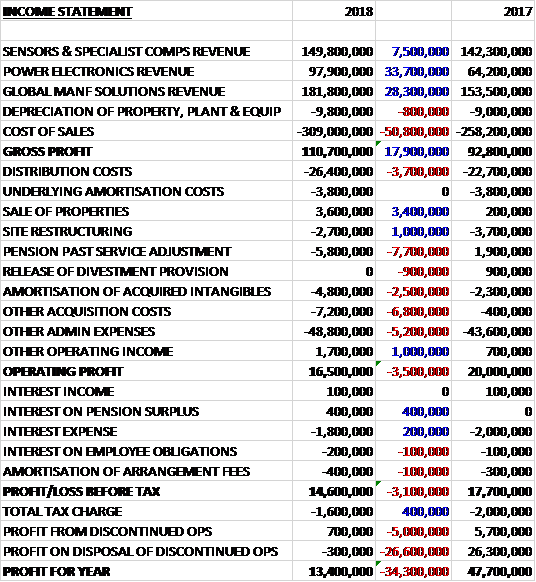
Revenues increased when compared to last year due to a £33.7M growth in power electronics revenue, a £28.3M increase in global manufacturing solutions revenue and a £7.5M growth in sensors and specialist components revenue.  Cost of sales increased by £50.8M to give a gross profit £17.9M higher.  Distribution costs were up £3.7M, there was a £7.7M detrimental swing in pension past service adjustments, amortisation of acquired intangibles were up £2.5M, acquisition costs were up £6.8M and other admin expenses grew by £5.2M.  Offsetting this somewhat was a £3.4M profit from the sale of properties, a £1M decline in site restructuring costs and a £1M  increase in other operating income to give an operating profit £3.5M below last year.  There was a decline in net interest costs and the tax charge was down £400K to give a continuing profit for the year of £13M, a decline of £2.7M year on year.

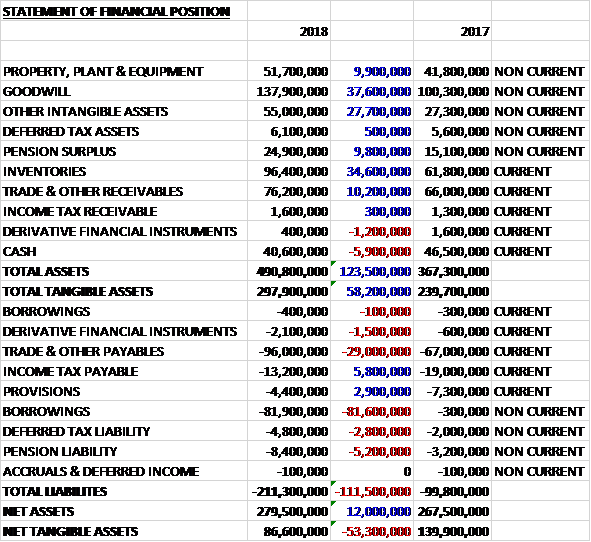
When compared to the end point of last year, total assets increased by £123.5M, driven by a £37.6M growth in goodwill, a £34.6M increase in inventories, a £27.7M growth in other intangible assets, a £10.2M increase in receivables, a £9.9M growth in property, plant and equipment and a £9.8M increase in the pension surplus, partially offset by a £5.9M decrease in cash.  Total liabilities also increased during the year due to an £81.7M increase in borrowings and a £29M growth in payables.  The end result was a net tangible asset level of £86.6M, a decline of £53.3M year on year.

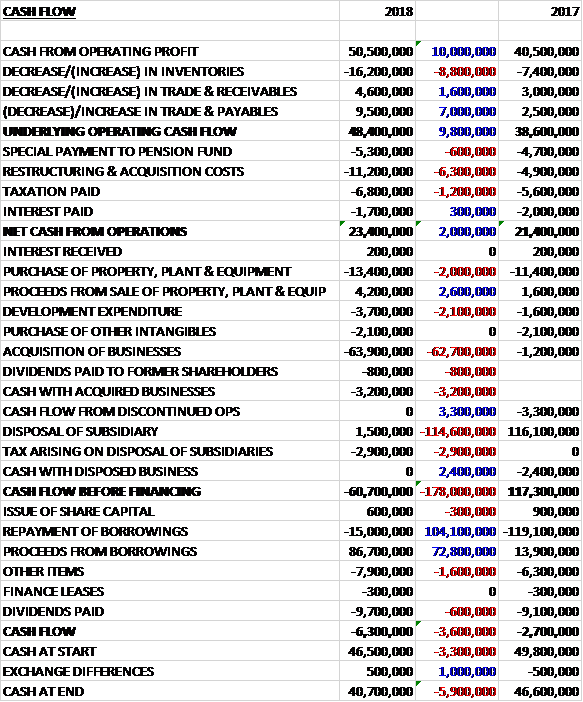
Before movements in working capital, cash profits increased by £10M to £50.5M there was a cash outflow from working capital which was broadly the same as last year but there was a £600K increase in payments to the pension fund, a £6.3M growth in acquisition costs and a £1.2M hike in tax payments to give a net cash from operations of £23.4M, a growth of £2M year on year.  The group spent £13.4M on property, plant and equipment, £3.7M on development expenditure, £2.1M on other intangibles and £63.9M on acquisitions to give a cash outflow of £60.7M before financing.  They took out a net £71.7M of new loans, paid out £9.7M and spent £7.9M on “other items” which meant the cash outflow for the year was £6.3M and the cash level at the year-end was £40.7M.

The underlying operating profit in the Sensors and Specialist components division was £21.3M, a growth of £2.5M year on year with revenue up 5% due to increased volumes in optical sensing and power management.  During the year they announced a joint venture with UniRoyal for sensing and power management devices.  The partnership will combine the group’s design engineering and worldwide distribution channels with UniRoyal’s penetration in the Asian market and higher volume manufacturing capabilities. 

The division achieved strong growth in their sensing and power management lines as a result of market demand, particularly in products that measure current, with three notable new contract wins.  They also saw growth from a platform of products that they identified as a priority in 2015 and have been in a ramp-up phase over the last three years.  They continued to invest in the development of further platforms and launched five new sensing and power management products during the year. 

Their optical sensors also saw good revenue growth.  They won a new contract for a navigation system for an aerospace and defence customer and a new contract with a Taiwanese electronics manufacturer of products used in robotic automation.  During the year they launched a quick response customisation programme resulting in 28 new orders of higher level assemblies for their optical sensor platforms, helping customers get their products to market rapidly. 

The underlying operating profit in the Power and Connectivity division was £8.4M, an increase of £2.2M when compared to last year, with the Stadium acquisition contributing £3.5M.  Revenue increased by 52% due to the acquisitions with organic revenue decreasing by 4% as expected due to the absence of the high margin one-off sales relating to the last time buy activity from a site closure in the US.  In the second half of the year organic revenues increased by 4%. 

During the year they have benefited from revenue growth from aerospace and defence product lines that were outsourced to them from OEM customers in 2017.  They also benefited from increased demand for their power controls for navigation products in defence applications.

Following an increased focus on key account management, the division grew its revenues with these customers in aerospace and defence by 10%.  The macro trend towards more electric aircraft continues to drive demand.  They won a development contract to supply power modules for a new E-Taxi system on the Airbus A320.  The system will power the aircraft using electricity rather than the jet engine during taxiing to and from the runway, resulting in reduced carbon emissions. 

They made progress with their connectivity offerings, securing a partnership with a major distributor of IoT solutions based around single board computers.  They saw good growth in the second half of the year across these offerings.  They also launched a range of connectivity platform products to drive growth for future years.  The IoT hardware platform product range has the ability to be rapidly customised for end customer requirements.  An example application is for a European medical customer where they had good growth this year.  This connectivity device is used to remotely monitor medical equipment and patients in their homes or care centre.

The underlying operating profit in the Global Manufacturing Solutions division was £11.3M, an increase of £4.8M when compared to 2017, of which £800K was due to the Stadium acquisition and £1.1M from the Precision acquisition) with revenues up 19% and 8% organically driven by the continued strength of the offering to Chinese and other Asian customers.  They have also seen good growth from medical customers.

The strong performance also reflects improvements made in strategic business development, including training all their customer facing staff during the year.  This has resulted in the development of strategic partnerships with their customers in addition to winning 14 new customers during the year, all of which will deliver multi-year revenues.  They extended their strategic partnerships with their key customers, including an industrial labelling and packaging device company where they provide full system integration as well as value engineering support for the new customer’s new product development.

During the year they delivered strong operational improvement in their UK operations.  They won six new contracts in the UK, including aerospace and defence contracts for a European aerospace OEM and a new contract for a military aerospace programme.  They have been increasingly focused on key account management and this has resulted in a win with a US aerospace systems company following an introduction from their sales teams in the Power and Connectivity division.  This contract is to provide systems integration for a navigation processor for commercial aerospace applications.

In April the group acquired Stadium for £45.8M in cash and assumed debt of £13.9M.  The business contributed underlying operating profit of £4.3M since acquisition.  In addition the group acquired Precision Inc for a cash consideration of £17.6M and a further £3M of contingent consideration.  The business contributed £1.1M in profits.  The Stadium acquisition generated goodwill of £27.3M and the Precision acquisition goodwill of £6.2M.  The Stadium acquisition is performing ahead of expectations with the integration now complete ahead of plan.  The integration of Precision is progressing well.

Stadium is a provider of connectivity solutions across industrial, transportation, medical, aerospace and defence markets.  As part of the integration the group invested in engineering, business development and talent to strengthen the business.  They established a new technology centre in Shenzhen, Chin, for custom engineering for connectivity solutions to help unlock opportunities from the market growth being driven by industrial internet of things solutions.  Synergies have been realised including savings associated with the plc costs and the consolidation of sales operations in North America.  Procurement and supply chain savings have been identified. 

Precision is a designer and manufacturer of precision electromagnetic product solutions for critical applications, primarily in the medical market.  The acquisition extends the group’s capabilities by adding new design, simulation and manufacturing capabilities including ultra-fine wire winding.  The business provides an enhanced presence for the group in the US, with close proximity to a hub of medical customers in Minneapolis.  The technical capabilities in the business have highlighted new opportunities to expand into aerospace and defence markets using the group’s expertise in these sectors.  The board anticipate the integration and associated costs to be around £3M. 

During the year restructuring costs amounted to £4.9M, of which £2.7M related to costs associated with site restructuring and £5.8M of past service pension charge as a result of UK pensions having to equalise male and female benefits, offset by a profit of £3.6M arising on the sale of a property.  There were acquisition related costs of £12M which comprised £4.8M of amortisation of acquired intangibles and £7.2M of other costs associated with the acquisition of Stadium and Precision.

The group has agreed additional fixed pension contributions extending to 2020 amounting to £5.1M and £3.9M over the next two years. They have agreed fixed contributions of £600K per annum through to 2025 relating to the Stadium pension.

Going forward the group enter 2019 with a better balanced business, a strong order book and more self-help opportunities and remain on track to make further progress in 2019.

At the current share price the shares are trading on a PE ratio of 28.7 which falls to 12.8 on next year’s consensus forecast.  After a 12% increase in the dividend the shares are yielding 2.8% which increases to 3% on next year’s forecast.  At the year-end the group had a net debt position of £41.7M compared to a net cash position of £47M at the end of last year. 

Overall then this year has been slightly mixed.  Profits fell, but this was due to the pension adjustment costs and acquisition charges.  Net tangible assets declined but the operating cash flow improved, although no free cash was generated.  The sensors division performed well, as did the global manufacturing division with good demand from Asian and medical customers.  The Power and connectivity division also performed OK, but this was due to the acquisitions and like for like results deteriorated due to the lack of the large one-off orders that occurred last year due to a US site closure. 

The board seem fairly confident going into the coming year and I would like to see a year of consolidation and organic growth before more acquisitions.  The forward PE of 12.8 and yield of 3% look decent enough and I’m tempted to buy back in here.

On the 21st March the group announced that non-executive director Jack Boyer purchased 11,000 shares at a value of £25K.

On the 2nd April the group announced that non-executive director Stephen King purchased 23,000 shares at a value of £51K. 

On the 9th May the group released a trading update covering the first four months of the year.  They had a strong start to the year with revenue 27% ahead of last year reflecting both business development actions and the integration of Stadium and Precision.  Organic revenues increased by 10%.  They have seen strong organic growth in both Power and Connectivity and Global Manufacturing Solutions but as expected revenues in Sensors and Specialist Components are unchanged compared to the prior year. 

The order book remains ahead of the prior year, driven primarily by Global Manufacturing Solutions, and more than mitigating softer order intake in Sensors and Specialist Components.  They have secured a number of new contract wins with both aerospace and medical customers. 

In March they acquired Power Partners, a small US power supply provider, which will enhance their technology capabilities in power products and improve their medical market access.  The consideration was $1.75M with an additional performance-based amount of up to $1.25M payable over two years. 

On the 3rd July non-executive director Ann Thorburn purchased 45,000 shares at a value of £107K.

Keller Share Blog – Final Results Year Ended 2018

Keller has now released their final results for the year ended 2018.

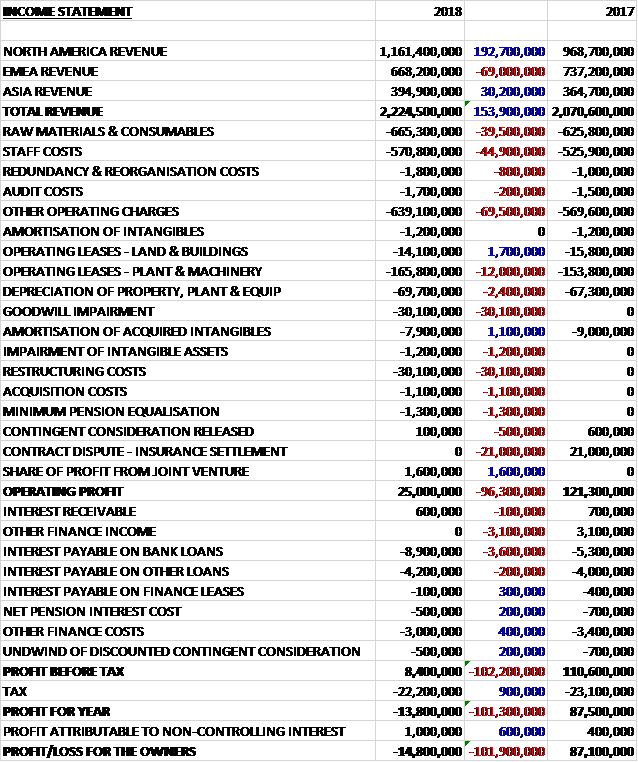
Revenues increased when compared to last year as a £69M decline in EMEA revenue was more than offset by a £192.7M growth in North America revenue and a £30.2M increase in Asian revenue.  Raw material costs increased by £39.5M, staff costs grew by £44.9M and other operating charges were up £69.5M.  Operating lease costs increased by £10.3M and depreciation increased by £2.4M.  There was a £30.1M goodwill impairment and £30.1M restructuring costs along with a £21M reduction in insurance settlements following last year’s contract dispute.  All of this meant that the operating profit was £96.3M lower.  Finance income reduced by £3.2M and interest costs on bank loans were up £3.6M before a £900K fall in tax charges gave a loss for the year of £14.8M, a detrimental movement of £101.9M year on year.

When compared to the end point of last year, total assets increased by £59.8M driven by a £42.8M growth in cash, an £11.9M increase in plant, machinery and vehicles, an £11.9M increase in trade receivables, a £10.6M growth in land and buildings and a £7.7M increase in inventories, partially offset by an £18.1M growth in goodwill, and a £12.4M increase in deferred tax assets.  Total liabilities also increased during the year as a £15.3M decline in accruals was more than offset by a £99.5M increase in loans and borrowings and a £19.7M growth in advance billings and other payables.  The end result was a net tangible asset level of £291.9M, a decrease of £9.4M year on year.

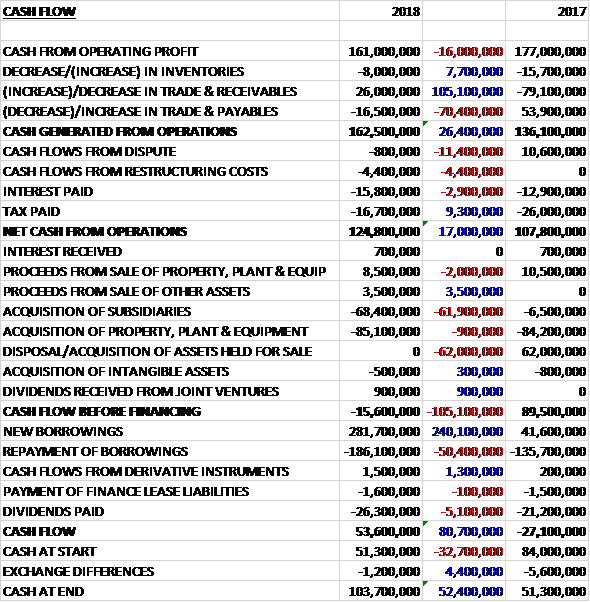
Before movements in working capital, cash profits declined by £16M to £161M.  There was a modest cash inflow from working capital compared to cash outflow last year.  There was no insurance cash from the contract dispute, which was £10.6M last time, restructuring costs were £4.4M and interest payments increased by £2.9M.  Tax charges were down £9.3M, however, to give a net cash from operations of £124.8M, a growth of £17M year on year.  The group spent £85.1M on property, plant and equipment and £68.4M on subsidiaries to give a cash outflow of £15.6M before financing.  The group took out a net £95.6M of new borrowings and paid out £26.3M in dividends to give a cash flow of £53.6M for the year and a cash level of £103.7M at the year-end.

The underlying operating profit decreased by £12.1M with the headwind of adverse forex rates causing a further 3% reduction to the constant currency call of 8%.  Moretrench contributed 9% so the group’s organic performance saw a 17% reduction.

The operating profit in the North American division was £78.6M, a decline of just £100K year on year, although underlying profits were up 3% on revenues that increased by 24%.  Without Moretrench, however, organic profits fell by 9% with the adverse raw material pricing at Suncoast being the biggest factor.  All of the businesses had good revenue growth, benefiting from positive market conditions.  The overall margin declined, reflecting a decrease at Suncoast due to raw material cost increases as well as general adverse North America project mix and performance in the second half compared to a strong second half of 2017.  Hayward Baker saw strong revenue growth but profit below the record level last year.  The integration of Moretrench has gone well.  Cost reductions exceeded plan and the nine months of profits were ahead of original expectations.  They are now starting to see revenue synergies, with Moretrench’s specific niche products of ground freezing and dewatering being offered throughout the group.

The three US piling businesses all improved revenue and profit.  In Bencor there has been no change regarding the adjustment due to the scope increase on a large term contract. They continue to negotiate the adjustment with the client and remain confident of the position they have taken.  Suncoast had healthy revenue growth but its profits reduced by £7M as a result of increases in steel prices that it was unable to pass on to customers in full, and the record rainfall in Texas in September and October.  The margin has now been restored by passing the costs on to customers.

Keller Canada is making good progress on the east coast but continues to operate in difficult markets in the west.  The business substantially grew its capability in Vancouver and is now better placed to take advantage of the strong market on the west coast of Canada.  Going forward, the year-end order book of work to be undertaken over the next year was 19% above last year, giving confidence for 2019.

The operating profit in the EMEA division was £39.7, a decline of £13.6M when compared to last year.  The underlying operating profit was down 24% on revenues that declined by 24%.  This significantly lower result was a consequence of two large projects coming to an end in the first half of the year, including the Caspian project.  The completion of these projects resulted in a benefit of £16M compared to £45M last year and outside of these two projects, the performance in the region improved considerably.

All the core businesses in continental Europe continued to benefit from a sound market environment and performed well.  South East Europe recorded another record year and the operations in Germany continued to grow on the basis of ongoing high demand and extended product offerings.  The UK experienced a generally hesitant commercial investment climate but major infrastructure projects are developing, including HS2, and the board expect the market for geotechnical work to pick up towards the end of 2019, extending well into 2021.

The operations in the Middle East experienced a relatively quiet year following the completion of large projects in Abu Dhabi and Egypt.  New projects continue to develop slowly resulting in lower utilisation in the second half of the year.  They have secured some new projects in the region and on the basis of improving fundamentals they see the prospects for the Middle East as positive. 

The French speaking countries business performed solidly, helped by good performance in North Africa.  Their geotechnical portfolio of near-shore marine solutions, stone columns to mitigate liquefaction and a range of piling solutions has secured some interesting projects, particularly in Morocco and Algeria.  The French domestic market was characterised by good demand around Paris leading to niche opportunities across the country.

Brazil and South Africa both experienced a difficult year.  Both countries suffered heavy margin pressure requiring the group to adapt their local capacity.  They have taken proactive measures to scale back their operations and as a result to maintain bidding discipline.  The challenges in South Africa have been compensated to an extent by the group’s strong presence in sub Saharan Africa.  They continue to monitor the development of the political situation in Brazil and will respond to developments.

The year-end EMEA order book of work for the next year was around 8% down on last year reflecting the run-off of the large projects.  Excluding these, it was 4% down.

The operating loss in the APAC division was £18M, an increase of £1.5M compared to 2017.  The underlying loss increased by 10% despite revenue growing by 13%, driven by good increases in India and Australia.  The increased loss was due to deteriorating ASEAN market conditions and poor project performance in ASEAN and Waterway, prompting a review of both businesses.

In ASEAN they completed a review of their portfolio.  As a result of the deterioration in the Malaysian market conditions and disappointing project performance, they took the decision to downsize the business.  They therefore exited their heavy foundations activities in Singapore and Malaysia which have become highly commoditised and continue to see competitive pricing pressure.  These activities had a combined annual revenue of around £60M.  Going forward, they are focusing on higher margin ground improvement activities such as vibro, grouting and deep soil mixing.  The restructuring of the business is now substantially complete although some piling projects extend through the first half of 2019.

In Waterway, they took the decision to exit the highly congested Australian bridge superstructure market and refocus on higher margin marine infrastructure projects.  Whilst Austral and Waterway retain their independent brands, they are sharing key leadership roles and functional support between the two businesses.  They continue to expect that legacy and lower margin contracts in Waterway will be complete by the end of the first half of 2019.  Austral and Waterway are now aligned to pursue a selection of east coast marine projects predominantly in the defence sector.

Austral had a record year due to a strengthening in investment by the mining industry in Pilbara.  The business has good tender and prospects lists and is set for another strong year in 2019.

The group’s geotechnical business in Australia saw a year of consolidation as it adjusted to a softening in the property sector and a government shift towards major transport infrastructure expenditure.  This segment of the market offers good revenue opportunities but at lower profitability levels.  The business returned to profit in 2018 but the outlook for 2019 remains muted.  The large Melbourne metro project is experiencing client driven delays that are subject to a claim and this claim is not yet recognised in the 2018 results.  The Indian business has a good year and has a healthy pipeline of major infrastructure projects for 2019.

The year-end Asia Pacific order book of work to be undertaken over the next year was down 43%, particularly impacted by a rebasing in ASEAN and with some softening in the three Australian businesses.  All three Australian businesses have a strong prospect list, however, and a higher than normal list of tenders under review.  A number of significant tenders will be decided late in Q1 2019.  Overall the board expect the division to return to profit in the second half of 2019.

In March the group acquired Moretrench America Corp, a geotechnical contracting business operating along the east coast of the US, for a cash consideration of £64.7M, generating goodwill of £9M.  In June, they acquired Sivenmark Maskintjanst, a sheet piling specialist based in Sweden, for a cash consideration of £2.1M, generating goodwill of £800K.  During the year the acquisitions contributed a net profit of £5.5M.

There were a number of non-underlying items over the year.  The amortisation of acquired intangibles relates to the Keller Canada, Austral, Bencor and Moretrench acquisitions.  The goodwill impairment relates to the ASEAN Heavy Foundations, Waterway, Franki Africa, Brazil and Wannenwitcsh units, all of which are experiencing significantly depressed trading conditions.  The impairment of intangible assets relate to the impairment of the Tecngeo and Franki Africa trade names capitalised on acquisition. 

In November the group announced a restructuring programme.  They have taken a £30.1M restructuring charge, of which £21.6M was non-cash, relating to asset write-downs, redundancy costs and other reorganisation charges.  Affected businesses are ASEAN, Waterway, Brazil and Franki Africa and includes the write-down of surplus equipment to current market values. 

Going forward, overall market fundamentals are healthy and the group remain well positioned to benefit from the global trend of urbanisation.  In North America the outlook is good with robust markets and solid growth expected, and an improvement in margin anticipated as cost increases at Suncoast start to be fully passed through.  In EMEA they benefited from the large, highly profitable projects in the first half of 2018 which will not repeat in 2019.  These projects aside, the outlook in the main markets is positive so the board expect progress in the core business. 

In Asia Pacific, the decision to exit ASEAN heavy foundations will lead to a revenue decline in 2019.  The main Asia Pacific markets remain mixed but the board expect that the measures already taken will return the division to profit in the second half of the year.  In 2019 overall they expect revenue to be broadly flat with an improvement in margin and a good recovery in profit.  The profit improvement, together with a focus on cash generation, means they expect debt leverage to reduce significantly by the year-end.

At the current share price the shares are trading on a PE ratio of 27.8 which falls to 6.9 on next year’s consensus forecast.  After a 5% increase in the total dividend but a reduction in the final dividend the shares are yielding 5.6% which is expected to grow to 5.9% next year.  At the year-end the group had a net debt position of £286.2M compared to £229.5M at the end of last year.

Overall then this has been a rather tricky year for the group.  Losses worsened and the underlying profit declined, the net asset base fell and although the operating cash flow improved, this was due to working capital movements and cash profits declined with no free cash being generated.  Forex movements haven’t helped but the underlying business has faced quite a few problems.  The North American business saw organic profits fall due to increased raw material costs, although these have apparently now been passed on and the region’s order book has improved.

The EMEA business struggled due to the fact that there was only six months of the large projects included.  This will continue into this coming year and the order book has also declined somewhat.  There are also issues in the Brazilian and South African businesses.  Asia Pacific has really struggled due to difficult market conditions in Malaysia and some issues in Australia.  Actions have been taken to improve this and the board expect a return to profit in the second half of the year.

So, there are tricky conditions here but it does sound as though the group is confident of an improvement so perhaps the shares are worth a punt with a forward PE of 6.9 and yield of 5.9%.  Risky but potentially good value.

On the 16th May the group released a trading update.  The board’s expectations for the full year remain unchanged.  They have experienced modest trading for the year to date and continue to expect profits to have a second half weighting.  The order book remains at £1BN, slightly lower than at the same point last year reflecting the restructuring in Asia Pacific.  It grew in North America and EMEA.

In North America, the adverse steel cost impact in Suncoast experienced last year is now reversing and margins have returned to more normal levels.  Noretrench is performing well and planned cost synergies have been exceeded.  Elsewhere in North America, performance in the first four months has been weaker than expected, partly due to mix and partly due to additional costs to recover from the adverse weather conditions in January, but this shortfall is expected to be recovered in the second half. 

In EMEA the European businesses are performing in line with expectations with a particularly strong performance from South East Europe.  The Middle East is having a much quieter year to date following the completion of major projects and the slow development of new projects.  Franki Africa has also continued to struggle and they are managing it closely, although it is bidding on new projects in the region.  Brazil remains challenging although underlying performance is slightly improved compared to last year.

In Asia Pacific, the expectation to return to profitability in the second half remains on track.  The restructuring and subsequent refocusing of the business in ground improvement is proceeding to plan, asset disposals will generate additional cash, and profitability continues to improve.  India is performing to plan.  Market conditions and performance across Australia remains mixed with a slower start to the year than expected but a recovery is anticipated for the year as a whole.  Austral has been affected in the period by the recent cyclone which as impacted all mining and processing activities in the Pilbara, but is expected to recover well.  The restructuring at Waterway is proceeding to plan, and additional action will be taken in response to the further deterioration in the market.

Overall trading performance in the four month period has been lower than anticipated but is on an improving trend.  This, together with the final completion of the Caspian project in the first half means that results for the period will be materially lower compared to last year.  They continue to expect as much stronger second half, and for full year revenue to be broadly flat, with an improving margin driving a recovery in profit.  Net debt has risen slightly since the year-end but is expected to come down again by the end of the year. 

This all sounds rather dependent on the second half to me and all a bit risky…

XP Power Share Blog – Final Results Year Ended 2018

XP Power have now released their final results for the year ended 2018.

Revenues increased when compared to last year due to a £17.7M growth in semiconductor revenue, a £5.6M increase in industrial revenue, a £3.2M growth in technology revenue and a £1.8M increase in healthcare revenue.  Cost of sales increased by £13.6M to give a gross profit £14.7M higher.  Amortisation and depreciation was up £3.2M, distribution and marketing costs increased by £3.8M and R&D expense grew by £2.6M but admin costs were down £1.7M to give an operating profit £6.8M above last time.  Finance costs increased by £1.4M and tax charges grew by £3.6M which gave a profit for the year of £30.2M, a growth of £1.9M year on year.

When compared to the end point of last year, total assets increased by £62.7M driven by a £20.1M growth in development costs, an £18.7M increase in inventories, a £13.7M growth in goodwill, a £9.2M increase in trade receivables and an £8.2M growth in property, plant and equipment partially offset by a £3.5M decline in cash and a £2.1M decrease in corporate tax recoverable.  Total liabilities also increased due to a £39.5M growth in bank loans.  The end result was a net tangible asset level of £39.7M, a decline of £13.3M over the past year.

Before movements in working capital, cash profits increased by £17M to £51.4M.  There was a cash outflow from working capital and despite a £1.3M increase in interest payments being more than offset by a £2M decline in tax payments, the net cash from operations came in at £25.2M, a decline of £4.3M year on year.  The group spent £7.9M on property, plant and equipment, £6.2M on R&D and £900K on software along with £35.5M on acquisitions to give a cash outflow of £25.1M before financing.  The group brought in a net £36M from new borrowings in order to pay the £15.3M of dividends to give a cash outflow of £4.2M for the year and a cash level of £11.5M at the year-end.

The profit in the European division was £15.9M, a growth of £1.3M year on year on revenues that were up 6%.  All sectors grew but healthcare showed the strongest gains due to a number of larger medical programmes entering production from some of their bigger customers.  The semiconductor equipment manufacturing business in Europe is currently insignificant.  Order intake increaed by 5%.

The profit in the American division was £40.8M, an increase of £5.4M when compared to last year.  Revenues were up 31% or 13% on a like for like basis.  This division particularly benefited from the growth in the semiconductor equipment manufacturing sector, but all markets grew year on year.  Order intake increased by 14% but was up only 2% on a like for like basis.  Comdel had a very strong order intake in Q4 2017 as semiconductor manufacturers placed orders for delivery throughout the year.

The Section 301 tariffs which the US has imposed on Chinese sourced products has a mixed impact on the group.  A 10% tariff was imposed on power converters imported from China where the group has a manufacturing facility.  There are proposals to increase this to 25%.  Where possible they have been recovering some of these tariffs from customers but the facility in Vietnam has presented an opportunity over many competitors who manufacture largely in China as Vietnam is now yet caught by the new tariffs.  They have been moving their lower power products from China to Vietnam and these tariffs have caused them to accelerate this process. 

The profit in the Asian division was £4.9M a growth of £400K when compared to 2017 on revenues that increased by 5% with the strongest growth in industrial and declined in healthcare and technology as programmes went end of life.  Order intake in the region increased by 13%.

The first half of the year saw very good growth in the semiconductor equipment manufacturing sector which then softened in the second half of the year, and in particular in Q4.  In contrast, the industrial, healthcare and technology sectors all showed growth in the second half of the year compared to the first half and remained robust in Q4.

Revenues from industrial customers grew by 7% as the recovery in the sector continued into 2018.  Revenues from the semiconductor manufacturing equipment sector grew by 60%.  In the first half they benefited from a cyclical upswing, combined with strong market share gains and revenues from Comdel and Glassman as their expansion into high voltage and high power products made them an attractive supplier to the industry.  The new products they have allow them to service considerable more opportunities in this sector.  As widely reported, the sector slowed significantly in the second half of the year, however, with impacted Q4 order intake and revenues.

Revenues from healthcare customers grew by 4%.  This remains an attractive market for the group.  Revenues from technology customers grew by 19% and contains a number of large project with shorter lead times than typical in the other sectors the group are involved in.

Their design win pipeline was strong in 2018, which bodes well for continued market share and revenue growth.  They also continued to move their product portfolio up to higher power and technically more complex applications, and to expand the number of design wins with higher engineering solutions content. 

On a like for like basis, order intake increased by 5%.  They grew across all regions and sectors but they did see a slowdown in the semiconductor manufacturing sector in Q4.

During the first half of the year the group started to see significant tightening of the supply chain for certain electronic components which resulted in increased lead times and component cost inflation.  In response they secured supplies of critical components at prices beyond their standard costs in order to ensure they could continue to meet their lead times to customers.  Lead times for certain components increased dramatically, in some cases moving from 12 weeks to a year which meant they had to increase their safety inventories significantly.  The higher prices they had to pay were a drag on margins in the second half of the year but were offset by other cost savings and a favourable product mix.

In May the group acquired Glassman High Voltage, a designer and manufacturer of high voltage power converters.  The total consideration of £35.7M was paid in cash.  The group share several customers with the business and while there is no direct overlap in product lines, the power supply solutions are highly complementary.  Glassman’s products and engineering capabilities have enhanced the group’s ability to implement its strategy of winning a greater share of business from its largest customers by achieving a wider vertical penetration of key accounts.  The business is being integrated into the group well.

The group plant to spend £10M on capex next year which is double that of 2018.  This is due to the completion of the new Vietnam site and an investment in upgrading their ERP system.

Going forward, the new financial year has begun against a backdrop of ongoing macroeconomic uncertainty.  While they are not immune from the impact of external events, they are encouraged by our start to 2019 in terms of order intake and their healthy order book.  On that basis, and with the benefit of the Glassman acquisition, the board expect further revenue growth in 2019, but this will be weighted to the second half of the year.

At the current share price the shares are trading on a PE ratio of 14.5 which falls to 12.2 on next year’s forecast.  After a 9% increase in the dividend, the shares are yielding 3.8% which increases to 3.9% on next year’s forecast.  At the year-end the group had a net debt position of £52M compared to £9M at the end of last year with the increase due to the Glassman acquisition and higher inventory levels.

Overall then, this has been a decent year but not without some challenges.  Profits increased but net tangible assets reduced due to the acquisition.  The operating cash flow also fell with no free cash generated after the acquisition.  This was due to the increase in working capital due to the longer lead times which should relent somewhat this year.  All regions saw growth, although there were projects in healthcare and technology in Asia coming to their end.  There was also a slowdown in semiconductor orders in Q4 which doesn’t bode well for the start of the coming year, and the board have stated it is likely to be second half weighted which is always a risk.  The shares are starting to look better value, though, with a forward PE of 12.2 and yield of 3.9% but I am not sure this is enough to cover the risks, and I would like to see debt come down too.

On the 15th April the group released a trading update covering Q1.  They made a good start to the year with order intake up 7% on a reported basis but flat at constant currency.  On a like for like basis, orders decreased by 4%.  Revenue was down 5% at constant currency and 12% like for like.  Revenue growth was encouraging across industrial, healthcare and technology markets but the semiconductor sector continued to feel the impact of the slowdown with both order intake and revenue down.

Net debt was £49.1M compared to £52M at the year-end. Going forward, they continue to expect further revenue growth this year which will be weighted to the second half so board expectations remain unchanged.

MPAC Share Blog – Final Results Year Ended 2018

MPAC has now released their final results for the year ended 2018.

Revenues increased when compared to last year as a £3.1M decline in Asia Pacific revenue was more than offset by a £4.3M growth in EMEA revenue and a £3.7M increase in Americas revenue.  Cost of sales grew by £5.4M to give a gross profit £500K lower than last year.  Distribution expenses declined by £400K but there was no profit on the sale of surplus property, which was £4.8M last year and there was a past service cost of the pension scheme of £7.3M which meant that there was a detrimental movement of £12.2M to an operating loss.  There was a £500K positive swing in pension interest income and the tax charge saw a £3.3M positive swing to give a loss of £6M, a detrimental movement of £8.4M year on year.

When compared to the end point of last year, total assets increased by £4.3M driven by a £5.5M growth in contract assets, a £2.9M increase in the pension asset and a £900K growth in inventories, partially offset by a £3M decline in receivables and a £2.4M decrease in cash.  Total liabilities also increased during the year as a £6.2M decline in payables was more than offset by an £11.6K increase in contract liabilities and a £1M growth in deferred tax liabilities.  The end result was a net tangible asset level of £39.6M, a decline of £2.3M year on year.

Before movements in working capital, cash losses improved by £2.1M to £700K.  There was a cash inflow from working capital but tax payments increased by £700K and reorganisation costs were up £200K.  Despite the £4.4M cash received last time from discontinued operations the net operational cash outflow from operations improved by £1.3M to £1M.  The group spent £1.1M capex and £300K on development costs to give a cash outflow of £2.2M before financing, of which there was none, so the cash outflow for the year was £2.2M and the cash level at the year-end was £27.9M. 

The group faced a challenging first half to the year with slower than expected order intake and two contract issues. 

The gross profit in the OEM division was £9.3M, an increase of just £100K year on year on revenues that increased by 14%.  Order intake was £4M ahead of last year, driven by a 75% increase in the order intake in the Americas due to growth in the healthcare market and the significant investment plans of a new customer in H2 2018.

EMEA made considerable progress across most markets with packaging solutions but this was offset by slow order intake for their first of a kind solutions in the region, resulting in order intake falling by £8M.  There was also slowdown in order intake in Asia, driven mainly by subdued demand from China which reduced order intake by £1.7M. 

A strong performance in sales to the food and beverage market contributed to Americas revenue increasing by £4.1M.  EMEA sales in the period increased by £4.3M.  In 2017 order intake included the investment plans of a major customer in the pharmaceutical market which were directed towards Europe, resulting in revenue growth this year.  The closing order book of 2017 was also heavily weighted towards projects in the EMEA region, and consequently revenue growth was achieved despite the slowdown of orders this year.  The closing order book of 2018 was weighted towards the Americas. 

Asian sales, predominantly driven by the food and beverage market, reduced by £2.6M this year.  Gross profit margins fell from 22.8% to 20.1% due mainly to the costs associated with two problem contracts.  The UK contract is resolved and they have agreed the commercial and technical approach to resolving the Canadian contract which is expected to be finalised during 2019.  Overall order prospects remain strong and activity levels across the business remain high such that it is well positioned moving into 2019.

The gross profit in the Service division was £4.7M, a decline of £600K when compared to last year on revenues that declined by 7%.  Order intake was 9% below last year.  This is being blamed on staff being dedicated to fulfilling machine installation, especially in the first half of the year.  They have found candidates for the management positions across the regions and expanded the number of field service agents which should give some momentum to sales as the impact of these changes was notable in the last few months of the year.  Americas revenue was down £400K, Asian sales fell by £500K and EMEA revenue was flat with order intake broadly in line with sales.  Overall margins remained unchanged.

The pension fund continued to be a drain on the company.  Administration costs during the year were £900K, although there was a net £200K finance income on the scheme balances.  In addition the group paid £1.9M in respect of the deficit recovery plan.  These recovery payments will continue going forward.  Also, following a high court ruling the group have recognised a charge of £7.3M in respect of increased future liabilities relating to GMP equalisation.

Going forward, the group entered 2019 with a stronger order book than last year (16% higher) with a broader, updated product portfolio following the commercialisation of several innovation projects.  The year has started well with order intake in the first two months ahead of last year. 

At the year-end the group had a net cash position of £27M compared to £29.4M at the end of last year.  At the current share price, excluding the exceptional pension costs, the shares are trading on a PE ratio of 24.2 which falls to 12.1 on next year’s forecast.  There are no dividends on offer here.

Overall then this has been a rather difficult year for the group.  Discounting the one-off pension adjustment and last year’s building sale, there was an improved performance but the group is still not making a profit.  Net assets declined and again the operating cash flow improved but there is a still a cash loss and there was not free cash generated.  There have been two difficult contracts which have been a drag on results, one of which at least has been resolved but a good performance in the Americas region has offset poor conditions elsewhere.  The services division has apparently suffered as staff are not able to make fees, which hopefully has also been resolved.

The group seems to be better positioned now and this year has indeed started better but a forward PE of 12.1 seems a little pricey given the group has not made any profit since they sold their tobacco machinery division.  There is a big cash buffer here, which is helpful, and may come in handy to bolster their position.  Tricky one this.  I feel it might be worth a punt.

On the 1st May the group released a trading update which was in line with market expectations.  Order and quote activity remain strong and the current order book is significantly above the previous year.  Overall the board are confident that they will be able to deliver results for the full year in line with expectations.

They also announced the acquisition of Lambert Automation for an initial consideration of £15M in cash with further deferred consideration potentially becoming payable, capped at £2.5M.  The business is a provider of automation solutions to the medical and consumer healthcare markets.  They are based in the UK and last year made a pre-tax profit of £1.3M, including an interest credit of £1.1M.  Net assets were £7.1M, including goodwill of £4.9M. It is expected that the acquisition will be immediately earnings enhancing. 

It was also announced that Chairman Mr. Kitchingman purchased 6,682 shares at a value of £10K. 

On the 16th July the group released a trading update covering the first half of the year. Trading so far is ahead of market expectations, with the momentum gained in the latter months of 2018 continuing into the first half of 2019. 

Good progress has been made in delivering the significant value contracts won last year and the financial performance of the Services division is benefiting from the extended service model offered to their customers.  The current order book, year to date order intake and the volume of quotation activity provides the board with confidence in the prospects for the remainder of the year.  The integration of the recently acquired Lambert Automation is on track to deliver its expected results.

As a consequence of the above, the board anticipates that profit for the full year will be significantly above current market expectations.