
Tristel has now released its final results for the year ending 2015.

Overall revenues increased when compared to last year with a £1.6M growth in human healthcare revenue, a £184K increase in contamination control revenue and a £109K growth in animal healthcare revenue. Cost of inventories also increased to give a gross profit £1.3M above that of 2014. We then see a £125K loss on disposal of intangible assets and a £164K growth in wages along with a £102K increase in research costs expensed and a growth in other admin expenses which meant that operating profit came in £722K ahead of last year. There was a small increase in finance income and a £214K decline in the amount of tax paid relating to deferred tax. The end result is a profit for the year of £2.2M, an increase of £943K year on year.

When compared to the end point of last year, total assets increased by £1.9M driven by a £1.4M growth in cash, a £381K increase in trade receivables, a £153K growth in plant and machinery, a £145K increase in computer software as the group invested in a new operating system (SAP Business One) and a £110K increase in other receivables, partially offset by a net £162K decline in the value of capitalised development costs. Liabilities fell during the year as a £465K decline in trade payables was partially offset by a £323K increase in social security and other tax payables. The end result is a net tangible asset level of £7.9M, an increase of £2.1M year on year.
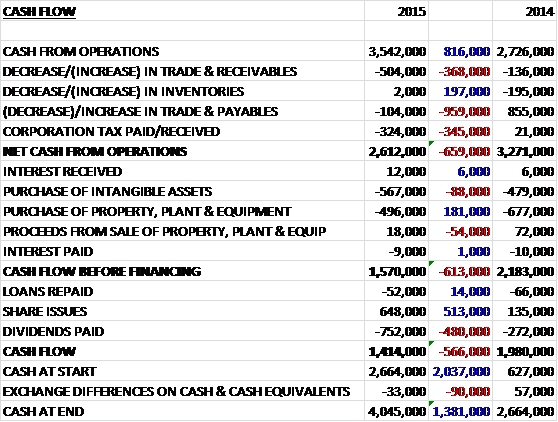
Before movements in working capital, cash profits increased by £816K to £3.5M. An increase in receivables combined with a large swing to a fall in payables and the payment of corporation tax (as opposed to a tax cash receipt last year), however, meant that the net cash from operations was £2.6M, a decline of £659K year on year. The group then spent £567K on intangible assets, and a net £478K on tangible fixed assets to give a few cash flow of £1.6M. Out of this, the remaining £52K loan was repaid and £752K was spent on dividends which meant that after a £648K receipt from share issues, the cash flow for the year was £1.4M to give a cash level of £4M at the year-end.
The gross profit in the human healthcare business was £9.4M, an increase of £1.1M year on year; the gross profit in the animal healthcare division was £557K, an increase of £50K when compared to last year; and the gross profit in the contamination control business was £678K, an increase of £83K when compared to 2014.
The group plans to achieve revenues of £20M by 2017 which seems as though it should be achievable at this rate of growth. They also intend to maintain a pre-tax margin of at least 15% whilst investing in new markets and products to sustain growth beyond 2017. So far the pace of up-take of the group’s products has been frustrating for the chairman but the geographical expansion means that the rate of growth could accelerate. They have embarked on their US regulatory approvals project and apparently now have a more exciting pipeline of new product innovations than the Chairman has ever witnessed, which sounds positive. Other markets that they do not yet operate are Canada, much of South America, India, Central Europe, Africa and much of South East Asia. They are committed to establishing a presence in most countries in Latin America by 2017.
In the hospital market the group is focused on two areas of infection prevention which are Instrument decontamination in the out-patient area, and the disinfection of critical services. Sales in both of these areas are growing faster than the group-wide CAGR of 18%. In the out-patient market the group provides disinfectant products that are used with small medical instruments in ENT, cardiology, ultrasound, urology, GI physiology and ophthalmology. In these areas there is a constant stream of patients requiring procedures for which clinicians use small instruments that are relatively simple to decontaminate. They have targeted these areas because they are not addressed by the competition. Global revenues from out-patient care have reached £9.3M over the year.
The group’s disinfectants provide an effective strategy to control C. difficile, one of the most problematic pathogens in hospitals. Globally, revenues of the surface disinfectants have grown at a CAGR of 63% from 2006 and now provide revenues of £1.4M in human health and £101K in contamination control and animal health.
This year, one customer made up 27% of total revenues. In the human healthcare division, I guess this client must be the NHS so the group is very susceptible to funding of the health service. Another potential issue is the time it is taking to collect receivables. At the end of the year some £220K of receivables were overdue by more than 120 days which represents nearly 8% of the total and compares unfavourably to last year where there were no receivables past 120 days due.
During the year the group appointed David Orr as non-executive director. His career spans the British Army, the City and managing businesses in the packaging industry where he has been group MD of Fencor Packaging. It is notable that many of the directors have options that vest in the event of a change of control of the company so they seem to be very motivated to find a buyer for the company before 2019.
At the current share price the shares trade on a PE ratio of 22.9 which reduces to 21.4 on next year’s consensus forecast which seems rather expensive. After a 69% increase in the final dividend, the shares yield 4.8% which reduces to 2.3% on next year’s forecast as the special dividend is not expected to be repeated and the group will maintain a dividend cover of two times going forward.
Overall then this was a very good year for the group. Profits are up, there is plenty of free cash flow and net assets have increased but operating cash flow has fallen year on year. This is only as a result of detrimental movements in working capital, however, in particular a fall in payables relative to the increase in 2014, and underlying cash profits have increased. Profits are up across all business sectors with the human healthcare sector being by far the most important as both outpatient instrument decontamination and surface disinfectants have performed well.
As usual, there are some things to be aware of though. One customer, probably the NHS, accounts for over a quarter of sales and perhaps more concerning is the increase in overdue receivables, some by quite a lot, which have not yet been impaired. In addition, the forward PE of 21.4 doesn’t leave much room for error. Overall though, this is a good set of results for an interesting and growing company so I am happy to hold and may add more if the share price comes down a notch.

The market has reacted well to these results and has posted a multi-year high.
On the 15th December the group released an AGM statement. So far this year, they have achieved year on year profit growth. The board expect pre-tax profit for the first half of the year to be no less than £1.4M compared to £1.1M in the first half of last year and £1.5M in the second half of last year, which is in line with market expectations. They expect cash generation before the payment of dividends to be move than £1M during the period. Growth is coming from all areas of the business but they are particularly pleased with the progress in China and are satisfied with the progress that is being made on the US regulatory approval programme.
Overall, this seems to be a decent update and I will continue to hold.
On the 15th December the group announced that Elizabeth Dixon, Finance Director, has purchased 4,933 shares at a cost of £7.2K which brings her holdings up to 50,000. It was also announced that CEO Paul Swinney had purchased 5,000 shares at a cost of £7.6M which brings his holdings up to 920,000. Whilst nice to see the execs buying shares, these are fairly modest amounts.