

TT Electronics have now released their preliminary results for the year ending 2014.
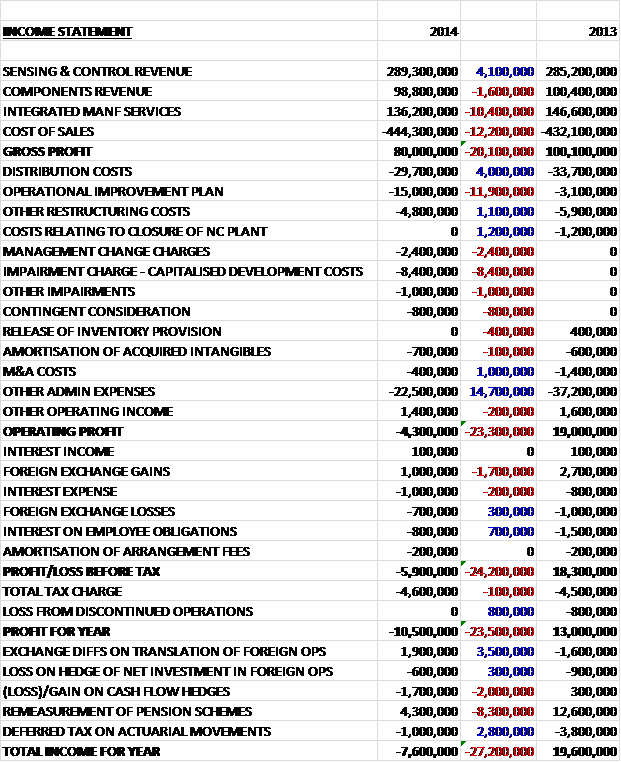
When compared to last year, revenue fell in 2014 as a £4.1M increase in sensing and control sales, largely due to a one-time order, was more than offset by a £1.6M fall in components revenue and a £10.4M collapse in integrated manufacturing services revenue, although there was a massive £22.6M detrimental effect from foreign exchange. On top of this, cost of sales also increased so that gross profit was £20.1M lower at £80M. Distribution costs did fall during the year as did underlying admin costs but there were a raft of non-core costs such as the £15M spent on the operational improvement plan, other restructuring costs, impairment charges relating to capitalised development costs and an increase in contingent consideration which helped drive the operating loss some £23.3M lower than last year at £4.3M. After various finance costs and tax, the loss for the year became £10.5M, a negative swing of £23.5M when compared to 2013. Although the underlying operating profit at a constant currency basis was broadly unchanged but included £5M of non-repeating profits.
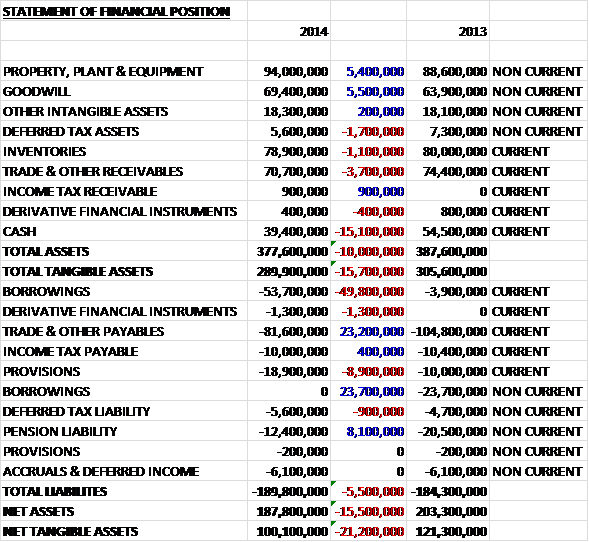
When compared to the end point of last year, total assets fell by £10M driven by a £15.1M decline in cash levels, a £3.7M fall in receivables and a £1.7M fall in deferred tax assets, partially offset by a £5.5M increase in goodwill and a £5.4M growth in property, plant and equipment. Liabilities increased during the period due to a £30M hike in borrowings and an £8.9M growth in provisions being partially mitigated by a £23.2M decline in payables and an £8.1M fall in pension liabilities partly due to the deficit reduction payments made during the year.
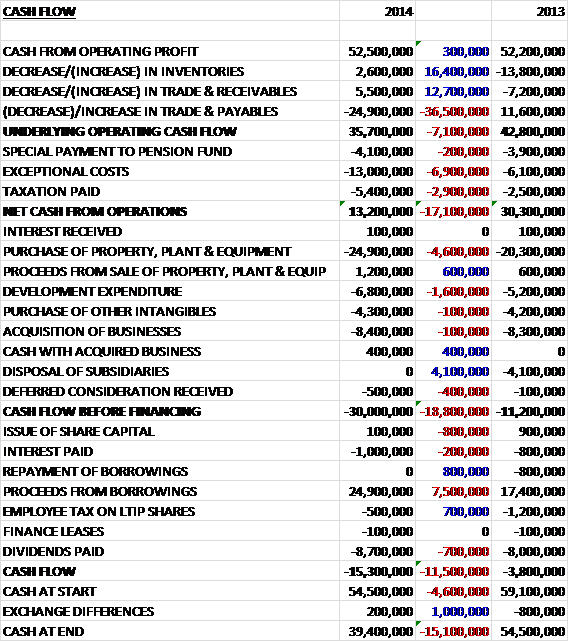
Before movements in working capital, cash profits were fairly flat, up by £300K to £52.5M. A huge fall in payables due to significant supplier payments made during the first half of the year, however, meant that the underlying operational cash flow was £35.7M, some £7.1M below that of last year. There was then £13M of exceptional cash costs, another £4.1M paid into the pension scheme and an increased tax payment to give a net cash from operations of just £13.2M. This cash was no-where near enough to pay for the net £23.7M spent on property, plant and equipment, let alone the £6.8M of development expenditure, £4.3M on other intangible assets and £8.4M on the acquisition. The cash outflow before financing was £30M so it comes as little surprise that the group had to borrow some £24.9M more to give a cash outflow for the year, after an increase in the dividend payout that the group can’t really afford, of £15.3M which leaves £39.4M of cash at hand at the year end point. It is worth noting, however, that there was a positive free cash flow in the second half of the year.
Underlying operating profit at the Sensing and Control business was £14.2M, a decline of £3.3M when compared to last year with the operating profit margin falling from 6.1% to 4.9%. This reduction was driven by poor performance in the Transportation Sensors business related to price-downs and adverse product mix, investment in product development and inefficiencies resulting from the movement to Romania from the German location. This was partially offset by the £4M profit from the one-off order for steering position sensors and growth in the transportation controls business. There was also a negative foreign exchange impact of £1M and the acquired Roxspur contributed £400K to operating profit. The first full year was completed at the Indian facility and the group are starting to see benefits of having established a local manufacturing site to serve the growing market. A key focus for both the transportation and industrial sensing and control businesses will be improving R&D investment efficiency and processes during 2015.
The business launched several new sensor products during the year including a new technology based on SIMSPAD, a new non-contacting sensor platform that is designed to detect non-linear positions through non-ferromagnetic walls. The new overmoulded speed sensor was launched during the year which simplifies production and provides cost savings on assembly processing. The business also launched a new Magnetorque sensor for combining position and torque in a smaller package, improving their ability to serve the growing area of Electronic Power Steering applications.
The transportation controls business grew significantly during the year, helped by increased penetration of front LED lighting into a broader range of vehicles and the increased usage of petrol engines where the increase in demand for engines benefited the group’s supply of intelligent electrical water pumps used in engine cooling systems. The business expanded the supply of intelligent electrical water pumps regionally having won business with their first Korean customer and they continue to develop technology to address customer needs in the area of LED lighting and intelligent power modules. The patented approach to LED placement helps customers enhance the light’s appearance on the road and will be used for the next generation of intelligent headlights. In addition, a chip stacking technology was patented which enables higher power density in smaller packages, increasing the number and type of applications that can be served in transportation systems requiring power electronics.
The group experienced a number of delays in the launch of new product platforms during the year in the Industrial sensing business and they are taking steps to re-organise the engineering function and review core processes in order to improve this in the future. Despite these set-backs, a number of new products were launched during the year including an optical sensor designed to monitor seeds as they are dispensed in agricultural planting equipment and a number of new products are expected to be launched during 2015 which are expected to deliver modest benefits in the second half of the year. The acquisition of Roxspur strengthened the offering for industrial pressure, temperature and glow sensors and provides a platform for future growth in industrial applications. A number of activities have been identified to expand the product range and support growth which includes developing an enhanced range of pressure sensors with improved performance and they are also evaluating a number of manufacturing process improvements leveraging skills from other parts of the group.
Underlying operating profit at the Components business was £9.5M, an increase of £5.2M when compared to 2013 with operating profit margins increasing form 4.3% to 9.6%. This performance was driven by a favourable product mix, improvements in the underlying cost base and a £1M benefit of non-recurring orders associated with the closure of the US facility. The Power and Hybrid business had a strong year with increased sales and profitability with prior improvements in the strength of the team having an impact. The business signed a long term supply agreement with Rolls Royce subsidiary CDS to supply a new range of multi-chip modules used in the control of fuel supply for a wide range of engines and they supplied hybrid circuits for the vehicle management computer on the Orion space mission.
The Resistors business saw a significant increase in sales across all product lines and managed a number of major projects. A new customer service centre was opened in the UK and the US service centre was expanded with the latter installing a major new production facility after a multi-million dollar investment programme. This new facility produces the new range of WIN moisture resistant precision thin film chip resistors mainly focused on industrial markets and some were successfully shipped during the second half of the year. The business also managed the closure of the Smithfield site without interruption to customers. The Magnetics business had a solid performance and progress was made on a number of fronts gaining new programmes and launching new products. The business, based in Malaysia, continued to expand its automotive sales, launched a new initiative to grow industrial sales and continued to expand their range of moulded inductors. The connectors business achieved a solid year and continued to support their customer base in military and rail markets. During the year they launched the new MIL PP and MABAC connectors for military use in land based applications.
Underlying operating profit at the Integrated Manufacturing Services business was £5.5M, a fall of £3.5M when compared to last year with the operating margin falling from 6.1% to 4%. This reflected the impact of lower revenues due to weaker than expected demand from some key customers in Europe and the cost increases in Romania in anticipation of volumes which have not yet been realised. Foreign exchange movements also accounted for £500K of the decline in profits. Key wins have been achieved within the aerospace and defence markets, though. During the year the division expanded its suite of end-to-end solutions by globalising cable harness and environmental and reliability testing services. A new engineering office was opened in North Carolina which will provide aerospace and defence customers with specialised technical expertise and product support.
During the year, management conducted a comprehensive review of the business, during which a number of immediate actions were completed to simplify and stabilise operations. They identified good opportunities in the Industrial Sensing and Control and Advanced Components businesses based on favourable market dynamics. Transportation sensing and control had good structural growth characteristics but the performance of the transportation sensors business has been disappointing and there is now a clear plan to turn it around by ensuring that R&D spend is targeted on the right opportunities. The IMS business will continue to deliver at a similar level of performance.
As previously reported, the progress in moving some manufacturing lines from Germany to Romania was delayed but agreement has now been made with the unions and the transfer is making progress. The cost of the Operational Improvement programme in Europe is expected to be £24M and should generate cost improvements of £3.5M per year and is a necessary step to underpin future competitiveness. The first production line transfer was completed in January and the qualification of that line in Romania is now in progress with the additional ten lines being moved in 2015 and the remainder throughout 2016. The closure of sales offices in Japan, France and Italy was completed on schedule with the full year benefits of £1.3M per annum being realised in the year. The transfer of manufacturing from the US to Mexico has been put on hold in order to fulfil a significant customer order agreed in the first half of 2014 and the transfer should now be completed in 2015.
As can be seen, once again there were a lot of non-underlying costs this year. Under the operational improvement plan, the charge was £15M relating to the closure of the facility in the US and transfer of production to Mexico and the transfer of manufacturing in Germany to Romania. Other restructuring costs of £4.8M related to site consolidation in the UK and the establishment of a facility in Romania for the IMS division; costs incurred in securing certain supply chain activities; costs incurred in the closure of the loss making connectors facility in the US and costs relating to the creation of the new organisation structure. There was also £2.4M worth of charges relating to management changes. There was a non-cash impairment charge of £9.4M after the board re-evaluated the margin expectations of certain products in relation to capitalised development products and finally, acquisition related costs totalling £1.9M relating to the amortisation of intangible assets and costs arising from the Roxspur acquisition.
In July the group acquired Roxspur for an initial consideration of £8.3M in cash with a further amount of up to £2.5M payable in 2016 based on the performance of the business during 2015. The acquisition came with £4.5M of intangible assets and generated goodwill of £2.1M. During the year, the business contributed £3.7M to revenue and £400K to operating profit and had the acquisition occurred at the start of the year, operating profits would have increased by £900K so this seems like a decent purchase on this basis.
The pension scheme continues to be a drag on profitability. This year the group paid £3.1M as part of their agreed deficit reduction plan and a further £1M was paid to fund an exercise which offered scheme members with small pensions the opportunity to exchange their annual pensions for a one-off lump sum payment with £3M being set aside to reduce the long-term liabilities of the scheme. So far in 2015, £1M has been paid towards the deficit reduction programme for 2014 and a further £4.3M is expected to be forked out with another £4.5M due in 2016. These figures are fairly material for the group, especially during the restructuring that is taking place at the moment.
There were a number of changes at the board level as Richard Tyson joined from Cobham as CEO and Mark Hoad was appointed as CFO at the start of 2015 having previously worked as finance director at BBA Aviation. Going forward, whilst the order book at the company remains sound, their markets continue to look challenging, especially in Europe. The board remain cautious in their outlook for 2015 and expect profits to be more second-half weighted than in the prior year with the benefits of the strategic plan not likely to be seen until 2016.
Due to the loss, it is hard to value the shares on a P/E ratio basis but on next year’s consensus forecast, the ratio is 14.8 which seems a little steep given the issues surrounding the group. The shares yield a decent 4.2% after dividends were increased by 2% year on year, which is not expected to change next year. At the end of the year the group had a net debt position of £14.3M compared to a net cash position of £26.9M at the end point of last year with undrawn long term borrowing commitments of £70.7M providing ample head room.
Overall then this has been a difficult year for the group. The loss for the year is disappointing especially when it is considered that results were boosted by £5M worth of one-off contracts. Net assets fell as a higher amount of borrowing took its toll, although the balance sheet still looks fairly robust. There was no free cash flow, even on an underlying basis as a huge increase in supplier payments meant that operating cash flow was not enough to fund capital expenditure. Operationally both the sensing & control and IMF businesses are struggling with the Components segment being the only chink of light as they won an interesting sounding contract with Rolls Royce. The restructuring is going to continue into 2015 and with the potential for further delays and the benefits only starting to be felt in 2016, I can see this year being another difficult one with the continued pension deficit reduction payments not helping. Going forward, the market looks challenging and the board set a cautious tone with the fact that profits are heavily weighted to the second half of the year not inspiring confidence. The shares do have a decent dividend yield but this is certainly not covered by free cash flow and the shares seem fully valued at a P/E level for next year. In conclusion I feel there is still too much uncertainty for me to invest here despite the recent share price strength.
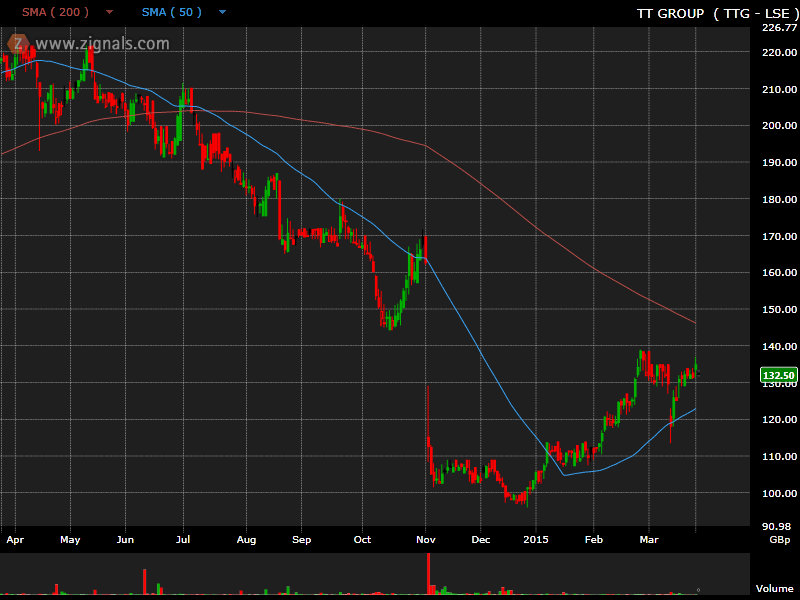
The share price has been in recovery mode recently but I still remain cautious.
On the 16th March it was announced that Norges Bank had sold 2,534,989 shares at a value of about £3M to give them a 3.53% holding. This is a large sale and does not do much for confidence.
On the 9th April the group announced that Chairman, Sean Watson was retiring from the board after spending five years in the role. He will be succeeded by Neil Carson, the former CEO of Johnson Matthey.
On the 12th May the group released a trading update for the first four months of the year. Overall trading was in line with expectations with revenues in line with the previous year and an order book that remained sound. The operational improvement plan continued to progress to schedule with the transfer of nine lines from Germany to Romania now completed with five of the lines also fully qualified. Management continues to expect the programme to be completed in the first half of 2017. The outlook for the rest of 2015 remains unchanged with profits apparently still expected to be second half weighted. A steady update then and one could be forgiven for thinking that the worst might be over for the group.
On the 15th May it was announced that director Neil Carson doubled his share holding to 100,000 shares at a cost of £76.7K which is a decent purchase.