Waterman Share Blog – Interim Results Year Ending 2016

From July, trading undertaken by the Environment business unit has been consolidated with the Civil and Transportation consulting business to form an infrastructure and environment consulting business. Also, the results of the other international business unit has been included in the European business. I suppose if you can’t get a business to break-even point, just merge it with one that is profitable and job done!

Waterman has now released its interim results for the year ending 2016.

WTMincome

Revenues increased when compared to the first half of last year as a £2.3M growth in highways and transport outsourcing revenue, a £1.1M in structures revenue, a £1.3M growth in building services revenue and a £464K increase in European property revenue was partially offset by a £569K fall in infrastructure and environment revenue and a £561K decline in Australia property revenue due to the weaker Aussie dollar. Staff costs increased by £1.6M and other operating expenses were up £1.6M so that the operating profit increased by £718K. Income tax expenses were up £194K which meant that the profit for the period was £1.2M, a growth of £629K year on year.

wtmassets

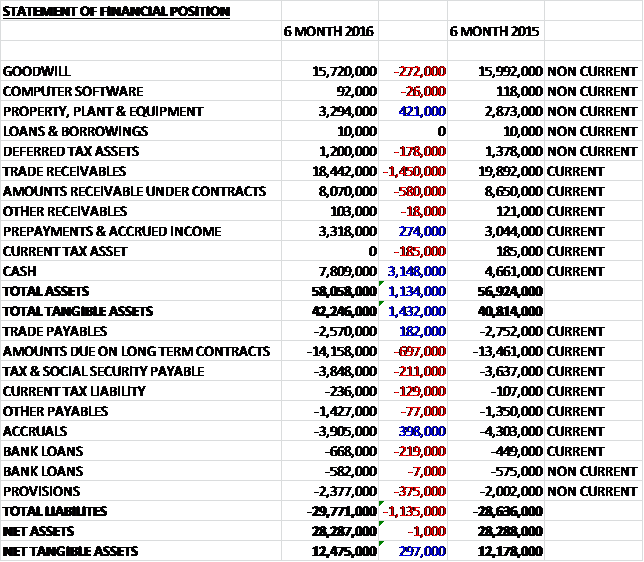
When compared to the end point of last year, total assets increased by £1.1M driven by a £3.1M growth in cash and a £421K increase in property, plant and equipment, partially offset by a £1.5M decline in trade receivables and a £580K fall in amounts receivable under contracts. Total liabilities also increased as a £697K increase in amounts due on long term contracts and a £375K growth in provisions was partially offset by a £398K fall in accruals. The end result is a net tangible asset level of £12.5M, a growth of £297K over the past six months.

WTMcash

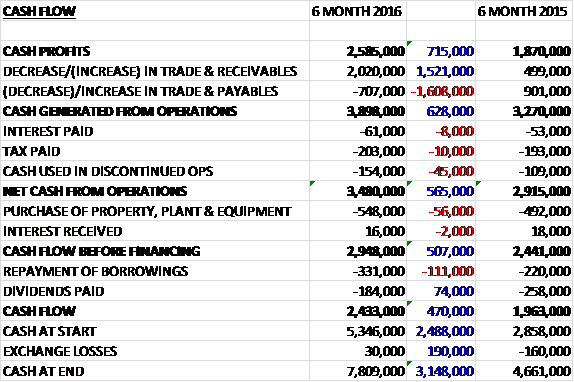
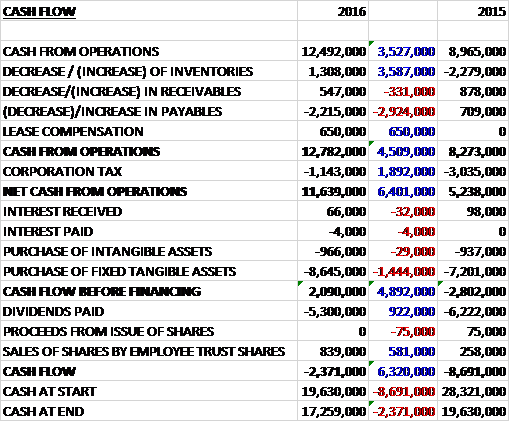
Before movements in working capital, cash profits increased by £715K to £2.6M. There was a cash inflow from working capital with a fall in receivables, benefiting from early customer receipts ahead of the calendar year end, and after modest increases in taxes paid and cash used in discontinued operations, the net cash from operations came in at £3.5M, a growth of £565K year on year. The group spent just £548K on property, plant and equipment so that there was a free cash flow of £2.9M. They then spent £331K on repaying loans and £184K on dividends to give a cash flow for the period of £2.4M and a cash level of £7.8M at the period-end.

The operating profit at the Structures business was £650K, a growth of £93K year on year and the operating profit at the Building Services business was £150K, a decline of £104K when compared to the first half of last year with investment continuing in the recruitment of additional staff and design software A number of new commissions within the property team are yet to release profits as they are still at the early stages of design.

The group continues to win and deliver new projects. Friars Walk, a 38,000m2 retail development in Newport opened in November and construction has started on the 80,000m2 retail development at Westgate Oxford by Land Securities and the Crown Estate, both projects where the group designed the structures. The 42,000m2 Victoria Gate retail development in Leeds, on which the group are the structures and building services designers, reached a significant milestone with the completion of the highest structural point of the development.

The group is the designer for Capital & Countries Properties on three of their developments which have started on sites around Covent Garden. They are all mixed use retail and residential developments with a combined area of over 11,000m2. In addition to these projects, they are also assisting them on their masterplan for the 77 acre Earls Court Development. Several commercial projects in the City of London have made significant progress on site over the past six months. In particular, Angel Court by Mitsui Fudosan and Stanhope and New Street Square by Land Securities, which is pre-let to Deliotte, are nearing the completion of the construction of the structure.

The operating profit at the Australia business was £336K, a fall of £120K when compared to the first half of 2015 with part of that decline due to the weakening of the Australian dollar. Revenues were also lower but Q2 improved after a poor Q1. The business has continued to win new commissions, particularly in the healthcare market. They have been appointed to design the building services on the A$200M Joan Kirner Women’s and Children’s hospital which will be the third largest maternity hospital in the state of Victoria.

The operating profit in the European business was £118K, an increase of £46K year on year. In Ireland the group have been appointed for the redevelopment of the Clerys Building in Dublin which is a £50M mixed use scheme for D2Private. They also advised Hammerson and Allianz Real Estate on their £1.34BN acquisition of a portfolio of retail assets in Dublin from Ireland’s National Asset Management Agency.

The group also provided engineering and environmental due diligence studies for the £335M acquisition by Hammerson of the Grand Central Shopping Centre in Birmingham. The scheme is developed by Network rail and Birmingham City Council as part of the £750M New Street regeneration project.

The operating profit at the Infrastructure and Environment Consulting business was £23K, an improvement of £301K when compared to the first half of last year. The streamlining of the business resulted in more focused units and there were significantly fewer historic commissions passing through the business which had previously adversely affected profitability. The business was very active, advising clients across all markets throughout the UK.

They continue to provide pre-planning support on major urban regeneration projects in London including Battersea Power Station, Brent Cross and Old Oak Park. More recently they have advised on the proposed development of the old Shredded Wheat factory site in Welwyn Garden City for Spen Hill Developments, the redevelopment of Royal Mint Court opposite the Tower of London for Delancey and LRC, and the redevelopment of the Elephant & Castle shopping centre for Delancey and APG. They are also assisting British Land with engineering and environmental advice for the development of a masterplan for the 46 acre mixed use regeneration of Canada Water.

The operating profit at the Highways and Transportation outsourcing business was £579K, a growth of £253K year on year with staff numbers increasing by 22%. The autumn statement by the chancellor confirms the government’s commitment to invest in highway and transport infrastructure which bodes well for the continued flow of new projects and commissions. The board are expecting demand for these services to grow which should increase operating margins in future years. They currently provide highways and transportation engineers to over fifty local authorities and highways departments throughout the UK.

It is worth noting that this company seems to have quite a lot of overdue receivables as over 55% seem to be overdue and over 15% were impaired. This is actually an improvement on the prior year but it still seems high to me. Also, as touched upon before, there is a hefty LTIP award here that has the potential to be quite dilutive. There are 3,000,000 nil-cost options outstanding, all of which will vest of the share price remains above 150p for a short period of time. This is not a very stretching target and seems rather greedy in my view.

Going forward the board expects further progress to be made during the second half of the year and beyond and they expect to continue to generate repeat business year on year whilst the UK economy is strong.

At the period-end the group had a net cash position of £6.6M which was an improvement on the £3.8M net cash position at the year-end. A the current share price the shares trade on a forward PE of just 10.5 and after a 50% increase in the interim dividend the shares are yielding 2.9% which increased to 3.7% on the full year consensus forecast.

Overall then, this has been a strong period for the group. Profits were up, net tangible assets increased and the operating cash flow grew with plenty of free cash being generated. The structures business performed well, as did the Irish business and the Highways and Transportation outsourcing division which looks very strong. The Infrastructure and Environment business hit break-even, although this was mostly because the loss making business has been merged with the profitable environment one. This is perhaps a little unfair, as it has also been streamlined and there were fewer historic commissions affecting profitability.

The Australian business fared less well, in part due to weakness in the Aussie dollar, and the Building Services business also suffered a decline in profitability due to continued higher investment. The shares do look cheap with a forward PE ratio of 10.5 and yield of 3.7% and I am tempted to take a position here but I am held back by Brexit worries and the possible effect it would have on the UK economy. I will have a think about this and may add.

On the 11th May the group released a trading update covering Q3. Their trading performance has remained in line with board expectations with revenue in the first nine months of the year 10% above the prior year period. The board continues to anticipate that results for the current year will show a significant increase in adjusted operating margin and cash collection has been strong with group net cash at the year-end now expected to be above the current market forecast.

This is all reassuring stuff but I feel a bit overexposed to the sector at the moment with the looming Brexit vote so I will probably sit this one out.

On the 16th June the group announced that CEO Nick Taylor purchased 32,756 shares at a value of £28K to give him a total holding of 212,525.

On the 27th June the group announced that it has been commissioned to provide advice on two riverside residential projects in West London. They have been appointed by Pinenorth Properties structural designs for the 4.5 acre Tedding Film Studios riverside site where planning consent has been granted for over 200 apartments. Demolition of the existing buildings is currently ongoing and construction of the new apartments will start this year.

A second commission recently received from Reselton is to provide environmental and structural advice for the planning application for the 22 acre Stag Brewery site adjacent to the River Thames at Mortlake. This site is being developed for residential, retail, hotel and leisure use. This is good stuff, clearly designed to halt the share price collapse after the Brexit vote.

On the 28th July the group announced the start on site of the Capital Dock development by Kennedy Wilson in Dublin where they have been appointed to provide civil and structural engineering services. The project includes 30,000m2 of office space and 190 homes across three buildings, one of which will be the tallest tower in the city.

On the 1st August the group released a trading update covering the year ending June. The board expects to report results which exceed its previously declared objective of tripling annual pre-tax profit to £3.3M over the three year period to June 2016. An emphasis on working capital management has resulted in a significant improvement in the cash position and they expect to report net cash of £5.4M compared to £3.8M at the same point of last year and £6.6M at the half year point.

Whilst the recent EU referendum decision has generated a period of uncertainty for markets, the board feel it is too early to speculate what impact there will be on future prospects. In the five weeks since the referendum they have continued to experience good levels of enquiries and have been appointed for several new commissions.

So, this seems to be a good performance but this was never really in doubt. More important is future prospects but despite holding up OK, as the group say – it is just too early to tell.

On the 22nd September the group announced that it had been appointed by Canary Wharf Group to provide structural engineering for a significant development at Canary Wharf. They are assisting them with their plans for a further phase of the overall development which is likely to involve over 200,000 square metres of mixed use buildings.

N. Brown Share Blog – Final Results Year Ended 2016

N Brown has now released its final results for the year ended 2016.

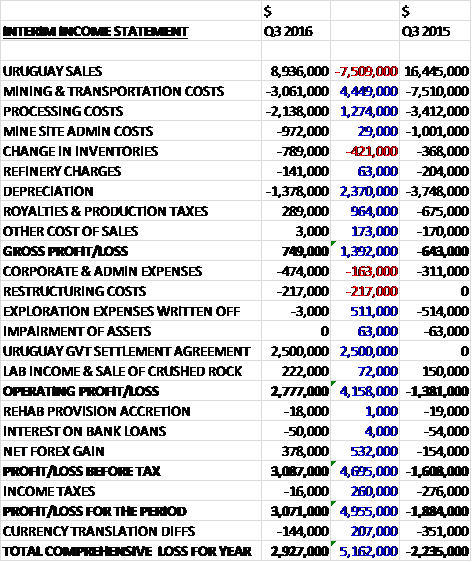
BWNGincome16

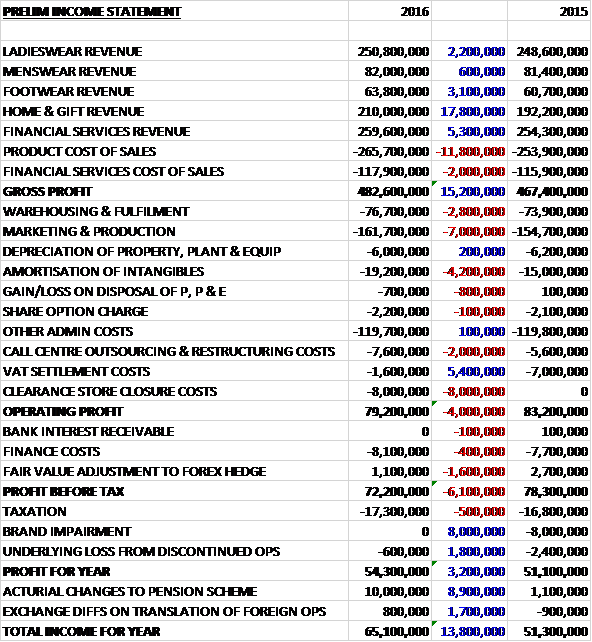
Revenues increased when compared to last year due to a £17.8M growth in home and gift revenue, a £5.3M increase in financial services revenue, a £3.1M growth in footwear revenue and a £2.2M increase in ladieswear revenue. Cost of sales also increased but the gross profit was some £15.2M above that of 2015. Warehousing and fulfilment costs were up £2.8M due to higher volumes, marketing and production costs increased by £7M as the creative production function was outsourced, resulting in some costs shifting from payroll to marketing, and amortisation was some £4.2M higher due to more investment in intangibles. We also see a £2M increase in restructuring costs and an £8M charge relating to clearance store closures, but this was somewhat offset by a £5.4M fall in VAT settlement costs which meant that the operating profit fell by £4M. We then see a £1.6M reduction in the changes in the forex hedge value but there was no brand impairment which accounted for £8M last time and there was a £1.8M reduction in the underlying loss from discontinued operations which all meant that the profit for the year came in at £54.3M, a growth of £3.2M year on year.

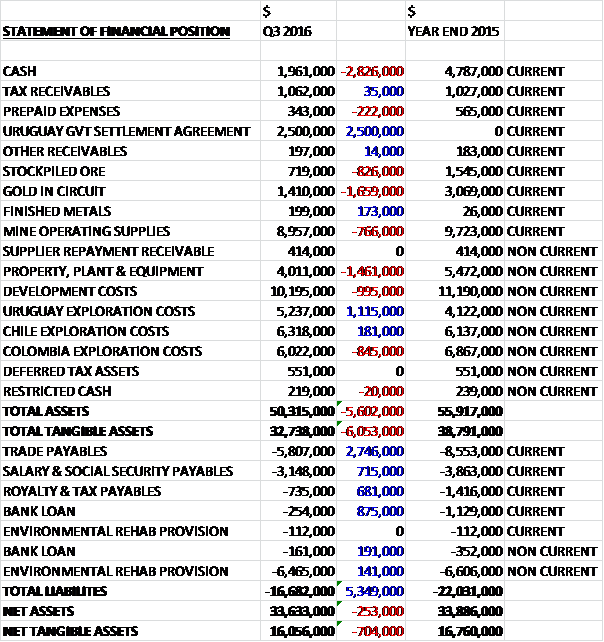
BWNGassets16

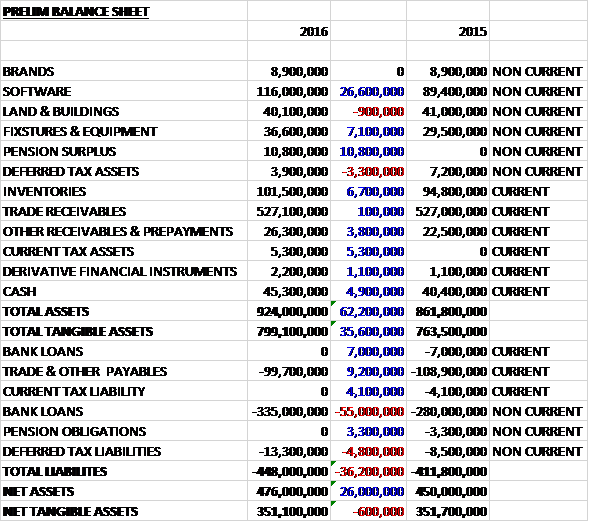
When compared to the end point of last year, total assets increased by £62.2M driven by a £26.6M growth in software, a £10.8M increase in pension assets, a £7.1M growth in fixtures and equipment, a £6.7M increase in inventories, a £5.3M hike in current tax assets and a £4.9M growth in cash, partially offset by a £3.3M fall in deferred tax assets. Total liabilities also increased during the year as a £48M increase in the bank loan and a £4.8M growth in deferred tax liabilities were partially offset by a £9.2M fall in payables and a £4.1M decrease in current tax liabilities. The end result was a net tangible asset level of £351.1M, broadly flat year on year with a decline of just £600K.

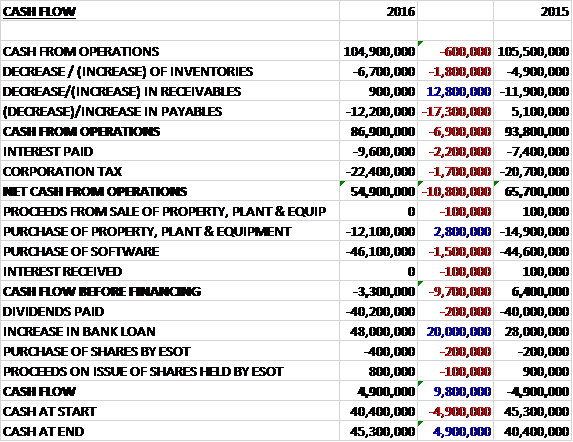
BWNGcash16

Before movements in working capital, cash profits fell by £600K to £104.9M. There was a large cash outflow from working capital as inventories grew driven by the timing of the new season intake, and payables fell which meant that after the interest costs increased by £2.2M and tax payments were up £1.7M, the net cash from operations came in at £54.9M, a decline of £10.8M year on year. The group spent £46.1M on software relating to the Fir for the Future programme and £12.1M on tangible fixed assets related to the warehouse extension, which gave a cash outflow of £3.3M before financing. They then increased the loan so they could pay out £40.2M in dividends which doesn’t seem that sensible to me. In all, there was a cash flow of £4.9M for the year to give a cash level of £45.3M at the year-end.

Overall the performance in 2016 was in line with expectations with a strong 11% profit growth in H2 with a good Christmas trading period. They saw a flat market share in ladieswear but within this they gained market share in younger fashion, driven by Simple Be and saw a small decline in the older age groups as a result of the underperformance of their traditional segment. There was a 20 basis point increase in menswear market share which was driven by Jacamo. In Q4, product revenue declined by 3.5% but financial services revenue was up 8.1% which meant that overall continuing revenue increased by just 0.2%, the weakest quarter during the year when compared to 2015, although it remained relatively unchanged when compared to Q3.

One area of focus has been expanding the offering of third-party brands and the ranges with Sprinkle of Glitter and Coast performed particularly strongly. In the last six months they have also launched collections from Scarlet & Jo, Studio 8 by Phase 8, Eden Row and Luke. In March they launched their first homewares range with Lorraine Kelly, building on the success of her womenswear and footwear ranges. The range consists of interior accessories across two trend collections and includes bed linens, lighting, soft furnishings and home accessories.

The group saw a reduction in returns with the returns rate improving by 120 basis points to 27.4% which was driven by the relative outperformance of homewares and menswear, improvements to the product quality and fit, and the increase in cash customers. Inventory clearance across the industry is moving online and as a result of this dynamic, the group closed their clearance stores in the first half. They are developing new online clearance tools and will be taking the opportunity to leverage these capabilities and reduce the aged inventory position over the course of 2017.

Online revenue was up 15% and online active customer numbers increased by 13%. Online penetration stood at 65%, a 6 percentage point increase but the online conversion rate was flat at 5.8%, although this was significantly above the industry average.

Financial services performed well during the year and continues to be an important enabler of the business. Revenue was up 2.1% to £259.6M but credit arrears over 28 days stood at 10.9%, an increase from the 10.3% recorded last year, driven by new customer recruitment. The provision rate improved from 16.1% to 15.6% with the improving trend a direct result of the work done over the past two years to tighten up the credit policies and help customers in financial difficulties. In 2017 the board expect both the provision rate and the arrears rate to reflect increased levels of customer recruitment and increase slightly.

Currently half of new customers opt to open a credit account, with about half being cash customers. Whilst less profitable, cash customers generate attractive returns, and are important in terms of driving growth and enabling the group to gain economies of scale. Once their new financial services offering is live they will aim to convert some of the cash customers to account customers. Over Christmas the group ran a small trial on a few of their brands offering 0% interest to new customers. The initial results of this trial are positive, but they need to assess the behaviour of customers who took up the offer over the course of the current season before they will be able to fully judge the result.

The Credit release of Fit for the Future goes live from autumn 2016 with the main brands moving onto the new credit platform in early calendar 2017. The new platform will allow the group to charge variable APRs for the first time as well as offer promotional interest free periods and other new credit products. In common with the wider industry, they are now regulated by the FCA having historically been regulated by the OFT and the FCA application is progressing in line with expectations.

The JD Williams brand continues to perform well, as the improvements the group are making to their products, their PR activity and their digital marketing campaigns continue to yield results. This season they significantly extended the menswear range within the brand and the performance exceeded expectations. The loyalty scheme launched in May 2015 continues to drive encouraging results in both frequency of spend and customer retention. Revenue from the brand was £151.2M, up 4.7% year on year with online penetration up 6ppts to 51% and online penetration of new customers up 13ppts to 65%.

Simply Be revenue was up 15.6% year on year to £103.9M The online penetration of the brand is 89% and 97% of new customer orders. The group improved their digital marketing expertise and social engagement, championing size inclusivity and body confidence. The new SS16 campaign has been well received and the board believe the brand offers a good global growth opportunity.

Jacamo revenue was up 14.6% to £62.8M. Online penetrations stands at 90% and 97% of new customer orders. They group have made significant product improvements, focused on broadening the brand appeal, the styling of the product range and the fit out of smaller sizes which resulted in strong sales and a reduction in the returns rate for these sizes.

The traditional titles such as Ambrose Wilson, House of Bath and Premier Man, have been disappointing with revenue down 5.5%. The board have taken a number of actions to improve performance including establishing a dedicated marketing team, changing their approach to promotions and giving a renewed focus on ensuring the product offering is what the customers actually want. The low online penetration of this segment means that it is likely to take until the autumn before performance is improved but they are confident that these actions will yield results.

The systems transformation project is progressing well. During the half the group launched the Simply Be Euro website and Powercurve, the foundation of the credit released and both launches were made on time. The benefits of the project are expected to ramp up from 2018 onwards and some of these benefits will be invested back into the business. The timetable for the project remains unchanged. This August they plan to start the roll out of the new web platform and new financial services platform, initially to the US, and then to a number of the smaller UK brands in September. The main brands will move onto the new systems in early 2017, after peak Christmas trading.

In May the roll out of the first phase of the planning transformation will be completed, giving the group improved tools for assortment and range planning. This will allow them greater visibility, control and consistency. The second phase of the planning release, which will give them item-level forecasting tools, improving markdown efficiency will go live in early 2017.
The warehouse extension at the main warehouse facility in Shaw is now complete and in the process of coming on stream. The project was completed on time and budget and the new facility has doubled throughput and importantly materially improving the next day availability of products.

US revenue was up 29%, aided by favourable forex movements and the business made a dollar profit in H2 with the operating loss for the year falling form £2.5M last year to £1M. The significant improvement year on year was driven by continued marketing efficiency, a small amount of financial income as a result of the relationship with Alliance Data, an improvement in promotional efficiency and a small charge for delivery.

In March the JD Williams brand was launched in the US and whilst early days, the initial performance has been encouraging. The new international web platform goes live in the US in August. This will give the group much improved personalisation tools and a more agile site from an operations perspective. Until this platform is live, they will remain in cautious expansion mode in the country with a focus on further improving customer loyalty, building brand awareness and increasing profitability.

The Ireland business delivered a decent performance this year with revenue growth of 4% on constant currency terms. The revenue growth was driven by new customers who are responding to their improved product offering. The business suffered due to the decline in the euro, however, and in sterling terms revenues were down 7% to £13.4M.

The stores remain a small part of the group overall but sales from the store estate were up 18% to £27M. The operating loss was £1M versus £800K last year and there remains more to do in terms of improving the efficiency of the estate. They group have 14 dual fascia Simply Be and Jacamo stores and the long term strategy is to have 25 in total, covering 85% of the UK population.

As with most years, the group have recorded a number of “exceptional costs”. Strategy costs of £7.6M relate to reorganisation costs and the outsourcing of IT maintenance whilst last year the £5.6M charge related to the outsourcing of the call centre. The VAT costs of £1.6M are legal and professional fees related to ongoing disputes with HMRC. Last year these charges of £7M related to a potential settlement with HMRC in respect of VAT recovery on bad debts written off over a number of years. Within the year-end VAT debtor is an asset of £21.7M which has arisen as a result of cash payments made under protective assessments raised by HMRC and based on legal opinion, the group believe that they will recover this amount in full and are engaged in a legal process to do so. In the first half of the year the group closed their retail clearance stores and the exceptional costs of £8M relate to stock write downs, onerous lease provisions and other closure costs. In all, these “exceptional” costs were £17.2M this year compared to £12.6M last year.
There are a number of risks facing the group. A key risk the delivery of their transformation project, Fit for the Future. This is due to be delivered in 2017 and the scale of the changes means that the success of the business in meeting its expectations for profitability is linked to the success of the project. Business continuity plans are in place and the group has further migrated IT systems and data security risk within the business through outsourcing IT services to a specialist IT provider. The Chairman has suggested that a programme on this scale will likely bring some “unexpected bumps in the road” which sounds ominous.

Also, they continue to review their compliance with the CCA and submitted an application to the FCA for full authorisation in September. Whilst the board consider that they are compliant, there is a risk that the eventual outcome may differ.

Following the appointment of KPMG as auditor, the group determined that it was necessary to make a change in the technical interpretation of IAS39. The revised interpretation relates to the judgement over whether a credit loss has been incurred when interest or other charges are temporarily waived, even for customers who ultimately repay their full capital balance. For customers who find themselves in financial difficulties, the group may offer revised payment terms but for these customers the group’s financial statements now reflect an impairment provision for the foregone interest income upfront and they recognise interest or other income over time on the impaired balances. Previously the group was focused on the capital element of receivables and did not consider loss of interest as an impairment loss. Last year this had the effect of increasing profits by £1.7M but reducing net assets by £46.6M due to the fall in receivables.

Going forward in 2017 the board are expecting product margin to fall by 50bps to 150bps due to forex headwinds, the clearance of aged inventory and tactical price activity to drive market share growth in a challenging market. Group operating costs are expected to grow by between 2% and 4%, capex is expected to be around £40M and exceptional costs of £2M are expected due to the ongoing tax disputes with HMRC.

Trading since the year-end has been subdued with sales lower year on year. The industry backdrop has been more challenging since January and the group have also adjusted their marketing approach this year, shifting from large TV campaigns to a more phased approach with increased investment in digital channels. This new approach delivers a better return on investment when viewed across the season as a whole so the board are expecting to see performance strengthen over the half. Forex rates also represent a significant challenge year on year with the strengthening US dollar against the pound giving a £3M profit headwind in 2017 with every 0.05 rate move in the exchange rate representing a £1M impact on profits, but overall the board remain confident of making further progress this year.

At the year-end the net debt position was £289.7M compared to £246.6M at the end of last year. At the current share price the shares are trading on a PE ratio of 13.9 which reduces to 11.2 on next year’s consensus forecast which doesn’t seem too taxing. After the final dividend was kept the same, the shares are yielding 5.3% which is also expected to be the yield next year too.

Overall then this has been a bit of a sluggish year for the group. Profits were up but this was only due to losses and impairment last year from discontinued operations and continuing profits fell modestly. Net tangible assets were broadly flat and operating cash flow declined with no free cash being generated after the investments in IT and the warehouse. Operationally, Jacamo and Simply Be are performing very well but this is offset by slower growth elsewhere and a decline in sales from the traditional brands. The US business is nearly at the breakeven point, though, and I must say I like the cautious approach to this market.

There are a number of issues facing the group, however. The fact that many of the products are purchased in US dollars mean that recent forex movements are unhelpful and the very expensive Fit for the Future programme could cause some teething issues this year. Indeed there are several warnings in this update stating that projects this size often have issues so I am fully expecting something to come out of the woodwork. When this is combined with subdued trading so far this year which is behind last year, despite the forward PE of 11.2 and yield of 5.3% looking good value, I am steering clear for now having sold out at a small loss.

On the 22nd April it was announced that CEO Angela Spindler acquired 18,000 shares at a cost of £49K which gives her a total of 93,295 shares.

On the 16th June the group released a trading update covering Q1. Group revenues were down 0.2% year on year with a 3.4% growth in financial services more than offset by a 1.6% fall in product revenues. Overall trading was in line with board expectations and the guidance for the year remains unchanged. The growth in financial services was driven by the increase in new credit customers. JD Williams, Simply Be and Jacamo continue to outperform the wider group and revenue from the traditional segment has continued to decline.

Simply Be and Jacamo revenues were both up year on year, driven by ongoing product improvements and the new season campaigns which are resonating well with the target customer bases with both brands seeing a significant increase in their active customer files. The JD Williams brand saw double digit growth but revenues for JD Williams as a whole were slightly down due to a weak performance from the Fifty Plus title.

Product revenues in Fashion World Figleaves, High and Mighty and Marisota were marginally lower year on year with Fashion World being the strongest performer. The traditional segment saw a mid-single digit decline in product revenues, in line with the performance reported at the final results stage. Actions have been taken to rectify this but although early signs are encouraging, it will take until H2 for them to positively impact performance.

During the period the group ran targeted promotions in order to drive revenue which resulted in a low single digit decline in average selling price, which was more than offset by an increase in average units per basket. The USA business saw Q1 revenue up 25% year on year with an increase of 17% at constant currency. The group remain in cautious expansion mode in the country, ahead of the new international web platform going live in August.

They had a good performance in the financial services division with the increase in revenues being driven by interest payments from new credit customers. The board continue to expect both their arrears rate and provision rate to increase slightly during the year, however. The full FCA authorisation application is progressing in line with expectations.

The Fit 4 the Future transformation project remains on track and to budget. They have now completed the roll out of the first stage of their new merchandising system as planned and are now in testing phase for the new web platform and credit systems with the next significant milestone being the launch of the new US website in August.

So, it doesn’t appear that much has changed for the group and I am staying away for now.

On the 21st September the group announced that JD Williams had been granted full FCA authorisation. The group’s new US web platform is scheduled to go live within the next few days, slightly later than planned. Learnings from this launch will be incorporated into the plan for the roll out of the new UK web platform and financial services system. This will result in a change to the previously communicated timetable with further details being released at the interim results.

The group has identified an error in relation to its previous calculation of financial services customer complaint redress. A detailed review is being undertaken but they currently anticipate that this will result in an exceptional cash cost of between £5M and £8M.

Waterman Share Blog – Final Results Year Ended 2015

Waterman provides engineering and environmental consultancy advice to the property and infrastructure markets. They operate in two business segments: property and infrastructure & environment. The Property segment encompasses the UK Structures and Building Services businesses which are involved in development projects both in public and private sectors. In addition, this segment includes the overseas business in Australia, which is partly owned by the group, Ireland and Poland which are solely involved in the engineering design of buildings. The group also operate an outsourcing office in India which solely provides draughting services for the UK structures team.

In Australia the group have businesses in Melbourne and Sydney with a 51% ownership of the business in Melbourne and a 100% ownership of the Sydney business. The Australian operation primarily provides building services consultancy advice to the public and private sectors. The majority of the revenue is generated from healthcare, educations, prisons, residential, technology and bank fit out markets.

The group has a number of long term contracts that span more than one year. In calculating revenue, the percentage of completion method is used, based on a review of contract progress and the proportion of contract work completed in relation to the total contract works. Profits are only recognised where they can be reliably measured, which is normally after the contract has reached 40% completion. Contract costs comprise direct labour, direct expenses and attributable overheads. Gross amounts due from customers are stated at the value of the costs incurred plus recognised profits less recognised losses where they exceed progress billings. Progress billings not yet paid by customers are included within receivables. To the extent that progress billings exceed costs incurred plus recognised profits they are included in payables as amounts due to customers on long term contracts.

Waterman has now released its final results for the year ended 2015.
Waterincome

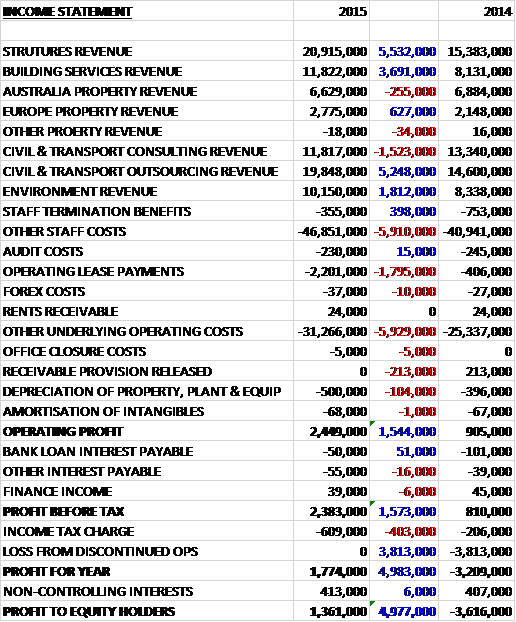
Revenue increased when compared to last year as a £1.5M fall in civil and transport consulting revenue and a £255K decline in Australia property revenue was more than offset by a £5.2M growth in civil and transport outsourcing revenue, a £5.5M increase in structures revenue and a £3.7M growth in building services revenue. Underlying staff costs increased by £5.9M and operating lease payments were up £1.8M with other underlying operating costs increasing by £5.9M which meant that after the lack of released provisions which were £213K last year and a £104K increase in depreciation, the operating profit increased by £1.5M when compared to 2014. There were negligible changes in the finance costs but tax costs were up £403K and there was no loss from discontinued operations which cost £3.8M last year so the profit for the year came in at £1.4M, a positive movement of £5M year on year.
Waterassets

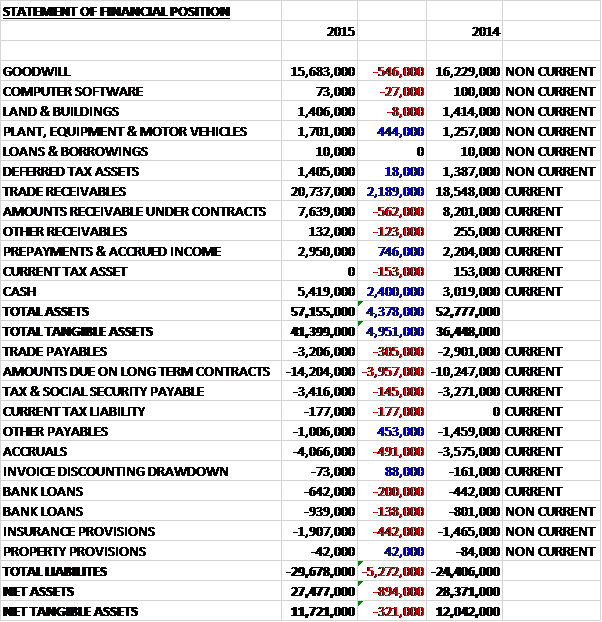
When compared to the end point of last year, total assets increased by £4.4M driven by a £2.4M growth in cash, a £2.2M increase in trade receivables and a £746K growth in prepayments and accrued income, partially offset by a £546K decline in goodwill and a £562K fall in amounts receivable under contracts. Total liabilities also increased during the year as a £4M growth in amounts due on long term contracts, a £491K increase in accruals and a £442K growth in insurance provisions were partially offset by a £453K fall in other payables. The end result was a net tangible asset level of £11.7M, a decline of £321K year on year.
Watercash

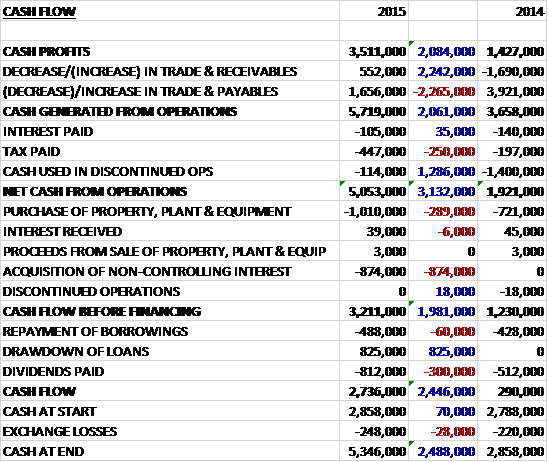
Before movements in working capital, cash profits increased by £2.1M to £3.5M. There was a cash inflow from working capital, although it was broadly similar to last year but tax payments increased by £250K and there was £1.3M less cash used in discontinued operations than last time so the net cash from operations was £5.1M, a growth of £3.1M year on year. The group then spent £1M on fixed tangible assets and £874K on the acquisition of some non-controlling interests in the Australian business so the free cash flow was £3.2M. Of this, £488K was used to pay back borrowings and £812K went on dividends but there was also an £825K draw-down of new loans so I suspect these figures have been massaged somewhat to show a good cash position at the year-end. In any case, there was a cash flow of £2.7M and the cash level at the year-end was £5.3M.

Overall, the UK business grew by 25%, significantly ahead of the published 7% growth in output of the UK construction industry in the year. In Australia they delivered a consistent financial performance even though the slowdown of China’s growth has impacted on the local economy. The office in Dublin has reported improving trading conditions as the requirement for new office space and residential properties increases. Whilst fee levels remain competitive, there are some signs of improvement particularly in the Highways and in the private development sectors.

During the year the group have recruited an additional 151 staff, an increase of 14%. This recruitment has impacted on the operational costs and margins in several of the businesses as it has proved necessary to recruit through agencies involving on off recruitment fees. The majority of the group revenue is generated from London based clients comprising major development companies, banks, pension and property investment finds. They are experiencing an increase in retail sector activity with 160,000 m2 of development designed by the group currently under construction on sites in Leeds, Newport and Oxford.

The operating profit in the Property businesses was £2.6M, a decline of £500K when compared to last year on margins that fell from 9.5% to 6.2% as the group needed to invest in the recruitment of additional technical staff to service the greater workload and salary costs have increased in line with the market.

The operating profit in the Structures division was £1.1M, a decline of £346K year on year on margins that fell from 9.7% to 5.3%. It has been necessary to increase headcount during the period to meet their client’s requirements and this has resulted in additional costs being incurred for one off agency recruitment fees which has reduced the operating profit and margins. The enhanced capacity within the team will be available to service the increasing workload and therefore the investment in staff should lead to higher margins in future.

The business continues to win awards for the structural design of buildings in all markets such as offices, retail and residential. One of the residential projects, Neo Bankside situated next to the Tate Modern, was shortlisted for the Royal Institute of Architects Stirling Prize.

The operating profit in the Building Services business was £452K, a fall of £122K when compared to last year on margins that fell from 7.4% to 4.2%. In October 2014, the Everyman Theatre in Liverpool won the Stirling prize for the ingenious use of natural ventilation to provide cooling in the theatre. This design involved the development of computerised thermal modelling to predict the future temperatures within the auditorium, thereby enabling the building services design to be finalised.

Tenant demand continues to drive towards commercial development, particularly in London where projects have provided a high proportion of the group’s revenue this year. They are also experiencing increased demand for their services in cities such as Manchester and Birmingham where developments are moving forward to tender and construction.

The group provided multidisciplinary services on the Land Securities development at New Ludgate in London which comprises office space located above retail units on the ground floor.
Following the completion of the project, the group has been retained by Land Securities on New Street Square in London which is a 27,000m2 pre-let to Deliotte. An unusual commission which is progressing on site is Angel Court in London developed by Mitsui Fudosan and Stanhope. This 27,000m2 project has involved the retention of significant parts of the existing core structure which is enclosed with a new steel superstructure incorporating an efficient building services system.

The Building Services team have been appointed by Generali to provide consultancy services on 10 Fenchurch Avenue which is a 46,000m2 mixed use office development located in the centre of London’s insurance district. The 17 storey building has been designed by the group to have an energy efficient façade to reduce solar gain while maximising useful daylight. In Birmingham the group has recently been appointed by Legal and General on their 15,000m2 Temple Court development.

In the residential market the demand the group’s structural and building services has been high. The Clarges development by British Land opposite the Ritz hotel in London where the group is providing a multidiscipline service, includes a new HQ for the Kennel Club. This 18,000m2 residential project provides 34 apartments arranged over ten floors. Two Fifty One is located in Elephant and Castle. This whole district is undergoing an extensive redevelopment and the group originally provided environmental planning advice on the regeneration of the area. The development is a 41 storey residential tower designed by the group in conjunction with Laing O’Rourke using their prefabricated system for the structure and building services systems.

Another project under construction is Tribeca Square at Elephant and Castle which comprises 40,000m2 of high quality residential homes for developers Delancey and Oakmayne. The group is appointed to provide structural engineering design services to Barratt on the development of the Sainsbury Nine Elms site. On completion, this site will deliver over 700 new residential units in Vauxhall. Recent completions include Buildings P1 and T1 for Argent at Kings Cross which provide over 300 luxury apartments.

Within retail and urban regeneration, several of the group’s clients’ town centre retail led developments designed by the group have progressed onto the construction phase. They are currently providing advice on over 600,000m2 of future retail development, of which over 160,000m2 is currently on site.

Large retail developments can often take many years to proceed through planning to completion and these projects provide good opportunities for the group to provide consultancy services at all stages. They are currently moving into a period where retail commissions will be providing an increasing proportion of revenue. Their extensive track record has enabled them to secure commissions on the next series of large retail centres moving through the planning system such as Brent Cross in London and Whitgift Centre in Croydon.

Projects designed by the group include Friars Walk in Newport, a 38,000m2 retail led development for Queensbury Real Estate which is opening in autumn 2015. The 42,000m2 first phase of Victoria Gate in Leeds commenced on site in 2014 and involves the construction of a John Lewis store and retail units. The group has been involved in this project for over ten years providing planning and preconstruction services to the developer, Hammerson, for the 100,000m2 development. They are currently providing design services for structures and building services to Sir Robert McAlpine who appointed for the construction of the first phase of the project with completion in 2016.

The third development designed by the group, which recently commenced on site, is the 80,000m2 extension to the Westgate Centre in Oxford for Land Securities and the Crown Estate. This project is due for completion in autumn 2017 and is anchored by a 14,000m2 John Lewis store with retail and leisure units along a mall leading onto the existing shopping centre, which is also being refurbished. In London the group has provided consultancy services to the Crown Estate on their projects in Regent Street. The latest development is St. James Market which provides 31,000m2 if mixed use retail and commercial space in two significant buildings between Haymarket and Lower Regent Street.

In the Leisure industry, the group is providing building services to Reignwood Group on the redevelopment of Ten Trinity Square of London. The original building was previously the HQ of the Port of London authority, is grade II listed and overlooks the Tower of London. The building is being retained and sympathetically transformed into a luxury Four Seasons hotel with 100 rooms. The complex routing and access requirements of the building’s services has been considered by the group to limit damage to any of the heritage areas and particularly the ceilings.

The group has been appointed by the British Museum to carry out a full energy review of their Bloomsbury site which extends over 75,000m2. This review will evaluate and proposed means of significantly reducing the carbon emissions from the buildings.

The Education market has remained a major sector for the group’s regional offices with commissions for primary and secondary schools plus further and higher education schools. As part of the Education Funding Agency priority school building programme, the group has been appointed as designers for the Harris Academy for 1,150 students and the Stratford Academy for 1,500 students in London. They are currently designing the Holywell primary and secondary schools as part of the North Wales schools framework. Construction is progressing and the schools are programmed for delivery in the summer for 2016.

In the North West they have been appointed to provide detailed design of six schools within the priority schools building programme. These schools are of significant importance as they represent the first series of schools designed to the new education funding agency design guidelines. There is a greater emphasis on computer simulation based design techniques and strict energy targets for all aspects of the building energy use.

The group’s regional involvement in industrial projects is increasing. They are currently providing design advice to Rolls Royce on their jet engine casing production facility in Nottinghamshire and Siemens have appointed them to design their new wind turbine factory in Hull. In Nuneaton they continue to provide multidiscipline consultancy services on the Motor Industry Research Association complex. The redevelopment of the site will provide a location for the European research and development of motor vehicles and associated components. It is expected that development will be phased over the next ten years.

As part of the ongoing framework with the Manufacturing Technology Centre, the group have designed a third technology building for their client in Coventry. This advanced manufacturing technology centre will showcase the cutting edge of British technology and provide teaching facilities for R&D engineering. The group have been appointed by Vinci to provide multidiscipline design services for the construction of Allerton Waste Recovery Park. This project is a 13,500m2 multi-treatment development comprising an energy from waste facility, a mechanical treatment facility and an aerobic digestion unit. The park will produce 220,000 MWh of renewable electricity per annum and is due for completion an operation in 2018.

The operating profit in the Australian business was £1M, a growth of 156K when compared to 2014 on margins that increased from 13% to 15.2% with demand remaining robust in many of the markets despite the slowdown in China. In Melbourne, justice, healthcare, residential, sports and recreational markets have provided a base workload for the office. During the year the group designed and documented the A$130M Royal Victorian Eye and Ear Hospital and the Monash Children’s Hospital with a construction value of A$260M. They have recently been appointed designers for the A$200M Sunshine Hospital Women’s and Children’s Centre and this will generate fee income over the next two years. Another appointment is the technical advisory role on the A$100M expansion of Casey Hospital in Victoria.

In the Sports and Recreation market, the group have completed the design of the Eltham Leisure Centre and Aquanation Aquatic Centre in Ringwood. They are currently designers for Franksten stadium and Bendigo Stadium. They have completed building services designs for the new A$40M Robert Bosch HQ on the Clayton Campus in Melbourne. New appointments include a technical advisory role at St. James Cook University in Cairns and building services designs for an $A150M residential development in St Kilda Road in Melbourne.

In Sydney, the residential, education, bank fit out and telecoms markets remain strong. The group have been appointed to provide building services design on the A$100M Northpoint retail and hotel development in North Sydney where the client wishes to use their 3D design and draughting capability on this project. In the residential market, Airlie Beach resort development providing 101 apartments in Queensland has recommenced and the group is appointed for both the building services and structural design. Universities have continued to generate revenue as they expand their campuses to accommodate overseas students. They are currently working on projects at UTS, Sydney University, University of South Wales, Wollongong University and Macquarie University.

The financial services sector is experiencing a roll out upgrades in the retail outlets of many high street banks. The group has been appointed to provide building services designs for the refits for Commonwealth Bank, Westpac Bank and St. George Bank across Australia. These are ongoing commissions and they have completed one hundred branches to date with an additional three hundred branch refurbishments expected to continue to generate revenue over the next three years.

The group relocated their offices from the outskirts of Sydney into a more central city location in February 2015. The new office provides better connections with clients, thereby reducing travel time. In addition they are aiming to recruit additional staff to service the increasing workload and the city centre location provides a greater access to the available staff pool in the city.

The operating profit in the European business was £48K, an increase of £47K year on year on margins of just 1.7%, although the business has returned to profitability after a number of very challenging years. The Irish economy recorded the strongest growth figures in the Eurozone last year and investment in commercial property in Dublin has increased significantly. The residential sector is also growing with a drive towards properties for lease rather than traditional housing for sale. Retail, hotel, industrial and logistics sectors are expected to become more active in the future. The property sector in Poland remains subdued, though, with some signs of increasing investment. The Warsaw team has therefore continued to provide technical support on London and Dublin projects.

The Dublin office has seen considerable growth in its residential workload in the year as projects start to move from the planning stage to construction. New commissions secured include the 200 unit Marrsfield apartment scheme and projects at Waterside Swords, Station Road Portmarnock, Oldourt in Firhouse and at Kilternan. Planning for phase 3 of the Clancy Quay development has also commenced. Construction is now underway at Royal Canal Park for Ballymore, Oldtown and Clongriffin for Gannon and at Clancy Quay and Central Park for Kennedy Wilson.

The group has been appointed by Green REIT to provide structural design services for a 13,000m2 office scheme at Central Park and by state agency IDA Ireland for an office development at Tralee Technology Park, County Kerry. Construction of a major refurbishment and extension to Baggot Court in Dublin has started and will provide 18,000m2 of grade A office space on completion. Planning stage services have also been completed for 35,000m2 of new development as part of the Capital Dock Scheme.

The retail sector remains more subdued, although there are signs of activity levels starting to pick up. Planning stage services have been provided for a major upgrade to Stillorgan Shopping Centre where the group are appointed to provide structural and building services engineering. Construction of Aldi’s Terenure store in Dublin, which incorporated elements of a historic tram terminus building, has recently been completed and is due to open for business in autumn 2015. They have subsequently been appointed for the design of several new Aldi stores.

The group continues to be one of the leading consultancies in the education sector in Ireland. Several new commissions have been secured, including the 32 classroom Harcourt Urban primary school which is to be developed as an exemplar project for the Irish Department of Education, a six hundred pupil secondary school in Galway, and the rapid build schools framework for 2015. For this latter appointment, they have already provided all civil and structural work required to obtain planning and to procure design and build contractors for new schools at thirteen sites. Detailed design has started for the 1000 pupil Kingswood secondary school in Dublin while construction of several primary school projects has been completed in the year.

The group have strengthened their teams through recruitment of additional senior and support staff. Their building services team, only established in 2014, has made better than expected progress and an increasing number of projects are now being awarded on a multi-discipline basis. As a result the group is well positioned to benefit from the recovery in the Irish economy.

In Warsaw they have completed a number of fit out commissions for tenants of the Pramerica Tower in Krakow, following completion of refurbishment work at the building in early 2015. Structural design work for a 34,000m2 office in Warsaw has now been completed with construction due to start in the coming months. They have been appointed to provide multi-discipline engineering services for Palace Park, a new leisure and residential community development south of Warsaw and feasibility work for a retail refurbishment and extension scheme at Zielona Gora. The operating loss in the other International business was £16K, a detrimental movement of £201K when compared to last year.

The operating profit in the Infrastructure and Environment segment was £200K, a positive movement of £1.8M year on year on margins for just 0.5% with the improvement in revenues primarily due to growth in the Highways and Transportation Outsourcing business which has experienced a strong demand for services. The actions taken in 2014 to restructure the management of the Civil and Transportation Consulting business and to reduce costs and increase utilisation has significantly reduced the losses in this business with the current year loss in part due to one off provisions in legacy projects as the underlying performance moves towards a profit in the future. The board anticipate that public sector frameworks and transportation planning will generate additional revenue in the near future.

The operating loss in the Civil and Transportation consulting business was £1.2M, an improvement of £1.7M when compared to 2014. Included in this loss are legacy issues from historic projects which have been protracted and one off provision of £500K on two projects where financial account settlements have been reached with clients. Following the restructuring of the business in 2014 significant improvements in the underlying performance have been achieved. It has now been streamlined and the forward order book has improved, giving confidence that it is on course to deliver a return to profitability in the future.

In Transport Planning, in the South the residential sector has provided a good revenue stream through the delivery of immediate supply sites as well as promotion of strategic land through local plans for clients including Linden Homes, Barratts, Crest Nicholson, Coca Cola, Cala Homes, Network Housing and Hyde Group. Key commissions included providing the transport planning advice on a major mixed use and residential development at Sampson House in Blackfriars, in addition to ongoing work advising the redevelopment of Cringle Dock adjacent to Battersea Power Station to provide a new waste transfer station with 450 residential units above.

The group continue to provide transportation and highways advice to the States of Jersey Development Corp for the six building finance centre on the St. Helier sea front. Following planning consent, they are also working with the new owner of the site adjacent to Hampton Court Station to further optimise the site layout and junction work for this residential led mixed use scheme. In Milton Keynes they have provided transportation advice to Hermes, the owners of the main retail centre, on their emerging development plans and have recently helped secure planning consent for a major new multi storey car park.

The Manchester transportation team has continued to grow and provide technical support to the teams across the North of England and Scotland. Notable commissions included assisting Peel Energy with the expansion of their Scout Moor onshore wind farm, and delivering numerous transport assessments for Scottish school projects commissioned through the Hub West Framework.

Within Transport Infrastructure and Highways, in London and the South East, having completed the design of the Bedford Western Bypass on behalf of the local council, the team is now retained for the £18M construction phase by J Breheny Contractors. They have also been providing transportation advice and support to a number of proposed allocations in local development plans that are being formulated throughout the UK. In the South West the team was appointed on a number of significant sized infrastructure schemes including a new link road and enabling works in Abbeymeads in Swindon, Crosshands and South Sebastopol near Cwmbran.

In the rail sector the team has been engaged on the National Station Improvement Programme designing upgrades at Clapham Junction, Farnborough, Crystal Palace, Faversham, Rainham, Portsmouth and Southsea, Putney, Virginia Water, Walton on Thames and Hatfield. They are also providing the Network Rail role contractor’s engineering manager for a number of sizeable developments. One includes the redevelopment around Twickenham stations and another the 32 storey Atlas development adjacent to the railway viaduct in Vauxhall.

In the aviation sector the group have provided support to British Airways at Heathrow with maintenance projects and recent new commissions relating to aprons, carparks, fire mains and hydrants. Work at London City airport has also been growing with the group providing civil, structural and building services support for the extension of the West Pier and civil engineering support on a number of maintenance projects. In the marine sector the group provided engineering input and ground contamination advice to support the planning application for a new cruise liner berth at Dun Laoghaire harbour in Ireland, supporting the wider services being provided by the Dublin office.

In Scotland the group has been very active in the energy sector, providing design services to a number of distribution network operation companies in the uploading of the national grid infrastructure on projects of national significance such as the Moray to Caithness high voltage direct current project and the Foyers to Knochnagle upgrade. They have undertaken the design role for a number of major substations in the Highlands including a twin 275KV substation at Darigaig which involves the blasting of rock and conventional mechanical extraction of over 200,000m3 of material in some of the remotest country in the UK.

The group have also, in conjunction with SSE and Shell, provided geotechnical assistance for the horizontal directional drilling study on the world’s first large scale gas carbon capture and storage project at Peterhead power station. The group has continued to support Vinci in constructing the Energy from Waste plant in Allerton and in the design of the Cringle Dock project in London.

The London infrastructure teams continue to provide urban regeneration services to many clients including Hammerson, Land Securities and Hermes. In Brent Cross and Canada water they are providing strategic infrastructure advice on drainage and services within the site perimeter. Other retail and residential projects include schemes in Didcot Orchard Centre, Exeter Bus Station and Nine Elms in Battersea. Within London the drainage team are working on the refurbishment and extension of several office, retail and residential blocks including the redevelopment of St. Barts hospital and several sites around Covent Garden and Southampton Street.

The civils teams in the south have been engaged on a number of Waterman Property group projects as well as supporting Berkeley Homes on their Riverside development in Woolwich, St. James Street and Ringway Island roads. The services provided include ground movement analysis, bridge assessments and design, design checks of all subcontractor work as well as obtaining approvals for development over or adjacent to third party assets such as London Underground, Network Rail, RMG, Thames Water and London Overground. They also continue to provide temporary works design and checking for major contractors such as O’Rourke, O’Keefe, Volker Fitzpatrick, ISG and Vinci.

In Bristol, they were appointed to provide civil and sub-structure design advice on Cody Park, a data centre for Ark Continuity, which follows similar ongoing work at Spring Park for the same client. Pre-planning flood risk assessments and water resources assessments have been completed for St. James Group for the redevelopment of Southall Gasworks, which has led to the provision of design advice. The Civils and Infrastructure business in Manchester continues to work on projects commissioned through the Mersey Travel framework, which is the integrated transport authority for Merseyside. Work also continues for Metrolink and MPT in relation to the tram system. Schemes in Leeds and Oxford are nearing design completion and are on site encompassing drainage, S278 and streetscape improvements for major shopping centres.

The group have been working in long term partnerships with many public sector clients for nearly 20 years and have recently secured significant extensions to some of these frameworks. In the London borough of Bexley, the group has held frameworks with the council since 1996 providing a range of engineering consultancy services. Earlier in the year, this contract was extended for up to four years and includes provision of traffic and transportation engineering services over and above the current scope of civil, highway, bridgework, drainage and staff secondment. The framework is an important part of the long term regeneration framework of the borough’s growth strategy for its economic, environmental and social regeneration. The programme aims to strengthen Bexley’s reputation as a desirable location to live and do business with plans to expand its transport infrastructure and education programmes.

In Crawley, the group has secured a two year extension of three partnering contracts with the council, providing civil engineering, flood alleviation, drainage and structural engineering services. More recently the business was appointed to the North Lincolnshire Council Framework which is for an additional two years with the option for further extensions. Services include highway design, bridge engineering, traffic and transportation, drainage design and surface water management.

Following on from previous successful frameworks, the group has been appointed to a new four year framework with Mersey Travel to provide multidisciplinary engineering consultancy services covering expertise across rail, civil and structural, transport, highways infrastructure and business case development.

The operating profit in the Civil and Transportation outsourcing division was £787K, a growth of £117K year on year on margins that reduced from 4.8% to 4%. This year saw continued strong demand for the group’s specialist secondment services in the highways and transport markets and in response to this they increased staff numbers. This necessitated an enhanced overhead support structure to manage the larger number of engineers on secondment and support plans for future growth. Government investment in the highways programme and on major infrastructure projects has created a skills shortage. The requirement for the group’s services has increased and margins are likely trend upwards in future years as skilled resources become sought after by local authorities, consultants and contractors.

The group’s specialist secondment business has built a strong track record by seconding engineers to a range of clients in the highways and transportation sector. In the last year the significant increase in employee numbers has been achieved by incremental growth in all parts of the UK, underpinned by a strong performance in servicing three major local authority frameworks.

The Midlands Highways Alliance Professional Services Partnership contract was re-awarded to an AECOM/Waterman partnership in April 2015. This framework is in its seventh year and has expanded to serve 20 local authorities and extends to 2018 with the additional potential for a one year extension. Demand has remained strong at as of the year-end they had 76 staff working within these authorities. The group is also supporting AECOM with a further 18 staff on its other local authority commissions.

The West Midlands Highways Alliance is the corresponding framework in the West Midlands area. This contract was awarded in 2013 to an Atkins/Waterman partnership. Over the course of the year, the number of seconded staff working within the three main participants, Warwickshire County Council, Coventry City Council and Solihull Borough Council, has increased to 82 with the framework extending to 2017.

The Hampshire County Council Strategic Partner contract, also in association with Atkins, was awarded in April 2014 and the group have 30 seconded staff in place. With satisfactory performance this initial four year contract which ends in 2018 has the potential to be extended to 2022. The group is also supporting Atkins with a further 30 staff working throughout the UK.
These major framework wins have been captured by collaborating with partner consultants and the group continues to secure further opportunities on future bids and frameworks. The client facing management team has been strengthened in all parts of the UK and they are targeting diversification into new sectors such as water, utilities and rail. The group differentiate themselves from recruitment agencies by employing the majority of their secondees and employees receive varied experience and effective training and development.

The operating profit in the Environment division was £600K, broadly flat year on year on margins that declined from 7.2% to 5.9%. The group has made progress with respect to diversifying the business into the infrastructure market and prospects for the new year remain positive with good levels of forward orders. The business focuses on maintaining long term relationships with clients.

It has been a good period for the group’s due diligence service. They cemented their position as a leading advisor to the real estate sector and was awarded Property Due Diligence Firm of the Year by Acquisitions International. In the UK the business advised Blackstone on the refinancing of the large and recently acquired Max Property Group, whilst in Europe they supported BMO Real Estate Partners on their first European acquisition involving properties in Germany, Belgium and Netherlands.

In the infrastructure sector, the team supported the acquisition of Glasgow, Aberdeen and Southampton Airports by Macquarie and Ferrovial, Toulouse Airport, Green Highlands Renewables and Wightlink Ferries. Transactional work in the mergers and acquisitions field also experienced growth, with particular emphasis on the leisure sector. They also advised on a number of corporate deals, including the acquisition of Away Resorts and Bridge Leisure. As the business continues to diversity its service offering, it has established itself as a leading adviser in responsible investment, developing a series of services.

The environmental management advisory system was expanded to cover corporate environmental, health, safety and carbon management services. In addition to data security, this year the team developed a new Hazard Register function, initially for Tata Steel, but with a view to expanding the function to other clients. This tool allows customers to document, assess and control their occupational health and safety hazards. There has also been growth internationally and the hazard register is now operational in Sweden, Holland, Australia, China, Russia, Malaysia and the US.

The health and safety team has positioned itself at the forefront of the transition to CDM 2015, offering high quality and commercial principal designer and client advisor services having been appointed as advisor on a large number of high profile projects.

The group strengthened its position as a leading provider of pre-panning environmental impact assessment services for urban regeneration projects. Notable large scale commissions in London included continuing to support the proposals at Brent Cross for Hammerson and Standard Life Investments; phase 4A of Battersea Power Station for the development company; British Land’s plan for Canada Water encompassing Harmsworth Quays, Surrey Quays Shopping Centre, and the Surrey Quays Leisure Park; Ballymore’s 2.43 hectare residential scheme in the docklands; and advising Car Giant and London & Regional Properties’ masterplan for their 46 acre site at Old Oak Park.

In the South West the team provided pre-planning services to a host of schemes across the residential, commercial, industrial, leisure and retail sectors. In the residential sector the business supported Taylor Wimpey on three schemes in Wales, in addition to advising on a major residential development on the outskirts of Hereford. For the past two years the business has also been advising on environmental issues and designing the infrastructure and highway improvements for the Graven Hill New Urban Village in Bicester, a 207 hectare operational MOD site that has been purchased by Cherwell District Council.

In the North and Midlands, the business began the year advising on major residential led developments proposed in Lincolnshire and Cambridgeshire. As the year progressed, an outline planning application was submitted for a 90 hectare strategic greenfield site in the Midlands for a residential led scheme providing up to 1,700 units along with a retirement village, commercial units, community facilities, a primary school and an energy centre. During the year a new masterplan was also developed for the Hungate site, the residential led scheme for Lend Lease/Evans Property joint venture in York.

In Scotland, the team have been provided detailed support to TH Real Estate on the detailed design and application process for the £850M Edinburgh St. James project, involving key inputs to support two successful planning committee hearings, including the high profile central hotel design. The business is also finalising the EIA, together with specialist marine consultancy Fugro, for the £350M Aberdeen Harbour expansion project, one of Scotland’s key national infrastructure projects. Elsewhere, specialist technical support has been provided on a wide range of residential, retail, education and healthcare projects, the latter of which as part of a multidisciplinary Waterman offering in the HUB framework.

Ecological services continued to build on the growth seen in previous years with the business expanding nationally and advising on a number of projects including Land South of Newark for Catesby Properties, Land South of Clovelly Road Bideford for Linden Homes, Leybourne Grange for Taylor Wimpey and a portfolio of sites for Aldi across Scotland. Of particular note is the addition of specialist aquatic ecology services to the national skill set via the Glasgow office. Complimenting this service line, the Landscape and Heritage teams also grew nationally, providing a holistic approach and an integrated design solution.

The acoustics team continues to experience growth in both the property and non-property sectors. The business has recently completed acoustics assessments for Hampden Park Stadium in Glasgow together with providing acoustic support from pre-planning to completion for major developments throughout the UK. Key commissions include St. James Quarter, Edinburgh, and One Angel Court in London, whilst work also continues on a number of high profile projects including Two Fifty One a residential development in Elephant and Castle, Clarges Estate, a high end residential development in Mayfair, and 10 Trinity Square, the conversion of an existing Grade II listed building to provide residential and hotel development.

The group’s land quality and brownfield regeneration team experienced significant growth in workload during the year, advising on a number of complex projects. In London, work progressed at the Old Gasworks in Sutton with the demolition of two has holders and an eleven storey tower block. The business has also been supporting Royal Mail in the redevelopment of the South London Mail Centre at Vauxhall, itself a former gas works. This site is one of the largest remediation projects in London at the moment.

Detailed geotechnical and environmental investigations have been completed on a number of projects where the interaction of London Underground infrastructure has been carefully modelled and where foundation solution for high rise towers have been designed without impacting the neighbouring buildings. Outside London, the Bristol business has had a busy year, delivering a wide range of assessments on a number of different mixed use and commercial schemes for Kier and residential led developments for Taylor Wimpey. They have also completed a large ground investigation for the Esplanade Quarter in Jersey and continue to support the client on delivering the first phase of development as part of the overall group engineering services.

The Leeds and Manchester businesses are continuing to assist with the John Lewis anchored Victoria Gate scheme in Leeds, supporting Sir Robert McAlpine with site enabling works. The team is also continuing to provide support to Vinci with the geotechnical design of the plant in Allerton and the remediation specialists are also assisting with the ground remediation of a former RAF base in Cambridgeshire.

In 2013 the board decided to discontinue trading in the UAE and in 2014 they stopped trading in Russia and last year, the loss from these discontinued operations was £3.8M.

Clearly the group is very susceptible to the economic environment which would impact on expenditure on construction projects from both public sector and private sector clients. It is also worth noting that one client represents 7% of the total group revenue. Whilst not that excessive they are still rather susceptible to the loss of this client. The group is somewhat susceptible to exchange rate movements. If sterling had strengthened 10% against the Australian dollar the profit would have been £77K lower and if it had strengthened 10% against the Euro, profits would have been £12K lower.

In April 2015 the group purchased an additional 20% of Waterman International Asia from a retiring director, John North, for the sum of £820K. The book value of net assets acquired was £570K and the difference has been deducted from equity. They now own 100% of WIA, 100% of AHW and 51% of AHW Victoria. The purchase was funded by a term loan from HSBC which is repayable over four years.

It is worth noting that the directors have awarded themselves 3,000,000 options over shares at nil costs which all vest if the share price hits 150p and stays there for 25 days, over the next ten years. This does not seem to be a particularly taxing target and as I have seen with Tristel, it can be counter-productive to have these kinds of targets as bad news tends to be held back if the options are lose to vesting.

The group’s order book has grown by 8% to £130M and the range of future work is more diverse than in previous years. In the short term, the group is focused on improving the performance of their Civil and Transport Consulting business. The board is confident of meeting their targets for the coming year and aim to increase operating profit margins from the current level of 3.3% towards 6% by 2019.

The group had a net cash position of £3.8M at the year-end compared to £1.6M at the end of last year. At the current share price the shares have a PE ratio of 18.5 which reduces to a cheap-looking 10.5 on next year’s consensus forecast. After a doubling of the total dividend, the shares are yielding 2.4% which increases to 3% on next year’s forecast.

Overall then this has been a decent year for the group. Profits were up but net assets were modestly down. Operating cash flow improved, however, and the group generated a decent level of free cash flow. The operating performance was mixed with the structures and building services businesses suffering from increased costs relating to a greater level of staff being taken on. The Australian and Irish businesses fared well, however, which is good to see particularly with the Australian economy being effected by the Chinese slow down – perhaps this is yet to filter through. The Polish market is still difficult though.

The Civil and Transportation consulting business remains loss making but the performance has improved and the board seem confident that it can contribute a profit going forward. The outsourcing business put in a strong performance, however, and the environment business put in a solid performance with profits flat despite a fall in margins. Going forward, the order book has increased, there is a decent 3% forward yield and the forward PE of 10.5 looks good value. It is worth noting, however, that the business would be very susceptible to a slowdown in construction. Despite this, this could be a good investment.

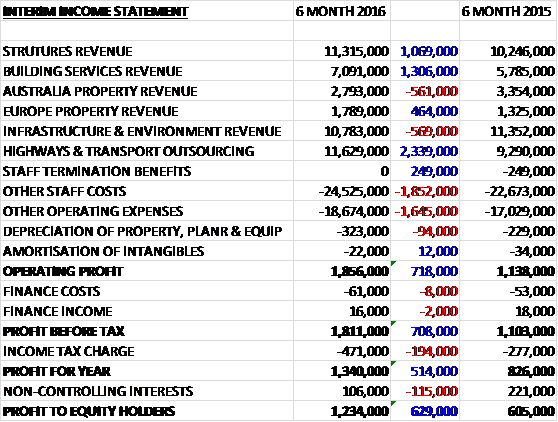
Orosur Mining Share Blog – Q3 Results Year Ending 2016

Orosur Mining has now released its results for Q3 2016.

OMIQ3income

Sales reduced by $7.5M when compared to Q3 last year but cost of sales also declined with a $4.4M reduction in mining and transportation costs, a $1.3M fall in processing costs, a $2.4M decrease in depreciation and a $964M positive swing in production taxes as the group enjoyed an exemption from royalty payments, which meant that the group showed a gross profit of $749K, a $1.4M positive swing. Admin costs increased by $163K, however, and there were $217K of restructuring costs but there was a $511K reduction in exploration costs written off and the lack of $63K of asset impairments that occurred last time. We then see a $2.5M settlement agreement with the Uruguay government which drove a $4.2M improvement in the operating profit to $2.8M. There was then a $532K positive swing in forex movement and income taxes were down $260K which meant that the profit for the period came in at $3.1M, a positive movement of $5M year on year.

OMIQ3assets

When compared to the end point of last year, total assets declined by $5.6M driven by a $2.9M decrease in cash, a $1.7M fall in gold in circuit, a $1.5M decline in property, plant and equipment, a $995K decrease in development costs and an $845K fall in Colombian exploration costs, partially offset by a $1.1M growth in Uruguay exploration costs and a $2.5M Uruguay government settlement agreement. Total liabilities also decreased during the period, mainly as a result of a $2.7M fall in trade payables and a $1.1M decline in the bank loan. The end result was a net tangible asset level of $16.1M, a decline of $704K over the past nine months.

OMIQ3cash

When compared to Q3 last year, cash profits increased by $1.8M to $4.8M. There was a cash outflow through working capital, however, particularly due to an increase in receivables (probably the receivable from the government) and the cash from operations came in at $1.2M, a decline of $1.9M year on year. The group then spent $389K on property, plant and equipment, $491K on mine development and $618K on exploration expenditure to give a cash outflow of $316K before financing and after a $356K loan repayment the cash outflow was $672K and the cash level at the period-end was $2M.

During the quarter the group produced 7,274 ounces of gold, a decline of 6,486 ounces year on year and less than the 8,172 ounces produced in Q2 which means that year to date production of 27,917 was ahead of the company’s 30,000 to 35,000 ounce guidance for the full year. The average price received was $1,143, a decline of $77 per ounce, and the all in sustaining cost was $978 per ounce, a fall of $154 per ounce which was in line with expectations. The company is guiding towards costs below $1,000 per ounce for the rest of the year and between $1,000 and $1,100 for the full year.

In total, 194,197 tonnes of ore was processed at a grade of 1.25g per tonne with recoveries averaging at just under 94%. This compares to 305,609 tonnes at 1.47g/t for Q3 last year and 199,352 tonnes at a grade of 1.36g/t in Q2.

Permits for the San Gregorio Deeps were granted by the Uruguayan mining authority in February. The de-watering of the main pit of San Gregorio during the previous quarter allowed the company to mine about 1,500 ounces of gold from the pit during January and February, including some higher grade material from a north wall structure and some lower grade material located at the bottom of the pit.

During the quarter, an initial infill reverse circulation drilling campaign of 500m was undertaken from the main ramp of the open pit mine with the intention of further defining reserves and optimising mine design. The weighted average grade of the intercepts was 2.35g/t of gold over widths of about 4 to 14 metres. The company plans to complete a further infill drilling campaign of 5,000 metres from underground drilling stations as development progresses, in order to reduce costs, compared to drilling from the surface.

Following the implementation of the strategic plan to reduce costs in line with the gold price environment, a significant restructuring has been achieved and the economics of the San Gregorio Deeps have been updated, also assuming a reduced initial investment as the company plans to use the equipment from Arenal Deeps instead of purchasing new underground mining equipment. The company intends to dovetail the beginning of production in San Gregorio Deeps with the conclusion of operations at Arenal to facilitate these anticipated savings and plans for this to take place in 2017. To me it sounds likely that there might be a period of lower production while the transfer takes place – it seems a bit risky actually. Development work at San Gregorio is scheduled to start during the final quarter of this year.

An additional expected benefit of the revised plan is that San Gregorio will require no further external financing and is to be developed using cash from operations. At the end of the quarter the company started pre-stripping the relatively small Veta Rey open pit. The mine plan for this pit targets about 8,000 ounces of gold to me mined over the next six months. About 70% of waste rock will be allocated to the new tailings dam, decreasing costs of loading and hauling.

The group is currently focusing its brownfield exploration effort in Veta Rey and in Don Tito. Gold mineralisation in Don Tito is hosted in a hydro thermally altered granite and associated with quartz veining. Exploration work completed to date consists of six trenches, twelve drill holes and 65 pantera drill holes. Concurrently the group is advancing known target zones in Don Tito with the geophysics programme being ongoing during March and April with results expected during Q4. At Arenal Deeps, the group is testing a down-plunge extension of the Arenal mineralised structure. A 1,100m drilling campaign started in December and is expected to conclude during Q4.

In Chile, gold was encountered in the south and west sectors, opening up further exploration targets. The south and north gold-silver intersects are located in a north-south structural corridor, which appears to be the natural orientation for the mineralised veins in the district. Consistent anomalous silver values at the central north sector point to the possibility of an envelope of a potentially mineralised northwest structure. All the gold and silver encountered during drilling were intersects in silica/quartz-rich structures. As previously announced, the process of returning the Pantanillo properties to Anglo American continues.

In Anillo in Chile the phase 1 exploration was completed in December and included a geophysics campaign and an approximately 3,600 metres of reverse circulation drilling which took place over six months. Phase 2, if exercised, would include an additional geophysics campaign and a minimum of 5,500 metres of RC drilling and has an estimated duration of up to a year and a half.

On November, Minerales Cala gave notice to the company of the completion of its expenditures and reporting obligation with respect to phase 2 of the option agreement, thereby earning an additional 29% interest in the project for a total of 80% with Orosur retaining a 20% interest. Phase 3 of the option agreement has commenced and Minerales Cala is obliged to submit a detailed work programme and budget to the company.

As can be seen the group reached a settlement agreement with the government of Uruguay for $2.5M achieved through an administrative petition for repayment due to a custom benefit relating to the export of industrial goods which had been eliminated through a national decree in 2009. The company expects to receive the settlement proceeds during April this year which should come in handy.
The group has hedged a portion of their gold sales. They are committed to a forward contract of 3,500 ounces of their forecasted production in Q4, 1,400 ounces at $1,254 per ounce and 2,100 ounces at $1,260 per ounce in order to reduce their exposure to gold price fluctuations.

In January the group issued 2,103,894 shares to Pablo Marcet as termination consideration in connection with his resignation as their exploration and development director – he remains on the board so this seems a very good deal for him! The group also granted 2,920,000 options incurred $16K of compensation expense. Alejandra Lopez, current controller of Oroshur, has been promoted to interim CFO.

During the period the group has enjoyed an exemption on the royalty payment to the government (3% of sales) but this ended in March.

At the end of the period, the group had a net cash position of $1.5M compared to $3.3M at the end of last year. They have $3M of committed but undrawn lines of credit at the moment and an actual cash balance of $2M and should hopefully receive $2.5M from the Uruguay government imminently (although until they actually have this in their hands I’m not sure it can be counted on).

Overall then the group seems to be making progress. They made a profit this quarter, even when the tax settlement is excluded, as they focused on cost cutting. Net assets and the operating cash flow both declined, however, and there was no free cash generated. Less gold was produced during the period but it was ahead of the revised lower. The $1,143 per ounce received is not too bad and good progress has been made on costs, falling to $978 per ounce during the period.
It is worth noting that the price of gold is hovering around $1,245 at the moment and the group has hedged some production marginally above this price although it should also be noted that the royalty payment exemption has now ended so that will probably bring costs up towards $1,000 all else being equal.

Permits have been granted for SGD and some preliminary mining has begun with the grades looking OK. I am a little concerned about the transition from Arenal Deeps and the lack of any margin for error there. The group has $2M in cash and should be receiving $2.5M from the government any time now so there seems to be no immediate need for a cash call, and the board have stated no dilution will be necessary to get SGD into production.

It is an interesting situation here. The shares still no not look expensive and the fact that no share placings are expected is helpful. There are still risks here though, not least the transfer of production to SGD and the fact that they don’t really seem to have much in the way of actual reserves. Tricky. I am tempted to go for a little (risky) punt.

Havelock Europa Share Blog – Final Results Year Ended 2015

Havelock Europa has now released its prelim results for the year ended 2015.

HVEincome

Overall revenues declined by £9M when compared to last year, mostly as a result of reduced UK retail activity (M&S?) and delayed public sector contracts, but underlying cost of sales fell by £6.5M and there was no stock rationalisation cost which was £2.1M last year and no goodwill impairment which accounted for £2M which meant that the gross profit increased by £1.7M. A decline in depreciation was offset by an increase in operating lease charges and a £919K growth in restructuring costs along with an £82K increase in the board reorganisation costs was offset by the lack of premises impairments and relocation costs that occurred last year. Other admin expenses were down £1.4M, however, so the operating loss fell by £3.1M when compared to 2014. Finance costs declined but tax costs increased by £876K as the group stopped recognising further deferred tax losses incurred during the year, and despite a £285K gain from the disposal of the discontinued operation, the loss for the year came in at £2.7M, an improvement of £2.5M year on year.

HVEassets

When compared to the end point of last year, total assets declined by £9.3M driven by a £3.5M fall in cash, a £3.6M decrease in trade receivables and a £2M decline in inventories, partially offset by a £1.3M growth in intangible assets. Total liabilities also declined during the year due to a £3M fall in trade payables, a £4M decrease in bank loans and a £2.7M decline in pension obligations due to an increase in corporate bond rates. The end result is a net tangible asset level of £4.1M, a decline of £2.1M year on year.

HVEcash

Before movements in working capital, the group swung by £1.2M to a cash loss of £563K. There was a cash inflow from working capital, mainly as a result of a decrease in receivables and inventories and after interest costs fell by £136K there was a net cash inflow from operations of £1.1M, a decline of £653K year on year. This did not cover the £1.6M spent on intangibles relating to the new ERP system, but there was a net £41K cash inflow from asset sales as the group sold its Dalgety Bay site, and an income of £1.3M from the sale of the subsidiary so before financing there was a cash inflow of £857K. Of this, £392K was spent on finance lease payments and £4M of loans were paid back to give a cash outflow of the year of £3.5M and a cash level of £2M at the year-end.

In September the group announced the simplification of the business model and the rightsizing of the business which led to a 10% reduction in staff numbers. The announcement by Lloyds in November that they will reduce activity in 2016 led to an intensification of this process which was completed by the end of the year. The business is now organised into three divisions – Retail and Lifestyle; Corporate Services, which comprises mainly the financial services sector; and Public Sector which includes education and healthcare.

Within Retail and Lifestyle the group is having some success in winning new clients and whilst current volumes are low, the full benefits of these new customers will accrue as the relationships begin to mature. Corporate Services is currently the smallest of the segments but the group are developing a number of opportunities and expect to make progress during the year. Public Sector is currently the largest segment and includes healthcare, education and student accommodation.

During the year the group developed a number of new UK retail customers and they look to turn these relationships into significant accounts over the next few years. The impact of these customers was not enough to negate the reduction of work from M&S, however, so UK retail sales in the period were responsible for the reduction in total sales. International retail sales had a good year and now make up more than 15% of the total.

Due to a strong second half of the year, corporate services had a decent year with both sales and margin above target but this good work was undone when Lloyds announced they will be substantially reducing their spend on refurbishment for the foreseeable future. The board continue to target opportunities for both furniture and fit out sales in this market, however, and are pursuing a number of prospects.

Although public sector sales improved in the year, the scale of the increase and the margins achieved were disappointing. Action has been taken to address these issues as part of the restructuring plan and education now forms and integral element of the division. The business will be focused on securing work from those markets where the final customer is government funded.

The restructuring of the business interrupted the development and implementation of the ERP system which will result in an increased cost of delivery but the board expect to start operating aspects of the system from June. The relocation of the head office from Dalgety Bay to a new facility close to the factory in Kirkcaldy was completed in May. The move is cost neutral to the business but the facility has become a showcase for their office fit out capabilities which is a market they intend to target more intensively.

Interestingly the group mention that sales to Lloyds Bank made up 30% of revenues this year and after sales to M&S represented 14% of revenues last year, they have now disappeared. This shows quite how susceptible they are to two large clients but the board is trying hard to make sure that no one customer makes up more than 10% of sales (this is likely to come from reductions from the large clients though!)

In September the group sold Teacherboards to Sundeala for a modest profit which gave rise to a gain on disposal of £285K. Unlike the main business, Teacherboards is actually slightly profit making, with a profit of £41K this year but the disposal signals the group’s exit from the educational supplies market. I suppose the group needed the £1.3M cash injection which gave rise to a net cash position at the year-end of £1.1M, an increase from the £200K recorded at the end of last year.

David Ritchie was appointed as the new CEO in May, replacing Eric Prescott. Due to overseas commitments, Andrew Burgess, the largest shareholder, resigned from the board in June and was succeeded by Peter Dillon who lasted less than three months before resigning himself! From April, the Chairman is deferring £25K of his salary and the other non-executive directors are deferring £5K of their salaries until the company returns to profit which is a nice gesture.

The order book for current year delivery of £25M was an increase of 25% year on year and current trading is in line with market expectations, which the board believes will continue for the first half of the year. The group retains a high dependence on second half orders, however, which restricts their visibility for the full year outturn but the board are cautiously optimistic for the year as a whole.

As the group is loss making, any PE ratio comparisons for this year are meaningless but next year they are expected to turn a modest profit which would give a forward PE of 31.9 which seems rather expensive. No dividend was paid, nor is one expected in the immediate future.

Overall then, this is clearly a business that is struggling. The losses did improve but this was only due to no goodwill impairments or stock rationalisation costs that occurred last time and underlying losses deteriorated. Net assets also fell and the operating cash flow declined too. Indeed, it was only a favourable movement in working capital that gave a positive cash flow as the group incurred cash losses this year.

There are some new clients but volumes seem low and they were not enough to replace the loss of M&S and with Lloyd’s announcement they are cutting back on refurbs, the corporate services division is also struggling. The new ERP system looks really expensive and I am not sure whether the group can really afford it. Although the order book is up, the group are reliant on second half orders to hit targets and with a forward PE of 31.9 this doesn’t seem close to covering the risk so I am not interested at these levels.

On the 29th April the group announced the appointment of Hew Balfour as a non-executive director. He replaces Alastair Kerr who joined the board in 2012 and will stand down at the AGM. Hew is not new to the company, he was CEO from 1989 until 2010 and is currently chairman of Ebico Trading. This is an interesting development, although I am not sure it is a positive one.

On the 10th June the group announced a trading update. The restructuring of the business is making a positive contribution but has impacted on the development of the new ERP system which has taken longer than originally planned. Nevertheless, the group have implemented the first module of the system and now expect to complete the full implementation of the system during Q4 2016.

The board expects the first half performance to remain in line with their expectations but the business continues to have a high dependency on second half orders and whilst the public sector is performing well, visibility in the retail and leisure sector is less clear. This situation makes predictions for the second half difficult but the board currently believes that performance for the full year will also remain in line with their expectation.

In addition, the chairman has given his notice to stand down after being in the role for four years.

On the 14th June the group announced that Andrew Burgess sold 100,000 shares at a value of £13K. This may not seem like much but given he still owns 6,904,785 shares this is a significant development.

Matchtech Share Blog – Interim Results Year Ending 2016

Matchtech has now released its interim results for the year ending 2016. Following the integration of Networkers, the reporting structure of the group has changed to two main reporting segments, Engineering and Technology. The new Engineering segment includes the engineering business previously reported together with the Networkers engineering business and the professional services brands of Barclay Meade and Alderwood. The Technology segments includes the Connectus brand previously reported in professional services and the remaining Networkers business.

MTECincome

Revenues increased when compared to the first half of last year with a £70.3M growth in technology revenue and a £10M increase in engineering revenue. Cost of sales also increased to give a gross profit £14M above that of last time. There was a £3.3M charge for proforma Networkers profits last year, which I’m not sure I understand but this year amortisation of acquired intangibles increased by £1.6M, as would be expected following the acquisition. Other admin expenses increased considerably to give an operating profit £1.7M ahead. Finance income increased by £178K but finance costs remained broadly flat before an £890K growth in tax expense due to irrecoverable withholding tax in the acquired Networkers business and meant that the profit for the period came in at £4.8M, a growth of £993K year on year.

MTECassets

When compared to the end point of last year, total assets declined by £6.3M driven by a £6.8M fall in trade receivables, a £3M decline in other receivables and a £1.6M fall in acquired intangibles, partially offset by a £5.1M increase in cash. Total liabilities also decreased during the period as a £3.8M fall in borrowings and a £3.5M decline in payables was partially offset by a £934K growth in the current tax liability. The end result was a net tangible asset level of £26.7M, a growth of £2.4M over the past six months.

MTECcash

Before movements in working capital, cash profits increased by £3.4M to £10.2M. There was a cash inflow through working capital as a large fall in receivables was only partially offset by a decline in payables but both interest payments and tax costs increased somewhat to give a net cash from operations of £13.7M, a growth of £8.5M year on year. The group did not spend much on capex, with £186K going on tangible assets and £53K going on intangibles and the £390K spent on acquisition was offset by £420K received from the sale of a subsidiary. This meant that there was a strong free cash flow of £13.5M which was used to repay £15M of loans but a £5M dividend payment gave rise to a cash outflow of £6.5M and a cash level at the period-end of -£11.2M.

Overall the performance in the period was in line with management expectations with NFI growth in Engineering of 7% and Telecoms of 11% compared to the second half of last year, with IT down 9% on H2 2015 and falling by 20% compared to the first half of last year as demand for skilled engineers remained strong in the UK. Overall contract NFI declined by 2% to £26.5M when compared to H1 2015 and permanent fees increased by 2% to £9.4M. When compared to H2 last year, the performance is much better, however, with a 2% and 12% growth respectively.

The operating profit in the Engineering business was £6.1M, broadly flat year on year with an increase of just £6K. Contract NFI increased by 5% to £15.3M and permanent fees grew by 12% to £6.4M. There was a strong performance from infrastructure with NFI up 19% year on year. There is continuing high demand in the rail sector, mainly in project delivery, in property largely with private sector structure/service work and in water with design/project delivery phases. With many major projects in the pipeline, such as the Thames Tideway Project, HS2, Crossrail phase 2 and the Wessex to Waterloo line improvements, the group have long term visibility in this sector.

In Energy, whilst the low oil price means activity remains muted globally, the group has diversified in recent years which meant that two thirds of their business lies outside the oil and gas market. There are an increasing number of requirements for candidates throughout Europe in the renewable energy, transmission and nuclear markets. In renewable energy the main focus is within offshore and onshore wind programmes where there a number of upcoming opportunities in Northern Europe. Within the transmission area there are extensive upgrades being carried out to the electrical grid infrastructure throughout Europe, whilst in the nuclear sector there are a number of new reactors being planned in the UK alone.

Investment in the UK automotive manufacturing industry continues, which is flowing down through the supply chain, where the need to design new automotive technologies, particularly hybrid and alternative fuel transmissions, is increasing. The group are also seeing signs of UK automotive companies looking to re-shore certain operations and further expand. The aerospace sector is focussed on increasing manufacturing production rates, as no major new aircraft models are in the pipeline. The large aftermarket retrofit and interior suppliers are struggling to keep up with design and production demand, hence increasing the group’s opportunities with SMEs.

In maritime much of the growth is coming from the international team, particularly in Canada where the NSPS naval ship building programme will span the next thirty years and the group is well positioned as a key supplier of global talent to the two prime shipyards. Elsewhere, super yacht build and cruise liner refit and repair projects in Europe are creating opportunities in design, build and project management.

The operating profit in the Technology business was £4M, a growth of £3.2M when compared to the first half of last year. Contract NFI reduced by 10% to £11.2M and permanent fees fell by 14% to £3M year on year, although against the second half of last year, contract NFI was down 2% and permanent fees were up 8%. Telecoms was in line with the first half of last year but IT was down 20%.

Although overall demand for IT staff remains high, the shortage of candidates in specific areas means that the group needs to be increasingly specialist in their approach. The group are focused on six core markets, five of which are across specific technology skillsets, with the objective of becoming the leading specialist recruiter in each of these markets. They are digital/mobile development, cloud, cyber security, leadership and ERP. At the same time they will build on their success in the public sector, expanding their teams in the NHS through their presence on the non-medical framework as well as developing their central and local government business.

The telecoms market is currently quite buoyant as it increasingly converges with the IT sector. In addition, they are seeing growth in Asia from the continued expansion of 4G. They have also seen a resurgence of fixed line business in North America and Europe where there is a renewed investment in cable laying, enabling higher quality and faster streaming. As 5G is eventually rolled out the group are well placed to support their clients as the technology is deployed.
The integration of Netoworkers continues to go well. The group have identified nearly £2.3M in annualised synergies since the acquisition which will be fully realised in 2017. The board expect to identify additional cost synergies as they continue the integration process and combine the remaining back office functions by the end of this year.

With the board mindful of the increased caution in economic forecasts in recent months, based on opportunities won, trading in the two months since the half year and continued close cost management, they anticipate the group’s results for the year will be in line with management’s expectations.

After a 6% increase in the interim dividend the shares are currently yielding 4.8% but this falls to 4.3% on the full year forecast for some reason. The forward PE ratio at the current share price is 10.2 which looks like decent value. The group had a net debt position of £24.8M compared to £33.6M at the same point of last year.

Overall then, this was a fairly mixed period for the group with the Networkers acquisition masking sluggish underlying demand. Profits were up, net assets increased and the operating cash flow improved with a strong generation of free cash, although perhaps it might be an idea to hold off a bit on the dividends while the debt is paid off.

The performance in the engineering division was flat as a growth in infrastructure NFI was offset by continued difficulties in the energy market following the oil price collapse. The acquisition meant that profits in the technology division increased but like for like NFI declined as the IT business suffered due to a lack of suitable candidates.

Clearly the Networkers acquisition is the main differentiator in performance and the integration seems to be going well. There is still quite a bit of debt here but the balance sheet can support it and despite the sluggish underlying performance, the forward PE of 10.2 and dividend yield of 4.3% seems pretty decent value to me. I am now back in there.

On the 18th July the group announced that they intend to change their name to Gattaca. They will continue to trade through their core brands Matchtech and Networkers, however. They will also have a new ticker. Good grief, it was a decent enough film but I can’t get behind this one! The change of ticker is going to balls up my charting software too.

On the 4th August the group released a trading update covering the year ending 2016 where the board reiterated that they expect profits to be in line with previous expectations. Total NFI is up 34% with contract up 35% and permanent increasing by 30% but this is due to the acquisition and like for like NFI was up just 1% reflecting a 4% growth in permanent NFI and flat contract NFI. By market, this reflected a 6% growth in engineering NFI and a 6% decline in technology NFI. The second half of the year was slightly stronger, however, with a 3% increase compared to a 1% decline in H1.

There was strong annual growth in infrastructure, professional staffing and engineering technology offset by a weaker performance in oil & gas and maritime. The IT market segmentation and sales restructure carried out in Q4 is already starting to show an improvement with NFI stabilising in H2 as further benefits are expected to be seen in the coming year.

During the period the group appointed regional MDs to run the Asia and Americas operations and a number of experienced UK based consultants and managers are transferring to the Dallas office in order to accelerate the development of the engineering business in the US. The integration of Networkers is expected to be fully completed by December 2016.

At the year-end, net debt stood at £27.5M, down £6.1M over the year. Demand for skilled engineers remains strong in the UK and so far the group have not seen any impact on vacancy flow in the six weeks since the Brexit vote. They have seen strong growth in the Engineering division and in Technology the sales restructuring undertaken in the IT business gives the board confidence for the coming year.

This all seems to be quite good – momentum seems to be improving after a poor first half and so far there does not seem to be any Brexit issues – could be worth an investment at these levels.

On the 11th August the group announced that CEO Brian Wilkinson purchased 47,722 shares at a value of £170K which gives him a total of 92,722 shares – this is actually a fairly hefty purchase.

Northern Petroleum Share Blog – Final Results Year Ended 2015

Northern Petroleum has now released its final results for the year ended 2015.

NOPincome

Revenues crashed by $2.4M to just $332K this year and with a $1.8M fall in production costs, the gross loss worsened by $587K when compared to last year. Depletion and amortisation therefore fell by $696K, depreciation of non-oil assets declined by $389K and other admin costs fell by $2M. We also see the lack of a $2.3M profit on asset disposals that occurred last year offset by $786K of other income representing the cash consideration of the Italian farm out, a $33.4M fall in exploration asset impairments and a $12.7M decline in oil and gas asset impairments to give an operating loss which improved by $47.3M when compared to 2014. Finance costs reduced by $1.1M and the income tax credit increased by $437K to give a loss for the year of $10.1M, a decline of $32.8M year on year.

NOPassets

When compared to the end point of last year, total assets declined by $17.2M driven by a $9.7M decrease in cash, a $4.6M fall in Italian exploration assets due to impairments and exchange differences, a $1.1M decrease in other exploration assets due to exchange movements, a $1.1M fall in the value of IT systems and a $915K decline in receivables. Total liabilities also declined due to a $4.6M fall in payables and an $861K decline in deferred tax liabilities. The end result is a net tangible asset level of $2.2M, a decline of $5.1M year on year.

NOPcash

Before movements in working capital, cash losses decreased by $2.2M to $2.9M. There was a large fall in payables which meant that, after a modest tax receipt, the net cash outflow from operations was $6.4M, an increase of $3.7M year on year. The group also spent $4M on property, plant and equipment, mainly relating to the drilling of the 102/11-30 well in Alberta, along with $1.1M on exploration so that before financing there was a cash outflow of $11.5M. The group received $2.4M from the issue of shares and repaid a $382K government loan to give a cash outflow for the year of $9.5M and a cash level at the year-end of just $2.4M.

In Canada, early in 2015 the 102/11-30 well was drilled targeting upswept oil on a reef edge location. The well encountered the reservoir as expected and when tested the well flowed at 90 bopd but with a water cut of 85% so the well was suspended. With the production in Virgo not economic at the prevailing oil price and remaining high costs at the start of the year, combined with the use of rental equipment, all wells were shut in during January 2015 while lower operating cost options were evaluated. Subsequently the group purchased and installed a new production package on the 100/16-19 well and brought this well back into production in June at a rate of 75 bopd.

The 102/15/23 well, which was tied in during 2014, was shut in by the third party operator in Q1 2015 due to concerns about the integrity of the gathering pipeline the well was tied into. The operator of the gathering pipeline subsequently decided that it was uneconomic for them to reinstate the line, therefore the group acquired operatorship of the pipeline and reinstated production from the well in early 2016 at a rate in excess of 100 bopd.

Early in 2016 the group completed the acquisition of the Rainbow assets, about 15 miles from their existing Virgo development. As well as adding 1.1M barrels of oil equivalent of 2P reserves, the acquisition also included two processing facilities providing significant cost savings for production from the group’s trucked Virgo area wells and potential third party processing fees. At the time of the acquisition the Rainbow facilities were producing about 200 bopd and the group identified an initial low cost work programme involving facility repairs and well workovers that aim to increase average group production for 2016 to 400 bopd. Activities in early 2016 have focused on the Rainbow area and the restart of the 102/15/23 Virgo well, resulting in average production in March in excess of 400 bopd.

In Italy, the group has obtained approval of six EIAs in the southern Adriatic; one for the proposed 3D seismic programme across the Giove oil discovery and Cygnus exploration prospect and five others for exploration permit application areas. Approval of these EIAs has allowed them to continue to plan the seismic programme and work with the Ministry of Economic Development to turn the application into permits. The seismic acquisition is subject to financing, most likely through a farm out of the permit, and the positive conclusion of local appeals and operational approvals.

The group has also drafted an appraisal well EIA submission for the Giove oil discovery, to be submitted during 2016, to drill a well 12 to 18 months after submittal, again subject to financing and approvals being received. All offshore permits are currently held in suspension pending approvals for the next state of the work programmes.

In December, the Italian government passed a law restricting offshore oil and gas activities within the 12 nautical mile limit off the coast of Italy. Most of the group’s offshore acreage is unaffected by this law change but one application is fully within the 12 mile limit in the Ionian Sea, and three applications are partially within the limit so they have received full and partial rejections early in 2016.

In the onshore acreage, in early 2015 the group agreed a farm out deal for the Cascina Alberto permit in northern Italy with Shell Italia whereby in return for an 80% interest in the license and operatorship, Shell Italia will carry the group for a seismic acquisition programme up to $4M and a single exploration well up to $50M. Shell Italia also paid the group $850K on completion of the farm out. The operator has commenced the exploration work programme with the reprocessing of existing seismic to determine if further data acquisition will be required before making a decision on an exploration well. A decision on seismic acquisition is expected in Q3 2016.

There was little activity on the French Guiana exploration permit during 2015 and it is due to expire in mid-2016. The joint venture is currently considering options regarding the future of the permit. There has been limited activity on the license in the Otway Basin in South Australia during the year. The license continue to be suspended to allow further technical work and evaluation prior to potentially progressing with a seismic programme. The group continues to seek a farm in for the license.

The group have taken further steps to reduce their general and admin expenses. This included relocation of the head office, staff reductions and reduced salaries for the board and senior management. During the year the group raised a total of £1.6M through a combination of a subscription by the group’s two key shareholders, raising £1.2M, coupled with an open offer to all shareholders raising a further £400K. The new capital allowed them to finalise the terms on the acquisition of the Rainbow assets and funded modest work programme for 2016 to deliver growth in Canadian production.

An impairment loss of $2.1M has been recognised against the costs capitalised in respect of the Sicily Channel licenses CR146 and CR149. These licenses are currently under suspension awaiting EIA approval to drill a well. The carrying value of the permits in the southern Adriatic has not been impaired but if no progress is made during 2016, the board will consider whether the carrying value is still warranted. An impairment loss of $970K has also been recognised against the Australian cost pool. The government of South Australia has agreed to place the license into suspension to allow time for a farm out to be completed once the short term economics improve. Given the uncertainty of timing and likelihood of a farm out being completed the directors have decided to impair the cost pool in full.

In addition there were $621K impairment losses in the year relating to accounting and procurement IT systems implemented in early 2012. Following the decision of the directors at the end of 2015 to implement a Canadian software package and migrate the group’s accounting and procurement onto that system, the carrying value of the existing IT system has been fully impaired. The 102/11-30 well encountered the reservoir on prognosis but problems experienced when cementing the liner over the reservoir section lead to difficulties in interpreting the well test. The well delivered nearly 100 barrels of oil per day during the test with 85% water production but it was not possible to determine where the water was coming from due to the cementing issue. As a result the well was suspended pending a subsurface review to understand the water production mechanism and determine the optimum way to produce the well with minimal water production. Due to the uncertainty surrounding the economic value of the well, the directors impaired its carrying value by $2.5M.

As of the end of march, the group had just $700K of cash with $1.4M on deposit from the Alberta Energy Regulator which is forecast to be returned from June this year, although there is material monthly revenue being received with production currently over 400 bopd which at an oil price of about $50, all group costs would be covered. The continued oil price volatility and relatively small financial resources of the group at this time mean that the focus over the next will be on sourcing further capital to increase production, most likely via debt finance or an asset farm out in Italy.

While the group has no material capex commitments, the cash position combined with the future revenue from existing oil and gas fields, is only likely to provide enough financial resources to undertake the redevelopment work programme in Rainbow and Virgo planned for the first half of 2016. Any further development or drilling in Canada and appraisal activities on the assets in Italy will require external capital which may come from the farm out of existing assets, debt or equity. Also if the group suffers operational difficulties, it may not have the financial resources, even if the oil price increases, to resolve whatever operational problems have arisen and would be forced to seek further capital from external sources.

On the 6th April the group released an update. Net oil production in March was 432bopd which equates to sales for the month of about 13,400 barrels. Three additional wells will come on stream in April following completion of the workover programme and the 9-25 battery is waiting for regulatory approval before start-up which will initially add another three producing wells. Near term production will support the return of the $1.4M abandonment deposit paid to the Alberta Energy Regulator in January which is now forecast to be returned in three monthly payments starting in June.

Following the completion of the winter programme, a summer work programme will be developed for August and September to achieve further production enhancements and operating cost synergies. The company is now receiving material monthly revenue from the Rainbow assets and production engineering and subsurface reviews conducted to date have identified significant opportunities to steadily grow production from this assets base with relatively low capital investment and risk so the company is now focused on developing plans to realise these opportunities.

Overall then, this has been a very difficult year, as it has been for many small oil and gas producers. The loss did improve from last year, even when we take out the large impairments in 2014, as the group cut costs. Likewise, although the cash outflow from operations increased year on year, this was due to a large payables payment and the cash losses actually fell. Still, the group burned through $11.5M in cash before financing. The net asset level also took a battering during the year.

The group started the year with all of its wells shut in as they were loss making in the current climate. The group also suffered a technical failure in the only new well drilled, and a problem with a third-party pipeline. As the year progressed, some production was brought back on stream as some costs lowered and the pipeline issue was sorted. The addition of the Rainbow assets was an essential step too, which meant that by March 2016 the group was producing 432bopd.

Italy has been placed on the backburner somewhat but the farm out with Shell is a good step in the development of at least one of those assets. The amount wasted on the old IT system is very disappointing, however. The group now only has $700K in cash and despite the fact they should get their deposit back from the Alberta regulators later in the year, it seems inevitable that they will have to raise more cash. Hopefully this will come from a farm-out but this is by no means certain and it is a distinct possibility the company will have to undergo another dilutive placing to keep the lights on. Not something I am willing to risk a bet on at the moment.

On the 10th May the group released a production update. Net average oil production in April up to the 18th was 449bopd but regional trucking restrictions were imposed for the rest of the month due to the expected annual spring thaw which meant that production from wells tied in via a pipeline continued at a rate of 212bopd and overall average production for April was therefore 354bopd. The trucking restrictions were lifted by the 29th April due to unusually dry weather so trucked wells are now back in production.

The 9-25 battery is ready for start-up once final approvals are obtained from the regulator which will add another three producing wells. Costs incurred to date at the Rainbow development project indicate that operating costs per barrel are between $20 and $25 when measured at an average production rate of 400bopd. The variable operating costs per barrel of incremental production over 400bopd are forecast to be between $4 and $10 per barrel, depending on whether the oil is transferred to the processing facility by pipeline or truck.

Following the completion of the current programme, a summer work programme will be developed for Q3 to achieve further production enhancements and operating cost synergies. Building production from here will create an asset with very attractive net cash flow, even at current oil prices.

On the 7th July the group released an update. The workover programme on the Rainbow assets consisted of the reconfiguration of tank storage and pipelines at two single well batteries; the replacement of tubing, rods and pumps in five wells; and the re-testing of pipelines and re-certification for use with the AER. The cost of the programme was budgeted at more than $1M but with adjustments and a reduced cost environment, the same production target from 150bopd to 400bopd was achieved at a total cost of about $500K.

There are eleven producing wells tied into 13-36 and four single well batteries currently in production whose output is trucked into this facility. The 9-25 battery is about 25km to the SE of this battery and currently has three wells tied into the facility and on production. Following processing and water separation, dry oil is stored at the facility before being trucked to the 13-36 battery for sale. The produced water disposed of at 9-25 is used in a waterflood programme to bring pressure support to three additional wells that are awaiting pipeline reinstatement before being brought online.

In the Virgo area, the 15-23 well is tied in to the local operator’s infrastructure. Produced oil, water and associated gas is piped for processing, separation and sale by the local operator. The average production for May and June, during which there were unusually heavy rains was 300bopd due to trucked wells being shut in as road conditions restricted the trucking of oil to the 13-36 battery for sale. With roads repaired and all wells on production, net average production for the last week in June was about 500bopd.

The focus for the proposed Q3 work programme is to improve operating synergies and costs and increase production through the restart of three waterflood wells at the 9-25 facility. One of the largest costs in this field is electrical power, which is used for pumps and the processing facilities. Within the Rainbow asset ate 16 sweet gas wells which are connected to the 13-36 facility and have about 700K standard cubic feet of daily production capacity. This is sufficient to provide more power than is currently required by the assets and the company is evaluating the possibility of installing gas powered generators to produce electricity from this supply.

There are three wells connected to the 9-25 battery which are shut in due to the pipeline needing some repair work. These wells receive the benefit of the pressure support from the waterflood programme. Subject to confirmation from engineering studies, the company is planning to repair and test the pipeline this summer and bring the wells back into production.
While the 9-25 battery is located about 25km from the 13-36 battery, the nearest point between each facility’s connected pipeline network is only 3km. The group has commissioned studies to assess the cost and work required to connect the two facilities which is anticipated to have significant operating cost savings and reduce production downtime due to trucking restrictions in bad weather.

There are between ten and fifteen further well workover candidates from the existing well inventory which should require only the pulling and replacement of rods or pump assemblies to bring them back into production. Alongside this work, the company is considering a list of reefs in the Rainbow area which have had limited oil recovery and could support further production from a sidetrack well, drilled from an existing well. Material production gains could be possible from this activity with relatively low risk and limited capital outlay, especially in the current cost environment.

The final activity being considered for a winter work programme is the recompletion of some of the wells in the Virgo region. The original plan for these wells was to tie them into local pipeline infrastructure for transportation and processing of produced oil and water by the local operator. The 15-23 well was completed this way and is on production with a tariff being paid to separate and disposed of produced water as well as process the oil for sale.

Given the third party tariff paid for this work, the lower sales price achieved for oil in Virgo and that the company now owns its own processing facilities in Rainbow, they are considering the recompletion of these wells without connecting them to the local infrastructure. This would allow the separation of oil and water at the well site and disposal of produced water downhole to a lower formation through a dual completion assembly. Dry oil could then be trucked to the 13-36 facility where it would receive a better sales price and not incur third party tariff.

The increase in production from the Rainbow assets to 400bopd, combined with the rise in oil price since February is providing material monthly revenue and cash flow. The next step for the company is to increase production further and not only cover group costs but to create net operating cash flow for future investment. With the initiatives discussed above, I am feeling for the first time that the company might actually make it.

Central Asia Metals Share Blog – Final Results Year Ended 2015

Central Asia Metals has now released its final results for the year ended 2015.

CAMLincome

Revenue declined when compared to last year with a $7.7M decrease in international revenue and a $1.5M fall in domestic revenue. Depreciation and amortisation fell by $1M, mineral extraction taxes were down $597K, buyer fees decreased by $504K and duties fell by $101K but the cost of reagents and materials increased by $1.2M as a result of the higher tonnages produced and an increase in electricity costs, so that gross profit declined by $8.2M. We then see a $1.8M growth in consulting services relating to the Copper Bay feasibility study, an $887K increase in duties, a $482K growth in share based payments and a $600K inventory write-off which was offset by a $7.1M increase in forex gains to give an operating profit $4.5M below that of 2014. The group did not benefit from last year’s $33M gain on the fair value acquisition of a controlling interest but tax was down modestly to give a profit for the year of $22.4M, a decline of $37.1M year on year, although without last year’s one-off gain relating to the completion of the Kounrad transaction, the profit would have been down by a more modest $4M.

CAMLassets

When compare to the end point of last year, total assets declined by $83.4M, mainly as a result of the collapse of the Kazakhstan Tenge, driven by a $30.4M fall in the value of mining licenses, a $29.5M decrease in plant & equipment, a $10.2M reduction in goodwill, a $5.7M fall in construction in progress and a $4.6M decrease in cash. Total liabilities also decreased as a $10.3M decline in deferred tax liabilities due to the translation of the goodwill arising on the Kounrad transaction which is denominated in Tenge, was partially offset by a $2.9M increase in trade payables. The end result was a net tangible asset level of $74M, a decline of $32.4M year on year.

CAMLcash

Before movements in working capital, cash profits declined by $14.4M to $37.2M. There was a modest cash outflow through working capital, although this was slightly less than last year, but tax payments were $6.6M lower, mainly due to a payment towards 2013’s tax bill that occurred last year, to give a net cash from operations of $23.5M, a decline of $7M year on year. The group spent $7.8M on property, plant and equipment along with $556K on intangible assets which meant that there was free cash flow of $16.2M. This did not cover the dividend payment of $20.4M, however, and there was a cash outflow of $4.4M for the year and a cash level of $41.5M at the year-end.

The Kounrad business made a profit of $43.7M, a decline of $35.6M year on year. The total production for the mine was 12,071 tonnes compared to 11,136 tonnes last year and the average gross price achieved was $5,336 per tonne, down from $6,794 per tonne in 2014 although the copper price did hit a six-year low of $4,500 per tonne during 2015. C1 cash costs were $60c per pound compared to 62c last year (why they can’t quote this in dollars per tonne I don’t know!). The fully inclusive costs was $1.58 per pound compared to $1.65 in 2014 and included a 2c cost of the organic inventory loss.

In November the Kazakhstan authorities approved an amendment to the project’s existing Subsoil Use Contract. This approval gives the group the right to exploit the copper contained in the western dumps with the start of production scheduled for 2017. The procurement of materials and equipment for the stage 2 expansion is now underway, with the programme’s capital costs remaining within the $19.5M estimate, most of which will be paid in 2016. The construction works will be executed primarily by company personnel. The commissioning of the additional SX-EW facilities during the year has already had a positive impact on the unit cost of production.

The Copper Bay business made a loss of $728K and this was the first period of incorporation into the group. The $3M invested by the group into the business is being used for the Definitive Feasibility Study which should be completed in late 2016.

Following the completion of the pre-feasibility study in June, the group subscribed for 135,621,610 newly allotted shares in Copper Bay for $3M which increased their shareholding from 50% to 75%. An intangible asset of $3.2M recognised in 2013 equal to the cash consideration paid for the initial 50% shareholding has been reduced by $1.6M following the consolidation of the business into the group so the exploration asset relating to the Copper Bay business is now $1.6M.

In August the Kazakhstan Tenge immediately devalued by almost 37% when the government transitioned from a free-floating exchange to allowing the market to determine its value. It devalued further towards the end of the year, resulting in a total devaluation of about 85% and ended the year at 339.47 per US dollar which has resulted in the recognition of exchange gains through the income statement of $9M arising mostly on US dollar denominated monetary assets and liabilities held by the group’s Kazakhstan based subsidiaries whose functional currency is the Tenge.

The group’s main receivable is the VAT incurred on purchases within Kazakhstan. At the year-end there is a total of $4.4M of VAT receivable that was still owed by the Kazakhstan authorities, this was less than the $6.4M recorded at the end of the prior year due to the devaluation of the currency. In February 2016, the authorities refunded a portion of the outstanding amount totalling $1.7M and the group remains confident about its prospects of recovering the remaining $2.8M. The planned means of recovery will be through a combination of the local sales of cathode copper to effectively offset VAT liabilities and by a successful appeal to the authorities.

An incident occurred in June which resulted in about a third of the organic inventory being lost to the dumps within a very short period of time which resulted in the write-off of inventory totalling $600K. Following the incident an insurance claim was submitted and in March the group received notification that the merits of the claim had been accepted with negotiations ongoing as to the quantum. The group has not recognised a receivable for the claim.

After nine years as Chairman, Nigel Hurst-Brown will step down to the role of Deputy Chairman and CEO Nick Clarke will assume the role of Executive Chairman which seems like a step backwards for corporate governance at the company. Also, due to personal reasons, Technical Director Howard Nicholson will be stepping down from the board at the AGM although he is staying with the group as an employee and will be focussed on delivering the western expansion programme at Kounrad as well as ensuring the strong operational performance of the project. The group be appointing Gavin Ferrar, the existing Business Development Director, to the board and Roger Davey, an experienced mining engineer, has also been appointed to the board.

Going forward the group will focus their efforts on maintaining their low cash costs and meeting their 2016 production target of between 13,000 and 14,000 tonnes. The recovery of copper from the dumps is taking slightly longer than originally expected but the board are confident of producing the same tonnage of copper overall which extends the life of the operation beyond 2030 which will have the effect of reducing depreciation by about $4M a year, all else being equal.
Delivery on time and within budget of the stage 2 expansion programme at Kounrad is the primary objective for 2016 and the company is confident that it has sufficient funds available to finance the dividend policy, complete the capital expansion and provide them with flexibility to support the growth of the business.

At the end of the year the group had a cash position of $41.5M and no debt compared to $46.2M at the end of last year. At the current share price the shares are trading on an undemanding PE of 12.3 but this increases to 20.6 on next year’s consensus forecast. After a modest increase in the final dividend the shares are yielding 7.4%, which reduces to 6.5% on next year’s forecast – still nice to have!

On the 7th April the group released a Q1 production update. Copper production of 3,207 tonnes in the quarter was 36.5% higher than that achieved in Q1 2015. This increase is due in part to mild winter conditions and the completion of the stage 1 expansion of the SX-EW plant in Q2 2015. The company is on track to deliver its 2016 production guidance of between 13,000 and 14,000 tonnes.

In March the group commenced groundworks on the stage 2 expansion which will enable them to leach copper from the larger resource within the western dumps. The 12km overhead power line and substation are complete and a significant portion of all process equipment and pipes has been delivered to date. They are on track to achieve first production from the western dumps in the first half of 2017 and estimated capex remains at $19.5M.

Overall then this has been a difficult year for the group, as with many miners. Profits were down, net assets fell, driven by a depreciating local currency, and the operating cash flow decreased. The group is still generating a decent amount of free cash, but not enough to cover the dividends. Copper production actually increased, and is forecast to increase again in 2016 but the problem has been the price of copper which was on average $5,336 per tonne during the year.

In the coming the year, the group has a big capital project in the form of the stage two expansion but it does have plenty of cash to cover this. There is not much new info on the Copper Bay project but there seems to be some potential there. I am a little concerned about the CEO taking over the role of exec Chairman, I do hope this is only temporary but there is no sign that it is. The forward PE is not that special, at 20.6, but the 6.5% dividend yield is very good. This is a company Which I do really want to own but the price of copper is under $5,000 and although, they are still profitable at that level, I think it may be a bit soon to buy in here.

On the 4th July the group released an operations update covering Q2. Copper production in the quarter was up 20% year on year to 3,701 tonnes which brings production for the first half of the year to 6,908 tonnes, a 27% increase. Copper cathode sales of 6,355 tonnes represents an increase of 24% with 3,125 tonnes being sold in Q2 at a fixed price of $5,025 per tonne (prices are now around $4,700 per tonne).

Construction of the buildings, collector trenches, ponds and pipeline infrastructure to connect the SX-EW plant to the Western dumps area is progressing on schedule and under budget.
Construction of the main buildings consisting of pump houses and a boiler house are nearing completion, with boilers in position and the chimney erected. Three solution ponds have been excavated and will be lined in July whilst the installation of the 24km solution transfer pipeline infrastructure for PLS and raffinate is now 30% complete.

The water pipeline that will supply water to the site from Lake Balhkash is 95% complete and will be commissioned during Q3. The scheduled completion date of the stage 2 expansion in October with leaching operations on the Western Dumps planned to start in Q2 2017. Completion of this project will extend the life of the operation beyond 2030.

At the end of the period the group had cash of $30.2M and no debt and going forward, in H2 the group aim to complete their stage 2 expansion works which will be the last major capital programme required at the mine, and to conclude their definitive feasibility study for Copper Bay.

Overall then, things seem to be progressing nicely – the remaining doubt is the weakness in the Copper price but at some stage I am going to have to bite the bullet and buy these shares!

Aureus Mining Share Blog – Final Results Year Ended 2015

Aureus Mining has now released its final results for the year ended 2015.

AUEincome

There was no revenue during the year as the mine had not reached commercial production. There was a reduction in legal fees and depreciation and there was an $848K forex gain compared to a loss last year, but share based payments were up $845K and there were a number of large non-underlying costs which did not occur in 2014 including a $50.4M impairment of property, plant and equipment, a $3.5M impairment of inventories and a $2.5M contractor receivable provision relating to the disputed civil and earthworks contractor, which meant that the operating loss increased by $56M. There was also a $1.9M reduction in the warrant derivative gain as the share price fell further which meant that the loss of the year came in at $61.3M, an increase of $57.9M year on year.

AUEassets

When compared to the end point of last year, total assets increased by $14M to $281M driven by a $26.6M growth in mining and development property, a $14.3M increase in inventories and a $3.8M growth in Liberian evaluation costs, partially offset by a $25.8M reduction in cash and a $4.3M fall in prepayments relating to the ICE contractor dispute. Total liabilities also increased during the year due to a $27.1M growth in bank loans, a $7.4M increase in trade payables, an $8.9M growth in finance leases, a $2M increase in accruals and a $1.4M rehabilitation provision. The end result is a net tangible asset level of $111.5M, a decline of $37M year on year.

AUEcash

Before movements in working capital, cash losses reduced by $492K to $3.9M. There was a broadly neutral working capital movement but last time there was a cash inflow so the net cash outflow from operations was $4M, an increase of $224K year on year. The group then spent $4M on intangible assets, $87.7M on property, plant and equipment, and $5.2M on interest which meant that before financing there was a cash outflow of $81.4M. The group received $26.8M from share issues and $28.9M from new bank loans to give a cash outflow for the year of $25.7M and a cash level of $7.1M at the year-end.

Mining operations during the period continued to be hampered by an inconsistent supply of explosives throughout October and November, improving in December. As a consequence, mining activities predominantly focused on keeping the plant supplied with sufficient feed levels of run of mine ore and as a consequence there were slippages in the waste mining schedule. Despite this, a total of 235,351 tonnes of ore and 1,419,254 tonnes of waste material were mined during Q4.

Excavation works started during the period on a diversion channel along the south of the final pit limit to prepare for mining operations throughout the wet season which resulted in the removal of 305,322 tonnes of material. ROM stockpiles stood at 136,657 tonnes at a grade of 2.25g per tonne at the year-end in addition to fine ore stockpiles of 12,382 tonnes at 3.03g/t.

In October a mechanical failure occurred with the secondary crusher of the process plant resulting in the suspension of processing activities at the processing plant. After a stoppage of 19 days, ore crushing operations restarted at the end of the month following the installation of a temporary 200 tonne per hour mobile crushing unit. This crusher will be retained on site for a six months to provide additional flexibility during the final testing and commissioning phase of the plant, and also to provide additional crushed rock material for use on haul road surfaces and other infrastructure. The crusher was repaired by the end of October and mining operations continued during the processing outage.

The plant processed 348,517 tonnes of ROM stockpiles during the year resulting in 16 shipments of gold dore for smelting and refining at the MKS PAMP refinery in Switzerland which totalled 17,172 ounces of gold. The average achieved price for gold sold during the year was $1,117 per ounce.

Performance from the gravity circuit of the plant had not yet reached design specifications as of the year-end which resulted in overall gold recoveries of about 70% in Q4. During the period there was a focus upon fine-tuning and improving the operational performance of the gravity circuit and further optimising carbon in leach kinetics. Various options were evaluated during the period which improved overall plant performance.

As a result of the ongoing process plant optimisation activities at the mine, overall plant recovery levels increased towards design specs in early Q1 2016. Continued optimisation of the gravity circuit since this time has shown incremental improvements and there have been further operational improvements in CIL kinetics. Additionally ongoing preventative maintenance activities have allowed plant availability to improve and have resulted in more stable operating conditions. Following the introduction of a fresh carbon supply into the CIL tanks of the process plant, overall gold recovery reached 90% towards the end of February and as a result, commercial production at the mine was declared from March.

In November the group received a request for arbitration from International Construction and Engineering with respect to their contract to carry out civil and earth works at New Liberty. The contract was terminated in August 2014 when the works were about 70% completed with the works being completed by directly hired labour and contractors. The company believes that the request is without merit but they have not received sufficient details to substantiate the claim. Despite this, management believes that no material amount will be found payable.

The company is currently working with SRK Consulting to develop and explore several Life of Mine options for New Liberty. The result of this will be an updated LOM plan for the mine that is more suited to the prevailing gold price and takes into consideration the current shortfall in waste mined compared to the original plan. As part of this, SRK has developed an update orebody model for the project, taking into account information provided by the grade control drilling that was completed during the year. This updated model has been used to undertake a pit optimisation exercise to develop the most economic ultimate pit-shell, pit phase and ramp design. Work is currently focussed on developing an optimal mining schedule and plan for the mining of this pit.

During Q4, exploration works focused on the near mine potential around New Liberty with pitting and regolith mapping around the western portion of the license. The aim of this work was to test for concealed mineralisation along major and secondary structures close to the New Liberty plant. Much of the soil sampling around the mine has been found to be in residual or depositional regimes and therefore pitting is needed to reach the saprolite sections.
Soil anomalies at the West Mafa and Goja targets, located six and nine Km NW of New Liberty occur in erosional and residual terrains and are representative of in-situ mineralisation.

Trench and pit results from the Goja target show broad mineralisation developed in close proximity to intrusives with better grades found at depth showing the need for further pitting work. On Anomaly B and C regolith mapping shows that depositional regimes and some ferricrete potentially mask a large proportion of the target strike extent. Further pitting on these major structures will be completed in Q1 2016 as well as on the West Mafa and Goja areas.

During Q4, detailed geological mapping was undertaken to the south and north of Ndablama to further extends the strike of mineralisation at surface with the aim of defining drill targets and a review of the existing core is being undertaken as preparation for possible future drilling. During the quarter, mapping and channel samples taken to the SW of the Weaju project show the potential to increase the strike of mineralisation for another 800 metres. Further mapping and sampling will be done going forward to better define the surface expression of mineralisation.

In May, the Bea Mining license was enlarged to include the Leopard Rock gold target immediately south of the license which hosts the SE extension to the gold bearing rocks associated with Ndablama over a distance of 3km. To date, 4,294 metres of diamond drilling has been completed and results from 27 diamond drill holes have been made available. Gold mineralisation occurs within folded, deformed and metamorphosed ultramafic and mafic rocks along a NW trending shear zone. A geology and mineralisation model was completed using the drill and trench data which was done to help further in exploration planning and understand the geology and structural setting of the area. Further mapping is being undertaken to gain better understanding of Leopard Rock ready for a phase two drilling programme planned for the future.

Gondoja was mapped in detail as part of a campaign to map the Yambesei shear zone, this has enabled the tracing of mineralisation at surface and put the soil anomalies into a geological context. Further pitting to follow the mineralisation along the shear zone is planned for Q1 2016. At Silver Hills, work focused on the Belgium target during Q4 where pitting and mapping has increased the strike extent of mineralisation to over 900 metres. This mineralisation which is highlighted by a NE trending shear has the potential to extend over 3km up to the Bruges target located in the NE. Further pitting, mapping and soils work is ongoing at the target to trace the mineralisation along strike and to bring the Belgium target to an advanced stage.

In Cameroon, exploration work continued on the interpretation of the mineralised systems of the Kambele and Dimako targets following on from core relogging. The work was recommended in order to produce a new interpretation of the mineralisation models and determine their potential to host economic deposits. A GIS study was undertaken over the license area and resulted in the identification of structural lineaments along which field verification has shown the presence of artisanal sites. A first pass RC drilling programme is planned for Amndobi along the 5km structure to test its potential while diamond drilling is planned to further test the Kambele target.

Following Liberia being declared free of Ebola for the second time in September, there was a small resurgence of cases in Monrovia in November. In December the last two patients were discharged from hospital and human to human transmission of the disease was declared over in the country during January 2016.

In September the final payment was made in relation to the settlement agreement for the acquisition of certain mining rights from Weajue Hill Mining Corp. This comprised of $445K in cash and 1,148,611 shares.

During the year the group provided for a $2.5M advance payment to the civil earthworks contractor for the development of the mine but the company continues to pursue the recovery of the amount. The continued deterioration in the gold price during the year along with the mine operations falling below expectations during the pre-production phase meant that the company recognised an impairment of $50.4M against their mining and development property along with an impairment of $3.5M to the gold in circuit inventory. They have used estimated gold prices of between $1,190 and $1,292 and should the gold price fall by a further 10%, it would lead to a further impairment charge of $78.7M. Similarly a 10% increase in operating expenses would give rise to an impairment charge of $54.8M.

As of the end of the year the company had net current liabilities of $11.1M and $12.4M of debt repayments due in 2016. Commercial production was declared at New Liberty in March 2016 and the company is currently finalising an updated mine plan which will form the basis of discussions between them and their lenders to agree a revised debt repayment schedule. The board believe this will be achieved but there is no certainty that the negotiations are successful or that the company will be able to generate the necessary funds to repay the debt as it currently falls due. Offset against these liabilities, the group has just $7.1M in cash and $374K of receivables so there is definite need for more cash from somewhere – I would have thought the company needs to undertake a placing unless there is a sustained gold price recovery and the lenders are very generous.

The first repayment of $3.1M was originally due in January 2016 but this has been deferred to April. In December the group entered into an agreement for an additional $10M which were fully drawn by the end of the year and helped finance the development of the New Liberty mine. In consideration for granting this facility, the company issued options to purchase 20,400,000 shares at an exercise price of 7p and also re-issued the 11,124,528 warrants issued to RMB on the same terms. As the current share price is about 7.6p, this is likely to keep a cap on the price going forward in my view.

The group also seems to have a high level of finance leases relating to diesel powered generators and the fuel storage facility – they represent $12.9M in total with $2.3M due within the year. It is expected that operating cash flows will fund the New Liberty mine operations going forward, however.

After the year-end the group granted stock options over 11,796,000 shares at an exercise price of 5.6p per share which vest over the next two years which is nice for those who received them! Also, they completed the acquisition of three exploration licenses from Sarama Investments for a consideration of 6,645,070 shares. These licenses are located close to the New Liberty mine and prior to the sale, Sarama conducted a $1.8M exploration programme over the license areas which included an airborne magnetic survey and regional soil sampling. This programme led to the identification of the 15km gold in soil anomaly that straddles the Cape Mount and Cape Mount East licenses and that corresponds the to the Westerly extension of the Bea Mountain Greenstone Belt. This belt is interpreted as being folded over the license areas with the southern limb corresponding to the Silver Hills target in the Bea Mining license. Subsequent trenching was undertaken in several locations along the gold corridor and demonstrated in situ mineralisation with best intercepts of 16m grading 1.7g/t and 6m grading 2.3g/t.

In 2014, Sarama undertook a 1,600 metre reconnaissance diamond drilling programme of 15 holes targeting the Bangoma, Saanor and Bomafa prospects, all of which are located in the Cape Mount license.

Since the declaration of commercial production at the New Liberty mine, the plant continues to operate in line with original design specs and recovery levels in excess of 90% continue to be achieved. Ongoing optimisation activities continue at the process plant and as a result management fully expect further operational improvements to be realised in the coming months.
The key focus for the company is now finalising an updated mine plan to maximise the returns of the mine and which will be the basis of discussions between the company and its lenders to agree am appropriate debt repayment schedule. Operationally, mining activities continue to progress in both the Kinjor and Larjor pits with a focus on the completion of the southern water division bund to facilitate the continuation of mining activities during the wet season.

As the group is loss making and forecast to be loss making next year, there is not really much point looking at PE ratios. The group does have a large amount of tax losses that could potentially be used going forward with the unrecognised deferred tax asset standing at $73.9M.
On the 5th April, the company announced that it continues to work with its consultants to finalise a number of revised mine plan scenarios at various gold price levels.

Overall then this has been a difficult year for the group. There was still no revenue so the group incurred a hefty loss, mainly as a result of impairment. Net assets also declined and although cash losses were slightly improved over last year, the operating cash outflow was higher. The year was affected by poor availability of explosives, although this did improve in December, and the group had problems with a mechanical failure on the secondary crusher which has now been repaired. In all, they still managed to produce 17,712 ounces of gold at an average sales price of $1,117 per ounce.

The mine has now entered commercial production and the problems in the secondary crusher seem to have been resolved but the availability of explosives is still a concern and, although higher than it was, the gold price could be better. The real problem, however, is the trouble the company has got into regarding its debt. There is no way it can pay its debt on time and discussions over a mine plan and debt repayments are still ongoing. Until this has been resolved, these shares are a total gamble and therefore not for me.

Moss Bros Share Blog – Final Result Year Ended 2016

Moss Bros has now released its prelim results for the year ended 2016.

MOSBincome

Revenues increased when compared to last year with a £5.4M growth in retail revenue and a £910K increase in hire revenue. Depreciation was up £1.3M and amortisation increased by £313K but other cost of sales fell by £840K to give a gross profit £5.6M above that of 2015. There was a £356K increase in the loss on disposal of fixed assets and selling and marketing costs were up £3.9M with a dilapidations provision of £748K which is being treated by the company as non-underlying. This means that the operating profit grew by £433K. We then see a £650K compensation from the termination of a lease and a £100K fall in tax charges, although finance costs did increase with investment revenue down. This all meant that the profit for the year came in at £4.6M, a growth of £1.1M year on year.

MOSBassets

When compared to the end point of last year, total assets declined by £2M, driven by a £2.4M decrease in cash, a £1.3M fall in inventories and a £547K decline in receivables, partially offset by a £2.4M increase in property, plant and equipment. Total liabilities also declined during the year as a £2.3M fall in payables was partially offset by a £243K growth in provisions. The end result is a net tangible asset level of £35.5M, broadly flat year on year with a growth of just £66K.

MOSBcash

Before movements in working capital, cash profits increased by £3.5M to £12.5M. Working capital was broadly neutral, although compared to last year’s outflow, there was an improvement and we also see the £650K received in compensation for the end of a lease. After a £1.9M reduction in the tax paid, the net cash from operations came in at £11.6M, a growth of £6.4M year on year. The group spent £8.6M on property, plant and equipment which included the opening of four new stores, fore store relocations and the refit of 16 stores along with £966K on intangible assets to give a free cash flow of £2.1M which did not cover the £5.3M of dividends so there was a cash outflow of £2.4M for the year and a cash level of £17.3M at the year-end.

The planned acceleration of the store refit programme means that 81 of the 124 stores are now trading in the new format at the year-end. As planned, this increased investment has impacted cash in the short term but the three year payback means the group will quickly recoup the funds invested.

The gross profit in the retail business was £58.6, an increase of £5.2M year on year as the accelerated refit programme led to like for like sales increasing by 7.6%. Retail gross margins also improved, increasing by 2.2 percentage points as a result of more focused promotional activity. The promotional activity around Black Friday, again generated significant customer interest but this year the group were able to manage their exposure to discounting more effectively through a carefully targeted campaign.

As planned they opened four new store and closed ten during the year and a further four stores were relocated into larger sites in better locations. The board are considering further new store opening opportunities over the next year and currently have three confirmed openings. They now trade from 124 stores compared to 130 at the end of 2015. The average lease length across the store portfolio is 59 months and they are targeting improved lease terms on renewal of a ten year term with a tenant only break clause half way through.

The gross profit in the hire business was £13.8M, a growth of £305K when compared to last year with like for like sales increasing by 11.7% reflecting the recovery in wedding hire in the year. The broadening of the range to include lounge suits has proved successful and has received positive customer feedback. Weddings, evening wear, Royal Ascot and school proms all showed good levels of growth. The group have invested further in new hire stock, supplementing the lounge suit offer with two new styles and adding to their branded ranges which have proved popular.

E-commerce sales performed strongly, increasing 36.3% on the prior year and now represent 10% of total sales. Expansion into international markets has been refocused to concentrate on dedicated, local currency sites for Ireland, Australia and the US. The hire website continues to gain traction and it is believed that it is capable of further growth. Results are encouraging and the incidence of wedding hire customers beginning their journey online before buying from stores is becoming more prevalent. There are a number of enhancements planned for the year ahead to improve the customer experience and conversion rates.

Actions to develop their product offer have included the launch of “Tailor Me”, a more accessible form of bespokng which will allow a significant proportion of the group’s suit range to be personalised. Following a pilot, this is now available in 25 stores and will be rolled out across the entire estate by September.

There are a couple of exceptional items this year. An exceptional credit was received following the renegotiated exit from a retail location where the landlord paid compensation for the release of certain lease obligations of £650K. An exceptional charge of £748K was incurred in respect of property dilapidations. As a result of the stores increasingly moving away from the high street and towards shipping centres and retail parks, the group have refined their estimation technique for calculating dilapidation provisions.

Given the change in estimate and the unusually high number of dilapidation claims received in the period there has been a large dilapidations charge to the income state. The size of the charge in the current year means that this meets the board’s definition of an exceptional item. Last year a charge of £100K was incurred which was treated as an underlying item. It is not clear whether the whole amount of the dilapidation charge has been taken as an exceptional item or just the amount above the £100K norm. If the former, then the group is surely overstating underlying profits by £100K.

It is also notable that the group overstated their profits last year by £403K because they included the benefit of corporation tax deductions arising from the exercise of share options in the income statement when apparently tax benefits above the designated IFRS2 charge should be recognised directly in the statement of changes in equity rather than the income statement. Last year’s accounts have been amended accordingly.

The group recruited Sara Gomez as People Director during the year, and this was followed by the appointment of Paula Minowa as COO to accelerate the development of their multi-channel and international aspirations. In September, Finance Director Robin Piggott announced this intention to retire following the AGM and he will be replaced by Tony Bennett who will join in August from Charles Tyrwhitt, a menswear retailer.

Having invested £2.4M in new hire stock during the year, the group are intending to invest a further £2M during the coming year. They anticipate central costs will increase in line with turnover as investment in the multi-channel capability continues and including the £2M of hire stock investment, the overall capex for 2017 is expected to be around £9M with £3.3M of that as a result of 20 store refits.

Like for like sales in the first nine weeks of the new financial year are up 5.2% with growth seen across in-store retail, e-commerce and hire with the broadening of the hire offer to include lounge suits underpinning a positive start to the 2016 hire season and overall trading is in line with the board’s expectations despite the continuation of competitive market conditions.

The group had a net cash position at the year-end with cash levels at £17.3M compared to £19.6M at the same point of last year. At the current share price the shares are trading on a PE ratio of 22.6 which reduces to 19.5 on next year’s consensus forecast, which looks rather expensive. After a 6% increase in the total dividend, the shares are yielding 5.5% which is expected to remain the same next year.

Overall then, this has been a fairly good year for the group. Profits were up, net tangible assets remained flat and the operating cash flow increased with some free cash generated, albeit not enough to cover the dividends. The retail business increased profits as the refitted stores increased their contribution and the group made more focused marketing efforts, particularly around black Friday. The hire business also increased its profit, mainly as a result of a recovery in wedding hire.

There are just over 43 stores still to refit which should continue to deliver increased profits, albeit at the expense of increased investment, and like for like sales so far this year are up. For me, this has probably been priced in already, however, with a forward PE of 19.5 and an uncovered yield of about 5.5%. The shares are a little pricey for me.