MartinCo Share Blog – Final Results Year Ended 2015

Martin & Co has now released its final results for the year ended 2015.

MCOincome

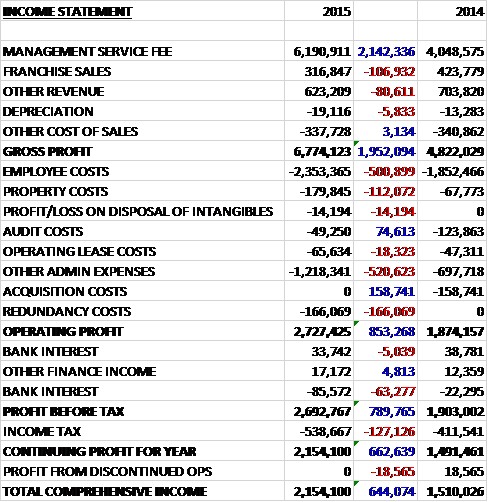
Revenues increased when compared to last year as a £2.1M growth in management service fee revenues, £1.7M of this due to the acquisition last year, was partially offset by a £107K decline in franchise sales and an £81K fall in other revenue after the Saltaire portfolio was sold in January. Cost of sales were flat which meant that gross profit increased by just under £2M. Audit costs fell by £75K but employee costs grew by £501K, property expenses were up £112K and other admin expenses grew by £521K which meant that after redundancy costs of £166K following last year’s acquisitions broadly offset the lack of acquisition costs that occurred last year, the operating profit was £853K ahead of 2014. Bank interest grew by £63K and tax expenses were up £127K to give a profit for the year of £2.2M, a growth of £663K year on year.

MCOassets

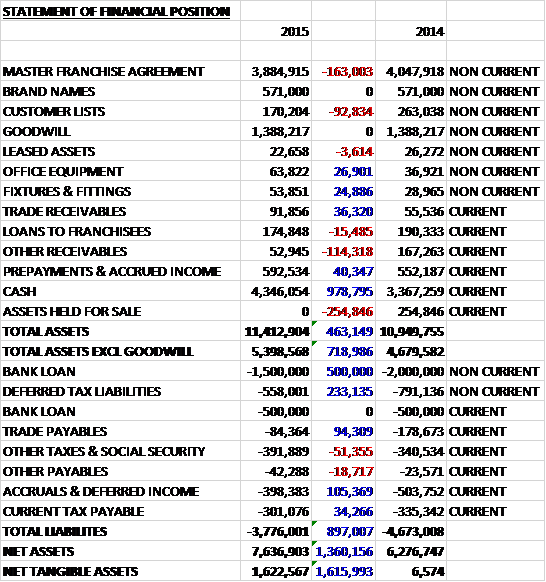
When compared to the end point of last year, total assets increased by £463K driven by a £979K growth in cash, partially offset by a £255K elimination of the assets held for sale, a £163K decline in the value of the master franchise agreement as it is amortised, a £114K fall in other receivables and a £93K decrease in the value of customer lists. Total liabilities fell during the year due to a £500K reduction in the bank loan, a £233K decrease in deferred tax liabilities due to an increase in share based payments, and a £105K reduction in accruals and deferred income. The end result is a net tangible asset level of £1.6M, a growth of £1.6K year on year.

MCOcash

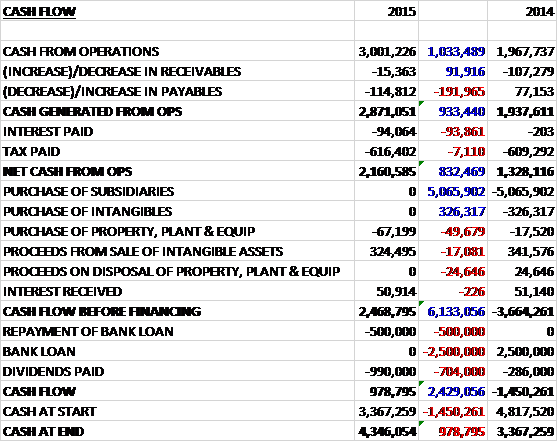
Before movements in working capital, cash profits increased by £1M to £3M. There was a modest outflow of cash through a decrease in payables and interest payments grew by £94K to give a net cash from operations of £2.2M, a growth of £832K year on year. The group only spent £67K on capex and received £51K in interest along with £324K from the disposal of intangible assets relating to the disposal of the Saltaire portfolio to give a strong free cash flow of £2.5M, of this £500K was used to repay the bank loan and £990K was paid out in dividends to give a cash flow for the year of £979K and a cash level of £4.3M at the year-end.

During the year the group opened thirteen offices, seven of which were in new territories for them. Cold start offices launched with new franchises in Kingston, Plymouth, Hull, Wokingham, Gloucester and Greenford and offices were opened by existing franchisees in Downend, Cirencester, Worcester, Chester, Longbridge, Ashford and Huyton.

The group ended the year manging over 45,000 tenanted homes which means collecting and accounting for £34M in rents every month. The first part of the year was substantially taken up with the integration of Xperience into the group. The business operated out of two headquarter buildings, one in Leeds and one in Theale. The group never occupied the Leeds building and disposed of the lease at Theale. All the costs of the re-organisation and assimilation of Xperience have been incurred and they enter 2016 with a lowered cost base.

The vast majority of the group’s franchisees have been franchisees for five years or more which means that their initial bank loans will have been paid down and these businesses should be well placed to raise new funds to acquire competitors with the group intending to put more energy into this activity during the coming year.

The group will rolling out a financial services strategy to all their offices during 2016. The proposition will be a “whole of market” selection of mortgages and fee-free advice. Life Assurance and General Insurance products will be tied to Legal and General and the benefits of this strategy will be increased income from financial services, which currently account for just 1% of fees, and greater understanding of customers.

Enquiries from potential franchisees have been on a steep rise during Q4 2015 and the group achieved their highest number of new recruits in three years and opened 13 new offices. The board remain very positive about prospects for the private rental sector and they aim to surpass this year by a substantial margin in 2016.

Having built up the lettings business, the group are now focusing on advancing the residential sales side of the business. The number of house sale transactions completed across the group increased from 2,201 to 7,689; offices offering an estate agency service increased from 243 to 256; and a financial services strategy has been agreed with business partner Legal and General and will roll-out during 2016.

The franchisees pay a management service fees which is 9% of all income for Martin & Co offices and 7.5% for the other brands, although this will be increased to 9% when franchises renew. In addition, franchisees contribute to a marketing promotions fund and the total contributed during the year was £694K. The franchisees decide on the use of this fund and this has included sponsorship of international rugby and cricket.

There are a number of drivers for growth. Pension reform has enabled the over-55s to access retirement funds which can be used as a deposit on a buy-to-let property and the record net migration into the UK drives further demand with the foreign-born UK population being three times as likely to be in the private rental sector. In addition, the government is increasing regulation on landlords. Deposits must be registered, new health and safety rules for rented homes, and checks on a tenant’s right to rent in the UK, all of which makes rental agents more appealing.

Regardless of minor regulatory or fiscal adjustments, the demand for property in the UK has never been greater and the board have confidence in the future for the group.

The group still have £3M undrawn from the Santander facility so they have plenty of headroom with their debt. At the current share price the shares are trading on a PE ratio of 15.5 which falls to 11.5 on next year’s consensus forecast. After a 47.5% increase in the total dividend, the shares are yielding 4% which rises to 4.5% on next year’s forecast.

Overall then this has been a good year for the group. Profits were up, net assets increased, and the operating cash flow grew with a good amount of free cash generated. The Xperience acquisition is now integrated so the full benefits of that should be seen in 2016, along with the introduction of the financial services offering. Enquiries in Q4 were up considerably, which also bodes well for the coming year. Of course there are always risks with these kind of businesses but with a forward PE of 11.5 and yield of 4.5%, these shares look good value. I have bought back in here.

Serabi Gold Share Blog – Final Results Year Ended 2015

Serabi Gold has now released its final results for the year ended 2015.

SRBincome

Revenues increased when compared to last year with a full year contribution of production from the Palito mine. Gold Bullion revenues increased by $8M and concentrate revenue was up $14.4M. Cost of sales increased by $13.9M, depreciation was up $1M and amortisation grew by $2.2M reflecting the fact that there was a whole year of commercial production at Palito this year to give a gross profit $5.4M above that of 2014. Admin expenses were up modestly, and share based payments increased by $145K but we also see the lack of provision write-backs which gave an income of $2.9M last year which meant that there was a $2.2M swing to an operating profit this year. This was entirely wiped out by $951K of loan interest and $527K of finance costs on the Sprott loan. In addition there was a £638K increase in the gains on financial instruments relating to the warrants and after $525K of income tax costs due to unrecognised tax losses being carried forward, the loss for the year came in at $49K, an improvement of $126K year on year.

SRBassets

When compared to the end point of last year, total assets declined by $26.6M driven by a $12.1M fall in the value of mining property due to the depreciation of the Brazilian Real, a $7.6M reduction in cash, a $1.9M decrease in projects in construction, a $3.1M fall in development and deferred exploration costs, also due to the depreciation of the Real, and a $1.2M fall in inventories, mainly as a result of a fall in the stockpile of flotation tails. Total liabilities also decreased during the year due to a $4.9M fall in other loans and borrowings and a $919K decrease in the environmental rehab provision, also due to the depreciating currency. The end result was a net tangible asset level of $38.1M, a decline of $17M year on year.

SRBcash

Before movements in working capital, cash profits increased by $5.9M to $4.5M. There was a broadly neutral movement in working capital compared to a large increase in receivables last year so that the cash from operations was $4.4M, a positive swing of $17.1M year on year. The Sao Chico mine contributed a net cash loss of $2.1M and the group also spent $3M on property, plant and equipment, along with $1.5M on exploration and development to give a cash outflow of $1.5M before financing. The group paid $758K in finance leases and paid back $4M of the Sprott loan and after a $1.1M cash outflow on the short term trade finance arrangement the cash outflow for the year came in at $7.4M to give a cash level of $2.2M at the year-end.

All in all, the gold produced during the year was as follows:
Q1 7,389 ounces
Q2 8,237 ounces
Q3 9,078 ounces
Q4 7,925 ounces.

During the year the group produced 32,629 ounces of gold having mined 135,827 tonnes at a grade of 9.8g/t. The average gold price achieved was $1,151 per ounce, although the price at the end of Q4 was $1,063 per ounce, and the all-in sustaining costs were $892 per tonne. The year was dominated by a falling gold price but a mitigating effect of local currency weakness. So far this year, the average LMBA price has been $1,178 per ounce although there has been a tendency in recent years for prices in Q1 to be strong with a decline over the remainder of the year. There are some commentators who expect gold prices to make a gradual recovery in 2016, driven in part by contraction on global mine production and increasing demand from Asia.

The production in Q4 was adversely affected by power generation problems at the Sao Chico mine which delayed mining activities. The shortfall in what was supposed to be high grade Sao Chico development ore feed was replaced by surface stockpiled ore from the Palito mine at a lower grade. By December the problems were resolved and the Sao Chico mine turned in its best month of the year with over 4,000 tonnes mined at grades in excess of 11.5g/t.

About 33,959 tonnes were produced in Q4 in total which represents an increase of 34% compared with Q4 2014 with 7,000 tonnes of this increase coming from Sao Chico, which was not in production this time last year, and 1,600 tonnes of this increase representing a growth in Palito production. Going forward, Palito is expected to produce about 27,000 tonnes a quarter, so at a similar level.

The Palito mine has continued to perform well with the level of mine output exceeding the group’s internal plans. Tonnage of Palito ore processed through the gold recovery plant exceeded internal plans by 9% and the total contained gold processed exceeded plans by 14% with the Gold production from the run of mine ore exceeding the plan by 10%. This increase in the level of ROM processed did, however, reduce the ability of the group to process stockpiled material and the stockpile of coarse ore that the group had hoped to run down during the year remained at approximately 10,000 tonnes at the year-end whilst only about 18,500 tonnes of flotation tailings were processed out of the total volume of 56,000 tonne as the start of the year.

The Palito mine generated about 111,751 tonnes of ore at a grade of 10.05g/t during the year and management expect that mine output for 2016 will be between 105,000 tonnes and 110,000 tonnes at an average grade of between 8.5g/t and 8.9g/t of gold. The gold production in 2016 will be supplemented by the processing of surface stockpiles of ROM ore and about 37,500 tonnes of flotation tailings generated in 2014.

Labour costs increased from $9.75M to $10M due to an increase in the staff numbers and pay increases for staff – the relatively modest increase was due to the depreciation of the local currency. The cost of mining consumables of $3.78M increased by 3% in dollar terms and 47% on a local currency basis as a result of increased activity. Maintenance costs of $1.23M decreased by 14% due to the favourable exchange rate movement with costs in the local currency increasing as the mining fleet grew. Plant operating costs increased by 82% to $3.38M due to an increase in productivity as the costs per tonne fell.

During the year the group completed a cross cut to the Chico da Santa zone in October and to the Senna zone in December. The opening up of these new sectors allows them to establish more ore faces and stoping areas. In the case of the Senna zone, there has never been any previous underground development on the ore zone but based on the ore grades recovered from the limited pit operations of over 3g/t, management is hopeful of the potential within the zone where they have recorded a drill intersection in hole PDD289 of 0.55 metres at a grade of just under 51g/t at about 300 metres below the surface.

The group continued mine development towards the Palito South area which has been driven some 700 metres further south than any other underground working at the mine. Having intercepted numerous high-grade pay shorts, the group are now testing the down-dip continuity of these pay shorts for future development of the mine at depth, as well as incorporating the up-dip extensions of the pay shoots in the upper levels into its future mine plans which represent an excellent potential source of additional ore.

The performance of the Sao Chico mine was below the group’s internal plans for 2015. Whilst the group remains optimistic about the long-term potential for the mine, the orebody has, to date, been more complex than the surface drilling results has suggested. The implications for mining methodology and grade control only became apparent once access through underground development had been established at the start of Q2. The production at the mine during the year was about 3,150 ounces representing less than 40% of the initial targets. Commercial production at the mine was declared at the start of 2016 reflecting mine outputs having been achieved over a sustained period of time at levels agreed as being necessary to consider that a viable long term operation had been established.

During the year about 2,800 metres of development had been achieved and in January the ramp development intersected the principal vein about 30 metres below the portal entrance. The initial sampling confirmed a payable intersection with a true width of 3.6 metres and a gold grade of 42g/t.

The immediate priority is to evaluate and define stoping blocks on the first four levels to secure mine production for the next year and a half. Further ramp development will therefore be progressed to pursue the down-dip extension of the current areas that are in development. The rates of lateral development on existing levels will be increased when the group has greater confidence in the distribution of the high grade mineralisation within the lateral strike extensions.

As previously reported, the high grade mineralisation is dominantly hosted in a consistent alteration zone that can be anything from two to ten metres wide. The alteration zone itself is readily identifiable but the high grade gold zones within the zone are much less so, and as a result the mining operations will require on-lode development at regular vertical intervals, with regular channel sampling and in-fill drilling between these levels to best define the high grade gold mineralisation. This approach will allow the group’s mining personnel to readily identify stoping blocks and optimise mining the high grade zones.

The group is continuing to progress the conversion of the exploration license at the mine to a mining license. As the next major step in the conversion procedure, in September they submitted a form of economic assessment prepared in accordance with Brazilian legislation. With the trial mining license already in place, all mining operations can continue in parallel, however. A submission for a further extension for a period of one additional year was also submitted in September. The issuing of the mining license requires the submission of a risk assessment and management plan, safety assessments, environmental and social impact studies and these additional reports have either been submitted or are being submitted when requested to the relevant government bodies.

Reflecting the higher volumes of ore that the group expects to produce and process, a third ball mill was acquired in Q4 2015 and will become operational during Q2 2016. During the year the group also acquired and commissioned an in-line Leach Reactor for processing the high grade gravity concentrate that is produced from the processing of the Sao Chico ores. This will help improve overall gold recovery levels and increase the processing capacity of the Carbon in Pulp process circuit. The improvements should cost about $1.2M, funded from the cash flow of the current operations. The group has also been introducing further improvements to its process plant targeted to increase process capacity and overall gold recoveries which averaged 90% during 2015.

As well as the potential that exists to grow resources at Sao Chico, the Palito South , Currutela and Piaui prospects still provide excellent opportunities for identifying additional resources which could enhance current production levels and extend the mine life. At this time, no surface drilling or other surface exploration activities are currently planned on the group’s properties but once adequate cash flow is being generated, they will step up exploration activity and will be looking to add to the resource base and production potential by establishing additional satellite high grade gold mines close to the current Palito operation which would be a centralised processing facility.

The mining fleets at the mines are relatively new and in total the group operates with a fleet of seven 20 tonne trucks, five underground drilling jumbo rigs and dour underground loaders. The group also owns various other mobile equipment including four front end loaders, a bulldozer and other smaller vehicles. Whilst further equipment purchases are planned during 2016, both mining operations are now well equipped. Transportation of the ore from the Sao Chico mine to the Palito processing plant is undertaken by a contractor and began in February 2015.

The total volume of ore processed during the year was 130,299 tonnes. Milling performance at the start of Q1 was affected by power stoppages resulting from an inconsistent electricity supply from CELPA, the regional power company. The reliability of power has remained subject to fluctuations and interruption which is particularly detrimental to the performance of the gold processing plant. As a consequence, during Q2 the group took the decision to commit to the use of diesel generated power for the operation of the plant as management expects the benefits of increased plant availability will significantly outweigh the increased operational costs but the power requirements of mining operations continue to me met by CELPA except in exceptional circumstances.

To enable processing of ore from the Sao Chico mine through the Palito gold recovery plant, a separate process line was established with a dedicated feed hopper which can feed one of the two mills that have been in operation during the year with a dedicated feed of Sao Chico ore. The construction of the hopper was completed at the end of Q1 2015 and after an initial commissioning period using ore from the Palito mine, the processing of the Sao Chico ore commenced in April. In the short term the crushed and milled Sap Chico ore has passed directly to the CIP plant but during Q3, the group acquired an ILR which was commissioned during November and with this now fully operational the milled Sao Chico ore can be passed initially through a gravity concentrator with the recovered gravity concentrate containing gold passing through the ILR where in a small closed circuit it is leached with high concentrations of cyanide, dissolving the gold. The gold in solution is them recovered by conventional smelting. This use of the gravity concentrator enhances gold recovery for the Sao Chico ore and creates efficiencies in the CIP plant and the ability to increase flow rates.

The slower start-up of the Sao Chico mine which necessitated an increased level and longer period of financial support for this new operation placed pressure on the group’s ability to generate positive cash flow from operations. To compensate for falling gold prices during the year and after the year-end, the group renegotiated the repayment terms of its financial arrangements with Sprott.

At the end of the year the group entered into an agreement with the major shareholder, Fratelli Investments, in which they received an unsecured short term working capital convertible loan facility of $5M to provide additional working capital facilities and in January they drew down $2M against the facility. The balance of the facility may be drawn down at any time up to the end of June 2016 and it is to be repaid by January 2017. It comes with a hefty interest rate of 12% per annum but there is no prepayment penalty or arrangement fee. The first $2M of the loan is convertible at the election of Frateli into new shares at an exercise price of 3.6p each.
The remaining amount of the loan, if drawn down, may be repaid by the group at its option at any time before the end of June 2016 after which, Frateli will have the right to convert all or part of the remaining amount into Serabi shares at an exercise price of 3.6p.

They also have a secured loan facility with Sprott which carries an interest rate of 10% per annum and is repayable by the end of 2016 with the amount outstanding on this loan being $4M. The directors think that the group now has access to sufficient funding for its immediate projected needs and they expect to have sufficient cash flow from its forecast production to finance its ongoing operational requirements and to pay back the loan facilities along with, in part, funding exploration and development activity on its other gold properties. There are a number of undertakings that the group has provided with regards the Sprott loan including an undertaking to maintain working capital in excess of $2.5M excluding any amount due to Sprott of Fratelli, and a minimum of $1M in unrestricted cash.

The company issued 100,000,000 warrants in March 2014 which gave rise to a liability of $1.7M at the date of issue. At the end of 2015, the fair value of these warrants was assessed to be nil (compared to $332K in the prior year) and they expired in March 2016 with none having been exercised.

A significant element behind the decrease in current liabilities relates to the fair value provision for a property acquisition payment that is due to a past owner of the Sao Chico property. This is currently valued at $1.75M and the group expects that under the contractual terms the first instalment will become payable in Q2 2017, instead of the originally forecasted June 2015. As the payment terms have been deferred, all of the provision is included in non-current liabilities. There is no longer a liability for derivatives as they have all expired. The liability for derivatives was valued at $529K and all provisions have been released to the income statement during the year.

In 2016 the group is forecasting gold production of about 37,000 ounces with all-in sustaining costs of between $840 and $870 per ounce. In all, the group expects Palito to produce about 127,000 tonnes per annum and during 2016 to run down stockpiles of course ore and flotation tailings whereas Sao Chico is going to be in its first full year of production in 2016 with the mine producing between 30,000 and 33,000 tonnes per annum. The average LOM gold production from 2017 is 42,000 ounces and the production period is eight years for Palito and seven years for Sao Chico. These plans assume a gold price of $1,150 per ounce. As of the 1st January 2016, the Sao Chico mine entered into commercial production. Going forward, the board is confident that the group will meet or even exceed their targets for the next year.

As the group made a loss during the year, we can’t really gain much from looking at PE ratios in 2015 and I can’t find any forecasts for next year.

Overall then, this has been a bit of a mixed year for the group. They are nearly at the break-even level but this was only due to a gain from the expiry of the warrants and the operating profit was wiped out by financing costs. Net assets declined due to the depreciation of the Brazilian Real but there was a cash inflow from operations as opposed to last year’s outflow, although there was an outflow before financing. Gold production in Q4 was below that of Q2 and Q3 due to power generation problems at Sao Chico meaning that lower grade stockpiled ore was used. These issues have been resolved now, however.

The Palito mine performed well in it’s first full year of commercial production but the going at Sao Chico was more challenging as the ore body is proving more complex than initially expected which has meant that production is slower than expected. Despite this, the mine has entered commercial production but there remains much to be done to fully understand the ore body and get it contribution in the way that it should.

The group achieved an average gold price of $1,151 during the year and so far in Q1 the gold price has averaged $1,178 which bodes fairly well for the year, although the board have cautioned that Q1 is often strong with regards the gold price and it tends to drift as the year progresses. The all-in costs of $892 per ounce were pretty good and the group expects these to fall further to $870 per ounce going forward.

In conclusion then, the investment case here is pretty good if the gold price can be sustained at this level but it starts to look a bit shaky if it falls. There is some headroom with regards the cash position due to a supportive majority shareholder so I don’t think a placing is on the cards for the foreseeable future. A tricky one this, I am tempted to take a nibble.

On the 20th April the group released an update covering trading in Q1. The mine production totalled 37,546 tonnes which included 26,752 tonnes at a grade of 11.84g/t from Palito and 10,794 tonnes at 9g/t from Sao Chico which meant that 9,771 ounces of gold was produced compared to 7,924 ounces last quarter. At the end of the quarter, the combined surface stockpiles totalled 17,000 tonnes at a grade of 5.3g/t with the accumulation as a result of the overall limitations in the capacity of the gold processing plant.

The installation of the third ball mill is nearly complete, along with the second flotation line and enhancements in the carbon in pulp plant. The works are on schedule to be completed by the start of May. A carbon regeneration kiln is also being acquired which will assist in enhancing gold recoveries once it is operational in H2 of this year. Following the completion of the improvements, it is anticipated that plant processing capacity could be increased from the current levels of about 400 tonnes per day to over 500 tonnes. This will be in excess of production levels, allowing the stockpiles to be depleted and creating surplus capacity to catch up any lost production caused by unplanned stoppages.

The lateral expansion of the Palito mine, completed at the end of 2015, has opened up the Senna and Chico da Santa sectors. Senna especially is returning some very encouraging mineable grades to date. Underground drilling is being used to evaluate numerous known but underexplored veins and together with these two new sectors, the group hope to open up numerous new mining faces in the upper levels. These have the advantage of being in close proximity to existing mine infrastructure and will not require any new ramp development.

At Sao Chico, outside the pay shoots the vein is continuous but with low gold grades and as a result it is unavoidable that as the mine development passes between the pay shoots, lower grade ore has to be mined. The central pay shoot is the most established of the four and is some 100m long. The group are focusing on developing this part of the main vein and are now seeing some consistent higher grade development ore as a result. The other pay shoots along the strike will be developed later in the year.

The group expects to produce 28,000 ounces of gold this year from the processing of Palito ROM and stockpiles. With the Sao Chico mine now under development, they also expect production of 9,000 ounces of gold from ore mined there and as a result, the board remain confident of achieving their production forecast of 37,000 ounces for the year with an all-in sustaining costs of between $840 and $870 per ounce, which looks impressive to me.

I do think this company would probably make a good investment but I have heard rumours of an acquisition on the way. If this is true, I would prefer to wait to see where the funding is coming from for that before buying the shares.

Getech Share Blog – Interim Results Year Ending 2016

Getech has now released its interim results for the year ending 2016.

GTCinterimincome

Revenues decreased by £331K when compared to the first half of last year and after cost of sales were up, the gross profit declined by £1.2M. There was a £71K favourable movement in exchange adjustments but depreciation and amortisation was up £155K and other admin costs increased by £84K to give an operating loss that was £1.4M worse than last time. Finance costs were up modestly but the tax charge fell by £16K which meant that the loss for the six month period was £704K, a detrimental movement of £1.4M year on year.

GTCinterimassets

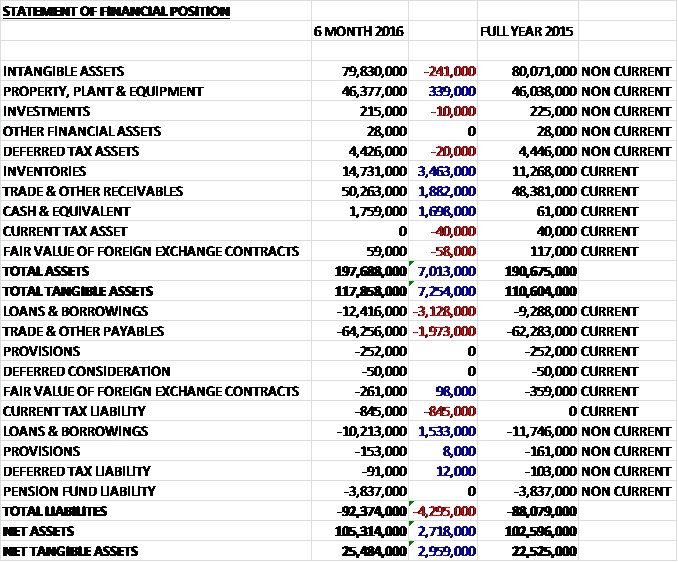
When compared to the end point of last year, total assets declined by £3.2M to £14.4M, driven by a £2M fall in cash and a £1.6M decrease in receivables, partially offset by a £288K growth in intangible assets and a £165K increase in inventories. Total liabilities also declined during the period due to a £1.7M decrease in payables, a £166K fall in current tax liabilities and a £132K reduction in borrowings. The end result is a net tangible asset level of £3.6M, a decline of £1.5M over the past six months.

GTCinterimcash

Before movements in working capital, cash losses showed a £1.3M detrimental swing to £488K. There was a modest cash inflow through working capital due to a reduction in receivables but tax payments increased by £930K to give a net cash outflow from operations of £431K, a detrimental movement of £2.9M year on year. There was no capex on fixed tangible assets but the group spent £459K on development costs and £576K on acquisitions to give a cash outflow of £1.5M before financing. They then repaid £132K of borrowings and spent £572K on dividends to give a cash outflow for the period of £2.2M and a cash level of £2.7M at the end of the half.

During the period the group continued to be adversely affected by the difficult market conditions. After the significant decline in the oil price in the second half of 2014, it fell further during 2015 which resulted in a considerable tightening of exploration budgets by the group’s clients and these budgets continued to be affected throughout the first half of this year. In light of the challenging market conditions, the group has significantly lowered its cost base through a range of measures including cutting marketing costs and reducing staff costs through reduced working hours and job losses. As a result, the month on month cost base will be down by more than 20% from its peak during the period.

The programme of integration with ERCL has continued, including a number of joint projects, and the directors are confident that it will continue to be a major asset for the group. The group have stated that they will continue to seek complementary acquisitions with have minimal impact on cash and risk but will present an upside once the market recovers.

The group entered the second half of the year with a substantial pipeline of sales opportunities. A number of new sales, including the signature and delivery of a data license valued at $720K led to a record February for sales and income and the board have also announced that they have signed a $1M new contract which includes parts of Globe and two regional reports, the global depth to basement study and their multi-satellite project, most of which will be delivered in H2. The board are also optimistic that a number of other opportunities which either did not complete in the first half of the year or have been generated recently will complete in H2.

Although the oil price has increased by nearly 50% since in low point in January 2016, there is still considerable uncertainty as to the timing of a stronger recovery and this continues to affect the availability of client budgets in 2016. The board remain confident about longer term prospects, however.

The group is not proposing an interim dividend and they have a net cash position of £1.8M.

Overall then, this has been a tough period for the group. They have swung to a loss, net assets declined and there was a cash outflow at the operating level. The low oil price continues to put client budgets under pressure but February seems to have been strong for the group with a large contract signed for delivery in H2. It is difficult to determine whether this is a one-off or the start of a recovery but I am veering towards the former as going forward, there remains considerable pressure on client budgets. This company is looking a bit more interesting at this share price but I am not sure the time is right yet to jump in. I will keep it on watch.

On the 9th June the group released a trading update covering the year ending July. After their successful Q3, the market has remained very depressed and a number of potential sales for Q4 have now either been deferred or cancelled. As a result, the company is trading below current market expectations, albeit the board expect to generate a pre-tax profit for the year.

The oil price has shown signs of strengthening but this is unlikely to have an immediate impact on purchasing behaviour. If it shows that the price rises are sustainable, however, they anticipate that demand for their products will convert from a wish to buy to actual purchases when budgets are available.

On the 14th June the group announced the acquisition of Exprodat Consulting, a company specialising in the provision of geographical information systems software and services to the oil and gas industry. GIS systems are used as part of the work at all stages from exploration through to production and virtually all clients use the ArcGIS software platform provided by ESRI. Prior to the current downturn the business generated a pre-tax profit of £107K but in 2015 they are expected to report a loss of £109K. The directors believe that the enlarged group will deliver a number of synergies, both in relation to internal group performance and in term of the products and services provided to clients.

A cash payment equal to the value by which the net assets exceed £500K is payable in two instalments with £250K immediately on completion and the balance in January 2017. The group is also issuing 4,666,667 new shares to the current owners of Exprodat which means that they will end up owning more than 12% of the enlarged group! The aggregate potential consideration is expected to be £1.8M.

Overall, the trade update is disappointing and I am disappointed that some 12% of the company is being given away for such a modest acquisition. There is nothing here to tempt me to buy.

On the 3rd August the group announced the appointment of Jonathan Copus as CEO with immediate effect. Jonathan has previously worked as an exploration geologist at Shell, as an exploration & production sell-side equity analyst for Investec and Deutsche Bank and most recently as CFO at Salamander Energy which was acquired by Ophir in 2015.

On the 7th October the group announced that Paul Carey was leaving the group as Sales and Marketing director. The current Marketing Director, Jules Cullen will step up to succeed Paul.

James Halstead Share Blog – Interim Results Year Ending 2016

James Halstead has now released its interim results for the year ending 2016.

JHDinterimincome

Revenues declined by £2.5M when compared to the first half of last year, due to the strength of Sterling, but cost of sales fell by more to give an operating profit £1.7M above that of last time. Finance costs were up £57K and tax expenses increased by £82K to give a profit for the half year period of £17.7M, a growth of £1.5M year on year.

JHDinterimassets

When compared to the end point of last year, total assets increased by £4.4M driven by an £8.4M growth in cash and a £1M increase in property, plant and equipment, partially offset by a £3.5M fall in receivables and a £1.5M decrease in the value of derivative financial instruments. Total liabilities also increased during the year due to a £16.3M special dividend payable and a £2.6M growth in payables. The end result is a net tangible asset level of £87.1M, a decline of £16.1M over the past six months.

JHDinterimcash

After a £1.1M increase in tax paid, the net cash from operations came in at £24.4M, a growth of £1.6M year on year. The group spent just £2.2M on capex to give a free cash flow of £24.4M, of which £16.3M was spent on dividends, to give a cash flow for the half year of £8.3M and a cash level of £55.9M at the period-end.

There was growth in most markets in the period on a constant currency basis. Polyflor Canada continued to expand with a 32% growth in turnover and their flooring is refurbishing store chains such as Loblaws and Indigo Kids. The French business reported a near 10% increase and notable projects there included the Alstrom Epsilon building complex in Lyon. In the more established markets, the Central European operation based in Germany reported a 4% growth in sales. The latest range, Expona Flow, has already been fitted in sales areas within Ikea stores in Kaiserslautern, Berlin and Ravensburg and long term customers such as the fashion retail chain Modepark Rother continue to expand.

The UK business maintained its strong presence with notable projects including the Croydon University Hospital, the Vision Express retail chain and the new Pontypridd Lido in Wales. The UK market, representing about 39% of total turnover, has shown a solid performance with growth of 4.5% in the period which is ahead of the general market. Australia and New Zealand have reported an 8% to 9% growth with the former providing flooring to Aldi stores across the country and the latter to Burwood Hospital in Christchurch, which is the country’s largest ever healthcare project.

Gross margins have improved by 1.5% despite the adverse forex effect due to the increased output of heterogeneous flooring, reduced raw material prices and energy savings. Overheads are 3.2% below the comparative period but on a par at constant exchange rates.

Early trading in the second half of the year has been challenging with the UK noticeably facing tougher trading conditions but the global footprint provides opportunities for advancement.
At the current share price the shares are trading on a forward PE ratio of 23.5. Including the special dividend and the increased interim dividend (up by 11%), the shares are currently yielding 4.8% which reduces to 3% on the full year forecast.

Overall then, this was another strong period for the group. Profits were up, the operating cash flow grew with loads of free cash being generated and although net assets declined, this was due to the payment of the special dividend. The performance was pretty good across all markets, especially Canada, France and Oceania and the group also benefited from lower raw material costs.

The problem is, however, the outlook statement where the board have indicated that trading in H2 so far has been challenging, especially in the UK and with a forward PE of 23.5 and yield of just 3%, the shares are looking a bit expensive to me and I have sold out for now (with a heavy heart – this company has been a great money maker for me). Hopefully I will be able to buy back in a bit lower in the future.

On the 1st August the group released a trading update covering the year-end 2016. As reported previously, profit in the first half of the year was 7.5% ahead but early trading in the second half was challenging. During the majority of the year, Sterling traded at a higher level than last year which presented challenges for the export business, which is over 60% of total turnover. Obviously this situation has ow reversed which bodes well for the next year.

Trading for the rest of this year has been solid and pre-tax profit will be ahead of this year (it should be given they were 7.5% ahead at the half year point!). It is also in line with market expectations, whatever they are.

AG Barr Share Blog – Final Results Year Ended 2016

AG Barr has now released its final results for the year ended 2016.

BAGincome

Revenues declined when compared to last year as an £8.5M fall in carbonates revenue and a £1.1M decrease in still drinks revenue was partially offset by a £7.4M increase in other revenue. Underlying cost of sales decreased by £3.5M and there was also no redundancy and impairment costs related to the Tredegar site which accounted for about £3M last year so the gross profit was £4.1M above that of 2015. There was no compensation from the terminated Orangina contract which contributed £747K last time, depreciation was up £600K, amortisation increased by £800K and there was a £319K reduction in profits from asset sales. Share based payments did fall by £400K, however, and other underlying operating expenses declined by £819K before last year’s £900K redundancy cost was mostly offset by a £500K pension curtailment gain to give an operating profit £3.3M above that of last year. Finance costs increased by £600K due to interest costs on the pension deficit, but tax costs were down £1.6M which meant that the profit for the year came in at £34.3M, a growth of £4.3M year on year.

BAGassets

When compared to the end point of last year, total assets increased by £14.4M, driven by a £26.6M growth in intangible assets, a £5.7M increase in property plant and equipment and a £1M growth in derivative financial assets, partially offset by an £18.6M decline in cash and a £1.1M fall in inventories as the prior year inventory build in advance of the Tredegar site closure was unwound. Total liabilities declined during the year as a £13.7M fall in current payables and a £5.4M decrease in pension obligations was partially offset by a £4.5M growth in non-current payables, a £3.5M increase in deferred tax liabilities and a £3.2M growth in borrowings. The end result is a net tangible asset level of £72.6M, a decline of £3M year on year.

BAGcash

Before movements in working capital, cash profits increased by £3.1M. There was a large cash outflow through working capital, with a big fall in payables due to the 53 week year meaning that month-end supplier payments occurred before the year-end, and after tax payments fell by £231K, the net cash from operations came in at £29M, a decline of £15.5M year on year. The group then spent a net £13.8M on property, plant and equipment along with £4.8M on intangible assets before the £15.7M spent on the acquisition meant that before financing there was a cash outflow of £5.2M. The group took out a net £2.5M in new loans but spent £2M on the employee share scheme and paid out £14.3M in dividends to give a cash outflow for the year of £19.1M and a cash level of £6.2M at the year-end.

The gross profit in the Carbonates business was £98.6M, a decline of £1.1M year on year. In a competitive market the division delivered market share gains in a deflationary environment. The IRN-BRU brand held market share and the partnership Rockstar brand continued to grow both overall volume and value share. Gross margins benefited from favourable commodity pricing and supply chain savings and increased 1.3 percentage points to 52%.

The gross profit in the Still drinks and Water business was £16.9M, a fall of £1.8M when compared to last year. There was modest volume growth but the business was impacted by general market deflation and price repositioning of the Sun Exotic brand. Margins in this division were impacted as promotion pricing pressure and Rubicon availability challenges in the summer offset very positive growth in the Snapple brand following the new franchise agreement.

The gross profit in the “Other” division, which includes the acquired Funkin cocktails business, rental income for vending machines and ice cream, was £5.6M, a growth of £4.1M when compared to 2015. This year the division was dominated by the first time inclusion of the Funkin cocktail mixer business and last year by the discontinued Orangina and Findlay businesses. Funkin performed well in a growing market and syrups, purees and mixers all grew volume and value.

In February, the group acquired Funkin, a business that offers a broad range of premium cocktail solutions including fruit purees, cocktail mixers and syrups, for a total consideration of £22M which included contingent consideration of £4.5M. The acquisition generated goodwill of £15.7M and the business contributed £1.3M of operating profit during the year.

The second half of the year saw sales and performance recover as the group stabilised their operating platform following a significant level of investment and consequential change across the summer.

The UK soft drinks market has not yet appeared to have benefited from the improvement in underlying consumer purchasing power and the group have seen the impact of general price deflation, poor summer weather and retail competition feeding through to the overall performance. The market was down in value terms by 1.8% with volumes flat and within this performance, carbonates were down 1.5% in both value and volume whole stills were up slightly in volume but down 2% in value.

The growth driver in overall soft drinks was water, offset by significant value declines in fruit juice, dilutables, sports drinks and some areas of carbonates. Previously much of the market growth has been delivered by the significant growth in carbonated energy but this sector grew by only 1% in volume terms and was flat in value terms in the period. The market has seen growth in sugar free products, lower sugar brands and premium products such as those in mixers, and these have outperformed the overall category.

The group have created a select portfolio to develop in their chosen overseas markets and they expect to see continued growth in this area of the business. During the period, the international business grew revenue by nearly 30% on last year and would have grown by over 40% if measured on a constant currency basis. The push to develop outside the UK is also allowing them to build more significant relationships with their partners, Rockstar and Dr Pepper Snapple.

To ensure success in the UK market, the group are focusing their marketing efforts on their lower and no sugar products and are substantially reducing the sugar content of their portfolio to reflect consumers’ changing preference. They have already made progress in this area, reducing the average calorific content of the owned portfolio by nearly 9% in four years, and they anticipate the scale of this change to accelerate over the next year as they reduce their exposure to high sugar products where appropriate.

The expansion plans continued with the acquisition of land and the subsequent warehouse build at Milton Keynes along with the new glass line in Cumbernauld which will enable the group to bring the Snapple brand production in-house over the coming year. In the year ahead, capex is anticipated to continue at a similar level with the completion of several key expansion projects including the new flexible glass line in Cumbernauld and the warehouse expansion at Milton Keynes.

Going forward, market conditions in the core UK soft drink market are not expected to substantially change. Top line growth remains under pressure and changes to consumer preferences offer challenges and opportunities. Although the details of the Chancellor’s proposed soft drinks levy are still to be consulted upon, the board believe that their brand strength, ongoing product reformulation and innovation will allow the, group to minimise the financial impact on the business from implementation in April 2018. Based on the proposed metrics, the board expect at least two thirds of the portfolio will be lower or no sugar and would be levy free at that time. In the rest of the portfolio they expect that brand loyalty and consumer preference will drive continued demand.

At the year-end, net debt stood at £11.3M compared to a net cash position of £10.3M at the end of last year. At the current share price the shares are trading on a PE ratio of 17.8 which falls modestly to 17.5 on next year’s consensus forecast. After a 10% increase in the total dividend, the shares are now yielding 2.5% which increases to 2.6% on next year’s forecast.
Overall then this was a rather mixed year for the group. Profits were up but underlying profits were broadly flat; net tangible assets fell modestly; and while the operating cash flow did fall, this was due to a decline in payables and the cash profits increased. The cash generation was OK, but there was not enough free cash to cover the dividends let alone the acquisition, which was an essential one in my view.

Both the carbonate and stills business suffered from price deflation, driven by retail competition, and were not helped by poor summer weather and both of these businesses saw profits fall. The saving grace was the acquired Funkin business which drove the profits in the “other” division considerably higher and were it not for this acquisition, these results would have been much worse.

Going forward, the market remains subdued and is not helped by the proposed levy of high sugar drinks, which will include about a third of the group’s portfolio. The forward PE of 17.5 and dividend yield of 2.6% do not fully reflect the outlook for the market in my view and despite this being a quality company with a very solid balance sheet, I am not looking to buy in just yet.

In the annual report there is a bit more detail on how the individual brands are performing.
Irn Bru delivered a resilient performance, growing its share of the other flavour carbonates category in the year. Its position in Scotland remains very strong, supported by some marketing initiatives such as special edition tartan packs and their Made in Scotland from Girders anniversary campaign. The significant growth potential for the brand lies in England and Wales, however, and the group are looking to increase brand awareness in the region through their first national TV advertising campaign which delivered a significant increase in consumer brand awareness.

Irn Bru Sugar Free continued to show growth in popularity, aligned to the increasing consumer trend towards lower and no sugar products, and now accounts for more than a third of purchases. Irn Bru Sugar Free increased its share of the UK carbonates market, up 2%.

The fruit juice marker performance across the past year has been weak with value declining 6%. Rubicon’s performance has been broadly in line with the market but Rubicon carbonates has proved to be more resilient. Despite the difficult environment, the group have continued to invest in the brand equity and remained focused on their brand strategy with the “It’s a Family Thing” campaign reinforcing the brand’s strong position with ethnic consumers and the “Believe in Beach” campaign developing the brand as a mainstream offering through a new national TV ad.

The overall category performance in soft drinks was once again driven by growth in water. Total Strathmore volumes increased in the year but in the current deflationary market, value declined slightly. Sparkling water delivered a strong performance, though. The year saw a lot of Strathmore sports sponsorships from Scottish Rugby to the World Gymnastics Championships, increasing brand visibility. The Barr range of flavoured carbonates has developed further in the year with new limited editions and an impactful outdoor advertising campaign for Xtra Cola. The full range is now categorised as lower or no sugar, following a considerable reformulation programme, in response to changing consumer preferences.

Within a growing cocktail market, the Funkin brand has performed extremely well with UK sales in particular delivering a strong performance. Consumer dynamics remain very positive with cocktail distribution increasing. The group are working on some brand development over the next year.

The ten year agreement with the Dr Pepper Snapple group, which started at the beginning of 2015, is progressing to plan. The focus in the first year of this partnership has been on building brand awareness and redeveloping the brand identity for the UK and Europe. Snapple is now available in twelve European markets and, with strong revenue growth in its first year, is poised for success in 2016.

In May the group confirmed a long-term license agreement with the Moscow Brewing Company to manufacture, sell and distribute their Irn-Bru brand in Russia. The business is a leading Russian brewer who holds the license for a variety of premium soft drinks. With their well-established sales and distribution network, combined with increased sales and marketing focus and investment, the board are confident of delivering in the country.

Also, on the 27th April the group announced that Commercial Director Jonathan Kemp sold 4,896 shares at a price of nearly £30K. He still owns 20,729 shares in the company.

On the 2nd August the group released a trading update covering the first half of the year. In the period the UK soft drinks market performance has been challenging with continued deflation and volume declines with value down 0.8% and volume down 0.4% and indications are that the poor weather across June and July will further adversely impact the total market performance. Despite this backdrop, the group have maintained overall market share but anticipate that revenue will be down 2.9% on a like for like basis.

In the period they announced a new IRN-BRU zero sugar variant and launched three major new lower sugar products which are all showing encouraging early signs and is part of a move to reduce sugar across the portfolio. A new £5M glass bottling line at Cumbernauld is now operational, allowing in-house production of Snapple and offering future product development potential. During the period, the group closed the defined benefit pension scheme to future accrual.

The weaker Sterling following the Brexit vote will not have a significant impact this year but it is anticipated input costs will increase in 2017. The balance of the summer will remain an important trading period but assuming market conditions improve and their second half plans deliver, the board expect to meet their profit expectations for the full year. These seem to be big assumptions to me and I am staying out for now pending further clarity.

Laura Ashley Share Blog – Interim Results Year Ending 2016

Laura Ashley has now released its second set of interim results or the year ending 2016. This encompasses the results for the past year or so.

ALYincome

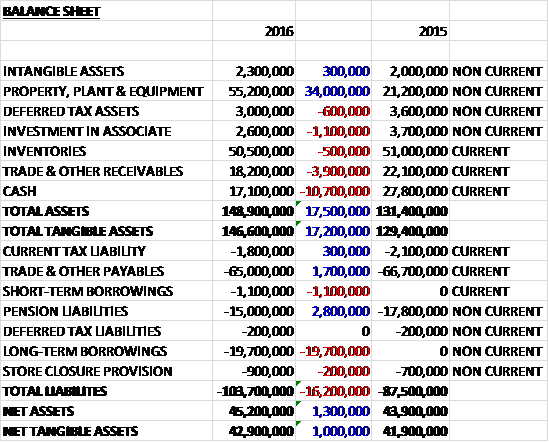
Revenues declined when compared to last year as a £2.6M growth in e-commerce and mail revenue, and a £600K increase in hotel revenue was more than offset by an £8.4M fall in store revenue and an £8.9M decrease in non-retail revenue. Cost of sales also declined but gross profit was still some £4.3M below than of 2015. Amortisation and depreciation both increased modestly but other operating expenses fell to give an operating profit £1M below that of last year. The loss from the associate increased by £800K and finance costs were up £400K along with exceptional items which showed a £1.9M detrimental swing to a £1.3M expense which related to the license partner in Australia being placed into voluntary administration. After the tax charge fell by £1.1M the profit for the year came in at £15.3M, a decline of £3M year on year.

ALYassets

When compared to the end point of last year, total assets increased by £17.5M driven by a £34M growth in property, plant and equipment partially offset by a £10.7M decline in cash, a £3.9M fall in receivables and a £1.1M decrease in the investment in an associate. Total liabilities also increased during the year as a £20.8M growth in borrowings was partially offset by a £2.8M decline in pension liabilities and a £1.7M fall in payables. The end result was a net tangible asset level of £42.9M, a growth of £1M year on year.

ALYcash

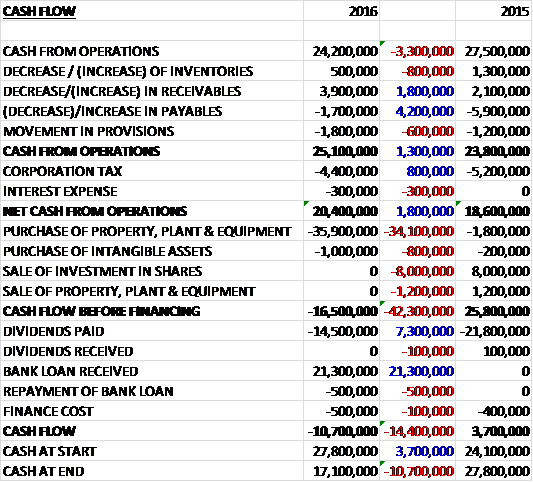
Before movements in working capital, cash profits declined by £3.3M to £24.2M. There was a modest cash inflow from working capital compared to an outflow last year so that after tax payments fell by £800K and interest costs increased by £300K, the net cash from operations came in at £20.4M, a growth of £1.8M year on year. This did not cover the £35.9M spent on property, plant and equipment along with the £1M spent in intangible assets so before financing, there was a cash outflow of £16.5M. Despite this, the group still spent £14.5M on dividends so after a net £20.3M of new borrowings, there was a cash outflow of £10.7M and a cash level of £17.1M at the period-end.

The contribution from the retail stores was £19.7M, broadly flat year on year with an increase of just £100K. There are currently 193 stores in the UK compared to 205 at the same point of last year as during the year, three new stores were opened and fifteen were closed, reducing total selling space by 3.8%. Total UK sales decreased by 2% due to the reduction in store numbers and one week less of reported trade. The UK retail business performed in line with the overall retail market but ahead in some product categories.

Furniture sales increased by 2.8% over the same period last year with like for like sales up 4.8%. The depth of choice within this category has enabled this growth with 24 wooden furniture ranges, six of which are new and various other new products. Further product development has been added to the range for this year. Home accessories sales for the period increased by 5.6% with like for like sales up 8.7%. This category continues to grow on the back of innovative product development, range additions, and in particular, seasonal offerings and the group outperformed the market in this category.

Decorating sales fell by 1.1% with like for like sales up 1.3%. The best performing products in this category were the made to measure and readymade curtains as well as the extensive paint collections. Fashion sales decreased by 4% over the same period last year, with like for like sales up 2.6%. The group are pleased to have maintained like for like growth in what has been their most challenging product category. They plan to broaden exposure of their fashion ranges as they forge new partnerships with other retailers.

The contribution from the e-commerce and mail order division was £11.9M, a growth of £2.3M when compared to 2015 and the division now represents 19.5% of total UK retail sales. The loss from the hotel business was £300K, an improvement of £100K year on year and continued to improve steady with a strong growth in sales.

The contribution from the franchising, manufacturing and licensing business was £10M, a decline of £3.4M when compared to last year. At the period-end, there were 270 franchised stores in 29 different territories worldwide compared to 303 at the same point of last year. The primary reason for the shortfall in performance compared to last year was the Japanese market were a rise in local sales tax, a weak Yen and a subdued domestic economy meant that demand was weak and the slow down continued through the year. Also, political instability and economic difficulties in other territories have contributed to a weak performance. Work continues on establishing the brand in new territories, however, and the board believe that the acquisition of the Asian head office in Singapore will help lead the brand expansion into the Asian territories. The share of loss from the associate was £1.3M, an increase of £800K year on year.

In August the group purchased a commercial property in Singapore at a total cost of £36.2M. The acquisition has been partly funded by a SG$42.9M debt facility provided by DBS Bank (currently translated at £20.8M. The loan is repayable on a monthly basis for a term of fifteen years with a prevailing interest of LIBOR plus 2% per annum. The remaining consideration of £14.9M was funded from the group’s cash reserves.

So far this year, trading in the first seven weeks of the period is down 0.4% on a like for like basis. At the current share price, the shares trade on a PE of 12 which falls to 11.1 on the full year consensus forecast. After the interim dividend remained the same this year, the shares are yielding a hefty 7.9% but I can’t find a forecast for the dividend going forward.

Overall then, this has been a bit of a mixed year for the group. Profits were down but net assets increased, as did the operating cash flow, although this was due to a comparatively favourable movement in working capital and cash profits declined. The group is very cash generative and if they did not purchase the office building in Singapore, the dividends would have been just about covered although the office building meant there was a cash outflow for the year.

The performance in the UK has been fairly good – the stores have been flat but e-commerce has increased profits. Within the individual categories, furniture and home accessories have done particularly well with decorating and fashion struggling a bit more. The hotels are still loss making but the real issue is the performance of the overseas franchises with the Australian franchise now in administration and poor sales in Japan.

Going forward, the 0.4% LFL fall in trading does not fill me with confidence but perhaps a PE of 11.1 and dividend yield of 7.9% prices this in. A tricky one this – I am tempted to buy back in here for the covered yield.

IQE Share Blog – Final Results Year Ended 2015

IQE has now released its final results for the year ended 2015.

IQEincome

Revenues increased when compared to last year as a £9.6M decline in Wireless revenue and a £398K fall in IR revenue was more than offset by a £3.5M growth in Photonic revenue, a £515K increase in CMOS++ revenue and the first licensing revenues, which came to £8M this year. Depreciation fell by £398K and other cost of sales were down £2.2M to give a gross profit £4.7M above that of last year. We then see a £2.5M positive swing relating to other income and expenses due to this year’s gain on the reduction of the estimated remaining balance of contingent consideration payable, and no onerous lease provisions that occurred last year, offset by a £1.1M increase in amortisation and a £4.8M growth in other selling and admin costs.

There were a raft of improvements from non-underlying costs, including a £5.9M reduction in impairments, a £6.7M fall in onerous lease provisions, a £4.6M decline in restructuring costs and a £5.2M profit on the disposal of property, plant and equipment relating to the contribution of equipment to the joint venture in Cardiff which was a non-cash item, partially offset by a £9.1M fall in the gain on the release of contingent consideration to give an operating profit some £14M above that of 2014. Finance costs were down modestly but there was a £4M positive swing to a tax rebate this year after last year included a tax charge on exceptional items that meant the profit for the year came in at £19.9M, a growth of £18.2M year on year.

IQEassets

When compared to the end point of last year, total assets increased by £13.8M, driven by an £8M financial asset, a £4.8M growth in intangible assets, a £2.9M increase in inventories and a £1.9M growth in deferred tax assets, partially offset by a £1.4M decline in property, plant and equipment, a £1.4M fall in receivables and a £940K decrease in cash. Total liabilities fell during the year as an £8.1M decline in bank borrowings, a £14.9M fall in the deferred consideration and a £1.4M decrease in onerous lease provisions was partially offset by a £43.7M increase in payables. The end result is a net tangible asset level of £61.2M, a growth of £21.1M year on year.

IQEcash

Before movements in working capital, cash profits increased by £9.1M to £23.3M. There was a modest cash outflow form working capital but there was a £1.7M negative swing to a tax payment which meant that the net cash from operations came in at £19.1M, a growth of £4.4M year on year. The group then spent £5M on development expenditure, £1.2M on other intangible assets and £3.8M on property, plant and equipment, which remains towards the lower end of the normal expected levels of maintenance capex, to give a free cash flow of £9.1M. This was used to pay back a net £10.8M of borrowings which meant that the cash outflow for the year was £1.1M and the cash level at the year-end was £4.6M.

The adjusted operating profit in the Wireless division was £7.2M, a decline of £8.7M year on year. The reduction in wireless revenues reflects the well-publicised slowdown in the smartphone market during the second half of the year which was exacerbated by inventory adjustments through the supply chain. Device and systems architectures continue to evolve, and several programmes have the potential to increase compound semiconductor content further. In addition, work is underway to address the requirements of 5G, which because of the higher frequencies is highly likely to require even more compound semiconductor content.

In the short term, the board expect this market for wireless materials to grow at a rate of about 5% and the group’s business is underpinned by a major contract win of $55M announced this January and recent market share gains following new product qualifications. They anticipate significant upside potential to this growth in the medium term due to innovation in smartphone hardware, including the adoption of advanced photonics sensors; the adoption of GaN on Silicon technology for base stations; the transition to 5G communications, which will require more advanced materials; and the adoption of compound semiconductors using cREO for other wireless communication chips.

The adjusted operating profit in the Photonics division was £4.3M, a growth of £2.5M when compared to last year. There are two technologies which are driving rapid growth in this market for the group. VCSEL is the key enabling technology behind a number of high growth photonics markets including data communications, data centres, sensing applications, gesture recognition, health, cosmetics, illuminating and heating applications with the group being the market leader for outsourced VCSEL materials. In addition, with its 6” wafer capability, IQE has been successful at enabling its customers to reduce significantly the unit cost of chips which is accelerating the adoption of this technology.

The other technology driving growth in this market is Indium Phosphide for fibre in the premises. The group’s roots lie in photonics and advanced laser technology for fibre optic communications. The continued development of this technology to achieve higher performance at lower costs, plus the growth in data traffic is finally leading to extension of the fibre optic network to the premises. By way of example, China has committed to delivering fibre to 100M premises, which alone represents an estimated materials market of $200M. The group is introducing advanced laser technologies to the marketplace during 2016 to address the specific needs of this marketplace, with differentiated IP, in order to secure a leading supply position to the world’s leading supply position to the world’s leading chip companies in this space. In light of these drivers, the board expect this market to continue to achieve strong double digit growth.

The adjusted operating profit in the Infra-red division was £1.2M, an increase of just 37K when compared to 2014. The group is a global leader in the supply of indium antimonide and gallium antimonide wafers for advanced infrared applications. They are technology leader with the launch of the industry’s first 150mm indium antimonide wafers, a major milestone in reducing the overall cost of chips to drive increasing adoption. This success was followed up with a number of significant contract wins for the division. In addition there has been significant work in developing these materials for consumer sensing applications which will drive much higher volumes of wafers in the future.

The board expect this market to growth at a rate of about 5-10% for the near future. There is an element of lumpiness in IR sales reflecting an element of product development revenues, but 2016 has started well, with a contract win of $3.7M.

The adjusted operating loss from the CMOS++ division was £1.7M, an increase of £509K year on year. The group has developed multiple routes to delivering this powerful new hybrid. They are involved in multiple programmes across the globe, which are developing the core technologies from which they expect highly significant revenue streams to emerge over the next three to five years.

In Advanced Solar, there is technology known as Concentrating Photovoltaics or CPV that can already deliver efficiencies of over 44% and has a route map to much higher levels of efficiency. Although this offers a lower overall cost of energy generation in sunny territories, the challenge in mass adoption is in reducing the end system install costs, which has been hampered by global macroeconomics as the cost of oil has fallen.

The terrestrial market remains an exciting market opportunity, but as a result of the shifting macroeconomics, focus has shifted to the space market, where these advanced materials are used to power satellites where the higher efficiency has a dramatic cost benefit on payload. Product qualification is underway with a leading satellite manufacturer, paving the way for increasing production revenues in 2017 from this sector of the market.

In the Power market, the group has continued to push the technology boundaries and is making rapid progress both technically and in developing commercial relationships in the supply chain. The power switching market alone is about three to four times the size of the current market for wireless PA chip market, and represented a major growth market for the group. Qualifications with multiple end users are underway, in addition to continued technology development, enabled by cREO and other in house IP.

This year the group made its first profit license income from sales to joint ventures which brought in £8M this year. The license income was earned from licenses to joint ventures, of which the group controls 50% of the share capital. The license revenue earned by the group reflects only its share of the gross income and is stated after the elimination of unrealised gains. The license fees this year were primarily upfront fees but there is also a recurring element. The group is also exploring further opportunities to license IP to third parties. By its nature this income is inherently lumpy and in Q1 2016 the group has earned further upfront license income with joint ventures of about £2M.

In July the group established a joint venture with Cardiff University to develop and commercialise compound semiconductor technologies in Europe. To establish the joint venture, the group contributed equipment with a market value of £12M which was matched by a £12M cash contribution from the University. This created a non-cash gain of £4.8M reflecting the group’s share of the difference between the book value and market value of the equipment contributed.
In March the group entered into a joint venture agreement with WIN Semiconductors and Nangyang Technological University to create the Compound Semiconductor Development Centre in Singapore. This is a centre in Asia for the development and commercialisation of advanced semiconductor products.

It is worth noting that the group still has sufficient tax losses available to shield future tax payable of about £37.5M.

Going forward, the board expect a return to growth in Wireless, accelerated growth in Photonics, increasing contributions from Power and Solar, and continuing leverage of the IP through licensing, new product development and introductions. They have had a good start to 2016 and are trading in line with expectations. The board believe that they remain on track to achieve their expectations for the full year.

At the year-end, net debt stands at £23.2M compared to £31.3M at the end of last year. At the current share price the shares have a PE ratio of 10 which falls to just 7.8 on next year’s forecast. The board are not recommending the payment of a final dividend.

Overall then, this has been a decent year for the group. Profits were up, boosted by the gain on property contributed to the joint venture in Cardiff, although underlying profits were up too as the license revenue started to come through. Net assets also increased and operating cash flow grew with a decent amount of free cash being generated, boosted by the license income. The Wireless division is still the most profitable business, but profits more than halved this year due to the slowdown in the smartphone market. The photonics division is the second most important, an in contrast to the Wireless division, profits here more than doubled. IR profits were flat but losses in the CMOS++ division grew.

The Cardiff joint venture seems to be a good move – the group has managed to stump up some equipment whilst Cardiff uni contributes hard cash and the license sales to the joint venture has been a useful addition to revenues this year. Going forward, revenue from licenses is expected to reduce but revenues from wireless products are expected to resume growth and photonics revenue is expected to continue growing. The debt is falling here, although it still remains towards the top end of what I am comfortable with and despite the clear risks, the forward PE of 7.8 looks a bit cheap to me and I have made a small initial purchase here.

On the 19th April the group announced that it had received record volume purchase orders worth just over $3M, to be delivered over the next year, for its indium antimonide and gallium antimonide substrate materials. The orders are from three long term customers if the IR business and are for various specifications of material including large diameter products that are used to fabricate state of the art IR detector products.

On the 23rd June the group announced that at the AGM, resolution 2 to receive the remuneration report only received a paltry 31% of votes in favour and was therefore not passed. They have also announced that the senior independent director, David Grant, has been appointed chairman of the remuneration committee to ensure executive remuneration is aligned with shareholder objectives and in accordance with good market practice. In addition, non-executive chairman Dr. Ainsworth and non-exec Professor Gibson will be standing down after spending more than nine years on the board.

This is rather embarrassing but at least they seem to be addressing the problem.

On the 20th July the group released a trading update covering the first half of the year. They expect to deliver a significant increase in revenues and profits compared with the first half of 2015 and they continue to reduce their balance sheet leverage.

Sales in the period are expected to be at least 15% higher than in H1 2015 with the group seeing an increasing diversification of revenues. Photonics continues to grow rapidly and is expected to deliver a double digit rate of growth. It is expected that the photonics market will continue its rapid growth over the coming years as Vertical Cavity Lasers and Indium Phosphide Lasers are increasingly adopted for a wide range of applications including consumer products, fibre optic communications, data centres and industrial processes. License income from joint ventures is expected to be about £3.5M with both businesses making good progress. Wireless and IR sales are expected to show a slight increase.

The depreciation of sterling against the US dollar following the Brexit vote occurred shortly before the end of the period so the impact on trading was limited. The impact on the balance sheet, however, was more pronounced with an increase in both assets and liabilities. Despite this, the group has continued to reduce leverage and deferred consideration will be completely eliminated by September. Other than the impact of currency fluctuations, the board do not see any material impact from the Brexit vote on their business and they remain on track to achieve full year excpectations.

Safestyle Share Blog – Final Results Year Ended 2015

Safestyle has now released its final results for the year ended 2015.

SFEincome

Revenues increased by £12.9M when compared to last year with the conservatories contributing £900K, and after an £8.1M decline in the cost of sales, the gross profit was up by £4.8M. Depreciation was up £50K, amortisation increased by £36K and share-based payments grew by £80K so that after a £3.5M increase in other operating expenses, with £1.7M of that increase due to more investment in TV and online advertising (this 18% increase in marketing costs resulted in a 32% increase in the value of orders generated), the operating profit grew by £1.1M. There was a reduction in finance costs but this was offset by a modest growth in taxation to give a profit for the year of £14M, a growth of £1.1M year on year.

SFEassets

When compared to the end point of last year, total assets grew by £10M driven by an £8M increase in cash, a £901K growth in deferred tax assets, a £544K increase in receivables and a £339K growth in property, plant and equipment. Total liabilities declined during the year as a £157K growth in current tax liabilities was more than offset by a £158K fall in payables, a £142K decrease in provisions and a £109K decline in finance lease obligations. The end result is a net tangible asset level of £16.1M, an increase of £10.1M year on year.

SFEcash

Before movements in working capital, cash profits increased by £1.2M to £18.9M. There was a modest cash outflow from working capital, mainly due to a growth in receivables, but the outflow was less than last year and after a £360K fall in tax paid, the net cash from operations came in at £14.6M, a growth of £2.9M year on year. The group spent £1.3M on property, plant and equipment along with £243K on intangible assets to give an impressive free cash flow of £13.1M. Out of this the group paid £7.5M in dividends and after a receipt of £2.5M relating to the proceeds from the warrants exercised by Zeus, there was a cash flow of £8M and a cash level of £16.5M at the year-end.

As expected, after a slower first half in terms of profit growth, the group delivered significant growth in the second half due to the fact that there was a further refinement to their advertising and online strategies and they launched their conservatory refurbishment programme. In the second half, revenue was up 12% and pre-tax profits increased by 13% in a market that contracted by 6.6% in the year which meant that over the year as a whole, the group increased its market share from 8.48% to 9.46%.

During the year the group carried out 60,134 installations, up 4.4% on last year consisting of 279,453 window and door frames, up 4.3%. The average frame sales price increased by 5.4% to £531 and the average installed order value increased from £2,806 to £2,963. They continued to expand their sales branch network in the South of England with new branch openings in Watford in February 2015 and in Guildford in January 2016. In addition, they opened branches in Newcastle and Stockport in the rest of the country. During 2016 they will seek to expand their sales branch network by identifying locations in which they are relatively under-represented in relation to the target customer base. They added an installation depot in Stevenage in Q4 and now have 12 depots.

Leads generated from digital activities and direct response channels accounted for 37% of all business during the year, a significant increase on the 31% in 2014. Lead generation from door canvassing remains an important part of the marketing mix, however, with the value of business from this source remaining constant during the year, although it reduced to under 50% as a proportion of the total. The group’s continuing increased investment in direct and digital marketing will be a key factor in gaining market share and reducing average lead generation costs going forward.

From the start of July, the group have enhanced their consumer finance offer which resulted in a significant step up in order intake and has been a key driver of sales during the year. This reflects their strategy of using finance to generate incremental business and has resulted in the elimination of all products that had previously earned the group introductory commission. This growth came with additional subsidy costs which they have sought to recover with an increase in their prices from January 2016. Early indications are that despite this price increase, they expect to maintain their market leading price and value proposition.

During the year the group invested in a new machining and cutting centre at their manufacturing facility. This year the board have approved the development of further manufacturing space and an additional glass furnace adjacent to the existing freehold facilities in South Yorkshire.
The group owns the adjoining site, on which they have planning permission to construct a 5,750 square metre factory extension. On completion, this factory will house a new glass toughening furnace, replacing the current furnace which is twelve years old, and the glass manufacturing process. This will bring the manufacturing of both the frames and double glazed units to a single site which will reduce handling costs and increase efficiency.

The remaining increased manufacturing area in the new factory will allow them to extend and optimise their manufacturing operations, improve product quality and provide sufficient capacity for the foreseeable future. Once vacated it is intended to use the current glass manufacturing factory for the manufacture of non-standard and specialist bought in items. They expect to increase their production capacity by up to 50% when fully operational and by up to 100% once they have utilised all available space. They have committed up to £7.25M for this project with expenditure starting in Q2 2016 and the facilities operational by Q3 2017. The investment will be funded from current cash resources.

In April the group launched their conservatory upgrade product to an initial eight sales branches. Following that, they rolled out the product to all branches. Order intake in the second half of the year and in the first two months of 2016 has continued to gain momentum and suggests that the target number of 450 installed conservatory upgrades will be comfortably met. At the beginning of 2016 they launched their Heritage range of PVCu windows and doors which are intended to reproduce the authentic look of traditional timber, along with their Inspire aluminium bi-folding doors. In Spring 2016, they will launch three new coloured PVCu frames to enhance their product offering.

During the year, nearly 2.4M shares were issued on the exercise of warrants granted to Zeus Capital in lieu of flotation fees, at an exercise price of £1 per share, settled in cash and this represents the whole total of outstanding warrants. There are also a large number of options outstanding. The only vesting conditions of the LTIP 2013 scheme are that the individual must remain an employee of the group for a minimum period. The LTIP 2015 scheme requires a combination of specific performance based criteria and remaining an employee for a minimum period. There are 4,083,333 options outstanding at an average exercise price of £1 attached to the 2013 scheme and 595,866 were granted at £1.79 under the LTIP 215 scheme.

In the current year so far, order intake has been very strong, significantly ahead of the same period in 2015, giving the board confidence that they will maintain their good performance in the year ahead when they are expecting to deliver market outperformance, gain market share and grow in absolute terms. In addition, thy have established a solid foundation following their entry into the conservatory refurbishment market and expect growth in this area to accelerate in 2016.

At the year-end, the group had a net cash position of £16.5M, an increase of £8M over the year. At the current share price the shares have a PE ratio of 15.9 which falls to 14 on next year’s consensus forecast. After the announcement of a special dividend, the shares are now yielding 6.2% which falls to 4% on next year’s forecast, not including and special dividends.

Overall then, this has been a good year for the group. Profits increased, net assets grew and the operating cash flow also increased, generating lots of free cash. Profits improved in H2 due to increased marketing, more conservatory refurb sales and the new consumer finance offering. The group have introduced a price increase for 2016 so hopefully that will take hold OK. There are now no warrants outstanding but there do seem to be a lot of options which could increase the share based payments charge going forward.

The group is embarking on a big capex drive with the new factory so there are obviously risks associated with that but in the long term this should be a positive. There is a large amount of net cash to pay for the investment, so there should be no need for a lot of debt or dilutive placing to pay for it. Going forward, 2016 has started strongly with an increase in order intake and with a forward PE of 14 and normal yield of 4% with a special dividend on top, I am very happy to continue holding here.

On the 22nd April the group announced that CEO Steve Birmingham and CFO Mike Robinson exercised options over nearly 4M new shares. These were granted at IPO with an exercise price of £1 a share and became exercisable on the second anniversary of the data of grant. Steve received 275,282 new shares and Mike received 625,470 and both of them sold about half of them. This is obviously going to cause quite a bit of dilution but these options have been known about since the IPO and are not new. Indeed, it is quite heartening to see both directors opting to retain about half of the shares granted.

On the 19th May the group released an update covering the first four months of the year. The year has begun very well and order intake over the period shows growth of 24% against the same period of the prior year, which is ahead of management expectations. Their strong start to the year can be attributed to a number of factors, including a wider product range, investment in the brand and the continued success of the promotional finance.

The comparators for the second half of the year will take into account the group’s enhanced promotional finance offer that was introduced in June 2015 and had a significant positive impact on trading in the second half. As a consequence the growth in order intake in H2 is expected to moderate from the current exceptional levels. Nonetheless, this is a good performance and I am very happy to continue holding here.

On the 18th July the group announced that Peter Richardson will join the board as a non-executive director. He was COO at Dyson for nearly fifteen years and is currently CEO of FlowGroup.

On the 19th July the group released an update covering the first half of the year. Since the last trading update they have continued to trade in line with their expectations. Order intake in the first half was up nearly 20% on the prior year, which is expected to deliver revenue of £83.5M, an increase of 12.8% which represents an increased market share from 9.5% to 10%.
During the first half of the year the order book increased significantly and they will benefit from a controlled release of some of this increase in the second half. Cash flow has continued to be strong and there was net cash of £23.6M at the period-end compared to £14.9M at the same point of last year.

Whilst the longer term impact of the Brexit vote on the broader economy remains to be seen, there has been no short term detrimental effect on order intake. As a result the board remains confident in their ability to continue to outperform the market and achieve full year results in line with management expectations. This all seems very positive to me. I must admit I wobbled after the Brexit vote on this share, grabbing some profit but this has reassured me enough to buy back in.

TT Electronics Share Blog – Final Results Year Ended 2015

TT Electronics is now organised into four divisions which include Transportation Sensing and Control which develops both sensors and control solutions for automotive OEMs and tier one suppliers including powertrain providers for passenger cars and trucks. The division develops a wide range of sensors for multiple applications on a vehicle from gear position and pedal sensors to fluid and emission sensors. The Industrial Sensing and Control division develops position, pressure, temperature, flow and fluid quality sensors which are used for applications in a range of end markets including industrial automation, industrial process control, medical and aerospace sectors.

The Advanced Components division creates specialist, highly engineered electronic components for circuit protection, power management, signal conditioning and connectivity applications in harsh environments. The division serves customers in the industrial, automotive, aerospace, defence and medical markets and focuses on developing solutions that solve challenging problems for their customers. The Integrated Manufacturing Services division provides electronic manufacturing solutions to customers in the aerospace and defence, medical and industrial sectors. The division has broad capabilities ranging from printed circuit board assembly to environmental test and full systems integration and is focused on low volume business.

TT Electronics has now released its final results for the year ended 2015.

TTGincome

Revenues have fallen when compared to last year as an £11.6M growth in Integrating Manufacturing Services revenue, and a £2.2M increase in Industrial Sensing & Control revenue due to positive forex movements was more than offset by a £24.7M decline in Transportation, Sensing & Control revenue and a £3.5M decrease in Advanced Components revenue. Depreciation declined by £600K and other cost of sales were down £26.2M which meant that the gross profit was £12.4M above that of 2014. Underlying amortisation costs declined by £1.5M and a raft of non-underlying costs fell, including a £13.2M reduction in the spend on the operational improvement plan, a £4.1M fall in other restructuring costs , a £2M decrease in management change charges, a £7.7M reduction in impairments which this year related to the North African resistors business reflecting the downturn in activity experienced in H2, and a £1.6M positive swing in deferred consideration relating to the decline in the oil and gas market following the Roxspur acquisition. Other admin costs did increase by £21.8M, however, so that the operating profit was up £20.6M.

We then see a £400K fall in the interest on employee obligations being offset by a £1.2M increase in bank interest costs but after a £1.2M fall in tax costs, the profit for the year came in at £10.4M, a growth of £20.9M year on year.

TTGassets

When compared to the end point of last year, total assets increased by £41.6M driven by a £25.5M growth in goodwill, an £18.3M increase in other intangible assets, a £1.5M increase in receivables and a £1.5M growth in cash which was partially offset by a £4.4M reduction in property, plant and equipment. Total liabilities also increased during the year as a £43.3M growth in borrowings, an £8.7M increase in the pension liability and a £2.1M growth in payables was partially offset by a £6.3M decline in provisions, a £2.6M fall in the income tax payable and a £1.9M decrease in accruals and deferred income. The end result is a net tangible asset level of £55.9M, a decline of £44.2M year on year.

TTGcash

Before movements in working capital, cash profits fell by £9.5M but there was a modest cash inflow through working capital and a much lower fall in payables than occurred last year. Restructuring costs did fall by £2.9M but tax payments increased by £2.5M and interest costs were up £1.2M to give a net cash from operations of £23.1M, a growth of £10.9M year on year. The group then spent £15.1M on property, plant & equipment, £1.3M on development expenditure and £2.5M on other intangible assets before a net £38.2M was spent on the acquisition which meant that before financing there was a cash outflow of £33.1M. The group then paid out £8.7M in dividends that it couldn’t really afford so took out £41.7M of new borrowings to give a cash flow of £300K for the year and a cash level of £40.3M at the year-end.

Overall results were in line with board expectations in what was a year of transition. The reduction in revenue was largely as a result of the non-recurrence of two large one-off orders. These orders contributed £5M of profit last year and overall profits were also affected by lower R&D capitalisation with a £2.5M increase in the R&D expense, although profits did benefit from a £1.4M positive forex benefit. The order book remains sound, albeit recent weakness in the shorter cycle industrial markets has resulted in it being slightly below that of the same time last year.

The underlying operating loss in the Transportation Sensing and Control division was £1.4M, a detrimental movement of £2.8M year on year on revenues that declined 3% on an organic basis as a result of contractual price reductions of about 2% and modest volume reductions along with an adverse forex impact of £18.6M. Despite the loss, the operating performance is showing signs of improvement, moving to break even in the second half before exchange movements increased the loss by £400K, with the full impact in the second half.

There was a series of contract wins in target growth markets and with new customers. In the first half the business displaced an existing tier one manufacturer for the supply of an advanced haptic pedal solution for a global premium automotive OEM. They delivered wins in China with three new contracts for accelerator pedals, an oil temperature sensor for a major Chinese transmission manufacturer, and a crankshaft sensor leveraging an existing product design. They also won a global project for a new chassis height sensor based again on an existing TT design, with initial launch in Europe and China.

The division also secured a development order from a large tier one customer for a new linear sensor for suspension systems and extended their capabilities in high temperature sensors via the purchase of capital equipment from a supplier. They launched their AdBlue optical fluid sensor which is used to reduce NOx emissions for diesel exhaust systems, a key area of OEM focus to address legislative change and their first-mover advantage was reflected in securing their first customers in Korea, India and China.

The underlying operating profit in the Industrial Sensing and Control business was £11.4M, a decline of 11% on last year, and an 18% fall at constant exchange rates. This was on revenues that declined by 10%, mainly due to the non-recurrence of a material one-off order for steering position sensors last year. Excluding this impact, like for like revenues increased by 4%. The absence of the last order affected profits by £4M and was partially offset through new orders and some initial modest benefits from the transfer of activity from Fullerton to Mexico, which was completed in the second half. Roxspur contributed an additional £300K during the year.

The division secured a number of key programme wins in the year. In their core industrial markets they shipped the first production order for their latest phase diode array, a critical component used in robotic position sensors. Working with a major customer, they designed a custom optical sensor with increased ambient light immunity to meet a specific application need, resulting in the award of business on their next generation platform which is expected to be volume production from 2016 for a minimum of four years.

The business also secured a number of new wins with its position and torque sensors used in electronic power steering systems. By focusing on the recreational and off-road vehicle markets where the deployment of these systems is increasing, they secured a number of new multi-year programmes with customers in the US and Asia. The integration of the Roxspur business is now complete but it has been impacted by the slowdown in the oil and gas sector which has resulted in £2.5M of contingent consideration now not becoming payable.

The underlying operating profit in the Advanced Components division was £6M, a decline of 37% year on year on revenues that declined by 7% reflecting a weaker second half performance from the resistors market and the prior year’s £2M of non-recurring revenues associated with the closure of the Smithfield facility. The reduction in profit was put down to this high-margin non-recurring revenue, increased depreciation from last year’s investments and the reduction in demand for resistors products.

The business released a number of new products during the year and successful launches included a high power current sense resistor for the industrial, medical and automotive markets in motor drive, battery monitoring and process control applications; passive components which have been ordered by all three manufacturers of smart meters; and custom inductors for a major tier one automotive supplier to the truck market.

At the end of 2014, the business extended its long term agreement with Controls and Data Services. In support of this agreement, a new clean room facility to supply multi-chip modules for fuel management systems on aircraft engines was constructed which opened in early 2016. This has also positioned the division to accept the transfer of production from Fullerton as part of the additional footprint reduction.

The underlying operating profit in the IMS division was £5.7M, an increase of 4% year on year, although this included a favourable foreign exchange benefit and on a constant currency basis, the profit fell by 11% on revenues that were up 4% driven by strong demand in the US and China. The profit performance was as a result of a substantial adverse mix impact in the first half of the year which was largely reversed in the second half and a higher allocation of central costs. The growth in revenues in China was supported by contract wins supplying into metro train systems and narrow body aircraft, together with the benefit of a global contract renewal with one of their largest customers, which also supported demand in the US along with a production extension for a major defence customer.

In the first half, the business was chosen by L3 as a partner to support the design and prototyping for a new product to help aircraft operators take advantage of the Next Generation Air Transportation System traffic management standards. The division also passed a number of major customer audits and renewed its NADCAP certifications. In addition they received the Carestream supplier of the year award in China and Cubic Defence’s supplier excellence award in the US.

For the Germany to Romania transfer, the board initially intended to move 16 lines over the life of the project, with ten of those being transferred during 2015. In November, under pressure from the unions, they decided not to move four of the remaining lines as the expected benefits no longer justified the required level of spend. All twelve lines have now been moved and are customer qualified. The final step in the programme is to consolidate the footprint in Germany.

The transfer of production from Fullerton, USA to Mexico was completed in H2 2015 and overall the Operational Improvement Plan is expected to be completed at a cash cost of about £23M, £7M less than the original estimate, and the full run-rate benefits of £5M per annum are now anticipated in 2017, a year earlier than originally expected. What is omitted from this narrative is the fact that this benefit is lower than originally thought. The shorter-cycle industrial market facing businesses experienced market weakness, and the intention is now to make footprint reductions. These plans ae well advance and include relocating the last remaining production out of the Fullerton site to be transferred to the facility in the UK.

On the 18th December the group announced the acquisition of Aero Stanrew for a total consideration of £43.8M consisting £39.8M in cash and the issue of 2,575,669 shares worth £4M to key members of the management team. The acquisition generated goodwill of £22.4M and £18.8M of intangibles have been recognised. The acquisition strengthens the group’s position in growth areas in the aerospace and defence market and is expected to be earnings enhancing immediately with the business delivering EBITDA of £3.6M in 2015.

As a result of the impact of a slowdown in the oil and gas sector, a £2.5M contingent consideration payment relating to the Roxspur acquisition will not now become payable and £800K of contingent consideration accrued to date was released through the income statement.

The triennial valuation of the UK pension scheme in 2013 showed a deficit of £19.1M. It was agreed with the trustees that the group would make contributions of £4.5M in 2016 after £4.3M was paid in 2015, £3.2M in respect of 2015 and £1.1M in respect of the prior year. A further £1.1M was paid early in 2016 in respect of 2015. In addition, the company set aside £3M to be utilised in agreement with the trustees for reducing the long term liabilities of the scheme. The next valuation is due to be undertaken around now.

Despite the tougher macro-economic environment, the combination of self-help actions and the contribution from Aero Stanrew mean the group is on track to make progress in 2016 and the board are confident in their ability to return the business to sustainable profit growth in the medium term.

At the year-end, net debt stood at £56.1M compared to £14.3M at the end of last year and there was £20.3M of long-term facilities available along with £17.3M of short-term facilities undrawn. At the current share price the shares are trading on a PE ratio of 25.5 which falls to 17.2 on next year’s consensus forecast – that looks rather expensive to me. After the final dividend was kept the same this year, the shares are yielding 3.3% which increases modestly to 3.4% on next year’s forecast.

Overall then this has been a mixed year for the group. Profits are up but when we take off last year’s impairments and restructuring, profits fell in 2015. Net assets were also down and although the operating cash flow did improve, this was due to a lower fall in payables and cash profits declined. Some free cash was generate but this doesn’t cover the dividend even before the acquisition is taken into account. The poor performance is put down to less large one-off orders, and less R&D capitalisation which increased expenses.

The transportation sensing and control division was loss making and the performance deteriorated this year due to price reductions and unfavourable forex movements. The industrial sensing and control business saw profits fall due to the one-off steering position sensor order last year; the advanced sensing and control division also saw profits decline as a large order relating to the closure of the Smithfield facility was not repeated and the resistors market saw a difficult H2; and although the IMS division did modestly increase profit, this was entirely due to forex movements and constant currency profits declined due to an adverse product mix.

The acquisition seems like strange timing to me, I would have thought the group would have completed its restructuring first but hopefully that will add to the bottom line despite the extra debt taken on to pay for it. Going forward, markets seem to be tough and the order book has fallen when compared to the same point of last year. With a forward PE of 17.2 and dividend yield of 3.4%, these shares look too expensive to me but then again, I have thought this for some time and they keep going up!

On the 11th May the group released a trading update covering the first four months of the year. Overall trading was in line with board expectations with revenue 4% higher on a constant currency basis and flat on an organic basis. The order book is in line with last year before the additional contribution from Aero Stranrew and trading results in the year to date have been favourably impacted by forex movements.

The integration of Aero Stanrew has progressed well with the majority of the basic integration complete and focus is now shifting to opportunities to enhance value through collaboration with other group businesses which is showing encouraging signs.

Overall, not a bad update but pretty unexciting really and I don’t completely understand why these shares are so expensive. This is perhaps not a view shared by the directors as Chairman Neil Carson has purchased 50,000 shares at a value of £67K to give him a holding of 150,000 in total.

On the 28th June the group announced that director Jack Boyer acquired 40,500 shares at a value of just under £50K. This represents his first share purchase.

On the 11th July the group announced that Alison Wood joined as a non-executive director. She is senior independent director of E2V and a non-executive director at Costain, Cobham and the BSI. She was formerly global director corporate development and strategy for National Grid.

Finsbury Foods Share Blog – Interim Results Year Ending 2016

Finsbury Foods has now released its interim results for the year ending 2016.

FIFinterimincome

Revenues increased when compared to the first half of last year with a £46.9M growth in UK bakery revenue and a £2.1M increase in overseas revenues. Cost of sales also increased to give a gross profit some £17.7M above that of last time. Depreciation increased by £1.2M and amortisation grew by £238K with other admin expenses up £12.7M. The group benefited from the lack of £1.3M acquisition costs that occurred last year but there was a £119K negative swing in forex hedges which meant that the operating profit grew by £4.7M. There was a positive change in the value of interest rate swaps, offset by no unwinding of deferred consideration receivables and an increase in bank interest payable but a close to £1M increase in tax meant that the profit for the half year came in at £5.6M, a growth of £3.7M over the past six months.

FIFinterimassets

When compared to the end point of last year, total assets increased by £7.3M, driven by a £3.5M growth in inventories, a £1.9M increase in receivables and a £1.7M growth in cash. Total liabilities also increased during the period due to a £1.6M growth in borrowings, a £2M increase in payables and an £845K growth in current tax liabilities. The end result was a net tangible asset level of £25.5M, a growth of £3M over the last six months.

FIFinterimcash

Before movements in working capital, cash profits increased by £6.3M to £11.6M. There was a cash outflow through working capital with an increase in inventories and a growth in payables that was much lower than last year so that after a £178K increase in interest payments and a £370K growth in corporation tax paid, the net cash from operations came in at £6.5M, a growth of £319K year on year. The group spent £3.7M on capex which meant that the free cash flow was £2.8M. We then see a £3.2M draw down through the invoice discounting facility and a £1.5M repayment of other loans and £2.1M spent on dividends to give a cash flow of £1.7M for the half year period and a cash level of £1.8M at the period-end.

The underlying operating profit at the UK Bakery business was £7.2M, a growth of £3.4M year on year with a like for like growth of 23% on revenues that increased by 6.1% on a like for like basis. The grocery cake market is mature with year on year volume decline of 1.9% and value increase of just 0.5%. The revenue growth experience by the group has been driven by a successful Christmas trading period and the success of the Minions licensed celebration cake and promotional activity on bites.

The bread and morning goods retail market is also mature with year on year volume growth of just 1.9% and value decline of 1.5%. The acquisition of Fletchers in 2014 has significantly expanded the group’s existing opportunities in this market with the introduction of new retail and foodservice customers. Their focus is on more niche style bakery products as opposed to traditional bread and therefore their revenue growth exceeds that of the market as a whole.

The group’s foodservice sales are experiencing strong organic growth supplemented by new bread and morning goods products such as organic bread and the launch of 10 inch round cakes sold under the Kara Foodservice brand. The acquisition of Johnstone’s in July has brought opportunities for further cake and bread product diversification into the coffee shop and foodservice sector. The overall operating margin increased from 3.9% to 5% due to operational efficiencies within the factories and the group will continue to invest in automation and operational improvements to increase margins further.

The underlying operating profit at the overseas business was £768K, an increase of £173K when compared to the first half of last year on revenues that increased by 19%. This seems to be a good performance considering the exposure to the Euro.

The group seem to be on the lookout for further acquisitions. They will either consolidate their market share in existing product areas or introduce further diversification. I think I would prefer them to concentrate on organic growth for the moment to be honest. Several times throughout the report, the board are keen to point out how strong the balance sheet is – it is not bad, but I am getting a bit concerned that the company will go down the same route as they have done previously and try and grow too quickly.

The National Living Wage legislation presents a challenge to the group that they are preparing for through a number of initiatives. Adjusting and mitigating the impact will take time, however, and will require a greater focus on efficiency improvements and cost reduction exercises.

Whilst the UK grocery market continues to be challenging, the wider economic environment is slowly improving. The board expect the first half performance to continue into the second half of the year as they deliver the planned acquisition related synergy benefits.

At the period-end the net debt stood at £21.1M compared to £21.3M at the end of last year. After a 12% increase in the interim dividend, the shares have a yield of 2.3% which increases to 2.5% on the full year consensus forecast. The forward PE ratio is currently at 12.

Overall then this has been a very good six month period for the group. Profits were up, net assets increased and the operating cash flow improved with a decent amount of free cash being generated. Both the UK and French bakery businesses have performed well with the group seeing a good Christmas and strong sales of the Minions cake along with growth in the foodservice category. The national living wage looks like it will cause a problem going forward, however, and the board need to be careful to not rush into expansion for the sake of it but with a forward dividend yield of 2.5% and PE of just 12, I am more than happy to hold here.

On the 20th April the group announced the appointment of Zoe Morgan as a non-executive director. She was previously marketing director of the Co-Op, HBos retail and Boots UK. She also holds other directorships and is currently a board member of Moss Bros, Kind Consumer and the Good Care Group. Also, after 13 years at the group, Edward Beale is stepping down as non-executive director at the AGM. He was appointed a director when Memory Lane Cakes was reversed into a cash shell to create Finsbury in 2002 and serves as interim finance director for the first year.

On the 27th April it was announced that legacy unapproved options granted in 2011 to the CEO and Finance Director over a total of 5,254,000 shares were settled. They have cancelled their options and have been issued with 2,317,824 shares. These options were put in place at a share price of 20.5p and the performance conditions attached to them were met in full in 2013. The net effect for the directors is the same as if they exercised the options in full and sold the number of shares necessary to meet the exercise price of 20.5p per share and the tax costs associated with the exercise of the options.
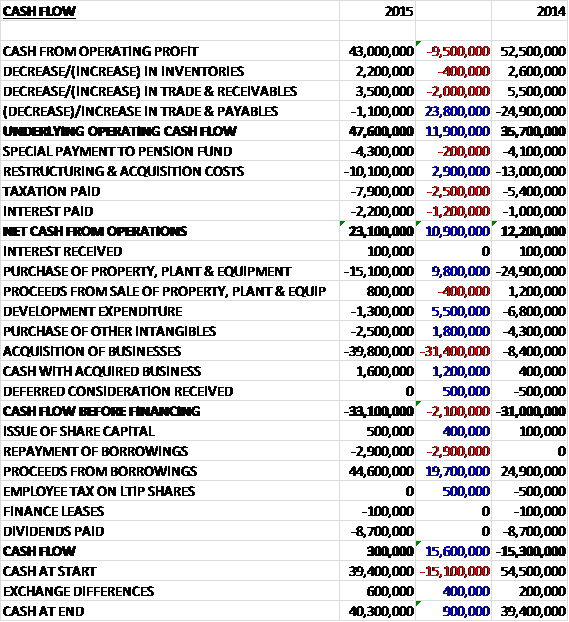
A cash amount of £2.5M will be paid to meet the PAYE and national insurance payable in respect of the settlement of the options. Following this, the directors have sold all of these shares issued to them with the shares being acquired by the Employee Benefit Trust at a price of 122.33p and are intended to be used to satisfy awards made under the LTIP and to satisfy future bonuses. Following these transactions, Mr Duffy remains interested in 2,197,599 shares and Mr Boyd has 961,034 shares.

On the 29th June it was announced that appropriately named Chairman Paul Baker purchased 40,000 shares at a value of £43.2K. He now holds 86,000 shares in total so this has nearly doubled his holdings.

On the 18th July the group released a trading update covering the year ending 2016. Following the positive first half trading performance, strong trading has continued in the second half and the group is confident of delivering profits in line with market expectations. Total company sales grew to £319.7M, an increase of 25%, following the integration of the prior year acquisitions of Fletchers and Johnstones. This includes like for like growth of £12.8M, a 5% increase versus the prior year. The UK bakery division grew by 3% on a like for like basis while the overseas business grew by nearly 26%. Sales to the foodservice channel grew by 5.3% on a like for like basis.
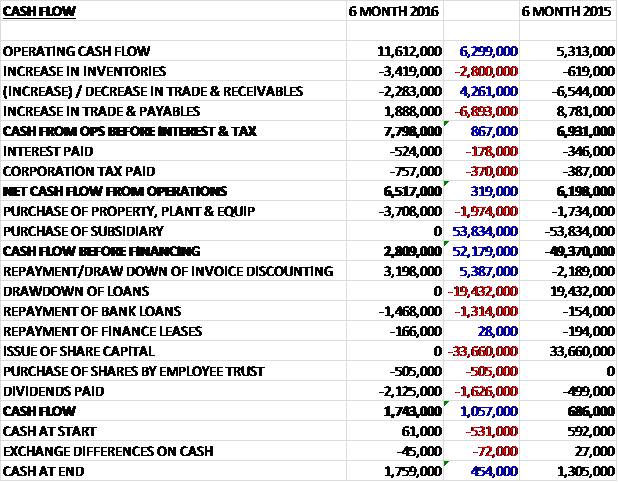
The second half performance benefited from a growth in sales revenues ahead of the UK market as a whole although the rate of growth was lower in the second half as they annualise against strong sales in H2 last year. Whilst it is too early to fully understand the impact of the Brexit vote, the board believes it is well equipped to manage the potential effects and continue to deliver growth over the coming years.

Not really much to go on here but all sounds like it is ticking along well.