Brooks MacDonald Share Blog – Interim Results Year Ending 2016

Brooks Macdonald has now released their interim results for the year ending 2016.

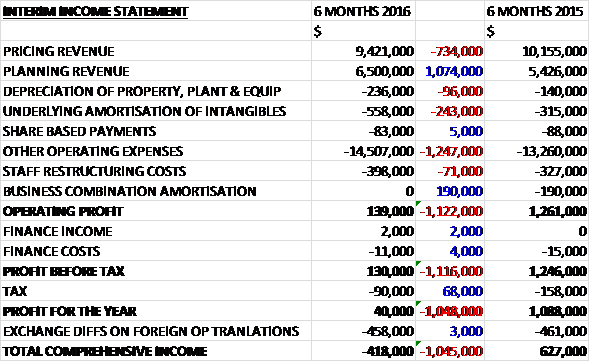
BRKincome

Revenues increased when compared to the first half of last year as a £1.2M decline in International revenue was more than offset by a £1.9M increase in investment management revenue, a £323K growth in fund & property management revenue, and a £118K increase in financial planning revenue. Share based payments declined by £310K and acquisition costs were down £120K but other admin costs increased by £270K. We then see a £174K impairment of available for sale assets reflecting the perceived permanent reduction in value of the shares held in Braemar Student Accommodation and a £400K impairment in the investment in joint ventures as the forecast future cash flows from the partnership are now expected to accumulate slower than originally anticipated meaning it will take longer to realise a cash return on the investment.

In addition there was a £152K positive swing in to a gain in the changes in the fair value of assets to give an operating profit £920K above the first half of 2014. The interest received on bank deposits fell by £8K and there was a £62K increase in the loss from joint ventures relating to North Row Capital but this was offset by a £177K reduction in the finance cost of the deferred consideration and after tax increased by £188K, the profit for the half year came in at £4.4M, a growth of £811K year on year.

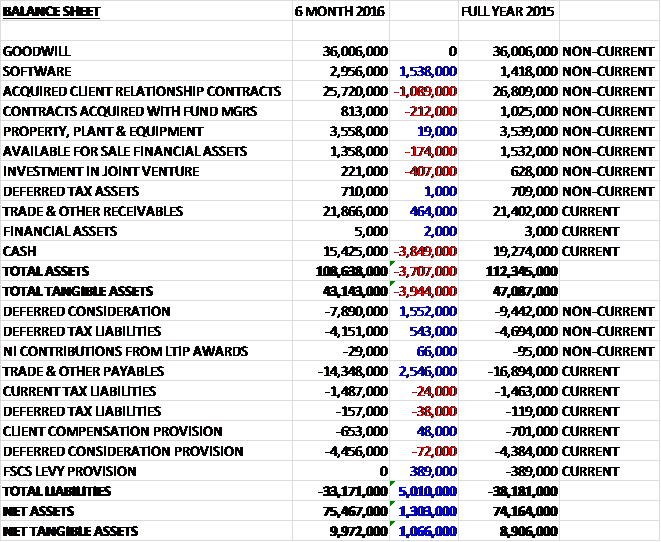
BRKassets

When compared to the end point of last year, total assets declined by £3.7M, driven by a £3.8M fall in cash, a £1.1M decrease in acquired client relationships and a £407K decline in the investment in joint ventures relating to the impairment in North Row Capital, partially offset by a £1.5M growth in the value of software and a £464K increase in receivables. Total liabilities also declined during the period due to a £2.5M decrease in payables, a £1.5M fall in deferred consideration and a £505K decline in deferred tax liabilities. The end result is a net tangible asset level of £10M, a growth of £1.1M over the past six months.

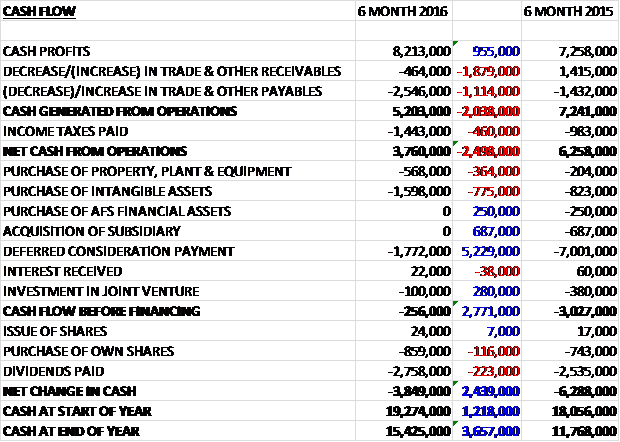
BRKcash

Before movements in working capital, cash profits increased by £955K to £8.2M but a cash outflow through a fall in payables in particular along with a £460K growth in taxes paid, meant that the net cash from operations came in at £3.8M, a decline of £2.5M. The group spent £568K on property, plant & equipment; £1.6M on intangible assets and £1.8M in deferred consideration to give a cash outflow of £256K before financing. They also spent £859K on their own shares relating to the Employee Benefit Trust and £2.8M on dividends which meant that the cash outflow for the period was £3.8M and the cash level was £15.4M at the end of the period.

The profit at the Investment Management division was £8.5M, a growth of £1.9M year on year. The business continued to grow its professional connections and now works with over 900 introducing firms who refer new business to the group. The international business continues to gain traction in South Africa from a distribution perspective, managing the assets won out of its offices in the Channel Islands.

The loss at the Financial Planning division was £13K, a fall of £37K when compared to the first half of last year. The division had a satisfactory period but the employee benefits market remains challenging and behind board expectations.

The loss at the Fund and Property Management division was £1.1M, an increase of £604K when compared to the first half of 2015. The funds business continued to gain traction and increase its funds under management, with particular momentum in the Multi-Asset Fund range. The business incurred a loss during the period, however, mainly due to costs and charges incurred in two specialised funds which have not achieved critical mass. The property management business saw a small decline in the value of property assets under administration to £1.13BN.

The profit at the International division was £245K, a decline of £364K year on year. This decline was due to the planned conversion of advisory accounts to discretionary accounts.
Advisory accounts deliver higher short term revenues while discretionary accounts are charged in arrears but at higher overall rates so over the medium term this move should enhance fee income, although there is a short term impact.

There was a continued growth in funds under management for the three core investment businesses. This growth was ahead of the board’s expectations and comprised of £394M of organic new business and £15M related to the portfolio performance during the period. The group’s discretionary funds under management rose to £7.82BN, an increase of 5.52% compared to the WMA index that declined 0.75% over the same period.

The group made progress with its IT upgrade and implementation plan, and has added to the scope of the upgrade to include enhancements and to reflect the latest regulatory requirements. The project remains on course to be completed by the end of 2016. It also includes investment in growing the group’s fund management capabilities while expanding the new business teams both on and offshore.

Of the £12.3M of outstanding consideration, £4.5M becomes due within one year. At the end of last year, there was £510K of provisions relating to the expected levies for the FCA compensation scheme. This levy for the 2016/2017 scheme has been announced but is not yet recognised as a provision – the group gives no clue as to how much it is likely to be.

During the year, share options of £529K were exercised relating to the Employee Benefit Trust. There remains a substantial amount of shares held by the trust, with a total value of £4.4M. As these shares are purchased on the market, there is a material amount of cash spent on this. The performance conditions attached to the Share Option Plan require an increase in the diluted EPS of 2% more than the RPI over the three years starting the year the options are granted – this doesn’t strike me as a particularly ambitious target.

The board have continued to see strong organic growth in the early weeks of the second half of the year although the volatility in markets since the New Year is likely to have impacted the group’s funds under management. The second half will benefit from the year on year growth of funds under management but will be impacted be the continuing planned conversion of advisory to discretionary assets by the international business. Overall, subject to the level of the market, they expect to make further progress for the year as a whole.

After a 20% increase in the interim dividend, the shares are yielding 1.8% which increases to 2% on the full year consensus forecast.

Overall then, this was a decent period for the group. Profits were up, net assets increased and although the operating cash flow fell, with no free cash being generated, this was due to an increase in receivables and fall in payables and cash profits grew year on year. The Investment Management business is the profit maker for the group and it performed well during the period. The Fund Management business struggled, with higher losses due to charges relating to two specialised funds. The Financial Planning business is still loss making due to the challenging employee benefits market, but the performance is slowly improving.

The funds under management increased during the period, mainly due to new business with a very modest increase from the fund performance. It is worth noting the high levels of deferred consideration still outstanding and the volatility in financial markets so far this year is likely to have taken its toll. Despite this, however, the group have seen strong growth so far this year. With a forward yield of 2%, I am not sure this fully rewards shareholders for the risk of further turmoil in the financial markets which will affect the company. I remain on the side lines here.

On the 26th April the group announced that at the end of Q3, discretionary funds under management totalled £8.007BN, an increase of 2.37% compared to the WMA balanced index which increased by 0.72% over the quarter. This was driven by new business, which increased funds by £241K and was offset by a £56M reduction due to performance. The property management business had property assets under administration of £1.132BN, an increase of £5M, and they now have third party assets under administration in excess of £260M, a growth of £15M. The group’s underweight positions in resources and UK fixed income assets caused client portfolios to lag the benchmark after a sustained period of underperformance.

On the 27th April the group announced that directors Richard Spencer and Simon Wombwell were selling a combined 585,000 shares in the group, equal to about 4.3% of the entire share capital. After the sale, Richard will still own 1.7% and Simon will own 0.4%. Richard has agreed to a lock-in arrangement in relation to the balance of his shares and having co-founded the company in 1991 he has decided to diversify his holdings, not the most bullish of moves though nonetheless.

On the 27th July the group released a trading update for the year ending 2016. The second half was stronger than the first and trading for the year as a whole was in line with board expectations. Discretionary funds under management rose to a total of over £8BN, with organic growth of 11.6% over the year. The EU referendum has increased investment volatility and negatively affected client sentiment. In addition they had hoped to launch two new funds in Q4 but both did not occur due to the uncertainties around the Brexit vote.

Over the year discretionary funds under management grew by 12% with the index growing by just 4.6%. Over the last quarter, discretionary FUM rose by 3.7% compared to the index growth of 3.4%. The group’s property management business had property assets under administration of £1.1BN at the year end, a fall of 0.32%. The group now has third party assets under administration of over £270M.

Overall then, this seems to have been a decent performance in difficult circumstances. Whether now is the time to be invested in asset managers, however, is not so certain.

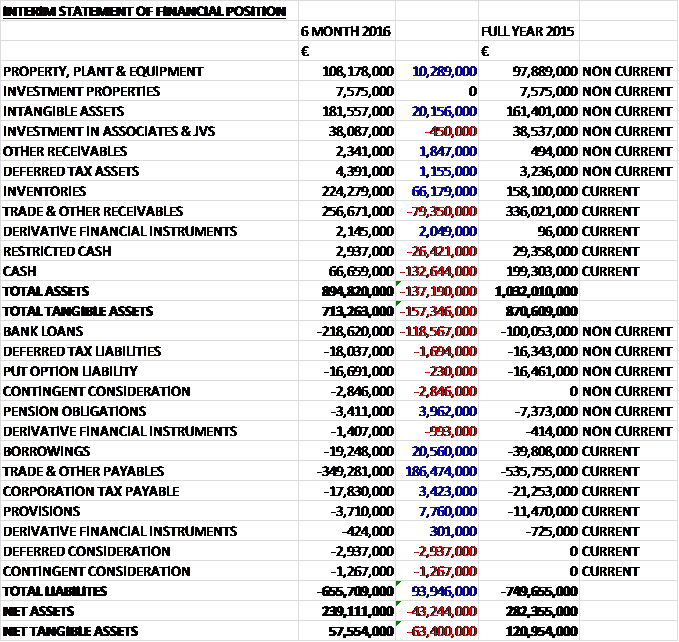
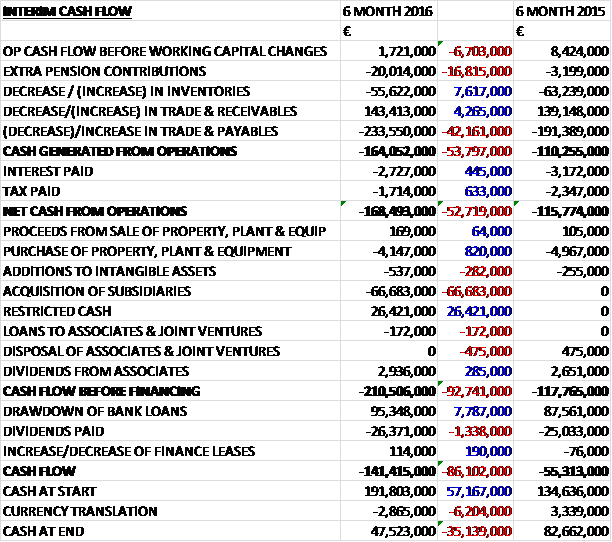
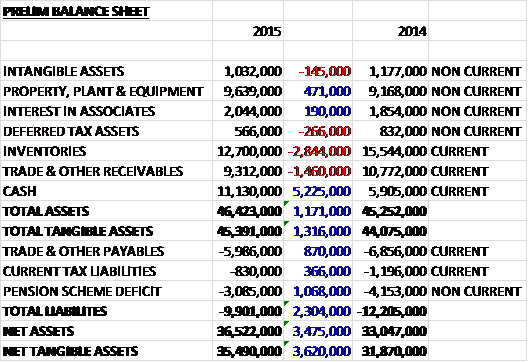
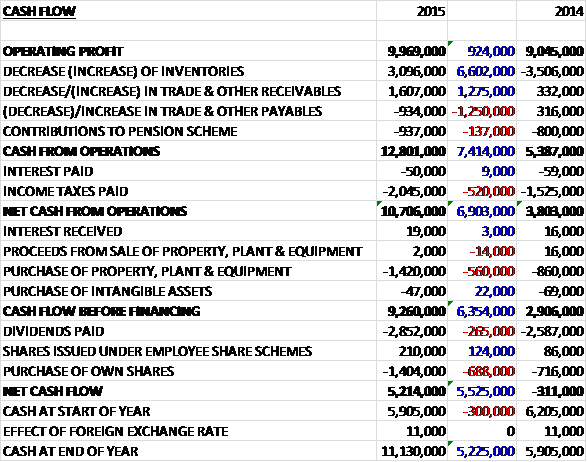
Kalibrate Technologies Share Blog – Interim Results Year Ending 2016

Kalibrate Technologies has now released its interim results for the year ending 2016.

KLBTincome

Revenues increased when compared to the first half of last year as a £734K decline in pricing revenue was more than offset by a £1.1M growth in planning revenue. Depreciation was up £96K and amortisation increased by £243K with other operating expenses growing by £1.3M. We also see exceptional items increasing by £71K relating to staff restructuring this year due to the downsizing of certain legacy areas of the business, and mostly flotation costs last time, but there was no amortisation of acquired intangibles which gave an operating profit some £1.1M below that of last time. After a modest improvement in finance costs, tax expenses fell by £68K which meant that the profit for the period was just £40K, a decline of £1M year on year.

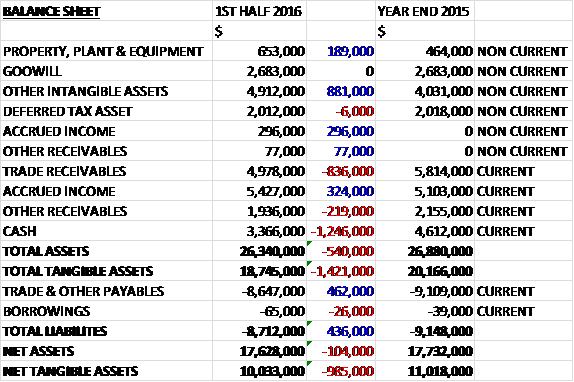
KLBTassets

When compared to the end point of last year, total assets declined by £540K driven by a £1.2M fall in cash, an $836K decrease in trade receivables and a £219K fall in other receivables, partially offset by an £881K growth in other intangible assets, a £620K increase in accrued income and a £189K growth in property, plant and equipment. Total liabilities also declined during the period due to a £462K decline in payables. The end result is a net tangible asset level of £10M, a decline of £985K over the six month period.

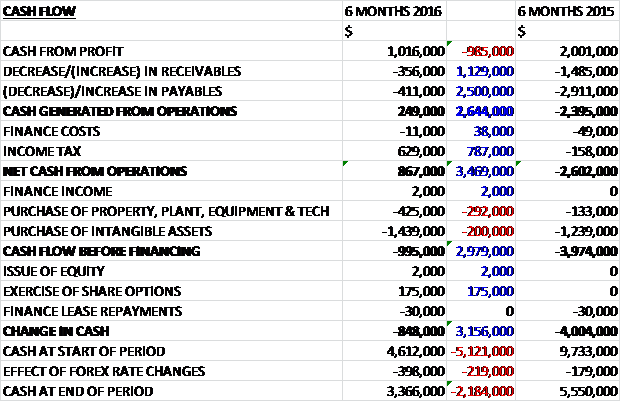
KLBTcash

Before movements in working capital, cash profits fell by £985K. There was a cash outflow through working capital, but this was less than last time and after a £38K decline in finance costs and a £787K swing to a tax receipt, the net cash from operations came in at £867K, a positive swing of £3.5M year on year. The group spent £425K on tangible assets and £1.4M on intangibles, however, which meant that before financing there was a cash outflow of £995K. (It is worth noting here that amortisation was just £558K compared to the spend on intangibles, which was £1.4M). After a cash income of £175K from the exercise of share options, the cash outflow for the six month period was £848K and the cash level at the period-end was £3.4M.

The underlying loss in the Pricing division was £1M, a detrimental movement of £1.9M year on year on revenues that declined by 7.2%. This decline was related to the timing of closing several perpetual pricing license deals that were slated for this half of the year but have been pushed into the second half, along with a reduction in the non-core Price Tracker business line. Since the period-end, they have closed these deals with a healthy pipeline of other deals remaining for the second half of the year. By the period-end, the group have secured new managed services clients and the total managed service client base stands at 32. The focus is on continuing to convert existing clients and adding new clients to the managed services offering and they have increased staff resources to support the offering.

The underlying operating profit in the Planning division was £1.6M, a growth of £680K when compared to the first half of last year on revenues that increased by 20%, driven by significant increases in revenue from the European market and inroads made into the newly deregulated markets of India and Latin America. Going forward, the business typically leads the deregulation cycle as well as industry consolidation that is a trend in Europe and North America.

In North America, the group closed several pricing deals as SaaS, which is positive from a recurring revenue perspective. There was also a timing effect of closing a significant perpetual pricing license deal which slipped into H2 and has since been signed. Additionally there was a reduction in the group’s Price Tracker business. The planning business experienced a 2% increase due to the signing and implementation of several new market studies. Overall the net effect caused the revenue to decline by 4.8% in the period to £7.4M.

Revenue in Europe was about 16% higher due in part to the successful implementation of the significant market planning business. The new planning deals allowed the group to re-enter the markets of France, Belgium and the Netherlands. The pricing business was down in this half of the year due to fewer perpetual and SaaS pricing deals signed, but the pipeline for H2 remains strong for both pricing and planning.

The revenue for the rest of the world was flat year on year as the group saw increases in business related to the newly deregulated Mexican and Indian markets and increases in SE Asia offset by decline in the Japanese and African markets. With the deregulation trends continuing in various countries around the world, they see growing demand for both pricing and planning products in the ROW region. They experienced fairly rapid receptivity to its products in the newly deregulated Mexican market where retailers are adjusting to the new landscape.

While they experienced increased revenue in the Indian market, the overall marketplace is being more measured in its approach to deregulation so the process is moving at a slower pace than Mexico. The Japanese market experienced a decline in revenue mostly related to one of the group’s major clients placing its orders on hold for this half of the year as it completes its merger with another Japanese business. The markets of Africa and Japan have also seen softness in revenue related to the negative currency valuation trends, making the group’s products less competitive.

The decline in oil price has led to a fall in the average retail price of motor fuel. In times of prolonged price drops, the integrated refiner/retailers can experience capital pressures which may lead to delays in capital spending. To date the group has not experienced any demonstrable effects on its business but they continue to monitor the situation. The board believe that their business has been sheltered from the negative effects of the lower oil price because their client base comprises companies that mostly don’t participate in upstream activities; their pricing platform is a longer term business process that is not easily replaced; the volatility in fuel prices creates a greater need for companies to utilise the group’s products so that they can better navigate the changes; and with the continued trends of countries deregulating fuel prices there will be a need for solutions for pricing and planning.

A new merchandise Pricing and Promotion offering allows the company to provide both pricing and promotion data analytic solutions to convenience stores which aids retailers that operate both motor fuel and convenience operations. This also opens the market for convenience only retailers to work with the group’s products. As a result of cross-selling initiatives, another significant client now uses both the Pricing and Planning solutions, bringing the total using both to 32. In addition to these sales efforts, they have managed to record a 100% customer retention record.

Last year India, Mexico and Kenya announced that they plan to deregulate the operating control of motor fuel procurement and resale in their respective markets. The group are focused on all active deregulation processes and all potential areas of deregulation to ensure that they are involved in these opportunities. They are actively pursuing clients in certain countries in SE Asia and Africa in advance of the deregulation announcements that are anticipated to occur within the next two years. The group also provide business advice around the effects and process of government deregulation of motor fuel infrastructure.

The group have been marketing their 7 Elements for Fuel and Convenience Retail Success. This is a strategic analytic process that enables fuel and convenience retailers to understand and optimise performance across the entire consumer experience. The process uses a combination of proprietary modelling, extensive global market and site data sets and an understanding of fuel and convenience retailing to define a 7E score for each retailer in the market. It combines information that the group have amassed in their data warehouse to measure and provide a score upon which retailers can benchmark themselves against. This is the cornerstone upon which the group will deliver growth.

The group maintains up to date traffic stats at over 4 million traffic points in various countries around the world. They have resold this global data and continue to focus their efforts on finding new markets to sell this data to support the Planning business.

The planning business holds a lower initial gross profit during the start-up phase of a project because of the labour expense associated with the data collection, model set up and analytic modelling associated with some of the market studies and as such, the overall EBITDA margin was negatively affected in this half of the year. The group has a robust pipeline of pricing deals for H2, in addition to more Planning deals, which, if closed, could provide gross profit performance similar to prior periods.

The group have invested to strengthen their sales and marketing efforts, particularly related to dedicated resources to support the deregulation opportunities around the world, increased product development resources as well as added operational infrastructure to support growth in the managed services business. Many of these initiatives were started last year and as such, this half year period bore the full run-rate effect of these expenditures compared to the ramp-up period last year. In addition, the group also invested in its new Merchandise Pricing and Promotion platform, an additional offering through which the group can sell to its existing client base and attract new clients.

No dividends were proposed during the period but the board remain confident in the group’s ability to meet expectations for the full year as they are continuing to see good demand for their products both in core and new geographies. The group has $22M in recurring revenues as of the period-end, an increase of $1M over the past six months. The order book continues to improve due to ongoing demand for SaaS and as of the period-end, the order book stood at $42M compared to $41.4M at the end of last year.

During the period the group launched their new Merchandise Pricing and Promotion platform with pilots underway. During the second half they plant to commence marketing their Merchandise offering to both existing and potential clients. They continue to target growth opportunities in new geographic markets and are positioned to be a global partner for their large accounts by having 24/7 hosting capability which allows them to further opportunity to increase the recurring revenue.

On the 17th March the group announced that it had entered into a $5M revolving line of credit with PNC Bank. The facility will be used for the issuance of performance bonds of credit, forex facilities, potential business development opportunities and general working capital. It is for a two year term with an interest rate of 2% above LIBOR and there is an unused facility fee of 0.25%.

Overall then this has been a difficult half year period for the group. Profits have reduced and they are barely at a break-even level now; net assets have declined; and although the operating cash flow did increase, no free cash was generated and the improvement was down to better working capital movements with cash profits falling year on year. The pricing business incurred a loss this year which is being blamed on three large contracts slipping into the second half of the year (all of which have now been signed), and a decline in the non-core Price Tracker business. Conversely, planning profits have grown year on year with the improvement led by contract wins in Europe, Mexico and India with the latter two countries benefiting from deregulation of the industry.

In Japan, the group suffered from a major client merging with another business during the period but hopefully orders will pick up form them going forward. The board do seem confident of the H2 performance picking up the slack from a poor H1 but to me it looks like they have quite a lot to do to meet expectations for the full year. I suppose the convenience offering may be a driver for growth but I see no particular reason to invest in here on the hope that there are no further issues going forward.

Arbuthnot Share Blog – Final Results Year Ended 2015

Arbuthnot has now released its final results for the year ended 2015.

ARBBincome

Revenues increased when compared to last year as net interest income grew by £45.1M, driven by an increase in loans to customers; and net fee and commission income declined modestly as a growth in “other” revenue, mainly relating to fee income from OneBill, insurance sales and commission earned on debt recovery activities, was offset by a decline in banking commissions and structured product commissions. Other costs also increased during the year and we see a £6.1M increase in the net impairment loss on loans to customers and a £13M growth in staff costs, partially offset by a £1.1M fall in operating lease rentals to give a pre-tax profit some £8.6M above that of 2014. After an increase in tax was more than offset by a £2.9M growth in the profit from the discontinued operation, the profit for the year attributable to equity holders came in at £12.7M, a growth of £4.1M year on year.

ARBBassets

When compared to the end point of last year, total assets increased by £784.9M, driven by a £326.8M growth in commercial loans to customers, a £252.7M increase in cash balances held at central banks, a £118.5M growth in assets held for sale, a £103.7M increase in retail loans, a £69.6M growth in residential mortgages and a £27.8M increase in motor finance loans, partially offset by a £112.9M decline in personal lending. Total liabilities also increased during the year due to a £306.1M growth in term deposits from customers, a £284.5M increase in notice account deposits from customers, a £144.9M growth in current account deposits from customers and a £27.6M increase in deposits from banks. The end result is a net tangible asset level of £180.5M, an increase of £18.3M year on year.

ARBBcash

An increase in interest received was offset by a growth in interest paid, a reduction in fees and commissions received, a growth in cash payments to suppliers and employees and an increase in tax paid to give a cash profit of £29.7M, a decline of £1.5M when compared to 2014. There was a big inflow through working capital due to an increase in amounts due to customers, however, which meant that the net cash from operations came in at £234.9M, a positive swing of £398.7M year on year. The group spent £3.5M on software and £3.4M on property, plant and equipment and also received a net £4M from the redemption of debt securities to give a cash flow of £232M before financing. They then increased borrowings by £27.7M and paid dividends of £10.2M to give a cash flow for the year of £249.4M and a cash level of £397.2M at the year-end.

The private bank, Arbuthnot Latham saw a pre-tax profit of £6M, an increase of 65% year on year. The bank originated £250M of new loans, an increase of 45% on the previous year and attracted an average 50 new clients per month. The bank continues to be funded by retail deposits with customer balances reaching £897M, an increase of 53% and investment assets under management grew by 11% to £739M. In the latter part of the year the bank started an initiative to build a wider commercial banking business, initially driven by client demand to provide banking services for the corporate structures of entrepreneurial clients in the media sector. The bank intends to broaden the initial focus and develop its services for clients in the commercial real estate and professional services sectors.

An increasing proportion of the bank’s business is being generated across the UK, particularly through the offices in Exeter and Manchester. In Exeter, the bank moved into new, larger, premises during the year which had a positive effect on the local profile. In Manchester, the office was strengthened by additional recruitment and a healthy momentum is being created in the local market. Overseas, the Dubai office is performing well and the local Gulf market offers significant opportunities for further growth in the years ahead.

The retail banking group, Secure Trust Bank, provided a pre-tax profit of £36.8M, including the results of the discontinued Everyday Loans compared to £26.3M last year, with £23M of that attributed to Arbuthnot. Excluding the contribution from ELL, the bank increased profit of 42%. The higher growth rate reflects the investment made in SME lending and at the end of the year, the combined lending balances of the SME divisions stood at £468M, a growth rate in excess of 200%.

The continuing businesses have been proactively managed to result in a good composition of portfolios, with a balance between consumer and SME lending assets, and this will be augmented in 2016 with a new mortgage offering that they believe will be well received by the market and still deliver the required return on equity. The new business lending volumes grew by 65% to reach £903M which resulted in an overall increase in customer lending assets of 73% with balances reaching £1.1BN.

Within the Consumer Finance division, the Retail Finance business led the way with balances increasing by 89% to £220M. This business has a very strong position within the music and cycle sectors but has been broadening its reach into the leisure and home furnishings sectors. The business has also seen an increase in the volume of interest bearing lending which has naturally resulted in higher levels of impairments which were anticipated in the pricing of the products.

The Motor Finance balances increased by 20% to £166M. This business, which focuses on the near prime market segment, continues to service the majority of the Top 100 UK car dealer groups and has strong relationships with a number of specialist motor intermediaries. During the year the business tested the prime lending market and the initial results were positive so it is expected that activities in this area will increase in 2016.

The group’s commercial lending operations have grown as planned. Real Estate Finance increased by 175% £368M. This lending is split roughly between residential development funding and residential investment finance. To date their experience in the residential development lending has been that properties being developed are selling faster and for higher prices than expected when the loans were started. The residential investment lending is not a regulated mortgage business and is not designed for amateur landlords. As such, it is difficult to predict how the recent fiscal changes will affect the market in the future but it is the group’s initial belief that it will have a neutral impact.

In its first full year, Secure Trust Commercial Services, the invoice finance division, funded in excess of £220M of customer’s invoices. Customer lending balances grew £24M to £29M but given the fact that the key customer proposition for this business is built on long term relationships, it will take a whole longer before the business reaches critical mass.
The Asset Finance partnership with Haydock Finance has proved successful with the business closing the year with balances of £71M compared to just £5M at the end of last year. The bank maintained its principle of funding its lending mainly from the retail deposit market, with balances increasing by 83% to close the year at £1.1BN. The bank attempted to minimise the interest rate risk by mainly offering fixed term deposits and bonds given the fact that interest rates are likely to remain low for some time to come.

The UK private bank opened a branch in Dubai in the year, which generated £1.85M fee income and had operating costs of £1.82M although the business generated a pre-tax loss of £1.8M compared to a loss of £1.4M in the prior year. On an operating level, the office hit break even in July.
Overall the book is well secured with an average LTV of 46%, an increase from 43% last year. The private bank had a total capital ratio of 10.4% and a core tier 1 ratio of 10.4% compared to 9.4% last year. Secure Trust Bank is well capitalised with a total capital ratio of 11.9% and a core tier 1 ratio of 12.2%, although down from the 16.6% recorded last year.

In December Secure Trust Bank agreed to the conditional sale of its non-standard consumer lending business, Everyday Loans, to Non Standard Finance for £107M in cash subject to a net asset adjustment and £20M in NSF shares. On completion, NSF will repay the current intercompany debt of £108M to STB. This business is therefore classed as discontinued and it contributed profits of £4.9M net to Arbuthnot this year. The disposal is progressing as planned and ownership is expected to transfer before the end of April. The board is proposing a special dividend of 25p which is contingent on the completion of the transaction which is expected to recognise a gain on disposal of £115M.

Having paid just £1 for ELL and refinancing its books to the tune of £64M, the board now recognised that under their ownership the business was not maximising its potential as they were careful to restrict the interest rate levels charged to customers but NSF are more experienced with this type of lending and better positioned to test other demographics of the market. Once the transaction is completed the gain will significantly increase the capital strength of the group which will allow their more mainstream banking activities to continue to grow.

At the end of 2014 the AL purchased a portfolio of residential mortgages from the administrator of the Dunfermline Building Society. This portfolio has been transferred to the ownership of the bank and a new servicer has been appointed and is operating well. Recently the portfolio was accepted into the Funding for Lending Scheme and the portfolio has performed in line with expectations. Given the success of this transaction, the group had made good progress in negotiating to acquire a larger mortgage book but this was brought to a halt following the December publication of the Basel Committee’s second proposal to revise the Standardised Capital Rules.

There were a number of “non-underlying” costs incurred during the year for AL. There was a £1.2M investment in operating systems, a £333K commercial banking investment and £418K in acquisition costs relating to the aborted acquisition of the mortgage portfolio. For Secure Trust Bank there was a £662K cost relating to share options and an £893K V12 fair value amortisation charge. In the prior year, for AL there was a £981K Dubai office investment and a £217K regional office investment and for Secure Trust Bank there was a £198K charge relating to acquisition costs, a £1.5M share option expense and an £893K V12 fair value amortisation charge. I have to say that these costs don’t look very “non-underlying” to me, particularly for Secure Trust Bank.

Impairment losses rose to £18M, an increase of £6.4M. There were a number of reasons for this. The prior year results were artificially lowered by £1M due to the provision releases that arose from a review of the carrying value of written off loans; the volume of the balance sheet was increased, which leads to higher levels of expected impairments, especially in the retail lending business; and the motor finance and retail lending divisions have been exploring higher yielding opportunities in their markets which leads to higher anticipated impairments.

The group has been relatively unscathed by the PPI selling scandal, although accruals did include a provision for outstanding potential PPI claims of £2.6M, an increase of £600K. This increase is as a result of new claims emerging following an extension of the deadline for making claims. During the year, £1.5M of PPI provisions were utilised. The FCA is currently consulting on a proposed deadline for making PPI claims and the ruling is expected to come into force in spring 2016 with a deadline of two years, which would give consumers until spring 2018 to make a claim.

In common with all regulated UK deposit takers, the group pays levies to the FSCS to enable them to meet claims against them. The FSCS levy consists of a management expenses levy and a more significant compensation levy. The management expenses levy covers the costs of running the scheme and the compensation levy covers the amount of compensation and associated interest the scheme pays. The group’s provision reflects market participation up to the end of the year and the accrual of £300K relates to the interest levy which is payable in September.

There were a couple of board changes in 2015 and during the year, Ian Dewar jointed in August and Robert Wickham retired in December after 22 years of service.

During the year the chancellor announced the introduction of a corporation tax surcharge applicable to banking companies with effect from the start of 2016. The surcharge will be levied at a rate of 8% on profits of banking companies after taking into account an annual allowance of £25M. This will increase the group’s future tax charge but I would be interested to know how profit is being defined in this case. With regards the UK EU referendum, it is anticipated that the financial impact to the group would be minimal assuming there were to be no significant macroeconomic shock to the UK.

After the year-end, the group signed a contract with Oracle to replace its current banking system with a committed cost of £2M.

Going forward, the global economic outlook has become increasingly uncertain. The collapse of the commodities market has had a knock on effect on the equity markets. The Federal Reserve Bank in the US has increased interest rates for the first time in ten years but other major economies look unlikely to follow suit at present. On top of this, the UK has the uncertainty of the outcome of the EU referendum but despite these headwinds, both of the banks are well capitalised and highly liquid and they remain well positioned to continue their good progress and the board are optimistic about their prospects.

At the current share price the shares trade on a PE ratio of 24.8 but this falls dramatically to 10.1 on next year’s consensus forecast. If we include the proposed special dividend, the shares are currently yielding 4.1% which falls back down to 2.3% on next year’s forecast.

Overall then this has been a good year for the group. Profits were up due to higher investment income from loans to customers; net assets increased; and the operating cash flow was up, generating plenty of free cash, although it should be noted that this was due to an increase in payables and cash profits actually fell. The profit at AL increased as loans were up considerably and Secure Trust Bank also did well with higher SME lending, particularly in Real Estate Finance, and more retail finance in consumer lending. The Dubai office seems to be promising and has apparently now broken even.

The Everyday Loans Sale looks a good bit of business and will further strengthen the balance sheet, even after the special dividend. Like all business, there are some potential risks, however. The impairment losses have increased, although this doesn’t look all that alarming, and the corporation tax surcharge dumped on banking companies by the government is unhelpful. Probably the biggest issues are macro-economic, however, with the Brexit vote likely to cause volatility and the global economic outlook seeming rather uncertain. With a forward PE of 10.1 and normal dividend yield of 10.1, however, the shares look decent value to me and I might look to re-enter here.

On the 21st March the group announced that director James Cobb purchased 5,000 shares at a value of just under £67K. This was his maiden purchase and should be taken in the context of the grant of 50,000 options with an exercise price of £9.30 but is still nice to see.

On the 21st March the group announced that director James Cobb purchased 5,000 shares at a value of just under £67K. This was his maiden purchase and should be taken in the context of the grant of 50,000 options with an exercise price of £9.30 but is still nice to see.

On the 14th April the group announced that Ian Henderson will take up the role of CEO at Arbuthnot Latham. At the same time, James Flemming is being appointed as Vice Chairman of Arbuthnot Latham after he stood down as a director of the group. Ian joins from Secure Trust Bank where he held the position of head of strategic business development and CEO of personal lending and mortgages. Prior to that he was CEO of Shawbrook Bank and held senior executive roles in Barclays and RBS.

On the 5th May the group announced that they had had a good start to the year with overall lending volumes higher than last year and at the end of Q1, customer loan balances had increased by more than 30% year on year. The completion of the sale of Everyday Loans in April has generated a substantial profit which has strengthened their capital and liquidity resources. The board remain confident of making good progress during the remainder of the year.

Secure Trust Bank has also made good progress during the period. Motor Finance and Retail Finance have delivered higher new business volumes compared to Q1 last year. In the SME lending market they continue to see strong demand for their products with the Commercial Finance and Asset Finance business performing in line with management expectations. As previously disclosed, the bank has taken a more cautious approach to lending to the residential development sector ahead of the Brexit vote, however.

This all seems fine to me, EU referendum not withstanding, so I am happy to hold.

On the 27th May the group announced its intention to sell 6M shares in Secure Trust, representing about 32% of its share capital, by way of a secondary placing to institutional investors. The sale is priced at £25 per share, representing a 10.7% discount to the Secure Trust closing price. This transaction will reduce Arbuthnot’s holding from 51.9% to 18.9% and will generate gross proceeds of £150M.

Secure Trust has announced its intention to seek a move to a Premium Listing on the main market of the LSE so an independent Chairman of Secure Trust is being sought. The special dividend of 165p per share (worth nearly £10M on the sale shares) will not be paid until after the sale has taken place so Arbuthnot is giving up this £10M.

The sale will represent a fundamental change of business for the group as it will now have a non-controlling interest in Secure Trust and they intend to use the proceeds generated from the sale to accelerate growth including the private and commercial banking business.

It is a shame the placing is having to be done at a discount and that the group will no longer receive much of a cash receipt from the special dividend but given Arbuthnot’s market cap is only about £220M, this represents a significant chunk of that.

On the 10th June the group announced that it had acquired 20 King Street/10 St James Street in the West End of London as an investment for Arbuthnot Latham. In due course these premises may also allow the business to develop its presence in the area, occupying part of the property for client purposes.

The property comprises 22,450 square feet of office space and 7,000 square feet of retail space. The purchase price is £50.2M with associated costs of around £3.2M and it has a current annual rent income of about £1.8M. The property is held as a leasehold from the Crown Estate with just over 119 years remaining.

On the same date the group announced that Sir Alan Yarrow has joined as a non-executive director. He has experience of over 37 years in the city including as Chairman of Kleinwort Banking and a member of the Takeover Panel. He has also been Lord Mayor of London.

On the 14th June the group granted phantom options over is shares under a new seven year incentive scheme. Mr. Salmon has been granted options relating to 200,000 shares with Mr. Cobb and Mr. Henderson being granted options over 100,000. The initial value of each shares for the purpose of the phantom options is £15.91 and an increase in the value of shares over this amount will give rise to an entitlement to a cash payment by the company on the exercise of the option, which is subject to the satisfaction of performance conditions.

This new scheme is intended to replace the other schemes.

Fairpoint Share Blog – Final Results Year Ended 2015

Fairpoint has now released its final results for the year ended 2015.

FRPincome

Revenues increased when compared to last year as a £2M decline in IVA revenue, a £1M fall in debt management revenue and an £879K reduction in claims management revenue was more than offset by a £19.7M growth in legal services revenue. Staff costs increased by £10.2M but other cost of sales fell by £2.6M to give a gross profit £8.2M above that of 2014. The amortisation of acquired intangibles increased by £1.5M, marketing costs were up £2.7M and operating lease expenses increased by £866K, although the credit impairment on IVA revenues declined by £560K with other underlying admin expenses up nearly £3M. We then see a £9M goodwill impairment of the IVA business, however, which meant that the operating loss took an adverse swing of £7.4M when compared to last year. As far as finance costs are concerned, we see an £881K unwinding of the discount on contingent consideration which did not occur last time, and a £751K reduction in the unwinding of the discount on IVA revenues and a small increase in tax. The loss for the year stood at £6.3M, a negative swing of £9.2M, although this should be seen in the context of the £9M goodwill impairment.

FRPassets

When compared to the end point of last year, total assets increased by £15.3M driven by a £6.8M growth in other receivables, a £3.9M increase in the value of customer relationships, a £3M increase in trade receivables, a £5.3M growth in unbilled legal services income, a £2.4M increase in cash and a £2M growth in the value of software development, mainly relating to the acquisition of Colemans. This was partially offset by a £4.3M reduction in the amounts recoverable on IVA services, a £2.9M fall in the value of acquired back books and a £1.8M reduction in goodwill. Total liabilities also increased during the year due to a £13.8M growth in trade payables, an £8.4M increase in bank borrowings and a £2.6M growth in contingent consideration. The end result is a net tangible asset level (including some selected intangible assets!) of £14.5M, a decline of £10.7M over the year.

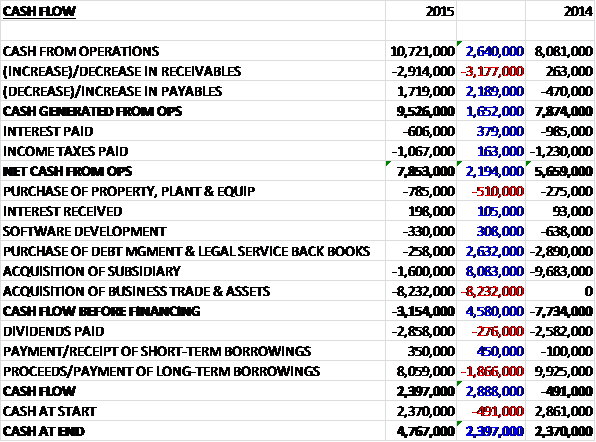
FRPcash

Before movements in working capital, cash profits increased by £2.6M when compared to last year. There was a cash outflow through working capital, with an increase in receivables, but interest and tax were both lower than last time, with the previous year including re-financing arrangement fees, to give a net cash from operations of £7.9M, a growth of £2.2M year on year. The group spent £785K on property, plant & equipment, £330K on software development, and £258K on the purchase of debt management and legal service back books. There was also £1.6M spent on the acquisition of a subsidiary relating to the contingent consideration paid for Simpson Millar and £8.2M spent on the acquisition of Colemans to give a cash outflow of £3.2M before financing. The group also spent £2.9M on dividends so needed to take out more borrowings (£8.1M) to give a cash flow of £2.4M for the year and a cash level of £4.8M at the year-end.

The adjusted pre-tax profit in the IVA division was £2.9M, a decrease of £500K year on year on revenues that also reduced. This decline was largely as a result of fewer newly incepted cases in a declining market. Continued low interest rates and high levels of employment have reduced the demand for debt solutions such as IVAs. The group continues to avoid exposure to fee levels which it considers uneconomic and in light of these market conditions, they have focused on profit margin management through tight cost management which meant that profit margins reduced by just 1% to 24%.

The total number of fee paying IVAs under management at the year-end was 14,841 compared to 17,628 at this point of last year. The number of new IVAs written during the year was 1,268 compared to 2,716 in 2014 and the average gross fee per new IVA was £3,045, down from £3,437.
The adjusted pre-tax profit in the Debt Management division was £2.9M, a fall of £400K when compared to 2014 on declining revenues, reflecting the absence of acquisition activity in this segment, in line with the group’s previously outlined strategy in respect of new back book acquisitions following the FCA’s clarification on the subject. The total number of DMPs under management fell from 25,462 to 16,925 during the year.

The adjusted pre-tax profit in the Claims Management division was £865K, a decline of £519K when compared to last year on a decline in revenue as the business transitions from maturing IVA PPI claims to newer lines of activity. In addition, the margin has fallen from 31% to 24% to reflect this mix change.

The adjusted pre-tax profit in the Legal Services division was £4.4M, a growth of £2.8M year on year, including an £800K contribution from Colemans and further contribution from the full year of ownership of Simson Millar which was acquired in June 2014. There was also underlying organic revenue growth of 4% and good progress has been made on integration, including office rationalisation, unified branding as Simpson Millar and the first phase of migrating the case management processes to a single IT platform.

Following the retirement of the Colemans brand, a new marketing campaign has been developed in order to improve organic growth. Product development continued with the launch of around 70 fixed fee legal services in personal, family, employment and travel law. The first unified marketing campaign is being launched in Spring via a mixture of print and on-line media. In addition, the business expects to make a small number of WIP acquisitions and is considering other commercial opportunities.

Following the proposed changes announced by the chancellor in the autumn statement relating to small claims limits and whiplash claims, the group believes that they are intended to be focused on whiplash claims relating to road traffic accidents; they are subject to consultation with anticipated implementation from April 2017 should the current timetable be met; and they are expected to follow previous precedent and apply to cases introduced post implementation and not retrospectively.

This category of business, on a pro-forma basis, represented about 8% of the group’s revenues in 2015. The group believes that its recently acquired legal processing centre positions them advantageously to manage such legal work at low cost should other providers chose to outsource this work. They also believe that the changes proposed by the chancellor may provide interesting acquisition opportunities. Still no idea what effect it may have on profits then.
In addition, the CMA announced a market study into legal services to examine concerns over affordability, service and complexity. The group apparently welcomes such a study, given its strategy in this area of transparency and value, through deploying its core skill of applying process to legal services.

Market conditions for the group’s debt solutions remain challenging. During the year the volume of new IVA solutions in England and Wales decreased by over 23% to 39,992 and the level of new IVA solutions were at their lowest level since 2008. Given these challenging market conditions and uncertainty over the likelihood of raised interest rates, which is expected to have a positive impact on the IVA market, the group assumed a growth rate of 0% in its impairment calculations. As a result, the recoverable amount for the IVA segment was insufficient to cover the carrying value of total net assets, resulting in an impairment charge of £9M which has been recognised in the income statement.

In the debt management sector, a rigorous regulatory agenda has been driven by the FCA since it assumed responsibility for the regulation of this sector. As with all firms operating in this sector, the group has traded under an interim regulatory permission, having submitted an application for full permission. Following clarification from the FCA regarding new debt management back book acquisition, the group don’t intend to resume acquisition activity in this field.

In August the group acquired Colemans, along with Holiday Travel Watch. Colemans is a provider of consumer focused legal services with particular expertise in volume personal injury, conveyancing and travel law. The total consideration was £13.6M which was satisfied by £8.3M in cash, £1M in issued shares, and £4.5M in contingent consideration with the acquisition generating £6.7M of goodwill. In the four months since the acquisition, the business contributed £800K to adjusted profit of the group.

The group incurred “exceptional” costs of £1.4M during the year. This comprised acquisition, restructuring and professional services costs associated with the Colemans acquisition and costs associated with the application for full regulatory permissions with the FCA regarding DMP activities. I don’t actually think either of these are exceptional – the acquisition costs are ongoing given the group’s acquisitive strategy and the regulatory applications are probably a normal business expense.

Going forward, the coming year will benefit from a full year contribution from the acquisition of Colemans and the integration, marketing and new product initiatives. In addition, they are targeting further value enhancing acquisitions to further consolidate their market. They anticipate the market conditions in the IVA and DMP segments will remain challenging given the benign interest rate and employment outlook. The group will therefore continue to focus on margin management and cash generation and expect these businesses to continue to make a useful contribution to group earnings. As a result of this, the board expects to make good progress in 2016.

Net borrowings at the year-end stood at £13.6M compared to £7.6M at the end of the prior year, not including the contingent consideration of £7.3M outstanding. If we take off the goodwill impairment, at the current share price the shares are trading on a PE ratio of 42 but this falls to 7.9 on next year’s consensus forecast, adjusted for a load of “non-underlying” items I suspect. After a 6% increase in the total dividend, the shares are yielding 4.3% which increases to 4.4% on next year’s forecast.

Overall then, this has been a bit of a mixed year for the group. They swung to a loss, but this was due to the goodwill impairment and excluding this, profits were broadly flat. Net assets declined as we see a large growth in payables and borrowings, both presumably acquisition related, but the operating cash flow did improve with some decent amounts of cash being generated, albeit not enough to cover the acquisition let alone the dividends.

The main issue is that with the exception of legal services, all of the group’s markets are declining. The IVA market is likely to remain subdued as long as interest rates remain low, Claims Management is suffering from a slow-down in PPI claims with other lines of business carrying lower margins, and the Debt Management business seems to be in terminal decline following the FCA’s ruling over acquisitions in this area.

Going forward, the group should benefit from the full year contribution from Colemans but I suppose the question is whether this will be enough to offset the declines elsewhere. The forward PE of 7.9 and yield of 4.4% both make the shares look cheap but that PE excludes a load of “exception” costs that occur each year and the yield is not covered by cash after the acquisitions, of which the board have indicated there will be more. A tricky one this, I might be tempted to take a small position on weakness.

On the 9th May the group released a trading update covering Q1 2016. Overall they are performing in line with management expectations during the quieter first three months of the year. The half year as a whole is expected to feature growth in the legal services division to reflect the additional contribution from the acquisition of Colemans and CT Support Services; good progress on the integration of Colemans and Simpson Millar, albeit with a quieter than anticipated start to the year in conveyancing giving housing transactions have not been as expected. The core debt solutions market is expected to remain challenging and focus remains on cost control.

In addition, CFO John Gittins is stepping down from this position after five years to pursue a portfolio career of non-executive positions. So, they are in line with expectations during the quietest part of the year but the decline in conveyancing gives cause for a bit of concern. There is no mention as to whether the full year is still on track to deliver to expectations so this is a bit of a clumsy update (again from this company) so there is nothing here to tempt me back in.

On the 20th July the group released a trading update covering the first half of the year. Overall trading has been in line with the board’s expectations and revenues have increased by 20% year on year. Adjusted pre-tax profit is expected to be flat, however, at £4.1M, reflecting the continued transition from a low-growth, higher margin debt solutions company towards a lower-margin higher growth legal services business. The decision to exit the Debt Management Plan business due to regulatory changes will impact on second half expectations.

In Legal Services, strong progress has been made on the integration programme with some 80% of revenues now administered on a common IT platform and encouraging early results are being generated from the new marketing approach. During the period the group acquired a small market leading practice specialising in child abuse actions in order to expand its range of legal services – this resulted in one-off transaction costs of £300K.

Conveyancing represented 6% of first half revenues and as reported previously, it has experienced quieter trading compared to original expectations. Consultation regarding the Chancellor’s proposed changes to small claims limits on whiplash claims has yet to commence. As a consequence it is not anticipated that any changes will be implemented before Autumn 2017 – small whiplash claims represent 9% of group revenues.

In the IVA business, as expected, market conditions in the group’s debt solutions market remain challenging. The group continues to focus on delivering good margins and cash generation and avoiding uneconomic business. Given the reduced prospect of upwards interest rate movement, the group has put marketing activity in support of this segment on hold.

As reported previously, the FCS is driving a rigorous regulatory agenda in the DMP sector. This resulted in the board’s decision to halt acquisition activity last year. The regulatory regime has already severely impacted the commerciality of the whole of the industry and has resulted in a reduction in profitability in the first half of the year. The ultimate outcome of the revised regulatory regime is expected to transfer competitive advantage to the charitable DMP sector from the commercial sector thus rendering the commercial DMP business model unsustainable. As a consequence, the group has decided to complete an orderly wind down of its DMP operations during the second half of the year.

This will materially affect the results of the group’s DMP segment in the second half as well as those of the claims segment given its dependency on selling services to DMP clients. The DMP business is now expected to make little or no profit for the second half of the year. The board expects the restructuring will give rise to exceptional charges in H2 of about £2M, half of which will be cash costs this year, and a non-cash impairment of the intangible asset of £5M.
Progress has been made on the recruitment of a new CFO with David Broadbent joining in August. He was previously on the board of International Personal Finance from its initial listing in 20007 to 2016, serving as finance director and chief commercial officer.

Overall then, this seems to be another sorry state of affairs with the more profitable parts of the business seemingly undergoing structural decline. At some point, these shares might be cheap but it seems like the decline might not year be over here.

Gem Diamonds Share Blog – Final Results Year Ended 2015

Gem Diamonds has now released its final results for the year ended 2015.

GEMDincome

Revenues declined by $21.4M when compared to last year due to a reduction in volumes sold and the average diamond price achieved at Letseng. With cost of sales falling to a lesser degree, the gross profit decreased by $1.5M. Royalty and Selling costs fell by $2.8M, however, and corporate expenses declined by $687K. We also see an $8.1M reversal of accrued tax expenses that did not occur last time, a $1.4M foreign exchange gain and a $1.5M forex gain on the tax settlement which meant that the operating profit increased by $13.3M when compared to 2014. The bank deposit income fell by $1.5M and other financial income was down $448K but this was partially offset by a $1.7M decline on the interest payable on loans before a $3.1M positive swing to profit from the discontinued operation and a $3.5M decline in tax charges meant that the profit for the year came in at $77.7M, a growth of $19.7M year on year, although it is worth noting that Ghaghoo has bypassed the income statement.

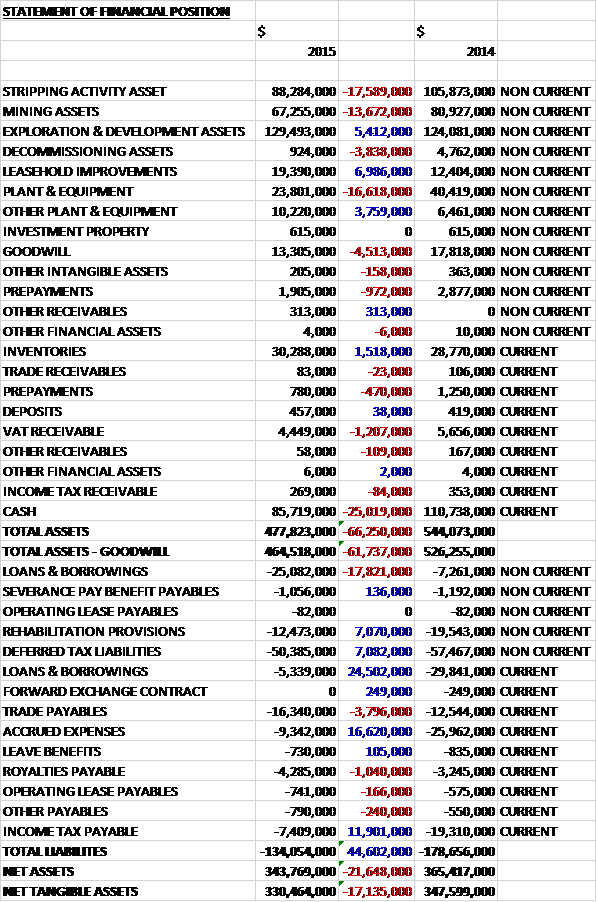
GEMDassets

When compared to the end point of last year, total assets declined by $66.3M, driven by a $25M fall in cash, a $17.6M decrease in the stripping activity asset due to forex differences, a $16.6M fall in plant & equipment (also forex related), a $13.7M decline in the value of mining assets (forex again!) and a $4.5M decrease in goodwill, partially offset by a $7M growth in leasehold improvements and a $5.4M increase in exploration assets. Total liabilities also declined during the period as a $6.7M fall in borrowings, a $16.6M decline in accrued expenses, a $7.1M decrease in deferred tax liabilities and a $7.1M fall in provisions as a result the annual assessment of the estimated closure costs relating to the weakening of local currencies, and changes in the discount rate (about half attributable to each effect) was partially offset by a $3.8M growth in trade receivables. The end result is a net tangible asset level of $330.5M, a decline of $17.1M year on year.

GEMDcash

Before movements in working capital, cash profits increased by $1.7M to $155.3M. There was a cash outflow through working capital, however, with a growth in inventories reflecting the timing of production cut-off for tender purposes, and an increase in receivables which meant that before tax and interest, the cash from operations fell by $2.1M. There was a big growth in tax payments, with an $11.8M increase, to give a net cash from operations of $119.1M, a decline of $14.6M year on year. The group then spent $48.6M on property, plant & equipment along with $61.4M on waste costs to give a free cash flow of $9.5M. This all went on dividends to non-controlling interests with a further $4.4M of financial liabilities paid back and $6.9M in dividends to shareholders to give a cash outflow of $13.6M for the year and a cash level of $85.7M at the year-end.

Revenues this year exclude any contribution from Ghaghoo on the basis that the mine had not reach full commercial production by the end of the year, although the mine did generate sales of $14.4M. Net of this income, Ghaghoo operating expenses were $15.8M during the year, capitalised to the carrying value of the asset during the year.

The year was characterised by continuing global macro-economic volatility and the sentiment in the diamond market as a whole remained cautious. These conditions, together with continued liquidity constraints and high levels of stock, plagued the diamond market throughout the year, placing downward pressure on both rough and polished diamond prices with diamond indices showing a decrease in the average diamond prices across all diamond producers in excess of 19%.
Letseng’s high value diamond prices remained resilient, increasing by 3% compared to the reserve price estimates set out at the start of the year. During the year the price per carat achieved for the Ghaghoo production decreased from $210 per carat in February to $150 per carat in December.

The significant drivers of the diamond market during the year included the continuing economic recovery in the US which had a positive impact on diamond sales in the country during the year but on the flip side, this resulted in a stronger US dollar which, due to diamond sales being US dollar denominated, had a negative impact on sales in countries whose currency was negatively impacted by the strengthening dollar. Other factors were weakening demand from China as economic growth there slowed; funding constraints due to the closure of the Antwerp Diamond bank at the end of 2014 and tightening of lending criteria, particularly in India; and high levels of polished inventory in the manufacturing sector towards the end of 2015 following the reduced demand from China.

At Letseng, 108,579 carats were recovered compared to 108,569 in 2014 and ore treated increased from 6.4M tonnes to 6.7M tonnes. This increase in ore treated, particularly in the second half of the year, reflects the benefits of the Plant 2 Phase 1 upgrade project implemented at the beginning of the year. Of the total ore treated, 71% was sourced from the main pipe and 29% from the satellite pipe, which is a similar split to last year. Waste tonnes mined increased by 21% in line with the optimised LoM plan which allows for increased levels of higher grade ore from the higher value satellite pipe to be mined. The average price per carat declined from $2,540 last year to $2,299 in 2015.

A new optimised life of mine plan was published in May. The plan makes provision for increased levels of higher grade ore from the satellite pipe to be mined annually. In accordance with this plan, satellite ore production will ramp up to 2M tonnes per annum in 2020 and remain at that level to the end of the life of the mine which extends to 2038. A key feature of the plan is the use of steeper pit slope angles as significant improvements to side wall control and blasting of the pit slopes has allowed the mine to safely increase the angles. This will result in lower stripping ratios, thereby significantly reducing the total cost of mining and increasing open pit ore tonnage.

During the second half of the year, a third 300 tonne excavator and five additional 100 tonne dump trucks were acquired, equipping the mine to achieve the new waste stripping target. Furthermore, the optimised plan made provision for the increased treatment capacity of 250,000 tonnes per annum following the recent Plant 2 Phase 1 upgrade with the full benefit of the upgrade expected to be seen in 2016.

The expansion of the open pits has necessitated the relocation and construction of an expanded mining support services complex. The first phase of this project has been approved and will establish the infrastructure where daily service maintenance on the 100 tonne trucks can be carried out and will be completed by the end of Q2 2016 at a cost of less than $1M. Initial high-level studies suggest there is a case for an underground mine in both the satellite and main pipes. Further studies will be undertaken to determine the optimal timing of when underground construction needs to start.

During the year the company continued to benefit from the investments made in previous years. The introduction of optimised secondary crushers at Letseng in 2013 was an important milestone towards reducing diamond damage. In addition, a change in mine blasting practices has resulted in improved fragmentation of the ore delivered to the treatment plants which further contributed to a reduction in damage of the valuable Type II diamonds.

Reducing diamond damage remains an area of key focus at Letseng. A number of schemes are underway to reduce damage and are starting to yield results which is evident in the increase in the number of larger diamonds that were recovered during the year with 11 diamonds greater than 100 carats having been recovered which was a new record for the mine. The Plant 2 Phase 1 upgrade was completed in Q1 of the year. This project was completed at a cost of $3.5M on schedule and the expected increase in the annual plant capacity as a result of the upgrade has been realised. The new Coarse Recovery plant was finalised in Q2 at a total amount of $11M, being below the original budget. The plant is operating and has met most expectations, although some minor refinements will be introduced during Q2 2016.

Skills attraction and retention remains a principal risk at Letseng. Localisation demand, challenges in obtaining work permits for skilled ex-patriots and increasing demand for skilled personnel from other companies in Lesotho have exacerbated the risk. Extensive engagement with government officials on this matter and initiatives to mitigate the skills risk by enhancing remuneration practices and conducting development programmes for local employees are ongoing.

The focus for the mine in 2016 is to continue the ramp up of the waste stripping in line with the optimised mine plan, intensified focus on costs, enhanced efficiencies through continuous improvement programmes, construction of the first phase of the mining equipment support services complex, progress the underground mine studies, and to progress innovation work streams to further reduce diamond damage.

Letseng sources its power through the Lesotho Electricity Corp which in turn sources its power from Eskom, in South Africa. Eskom has had challenges in providing consistent power in South Africa and the neighbouring states. In light of this, improvements in power supply monitoring, and the provision of additional back-up power supplies were undertaken last year to minimise the impact of lengthy outages. During the year, Eskom’s downtime didn’t materialise to the extent expected and the mine experienced less than 88 hours of outages, of which 64 hours were countered with backup power.

The Ghaghoo mine treated 326,922 tonnes during the year and recovered 91,499 carats, achieving a recovered grade of 28cpht. The Autogenous Mill technology proved successful and recovered grades were 1% above the reserve estimate. This was further enhanced after installing a surge bin ahead of the AG mill in early 2016 to improve its performance, confirming the plant’s ability to run at its nameplate capacity of 60,000 tonnes per month. The majority of the ore treated during the year was sourced from Level 1 and a total of 1,751 metres of tunnelling was completed. During the year, 30 diamonds larger than 10.8 carats were recovered, including a 48 carat diamond, the largest diamond recovered at the mine to date. A number of fancy coloured diamonds, although predominantly in smaller sizes, were also recovered.

The mine continued to experience difficult underground conditions. At the end of November, caving at the end of tunnels two and three propagated through to the surface. Although this was expected to occur as the volume of ore extracted underground increased, it occurred some six months earlier than anticipated. Actions required to create a buffer zone to limit sand dilution have been put in place and underground mining has resumed. This will result in the deferment of extraction of about 300,000 tonnes of ore. A notable achievement this year was establishing a sustainable solution for the water fissure on Level 1 and the intersection on the ramp to level two.

Diamond prices achieved from the three sales held in 2015 were lower than the reserve estimate due to the current depressed state of the rough diamond market and the overall finer size of the recovered diamonds. Based on this fall in prices, various options were reviewed with the aim of minimising operating losses in the coming year. It was decided, that in the short term it was prudent to downsize current production to achieve a modified target of about 300,000 tonnes for 2016. Options are being assessed to expand the operation in order to achieve acceptable financial returns as and when diamond prices improve.

The focus in 2016 will be on cost optimisation and restructuring of the operation, sampling of the VK-Main phase of the orebody, the continuation of Level 2 development, and assessing options to expand the operation.

The group continued generating additional margin on selected high-value diamonds through its manufacturing facilities and partnership agreements. The diamond manufacturing operation in Antwerp contributed $3.8M to group revenues through additional polished margin generated, and $2.9M to underlying EBITDA. During the year, 336 carats valued at a rough market value of $4.6M were extracted from the Letseng exports for manufacturing. In total, polished diamonds with an initial rough value of $13.4M were sold during the year and $6.2M remained in inventory at the year-end compared to $15M at the end of last year.

In order to help determine the location, size and shapes of the basalt mega-xenoliths in both Letseng pipes, the ahead of face drilling programme continued in 2015. This assists in guiding mine planning to ensure that rafts are not blasted together with clean ore, minimising dilution and diamond damage. A total of 48 holes or 3,179 metres were drilled and the data gathered from this programme will also be used to improve the 2016 geological model. A total of 768,396 tonnes of discrete samples were collected during the year and this additional sampling information will be incorporated in the 2016 resource estimates.

Letseng’s mineral resources were re-estimated in 2015 which reflects slight changes to resources and reserves due to mining depletion and updates to orebody volumetric and estimation models and there are now 4.95M carats of resources, a decline of 1%. The Ghaghoo statement will be updated during the course of 2016.

In December the company settled an interest-bearing tax liability for an amount less than previously provided for, resulting in the reversal of accrued expenses of $8.1M. In addition, this liability was payable in Australian dollars, resulting in a foreign exchange gain of $1.5M. In June the group sold its manufacturing facility in Mauritius for an agreed price of $400K to be paid in quarterly instalments starting in October 2016 which, given the net liabilities recognised in the business, led to a gain on disposal of $1.7M.

The group is benefiting from the strength of the US dollar and a 10% further strengthening of the currency would have had the effect of increasing pre-tax income by $2.8M.

During the year the group appointed Michael Lynch-Bell as an independent non-executive director. Michael was previously a senior resources partner at Ernst & Young and is a current non-executive director at three other mining companies, including Kaz Minerals. After eight years of service as Chief Operating Officer, Alan Ashworth announced his intention to retire in June 2016.

At the year-end, the group has $16.1M of undrawn facilities representing the three-year revolving credit facility at Letseng. After the year-end, the company’s existing $20M three year unsecured revolving credit facility was refinanced for an increased amount of $35M for a further three years.

Going forward, although 2016 has seen a positive start with improved rough diamond prices being reported across the industry, significant global economic uncertainty remains. In the short term, the downward pressure on both rough and polished prices in the diamond market remains a challenge, particularly for the more commercial Ghaghoo operation. The prices achieved for Letseng’s large high value production are expected to remain resilient during a continued uncertain and difficult short term period facing the global diamond market. Next year, the Letseng mine will have the full benefit of the Coarse Recovery Plant and the Plant 2 Phase 1 upgrade should further enhance the potential at the mine.

At the current share price the shares are trading on a PE ratio of 4.3, including the exceptional income following the tax settlement. On next year’s consensus forecast, however, the shares are trading on a forward PE of 9.6 which seems pretty cheap to me. After the announcement of a special dividend, representing the cash saving arising from the settlement of a previous tax assessment, the shares are currently yielding 5.3% which falls to 3.8% on next year’s forecast.

Overall then, this has been a mixed year for the group. Profits were up but when we consider the $9.6M benefit from the tax settlement, the $3.1M swing from the sale of the Mauritius operation and the $15.8M of losses that bypassed the income statement relating to the Ghaghoo mine, the profit looks less impressive and taking all these into account, profits declined year on year. Net assets also declined but this was mainly due to the weakness of local African currencies against the dollar. The operating cash flow declined too but this was as a result of an increased tax payment and a growth in inventories and cash profits increased – although, once again, this does not include the cash sink that has been Ghaghoo and once the Lesotho government got its dividends from Letseng, there was no free cash left.

The Diamond market has been difficult during the year due to the strong US dollar, weakening Chinese demand and funding constraints to the market. This has all led to the Ghaghoo mine not achieving the prices expected of it which in turn has led to a downsizing of current production. The downturn has had less of an effect on the large diamonds produced from Letseng, however, and that mine continues to be strong.

Going forward, the increase of production from the higher grade satellite pipe at Letseng along with the full benefit from the Plant 2 upgrade and reduced diamond damage should mean that the mine prospers next year. The problem is the Ghaghoo mine which remains a drag and a cash sink. This is a difficult one but I think I am sitting tight at the moment and await further developments.

On the 19th July the group released a trading update covering the first half of the year. Letseng’s high quality large white rough diamonds have seen a modest improvement in prices during the period. Liquidity constraints, high polished inventory levels and the uncertain macro-economic outlook continue to characterise the polished diamond market. It is anticipated, however, that the modest recovery in rough prices will continue into the second half of the year.

Letseng continued to perform well with consistent prices and carat production that is tracking towards the top end of guidance. In all, 57,380 carats were recovered, an increase of 15% and the average grade achieved was 1.72cpht compared to 1.61cpht with a 7% growth in the tonnes of ore treated. The good grades achieved are reflective of the area mined in the Satellite pipe that has historically produced higher than reserve grades albeit at a slightly smaller average stone size. The Coarse Recovery XRT plant is operating at a >5mm size cut off with final materials handling improvements rolled out during June.

The average price achieved was $1,899 per carat, compared to $2,264 in the first half of last year although apparently this decline reflects the mix of diamonds recovered due to a lower-value, higher-grade area being mined. This decline was offset by a 19% increase in carats sold which meant that the total value of sales remained flat at $106.3M. Amongst the exceptional diamonds recovered, an undamaged Type II 160 carat and an 11.8 carat pink diamond, which sold for $187K per carat, were recovered. After the period-end, an exceptional quality 104 carat Type II white diamond was recovered after mining moved to a different are of the Satellite pipe. There has been a modest recovery in the mine’s rough diamond prices towards the end of the period on a like for like basis.

At Ghaghoo, development of production block 2 on level 1 was completed and development of level 2 has started. A sale in Q1 achieved an average price of $160 per carat and a sale that took place in June achieved an average price of $155 per carat due to an increase in the proportion of finer material sold due to an improvement in diamond liberation at the mill. There was a large proportion of ore treated that has been from diluted areas near the pipe extremities with lower recovered grades achieved. Grades have improved, however, as mining in the second block has moved towards the centre of the pipe.

The mine has focused on downsizing from the original production target of 2,000 tonnes per day, improving efficiencies, and progressing operational developments. The quantity of ore treated declined by 51%, the grade fell by 24% to 21.8cpht as a significant proportion of the ore treated was sourced from lower grade areas at the edge of development zones, and the quantity of carats recovered fell by 63% to 20,876.

The group had $66.4M cash on hand as of the period-end, with $53.1M attributable to Gem Diamonds. Also some $28.7M of debt facilities had been drawn down which resulted in a net cash position of $37.7M.

Clearly the market is undergoing some pressure at the moment but the modest increase in prices is promising. I note the reduction in net cash but these shares are actually starting to look a bit cheap now.

On the 10th August the group announced that extreme weather conditions have recently been experienced where the Letseng mine is located, with excessive snow falls and severe winds limiting access to the mine. Following damage to overhead power lines, standby generators installed at the mine have been used to mitigate some of the impact, allowing the plants to operate, albeit at reduced rates. The Lesotho Electric Company is currently on site carrying out repairs to damaged overhead power lines and external power supply is expected to be fully restores in the short term.

Full year guidance for ore tonnes treated and operating costs may need to be reassessed but due to the strong operational performance in the first half of the year, carats recovered are not expected to be affected materially and full year carats recovered will likely be within original guidance.

Origin Enterprises Share Blog – Interim Results Year Ending 2016

Origin Enterprises has now released its interim results for the year ending 2016.

OGNinterimincome

Revenues declined by €24.4M when compared to the first half of last year reflecting lower fertilizer volumes and prices, lower agronomy services and crop protection volumes and prices as well as lower crop marketing volumes and prices. Cost of sales fell by €20.4M to give a gross profit €4M below that of H1 2014. Depreciation was up €255K and non-ERP intangible amortisation increased by €639K although there were no rationalisation costs which accounted for €661K last time. Other operating costs increased by €1.7M and the share of profit from the associates reduced by €3.2M to give an operating loss of €4.4M, a detrimental movement of €9M. We then see finance income down €1.2M, offset by a finance expense that reduced by €258K and a tax charge that was €1.3M lower to give a loss for the first half of €6.6M, a detrimental movement of €8.6M year on year.

OGNinterimassets

When compared to the end point of last year, total assets declined by €137.2M, driven by a €132.6M fall in cash, a €79.4M decline in receivables, and a €26.4M decrease in restricted cash, partially offset by a €66.2M growth in inventories, a €10.3M increase in property, plant & equipment relating to the acquisitions and a €20.2M increase in intangible assets, also from the acquisitions. Total liabilities also declined during the period as a €186.5M fall in payables, a €7.8M decline in provisions as €7.3M were paid during the period, a €4M fall in pension obligations as a result of the €4.5M contribution paid into the scheme, and a €3.4M decrease in corporation tax payable was partially offset by a €98M growth in borrowings, a €2.9M increase in deferred consideration and a €4.1M growth in contingent consideration. The end result is a net tangible asset level of €57.6M, a decline of €63.4M over the past six months.

OGNinterimcash

Before movements in working capital, cash profits declined by €6.7M to €1.7M. There was a big outflow of cash through working capital, reflecting seasonal requirements, with a €233.6M decrease in payables and we also see a €20M extra contribution to the pension scheme. After this and a slightly smaller interest and tax payment, the net cash outflow from operations is €168.5M, an increase of €52.7M year on year. The group also spent €4.1M on property, plant and equipment; €537K on intangible assets and €66.7M on acquisitions, of which €26.4M came from restricted cash. We also see €2.9M in dividends from associates to give a cash outflow of €210.5M before financing. The group spent €26.4M on dividends and drew down €95.3M of new bank loans to give a cash outflow of €141.4M in the six month period and a cash level of €47.5M at the period-end.

Trading for the first half of the year has been slow and challenging. Highly adverse and unseasonal weather patterns significantly limited in-field crop maintenance activity during Q2 and this, combined with weak farmer confidence reflecting the current pressures on primary producer incomes, is expected to result in a greater of concentration of demand in the second half of the year.

The loss recorded at the Agri-Services business was €1.8M compared to a profit of €4.1M in the first half of last year which was mainly attributable to lower fertilizer volumes and prices along with lower agronomy services and crop protection volumes and prices, partially offset by improved performance in the feed ingredients business. In the UK, the business recorded lower agronomy revenues and margins in the seasonally quiet first half, largely reflecting the impact of a delayed harvest and poor weather. Record rainfall across much of the UK during December and January led to widespread flooding. In-field crop maintenance and cultivation activity was significantly curtailed during Q2 due to these weather patterns which resulted in poorer ground conditions. This contrasts with excellent in-field conditions towards the end of Q1 which supported robust crop planting activity.

While it can be expected that there will be a minor level of crop damage in those areas worst affected by the flooding, conditions for crop establishment and growth were generally excellent due to above average temperatures throughout the winter period. Assuming normal weather patterns during the main growing season, the board remain positive regarding catch up agronomy revenue development in H2 as farmers address the current weather effects of higher disease levels in crops, saturated soils and nutrient deficiencies. The challenging market backdrop for primary producers, however, continue to drive greater competitive intensity across the group’s service and input portfolios as farm budgets are rigorously scrutinised for value and returns.

Poland achieved a good first half result with higher agronomy revenues and margins in the period. This performance was driven by the benefit of an extended autumn season, which in combination with the introduction of new service offers, supported solid volume development across the agronomy portfolios. Sustained high temperatures during the summer period led to a difficult maize harvest for farmers and resulted in significantly lower yields. Total autumn and winter plantings are some 2.3% lower than last year, which is in line with expectations with generally favourable weather supporting good crop development.

During the period the group combined Dalgety and Kazgood to form Agrii. Integration is progressing well across commercial, technical and business processes with the combined business now operating a single sales organisation and customer interface. The enlarged business significantly extends the group’s reach and service capability to provide value added solutions and applications that meet the requirements of an increasingly professional and technically oriented customer.

In Romania, the group completed the acquisitions of Redoxim and Comfert in September and December respectively. Business performance was satisfactory and in line with expectations during the seasonally quiet first half. Farmers adopted a cautious approach to investment spend in advance of the main season following delays in the receipt of the single farm payment and the impact of sustained drought conditions last year which significantly reduced yields for spring crops in 2015. Crop establishment over the autumn and winter period has been favourable despite the impact of unseasonably high temperatures on soil condition following the earlier drought.

Notwithstanding that current weather conditions are conducive to crop development, normal rainfall during the early growing season will become an increasingly important requirement in maximising the planted area and the potential of spring crops. Integration planning was started during the period with an initial focus on combined commercial opportunity and the establishment of a technically based agronomy communication infrastructure.

In Ukraine, Agroscope achieved an improved result in the first half supported by higher early season agronomy revenues. The business is well positioned for the rest of the season with volume growth principally reflecting an increased level of customer commitments secured ahead of the main H2 application period. Trading conditions remain extremely competitive as farmers face heightened cash flow pressures which are due mainly to significant year on year local currency weakness.

The autumn and winter crop planting programme was significantly impacted following the sustained high temperatures and drought conditions last year and about 70% of the target arable cropping area has been completed. The business continues to pursue new development opportunities through the broadening of its agronomy sales force and the regional extension of its farm services distribution footprint along with the creation of service offers that are principally dedicated to the independent farms channel.

Business to business agri-inputs had a challenging first half with lower revenues and margins reflecting slower fertilizer volume development which was partially offset by higher feed volumes. A combination of reduced farmer confidence and delayed seasonal timing due to poor weather drove weak early season fertilizer demand. Lack of certainty on near term fertilizer price development has provided customers with little incentive to buy forward during the period despite a more competitive trading backdrop. The board remain positive regarding the full year fertilizer volume outlook in Ireland with application expected to be underpinned by higher livestock numbers. While lower market volumes are anticipated in the UK for the year as a whole, they expect volume development to improve during the second half.

The amenity business performed satisfactorily during the period. The professional sports turf channel continued to drive new customer opportunity in the period with new product and service innovation underpinning improved brand awareness through the development of advanced turf management and maintenance solutions. Higher volumes and improved margins supported a good first half performance from Feed Ingredients. Volume development in the period reflected favourable spot demand and the board anticipate a stable volume outlook for the full year.
The profit from associates, which now just includes the feed ingredient business following the sale of the consumer foods business, was €1.5M, a decline of €4.8M year on year. This was a satisfactory result in the period against lower volume performance.

During the period the group completed a number of acquisitions in Romania and Poland. In September they acquired Redoxim. Based in Romania, the business is a provider of agronomy services, macro and micro inputs to arable, vegetable and horticulture growers. In November they acquired Kazgod, based in Poland. This business is a provider of agronomy services, inputs, crop marketing solutions and also manufactures micro nutrition products. In December they acquired Comfert, based in Romania. This business is a provider of agronomy services, integrated inputs and crop marketing support to arable and vegetable growers. In all, the acquisitions cost €48.8M, satisfied by €41.5M of cash consideration with the rest in deferred and contingent consideration.

Going forward, reflecting the seasonality profile of the business, for the current year the group will earn over 100% of the full year operating profits from agri-services in the second half (this is not saying much considering it made a loss in the first half!). The board are maintaining their full year adjusted EPS guidance of between 51c and 53c assuming normal weather patterns and no material adverse changes in exchange rates.

At the period-end, there was a net debt position of €171.2M compared to a net cash position of €59.4M at the end of last year and a net debt position of €161.2M at the same point of last year. After the introduction of an interim dividend, the shares are now yielding 3.5% on an annual basis.

Overall then this has been a difficult period for the group. The loss worsened, partly due to the sale of the associate; net assets declined and the operating cash outflow worsened, mainly due to a large fall in payables. Most of the issues have stemmed from the unseasonal weather, especially the flooding experienced in the UK, and weaker farmer confidence given a fall in output prices. These issues had the effect of reducing fertilizer prices and volumes, along with a reduction in demand for agronomy services and crop protection.

The results of this company are always second half weighted but this year even more so as the board expect the performance to catch up in H2 to give an unchanged performance for EPS for the year. The dividend yield of 3.5% does not fully discount the risk that adverse weather or worsening farmer confidence derail this so for now I prefer to wait for guidance as to how trading in the second half is progressing.

On the 28th April the group released a Q3 trading update. Highly adverse weather conditions, combined with a very difficult market backdrop for primary producers, has resulted in increased seasonality with the group earning all its profits in the second half of the year.

Trading for Q3 has been disappointing, with the group achieving lower revenues against the comparative period across its service platforms in Ireland, the UK and Poland. The performance principally reflects the impact of very late spring conditions on activity levels on farm due to the continuation of highly unseasonal weather patterns across Northern Europe. Following a positive start in February, March and April experienced a return to abnormally cold and wet conditions which led to a combination of increased crop losses, slower crop development and re-saturated ground conditions which have limited infield crop maintenance and spring planting activity.

The current seasonal challenges together with the impact of sustained pressures on the incomes and cash flow of primary producers will make for a highly competitive backdrop to trading in Q4 so the board believe that the full year outturn will be lower than the level previously indicated at the time of the publication of the group’s interim results. In light of the current adverse weather, it is not possible at this point to assess the level of delayed service and input application which will carry forward to Q4. Things do not seem to be improving here and I don’t see this decline as a reason to jump in to buy here.

On the 26th May the group released a trading update covering the first nine months of the year. As outlined previously, trading for Q3 was disappointing with the group achieving lower revenues across its service platforms in Ireland, the UK and Poland. The performance principally reflects the impact of very late spring conditions on activity levels on farm due to the highly unseasonal weather patterns across Northern Europe.

In Agri-Services, revenues for Q3 were 1% lower at €555.5M with a 2.7% decrease over the nine month period. This is despite acquisitions having a 15% favourable impact on the quarter’s trading which means that underlying revenues collapsed by 12.2%. Underlying year to date crop input volumes have decreased by about 8% comprising lower crop protection and fertilizer volumes partially offset by higher feed volumes.

In the UK, Agrii achieved lower revenues in Q3 due to the impact of a very late spring season. Following an unseasonably wet first half, the continuation of higher average and sustained rainfall levels across the main crop growing regions during the quarter resulted in heavily saturated soils and slower crop development. In field crop maintenance and spring planting activity were significantly curtailed as a result. This was the principal factor driving a 20% reduction in agronomy service revenue and crop protection volumes in the quarter.

The board anticipate increased agronomy demand in Q4 reflecting the more concentrated seasonality profile in the year. The missed service and input application carried forward from Q3 is unlikely to be recovered in full, however, due to the agronomic impact of the significantly later season on crop potential against the backdrop of generally weaker sentiment on farm. The business remains focused on prioritising higher value full service and influenced agronomy application through technical strategies that dilute the cost of production and maximise the economic potential of crop enterprises.

In Poland, trading conditions in Q3 were extremely challenging with like for like agronomy revenues some 25% lower. Service and input demand were reduced following prolonged frost conditions combined with an absence of snow cover across the country during March and April. This unusual weather pattern led to a loss of about 1.2M hectares of winter wheat and oil seed rape crops, equivalent to about 20% of the total winter cropping area. Given the seasonality profile and structure of cropping, missed service and input application is not expected to be recovered in Q4. A comprehensive programme of integration and change management was advanced in the period.

In Romania, the total business has performed ahead of expectations in Q3 with increased agronomy and crop input revenues. Solid momentum was achieved across the direct farm and retail customer channels supported by a combination of favourable conditions on farm and the introduction of enhanced technical support to the agronomy sales teams and product specialists. Good progress has been achieved to date in the integration of the acquired businesses with the focus on building new capability, systems and process development along with operational simplification.

In Ukraine, Agroscope achieved higher revenues in Q3 with favourable momentum across all service and input portfolios supported by new customer development through an expansion of the agronomy sales force. Highly competitive trading conditions drove margins lower, however, and largely reflect current cash flow pressures on farm with many primary producers opting for alternative, lower crop investment options.

Business to business agri inputs achieved a satisfactory performance in the quarter reflecting stable fertilizer volume performance against a lower margin sales mix together with the benefit of increased feed volumes.

Fertilizer volume development in both Ireland and the UK improved during the quarter following weak early season demand due to weather delayed seasonal timing and lack of confidence in near term price development. The board remain positive regarding the full year fertilizer volume outlook in Ireland with application underpinned by higher livestock numbers and the requirement to maximise grass production to replenish winter fodder supplies. UK volumes will be lower for the year as a whole due mainly to reduced application of speciality and bespoke fertilizer as primary producers adopt a targeted approach to nutrition investment this year in light of the current pressures on farm incomes.

Amenity performed satisfactorily in the period with the professional sports turf channel continuing to provide solid market opportunity. The business is progressing new product formulation and application development to address customer requirements for technically oriented turf management and maintenance solutions.

Feed ingredients achieved higher volumes in the quarter reflecting active spot demand as unsettled weather drove poor grass growth and led to the requirement to house animals for longer periods due to poor ground conditions. The volume outlook for the year as a whole is indicating a marginal increase on the prior year. John Thompson, the joint venture, delivered a satisfactory result in the period against lower volume performance.

Going forward, demand for services and inputs in the final quarter is expected to be higher when compared with the prior year resulting from a greater concentration of seasonal activity. There has been an encouraging start to the quarter but confidence at farm level remains subdued reflecting the current challenging backdrop to primary output markets which is expected to make for a highly competitive trading environment. In light of the lower Q3 performance, the board are downgrading full year guidance in diluted EPS to a range of between 43c and 46c for 2016.

All the above seems to suggest the market is not getting much easier and I think these shares don’t really reflect the tough trading conditions.

Portmeirion Share Blog – Final Results Year Ended 2015

Portmeirion has now released its final results for the year ended 2015.

PMPincome

Revenues increased when compared to last year as a £2.7M decline in South Korean revenue was more than offset by a £2.2M growth in US revenue, aided by the strength of the US dollar, a £2M increase in UK revenue and a £5.8M growth in ROW revenue. Depreciation and amortisation fell by £142K but other operating expenses were up £6.4M as staff costs increased, to give an operating profit £8M above that of 2014. A small increase in the pension scheme interest was offset by a decline in loan interest and a £52K growth in the share of profit from associates and after a £214K increase in tax payments, the profit for the year came in at £6.9M, a growth of £824K.

PMPassets

When compared to the end point of last year, total assets increased by £1.2M, driven by a £5.2M increase in cash and a £471K growth in property, plant and equipment, partially offset by a £2.8M decline in inventories and a £1.5M fall in receivables. Total liabilities fell during the year due to a £1.1M decline in the pension deficit, an £870K decrease in payables and a £366K fall in current tax liabilities. The end result is a net tangible asset level of £35.5M, a growth of £35.5M year on year.

PMPcash

Before movements in working capital, cash profits increased by £924K to £10M. There was a cash inflow through working capital, with a decrease in inventories compared to an increase last year and after taxes increased by £520K, the net cash from operations was £10.7M, a growth of £6.9M year on year. The group spent £1.4M on property, plant and equipment and £47K on intangibles to give a stonking free cash flow of £9.3M, of which £2.9M was spent on dividends and £1.4M on share purchases to give a cash flow for the year of £5.2M and a cash level of £11.1M at the year-end. As seen above, there was a large working capital swing during the year and the year-end cash balances were broadly at the peak level that was achieved. It is therefore assumed that there will be a cash swing approaching £9M for 2016 which means the end of year cash balance is not all that excessive.

Although revenues were up by 11% in the US, much of this was due to the strength of the dollar and in constant currency terms, sales in the US increased by 3.1%. Continuing improvements in economic conditions in the country give cause for optimism but there is some uncertainty around the upcoming presidential elections. Sales increased by 12.5% in the UK. The EU referendum carries uncertainties for both the UK and the wider EU market but sales to the EU, other than the UK only account for 3% of revenues so the board feel the short term impact of Brexit would be slight in terms of global sales, although they do see the EU as a market of potential.

Sales to South Korea fell back by 18% year on year. The local economy has been weak which has translated into a greater effect on the sales of luxury goods. The board believe that this is a temporary slowdown, however, and the market is beginning to stabilise. Sales growth to the rest of the world was strong, at over 56% with an excellent performance in India which more than doubled to consolidate its place as the fourth largest market at over 8% of total sales. Thailand and Taiwan were also areas of high growth for the group.

Online sales, principally to the UK and the US, were £2.5M which represented a 26.6% increase over 2014. This route to market continues to provide growth opportunities. Profit growth was ahead of revenue growth as the group have a manufacturing facility with a fixed cost base. They continue to suffer from the imposition of anti-dumping duty, however, which has been applied to some of the European sales and costed the business over £2M cumulatively.

The Botanic Garden product saw sales of over £33M during the year and the design remains at the heart of the group’s future prosperity. Spode Christmas Tree is the second largest pattern, its main market is North America where it achieves sales of more than $10M per annum. The group also have other Christmas patterns such as The Holly and The Ivy. Annual sales of Blue Italian exceed £1.5M and Ted Baker Portmeirion tableware patterns, a range of licensed designs produced in collaboration with the fashion designer, were launched in 2015 with sales above budget.

The Stoke factory produced volumes at a similar level to 2014 and maintained quality standards at the same time as coping with the building of a new tunnel kiln and major movements of equipment to accommodate it. The installation of the kiln was not without its challenges but it is now fully commissioned and the group have just started to increase production by some 20,000 pieces per week. Other bottlenecks will occur as this is increased further, particularly in decoration, but the board believe that can add another 80,000 pieces a week on top of this 20,000 pieces, subject to customer demand of course. They have purchased a hollowware decal application machine and will be increasing the use of heat transfer decals in order to drive further production efficiencies.

The pension scheme deficit on the defined benefit scheme which was closed 17 years ago reduced to £3.1M from £4.2M last year, mainly due to the cash payment made and the discount rates used to evaluate the liabilities. £900K of cash contributions were made into the scheme over the year.

Trading in the first two months of the current year is ahead of the same period of 2015 and the outlook for 2016 is positive but as the results are becoming increasingly second half weighted, sales in these months are low in comparison to the rest of the year.

At the current share price the shares are trading on a PE ratio of 17.1 which reduces to 16.4 on next year’s consensus forecast. After a 13% increase in the total dividend, the shares are yielding 2.7% which increases to 2.8% on next year’s forecast.

Overall then this was a very strong year for the group. Profits were up, net assets increased and the operating cash flow grew, producing copious amounts of free cash. Although a lot of this cash performance was due to a fall in inventories that will likely reverse in 2016, cash profits were also up year on year. There was a decent performance in the US, helped by the strong dollar and a very good performance in the UK. India saw sales double and the country is becoming more important to the group with Thailand and Taiwan also showing growth, albeit from a smaller base. The main decline was seen in South Korea which has suffered from economic problems over the past year.

The new kiln is fully commissioned and production capacity has increased and so far in 2016, the performance has been above that of last year – although it should be noted that the second half is far more important for sales. With a forward PE of 16.4 and dividend yield of 2.8% the shares are not cheap but they are good value for such a solid, prudently run business and I am very happy to continue holding at these levels.

On the 5th May the group announced the acquisition of Lighthouse Holdings and its subsidiary, Wax Lyrical, for a total cash consideration of £17.5M. Wax Lyrical is the UK’s largest manufacturer of home fragrances, primarily scented candles and reed diffusers. Their brands of Wax Lyrical and Colony are sold in high quality stores together with ranges produced for other brands. They export to over forty countries around the world.

The consideration has been funded from cash reserves and debt draw down on new banking facilities comprising a £10M loan facility, a £10M revolving credit facility and a £2M overdraft from Lloyds.

The business made a pre-tax profit of £2.1M and had net assets of £7.6M at the end of last year. The acquisition is expected to be earnings enhancing in the current year and the group expects to grow Wax Lyrical’s sales the group’s existing customers, websites and retail outlets as well as into export markets such as the US and South Korea.

Joanne Barber, the current MD of the acquired business will continue to run it from its existing facilities in the Lake District.

Overall, I like this acquisition. With goodwill generated of about £10M and pre-tax profits of the business of £2.1M, the price seems right and the products seem a nice fit with those the group already sells.

On the 19th May the group released a trading statement. The US and the UK have both performed better than during the same period last year but sales to South Korea have not recovered as expected. As a result, total sales for the first four months of the year were 2% below the corresponding period last year. The group have also experienced an unexpected decrease in demand from some of their other Asian markets, although the board do not think this is a permanent trend. They are taking action in response to the decrease in demand and are confident that this, along with the recent acquisition, will provide overall growth for the group this year and therefore they expect profits to be in line with market expectations.

This is disappointing news, South Korea was probably expected but last time, India was flagged as doing especially well so this is most unwelcome. I have decided to take profits here.

On the 15th June the group announced that Finance Director Brett Phillips sold 25,000 shares at a value of £254K which leaves him with 61,745 shares. This is not a great sign justifies my decision to sell up here in my view.

On the 7th July the group released a profits warning. Total revenue for 2016 is expected to be ahead of last year due to the Wax Lyrical acquisition but pre-tax profits are expected to be materially below the £8.6M reported in 2015. In particular, sales to South Korea still show no signs of recovery and the performance of the distributor in India has continued to be extremely disappointing. In addition they have seen negative effects on demand in the UK before and following the leave vote at the EU referendum. The potential benefits of a weaker pound have yet to translate into firm overseas orders but the US has continued to perform well.

The board believe that this is a short term setback so they still intend to increase the interim dividend by 14%. This is a real shave as it is a quality company but the issues expressed here are enough to stop be buying back in.

32Red Share Blog – Final Results Year Ended 2015

32 Red has now released its final results for the year ended 2015.

TTRincome

Revenues increased when compared to last year as the underlying casino revenue increased by £10M, Roxy Palace contributed £5.2M, Italian revenue grew by £585K and other gaming revenue increased by £696K. Marketing costs increased by £6.3M, point of consumption tax was up £4.4M and other cost of sales increased by £4M to give a gross profit some £1.9M ahead of 2014. Operating lease rentals increased by £139K as the company moved into larger offices, share options costs grew by £163K, amortisation grew by £1.1M following the acquisition of Roxy Palace, there was a £356K loss on impairments of intangible assets and other underlying admin costs were up £1.9M. We also see £127K of due diligence costs and £364K of restructuring costs and overall, operating profit declined by £2.3M. After a small decline in tax and increase in interest income, the profit for the year came in at £964K, a decline of £2.3M year on year.

TTRassets

When compared to the end point of last year, total assets increased by £10.8M, driven by a £3.9M growth in player databases, a £3.4M increase in brands and domain names, a £1.5M growth in cash and a £1.7M growth in cash held on behalf of players and held with processors. Total liabilities also increased due to a £2.9M growth in accruals, a £1.7M increase in trade payables and a £922K growth in the player balance liability. The end result is a net asset level of £11.4M, a growth of £5.6M year on year.

TTRcash

Before movements in working capital, cash profits declined by £604K to £4.5M. There was a strong cash inflow from working capital, with a £5.4M fall in payables, which meant that the net cash from operations came in at £9.3M, a growth of £3M year on year. The group then spent £2.1M on intangible assets, £739K on property, plant and equipment, and £1M on acquisitions to give a free cash flow of £5.5M. We then see £402K spent on shares by the employee share scheme and £2M spent on dividends to give a cash flow of £3.2M for the year and a cash level of £10.3M at the year-end.

The gross profit in the underlying business was £10.9M which was flat year on year with the core Casino brand showing NGR growth of £10M to £39.3M reflecting the effect that the point of consumption tax has had. Throughout the year, marketing expenditure incurred in any one month was paid back within three months in gross gaming revenue derived from new players directly attracted by that month’s marketing spend. Mobile devices remain the fastest growing platform and revenues derived from mobile customers increased by 71% year on year, representing 44% of the total.

Kambi Sports Solutions continues to provide a fully managed sportsbook solution, enabling the group to offer a competitive sports betting product to its customers. The group entered into an agreement with the British Horseracing Authority to become an authorised betting partner in December. They have made voluntary contributions to the Levy since it commenced operations and under this agreement, will continue to make voluntary contributions in respect of all bets placed on UK horseracing. Overall, sports betting revenues continue to grow and focus remains centred on cross-selling the casino products to new sportsbook players.

Poker and Bingo operations continue to benefit from increased investment in the marketing and value of the brand and from increased activity levels at the 32Red casino from which the group can cross-sell and maximise lifetime player value. In all, NGR of other products increased by 42% to £2.4M.

The gross loss in the Italian business was £792K, a detrimental movement of £1.1M when compared to 2014. The board saw opportunities to increase marketing investment in the market in order to further the long term development of the brand in the county which resulted for the loss recorded. NGR increased by 54% to £1.7M and a total of 6,413 new players were recruited, bringing the total number of active players to 12,774. The board expect the Italian operations to break even during 2016 as the brand gains continued traction.

The gross profit in the Roxy Palace business was £1.8M, which was the maiden contribution from the business. The integration of the business was completed ahead of schedule and will deliver material cost synergies in 2016 and beyond. NGR has been in line with expectations during this integration phase and the business will benefit from increases and more efficient marketing in the year ahead.

The company is focused on growing its established brands in the core UK market, where they continue to see significant growth potential. They will do this through developing return on investment driven marketing campaigns that deliver value for the business. Following the introduction of new regulatory and licensing regimes in the UK, NGR derived from the UK was subject to a new 15% point of consumption tax from the start of December 2014, resulting in a change in the dynamics in the UK market. Smaller operations have withdrawn from the UK and some larger operators have chosen to reduce their marketing expenditure which enables the group to grow its market share by accelerating marketing investment.

The marketing expenditure in the core UK market will continue to be supplemented by controlled investment in Italy where the group is establishing the brand to deliver on the long term potential seen in the country. Furthermore, the global online gaming regulatory landscape continues to evolve and the board is apparently encouraged by developments in potential new markets.

During the year the company moved to larger offices in Gibraltar and entered into a new ten year contract to lease the premises with the same landlord as the smaller office. The rent at the new office is subject to annual escalation clauses based on annual rent reviews and at the year-end there was a minimum operating lease payment of £2.4M over the term.

In July the group acquired Roxy Palace Casino for total consideration of £8.4M comprising £2M in cash and the issuance of 10,000,000 new shares with £1M of the cash consideration deferred into 2016. No goodwill was generated but there were £8.4M of intangible assets acquired and during the year, Roxy contributed NGR of £5.2M. The business has 230,000 registered players and was founded in 2002.

The group is somewhat susceptible to exchange rate changes with a 15% strengthening of Sterling against all other currencies giving rise to a loss of £337K over the year.
Trading so far in 2016 has been very strong across the portfolio with like for like NGR for the first nine weeks of the year up 35%, and up 66% including the contribution from Roxy Palace.
The board remains committed to delivering strong growth, both organically and via acquisitions, and as the landscape continues to evolve, they remain encouraged by regulatory developments in new European markets. They are confident that 2016 will be another year of strong organic growth as they continue to increase marketing investment in both 32Red and Roxy Palace brands.

At the current share price the share trade on a massive PE ratio of 132 but this falls to a much more reasonable 13.3 on next year’s consensus forecast. After the announcement of the special dividend and a 17% increase in the underlying dividend, the shares are currently yielding 3.8% which is predicted to fall to 2.8% on next year’s forecast.

Overall then, this was a bit of a mixed set of results with a very strong underlying performance offset with the effects of the point of consumption tax. Profit declined due to the tax and a higher level of amortisation following the acquisition – underlying profit was up. Net assets grew year on year and operating cash flow improved which generated copious amounts of free cash – this was due to an increase in payables, however, and cash profits declined year on year.

The Italian business showed a loss due to a step-up in investment but the Roxy Palace acquisition contributed well. The new year has started strongly and the forward PE is forecast to be 13.3 with a 2.8% dividend yield. The shares are not obviously cheap and the point of consumption tax is obviously having an effect. This is a rapidly growing company, however, and this year’s comparison will include the tax. I sold out just before the results to conserve the big profits made here but I am tempted to jump back in again for the ride.

On the 18th March the group announced that Operations Director Patrick Harrison sold 296,125 shares at a value of £444K. Following the disposal he owns 550,000 shares so this is quite a hefty sale.

On the 13th May the group announced a three year sponsorship agreement with Leeds United but more importantly they stated that trading remained very strong. Like for like net gaming revenues for the first nineteen months of the year were up 39% on the same period of the prior year and increased by 71% including the contribution from Roxy Palace. The board remain confident of delivering their expectations for the year as a whole.

On the 29th July the group released a trading update covering the first half of the year. NGR was up 63% to £30.4M, driven by a combination of strong organic growth (up 32%) reflecting the growing market investment, and an increasing contribution from the Roxy Palace business.

Casino NGR was up 24% to £21.2M and other products were up 223% to £2.3M. Roxy Palace contributed NGR of £5.8M which was in line with management expectations and the Italian NGR were up 33% to £1.1M, again in line with board expectations as the company continues to examine ways to broaden its product offering in this competitive market.

Strong trading momentum has continued since the period-end with the number of like for like active users in July up 21%. Like for like wagering levels are up by 33% but an unusually weak casino gross win margin resulted in NGR being slightly behind, down 2% on a strong July 2015 comparative. Trading as a whole remains in line with full year expectations.

Vast Resources Share Blog – Interim Results Year Ending 2016

Vast Resources has now released its interim results for the year ending 2016.
vastinterimincome

We now have some revenues with a two month contribution from the mines but they were below cost of sales which meant that there was a gross loss of 88K for the period. Depreciation increased by $600K and there was a $171K negative swing to losses on the sale of property, plant and equipment, and after an increase in some other admin costs, the operating loss was $1M worse than in the first half of last year. There was a finance income of $130K, however, which gave a total loss attributable to equity holders of $3M, an increase of $224K year on year.
vastinterimassets

When compared to the end point of last year, total assets increased by $6.7M driven by a $4M growth in plant and machinery as they were moved from assets under construction, a $2.4M increase in mining assets, a $1.6M growth in inventory and a $1.2M increase in the value of buildings due to acquisitions, partially offset by a $1.2M fall in cash, a $637K decline in restricted cash and a $531K decrease in receivables. Incidentally I am not sure how they managed to get a negative $42K of computer assets on the books – I have not seen that one before! Total liabilities also increased during the period due to a $5.4M growth in borrowings, a $1.9M increase in payables and a $1M growth in “other” non-current liabilities. The end result was a net tangible asset level of $23.4M, a decline of $1.6M over the past six months.
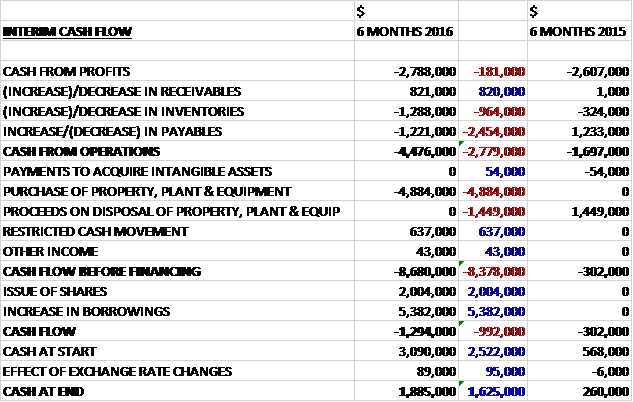
vastinterimcash

Before movements in working capital, there was an operational cash outflow of $2.8M, a detrimental movement of $181K when compared to the first half of last year. We then see a cash outflow through working capital with an increase in inventories and a reduction in payables so that there was a $4.5M cash outflow from operations, an increase of $2.8M year on year. The group then spent $4.9M on property, plant and equipment to give a cash outflow of $8.7M before financing and after the issue of shares brought in $2M and the group increased borrowings by $5.4M, there was a cash outflow of $1.3M during the period and a cash level of $1.9M at the period-end.

The gross loss has arisen during the first two months of production where throughput has not yet reached a steady state level which allows for full absorption of mining and processing costs but management are confident that the trend will reverse in the second half of the year.

The period saw the first gold pour at Pickstone-Peerless in September and the first sale of concentrate at Manaila Polymetallic mine, also in September. The construction and commissioning of Pickstone-Peerless has therefore been completed and production at the mine is ramping up to a steady state. Exploration activities in Zimbabwe and Zambia have been terminated apart from the Nkombwa Hill rare earth project in Zambia which is being funded and managed by a partner.
Production at the Baita Plai mine is planned to start in early 2016 and a small administrative office has been established in Romania to assist in the management of the two mines.

The short term objectives at the Manaila Open cast mine include improvements to the open cast mine to facilitate increased mining volumes and compliance with international best practices; expansion of the mining license area to increase the potential to expand the mine life; the undertaking of an exploration programme to firm-up the expansion of the phase one open pit and phase two underground mining resources; the completion of metallurgical test work on the ore to assist in the design of the proposed processing facilities that may be constructed at the mine, subject to a positive feasibility study, to avoid transporting ore 34km to the Iacobeni concentrator, and tailings 20km to the tailings facility; and the conversion of the resources and reserves defined according to the Russian code to JORC, which will be undertaken in 2016.

At the Iacobeni Concentrator, the short term objectives include the recommissioning of the second ball mill to increase milling capacity to 20,000 tonnes per month; the repair and re-commissioning of the second and third float lines to facilitate the production of high quality copper concentrate and high quality zinc/lead concentrate; the upgrade of the milling and flotation facilities to comply with international standards; the elimination of material double handling wherever possible; and establishing warehouse facilities for concentrate to make timeous payments for concentrates sold without waiting for transport delays.

At Baita Plai, the short term objectives include re-starting the underground mining operations in early 2016 with an initial steady state objective of 10,000 tonnes per month; the recommission of two of the three ball mills, the service of four flotation circuits and the recommission of a fifth for molybdenum; the start of a study to increase production to 20,000 tonnes per months which is the total installed processing capacity; the conversion of the resources to JORC; the review of current mining methods and plan to reduce waste volumes; to undertake a feasibility study on the benefits of beneficiation of ore prior to milling; the evaluation of near surface resources in adjacent undeveloped skarn pipes for future mining; and the planning of systemic modernisation of all mining and processing equipment and plant.

The group are also looking to re-engage with SC Remin and the government of Romania to negotiate the acquisition of target mines identified during the exclusivity period that resulted from the past memorandum of understanding entered into by Remin and Vast but at the request of the government, negotiations have been suspended pending changes planned for mining and investment in the country which are expected in 2016. The group have also been offered additional mining projects which are being evaluated.

While the group is now earning operational income on Manaila and Pickstone-Peerless, it will require additional funding in order to meet its capital requirements to bring Baita Plai Polymetallic mine into production and for further capex required to increase production. The company is in an advanced discussion with a funding source and the directors are very confident of being able to raise such funds as are required.

In July the group concluded an agreement to purchase 50.1% of the share capital of Sinarom Mining for €1. Sinarom currently operates the open pit mine at Manaila Polymetallic mine. No assets were acquired with the business as they were offset by payables but management is of the opinion that the final fair value of this acquisition is in excess of the amounts stated.

In November, the appeal court of Cluj confirmed the merger with Mineral Mining in Romania. The group has therefore been advised that it has a direct legal right to obtain the right to mine at Baita Plai Polymetallic mine without any further legal argument from the holder of the head license, Baita and that the grant of the mining sub-license should now only be a matter of due process. In December the company received a letter from Baita to request a meeting in January to conclude the grant of the license. This grant requires the approval of the Romanian National Mining Agency and such approval is required to be given if Vast fulfils the criteria laid down under Romanian mining law, which the directors expect to be satisfied.

In July the company announced that the lender of the short term loan of $1.22M had notified them that the conversion rights would be exercised so 154,649,140 shares became due to be issued to the lender at an issue price of 0.5p which were issued after the period end, in October. Also in October, 7,500,000 new shares were issued due to an exercise of warrants for a cash consideration of £42K; and 23,097,237 new shares were issued to a consultant to satisfy obligations to pay commissions in relation to a prior fundraising.

After the period-end the cash level fell to just $250K as of the end of December.

On the 4th January the group announced that it has entered into an agreement with Crede Capital whereby they will subscribe for new shares in order to raise up to £5M. 156,250,000 new shares will make up the first tranche of the subscription shares at an issue price of 0.8p per share and in addition, the same number of warrants to acquire shares in the company have been issued, exercisable up to 2021. Overall there will be four tranches, occurring quarterly with each tranche raising £1.25M with the issue of 156,250,000 shares and an equal number of warrants.

For each subscription of shares by Crede Capital, a commission equal to 10% of the aggregate purchase price of the shares may become payable by the company to Crede in the event that Crede subsequently subscribes for shares pursuant to the exercise of warrants. Crede is apparently a passive investor and does not seek board seats or control positions.

On the 6th January the group announced that certain directors subscribed for 62,500,000 shares, raising £500K along with warrants on the same terms that Crede have been issued shares.
On the 8th February the group released a quarterly production summary. The Manaila Polymetallic mine and the Pickstone-Peerless gold mine were both commissioned in August and operationally the two mines have achieved break even status in the quarter to the end of December. Costs and efficiencies are improving and further improvements are possible going forward.

At Manaila, the mining rate averaged more than 11,200 tonnes of ore per month. During the quarter the existing operational mill was still ramping up to its design capacity of 10,000 tonnes per month and has undergone a full refurbishment, including new liners. The second mill, currently non-operational, is being refurbished and is expected to be in production from April. With both mills operational, the mine will have an installed milling capacity of 20,000 per month.

In conjunction with the increased procession capacity, a second flotation line is being installed enabling the mine to produce separate copper and lead/zinc concentrates. Metallurgical testwork undertaken by the company indicates that the second flotation circuit will increase plant recoveries resulting in higher-grade concentrates. In addition to the improved grade, moving away from a bulk concentrate will increase the marketing flexibility of the product.

In all, the mine mined 33,756 tonnes of ore and milled 26,375 tonnes which produced 745 tonnes of concentrate, of which 550 tonnes were sold in the period. The cash costs of the concentrate was $1,064 per tonne with an average selling price of $1,033 per tonne so not much money being made here yet.

At Pickstone-Peerless, the plant processed an average of 15,400 tonnes per month at an average plant head grade of 1.97g/t, producing 2,601 ounces for the quarter. The strategy is to now work towards achieving up to 20,000 tonnes per month. Head grades during the quarter were negatively impacted by the presence of artisanal miners in the shallower parts of the mine. With the assistance of the authorities, the miners have now been removed and the short term mine plans are being reviewed in order to optimise the tonnage and mill feed grade. Consideration is now being given to the further higher grade sulphide resources that are scheduled for future mining.

During the quarter the mine mined 46,285 tonnes of ore with a similar amount being milled which produced 2,601 ounces of gold, of which 2,375 ounces were sold. The cash costs were $831 per ounce of gold and the average sales price achieved was $1,080 per ounce.

On the 7th March the group announced that it had entered into an agreement with a number of existing shareholders whereby they will subscribe in four tranches of new shares and associated warrants in order to raise up to £800K. The first tranche of the financing of £400K was completed on the 4th at an issue price of 0.8p resulting in 50,000,000 new shares being issued with the same number of warrants. The next three tranches will be priced at the closing price of the shares on the prior trading day and will raise £133K each.

At Manaila, there are two installed ball mills and associated flotation circuits. At present one ball mill and part of the flotation circuits have been successfully re-commissioned, providing the mine with processing facilities of up to 10,000 tonnes of ore per month. About 250 to 300 tonnes of copper concentrate are being produced per month. The single flotation circuit results in high levels of zinc and lead in the copper concentrate which reduces the per tonne value of the concentrate. The unrecovered lead and zinc is being lost.

In order to improve revenues, it is therefore necessary to commission the second mill and flotation circuit, produce a copper concentrate with much lower levels of lead and zinc, to produce a high grade lead and zinc concentrate, to increase monthly tonnages from 10,000 tonnes to closer to 20,000 tonnes, to improve plant efficiencies, and to reduce transport and double handling costs. The funding from Crede has been facilitating and will continue to facilitate the above improvements but the staged instalments from Crede delays the full implementation of these improvements and the positive financial impact that they are expected to have hence the additional funding that has been sought.

Gold production at Pickstone-Peerless is in line with expectations. Costs are stabilising at anticipated levels and the higher gold price is improving revenues. The plant design capacity of 10,000 tonnes per month has been exceeded and is currently operating at 15,000 tonnes per month. The expected production of about 30kg per month is being achieved as a consequence of this increase throughput and the group continue to evaluate operational improvements.

Examination is in process so as to decide the best option for the start-up of some small scale mining at the 500,000 ounce Giant Gold Mine, whilst a better understanding of the potential of the mine is determined through exploration activities. The gold occurrence is open at depth and along strike and further drilling is necessary to determine the extent of the in-situ gold potential. Exploration work by former holders of the mining claims suggests that the mine has the potential of a larger resource.

The Baita Plai mine is being readied and prepared for the investment required for its restart after receipt of the license that is currently still being processed by the authorities.
The company’s options for utilisation of surplus funds after the expansion of operations at Manaila, the restart of Baita Plai and the receipt of the final tranches of the Crede investment include an estimated $350K for expanded phase one resource drilling at Manaila as part of the overall drilling programme expected to cost a total of $800K when finalised, which includes the work necessary to convert the resources to the JORC reporting code; an estimated $500K for resource drilling at Baita Plai; an estimated $50K for auguring and assaying of the tailings dam at Baita Plai to assess the potential of retreating the dump for any contained minerals; and estimated $200K for upgrading the lab at Manaila to facilitate assaying for gold and silver concentrates prior to shipping ; and the design and construction of a milling and flotation circuit at Manaila to remove the transport costs of ore from the mine to the mill and flotation facilities to the tailings facility.

Overall then there has been some considerable progress over the period with both the Pickstone-Peerless and the Manaila mines starting up and broadly breaking even. There are continued delays at Baita Plai, however. The group is obviously consuming some considerable cash at the moment and whilst the Crede Capital investment is welcome, it was not enough and new shares have been issued like confetti. I feel that at the moment with the amount of ongoing dilution taking place this is not something I want to be invested in but I will keep it on watch.

On the 16th March it was announced that having sold their last tranche of shares, Crede were converting 32,200,000 warrants to shares at 0.8p which meant that the group issued just over 55M new shares to Crede and they now own 2.77% of the total share capital. Inexplicably, pursuant to the terms of the subscription agreement, an admin charge is due to the investor of £55K! Incredible! I’m not going anywhere near these until this agreement has finished.

On the 30th March the group announced the extension of the prospecting license at Manaila. The current mining license covers an area of about 0.0675km squared and following the extension will cover an area of about 1.323km squared, an increase of more than 20 times. Historical exploration has indicated that the ore body extends to the NW and SE and on completion of the exploration programme, the defining of reserves and resources, and the preparation of a mine plan, the group is entitled to apply for a mining license on the additional area.

Resource drilling completed in Q3 2015 on the existing mining license has indicated a likely increase in the current open pit resource. Additional open pit mineralisation has been identified to the SE of the current resource, which will be targeted during the Phase 1 drilling campaign, planned to start in Q2 2016. It is expected that the group will be able to convert all of the resource to the JORC reporting code during Q4 2016.

This is all very good but these shares are not going anywhere until the ridiculous financing agreement with Crede is sorted out…

On the 5th April the group announced that it has decided not to give consent to the subscription of £1.25M from Crede, the second tranche of the financing agreed. The grounds for withholding this consent are that the subscription for the tranche would result in Crede being interested in more than 25% of the share capital of the company.

The company’s share price has fallen substantially since the financing was agreed (this is not a coincidence!) and as a result of this, the ordinary shares of 0.1p each issued to Crede on exercise of certain warrants granted to it as part of the first tranche of financing have been highly dilutive to shareholders. The new shares that would have been issued to Crede as part of the second tranche would have been issued at 0.24p per share and would have entitled them to a futher 520,833,333 shares with an equal number of warrants.

The cancellation of this tranche does not affect the contractual rights and obligations between the parties in relation to the third and fourth tranches but the directors intend to replace the second tranche of £1.25M so that the momentum of increasing production can be maintained. Initial discussions indicate that the terms of this funding will be on more favourable terms and on a basis that will not conflict with the terms of the subscription agreement.

This is certainly a positive development but it is unclear how this affects the relationship with Crede, how easy it will be to gain this financing from elsewhere and also how the further two tranches will affect the share price.

On the 6th April the group announced that it has received subscription of £133K for the issue of 55,555,550 new shares at an issue price of 0.24p per share and 55,555,550 warrants pursuant to the agreement entered into with a number of existing shareholders.

On the 11th May the group released an operational update covering trading in Q1. At Pickstone-Peerless the plant milled 54,237 tonnes and produced 2,808 ounces of gold, an increase of 17% and 8% on the previous quarter. Operational efficiencies have started to take effect with production costs decreasing in line with gold production. Head grades averaged between 1.9 and 2.1g/t during the quarter and are expected to increase in future as the open pits are developed to deeper levels. Overall 2,475 ounces of gold was sold at an average price of $1,139 per ounce and cash costs of $910 per ounce, both of which increased 5% quarter on quarter.

The improved production profile has continued into the current quarter with the milling tonnage again exceeding 20,000 tonnes in April which along with the higher grades enabled the monthly production to exceed 40Kg of gold for the first time. The domestic bank overdraft has been reduced from about $2M at the start of operations to $1.2M in early April. Attention is now being focused on the design and installation of the sulphide processing plant which will be required for the next phase of mining once oxide resources are depleted. In addition, development at the nearby Giant Gold Mine is being considered although further exploration work is required to increase the current inferred resource of about 500KT.

At Manaila, the group has undertaken a number of capital projects to improve operational efficiency, including some maintenance work which had been neglected by the previous owner. As a result, some plant downtime was incurred and furthermore, severe cold weather in January negatively impacted flotation recoveries which resulted in a reduced concentrate quality. Additional mining areas were exposed in anticipation of the increased plant throughput, resulting in an increase in waste tonnage mined whilst the single, mainly copper concentrate, produced during the quarter contained high levels of zinc that resulted in the mine incurring penalties when selling.
In order to reduce the quantity of zinc in the product, a second flotation circuit has been constructed during the quarter and is now being tested, along with new reagents identified by flotation test work. Additional capital projects undertaken include the relining of the new primary mill which was completed towards the end of the quarter allowing for higher milling tonnage throughput and improved grind and recoveries. The refurbishment and relining of an older second mill also started during the quarter and was commissioned in April. This mill is being tested as a regrind mill which will enable separate copper and zinc concentrates to be produced. In addition to now having the ability to produce two saleable concentrates, the grade of the copper concentrate is expected to improve and with the production of a separate zinc concentrate, the penalties of zinc in the copper product will decline. With both mills operational the mine will have an installed capacity of 20,000 tonnes per month from May.

More intensive metallurgical test work has been commissioned for the mine with two objectives in mind. The first is to provide data for the design of the new milling and flotation circuit that the group wishes to construct at the open cast mine site to avoid the extensive ore and waste transport costs associated with using the concentrator 34 km away. Secondly the data will be used to determine the optimal process flow at Lacobeni using the existing concentrator until the new unit is constructed at Manaila.
In all Manaila mined 20,362 tonnes of ore and milled 22,510 tonnes to produce 677 tonnes of concentrate which represents a 40%, 15% and 9% decline respectively. The amount of concentrate sold increased by 57% to 866 tonnes, however. The average sales price declined by 8% to $949 per tonne of concentrate but due to the zinc contamination, cash costs increased by 45% to $1,542 per tonne so this is certainly not profitable at the current time.
The Baita Plai license process is apparently nearing completion. All the legal work to facilitate the merger has been completed. Numerous legal proceedings by parties opposing the merger have also been concluded and meetings between various parties are to be convened shortly to arrange the granting of an associate mining license. The group has undertaken certain capex to comply with underground mining safety which includes new man-carrying cages, hoist ropes and making safe areas that will be accessed in the initial stages of reopening the mine. Metallurgical test work will be undertaken during the rehab of the mine and processing facilities to confirm that the current processing layout is appropriate.

The group also announced that they have been granted a prospecting license over the Faneata tailings dam located 7km from Baita Plai. This license constitutes a separate right from the anticipated right to mine at BPPM itself. The 4.6MT dam is comprised of forty years of tailings from Baita Plai and historical data indicates that they contain economic quantities of minerals including gold, silver, copper, lead and zinc. The company will undertake an 825m auger exploration programme starting in Q3 to upgrade the dam to a JORC compliant mineral resource and thereafter undertake a feasibility study to assess the viability of the resource. The total cost for the drilling, assaying and feasibility study is expected to be just $125K.

The dam has the potential to be a stand-alone mining operation when enhanced processing technologies that have the ability to enable the economic extraction of the metalliferous content of the tailings are used. A sampling programme undertaken in 2011 estimated that the dam contains 4,080 tonnes of copper, 6,640 tonnes of zinc, 3,100 tonnes of lead, 35 tonnes of silver and 309kg of gold. This dam seems as though it will provide a decent source of feedstock and it will also reduce operational risk by having two sources of feed for the processing facility.
On the 16th May the group announced that it had entered into a bridge loan with Darwin Capital for up to £1M. An initial note of £650K, which will be used for ongoing capital requirements, has been issued so far. The note will mature in two halves, with the first falling due on the 10th July and the second on the 10th October. It will accrue hefty interest of 20% per annum. If the company fails to pay on these says, the amount owed will increase to 120% of all outstanding payment obligations and the dates will move to 10th January and 10th April. Also, if this happens, Darwin will have the right to convert the amount outstanding into shares at the prevailing price.

The purpose of the loan is to provide cover for the working capital requirements until the Crede Tranche 3 financing has taken place which they will use to pay off the loan. I would have thought this just kicks the can down the road a bit but desperate times call for desperate measures I guess.

Overall then, the gold mine seems to be working well and contributing but the Manaila mine is consuming cash rather than making it at the moment and the license for the Baita Plai is still not forthcoming. The group are sailing very close to the wind with regards financing at the moment and I feel that buying shares here is akin to gambling – when(if) the license news comes in for Baita Plai I would expect a short-term jump in the share price, however.

On the 16th June the company released an update. As has been mentioned previously, due to movements in the share price the authorities granted to the company at the general meeting may not be sufficient to allow them to issue the Tranche III shares to Crede together with the warrants. In order to issue the shares on the 4th July, the date for the next issue, they are obliged to seek further authority to allot rights.

The group expected that it will utilise part of the amount drawn down from Crede in the Tranche III issue to pay the amounts due to Darwin on the 10th July. In the event that they do not repay this, Darwin will have the right to exercise the conversion. The company is therefore seeking the authority to allot and to disapply pre-emption rights to issue shares to Darwin in the event that they are unable to pay back the loan. They are further seeking to refresh its existing allotment authority for rights up to an amount of £500K until the next AGM.

The company most definitely needs this cash. The recent fall in copper and lead prices has reduced cash flow from Manaila. It has been further affected by the reduced concentrate grade at the mine as a consequence of extreme cold weather in Q1 and the commissioning of the second mill and flotation line. Cash flow from Manaila and Baita Plai had been expected to fund a significant part of the group’s capex.

Curiously the group have stated that shareholder support for the share price is now sought to ensure that the future tranche of shares are issued at increasing share prices – as if shareholders could control the price of the stock somehow! I suppose they are pleading to shareholders not to sell!

If resolutions 1 and 4 are not passed at the upcoming GM, the group has the right to terminate the subscription agreement with Crede. On termination, all of their obligations to Crede will fall away and the company will have to identify alternative sources of funding which could include an open offer.

In Zimbabwe, Pickstone-Peerless is producing higher than expected grades and milling tonnages are significantly above the original design capacity of the plant. In April and May the total tonnage milled has exceeded 20,000 tonnes per month in both months, producing more than 2,900 ounces of gold during that period. A better understanding of the ore bodies is being developed as the open pits are expanded and the grade control drilling provides additional information.
Additional potential ore sources are also being evaluated within the existing mining lease. The mine is also considering improvements and additions to the existing oxide plant which would form part of the expansion of the processed facilities that will handle the higher grade sulphide ore to be mined when the oxide resources are depleted.

The company is now looking to develop the Giant Gold Mine where there is currently an inferred resource of about 500K ounces of gold. They have secured additional information and further exploration drilling now needs to be undertaken to upgrade and increase the known level of resources at the mine. Artisanal miners working in the area will need to be relocated and consultations with their representatives have begun. The mine provides the company with the potential to develop a second significant fold mine and management will now focus on this objective.

At Manaila, Q2 has seen the mine face a number of challenges that have impacted performance. Extreme cold weather in January and February affected recoveries as the heating of the flotation facility and cells was not adequate and it was not possible to upgrade the heating system in time. It will now be upgraded for the next winter. The mine is also still producing a combined copper and lead concentrate, which incurs penalties with the refurbishment of the flotation circuit that is designed to prevent this not being ready until the end of June. Additionally it was expected that a change in reagents and the separated flotation circuits should result in improved recoveries, a clean copper concentrate and a second zinc concentrate but initial application of the test outcomes to the plant did not achieve the anticipated results.

The delay in obtaining the right to mine at BPPM is still ongoing. Not only has it delayed cash flow generation from what management regard as the company’s most valuable asset but also monthly dewateing and maintenance costs are being incurred. The company remains confident that it will obtain its due right to mine at BPPM but it has had little control over the speed of the process. Some more information regarding the whole sorry saga has been given.

The legal process for the merger was started in February 2015 and at the time the group was advised that the process would be complete by May 2015. The previous management of Baita were uncooperative, however, and the whole legal process was spun out until a final court of appeal decision was reached in November 2015 confirming the merger with the termination of the bureaucratic process following this decision occurring in February this year.

While the legal proceedings were taking their course, the company was attempting to bypass the legal process by negotiation with the government. In a meeting, the president of the Romanian Mining Agency, a secretary of state at the ministry of economy and the minister of economy promised a swift resolution of the matter which resulted in a new agreement announced in November.

Unfortunately the then government was removed and the ministers were replaced by people who were not familiar with the background of the situation and it has taken a long time to promote a proper understanding of the facts. Since February there has been new management at Baita and it has become evident that there is now no opposition in principle from any quarter to the company receiving the sub-license. The new secretary of state verbally confirmed in February that it would be granted upon clarification of the current position which could take up to the end of April.

The process has, however, remained slow for a number of reasons. One of the senior directors of Baita was in hospital for about five weeks which meant, under the Romanian system, that they were not able to hold any board meetings at all during that period. Meetings at the ministry of economy have taken a long time to arrange due to other pressures on them and the fact that key officials have been on holiday or on assignments! The officials still have no clear understanding of the detail involved and seem to be acting on different information.

In particularly, the previous management of Baita had materially overcharged for dewatering costs prior to Vast’s involvement. The amount that will become due to Baita on grant of the sub-license is subject to judicial audit that is still ongoing but in the interim the court has ordered that the maximum amount due is about $620K and the group have offered to pay this sum into an escrow account against delivery of the license.

The amount shown as due in Baita’s official accounts is about $1.7M, however, and although their current management accept that only $620K is legally due, this fact has never been communicated to the section of the Ministry of Economy within whose remit the shares in Baita lie. The ministry has now understanding as to why the group should not be paying $1.7M and the lack of provision of this information has only been revealed to the group over the past week.

The up to date position is that Baita has now mandated its GM to confirm the current position officially in writing to the relevant section of the ministry and the company is in advanced discussions to procure the additional funding required for the deposit in the escrow on terms which are considered acceptable to the company.

You really couldn’t make this up! It does seem as though the license should be forthcoming soon, but we have been in that position before and with material uncertainty surrounding funding I am not going near these shares for the time being.

On the 1st July the group announced that at the GM, resolutions 1 and 4 were defeated. These resolutions were required to five the company authority to issue shares sufficient to meet the requirements of the Crede tranche three which means the financing is cancelled in accordance with its terms.

On the 5th July the group announced that it had received a subscription of £133K for the issue of 37,037,036 new shares at an issue price of 0.36p per share and the same number of warrants. This represents the third tranche of financing. They have also announced the appointment of Brandon Hill Capital as joint broker.

On the 6th July the group announced that it has raised $1.14M before costs through a placing and subscription of 300,000,000 shares at a price of 0.285p per share. These shares will represent about 10.4% of the enlarged share capital of the company.

Whilst this is clearly good news, there remains a dire need of further capital here and for that reason I remain un-invested.

On the 14th July the group gave an update. Following the rejection by shareholders to grant additional head room to facilitate the third tranche of finance from Crede on the ground that its terms were too onerous, the group needed urgent injection of cash. They found support at 0.285p per share which came from the shareholders that voted down the Crede offer, together with other new shareholders identified by the new broker. At that price, the maximum sum that could be raised was £855K because they had available authorities to issue about 300M shares.

They will need further funding to allow the company to fulfil its development programme and therefore the directors are now proposing an open offer to shareholders on the same terms as the placing. Unfortunately the shares have been in decline so that 0.285p does not now represent an attractive discount but warrants attached to them might have some appeal. It is expected therefore that the open offer might not be enthusiastically supported. As such the group may seek to raise capital at project level, entering into financing structures that limit dilution at the company level or to enter into joint venture arrangements. The directors will not be participating in the open offer as they deem that they are in a close period.

Since the last update, production continues above expectations at Pickstone-Peerless and satisfactory progress was made towards advancing the grant of the sub licence at Baita Plai. At Manaila, progress was made concerning the separation of the copper and zinc concentrates. Improvement suggested by consultants are being implemented and consultants will remain on site for the next two months to monitor progress.

The group needs about £4.1M over the next six months. £1.2M is needed for loan repayments, £752K is needed to pay liabilities on taking over the mining sub-license, £684K is needed for general capex, £555K is needed for working capital, £456K is needed for start-up working capital and £456K is needed to pay acquisition creditors at Manaila. This clearly shows the further sums needed to make up the balance.

So, after not including private investors in an open offer when the placing was done at a discount, they are now “generously” including offering shares, which are worth 0.25p on the open market and opportunity to buy shares in an open offer at 0.285p! Of course the directors are not taking part in the open offer but that is not because it is a terrible deal of course, that is just because they are in a close period! It is very clear that the company desperately needs cash, and more than has been raised at the latest placing. This is all a terrible mess.

On the 28th July the group announced the appointment of Peterhouse Corporate Finance as joint broker and they have terminated their relationship with Daniel Stewart. They also announced that they repaid the £325K loan to Darwin, being half of the Bridge loan note.

On the 1st August the group announced that nearly 52% of shareholders opted to take part in the open offer which meant the issue of 181,992,582 new shares and the receipt of £519K. I have to say I am surprise it has been this successful and the group should be able to keep going until the next fundraise for a little longer now.

On the 11th August the group announced the results from the drilling operation in Manaila which is anticipated to produce JORC compliant resource at the mine in Q3 and to extend its life. Highlights include 11.7m @ 1.19% Copper and 0.69% Zinc from 20m in FZ60; 8.5m @ 1.47% Copper and 1.03% Zinc from 54m in FZ67; 13.9m @ 1.11% Copper and 0.31% Zinc from 25m in FZ3; and 17.8m @ 2.34% Copper and 1.83% Zinc from 30m in FZ4.

On the same date the group also announced that it had raised £364K before costs through a placing of 128,035,087 shares at a price of 0.285p per share.

The group has now released a quarterly update. At Pickstone-Peerless, the group mined 83,035 tonnes of ore, an increase of 30% quarter on quarter. They milled 61,577 tonnes with the plant now at steady state, and produced 4,542 ounces of gold, an increase of 62%. The average sales price achieved increased by 8% to $1,229 per ounce and cash costs fell by 24% to $695 per ounce.

Attention is now being focussed on the design of the PPHM sulphide processing plant that will be required when the oxide resources are depleted in the open pits. In addition, development at the nearby Giant Gold Mine is being considered. Further exploration work is required to increase the current inferred resource of about 500,000 ounces.

At Manaila, the group mined 24,711 tonnes of ore, an increase of 21% quarter on quarter. They milled 29,830 tonnes, an increase of 33%, but the concentrate produced declined by 12% to 727 tonnes due to the inclusion of an additional 144 tonnes of low-grade concentrate that was initially stockpiled. The average sales price increased by 4% to $844 per tonne but cash costs ballooned by 45% to $1,341 per tonne.

During the period the group continued to focus on cost control and operational efficiencies. The progress in controlling costs has led to a 3% reduction but the plant efficiencies have not met expectations and are reflected in the increase of cost per tonne of concentrate produced. The increase in coasts was largely due to a reduction in the plant mass pull when new reagents, based on the initial metallurgical work undertaken in the prior quarter, were introduced to reduce the zinc levels in the concentrate. The lab scale test work results did not materialise in the plant which reflected directly in the lower than expected average sales price as a result of less copper and higher levels of zinc in the concentrate.

Mining constraints due to the pit configuration resulted in a blend of ore containing higher than normal pyrite levels, which affected the recovery of metal and reduced the mass pull. Improved mine planning has resulted in a more consistent ore feed to the plant. Test work and plant optimisation being carried out has been in progress since May. The prior quarter upgrades in the flotation plant are now being optimised to achieve a steady state production of separate copper and zinc concentrates and the board are confident that this will reflect in increased plant efficiencies and concentrate grades.

At Baita Plai, a prospecting license was granted over the Faneata tailings dam located 7km from the mine. The 4.6MT dam is estimated to contain 4,080 tonnes of copper, 6,640 tonnes of zinc, 3,100 tonnes of lead, 35 tonnes of silver and 309kg of gold in-situ. The group plans to undertake an 825m auger exploration programme to upgrade the dam to a JORC compliant mineral resource and thereafter undertake a feasibility study to assess the viability of the resource. The drilling programme is expected to take up to eight weeks to complete and the initial metallurgical test work is expected to take up to 12 weeks. The estimated timeframe from initial drilling to first production is estimated to be 6 to 9 months but the programme has been delayed due to funding constraints and is expected to commence when the MPM revenue stream is achieved.

The BPPM license process is still ongoing. All the legal work to facilitate the merger of Mineral Mining and AFCRR has been completed and the company continues to engage with the relevant authorities. Prior to starting production at BPPM the group will undertake metallurgical test work on the MPPM ore to optimise the plant configuration. During this time the underground mining plan will be optimised.

After the period-end, the group required additional working capital following the termination of the equity subscription agreement with Crede. In July they raised £855K through a placing of 300,000,000 new shares at a price of 0.285p per share. Later in the month they raised $519K through a subscription of 181,992,582 new shares at the same price; and in August they raised £364K through a supplementary placing of 128,035,087 shares. This will provide the board with flexibility and time to review a number of alternate financing scenarios. In late July they repaid the first tranche (50%) of £325K plus interest due to Darwin. Once the BPPM license is received, they will require further funding to bring it into production.

Overall then this is still very mixed. The Pickstone-Peerless gold mine seems to be going very well but the performance at Manaila has been poor as the group continues to struggle to separate the copper concentrate from the zinc concentrate, further constrained by higher pyrite levels. The BPPM license is still not forthcoming and there seems to be little that can be done to expedite the decision. In any case, there is not enough funding in place to develop that mine so it is hard to see how the group can continue without substantial dilution taking place to current shareholders. I am still avoiding this for now.

On the 30th August the group released an update for the Manaila mine. The aim of the test work carried out in the first half of the year was to optimise flotation parameters in order to separate the contained copper and zinc into separate products with minimal cross contamination in the concentrates. The head grade of the composite sample as tested was 1.38% copper, 0.44% lead, 1.17% zinc, 1.08g/t gold and 41.5g/t silver.

The test work confirmed that the current grind size at the plant is optimum at 85% and the results of the flotation tests were: 80.97% recovery of copper in the copper rougher concentrate with a corresponding 23.53% recovery of zinc; 66.87% recovery of zinc in a zinc rougher concentrate with a resultant grade of 14.63% zinc; a theoretical grade recovery curve for copper indicates a 92% recovery at a resultant 20% copper concentrate grade is possible; and a theoretical grade recovery curve for zinc indicates an 85% recovery at a resultant 50% zinc concentrate grade is possible.

Optimisation work began on the MPM plant in May to reconfigure the float lines with the goal of replicating the SGS recovery and grade results achieved at the lab scale and production in the past six weeks has resulted in a copper concentrate with increased copper grades and continued reduction in the zinc grades.

The average concentrate grade in the last quarter was 17.3% copper and 14% zinc; concentrate grades over the past six weeks have seen an increase in copper to 19% but a reduction in the zinc grade to around 4%. The group are now targeting a steady state production in order to maximise sales values within industry standards to reduce tolling charges and penalties. Commissioning has now started on a second float line to produce saleable zinc concentrate with first sales in September.

In parallel to the grade optimisation work, mass pull problems experienced in July have now been rectified through a combination of plant recovery enhancements and new pit designs that include beams and trenches at MPM to reduce the water ingress during periods of higher rainfall resulting in head grade dilution. The Iacobeni plant mass pull has increased from about 1.5% in July to 2.5% in August.

The group has awarded an outsourced mining and transport contract to an independent contractor to mine and transport the ore from the open pit to the flotation plant in Iacobeni. The contract will eliminate the upfront cash requirement thereby reducing working capital constraints, outsource mining fleet maintenance and reduce on site management and overhead costs to improve the profitability of MPM.

On the 6th September the group announced that it has signed a long-term offtake agreement with Transamine Trading, a Swiss-based trader of non-ferrous metals, for all concentrates produced at Manaila. The terms and conditions of the agreement, which is valid until December 2017, dictate the offtake pricing dependent on the quality of concentrate with favourable payment terms to reduce the group’s working capital constraints.

The first concentrate sale under the agreement was in September for 430 tonnes of copper concentrate grading 18.7% copper. The steady state copper concentrate now being achieved after the plant optimisation is grading 20% copper.

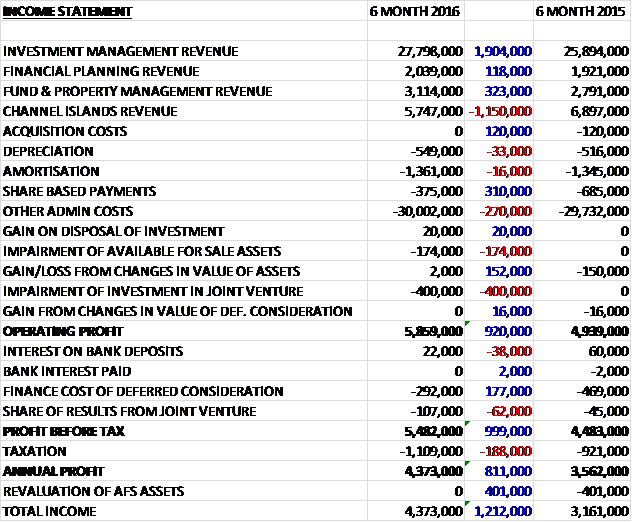
Vast Resources Share Blog – Final Results Year Ended 2015

The group has interests in Zimbabwe and Romania and has not generated any revenue to date. It has now released its final results for the year ended 2015.

Vastincome

There were no revenues during the year as the group is pre-production. There are assets, however, after they were transferred from exploration costs, depreciation increased by $415K year on year. There was also a $272K swing to a forex loss. We then see a $2.2M decline in staff costs, offset by a $3.3M increase in other admin costs but there was no repeat of the $6.7M impairment of intangible assets that occurred last year and the operating loss improved by $5.7M. After a $1M loss from discontinued operation and a $169K gain on business combinations, the loss for the year came in at $6.6M, a decline of $5M year on year.

Vastassets

When compared to the end point of last year, total assets increased by $6.2M driven by an $18.8M growth in mining assets, a $2.3M call on subscribed capital in a subsidiary and a $2.5M increase in cash, partially offset by a $16.8M decline in deferred exploration costs as they were transferred to mining assets, and a $3.2M fall in license acquisition costs as they were also transferred to mining assets. Total liabilities also increased during the year due to a $1.4M growth in trade payables, all relating to Mineral Mining, a $1.6M increase in the secured loan, a $714K growth in other payables relating to the $625K payable to Baita, and a $1.2M growth in the short-term loan. The end result is a net tangible asset level of $24.9M, an increase of $21.1M year on year.

Vastcash

Before movements in working capital, the cash loss increased by $498K to $5.1M. There was a cash inflow from working capital due to an increase in payables so the cash outflow from operations was $4.2M, an increase of $123K year on year. The group then received a net $1.1M from the disposal of property, plant and equipment, and spent $63K on exploration costs along with $522K on acquisitions before a $637K increase in restricted cash meant that before financing there was a cash outflow of $4.3M. The group then issued shares which brought in $3.8M, received $1.6M from new loans and $1.7M from the Greyfox investment to give a cash inflow of $2.7M for the year and a cash level of $3.1M at the year-end.

The group has acquired a 50.1% interest in the operating opencast Manaila Polymetallic Mine and has started a number of projects to improve the efficiency and productivity of the mine. It may also be possible to extend the life of this mine by extending the open cast mine over the existing license boundary and by developing underground mining operations. They are also awaiting the transfer of the mining license for their 80% owned underground Baita Plai Polymetallic Mine.

The 50% owned Pickstone-Peerless gold mine project in Zimbabwe is well advanced and the board expect first gold production in Q3 2015. Overhead costs in the country have been materially reduced.

In Zambia the Kalengwa Kasempa copper project has been disposed of. The group retains ownership of the Nkombwa Hill rare earth project and agreement has been reached with the new owners of ACR Zambia to facilitate the development of this property over the next three years. In doing so, the group’s ownership will be diluted to 35% of that currently, but in a project that should develop materially.

In March 2015 the group exercised an option to acquire 80% of Mineral Mining, a Romanian company which is in administration and whose principal activity is ownership of the Baita Plai Polymetallic Mine and the principal reason for the acquisition was to reopen and operate this mine. Mineral Mining is subject to insolvency proceedings and as a result the mining license was transferred to a state company, Baita. Under the protocol, it was provided that a sub-license on the mine be granted back to Mineral Mining if the business was not declared as bankrupt which will be formally ended when it is merged with the group’s Romanian subsidiary. The acquisition remains subject to certain bureaucratic processes.

There is a debt due to Baita payable on the grant of the sub-license, the precise amount of which is disputed but will not exceed $625K (this is now included in an escrow account and is recorded under restricted cash). There are also $1.4M of trade payables relating to Mineral Mining and of this amount, $950K falls due for payment on the restitution of the mining license and the balance is payable by instalments starting on the restitution of the license.

It is worth noting that the other 20% of Mineral Mining is held by a group of senior directors of the group. Under an option agreement, should the option be exercised, the company would be required to pay up to $3.6M partly for contractual sums due to the former owners, partly to retire existing debts and partly towards due diligence costs, operational overheads and mine rehabilitation. This option was exercised when the company acquired their 80% interest.

The Baita Plai Polymetallic mine licence area contains eight skarn pipes, the first two of which currently contain the majority of the 1.8M tonnes of mineral resource, in situ grading 2.19% copper; 128g/t silver; 3.46% zinc; 3.07% lead and 1.41g/t gold. The mine is fully developed to 18 levels with all the necessary mining equipment, ore transport and hoisting facilities in place. Milling and flotation circuits are in place enabling the company to recommission operations reasonably quickly and cost effectively. Some of the equipment is old, but serviceable, and will be replaced through an orderly modernisation programme.

Significant areas of the unexplored skarn pipes are accessible, subject to re-entry procedures and will enable the resources of the company to be increased and upgraded in future. Following completion of the transfer of the mining licence, BPPM is expected to enter production in late 2015.

In July, the group announces that it had concluded an agreement to purchase just over 50% of the issued share capital of Sinarom Mining Group, a business that is operating the open pit Manaila Polymetallic Mine although this is still subject to the registration of the sale at the Romanian Trade Resistry. The mine has 1.8M tonnes of mineral resource, grading 1.1% copper; 45.9g/t silver; 1.86% zinc; 0.95% lead; and 0.63g/t gold. This is a working mine which will underpin the transformation of the group to a fully-fledged mining operation. Production started in August and a sale of the first concentrate batch is now being negotiated between different buyers.

In March 2015 the company concluded an agreement whereby it disposed of the whole of its interest in African Consolidated Resources Zambia ltd while retaining full ownership of the Nkombwe Hills rare earth project through continued ownership of Fisherman Mining ltd, subject to am earn-in agreement with the purchaser whereby they will acquire up to 65% interest in the project over the next three years. The proceeds from the sale of the business was $100K plus a further $1M conditional on the purchaser obtaining full access to the Kalengwa Mine property.
The group has also disposed of the Harare office for $1.4M and an exploration aircraft for $200K.

In Zimbabwe, the indigenisation regulations stipulate that all companies registered in the country with a net asset value of $500K or more transfer at least 51% of their issued to shares to indigenous persons within a five year period. These regulations are relevant to Canape Investments and its subsidiaries which are group companies registered and operating in Zimbabwe. Following the investment agreement with the partner in the Pickstone-Peerless gold mine, these regulations now come into effect in respect of Dallaglio Investments but the method of implementation of these regulations is unresolved and the group intends to await government guidance on this issue.

All other Zimbabwe businesses in the group are in a net liability position at the reporting date due to them being financed by loans from the holding or other group companies. As such, the directors believe that there is currently no compulsion to effect any transfer of shareholding in these subsidiaries to any third party or enter into any plan to do so. The full effect that this legislation might have on the operations of the group is yet to be quantified and is subject to some uncertainty.

The group has taken out secured borrowings of $1.6M at a hefty interest rate of 12% per annum. The loan is repayable in four equal six monthly amounts starting in April 2016 and it contains a conversion option whereby on default, the loan will be converted into Vast shares, although the directors think that this eventuality is unlikely. A short term loan of $1.2M was provided by a company associated with the chairman. This loan bears interest at 15% and is convertible at the lender’s election, into new shares at an issue price of 1.5p or the lowest price at which the company secures new funding prior to the repayment date. It has been agreed that the conversion rights will be exercised and it will be repaid by the issue of 154,649,140 shares at a value of 0.5p each.

During the year, in July, the company raised about $2M through a placing and a subscription at a price of 1.2p per share to further the company’s opportunities in Romania and for general corporate purposes. The board expect one of the Romanian mines to start generating cash in September 2015 and PPGM is expected to be cash generative in the same period. They are exploring debt finance as an alternative funding instrument, being mindful of the significant dilution that has been endured over the last year.

At the year-end the group had authorised capital expenditure amounting to $2.8M in respect of the Pickstone-Peerless gold mine in Zimbabwe and this expenditure will be incurred before the end of September 2015. At the year-end the construction of the new facilities is substantially finished, mining operations have started and the plant has been commissioned and is operation. First sales are expected within days and this will complete the transformation of the group’s activities in Zimbabwe from exploration to production.

It is worth noting that there are ongoing litigation proceedings in Zimbabwe relating to diamonds acquired in the country. It is fairly convoluted but I think the upshot is that the group is alleged to have registered claims to the diamonds in the names of non-registered companies which was prejudicial to the ministry of mines or that the group was illegally in possession of the diamonds which are being held in a vault at the Reserve Bank of Zimbabwe. The charges have been laid against a company which is a shelf company that has no staff. I doubt much will come of the litigation but I also seriously doubt the group will ever see their diamonds again!

At the year-end, the group has sufficient cash resources to support minimum spend requirements and general overheads for the next year but further funds may be required to finance the group’s working capital requirements and the development of the Romanian assets. The group has accumulated tax losses of $21.3M at the year-end. They are clearly feeling the pinch and various measures have been put in place to contain costs including placing staff on half salaries, retrenchment of excess staff and cessation of exploration activities to focus on mine development.

As there are no profits, there is not much point looking at the PE ratio for this year but on next year’s (admittedly rather old) forecast, the shares are trading on a forward PE of 8.1. At the year-end, the group had a net debt position of $306K.

Overall then, this seems to have been a year of progress for the group but it is still in the early stages and will need to raise further capital going forward to advance its mines. The Manaila mine looks most promising in the short term, having started production in August but the group still await a mine license at Baita Plai which seems like it is quite an old decrepit mine which will need some considerable investment going forward. It is expected to be in production by late 2015. The Pickstone-Peerless mine also has some $2.8M of investment to pay in the short term but should be producing gold in Q3. Zimbabwe frankly sounds like a bit of a nightmare location. Overall, there is far too risk in my view at the moment but I will keep track of progress.