Newmark Security Share Blog – Interim Results Year Ending 2016

Newmark Security has now released its interim results for the year ending 2016.
NWTinterimincome

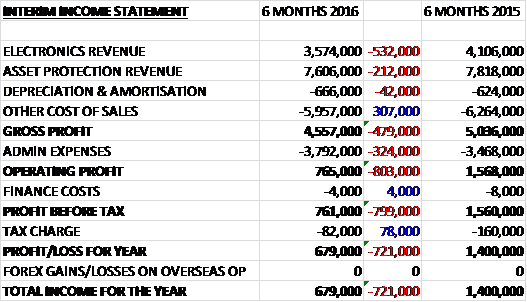
Revenues declined when compared to the first half of last year with a £532K fall in electronics revenue and a £212K decrease in asset protection revenue. Depreciation & amortisation increased by £42K but this was offset by a £307K decline in other cost of sales to give a gross profit £479K lower than last time. Admin expenses increased which meant that the operating profit was down £803K but a lower tax charge gave a profit for the half year period of £679K, a decline of £721K year on year.
NWTinterimassets

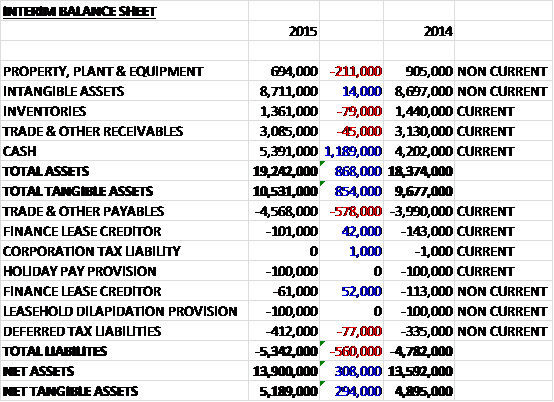
When compared to the end point of last year, total assets grew by £854K driven by a £1.2M increase in cash, partially offset by a £211K decline in property, plant and equipment. Total liabilities also grew during the period, mainly due to a £578K increase in payables. The end result is a net tangible asset level of £5.2M, an increase of £294K over the past six months.
NWTinterimcash

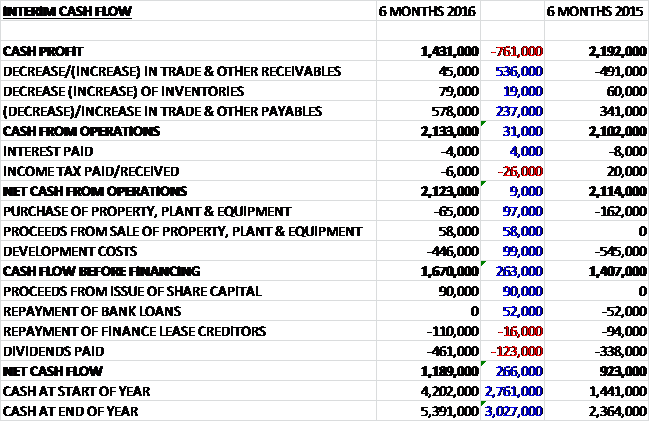
Before movements in working capital, cash profits declined by £761K to £1.4M. There was a cash inflow from working capital, however, with a sizeable growth in payables and a fall in receivables compared to a big increase last time, which meant that after a small tax bill was paid (compared to a receipt last time) the net cash from operations came in at £2.1M, broadly flat year on year. The group spent a net £7K on property, plant and equipment along with £446K in development costs to give a free cash flow of £1.7M. Some £461K went on dividends and £110K was used to pay finance leases to give a cash flow of £1.2M for the first half of the year and a cash level of £5.4M at the period-end.

Overall trading was in line with expectations. In the Asset Protection division, revenue declined from £7.8M to £7.6M. Safetell revenue was 3% lower than in the first half of last year as a result of a reduced contribution from time delay cash handing equipment to the Post Office and the completion of some major customer refurbishment programmes. Revenues from the CSI and Service divisions, however, increased by 17.4% and 21.7% respectively.

Excluding CSI product division revenue was 13.9% lower than last time. Revenue from Eclipse Rising was 35.3% lower as a result of reduced spending by one long standing financial institution client on its branch refurbishment programme. There was increased spending by another long standing financial institution customer, however, who decided to reinstall Eclipse Rising screens after their new screenless counter approach resulted in a spate or robberies. Cash handling revenue was 5.3% lower as a result of a decline in orders from the Post Office for time delay cash handling equipment as the programme enters its fourth year.

CSI division revenue increased by 17.4% as a result of increased sales from Gunnebo, which continued to promote and market CSI products after the division’s sale to Safetell in 2013. The group invoiced £307K in the period for 25 Ballistic Doors for a hotel in Iraq as part of their marketing efforts to promote their ballistic and blast resistant products in the Middle East.

During the period, Service division revenue increased by 21.7% compared to the same period last year. This was attributable to the various Eclipse Rising Screen upgrade programmes. Upgrading Eclipse Rising Screen control systems and pneumatic upgrades to the screens are expected to form a core revenue stream for the future and the service division has recently signed a contract with a top five building society to support the screens for a further three years, worth nearly £500K over that period.

In the Electronic Division, revenue fell from £4.1M to £3.6M. Revenue from workforce management in the UK based operation decreased by 27% compared to the prior year as previous major projects with a blue chip retailer and a supermarket chain reached their conclusion. As one of the world’s largest retailers, one of these customers has the potential to generate significant further revenues in the future as they look to continue integration of Grosvenor’s next-gen VFM solutions to help improve their business processes and increase efficiencies.

During the period, Grosvenor Technology secured a contract with a major global WFM partner for the development, manufacture and supply of one of the group’s next generation terminals. The development costs, partly funded by the partner, include incentives for completion of the development work and availability of the terminal in late 2016. The contract is for a period of ten years with guaranteed revenues of $6M over the first five years. The partner has exclusivity for the terminal for a period of six months from the launch of the terminal with the exception of one existing major customer.

Sales of SATEON Access Control increased by 44% following the restructuring of the sales team and expansion of the range. The product range is now ultimately scalable from entry level to enterprise level on a single platform and this proposition has proved attractive to system integrators looking to consolidate product lines, and it end users seeking seamless expansion to existing AC systems.

During the period SATEON version 2.9 was released which included integration into Salto’s wireless lock, adding to the integration already offered by Assa Abloy’s Aperio locks and further strengthening the company’s offering in the wireless locking markets. This version also included innovations such as a refined personal hub for easier user management, improved search facilities and support for Microsoft Windows 10. SATEON Faces was also incorporated into version 2.9 which enhances security by employing photo verification at the point of entry to a building, preventing the use of a lost or stolen credential.

Sales of JANUS AC declined 18% compared to the corresponding period last year due to a combination of adoptions of newer technologies and the transition of long-standing customers to SATEON. The group remain committed to supporting new and existing JANUS projects and it is expected that the product line will continue to be available as long as market demand remains.

In the Middle East a healthy sales pipeline is seen through a major systems integrator in the region with whom the group has reached an agreement to promote the SATEON range. Business development continues both in the Middle East and the US where it is expected that sales will increase in forthcoming period, as typical project gestation periods tend to be a year to a year and a half. Trading with US WFM partners decreased by 9% compared to the corresponding previous period and additional resources are planned to be deployed in this region to support and take further advantage of this large market. Grosvenor’s Hong Kong office was opened during the period, with staff based both in Hong Kong and China beginning business development in the region.

Going forward, profit for the year is forecast to be in line with market expectations. Group profits for the current year were expected to be lower than in the previous year with new market and product development, including the opening of the new office in Hong Kong, the benefits of which are expected to be seen in the future.

No interim dividend is proposed, as with last year so the dividend yield remains 3.3% for the year and the forward PE ratio stands at 13.6 at the current share price.

Overall then this was a fairly difficult period for the group, but one that was predicted with trading in line with expectations. Profits were down, but net assets were up and operating cash flow was flat, although this was due to a cash inflow from working capital and cash profits were down but nonetheless, plenty of free cash was still generated.

Profits in both the asset protection and electronics divisions fell with the decline in the former due to the well-publicised slow-down in the Post office contract and one financial institution client spending less on refurbishments, although the decision by one client to re-install the group’s products after a spate of robberies is a good sign. In the electronics division, the problem was with a reduction in workforce management sales due to two major projects coming to an end. Here the new terminal development sounds like a promising development.

Trading for the full year is expected to be as predicted so the investment case here really hinges on whether the actions and developments taking place this year can boost sales in the coming years to the degree that is expected. If so, a forward PE of 13.6 and dividend yield of 3.3% seems like a fairly decent entry point. I am considering a purchase here but it is not without its risks.

On the 19th May the group released a trading update covering 2016. The group’s financial performance in the second half of the year was broadly similar to that of the first half with revenues expected to be at least £22M and profit in line with market expectations at around £1.2M.

The strategy in the Middle East is proving successful with increasing traction bring gained in the region with the recent signing of Abu Dhabi National Oil Company as a client. Beyond the Middle East, Grosvenor has also achieved a number of new client wins including the Bank of Tokyo Mitsubishi and the Royal Albert Hall.

Three major product developments from Grosvenor include a combined hardware and software access control range in addition to a completely new workforce management terminal built on the Android platform. The business has also announced an opportunity to upgrade existing customers from its JANUS to its Sateon platforms.

Sateon’s new advanced range will provide customers with a seamless access control solution. It combines hardware and software in one package, and helps deliver low energy environments. Customer benefits include easier installation, enhanced reliability, lower cost per door and future proofing along with quicker installation times. The group are expecting to launch this new product this summer.

The workforce management business is launching its first Android based terminal. The new terminals will enable customers to expand their use of work force management by providing staff training and work scheduling with advanced end user features like delegating holiday booking to staff and central management of an organisation’s entire terminal estate. The system also offers biometric fingerprint readers.

Overall then, this is a decent enough update and I think the shares are looking rather cheap at the moment.

On the 6th July the group announced that trading conditions had become increasingly difficult and that the budgeted operating profit for the year is expected to be significantly lower than expected, although they will maintain the dividend.

During the year there was a clear divergence of revenue between the JANUS and SATEON product lines. Sales of JANUS declined more quickly than anticipated due in part to the retirement of older Microsoft platforms. SATEON revenues increased significantly overall, although revenue from the mid-tier customers has not grown as quickly as expected. The overall increase in SATEON sales has been partly attributable to the adoption of the product by new clients, but also to the migration of existing clients from JANUS.

Also a new sales office was opened in Hong Kong last year and the staff were hired locally to support sales in the Asia Pacific region. Whilst the pipeline of opportunities in these countries has grown, meaningful revenues are yet to be generated. Sales in the US have also not matched expectations.

Owing to a decline in sales of the legacy RS series of products and a slowdown of the rollout across the estate of a large apparel retailer, revenues in the UK Workforce Management business softened during the year. In addition, sales in support of a workforce management contract worth $6M over five years have been deferred due to the customer experiencing internal resource constraints. This will delay the delivery of the planned rollout and means that Grosvenor Technology will, in the short term, bare an increased proportion of the cost of developing its next generation workforce management product portfolio.

The revenue stream within the asset protection division during the last few years has included substantial sales of cash handling equipment to the Post Office as part of their network transformation programme. As previously announced, this revenue stream was expected to reduce during the year. The group have been seeking to replace this revenue stream by broadening their product range and have just been appointed as UK distributor of an industry leading manufacturer’s doors and partitions range. Safetell has also been expanding its market presence in new geographies, particularly in the Middle East following the large sales of ballistic doors in the first half of 2016.

Overall then, this is a pretty dire profit warning and I am steering clear until it can be seen whether the group can improve going forward.

Murgitroyd Share Blog – Interim Results Year Ending 2016

Murgitroyd has now released its interim results for the year ending 2016

MURinterimincomethe year ending 2016.

Revenues increased by £1.1M when compared to the first half of last year and with a £572K growth in cost of sales, gross profit increased by £528K. There was a small fall in amortisation but other admin expenses were up £429K to give an operating profit £121K ahead of the first half of 2015. Tax and finance costs were broadly flat so that the profit for the half year came in at £1.6M, a growth of £119K year on year.

MURinterimassets

When compared to the end point of last year, total assets grew by £653K driven by a £502K increase in work in progress and a £192K growth in tax recoverable. Total liabilities were broadly flat over the past six months as a £204K decline in borrowings was mostly offset by a £126K growth in payables. The end result is a net asset level (excluding goodwill) of £14.2M, an increase of £742K over the past six months.

MURinterimcash

Before movements in working capital, cash profits were broadly flat, up just £38K to £2.3M. There was an outflow of cash through working capital movements, in particular an increase in work in progress and the tax paid increased considerably, up £458K to give a net cash from operations of £1.1M, a decline of £514K year on year. There was only a net £73K spent on capex which meant the group had a free cash flow of £1M, of which £938K was spent on dividends and £207K was used to pay back loans to give a cash outflow of £25K for the first half of the year and a cash level of £1.6M at the period-end.

The OHIM stats show that there was an increase in CTM applications with 130,000 applications filed compared to 117,000 in 2014. Applications in the US increased by 6.7%, Japanese applications fell by 3.8% and European applications remained flat year on year.

Overall trading in the first half of the year has been in line with market expectations. Of the £1.1M increase in revenue, just under half was generated by the global support services business. Client wins in this area has resulted in first half revenue at the business increasing by nearly £2M over three years and now representing some 34% of total revenue, up from 28% back in 2012 and further growth in this area is anticipated. The rest of the increase in revenue was produced by the Attorney Practice groups, with productivity gains mentioned previously in this area having continued into this year.

The group continues to see strong growth in the US market where revenue has grown by 18% year on year, reflecting the investment in business development there and revenue from the country now accounts for 43% of the total. The US continues to be an important growth market and Murgitroyd’s growing presence there continued to offset weaker demand in Europe.

In December, the EPO announced that its Select Committee representing the EU member states participating in the new Unitary Patent had formalised a series of agreements into a complete secondary legal framework comprising the implementing rules, budgetary and financial rules, the level of the renewal fees and the rules concerning the distribution of the renewal fees between the EPO and the participating member states. With the adoption of these rules, the EPO considers that preparations for the new UP are complete. The only remaining steps are the opening of the Unified Patent Court and the finalisation of the ratification process at national level which it hopes will take place this year. So far, six countries, including France, have ratified. It is expected that the group’s established presence in six EU countries, including France, Germany and the UK, means it is uniquely placed to service clients in this Changing European IP landscape but no other potential effects are disclosed.

The group are monitoring any impacts from the outcome of the proposed referendum on the UK’s membership of the EU may have on the business and are confident that the geographic spread of the group’s customer base will enable it to deal with any resultant changes. Nevertheless, this must be a key risk to the group over the coming year.

Dr. Christopher Masters and John Reid were appointed as non-executive directors in August and the board was further enhanced by the appointment of an additional executive director, Gordon Stark, as COO.

Trading since the reporting date has been in line with management expectations.

At the current share price the shares are trading on a PE ratio of 16.5 which reduces to 15.7 on the full year forecast. After an 11.8% increase in the interim dividend, the shares have a yield of 2.7% increasing to 2.8% on the full year consensus forecast. At the half year point, the net cash position was £890K compared to £290K at the same point of last year.

Overall then this was a pretty decent half year period for the group. Profits were up and net assets increased but the operating cash flow declined, although this was as a result of an increase in work in progress and a big growth in tax paid and cash profits were flat. There was a decent amount of free cash produced and overall trading was in line with expectations. Both the Attorney Practice and Global Support divisions increased as a strong US offset some weakness in the EU. It is difficult to determine what affect the changing EU IP landscape will have on the group as they haven’t really said but the UK referendum on the EU must be a potential banana skin.

With a net cash position, a forward PE of 15.7 and yield of 2.8% these shares are probably priced about right. Trading does seem to be improving but it is hard to get excited about prospects, perhaps due in part to the lack of detail around current trading in the update.

On the 24th June the group announced an acquisition and a trading update. They acquired Dallas-based MDB Capital and Patentvest SA. The consideration of $2.43M was paid on completion and will be part-funded through a new term loan facility. The transaction is expected to be earnings neutral in its first year with the business generating revenues of $860K last year. Overall, the board expect to report revenues of more than £42M for the year and pre-tax profit broadly in line with market expectations (slightly below then).

Wynnstay Share Blog – Final Results Year Ended 2015

Wynnstay has now released its final results for the year ended 2015.

WYNincome

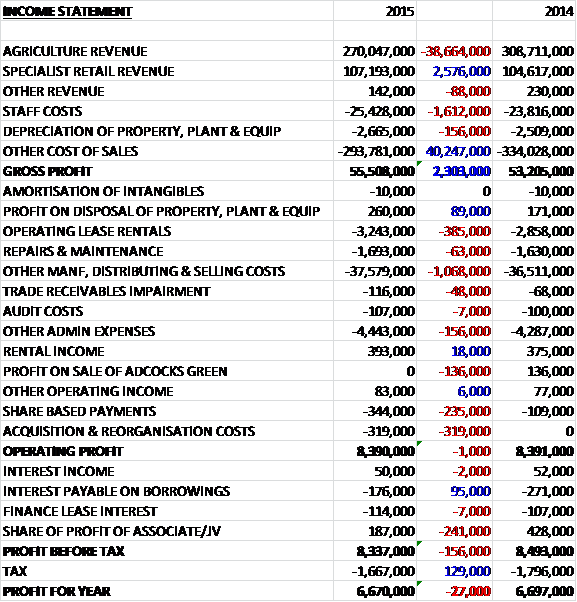
Revenues declined when compared to last year as a £2.6M growth in retail revenue, due to an increase in the number of outlets, was more than offset by a £38.7M decline in agriculture revenue with agricultural price deflation estimated to have accounted for about £32M of the reduction. Staff costs increased by £1.6M and depreciation was up £156K but other cost of sales fell by £40.2M and gross profit was some £2.3M ahead of last year. We then see operating lease rentals increase by £385K and other operating costs grew by £1.1M with admin expenses increasing by £156K. We also see a £235K growth in share based costs and acquisition costs were up by £319K which meant that operating profit was flat when compared to 2014. Interest payable declined by £88K but there was a £241K drop in the share of profits from associates and joint ventures reflecting the challenges of the agricultural market and after a £129K reduction in tax, the profit for the year came in at £6.7M, broadly flat year on year.

WYNassets

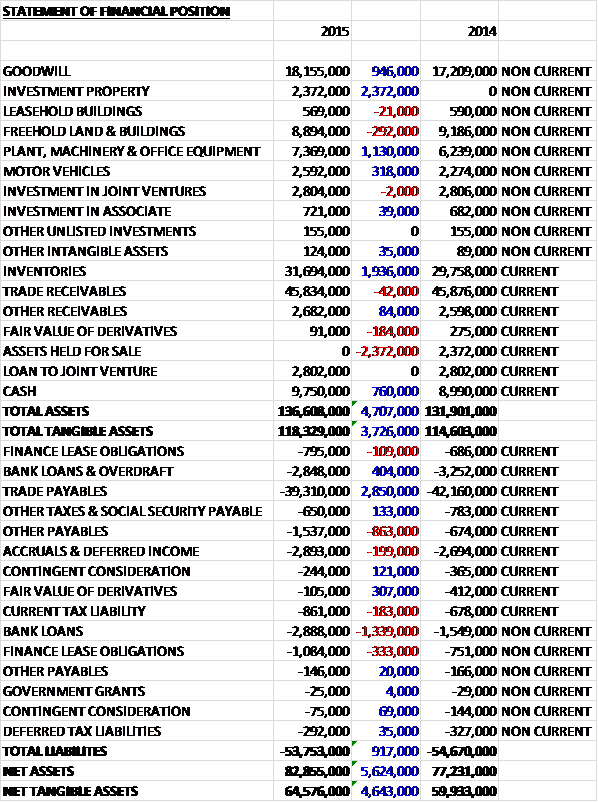
When compared to the end point of last year, total assets grew by £4.7M, driven by a £2.4M investment property, a £1.9M growth in inventories, a £1.1M increase in plant & machinery, and a £946K growth in goodwill, partially offset by a £2.4M elimination of the asset held for sale (perhaps this became the investment property?). Total liabilities declined during the year as a £2.9M fall in trade payables was partially offset by a £1M increase in bank loans and an £863K growth in other payables. The end result is a net tangible asset level of £64.6M, a growth of £4.6M year on year.

WYNcash

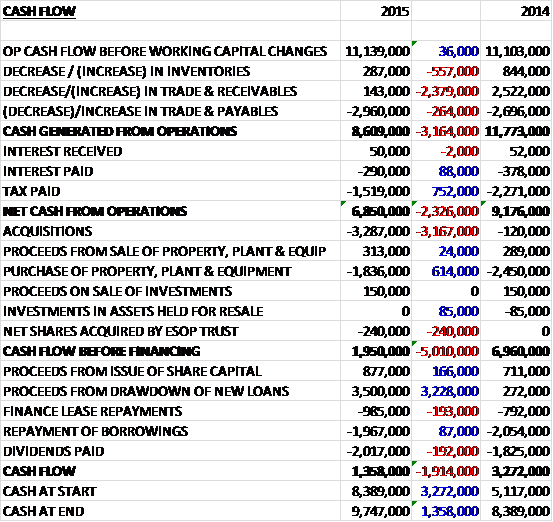
Before movements in working capital, cash profits were broadly flat at £11.1M. There was a cash outflow from working capital, however, with a particularly large fall in payables which meant that after a £752K reduction in tax paid and an £88K fall in interest paid, the net cash from operations came in at £6.9M, a decline of £2.3M year on year. The group spent a net £1.5M on property, plant and equipment and £3.3M on acquisitions to give a cash inflow of £2M before financing. The group then took out a net £1.5M in borrowings that was used to pay dividends of £2M and after finance lease payments of £985K there was a cash flow of £1.4M for the year and a cash level of £9.7M at the year-end.

The Agriculture division generated a profit of £4.1M, a growth of £332K year on year. The performance was helped by strong demand for feed in the first half and an improved raw materials performance. Whilst revenues were impacted by commodity price deflation, decreasing by 13%, the group achieved volume improvement in many product categories and although margins remained under pressure, the focus on operational efficiencies contributed to the improved financial performance.

In Feed Products, total feed volumes increased by 1.5% over the last year, in line with market trends. After a strong first half, demand for feed was more subdued in the second half, reflecting both the prolonged autumn weather and poor milk and meat prices affecting farmers. Slightly lower demand for dairy compound was balanced by an increased demand for blends and feed for poultry, beef and sheep. At Glasson, while overall volumes of raw materials were down year on year, the business generated a good financial contribution, supported by a favourable product mix. Good volumes of fertilizer and specialist products also offset a reduction in unit margins across these categories.

In Arable Product, the group continued to make progress in the sector, although margin pressure remained a feature. Sales of seed products were strong and volumes were in line with last year. Grain yields were good, although with output prices remaining disappointing, farmers have been reluctant to market their grain. The increased yields provided a good opportunity for the grain trading teams at Grainlink and Woodhead seeds, however, and combined volumes increased over the previous year. Demand for fertilizer was subdued in the first half as customers held back from buying in anticipation of a price reduction. The resultant spot market was strong but margins remained under pressure. Autumn demand for fertilizer was tempered by weaker farmer sentiment and the board anticipate a shift in seasonal sales activity to spring 2016.

The Retail division generated a profit of £5.1M, an increase of £207K when compared to last year. At Wynnstay Stores, total sales increased by 3.1% benefiting from the opening of a new store in Aberystwyth in November and the acquisition of Ross Feed at Ross on Wye in January, and S. Jones in September. On a like for like basis, sales showed a reduction of 1%, however, reflecting commodity price deflation. The acquisition of Agricentre was an important one, and provides the group with a trading entry into the West Country, bringing an additional eight units to the group. Its model of small units is wholly geared to farmers and mirrors the approach the group is taking with certain new stores.

At Just for Pets, total like for like sales increased marginally year on year. As expected, though, the profit contribution was lower than last year reflecting the costs associated with expansion. The group opened two new stores, at Cambourne in June and Reading in October, with a further outlet opening in Nottingham after the year-end. An additional outlet is expected to be added in spring 2016. Youngs manufactures and distributes a range of equine products. The business has performed strongly over the year, expanding its position in the market with further opportunities available from continuing growth of the specialist retail division.

The “Other” items generated a loss of £262K compared to a profit of £250K in 2014 as a result of reduced joint venture income mainly from agricultural activities.

During the year the Agricultural Supplies business completed three acquisitions and Glasson Grain completed one acquisition. The Agricultural division completed the purchase of Ross Feed ltd, a supplier of agricultural and hardware goods based in Ross on Wye for £447K, of which £60K was deferred. This acquisition generated £312K of goodwill and the business generated an operating profit of £123K last year. In September, an agricultural merchant based in Llanon was acquired for £143K which generated goodwill of £87K – this business made an operating profit of £40K last year; and in October the group purchased a West Country based Agricentre farm supplies business from T.G. Jeary for £2.7M, generating goodwill of £455K with an operating profit of £377K being generated last year. Finally, in September Glasson Grain completed the purchase of Horti Stores, a supplier of packaging materials to the horticultural and agricultural industries based in Skelmersdale for a consideration of £147K. This acquisition generated goodwill of £92K and the business generated an operating profit of £59K last year.

During the year Lord Carlile retired as non-executive director after spending 16 years at the company. He will be replaced by Steve Ellwood, an agricultural specialist in commercial banking having been head of agriculture at HSBC for ten years.

Going forward, output prices for farmers remain low, with the combination of high levels of world food stocks, tempered demand in developing countries and fluctuating international currencies delaying a return to acceptable pricing. This means that the group’s farmer customers will face ongoing challenges which will require further efficiencies throughout the agricultural industry. In light of continuing low farm gate prices and subdued farmer sentiment, the board’s view of the year ahead has become more cautious. Also, the prolonged mild autumn and late onset of winter has resulted in a slow start to the feed season and a slower start to early trading.

At the year-end the group had a net cash position of £2.1M compared to £2.8M at the end point of last year. At the current share price the shares trade on a PE ratio of 14.9 which falls to 14.1 on next year’s consensus forecast. After an 8.8% increase in the total dividend, the shares now yield 2.2% which grows to 2.3% on next year’s forecast.

Overall then this has been a bit of a subdued performance over the past year. Profits were broadly flat but net assets increased and although operating cash flow fell, this was due to a smaller decrease in receivables than last year and cash profits were flat. Some free cash flow was generated but not quite enough to cover the dividend. The agriculture business saw some improvement due to strong feed demand in H1, which tailed off towards the end of the year, and more cost-cutting. The operating profit in the retail division also increased, but this was due to more Wynnstay stores opening and like for like sales were broadly flat.

Going forward, the board are cautious for the year ahead due to increased pressures on their farmer customers and the slow start to the feed season following the prolonged warm autumn. With a forward PE of 14.1 and dividend yield of 2.3% along with the subdued outlook statement means there is not much to get excited about here in my view.

On the 9th March, Chairman Jim McCarthy purchased 5,000 shares at a value of £24,350. On the same day, non-executive director Philip Kirkham purchased 1,000 shares at a value of just under £5K. This represents both director’s maiden share purchase and is not really a particularly material amount.

On the 22nd March the group released an AGM statement where they informed the market that trading activity in the first four months of the year has been subdued following the downturn across the agriculture sector but has been broadly in line with management expectations.

In the Agricultural division, demand for dairy feed was reduced over the mild winter period but poultry, beef and sheep feed sales have remained in line with previous years. Demand for arable products has gained momentum over recent weeks after a slow start and is now up to the levels of the prior period. Grain trading volumes have increased compared to last year but as expected margins remain under pressure. The Glasson business continues to make a good contribution to the group but is not budgeted to repeat last year’s strong performance.

Trading at Wynnstay Stores has improved after a slow start and an active trading period is anticipated as livestock are turned out in the spring. The integration of Agricentre is progressing well. Like for like sales at Just for Pets were slightly behind those of last year but the roll-out programme is progressing well with new sites identified.

In all, there is nothing here that makes me want to buy the shares just yet.

On the 22nd March the group released an AGM statement where they informed the market that trading activity in the first four months of the year has been subdued following the downturn across the agriculture sector but has been broadly in line with management expectations.

In the Agricultural division, demand for dairy feed was reduced over the mild winter period but poultry, beef and sheep feed sales have remained in line with previous years. Demand for arable products has gained momentum over recent weeks after a slow start and is now up to the levels of the prior period. Grain trading volumes have increased compared to last year but as expected margins remain under pressure. The Glasson business continues to make a good contribution to the group but is not budgeted to repeat last year’s strong performance.

Trading at Wynnstay Stores has improved after a slow start and an active trading period is anticipated as livestock are turned out in the spring. The integration of Agricentre is progressing well. Like for like sales at Just for Pets were slightly behind those of last year but the roll-out programme is progressing well with new sites identified.

In all, there is nothing here that makes me want to buy the shares just yet.

Colefax Share Blog – Interim Results Year Ending 2016

Colefax has now released its interim results for the year ending 2016.

CFXinterimincome

The income statement is a bit scant on detail but we see that revenue increased by £545K and operating costs grew by £158K to give an operating profit £387K ahead of the first half of last year. Tax increased somewhat which meant that the profit for the half year came in at £2.3M, a growth of £313K year on year.

CFXinterimassets

When compared to the end point of last year, total assets grew by £1.9M, driven by a £1M increase in inventories and a £916K growth in cash. Total liabilities were broadly flat as a £181K decline in payables was offset by a £194K increase in current tax liabilities. The end result was a net tangible asset level of £25.7M, a growth of £2M over the past six months.

CFXinterimcash

Before movements in working capital, cash profits increased by £439K to £4.3M. There was a cash outflow from working capital, with a large growth in inventories which meant that after tax payments increased slightly, the net cash from operations came in at £2.3M, a decline of £498K year on year. The group then spent £1.1M on capex to give a free cash flow of £1.2M which was more than enough to pay the dividends of £248K to give a cash flow of £985K and a cash level of £7.8M at the period-end.

Trading conditions in the core Fabric Division became progressively more challenging during the first half and overall fabric division sales increased by 0.8% but fell by 1.5% on a constant currency basis. The improvement in operating profit was partly due to lower first half losses in the decorating division and partly due to the strength of the US dollar.

Operating profits in the Fabric Division increased by 5% to £3.35M, helped by a stronger dollar which benefits margins in the US market. The major market trends during the period have been a levelling off in US sales against strong prior year comparatives, a larger than expected decline in UK sales and the first tentative signs of a recovery in Europe.

Sales in the US, which represent 59% of turnover in the division, increased by 7% in reported terms but decreased by 1% on a constant currency basis. Whilst the general economy remains healthy, it is not yet clear how higher interest rates will affect housing market activity. The group are continuing to invest in the US market and over the next year and a half they will be opening their own showrooms in Atlanta and Boston which are the last two major US territories where they have traditionally sold through agents rather than direct to customers.

Sales in the UK, which represent 19% of turnover, were down 4%. Trading was more challenging than expected at the start of the year and the board believe that the high end housing market is being affected by the increase in stamp duty in December which has substantially reduced the number of high end housing transactions which are the key driver of sales.

Sales in Continental Europe were down 11% on a reported basis and 3% on a constant currency basis. Trading improved slightly during the period and there are signs of recovery in a number of markets suggesting that the weak Euro combined with quantitative easing is started to have a positive impact on the economy. The performance by country remains very mixed. The largest market, France, saw sales decline by 1% which was better than expected in a challenging trading environment. Sales in the rest of the world increased by 7% as weak sales in Russia and China were more than offset by a strong performance in the Middle East but overall these marets remain a small part of total sales.

At kingdom Sofas, sales for the half year increased by 4% to £1.26M and operating profit increased by 16% to £74K. Although market conditions are competitive the board believe that there are opportunities to grow sales and profits from a relatively low base and at the half year point, the forward order book was 8% ahead of last year.

Decorating sales increased by 7% to 3.4M and the division made a reduced first half loss of £148K compared to £365K last time. Decorating profits have been impacted by an increasingly difficult market for antiques which form part of the division. Antique sales during the first half of the year were down by 29% to £458K. The long lease at the flagship showroom in Mayfair is coming to an end in December and the landlord has indicated it will not be renewed. The group have identified suitable new premises in Pimlico and plan to relocate the decorating division in the latter part of 2016. The premises are smaller than the current location and they will use the move to significantly reduce the scale of the unprofitable antiques operation.

The recent trends in the two major markets of the UK and the US suggests that the group are entering a period of more challenging market conditions. Together with the turbulence in global markets that has marked the start of 2016, the board are cautions about prospects for the remainder of the year and going forward, trading conditions in the second half are expected to be more challenging. Although the first signs of recovery are being seen in Europe, it is unlikely to have a significant positive impact on the group’s overall results and although the recent strengthening of the US dollar is positive for the fabric division, this is balanced against the impact of rising interest rates on the US housing market and wider economy.

At the period-end, the group has a net cash position of £7.8M compared to £4.7M at the same point of last year. After a 5% increase in the interim dividend, the shares currently have a yield of 1% which is predicted to remain the same for the year as a whole. At the current share price the shares trade on a PE ratio of 14.2 which reduces to 12.3 on the full year prediction.

Overall then, this was a good six month period for the group. Profits were up, net assets increased and although the operating cash flow did fall, this was due to a growth in inventories and cash profits rose and there was plenty of free cash generated. A lot of this good performance was due to the strength of the UK dollar, however, and the trading conditions in the fabric business worsened as the period progressed. In the UK, a fall in sales is being blamed on the increase in stamp duty for high end properties whilst the increase in interest rates in the US is expected to affect sales there.

The small sofas business performed well, however, and the group recorded a smaller loss in the decorating business despite continued problems within the struggling antiques business. Going forward, the board see H2 as being more challenging and while the forward PE ratio of 12.3 looks good value, the 1% dividend yield doesn’t really add much and until the uncertainty around H2 performance is dealt with, I will hold off buying here I think.

Ashley House Share Blog – Interim Results Year Ending 2016

Ashley House has now released its interim results for the year ending 2016.

ASHinterimincome

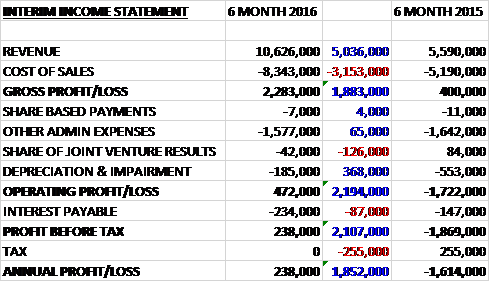
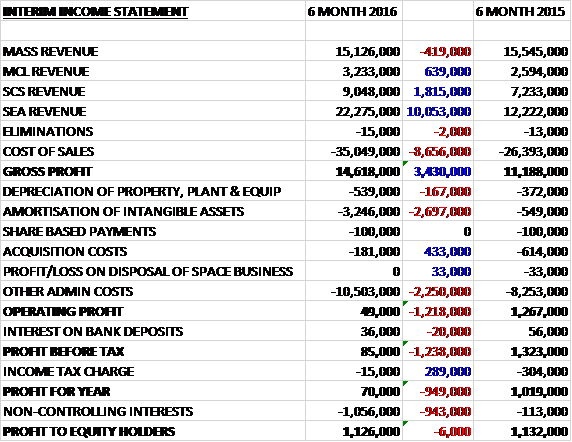
Revenues increased by £5M when compared to the first half of last year and given cost of sales grew by just £3.2M, the gross profit was some £1.9M higher. Admin expenses fell somewhat, and depreciation & impairment declined by £368K but there was a £42K loss from joint ventures as opposed to an £84K profit last time to give an operating profit some £2.2M better than the loss in the first half of 2015. Interest was somewhat higher and there was no tax rebate this time so the profit for the half year period came in at £238K, an improvement of £1.9M year on year.

ASHinterimassets

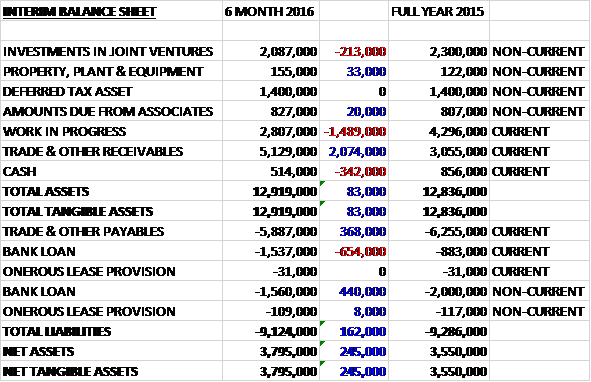
When compared to the end point of last year, total assets were broadly flat, up just £83K as a £2.1M growth in receivables was offset by a £1.5M fall in work in progress, a £342K decrease in cash and a £213K decline in investment in joint ventures. Total liabilities declined during the period, driven by a £368K fall in payables partially offset by a £214K increase in bank loans. The end result is a net asset level of £3.8M, a growth of £245K over the six month period.

ASHinterimcash

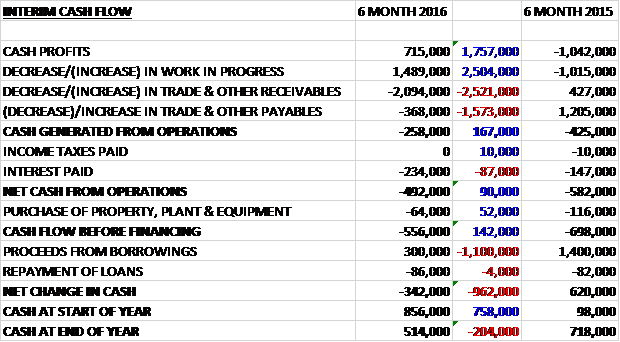
Before movements in working capital, cash profits grew by £1.8M to £715K. There was a cash outflow from working capital, however, as a growth in receivables was not quite offset by a fall in work in progress and after the increased interest was paid, the net cash outflow from operations was £492K, an improvement of £90K year on year. The group then spent £64K on capex and took out a net £214K of new borrowings which meant that the cash outflow for the period was £342K and the cash position at the end of the half was £514K.

In June the group opened their Extra Care development in Grimsby, marking their entry into this market. This was followed at the end of September by the signing of an agreement with the new Extra Care funding partner, Funding Affordable Homes and just before Christmas they reached financial close and had drawn down on the first part of the funding for the next two Extra Care schemes in Harwich and Walton on the Naze.

In the autumn statement the chancellor announced that housing benefit for social housing tenants would be limited to the local housing allowance rate from April 2018 for new or renewed tenancies taken out from April 2016. The Department for Work and Pensions is still working on how the policy will be implemented and whether Extra Care and similar schemes would remain exempted from such measures. Extra Care accommodation is much needed, and the group expect it to be exempted – there is an announcement expected in March.

The Health business continues, albeit at a slow pace. The group will shortly compete a GP centre in Danbury, Essex and are ready to commence on site with a further two schemes. The partnership with Integrated Pathology Partnerships is performing well where they have recently completed a pathology lab in Basildon and are about to commence on a lab refurbishment in Southend whilst pursuing further opportunities.

In Extra care there are two schemes on site (Harwich and Walton on the Naze) with total scheme values of £8.8M and there are also two schemes on site in the Health division with total scheme values of £1.5M. In Health there are also 11 schemes appointed with a value of £27.2M and in Extra care there are a further 17 schemes appointed with a value of £149.2M.

In December the group “novated” the non-core operations management element of the LIFT investment which is a service very different from the rest of the business. This has allowed the LIFT activities to be focussed on development activity. They remain committed to their LIFT joint ventures and are working with the partners to explore opportunities to provide further services within this framework.

The board are confident that the company will be profitable for the full year subject to the timing risk on the next Extra Care developments which is affected by the confirmation of government policy. At the end of the period the group had a net debt position of £2.6M compared to £2.2M at the same point of last year.

Overall then this was a comparatively decent half year period for the group. Profits were up, and a big improvement on the loss recorded in the first half of last year. Net assets also increased but we see a fall in work in progress as schemes progressed through to completion and were not replaced to the same level. The operating cash outflow improved from last year and the outflow was entirely due to working capital movements, with a cash profit evidenced (an improvement on last time too). They drew down the first funding from their FAH agreement to fund the next two Extra Cara schemes and this is very much the future for the group and a very positive move. Progress at the Health business remained slow, however.

The group has a very large pipeline of work but this has always been the case and the issue has been on progressing that pipeline in a timely manner. The funding agreement with FAH definitely helps in this regard but unfortunately another spanner has been thrown into the works with the proposed limits to housing benefit for social housing tenants. The board think that their Extra Care schemes will be exempted but until this is confirmed, this seems like a bit of a punt. I think at these price levels the company does look like an interesting value/recovery play but I would really like some more concrete evidence over government policy going forward before I take the plunge I think.

On the 1st March, Chairman Chris Lyons purchased 50,000 shares at a value of £5K which gives him a total holding of 226,500 shares. Last of the big spenders, huh?

Cohort Share Blog – Interim Results Year Ending 2016

Cohort has now released its interim results for the year ending 2016.

CHRTinterimincome

Revenues increased considerably when compared to the first half of last year as a £419K decline in MASS revenue was more than offset by a £10.1M growth in SEA revenue, a £1.8M increase in SCS revenue and a £639K growth in MCL revenue. After an increase in cost of sales, the gross profit was £3.4M higher than in the first half of 2015. Depreciation increased by £167K and amortisation grew by £2.7M but acquisition costs were £433K lower than last time. After a £2.3M growth in other admin costs the operating profit was down by £1.2M. Interest income was slightly lower but this was more than offset by a £289K reduction in tax charges and once the £943K growth in the loss attributable to non-controlling interests was taken into account, the profit for the half year was £1.1M, broadly flat year on year.

CHRTinterimassets

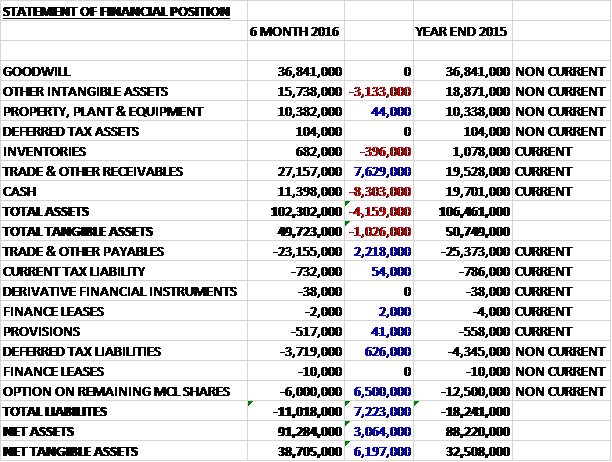
When compared to the end point of last year, total assets fell by £4.2M, driven by an £8.3M decline in cash and a £3.1M decrease in intangible assets, partially offset by a £7.6M growth in receivables. Total liabilities also declined due to a £6.5M reduction in the option on the remaining MCL shares, a £2.2M fall in payables and a £626K decrease in deferred tax liabilities. The end result is a net tangible asset level of £38.7M, a growth of £6.2M over the past six months, entirely attributable to the decline in the value of the option on MCL shares.

CHRTinterimcash

Before movements in working capital, cash profits increased by £1.1M to £3.9M. There was a big cash outflow in working capital, mainly due to a large growth in receivables which meant that after tax the net cash outflow from operations came in at £5.6M, a detrimental movement of £11.1M year on year. The group then spent £584K on capex and £670K so far on the EID acquisition which meant that before financing, there was a cash outflow of £6.8M. We then see £1.4M paid out in dividends and a mall net purchase of shares to give a cash outflow of £8.3M for the period and a cash position of £11.4M at the end of the half.

Order intake for the first half was £55.7M, down from £64.5M last year excluding the acquired order books of MCL and J&S which, when added to the total, resulted in a closing order book of £140M compared to £134M at the year-end. As expected the order intake was lower than last year which included a large order to extend SEA’s External Communications Systems to the whole UK submarine fleet. Further orders in respect of ECS are expected in the second half of the year.

The operating profit in the MASS division was £2.4M, a growth of £458K when compared to the first half of last year on a slightly lower level of revenue. The improved performance arose from increased revenue from higher margin electronic warfare support contracts, including the recently announced contract win in the Middle East and the operating margin of 15.7% is below what they expect to see for the full year. The division had a closing order book of £52.4M, of which £15M is deliverable in the second half of the year and this, along with some good opportunities, give the board confidence that the business will have a stronger second half.

The operating profit in the MCL business was just £19K, a decline of £145K year on year. This performance was a result of slower order intake but the recent hearing protection order for £11.2M, together with other programmes for which the company is bidding, will help give better forward visibility in future and this, combined with the £13.9M closing order book, of which £7.2M is deliverable in the second half and the fact the MOD’s order patterns are usually stronger in the second half, give the board confidence that the business will deliver a stronger second half.

The operating profit in the SCS division was £303K, broadly flat year on year with a fall of £5K on revenues that increased by nearly £2M which meant that net margin fell from 4.3% to 3.3%. This decline reflects a weaker mix, with higher levels of Air Systems work and less overseas support work as a result of the withdrawal from Afghanistan. The recently announced contract win to continue to provide support in the UK’s Joint Warfare Centre supports a closing order book of £17.7M, of which £7.2M is deliverable in the second half and again the board believe the business will perform strongly in the second half.

The operating profit in the SEA division was £1.8M, an increase of £691K when compared to the first half of 2015 as the integration of J&S continued. The increase in profit was achieved on higher revenues and the net margin of 7.9% was below the 8.8% achieved last year, a reflection of a mix of slightly lower margin work and a tough market for the offshore energy business. The closing order book of £56.1M included £19M of revenue to be delivered in the second half of the year and this, together with a pipeline of good opportunities and the expectation of the usual stronger second half gives the board confidence that this division, too, will make further progress in the second half as well as returning to a more usual operating margin.

Some £48.4M of the period-end order book is deliverable in the second half of the year and represents 90% of the consensus forecast revenue for the year.

In August the group announced it had agreed to acquire EID, a Portugal based supplier of advanced electronics, communications and command and control products and systems for the global defence market. At the same time they paid £670K, representing 5% of the total gross consideration of £13.3M. The total expected costs of the acquisition are estimated at £650K. Initially the group had expected to complete the acquisition by December but due to the political situation in Portugal following the general election, the completion has taken much longer than expected to resolve with a government with parliamentary support only sworn in towards the end of November.

With other urgent priorities for the new government, political approval of the transaction is likely to take some time so the group have agreed to acquire a 57% stake which equals the entire stake of EID’s private shareholders and gives them management control of the business and this is expected to take place before the end of January, though a limited further delay is possible if Portuguese competition clearance is required. This stake is being acquired at a cost of £7.7M, in line with the original acquisition terms. The group have agreed to acquire the Portuguese government’s stake as and when approval is given, provided this is no later than the end of June. This is turning into a bit of a mess actually.

As can be seen, the value of the option for acquiring the non-controlling interest in MCL, from £12.5M to £6M reflects the latest estimate of MCL’s performance for the next two years.

During the period the group concluded its negotiation with its banks and has recently put in place a new £25M revolving credit facility. This will be party utilised to fund the acquisition of EID and provides the group with further acquisition capacity as well as sufficient funding for day to day operations, especially in respect of export opportunities.

Overall, the closing order book of £140M and recent order wins provide a good underpinning to the second half of the year and the board expect, as seen in the last few years, a much stronger performance than in the first half. The Strategic Defence and Security Review recently concluded in the UK gives support to existing programmes, such as submarines, in which the group is engaged and foresees greater expenditure in areas such as Cyber and Special Forces. The board expect EID to deliver a small contribution this year with more significant contributions thereafter.

After a 19% increase in the interim dividend, at the current share price the shares have a dividend yield of 1.6% which increases to 1.8% on next year’s consensus forecast. The net cash position at the period-end was £11.4M compared to £6.7M at this point of last year and £19.7M at the end of 2015, although some £7.7M is still to be paid for the EID acquisition.

Overall then this has been a bit of a mixed half year for the group. Profit was flat year on year, although this does include a bit increase in amortisation charges. Net assets did improve to a more healthy level, however, due to the reduction in the value of the option for the rest of MCL. There was an operating cash outflow compared to an inflow last time due to a growth in receivables. The cash profits did actually increase year on year though.

Operationally, it was a bit of a mixed bag. MASS and SEA performed well on the back of some good Middle East contracts but SCS profits were flat due to lower margin work following the withdrawal from Afghanistan and profits at MCL fell due to a slower order intake – something the board expect to reverse in the second half. The EID acquisitions seems to be getting a bit messy and I am a bit concerned this will be a bit of a distraction and with a dividend yield of 1.8%, I am not sure this fully compensates the potential risk here. I will keep a watch on the shares for now.

On the 10th February the group announced that non-executive director Robert Walmsley had purchased 4,965 shares at a value of £16.5K to give him a total of 30,000 shares in the company.

On the 7th March the group announced that its proposed acquisition of a controlling stake in EID has received approval from the Portuguese competition authority. Their aim to take a majority stake in the business is running into some issues, however, as the new Portuguese government has indicated that it wishes to retain part of its existing holding. Discussions are underway to agree the terms of the relationship between the two future shareholders. This is starting to look a bit messy in my view.

On the 31st March the group announced that it had been awarded a further order by BAE to provide its External Communications System for the second stage of the common External Communications System for the Royal Navy. The value of this order will eventually be worth up to £17M and will cover further procurement and design activities.

The group is already committed to providing the ECS for five new build Astute class subs, having been awarded the initial contract in 2009. In October 2014 they were awarded a further order to commence design work on cECS, exctending ECS to all classes of Royal Navy subs. This second stage order continues cECS design and critical procurement activities into 2017, and further orders are expected in that year. In all, this programme is continuing in line with board expectations.

Cohort Share Blog – Final Results Year Ended 2015

Cohort provides a wide range of services and products for UK and international customers in defence and related markets. There are four main businesses. MASS is a specialist defence and technology business, focused mainly on electronic warfare, information systems and cyber security. MCL is an expert in the sourcing, design and integration of communications and surveillance technology, as well as support and training for UK end users including the MOD and other government agencies. SCS is a defence and security consultancy, combining technical expertise with armed forces experience and domain knowledge. SEA is an advanced electronic systems and software house operating in the defence, transport and offshore energy markets.

Following the acquisition and integration of J&S, the SEA business has been restructured into four market facing divisions which comprise the Maritime Division, including design, development, production and support of its naval communication systems, sonar, torpedo launch and other naval systems; the Research and Technical Support Division, including its capabilities in the land and research markets of defence; the Software division, including the transport work as well as other civil and non-maritime products, its training and simulation capabilities and other information systems; and the Subsea Engineering division, developing and delivering the business’ activities in the offshore energy market. The four divisions will be supported by a single production facility at its Barnstaple site following the integration of the former SEA and J&S facilities at Beckington, Bristol and Barnstaple into one.

It has now released its final results for the year ended 2015.

CHRTincome

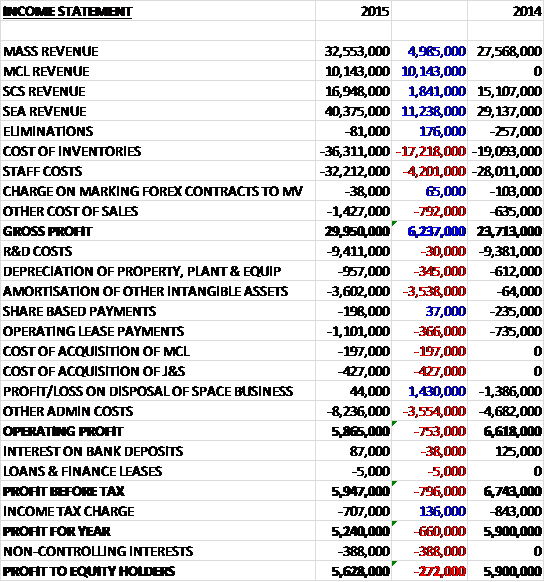
Revenues increased across all business segments when compared to 2014 with an £11.2M growth in SEA revenue, a £5M increase in MASS revenue, a £1.8M growth in SCS revenue and a maiden contribution of £10.1M from the MCL business. Cost of inventories grew by £17.2M, staff costs were up £4.2M and other cost of sales increased modestly but the gross profit was still £6.2M ahead of the prior year. The amortisation of intangibles grew by £3.6M year on year and other admin costs were up £3.6M, although there was no loss from the disposal of the space business that occurred last year which accounted for £1.4M, which meant that the operating profit was £753K lower than in 2014. A small reduction in interest received was offset by a lower tax payment and after the loss attributable to non-controlling interests is taken into account, the profit for the year comes in at £5.6M, a decline of £272K year on year.

CHRTassets

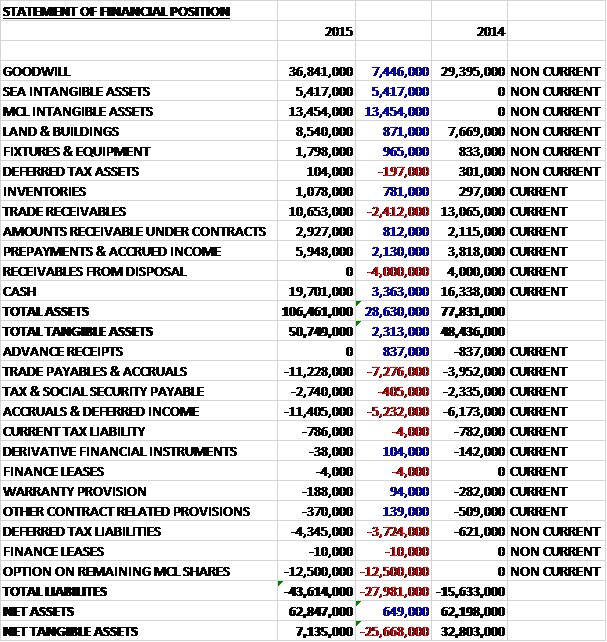
When compared to the end point of last year, total assets increased by £2.3M to £50.7M driven by an £18.9M growth in intangible assets, a £7.4M increase in goodwill, a £3.4M increase in cash and a £2.1M growth in prepayments and accrued income, partially offset by a £4M reduction of receivables following the disposal and a £2.4M fall in trade receivables. Total liabilities also increased during the year due to a £12.5M option on the remaining MCL shares that were not acquired, a £7.3M growth in trade payables, a £5.2M increase in accruals & deferred income and a £3.7M growth in deferred tax liabilities due the addition of intangible assets from the acquisitions. The end result is a net tangible asset level of £7.1M, a collapse of £25.7M year on year.

CHRTcash

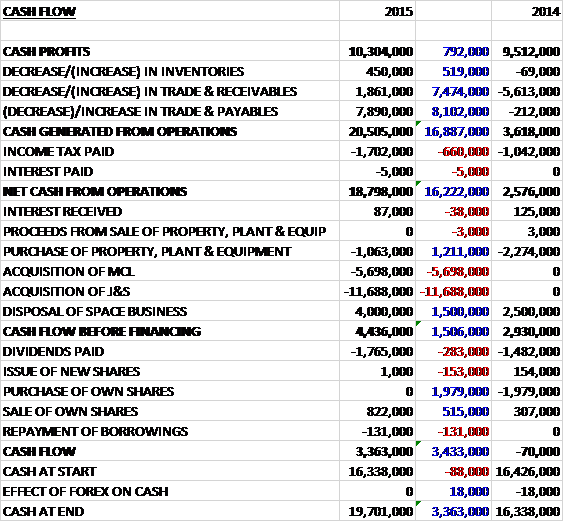
Before movements in working capital, cash profits increased by £792K to £10.3M. There was a big cash inflow from working capital, however, with a particularly large growth in payables due to supplier invoice slippage from the year-end into Q1 and after tax increased by £660K, the net cash generated from operations still came in at £18.8M, an increase of £16.2M year on year although given the reasons for the reduction in working capital this year, the operating cash conversion will be much weaker in 2016. The group then spent £1.1M on capex and a net £13.4M on acquisitions and still managed a cash inflow of £4.4M before financing. Of this, £1.8M was spent on dividends to give a cash flow for the year of £3.4M and a cash level at the year-end of £19.7M which is impressive given the acquisitions.

The adjusted operating profit in the MASS division was £5.5M, a growth of £500K year on year. A significant contributor to the increase in revenue was export EW operational support with extensions to its existing services in the Middle East taking its current workload through to the end of the 2016 calendar year. Educational deliveries were flat during the year but the business has continued to invest in its wider cyber offering for new commercial and government customers, the latter providing the first significant order wins and deliveries towards the end of the year.

The mix of work and the investment in cyber capability resulted in the division’s net margin being lower than last year, falling from 18.1% to 16.9% which is nearer to their long term expectations for the business as it grows its cyber offering which includes more brought in equipment. There is a portfolio of work including long-term managed service offerings, higher margin but unpredictable export business and more predictable but lower margin secure network and cyber activity in education, commercial, security and defence markets.

The division’s support contract for the NATO joint EW Core Staff, secured in 2014, was extended for a further year which provides MASS with further opportunities to access NATO customers as well as providing a growing work stream in its own right. The business enters the current year with a strong order book, increasing from £46.M this time last year to £53.4M, and pipeline of opportunities including exports.

The adjusted operating profit in the MCL division was £1.3M which represents ten months of contribution from the division and was close to expectations with a net margin of 13.1%. This performance was driven by the delivery of electronic surveillance systems to the UK Royal Navy, tactical satellite communication upgrades for British Army vehicles returning from Afghanistan and a number of other EW and communication deliveries for UK forces.

During the year the business designed, built and tested a one-off electronic system for a defence customer in under six months, a requirement driven by a demanding time sensitive mission, and a project that is likely to lead to the possibility of further orders. The business currently has a short order to delivery timescale, resulting in a relatively low current order backlog at any time and it ended the year with just under £3M on contract. The pipeline includes prospects for securing long-term, larger orders which if won, would help to build a higher and more predictable base load of work.

The adjusted operating profit in the SCS division was £1.3M, an increase of £300K year on year. This improvement reflects a continued focus on growing areas of the MOD budget, in particular domain hazard analysis and technical assurance which have grown as new military air platforms have been introduced into UK service. The business has also grown its NATO work and other export offerings. A further positive sign for the business was the improvement in its high level training offering to the UK’s joint Warfare Centre, a service they have been providing for over ten years and which was extended for a further year until March 2016 following an exercise of an option by the customer. The increased activity was a result of the UK’s return to normal patterns of deployment and training following the exit from Afghanistan and they also continued to secure further overseas work for this offering. The order book at the year-end was £9.8M compared to £10M at the end of last year.

The adjusted operating profit in the SEA division was £4M which includes seven months of contribution from the acquired J&S business but no contribution from the sold Space business, and represents an increase of £200K when compared to last year. The continuing business saw adjusted operating profit grow by 28% and revenues increase by 32%. The growth in revenue was due primarily to the securing of an initial common EXS contract which extends the ECS system to cover two additional Astute class boats to bring the number under contract up to seven, the four Vanguard class boats and certain of the Trafalgar class vessels.

This increase offsets a deterioration in the transport revenue where an export contract delivered last year was not repeated. In net margin terms, the effect of these changes was a small reduction on a like for like basis from 13% to 12.6%. The business continued to make good progress on its External Communications System for the Astute class of submarines, with the first boat carrying the system having now gone to sea.

The defence research revenue was slightly up on last year. The business has continued to deliver a major research programme on soldier equipment known as Delivering Dismounted Effect to its customer, the Defence Science and Technical Lab. In the transport market, the business maintained deliveries of Roadflow units to UK customers. They made good progress on their red light enforcement system, which is derived from Roadflow, obtaining the necessary technical clearance for the system. They now have to wait for formal sign-off by the Home Office to enable the system to be fully deployed, with its output admissible as evidence in future prosecutions.

The division had a very strong operating cash flow in the year with good receipt management in the final quarter and slower than expected invoicing from its suppliers which caught up in the first few months of 2016.

The acquired business of J&S contributed just £100K of adjusted operating profit on revenues of £7.9M. This was below the board’s expectations and was as a result of delayed orders for naval support and its low profile array sonar. These orders have now been secured and delivery has commenced so they now expect J&S to deliver a return next year in line with expectations at the time of the acquisition.

The offshore energy business was acquired just at the end of its peak activity period in the summer but despite the depressed oil price it has secured its largest ever contract for a subsea distribution unit from Apache for over £1M. The integration of J&S has progressed well and was mostly complete by the end of the year. The division incurred £200K of integration costs in the year and this is expected to realise annual savings of around £500K so a great return there. The division’s closing order book of £68M underpins next year’s revenue nicely, especially in the submarine and other naval system work.

Order intake for the year was £114.3M compared to £68.5M last year and a further £5.4M and £32.6M of orders were added to the order book with the acquisitions of MCL and J&S respectively.

There are a number of interesting projects completed by the group during the year. SEA is delivering torpedo launch systems to the Malaysian Navy for deployment on a fleet of offshore patrol vessels; SCS provides the communication and information system to the EU’s counter-piracy operation; MASS provides the UK’s electronic warfare database based on THURBON; MCL provides tactical Nano UAV systems for front line operations; SCS has renewed its contract to provide training and exercise support to the UK’s Joint Forces Command; SCS provides expert non-lethal weapons technology advice to DSTL; SEA is leading research into the future British infantryman through its framework for the DSTL; and SCS provides independent technical analysis for air platforms entering UK service, including JSF and Air Seeker.

It is worth noting that the group is heavily reliant on a small number of clients. The UK MOD is the largest and accounts for 38% of revenue and another large client accounted for 22% of revenues this year and the MOD is probably more important even than this as many other orders were ultimately sourced from the MOD but received via other contractors. With the Government running a significant budget deficit there is a risk that further controls in defence expenditure could be introduced and given how reliant the group are on the MOD as a customer, this is probably the key risk facing the company in my view. Another operating risk is the short visibility on revenues in the SCS and MCL businesses due to the short typical contract duration in these divisions.

There were a couple of acquisitions during the year. In July the group acquired 50% of Marlborough Communications for a total consideration of £8.8M satisfied entirely by cash, generating goodwill of £2.4M with other intangible assets of £7.8M. In the ten months following the acquisition, the business generated adjusted operating profit of £1.3M. There is an option for the purchase of the remaining 50% of the business which is exercisable by the end December 2016 and capped at £12.5M.

In October the group acquired J&S ltd for a cash consideration of £11.7M. The acquisition came with intangible assets of £6.8M and generated goodwill of £5M. In the seven months since acquisition the business generated just £100K to adjusted operating profit. At the end of April the group sold its space business to Thales for a consideration of £5M in cash. Going forward, the group have stated that they will look to make at least one acquisition in 2016 and are putting in place enlarged bank facilities to support their growth, which is expected to be about £25M.

The closing order book at the year-end was £134M compared to £81.7M at the end of last year which underpins the revenues for the coming year, although the UK defence market remains tight. Export prospects continue to strengthen and outside of defence, MASS is making progress with its cyber capability, especially in the security market, and in transport the level crossing enforcement system has completed all of the testing required to enable it to achieve UK Home Office approval. A number of long term orders were secured during the year so the board do not expect to see a repeat of this year’s sharp increase in the order book over the coming year. Overall the board considers that their order book and near-term prospects provide a good base for future progress.

At the year-end the group has a net cash position of £19.7M compared to £16.3M at the end of last year. At the current share price the shares trade on a PE ratio of 24.6, falling to 16.9 on next year’s consensus forecast. After a 19% increase in the total dividend, at the current share price the shares have a dividend yield of 1.5% increasing to 1.8% on next year’s forecast.

Overall then, this has been a decent year for the group marked by some large acquisitions. Profits were down but this was due to the effect of the acquisitions with a large growth in the amortisation of acquired intangibles. Net tangible assets fell considerably as a large amount of intangible assets were acquired with the businesses. Operating cash flow increased and generated plenty of free cash, although this was mainly due to the fact that payables increased substantially, although cash profits also saw a modest increase.

There was growth in most of the businesses with decent levels of order books – the orders for NATO sound interesting and could be a foot in the door for a big customer base. The acquired J&S business is not contributing as well as expected, however, due to some delayed naval orders which have subsequently been received. The focus on offshore energy is also a concern given the current state of the oil and gas industry, although a large order has been received there. In summery this is a nice business in my view but given the risks surrounding the new acquisitions, I think the forward PE of 16.9 is a little strong and the dividend yield of 1.8% doesn’t really offer enough reward to cover the risk. It is an interesting company, though, and one I will keep a close eye on.

Poundland Share Blog – Final Results Year Ended 2015

Poundland is the largest single price value general merchandise retailer in Europe with a network of 588 stores across the UK and Ireland with a further five stores in Spain. Stores are typically in areas with high footfall across a mixture of high streets, shopping centres and retail parks and are all operated on a leasehold basis. They have an office in Hong Kong in order to supply products and an exclusive sourcing arrangement in India.

It has now released its final results for the year ended 2015.

PNLDincome

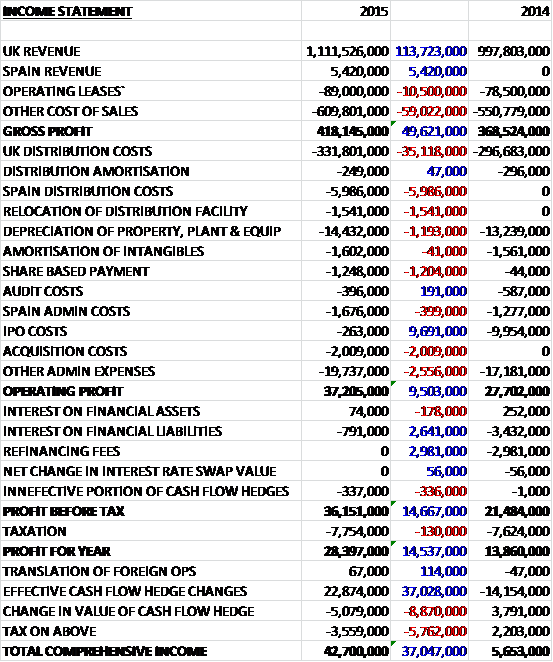
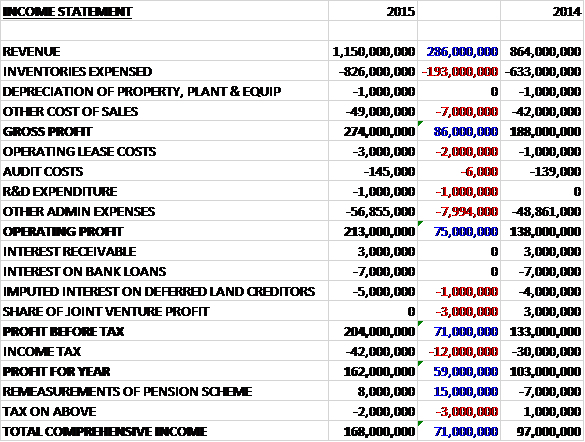
Revenues increased when compared to last year with a £113.7M growth in UK revenue due to both an increase in like for like sales and store openings, and a £5.4M increase in Spanish revenue. Operating lease costs grew by £10.5M and other cost of sales increased by £59M to give a gross profit some £49.6M higher than in 2014. Distribution costs grew by £35.1M and there were a number of “non-underlying items” with a £6M increase in Spanish distribution costs, a £1.5M charge relating to the relocation of a distribution facility, a £1.2M growth in depreciation, a £1.2M increase in share based payments, a £2M acquisition costs relating to the proposed 99p store acquisition and a £2.6M growth in other admin expenses, offset by a £9.7M reduction in IPO costs. Finance costs reduced due to a £2.6M reduction in interest and the lack of £3M of financing fees that occurred last year. Tax was slightly higher to give a profit for the year of £28.4M, an increase of £14.5M year on year.

PNLDassets

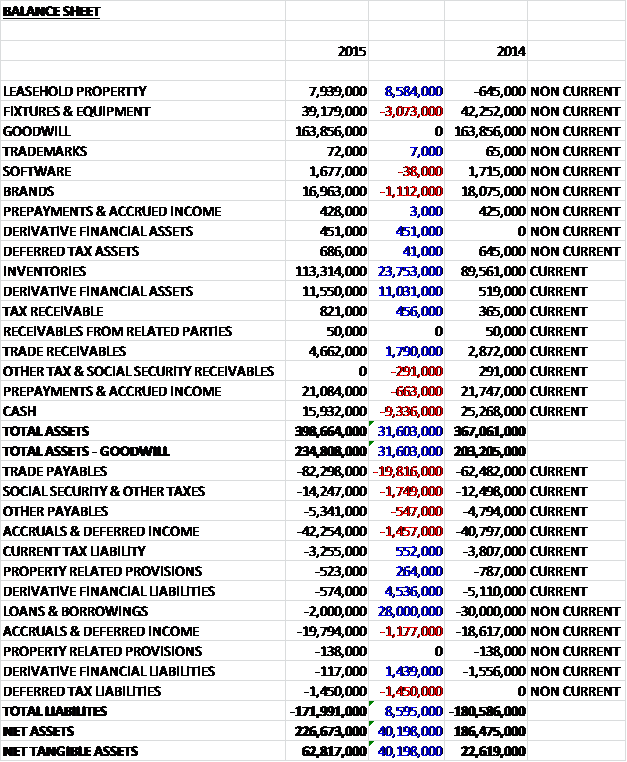
Total assets increased by £31.6M when compared to the end of point of last year driven by a £23.8M growth in inventories, an £11M increase in derivative financial assets, an £8.6M growth in leasehold property due to the transfer of some items from fixtures and equipment (I can’t fathom how there was a negative number last year!), and a £1.8M increase in trade receivables partially offset by a £3.1M fall in fixtures and equipment, and a £1.1M decline in the value of brands. Conversely, total liabilities fell during the year as a £28M fall in loans and borrowings and a £6M decline in derivative financial liabilities was partially offset by a £19.8M growth in trade receivables, a £2.6M increase in accruals and deferred income, a £1.8M growth in other tax payables and a £1.5M increase in deferred tax liabilities. The end result is a net tangible asset level of £62.8M, a growth of £40.2M year on year.

PNLDcash

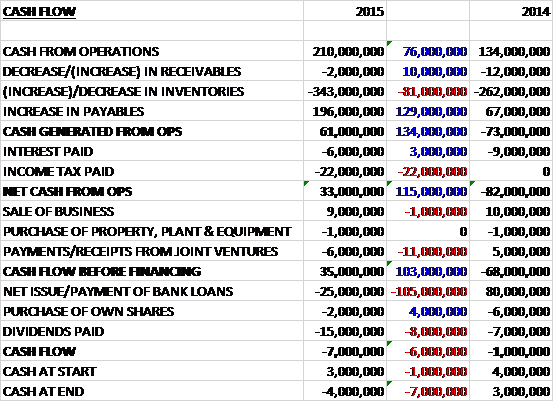
Before movements in working capital, cash profits increased by £10.9M to £54.2M. The working capital was broadly neutral but due to a much larger growth in inventories than last year, partially offset by a lower interest payment, the net cash from operations came in at £42.2M, a decline of £3.4M year on year. The group then spent £19.1M on tangible assets, primarily relating to the opening of new stores, and £708K on intangibles to give a free cash flow of £22.4M. Some £3.8M was spent on dividends with the rest being used to pay back borrowings and the cash outflow for the year was £9.3M and the cash level at the end of the year was £15.9M.

During the year the group grew their like for like sales by 2.4%, ahead of expectations. It should also be noted that in the first half of the year was an exceptional period which benefited from a late Easter, fewer competitor openings and the one-off loom bands craze. The board are therefore expecting the first half of the new year to be relatively subdued, not helped by currency headwinds (if the current weakness in the Euro continues there will be a detrimental effect of £4M on EBITDA), but the second half of the year should benefit from softer sales comparisons, a strong first half store opening programme and the contribution of this year’s late store openings.

This year the group had a number of non-underlying expenses. They are calling their “strategic initiatives” non-underlying which includes the Spanish stores and this accounted for expenses of £2.2M. The group also incurred £1.5M of costs relating to the distribution facility in the SE of England, together with the costs to dispose of the existing temporary facility. They are also counting the amortisation of the Poundland brand as non-underlying, this accounted for £1.1M, and finally the group incurred further fees relating to its listing of £263K and £2M relating to the proposed acquisition of 99p stores.

The Harlow distribution centre is a purpose built 350,000 square foot facility opened in August replacing the temporary facility in Hoddeston. Harlow will now serve as the main depot for SE England and will also provide initial support to the business as they trial the Dealz stores in Spain. The combined distribution centres have increased distribution capacity so that the group is now able to operate about 750 stores. They are currently working on a new distribution centre in the NW of England which is scheduled to open in 2017.

The group is able to generate pay backs from their new stores in around a year so they will continue to add to their store base. They believe that there is potential for more than a thousand Poundland stores in the UK with a potential for a further 70 Dealz stores in Ireland. They therefore plan to continue opening stores at similar rates as in the last four years, adding about 60 net new stores per year, of which about 10% are expected to be in Ireland.

In Spain, the group expect to open up to ten new stores over a two year period, which will initially be supported from the UK distribution centres. The Spanish operations are staffed by a core local team with extensive Spanish retail experience and are supported by a UK-based senior management team. The pilot store’s performance is being assessed ahead of any further roll out in Spain or elsewhere in continental Europe. The customer response has been positive and sales in line with plan. Whilst the board are confident they will succeed in Spain, there is still work to do in developing the economic model. For example, they need to improve the proportion of general merchandise within their mix and they need to increase the local product range. Currently, local sourcing accounts for 20% of sales and Spanish suppliers are increasingly working in partnership with the group.

The group are exploring some other new growth opportunities such as the potential development of a transactional website to access new customers as well as developing new store formats such as a city centre format which is a smaller store designed to operate in high footfall city centre locations with a focus on impulse and convenience purchases.

During the year the group agreed to purchase 99p stores for £55M conditional on Competition and Markets Authority permission. They are now working with them in a Phase 2 review of the acquisition and they are hopeful that they can proceed. If they are successful in the acquisition, they will add over 250 new stores to their portfolio.

During the year the group entered into a new banking facility consisting of a revolving credit and working capital facility of £55M, of which £30M was drawn down to repay the existing long term debt. At the end point of the year the group had a net cash position of £13.9M compared to a net debt position of £4.7M at the end of last year. It is worth noting, however, that the group, in line with many retailers, has a huge operating lease liability off the balance sheet with some £92.6M due within a year and some £645M in total. The group also have outstanding capital commitments of £3.3M at the year-end.

The group has a significant transaction exposure with increasing, direct sourced purchases from its suppliers in the Far East, with most of the trade being in US dollars. In addition to this they are exposed to transaction risk on the translation of surplus Euro balances generated by the Irish business, and to a lesser extent the Spanish trial, into Sterling. The policy allows these exposures to be hedged for up to a year and a half forward in order to fix the cost in Sterling.

At the current share price the shares trade on a PE ratio of 13.1 but this increases to 16.7 on next year’s consensus forecast which seems a little steep. After the group paid out its first dividends, the shares are now yielding 3% which increases to 3.3% on next year’s forecast.
Overall then this has been a fairly good year for the group. Profits were up, as were net tangible assets and although operating cash flow was down, this was due to an investment in inventories and cash profits grew. Like for like sales were up but the board point out that this was due to an exceptionally strong H1 which is unlikely to be repeated in the coming year.

I have to say kudos to management for pointing this out as so many times in some other companies they fail to mention this. Having said that, I do think the accounting for non-underlying items is a bit aggressive. The opening of the new distribution centre should help growth, and the company is definitely in an expansion phase with large numbers of new stores opening but they will have to keep an eye out for costs, particularly the bulging operating lease commitments going forward.
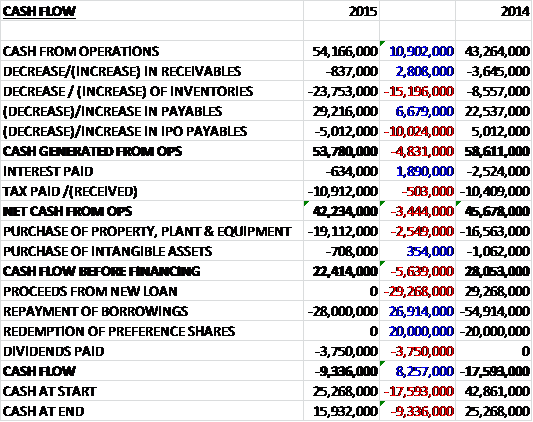
With a forward PE of 16.7 and dividend yield of 3.3% these shares are no exactly cheap and when we add on the operating lease commitments to debt, there is a bit net debt figure here and I feel this is a bit risky for me. Unless things change, I will not be covering Poundland going forward.

Redrow Share Blog – Final Results Year Ended 2015

Redrow is a UK house builder. They also have two joint ventures. They have a 50% shareholding in the Waterford Park Co in order to pursue the potential redevelopment of Watford Junction and a 50% shareholding in Menta Redrow to pursue redevelopment opportunities in Croydon.

The group is able to make land purchases on deferred payment terms. The deferred creditor is recorded at fair value and nominal value is amortised over the deferred period via financing costs. The interest rate used for each deferred payment is an equivalent loan rate available on the date of land purchase so it begs the question as to why not just take out a loan?

The group has a number different brands. Heritage homes includes traditional homes for modern living, Elegant homes are more luxury spec and focused on location, Regent is based on a townhouse designs in a suburban location, Abode has open plan urban designs where space is limited, and Bespoke involves unique designs and locations.

Redrow has now released its final results for the year ended 2015.

RDWincome

Revenues increased by £286M when compared to the prior year and with cost of inventories up £193M and other cost of sales increasing by £7M, the gross profit was some £86M ahead. Admin expenses also increased with growth in operating lease costs along with R&D and other expenses to give an operating profit £75M up on 2014. There was the lack of any profits from the joint ventures and interest on deferred land creditors grew along with a £12M hike in the tax charge which gave a profit for the year of £162M, a growth of £59M year on year.

RDWassets

Total assets increased by £342M when compared to the end point of last year, driven by a £218M growth in land for development, a £102M increase in work in progress and a £24M growth in the stock of show homes. Total liabilities also increased during the year as a £108M hike in amounts due in respect of developed land, a £65M growth in trade payables, a £19M increase in accruals & deferred income and a £19M growth in current tax liabilities were partially offset by a £17M decline in the bank loan. The end result is a net tangible asset level of £847M, a growth of £153M year on year.

RDWcash

Before movements in working capital, cash profits increased by £76M to £210M. There was a cash outflow from working capital with a large increase in inventories but the overall outflow was less than last year as payables also increased considerably. After a £22M growth in tax payments as the tax-losses were used up, the net cash from operations came in at £33M, a positive movement of £115M year on year. The group then received £9M from the sale of a business, offset by a £6M payment in joint ventures and a £1M spend on capex to give a free cash flow of £35M. The group then spent £15M on dividends, £2M on buying their own shares and £25M on net debt repayments so that there was a cash outflow of £7M for the year and a cash level of -£4M at the year-end, which seems a little precarious.

The number of planning applications granted in the UK is at its highest level since 2008 and the approval rate has been maintained at the 13 year high achieved last year. Residential transactions in England and Wales increased by 14% in calendar year 2014, increasing to 1.1M. UK average prices increased by 4.1% in the year to June 2015, significantly down on the 11.5% increase observed in the prior year. These price increases were influenced by the London market where average prices grew by 7.3% in 2015 and 25.8% in 2014.

The early months of the year were tougher than in the same period of the prior year which was buoyed by the introduction of the government’s Help to Buy scheme. The scheme continues to be an attractive incentive for house buyers and accounted for around 40% of reservations for the group during the year. As the year progresses, the market improved with both sales rates and prices lifting before the election outcome brought further stability to the market with the announcement that Help to Buy would be extended to 2020.

The Central London market softened during the year in response to the threat of mansion tax, increases in stamp duty and uncertainties in the wider global economy. As a consequence the group curtailed their land buying in the “super prime” areas and focused more on sites in the outer London boroughs where demand is strong and selling prices remain affordable.

The group completed 4,022 new homes during the year, an increase of 12% over last year. Of the £1.15BN of turnover, some £65M was from the sale of commercial property, freehold reversions and land with the core housing turnover up 26% to £1.085BN due to the rise in legal completions and a 13% growth in average selling price to £270K. Gross margin improved from 21.7% to 23.8%, as 88% of the completions came from sites purchased post downturn with normal margins and as house price inflation exceeded build cost inflation, particularly in the South of the country.

The number of private apartments completed during the year increased by 24% and represented 14.8% of private sales completed, an increase on last year. Social Housing, as a consequence of the timing of delivery, reduced from 17.6% to 14.2% in 2015 but moving forward this position will be reversed and social housing is set to be a larger proportion of output, the government’s announcement regarding year on year reductions in social rents has created a hiatus that will affect the delivery of social housing in the short term.

The group continued to invest significantly in land and work in progress. They have increasingly entered into deferred terms on many of the land purchases and have also purchased more land on a subject to planning basis which has enabled them to reduce their net debt to £154M at the year-end which seems a bit of a dubious claim to me – they still have to pay up on those deferred purchases so what makes that less of a debt than the bank debt? Sounds dubious to me. In any case, the board expect net debt to increase over the next year with the ongoing investment in inventory.

Due to the roll out of the Regent and Abode brands along with apartment schemes around London, it was expected that the turnover accounted for by the primary brand, Heritage would reduce over time to about 70% and in 2015 it declined from 77% to 76%. The roll out of the Regent brand continued and it now represents 4%, up from 1.6% and there is now a number of Abode developments under construction.

During the year the group secured 5,892 new plots across 52 sites, of which 1,975 were converted from the forward land bank across 22 sites with 2016 expected to be even stronger with over 3,800 plots at Colindale and Woodford in Stockport on track to contribute. As of the end of the year the current land bank totalled 18,216 plots, a 9% increase on the previous year. The average plot cost increased from £63K to £70K, primarily as a result of a change in geographical mix of the land bank, with over 50% of plots being in the South of England compared to 44% at the end of last year. The plot cost equates to 23.5% of the current average selling price, broadly in line with previous years. The percentage of provisioned land in the land bank has now reduced to 2% and by the end of 2017 it will be zero. Despite the strengthening housing market, they group have found plenty of land opportunities within the areas that they operate.

Although the local plan process has noticeably improved since the introduction of the NPPF, the group still see the process as being too slow in some parts of the country and they state that gaining reserved matters and detailed planning consents is still taking far too long.

The group continued to experience trade shortages in some parts of the country, most acutely in new operating areas where they need to establish a base of subcontractors. As a consequence they have experienced delays that have had a knock on effect on customer satisfaction. They have also seen build costs increase during the year. Material prices have stabilised but labour costs have risen substantially and the board estimate that overall build costs have increased by in more than 5% over the past year and it is expected that this trend will continue for some time to come. It is expected, however, that any build cost increases will be more than offset by modest house price inflation.

Through “My Redrow”, a service that allows customers to tailor their homes to meet their needs, the group has managed to sell £10M of extras.

In December 2014 the group acquired a former test track and storage centre from General Motors. The 59 acre brownfield site is situated within the Bedfordshire Green Belt and has an outline planning permission for the development of up to 325 homes and a community centre. More than 30 acres of the site will be given over to open space and woodland with the remaining area creating a leafy setting for Heritage branded homes. There is also a plan for 46 affordable homes to be provided at no cost to a community trust with the rental income from those homes being used to fund a local bus service and other facilities which will benefit residents of the development. Work is scheduled to start later in the year.

Last year the group established a West Country division based in Exeter that has made a significant contribution in the year and the group recently split their business in the East to create divisions north and south of the Thames. They have also recently reorganised their London operations with London now operating as a region in its own right with two divisions initially. The Colindale Gardens division will focus entirely on delivering that highly important development. The division recently received a resolution to grant planning for 2,900 new homes and up to 100K square feet of commercial space. Under the planning agreement they will also be providing healthcare and nursery facilities, land for a new school, a significant contribution to upgrade Colindale tube station and four hectares of public open space and gardens. The project has a gross development value of over £1BN and is expected to take ten years to build. The Greater London division will oversee the other sites across the capital including the joint venture in Croydon.

As the group’s sales rates and average selling prices reach optimal levels, the future growth will rely largely on increasing the number of outlets from which they operate and expanding the divisional structure. Last year they opened 54 new outlets, and after taking into account the closure of 40, they ended the year on 117 outlets, a net increase of 14. In 2016 they expect to open around 55 new outlets, and after taking into account a higher number of closures weighted to the second half, they are forecasting to end the year on 128 outlets.

The group has a self-administered defined benefit pension scheme and a funded defined contribution scheme with the defined benefit scheme closed to new entrants in 2006 and both schemes were closed to future accrual from 2012. There is currently a deficit of just £3M on the schemes which have total obligations of £106M, so nothing really to worry about here. There is obviously a risk if interest rates were to rise, however, on two fronts with the increase in interest payments and the reduction in interest in housing following any rise. The group have £365M of committed bank facilities of which £215M is currently undrawn.

During the year the group appointed Sir Michael Lyons as a non-executive director. He chaired the Lyons Housing Commission to produce a road map for increasing house building in this country and prior to this, following a long career in local government, he was chairman of the BBC.

Demand for new homes continues to be strong which is being reflected across the country. The group has entered the year with a record order book and reservations to date are running 5% ahead of last year. They have secured 820 reservations in the first ten weeks of the year, some 28% ahead of last year and the board are looking forward to another year of significant progress. The group have updated their targets for 2018. They expect turnover to increase by 40% to £1.6BN, operating margins to improve to 19% and ROCE to be in excess of 21% despite the ongoing investment in land and inventory to grow their outlets. As the number of outlets grows, it is worth noting that it will increase the pressure on the teams and contractors to deliver.

At the current share price the shares trade on a PE ratio of 9.4 which falls to 8.2 on next year’s consensus forecast. After an increase in the final dividend, the shares are currently yielding 1.4% which increases to 2.2% on next year’s forecast.

On the 10th November he group released an AGM trading statement where they stated that the positive sales trend has continued. Currently, net private reservations are 28% ahead at 1,560 and the sales rate for the 19 weeks to 6 November 2015 is 0.68 per outlet per week, up 5% on last year. The Average Selling Price of private reservations for the financial year to date is £334,000, an 18% increase mainly driven by better quality outlets coming on stream to replace lower priced sites. With this strong sales performance, the board are confident this will be another year of significant progress.

Ashley House Share Blog – Final Results Year Ended 2015

Ashley House operates in the design, construction management and management services space in the UK. The principle activities are design, construction management, consultancy and asset management services primarily working with providers of health and social care on infrastructure developments from project inception to completion of construction and beyond.

Construction contract revenues are recognised under the percentage of completion method. Where the outcome of a construction contract can be reliably estimated, revenue and costs are recognised to the stage of completion of the contract activity at the balance sheet date. Where the outcome of a construction contract can’t be estimated reliably, contract revenue is recognised to the extent of contract costs incurred where it is probable that they will be recoverable. Contract costs are recognised as expenses in the period in which they are incurred and when it is probable that total contract costs will exceed total contract revenue, the expected total loss is recognised as an expense immediately.

Design and development fees are recognised as the service is provided and where it is possible that total costs will exceed total contract revenue, the expected loss is recognised as an expense immediately. Asset management fees relate to the provision of services to manage property assets and revenue is also recognised as the service is provided.

The group has a number of associates and joint ventures. Infracare, AHBB ELL and AHBB LHIL operate in the NHS Local Improvement Finance Trust arena. They are public private partnerships which provide purpose built premises for health and local authority services in England. They are jointly held with Amber Infrastructure with Ashley House having control over development activities and Amber having control of investment activities. The group jointly controls IPC Plus and Wilco Plus with groups of GPs and these businesses are engaged in providing clinical services in West Sussex and Wiltshire respectively.

The group also owns a share in Best Practice which provides a healthspace facility for use by local healthcare practitioners in Hampshire and is owned with two GPs. In addition, they own a share in Portsmouth Health which provides clinical services in Hampshire and is also owned with a group of GPs. Ashley House has now released its final results for the year ended 2015.

ASHincome

Revenues increased slightly as a £131K decline in management services revenue was more than offset by a £178K growth in design and construction management revenue. Staff costs were broadly flat but other cost of sales grew which meant that the gross loss was £216K, a detrimental movement of £776K over last year. We then see a £24K loss on disposal of property, plant and equipment offset by a decline in other admin expenses relating to reduced director pay and there were no restructuring costs which accounted for £230K last year. We do have a £5.8M growth in joint venture asset impairments though, which gave an operating loss of £11M, an increase of £6.4M. Interest costs then increased by £788K and a small tax expense represented a £545K adverse movement over 2014 as some expenses were not deductible for tax purposes so that the annual loss came in at £11.9M, an increase of £7.7M year on year.

ASHassets

Total assets declined by £8.4M when compared to last year, driven by a £7.7M impairment of the investment in joint ventures, a £3.6M fall on amounts recoverable on contracts and a £706K reduction in prepayments and other receivables, partially offset by a £1.5M growth in work in progress, an £807K increase on amounts due from associated companies and a £758K growth in cash. Total liabilities increased during the year due to a £2.1M growth in deferred income and a £1.2M increase in borrowings. The end result is a net tangible asset level of £3.5M, a decline of £11.9M year on year – pretty poor stuff.

ASHcash

Before movements in working capital, cash losses widened by £270K to £3.1M. There was a cash inflow from working capital, however, with a fall in receivables and a growth in payables but the effect was less than last year and the net cash from operations was £529K, a decline of £752K year on year. We also see a bit of growth in interest paid so that there was a net cash outflow of £354K from operations, an adverse movement of £1.7M on last year. Capex was low at just £122K but the group still needed to take out some more borrowings which gave a cash inflow of £758K for the year and a cash level of £856K at the year-end.

The loss in the design and construction management division was £457K compared to a profit of £161K last year and the profit in the management services business was £440K, a decline of £106K year on year. The pipeline of schemes continues to grow in both quality and quantity, though, dominated by Extra Care schemes. Good progress has been made during the year with four schemes on-site at the year-end. Both of the flagship schemes at Harwich and Walton are progressing to plan and are expected to reach financial close this year, contributing about £21M to revenues over the next two years as they are built out.

The health business continued to be slow but there are signs of activity, albeit on a much reduced level. The group are currently contracted on a number of schemes and projects for a GP surgery in Danbury and a Pathology Lab in Basildon are underway, contributing about £1.4M of revenue during the year. Both the scheme at Dabury and the next three health schemes are forward funded and the group is looking to do more in this area. During the year the group completed an extension and refurb to GP premises in Hillingdon. The outlook for health is considered to be improving with some small signs of recovery in the market, but not as quick as the board would like. Nonetheless they remain committed to the sector.

The group were appointed as property partner for two organisations: HSN Care with whom they are developing a pipeline of housing designed for profoundly disabled adults and where they are now in advanced stages with three schemes; and national charity Hft who provide services for people with learning disabilities throughout England.

The company has signed a funding and partnership agreement with Funding Affordable Homes which is a newly established investment company set up to serve investors in the affordable homes sector. They have agreed to work together on the development and delivery of affordable Extra Care housing for older people. The schemes will be forward funded by FAH during construction and through to completion allowing the group to develop the business without needing to grow external debt and this arrangement will give them a much needed boost to their current pipeline delivery.

The group has won a place on North Yorkshire County Council’s Extra Care Housing Framework to design, fund, build, deliver and asset manage Extra Care accommodation in various locations in York and North Yorkshire. This appointment is apparently not guaranteed to bring any work but the framework will be used by other bodies looking to commission services. The board believe that the market for Extra Care Housing is growing. During the year the first Extra Care scheme undertaken by the group was completed in Grimsby. It was a development of 60 flats providing purpose-built accommodation for vulnerable older people.

In the immediate future it is likely that revenue streams will be variable but more predictable as the emphasis swings towards the construction phase of pipeline delivery and as the scheme volumes increase, this should have a smoothing effect on volatility. The growth in the pipeline continues to be dominated by Extra Care projects which have increased from £106.8M to £148.5M during the year, of which two schemes at a value of £12.4M are on-site. The health pipeline currently stands at £31.9M across 13 schemes with two schemes worth £5.1M currently on-site.

The current economic conditions create uncertainty over the level of new schemes required by the company’s social housing clients; the level of new schemes required by the NHS; the contribution earned to cover the cost base; and the availability of finance within the sector. The group is very reliant on their largest client, Coal Pension Properties led who represent and astonishing 52% of total revenues so this reliance is a key risk.

As far as financing is concerned, the group has a £2M development finance facility with Novus which has been fully drawn down with the first tranche of £740K due by August 2016 and the second tranche of £1.3M payable in November 2016. One of the joint ventures also has a bank loan of £883K from Lloyds and the group also has an undrawn overdraft of £500K available at pretty extortionate exchange rates.

In July the company received an approach to acquire its interest in the NHS LIFT joint ventures. This is now unlikely to complete in the structure first envisaged due to a number of complexities (no hint as to what they might be). Following these discussions the board conducted a full impairment review and in light of the very low activity within the NHS estate they have written down the value to just £2.3M which led to an impairment of £7.6M as the board has anticipated that whilst the LIFT arrangements may still have value at the end of their exclusivity periods, it is prudent to revise the useful economic life to nine and a half years, which is the average remaining period of exclusivity.

During the year the group sold its interest in Best Practice to Portsmouth Health for a consideration of £1. All amounts due to the group from the business have been incorporated in a formalised loan which is interest free for the first four years by which point, the board expect it to be repaid. There is no indication as to why the group has done this but it doesn’t sound like this is a great deal!

Interestingly in September 2013 the group granted options to some directions with an exercise price of 15p but they will not be exercisable until the share price reaches 37p which is a considerable premium to the current price.

During the year a number of changes were made to the board. Jonathan Holmes moved from CEO to Commercial Director and Tony Walters moved from Finance Director to CEO. In addition, John Moy joined as a non-executive director. He is a significant investor in the group and he replaced Richard Darch who stepped down due to his increasing executive commitments with Capita Health Partners.

Going forward, the board see challenges ahead but the “general direction of travel” is apparently positive as the group gear themselves up to deliver the pipeline schemes to financial close. They remain in the early stages of their recovery but there is confidence that they can deliver sustained growth for the business and they expect to post a profit in the next year.
The group made a loss this year so looking at the current PE would be pointless but based on next year’s consensus forecast, the shares trade on a forward PE of 5.1 which seems very cheap. There are no dividends paid here. At the year-end, net debt stood at £2M, a growth of £476K over the end of last year.

Overall then, this has been a very difficult year for the group. The loss worsened, even when the impairment is excluded; net assets are down and the group is close to having a negative tangible book value and the operating cash flow worsened. There is some evidence that the worst could be over, however, the pipeline looks much better and the funding agreement with Funding Affordable Homes looks like a very important step. The health sectors looks like it will continue to be difficult for some time but there are opportunities in the Extra Care sector catering for elderly people and those with disabilities.

It is a concern that one client makes up more than half of revenues and the big impairment does not bode well for the future of those joint ventures and additionally, the change in leadership could add extra uncertainty. The options are interesting though and heavily incentivise the board to increase the share price (although I suppose they do act as a cap on the share price) and with a forward PE of just 5.1 these shares could be worth a gamble?