Newmark Security Share Blog – Final Results Year Ended 2015

Newmark Security designs, manufactures and supplies products and services for the security of assets and personnel. The group has two main segments. The Electronics division is involved in the design, manufacture and distribution of access control systems (hardware and software) and the design, manufacture and distribution of WFM hardware only, for time and attendance, shop floor data collection, and access control systems with the division accounting for 33% of revenues. The majority of customers in this division are security installation companies dealing directly with end users. For WFM equipment, the majority of the customers are value added resellers but the business has the ability to work on special projects directly with end users in order to meet specific user requirements.

The Asset Protection division is involved in the design, manufacture, installation and maintenance of fixed and reactive security screens, reception counters, cash management systems and associated security equipment with this division accounting for 67% of revenues. Customers in this division range from leading blue chip organisations to single sites, including banks, building societies, post offices, police forces, railway companies, local authorities, government departments, petrol outlets, hospitals, convenience stores, retailers and supermarket chains.

Sales of equipment including hardware and software are recognised when the customer takes ownership but service, maintenance and license revenue is spread evenly over the term of the contract and the proportion related to the period after the year-end is included within deferred income. Other sales include installation and refurbishment work which is recognised on completion.

Newmark Security has now released its final results for the year ended 2015.
Newmarkincome

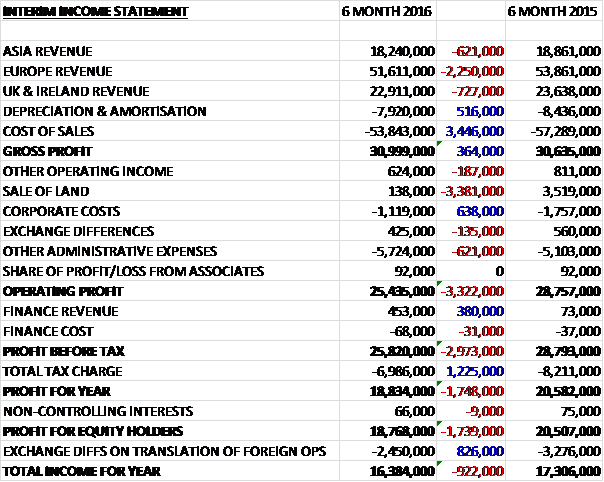
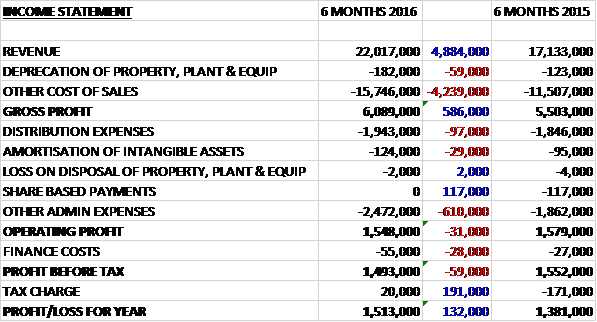
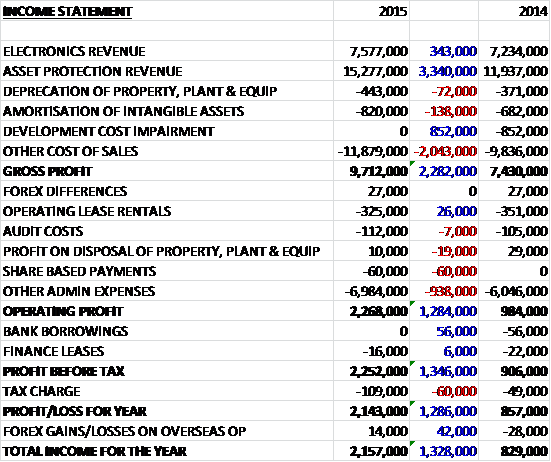
Revenues increased when compared to last year with a £343K growth in electronics revenue and a £3.3M increase in asset protection revenue. The £852K development cost impairment that occurred last year was not repeated but other cost of sales did increased by £2.2M which gave a gross profit £2.3M ahead of last year. Admin expenses were also up but the operating profit was still £1.3M above that of 2014. The fall in loan interest payable was broadly offset by a growth in the tax charge which remained low due to the availability of accumulated tax losses and R&D allowances. This all meant that the profit for the year came in at £2.1M, a growth of £1.3M year on year.
Newmarkassets

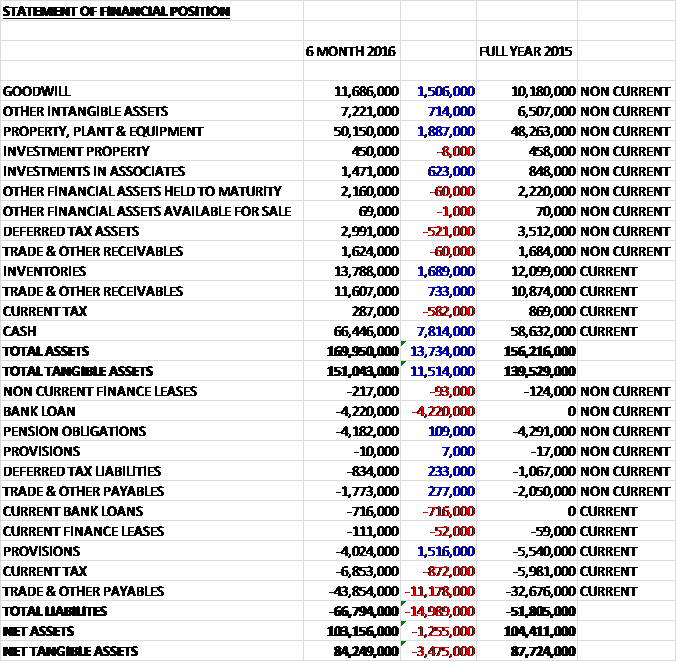
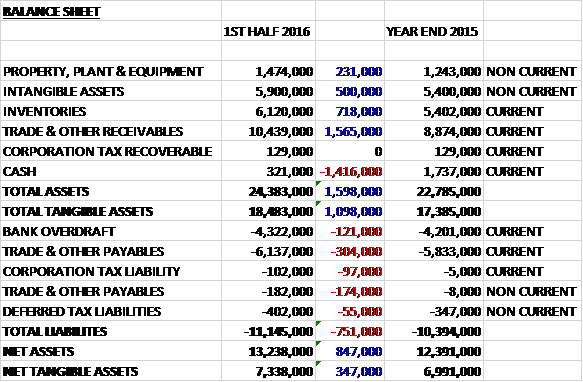
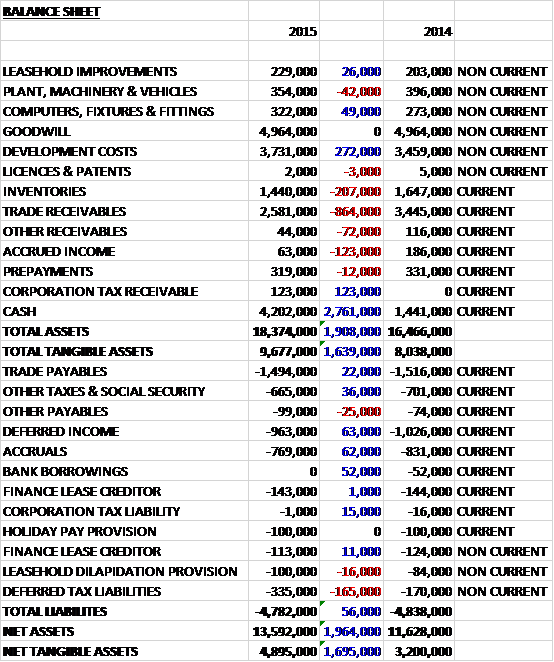
When compared to the end point of last year, total assets increased by £1.9M driven by a £2.8M growth in cash and a £272K increase in development costs as they were higher than amortisation during the year, partially offset by an £864K decline in trade receivables and a £207K fall in inventories. Total liabilities were broadly flat over the year as a £165K growth in deferred tax liabilities was offset by small falls in most other liabilities. The end result is a net tangible asset level of £4.9M, a growth of £1.7M year on year.
Newmarkcash

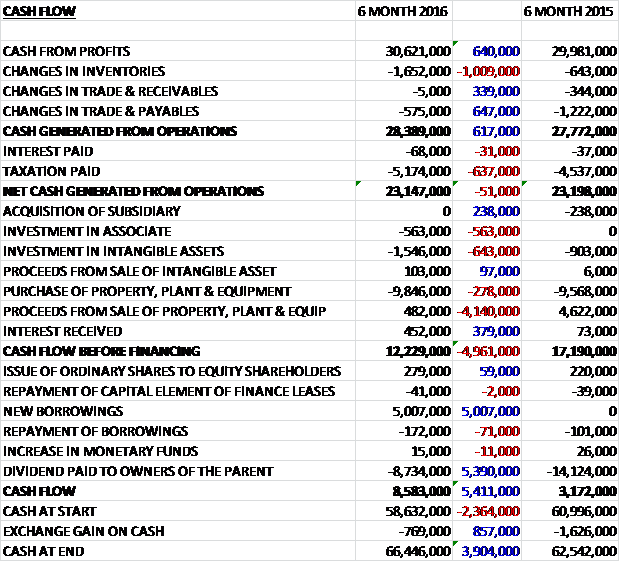
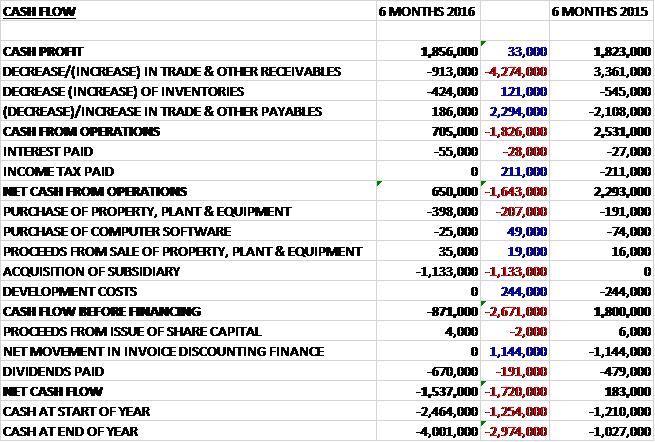
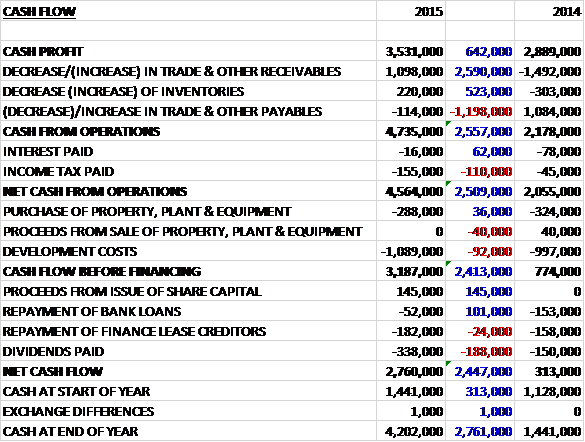
Before movements in working capital, cash profits increased by £642K to £3.5M. There was a cash inflow from working capital compared to an outflow last year, mainly attributable to a fall in receivables following an exceptionally high figure last year due to the advance billing of customers and high sales prior to the year-end, and after a £62K fall in interest paid was offset by a growth in income tax, the net cash from operations came in at £4.6M, a growth of £2.5M year on year. The group then spent £288K on capex and £1.1M on development costs so that free cash flow was £3.2M. Of this, £182K was used to pay finance leases and £338K went out in dividends to give a cash flow for the year of £2.8M and a cash level of £4.2M at the year-end.

The pre-tax profit in the Electronics division was £48K, a decline of £164K year on year partly due to a £138K growth in amortisation charges. Access control revenues grew by 1.3% to £4.1M during a transitionary period. The SATEON range was expanded to include the newly launched SATEON Pro and creating separate and specific offerings focused on the high-tier and mid-tier sections of the market and the business has upgraded some existing customers from the JANUS legacy systems.

During the year SATEON version 2.7 and 2.8 were released. Version 2.7 featured a number of updates that included improved reporting and search functionality and integration with two major elevator companies. Version 2.8 featured new graphical tools, real time maps, time patterns, custom reports and several integrations including Honeywell’s Galaxy Intruder panel, Tyco’s Simplex Fire Alarm plane and Assa Abloy’s Aperio offline locks. Version 2.9, to be launched in August 2015, will contain photo verification via the Stateon Faces feature and will look to build the group’s wireless locks capability through integration into Salso’s offline locking solutions. SATEON has become the solution of choice for a number of public sites including museums and several local authorities along with a major data centre have also chosen to partner with Grosvenor for their access control needs.

Overseas, sales and technical resource has been increased in the US operation with a healthy pipeline of sales opportunities being established. A contract with a major Middle East systems integrator in the UAE was won during the year, securing a robust long-term pipeline for projects in the region. Grosvenor’s Asia Pacific operations have been set up with Hong Kong activing as the hub as an office was established in June. It is envisaged that networks of systems integrators will be established in Japan, South Korea, Singapore and China.

Workforce Management revenues grew by 9.1% to £3.5M. Grosvenor continues to benefit with healthy revenue from the long standing relationship with one of the world’s largest retailers as they continue to roll out their workforce management solutions in their stores globally. A further opportunity exists with this client in terms of an additional roll out with a product designed to meet their specific requirements. During the year the business also completed a long term project for Tesco which was carried over from the previous year.

In principle terms were agreed with a major US channel partner in July for the exclusive supply of a workforce management terminal, which is expected to begin in the year ending 2017. This is the largest single contract secured to date by the group in this line of business. It is also expected that significant revenues will be generated from this customer during 2016 on the existing range of workforce terminals. Cross-selling opportunities began to be recognised during the year with Grosvenor being chosen to supply Workforce Management and Access Control in sites such as a major library, food group and charity.

The pre-tax profit in the Asset Protection division was £3.4M, an increase of £1.5M when compared to last year, partly as a result of the £852K impairment in development costs that was incurred in 2014 as a consequence of the redevelopment of a product design. Product revenue increased by £3.5M to £12.2M which included a growth of £1.2M in CSI revenues after it was acquired in November 2013. Excluding CSI, revenue increased by 29%, principally due to the timing of orders received for time delay cash handling equipment from the Post Office and accelerated installation of equipment at Post Office branches in Q3 and Q4 to meet their targets. Sales of new cash handling products developed for a high street bank in 2012 continued despite competitor products being introduced to the market.

Orders for new Eclipse Rising Screens and screen reconfiguration work increased by 120% after a long term customer accelerated its branch refurbishment programme planned for several years. Sales of Eclipse Rising Screens also increased to financial institutions who previously opted to have no security screens and trade over open counters after they reviewed the security risk at branches that fall in high crime areas. There was also an increase in sales to public sector clients as the government released money for capex programmes.

Eye2eye sales continued to decrease as a results of a reduction in train station refurbishment programmes. Counter Shield sales decreased substantially due to increased demand for Eclipse Rising Screens and Fixed Glazing solutions but they received a substantial order of £174K from a local authority at the end of the year for installation in Q1 2016. Sales of Fixed Glazing and Counter Protection Systems returned to previous levels after the inclusion of a single large order of £373K from a foreign embassy based in London in the previous period. Sales of other non-standard products increased by 26.4% with the benefit of a programme for non-traditional work from a large financial institution.

CSI sales in the year were lower than expected due to the cut backs from a major supermarket chain after poor financial results. The cut backs included the reduction in store numbers as well as the cancellation of plans to open new stores. The business did successfully obtain government CPNI certification on a blast door, however, and this product as well as other products developed during the year will provide significant revenue streams in future years. Continuous produce development and certification as well as a re-certification will reduce margins but they are essential requirements to ensure products are updated to withstand new methods of attack and meet customer demand.

Revenues from the Service stream declined by 4.1% to £3.1M but profitability was higher due to margin improvements driven by reduced unit labour costs. During the year Safetell signed a new service contract with a long standing customer for a further three years and since the year-end the business has also renewed a four year service contract with a large facilities management company to support one of the high street financial institutions. These contracts provide the foundation of the group’s service business.

It has taken longer than expected to enter the more competitive CCTV and access control markets but these products have added to the group’s counter and screen offering which will provide product revenue, as well as additional service revenues in the future. The upgrades to older Eclipse Rising Screen systems have proven successful for two long term customers who will embark on roll-out programmes during the next year to replace the pneumatics and control systems on units that have been installed for many years. These upgrades extend the life of the Eclipse product while reducing the cost of replacing the product and the board believe this will provide revenue streams going forwards. The business continues to receive reactive call outs on the Post Office Transformation Programme.

The two new STATEON lines both operate with a single software platform allowing a simple movement from one door system to the most complex multi-site installations. This will facilitate growth in a far larger number of installers, many of whom currently use different manufacturers to satisfy their small and large system needs. Annual recurring software agreements pave the way for an “Access Control as a Service” model significantly increasing opportunities for new and recurring revenue for both Grosvenor and the systems integrator companies. A leading CRM is being installed to provide capability to manage this increased demand and in the medium term e-commerce technologies will also be adopted, negating the requirement to create costly and complicated distribution channels.

In Workforce Management Systems, growth will be achieved through emphasis on securing new business with high value VARs. Market research has demonstrated specific customer groups where success is more likely and a focused approach has been adopted to target these.

The strategy in the Asset Protection division is to broaden the customer base and product range. Safetell is looking to extend into sectors outside the financial services sector following the acquisition of CSI who address supermarket and retail chains, particularly with ATM pods, BR doors and walls, and fire exit doors. By obtaining government CPNI certification on the blast door, the business had broadened the scope for the ballistic and blast product range and has already received a substantial order for these doors from Iraq.

The Cash Deposit Device developed last year received good reviews from retailers in the UK who are slow to take up new technology whilst still maintaining current cash handling practices. The service provides real cost savings including same day credit, but this is dependent on the UK banks offering the service and currently they are reluctant to move forward with an offering that is already applied by banks in the rest of the world. This networked point of sale cash deposit device provides secure cash holding and device sharing between several cashiers resulting in substantial cost savings.

The group still has some £2.2M in trading losses that can be offset against future trading profits along with £786K of management expenses. They do not currently have any bank borrowings, with the only debt being finance leases but there are undrawn borrowing facilities of £750K which expires within a year. The net cash position stood at £3.9M at the year-end compared to £1.1M at the end of last year but there are £1.6M of outstanding operating leases relating to properties.

There is a modest risk of changes in forex movements. A 10% weakening of the US dollar and Euro against sterling has the effect of reducing profits by just £6K. It is worth noting that as part of loan note facility taken out in 2011, the company entered into a warrant instrument with the loan note holders whereby the company granted then 30,000,000 warrants to subscribe for the same number of new shares until the end of November 2016 at an exercise price of 1p per share. As of the year-end there 29,250,000 warrants outstanding with non-executive Michael Rapoport having 7,500,000 and Chairman Maurice Dwek having 21,750,000 outstanding.

The group is reliant on customer refurbishment programmes within the financial sector which are currently acting as an underlying positive trend for many of their products and the business is reliant on the timing of these programmes. Operating performance is also impacted by the pricing and availability of key raw materials which include electronic components, steel and security glass, the pricing of which can be quite volatile.

Revenue was lower in the second half of the year than in the first half due to the timing of customer projects and roll out programmes. The group therefore focused on new business and products in order to maintain their position in the market. They have agreed in principle terms with a major US channel partner for the supply of a new workforce management terminal which is expected to begin in the year ending 2017 which will be the largest single contract secured to date by Grosvenor Technology.

The asset protection revenues going forward are expected to be lower than during this year due to the completion of some major customer programmes, although revenue from CSI is expected to increase. Overall the board believe that profits in the new year will be lower than in 2015 whilst they develop new markets and products from which the benefits will be seen in the following year.

At the current share price the shares trade on a PE ratio of 6.8 which increases to 13.2 on the full year consensus forecast. After the final dividend (there is no interim dividend here) was increased by a third, the shares are currently yielding 3.4% which remains the same on next year’s forecast.

Overall then, this has been a good year for the group. Profits were up, net assets increased and a growth in operating cash flow gave rise to a decent level of free cash. The profit in the electronics division did decline, however, mainly as a result of increased amortisation and flat sales in the access controls division, although there seem to be some exciting international opportunities with a big contract being signed in the US. Profits in the Asset Protection division grew, mainly as a result of the timing of orders from the Post Office.

This impressive performance doesn’t look as though it is going to be repeated in 2016, however, as the board have guided to lower profits as new products work their way through the system. More generally, the group is dependent on refurbishments from bank customers and the number of stores at their grocery clients, which are obviously under strain at the moment. These issues do seem to be somewhat priced in, however, with a forward PE of 13.2 and dividend yield of 3.4% the shares do not look that expensive to me – this is an interesting one.

On the 18th September the group announced that it had secured a contract with a major global workforce management partner for the development, manufacture and supply of one of Grosvenor’s next generation terminals. The contract is for a period of ten years with guaranteed revenues of $6M over the first five years with the partner having exclusivity for the terminal for six months form its launch, with the exception of one existing major customer.

Example applications for the terminal include attendance recording, collaborative shift planning, shop floor data collection, health and safety briefings and staff training. Overall, this looks to be a positive development for the company.

The group also announced a grant of options over 1,142,857 new shares to CEO Marie Claire Dwek at an exercisable price of 3.325p per share. Given the exercise price I have no qualms over this but it would be nice if she owned some shares in the company that were not gifted to her.

Games Workshop Share Blog – Final Results Year Ended 2015

Games Workshop designs and manufactures miniature figures and games and distributes these through its own network of retail stores, independent retailers and direct via the internet and mail order. The group has manufacturing activities in the UK and sells mainly in the UK, Continental Europe, North America, Australia, New Zealand and Asia. Most revenues are recognised at the point of sale, but the revenue for magazine subscriptions is recognised on a straight line basis over the subscription period. The group also earns revenues from royalties.

There are three different business areas. The trade division sells globally to independent retailers and also includes the group’s magazine newsstand business and the distributor sales from the group’s publishing business. The retail division includes sales through the group’s retail stores, the visitor centre in Nottingham, and global exhibitions. The mail order division includes sales through the group’s global web stores and digital sales through external affiliates. It has now released its final results for the year ended 2015.

GAWincome

Revenues declined when compared to 2014 as a £971K growth in mail order revenue was more than offset by a £3M fall in trade revenue and a £2.4M decrease in retail revenue. There was a £607K increase in the amortisation of development costs and a £483K growth in the cost of inventories but other cost of sales declined so that gross profit fell by £4.6M. The amortisation of software increased by £524K but operating lease costs fell by £1.2M and we also see a £337K decline in the loss from sales of tangible fixed assets and a £309K fall in the loss from the sale of intangibles and £2.6M lower redundancy costs. We then see the lack of a £4.5M European restructuring charge that occurred last year which meant that the operating profit grew by £4.2M. Interest income was broadly similar and the tax charge was slightly lower so the profit for the year came in ay £12.3M, an increase of £4.3M year on year.

GAWassets

When compared to the end point of last year, total assets declined by £5.2M driven by a £5M fall in cash and a £1.1M decline in deferred tax assets, partially offset by a £1.6M increase in freehold land & buildings. Total liabilities also declined during the year as a £2.5M fall in provisions was partially offset by a £1.2M growth in deferred income. The end result was a net tangible asset level of £41.8M, a decline of £3.4M year on year.

GAWcash

Before movements in working capital, cash profits increased by £462K to £25.3M. A slight cash inflow from working capital and a tax payment that almost halved, gave a net cash from operations of £23.3M, a growth of £3M year on year. The group then paid £4.6M on product development, £6.8M on the purchase of property, plant & equipment including £3M on production equipment and tooling, £2.4M on the visitor centre and £800K on 34 new stores and three refurbishments, and £1M on computer software to give a free cash flow of £11M, an increase of £2.5M when compared to last year. The group spent £16.6M on dividend payments so that there was a £4.8M cash outflow for the year to give a cash level of £12.6M at the year-end.

The operating profit in the trade division was £11M, a decline of £3.8M year on year. There was a £2.2M decline in non-core trade activities which comprised export, non-strategic accounts and magazine sales with the rest of the decline as a result of adverse currency movements. The operating loss in the retail division was £1.1M, an improvement of £586K when compared to last year and included a £700K decline in non-core retail due to the redevelopment of the visitor centre in Nottingham. The group aim to offset this decline with the opening of a new visitor centre and events programme in 2016 having been opened in May 2015.

The operating profit in the mail order division was £14.2M, an increase of £99K year on year. The operating profit in the product and supply division was £8.6M, a growth of £8.4M when compared to 2014, although last year did include a £4.5M exceptional cost. They made an operating profit of £1.1M through royalties, which was flat year on year. During the year the group have signed 17 new licensing details with 44 currently in place to produce more than fifty interactive products. A major tie-up included one with Sega to develop a real-time strategy game, Total War Warhammer. The royalty income overall is split between traditional PC games (52%), mobile (27%) and card, board and role-playing games licenses (21%).

Overall the detrimental movements in foreign exchange reduced operating profit by £2.5M during the year. The restructuring across Continental Europe was delivered on time, within budget and delivered the cost savings that were planned. It has taken some time to get this region back to its normal levels as the group had to recruit a new trade team of account developers in Nottingham servicing all of Continental Europe in the local languages. In the second half of the year that team delivered sales growth of 1% but the impact in retail has taken longer than planned to recover with the key issue being store manager recruitment.

The exit of loss making stores in North America has been a challenge, they closed nine stores in the year and have not delivered a net increase in stores in the region in the year. These closures hare now complete and subject to finding the right managers, they will be embarking on a store opening programme in North America next year.

The group is some way through a “Great Master Plan” which involves cutting costs, becoming more efficient and paying dividends. One aspect that remains unrealised, however, is sales growth. The board have identified the fact that the large infrastructure changes that have been taking place have been disruptive and some trade accounts across Europe no longer trade with them. They also indicate “truly dreadful” trading conditions with the strength of Sterling against both the euro and dollar adversely affecting the group. The CEO has asked the staff to take a pay freeze until December 2015 with any increases being back dated to June if they deliver sales growth in H1 2016.

The visitor centre is an interesting concept, where visitors are being charged £7.50 to see many of the group’s products and miniatures in one place. The design studio in Nottingham creates the miniatures, art work, games and publications that are sold and during the year the group invested £7.7M in the studio, including software costs, with a further £2M spent on tooling for new plastic miniatures. The board are committed to a similar level of investment every year. They have also been planning a project to upgrade the core IT systems that interface with the manufacturing equipment and systems; and started a project to upgrade the IT infrastructure and software for the warehouse that supports the mail order store based in Nottingham.

Over the last five years, the group have been focusing on ensuring all of their stores are profitable by exiting expensive locations and converting the others to one man stores. It is believed that this project is in effect complete, they have 324 one man stores and 94 multi-man stores, which are constantly reviewed to ensure they remain profitable.

The group are also looking at reviewing their product range with a view to resetting the ranges. They will not be reducing the RRP of their products but are apparently looking at offering a broader range of price points – that’s management speak if ever I heard it, I suppose they meant they are introducing a cheaper range of products? This is still early days, however, and the board do not know when the change will be introduced.

There is a plan to open more stores, mostly in the one man format in greenfield cities in North America and Continental Europe. They are also looking at opening more stores in Japan, Singapore and Hong Kong with the global goal set at a net 30 new stores globally. A trial of new stores in high footfall locations has also been proposed, like the one opened in Tottenham Court Road in April which is a multi-man format with an extended shop fit; mainly new till format, mobile tills, better use of merchandising space, new web terminal and next day stock delivery to the store for in-store orders. The aim is to pilot one each in Boston, Sydney, Munich, Paris and Copenhagen during the year ahead.

They are also looking to open more stockist trade accounts with a particular focus on North America; and to explore new core trade opportunities in toy, craft, book and comic stores; and finally they will be replacing the European ERP system in Nottingham that has been used over the last fifteen years and has come to the end of its useful life. This project will give them the opportunity to drive synergies throughout their back office functions by removing complexity, re-engineering their processes and delivering their services at a lower cost. The product and vendor has now been chosen with the project expected to cost £6.4M. This is obviously a complicated project with the risk of widespread business disruption if not implemented well.

The group has some £447K of capital expenditure contracted for but not yet incurred and there are £19.3M of operating leases outstanding, of which £7.3M is due within the year. There are currently three major projects being implemented including a European ERP replacement at a cost of £6.4M; a new Forge mail order store on the same platform as the Citadel mail order store at a cost of £1.1M; and a mail order warehouse system replacement estimated to cost £800K.

The board have indicated that they have no intention to acquire other companies or dispose of any that they currently own but they are at the start of a rebrand away from Games Workshop to Warhammer with 13 stores having been rebranded at the year-end.

The group has a modest amount of susceptibility to exchange rate changes. A 10% appreciation of the US dollar would increase income by £27K whereas a 10% appreciation of the euro would reduce income by £35K.

At the current share price the shares trade on a PE ratio of 15.3 which reduces to 14.5 on next year’s consensus forecast. The shares are yielding 8.9% which reduces to 6% on next year’s forecast. There were no utilised borrowings at the year-end so the net cash position currently stands at £12.6M compared to £17.6M.

On the 7th December the group released a trading update for the first half of 2016. Trading on a constant currency basis has been broadly in line with both the board’s expectations and the first half of 2015. There has been modest sales growth at constant currency but the adverse impact of a stronger pound will result in a small decline in reported sales.

Overall then, this has been a mixed year for the group. Profits did increase during the year but when last year’s European restructuring is discounted, profits fell, not helped by detrimental movements in forex. Net assets also declined but cash profits did improve, generating a decent amount of free cash. The trade division seems to have been responsible for the decline in profits with the other businesses showing improvements or no movement, although it should be noted that the retail business is still making a loss.

The group seems to be having a real problem growing sales which is probably to be expected given the cost cutting that has occurred in recent times. They do need to be careful to not cut too far and kill the goose that is laying the golden eggs (as it were) as the company’s customers are very enthusiastic about the products and the social aspect of the games and I can’t help thinking that the move from two man stores to one man stores is having a bit of a detrimental effect on this perception. The international growth and trial of the high-footfall stores does sound interesting though but it should be noted that the new ERP system upgrade comes with some risks.

The recent update shows that trading in the first half of 2016 is subdues and although the group has a net cash position and a generous forward dividend yield of 6%, the forward PE of 14.5 doesn’t really leave much room for error and I am not sure this company is one that is growing at the moment.

James Latham Share Blog – Interim Results Year Ending 2016

James Latham has now released its interim results for the year ending 2016.

LTHMinterimincome

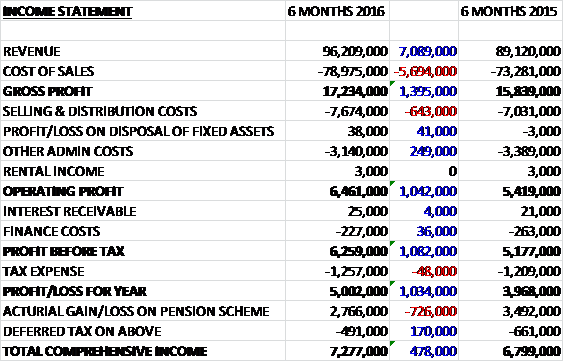
Revenues increased by £7.1M when compared to the first half of 2015 and after a growth in cost of sales, gross profits were £1.4M higher. Selling and distribution costs increased by £643K but admin costs fell and the operating profit grew by £1M. Finance costs fell modestly, reflecting reduced interest charges on the lower pension scheme deficit, but this was offset by a small growth in tax expenses to give a profit of £5M, a growth of £1M year on year.

LTHMinterimassets

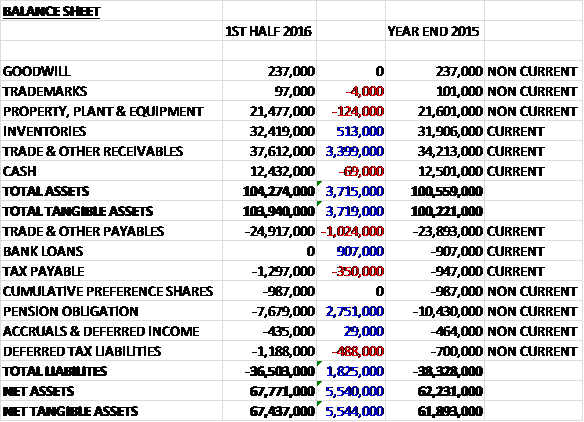
When compared to the end point of last year, total assets increased by £3.7M driven by a £3.4M growth in receivables, and a £513K increase in inventories. Total liabilities declined over the past six months as a £2.8M fall in the pension obligation was partially offset by a £1M growth in payables, a £488K increase in deferred tax liabilities and a £350K growth in current tax liabilities. The end result is a net tangible asset level of £67.4M, a growth of £5.5M over the past half year.

LTHMinterimcash

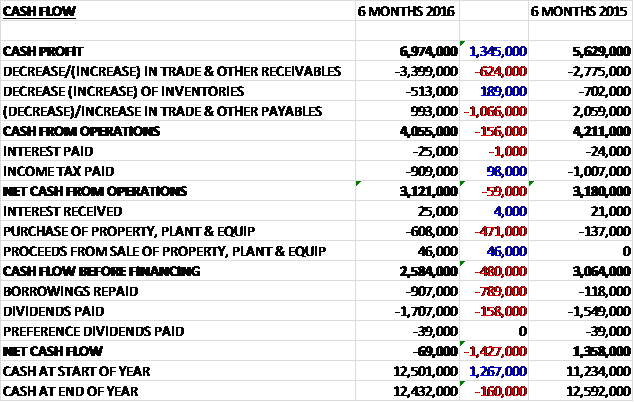
Before movements in working capital, cash profits increased by £1.3M to £7M. There was a cash outflow from working capital, in particular a £3.4M growth in receivables and after a slightly lower tax payment, the operating cash flow was £3.1M, broadly flat year on year. This easily covered the £608K spent on property, plant and equipment to give a free cash flow of £2.6M. The group then used this to repay £907K borrowings and to pay £1.7M in dividends which meant that the cash outflow for the half year was £69K with a cash level of £12.4M at the period-end.

Group revenue has grown as a result of higher sales volumes and product mix, which offset lower prices. This growth was both in panel products and timber with increased sales in decorative panels, doors, Accoya and WoodEx. Trading margins for the period are similar to the previous year with an improvement in panels and a small decline in timber. There were higher warehouse and distribution costs reflecting higher volumes handles and the extended working day at a number of depots but otherwise overheads have been well controlled and bad debts have been significantly lower than in previous periods. The group are continuing to take advantage of cash settlement discounts from suppliers where this represents a good return.

So far in the second half there has been growing revenues for October and early November, at slightly improved margins but market conditions continue to be difficult in some areas while improving in others. Overall, so far the group are trading comfortably in line with expectations. They are progressing with their plans to relocate the two oldest depots and are close to agreeing heads of terms on the new Yate site and are in negotiations for the new Wigston site.

From January 2016, Peter Latham will step down from being executive chairman and instead become non-executive chairman of the group with Nick Latham taking over most of the executive duties.
After an increase in the interim dividend, the shares are now yielding 1.9% which increases to 2% on the full year consensus forecast.

Overall, this has been another decent period for the group. Profits increased, as did net assets, aided by the pension deficit reduction. The operating cash flow did decline modestly but this was due to an increase in receivables and cash profits increased and once again, a good level of free cash has been generated. Although volumes are up, there has been a reduction in prices which should be watched but the new year has started well and, although the shares are not obviously that cheap with a forward PE of 15.4 and yield of 2%, and they are likely to get badly burned in the next UK economic downturn, this company seems to be doing well at this stage in the cycle and I am tempted to pick a few shares up.

On the 30th March the group released a trading statement. Revenue for the year is expected to be slightly lower than market expectations but pre-tax profit is likely to be higher. Quite light on detail, this, and not really much to go on.

James Latham Share Blog – Final Results Year Ended 2015

James Latham supplies joiners, door and kitchen manufacturers, shopfitters and other market sectors entirely in the UK, offering a range of wood based panels, natural acrylic stone, hardwood, high grade softwood, flooring, cladding and decking. They also supply commodity and specialist products to timber and builders’ merchants. The company was taken public in 1965 and they are quoted on the AIM market. The Latham family still owns over half of the company shares and six members of the family work in the business.

It has now released its final results for the year ended 2015.

LAthaminxome

Revenues increased by £11.7M when compared to last year and cost of inventories grew by £10.9M but other cost of sales fell so that gross profit was up by £2.4M. Distribution staff costs increased by £393K and other selling & distribution costs grew by £831K, mainly as a result of higher haulier costs. We also see admin staff costs increase by £1.7M but this was mostly offset by a £1.5M decline in other admin expenses but the lack of a £1.8M one-off receipt following the change from RPI to CPI in the pension scheme meant that operating profits fell by £711K when compared to 2014. The finance cost on the pension liability fell by £319K, again due to the change in inflation calculation but this was more than offset by a £397K growth in tax expenses as the last of the carried forward losses were utilised so that the profit for the year came in at £7.8M, a fall of £769K year on year.

LAthamassets

When compared to the end point of last year, total asset increased by £5.6M driven by a £4M growth in inventories, a £1.3M increase in cash and a £1.1M growth in trade receivables, partially offset by a £762K decline in the value of plant and equipment. Total liabilities also grew during the year due to a £1.2M growth in the pension obligation, and a £1M increase in trade payables. The end result is a net tangible asset level of £61.9M, an increase of £4.1M year on year.

LAthamcash

Before movements in working capital, cash profits increase by £766K to £10.9M. There was a cash outflow from working capital, however, with a particularly large increase in inventories resulting from overstocking due to erratic shipments of commodity products in Q4, and after a £657K increase in tax paid, there was a net cash from operations of £4.2M, a decline of £2.5M. This more than covered the £383K spent on property, plant and equipment, mainly relating to the purchase of lorries to give a free cash flow of £3.8M which was then spent on dividends and a £234K repayment of borrowings to give a cash flow for the year of £1.3M and a cash level of £12.5M at the year-end, although the lowest amount of cash held during the year was £5.9M (I like the fact that the group tells us this).

Revenue continued to grow during the year, due to increased volumes both in ex-warehouse and direct business with a modest increase in some prices. Year on year growth was slightly lower in the second half of the year due to a very strong Q4 in the prior year. Both panels and timber grew revenues throughout the year and the gross margin increased by 0.4% due to a better product mix with improving margins on the specialised products offsetting continuing competitive pressure in other markets. Timber and panel prices remained steady throughout the year. Focus panel products including Melamine Panels and Door Blanks, continued to show good growth. Accoya modified wood and WoodEx, the group’s brand of engineered timber for the joinery sector, were particularly successful this year.

Panel sales were 7.3% higher at £124.9M with volumes up nearly 5%. The group’s strategy continues to be to target markets for decorative surfaces to include veneered and melamine panels, laminates and natural acrylic stone plus flexible panels. The range of hardwood and softwood plywood has gained market share. Turnover of MDF was steady throughout the year showing a small volume increase in a static market. One positive area was a large increase in sales of Medite Tricoya Extreme Durable MDF. Development of added value OSB and its competitiveness versus plywood has enabled the group to grow sales into merchants and manufacturers. During the year they launched LuminFirePro, a fire retardant plywood and more fire retardant products will be launched in the new year.

Sales to importers, timber and builders merchants showed good growth during the year and a wide range of core fit for purpose and added value products, supplied ex stock, has enabled the group’s customers in this sector to grow their sales.

Timber sales at £50M were 7.3% higher than last year with volumes nearly 2% higher. Joinery, kitchen and shop fitting sectors have all shown sales and volume growth. The core business for African, European and North American hardwood was reviewed during the year with a more strategic product and purchasing policy being put into place. Supply issues in parts of Africa eased leading to a large influx of product into the market during the second half of the year which impacted on sales and margins.

The group’s own engineered hardwood and softwood brand, WoodEx, continued to make inroads into the joinery sector, and Grandis 690+, made of laminated eucalyptus, was launched in the second half of the year and sales have been good. The established range of Sapele, Redwood and European Oak has also seen good growth. The largest growth area for the timber business, however, was Accoya Modified Wood and very strong sales have been made into the external joinery sector. Profi-Deck and Lifecycle wood plastic composite decking sales into merchants and to contractors have shown good growth and the group have redefined their range of Bausen flooring, removing some lines of solid flooring and replacing them with new engineered floors including the Henshaw range.

During the year the group introduced Xylocleaf, a high definition melamine panel for shop fitting, furniture, kitchens and bedrooms; and Kydex, a thermoformable plastic product for shop fitting, doors and the transport sector. The group are also looking to develop new markets such as Ireland and other export markets. They will also continue to invest in their depots, with advanced plans drawn up for relocating their Yate and Wigston depots over the next two years, as well as improvements to racking systems in their Thurrock, Hemel Hempstead and Purfleet depots.

Overheads were within the budgeted forecast but higher than last year due to the extra volumes, smaller order size and later order times for next day delivery. Staff numbers increased during the year with sales staff recruited in areas of the business where the board see opportunities. Bad debts were low overall for the year despite the high level seen in Q1.

The group operates a contributory defined benefit pension scheme which is closed to new entrants, and a defined contribution group scheme has been established for the pension provision of all other employees. The net liability currently stands at £10.4M with a total benefit obligation of £64.4M and the group intends to contribute £876K to the scheme next year. If the inflation rate increased by 0.25%, the deficit increases by £1.6M; if life expectancy increased by one year, the deficit increases by £2.1M; and if the discount rate falls by 0.25%, the deficit increases by £3.2M. During the previous year the trustees of the scheme amended the index used to measure inflation from the RPI to the CPI and the company have agreed a recovery plan over two years, paying £1.2M this year and £420K next year.

As well as the pension deficit, the main risk is probably that of a slowdown in the UK economy with the construction industry being the most important.

There is little in the way of debt but there is only £1M of undrawn bank facilities available. I am not too sure what the cumulative preference shares are but they are held on an ongoing basis and pay pretty hefty dividends of 8% per annum. At the end of the year, the group has £413K of capital commitments contracted for but not provided for in the accounts. Plans are being drawn up to upgrade the two older sites at Yate and Wigton over the next two to three years, to emulate the success that investment in new facilities has delivered elsewhere.

So far this year, revenues are 7% higher than in the corresponding period last year, both in panels and timber, and the gross margin is also higher. It is a steady start to the year and generally customers are busier than they were in Q4 2015. The panels market remains competitive but the group are seeing encouraging growth in the newer decorative products they have introduced.

At the current share price the shares trade on a PE ratio of 17.3 which falls to 15.4 on next year’s consensus forecast which is not really that expensive. After a 9.6% increase in the annual dividend, the shares yield 1.8% increasing to 2% on next year’s consensus forecast.
Overall then, this seems to have been a steady year for a steady company. Profits did fall but this was only due to a one-off gain on the pension scheme last year and if we take this off, profits increased. Net assets were up too but operating cash flow declined. Again there is a caveat here too as the fall was entirely due to a cash outflow from working capital due to overstocking following erratic Q4 orders and cash profits increased year on year to give plenty of free cash. Sales of both panels and timber improved with the specialist project margins holding up better than the commoditised product margins which were affected by an influx from Africa following the easing of supply issues.

It is worth noting that order sizes have fallen whilst lead times have also declined which makes trading a bit more awkward and there are pension risks here too. Of course the most prevalent risk is that of a downturn in the UK economy, particularly the building sector, but this still seems to be some way off and for now the new year has started well which means with a forward PE of 15.4 and dividend yield of 2% these shares are probably priced about right.

Goodwin Share Blog – Interim Results Year Ending 2016

Goodwin has now released its interim results for the year ending 2016.

GDWNincome

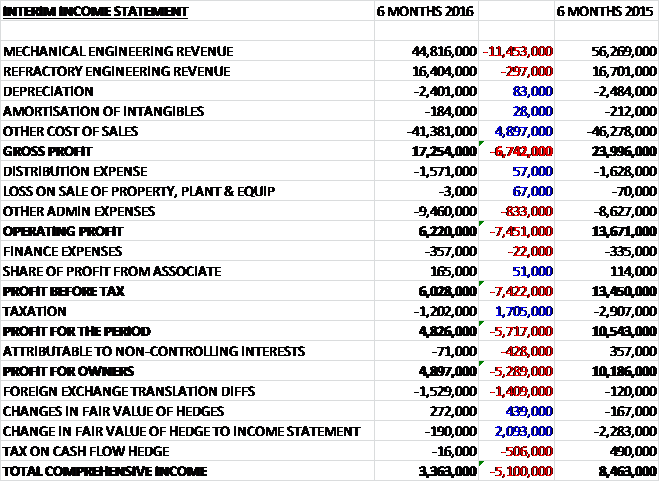
Revenues declined when compared to the first half of last year with an £11.5M fall in mechanical engineering revenue and a £297K decrease in refractory engineering revenue. Cost of sales also decreased which meant that gross profit fell by £6.7M. Admin costs increased, however, so that the operating profit declined by £7.5M before a decrease in taxation gave a profit for the half year of £4.9M, a decline of £5.3M year on year.

GDWNassets

When compared to the end point of last year, total assets increased by £7.2M driven by a £4.6M growth in intangible assets, a £3M increase in property, plant & equipment, a £1.8M growth in inventories and a £1.2M increase in receivables, partially offset by a £2.5M decline in cash. Liabilities also increased during the period as an £11.4M increase in bank overdrafts was partially offset by a £1.1M fall in other loans and borrowings, a £1.4M decrease in payables and a £1M decline in derivative financial liabilities. The end result is a net tangible asset level of £70.9M, a decline of £4.8M over the past six months.

GDWNcash

Before movements in working capital, cash profits declined by £7.6M to £8.8M. There was then a cash outflow from working capital, although this was much lower than last year, in particular a smaller increase in receivables which is expected to reverse in the second half of the year. After a £1.1M decline in tax paid the net cash from operations came in at £2.1M, a growth of £2M year on year. This did not come close to covering the £6M spent on tangible fixed assets relating to investment in new machinery for Goodwin International, the £3.5M spent on intangibles and the £1.7M paid for the acquisition so that before financing, there was a cash outflow of £9.5M. The group then paid out £3M in dividends which it couldn’t really afford and repaid £1M of loans to give a cash outflow of £13.8M for the half year and a cash level of -£6.2M at the period-end.

As previously indicated, the group started the year with a work load 22% lower than the year before and this coupled with tighter pricing in the difficult market has led to the reduction in profits. The sales order input during the period was 16% higher than in the same period last year but this increased level of order input was only achieved by quoting tenders with tighter margins.

Good progress was made in expanding the activity of the refractory engineering division. Towards the end of last year, Goodwin Refractory Services purchased the assets of a casting powder company and now supplies a significant amount of tyre tread moulding powder both in Europe and Asia pacific. In October 2015, Dupre Minerals and Hoben International purchased assets at a cost of £4.8M which enable both businesses to expand their manufacturing facilities to produce more vermiculite and perlite. It is hoped that this will start to generate significant benefits during the second half of the year.

In addition, the bulk of the rest of the £5.8M of capital expenditure related to investment in new machinery for Goodwin International to enhance and increase its machining capability to allow the business to further expand its specialist large five axis CNC machining capability. The board expect an increase of £8M in order input for this type of worth this year. Easat Antennas was awarded an R&D grant which over the next two years will enhance its radar supply capability and it is hoped that these activities will, in part, mitigate the effects of the downturn in the oil and gas and mining industries.

The profit in the Mechanical Engineering business was £5.4M, a decline of £6M year on year and the profit in the Refractory Engineering division was £1.6M, a fall of 802K when compared to the first half of last year.

A small electronics company was acquired during the period for a consideration of £1.6M which represented a provision intangible asset and goodwill value of £1.4M. In order for the group to take on larger contracts, an extra £10M line of five year committed bank facility (so far unutilised) has been arranged as payment cycles are less certain in current economic conditions.

Going forward, time will tell whether the group will find satisfactory levels of work to fill the gap temporarily caused by the slowdown in the oil, gas and mining industries which the board seem being quieter for a couple of years.

There was no interim dividend announced (just as last year) so the shares continue to yield 2.5% on an annual basis.

Overall then, this has undoubtedly been a difficult period for the group. Profits have declined with falls in both mechanical and refractory engineering, and net asset levels have increased over the six month period. The operating cash flow did improve but this was only due to a lower cash outflow from working capital than last time and cash profits declined with no free cash generated. The workload at the start of the year was poor but this has improved somewhat as the period progressed, although margins are now lower due to increased competition following the collapse in the oil and gas and mining industries. The group is trying to diversify away from these sectors nut it seems unlikely this will be enough to plug the gap left in profits and this company does not look a good investment until this uncertainty improves.

On the 17th March the group announced its Q3 management statement. In the first nine months of the year, revenues declined by £21M to £87.5M and pre-tax profit fell by £8.3M to £9M. There have been no significant adverse events and whilst many of the engineering customers in the oil, gas, mining and power generation businesses are having a difficult time, overall the order input for the nine month period has increased by 15% when compared to the same period of the prior year. This increase has in part been helped by the refractory engineering division continuing to grow and by the antenna systems business now having a record order book for primary and secondary radar. They are also obtaining significant valve orders for LNG terminals and for the Middle East.

For these reasons, the board do not expect next year to be as difficult as they had previously thought. During Q3 they purchased a casting powder company in China which is complementary to the slightly larger existing two Chinese casting powder companies which should help enhance critical mass and market share.

Overall, this is a better update than expected and I have taken a small position in what I consider to be a high quality company experiencing difficult markets.

On the 12th May the group announced that director Simon Goodwin purchased 1,874 shares at a value of £39K which gives him a holding of 97,307 shares.

Trifast Share Blog – Interim Results Year Ending 2016

Trifast has now released its interim results for the year ending 2016.

TRIinterim16

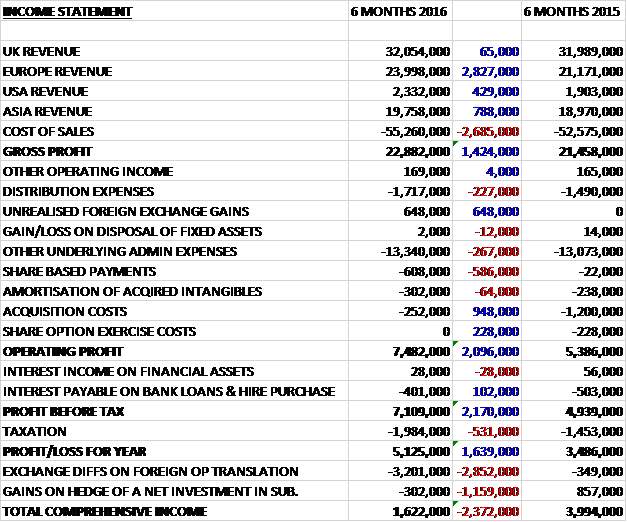
Revenues increased when compared to the first half of last year due to a £2.8M growth in Europe revenues, a £788K increase in Asia revenues and a £429K increase in USA revenue. After a growth in cost of sales, gross profit increased by £1.4M. Distribution costs increased by £227K but there was a £648K income from unrealised forex gains which more than offset the increase in other underlying admin expenses. We then see a £586K increase in share based payments offset by a £948K reduction in acquisition costs and a £228K fall in the share option exercise costs which meant that the operating profit increased by £2.1M. There was a reduction in the interest payable but this was more than offset by a growth in tax so that the profit for the first half of the year was £5.1M, an increase of £1.6M year on year.

TRIinterimassets16

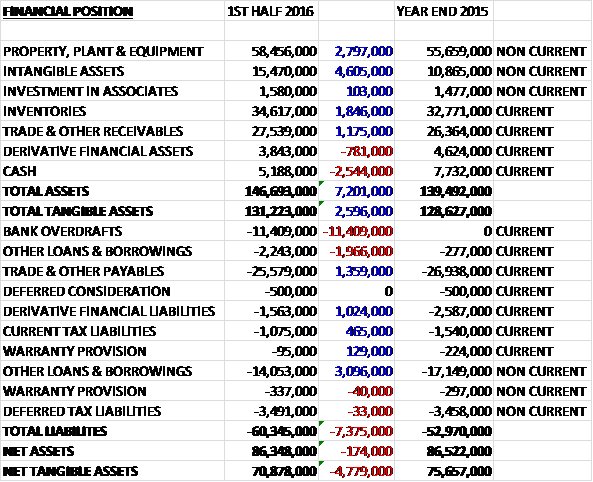
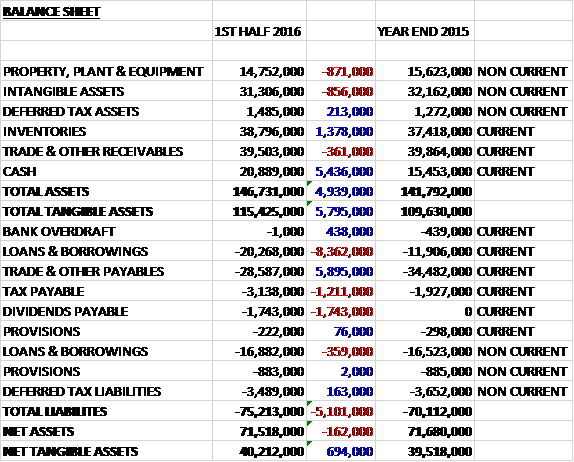
When compared to the end point of last year, total assets increased by £4.9M driven by a £5.4M growth in cash and a £1.4M increase in inventory, partially offset by an £871K fall in property, plant & equipment, and an £856K decline in intangible assets. Total liabilities also increased during the period as a £5.9M decline in payables was more than offset by an £8.8M growth in borrowings, a £1.7M dividend payable and a £1.2M growth in taxes payable. The end result is a net tangible asset level of £40.2M, an increase of £694K over the past six months.

TRIinterimcash16

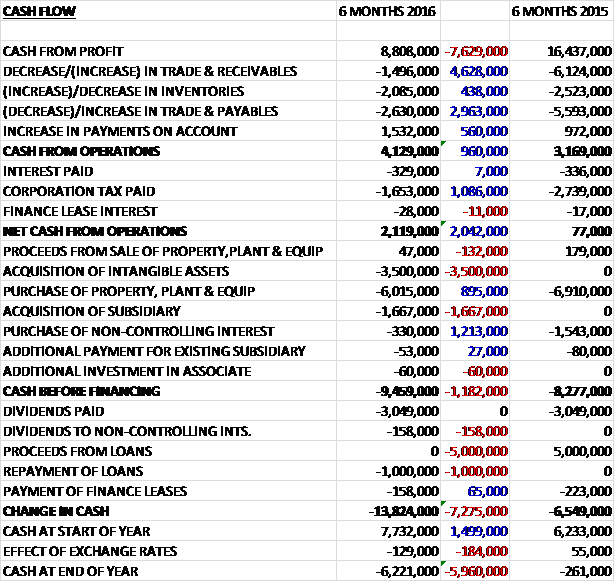
Before movements in working capital, cash profits increased by £2.1M to £8.4M. We then see a cash outflow from working capital (expected to reverse in the second half of the year), although this was less than last year and the tax payment was also below that of last time which meant that the net cash from operations came in at £2.9M, a positive movement of £6.4M year on year. The group then spent £769K on fixed tangible assets and £3.4M on the VIC deferred consideration so that before financing, the cash outflow stood at £1.1M. We then see £697K paid out in dividends and a net £8.4M taken out in new loans to give a cash flow for the period of £6.5M and a cash level of £20.9M at the end of the half.

Overall, the underlying operating profit at actual exchange rates increased by 22% to £8.6M with the organic growth in profits being £800K. The underlying operating profit in the UK business was £3.2M, an increase of £319K year on year; the underlying operating profit in the European business was £2.9M, a growth of just £44K when compared to the first half of last year; and the underlying operating profit in the US business was £247K, an increase of £54K when compared to the first half of 2015.

The underlying operating profit in the Asian business was £3.8M, a growth of £1.1M year on year. The Singapore location continued to perform very well with revenue growth of 19.5% but in contrast, the PSEP business in Malaysia reported a 9.6% decline in revenue. Both of these changes have arisen largely out of changes in product/sales quantities to specific key accounts in the region. The overall growth reflects increased business with certain key customers.

Sales in the UK and China were broadly flat, they fell in Hungary and Malaysia, whereas sales in the US, Sweden, the Netherlands and Singapore were substantially higher and the key customer order pipeline into 2016 apparently remains encouraging. The Italian operation continues to yield strong results and now the earn-out has been has been delivered, the integration of sales and marketing activities is gaining rapid momentum. Interestingly the group have stated that the cost gap between Italy and Taiwan is closing…

The factory extension at SFE in Taiwan has been completed and an additional section of new cold forging machines installed, increasing their total capacity in Taiwan by 15%. Before the end of the year, a six stage parts former, costing £1M, will be ready to commence production at PSEP in Malaysia. This will increase their capacity for complex larger components for the automotive, two wheel vehicle and compressor sectors. In the UK, this period has seen the trial and gradual introduction of computer controlled lean-lift stock storage and picking machines which are halving stock picking times and reducing warehouse space consumption so that the need for any new premises through business growth has been removed for the foreseeable future which in turn has led to the consolidation of the Poole warehouse into the Uckfield hub.

The group are looking at a number of new geographical areas, including Spain and Mexico for new business opportunities but there is no further information on this as of yet.

Just after the period end, the group acquired Kuhlmann for a total consideration of £6.2M. The initial amount of £4.9M was paid on completion in cash and £30K was satisfied by the allotment of 29,350 shares in the company. There is also a consideration of £1.2M deferred for a year and is to serve as a retention against which any potential warranty and indemnity claims will be offset. The group will be investing into Kuhlmann to further develop the opportunities in the German market and expect the acquisition to be earnings enhancing in the first full year of ownership.

Kuhlmann is a distributor of industrial fastenings within the domestic German market with a customer base in the principle sectors of machinery and plant engineering, sheet metal processing and industrial. The management team and previous owners will continue to run the business and last year it made a pre-tax profit of £1.4M, so a nice little business then which comes with goodwill of £2.2M and incurred costs of £300K. This buy should help the company in a large European market (the 4th largest industrial fastener market in the world) where they have apparently been constrained by the lack of a German speaking team.

The group have once again suffered from detrimental movements in exchange rates. The continued weakness of the Euro has reduced revenue growth from the European businesses by £2.1M and the recent depreciation of the Chinese Yuan and its wider impact on currencies across the Asian region has led to a decrease in the revenue from the Asian operations of £300K.

From the 1st October, Mark Belton took over as CEO after the retirement of Jim Barker who stays on as a consultant for the time being. Mark’s role of CFO has been taken on by Clare Foster who moves up from the position of financial controller.

Current global events have influenced the industrial sector’s confidence during the period but the group’s trading to date has not been unduly affected. Taking into account the current business climate the group are operating within, the board are optimistic about the group’s prospects and continue to expect its trading for the whole year to be in line with their expectations. As well as organic growth, the board have stated that they will continue to look for further acquisitions – I think I would rather they concentrated on bedding in the recently acquired businesses.

Looking forward, the order pipeline across the key locations remains healthy with continued sales growth expected primarily from Europe and the US but this is being tempered by a slight softening in demand in the UK where the group are starting to see some signs of hesitation and order deferral. In Asia, the substantial growth in the first half due to increased business with certain key customers has begun to slow down in the second half and at PSEP, slower order levels in the automotive sector are expected to continue in the short term. More positively, following the recent £1M capital investment programme, it is anticipated that the increased capacity in Malaysia will start to counteract any possible slowdown in 2017.

In Europe, the board expect organic sales to continue to grow on a constant currency basis and more generally the cost control and supply chain management is positively impacting margins, which will continue going forward, particularly with the ongoing investment into efficiency drivers such as the lean-lifts the group is rolling out across the UK business.

At the end of the period, the net debt stood at £16.3M compared to £17.5M at the same point of last time and £13.4M at the end of last year, although we should also note that just after the end of the half, the group spent £4.9M on the acquisition. After a 33% increase in the interim dividend, the shares are yielding 2% which increases to 2.1% on the full year forecast.

Overall then this has been a fairly good half year period for the group. Profits increased, net assets grew and operating cash flow improved, although this was not enough to cover the deferred consideration paid out. Profits improved in all regions with particularly strong growth in the UK, the US and Asia where an improved performance in Singapore more than offset weakness in Malaysia. European profits were broadly flat, not helped once again by Euro weakness, where a strong performance in Sweden and the Netherlands offset weakness in Hungary.

The capital expenditure seems to be doing fairly well, although a 15% capacity increase in Malaysia is fairly modest. The new picking machines in the UK sound very promising, however, with impressive efficiency savings and lower space requirements in the warehouse. The Kuhlamm acquisition does look good but I think I would rather the group concentrates on organic growth and brought the net debt down a bit which stood at £21.2M at the acquisition. The board have stated that full year expectations remain the same but the market in the UK is softening and the slowdown in Malaysia is continuing so this will have to be watched. In addition, the change of CEO suggest another potential risk. With a forward PE of 15.4 and yield of 2.1% the shares are decent value and I am tempted to buy in but there are nonetheless some potential banana skins in the near future which is holding me back a bit.

On the 16th February the group released a trading update for the last four and a half months. Whilst the UK industrial market has shown signs of some softening, the markets in both mainland Europe and Asia remain strong. Both Kuhlmann, acquired in Q3 and VIC, acquired in May 2014 are trading well and a combined investment programme of more than £1M is underway in both businesses to further develop the opportunities they have in their respective markets.

Sales enquiries remain brisk through the TR portal and this gives the board confidence in the continuing growth of the business. The order pipeline remains encouraging and they are in negotiations with a number of multinational OEMs to extend the plants they service and to widen the product ranges they currently supply so their long term expansion plans remain on track.

Although global sentiment and the Brexit debate might be influencing the current climate, from the group’s perspective, trading has not been unduly affected and they remain confident of meeting their full year expectations for 2016. Overall then, this is quite a nice update and I am tempted to take a position here.

On the 19th April the group released a trading update for the year. They had a strong finish to the year, benefiting from the ongoing focus on driving operational efficiencies, continued organic growth and a positive contribution from acquisitions. The board therefore expects the results for the year to be towards the upper end of market expectations.

Despite some slowness in the UK, the group’s markets in Asia and mainland Europe have remained strong and the order pipeline is encouraging, especially within automotive. The group have extended their relationship with a number of their multinational OEM customers by serving more plants and widening the product ranges they supply.

Following their investment programme in automation in Asia, Europe and the UK last year, the group are seeing an improvement in UK productivity whilst their operations in Italy, Malaysia and Taiwan have also benefited from this programme, giving them the opportunity to further extend sales and marketing initiatives on a domestic and global basis.

The German business acquired in October has performed slightly ahead of management expectations and the Italian business has had a solid year and contributed strongly, on a constant currency basis, to group performance.

Overall this all sounds good, probably already reflected in the share price but I might look to take a position on weakness.

Trifast Share Blog – Final Results Year Ended 2015

Revenue is derived from the manufacture and logistical supply of industrial fasteners and category C components. The automotive sector is the most important market, representing 31% of group turnover, with other markets including electronics and domestic appliances. The group still only has less than 1% of the global industrial fastener market.

Trifast has now released its final results for the year ended 2015.

TRIincome

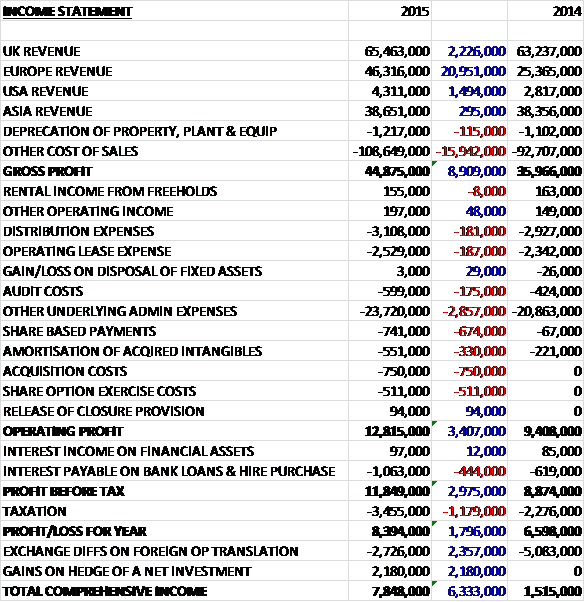
Revenues increased when compared to last year with a £21M growth in European revenue, a £2.2M increase in UK revenue, a £1.5M growth in North American revenue and a £295K increase in Asian revenue (although £19.6M of the increase is from the acquired business). Cost of sales also increased which meant that gross profit grew by £8.9M. There was a modest increase in operating lease expenses, distribution costs and audit expenses along with a £2.9M increase in other underlying admin expenses. We also see share based payments up £674K, a £330K increase in the amortisation of acquired intangibles, a £750K acquisition cost and a £511K share option exercise cost which gave an operating profit some £3.4M ahead of last time. Interest costs increased by £444K, mainly relating to the acquisition, and tax was £1.2M higher, again blamed on the acquisition as the tax rate is higher within that business, so that profit for the year came in at £8.4M, an increase of £1.8M year on year.

TRIassets

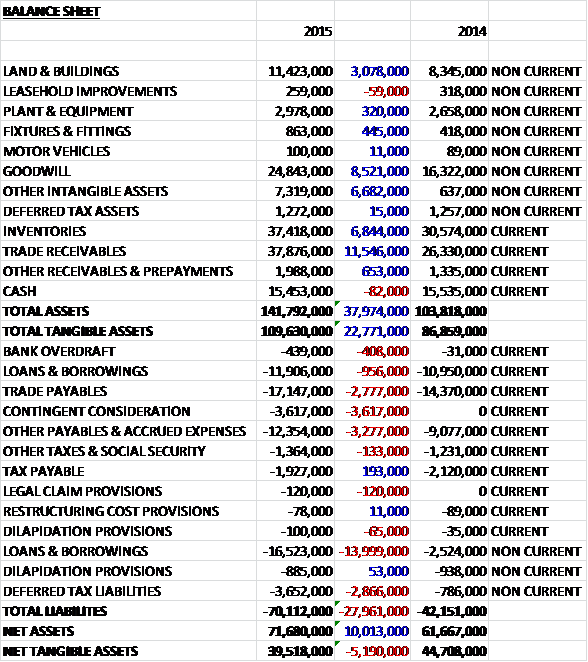
Total assets increased by £38M when compared to the end point of last year, driven by an £11.5M increase in trade receivables due to the acquisition, an £8.5M growth in goodwill, a £6.8M increase in inventories, a £6.7M growth in other tangible assets and a £3.7M increase in land and buildings. Total liabilities also increased during the year due to a £14.1M growth in borrowings, a £3.6M growth in contingent consideration, a £3.3M increase in other payables and accrued expenses, a £2.9M increase in deferred tax liabilities and a £2.8M growth in trade payables. The end result is a net tangible asset level of £39.5M, a decline of £5.2M year on year.

TRIcash

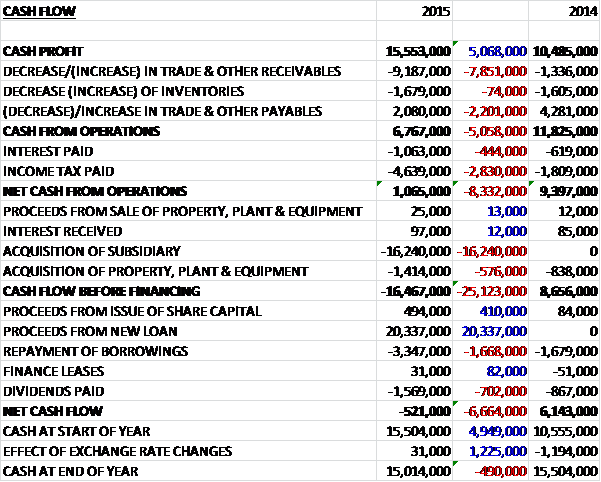
Before movements in working capital, cash profits increased by £5.1M to £15.6M. There was a large cash outflow form working capital, in particular a £9.2M increase in receivables, an increase in interest and a more than doubling of tax which meant that the net cash from operations was just £1.1M, a decline of £8.3M year on year. This did not cover the £1.4M spent on tangible fixed assets, a level of capex that is expected to continue going forward, let alone the £16.2M spent on the acquisition so that there was a £16.5M cash outflow before financing.

There was a net £17M received from new loans but £1.6M was spent on dividends which gave a cash outflow of £521K for the year and a cash level of £15M at the year-end.

The UK underlying operating profit was £5.8M, an increase of £300K year on year driven from the automotive sector as new products that were under development with customers in previous years came into production and this momentum is expected to continue. The electronics sector has also performed well, benefiting from an increase in demand from businesses supporting 4G technology. This year operating efficiencies have been achieved through the streamlining of the management structure and the investment of two automated storage systems at the Uckfield site.

These storage systems have had the added benefit of more than halving pick times in the warehouse and improving productivity. More units are expected to be rolled out in the UK in the medium term. During the new year, additional investment in people and equipment will be made to further enhance productivity.

The Europe underlying operating profit was £6.5M, a growth of £4.8M when compared to last year with £4.43M attributable to the acquired VIC business and a 30% increase on a constant currency basis. During the year, Hungary continued its strong growth, further increasing the group’s presence in the electronics sector. Holland saw its prior years’ momentum continue with a number of new automotive projects where production has commenced but the performance in Norway has been affected by the challenging conditions in the oil and gas industry.

The USA underlying operating profit was £327K, a growth of £80K when compared to 2014 reflecting the group’s strategy to grow its presence in the multinational OEM arena in the automotive sector with some automotive platforms in Europe moving over to the US.

The Asia underlying operating profit was £5.7M, an increase of £400K year on year with the growth driven by the Singapore and Taiwan business. The Singapore manufacturing plant has seen strong growth from its customers within the domestic appliances and electronics sectors and trading in Thailand and India has been in line with expectations with potential identified for further growth in these sites. In Taiwan, following the surge in growth experienced over the last few years, the local manufacturing site is now close to capacity. In January the board approved a capital investment project to extend and existing building on site and purchase new plant which is expected to become operational in Q3 2016 and will increase capacity by 15%.

China has recovered from the setback recorded a couple of years ago when one of its largest customer went into bankruptcy which resulted in losses at the business. It has subsequently been able to develop relationships with existing and new customers which is giving them a more evenly spread sector base and going forward they have already secured a strong automotive pipeline. In Malaysia, the business experienced a slight softening in its key markets during the year but in the medium term the board see this trend reversing as the development work put in with some major automotive OEMs bears fruit.

At PSEP the group are expecting to take delivery of a new large diameter cold forging machine. Costing some £1M, which is expected to become operational during the latter part of the new year and will provide a quantum leap in production capability, in particular with regard to the complexity and accuracy of customised components.

At the end of May the group acquired Viterie Italia Centrale (VIC) for an initial consideration of £22M satisfied by way of £19.65M in cash and £2.37M by the issue and allotment of 3M shares to the 30% owner of the business, Carlo Perini. At the date of the acquisition, a further £3.62M was due to the vendors based on performance criteria that was met during the year and this payment will be made in June. VIC is a manufacturer and distributer of fastening systems for the domestic appliances sector and significantly strengthens the group’s presence in that market and provides an additional manufacturing facility in Europe. In the ten months since the acquisition, the business contributed £4.4M to the operating profit of the group.

There are a large number of supposed non-underlying items at this company. The share based payment charge increased significantly, reflecting the new employee share plan and SAYE schemes approved in 2014 with £600K associated with the deferred equity bonuses awarded to the directors for this year and last, and £140K in relation to SAYE. The increase in the amortisation of acquired intangibles was due to the purchase of customer relationships, technology know-how and technology patents on the acquisition of VIC.

The total acquisition costs in relation to VIC amounted to £1.2M but after an exchange gain of £450K was recognised on the deferred consideration due to the weakening of the Euro, the net acquisition costs were £750K. The £511K costs on the exercise of executive share options related to national insurance costs in relation to the exercising of the shares, and finally there was a £94K release of the closure provision for TR Formac Shouzou after the closure process was completed. At the start of the year there were a lot of options outstanding after they were awarded following the financial crisis to further incentivise the directors to turn the company around. Some 4.5M were exercised during the year with another 3.6M outstanding at the year-end.

The group has quite a bit of debt with banking facilities with HSBC consisting of a term loan facility of €25M used to fund the acquisition of VIC – the balance of this loan is €23.75M at the year-end. There is also a revolving credit facility of up to £10M, none of which has been drawn down; asset based lending of £8.6M outstanding and a PSEP acquisition loan of £2.6M still outstanding. In total there is £18.6M of undrawn facilities relating to the full amount of the revolving credit facility and £8.6M in the asset based lending facility. A change of one point in interest rates would change profit by £250K.

It has been announced that CEO Jim Barker will step down in September but will remain on as a consultant until June 2016. The current Finance Director, Mark Belton will take over as CEO and Clare Foster will step up from her role as Financial Controller to CFO.

At this early stage of the year, the forward order book remains solid and the group’s trading performance has been good as it continues to benefit from the positive momentum seen in the second half of the year. The board are encouraged by the future growth profile of the business and the commercial progress looks set to continue positively over the next year.

At the current share price the shares trade on a PE ratio of 16.2 which falls to 12.2 on next year’s consensus forecast. After a 50% increase in the dividend, the shares are currently yielding 2.1% increasing to 2.4% on next year’s forecast.
Overall then, this has been a fairly decent year for the group but it has been dominated by the acquisition of VIC. Profits increased, mostly as a result of the new subsidiary, but net tangible assets declined and operating cash flow fell, although this was due to the large increase in receivables and cash profits grew. There was a good performance in all regions with the UK benefiting from growth in the automotive and electronics sectors. The growth in Europe was mostly due to the acquisition but there was some organic growth as a decline in the performance in Norway was offset by improvements in Hungary and the Netherlands with the latter benefiting from new automotive projects.

Progress is being made in Asia with Singapore doing well due to the electronics and domestic appliances markets; and Taiwan also performing well, although the factory there is pretty much at capacity and is undergoing investment to increase this somewhat – long term it might need more investment to cope with demand. The acquisition was not cheap but given VIC’s performance since it was acquired, it actually does look to be decent value and has been substantially earnings enhancing for the group. It is worth keeping an eye on share based payments as these do seem to be rather high and increasing, and the loss of the CEO might cause some disruption in the near term. The Forward PE of 12.2 looks rather cheap, however and there is a decent enough 2.4% forward yield on offer here, although it should be noted that there is now quite a lot of debt.

Dewhurst Share Blog – Final Results Year Ended 2015

Dewhurst has now released its final results for the year ended 2015.

DWHTincome

Revenues declined by £670K when compared to last year mainly as a result of currency movements but we then see a £177K fall in depreciation, a £194K increase in forex differences, a £402K growth in the gain on sale of property, plant & equipment and a £367K fall in other operating costs which gave an operating profit some £496K ahead of last year. The amortisation of around £270K per annum relates to Dual Engraving’s acquired customer list and will be fully written off in February 2016. A small increase in pension scheme costs was offset by an increase in finance income and a fall in tax to give a profit for the year of £4.4M, an increase of £476K year on year.

DWHTassets

When compared to the end point of last year, total assets increased by £706K driven by a £2M growth in cash and a £405K increase in deferred tax assets, partially offset by a £1.1M fall in receivables and a £434K decline in goodwill. Total liabilities declined during the year as an £896K fall in payables and a £641K decrease in the warranty provision was partially offset by a £348K increase in current tax liabilities. The end result is a net tangible asset level of £21.5M, a growth of £2.6M year on year.

DWHTcash

Before movements in working capital, cash profits fell by £1.2M to £5.4M. There was a cash outflow from working capital but this was lower than last year, mainly as a result of a fall in receivables, and the tax paid was lower so the net cash from operations came in at £3.6M, a decline of £326K year on year. The group spent £893K on tangible fixed assets, £61K on development costs and £77K on the shares of a subsidiary (Dual Engraving) but they did make some cash back from the sale of the remaining building on the Inverness Road site, to give a free cash flow of £3.1M before £768K was spent on dividends to give a cash flow of £2.3M for the year and a cash level of just under £15M at the year end.

After last year’s strong performance in the UK, sales dropped back this year, whereas all but one of the overseas businesses achieved better revenues. The continued strengthening of Sterling had an adverse effect of £1.1M on sales and £200K on profits.

Sales at the UK manufacturing business fell by 3% on last year, mainly as a result of reduced infrastructure spending in the UK. Last year, the general election caused a number of private and public authority projects to be stalled which added to the challenge of growing sales. Export sales have increased by 10%, however, with the primary growth areas being Canada, where they have been able to broaden the range of products they have sold to Dupar Controls; and the Middle East, where focused sales efforts have led to some reasonable signalisation orders from a range of customers.

The new UniBlade products and other products developed for Destination Despatch Lift Systems have sold well with significant projects won in the UK, Canada and Dubai for both new builds and modernisation. This year the group has made some significant investments in new plant, with the purchase of two new Arburg moulding machines, to replace existing machines that were over 20 years old. Towards the end of the year they also ordered a new Amada fibre laser cutter that they have now commissioned. Fibre laser machines are able to cut the stainless steel faceplates significantly faster than conventional machines and they also have lower running costs.

Thames Valley Controls struggled to live up to the excellent performance last year with sales falling 16%. Last year there was an unusually high number of projects which returned to more normal levels this year but the business still contributed strongly to group profits and new projects were won in the commercial sector including at Manchester’s Arndale Centre and for a building on Euston Road in London. They have continued to build on the success of their lift monitoring products by adding in new features and facilities, specifically an integrated CCTV function.

In line with the other UK businesses, Traffic Management Products encountered difficult trading conditions and sales fell 18% year on year but costs were well controlled and profits were not significantly impacted. The group have invested in new products with the launch of Evo N, the new reflective, reboundable bollard and they have also developed and launched a new range of Chevrons called Eco-Chev which incorporates TMP’s patented self-righting base which allows the Chevron to return to an upright position following impact.

Sales at the Hungarian business were broadly flat on last year, although price reductions meant that there was some growth in the number of units shipped. Improved processes at the factory in Hungary and the supply chain have enabled the business to reduce their costs and achieve some growth in profits despite the flat sales.

In North America, Dupar Controls experienced reasonable growth with a 15% increase in sales which created a challenge for production. There was a squeeze on margins with the Canadian dollar weakening against both Sterling and the US dollar, but despite this the business generated good profit growth. There was significant investment in new computer software to improve their processes and whilst this investment is ongoing, the board expect to see the rewards over the next year.

The business has also been involved in a major new product development and towards the end of the year they launched the US1 Touch Car Operating Panel which allows customers to create their own style of push button on the touch screen, with a background that complements the design of the building or lift car. It is a niche product, however, designed for high end installations and the board currently see it complementing their range of traditional push buttons rather than replacing them. The increased sales have meant that it has been critical for the group to continue to invest in new plant and machinery with another Amada fibre laser cutting machine ordered for Dupar and commissioned halfway through the year with them benefiting greatly from its increased capacity and reliability.

Sales have been flat at ERM over the last year but increases in costs pushed the business into a small loss for the year. It has been a difficult year operationally and they are now looking for a new general manager.

ALC saw strong demand this year and sales grew by nearly 20% and as a result, profits recovered considerably from last year’s disappointing level. The business is now working to increase its market share with the major lift companies to ensure that the growth in sales continues through the coming year. It was a year of consolidation at Lift Material with sales growing steadily by 10% year on year. They business continues to win contracts for EHC escalator handrails all around Australia and across the Asia Pacific region. Dual Engraving had a good year with 20% sales growth on last year. They have been involved in some major modernisation projects in Perth, the most notable of which was Central Park located in the city’s Central Business District with 23 lifts.

The Hong Kong business grew sales by just over 10% to achieve a record year for both sales and profit. They have been able to broaden their market and are now achieving notable levels of sales in other South East Asian countries, primarily Singapore and Malaysia.
The group have increased their investment in equipment this year with one new high speed laser machine purchased for Canada and another similar one ordered for Feltham. They have also replaced some of their older moulding machines.

The company has launched several products in the last three months that they have put considerable investment in during the year. The latest control system, Ethos 2, has been released after a lengthy development programme. This offers a touchscreen based control and integrated speed profiling, simplifying set up for their customers. They have also launched a touchscreen lift car operating panel and in the transportation division they have introduced a more robust and simpler version of the retroreflective reboundable traffic bollard earlier in the year and more recently a new highways passively safe chevron sign system.

There was no movement in the pension deficit bit it still remains rather sizeable at £12.2M. The scheme was closed to future accrual in 2010 and the group continues to pay a fixed sum of £1.4M annually to reduce the deficit. During the year, Dewhurst Hungary paid a confidential full and final settlement of all claims arising from the lawsuit in Arizona.

As seen above there was a £423K gain arising from the disposal of a property. The old factory site in Hounslow was sold in 2012 generating the cash to acquire and develop the current site in Feltham. At that time the property developers were not interested in acquiring the caretaker’s bungalow which was also owned by the group and was adjacent to the old site. The directors therefore chose to retain this property in the expectation that the redevelopment would enhance its future value with it being finally sold in May.

The group had a strong Q1 last year but it does not look as though it will be replicated in the coming year. Instead, the pattern from Q2 of last year onwards is continuing with demand in the UK rather weak, but most of the overseas markets are stable or gently growing. There are signs of potential future improvement in the UK with project activity quite high, but timing of orders are uncertain. At some point these projects will feed through to sales, but the business does tend to lag behind the general performance of the economy.

At the current share price they trade on a PE ratio of just 11 but this is expected to increase to 12.6 on next year’s forecast. After a 3p special dividend was announced following the sale of the remaining building on the Inverness Road site, the shares are yielding 2.3% which is predicted to remain the same next year.

Overall then this was a bit of a mixed year for the group. Profit did improve, although most of the increase was due to the gain on the sale of the Hounslow property and a strong Q1. Net assets also grew but operating cash flow declined year on year. Despite this, the group still generated a pleasing amount of free cash. Overall, conditions in the UK are difficult with reduced infrastructure spending which is being partly blamed on the election but that was some time ago now and conditions have not improved. Sales in the UK manufacturing business fell along with those in Thames Valley Controls and Traffic Management Products, although tight cost controls in the latter business meant that profits were not badly affected.

Overseas the position is rather better with good export orders headed to Canada and the Middle East, although the weak Canadian dollar has mitigated the strength there. In Hungary, lower costs meant that profits improved and in Australia, ALC and Dual Engraving performed well, although ERM made a loss. Again, though, the decent performance in Australia was constrained by the weak Aussie dollar. Demand in the UK has remained poor in Q1 of 2016 but with a forward PE of 12.6 and yield of 2.3% these are probably price about right at the moment in my view. A great, cash generative company that is well run but is facing some headwinds in its home market.

On the 2nd February the group released an AGM statement. The weakness in the UK has continued and shows no immediate signs of improvement although the recent fall back of the pound from its peak levels is welcome. In addition, demand for the keypad products unexpectedly and rapidly slowed in Q1, although it has since stabilised. In those markets where sales remain reasonable the group have been under pressure on margins. At present there is no significant improvement expected in the immediate future and in the medium term it seems as though the pipeline of prospective projects are converting to orders more slowly.

The combination of lower short term demand, margin pressures and adverse exchange rates means that the board currently expect 2016 revenue and profit to be materially below those for last year. This is a very disappointing statement and I am surprised the shares have held up as well as they have to be honest.

Photo-Me International Share Blog – Interim Results Year Ending 2016

Photo-Me has now released its interim results for the year ending 2016.

PHTMincomeinterim

Revenues fell when compared to the first half of last year due to adverse currency movements (they showed modest growth on a constant currency basis) with a £2.3M decline in European revenue, a £727K decrease in UK and Ireland revenue and a £621K decline in Asia revenue. Depreciation and amortisation also fell by £516K and other cost of sales declined by £3.4M so that gross profit increased by £364K. Other operating income fell by £187K, and there was a £135K decline in gains from exchange differences with a decrease in corporate costs broadly offset by an increase in other admin expenses but the lack of the £3.4M gain on the sale of vacant land at Bookham meant that operating profit was down by £3.3M. Finance revenue increased by £380K and the total tax charge fell by £1.2M which meant that the profit for the year came in at £18.8M, a decline of £1.7M year on year.

PHTMassetsinterim

When compared to the end point of last year, total assets increased by £13.7M driven by a £7.8M growth in cash, a £1.9M increase in property, plant & equipment, a £1.7M growth in inventories and a £1.5M increase in goodwill. Total liabilities also increased during the period as an £11M growth in payables and a £4.9M increase in bank loans were partially offset by a £1.5M fall in provisions – I am a little uneasy about the large increase in payables and the new bank debt given the large cash pile – what is that for? The end result is a net tangible asset level of £84.2M, a decline of £3.5M over the past six months.

PHTMcashinterim

Before movements in working capital, cash profits increased by £640K to £30.6M. There was a modest outflow of cash through working capital, in particular an increase in inventories and taxation was £637K higher to give a net cash from operations of £23.1M, broadly flat year on year with a £51K decline. The group spent £9.8K on property, plant & equipment, mainly relating to photo booths and vending machines, £1.5M on intangible assets relating to R&D, and £563K on investments in an associate to give a free cash flow of £12.2M, of which £8.7M was spent on dividends and inexplicably the group took out £5M of new borrowings which meant that the cash flow for the period was £8.6M and the cash level was £66.4M at the period-end.

The operating profit in the Asian business was £3.5M, an increase of just £26K year on year. The largest territory by far is Japan where performance was strong in the first half. Revenues were up by 2.8% at constant currency with profits up 10% on the same basis. The medium term outlook for Japan is good with the government introducing new ID cards for every resident in the country from 2016 to be used primarily for tax and social security purposes. Asia is seen as a promising market for the laundry product in the medium term and the group is intending to start trials in Japan and China. Gradual progress continues to be made in China and Korea where turnover rose by 23% and 123% respectively, albeit from a low base.

The operating profit in the European business was £17.6M, a decline of £846K when compared to the first half of last year. On a constant currency basis, photo booth turnover grew by 2.7% with the takings of the laundry machines operated by the group more than doubling. On a constant currency basis, operating profits rose by 3.8%. The European photo booth estate increased by 1.4% year on year with the main areas of growth being France, Germany and Switzerland where in spite of the challenging conditions of the mature ID photo market, the performance benefited from the continued rollout of higher margin Starck booths. Across Europe, 3,263 Starck booth have now been deployed.

The rollout of the laundry product continues to progress well. At the end of the period, the group had sold 497 of these units and operated 1,200. The results from the units in operation in France, Ireland and Portugal remain encouraging with monthly takings averaging €1,400 during the period across the more established machines in the operating estate. In the six month period, the turnover of the laundry business increased by 90% to £5.5M.

The most recent laundry launch has been in Spain, a new territory for the group, where there are now a handful of units with supermarkets and petrol stations being the initially targeted sites. They are also considering additional country launches. The gradual planned expansion of capacity in the manufacturing facilities for the laundry business is proceeding according to plan with a current capacity of about 80 units per month. The group has recently finalised the design of “Revolution 2”, expected to be launched in 2016, which again comprises three machines but with a footprint of only 5sqm compared with 10sqm for the current model. This is expected to increase the potential market for the product overall and is likely to be more attractive in Far Eastern markets.

The group continues to operate over 4,700 digital printing kiosks, primarily in France and Switzerland, which are being progressively upgraded to accept all models of memory cards and other media. The new Starck design kiosk has also recently been introduced into a number of locations in France. The new kiosks are fully integrated to major social media networks and enable easy photo printing from smartphones. The initial results of that new product range are promising and trialling will continue in France in coming months. Aside from the new printing kiosk and new versions of the Starck photo booth, work continues on the 3D technology, a compact version of the automated laundry product as well as the optimisation of the energy consumption in photolights.

The operating profit in the UK and Irish business was £5.5M, an increase of £379K when compared to the first half of 2015, driven by operational cost optimisation despite a contraction in turnover. Growth in photo booth numbers was 1.6% year on year while there was a 20% reduction in amusement machines which perform below the group profitability standards due to increasing maintenance costs.

During the period the group signed a five year agreement with Moneygram which would see them roll out money transfer services at Photo-Me’s photo printing kiosks worldwide. They are developing a specific version of its kiosks enabling the new service to be launched on a trial basis in France in 2016. The group have agreed with Karcher, a three year exclusivity in the French car wash retail market in order to support possible larger scale expansion after the trial period. The focus is now on rolling out their laundry product line aggressively with an increasing focus on developing new markets for the photo printing lines and the photobooths, through 3D and extensive technological enhancements to anticipate the new standards in 3D face recognition.

I am a little confused as to why the group has taken out loans of £4.9M when it has cash of £66.4M. I am also a little concerned that in their net cash calculation they are not including the non-current bank loan of £4.2M – why not? Are they trying to hide it?

In October the group acquired Fowler UK.com, a business that supplies and installs laundry and catering equipment. The total consideration paid was £2.3M consisting of “accrual for investment” (whatever that is) of £1.9M and contingent consideration of £400K. The group expects the distribution of the group laundry equipment to be facilitated by using Fowler, which also has an established network of service engineers. The business also has good expansion opportunities in the wider laundry business under the group’s ownership.

Historically the first half of the year is seasonally the stronger for the group and this is expected to be the case again for this year but overall the board remain confident of the outlook for the business over the rest of the year. After a 10% increase in the interim dividend, at the current share price the shares have a dividend yield of 3.3% which increases to 7.4% on the full year forecast.

Overall then, this has been a bit of a mixed six month period for the group. Profits fell year on year but this was entirely due to last year’s sale of the vacant land at Bookham and underlying operating profits were broadly flat. The net assets did fall, though, as the group took out a loan and the payables increased considerably. The operating cash flow was broadly flat due to an increased tax payments but the cash profits increased and the group generated a decent amount of free cash. Operationally, both Asia and Europe suffered from forex movements which meant that operating profits were flat and declining respectively (both increased on a constant currency basis). In the UK, profits did increase due to lower costs.

As usual there are a number of schemes that are being considered with the car wash concept undergoing trials and the money transfer service a new one on me (with not much information given either). The second half of the year is usually not quite as strong and this is expected to remain the same this time and with a lot of cash and a yield north of 3.3% the shares look decent value but I am a little uneasy about some of the items this time – I would have liked some explanation on the large increase in payables and the new debt – is it a hedge against further Euro weakness or are they stepping up for a large acquisition? So, in conclusion I am still invested here but am thinking about realising some profits to be on the safe side.

On the 8th January the group gave an update of trading in Japan where they are benefiting from the introduction of new ID cards for every resident in the country. Trading in Japan in both November and December showed a very significant uplift over the same period of the prior year, with takings about 90% higher which is well ahead of board expectations. Whilst to date, they have only seen an impact on trading in these two months, if a similar level of sales were to continue in the remaining four months of the year, then the group would expect to report results materially ahead of current market expectations. This is a good update but I note they leave wiggle room in case the rest of the year doesn’t match up.

On the 26th February the group released a trading update. They confirmed that trading in Japan during January remained strong, supported by the strong start of the “My Number” programme. For the group as a whole, Q3 turnover was 11% higher with profits up by 90% at constant rates. The much better than expected performance in Japan coupled with the year to date performance in the rest of the business where laundry continues to produce strong results leads the board to conclude that pre-tax profits for the year will be more than £40M. If the Japanese business continues its strong performance in Q4, the eventual outturn for the year is likely to be in excess of this.

Also, the group announced that they have a number of initiatives underway to introduce the next generation of secure ID technology into its booths and is announcing the start of a major initiative in France. They have obtained the first agreement with ANTS to allow the delivery of a digitised e-photo and signature, fully compliant with the new requirements. This document is sent from the photobooths via a secure server.

All of their French photobooths will be upgraded and capable of delivering this service and the new connected secure system is being deployed nationally, beginning in Paris. About 2,000 machines should be upgraded by the end of June and the balance converted progressively in the coming months, with the intention to complete the rollout before the end of 2016.

This approach provides a higher level of security to the French authorities and requires no investment by them. In addition, for the public it simplifies the license application process and is expected to be beneficial to photobooth usage and revenue. The group will provide further details of its other initiatives undertaken in the field, including its work in Germany, Switzerland and China at a later date.

On the 27th April the group announced that they are in discussions with Asda Stores to acquire their UK Photo Product division assets with a view to operating the business from Asda Stores. No further information is given at this stage.

Solid State Share Blog – Interim Results Year Ending 2016

Solid State has now released its interim results for the year ending 2016.

SOLIincomeinterim

Revenues increased by £4.9M when compared to the first half of last year due to the first contributions from the MoJ contract and Ginsbury Electronics –like for like revenues were flat, but after a growth in cost of sales, the gross profit was just £586K higher. Distribution expenses grew by £97K but there was no share based payment this time which accounted for £117K in the first half of last year. Other admin expenses increased by £610K though which meant that the operating profit fell by £31K. A doubling of finance costs was more than offset by a £191K positive swing in taxation with a rebate this time to give a profit for the six month period of £1.5M, an increase of £132K year on year.

SOLIassetsinterim

When compared to the end point of last year, total assets increased by £1.6M to £24.4M driven by a £1.6M growth in receivables, a £718K increase in inventories and a £500K growth in intangible assets, partially offset by a £1.4M decline in cash. Total liabilities also increased due to a £478K growth in payables and a £121K increase in the overdraft. The end result is a net tangible asset level of £7.3M, an increase of £347K over the half year period.

SOLIcashinterim

Before movements in working capital, cash profits were broadly flat, increasing by just £33K. A cash outflow from working capital, in particular an increase in receivables was partially offset by no tax being paid so that the net cash from operations was £650K, a decline of £1.6M year on year. The group then spent £398K on tangible fixes assets and £25K on computer software before the £1.1M spent on the acquisition meant that before financing, there was a cash outflow of £871K. The group then spent £670K on dividends that it couldn’t really afford to give a cash outflow of £1.5M over the six month period and a cash level of just £321K at the end of the half year.

The Steatite business faced a challenging first six months of the year due to a softening of the UK’s manufacturing sector and delays to two major programmes, one being the MoJ contract and the other being a programme to supply antennas, which is now underway and will make a contribution in the second half of the year. Due to these delays, however, the gross margins in the division were below that of last year. There have been some contract awards at a higher system integration level which will have a positive impact in the ensuing months along with the completion of a new design for ticketing machines for the rail industry with orders expected to start in the second half.

Construction is now underway on a new leasehold facility for the Q-Par antenna and subsystems operation close to the existing facility in Leominster. It is expected to open in Q1 2017 and will more than double capacity and incorporate a new group pre-compliance test centre which will increase in their in-house test capabilities and save outsourcing costs. The Steatite business has a healthy pipeline of prospects in the second half which include programmes in the government and transport sectors and its secure communications product range. As a result both the Steatite and Q-Par parts of the division are on course for a stronger second half.

During the period the group recognised £3.5M of revenue as part of the mobilisation element of the MoJ contract. This part of the contract is at low margins compared to the actual delivery part of the contract. Additional mobilisation revenue will be recognised in the second half of the year but will be less than in the first half. Unfortunately the delivery schedule to the contract has encountered delays. Steatite has to date fulfilled its contractual requirements but the overall project is made up of a consortium of suppliers and therefore there is a dependence on other parties for the project to roll out in unison as a fully operating upgrade to the existing offender tagging estate. The group expect to be updated on the revised roll out to this client in the new year but no significant deliveries are now expected in the current financial year.

The supplies division has experienced a softening in its markets in the first half. Like for like margins were down but the overall gross margin was up as the division benefited from Ginsbury’s higher margin products. Client order patterns show that the industry as a whole has moved from committing to long term scheduled orders to placing shorter term orders which is consistent with previous periods of market softening. The effect of this is a reduction in the order backlog, but billings are holding which demonstrates that the overall demand has largely remained constant despite the reduced revenue visibility.

The business negotiated two important new franchise contracts with Luminus and Silicon Labs. Luminus brings new high value products to the LED lighting sector of the business and is expected to start contributing to revenue in Q4 this year whilst Silicon Labs is a supplier of low energy microprocessors and radio devices with additional revenues expected in 2017. Commission income on overseas or indirect sales has improved during the period and is now 50% above forecast, in line with the growing recognition from suppliers of the design work carried out by the company in the UK.

At Ginsbury, turnover is currently running behind plan but concerted efforts to increase margin have seen the gross profit margin up 2% thus reducing the impact of the lower sales on net profit. Efforts to generate new sales through cross selling with Solid State Supplies are progressing well and cross training has been completed with some early sales successes already recorded. Furthermore, the single board computer platform developed as an own brand product range by Ginsbury has been well received with several potential customers now evaluating it. Recognising the softening in its market, however, the division has taken steps to reduce its cost base and as a result expects to see a stronger performance in the second half.

At the beginning of the year, the group completed the acquisition of Ginsbury Electronics for an initial cash consideration of £1.6M and a further £525K payable in three equal six month tranches. The business specialises in the supply of high quality display components, monitors, panels, signage and power components to the commercial, retail, industrial and military markets throughout the UK and Europe. It is expected to make a positive contribution to the performance of the group in the current financial year. The board remains active in pursuing acquisition opportunities, particularly in the battery and added value services sectors.

The group have announced they will be appointing Mark Nutter as finance director and he will start in January. At the period-end, the order backlog stood at £18.1M and as in previous years, the order intake and sales performance is expected to be second half weighted. The announcement of delays to the MoJ contract has caused expectations for the group to be revised for the current year and at present the board do not have visibility on how the contract will impact the next financial year. While they are pressing for clarity on the issue, it remains largely out of their control. The project is high priority for the MoJ and the directors are confident that the contract will be fulfilled.

A softening in the group’s markets have resulted in a slower start to the year than the directors would have liked. Nevertheless they remain confident about the prospects across the group and expect an improved performance in the second half. In response to the current state of the market the board has implemented a cost reduction programme which will deliver savings of approximately £500K in the full year of 2017. After the interim dividend remained the same, at the current share price the shares yield 2% which is expected to remain the same on the full year consensus forecast.

Overall then this has been a fairly difficult half year period for the group. Profits did increase but this was only due to a tax rebate and pre-tax profits were down. Net assets did improve but the operating cash flow fell due to an increase in receivables with cash profits broadly flat. The Steatite and Q Par businesses saw softening in their markets which was exacerbated by delays to an antenna supply contract, which has now started, and the MoJ contract which is still clouded by uncertainty over the timings. The supplies business has also seen softening markets, although it did benefit from the Ginsbury acquisition.

The group’s markets seem to be worsening and the delay to the MoJ contract is an unwelcome concern. With a dividend yield of 2% and a forward PE ratio of 18 these shares do not seem to be factoring in these risks in my view and look too expensive.

On the 25th February the group announced that it had been informed by the MoJ that it was terminating the contract for Electronic Monitoring Hardware. The group is to enter discussions with the MoJ regarding the terms on which the relationship will end. This is very disappointing since in the past the board had stressed there was a delay only and the contract was still going ahead. This was supposed to be very material for the group so is a major set-back. The silver lining is any compensation they may be due from the MoJ regarding the termination and the reduction in the share price has actually brought this down to an area that I am much more interested in.

On the 27th April the group released a trading update covering the year ended 2016 in which they stated that trading in their core businesses is expected to be in line with market expectations. The overall final result for the year will be dependent on the completion of negotiations in relation to the settlement of the terminated contract with the MOJ which are now at an advanced stage. The group has entered the new financial year with healthy order books although on a like for like basis the backlog of £13.94M was below the £14.41M at the end of the prior year. Including Ginsbury, which was acquired during the year, however, the backlog was £15.34M.

On the 1st June the group announced the acquisition of Creasefield for a maximum consideration of £1.54M. A cash consideration of £1.4M will be paid on completion from the group’s existing bank facilities with a further £140K payable once completion accounts are agreed. The business specialises in the design and manufacture of custom battery packs to a diverse range of industry sectors such as commercial aerospace, oil & gas, medical, subsea, safety, water, rail, military, security and government. Their operations are complementary to the existing battery operations at Solid State and will allow for wider use of IP, design and engineering capability, cross-selling of existing products and development of sales into new markets.

Last year the business generated an EBITDA loss of £60K and the acquisition generated goodwill of about £71K. The board believe that Creasefield will make a limited but positive contribution to the group performance for the rest of the year and a more significant contribution in 2018. Overall, this looks to be a decent, albeit small, acquisition.