Tristel Share Blog – Interim Results Year Ending 2016

Tristel has now released its interim results for the year ending 2016.

TSTLinterimincome

Revenues increased when compared to the first half of last year with a £418K growth in human healthcare revenue, a £103K increase in animal healthcare revenue and a £77K growth in contamination control revenue. Costs of sales were broadly flat so that the gross profit was £610K above that of last time. The big difference, however, is a massive £948K hike in share based payments which, after a £250K increase in other admin expenses meant that the operating profit fell by £567K. Tax was slightly higher and finance costs were broadly flat so that the profit for the half year came in at £192K, a decline of £581K year on year.

TSTLinterimassets

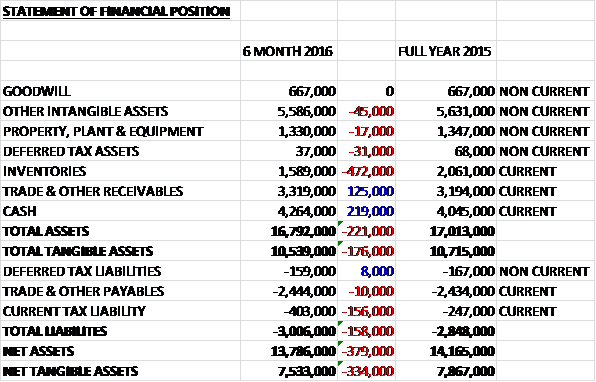
When compared to the end point of last year, total assets declined by £221K driven by a £472K fall in inventories, partially offset by a £219K growth in cash and a £125K increase in receivables. Total liabilities increased during the year, mainly as a result of a £156K growth in current tax liabilities. The end result is a net tangible asset level of £7.5M, a decline of £334K over the past six months.

TSTLinterimcash

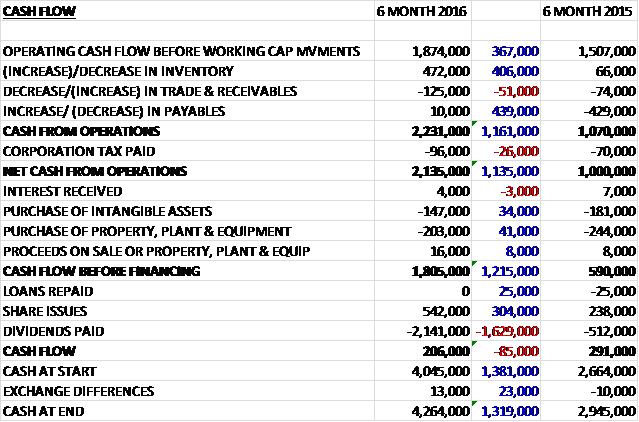
Before movements in working capital, cash profits increased by £367K to £1.9M. There was a cash inflow from working capital due to a decrease in inventories but tax paid increased by £26K to give a net cash from operations of £2.1M, a growth of £1.1M year on year. The group spent £147K on intangible assets and a net £187K on property, plant and equipment to give a free cash flow of £1.8M, although this did not cover the £2.1M paid out in dividends but after £542K was earned through share issues, there was a cash flow of £206K and a cash level of £4.3M at the period-end.

Overseas sales accounted for about 36% of total revenue and increased by 20% during the period. These overseas markets are needed to counteract the “anticipated” slowing of sales growth in the UK. The board hope to achieve this through a combination of targeting more rapid growth in overseas markets and a steady pipeline of new product launches. Slowing growth in the UK is basically as a result of market saturation of Tristel products in the clinical areas of the hospital that they target. They have started a programme to cull lower margin products which do not incorporate their chlorine dioxide chemistry. It is interesting that they state the slowdown was anticipated as I was not expecting it so I would question how efficient management have been in communicating this slowdown to their shareholders before now.

The gross profit in the Human Health division was £5M, a growth of £454K year on year; the gross profit in the Animal Health division was £344K, an increase of £100K when compared to the first half of last year; and the gross profit in the Contamination Control division was £399K, a growth of £56K year on year.

As far as the overseas markets are concerned, overseas distributors increased by 17%; German sales grew by 31% on a constant currency basis to £794K; Australian sales increased by 12% on a constant currency basis to £491K (although they were flat at actual currencies); and China increased by 52% at constant currencies to £486K. The board expect international markets to maintain the group’s momentum over the course of the next couple of years as they wat for new product developments to gain traction for new market territories to open up in America.

The group have invested in new manufacturing equipment for their burstable sachet, of which they produced 1.4M units in 2015; they are currently midway through an investment programme to automate their product assembly lines; they have completed the implementation of an ERP system and rolled it out across their UK operation and overseas subsidiaries; and they have converted their German branch operation into a subsidiary with the plan being for their Berlin based team to expand their activities throughout Central Europe.

The group have embarked on an FDA regulatory programme in order to enter the US market. During the half they spent £40 on fees and testing costs in the pursuit of this programme and have presented a preliminary dossier to the FDA to seek their guidance on their approach to data generation for a 510(K) submission. Once they have this feedback, they will be committing to a substantial investment that is still to be made if they are to attain an FDA approval. This additional spend will be material and will be incurred in H2 this year and also next year but management believe that they can maintain a 15% pre-tax margin throughout this period of heavy investment.

The Biocidal Products Regulation is intended to harmonise the European market for biocidal active substances and products containing them. To conform to this regulation, manufacturers of disinfectant products will have to make substantial investments. As part of this regulation, the group have stopped manufacturing and supplying a number of lower margin non-chlorine dioxide products and they may eliminate further products from their portfolio which will act to dampen top-line growth but will make the group a more efficient and higher margin business.

During the period an unusually large share-based payment charge of £1M was incurred. This expense was calculated on the fair value of share options granted in the period and is higher if the options have vested. With the increase of the group’s share price since its low point of 20p in 2013, the majority of staff scheme options have vested and during the period, 35 employees exercised a total of 793,000 options.

In addition, a senior management scheme was agreed by the board in April 2015. This scheme was based on certain profit and share price performance conditions over a three year period. On the date the scheme was approved, the share price was 70p and on the date the scheme was announced the shares were at 96p. A vesting condition of the scheme was the share price staying above £1.34 for thirty consecutive dealing days and in December 2015 this condition was met. I have to say this is a little galling considering the shares are now below this level and had the board properly communicated the slow-down in UK growth at the last update, it is doubtful whether this condition would have been met. This is very disappointing in my view.

During the year the board has been joined by David Orr as a non-executive director but the search is apparently continuing for a replacement of “interim” Chairman Francisco Soler.
Two products have been selected for the group’s approach to the US market and they are in dialogue with the FDA in preparation for a full regulatory approval submission during 2016.
Going forward, the board have stated that overseas sales are stronger in the second half of the year and traditionally the group is more profitable in this period of the year but with the increased investment in new products and the FDA submission, they expect a more equal split this year.

At the period-end, the group had a net cash position of £4.3M compared to £2.9M at the same point of last year. At the current share price the shares trade on a PE ratio of 22.1 which reduces modestly to 22 on the full year forecast. After a 95% increase in the interim dividend and including the special dividend, the shares are currently yielding 5.4% but this reduces to 2.5% for the full year.

On the 25th February the group announced that directors Francisco Soler, Paul Swinney, Liz Dixon and Paul Barnes purchased shares in the company. They purchased 61,200 shares at a value of £61K; 5,000 shares at a value of £4,700; 5,000 shares at a value of £4,800; and 30,000 shares at a value of £31K. It has to be said that these are not particularly material purchases. Francisco Soler for example owns 10,686,188 shares and Paul Swinney now owns 925,000 shares.

Overall then this has been a difficult period for the group. Profit fell year on year due to the share-based payments and net assets declined. The operating cash flow did grow and was strong, with plenty of free cash generated, however. The overseas growth has been impressive but this is offsetting a slow-down in growth in the core UK market as the group apparently nears market saturation.

The FDA regulatory application is an exciting development but the costs will be material in the short term with further short-term headwinds in the form of the EU Biocidal Products Regulation. These issues along with the sour taste the share based payment debacle leaves make me reconsider whether I should be invested here. The full year PE ratio is a whopping 22 which is too high in my view, even when the cash pile is considered. The forward yield of 2.5% is nice to have but I feel these shares are somewhat overvalued so I have sold out on the back of these results. I still like the story but I want to see more clarity on the rate of slow-down in the UK market and how much of a drag the extra regulatory costs will be before buying back in.

Chairman Francisco Soler has been on a bit of a spending spree. On the 29th Feb he purchased 112,038 shares, and on the 2nd March he bought 36,762 shares. This totals 148,800n shares at a value of nearly £169K so is a fairly hefty buy in a (fairly successful) attempt to prop up the share price.

On the 9th and 10th Francisco Soler purchased yet more shares, this time 30,000 at a value of £34K.

On the 14th March it was announced that Chairman Franciso Soler purchased yet more shares, this time 36,521 at a value of about £41K.

On the 21st July the group released an update covering the year ended 2016. Turnover increased by £1.7M and pre-tax profit excluding the huge share based payments grew by £500K to £3.1M, which is ahead of market expectations. In the second half, revenue from overseas markets contributed 41% of the total compared to 36% in the first half.

The group has generated significant levels of cash and at the year-end, cash balances were £5.7M with not debt, compared to £4M a year ago. The board has decided to return to shareholders some of this cash so a special dividend of 3p per share has been declared. After the payment of the dividend, the group’s ongoing intention is to retain cash reserves in excess of £3M.

They have also announced the acquisition of Ashmed, the group’s distributor in Australia, for a consideration of A$1.35M plus compensation payments for the re-purchase of inventory. The business brought in sales of A$3M during the past year and is profitable. The group expects the acquisition to significantly improve margins on sales to the Australian hospital market and it will be earnings enhancing with the business expected to contribute incremental earnings of at least £100K during the current year.

The plans to enter the US market remain on track following a meeting with the FDA in April. They also continue to actively pursue registrations with the Environmental Protection Agency. Following the FDA mee5ting and detailed investigation into the product approval requirements of the EPA, the group has multiple test programmes underway.

UK revenues in the second half were £5.3M, an increase of 10.4% year on year and overseas revenue was up 19% to £3.7M. This all sounds very favourable but as has been seen in the past from the group, it is what is not being said that is important – I suspect that UK profits have not fared as well. Nevertheless, overall the group seem to be making progress so I have bought back in here.

Pan African Resources Share Blog – Interim Results Year Ending 2016

Pan African Resources has now released its interim results for the year ending 2016.

PAFinterimincome

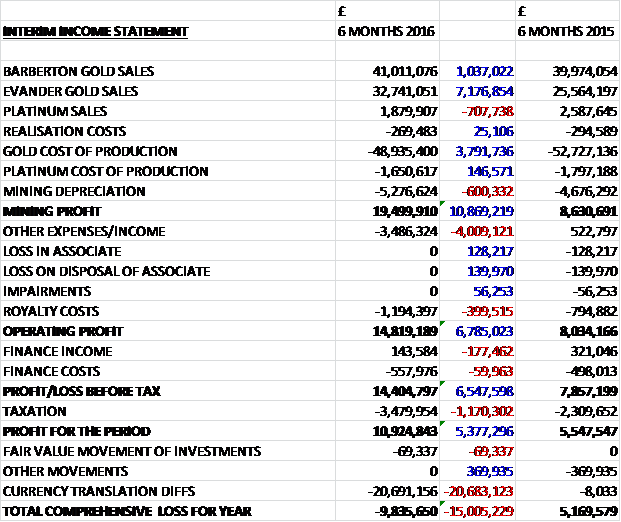
Revenues increased when compared to the first half of last year as a £707K decline in platinum sales due to lower tonnages processed and the lower price of platinum was more than offset by a £1M growth in Barberton gold sales as a result of improved gold sales, and a £7.2M increase in Evander gold sales. The cost of production decreased by £4M due to the depreciation of the rand (rand denominated costs increased) but mining depreciation grew by £600K to give a mining profit some £10.9M above that of last time. There was another expense of £3.5M compared to an income of £523K which at least partly related to gold price hedges in the first half of 2015, and royalty costs increased by £500K to give an operating profit £6.8M ahead. Finance income was down by £177K and there was a modest growth in finance costs so that after a £1.2M increase in tax, the profit for the half year came in at £10.9M, a growth of £5.4M year on year.

PAFinterimassets

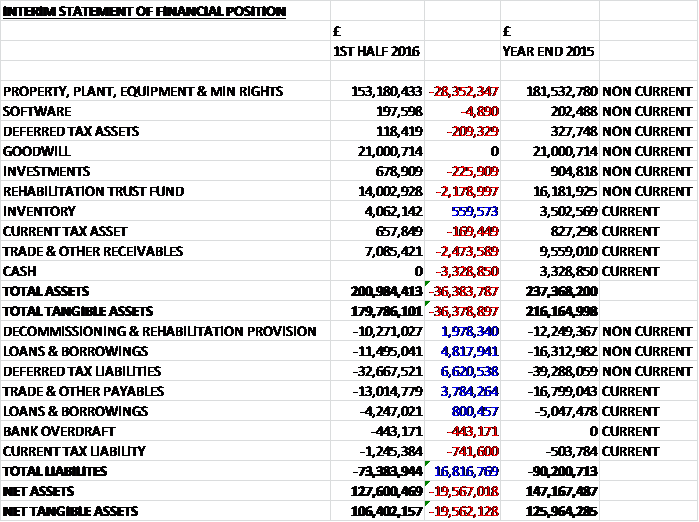
When compared to the end point of last year, total assets declined by £36.4M, driven by a £28.4M fall in property, plant, equipment and mineral rights; a £3.3M decrease of cash, a £2.5M decline in receivables and a £2.2M fall in the value of the rehabilitation trust fund due to the Rand depreciation. Total liabilities also declined during the period due to a £6.6M fall in deferred tax liabilities, a £5.6M decline in borrowings due to a decrease in the Evander Mines’ gold loan and the revolving credit facility, a £3.8M fall in payables and a £1.9M decrease in the decommissioning and rehab provision. The end result is a net tangible asset level of £106.4M, a decline of £19.6M over the past six months.

PAFcash

Before movements in working capital, cash profits increased by £8.4M to £19.5M. There was a modest outflow through working capital, although this was less than last time and after a growth in finance costs was offset by a fall in royalties paid, and tax increased by £924K, the net cash from operations came in at £14.1M, a growth of £8.4M year on year. The group spent £6.2M on capex relating to £2.3M at Barberton Mines, £400K on the BTRP and £3.5M at Evander Mines to give a free cash flow of £7.9M which did not cover the dividends of £9.3M so there was a cash outflow of £2.4M for the period and a cash overdraft of £443K at the period-end.

Overall gold sales increased by 17.4% to 101,797 ounces. All in sustaining cost per ounce declined from $1,165 per ounce to $908 per ounce and the average gold price received fell by 9.8% to $1,110 per ounce. The market platinum group metal basket price decreased by 20.4% to $859 per ounce but Phoenix’s average net basket price decreased from $894 per ounce to $641 per ounce after taking into account the terms of its off-take agreement with Lonmin.

The profit at Barberton mines was £9.9M, a growth of £1.4M year on year. The average underground head grade fell from 11.6g/t to 10.9g/t but the gold sold increased by 6.6% to 56,447 ounces and tonnes milled from mining operations was 10% higher at 139,430 tonnes due to the underground mining operations tonnes increasing to 133,890 tonnes and surface tonnes milled increasing to 5,528 tonnes. Gold sold from the BTRP increased by 9.6% to 12,830 ounces but tonnes processed decreased by 4.2% to 464,179 tonnes at a lower head grade of 1.3g/t which was set off by an increase in plant recoveries from 51% to 64%.

Excluding the BTRP, the cash cost per ounce decreased by 23% to $681 per ounce. This was mainly due to an increase in gold sold by 5.8% and a reduction in cost of production following a gold inventory credit adjustment amounting to ZAR23.5M as a result of 58Kg of unsold gold inventory concentrates held in the Fairview BIOX plant. Excluding this adjustment, the ZAR cash costs increased by 4.6%, although the USD cost was still lower due to the Rand depreciation. The BRTP’s cash cost decreased from $459 per ounce to $367 per ounce, mainly as a result of the Rand depreciation. The combined all-in cash cost decreased by 16.4% to $800 per ounce, once again due to the depreciation of the Rand.

The total cost of production increased by 0.9% on ZAR terms and was up 10.4% excluding gold inventory adjustments. Salaries and wages increased by 15.7% to ZAR219.3M due to an increase in the wage agreement settlement and a rise in production incentives and overtime due to the increased production. Mining costs increased by just 1% to ZAR58.5M due to the vamping contractor’s costs increasing, offset against cost controls. Processing costs decrease by 10.2% to ZAR29.1M as a result of lower plant repairs and maintenance costs. Engineering and technical services increased by 24% to ZAR39M with additional costs due to secondary support at Fairview to assist in accessing additional high grade pillars and corrosion maintenance in BTRP’s carbon in leach tanks.

The cost of electricity increased by 9.2% to ZAR52.1M which was lower than the National Energy Regulator’s approved rate increases due to improved electricity management of metallurgical plants and ensuring processing occurred mainly during lower peak tariff periods. Admin and other costs increased by 18.6% to ZAR19.8M as occupational accident and disease insurance increased, asset and bullion insurance costs increased, additional legal expenses were incurred, and license and software charges increased following IT upgrades.

From July, the life of mine was increased by a year to 20 years due to the down dip extension of the high grade 11 Block of the main reef complex ore body by a further 170 metres which resulted in an annual increase in the mine’s mineral reserves by 236,162 ounces. Total capital expenditure at the mine was maintained at the same level as year as maintenance capex increased and expansion capital declined with the ZAR900K being spent on the development of the Fairview ventilation raise borehole project to improve operating ambient temperatures.

Going forward, Barberton aims to maintain and increase levels of production by focusing on improving its tonnage throughput, while delivering on underground head grade in excess of 10g/t. Cost containment to avoid margin erosion is also a focus and will continue to be a priority.

The profit at Evander mines was £2.6M, an improvement of £3.9M when compared to the first half of last year. The underground head grade improved to 5.8g/t from 4.3g/t, principally due to mining at 8 Shaft’s newly established 25 level. The gold sold increased substantially, up 34.4% to 45,350 ounces due to underground mining operations increasing production to 36,370 ounces, while the Tailings Retreatment Plant provided an additional 3,708 ounces compared to zero last time and on an annual basis, the plant should add about 10,000 ounces of organic growth. Surface sources and surface feedstock material produced 5,272 ounces compared to 7,831 ounces following a reduction in the available surface tonnages to process.

Tonnes milled from underground sources increased by 1.5% to 200,942 tonnes and quantities treated by the ETRP amounted to 890,175 tonnes which comprised 729,085 tonnes from tailings sources and 161,090 of surface feedstock. Cash costs per ounce decreased by 31.4% to $903 per ounce, supported by the depreciating Rand and improved gold production. Total all-in cash costs declined by 41.8% to $1,046 per ounce as a result of increased gold produced and both ETRP plant construction costs and the redundancy cost that occurred last time.

The total cost of production increased by 14.1% to ZAR556.8M. Salaries and wages increased by 4.3% to ZAR247.8M as a result of the Chamber of Mines’ wage agreement offset by the implementation of a voluntary separation programme to reduce employee numbers. Mining costs increased by 8.3% to ZAR49.5M due to additional costs incurred on the No. 2 and 3 declines vamping recovery projects which produced an additional 820 ounces of gold. Processing costs increased by 11.7% to ZAR57.4M mainly as a result of acquiring surface feedstock material for ZAR4.4M. Engineering and technical costs increased by 24.7% to ZAR28.3M due to increased conveyor belt maintenance costs to maintain current efficiencies, as well as increased electrical repairs and maintenance costs to support the mine’s mature infrastructure.

Electricity and water costs increased by 19% to ZAR116M which included an increase for the ETRP, without this the 12.9% increase is broadly in line with Eskom’s tariff increase in the period. Security costs increased by 37.5% to ZAR7.7M to curtail criminal mining activities and protect surface assets. Admin and other costs increased by just 2.7% to ZAR25.6M and the gold inventory credit movements amounted to ZAR2M compared to none last time. Off-mine realisation costs nearly doubled to ZAR2.3M as a result of additional gold concentrates provided by the ETRP to Rand Refinery.

Effective from July, the life of the mine was 16 years compared to 17 years last year. Total capital expenditure declined from ZAR157.6M to ZAR71.9M with maintenance capex increasing by ZAR5.6M. Expansion capex was considerably lower than the corresponding period last year and ZAR1.9M was spent on development of 26 level compared to the capex on ETRP construction last time.

Going forward, the mine will invest in development capex to ensure that improved flexibility is achieved to mitigate the low grade mining cycles experienced in the prior year. The operational team will further focus on improving tonnages processed by the ETRP to reach its name plate capacity of 200,000 tonnes per month from tailings and surface feedstock material. Management will also continue to source toll-treatment material with a higher head grade than their ETRP tailings sources as long as it is economically viable, relative to treating their own tailings. They are also revisiting previous projects such as Evander South and the Evander 2010 Pay Channel with the objective of identifying viable options for the monetisation of these projects in light of the prevailing gold price.

The mining profit at Phoenix Platinum was just £837, a decline of £407K year on year. The profitability and cash generation decreased due to a curtailment in current arisings from International Ferro Metals’ Lesedi mine. Platinum production decreased by 4.6% to 4,493 ounces following a reduction in tonnage processed of 13.6% to 117,461 tonnes. This was a result of the drought constraining water resources to support re-mining activities at the Buffelsfontein and Elandsrakall tailings resource which gave rise to a loss of three weeks of production. The lower platinum group price environment further affected the operation’s profitability.

The all-in sustained costs declined from $636 per ounce last year to $608 per ounce during the period compared to an average price received that declined from $894 per ounce to $641 per ounce. The total cost of production increased by 7.2% to ZAR34.4M. Salary and wages increased by 5.3% to ZAR7.9M as wage increases were offset by lower production incentives. Processing costs increased by 5.5% to ZAR23.2M; electricity costs increased by 31.6% to ZAR2.5M which was above the NERSA tariff increase applicable for the period due to adjusting the milling coarseness of Elandskraal tailings, resulting in higher electricity consumption. Additionally, admin coasts increased by 14.3% to ZAR600K.

As of July, the life of operation remained steady at 28 years but in the event that the business rescue proceedings at IFMSA are finalised, and the Lesedi mine is put on care and maintenance indefinitely and the current platinum market conditions persist, there is a risk of an impairment of Phoenix’s carry value at the year-end. Total capex at Phoenix increased to ZAR800K.

During the period, Barberton mines entered into a short-medium term strategic hedge in July when the spot price of gold was ZAR440,000 per Kg, to protect its operational revenues against severe adverse price movements in the ZAR gold price. During the current year, the group recorded an unrealised cost collar derivative mark to market fair value adjustment of ZAR40.6M compared to a realised cost collar derivative income of ZAR44.8M last time. This was recorded under other income and expense.

The group is completing a definitive feasibility study to assess the merits of starting construction of the Elikhulu project. Elikhulu can potentially treat slimes at a processing capacity of up to 12M tonnes per annum and at a headgrade of 0.28g/t from the Winkelhaak, Leslie and Kinross tailings storage facilities. The total mineral resource for the project is 165M tonnes at 0.28g/t, equivalent to 1.5M ounces with a life of mine of 14 years. It is estimated to yield about 50,000 ounces of gold per annum in the initial eight years of production while treating the Kinross and Leslie storage facility and then approximately 38,000 ounces upon processing the Winkelhaak tailings storage facility.

Significant work has been performed on evaluating the Evander South project and progressing it to a preliminary economic assessment level. The project team is assessing the capital costs associated with the various mine designs that would provide the most efficient and cost effective manner of accessing the orebody. The project is a potentially attractive mining opportunity whereby the Kimberley reef could be exploited at shallow depths starting at 300 metres below the surface. It has an estimate mineral resource of 4.9M ounces relating to 20.1M tonnes at a grade of 7.7g/t.

In June the group entered into agreements to acquire the Uitkomst colliery. It is located near the town of Utrecht in KwaZulu Natal and is a high grade thermal export quality coal deposit with metallurgical applications. The consideration for the acquisition is the equivalent to about £8.9M at current exchange rates. It is an existing operational mine and the acquisition is expected to be earnings and cash flow enhancing with a coal resource of 25.7M tonnes of which 22.1M tonnes can be classed as measured or indicated. The area also has additional exploration potential and the mine currently sells about 400K tonnes of coal per annum to local and international customers.

The acquisition will be funded from an existing revolving credit facility and internally generated cash flows. The group has also received credit committee approval by Nedbank for £3.8M general banking facilities for the Colliery’s working capital purposes but the acquisition still remains subject to approval by the Department of Mineral Resources. The group’s exposure to coal, through this acquisition provides a natural hedge against an anticipated increase in energy prices in South Africa. It is not a divergence from the group’s strategy and precious metals focus. The life of mine is measured at 28 years, the coal price achieved was $52 per tonne, the sustaining capital per year is £350K and approximate profit per year is £1.4M. The group has committed £8.7M during the year to Oakleaf and Shanduka for the acquisition.

The group is well positioned to produce about 200K ounces of gold and 9K ounces of platinum group metals. The net debt was at the end of the period was £15M compared to £25.4M at the same point of last year. The shares are currently yielding 4.3% which is forecast to remain the same next year.

Overall then, this has been a fairly good period for the group. Profits were up, as was operating cash flow but although a decent amount of free cash was generated, this was during a period of low capex and it did not cover the dividends paid. Net assets did decline but this was due to the depreciation of the Rand rather than anything more sinister. Overall, the group managed to get a price of $1,110 for its gold sold with an all in sustaining cost of $908 which shows they are profitable at these levels.

The profit at Barberton mines increased during the period due to more ore being mined. The $800 per ounce all-in cash cost looks good to me. The Evander mine turned a profit during the period compared to a loss last time as the grade of ore improved. The all in cash costs of $1,046 per ounce still look rather high, though, mainly due to the ETRP construction costs so this should come down hopefully. The Phoenix Platinum operation is just about breaking even and with pressures including the low platinum price, the IFM business rescue proceedings and the drought affecting water usage, we are likely to see an impairment here and I am wondering if the venture has a future.

The colliery acquisition is an interesting one, if the profits are to be believed it looks like a canny acquisition that offers a hedge against one of the big appreciating costs in South Africa, the price of electricity. I must admit I am a bit reticent about investing in a coal miner at the moment but this seems to be a one-off purchase. The other big, appreciating cost is that of staff wages and this must be carefully watched going forward if the group are to keep their margins intact.

With a dividend yield of 4.3%, these shares do offer adequate reward but as with any stock of this nature, there are operational and country risks to take into account, not to mention the future movements in the stock price. It could be a decent hedge against a potential downturn in the markets though.

On the 23rd March the group announced that MD of Barberton Mines, Casper Strydom, purchased 750,000 shares at a value of £91K which represents his maiden purchase of any decent amount.

On the 4th April the group announced the completion of the acquisition of Uitkomst Colliery from Oakleaf and Shanduka. The group settled the transaction’s revised purchase consideration of £8.2M in cash at the end of March and the total net purchase consideration, including working capital acquired, was £7M compared to the £9.3M previously announced.

The colliery will be implementing a BEE transaction which will result in additional 9% black ownership which will be held by broad-based trusts and by a strategic entrepreneur’s trust. The BEE transaction will be financed by the colliery on a notional basis with this funding accruing interest linked to the prime interest rate. The transaction results in limited dilution to PAF and 80% of dividends issued to the BEE shareholders will be retained to repay the notional funding over a period of ten years. Over the past eight months, the run of mine coal mined was 412KT, the saleable coal produced was 278KT and the wash yield was 67.5%. The life of mine of the operation is estimated at 28 years.

Previously the group announced that they had agreed to acquire Standard Bank’s 16.9% interest in Shanduka Gold. Shanduka’s only assets are its 23.8% interest in Pan African. The other shareholders are Mabindu at 49.5% and Jadeite at 33.6%. In early June, Jadeite exercised a right whereby the group made an offer to acquire their Shanduka shares. Therefore the group will acquire their shares on the same terms as the SBSA transaction.

The SBSA and Jadeite transactions are expected to be concluded simultaneously at £23.9M which will be settled in cash from the group’s existing reserves and from some placing proceeds. A placing of 111,711,791 Pan African shares will be issued to certain shareholders and institutional investors at a price of 14.25p per share, a premium of 5.1% on the month average price prior to the announcement. The placing will raise about £15.9M and the shares will represent about 5.7% of the enlarged share capital.

Shanduka is the group’s black economic empowerment main partner and the transaction will give the group a 49.9% direct interest in it. Implementation of this transaction will result in the group consolidating all of their shares held by Shanduka so the net effect will be a reduction of 324,646,268 shares in issue. This is a complex deal but it seems as though the main rationale is to retain as much profit as possible and still comply with the BEE rules.

On the 15th June the group announced that Barberton Mines GM, Casper Strydom, sold 747,613 shares at a value of £123K leaving him with just 6,387 shares. This is certainly not a very bullish sign!

On the 19th July the group announced that Samancor Chrome was selected as the successful bidder to acquire IFMSA. PAF has reached an agreement with Samancor that allows for the assignment of the TTA to Samancor. The agreement further clarifies a number of the provisions contained in the TTA.

Even though the agreement does not guarantee current arising feedstock to the group, which will be dependent on the manner in which they use the IFMSA assets, it places them in a position where they will continue operations under similar conditions to those prior to the business rescue proceedings. It also ensures that their operations and interests are safeguarded. They do have alternative sources of feedstock, which was processed during the business rescue proceedings.

From the above, I am not sure if there is a huge amount of clarity on what will actually happen but hopefully things will continue as normal.

On the 3rd August the group released a trading update for the year ended 2016. The EPS at constant currencies for the period is expected to be some 157% higher than last year at around 29.5c although a depreciation in the value of the South African Rand meant that the actual EPS was up “just” 114% to around 1.37p.

The share price increased significantly during the period which resulted in an increase in the group’s cash settled share option costs which amounted to £3.7M. Earnings increased due to the robust operating performances from Barberton and Evander. The improved operational performance was supported by an increase in the gold price. The earnings were further enhanced by consolidating the Uitkomst Colliery results for the last three months. Phoenix Platinum production was adversely impacted by the curtailment of current arisings following IFM being placed into business rescue, however.

In all, Barberton saw production increased by 7% to 113,281 ounces; Evander increased production by 31% to 91,647 ounces but Phoenix saw production fall by 19% to 8,339 ounces. Uitkomst produced 136,102 tonnes of coal during the period.

At the year-end the group had a net debt position of £19.4M compared to £18M at the end of the prior year despite the £10.2M investment in Shanduka and the £8.3M spent on Uitkomst. By the end of July, net debt had reduced to £14.3M. Following receipt of a positive high level assessment of the Elikhulu tailings retreatment project, the group has conducted a definitive feasibility study on the project, the results of which will be available in November.
This all seems rather positive to me and I continue to hold.

Dechra Pharmaceuticals Share Blog – Interim Results Year Ending 2016

Dechra Pharmaceuticals has now released its interim results for the year ending 2016.

DPHinterimincome

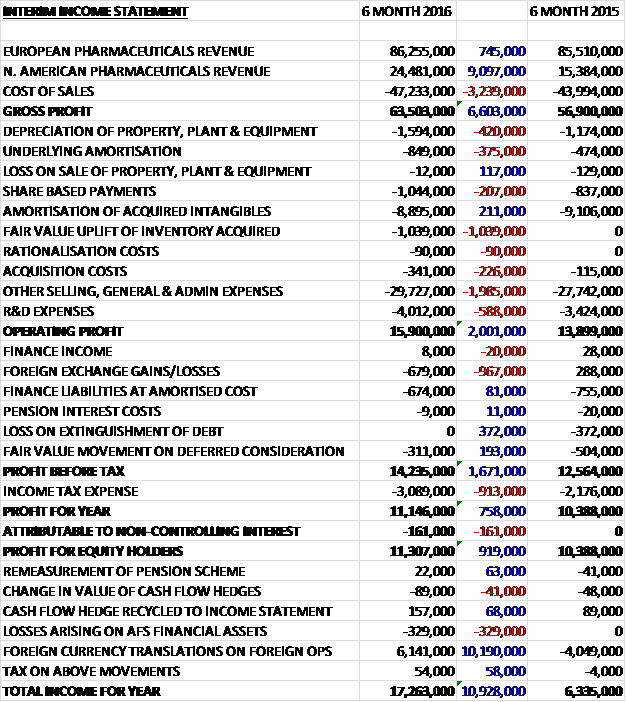
Revenues increased when compared to the first half of last year with a £9.1M growth in North American revenues, aided by a strong US dollar, and a £745K increase in European revenues which included the benefit of the Genera sales but an adverse effect of the weak Euro. Cost of sales also increased to give a gross profit £6.6M above that of last time. Depreciation was up £420K and underlying amortisation grew by £375K. We also see a £1M fair value uplift of inventory acquired through business combinations, which presumably pushed acquisition costs up, and other selling, general and admin costs which were up £2M. After a £588K growth in R&D expenses, the operating profit grew by £2M year on year. We then see a £967K adverse swing in foreign exchange levels, partially offset by no losses from the extinguishing of debt that took place last time, and a £193K improvement in the fair value movement on deferred consideration to give a pre-tax profit £1.7M above that of the first half of 2015. After tax increased by £913K, the profit for the half year came in at £11.3M, a growth of £919K year on year.

DPHinterimassets

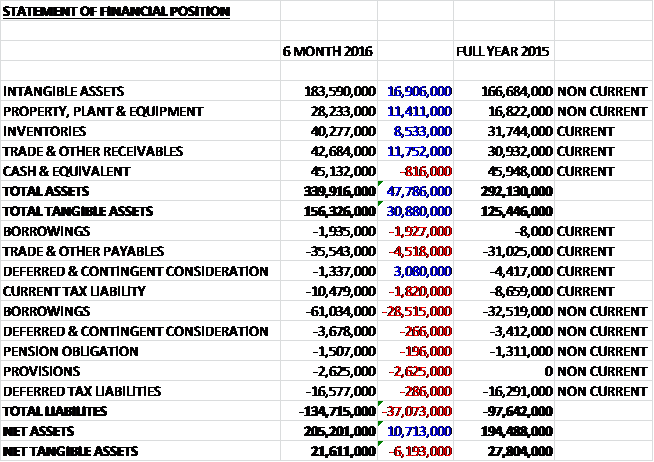
When compared to the end point of last year, total assets increased by £47.8M, driven by a £16.9M growth in intangible assets, an £11.8M increase in receivables an £11.4M growth in property, plant & equipment, and an £8.5M increase in inventories. Total liabilities also increased during the period as a £30.4M growth in borrowings, £4.5M increase in payables, a £2.6M growth in provisions, and a £1.8M increase in current tax liabilities were partially offset by a £2.8M decline in deferred and contingent consideration. The end result is a net tangible asset level of £21.6M, a decrease of £6.2M over the past six months.

DPHinterimcash

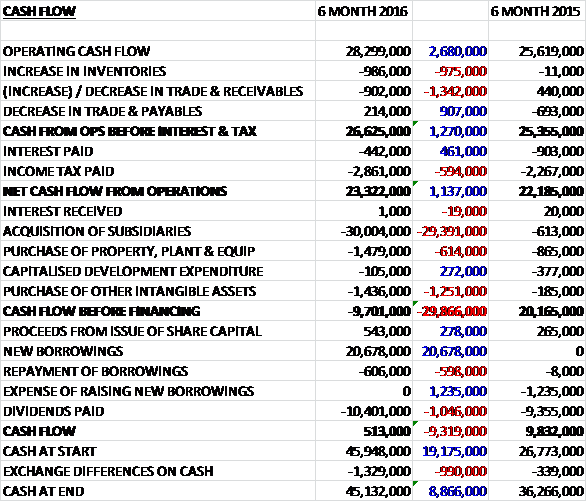
Before movements in working capital, cash profits increased by £2.7M to £28.3M. There was a modest outflow of cash through working capital to support the North American expansion and a higher tax payment was broadly offset by a decline in interest paid so that the net cash from operations came in at £23.3M, a growth of £1.1M year on year. The group spent £1.5M on property, plant and equipment along with £1.4M spent on intangible assets before they spent £30M on acquisitions to give a cash outflow of £9.7M before financing. The group still paid out £10.4M on dividends, however, so new borrowings of £20.7M meant that there was a cash flow of £513K for the half year period to give a cash level of £45.1M at the period-end.

The operating profit in the European pharmaceuticals division was £24.7M, a growth of £620K year on year. The growth was predominantly driven by a strong performance in companion animals with good sales in both the anaesthetic and endocrine therapeutic sectors. The introduction of Osphos into the UK, together with a repositioning of Equipalazone, contributed to the increase in equine sales. Osphos was also launched in Germany, France and the Netherlands towards the end of the period and will be launched into other European markets throughout the second half of the year.

Although there has been a continued decline of antibiotic sales in Germany, the group have delivered growth in farm animal pharmaceuticals in the period of 19% at a constant currency basis. This growth has been achieved through an increased penetration of target markets, a good performance in Poland which started trading in May, and the Genera acquisition which added 11% to growth. Two new farm animal antibiotics have been prepared for imminent launch in Europe and these products, together with a continued focus on increasing market share where they currently have a low base and gaining new registrations in the rest of the world, enhance the group’s future prospects in that area.

Diet sales declined by 2.3% at constant currencies over the period. This follows a difficult six months during which the group conducted a technical transfer of the products to a new supplier and the loss of a portion of their business with a large corporate account in Scandinavia. They have, however, seen signs of recovery in Q2 in several countries, including the largest market, France.

The operating profit in the North American pharmaceuticals division was £8.7M, an increase of £3.3M when compared to the first half of last year as the dermatology, endocrinology and ophthalmic ranges started the year strongly. Canada, which only started trading in the second half of last year, also contributed to the growth in revenues. Osphos has received good support from key opinion leaders within the US, and towards the end of the period, sales were strong and market penetration increased.

Sales of the Dermapet range reached the $20M annual total threshold in August which triggered the final milestone payment of $5M. The excellent growth in the endocrinology sector was again driven by Vetoryl which was enhanced by the launch of a new 5mg formulation which increases veterinarians dosing flexibility. During the period, expenses grew by 37% in North America as the group continued to expand their sales force in the US. Compared to the prior year, they have also funded two new subsidiaries in Canada and Poland. The R&D expenses have increased as they progress their pipeline.

In Western Europe there is a continued focus on prudent prescribing of antibiotics due to concerns about resistance. This trend is expected to continue in the region and has impacted the group’s farm animal business, particularly in Germany, but the rate of decline has slowed in Denmark and the Netherlands, where antibiotic use has reduced substantially in the past. The board believe their risk is minimal in other European territories where their market share is lower and their farm animal performance is stable.

The first half of the year saw some notable new product approvals. In September, Zycortal, a novel canine endocrine product for the treatment of Addison’s disease, received approval through the centralised process in all EU member states. The group are awaiting a new animal drug application in the US as all parts of the dossier were approved after the period-end. Following the successful registration of Osphos last year in the US and UK, approval was received in 19 EU countries in September for the product which treats Navicular Syndrome in horses.

The group have also had several successes in their farm animal portfolio in Europe with two new water soluble antibiotics, Solamocta and Phenocillin, approved in 17 EU states, and their existing antibiotic aerosol Cyclospray, extended into 12 new territories. Furthermore they have had several international approvals to enhance their geographic expansion including two canine products, Urilin in Australia, and Cardisure in Korea, and a farm animal antibiotic Soludox in Egypt. Although within the period they terminated an early stage project for canine ophthalmology, they continue to refill the pipeline and have started several new products in both farm animal and companion animal areas.

Geographical expansion is progressing well. In addition to the acquisition of Brovel which creates a foothold in Mexico, the Genera acquisition provides access to the smaller markets of Croatia, Slovenia and Bosnia. Furthermore a new start-up subsidiary has been established in Austria which started trading in January 2016. The subsidiaries in Canada and Poland, established in the prior year, are performing well with the latter being a major contributor to the reversal in trend of the farm animal business which returned to growth in the period.

Generics of Felimazole, Comfortan and Malaseb have entered the European market. In the first half of the year Malaseb sales have fallen by 5.8%, but the group’s defence strategies for the other two drugs have proved successful to date with European growth of 3% for Felimazole and 26% for Comfortan. During the period the group made forex transactional losses of £700K on trading activities and translational gains of £6.1M.

In August the group acquired 63% of Genera DD, a Croatian pharmaceutical business. By October they owned some 84% of the share capital of the business. The consideration paid was £26.8M in cash funded from current cash and debt facilities. The acquisition came with £17.5M of intangible assets and generated goodwill of £2.3M and in the four or so months since acquisition it contributed a pre-tax loss of £1.7M with an underlying operating loss of £200K. This acquisition gives the group an entry point into the fast growing poultry vaccines markets, broadens the EU farm animal business and extends the geographical reach in the Balkans. The integration so far is on track.

During the period the group also paid a further £300K contingent consideration relating to last year’s Phycox acquisition and £3.3M relating to the Dermapet acquisition that was contingent upon revenues exceeding $20M in any twelve month period. This was the final deferred consideration payment on this acquisition with a maximum further consideration of $3.2M outstanding on the Phycox transaction.

After the period-end, the group acquired Laboratorios Brovel SA, a veterinary pharmaceuticals company based in Mexico City. They paid $5M in initial cash consideration and a further $1M that is contingent on the business reaching registration milestones for Dechra’s products in Mexico. The book value of the net assets acquired was £1M and the business has a turnover of £2.6M. The board believes this acquisition will help open the significant Mexican animal health market to the group as well as offer the potential to access other Latin American Markets in the future. The initial focus will be to achieve registration of several existing Dechra products in Mexico.

Going forward, although the macro-economic conditions in Europe are uncertain and currencies could be volatile, trading for the second half of the year has started well and is in line with management expectations and they remain confident in their future prospects.

After an 8.4% increase in the interim dividend, the shares are now yielding 1.5% and this remains the same on the full year consensus forecast. The group had a net debt position of £17.8M at the end of the period compared to £3M at the same point of last year. Their revised borrowing facility comprises a £90M revolving credit facility and a £30M accordion facility committed until 2019.

Overall then, this was a strong six months for the group. Profits increased, despite neither acquisition being earnings enhancing yet; and operating cash flow improved with loads of cash generated before the acquisition. Net tangible assets did decline, however, as the group used hard cash to pay intangible assets related to the acquisition. The European business is performing strongly with companion animals doing well and farm animals improving following the new subsidiary in Poland. The launch of Osphos in much of Europe over the period should also be making a contribution. North America also performed strongly and the last contingent consideration for the Dermapet acquisition was finally paid during the period.

There are obviously some potential risks. The antibiotic prescriptions in Europe are still under pressure and generic drugs have been launched that are competing against some of the group’s important products, although in two of those cases they have not yet caused a decline in sales. In addition the recent acquisitions will require a lot of attention before they are contributing to results and the shares are highly rated. In conclusion, however, this is a quality business performing well with plenty of drivers of growth going forward and I am happy to continue holding.

On the 15th March the group announced the acquisition of Putney Inc, a developer of generic companion animal pharmaceuticals in the US based in Maine. In addition they have announced the placing of 4,398,600 new shares at £11 per share to raise £47.1M to part fund the acquisition. The total consideration being paid is £139M, payable in cash on completion (no pesky deferred consideration).

The acquisition accelerates the group’s North American strategy, potentially doubling their US business within their planning horizon and it is expected to be earnings enhancing in 2017 and materially earnings enhancing in 2018 and thereafter, on an underlying basis. It is expected that there will be a charge of £6M for one-off transaction and integration costs during the current year.

Putney currently markets eleven products, which have achieved significant market shares and continue to grow, in complementary therapeutic areas to Dechra, including pain management, anti-infectives, and dermatology. In addition, the business has a strong pipeline of ten complementary products which are expected to launch over the coming years. The business has achieved over 40% of all US companion animal generic approvals since 2012 and the outsource manufacturing either through a profit share arrangement or on a fee for service basis. In future the board believe it may be possible to manufacture in-house products in the pipeline which are not already set up with third parties.

Putney reported net revenues of $49.6M in 2015 but made a loss before tax of $1.7M with gross assets of $23M. The acquisition has been funded in part from an extension to the group’s existing revolving credit facility to £150M which means that net debt to EBITDA will increase to about 2.1 times immediately following the acquisition, falling to 1.9 times by the end of the year.

Unfortunately, as is common in these cases, members of the public are not entitled to participate in the placing. The shares, when issues, will represent about 5% of the existing share capital and the placing price of £11 per share represents a 5.4% discount to the closing mid-market price the day before, which is not too bad.

Overall then, this looks to be an interesting acquisition. Although the business is still loss-making, it seems as though the board are confident of turning a decent profit from it in future. It does look rather expensive and saddles the group with quite a lot of debt, but overall this seems to be a decent development.

On the 21st March the group announced that CFO Anne-Francoise Nesmes and her spouse sold a total of 3,100 shares at a value of £37K. Following the sale, her interest in the company is 39,502 shares.

On the 21st March the group announced that CFO Anne-Francoise Nesmes and her spouse sold a total of 3,100 shares at a value of £37K. Following the sale, her interest in the company is 39,502 shares.

On the 8th April the group announced that Tony Rice had been appointed as Chairman. He is currently the senior non-executive director at Halma having previously served as CEO at Cable and Wireless and Tunstall. Also, after six years in the role, Chris Richards is stepping down as non-executive director of the company with immediate effect.

On the 6th June the group announced that non-executive director Tony Rice purchased 20,000 shares with a value of £228K. This represents his first purchase.

On the 12th July the group released a trading update covering the year ended 2016. During the year, revenue growth in EU Pharmaceuticals increased by 5% at constant exchange rates (3% on actual rates). Including Genera, growth was 13% at constant rates. A solid performance in the Companion Animal Products and Equine portfolios together with a recovery in Farm Animal Products supported this growth. Whilst they have seen momentum in some of their markets, Diets have not yet fully recovered to their previous sales level following the supply problems. The growth in the Farm Animal division was driven by the new subsidiary in Poland, a slowdown of the decline in Germany and market share gain in countries where they had a low market share and are now increasing penetration. The launches of Osphos and Zycortal also contributed to the EU performance.

North America continued to grow at a significant rate with revenue increase of 37% at constant currency. The two months of trading at Putney added another 16% to the growth. These results were driven by increased market penetration of the Endocrinology and Dermatology portfolios in the US and the full year effect of the Canadian subsidiary.

The pipeline progress has been in line with board plans. A number of approvals were achieved throughout the year, including Zycortal, a novel endocrine product; four FAP products, including Solamocta and Solupen; and the first poultry vaccine, Avishield ND. Additionally they received several registrations in emerging markets.

The geographical expansion is accelerating with the acquisitions of Brovel and Genera and their solid progress in the recently established subsidiaries in Poland and Austria. The results also include the full year effect of the establishment of the Canadian subsidiary which started trading in January 2015.

Integration activities of the acquisitions are well underway. The reorganisation of Genera’s business is completed, the restructuring of Putney was conducted in the first week of integration and the new management team at Brovel is in place. Overall, trading in the acquired entities is progressing well.

The board remain confident in their future prospects and believe that the growth opportunities available to them should not be affected by the current market volatility and uncertainty. This all looks fine to me, I continue to hold.

On the 17th August the group announced the appointment of Richard Cotton as CFO. Richard joins from Consort Medical, where he is currently CFO but he won’t start until January 2017. In the meantime, the current financial controller, Septima Maguire, will be acting CFO.

Gemfields Share Blog – Interim Results Year Ending 2016

Gemfields has now released its interim results for the year ending 2016.

GEMinterimincome

Revenues declined by $9.4M when compared to the first half of last year. We also see an increase in costs as a $1.9M decline in depreciation & amortisation, a $749K fall in mineral royalties and a $735M decrease in fuels costs were more than offset by a $1.4M growth in labour costs, a $1.2M increase in security costs, a $764K growth in repairs & maintenance and a $1.2M increase in other mining and processing costs. We also see a $10.2M adverse change in inventory and purchases to give a gross profit some $21.4M below that of the first half of 2015. Rent & rates were up $999K and professional services increased by $745K which drove the operating profit down by $24.3M. The group did benefit from over $3M of positive exchange differences and a $6.7M reduction in income tax costs, however, which meant that the profit for the half year came in at just $3.4M, a decline of $12.8M year on year.

GEMinterimassets

When compared to the end point of last year, total assets increased by $5.4M, driven by a $7.8M growth in receivables, a $4.8M increase in the Faberge inventory, a $2M growth in freehold land & buildings, and a $1M increase in gemstone inventory, partially offset by a $3.1M reduction in cash, a $2.8M fall in the value of evaluated mining properties, a $2.5M decrease in deferred stripping costs and a $2.4M decline in plant, machinery & vehicles. Total liabilities declined during the year as a $10M growth in borrowings was more than offset by a $6.4M decrease in payables, a $2.1M fall in deferred tax liabilities and a $1.9M decline in current tax payables. The end result is a net tangible asset level of $259.7M, a growth of $5.4M year on year.

GEMinterimcash

Before movements in working capital, cash profits declined by $24.2M. There was also a large cash outflow through working capital with a $20.1M growth in receivables, to give a net cash from operations of $8.1M, a collapse of $27M year on year. The group then spent $6.8M on property, plant & equipment along with $6.7M on stripping costs to give a cash outflow of $5.7M before finances. We then see $5.5M of dividends paid to non-controlling interests and a net $10M of new borrowings to give a cash outflow of $1.5M for the period and a $24.9M cash level at the end of the half.

The coloured gemstone market continued to expand throughout the period with demand for the more commercial medium to lower quality gemstones being particularly strong. This is indicative of a resurgence within the US consumer market. There is also evidence of the resurgence of coloured gemstones within the luxury sector and the inherent potential for added value drivers.

Production at Kagem was up 30% to 15.7M carats of emerald when compared to the same period of last year. This increase in production is due to an increase in the average grade of ore being mined and the continued increase in available ore reserves as a result of the earlier waste stripping projects and the ongoing improvements in mining efficiencies.

The fourth high wall pushback was completed in September leaving about 15 months of exposed ore available for mining. Continued waste stripping of the Chama pit will be done by the in-house team, which will provide for about two to three years of ore available for mining at any given point in time. Increasing the overall strike length at the Chama pit operation and optimising the blasting and scheduling techniques assisted in further improving the mining efficiency and productivity. The operations yielded 15.7M carats during the period at a grade of 254 carats per tonne compared to 12.1M carats at a grade of 202 carats per tonne in the first half of last year.

The total operating costs were $22.4M while the cost per carat decreased by 21% to $1.43 per carat reflecting the increase in production while overall costs were largely maintained at the same level. Cash rock handling unit costs were $2.38 per tonne, down from $2.92 per tonne, with the reduced costs of mining operations being a result of improved operating efficiencies, lower fuel prices and the short term positive impact of forex fluctuations.

In September the group published its updated CJORC resource and ore reserves statement for the mine with measured, indicated and inferred mineral resource of 1.8BN carats at an in-situ grade of 281 carats per tonne and proven and probable ore reserves of 1.1BN carats at an ore grade of 291 carats per tonne. The projected life of mine is 25 years with projected undiscounted real cash flow over its life of about $1.59BN. The independent technical economic model shows a post-tax net present value of $520M based on a 10% base case discount rate.

Kagem increased its processing efficiencies and capacity following an upgrade and extension to the existing washing plant and the installation of upgraded digital security and surveillance infrastructure. A better climate-controlled environment has been established with the enclosed picking facility, resulting in an improved working environment and more rigorous operating controls. These improvements have further contributed to the efficiency drives which are being implemented at the mine with fewer breakdowns, reduced maintenance costs, improved gemstone recoveries and enhanced overall security.

Diamond core drilling continued in the Chama pit area, establishing depth continuity of the TMS up to a vertical depth of 350 metres. In the Fibolele sector, drilling resulted in the proving of steeper dipping TMS of an average drilled thickness of 25 metres. The Fibolele pit has emerged as a potentially significant production target and is presently in active operation over a strike length of 600 metres. During the period, additional production contacts were also delineated. The prime production points continued to yield good volumes, producing 2.2M carats with an average grade of 191 carats per tonne. At one of the important prospects within the Libwente sector, two bulk sampling programmes continued to test the prospective ground and a total of 56,850 crats of emerald was produced by the pit during the period.

Two auctions of rough emeralds were held during the period. In September, an auction of higher quality stones was held in Singapore, generating revenues of $34.7M at a price of $58.42 per carat. An auction of lower quality emeralds was held in November in India, generating revenues of $19.2M at a price of $4.32 per carat, which is a new record for the lower quality stones. Two further auctions of emeralds are planned for the second half of the year.

In August, Kagem entered into a $10M revolving credit facility with Barclays, supplementing an existing $20M facility, bringing the total with Barclays to $30M. Funds drawn under the facility bear interest at a rate of US LIBOR plus 4.5%. The mine also entered into a $10M short term financing facility with Pallinghurst Resources. This facility had a maturity date of 15th December and was repaid during the month. The mine therefore has an outstanding debt balance of $30M.

At Montepuez, 2.1M carats of ruby were produced compared to 6.3M last time. This variance is due to the deliberate decision to focus on lower grade, but significantly higher quality, alluvial areas in the short term which will be supplemented by a planned shift to some of the already exposed higher grade, lower value areas in the coming months.

The bulk sampling programme at Montepuez continues to increase in scale and has delivered encouraging results. During the period, bulk sampling activities have focussed primarily on alluvial deposits in Maninge Nice and Mugloto blocks, located about 9km apart. The data from the drilling provides an indication of the significant possibility to further increase the resource base.

Rock handling capacity has increased from 310,000 tonnes per month last time to 360,000 tonnes per month during the period and total rock handling during the period was 2.2M tonnes, made up of 300K tonnes of ore and 1.9M tonnes of waste.

During the period higher quality and higher value but lower grade secondary ore deposits were mined and processed. About 144,000 tonnes of ore was processed by the washing plant producing a total of 2.1M carats of ruby compared to 171,000 tonnes of ore producing 6.3M carats in the same period last year with an average grade of 15 carats per tonne compared to 37 carats per tonne. This resulted in a 341% increase in the overall volume of higher quality rubies. Total cash operating costs increased $3M to $13M which meant that unit costs increased from $1.59 per carat to $6.19 per carat. Total capex at the mine was $5.1M with much of this being spent on improved washing plant and camp site facilities.

The second phase of the exploration programme has been carried out in and around the Maninge Nice area up to the eastern boundary of the concession involving both diamond core drilling and auger drilling through a combination of the in-house team and a third party contractor. The second phase of the auger drilling programme took place between April and December. A total of 2,026 holes were drilled and in addition a total of 76 diamond core drills were also drilled.

The auger exploration programme has delineated additional new areas of potential with a gravel bed thickness of more than one metre but these are yet to be confirmed by bulk sampling. In addition to this, some added areas of mineralised amphibolite have also been identified with the available data suggesting that the amphibolite bodies hosting the primary ruby mineralisation are oriented in an East-West direction and occur intermittently across the area. Further exploration by diamond core drilling is currently in progress.

Further diamond core drilling has also been planned to support a better understanding of the disposition of the primary mineralised zone located on the east of the Maninge Nice area. Phase three of the exploration programme will be aimed at tracing the extent of the primary ruby mineralisation within the amphibolite body while auger drilling will continue to spearhead the exploration programme to expose further greenfield areas within the license. The airborne geophysical study, covering an area of 14,560 square kilometres, has been completed during the period and results are expected to be finalised during Q1 2016.

A more durable poly panel deck screen has been installed at the wash plant, replacing the wire mesh double deck screen during the period which has enhanced the screening efficiency of the washing plant. In addition, to the conversion of dry to wet screening on the M1700 rinser, a fines master has been installed in circuit with a view to further improving overall processing and water recovery efficiencies. A new replacement log washer, with two additional dewatering screens has also been installed, with further upgrades to the plant currently underway.

To support the need for a consistent supply of clean water to the wash plant throughout the year, six additional bore wells were drilled and commissioned with higher capacity water pumps. An additional water reservoir of about 25,000 cubic metres capacity was also created in order to increase the currently available water storage capacity. The installation of a water treatment plant and dense media separation plant to replace the existing jigs is under review.

One auction of higher and medium quality rubies was held during the period which generated $28.8M, yielding an average overall value of $317.92 per carat. It is likely to take a few more years before the ruby market has access to similar levels of working capital and distribution as the emerald market but at least one auction of mixed quality ruby is expected to take place before the end of the year.

The construction of the new camp at the mine started in March 2015 with a total of 102 housing units, a recreation unit, canteen and new kitchen being built. The first set of housing units have been commissioned and allotted and completion of the project is targeted for the end of April. A new fuel storage tank with a capacity of 50,000 litres has been constructed, increasing the total storage capacity on site to 96,000 litres. It is planned to extend the existing workshop during the coming year and additional facilities such as a training room, wash-bay, scrapyard, lubricant storage and heavy earth moving machinery maintenance bays will also be constructed.

The restriction of illegal mining activity and asset loss continue to be key challenges. With the implementation of new infrastructure and improved technological interventions such as the enhancement of radio communication ranges, mobile camera lighting towers, increased numbers of CCTV cameras and mobile guard posts, however, a meaningful improvement has been noticed during the period. A dedicated training programme for security personnel incorporating human rights and soft skill development has been provided to all key personnel during the period.

At Faberge, the value of realised sales during the period increased by 70% when compared with the same period last year and losses reduced by 21%, which is progress. The total number of Faberge distribution channels increased from 20 to 25 during the period. The business’ first significant print advertising campaign since Christmas 2013 began in September and will continue through to June, focusing on timepiece collections and the “Lady Compliquee Peacock” won the ladies high mechanical category at the 2015 Grand Prix d’Horlogerie de Geneve.

At Kariba Minerals in Zambia the Curlew North, Francis West and Main Curlew pits have been actively developed and mined during the period and a new exploration programme is to be put in place to confirm the mineral resources available at the mine. Production of amethyst during the period was 485 tonnes compared to 574 tonnes last time with the grade remaining at 49kg of amethyst per tonne of ore. A total of 10.1M carats of higher quality amethyst was sold in Singapore in September for $440K with the next auction taking place in March.

Kariba is working towards a long-term cost effective solution for energy supply and has initiated an environmental project brief for a 1MW solar farm in conjunction with an Australian solar supplier and the Zambian national energy company. The project aims to supply the mine with more cost effective electricity and to offer excess capacity to the local community at a rate that will be subsidised by the government. The group will lease a portion of its land to the project in order to accommodate the solar plant and the Australian company will fund construction with Kariba signing an off-take agreement to purchase electricity. The CCTV coverage system at this mine has been extended to 25 cameras to improve security.

In Ethiopia, exploration work began in July with a preliminary ground survey, detailed mapping and the preparation of base line plans. A manual trenching exercise has been completed on a key target area within the northern part of the license, named Dogogo Hill, selected on the basis of geological indicators and artisanal activity. The block measures 1.92 square Km, covering a strike length of 2.4Km. Eight trenches were planned at 100m intervals and excavation of these trenches was completed in November. They exposed contacts between pegmatites and talcose schists, and the occurrence of beryl has been recorded. A pitting exercise has been initiated at these contact zones.

A detailed geological mapping exercise has been completed concurrently in another block to the south of the license called Karolo Kora Hill. This block measures 13.75 square km and covers a 5.5km strike length of the ultramafic belt. Steps have been started to commission a diamond core drilling programme of the license area to establish dip continuity of the ore body identified during trenching, and is expected to start in early 2016. An airborne geophysical survey of the license area is also planned for later in the year.

In Sri Lanka the group received the necessary license to trade sapphires, completed the establishment of the required infrastructure and acquired the supporting equipment for trading in Colombo and Ratnapura. The appointment of key management personnel has also been completed and the associated supply chain mechanisms are being developed.

The group have a production target for 2016 of 25 to 30M carats for emeralds and 8M carats for rubies. The reduction in profits are apparently mostly attributable to a more equally planned auction mix between the first and second halves of the year when compared to last year when a significant part of the revenue was achieved in the first half.

During the period the group made two acquisitions in Colombia. The first project relates to the acquisition of a 70% stake in the Coscuez Emerald mine in the Boyaca province for a total consideration of $15M to be paid in tranches of a combination of cash and Gemfield shares conditional on achieving certain pre-determined milestones. The license area covers an area of 47 hectares with the mine having been in operation for over 25 years and known to have produced some fine emeralds. Exploration and mine planning activities such as drone surface topographic survey, and preliminary assessment of engineering solutions were initiated as part of the ground preparations for future operations. Further exploration activity will be carried out over the next 18 to 24 months to support the development of an expanded geological model and preliminary mine plan.

The second project relates to selected exploration prospects held by ISAM Europa via the acquisition of 75% and 70% interests in two Colombian companies holding rights in respect of mining license applications and assigned concession contracts respectively. It comprises a number of new license applications and assignments to existing concession contracts administered by the Colombian Mining Agency. Eight of the applications and assignments have been approved and issued with the remaining assignments and applications are being reviewed by the Colombian Mining Agency. The total consideration payable is $7.5M to be paid in tranches of a combination of cash and shares conditional to achieving certain milestones.

Overall then this has been a mixed period for the group. Profits were down as revenues fell and costs increased and although net assets did grow, the operating cash flow fell and there was no free cash generated. Although the coloured gemstone market is apparently strong, these results are affected by a more equal spacing of gemstone auctions with last year being first-half weighted.

The Kagem mine seems to be performing well with an increase in production due to earlier waste stripping projects and higher grade ore. The cost per carat declined due to operational gearing, forex benefits and lower fuel prices. The prices for low-quality emeralds held up well with some more softness at the higher quality end. The performance at Montepuez was more mixed. Production fell as the group concentrated temporarily on lower grade high quality areas and there was only one auction during the year.

The losses at Faberge do seem to be reducing, however, and in the second half, the production of rubies is expected to increase considerably as the mine moves to higher grade areas but it looks like the production at Kagem is expected to reduce slightly. I have to say, the lack of any cash generation is starting to concern me slightly and I don’t see anything in this update to really make me want to buy back in so I am keeping a watching brief currently.

On the 4th April the group announced the results of its auction of higher quality emeralds and amethyst which was held in Zambia. The emerald auction saw 558K carats of higher quality stones placed on offer with 470K carats being sold generating revenues of $33.1M at an average value of $70.68 per carat which was a new record for this type of auction.

The amethyst auction saw 9.4M carats of higher quality stones placed on offer with 6.6M carats being sold which generated revenues of $220K realising an average value of 3.26c per carat.
These prices look very good to me, although it should be noted that a fair amount of the gems remained unsold. I suppose the next ruby auction will be the real barometer with regards how the group is doing.

On the 4th May the group released an update covering trading in Q3. At Kagem, the group produced 23,900 tonnes of ore at a grade of 297 carats per tonne, producing 7.1M carats of emeralds. This compared to 30,100 tonnes at 272 carats per tonne producing 8.2M carats in Q2 and 27,900 tonnes at 355 carats per tonne, producing 9.9M carats in Q3 last year with the differences being attributed to the fluid nature of the mineralisation and a higher-grade zone having been encountered last year. Capex on property, plant and equipment was $2.6M and the spend on waste stripping was $1.2M. The gemstone unit cost was $1.45 per carat compared to $1.38 in Q2 and 99c in Q3 last year.

Waste stripping and ore mining of the Chama pit continued to be advanced. Total rock handling during the quarter was 2.6MT and increasing the strike length at the pit along with optimising production scheduling assisted in improving productivity. Exploration and bulk sampling activities at the Fibolele and Libwente sectors are progressing well and continue to indicate promising results. The mine has also increased its processing efficiency and capacity with commissioning of an upgrade and extension to the existing wash plant facility during the previous quarter. This is further supplemented by the installation of digital security and surveillance technology across the production infrastructure.

The April auction of higher quality emeralds held in Zambia saw 470K carats being sold, representing 84% of the total weight offered and generated revenues of $33.1M. The auction yielded an overall average value of $70.68 per carat which is a record average price achieved to date for this type of auction.

At Montepuez the group processed 67,600 tonnes of ore at a grade of 30 carats per tonne, generating 2M carats of gemstones. This compared with 71,700 tonnes at a grade of 22 carats per tonne generating 1.6M carats in Q2, and 78,600 tonnes at a grade of 18 carats per tonne generating 1.4M carats in Q3 2015. The total capex in the quarter came in at $1.6M and the unit cost per carat was $2.40, comparing favourably to the $3.31 in Q2 and $2.64 in Q3 last year.
The reduction in throughput at the processing plant was a result of delayed, unseasonably high rainfalls making the head feed difficult to process which was compensated for by a shift in focus on processing higher grade, lower value amphibolite ore.

The construction of the new camp is proceeding to plan and on track for completion by the end of June. An extensive security plan has been formulated to combat continuing asset loss at the mine and a training programme for security personnel incorporating human rights development has been provided.

Faberge saw a 26% fall in sales orders during the quarter largely due to the sale of the high value pearl egg in February 2015, boosting that period’s results, along with the timing differences on sales orders arising from the Baselworld fair. Total operating costs increased by 10%, largely due to an increase in advertising spend with the first significant print campaign since 2013 continuing in to 2016.

In Colombia, the group continued with its pre-emptive exploration and mine planning exercises which included topographical survey, mapping of underground tunnels, surface mapping, sampling, chemical analysis, testing of mining equipment and further planning of the underground engineering solutions. A project team has been created to finalise the takeover of admin and legal control of the ISAM portfolio and the group carried out field visits and preliminary geological activities in selected licenses.

In Sri Lanka the group has initiated early stage market evaluation and the appraisal of suitable partners for the supply of gemstones. They will continue its evaluation of some of the exploration licenses, covering diverse minerals, throughout the remainder of the year.

In Ethiopia, following completion of a trenching exercise within the northern part of the license named Dogogo Hill, exploratory pits have been excavated in potential contact zones that were exposed within the trenches. Samples of Beryl and other indicator minerals were recovered from some of the pits and preliminary ground work, including contractor selection, has been completed with a view to starting exploratory drilling in this block in due course. A detailed geological mapping exercise has been initiated on the Funkoftu block, located to the south of Dogogo. This measures 2.5 square km and covers 2.25km of prospective strike length for emerald mineralisation.

At the period-end, the group had cash of $5.6M with a further $33.1M of auction revenue due shortly. The total debt outstanding was $49M so net debt stood at $10.3M once the auction revenues are taken into account.

Overall then, the results from Kagem were affected by lower grade ore being processed and Montepuez was affected by increased rainfall, although higher grade ore was processed which meant that carats produced increased. The emerald auction seemed to go well and the coloured gemstone market remains robust, supported by improving consumer demand from the US. The Faberge business still seems a long way off breaking even though, and there is not much here really to make me want to buy in again.

On the 17th May the group released a trading update covering Q1 2016. The group had $68.8M cash on hand at the end of the period, excluding the receipts from the third tender, although the $11.7M dividend will be paid in June. Positive actions taken by the major diamond producers have led to an overall steady sentiment in the diamond market during Q1. Although there have been some signs of improvement, the diamond market as a whole remained cautious during the period. The continued slowdown in Chinese retail demand, a strong US dollar and reports of continued high levels of polished inventory have contributed to a cautious approach being adopted in the purchasing of rough and polished diamonds.

At Letseng, the mine treated 1,624,964 tonnes of ore which was 10% below the prior quarter due to seasonal rain impacting access to ore and treatment rates (the ore treated was up 14% year on year). The grade recovered increased by 10% to 1.77cpht, however, so the number of carats recovered stood at 28,698, down by just 1%. During the period, 7.1MT of waste was mined. This is in line with the revised life of mine plan which allows for increased levels of higher grade ore from the Satellite pipe to be mined.

The two plants treated a total of 1.4MT of ore during the period, of which 36% was from the satellite pipe. The balance of the ore was treated through the Alluvial Ventures plant which was sourced from the main pipe and low grade stockpiles. The increase in grade recovered is reflective of the area mined in the Satellite pipe that has historically produced higher than reserve grades, albeit at a slightly smaller average stone size which contributed to a lower average price achieved per carat in the period. The three tenders in the period saw 45,311 carats sold, an increase of 26% year on year but the $1,938 per carat achieved was a 10% decline which meant that the total value sold was $87.8M, a growth of 13%.

At Ghaghoo, the group treated 50,514 tonnes of ore which represented a 41% decline on Q4 but a 4% growth year on year. The grade recovered also fell, down 24% quarter on quarter to 21.8cpht so the carats recovered fell by 55% to 11,029 which represented a 5% decline on Q1 last year. The reduced tonnage is in line with the strategy of downsizing and reducing the production plan for 2016 to about 300KT. The majority of the ore treated was sourced from tunnels one to five on level 1. The area of the pipe mined was close to the contact and contained more internal dilution which led to the lower grade seen.

The development of the second production block is progressing well with over 200 metres of tunnelling completed per month which will allow access to higher grade ore towards the centre of the pipe in the second half of the year. A parcel of 14,114 carats was sold for $2.3M which represents a value of just $160 per carat, although this does represent a 7% increase compated to the previous price achieved in December 2015. Although the mine will operate at a reduced rate during the year, prices for the Ghaghoo production will continue to be monitored and the option of returning it to full production regularly reviewed.

On the 23rd May the group released the results of the lower quality rough emerald auction held in India. Of the 3.67M carats offered, only 2.78M were sold, representing about 76% of the total. This sale brought in $14.3M which represents an average of $5.15 per carat which is a record price, although the overall amount sold was disappointing.

A few of the lots, in which there was a slightly higher degree of uncertainty with respect to final recovery from rough to finished goods did not achieve their reserve price so were held back. The company believes that these goods offer considerable opportunity to further build demand in other areas and is confident in the quality and longer term value of these lots and is supported by evidence of the US market continuing to come back on stream.

On the 20th June the group announced the results of its mixed high and commercial quality rough ruby auction in Singapore. It recorded revenues of $44.3M with an average realised price of $29.21 per carat as a total of 95% of stones were sold. It is difficult to compared to other auctions given the mix of different qualities but apparently the prices achieved were indicative of improved overall global demand.

On the 4th July the group announced details of new debt facilities. This includes a $15M unsecured overdraft with Barclays at an interest rate of LIBOR+4%; a $15M overdraft facility with Banco Commercial De Investimentos with an interest rate of LIBOR+3.75; and a $15M finance leasing facility with BCI at an interest rate of LIBOR+3.75%, all for Montepuez. In addition, they announced a $20M financing facility with Macquarie with an interest rate of LIBOR+4.5%. This loan replaces the $25M debt facility and the proceeds of the new Montepuez loans will enable them to finance their capex requirements at the mine and provide additional working capital.

On the 1st August the group gave a market update covering trading in Q4.

At Kagem, the group produced 7.2M carats of emeralds, a reduction of 900K carats year on year due to the varied nature of mineralisation and a higher grade zone having been encountered during Q4 2015 as the average grade fell from 222 carats per tonne to 185 carats per tonne. Unit operating costs increased from $1.58 to $1.75 per carat, mainly as a result of the lower grade area being mined.

An auction of commercial quality stones held in India generated revenues of $14.3M at an average value of $5.15 per carat, a record average price for commercial emeralds. The amount sold represented 79% of the value being offered compared to 95% at the last commercial emerald auction.

An increase in the strike length at the Chama pit and optimising production scheduling has assisted in further improved mining efficiencies. Exploration and bulk sampling activities at the Fibolele and Libwente sectors are progressing well and continue to deliver promising early stage results.

A GPS based radio controlled fleet monitoring and management system was made fully operational during the quarter. The system improve the real time tracking and allocation of fleet. The utilisation of bulk emulsion explosives has further improved blasting performance and resulted in optimised rock fragmentation leading to less wear and tear of fleet buckets and improved cost of production. Security infrastructure has been further improved by the installation of digital security and surveillance technology across the mine infrastructure.

At Montepuez, the group produced 6.2M carats of ruby, an increase of 5.5M carats year on year, supported by processing of the higher grade but lower value amphibolite resources as the average grade increased from 9 carats per tonne to 75 carats. Unit operating costs reduced from $10 to $1.19 per carat but cash rock handling unit costs increased from $6.13 to $7.14 per tonne as a result of an increase in headcount and fleet size in anticipation of a continued increase in the scale of operations and a reduction of rock handling volumes due to the prolonged rainy season and focus on ore mining rather than waste mining.

During the quarter, the wash plant saw a 10% increase in tonnes processed due to improved production planning and processing availability. The construction of the new camp is proceeding according to plan and will be fully completed by December. In order to facilitate DUAT, a technical team from the government completed a site audit in April and the application is currently being reviewed by the Land Minister’s office and will be presented to the council of Ministers. The comprehensive resettlement action plan has also been completed and submitted and is also being reviewed by the government. Both submissions are expected to be approved by December. Construction of a new security base was started in April and is progressing well.

A mixed quality auction of rubies was held in Singapore which generated revenues of $44.3M at an average value of $29.21 per carat, representing 98% of the value being offered.

At Faberge, the value of sales orders agreed in the quarter increased by 14% and the number of transactions doubled which meant that the average selling price fell by 56% as two significant pieces were sold in Q4 last year. Importantly, operating costs fell by 28% in the quarter. Sales orders agreed during the year as a whole fell by 10% due to no high value objets d’art being sold this year.

In Colombia the group continued with its pre-emptive exploration and mine planning exercises in preparation for completion of the Coscuez transaction and as part of the base level arrangements for future operations. These included rock support testing, hoisting system evaluation as well as waste dump, ventilation systems and wash plant design. The administrative control of the ISAM licenses has been largely transferred to the project team. The group also carried out field visits and prelim geological activities in selected ISAM licenses.

During the period the group conducted several meetings with the Ministry of Mines and the National Mining Agency regarding the completion of the pending issues between Esmeracol and the government. Completion of the transaction was extended by a further three months to September in view of the pending issues which sounds a bit ominous.

In Sri Lanka, necessary geological and geophysical exploration work for diverse minerals has been completed in selected areas across the exploration licenses. Following field assessment, the requisite reports have been submitted to the authorities and the process of license renewal has been completed. Initial steps to set up an in house lab and the implementation of standard operating procedures for gemstone authentification has been completed and the group intends to start trading operations in Q2 2017.

In Ethiopia, an exploratory drilling programme was initiated at the end of June in the Dogogo South lock. The drill targets are based on the inputs from the trenching and exploratory pitting exercise carried out earlier in the year. Further trenching work has been carried out in the North Block. The excavated trenches covered a total length of 2.7km and the average width is 70cm to 80cm with a depth ranging from 60cm to 150cm. Contacts have been exposed between pegmatite and talc mica schist and the occurrence of beryl and mineralised reaction zone has also been recorded.

In June the group launched a global marketing campaign to promotive Mozambique rubies. A series of three short films formed the backbone of the campaign and in just under two weeks one of the films had reached over 550,000 views and the campaign was listed in the top ten brand social videos of Q2 2016 on Luxury Daily.

After the year-end, a $65M financing facility was announced to sustain the expansion plans to increase annual production to about 20M carats of rubies at Montepuez and more than 40M carats of emeralds in Kagem within the next three years.

XP Power Share Blog – Final Results Year Ended 2015

XP Power has now released its final results for the year ended 2015.

XPPincome

Revenues increased when compared to last year as a £500K decline in industrial revenue was more than offset by a £5.8M growth in technology revenue and a £3.3M increase in healthcare revenue, although about half of this increase was due to favourable currency movements. Cost of sales also increased to give a gross profit £4.5M above that of last year. Amortisation and depreciation increased by £700K, distribution and marketing costs were up £700K, partly as a result of Chinese wage appreciation and start-up costs at the Vietnamese facility. Admin costs grew by £500K and R&D expenses increased by £1.5M which meant that the operating profit grew by £1.1M. After the tax expense increased by £700K, mainly relating to deferred tax increases, the profit for the year came in at £19.9M, an increase of £400K year on year.

XPPassets

When compared to the end point of last year, total assets increased by £15.8M driven by a £5.7M growth in goodwill, a £3.5M increase in inventories, a £2M increase in development costs, a £1.5M growth in trade receivables and a £1.7M increase in property, plant & equipment. Liabilities also increased as an £8M growth in bank loans and a £1.4M increase in deferred tax liabilities was partially offset by a £1.9M decline in the overdraft. The end result is a net tangible asset level of £40.9M, a growth of £1.1M year on year.

XPPcash

Before movements in working capital, cash profits increased by £800K to £30.1M. There was a cash outflow through working capital, however, and tax was £1.1M above that of last year so that the net cash from operations was £20.9M, a decline of £800K year on year. The group spent £2.5M on property, plant & equipment; £2.9M on R&D; and £8.3M on acquisitions to give a cash flow of £7.4M before financing. This did not cover the £12M paid out in dividends, though, and the group took out £8M in new borrowings to give a cash flow for the year of £3.2M and a cash level of £4.3M at the year-end.

The year was one of significant progress, despite challenging economic conditions for the industrial electronics market. Apparently the market declined during the year so it seems XP have probably increased market share.

The profit in the European division was £6.7M, a decline of £900K year on year but revenues in the region grew by 7% having declined in the previous year, despite the translational effect of a weak Euro. The industrial business in Europe grew by 6% but healthcare performed better with new customer programmes driving growth of 11%.

The profit in the North American division was £14.6M, a growth of £1M when compared to last year. Revenues in the region only increased by 1%, however, and this was due to the EMCO acquisition with no organic revenue growth recorded. This weakness in revenue came entirely from the industrial sector which declined 18%, although this was compensated for by a 31% growth in the technology sector which shows that after a number of challenging years the technology sector in the region has bounced back strongly. Order intake during Q3 was noticeably weak at only $17.3M but they rebounded to $23.6M in Q4, giving the board greater confidence for 2016.

The profit in the Asian division was £1.4M, a fall of £300K when compared to 2014. Revenues continued to grow, increasing by 9%, despite the slow-down in China. The customers driving this increase generally have demand for their end products outside of the emerging markets and the region showed a similar pattern to North America with the technology and healthcare sectors demonstrating much stronger growth that industrial. Healthcare revenues showed very strong growth of 24%, technology revenues were up 16% and industrial revenues were flat.

The group consider that their transition from a sales distribution company, through the addition of a design capability, to designer and manufacturer is now complete and revenues from their own-designed products set a new record of £74.6M during the year representing 68% of total sales and further growth in that area is expected in 2016 too. The group have established their position with their standard offering products but now see opportunities for their larger customers to engage in custom designs and have deployed more of their engineering resource into these areas.

New product releases included the GCS265 and GCS350 series which extend their popular GCS180 and GCS250 product families upwards in power. These new ranges offer high efficiency at a lower price point and have apparently been well received by customers.

During the year the group produced 1.4M power converters compared to 1.3M last year. Production volumes of magnetics windings at the Vietnam facility have continued to ramp-up and during the year they produced 4.3M windings compared to 3.6M in 2014. In Q4 2014, the started to produce the first pre-production samples of complete power converters in the country which has continued to build to 200K units during 2015. This enhances cost competitiveness as production costs in Vietnam are significantly lower than the existing facility in China and the Vietnam facility is now at break-even as the volumes of converters continue to build. It is unclear what the future is for the Chinese facility though.

Last year the group was accepted as a supplier to Digikey, an electronic components distributor, in addition to the existing arrangements with Premier Farnell and Newark. These are good channels to service smaller customers and to gain brand recognition and in 2015, the first full year of the Digikey arrangement, it provided excellent growth in this channel, enabling the group to reach more customers.

In this market there is always the potential for increased competition. The development of new technologies could give rise to new competition and at the lower end of the target market, the barriers to entry are low and there is a risk that competition could quickly increase, particularly from emerging low cost manufacturers in Asia. The group is also, of course, susceptible to a global economic downturn with the current outlook as it is.

The group’s working capital facility reduces each year. This year they renewed the facility to $12.5M from $15M in 2014. It steps down to $10M from the start of 2016 and then reduces to $7.5M from April 2016 and to $5M from July (Only £600K of the facility representing 7% was drawn down at the year-end). In November they entered into a new term loan with Bank of Scotland of £8M, though, to finance the EMCO acquisition. It is repayable in equal quarterly instalments of $1.7M starting in June 2016 and ending in December 2017. The loan is priced at LIBOR plus 0.95% which seems like a good rate to me. Net debt at the end of the year was £3.7M compared to a net cash position of £1.3M last year due to the acquisition.

In November the group acquired EMCO, a specialist in high voltage DC-DC modules, for a total consideration of £7.7M paid in cash. The business is based in Northern California with manufacturing operations in Nevada and supplies the industrial and healthcare sectors with a broad range of standard, modified and custom high voltage products. The group currently supplies AC-DC power converters to many customers that are also using these high voltage DC-DC converters and the group’s AC-DC converter may often be supplying the DC power to the high voltage modules in the customer’s system. Until now they have not had access to this high voltage technology and the acquisition opens up a significant growth opportunity in this nice market characterised by numerous small players.

In May the group acquired a 51% stake in their distributor in South Korea for a cash consideration of $2.1M. They also set up a sales office in Israel early on in the year. Typical design in-cycles from identification of an opportunity to realising the first revenue are around a year and a half but the group are already identifying good opportunities in that market. They continue to seek acquisition that enable them to expand their product portfolio and engineering capabilities.

At the start of the year, Terry Twigger joined as a non-executive director having previously been CEO at Meggitt. At the start of 2016, Polly Williams joined as a non-executive director. She is a chartered accountant, having been a former partner at KPMG and she holds a number of other non-executive directorships including at Jupiter Fund Management and TSB. Following these new appointments, after spending 16 years at the group, John Dyson will be stepping down at the AGM.

Going forward, while there are a number of economic headwinds with the potential to impact the business in 2016, notably slowing growth rates in China and North America, the board consider that they are well positioned in their marketplace. They have good momentum as their design pipeline continues to grow and order intake in Q4 was strong, with a healthy order book evident as they enter 2016. In addition, they are excited by the prospects of the new high voltage DC-DC line following the acquisition of EMCO which will provide additional revenues in 2016 so the combination of these factors gives the board confidence that they will see further revenue growth in the year to come.

At the current share price the shares trade on a PE ratio of 15 which falls to 14.6 on next year’s consensus forecast. After an 8% increase in the total dividend for the year, the shares currently yield 4.3% which increases to 4.5% on next year’s forecast.

Overall then, this has been a decent, steady year for the group. Profits increased modestly, net assets were up and although the operating cash flow declined, this was only due to working capital movements and higher tax payments with the cash profits growing and a good amount of free cash being generated. Operationally, curiously both Europe and Asia saw revenues increase and profits fall with the latter affected by the slowdown in China whereas in North America, the profits increased by revenues were down due to the slowdown in industrial production in the US.

This slowdown did affect orders in Q3 but they seem to have bounced back in Q4 so there is some momentum going into 2016. Hopefully the Q3 figure was the anomaly and not the Q4 one. The board flag up that barriers to entry are low at the bottom end of their market, presumably this is why they are moving into designing bespoke products for their customers, but the Vietnam factory also means they are competitive on price too. The EMCO acquisition looks good – I like companies who make acquisitions out of their cash flow rather than big loans and placings, and the board seem excited about prospects there. Going forward there are certainly some headwinds but with a forward PE of 14.6 and yield of 4.5% I think these shares offer decent value and I have made a small purchase.

On the 11th April the group released a trading update covering Q1. Group revenues were £28.2M, up 10% year on year and up 6% on a constant currency basis. Order intake in the quarter was £30.3M, up 9% on Q1 2015 and 4% on a constant currency basis. Reported net debt was £3.7M at the period-end which was the same as at the end of 2015 and after an 8% increase in the quarterly dividend the shares are yielding 4.1%. Overall, the group remains on track to grow in line with their expectations in 2016.

Avingtrans Share Blog – Interim Results Year Ending 2016

Avingtrans has now released its interim results for the year ending 2016.

AVGinterimincome

Revenues declined when compared to the first half of last year as a £632K growth in aerospace revenue was more than offset by a £1.9M decrease in energy and medical revenue. Cost of sales also declined, however, so the gross profit increased by £1.9M. Amortisation increased by £111K and restructuring costs were up £88K but this was offset by a £134K R&D expenditure credit, the lack of £68K of acquisition costs and no Chinese start-up costs which were £237K last time along with a £332K increase in the profit on the disposal of property, plant and equipment relating to the sale of the Maloney Aldridge manufacturing site. We then see a £1.5M growth in other admin expenses which gave an operating profit some £949K above that of the first half of 2015. Finance costs declined by £29K but tax was up £180K so that the profit for the half year period came in at £1M, a growth of £798K year on year.

AVGinterimassets

When compared to the end point of last year, total assets declined by £2.8M, driven by a £1.8M fall in receivables, a £1.2M decrease in cash, a decline of £631K-worth of assets held for sale and a £490K decrease in property, plant and equipment, partially offset by a £1.9M growth in inventories. Total liabilities also declined during the year due to a £2.6M fall in payables and an £806K decline in borrowings. The end result is a net tangible asset level of £22.1M, a growth of £948K over the past six months.

AVGinterimcash

Before movements in working capital, cash profits increased by £744K to £1.9M. There was a cash outflow from working capital, however, with a particularly large fall in payables and even after £198K of cash was repaid to the group, there was a net cash outflow from operations of £515K, a deterioration of £924K year on year. They also spent £323K on intangible assets and £348K on property, plant and equipment but they had an income of £1.3M from the sale of the freehold building which meant that before financing there was actually a small cash inflow of £98K. The group then spent £277K on dividends, £380K on finance leases and a net £603K on the repayment of bank loans so that there was a cash outflow of £1.2M for the first half of the year and a cash level of £1.6M at the period-end.

The operating profit in the aerospace division was £1.9M, a growth of £675K year on year on revenues that increased by just 4% with the majority of the profit growth as a result of the restructuring programme undertaken over the past year. The benefits are still flowing through since the project to exit the Swadlincote site was finished during the period with the results to be seen in the second half.

The restructured division now has four sites. Hinckley is focused on pipe production and some specialist machining and will also become the centre of production for the new composite technology. Farnborough concentrates on fabrications including ducts and special processing of parts. Chengdu in China is the machining centre and also produces high volume pipe assemblies. Sandiacre houses the polishing and finishing business with a small satellite operation in Cheltenham.

Following the acquisition of Rolls Royce’s pipe business after the period end, the board estimate they have a market share of 22% of the addressable aerospace pipe market. As well as potential cost synergies, this new business provides Sigma with an excellent opportunity to rebalance its programme portfolio with the A350 and attendant Trent XWB engines being the best future prospects. The new business has two main sites – Nuneaton specialises in pipe production and is similar to the nearby Hinckley site whilst Xi’an in China specialises in machined parts.

The period saw the first trial orders for lightweight components associated with the group’s composite pipe technology programme. Although volume orders for these parts are still some way off, this is a significant milestone in the development project. During the first half the board also took the decision to transfer the non-aerospace components business to their Energy and Medical division from the second half of the year. In due course as new engine and airframe programmes ramp-up (notably the Trent XWB and the A350 with the Trent XWB being the exclusive engine) the board anticipated that divisional sales will increase to over £50M organically.

The operating loss in the Energy and Medical division was £167K, an improvement of £300K when compared to the first half of last year. The oil price continued to fall in the period but the new business model provides a base which enables the group to adequately cover their costs during this period. The group’s efforts to diversify into new markets and new customers has been rewarded with the business winning two important gas contracts valued at over £2M, with Samsung and Saudi Aramco and other gas prospects are apparently also in sight. Oil-related prospects are still at a low ebb, however which resulted in the decline in revenues.

As well as consolidating their position in the medical imaging market, Metalcraft has been making pre-production preparations for the Sellafield contract which starts in the second half with the layout of the initial production facilities required to manufacture the waste storage containers. Discussions with Sellafield about further opportunities are continuing and the board are optimistic that they will add to this contract in the coming years. The first contract is for 1,100 waste storage containers over ten years, worth £47M in revenue but Sellafield require over 40,000 such containers over the next 20 to 30 years so the board believe that a long term partnership is in prospect. This is potentially transformational for the division over the next few years.

Whilst the development of Metalcraft China has been slow, they have made progress in the period with Siemens and other MRI customers. As turnover is increasing, losses are gradually reducing and after the period-end the business was awarded a three year £3M contract with Bruker, a leader in analytical instrumentation with the products being produced in the UK and China. During the period the business was also awarded a three year £3M contract with Rapiscan, a leader in the global security screening market which is deploying new screening technology in airports around the world.

Prospects for Crown remain encouraging with road and rail infrastructure investments ongoing, although sales here are expected to be second half weighted due to the phasing of various projects. The board have seen promising progress with the FET environment technology where the initial carbon capture trial site is proceeding as expected and further tests are underway to widen the applications of the separation technology.

After the period-end, the group acquired Rolls Royce’s pipe manufacturing assets for £3.5M which gives the group a key future role on the Trent XWB engine. The acquisition of the Rolls Royce Pipe business does mean the group is dependent on one particularly large customer but the division is on track for a full year profit this year as opposed to a small loss last year. The deal is expected to complete in March and is expected to contribute to the results in 2017. Apparently this deal facilitates discussions with Rolls Royce about the supply of pipes for their new Trent XWB engine platform and in the meantime Sigma will produce all the pipes for this engine during the ramp up phase and the group are discussing longer term supply arrangements at present.

With good progression in the aerospace business and results for the energy and medical division expected to be second-half weighted the board remain optimistic about their prospects for the full year and remain confident about achieving their expectations.

The net debt at the end of the period stood at £6.1M compared to £5.9M at the end of last year. After a 10% increase in the interim dividend, the shares are now yielding 2.3% which increases to 2.6% on the full year forecast.

Overall then this has been another mixed period of trading. Profits and net assets did improve but there was a cash outflow at the operating level due to a big reduction in payables – cash profits actually increased – so once again the dividends are not covered by cash earnings. I would much rather the board stopped increasing the dividend and focused on preventing net debt increasing. The aerospace division performed better, mostly due to the restructuring activities performed previously, but sales only increased slightly which is disappointing given the poor first half of last year.

The energy and medical division showed further improvement but remained stubbornly loss making as the continued decline in the oil price affected sales. The group seem to be diversifying into gas projects but not enough to cover the loss in oil. Once again the Sellafield contract does offer some excitement going forward but it will be some time until it is contributing to any great degree. The board expect profits to be second half weighted so there should be an improved performance but they will have to perform very well to prevent any profit warnings in my view. I am not sure an uncovered dividend of 2.6% and forward PE of 10.2 adequately make up for the risks here. I am so far undecided…

On the 7th March the group announced that they have signed a ten year contract with Rolls Royce valued at more than £75M to supply pipe assemblies for a range of engine programmes including the rapidly growing Trent XWB variants fitted to the Airbus A350. The contract follows the acquisition of Rolls Royce’s internal pipe manufacturing business and I wonder if that was a condition of the contract being awarded? The assemblies will be manufactured in the UK and China and will provide a springboard for further recruitment as programmes such as the Tent XWB grow significantly in the coming years.

It is unclear how profitable this contract is but it does offer a decent platform and some certainty going forward and as such I have taken the plunge and bought in here.

On the 4th May the group announced that it has entered into an agreement to sell its Aerospace division to Anthony Bidco, a company controlled by funds managed by Silverfleet Capital, for an enterprise value of £65M which, after adjusting for debt and working capital will result in the company receiving proceeds of about £52M.

Following the transaction the group will continue to develop the energy and medical markets. As well as repaying the existing debts, it is intended that the group will return a substantial proportion of the proceeds of the sale to shareholders with the retained portion of the proceeds being used to continue to build a position in energy related markets and potentially in other high value engineering niches.

Last year, the aerospace division reported an operating profit of £3.3M and the net assets of the division are £26M. Following the completion of the disposal, the board expect to have net cash in excess of £47M. The company has received irrevocable undertakings to vote in favour of the disposal from shareholders representing 41.6% of the total issued share capital and I doubt they will have trouble obtaining enough.

The group as a whole has been trading in line with management expectations during the current year. Trading in the aerospace division has been marginally ahead of management expectations, driven by the Rolls Royce pipe business acquisition integrating ahead of schedule with integration costs that are lower than expected.

The energy and medical division continues to recover steadily and is expected to meet management expectations in terms of profit but sales are expected to be somewhat lower than expectations due to the Sellafield production start-up taking longer than expected and some delays in major gas contracts and prospects which have reduced the long term revenues that can be recognised in the current year. The board expect these revenues to be recovered in 2017, however.

The £47M ten year contract with Sellafield won last year represents less than 10% of the potential business that could be won with that customer and Sellafield accounts for about half of the nuclear decommissioning opportunities in the UK for the business with similar opportunities in other countries. There are also longer term opportunities in nuclear fleet refurbishment and the new build with EDF and others.

The board believes, therefore, that a focus on the prospects of the energy sector as well as a secure existing platform in the medical and biomedical equipment markets will provide the group the potential to achieve further growth.

So, this was a bolt from the blue. On the one hand, it is a bit of a shame to lose the most profitable part of the business but the price achieved is good and hopefully the board will be able to leverage significant value from the other parts of the business.

On the 30th June the group released an update on the return of capital to shareholders following the disposal of the Aerospace division. Following the disposal they had £47M in net cash and they intend to return £28M by way of a tender offer representing 100p for each share in issue (shares are currently at about 186p).

The balance of the net proceeds will be used to pursue the new strategy to invest in the energy and medical markets and more specifically to strengthen the group’s position in the nuclear sector and to pursue other related opportunities in the engineering sector.

On the 2nd August the group announced that it had signed a contract with EDF Energy worth £3.5M to supply components for their current fleet of seven nuclear power stations across the UK. Maloney Metalcraft will supply gas-cooling process-critical valves for each of the seven EDF managed gas-cooled reactors around the country. The contract is part of a life extension programme that will also see the business providing engineering support and on-site services to EDF as part of the deal. These contracts will continue until the end of life of the power stations.

The business designed and supplied the original Carbon Dioxide gas drying systems for the stations back in the 1970s but with further delays to the Hinkley Point C programme, extending the life of these older nuclear power stations has become critical.

Avingtrans Share Blog – Final Results Year Ended 2015

Avingtrans is engaged in the provision of highly engineered components, systems and services and has two main divisions. In the civil aerospace market the group produces pipes for a number of aero engine suppliers into the civil airliner market and they enjoy market leadership in Europe as well as a leading position as an independent supplier in the rest of the world. In addition, they are building a position in assemblies and fabrications beyond pipes such as ducts and nacelles. They also have UK market leadership in the domain of aerospace component polishing and finishing.

In Energy and Medical the group are developing their position as a leading European supplier of energy industry process modules to the power and oil & gas markets. They are also involved in the nuclear decommissioning market as well as a variety of other niches in the renewable energy sector and emerging markets like shale gas. The group manufacture cryogenic vessels in order to supply OEMs in markets such as MRI and the like where they have a global market leading position. Finally, they design and manufacture fabricated poles and cabinets for roadside safety cameras and rail track signalling.

The group has a £219K investment in available for sale assets which is a 7% holding in Vehicle Occupancy ltd which is an unlisted start-up company, but no further detail is given.

It has now released its final results for the year ended 2015.

AVGincome

Revenues declined when compared to last year as a £224K growth in Energy and Medical revenue was more than offset by a £2.7M decrease in Aerospace revenue due to customer destocking. Depreciation was up £209K but cost of inventories fell £3.1M with other cost of sales up £347K which meant that the gross profit was broadly flat when compared to 2014. The group had a £493K positive movement in forex transactions but operating lease rentals grew by £241K and Chinese start-up costs increased by £132K before other admin costs declined by £1.9M. After a one-off £2.6M bargain purchase on acquisition last year that was not repeated, the operating profit fell by £602K. The interest on bank loans grew by £22K and the interest on finance leases increased by £24K so that after a £488K detrimental movement in the tax paid/received, the profit for the year came in at £1.8M, a decline of £1.2M.

AVGassets

When compared to the end point of last year, total assets increased by £875K driven by a £3.1M growth in trade receivables and an £894K increase in development costs, partially offset by a £1.5M decline in other receivables and an £867K decrease in cash. Total liabilities declined during the year as a £2M growth in borrowings was more than offset by a £1.4M decline in trade payables and a £689K fall in provisions as all sites where dilapidation provisions were held were exited and various legal and other claims by customers were settled. The end result is a net tangible asset level of £21.2M, a growth of £779K year on year.

AVGcash

Before movements in working capital, cash profits increased by £1.4M to £3.4M. There was an outflow of cash through working capital, however, with a growth in receivables and a decline in payables to give a net cash from operations of £1.6M, a growth of just £96K year on year. The group spent £1.6M on intangible assets, mostly development costs relating to new customers’ MRI designs and waste storage equipment along with new designs for rigid pipes, light weight fittings and aerospace fabrications, and £832K on property, plant and equipment which doesn’t leave any cash for the £1.1M spent on acquisitions so before financing, there was a cash outflow of £1.8M. The group also spent £901K on finance lease payments and £740K on dividends (that they can’t really afford) and after a net £1.4M of new borrowings, there was a cash outflow of £1.9M and a cash level of -£361K at the year-end.

The civil aerospace market remains robust and between them Boeing and Airbus have a backlog of about 12,000 commercial jet orders and their 20 year demand projections remain at record levels.
The operating profit in the aerospace division was £2.7M, a decline of £1.6M year on year and included a £275K loss from the acquired RMDG business. In the first half of the year the group suffered a material decline in aerospace output due to customer programme volume changes and destocking. While this challenge has now fully abated, it has reduced markedly and they have concentrated on winning new business which has resulted in a £25M ten year contract with PFW (part of Airbus) to produce parts and assemblies for the A350 from the Farnborough facility.
The run rate revenues in the second half returned to the level of the previous period but they were unable to make up for the first half shortfall.

The order book is still strong with the new long term agreement secured with Airbus along with a Sonaca contract worth £5M over five years and these contracts help diversify the customer portfolio to a better balance of airframe and engine applications. As far as the different sites are concerned, Hinckley’s performance was severely impacted by the Q1 destocking events, though matters improved in the second half of the year. During the year the group exited the Derby site and transferred production to Hinckley and Swadlincote and they will conclude the lease arrangement for this site in 2016. The acquired RMDG in Swadlincote had a challenging year and the board have worked hard to stabilise volumes and margins but as expected, the business made a loss of £300K.

The performance at Farnborough continued to improve and the site is consistently profitable. Chengdu’s sales growth was curtailed by the associated Hinckley Q1 sales reduction, though output had stabilised by the year-end. The capacity of the site will be increased in the new year in anticipation of further customer demand and the need to expand pipe production in China. The composites business in Buckingham saw development expenditure and investment which caused losses to increase during the year. The C&H business in Sandiacre had another strong and consistent year with the barrel-type polishing equipment investment paying dividends and the board anticipate further capital expenditure of this sort in 2016.

The operating loss in the energy and medical division was £177K, a £1.1M improvement when compared to last year. The division was boosted by the win of a £47M ten year contract with Sellafield for the precision of three metre cubed boxes for the storage of intermediate level nuclear waste. This contract, together with a parallel contract awarded to another vendor, is the first step in a commercially significant programme by the UK government to repackage the legacy nuclear waste for long term storage and the group considers itself to be well placed to be a key partner for Sellafield in this programme over the next thirty years.

The abrupt reduction in the oil price shattered the recovery at the Maloney business. The prospect bank evaporated as customers delayed or cancelled their investment decisions and this reaction was universal with few projects surviving. The group have therefore downsized the business and exit the Aldridge manufacturing site. The oil price reduction meant that the growth intentions gave way to cost controls but despite the overall loss during the year, there was a modest profit in the second half. The loss included the ongoing start-up costs at the Metalcraft China facility where the build-up of MRI business from Siemens and others has been slower than expected. The Crown business continued to grow and made a profit as transport infrastructure business gradually returned and they worked on a new product for a new customer in the recycling arena.

As far as the individual businesses are concerned, Metalcraft in Chatteris saw steady business with Siemens and Cummins. Site delivery and quality consistency improved and the group began to see initial growth of other repeat customers. Key customer Meggitt saw the downside of the oil price and hence gave the group less business during the year. The site rolled out the Epicor IT systems and this has been bedding in reasonably well over the last few months. The nuclear decommissioning contract win will result in site preparations in 2016 but very little volume of business as the ramp up is quite slow.

At Metalcraft in Chengdu, the start-up losses were higher than in the original plan but they are containable as the business seeks to win business from a broader customer set. At Maloney Metalcraft in Aldridge, the oil price decline killed the prospects of the business. Whilst some restructuring costs have spilled over into the new year, the project to reshape the business is proceeding well and the win of a $3M Samsung Algerian gas field project in the second half shows there is still some new business out there to win.

In August 2014 the group acquired RMDG Aerospace for a cash consideration of £1.1M which is the value of the net assets owned by the business. Since the acquisition date the business had an adverse impact of £395K on operating cash flows. Last year, the group acquired Maloney Metalcraft. This acquisition resulted in a gain of £2.6M as a consequence of buying the business in a distressed state so the “gain on bargain purchase” was listed separately on the income statement.

The group continued to invest on their new composite pipe technology and produced some prototypes for the Paris air show this year and secured further grant funding for composites technology in the period.

The group is reliant on a relatively small number of large customers. The largest one, in the Aerospace division accounts for 22% of total group revenues and a large customer in the energy and medical division accounts for 13% of total group revenues. It is worth noting that the group is spending quite a lot on development at the moment. This year there was £1.4M of development costs compared to amortisation costs of £509K so it could be argued that the profits are over-stated by about £900K. Although the impairment of trade receivables did not show much of an increase this year, the amount of receivables overdue has increased considerably, up from £1.7M last year to £3.8M this year so this is perhaps something that should be watched.

The group is somewhat susceptible to a change in the sterling and US dollar exchange rate with a 10% adverse movement giving rise to a £123K loss. During the year the group appointed Les Thomas as a non-executive director. He is currently CEO of Ithaca Energy.

It is worth noting that the group has tax losses carried forward of about £5.2M that may be offset against future profits. During the year, management decided to relocate the direct production work undertaken by the Aldridge site within the Energy and Medical division to the Chatteris site, making it surplus to requirements. Consequently the freehold site at Aldridge was classified as held for sale. After the year-end, it was sold for £1.1M which resulted in a profit of £500K.

At the end of the year, the group had a net debt position of £5.9M compared to £3.6M at the end of last year. At the current share price, the shares trade on a PE ratio of 19.8 although this falls to 10.2 on next year’s consensus forecast. After an increase in the total dividend, the shares have a yield of 2.2% which increases to 2.6% on next year’s forecast.

Overall then this was a mixed year for the group. Profits declined but this was due to the gain on last year’s acquisition and without this, profits increased – although the above note regarding development costs should be taken into account. Net assets improved, as did the operating cash flow but there was no free cash generated. There were issues in both divisions, with profits in the aerospace division falling due to customer destocking in the first half of the year and while the performance in the energy and medical division did improve, the business is still loss making and oil and gas orders fell off considerably.

Going forward, the Sellafield contract does look interesting but with net debt increasing and an arguably unsustainable dividend of just 2.6% on offer, I will not be investing here yet.

Spectris Share Blog – Final Results Year Ended 2015

Spectris has now released its final results for the year ended 2015.

SXSincome

Revenues increased when compared to last year, although on a like for like basis they were flat as a £15.6M growth in Materials Analysis revenue and an £8.4M increase in Test & Measurement revenue was partially offset by a £6.4M decline in In-line Instrumentation revenue and a £1.3M fall in Industrial Controls revenue. Depreciation was up £1.4M and other cost of sales grew by £8.2M to give a gross profit £6.7M above that of last year. Indirect production and engineering expenses were up £5.4M, sales and marketing costs grew by £3.1M and amortisation of intangibles were up £1.3M but share based payments fell by £1.5M and acquisition related costs were down £1M before an £8.7M growth in the amortisation of acquired intangibles and a £14.9M increase in other admin costs gave an operating profit £24.7M below that of 2014. We then see the lack of £2.4M-worth of business disposal profits and a £3M decline in the gain from short-term internal company loan retranslations partially offset by an £800K decline in loan interest after the group renegotiated their bank loans during the year at lower interest rates before an £8.2M fall in tax, helped by increased R&D tax incentives and a higher tax credit on the amortisation of intangibles, meant that the profit for the year came in at £113.8M, a decline of £21.3M year on year.

SXSassets

When compared to the end point of last year, total assets increased by £52.6M driven by a £23.4M growth in cash, a £20.5M increase in receivables, a £15.5M growth in goodwill and a £6.8M increase in inventories, partially offset by a £6.8M decline in other intangible assets, a £3.6M eradication of pension assets as investment returns were lower than expected and a £1.7M fall in property, plant and equipment. Total liabilities also increased during the year as a £5.6M growth in payables, a £4.5M increase in pension obligations and a £4.5M growth in provisions were partially offset by a £3.6M decline in borrowings, a £5M fall in other payables and a £2.2M decrease in deferred tax liabilities. The end result is a net tangible asset level of £179.4M, a growth of £41.3M year on year.

SXScash

Before movements in working capital, cash profits declined by £10.6M to £208.1M. There was an outflow of cash through working capital, in particular and increase in receivables but interest payments fell by £1.9M and tax payments declined by £9.5M to give a net cash from operations of £148.7M, which was flat year on year. The group spent a net £25.1M on property, plant and equipment along with £40.1M on new business acquisitions to give a free cash flow of £83.7M which easily covered the £56.9M in dividend payments to leave a cash flow of £26.6M for the year and a cash level of £56.5M at the year-end.

Overall the year was characterised by mixed trading conditions, with growth in Europe and Asia offset by a challenging environment in North America and the rest of the world. North America experienced a broad-based deterioration in industrial production which particularly impacted sales growth in the industrial controls segment. This weakness accelerated as the year progressed and was especially pronounced in the oil and gas related sectors. Sales to the rest of the world also declined, primarily due to low demand in Russia, reflecting a weak economy and the imposition of certain technology sanctions in mid-2014.

As well as the subdued sales, the profit was affected by increased investment in R&D programmes and overhead cost inflation. Given the trading conditions, the group has initiated a number of cost reduction measures including selective restructuring in certain businesses. The combined effect of a reduction in restructuring charges and incremental benefits arising from that activity, is anticipated to result in a net increase in operating profit of about £10M. The acquisitions contributed £5.2M to operating profit but foreign currency movements had an adverse impact of £4.8M.

The operating profit in the Materials Analysis business was £53.7M, a growth of 1% although on a like for like basis, the profit declined by 2% reflecting the annualised effect of prior year headcount increases, the cost of restructuring and the absence of a £3M one-off R&D related government grant which benefited last year. Reported sales increased 4%, including a four percentage point contribution from acquisitions and a three percentage point adverse impact from currency movements which meant that like for like sales growth was 3%, driven by North America and Europe as sales to the rest of the world declined.

Sales to the pharmaceuticals and fine chemicals sector increased, driven by strong demand from biopharmaceutical and generic drug manufacturers. Sales also benefited from good progress by the particle measuring business together with their investments in solutions focussed on the life science industry, such as a biophysical characterisation tool, the Viscosizer, and a next generation calorimeter, the MicroCal PEAQ-ITC. Regulatory compliance, having previously been a strong growth driver for the operations in China, is now also a positive driver of growth in India, where the generic drug manufacturers are focused on achieving the standards necessary to export their drugs to the US. Elsewhere there was good sales growth in the major developed markets of North America and Europe.

Following weak demand from the metals, minerals and mining industries last year, there was a resumption of sales growth this year. There was good sales growth from North America, China, India and Brazil but sales declined in Australia, Germany and Japan. Generally sales growth in the mining sector came from aftermarket sales, with customers preferring to repair and support existing equipment rather than invest in new products. In the metals and minerals sectors, however, sales of new instruments were strong. Whilst managing the cost base to align it to the lower demand levels, the group have continued to develop new products and this year they launched a major new product family, the Zetium x-ray spectrometer, sales of which have been encouraging so far.

Sales to academic research institutes declined, with pressure on public finances and low levels of private funding from industries such as mining continuing to adversely impact trading conditions for the businesses. Among the major markets, only Germany and Japan delivered sales growth in this sector and there was a significant decline in China following what had been a strong year in 2014 when the Chinese state universities invested in projects related to water quality and energy storage.

Sales to the semiconductor industry grew strongly, benefiting from the group’s innovation as they launched the first particle liquid counter which can measure contaminants as small as 20 nanometres, and from the strong relationships they have with the leading semiconductor manufacturers in North America and Asia which have been enhanced with the acquisition of their distributers in South Korea and Taiwan where they are now directly serving the manufacturers.

The board expect the division to show further progress in 2016. Continued investment in new products should deliver progress in the pharmaceuticals, life science and semiconductors sectors. Investment by the mining sector is expected to remain low, with growth coming from aftermarket sales, although the metals and minerals sectors are expected to remain robust. It is expected that these factors will more than offset a subdued academic research market given public sector budget constraints and the cost reduction measures taken during the second half of this year are expected to improve future profitability.

The operating profit in the Test and Measurement division was £55.3M, a growth of 6% year on year with a 9% like for like change, primarily reflecting positive sales mix and the benefit of restructuring measures undertaken during the year. Reported sales increased 2%, including a six percentage point contribution from acquisitions and a five percentage point adverse currency movement. There was like for like sales growth in Europe and China with falls in other Asian markets.

Underlying demand from the automotive sector remains healthy. Whilst direct sales to this sector were broadly unchanged this year, due to the lack of large projects in North America which had benefited the prior year, there was strong sales growth to machine manufacturers, a significant proportion of which represented sales into the automotive supply chain. Automotive customers are increasingly demanding the provision of an integrated solution, combining hardware, software and services. For example, they won a significant contract with a major UK-based automotive manufacturer to provide not only hardware but also a broad range of services including calibration, on-site maintenance, spare part supply, training and dedicated hotline support and European on-site support.

In January the group acquired ReliaSoft, a US-based reliability engineering software and services business which has strengthened and extended their software applications offering. During the year they made good progress with their NVH simulator, winning important contracts with major automotive manufacturers in the US, UK and Europe, and they are expecting their noise, vibration and harshness offering to include engineering services with the acquisition in November of Sound Answers, a US-based provider of NVH consulting expertise. The business has been a strategic partner for nine years and they will now be able to offer their customers new capabilities such as troubleshooting and product development services.

Underlying demand from the aerospace sector remains robust but sales in this sector decreased during the year reflecting the adverse impact that economic sanctions on Russia had on their sales of satellite vibration test systems to this country, together with fewer large orders in the US. Aerospace companies continue to invest in the use of advanced composite materials to develop more fuel efficient aircraft, and the group are one of the few key suppliers capable of meeting their requirements to test and verify the key characteristics of these new materials. During the year they secured important orders from a major US aerospace company for data acquisition systems to stress test the Orion spacecraft and PULSE software analysers to test sound and vibration in its satellite systems.

Sales of the environmental noise monitoring services grew, benefiting from good demand in Europe. They won a major contract with the Italian government for noise monitoring in its vehicle inspection centres and extended their relationship with Aena, the Spanish airports operator to centralise the group’s systems across the six airports they already serve and extend their coverage to new sites. As was the case in Materials Analysis, and reflecting pressure on public finances, the division’s sales to academic research institutes declined. Amongst their major markets, only Germany delivered sales growth in this sector, whilst there was a significant decline in sales to China.

Sales to telecoms customers declined in the year following strong growth last year. The group see good opportunities in this market to provide additional services such as in test-rig design and calibration, thereby improving the resilience of revenues in this sector where sales patterns are lumpy.

Whilst the weakness in the oil and gas and mining markets this year led to reduced demand for the group’s microseismic monitoring solutions, they made good progress developing and extending their offering to these industries. As well as continuing to win key contracts against larger competitors, they have begun to expand their international presence outside North America, establishing offices in the Middle East and Mexico. In October the group acquired Spectraseis, a US-based leader in surface based microseismic monitoring technology which is complementary to the existing offering.

Over the coming year, the board expect conditions in the automotive and aerospace sectors to benefit from further growth in engineering software applications, together with improving demand from the telecoms market and a good contribution from acquisitions. The academic research market is expected to remain subdued and market conditions in the oil and gas and mining industries are expected to remain challenging, although there are good prospects for the increased adoption of microseismic monitoring solutions in the coming years as customers seek to make better use of data analytics to improve productivity.

The operating profit in the In-line Instrumentation division was £36.8M, a decline of 23% year on year with a 19% like for like fall reflecting falling sales and an adverse product mix. Reported sales decreased 2%, reflecting an adverse impact of 1% from forex movements and a like for like sales decline of 1%. Geographically, North American sales were broadly flat while sales to Asia and Europe were marginally lower.

In the pulp and paper market, growth improved progressively throughout the year with a good second half performance more than compensating for the sales decline in the first half. Growth in sales to the tissue and pulp segments reflected continuing positive trends in those markets as well as some success in offering customers new products incorporating high-performance creping blades and other instrumentation, such as the new control sensors for pulp mill automation. This growth was partially offset by lower sales into the graphic paper segment. While excess capacity in China in particular, continued to limit growth opportunities in this segment, there has been a positive market reaction to the new advanced material coating blades which drove higher sales into the segment in the second half.

In the energy and utilities market, the group achieved modest sales growth, with a strong growth in sales to the wind energy market being partially offset by a modest fall in sales to the downstream petrochemicals industry. In the wind energy market they continue to see favourable global trends, which contributed to good sales growth across all regions and in addition to an increase in sales to existing customers, they also managed to broaden their customer base with a number of significant contract wins from wind farm operators. They are in the process of strengthening their sales and marketing organisation, including the expansion of their regional office network, and they have increased their focus on the provision of innovative solutions to customers with an example being a solution that combines hardware and software to enable customers to view all information from any machine protection system in their plant on one diagnostic system. Since its launch in the middle of this year, this product has been positively received by customers.

Sales to the downstream petrochemicals industry fell modestly over the year after showing good growth in the first half of the year. This reflects the slowdown in the sector, which has resulted in falling investment levels and fewer large projects being progressed. The group launched a major new product platform in the industrial gases market, a laser gas analyser called the MiniLaser, which is more powerful, smaller and lighter than other products in the market, resulting in significantly easier and lower-cost installation for customers. During the year they launched important applications of the MiniLaser for the petrochemicals, combustion and power markets and customer reaction to date has been positive.

Sales to the web and converting industries declined significantly during the year, mainly due to a lack of large projects in North America and Asia. Whilst these industries have recently been experiencing cyclical softness, the group continue to see growth opportunities. They made good progress developing new systems that extend their offering for these industries such as the Slim TraK single beam scanner, a compact scanner for narrow web converting processes that is targeted at paper and plastic film converting applications. Following the creation in 2014 of NDC Technologies, the group have now aligned the combined sales forces of the previous businesses around single industry verticals in order to give them more effective coverage.

Going forward, the board are encouraged by the improved performance of the pulp and paper business in the second half of the year but growth from the energy and utilities sector is expected to be modest next year. Underlying market conditions in the renewable energy sector remain healthy and the new products for this market have been well received but the slowdown in the oil and gas sector that impacted sales to the petrochemicals industry in the latter part of 2015 is expected to continue into 2016. In the web and converting industries, they expect to see some modest growth after a weak year in 2015, together with modest benefits from the new product launches and the creation of single sales teams to service key industries.

In Industrial Controls, the operating profit declined by 21% on a reported basis and 27% on a like for like basis reflecting the impact of reduced sales, adverse sales mix and restructuring costs along with additional costs at Omega which were required to maintain service levels during the launch of a new ERP system. Reported sales decreased 1% including a one percentage point contribution from acquisitions and a positive impact of five percentage points from foreign currency movements which meant that like for like sales decreased 7%.

With over 70% of the segment’s sales being customers in North America, the key driver behind the sales decline was significant weakness in US industrial production, particularly in the second half of the year. The oil and gas sector particularly suffered and this was felt most acutely in the group’s industrial networking business following strong sales in 2014. In Asia they saw continued good progress on the development of their process measurement and control business and in Europe they saw a mixed performance with a challenging year for the industrial networking business being partially offset by growth in sales of process measurement and control products and automatic identification and machine vision solutions.

Omega continued to invest in its digital marketing capabilities, installed a common ERP system across the majority of its business and delivered good growth from its operations established in recent years in Asia, Latin America and Europe. The industrial internet of things is one of the key strategic markets and during the year the group established an innovation centre for the market in the US with a focussed engineering, product and sales team dedicated to the area.

In August the group acquired Label Vision Systems, a US-based business whose technology enables companies to comply with new US legislation on product identification marking to improve traceability throughout the supply chain. The business is performing well and its integration into Microscan is proceeding to plan.

The year also saw a number of key product launches and developments. In September, the machine vision business launched the Micro Hawk, a modular and scalable industrial barcode imager and smart camera platform. They also enhanced their series of industrial cellular routers through the addition of functionality to provide automatic alerts to operatives, and launched a major new series of temperature and process controllers targeted at customers in the laboratory and in the factory automation and chemical industries.

Going forward, given the significant exposure to the US, sales progress in 2016 will be largely dependent on the recovery of the industrial markets there. The board expect contributions from recent product launches, the acquisition of Label Vision Systems and the investments made in Omega to improve future profitability. In the medium term, the need for customers to improve productivity is expected to result in increased demand for factory automation and industrial networking products, particularly in China and Mexico.

There were a large number of acquisition during the year. In January the group acquired ReliaSoft, a company based in the US for a total consideration of £28.3M with the transaction generating goodwill of £17M. The business is a provider of engineering software, education, consulting and related services to product manufacturers and maintenance organisations around the world and is being integrated into the Test and Measurement segment. In March they acquired Sunway Scientific, a Taiwanese distributor, for a total consideration of £2.2M, including £400K of contingent consideration. This transaction generated goodwill of £900K and the business is being integrated into the Materials Analysis segment.

In August the group acquired Label Vision Systems, a US business, for a total consideration of £4.5M including £1.6M of contingent consideration. The transaction generated goodwill of £2.6M and the business is being integrated into the Industrial Controls segment. In October they acquired 96% of the share capital of Spectraseis, a company based in Switzerland which operates in the US and Canada, for a total consideration of £5M, including £100K of contingent consideration. This acquisition extends the group’s capabilities in surface-based microseismic sensing equipment for hydraulic fracturing monitoring and induced seismicity monitoring and generated goodwill of £2.1M. The business is being integrated into the Test and Measurement segment and the remaining 4% of the share capital is currently in the process of being purchased.

In November the group acquired Sound Answers, a company based in the US, for a total consideration of £2.3M including £900K of contingent consideration. The transaction generated goodwill of £1.4M and the business is a provider of engineering services that specialise in noise, vibration and harshness design and simulation, primarily for the automotive market and the business is being integrated into the Test and Measurement sector. All of these acquisitions contributed an operating profit of £2.5M to the group in the period since their purchase.

Lisa Davis will retire as a non-executive director following the AGM after her promotion to the Siemens managing board last year. She was in the role for two years.

Going forward, the group are on track with the restructuring measures and the benefit of these will help them better align cost growth with sales growth next year. New product launches and acquisitions are expected to continue to play an important role in the group’s development and these investments, together with the broad end market exposure provide the board with confidence that the company is well positioned for 2016.

The group is well covered with borrowings with some £371.1M undrawn facilities available. The net debt position at the year-end was £98.6M compared to £125.6M at the end point of last year. At the current share price the shares are trading on a fairly hefty PE ratio of 18.2 which falls to 15 on next year’s consensus forecast. After a 6% increase in the dividend the shares are now yielding 2.9% which increases to 3% on next year’s forecast.

Overall then this has been a bit of a mixed year for the group. Profits fell, not helped by a big increase in the amortisation of acquired intangibles; but net assets showed an impressive growth. The operating cash flow was flat but this was due to a big fall in tax along with a decline in interest payments following better terms agreed with the lenders, and cash profits declined. The group still generated an impressive level of free cash, however.

Operationally the best performing division was Test & Measurement which saw increased like for like profits but this due to a positive sales mix and prior cost-cutting rather than growth in their markets as the noise monitoring products did well but most of the other areas suffered. There was a decent performance in the Materials Analysis division was the modest decline in like for like profits was due to the lack of an R&D grant that occurred last year and the costs of restructuring, with sales actually up due to a strong performance in the semiconductor, pharmaceuticals and metals & mining markets, partially offset by weakness in academic research.

Profits declined considerably in the In-line Instrumentation division manly due to adverse product mix and lower sales as a good performance in pulp and paper along with a strong showing in the wind power generation market was more than offset by weakness in the downstream petrochemicals industry and the web and converting industry. The performance at Industrial Controls was poor due to reduced sales, an adverse product mix and restructuring costs. The division suffered weakness in the US industrial production market which actually worsened as the year progressed.

Going forward the board see profitability increasing in the materials analysis division but the outlook in Test & Measurement along with In-line Instrumentation is much more mixed whilst the outlook for the Industrial Controls business is dependent on US industrial production which is currently undergoing weakness. Whilst this remains a quality, cash generative company, the forward PE of 15 and dividend yield of 3% seems a bit expensive to me given the uncertainties over the performance next year so I will continue to keep a watching brief.

On the 23rd February the group announced the acquisition of privately owned CAS Clean Air Service. The business was established in Switzerland and is a cleanroom services company, providing measurement services, process qualification, calibration services and product sales primarily to the pharmaceuticals manufacturing market. The business generates annual revenue of about £7.2M and will be integrated into the Materials Analysis segment. There are no details of how much they paid for the acquisition.

On the 4th March, the spouse of non-executive director Ulf Quellmann purchased 500 shares at a value of just over £9K which gives Ulf a holding of 1,500. Although nice to see, this really isn’t a particularly material amount.

On the 20th May the group released a trading update covering the first four months of the year. Reported sales increased by 2% which all came from acquisitions. Favourable forex movements also positively impacted growth by 4% which meant that like for like sales were down 4%. Regionally like for like sales grew by 2% in Asia Pacific whilst sales to North America, Europe and the ROW declined by 4%, 8% and 11% respectively.

During the period the group completed the acquisition of Clean Air Service, a cleanroom services company which provides measurement services, process qualification, calibration services and product sales to the pharmaceutical and life science sector.

Trading conditions in the period continued to be challenging and the group are focused on implementing their restructuring programmes. The benefits of these will enable them to better align their cost and sales bases. Whilst there is limited visibility on trading, the outlook for 2016 remains unchanged. Nonetheless, this decline in sales is a concern and I am not rushing to jump in here.

On the 20th June the group announced the acquisition of US company Capstone Technology for a consideration of $22.5M. The business is a provider of software solutions for process control optimisation and decision support, serving multiple process industries such as pulp & paper, chemicals, utilities, oil & gas and food & beverage. It comprises two software platforms: the MACS software suite provides engineering services and software for advanced process control optimisation while data PARC is a data historian, visualisation and analytics software suite for operational decision support. The business will be integrated into the group’s in-line instrumentation segment.

Amino Technologies Share Blog – Final Results Year Ended 2015

Amino Technologies has now released its final results for the year ended 2015.

AMOincome

Revenues increased when compared to last year as a result of the acquisitions as a £3.5M crash in Serbian revenue and a £266K decline in Chile revenue was more than offset by a £3.4M growth in North American revenue, a £2.5M increase in Netherlands revenue, a £2.5M growth in other European revenue and an £868K increase in ROW revenue. Cost of inventories also increased, but to a lesser degree, to give a gross profit some £1.9M ahead of 2014. The amortisation of underlying intangibles increased by £502K, operating leases were up £123K, there was a £575K reduction in the positive movement in the inventory provision and a £445K negative swing on the realised loss of foreign exchange along with a £135K growth in other “underlying” operating costs.

There were also a number of non-underlying costs and income which included a £744K duty rebate, £1.4M in acquisition costs with a further £1.3M in contingent consideration, £272K of integration costs, £342K of redundancy costs and a £1.3M amortisation of the new group product roadmaps following rationalisation after the acquisition. The upshot of all this is an operating profit that fell by £3.7M. There were negligible changes in finance costs and tax so the profit for the year came at £356K, a decline of £3.7M year on year, although without all of the acquisition related costs, the profit would have grown by £113K to £4.2M, but given at the half year stage the profit was £1.9M up at £2.9M (excluding the duty rebate), this performance is not all that impressive!

amoassets

When compared to the end point of last year, total assets increased by £30.8M driven by a £30.2M growth in goodwill, a £6.1M increase in customer relationships, a £5.6M growth in “acquired platforms”, a £4.1M increase in trade receivables and a £1.4M growth in inventories, partially offset by an £18.7M fall in cash levels. Total liabilities also increased during the year due to a £2.3M growth in deferred tax liabilities relating to the temporary differences following the acquisition, a £2.2M increase in trade payables, a £1.9M increase in tax provisions, and a £2.6M growth in continent consideration. The end result is a net tangible asset level of -£1.3M, a deterioration of £23.4M year on year.

amocash

Before movements in working capital, cash profits declined by £1.2M to £5M. There was a small inflow from working capital, with a larger fall in inventories than last year so that the net cash from operations was £5.8M, a decline of £645K year on year although there was a £1.9M operating cash outflow from the acquisitions. The group spent £3.2M of this on intangible assets and £118K on property, plant and equipment before the £38.8M spent on the acquisitions meant that before financing there was a cash outflow of £36.2M. The group issued new shares to cover the bulk of this, with proceeds of £19.9M before a £2.9M dividend payment meant that the cash outflow for the year was £18.6M to give a cash level of £2.1M at the year-end.

The integration of Entone has been substantially completed with key technical, operational and marketing decisions taken. Cost synergies continue to track ahead of previously stated expectations with the full benefit being reflected in 2016. The board have realigned the group to create two drivers of growth, which are Hybrid TV and Cloud Services. The acquisition of Booxmedia provided the basis for the latter but it will also include Fusion Home and other cloud offerings.

Booxmedia sales and marketing plans have progressed well with two major customer wins secured in the second half of the year. Dutch utilities and digital services company DELTA selected their white-label platform and products to provide, install and maintain a new end to end multiscreen cloud TV solution. Also Belgian broadcaster RTL selected the group to provide, install and maintain a full end to end cloud video on demand platform.

Following the acquisition of Entone, the company has engaged in a number of new hybrid TV opportunities based on its portfolio. After the period-end, the group and Cincinnati Bell Telephone have started the migration of legacy IPTV devices to Amino’s Enable TV software platform, instantly enabling Cincinnati Bell’s entire Fioptics TV installed base to be upgraded with a rich media interface and advanced applications. The group has launched the new 6 Series, a comprehensive 4K Ultra HD and HEVC hybrid TV device range.

Strong demand remains for simple, reliable IPTV devices, particularly in emerging markets, but more and more customers are looking to operators for higher performance devices that can blend traditional IPTV with OTT content delivered over the internet. The transition to all-IP entertainment delivery has continued as has the growth in OTT video consumption, especially on mobile devices and the increasing importance of interconnectivity between devices around the “TV everywhere” concept. At the same time the timeframe within which new 4K Ultra HD services are expected to be developed by service providers has also shortened.

The group have developed a new integrated sales organisation across the enlarged business, directed by Steve McKay who led Entone’s international expansion and secured a number of tier 2 customers such as Cincinnati Bell in his former role as CEO of Entone. The company now has a targeted sales focus in all key regions with dedicated teams for Latin America and Europe and a new combined sales team for North America.

Some parts of Eastern Europe remained challenging and Serbia saw the potential consolidation of a major customer, impacting further roll out of their IPTV solution which resulted in a sharp drop in sales. The rest of Europe saw growth, however, with additional sales to France, Switzerland and Malta with continuing demand in Albania. Consistent demand was also seen in Chile whilst rest of the world revenue increased with ongoing demand in Argentina and the enlarged group brining sales in some new territories including Trinidad and Moldova.

One area of focus for R&D was cable hybrid and during the year the group introduced further x5x products with the A550 and H150 which are further variants of the mainstream A150 IPTV device, leading to more resource being involved in the enhancement and support of products.
There is some susceptibility with the exchange rate against the US dollar with a 5% strengthening of Sterling against the currency giving rise to a decline in profits of £100K. Despite a £2.8M decline in sales from the group’s largest customer in the USA, the client still represents 18% of total revenues. There also another US-based customer that accounts for 14% and a Dutch customer that accounts for 10%, which represents a new client for the group following the Entone acquisition.

The group has also announced that CFO Julia Hubbard has resigned with immediate effect having spent five years in the role. The finance operations will continue to be led and managed by Julian Sanders who has been interim CFO during Julia’s leave.

There were two acquisitions during the year. In May the group acquired Booxmedia, a software as a service cloud TV platform provider. The business was acquired to enhance the group’s offering by adding a field-proven cloud-based platform which can enable the delivery of “TV everywhere” entertainment to a full range of IP connected devices as it becomes more important in the industry. The total consideration was £7.5M with £5M satisfied in cash on acquisition and most of the rest contingent consideration and the business contributed £66K to the group’s profit during the year and the acquisition generated goodwill of £4.7M.

The other acquisition was Entone, which was acquired in August. The business is a provider of broadcast hybrid TV and connected home solutions and it was acquired to increase the group’s global footprint and scale as well as to consolidate a direct competitor. The consideration was £41.1M, all in cash and the acquisition generated goodwill of £25.6M. Since the date of acquisition the business contributed £2.4M to the group’s profit which shows what a dramatic reduction in profitability the rest of the group suffered. Curiously, has the acquisition been made at the start of the year, the business would have contributed a loss of over £300K which is rather concerning.

As can be seen there were a number of exceptional items that occurred during the year. There were acquisition costs of £1.4M, of which £300K related to the acquisition of Booxmedia and the rest was related to the acquisition of Entone. There was also contingent remuneration payable relating to the Entone acquisition. There were general integration costs of £272K which included additional travel and contractor costs resulting from activities to integrate the new enlarged group; there were development project costs expenses of £103K and amortisation costs of £1.3M resulting from the rationalisation of the new group’s product roadmaps; and redundancy costs of £342K. Finally, there was a final rebate of £744K in respect of duties paid on previously recognised international product sales following the favourable ruling at a tax tribunal in January 2015.

The group has a decent amount of access to funding should it be required with an undrawn facility of £15M although £5.1M was used during the year around the time of the Entone acquisition.

Overall the board reports a positive outlook for 2016 and feel that the group is well placed to deliver growth in the year.

At the current share price the shares are trading on an underlying PE of 16.1 which falls to 12.6 on next year’s consensus forecast. After a 10% increase in the dividend, the shares are currently enjoying a yield of 4.7% which increases to 5.2% on next year’s forecast after the board stated they will increase the dividend by at least 10% again in 2016.

Overall then, this is a bit of a disappointing set of results. Profits declined, although if we take out the acquisition related costs, they were up. It has to be said, though, that the performance in the second half was much worse than the first half and that includes a contribution form the acquired businesses so the underlying performance in H2 must have been terrible. Net tangible assets were also, down and there is not a negative tangible book value which is never good to see. The operating cash flow declined, although if we take out the acquisition-related operating items the cash profits were broadly flat. Before the acquisition there was some free cash flow but not enough to cover the dividend and I have to say I think it is a bit reckless to commit to an increase in the dividend next year when it was not even fully covered by operating cash flows this year.

The two acquired businesses at least do seem to be performing well and the Entone acquisition has apparently resulted in better synergies than expected and Booxmedia is progressing nicely. Following the difficulties in the sale team, that has now been restructured but the fall in sales doesn’t just seem to be sales team-related here. They mention that in Serbia a potential consolidation of a major customer has resulted in falling sales in that country. Indeed, sales there have been almost eradicated by this event. I am not sure exactly what the potential consolidation of a customer means but this hints at more wrong here than is being let on in my view.

With a forward PE of 12.6 and dividend yield of 5.2% the shares look cheap on the face of it but I am not happy about these results and I will not be investing. In fact, this will be my last update here unless things change materially for the better when I will revisit them. What a shame.

On the 29th February the group announced that Karen Bach was joining as a non-executive director and will replace Colin Smithers who retires today after spending fourteen years in the role. Karen has spent the last twelve years working as CFP at various software businesses before founding KalliKids in 2012 where she is CEO.

On the 6th June the group released a trading update covering the first half of the year. Trading for the period was in line with market expectations with regards profit but net cash of £3.1M was above expectations.

The group delivered a decent performance with record order intake and an encouraging backlog to take into the second half of the year following sales growth in key regions. The integration of the two acquisitions was completed during the period and cost savings from synergies between the businesses are in line with previously revised expectations.

Sales performance was particularly strong in Latin America with repeat orders from existing customers and new contract wins from operators transitioning to IPTV deployments as part of fibre network rollouts. There has also been continued traction in North America, across both IPTV and cable customers with good progress in the contract with Cincinatti Bell to migrate its legacy IPTV devices to the group’s Enable TV software platform. A number of new customer wins have also been secured in the region during the period.

In Europe there was the renewal of an existing contract with Vodafone Netherlands and the recent launch by Dutch operator DELTA of cloud TV services, based on Amino’s platform, underlines the growing appetite for multiscreen entertainment service delivery. The board is recommending a dividend increase of 10% and it seems to me that the worst might be over here – I am considering buying back in although would prefer to wait to have a gander at the balance sheet at the upcoming results next month.

Brooks MacDonald Share Blog – Final Results Year Ended 2015

Brooks MacDonald offers a range of investment management services and related professional advice to private high net worth individuals, charities and trusts. They also provide financial planning as well as offshore fund management and admin services and acts as fund manager to regulated OEICs, providing specialist finds in the property and structured return sectors and managing property assets on behalf of these funds and other clients.

Portfolio management and other advisory and custody services are billed in arrears but are recognised over the period the service is provided. Fees are calculated on the basis of a percentage of the value of the portfolio over the period. Dealing charges are levied at the time a deal is placed for a client. Performance fees are earned from some clients when contractually agreed performance levels are exceeded within specified performance measurement periods. Financial consulting fees are charged to clients using an hourly rate of by a fixed fee arrangement and are recognised over the period the service is provided. Amounts due on an annual basis for the management of third party investment vehicles are recognised on a time apportioned basis.

It has now released its final results for the year ended 2015.

Brookincome

Revenues increased across all business units with Investment Management up £5.5M, Channel Islands up £1.6M, Fund & Property Management increasing by £1.1M and Financial Planning revenue up £311K. Staff costs increased by £4.7M, there was a £159K growth in the financial services compensation levy, amortisation was up £496K and other underlying admin costs grew by £1.8M. We then see a £540K gain from the sale of the investment in SHL and a £216K gain from changes in the fair value of deferred consideration offset by a £718K impairment of an available for sale asset relating to the student accommodation fund and a £252K loss from changes in the fair value of other assets which meant that operating profit increased by £1.2M when compared to 2014. There was a £411K increase in the finance cost of deferred consideration and a £757K growth in tax charges, due to last year’s change in rate of tax applicable to deferred tax and less profit made in countries with lower tax rates, which meant that the profit came in at £9.2M, broadly flat year on year with a £95K growth.

Brookassets

When compared to the end point of last year, total assets increased by £11.3M, driven by an £11.2M growth in goodwill, a £2.1M increase in other receivables, a £1.6M increase in prepayments and accrued income, a £1.3M growth in the value of software and a £1.2M increase in cash, partially offset by a £3.8M decline in trade receivables and a £2.2M fall client relationship contracts. Total liabilities also increased during the year due to a £2.6M growth in deferred consideration, an £868K growth in other taxes payable and a £720K increase in trade payables. The end result is a net tangible asset level of £8.9M, a decline of £3.7M year on year.

Brookcash

Before movements in working capital, cash profits increased by £2.7M to £18.3M. There was also a cash inflow from both receivables and payables along with a lower amount of tax paid so the net cash from operations was £18.3M, a growth of £7M year on year. The group then spent £1.6M on property, plant and equipment; £1.9M on intangible assets – presumably software in this case; and £250K on available for sale financial assets. The big expense was the £9.2M spent on deferred consideration relating to £1M to the vendors of JPAM, £5.1M to the vendors of Brooks Macdonald Asset Management and Retirement Services International, £2.4M to the vendors of DPZ and £724K to the vendors of Levitas Investment Management but even after this and £400K invested into the joint venture, there was a free cash flow of £5.4M. This easily covered the dividend pay-out so there was a cash flow for the year of £1.2M and a cash level of £19.3M at the year-end.

The discretionary funds under management rose to over £7.4BN, an increase of over £860M over the year. The investment performance across the group accounted for £218M and net new business accounted for £645M. There are three avenues for growth in the discretionary funds: The Bespoke Portfolio Service (BPS), Managed Portfolio Services (MPS) and Funds. The core offering, the BPS, targets individuals with £200K or more to invest with the service split between the management of pension funds (mostly SIPPs), private portfolios and charities. Pension legislation changes continue to make SIPPs more attractive but at the same time, lifetime caps now restrict the size of individual pension funds. Private portfolios remain a significant area of growth, which is supported by the backdrop of a low interest rate environment, and the group are also seeing growth in their trust remits, most notably offshore.

MPS, which is a discretionary service targeted at those with £20K or more to invest, has three areas of growth. The first two relate to smaller investment clients, both portfolios that the group administers and portfolios that are held on external platforms. In both cases there have been pricing pressures over the last few years that now seem to have plateaued. The third area of growth for MPS is the multi-asset funds which sit within the funds business. The growth of this business, which now has £663M under management, stems from their specialist funds as well as the multi-asset funds within MPS.

In the Channel Islands business there have been some management changes as well as increased collaboration with professional intermediaries overseas. The business is now more integrated into the group and funds under management have grown to £1.16BN.

The profit in the Investment Management business was £15.8M, a growth of £3.5M year on year. Despite considerable changes within the industry and volatility within the financial markets, the group have continued to grow funds under management as described above.

The loss in the Financial Planning business was £68K, an improvement of £41K when compared to last year. This business derives both fee based financial planning to high net worth individuals and employee benefit consultancy to small and medium sized employers throughout the UK and remains a major introducer of new investment management to the group. The division had a mixed year. The consulting business was ahead of expectations but employee benefits proved more challenging than expected, not helped by the changes required to deliver an auto enrol solution to businesses in a profitable manner. During the year there was revenue growth of £200K as the business continued to invest in additional staff and systems, particularly as part of the employment benefits consultancy, resulting in the small loss for the year. The board believes that the business is now positioned to return to profitability next year.

The loss in the Fund & Property Management business was £564K, a deterioration of £462K when compared to 2014. It has been another year of considerable growth for the funds business with total funds under management increasing by 28% to £663M. This growth was achieved both organically through the net new investment in the seven existing funds, as well as by the investment in North Row Capital, which manages the Liquid Property Fund that was launched in February 2014 and has contributed £30M to the total of funds under management. The group also exercised its option to acquire Levitas in the year with funds under management of £89M which has increased to £114M by the end of the year. The funds have broken even during the year and given the current level of funds under management and the projected growth, it is expected to make a net contribution during 2016.

Braemar Estates had a particularly difficult year with assets under administration broadly unchanged at £1.14BN against an increased cost base and the loss of a number of mandates. New business instructions were slower in the first half of the year than expected but this has improved and the benefits of this will be seen in H2 2016. Since the year-end a strategic review of the business had been undertaken resulting in a number of changes to the board of the business which the directors believe will result in an improved performance in the forthcoming year.

The profit in the Channel Islands business was £1.3M, a decline of £1M year on year. During the year both the BMI and BMRSI businesses have undergone significant changes in personnel and integration costs following the acquisition of DPZ and during the year both the CEOs of the two businesses left the group resulting in some one-off costs. Darren Zaman has been appointed as CEO and has led a reorganisation of the structure of the businesses and the services offered, including the initiation of an international MPS and the development of links with professional intermediaries overseas focusing on South Africa, where they have recently obtained regulatory permissions to market their services; the Far East; and the Middle East. With a number of opportunities that are being pursued internationally, the directors believe there will be an improvement in profitability in 2016.

Regulatory costs have been high over the past two years with the required repapering of all clients, the Retail Distribution Review, FATCA etc, but the group believe that these have now stabilised. MiFID II, which will impact in January 2017, however, will bring further business requirements and additional costs. They are sheltered to some degree as they are undertaking a full IT system upgrade, which is due to be completed in Q4 2016. They have built in as many of the known requirements of MiFID II as possible into the system specification to enable them to comply with this new European regulation.

In May 2015, on the expiry of the leases on their offices, the group moved into new head office premises in the West End, giving them further room for expansion but the additional costs of this new property are expected to be around £700K in a full year. In line with the increasing regulatory requirements of the financial services industry generally, they are also investing further in their corporate governance, risk and compliance departments and they have incurred an increase in the levies from the FSCS to £500K from £300K last year.

The group’s available for sale financial assets relate to an interest of 10.88% in Braemar Student Accommodation Fund and 750,000 shares in GLI Finance, an AIM listed company based in the Channel Islands. The Student Accommodation fund is promoted by the group, although trading in the fund is currently suspended. At the year-end, based on the most recent valuation, the fair value of the investment was £782K compared to £1.4M last year which gave rise to an impairment loss of £718K. At the start of the year, the group had an investment of £250K in SHL, an unlisted company based in the Channel Islands. In December 2014, SHL sold its subsidiary company and distributed the proceeds to its shareholders prior to being liquidated. Through this transaction, the group realised a gain of £540K.

In July 2014, the group exercised its option to acquire Levitas Investment Management who is the sponsor of two funds known as TM Levitas A and TM Levitas B, to which the group acts as the investment advisor. The funds were launched in 2012 and aggregate assets under management were £89M. The consideration payable is dependent on the future assets under management in the funds on agreed milestones up to November 2018 with the final payment in November 2020. The maximum consideration payable will be £24M but the fair value of the liability at the acquisition date was measured at £11.3M based on forecasts and included an initial payment of £724K. The transaction generated goodwill of £11.2M and the business generated profit of £118K during the year. In the coming year, some £4.4M is due to be paid in deferred consideration which also includes consideration of JPAM and DPZ.

The group is somewhat susceptible to changes in interest rates but not in the same way that most companies are. A 1% fall in interest rates would reduce pre-tax profit by £190K with a 1% increase having the opposite effect, although a low interest rate tends to push investors away from banks and into the kind of funds the group manages. The main operational risks are regulatory risk which seems to be getting more and more onerous and investment performance risk whereby the company’s reputation may be damaged if their investments perform badly, which doesn’t seem to have happened over the past year at least.

During the year Andrew Shepherd was appointed as deputy CEO having been joint MD of the Asset Management business for the past seven years. Not sure why they need a deputy CEO as the current one is also the founder of the group – perhaps he is looking to take more of a back seat?
Going forward, investment markets remain volatile and this is a headwind for the industry as a whole but new business has been strong in Q1 2016.

At the current share price the shares trade on a PE ratio of 26.1 which falls to 17.6 on next year’s consensus forecast, so these shares are not exactly cheap. After a 17% increase in the dividend this year, the shares have a yield of 1.5% which increases to 2% on next year’s forecast.

On the 26th January the group released an update covering the first half of the year. Discretionary funds for the period rose by 5.52%, reflected across all there businesses, against the WMA balanced index which declined by 0.75%. Portfolios held up well in a period of significant volatility. In terms of discretionary funds under management, new business was ahead of management expectations but profits were affected by the faster than expected pace of conversion from advisory to discretionary in the International business. Although this is positive for the future, it negatively impacted trading income during the period.

The funds business increased its funds under management during the period but very high costs incurred in relation to two of its specialist funds prevented it from moving into profitability as had been expected. At the period-end, discretionary funds under management totalled £7.82BN, an increase of 6.71% over the situation at the end of Q1 compared to the WMA balanced index that rose 3.22% in the quarter. This growth was a combination of performance, responsible for a growth of £278M, and net new business, which came to £214M over the quarter.

The property management business had property assets under administration of £1.127BN, an increase of 1.29% in the quarter and the group now has third party assets under administration of more than £270M compared to £260M at the end of Q1. Overall the CEO sees the performance as being strong despite highly challenging market conditions.

Overall then, this has been a bit of a mixed performance in a difficult market. Profits were broadly flat but net tangible assets declined during the year. The operational cash flow was impressive though, and the group produced plenty of free cash despite large deferred consideration payments. Funds under management improved with the growth coming both from investment performance and new business. The investment management business is where the vast bulk of profits are made and this division improved during the year.

The Financial planning business did improve but remained loss making due to difficulties in the employee benefits product due to the costs of providing an auto enrolment product to clients. The Channel Islands business remained profitable but the income did decline as a result of some management upheaval. The movement of advisory clients to discretionary had the effect of reducing profits in H1 of this year, however. The Property Management business is loss making and losses widened during the year as costs increased and the expected move into profitability in the funds business did not materialise in H1 due to high costs in two specialist funds.

Going forward, it sounds as though the MiFID II proposals will cause the group some extra costs and the new head office also looks as though it will add to expenses. It is also worth keeping an eye on the Braemar Student Accommodation fund which was partly impaired during last year. Overall then, I feel there are a number of issues affecting the group and the conditions in the market are tricky at the moment so I feel a forward PE of 17.6 and yield of 2% don’t fully take account of these risks. I do feel as though this is a quality company but I will keep a watching brief for the moment.