Galliford Try Share Blog – Final Results Year Ended 2015

Galliford Try is a UK housebuilding and construction group. The housebuilding division comprises Linden Homes which develops both private and affordable homes for sale, and Galliford Try Partnerships, a specialist affordable housing business. In construction the group is a major UK contractor, operating mainly under the Galliford Try and Morrison Construction brands. Their business works across the public, regulated and private sectors.

Linden Homes delivers around 3,000 houses and apartments each year, the majority of which are for private sale. The business has a south of England focus with an increasing presence in the North and Midlands and they embark on worth that include brownfield, refurbishment and regeneration projects. Galliford Try Partnerships is a specialist affordable housing contractor, providing services to housing associations and local authorities. It has a strong presence in the South East, Midlands and North East England and a growing business across the rest of the country. The business also develops mixed tenure projects, providing housing for sale on regeneration-led sites.

The construction sector contains Building, Infrastructure and PPP Investment businesses. Building serves a range of clients across the UK and was further enhanced by the acquisition of Millar Construction in 2014. Infrastructure carries out civil engineering projects, primarily in the highways, rail and aviation, environmental, water and waste, and power and security markets. PPP Investments delivers major building and infrastructure projects through public private partnerships. It leads bid consortia and arranges finance, makes equity investments, manages construction through its operations, and ultimately realises its investment to fund new projects.

In construction contracts, revenue comprises the value of construction executed during the year and contracting development sales for affordable housing. The results for the year include adjustments for the outcome of contracts, including jointly controlled operations, executed in both the current and prior years. In fixed price contracts, revenue is recognised based upon an internal assessment of the value of the works carried out. Profit is not recognised in the income statement until the outcome of the contract is reasonably certain. Adjustments arise from claims by customers or third parties in respect of work carried out, and claims and variations on customers or third parties for variations on the original contract.

In cost plus contracts, revenue is recognised based upon costs incurred to date plus any agreed fee. Where contracts include a target price consideration is given to the impact on revenue of the mechanism for distributing any savings or additional costs compared to the target price. Any revenue over and above the target price is recognised once the outcome is virtually certain. Profit is recognised on a constant margin throughout the life of the contract.
Provision will be made against any potential loss as soon as it is identified. Bid costs relating to PFI/PPP projects are not carried on the balance sheet as recoverable until the group has been appointed preferred bidder or has received an indemnity in respect of the investment or costs. Costs that are carried on the balance sheet are included within amounts recoverable on construction contracts, within trade and other receivables.

The company operated schemes under which part of the agreed sales price for a residential property can be deferred for up to 25 years. The fair value of these assets is calculated by taking into account forecast inflation in property prices and discounting back to present value using the effective interest rate. Provision is also made for estimated default to arrive at the initial fair value. The unwinding of the discount included on initial recognition at fair value is recognised as finance income.

It has now released its final results for the year ended 2015.
GFRDincome

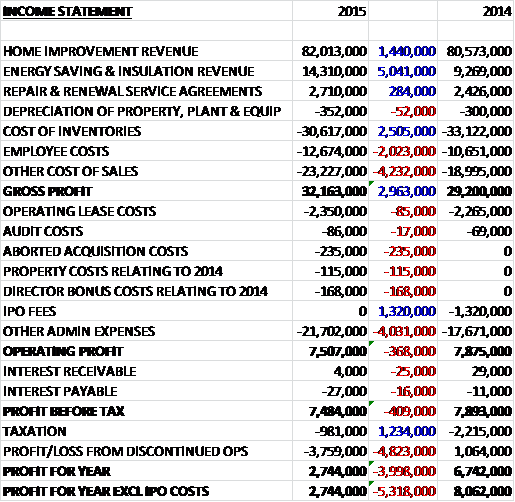
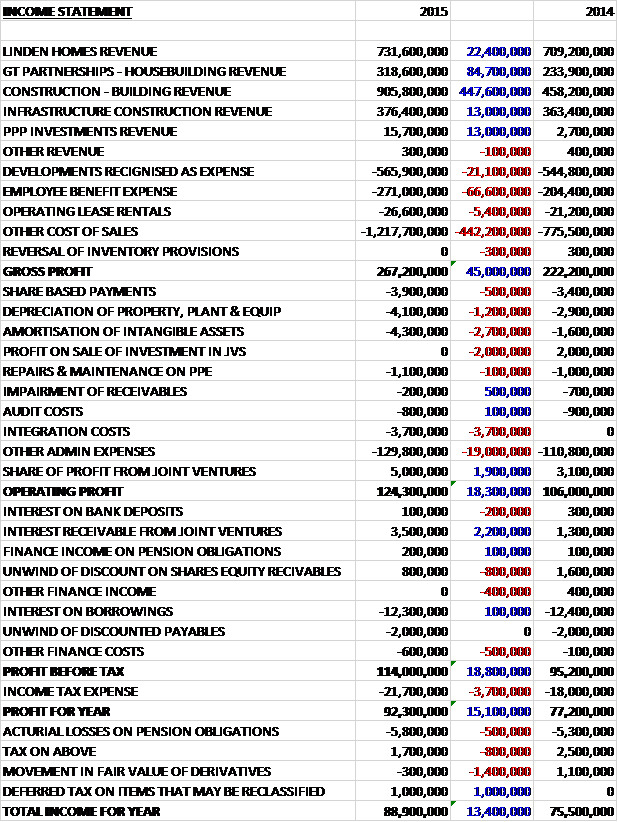
Revenues increased across all businesses when compared to last year with a £447.6M growth in construction building revenue, of which £400M was related to the acquisition of Millar Construction, an £84.7M increase in GT Partnerships housebuilding revenue and a £22.4M growth in Linden Homes’ housebuilding revenue. Developments as an expense increase by £21.1M, staff costs were up £66.6M and operating costs grew by £5.4M along with other cost of sales which increased by £442.2M to give a gross profit some £45M ahead of last time.

Depreciation and amortisation both grew modestly and we also see the lack of a £2M profit from the sale of investments in joint ventures that occurred last year along with £3.7M in integration costs relating to the integration of Millar Construction and other admin costs that grew £19M, partially offset by a £1.9M increase in the profit from joint ventures which meant that the operating profit was up £18.3M when compared to 2014. The interest receivable from joint ventures increased by £2.2M but this was offset by the £800K reduction in the unwinding of the discount on the shares as equity receivables, a £400K fall in other finance income and a £600K growth in other finance costs as well as a £3.7M growth in tax which gave a profit for the year of £92.3M, an increase of £15.1M year on year.
GFRDassets

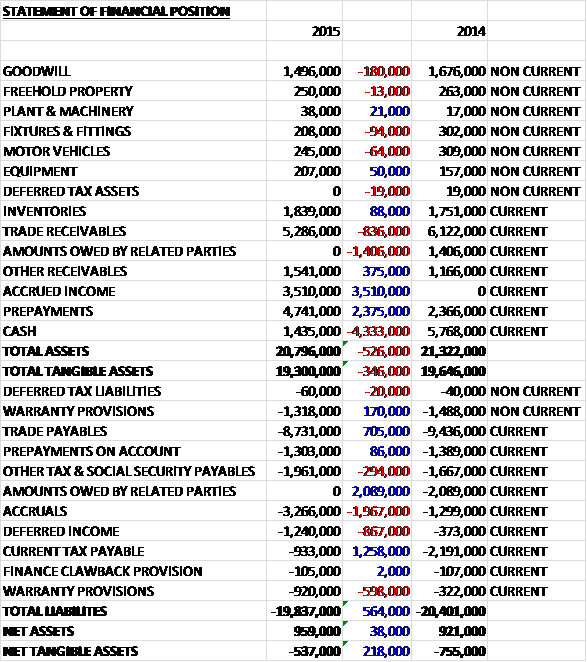
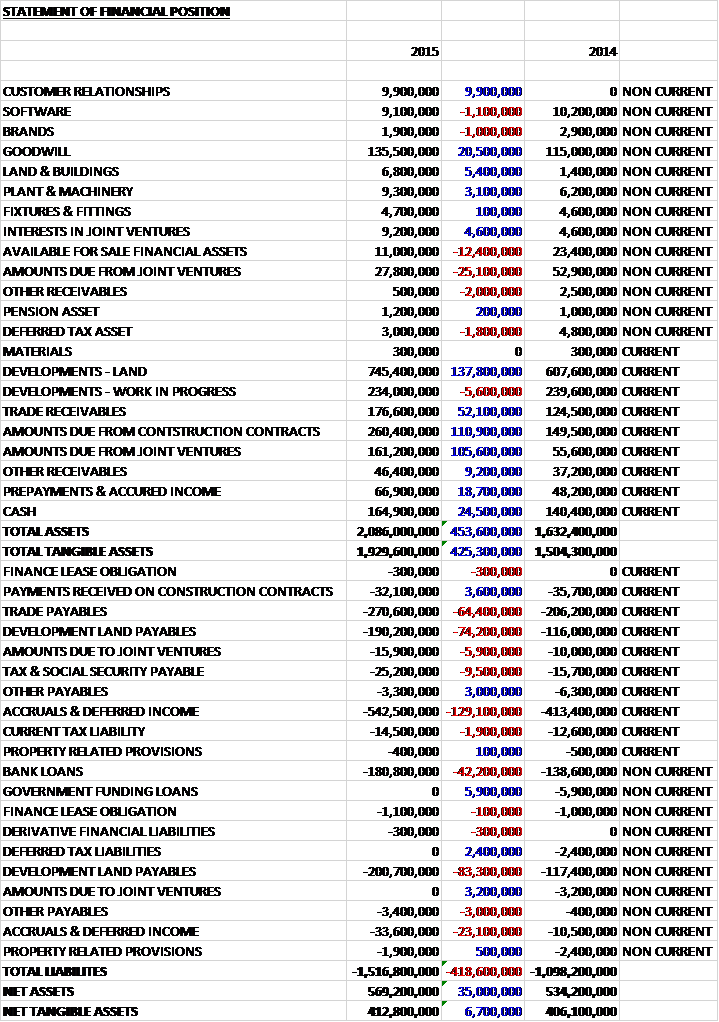
When compared to the end point of last year, total assets increased by £453.6M, driven by a £137.8M growth in land developments, a £110.9M increase in amounts due from construction contracts, an £80.5M growth in amounts due from joint ventures, a £52.1M increase in trade receivables, a £24.5M increase in cash and a £20.5M growth in goodwill. Total liabilities also increased during the year due to a £152.2M growth in accruals & deferred income, a £157.5M increase in development land payables, a £64.4M increase in trade payables and a £42.2M growth in bank loans. The end result was a net tangible asset level of £412.8M, an increase of £6.7M year on year.
GFRDcash

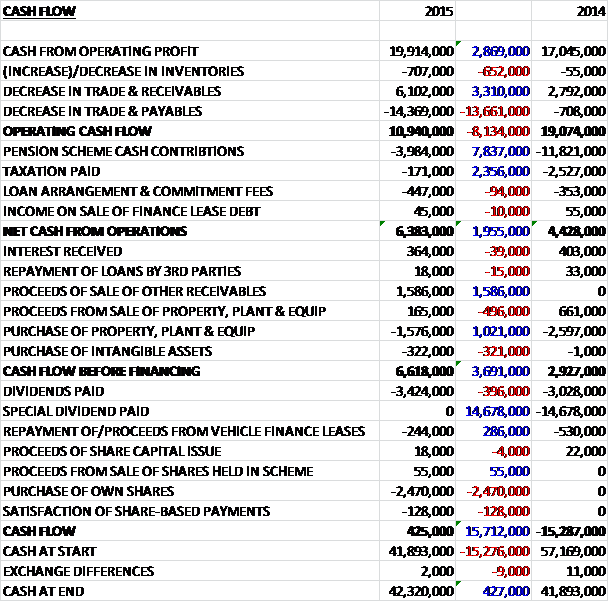
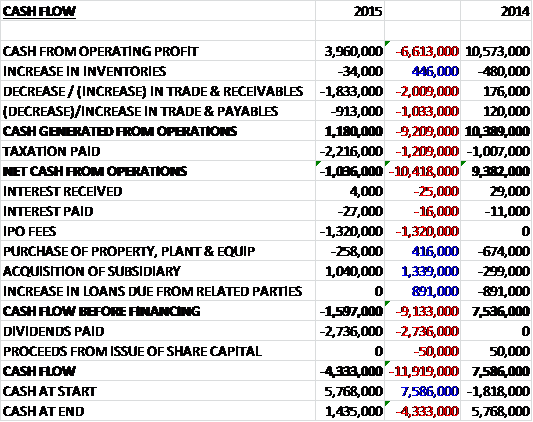
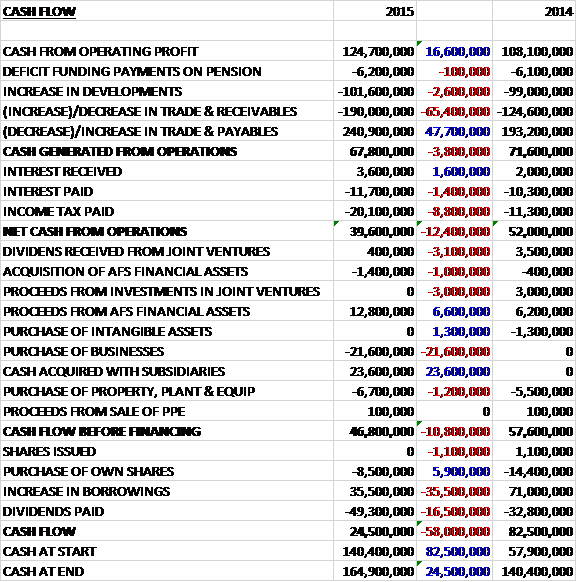
Before movements in working capital, cash profits increased by £16.6M to £124.7M. There was an outflow of cash through working capital, however, with a particularly large growth in receivables which, when combined to an £8.8M increase in tax paid, meant that the net cash from operations came in at £39.6M, a decline of £12.4M year on year. The group spent £6.7M on property, plant and equipment but received a net £11.4M from available for sale financial assets relating to the sale of most of the assets along with a net £2M from business acquisitions to give a cash flow of £46.8M before financing. For some reason the group took out an extra £35.5M in borrowings so it could pay its dividends and buy enough shares for employee schemes to give a cash flow of £24.5M for the year and a cash level of £164.9M at the year-end.

Government policy affects both demand and industry regulation. The Help to Buy scheme continues to benefit the market, particularly outside the South, as does the recent change to stamp duty. The planning environment remains positive but a shortage of planning officers in local authorities continues to cause delays. Housing associations are the main procurers of new affordable homes but provision of new homes by local authorities remain at very low levels.

Linden Homes increased both revenue and margin, with mortgage availability, the planning environment and the land market remaining positive. Galliford Try Partnerships grew faster than expected and the board see substantial potential for this business. Construction is benefiting from a rapidly improving market and the acquisition of Millar Construction with a good pipeline of opportunities at appropriate margins. Conditions in the supply chain remain challenging, however. The availability of materials has improved but it is still difficult to obtain skilled tradespeople, leading to cost inflation. The group took advantage of the continuing favourable land market to further increase the number of plots to a record 15,750, including 515 plots acquired with Shepherd Homes. In all, they have secured all the plots needed by the housebuilding businesses for 2016, and 87% for 2017.

The pre-tax profit at Linden Homes was £78.8M, a growth of £4.5M year on year with an operating margin of 16% compared to 15.1% last year on revenues that grew by 3% to £779M. The increase in revenues reflects a higher average selling price which rose 7% to £327K due to a product mix that moved towards more expensive homes and some price inflation, partially offset by a small reduction in unit numbers with completions down from 2,748 to 2,566. Prices benefited from a greater proportion of larger houses and further price inflation in an improving market. This revenue included sales of land into strategic joint ventures of £51.1M compared to just £7.2M last year. The margin improvement is attributed to the margin improvement plan, higher margin sites coming through from the land portfolio and a continued reduction in the proportion of legacy land. It is worth noting, however, that excluding the land sales, the operating margin increased from 14.6% to just 14.7%.

In July the business implemented operational restructuring in the South in order to improve their overhead leverage, generating savings in 2016 of £500K and annualised savings of £2M going forward. In June the group completed the sale of Linden Homes’ shared equity portfolios for £18.6M which was in line with the carrying amount on the balance sheet. The business had 62 active selling sites compared to 65 last year with sales per site per week declining slightly from 0.63 to 0.61 and they finished the year with sales in hand of £300M compared to £308M. The strategic land holdings stood at 1,500 acres at the year-end compared to 1,405 acres last year and they expect to generate more than 8,000 plots from this land.

Providing a proportion of affordable housing on their sites is often a condition of obtaining planning permission. During the year they formed new joint ventures with Home Group at Newhall in Harlow, and with Spectrum Housing Group, through which they will deliver new homes in the South West over the next fifteen years. The existing joint ventures with Thames Valley Housing, Aster Homes, Notting Hill Housing and Devon & Cornwall Housing all performed well.

Public land releases through the HCA’s delivery partner panel and the GLA have provided good land acquisition opportunities and the group continue to secure public land on deferred payment terms. The changes to social rent setting policy announced in the recent budget will have an impact on the tenure profile of affordable housing, but will not reduce underlying demand. The board anticipate some uncertainty in the short term as registered providers assess the impact and local authorities consider the potential in alternative tenures. Going forward, the housing market remains positive for the business but while supply chain conditions have eased somewhat during the year, the main challenge continues to be to deliver homes within expected timescales and costs.

The pre-tax profit at Galliford Try Partnerships was £8.6M, an increase of £4.2M when compared to 2014 with an operating margin of 2.9% compared to 2.1% last year on a 36% increase in revenues to £329.4M, of which £56.1M came from mixed tenure developments and £273.3M came from contracting. The operating profit was depleted by cost inflation incurred on the conclusion of some older contracts, in particular in the SE, but benefited from a transfer of land into a joint venture housing association. Looking forward, the intention is to allow the business to operate with a net debt position of up to £30M to accelerate its mixed tenure growth compared to a net cash position of £15M this year.

In June the business signed a development agreement with the GLA to construct 1,100 mixed tenure homes in Canning Town, with an approximate development value of £380M. This is the largest standalone housing scheme the group has ever undertaken and it is being delivered through the existing joint venture with Thames Valley Housing. The business also secured and commenced work on the £81M Great Eastern Quays project in East London for Notting Hill Housing. Other key wins included a £36M contract with ExtraCare Charitable Trust for a new retirement village which represents the seventh development for this client.

The increase in mixed tenure revenue contributed to the rise in margins as the business implemented its strategy to fund these developments using cash generated by the contracting operations. Their capability in land-led developments also contributed to the higher margin. For these schemes, the group finds sites, obtains planning permission for affordable housing and then sells the site on to a housing association client. At the year-end, the business’ contracting order book was £825M compared to £513M at the end of last year and at the same date the business had £43M of unit sales in hand. Going forward, the board see strong prospects for the business and have an opportunity to accelerate their growth in mixed tenure developments, by investing up to £30M of extra funding over the next few years to buy land for these schemes.

In construction, with strengthening market demand, the group are winning work with improved appraisal margins, although the results for this year are still constrained by older contracts. Revenue increased by 55% to £1.293BN, reflecting underlying growth and the contribution from Millar Construction. Profit from operations was £15.7M, an increase of £7.7M which represented a margin of 1.2%, up from 1% last year. The improving UK economy has led to increased activity, particularly in London and with clients in the hotels, leisure and office sectors.

As of the year-end, the order book was £3.5BN compared to £3BN the year before. Of the total order book, 72% was in the public sector (29%), 15% was in regulated industries (19%) and 13% was in the private sector (52%). Some 69% of the order book is in frameworks and the Miller Construction acquisition contributed to the increase and the change of sectoral split. In Building, the order book consists of a number of sectors with Education being the most important, followed by facilities management, health and commercial whilst in Infrastructure, the largest component of the order book is highways, closely followed by water with rail, flood alleviation and utilities making up the bulk of the rest of the order book.

The pre-tax profit in the building construction business was £1.3M, a decline of £2M year on year with a margin of 0.9% compared to 0.7% last time as cost inflation continued to impair profitability on contracts priced before current supply chain constraints arose. Last year’s results also benefited from £3.1M from disposing of three investments. Among the major contract wins, the business was one of six contractors appointed to all three lots of the Southern Construction Framework which allows all public bodies and local and central government in the Southern region to procure projects or programmes valued at £1M or above and the four year framework is worth up to £3.9BN in total.

The business was also one of 11 contractors appointed to the Medium Value lot of the North West Construction Hub, which has a framework value of up to £400M over four years. This allows public sector bodies across the North West to procure projects valued from £2M to £9M and follows their appointment to the high value lot in July 2014.

In the Education market they signed a £160M Priority School Building Programme contract with the Education Funding Agency, covering the NE of England. This was the first batch funded by the government’s new PF2 model to reach financial close. The construction contract is worth more than £103M, with a further £56.6M maintenance and life-cycle contract for the facilities management business. They also won EFA contracts for the North and NE Lincolnshire batch, worth £47.6M, and the Greenwich, Lewisham and Croydon batch (£45M). The Highland council awarded them a £48.5M Hub North Scotland contract to deliver a community campus in Wick, which will replace three existing schools.

Continuing their long term relationship with Frasers Property, they were awarded a contract to deliver three further phases of the Riverside Quarter residential development in Wandsworth. The contract has a total value of £69M and will involve the group building apartments for sale, affordable homes and commercial units. In Scotland, they won a place on the Next Generation Estates Contract framework for the MOD. This framework is worth up to £250M over four years, for projects with values of up to £12M, and is extendable for a further three years. They have also signed contracts with Birmingham City University to build a new £46M conservatoire in the Eastside region of the city.

The pre-tax profit in the Infrastructure business was £8.5M, a growth of £3M when compared to last year representing a margin that increased from 1.3% to 2%. The business continued to secure substantial new contracts. In December, as part of the Connect Roads consortium, they were appointed to design, build, finance and operate the £550M Aberdeen Western Peripheral Route. Two further major highway wins included their appointment by Highways England to its Collaborative Delivery Framework, where they are one of six contractors due to deliver up to £1.15BN of work over five years, and their appointment as part of a joint venture to its Smart Motorways programme, worth a total of £1.55BN.

In regulated markets, their joint venture with MWH Treatment and Black & Veatch was appointed preferred bidder by Scottish Water for its non-infrastructure Quality and Standards IV framework which is worth about £560M to the joint venture over six years. Southern Water appointed two of their other joint ventures to its AMP6 framework. These appointments ae expected to be worth around £215M over five years. Following the acquisition of Miller, infrastructure was also appointed to participate in the delivery of £250M of Network Rail Frameworks over five years.

Going forward, improving markets in the public and private sectors are leading to a positive pipeline of opportunities. The group remain focused on selecting work with appropriate risk and margin profiles and the Miller acquisition has significantly increased the order book and the number of frameworks they are now involved with, giving them a broader range of opportunities for which they can tender. Supply chain conditions remain challenging but the group’s cost estimates on new work reflect the inflationary conditions. They expect to increase margins during 2016 and remain on track for the 2018 margin target of 2%.

The pre-tax profit in the PPP Investments business was £3M, a positive movement of £4.8M year on year and included profit from sales of investments of £6.6M. The PPP market in England has seen the first PF2 funded projects finance work on the Priority School Building Programme and the group are awaiting announcements of further projects. In Scotland there continues to be a healthy and visible pipeline of PPP projects. The country uses the non-profit distribution model to finance a number of these projects. This is designed to ensure that contractors earn fair returns on their developments and a pilot programme is planned for Wales which could open up opportunities in that market.

During the year the group made new equity investments totalling £11.7M including the purchase of the Miller portfolio, and disposed of four investments generating the profit of £6.6M. PPP Investments continued to provide good opportunities for Galliford Try Partnerships and Facilities Management businesses, with projects closed during the year adding around £600M to the order books of these divisions and included the Aberdeen Western Peripheral Route and the first ever PF2 contract with the EFA.

Going forward the board believe the PF2 model works well and will allow public sector clients to drive good value for money for their projects. The project pipeline in Scotland and their strengthening position through Miller Construction makes them confident about the prospects for PPP Investments.

Galliford Try Partnership’s good prospects mean the board are increasing their revenue and margin expectations going forward. Having targeting 2018 revenue of around £350M, they are now aiming to exceed £400M. The margin target is now at least 4% against the original target of 3.5% to 4%. Due to the acquisition of Millar Construction, they are increasing Construction’s 2018 revenue target from £1.25BN to £1.5BN while retaining their margin target of 2%. They also intend to growth the housebuilding land bank to around 14,000 and then maintaining it at around this level. In construction, they are looking to increasingly become a collaborative investment partner for public sector clients to give access to a pipeline of projects rather than one-off bids.

Last year the group disposed of its investment in gbconsortium2 ltd for £3M giving rise to a profit of £2M. Their available for sale financial assets comprise PPP investments and shares equity receivables. During the year they sold the majority of their shared equity portfolio which meant that the net investment in shared equity receivables fell by £21.5M and the sale generated a profit on disposal of £400K. The £10.3M of additions represent equity securities acquired with Millar Construction and additional subordinated loans of £1.4M were made to its PPP investments, and the group disposed of interests held at £2.6M for a profit of £6.6M.

In July 2014 the group acquired the Millar Construction business from Millar Group Holdings for a total price of £16.6M in cash. The business is a UK only construction company which delivers building and infrastructure projects to both the public and private sectors. The acquired order book of £1.4BN doubled the group’s existing order book in construction to £2.8BN. The acquisition generated goodwill of £20.2M and came with further intangible assets of £12.1M. The group has so far spent £3.7M in exceptional integration costs and is expecting to generate synergy saving of more than £8M per annum compared to initial expectations of £7M.

In May 2015 the group exchanged contracts with Shepherd Homes to acquire its Yorkshire based housebuilding land assets comprising six current sites and five sites in planning totalling a land bank of 515 plots. The consideration of £30.9M is subject to finalisation based on actual results and £25.9M remained unpaid at the end of the year and is included within development land payables. The acquisition generated goodwill of just £300K and contributed £1.7M in gross profits since its acquisition.

There is a good split of customers with the largest being major water industry customers accounting for about 4% of revenues. Other risks include the level of UK house prices which are affected by factors such as mortgage availability, employment levels, interest rates and consumer confidence. At the end of the year the group’s house price linked financial instruments consisted of shared equity receivables held as available for sale financial assets and the sensitivity to house price inflation and discount rates was not significant. As well as being indirectly susceptible to interest rate increases, the group also has some debt and a 1% increase in rates would result in an £800K fall in profits, all else being equal. There remains some £211.4M of undrawn borrowings available to the group.

As can be seen, the pension scheme is currently running at a small surplus, which is a great state of affairs and with the present value of all the obligations standing at £218.9M, the scheme doesn’t really represent a massive risk in my view given the size of the company. The contributions expected to be paid into the scheme in 2016 are £5.8M.

The fact that the group has both housebuilding and construction businesses gives them some diversity. Housebuilding adapts quickly to economic changes, particularly during a recovery, while long contracts and lead times make Construction late cycle. This means that if one business turns down the other remains strong, reducing economic risk. Construction generates cash from regular payments whilst Housebuilding uses cash to pay for land and development so once again, these are complementary but unfortunately being earlier in the cycle, the cash absorbing Housebuilding comes before the more regularly cash generating construction business.

There were a number of board changes during the year. Amanda Burton retired as a non-executive director and Ian Coull stepped down as Chairman due to his other commitments. Having announced his intention to retire as CEO at the end of 2015, Greg Fizgerald became Executive Chairman on an interim basis and will become non-executive chairman from January 2016. In October, Peter Truscott joined as the new CEO and Peter Ventress joined as deputy Chairman, replacing Peter Rogers who retired. Peter Ventress will take over as non-executive Chairman in November 2017. The group also appointed Gavin Slark as non-executive director and promoted Ken Gillespie to COO.

Going forward, in housebuilding the UK’s supply of new homes continues to fall short of demand. The outlook for Linden Homes remains strong with the mortgage and land market and the planning environment all positive. The main issue is building to schedule, given the shortage of skilled people. In Galliford Try Partnerships, affordable housing remains high on the political agenda, with renewed emphasis on home ownership products. Despite the challenges in welfare reform and the recent rent cuts, housing associations remain financially robust and are continuing to leverage their balance sheets to support mixed-tenure developments. This gives the group continued confidence of growth at the business and will support longer term margin improvement as clients require mixed tenure expertise. Construction’s markets are improving and, with increasing opportunities for new work, the board remain confident that margins will move up to their 2018 target.

After a 28% increase in the dividend for the year, the shares are yielding 4.9% which increased to a hefty 5.7% on next year’s forecast with the group looking to reduce dividend cover from 1.7 times to 1.5 times which is cutting it a bit fine in my view. At the current share price the shares are trading on a PE ratio of 12.6 which falls to 11.1 on next year’s consensus forecast. At the end of the year, the group had net debt of £17.3M compared to a net debt position of £5.1M at the end point of last year. Although it should be noted that the year-end position if flattering and the average net debt during the year was £168M with the group increasing their use of debt to fund the growth of the housebuilding operations.

On the 13th January the group released a trading update covering the first half of the year. All three of the businesses are trading in line with board expectations in positive market conditions. Net debt increased to £95M from £35.9M at the same point of the prior year, reflecting additional investment in Linden Homes and Partnerships.

At Linden Homes, good progress was achieved on operating margin against the same period of last year. Revenue is expected to be 5% higher from a net 1,171 of unit completions, down from the 1,278 recorded last time and within this total, private sales were higher while affordable sales of 233 units were below the previous period. Average outlets increased to 76 compared to 62 at the year-end point and the average selling price for private sales was up 8% at £334K with the combined private and affordable average selling price increasing to £295K. Initiatives to rationalise operating processes targeting a reduction in overheads by about £5M per annum have been put forward with the effect being at least earnings neutral in the current year with the full savings expected in 2017. Also, the group have brought forward plans for an additional business unit in West Yorkshire, building on the integration of Shepherd Homes.

In GT Partnerships, contracting revenue was below the first half of last year, reflecting some delays in procurement by registered providers immediately following the changes announced in the summer budget. The impact of these changes have now largely been assimilated with the effect likely to be positive for the business. The operating margin is likely to be ahead of the first half of last year, reflecting progress in increasing the proportion of mixed tenure, and the board are considering options to accelerate the growth of the business, including bringing forward the opening of a sixth office this year.

In Construction, the order book increased from £3.2BN to £3.7BN in an improving market. Some 98% of projected revenue for the current year is secured with 66% of the revenue for 2017. The business continue to make progress in concluding legacy contracts whilst seeing improved margins on new work.

Overall market conditions have remained positive, with build cost increases stabilised to a manageable level. Looking ahead to the second half of the year, the board believe they are in a strong position to deliver results in line with their expectations.

Overall then, this has been a good year for the group. Profits were up, and net tangible assets increased modestly. The operating cash flow did decline but this was due to a growth in tax and receivables and the cash profits increased. There was a decent amount of free cash generated but this was not enough to cover both the dividends and the shares for the share schemes. Linden Homes is really the main profit driver and is performing well at the moment, driven by an improved mix of homes and some price inflation.

The other divisions are all pretty low margin operations. GT Partnerships is performing well, with margins increasing to 2.9% and the order book look strong, although in the first half of 2016 the business has been affected by the budget announcement which caused some delays to projects. The Infrastructure business increased its wafer thin margins to 2% and seems to be winning some good business but the Building Construction business has margins that are still under 1% due to the effects of cost inflation on some legacy contracts.

The fact that the CEO has stepped down does add some extra risk in my view and of course, the group is very susceptible to the general market sentiment, although the infrastructure division might add some stodge I guess. The dividend yield of a hefty looking 5.7% going forward but the cover is too thin for my taste to be honest, although the forward PR of 11.1 does suggest some value here. A tricky one this, it does seem a quality business and I might look to enter on weakness if the market doesn’t completely collapse!

Having had a further think about this, I am a little uncomfortable with the reduction in the dividend yield at the same time as the gearing up in debt as I don’t think this is how a company should be run. Therefore, unless something changes on this regard I won’t be updating this company regularly.
GSK Share Blog – Final Results Year Ended 2015

There will be some changes to the business split going forward as ViiV Healthcare will be merged into the Global Pharmaceuticals segment, which is a bit of a shame in my view. The results this year include ten months of the vaccines and consumer healthcare joint venture with Novartis (and excluding the oncology assets sold to Novartis) GSK has now released its final/Q4 results for the year ended 2015.

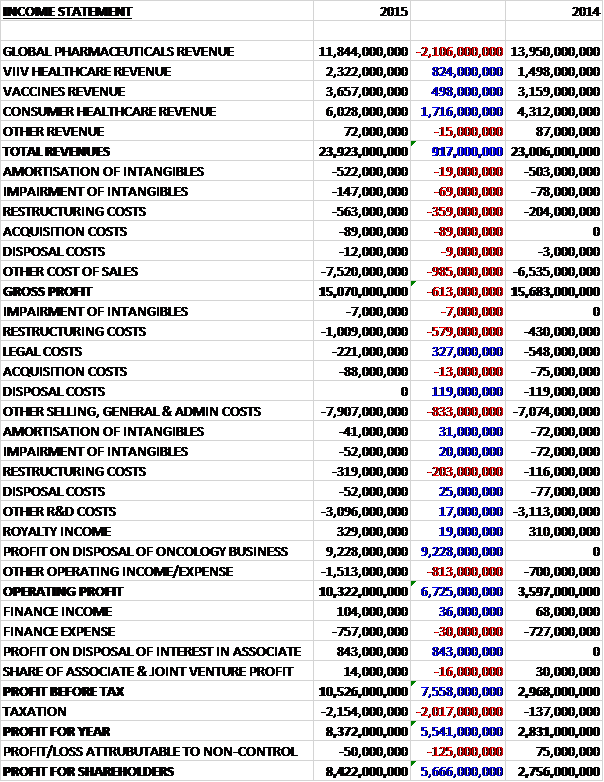
GSKincome

Overall revenues increased by £917M year on year as a £2.1BN decline in global pharmaceuticals revenue was more than offset by a £1.7BN growth in consumer healthcare revenue, an £824M increase in ViiV Healthcare revenue and a £498M growth in vaccines revenue. We then see a £69M increase in impairments, a £359M growth in restructuring costs and an £89M hike in acquisition costs along with a £985M increase in underlying cost of sales to give a gross profit some £613M below that of last year. There was also a £579M increase in admin restructuring costs, partially offset by a £327M decline in legal costs due to the Chinese fine levied last year, and the lack of any disposal costs which accounted for £119M last year.

The underlying increase in selling and admin costs was £833M, however. This was dwarfed by the £9.228BN profit on disposal of the oncology business to give an operating profit £6.725BN ahead of last year. We also see an £843M profit on the disposal of an interest in an associate relating to the disposal of half the investment in Aspen Pharmacare offset by a £2BN increase in tax to give a profit for the year of £8.422BN, an increase of £5.666BN year on year, although obviously without the £9.228BN profit on the disposal, the situation would have been very different.

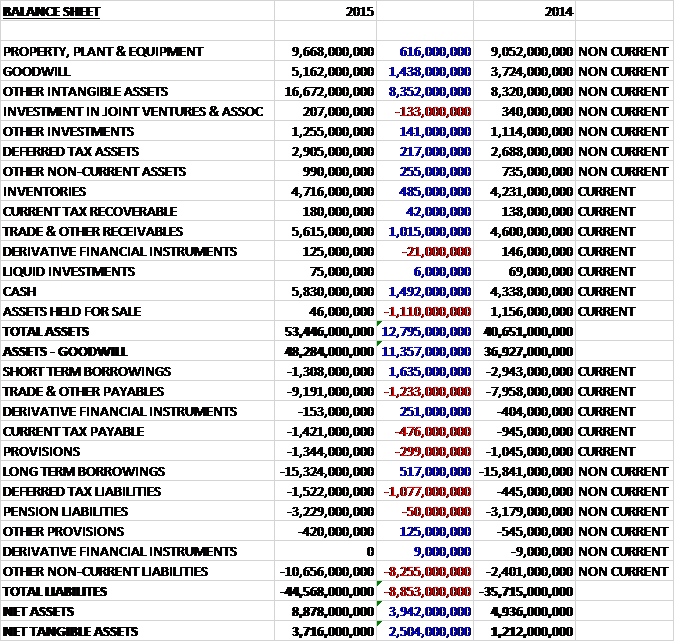
GSKassets

When compared to the end point of last year, total assets increased by £12.795BN driven by an £8.352BN growth in other intangible assets, a £1.438BN increase in goodwill, a £1.492BN growth in cash, a £1BN increase in receivables and a £616M growth in property, plant and equipment, partially offset by a £1.11BN fall in assets held for sale relating to the Oncology assets sold to Novartis. Total liabilities also increased during the year as an £8.255BN growth in other non-current liabilities including £6.287BN relating to the option for GSK to buy the remaining assets in the consumer healthcare joint venture from Novartis with the rest of the increase due to a growth in contingent consideration both to Novartis and Shionogi, a £1.233BN increase in payables and a £1BN growth in deferred tax liabilities due to the tax on consumer healthcare intangibles acquired from Novartis. These increases were partially offset by a £1.635BN decline in short-term borrowings and a £517M fall in long term borrowings. The end result is a net tangible asset level of £3.716BN, a growth of £2.5BN year on year.

GSKcash

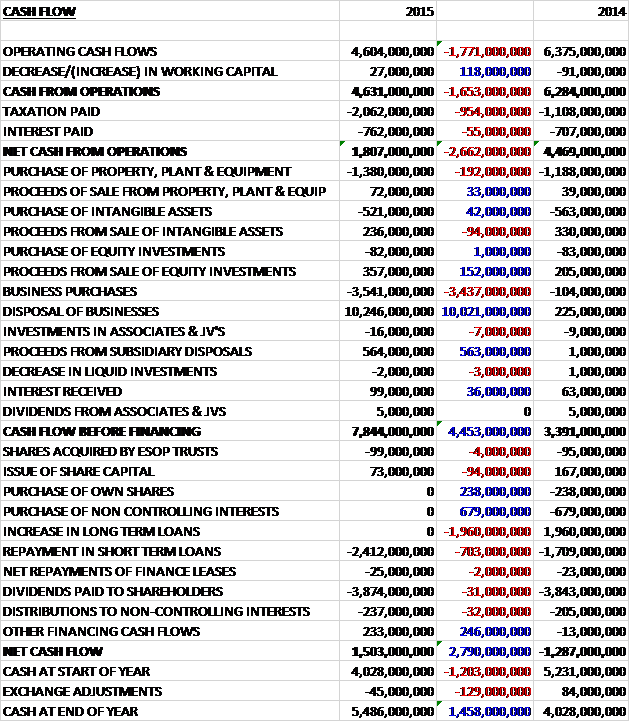
Before movements in working capital, cash profits declined by £1.771BN to £4.6BN. There was a very small decline in working capital but tax was up £954M relating to the tax paid on the Novartis transaction (£1.1BN) with the rest due to be settled in H1 2016, and interest paid grew by £55M to give a net cash from operations of £1.8BN, a decline of £2.66BN year on year. The group spent £1.38Bn on property, plant and equipment along with a net £285M spent on intangible assets but there was a net cash inflow of £275M related to equity investments (the rest of the Aspen Pharmacare investment I think) but the big move is from the net £7.269BN received from the disposal of businesses to give a cash inflow of £7.844BN before financing. The group then spent £2.412BN on repaying short term loans and spent £3.874B on dividends to give a cash flow for the year of £1.5BN and a cash level of £5.486BN at the year-end.

In Q4, pharmaceutical turnover was down 9% on a reported basis, primarily reflecting the disposal of the oncology business to Novartis. Adjusting for the impact of the disposal, turnover was down just 1% and HIV sales grew 51% in the quarter. Respiratory sales declined 3%, primarily reflecting further declines in Seretide in Europe and increased competitive pressures in the ROW region along with the continuing transition of the portfolio to newer products.
Sales of established products declined 20% with lower sales in all regions reflecting a continued decline in Lovaza in the US, intensifying pressure in Europe and the impact of the reshaping of the China business. Sales of new pharmaceutical products increased by £412M which more than offset the decline in Seretide.

The operating profit in Global Pharmaceuticals was £4.733BN, a decline of 24% year on year. In Q4, the operating profit was £1.149BN, a decline of 34% year on year with a 4.9% fall in operating margins on a pro-forma constant currency basis. This decline reflects the impact of lower prices and the cost of investments in manufacturing stability and additional capacity to support the new launches. Respiratory sales in Q4 declined by 3% to £1.594BN. Seretide/Advair sales were down 8% to £1.029BN, Flovent sales decreased 11% to £167M and Ventolin sales declined 16% to £147M. For the year, respiratory sales were down 7% with Seretide down 13%, Flovent decreasing by 12% and Ventolin falling 7%. Relvar/Breo Ellipta recorded sales of £99M and Anoro Ellipta, now launched in the US, Europe and Japan, recorded sales of £30M in Q4. During the year, the combined total of all Ellipta product sales was £353M with £139M of those in Q4.

In the final quarter in the US, respiratory sales increased 3% representing a 7% volume growth offset by a 4% negative impact of price and mix with sales of Advair up 2% although payer rebate adjustments related to prior quarters favourably impacted sales in during the period. Flovent sales were down 13% and Ventolin sales declined 26%, primarily as a result of the net negative effects of adjustments to payer rebates. The net impact of adjustments related to prior quarters for payer rebates across the respiratory portfolio was broadly neutral to reported US sales. The new Ellipta products recorded combined sales of £77M in the quarter.

European respiratory sales were down 11% to £341M with Seretide sales down 22% representing a 5% volume decline and a 7% negative impact of price and mix which reflected pressures of increased competition from generics and the transition of the portfolio to newer products. Relvar Ellipta recorded sales of £25M while Anoro Ellipta recorded sales of £6M. Respiratory sales in the International region declined 7% to £405M with emerging markets down 9% and Japan down 1%. In Emerging Markets, sales of Seretide were down 11% and Ventolin also declined 11%. In Japan, sales of Relvar Ellipta of £20M in the quarter drove overall respiratory performance.

In Q4, cardiovascular sales of £173M represented a decline of 30% year on year with the full year total of £858M representing a 9% fall. In Q4, the Avodart franchise fell 42% to £110M with 50% and 24% declines in sales of Avodart and Duaodart respectively driven by the onset of generic competition in the US and the interruption of third party supply in certain markets. Sales of Prolia were up 27% to £12M. In the year as a whole, immune-inflammation sales of £263M represented a 16% growth while in Q4 they increased 20% to £75M. Benlysta sales were £64M, up 27% and in the US, Benlysta sales were £59M, up 27%.

During the year, sales of other pharmaceuticals were down 4% to £2.199BN and in Q4 they were down 3% to £609M. Dermatology sales declined 11% to £104M, adversely affected by supply constraints, while Augmentin sales increased 1% to £129M. Sales of products for rare diseases declined 9% to £95M, including sales of Volibris which were up 5%.

During the year, sales of established products were down 15% to £2.528BN and in Q4 they were down 20% to £609M with sales in the US down 34% to £156M as Lovaza sales fell 62% to £22M. Europe was down 8% to £125M with Serevent sales down 18% to £9M. International was down 15% to £328M, with lower sales of Zeffix, down 25% to £27M driven by supply constraints in China, and Seroxat down 16% to £33M.

The operating profit in the ViiV Healthcare business was £1.686BN, a growth of 72% when compared to 2014. In Q4, the operating profit was £489M, a growth of 63% when compared to the final quarter of 2014. Sales during the year increased 54% to £2.322BN and sales in Q4 increased 51% to £695M with the US up 66%, Europe up 49%, and ROW markets up 9%. The growth in all regions was driven by Triumeq and Tivicay. The ongoing roll-out of both drugs resulted in sales of £289M in the case of Triumeq and £174M for Tivicay. Epzicom/Kivexa sales declined 19% to £162M and Selzentry sales declined 11% to £30M. There were continued declines in the mature portfolio, mainly driven by generic competition to both Combivir, down 47% to just £8M, and Lexiva, down 43% to £13M.

The operating profit in the Vaccines business was £966M, a fall of 9% year on year. In Q4, the operating profit was £164M, a fall of 23% year on year on margins that declined 8.9% on a constant currency basis, impacted be the inherited cost base of the former Novartis vaccines. Vaccine sales in the year were up 19% to £3.657BN and in Q4 they were up 20% to £963M with the US up 15%, Europe up 30% and ROW markets up 16%. Reported growth was driven by the newly acquired products, primarily Bexsero in Europe and Menveo in the US and Europe. Pro-forma performance was primarily driven by Europe due to strong growth in Bexsero with the US flat, primarily due to the phasing of Menveo and Fluarix sales; and ROW markets down, reflecting higher sales of the acquired vaccines in Q4 2014, and tougher competition for tenders as well as a number of supply constraints.

In the US, sales grew 15% on a reported basis and were flat pro-forma with performance driven by the favourable impact on Rotarix sales in the quarter of CDC stockpile movements in Q4 2014 and by increased Boostrix sales due to market share growth and increased wholesaler orders. These factors were offset by lower wholesale demand for Menveo and Fluarix sales due to the phasing of shipments. The Infanrix portfolio growth also was impacted by a strong comparative performance last year following supply shortages in Q3 2014.

In Europe, sales grew 30% on a reported basis and were up 11% pro-forma. This growth primarily reflected increased sales of the Meningitis portfolio. Bexsero growth came from gains in private market channels in several countries including Italy, Spain and Portugal, and in the UK following its inclusion in the NHS immunisation programme. Menveo growth was driven by tender awards in the UK and Italy and the MMRV portfolio was up 35%. Offsetting this growth, Infanrix was flat, impacted by supply constraints and increased competitor activity, and sales of Hep A vaccines declined reflecting ongoing supply constraints.

In ROW markets, sales grew 16% on a reported basis and were down 8% pro-forma. This performance reflected lower sales of Infanrix and Hep A vaccines due to supply constraints, partly offset by market expansion for Synflorix in Africa, Pakistan and Bangladesh, and the phasing of Boostrix sales in Brazil. Growth was also impacted by lower Cervarix demand and higher sales of the acquired vaccines in Q4 2014.

The operating profit in the Consumer Healthcare business was £680M, an increase of 66% when compared to last year. In Q4, the operating profit was £180M, an increase of 73% when compared to the same quarter of last year on core margins that increased 3.2% on a constant currency basis. Over the year, turnover grew 44% to £6.028BN and in Q4 2015, turnover grew 47% to £1.562BN, benefiting significantly from sales of the newly acquired products. On a pro-forma basis, growth was 5%, reflecting strong growth in the US following the launch of Flonase as well as globally strong growth in Sensodyne. Momentum from first half launches continued to drive innovation contribution with sales from product introductions in the last three years representing about 13% of sales.

US sales grew 50% on a reported basis and 13% on a pro-forma basis, with Flonase being the biggest growth contributor. Thereflu delivered double digit growth, driven by the launch of the warming syrups range earlier in the year, together with some price increases. Distribution gains contributed to the strong performance of Sensodyne Pronamel and the ongoing re-launches of Nicorette lozenge, Nicorette Minis and alli also contributed to the strong quarterly growth. This was partly offset by an adverse comparison on dental care, where re-supply boosted Q4 2014, as well as the continuing impact of supply constraints and increased competition on Tums.

Sales in Europe grew 75% on a reported basis and 2% pro-forma. This performance was driven by Voltaren which recorded market share gains in a number of markets, driven by a new advertising campaign and the Voltaren 12 hour topical innovation which has now launched in 35 markets. In Oral health, Sensodyne continued to report double digit growth due to new advertising in key markets and the rollout of Sensodyne True White in the UK, Sensodyne Repair and Protect Whitening in Germany and Sensodyne mouthwash across a number of markets. Paradontax delivered double digit growth in the period driven by a new condition awareness advertising campaign and consumer sampling. These strong performances were partly offset by denture care which reported an 11% decline due to an adverse comparison with Q4 last year which benefited from supply recovery. Overall, sales declined 6% in Central and Eastern Europe where continued softness in consumer spending was compounded by the low incidence of colds and flu.

ROW sales of £709M grew 32% on a reported basis and 3% pro-forma. This performance was driven by India which continued to perform well with Horlicks reporting growth of 18%, reflecting seasonal marketing campaigns which drove a record market share. Sensodyne delivered broad based growth of 19% across the region with Japan showing the benefits of the launch of Sensodyne Complete earlier in the year. Wellness sales continued to recover from earlier integration activities in many markets but were offset by economic and political uncertainty in Venezuela where sales were down 97%, and the weak consumer environment in Russia where sales were down 10% as a result of customers switching to value offerings as well as the adverse impact of the mild cold and flu season.

There were a number of new pharmaceutical and vaccine products that performed well, with Tivicay and Triumeq sales both up more than 100% in the year to £588M and £730M respectively. In respiratory, Relvar/Breo Ellipta was up over 100% to £257M and Anoro Ellipta also more than doubled to £79M. Incruse Ellipta also made some ground, also more than doubling to £14M with £9M of those sales being made in Q4. Elsewhere Eperzan/Tanzeum more than doubled to £41M in the year and in vaccines Bexsero also more than doubled to £115M although sales of Menveo fell during the year with a 50% collapse in Q4 taking the annual total for that product down to £160M.

During the year, Seretide/Advair remained by far the most important drug with sales falling 13% to £3.681BN but Trimeq became the second largest by sales as they more than doubled to £730M with Tivicay sales also up more than 100% to £588M. Next was Avodart, with sales down 15% to £657M and Flovent/Flixotide with sales down 12% to £623M and Ventolin down 7% to £620M. Other notable drugs were Benlysta, up 25% to £230M and Revlar/Breo Ellipta, more than doubling to £257M. Within vaccines, Infanrix remained the most important, although sales fell by 9% to £733M and Hepatitis vaccines fell 4% to £540M. Better performers were Rotarix, up 14% to £417M; Synflorix, up 5% to £381M; Boostrix, up 12% to £358M; and Fluarix, up 21% to £268M.

On a quarterly basis, again the most important drug remained Seretide, falling 8% to £1.029BN but once again it is pleasing to see Triumeq becoming the second highest by sales, more than doubling to £289M; with Tivicay next, increasing by 58% to £174M offsetting the 19% fall in Epzicom, down to £162M. Flixotide declined 11% to £167M and Ventolin was down 16% to £147M with Avodart collapsing, down 42% to £110M. Relvar/Breo Ellipta is really starting to contribute though, more than doubling to £99M and Benlysta also had a good quarter, up 27% to £64M. Anoro Ellipta is also starting to look promising, more than doubling to £30M. In vaccines, Infanrix was down 19% to £165M and Hepatitis vaccines were down 7% to £134M but there was a 13% growth in Synflorix sales to £136M, a 23% increase in Rotarix sales to £98M and a 61% increase in Boostrix sales to £91M.

There was some progress in the pipeline during the quarter. In HIV and Infectious diseases, the group announced that phase 2n LATTE study of long-acting, injectable formulations of cabotegravir and rilprivirine met its primary endpoint. In respiratory, the group announced FDA and EU approval for Nucala for severe eosinophilic asthma and 3008348 advanced to phase 1. In vaccines, they announced US filing to expand the age indication for FluLaval Quadrivalent, in immune-inflammation they announced positive results from the phase 3 BLISS-SC study of Benlysta administered subcutaneously in patients with systemic lupus erythematosus, positive top line results from the sirukumab phase 3 programme supporting regulatory filings for rheumatoid arthritis, and the initiation of a phase 3 study of sirukumab in Giant Cell Arteritis. In oncology, the announced the initiation of a phase 1 study to evaluate an OX40 agonist and they also announced EU approval for a variation to expand the indication of Volibris to include use in combination treatment of PAG along with the discontinued US Toctino programme.

Major restructuring charges during the year increased considerably, reflecting the acceleration of a number of integration projects following completion of the Novartis transaction, as well as further charges as part of the pharmaceuticals restructuring programme. The programme has delivered about £1Bn of incremental benefits this year, with a net impact on 2015 of £800M after taking into account the £219M structural credit recognised in Q3 2014. Charges for the combined restructuring and integration programme to date are £2.7BN and the total charges of the programme are expected to be about £5BN. By the end of this year, the programme has delivered about £1.6BN of annual savings and remains on track to deliver £3BN of annual savings in total and should be largely complete by the end of 2017.

Under the initial agreement, GSK had the right to withhold its consent to the exercise of either the Shionogi or Pfizer put options for their holdings in ViiV Healthcare so these were not included on the balance sheet. Following the good performance of the business, however, the board has decided that they should be recorded so they have given up their right to withhold consent and by the end of Q1 2016, the estimated present value of £2BN will be included in liabilities. Also, liabilities of £170M will be recognised for the future preferential dividends anticipated to become payable to Pfizer and Shionogi.

In December ViiV Healthcare had reached an agreement with Bristol-Myers Squibb to acquire its preclinical and discovery stage HIV research business. The consideration comprises an upfront payment of $33M followed by milestone payments of up to $587M and further contingent consideration depending on future sales performance. The acquisition is expected to complete during the first half of 2016. In a separate transaction, the group also agreed with Bristol-Myers Squibb to acquire its late stage HIV R&D assets. This consideration comprises an upfront payment of $317M, followed by milestones of up to $518M and tiered royalties on sales. This transaction is also expected to complete during the first half of 2016.

During the year the average sterling exchange rates were stronger against the Euro and the Yen but weaker against the US dollar which is the same situation that occurred in Q4. Due to the continuing political and economic uncertainties in Venezuela, at the year-end the group changed the exchange rate used to translate its subsidiaries in the country. This change had no significant impact on the income statement but gave rise to an exchange loss on translation of the cash held by the subsidiaries of £94M.

Going forward it is expected that the core effective tax rate will increase from 19.5% this year and last year to between 20% and 21% in 2016, mainly due to the higher proportion of sales expected from the US business and further moderate upward pressure on the tax rate is likely over the next several years too.

The group is apparently well positioned to return to core earnings growth in 2016 and the board now expect sales of new products to meet their target of £6BN in annual revenues up to two years earlier than previously stated which should now occur in 2018. In 2016, the board expect core EPS growth to reach double digit percentages on a constant currency basis but they are mindful that the macro-economic and healthcare environment will continue to be challenging. Over the next two years, they are expecting development milestones for Shingrix, sirukumab, ICS/LABA/LAMA, cabotegravir, daprodustat and their Men ABCWY vaccine. They also expect up to twenty Phase 2 starts for assets in Immuno-inflammation, Oncology, Respiratory and Infectious diseases. They also continue to expect to pay a dividend of 80p in 2016 and 2017.

At the end of the year the group had a net debt position of £10.727BN compared to £14.377BN at the end of last year. At the current share price the shares trade on a core PE of 16.7, although it has to be said I don’t really agree with the group not counting legal costs and amortisation as core items and if we add these back on, the PE becomes 19.6 which seems expensive to me. On next year’s consensus forecast, the shares trade on a PE of 16.6, although that probably discounts a load of costs too. After the payment of the 20p special dividend, the shares are currently yielding 7.1% which falls back down to 5.7% on the dividend going forward. These pay outs are definitely not covered by cash earnings, however, so care need to be taken.

So, this has been a difficult year for the group which has been characterised by their one blockbuster drug, Seretide, which is by far the biggest in sales, coming under competitive pressure. It is difficult to analyse profits as they are heavily influenced by the Novartis transaction and the company likes to take off all sort of costs in its calculations for core profits. Net assets did increase during the year, although the put option liabilities will be added next year so that should be taken into account. The operating cash flow was poor, falling year on year and not covering the dividend output, although the disposals meant that the group did get quite a bit of cash in during the year.

As well as Seretitde, Lovaza and Avodart both seem to be under pressure but the Ellipta drugs seem to be starting to make a meaningful contribution. The real saviours for the group at the moment, though, are the HIV drugs Triumeq and Tivicay with the former becoming the group’s second largest by sales. Given that it more than doubled this year, it would be very surprising if sales didn’t grow in 2016 too – I wonder just how important they can become for the group. It is a shame that the benefits have to be shared with the two partners in the associate really.

Overall, I do think there are some glimmers of hope here and the 5.7% forward dividend looks good, although as mentioned, this is no-where near close to being covered by operational cash flow or indeed earnings so the group needs the new drugs to come on stream quickly to maintain the dividend and prevent an outflow of cash. The forward PE of 16.6 does not look very exciting, particularly as it is likely based on GSK’s definition of core earnings which don’t include things like amortisation and legal fees – both of which seem pretty core to me – so I can’t help thinking that too much future growth is being assumed here and the shares look a bit pricey to me. Unless something changes in this regard, I will not be updating the company going forward.

Redrow Share Blog – Interim Results Year Ending 2016

Redrow has now released its interim results for the year ending 2016.

RDWinterimincome

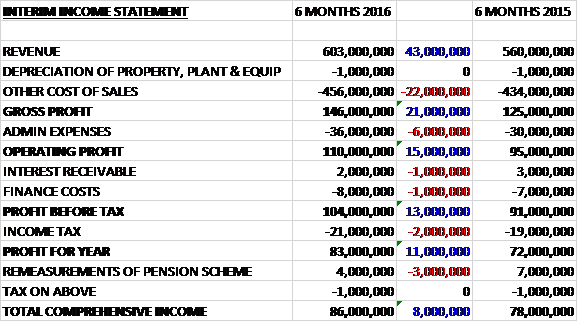
Revenues grew by £43M when compared to the first half of last year and with cost of sales up by just £22M, the gross profit increased by £21M. Admin expenses were £6M higher and there was a small reduction in interest receivable along with a modest growth in finance costs and tax which meant that the profit for the half year period came in at £83M, a growth of £11M year on year.

RDWinterimassets

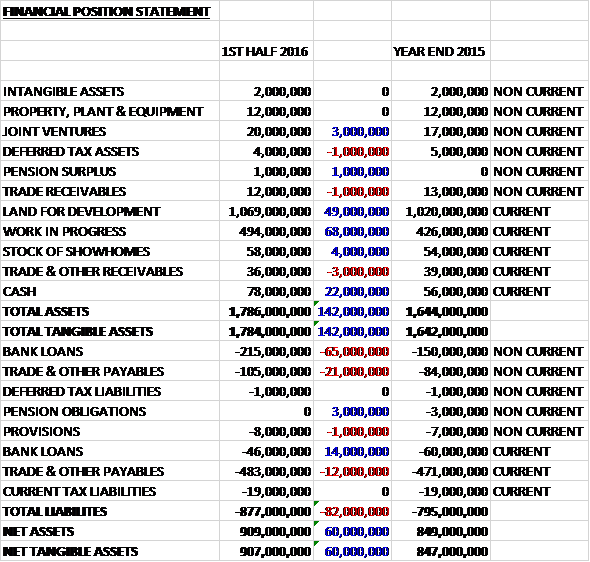
When compared to the end point of last year, total assets increased by £142M driven by a £68M growth in work in progress, a £49M increase in land for development and a £22M growth in cash. Total liabilities also increased during the period due to a £51M increase in bank loans and a £33M growth in payables. The end result is a net tangible asset level of £907M, an increase of £60M over the past six month period.

RDWinterimcash

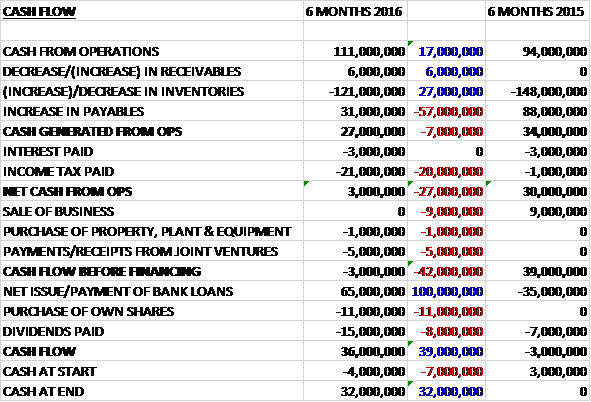
Before movements in working capital, cash profits increased by £17M to £111M. There was a large cash outflow through working capital, however, with a £121M growth in inventories along with a £31M increase in payables that was some £57M lower than last time. The income tax paid was also £20M above that of the first half of 2015 which meant that there was a net cash inflow of just £3M from operations, a deterioration of £27M year on year. The group spent just £1M on property, plant and equipment and £5M on their joint venture investments to give a cash outflow of £3M before financing. They then took out a net £65M in new loans to pay for the £15M of dividends and £11M of their own shares, presumably to pay out in incentive schemes which meant that there was a cash inflow of £36M for the half year period and a cash level of £32M at the end of the half.

During the first half of the year the group increased their legal completions by 18% to 2,178. Homes revenue in the period increased by 14% to £584M due to the increased number of completions and total revenues increased by 8% to £603M, impacted by revenues from commercial and land sales being £27M lower. The average selling price of their private homes increased 2% due to the shift of their London business away from high priced Central London apartments to concentrate on the Outer London commuter market where demand remains strong. Overheads increased by £6M due to the opening of two new divisions, one covering Kent and Sussex and the other to manage what will be the flagship development at Colindale in North London.

Demand for new homes was strong throughout the period and the Government’s Help to Buy scheme continues to give the board confidence to increase output. The only area where a slow-down has been seen is in Central London, but this had a limited effect on the group as they previously made the decision to re-focus their London business on Outer London where demand remains robust. In the period, some 44% of the private legal completions used the Help to Buy scheme and mortgage availability and rates continue to improve. As a result the group’s sales per outlet per week were 0.65, up 10% on the prior year. The value of private reservations in the first half increased by 51% to £679M which resulted in a closing order book of £655M, up 51% year on year.

During the period the group added over 5,700 plots to their current land bank, of which over 1,500 were converted from their forward land bank. These included 920 plots on their major Garden Village project in Cheshire. At the end of December the current land bank totalled 21,435 plots, an 18% increase compared to the end of last year and since the end of the period the group have obtained a fully implementable planning consent on the Colindale site, converting another 2,900 plots from forward to current land which has caused the forward land bank to reduce slightly. There were also some small land sales both in Harrow Estates and in the homes business as the group completed on some freehold reversion sales.

One consequence of selling faster is that sites are coming to an end quicker yet bringing new outlets on stream continues to be delayed by the planning system. About 42% of the current land bank is tied up at one stage or another. The shortage of skilled people also continues to be a constraint on output but this situation has eased over the past six months.

The group are only at the beginning of the spring selling season, but demand for new homes remains robust. They ended the first half with an order book up 51% on this time last year and in the first six weeks of the second half they have secured 455 private reservations, 10% ahead of last year. They have a strong pipeline of new sites in planning and the strategy to grow the business and increase the number of homes they build remains on track. Demand for new homes remains robust despite recent turmoil in the financial markets and the board are confident of another strong year of growth for the group.

At the period-end, the group had a net debt position of £183M compared to £154M at the end point of last year. After a doubling of the interim dividend, the shares trade on a yield of 1.9% which increases to 2.3% on the full year guidance of 10p per share for the year.

Overall then, this was another period of good progress for the group. Profits were up and net assets increased. The operating cash flow did decline year on year, however, mainly as a result of higher taxes paid but a smaller increase in payables also had an effect and there was no free cash generated during the period. The cash profits did increase, however. Overall, completions were up and the sale of homes was very strong with the more modest growth in revenues due to lower commercial and land sales. The average selling price only increased by 2% due to a shift in focus away from Central London where demand has slowed.

The closing order book is up an impressive 51% and demand for homes apparently remain robust despite the current economic turmoil. Despite a bit increase in the dividend, the shares still only yield 2.3% but considering the performance here I am tempted to make a purchase.

On the 10th February it was announced that non-executive director Sir Michael Lyons had purchased 3,000 shares at a value of £12K. This represents his maiden purchase.

On the 28th June the group released a statement for trading in 2016 which will be a pre-tax profit above current market estimates (£240M). In the run up to the EU referendum there was no impact on house sales or visitor levels. Although it is too early to tell if Brexit will have an effect on future sales, initial feedback is that sites remain busy, reservations continue to be taken and there were strong reservations at the new sites launches last week.

The value of private reservations was up 46% at £1.56BN, driven by strong regional growth. The private order book at the end of June is £807M, up over 50% year on year and the number of active outlets at the year-end increased by 11 to 128 in line with previous guidance.

In Central London the developments at Commercial Street and Amberley Waterfront are now completed and significant progress has been made at Holland Park Avenue and Connaught Place where just a handful of plots remain. All other London developments, including the Croydon joint venture, have sold either in line with or exceeding management expectations. At Colindale, in just a few months the order book has reached £116M, including a 211 unit sale to L&Q.

Turnover for the year increased by 20% to £1.38BN. The number of homes legally completed increased by 17% to 4,716, with private completions increasing by 12% 3,882 and the average selling price of private homes increasing by £31.2K to £328.5K. The closing net debt position was £139M, a 10% reduction on 2015.

This all sounds good to me – the huge cloud hanging over this statement is the uncertainty over Brexit and the effect on housebuilding – the latest construction PMIs are terrible. I will therefore hold fire for now I think.

On the 1st July the group announced some director purchase. Non-executive director Nick Hewson purchased 1,500 shares at a value of £5K and non-executive director Debbie Hewitt purchased 9,082 shares at a value of £30K. Nick now owns 20,500 shares and Debbie owns 30,687.

Origin Enterprises Share Blog – Final Results Year Ending 2015

Origin Enterprises is a company domiciled and incorporated in Ireland, listed on the AIM and the ESM markets and has now released its final results for the year ended 2015.

The group is an agri-services business with operations in the UK, Ireland, Poland, Ukraine and Romania. This comprises integrated on-farm agronomy services and business to business agri-inputs such as fertilizer, feed ingredients and amenity inputs. These businesses provide solutions that address the efficiency, quality and output requirements of primary food producers. Services include agronomy, crop and variety selection, cultivation systems, nutrition management, soil health and field inspections, logistics, handling, prescription fruit formulation and environmental stewardship.

As far as business to business agri-inputs is concerned, the group provides blended fertilizer in Ireland and the UK and animal feed ingredients in Ireland. In addition, the group is the UK’s leading advisory and inputs provider to the professional sports turf, landscaping and amenity sectors.

The Integrated Agronomy Services business provides specialist agronomy services directly to arable, fruit and vegetable growers in the UK, Poland, Romania and Ukraine. The service encompasses varietal selection, nutrition, crop protection and application techniques necessary to ensure high performing marketable crops.

The group has a number of businesses in Eastern Europe. In the Ukraine, they own the recently acquired Agroscope which is a provider of agronomy services, high spec inputs and advisory support to arable and root crop growers. In Poland they own Dalgety, a farm advisory, crops protection, fertilizer and seed, and crop marketing services provider and have agreed to acquire Kazgod, a provider of agronomy services, inputs, crop market solutions and a manufacturer of micro nutrition applications. In Romania, the group have agreed to acquire Comfert and Redoxim. Comfert is a provider of agronomy services, integrated inputs and crop marketing support to arable and vegetable growers whilst Redoxim is a provider of agronomy services, macro and micro inputs to arable, vegetable and horticulture growers.

OGNincome

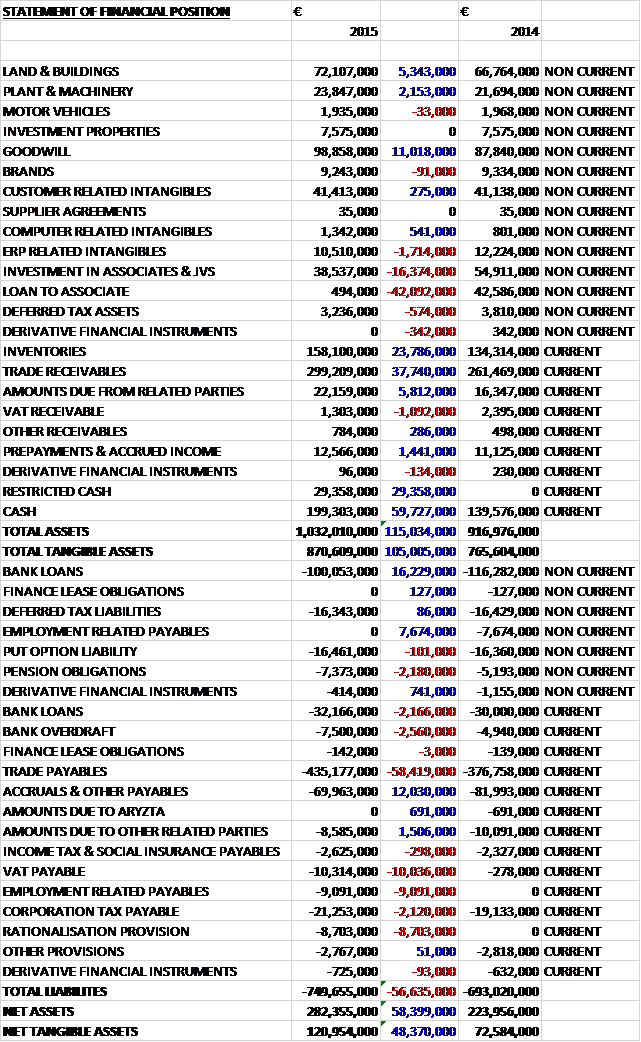
Revenues increased when compared to last year due to a €30.2M growth in UK revenue, a €3.2M increase in Irish revenue and a €9.5M growth in ROW revenue, although on a like for like basis revenue fell by €34.6M reflecting a combination of lower crop protection and crop marketing volumes along with lower crop marketing, feed and fertilizer prices. The cost of raw materials grew by €32.3M and other cost of sales were up €3.2M to give a gross profit some €7.3M ahead of last time. Operating leases grew by €1.6M and other distribution expenses were up nearly €10M with depreciation increasing by €920K, forex losses of €1.4M compared to a neutral position last year, and director emoluments up €3.4M due to extra benefits under long-term incentive schemes, offset by a €9.9M decline on other admin expenses. We then see a €1.1M growth in amortisation before an €8.3M increase in rationalisation costs were more than offset by a €22M gain on the disposal of an associate which pushed the operating profit up €11.8M when compared to 2014. Finance income grew, mainly as a result of increased interest receivable on a vendor loan note and income tax was lower to the tune of €1.3M to give a profit for the year of €77.3M, a growth of €13.8M year on year.

OGNassets

When compared to the end point of last year, total assets increased by €115M, driven by a €59.7M growth in cash, a €37.7M increase in trade receivables, a €29.4M increase in restricted cash relating to money set aside in an escrow account for the acquisition of Redoxim, a €23.8M growth in inventories and an €11M increase in goodwill, entirely due to forex translation differences, partially offset by a €42.1M reduction in a loan to an associate and a €16.4M decline in the investment in associates due to the disposal of Valeo. Total liabilities also increased during the year as a €58.4M growth in trade payables, a €10M increase in VAT payable, and an €8.7M growth in a rationalisation provision was partially offset by a €12M decline in accruals & other payables. The end result was a net tangible asset level of €121M, a growth of €48.4M year on year.

OGNcash

Before movements in working capital and payment into the pension scheme, the cash profits came in at €82.4M, a decline of €1.5M when compared to last year. The extra contributions to the pension scheme fell by €6.6M this year and payables increased by €3.9M but this was not enough to offset a big increase in receivables and a sizeable hike in inventories and after tax more than doubled to €9.4M, the net cash from operations came in at €54.9M, a decline of €20.5M year on year. The group spent €8.7M on property, plant and equipment along with €2.6M in intangible assets but they received a cash income from the disposal of their investment in an associate along with a vendor loan note which together brought it just over €87M and despite €29.4M being funnelled into restricted cash, there was a cash inflow of €104.5M before financing. The group used some €33.8M of this cash to pay off loans and €25M went on dividends to give a cash flow for the year of €45.6M and a cash level at the year-end of €191.8M.

The past year has been a difficult and demanding one for farming and farm incomes. Volatile output markets, high input costs and tightening farm credit can frequently challenge the sustainability and viability of farm enterprises. There is a current bearish crop cycle which coupled with reduced seasonal intensity resulted in lower overall market demand for services and inputs during the year. Against this backdrop the group have achieved a satisfactory result in line with expectations.

The segment result from the agri-service division was £78.9M, a decline of £618K year on year with a €2.6M decline on a like for like basis. As far as integrated on-farm agronomy is concerned, in the UK, Agrii delivered a solid performance against the backdrop of overall lower farm spending. While sales margins were decent, trading conditions limited service revenue and volumes, particularly in Q4. A combination of slower crop development, reflecting reduced seasonal intensity due to lower average temperatures and the backdrop of weaker output markets caused a cautious attitude to investment spend by farmers during the year.

Total winter and spring plantings for the principal arable, root and vegetable crops were some 1.2% behind 2014 levels at approximately 4.34M hectares. A noticeable switch by growers from higher yielding winter plantings to less intensive spring sown crops was evident and largely reflected demand for disease management and grass weed control which resulted in a 2.7% reduction in the winter planted area and a 2.5% increase in the spring planted area.

Good progress was achieved in the further agronomising of Agrii’s seed and nutrition portfolios which contributed to improved sales margins in the period. Key focus areas include an improved mix of value added applications that incorporate nutrient mapping, high spec seed advice and varietal selection, precision applications and variable rate input prescriptions.

In Poland, Dalgety achieved an improved performance, recording higher margins and profits. Increased agronomy revenues reflect the benefit of an early spring season and a favourable cropping profile. Total planted area for the principal cereals and oil seed crops was in line with last year at 8.7M hectares. An increased level of winter cereal sowings was offset by lower spring maize plantings, largely as a result of below average yield performance from spring cropping in 2014.

Lower crop marketing revenues and volumes in the period reflected lacklustre export markets and greater competitive markets. The business recorded good growth in the intensive and technically oriented farm channel with strong progress achieved in the development of integrated and higher specification input and technology offers which was the principal driver of higher margins during the year.

In Ukraine, Agroscope has delivered a resilient performance in its first full year of operations as part of the group. Higher revenues and profits reflect solid progress achieved to date with the business securing favourable sales and customer development through differentiated offers that promote technology intensification. Total plantings for the 2015 production year were approximately 20.5M hectares, some 5% lower than the prior year. From an operational perspective the impact of the current political and economic uncertainty is mostly reflected in pronounced currency weakness and tightening liquidity at farm level. Underlying advice and input spend is lower compared to last year with many farm holdings migrating to cheaper investment options.

The business is adopting a cautious planning approach in light of the current uncertainty. This approach is concentrated on currency and receivables risk management and the establishment of partner programmes to implement jointly developed input financing solutions on farm. The business continued the development of its two crop technology centres in the period which now provide an established knowledge transfer platform within the business. The rollout of precision agronomy and satellite monitoring applications as part of an extended service offer was also further progressed during the year.

As far as Business to Business Agri-Inputs are concerned, the UK and Irish business achieved a solid result reflecting an overall stable volume performance in fertilizer with a marginally lower contribution from feed. Fertilizer achieved volume growth in the UK against lower market demand. This performance was supported by a combination of operational improvements underpinning strong supply chain execution and sales of customised and value added nutrition formulations achieving solid momentum during the year. The favourable volume performance across arable enterprises was partially offset by reduced fertilizer application in the case of livestock enterprises. This is principally driven by lower returns currently generated by UK primary dairy producers.

In Ireland, the abolition of milk quotas supported demand in the second half of the year with farmers focused on maximising grass production to produce higher milk volumes. The routine investment and operational improvement programmes across the group’s fertilizer blending facilities are addressing evolving structural changes in the market with just in time customer ordering systems and the requirement for enhanced technical support becoming more prevalent. The overall capability of their fertilizer offering was further enhanced during the year with the commissioning of expanded blending capacity within the UK.

The amenity business achieved a good result in the year with momentum across the professional and niche agri sectors, offsetting the impact of lower demand within the amenity channel. Performance continues to be positively supported by a combination of ongoing business process alignment, industry leading partnership programmes and focused product development dedicated to the domestic and export home and garden channels.

Feed ingredients performed resiliently in the period against a lower volume result. Reduced feed consumption for the year largely reflected a combination of increased substitute fodder availability and the impact on demand of weaker returns from dairy and beef enterprises due to lower output prices. Pronounced price and currency volatility across raw material markets in the year drove generally weaker buying sentiment and delayed customer purchasing decisions.

The segment result for the associates and joint ventures was £14.1M, a growth of £684K when compared to last year. The bulk of the contribution, and the increase in profit, came from the now-disposed of Valeo Foods which performed in line with expectations in the context of a grocery market that remains highly challenging in both Ireland and the UK. A key success factor was the performance of the business’ brands which continue to consolidate market share and maintain category leading positions. The other joint venture, John Thompson is the largest single site multispecies animal feed mill in the EU and it delivered a satisfactory performance during the year.

During the year the group disposed of its 32% interest in the consumer goods group Valeo Foods to CapVest Partners together with the settlement of the outstanding principle and accumulated interest receivable relating to the group’s vendor loan note which was put in place at the time of formation of the business. A total cash consideration of €86.6M has been received in connection with the transaction comprising €42.5M in respect of the disposal of the 32% shareholding and €44.1M in full settlement of the vendor loan note. In all, a gain of €22M arose on the transaction.

In January 2014 the group completed the acquisition of a controlling interest in Agroscope International based in Ukraine. The business is a provider of agronomy services, high spec inputs and advisory support to arable and root crop growers. The group acquired a 60% interest in the business for a cash consideration and also entered into an arrangement with the minority shareholder under which they have the right to sell the remaining 40% interest to the group based on agreed formula. The group has therefore recognised an option liability of €16.5M. After the end of the year, in September, the group acquired Redoxim and agreed to acquire Comfert in Romania and Kazgod in Poland.

The group acquired Redoxim for a total consideration of €35M, of which €31.5M was paid upon completion and €3.5M is payable on the first anniversary of the acquisition. Underling operating profit in the business last year was €5.6M. The group agreed to acquire Comfert based on an enterprise value of €19.4M and additional deferred consideration will be payable based upon the achievement of specific annual profit targets over a five year period. The transaction is subject to a number of conditions including clearance from the Romanian Competition Council and is expected to complete in October 2015. Last year the business made an underlying operating profit of €3.2M.

The group also agreed to acquire Kazgod in Poland based on an enterprise value of €22.4M with about €20.3M of the total consideration payable on completion with €2.1M deferred and payable three years following completion. Last year the business recorded EBITDA of €1.2M and tangible integration benefits across Kazgod and Dalgety are targeted are targeted to be achieved over the three year period following completion. The transaction is subject to a number of conditions including clearance from the Office for the Protection of competition and Consumers in Poland and is expected to be completed in December 2015.

There were a number of other non-underlying costs which include rationalisation costs comprising termination payments arising from the restructuring of agri-services in the UK. The transaction costs relate to expenses arising on the acquisition of Redoxim and Comfert, along with Kazgod.

During the year the group recorded pension costs comprising of a settlement gain of €1.3M arising on the closure of two of their Irish-based defined benefit schemes, and costs of €500K in relation to the merger of the UK based defined benefit schemes. Other costs in the year relate to the movement in fair value of the put option liability in respect of the Agroscope acquisition. The exceptional costs arising in associates and joint ventures relate to the group’s share of redundancy, acquisition and financing costs arising in Valeo.

The group’s currency is the Euro but in addition to sales in Euro countries, the group sells a considerable amount into the UK as well as smaller operations in Poland and Ukraine. In addition they purchase from suppliers denominated in US dollars which exposes the group to currency differences. A 10% strengthening of the US dollar against the Euro would reduce profits by €241K while a 10% weakening of Sterling against the Euro would reduce profits by €23K. There is also some susceptibility to interest rate rises with a 50 basis point increase giving rise to a cash outflow of €336K for the year.

It is worth noting that an incredible 90% of earnings are made in the second half of the year so the interim results are nearly meaningless for this company. Also the group is now exposed to political risk overseas, particularly with the precarious situation in Ukraine. The group’s largest shareholder is ARYZTA AG, a Swiss-based food business who have 29% of the total share capital. At the start of the year ARYZTA was the controlling shareholder with 68% of the share capital and placed 49M shares over the course of 2015. Some of the directors of Origin are also investors in ARYZTA.

The group operates a number of defined benefit pension schemes and defined contribution schemes. All of the defined benefit schemes are closed to new members and the total deficit in the schemes currently stands at €7.4M. During last year, following discussions with the trustees, the company ceased its liability to contribute to two of its Irish based defined benefit schemes and a payment of €6.5M was made in full and final settlement of their obligation and resulted in a termination gain of €1.3M in the prior year. Although the deficit is not really that material to a company of this size, it is worth bearing in mind that the present value of scheme obligations is €107M. Overall though, I don’t think there is anything to be concerned about regarding these schemes.

Going forward, primary output markets continue to remain under sustained pressure with near term visibility on new price direction unlikely before mid-2016. This weaker backdrop is impacting farm sentiment and a lower demand profile for services and inputs is anticipated for 2016.

At the current share price the shares trade on a PE ratio of 15.6 which reduces to 13.2 on next year’s consensus forecast. At the end of the year the shares have a net cash of €88.8M compared to a net debt position of €11.9M at the end of last year although the year-end represents a low point in the group’s debt and the low point in the working capital cycle of the group, and average net debt amounted to €186M during the year. After a 5% increase in the dividend, the shares currently yield 3.1% which is expected to remain the same next year.

On the 27th November the group released an update covering trading in Q1 2016 where they report a slower start to the year for the seasonally quiet quarter. This performance is attributed to a delay in new season activity on farm during August and September as weather interruption slowed the 2015 harvest resulting in the later timing of service and input application in respect of the winter crop planting programmes.

New season activity levels on farm were robust in the latter part of the period with strong winter crop planting progress achieved during October and the total sown area for the principal winter crops is broadly in line with last year across the majority of markets. The generally weaker output price backdrop and the associated cash flow pressure on farm are expected to result in more concentrated purchasing patterns by primary producers. Accordingly, farmer decision making on crop investment spend will likely occur closer to the main application and usage period in the second half of the year – so, poor visibility of earnings then.

In Agri-Services, revenue in the quarter was €300.4M, a decline of 5.5%. This figure was flattered by favourable exchange rates, however, and the underlying decrease was 9% driven by lower fertilizer and crop protection volumes. The division performed satisfactorily in the UK against the backdrop of slower new season activity levels on farm. A weather interrupted harvest largely contributed to delayed in-field operations which limited early season agronomy revenue development in the period. Favourable weather towards the end of the quarter, however, supported good in-field conditions which resulted in significant catch up crop drilling activity.

Winter plantings are well advanced with current estimates for the total winter sown area at 3.05M hectares compared with 3.09M in 2014. In the case of winter wheat there is an estimated 2.5% increase in sown area to 1.9M hectares which mostly offset a 12% reduction in the winter oil seed rape area to 572K hectares. The sown areas for the remaining winter crops are about the same as last year. Crops are well established and in good condition with growing conditions to date providing for a more normalised level of seasonal growing intensity than last year.

Harvest yields are above average and providing support to cost recovery for primary producers. The group’s service and input portfolios continue to perform resiliently in highly challenging and competitive trading conditions through targeted and customised agronomy programmes promoting high output management and flexible crop production systems.

In Poland, higher agronomy revenues underpinned an improved result in the period which more than offset the impact of lower crop marketing volumes and margins. Dalgety’s service and input portfolios maintained decent momentum in the period with higher specification seed varieties in particular performing strongly. Crop marketing continued to be adversely impacted by highly competitive trading conditions, principally in export markets.

Harvest yields to date are below average and reflect the impact of unseasonal high temperatures over the summer period on maize cropping in particular. There was good progress in respect of winter sowings in the period with final plantings for the principal winter crops estimated at 5.6M hectares compared with 5.8M in 2014 but combined winter and spring plantings are expected to be broadly equivalent to last year. The acquisition of Kazgod was completed in November.

The group’s Ukraine operation recorded higher early season agronomy revenues underpinning an improved Q1 performance. Market conditions continue to be adversely impacted by the current political uncertainty, however, which is reflected in currency weakness and tightening liquidity on farm. The business remains well positioned, though, and has made good progress in securing advance customer commitments in respect of the main application season in the second half of the year.

Sustained drought conditions over the summer period have reduced 2015 harvest yields and significantly impacted the level of winter plantings. Farm management programmes are now focused on increased spring sowings and underlying crop investment spend for the 2016 production year is expected to be lower with the combined total for winter and spring plantings forecast to be equivalent to last year at 20.5M hectares.

In Romania the acquisition of Redoxim was completed in September and the business has achieved a satisfactory performance in the period as integration systems and process planning was started. The acquisition of Comfert has been cleared by the Romanian competition council and is expected to complete in Q2.

Business to business Agri inputs recorded lower revenues in the quarter due to slower fertilizer volume development which was partially offset by the benefit of higher feed volumes. Fertilizer consumption in Ireland was in line with the same period of last year with primary dairy producers investing in nutrition programmes prior to the end of the grass growing season. Fertilizer deliveries in the UK were lower, however, in part relating to an element of seasonal timing due to the later harvest. More importantly, the reduction reflects delayed customer purchasing decisions until closer to the main application period in the second half pending greater visibility on pricing and crop development. Overall the group is anticipating lower market volumes for the year as a whole.

Feed ingredients achieved higher volumes in the period with customers taking advantage of favourable pricing opportunities and the amenity business which provides advice and input solutions to the sports turf, landscaping and amenity sectors, performed satisfactorily in the period, underpinned by solid development momentum across the professional and nice agri sectors. The joint venture, John Thompson, delivered a satisfactory performance during the quarter.

Going forward, the weaker market backdrop for primary producers and the associated pressures on farm incomes makes for a challenging backdrop for service and input demand in 2016. The board anticipate an increased level of seasonality in H2, reflecting more concentrated purchasing patterns by primary producers. The current autumn cropping profile provides a strong foundation for the seasonally more important second half, however. At this stage in the year, the board expects to achieve full year adjusted EPS of between 51c and 53c.

Overall then, this has been a mixed year for the group. Profits were up, but this was due to the gain on the disposal of the associate and excluding this, profits fell due to higher rationalisation costs. Net assets did increase but operating cash flows were down, not helped by a large increase in receivables. The group remained comfortably cash generative, however. Looking at the performance in Q1, there was a slower start to the year due to a delay in new season activity which is weather related and led to lower sales of fertilizer and crop protection products. The performance was better in Poland and Ukraine, however, although continued economic problems in the latter must be considered.

Going forward, the board see a challenging 2016 ahead which is characterised by lower earnings visibility as a result of falling output prices. With a forward PE of 13.2 and yield of 3.1%, the shares are not that expensive but look priced about right given the difficulties the industry is currently facing.

Sylvania Platinum Share Blog – Interim Results Year Ending 2016

Sylvania Platinum has now released its interim results for the year ending 2016.

SLPincome

Revenues declined across all plants when compared to the first half of last year, both due to a declining price of platinum and palladium along with the weakening Rand. Included in this fall was $2M fall at Steelpoort, a $2.5M decline at Lannex and a $2M decrease at Doornbosch. Depreciation fell by $601K and direct operating costs were down $4M to give a gross profit some $4.4M below that of last time. There was an $87K increase in the forex gain and we also see consultancy fees down $182K with share based payments falling by $226K which gave an operating profit that was $3.9M lower than in the first half of 2015. Income tax was considerably lower, as would be expected, which meant that the profit for the half year came in at $281K, a decline of $2.7M year on year.

SLPassets

When compared to the end point of last year, total assets declined by $19.6M, driven by a $9.4M fall in plant & equipment, almost entirely due to the depreciation of the Rand, a $4.5M decrease in exploration assets, again due to Rand depreciation, and a $3.3M decline in cash. Total liabilities also fell during the period, due to a $4M decrease in deferred tax liabilities and a $2M fall in payables. The end result was a net tangible asset level of $30.8M, a decline of $8.5M over the past six months mainly as a result of the depreciation in the South African Rand.

SLPcash

Receipts from customers fell by $10.8M but payments to suppliers and employees only declined by $3.6M which meant that despite a $633K lower tax payment, there was a net cash outflow of $317K from operations. The group then spent $183K for the rebab guarantee, $667K on property, plant and equipment which represented stay in business capital, and $172K on exploration which meant that before financing there was a cash outflow of $1.3M. The group also paid $144K to repay borrowings and $833K on shares to pay its employee schemes to give a cash outflow for the six month period of $2.3M. This was exacerbated by a $1M detrimental effect of the exchange rate, as most of the cash is held as Rand, which meant that the cash level at the period-end was $5.1M.

In light of the declining commodity prices and challenging industry conditions during the period, the main operational focus of the company has been on maintaining and improving production stability and ounce production, combined with disciplined operational cost control. The dump operations produced 29,519 ounces for the six month period, down from the 31,341 ounces in the first half of last year but an improvement on the 26,246 ounces in the second half of last year. Likewise, EBITDA of $3.6M was well down on the $8.1M in the first half of 2015 but above the $2.3M recorded in the second half. The gross basked price dropped 26% to just $829 per ounce and plant cash costs are 18% lower at $471 per ounce due to cost controls and the depreciating Rand with the group cash cost falling by 17% to $508 per ounce.

Four of the plants remained profitable during the period with the best being Millsell, showing a profit of €1.2M, a decline of $186K year on year. Tweefontein has a profit of $1.1M, a growth of $158K when compared to the first half of last year; Doornbosch had a profit of $998K, a fall of $1.4M when compared to the first half of 2015; and Mooinooi had a profit of $238K, a decline of $59K year on year with the plant affected by a week of downtime following an electrical substation fire. The two unprofitable plants were Lannex with a $995K loss, a detrimental movement of $1.3M year on year; and Steelpoort with a loss of $693K, a negative swing of $1.7M as both operations were affected by three weeks of violent community protests regarding demands for improved infrastructure and jobs.

Plant feed grades were slightly lower than both halves of last year but PGM recovery efficiencies were higher with plant feed tonnes being similar to H1 last year and 13% higher than H2 due to higher plant utilisation.

At Volspruit Platinum, the company was requested by the Limpopo Department of Economic Development to submit a biodiversity and wetland offset strategy as an addendum to the Environmental Impact Assessment report. This was submitted to the DMR in September and the company continues to await the decision from them whether to award the mining right.

At Grasvally Chrome, the Mining Right application to mine chrome at the project was submitted in Q1 and a public participation meeting is scheduled for February. The company intends to sell the chrome deposit and an agent has been appointed to handle its marketing to potential ferrochrome smelters. The intended marketed cost is not yet known but a ballpark figure would have been nice.

At Harriet’s Wish, Aurora and Cracouw, notional execution of the Mining Rights occurred in December after the DMR’s decision to reduce the amount of financial provision for rehabilitation was finalised. An application for ministerial consent to transfer the right to mine iron ore, vanadium and heavy metals to a subsidiary of Ironveld has also been submitted to the DMR and the company awaits their decision in this regard. Cracouw will proceed with the Water Use Licence Application subsequent to permissions obtained from the land owners but this is delayed as the original land owners are deceased and the company will need to facilitate transfer of the title deeds to the lawful land occupants and descendants of the original owners.

During the year the company reduced the par value of each share from 10c to 1c per share as the share price was precariously close to being at par value which meant that it would not have been possible to issue shares at prices below the trading price with the immediate issue being any new options the poor directors would have been issued would be underwater but I suppose this would also have been an issue if the company needed to raise capital through the issue of more shares.

Overall then this was a fairly poor period for the group. Profits were down, net assets fell and there was an operating cash outflow. This is mostly due to the basket price of platinum group metals falling to $829 during the period. Unfortunately things got worse in Q2 with a decline to $785 per ounce. The reduction in assets is due to the depreciation of the Rand but this, together with some tight cost controls meant that costs dell to $508 in the period.

The production figures were down on H1 last year but an improvement on H2 with the main issue being continued violent protests at Lannex and Steelpoort which meant those two plants were loss making. Things did improve in Q2, however, with much less downtime and therefore better production figures. Progress is painfully slow with the regulatory hoops the company seemingly has to jump through in its exploration licenses but a potential sale of Grasvally Chrome is rather exciting. I took a position before this update and will tough it out for now I think.

On the 26th April the group released an update covering Q3 2016. The SDO continued on a steady production trend, producing 14,905 ounces during the quarter, bringing the total production for the year to date to 44,424 ounces. Although PGM feed tons were slightly lower than the previous quarter, higher feed grades and recovery efficiencies contributed towards the good ounce production. Based on year to date performance and recent production trends, annual PGM ounce production is expected to be in the range of 57,000 to 58,000 ounces, exceeding the previously stated guidance of 55,000 ounces for the current year.

The cash costs for the SDO decreased by 5% to $399 per ounce as a result of the weaker Rand. Revenues increased by 4% to $10.1M and the gross basked price recovered somewhat, up 10% to $860 per ounce. The group’s cash balance at the period-end was $7.2M, a $2.1M increase in the previous quarter. Cash generated before working capital movements was $3.8M with changes in working capital giving rise to a cash outflow of $1.7M. Some $300K was spent on business capital for the SDO plants and $300K was received from Ironveld as partial repayment of their loan. EBITDA increased by 63% when compared to Q2, to $3.7M.

The SDO production of 14,905 ounces was 6% below the record previous quarter performance due mainly to a 9% decrease in PGM plant treatment tons and a 6% decrease in feed grades as a result of lower current run of mine ore from the host mines. The community protests regarding demands for improved infrastructure and jobs at the Eastern operations significantly reduced during the quarter and no significant downtime was experiences at any of the operations.

The group was informed by the Limpopo Department of Economic Development that the application for Environmental Authorisation at Volspruit for various reasons. Upon assessment of the communication it is the opinion of the company advisors that LEDET has not given due consideration to the study documentation and additional work done at their request last year. As such the company has taken the decision to appeal the refusal.

At Grasvally, the final EIA, with all comments and responses, as well as the additional work will be submitted during May. With regards to the sale process of the Chrome deposit, the international agent appointed to handle the marketing of it finalised a marketing teaser during March.

At Hariet’s Which, the group was informed that the DMR granted the application in terms of section 11 of the mineral and petroleum resources development act for ministerial consent to transfer the right to mine iron ore, vanadium and heavy minerals, to a subsidiary of Ironveld in April. They will now take steps to execute the cessation of the right in favour of Ironveld’s subsidiary and lodge this with the Mining Titles Office for registration.

Overall then, the operational performance has been quite encouraging with a decent quantity of PGMs being processed, a slightly higher sales value and a reduction in costs. The refusal of the permit at Volspruit is a concern, however, and has likely kept a cap on the price. Overall though, I will continue to hold.

On the 29th July the group released an update covering trading in Q4. The SDO produced 16,219 ounces, 9% higher than in the previous quarter. The feed tonnes and grades improved and contributed towards the higher figure. The solid performance during Q4 enabled the group to exceed the previously stated guidance of 57,000 to 58,000 ounces for the year, instead producing 60,643 ounces.

The cash costs for the SDO in Rand terms decreased by 4% but increased slightly in dollar terms from $399 per ounce to $404 per ounce due to a stronger Rand/Dollar exchange rate. Revenue increased 5% in dollar terms to $10.6M but decreased by 1% in Rand terms. The gross basket price remained unchanged at $859 per ounce, which is rather disappointing.

The cash balance at the year-end was $6.7M, a $500K decrease on the previous quarter. Cash generated from operations before working capital movements was $3.6M with net changes in working capital amounting to a reduction of $1.3M, mostly attributable to the repayment of the three month pipeline financing on the sale of concentrate. A further $2.7M was paid in income taxes, $200K spent on the stay in business capital and $100K on share transactions. The group generated EBITDA of $3.4M, a decline of 9% on the prior quarter.

Wage negotiations for the Western operations are underway and the board anticipate a decision before the end of Q1, whereas the Eastern operations were negotiated as applicable for two years and as such remain in force until 2017.

The higher than planned PGM production can be attributed primarily to increased PGM feed tonnes and higher than expected grades with stable production at all operations. The group recovery efficiency was slightly down from the previous quarter due to a combination of higher PGM ounce contributions from lower recovery operations and the impact of PGM concentrate stock movement at the end of the quarter.

At Volspruit, an appeal against the decision by LEDET to refuse the Environmental Authorisation was submitted to the relevant authority and the outcome is awaited.

At Grasvally, the final Environmental Impact Assessment was submitted to the DMR in May. The Water Use License application was submitted to the DWS in June and the group now awaits the DWS review process to commence. The international agent handling the sale of the deposit is in the process of setting up meeting with interested parties in order to explore options and share more information. The process has taken a little longer than anticipated due to a downturn in the chrome markets in recent months but prices have recovered somewhat and the group remains optimistic that potential buyers will understand the value of the project.

Elsewhere, the notarial cessation of the right to mine iron ore, vanadium and heavy metals in favour of Ironveld has been attended to and the documents were lodged.

Overall then, operationally things seem to be going well but the cash performance and basket price for platinum is rather disappointing given the good performance of the metal recently. I will continue to hold for now but will monitor the situation

Pan African Resources Share Blog – Final Results Year Ended 2015

Pan African Resources is a mid-tier South African focused gold and platinum miner and explorer. They have three main segments. Barberton Mines is a low cost, high grade, greenstone belt producing operation with three gold mines which has contributed significantly to the group’s successful track record. The mine’s production capacity is 95K ounces of gold from underground and 20K ounces from the Tailings Retreatment Plant (BTRP) per annum. Evander Mines was acquired in 2013 and is another gold mine that has production capacity from underground operations of 95K ounces and 10K ounces from ETRP per annum. Phoenix Platinum is a tailings retreatment plant designed to extract 10K ounces of platinum group metals per annum from chrome tailings who sell platinum group metal concentrates to West Platinum, a subsidiary of Lonmin.

The Barberton Mines have resources of 9MT at 10.7g/t and 3M ounces along with reserves of 4.3MT at 10.1g/t and 1.4M ounces. The cash cost is $840 per ounce. The BTRP has resources of 20.4MT at a grade of 1.3g/t (900K ounces), and reserves of 13.4MT at 1.5g/t (600K ounces). The cash cost of the BTRP is $480 per ounce. The Evander mines has resources of 83.5MT at 9.7g/t and 25.9M ounces along with reserves of 28.8Mt at 8.5g/t representing 7.9M ounces with a cash cost rather higher at $1,291 per ounce. The ETRP has resources of 205.3MT at 0.3g/t representing 1.9M ounces along with 38.1MT at 0.3g/t representing 400K ounces with a cash cost of $688 per ounce. Phoenix Platinum has resources of 6MT at 3.1g/t representing 600K ounces along with reserves of 4.8MT at 3.2g/t representing 500K ounces with a cash cost of $578 per ounce.

The company has a dual listing, both on AIM and the JSE. The largest shareholding is Shanduka Resources with 23.83% and they are a black empowerment partner.

Pan African Resources has now released its final results for the year ended 2015.

PAFincome

Revenues decreased when compared to last year as a £1.2M growth in platinum sales was more than offset by a £7.9M fall in Barberton gold sales and a £6.8M decline in Evander gold sales. Salaries and wages decreased by £676K and engineering & technical services fell by £1.3M but most other costs were up with a £2.9M increase in gold processing costs, a £1.4M growth in gold mining costs and a £928K adverse movement in the inventory valuation adjustment which meant that gross profits decreased by £18.1M when compared to 2014. The director and share option expense fell by £830K and there was a £904K positive movement in the rehabilitation trust fund value which meant that the operating profit was some £16.2M below that of last time. Finance costs increased with a £486K growth in interest costs and a £1.1M increase in the rehabilitation provision interest but the tax charge declined by £3M which gave a profit for the year of £11.7M, a decline of £15.1M year on year.

PAFassets

When compared to the end point of last year, total assets declined by £9.6M driven by an £11M fall in assets under construction, a £5.6M decline in the value of mineral rights and mining properties due to the depreciation of the Rand, a £2.5M decrease in trade receivables, a £2.3M fall in cash, a £2.2M decline in building infrastructure and a £1.8M decrease in inventory relating to a fall in mineral stocks and gold, partially offset by a £14.4M increase in the value of plant and machinery after some was transferred from assets under construction. Total liabilities increased during the year as a £12.7M increase in the revolving credit facility as partially offset by a £4M fall in the gold loan, a £4.1M decline in deferred tax liabilities and a £1.5M fall in current tax liabilities. The end result was a net tangible asset level of £126M, a decline of £12.2M year on year mainly relating to the depreciation of the rand.

PAFcash

Before movements in working capital, cash profits nearly halved to £25.3M. There was a modest inflow of cash from working capital and a fall in income tax was offset by an increase in royalties paid and finance costs to give a net cash from operations of £19.6M, a decline of £17.2M year on year. The group spent all of this cash on property, plant and equipment so after a £1M purchase of intangible assets was partially offset by the sale of an associate there was a cash outflow of £666K before financing. The group then took out more loans so it could pay the dividends of £14.3M so that there was a cash outflow of £2M for the year and a cash level of £3.3M at the year-end.

This year has been a challenging one for the gold industry as the gold price declined by 7% and the rise in US interest rates reduced the attractiveness of holding gold as an investment. Although the price of gold in Rand terms has not fallen so far, the country has been hit by inflationary pressures such as employee costs and energy that has contributed to eroding margins. The group also experienced some operational difficulties, mainly due to the Evander Mine’s low grade cycle continuing through most of the year and the impact of oil contamination at the Biox plant at Barberton mines which affected gold production. Going forward, however, the Evander mine grades have increased considerably as expected.

While the wide-spread labour unrest continues to pose significant risk to the industry in South Africa, the group are endeavouring to maintain good relationships with the unions and they did not experience significant labour disruptions at their operations during the year. The road ahead in the country’s labour environment remains challenging, however.

Overall the group’s total ounces of gold sold during the year was 175,857 ounces compared to 188,179 ounces last year and was below the planned annual production. With the strategic initiatives in place, the board anticipates achieving a target of about 215,000 ounces of gold and 10,000 ounces of platinum in 2016. In the longer term there is a significant undeveloped resource of over 30,000,000 ounces at Evander Mines. Capex was focused on the commissioning of the ETRP, capital development on Evander 25 level to gain access to the higher grade panels and ensuring the infrastructure of both gold operations was maintained.

The profit at the Barberton Mines was £18M, a decline of £5.6 when compared to last year. The total amount of gold sold by the mine decreased by 5.2% to 105,776 ounces and the cash cost per ounce increased by 2.4% to $758 per ounce. Excluding the BRTP, the amount of gold sold fell by 8.2% to 81,493 ounces. This was due to the BIOX plant oil contamination and operational safety stoppages enforced by the DMR. Operational and maintenance systems have been implemented to mitigate the risk of future oil contaminations and safety improvements.

Excluding the BTRP, the cash costs increased by 8% to $840 per ounce, and much more in Rand terms. This was exacerbated by the lower gold production and higher wages and engineering costs. The total all in cash cost per ounce fell by 1.9% to $916 per ounce, however, but this was entirely due to the weakening Rand and on local currency terms, the costs increased by 11.7%. The group received an average $1,212 per ounce compared to $1,309 last year with all-in costs of $916 per ounce.

Expansion capital of ZAR14.7M was spent on the development of the Fairview ventilation raise borehole project to improve operating environment conditions. New ore reserve and exploration drilling projects have yielded positive results, confirming the down dip extension of the high grade 11 Block of the MRC orebody by a further 170 metres. This extension to the MRC orebody has resulted in an annual increase in the mine’s mineral reserves by 236,162 ounces, thereby extending the life of mine to twenty years.

Looking ahead, the mine aims to improve levels of production by focusing on BIOX recoveries, increased tonnages aligned with their incentive system in conjunction with cost containment in order to avoid margin erosion. The management team also aims to reduce safety stoppages. Gold sold from the BTRP was 24,283 ounces, up from 22,885 ounces last year. Tonnes processed improved to 971,627 tonnes at a lower grade of 1.4g/t. The cash costs at the plant fell from $493 per ounce last year to $482 per ounce this year. Looking ahead, the Sheba and New Consort tailings dams will provide potential future sources of tailings which has supported the increased BTRP life of operation to 15 years. The plant payback period was 18 months since commissioning in July 2013 so the increase in the life of operation will result in further surplus free cash flows.

The loss at Evander Mines was £1.8M, an adverse movement of £6M when compared to 2014 due to the low grade cycle of the mine. The amount of gold sold decreased by 8.5%. Underground and surface sources tonnes milled decreased by 1.2% to 648,209 tonnes largely due to challenges related to underground mining operations and infrastructure constraints, power interruptions and safety stoppages. These issues adversely impacted production output but the mine has implemented corrective actions including improved maintenance protocols on the underground conveyor belt system, thereby improving availability of the conveyor belts from 60% to 80%. The mine also improved the monitoring and pump infrastructure of its No. 8 shaft de-wartering pumps, thereby reducing the risk of shaft flooding.

The total cost of production increased by 8.6% to ZAR999.3M which included additional cost in relation to the new ETRP plant and related surface feedstock, and excluding the ETRP costs, only increased by 2.7%. In dollar terms, the cash cost per ounce increased by 7.3% to $1,238 mainly as a result of the lower grade cycle. The group received an average of $1,216 per ounce compared to $1,295 last year and with an all-in cost of $1,515 per ounce, the problem at this mine is clear.

During the year the group commissioned its ETRP and the first gold was eluted in January 2015. The plant has now ramped up processing to its capacity of 180,000 to 200,000 tonnes per month at 0.3g/t of tailings and 1.1g/t of surface feedstock. Gold production from the plant was on target and its recoveries from tailings source are currently above plan at 48% while additional surface sources aided in increasing the ETRP overall recovery to 53.7%. The plant was operational for four months of the year and its cash costs amounted to $688 per ounce and contributed an additional 2,494 ounces of gold from its tailings sources and 4,029 ounces from surface feedstock. The total construction capital spend on the ETRP was about ZAR174.3M which was below the original ZAR200M project budget.

An internal technical team from the mine has been assigned to assess the merits of developing the Evander South project to the level of a preliminary economic assessment. This project is an opportunity whereby the Kimberley reef can potentially be exploited at shallow depths starting at 300 metres below the surface. Evander South has an estimated mineral resource of 4.9M ounces. In light of the positive results from the ETRP, the group will undertake a preliminary economic assessment on the viability of constructing a tailings retreatment plant at the mine which can potentially treat slimes at a processing capacity of up to 12MT per annum at a grade of 0.28g/t from the Winkelhaak, Leslie and Kinross tailings storage facilities.

The profit at Phoenix Platinum was £842K, a growth of £627K year on year. The amount sold increased by 42.2% to 10,245 ounces and overall plant recoveries increased significantly to 44%. The cessation of IFL’s operations at Skychrome, which mined mostly oxidised material and its replacement with sulphide material from its underground operation at Lesedi resulted in an improvement in the quality of feedstock being treated and this, in conjunction with the introduction of new re-agents in the metallurgical process were the main contributors to the higher recoveries.

The PGE basket price received decreased by 13.1% to $839 per ounce and the cash costs per ounce decreased by 22.5% to $578 per ounce. Looking ahead, Phoenix aims to optimise resources from Elandskraal and Kroondal to maintain production and profitability. In June they signed a new agreement to secure Platinum rights to the Elandskraal resource. The haulage contract to transport this material to the plant at Phoenix has been awarded and processing will start in September. During the coming year, the Elandskraal material will be batch treated in the CTRP to conduct re-agent suite test work. In 2016, 60,000 tonnes of the Kroondal resource will be processed in the CTRP and re-agent test work will be conducted on this material during the latter part of the year.

Electricity is the second largest cost contributor for the group, representing nearly 14% of the total cost of production. Their electricity increases in the current year amounted to 8.6% compared to the NRSA approved Eskom increase of 12.7%. Eskom’s most recent announcement alludes to potential increases of up to 25% in 2016 which will obviously have a material adverse effect on the total production costs if NERSA approves the increase.

During the year, the group appointed a new CEO – Cobus Loots was appointed in March 2015 having previously been finance director of the group and MD of Shanduka Resources.

The group has committed £10.4M to Oakleaf and Shanduka, upon completion of the conditions precedent to the purchase agreement, relating to the Uitkomst Colliery acquisition. The colliery is an existing operational mine and the acquisition is expected to be earnings and cash flow enhancing. It contains a coal mineral resource of 25.7MT, of which 22.1MT can be classed as measured or indicated and the area also has additional exploration potential. Current operations at the colliery demonstrate that it can readily produce yields of high grade coal suitable for export or local metallurgical markets and it currently sells about 400K tonnes of coal per annum. As well as being earnings enhancing, the exposure to coal provides a hedge against an anticipated increase in rising energy prices in South Africa.

In August the IFL announced that as a result of deteriorating business conditions in its South African subsidiary, International Ferro Metals SA has entered into business rescue, a statuary means of enabling a financially distressed company to continue business, under the supervision of a business rescue practitioner. This is relevant to the group because Phoenix Platinum is situated on the IFMSA property and a 20% portion of the feedstock for the operation is obtained from tailings arising from IFMSA’s current processing activities. They also source electricity, water and some other services form the business. At this stage, Phoenix is not in a position to fully assess the impact of these proceedings but they will work with IFMSA to ensure operations and interests of Phoenix are safeguarded.

The group has two main banking facilities. The new revolving credit facility is for ZAR800M at an interest rate of JIBOR (currently 6%) plus a 2.5% interest rate margin. The final payment date is June 2020 and the financial covenants include net debt : equity less than 1:1; interest cover ratio greater than four times; and the ratio of net debt to EBITDA must be less than 2.5:1. I have to say it is very refreshing to see the banking covenants spelled out so clearly, other companies can learn something from this (all of these covenants were comfortably met this year). Last year a gold loan transaction of ZAR200M was entered into with ABSA Bank, the purpose of which was to provide funds for the ETRP constructed at Evander mines. The loan is repaid quarterly in gold ounces produced from the operation with payments to end in October 2017.

Obviously the group is very susceptible to changes in the gold price with the other major sensitivity is the South Africa Rand exchange rate, both with the US dollar and Sterling. Finally, the borrowings are dependent on the interest rates in South Africa so there is susceptibility there too. Operationally the group has considerable country risk as it operates entirely in South Africa which is susceptible to industrial action and the occasional power interruption.

In the upcoming year, the Evander mine will experience higher grades and there will be a full year of production from the ETRP, as well as the Barberton mines returning to its previous production level. Notwithstanding the recent business rescue decision of IFL, Phoenix should continue to contribute cash flows and operating profit to the group and the Uitkomst Colliery acquisition should be finalised.

At the current share price the shares trade on a PE ratio of 17.3 and I can’t find a forecast for next year sadly. In light of market uncertainties the board has proposed a reduced dividend and at the current share price the shares have a dividend yield of 4.9%.

On the 26th November the group released a trading update. They expect interim EPS to be at least 10.37c per share which is an increase of 91% compared to the prior interim reported. The reasons for this increase include an improved operating performance from both Barberton and Evander Mines, as well as an increase in the Rand gold price during the first five months of the year. In Sterling terms, the EPS is expected to come in at 0.51p per share, an increase of 70% compared to last time.

The cash flows have been robust and good progress has been made in reducing debt. At present the net debt position is at ZAR70M compared to ZAR321M at the year-end, although dividend payments of ZAR210M are due in December.

Overall then this has been a difficult year for the group. Profits more than halved; net assets declined, mainly due to the depreciation of the Rand; and operating cash flow was down with no free cash generated. Obviously like all gold miners, the group has been hit by the weak price of the metal but this has been combined with increasing employee and energy costs along with the lower grade cycle at Evander and oil contamination of the BIOX plant in Barberton, which at least remained profitable unlike the Evander mine.

The Phoenix Platinum business performed well despite the decline in the price of the metal, due to higher quality feedstock. Unfortunately there is a cloud on the horizon here though with the announcement that the company that owns the site they are situated on has entered business rescue which will affect the feedstock and things like electricity supplies – there is no indication of the effect this will have on the business.

The mooted 25% increase in electricity prices is a real concern and perhaps explains why the group are expanding into coal mining – an area that is really under pressure at the moment. Going forward, the Evander mine is entering its high-grade cycle which, despite the price pressures should improve the profitability of the group this year and with a forward PE of 7.7 and dividend yield of 4.9% these shares look decent value – is it worth the risk though?

On the 8th February the group released another trading update. Overall, EPS is expected to come in at 0.57p for the half year period compared to 0.3p last time and up slightly from the 0.51p mentioned in the last update. The Barberton mines produced 56,447 ounces, an increase of 6.6% on the first half of last year; the Evander Mines produced 45,350 ounces, an increase of 34.4% but the Phoenix Platinum project produced just 4,493 ounces, down by 4.6%. There are pretty good numbers and the share price has shot up today but I can’t help thinking that I would like to see in the interims just how this is translating to cash flow, and have some updates on the Phoenix issue with their landlords and how the acquisition is progressing along with any electricity hikes.

RM Share Blog – Final Results Year Ended 2015

RM has now released its final results for the year ended 2015.

RMincome

Revenues collapsed when compared to last year as a £4.5M growth in RM Resources revenue and a £2.9M increase in RM Results revenue was more than offset by a £31.7M fall in RM Education revenue. Cost of sales also fell but to a lesser degree than revenues so that gross profit fell by £6.6M when compared to 2014. Depreciation fell by £1M and other underlying operating expenses declined by £5.7M and this year also benefited from a 3.1M onerous lease provision release following the sublet of their old building, a £715K swing to a restructuring provision release and a £206K exceptional credit on the pension scheme which meant that the operating profit was £3.1M up on last time. The group also made £894K from the sale of some receivables which was partially offset by a £585K increase in the pension scheme finance costs and after tax payments were slightly higher, the profit for the year came in at £15M, an increase of £3.4M year on year.

RMassets

When compared to the end point of last year, total assets decreased by £10.5M, driven by a £7.5M decline in trade receivables and a £2M fall in deferred tax assets, partially offset by a £1.2M growth in assets held for sale. Total liabilities also decreased during the year due to a £5.8M fall in long term contract balances, a £4.9M decline in the pension obligation, a £4.2M fall in provisions, helped by the £2.4M release of onerous lease provisions, a £3.4M decline in deferred income, a £1.5M decrease in accruals, a £1.3M fall in trade payables and a £1.3M decline in other payables. The end result is a net tangible asset level of £4.5M, an improvement of £11.5M year on year.

RMcash

Before movements in working capital, cash profits increased by £2.9M to £19.9M. There was a big cash outflow from working capital, however, mainly due to a large fall in payables which is expected to continue next year too, but after a £7.8M fall in pension scheme contributions and a £2.4M decline in tax paid, the net cash from operations came in at £6.4M, a growth of £2M year on year. The group received £1.6M on the sale of “other receivables” which paid for the expenditure on property, plant and equipment so after a £322K purchase of intangible assets, there was a free cash flow of £6.6M. Of this, £3.4M went on dividends and £2.5M was spent on own share purchases to give a cash flow of £425K for the year and a cash level of £42.3M at the year-end.

Market conditions in the UK education sector will continue to be subdued as a result of increased pressure on school budgets.

The adjusted operating profit in the RM Resources division was £11.1M, a growth of £793K year on year on revenues that increased by 7.6% as the group gained market share in the UK and increased international revenues by 31.6%. Divisional revenue increased by 12.2% in the first half but only by 3.7% in the second half of the year as first half sales benefited from the curriculum changes that drove strong sales of new products.

At TTS UK Direct Marketing, revenues in the first half of the year were very strong, increasing by nearly 12% but in the second half, revenues fell by 2.9% reflecting tighter budgets within schools in the second half. The board expect the UK education resources market to continue to be subdued as a result of increased pressure on the discretionary element of school budgets and their focus will be on maintaining margins while looking to retain market position. At TSS International, revenues increased by 31.6% driven by growth in Europe and the Americas and included a large contract in the Middle East. The board expect international revenues to continue to grow in the coming year. At TTS UK Distributers, revenue from sales to UK trade partners decreased by 1.5% to £4.1M reflecting tightness of budgets in the wider UK education resources marketplace.

The adjusted operating profit in the RM Results division was £5.6M, an increase of £906K when compared to last year on revenues that grew 10.4% reflecting operating margins that increased from 16.7% to 18.1%. During the year the business secured a three year contract with the education charity AQA, the largest UK schools exam awarding body, to provide e-marketing services alongside the current provider.

Internationally the business is pursuing opportunities for the onscreen marking of paper-based exams as well as onscreen testing, often bidding with partner organisations. In the UK, exam and curricula changes introduced by the English Department for Education have significantly changed the phasing of exams so that the vast majority are taken in the summer term which has moved revenue phasing into the second half of the year (paving the way for a poor first half of 2016?) There is a long term trend from paper based to onscreen testing in the assessment market, though the adoption of such systems for school based examinations is low.

The educational data side of the business is heavily dependent on the Department for Education, principally through the National Pupil Database and RAISE Online contracts. These contracts include the capture and publishing of data for the school performance tables in England and both are up for retender over the next year. It is worth noting that the group have managed these contracts for over ten years, although of course that is no guarantee that they will retain the contracts. They are also in the process of exiting a number of other smaller data services and non-profit making contracts. The board are targeting the growth opportunities in e-assessment to more than outweigh reduced revenues in the educational data business, thereby allowing them to maintain good operating margins.

The adjusted operating profit in the RM Education division was £5.5M, a decline of £2.2M when compared to 2014. Market trends affecting this business include the demand from schools for solutions which are low-cost yet can cope with an increasingly diverse range of hardware and software. In addition, purchasing decisions in England have been increasingly devolved to schools and academy groups and away from central government and local authorities which has required a change in the way the division engages with its market and has resulted in an increased focus on the top couple of thousand customers.

As anticipated, the change of strategy away from selling hardware devices and a reduction in new school openings under the Building Schools for the Future scheme led to overall revenue in the division declining by 28% and the £2.2M fall in operating profit represents a broadly stable margin of 6.8%. The managed services offering is primarily the provision of full IT outsourcing services to schools and colleges and as anticipated revenues this year again declined with a reduction in new school openings under the BSF programme. Managed Services revenues decreased by 35.5% to £32.2M but the retention rates of existing customers increased significantly to 80% and 44 new schools signed managed services contracts in the year.

Digital platforms revenue increased by 1.4% to £7.7M. Revenue from RM Integris increased following good market share gains including over 350 schools in Derbyshire. The strategy is to increase market share by focusing on the cloud-based platform, competitive price point and investing to develop the product’s relevance in a market dominated by a large competitor, and with low levels of supplier churn. RM Unify is a technology platform to allow customers easy access to the varied digital, cloud-based, educational specific content and materials that are now available online and during the year the Scottish government chose to extend its contract to (providing the product to all schools in Scotland) by another two years to January 2018.

Infrastructure includes the tools, products and services to help schools manage their own IT.
Revenues in the business declined by 25.8% to £40.3M as the group continue to transition from manufacturing their own PC client devices and associated warranties and installations and move to a more technology agnostic service and support provider.

In March the group’s interests in Newham Learning Partnership were sold for £1.6M which generated a profit of £900K which I assume relates to the sale of “other” receivables on the income statement. In May their Milton Park leased premises were sub-let to South Oxfordshire District Council for a minimum period of three years. On sub-letting, some £2.4M was released from the onerous lease provision. At the end of the year, SpaceKraft was identified for disposal and was sold in December. As the group failed to realise the net book value of the business, an impairment of £233K was recognised on its intangible assets and property, plant and equipment.

One key risk for the group is the pension scheme. The deficit did fall from £26.8M last year to £21.9M this year, however. This reduction resulted from the reduction in liabilities due to beneficial membership experience over the three year valuation period, better than assumed returns on the scheme assets and the shortfall contributions paid by the company which has been partially offset by the change in mortality assumptions and a reduction in the inflation risk premium. In December, after the year-end, agreement was reached with the trustees with regards the triennial valuation where the deficit was agreed at £41.8M. The deficit recovery plan comprises an initial cash contribution of £4M into the scheme and £4M into the escrow account together with deficit recovery payments remaining at £3.6M per annum until 2024 so this is going to be a drag for some time.

Another major risk is public policy as the majority of the businesses are funded from UK governmental sources and in a related risk, the group is dependent on a small number of key contracts with government, local authorities and exam boards.

At the current share price the shares trade on a PE ratio of 9.1 which is expected to remain the same on next year’s consensus forecast. After a 25% increase in the normal dividend, the shares are yielding 3.5% which increases to 4.2% on next year’s forecast.

Overall then, this year gone has been a fairly decent period for the group. Profits were up, although this was due to the onerous lease provision release following the sub-letting of a building; and the sale of some receivables so underlying profits actually fell somewhat. Net assets did increase, however, and the balance sheet now looks much better with a positive tangible book value. The operating cash flow improved as a reduced payment to the pension scheme offset a large fall in payables and the cash profits increased and a decent amount of free cash was produced.

Operationally, RM Results performed well but it looks like revenues will be more second half weighted going forward and the league table data contract is out to tender which is a potential risk. The RM Resources business also performed well due to curriculum changes in the first half of the year driving increased sales – unfortunately the second half was much poorer and the market going forward looks subdued. RM Education performed badly as the group continued to move away from hardware sales and fewer new schools were opened.

With a forward PE of 9.1 and dividend yield of 4.2%, the shares look cheap but it seems the business is going to find going much toucher in 2016 and I feel there is scope for a profit warning if things don’t go so well. The repaired balance sheet does make this more investible now but I would like to see some evidence that the first half of 2016 isn’t going to be too bad before buying.

On the 12th February the group announced that CFO Neil Martin purchased 35,000 shares at a value of £47K which represents his maiden share purchase.

On the 23rd March the group released a trading statement where they stated that the UK market for educational products and services remained subdued. Trading in Q1 has been in line with the board’s expectations and cash levels at the end of February were £34.4M after an £8M cash payment into the pension scheme as agreed at the latest triennial valuation.

Entu Share Blog – Final Results Year Ended 2015

The group acquired Ashley Facades during the year and that business engages in the provision of long term contracts. Revenue from contracts is measured based on the stage of completion which is measured by qualified chartered surveyors. Where amounts have been billed to customers in excess of the stage of completion of contracts, revenue is deferred and is recognised as the contracts progress. Where the stage of completion has exceeded the amounts billed to customers, revenue is accrued in line with contractual terms.

Entu has now released its final results for the year ended 2015.

Entuinterim

Continuing revenues have increased when compared to last year with a £5M growth in energy saving & insulation revenue; a £1.4M increase in home improvement revenue; and a £284K growth in repair & renewal service agreement revenues. Cost of inventories fell by £2.5M but employee costs were up £2M and other cost of sales grew by £4.2M to give a gross profit some £3M above that of last year. Aborted acquisition costs, historical property costs and historical director bonus costs were more than offset by the lack of £1.3M of IPO fees but a £4M growth in other admin expenses meant that operating profit fell by £368K. Interest was slightly higher but tax payments were much lower, although there was a loss of £3.8M from discontinued operations compared to a profit of £1.1M last year to give a profit for the year of £2.7M, a decline of £4M year on year.

Entuassets

Total assets declined by £526K when compared to last year, driven by a £4.3M decrease in cash, a £1.4M decline in amounts owed by related parties and an £836K fall in trade receivables, partially offset by a £3.5M increase in accrued income and a £2.4M growth in prepayments. Total liabilities also declined as a £2.1M fall in the amounts owed by related parties, a £1.3M decrease in current tax payables and a £705K decline in trade payables was partially offset by a £2M increase in accruals, and an £867K growth in deferred income. The end result is a net tangible asset level of -£537K, an improvement of £218K year on year.

Entucash

Before movements in working capital, cash profits collapsed by £6.6M to £4M. There was also a cash outflow from working capital, in particular a growth in receivables attributed to the Astley acquisition, and this combined with a £1.2M increase in tax paid meant that there was a £1M net cash outflow from operations, a deterioration of £10.4M year on year. For some reason there was also £1.3M in IPO fees this year and we also see £258K paid on property, plant and equipment, partially offset by a £1M income of cash through the acquisition. After dividends of £2.7M which don’t look very sustainable were paid, there was a cash outflow of £4.3M for the year and a cash level of £1.4M at the year-end.

The operating profit at the Home Improvement business was £4M, a decline of just £98K year on year. Although market share has held up, margins came under pressure (down from 5.1% to 4.9%) in common with the industry as a whole but also as the division began to rationalise its financial offering in the second half of the year, resulting in lower finance commission in the run up to a full reset of the division’s finance offering in light of the recent FCA guidance. The order book continued to remain strong at approximately £9M throughout the year and the board continue to sense increasing consumer confidence as home owners decide to make improvements to their homes.

The operating profit at the Energy Saving and Insulation business was £1.9M, a fall of £1.3M when compared to last year. The shortfall is almost entirely attributed to insulation products as a result of the reduction of carbon offset funding through energy suppliers, although volumes have increased.

The board consider that a significant opportunity is the area of energy saving and efficiency. The group covers this area with cavity wall insulation, loft insulation, high efficiency boilers and the growing use of technology in controlling energy usage in the home. Another significant opportunity is the cross selling of the group’s products and services into the base of customers such as in energy switching, they are beginning to offer all customers the opportunity to switch their energy supplier to the most cost effective option and while this is a new area, the early signs are encouraging. They are also currently at an early stage of promoting products that will allow consumers to monitor their energy usage online and also to control remotely their use of energy within the home. Finally there is a major push on replacing older and inefficient boilers with new energy efficient ones, making savings on household bills.

The operating profit at the Repair & Renewal Service Agreements business was £2.1M, a growth of £226K when compared to 2014. During the year the installation service business has sought contracts to build on its installation network across the UK with corporate customers and national retail chains. For one national chain, after successful trials, the business has been appointed as national installation partner for its energy efficient windows and door products. Whilst it is still early days, there are good signs that the partner installation process is working well, quantity levels are being maintained and that the retailer is pleased with the progress made to date.

It is notable that the group has a real problem with trade receivable impairments. This year a provision of £861K was made which accounted for an incredible 14% of receivables. This is likely not to have been helped by the £324K of provisions against recoverability of Astley’s receivables.

In March the group acquired Astley Facades, a company that provides commercial cladding operations across the UK. Bizarrely there was no consideration paid and the net asset value of the business was zero. The initial purchase consideration of £200K was reduced as a result of an adjustment in the level of net assets existing at the date of acquisition and the initial cash consideration was repaid to the group before the year-end. The total operating profit at Astley for the past year was £102K so with the liabilities acquired notwithstanding, this seems to have been a good deal.

The UK market for solar PV had become increasingly competitive and despite a continuing fall in the cost of solar panels year on year it was becoming difficult to foresee how margins could be maintained in the future, not helped by a competitor poaching much of the group’s sales staff! Subsequently the dramatic cut in feed in tariffs announced by the government rendered the Solar PV product in the UK unattractive to customers. Against this backdrop, the group closed the business of selling solar products to retail customers in the run up to the year-end. Additionally, on the 2nd October they completed the disposal of its kitchen retail operation, Norwood Interiors as it did not form part of their core strategy. The business was loss making, making a pre-tax loss of £620K this year.

As the year progressed it became apparent that the group needed to invest further in infrastructure and senior management resource in order to fulfil its obligations as a public company and there have been a number of changes to the board during the year. In May, Geoff Stevens was appointed as CFO and at the same time Darren Cornwall assumed the position of Corporate Development Director. The board had intended the CFO role to be part time but they have now seen sense and appointed Neill Skinner as CFO on a full time basis. Neill was previously CFO at AIM-listed Clean Air Power having held senior financial roles at British Nuclear Fuels. On the same date Geoff Stevens stepped down as CFO and assumed the role of non-executive director, replacing David Grundy who resigned during the year. This January the group announced the appointment of Andrew Corless as COO. He is currently MD of Entu Energy Services and has been with Entu since September 2015 during which time he led Job Worth Doing.

The closure of the solar business and the required investment in infrastructure has affected the profit potential of the group over the next couple of years and it may take some time for them to find alternative sources of profit to completely replace those lost through the solar closure. The board are now taking a more prudent view of the outcome for the year to come than it had previously and now expects that the results for 2016 will be marginally below those reported this year for continuing operations.

At the year-end the group had net cash of £1.4M compared to £5.8M at the end of last year. At the current share price the shares trade on a PE ratio of 6.9 which falls to 6.1 on next year’s consensus forecast (presumably old forecasts). After a final dividend of 2.67p was declared, the shares have a yield of 7.8% which increases to a hefty 8.8% on next year’s forecast.

Overall then this has been a poor year for the group. Profits fell and although net tangible assets increased slightly, they remained negative and the cash pile seems to be dwindling. The cash flow statement is a real mess. There was an operating cash outflow and the cash profits collapsed when compared to last year. Operationally, the service side is doing fairly well on the back of some new corporate clients; the home improvement business was flat not helped by lower finance commission following recent FCA guidelines but it is in the Energy Saving and Insulation business where the real problems lie.

Not only has the solar business been discontinued but the cavity wall insulation business also suffered due to the reduction of carbon offsetting. The board now do not expect to be able to replace the lost business and profits in the coming year are likely to be down on this year. So, this is a pretty poor business operating in a market that seems to be shrinking but the one thing going for it is the valuation. At a PE ratio of 6.9 and dividend yield of 7.8% these shares are definitely cheap but I think they are cheap for a good reason and they are not for me. I will not be updating here again until something drastically changes.

On the 25th August the group announced that they were calling in the administrators. What a terrible mess.

Alumasc Share Blog – Interim Results Year Ending 2016

Alumasc has now released its interim results for the year ending 2016.

ALUinterimincome

Overall revenues declined when compared to the first half of last year as a £959K growth in water management revenue and a £330K increase in housebuilding & other product revenue was more than offset by a £2.5M fall in roofing & walling revenue, and a £539K decrease in solar shading and screening revenue. Cost of sales saw a greater decline, however, to give a gross profit £489K above last time. Operating expenses did increase but the operating profit was still £148K ahead of the first half of 2015 and both pension finance costs and interest costs declined during the period which, along with an £81K fall in tax, meant that the profit from continuing operations came in at £2.6M, an increase of £418K year on year.

ALUinterimassets

When compared to the end point of last year, total assets declined by £5.8M as a £4M asset held for sale was more than offset by a £2.2M fall in property, plant & equipment, a £953K decrease in inventories and a £5.4M decline in receivables. Total liabilities also declined over the past six months driven by a £6.5M fall in receivables and a £1.4M decrease in the pension liability, partially offset by a £1M liability held for sale. The end result was a net tangible asset level of £795K, an increase of £1.4M over the half year period.

ALUinterimcash

Before movements in working capital, cash profits declined by £215K to £4.4M. There was a cash outflow from working capital with a large fall in payables but the outflow was less than last year and after tax and interest were down somewhat, the net cash from operation came in at £2M, a growth of £1.6M year on year. The group then spent £617K in property, plant & equipment along with £160K on intangible assets to give a free cash flow of £1.2M. The group spent all this on dividends and also had £119K of finance costs and spent £388K buying shares to give a cash outflow for the half year of £506K and a cash level of £5.4M at the period-end.

UK demand for the group’s building products continues to grow. Whilst revenues declined during the period, the order book grew from £24M to £27.4M during the period. The group also continues to develop export markets. The decline in revenue reflects the non-repeat of the two large projects, Kitimat and Chiswick Park Building 7 that occurred in the first half of the prior year, along with delays to a number of projects in the roofing and walling business. Operating margins increased from 10.1% to 10.8% reflecting a combination of the resolution of the operational and capacity issues last year and the benefit of operational gearing following further growth in the water management and housebuilding product businesses.

The operating profit in the Solar Shading and Screening business was £462K, an increase of £76K year on year. Levolux’s order book increased 28% to £19.9M, further establishing a sustainable and growing business in North America. Some £11.4M of the order book is expected to convert into revenue in 2017 and beyond, including the £3M project announced in October to screen a power plant in Eastern USA, the largest order so far in North America. In the absence of work on any large projects during the period, the business’ trading performance was satisfactory, reflecting good project execution and a higher number of project completions.

The operating profit in the Roofing and Walling business was £1.8M, a decline of £834K when compared to the first half of last year in the absence of a replacement for the large Kitimat smelter refurbishment contract in Canada. Performance in the earlier part of the year was affected by delays to a number of refurbishment projects caused by factors in the wider contractual chain beyond the group’s control. The facades business is also being impacted by lower housing refurbishment work in England and Wales as Green Deal funding comes to an end and therefore continues to develop its new build business. Specification banks for the recently launched Alumasc Ventilated System are promising and continue to grow.

The operating profit at the Water Management business was £1.9M, a growth of £746K when compared to the first half of 2015 with a particularly strong performance from Alumasc Rainwater and a much better first half in domestic markets for Gatic Slotdrain. New products introduced during the period, including Gatic Filcoten and Harmer SML Below Ground, performed well and these should continue to gain traction. In addition, Gatic’s access covers business performed well, including some recovery of demand in SE Asia. Plans to relocate the rainwater and drainage business to a new site in the Kettering area have been delayed by up to a year due to issues with the initially preferred relocation site. A number of alternative options are being evaluated.

The operating profit at the Housebuilding and Ancillary product business was £573K, an increase of £141K year on year. Timloc delivered another record first half performance, benefiting from growing demand, an expanding product range and operational efficiencies. Further new products that will enable the group to leverage existing sales channels are being planned for launch later in the year. As part of the previously announced plans to facilitate future growth, Timloc will relocate to new leased premises in the Goole area over the next year and a half.

The group is in discussions with a number of parties to sell the Dyson Diecastings business. Current expectations are that the carrying value of the business of £3M will be recovered on sale but this is not guaranteed. This was a difficult period for UK die-casters supplying international OEMs in automotive and off-highway diesel markets with slowing growth rates in developing markets resulting in customer de-stocking. Against this backdrop, Dyson saw profits £100K lower at £200K and in view of the group’s strategy to concentrate on building products and the sale of Alumasc Precision Components last year, the board have now actively marketed the business for sale.

During the period the group awarded 180,000 options under the ESOS. They have an exercise price of 188p and require centre criteria to be fulfilled before vesting. Total awards granted under the LTIP amounted to 194,413, they have no exercise price but are dependent on certain vesting criteria being met. The group pension scheme continues to be an issue, although the deficit reduced from £20.9M at the end of last year to £19.5M at the end of the half, mainly due to lower long term inflation expectations. The company’s current obligations to make deficit funding contributions to its legacy defined schemes will be re-assessed following the next triennial valuation in March.

With the group expected to benefit from its normal seasonal trading bias in favour of the second half of the year, the board’s previous expectations for the full year performance remains unchanged. Against a backdrop of further UK growth in demand for premium building products for sustainable building, and with growing order books and continuing success in growing their overseas presence, the board believe the group is well positioned to make further progress from next year onwards.

At the period-end the group had a net cash position of £500K compared to £900K at the end point of last year, and given the delay to the investment in the new Kettering property, the group is now unlikely to incur any significant indebtedness for another year. At the current share price the shares trade on a PE ratio of 13 which falls to 10 on the full year forecast. After an 8% increase in the interim dividend, the shares trade on a yield of 3.2% increasing to 3.4% on the full year forecast.

Overall then this was a fairly decent half year period. Profits were up, net assets increased and the operating cash flow improved, although it should be noted that this was due to better working capital control and cash profits fell. Nonetheless, there was a decent amount of free cash flow generated. The Water Management division performed very well, but its relocation has been delayed. Elsewhere, the housebuilding products and solar shading/screening businesses also performed well with the latter winning a bit contract in the US to screen a power plant.

The performance at the Roofing and Walling business was not so good, however, as the conclusion of the large Kitimat smelter project hit earnings, along with delays in some other projects and lower housing refurbishments. The Dyson sale should bring in a bit of cash but leaves the group very specialised in niche products and the pension scheme remains a cloud hanging over the group with a huge deficit in relation to the size of the company. The dividend yield of 3.4% is decent enough and the forward PE of 10 looks cheap but these pension scheme and generally highly cyclical nature of the group’s markets need to be taken into account along with the impending capex associated with the relocation of the Water Management division, although this has been delayed now. The shares are probably fairly valued.

On the 7th March the group announced that non-executive Jon Pither purchased 2,500 shares in the company at a value of £4.4K. On the same date, Penny Pither purchased 1,550 shares at a value of £2.7K. Overall Jon has 258,181 shares so these buys are not really material.

On the 30th June the group announced that it had completed the sale of Dyson to Broadway Stampings for a cash consideration of £4M. The net asset value of the business was £3.2M so the disposal has given rise to a profit of £800K but under the terms of the transaction, the legacy defined pension obligations will be retained by Alumasc, which is a pain. The disposal is expected to be broadly earnings neutral due to the current challenging environment. The cash proceeds of the sale will be reinvested in the group and will help with the intended purchase of new premises for the Water Management Solutions business as it approaches full capacity over the next couple of years.

In 2016, the group’s performance has been in line with market expectations. Despite the short term impact on the UK construction markets of uncertainties surrounding the EU referendum towards the end of the year, the group has delivered growth and improving returns across a number of its niche building product businesses. Cash generation continues to be strong.

They currently have close to record building product order books with growth greatest at Levolux, the solar shading business, which has seen a significant uplift in orders for export to the US. Whilst it is too early to tell whether the recent referendum result will have any effect on business, the board believe that long term structural drivers support a positive outlook for revenue development over the next year. I am not so sure.

On the next day it was announced that non-executive director David Armfield acquired 10,000 shares at a value of £13K to give him a total of 35,000 shares.

Conviviality Share Blog – Interim Results Year Ending 2016

The acquisition of Matthew Clark has added a second segment of the wholesale of beers, wines and spirits to the on-trade market which includes pubs, restaurants, hotels, night venues, holiday parks, theme parks etc. Conviviality has now released its interim results for the year ending 2016.

CVRincome

Revenues increased when compared to the first half of last year with an £8.5M growth in off-trade revenue due to an additional trading week which contributed an extra £7M with the rest of the growth coming from an increase in stores, partially offset by a decline in revenue per store; and a maiden contribution of £60.6M of on-trade revenue. Cost of sales also increased to give a gross profit some £7.7M ahead of last time. Depreciation grew by £401K, amortisation increased by £629K, and share-based payments were up £346K with a £121K detrimental movement in foreign exchange. We also see a £6M growth in acquisition costs, an £825K integration charge and a £5.7M increase in other underlying operating costs which meant that the operating loss showed a detrimental movement of £6.4M when compared to the first half of 2015. A £324K increase in finance costs was partially offset by a £74K fall in tax which meant that for the half year period the loss came in at £4.5M, a detrimental movement of £6.6M year on year.

CVRassets

Total assets grew by £348.7M over the past six months, driven by a £116.1M increase in goodwill, a £110.6K growth in receivables, a £48.1M increase in inventories, a £39.5M increase customer base assets and a £22.8M growth in the value of brands. Total liabilities also increased due to a £107.9M growth in payables, a £101.6M increase in borrowings and a £12.7M growth in deferred tax liabilities. The end result was a net tangible asset level of -£27.4M when we include the value of brands, which is a detrimental movement of £27.4M over the half year period.

CVRcash

Before movements in working capital, cash profits increased by £1.8M to £5.8M. There was a large cash outflow due to working capital, however with a particularly big fall in payables which is expected to unwind in the second half of the year. This meant that after increases in interest and tax paid, the net cash outflow from operations came in at £8.4M, a detrimental movement of £10.1M year on year. The group also spent £1.8M on tangible fixed assets and £991K on intangible assets. They also spent £199M on the acquisition, took in another £10.9M in net debt from the acquisition and incurred £6.7M of exceptional costs related to the acquisition which all meant that before financing there was a cash outflow of £227.7M. The group still paid £4.2M in dividends – maybe it would be better to cease these for a while. We then see a £131M in proceeds from share sales and £80M in new loans to give a cash outflow for the half year of £20.5M and a cash level of -£19.3M at the period-end.

The EBITDA in the off-trade segment was £4.5M, broadly flat year on year with a decline of just £93K. Strengthening the franchisee base led to a 7.4% increase in the number of stores owned by multi-site franchisees over the last 18 months to 276 and the number of stores owned by multi-site franchisees has increased 31%. 16 new franchisees have joined the group, resulting in 19 stores opening in the first half compared to 8 in the prior year. Closures reduced by 49% with 18 closures during the period resulting in a net increase of just one. Franchisee profitability remained strong with profits about 12% above 2012 levels and resilient to the changes in the national living wage.

The UK retail environment continues to be highly competitive but there are a number of initiatives underway. The Bargain Booze app continues to grow its user base with 46,000 downloads and in April, Click and Collect was trialled with a gradual roll out to 165 stores. This development phase has apparently been a very informative process and by April 2016, a further 1,000 lines will be added to the offer.

The pipeline of new stores is at a three year high with 162 potential sites under review and the group are targeting a net increase of fifty stores by the year-end. The retail business remains positive about acquisitions but I would rather they concentrated on bedding in the Matthew Clark one first. The strategy to grow the Wine Rack business is showing positive results with LFL growth of 5.3% during the period and LFL growth over Christmas of 11.1%. The “try before you buy” any wine offer has had a positive response from customers and has led to sales of wine and spirits increasing by 10% and 21% respectively during the peak weeks.

The EBITDA in the on-trade segment was £2.1M which represents the maiden contribution from the business, representing about a month of trading. Since the acquisition, some 841 new outlets have chosen to be serviced by the business, an increase of 27% over the same period of last year. In December the business has acquired a controlling interest (61%) in Peppermint, one of the UK’s largest events bar operators, gaining access to the large and fast growing market for drinks consumed at leisure events and festivals. Last year, Peppermint generated revenues of £13M and normalised EBITDA of £500K. There was an initial consideration of £1.8Min cash the group have agreed to acquire the remaining 39% of the business by 2020 with the price dependent on Peppermint’s EBITDA and cash flow.

The gross margin in the post-acquisition period was slightly ahead of the corresponding period in the prior year at 12.4%. Margins at Matthew Clark are higher than those of Conviviality Retail as they do not sell tobacco which has lower margins than alcohol. The EBITDA margin post-acquisition was 3.4%

Over Christmas, LFL sales at Conviviality stores were up 1.1% which was better than the rest of the year at a time when customers are traditionally more likely to visit larger supermarkets.

Champagne and Sparkling Wine saw sales increase 31%; premium bottle ales were up 300% and cases of craft ales were up 218%. Matthew Clark delivered a strong Christmas performance with sales to its outlets up 20%.

Obviously the transformational news during the period was that in October the group acquired Matthew Clark for a total consideration of £198.7M funded by the placing of 86.7M new shares which raised £130M along with £80M of new term loans. The acquisition generated goodwill of £116.1M which, according to the board largely relates to synergy and integration benefits – all the more reason for Goodwill to be amortised like other intangible assets in my view. In addition, an assessment of the depots at Matthew Clark identified that some renovation works would need to be carried out and therefore a provision for £1M was made to account for this. The acquired business made an operating profit of £10.5M over the last half year so although expensive, the value is not that bad.

The board have completed a detailed analysis of supplier terms, held a joint supplier conference and started negotiations to deliver the buying synergies that they now expect to deliver significantly ahead of plan, benefiting 2017 and beyond. The analysis of the supply chain is underway and the potential for distribution synergies will be identified before year-end. During the period, Mark Aylwin joined the business as MD of Matthew Clark having joined from Booker, and David Robinson will be joining as MD of Conviviality Retail, coming from Home Retail.

Looking ahead, trading is in line with expectations, there is a strong pipeline of franchisee openings in the retail business as well as a strong pipeline of customers in the Matthew Clark business. The success over the Christmas trading period gives the board confidence that the second half will deliver further profitable progress.

Net debt at the period-end stood at £98.5M compared to a net cash position of £1.2M at the end of last year. At the current share price the shares trade on a PE ratio of 20.6 which falls to 15.6 on the full year forecast. After a 5% increase in the interim dividend, the shares are currently yielding 4% which grows to 4.1% on the full year forecast.
Overall then, this six month period was dominated by the acquisition of Matthew Clark and due to this the group made a loss during the period. If we exclude the acquisition and restructuring costs, however, the profit was slightly ahead. The real issue in my view is the precarious looking balance sheet with negative tangible assets even if we include the Matthew Clark brand as having value.

Due to a large fall in payables, there was a cash outflow at the operating level but cash profits did increase during the period.

The performance at Conviviality Retail was broadly flat but there seems to be a good pipeline of new stores going forward. Matthew Clark seems to have produced a decent amount of operating profit and the synergies going forward should improve this further. With a forward PE of 15.6, however, and the negative net tangible book value, these are not really for me at the moment and despite a 4.1% dividend yield, I will not be updating this again until the balance sheet has improved a bit.