Begbies Traynor Share Blog – Interim Results Year Ending 2016

Begbies Traynor has now released its interim results for the year ending 2016.

BEGinterimincome

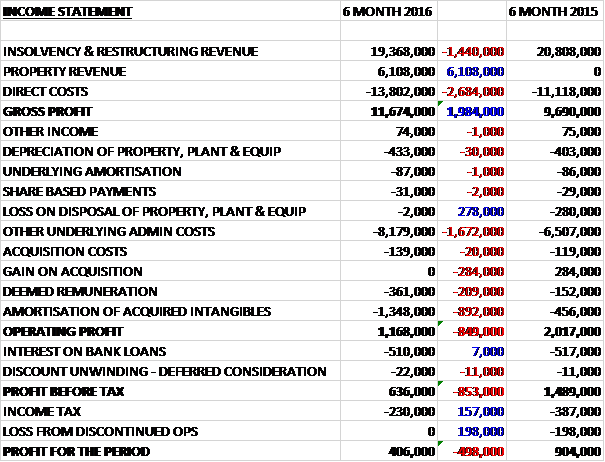
Revenues increased when compared to the first half of last year as the £1.4M decline in insolvency and restructuring revenue was more than offset by a £6.1M property revenue. Direct costs increased somewhat, but the gross profit was some £2M ahead. We then see a £278K decline in the loss on disposal of fixed assets but other underlying admin costs were up £1.7M. We also see the lack of the £284K gain on acquisition that occurred last time along with a £209K growth in deemed remuneration and an £892K increase in the amortisation of acquired intangibles which meant that operating profit fell by £849K. Finance costs were broadly flat but the tax charge was £157K lower and there was no loss from the discontinued operation which cost £198K last time. The end result is a half year profit of £406K, a decline of £498K year on year.

BEGinterimassets

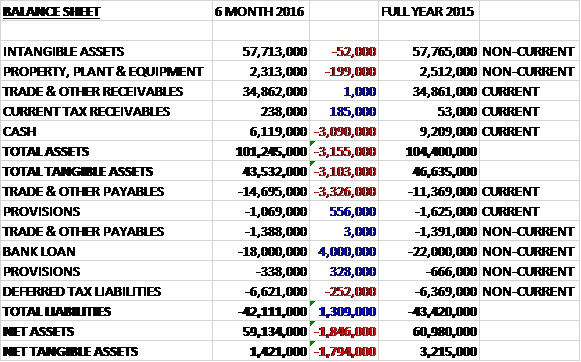
When compared to the end point of last year, total assets declined by £3.1M driven by a £3.1M fall in cash levels, and a £199K decline in property, plant & equipment partially offset by a £185K growth in current tax receivables. Total liabilities also declined as a £4M reduction in the bank loan and an £884K fall in provisions was partially offset by a £3.3M increase in payables and a £252K growth in deferred tax liabilities. The end result is a net tangible asset level of just £1.4M, a decline of £1.8M over the past six months.

BEGinterimcash

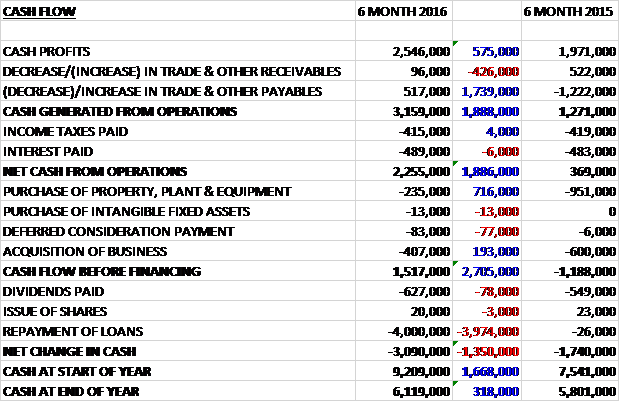
Before movements in working capital, cash profits increased by £575K to £2.5M. There was also an inflow from working capital, in particular and increase in payables which, after flat tax and interest payments, meant that the net cash from operations came in at £2.3M, a growth of £1.9M year on year. The group then spent £248K on capex along with £83K of deferred consideration and £407K on acquisitions to give a free cash flow of £1.5M. This did not cover the £4M of loan repayments, let alone the dividends, however, and the cash outflow for the half year stood at £3.1M to give a cash level of £6.1M at the end of the half.

The underlying EBITDA in the insolvency and restructuring business is £4.3M, a decline of £361K year on year. The insolvency market continues to be challenging with a further 10% reduction in the number of UK insolvencies over the course of the period which are now at their lowest level since 2007. The overall market conditions have led to reductions in revenue in the division but the impact has been somewhat mitigated by thorough cost control and operating margins were broadly maintained. Progress has been made in increasing market share which has been further enhanced by the acquisition of P&A.

The underlying EBITDA in the property business is £1.2M and this was the first contribution from the division, although pre-acquisition EBITDA was £1M. The integration of the Eddisons business into the group has proceeded well with synergy savings exceeding the initial targets with a further £500K of annual synergy savings on top of the £500K already identified which has led to operating margins increasing from 14.1% to 19%, further helped by the exit of non-profitable contracts. After the period-end, they completed the acquisition of Taylors, a specialist business property valuation consultancy which will add further depth to the group’s capabilities in this division.

In September the group acquired the P&A Sheffield team who are a significant regional provider of business recovery and insolvency services with a strength in asset based lending and creditor services out of administration for an initial consideration of £400K and a contingent consideration of £500K. After the year end the group acquired Taylors Business Surveyors and Valuers which specialises in providing commercial business and property valuations for secured lending purposes on behalf of a wide range of financial institutions, including all of the major high street banks. Taylors was acquired for a maximum consideration of £1.9M with an initial consideration of £500K in cash and £600K through the issue of shares along with deferred consideration of up to £750K. It made a pre-tax profit of £200K last year.

As there are no indications of a change to the benign financing environment in the UK which would cause an increase in insolvency levels, the board remains cautious about activity levels in the division in the near term and are focusing on cost control. Overall, their expectations for the year remain unchanged and they have stated they are still looking for acquisitions.

At the current share price, the shares are trading on a forward PE of 13.9 and have a dividend yield of 5% after the interim dividend was maintained. They were in a net debt position of £11.9M at the end of the half compared to £16.2M at the same point of last time.

Overall then this has been another difficult period. Profits have fallen but this was only due to the recent acquisitions, net assets have also declined but the operating cash flow has shown an improvement with the group now generating some free cash, albeit not enough to cover debt repayments. The insolvency market remains difficult, with a further decline in business over the period but the property division is now contributing to profits with some good cost synergies generated. The acquisitions look a good fit but I would like to see less reliance on so much debt.

Overall, expectations are unchanged and with reducing debt, a PE of 13.9 and yield of 5%, these shares look decent value to me.

On the 10th March the group released a trading update covering Q3. Performance has been consistent with the outlook reported at the time of the half year results with both divisions performing as anticipated. The estimated number of company insolvencies in England and Wales for 2015 was 14,629, a decrease of 10.3% when compared to 2014, and the lowest level since 1989.

On the 3rd June the group announced the acquisition of Pugh Auctions for an initial cash consideration of £2M from existing resources. Additional contingent consideration of up to £2.6M will become payable subject to the achievement of financial targets in the five years following the transaction. Pugh is the largest firm of commercial property auctioneers operating outside London with regular auctions being held in Leeds and Manchester. They had no assets to speak of and last year generated pre-tac profits of £800K. The acquisition is expected to be earnings enhancing in the current year so this looks like a good deal to me.

Begbies Traynor Share Blog – Final Results Year Ended 2015

The group now has two divisions. Begbies Traynor is an insolvency, restructuring and investigations consultancy. Edisons was acquired in December 2014 and now makes up the property consultancy division. It is a national firm of chartered surveyors, providing services to banks, insolvency practitioners and owners of commercial property. They are now positioned so that their earnings are hopefully a little less counter-cyclical.

The Begbies Traynor division provides corporate insolvency which aims to either rescue the business or realise the value of assets and distribute any available funds to creditors; personal insolvency where they provide advice to debtors and creditors on all aspects of personal insolvency; and restructuring & financial consulting where they provide consulting services to businesses, professional advisors and financial institutions on debt refinancing, business valuations, corporate finance and business reviews together with conduct of financial investigations and due diligence.

The services offered at Eddisons include the valuation and sale of property, machinery and business assets including fixed charge property receiverships, insolvency insurance brokerage, property and facilities management and building consultancy services such as lease advisory, dilapidations advice and rating reviews. The group recognised revenue when the account can be reliably measured and its probable economic benefits will flow. Services provided to clients, which at the balance sheet date have not been billed are recognised as unbilled revenue.

The company has now released its final results for the year ended 2015.

BEGincome

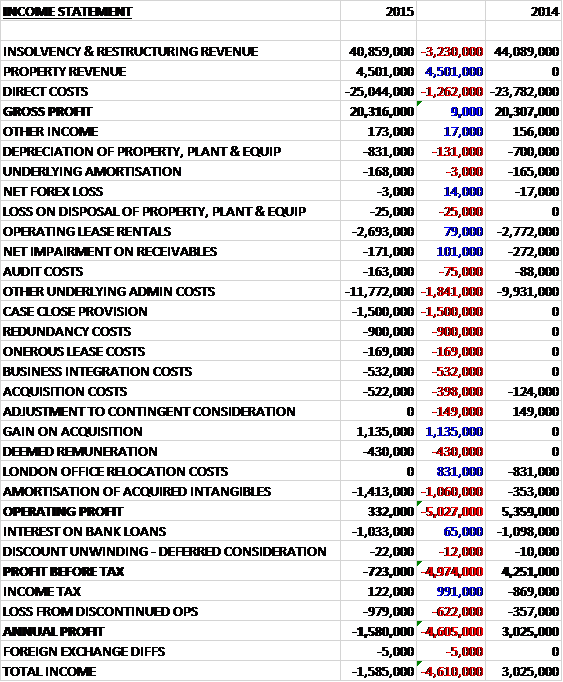
Revenues increased when compared to last year as a £3.2M fall in insolvency and restructuring revenue was more than offset by a £4.5M growth in property revenue. After direct costs, however, the gross profit was flat year on year. We then see a £131K increase in depreciation and a £1.8M growth in other underlying admin costs along with a £1.5M case close provision charge, £900K of redundancy costs, a £430K charge relating to deemed remuneration and £532K of business integration costs, all of which did not occur in 2014. In addition there was a £398K growth in acquisition costs and a £1.1M increase in the amortisation of acquired intangibles.

On the other hand, there was a £1.1M gain on acquisition and no London office relocation costs that were £831K last year. The result of all this is an operating profit that has fallen by £5M when compared to 2014. Finance costs were slightly lower but there was a £991K swing to a tax rebate, partially offset by a £622K increase in the loss from the discontinued operation to give an annual loss of £1.6M, a detrimental movement of £4.6M year on year.

BEGassets

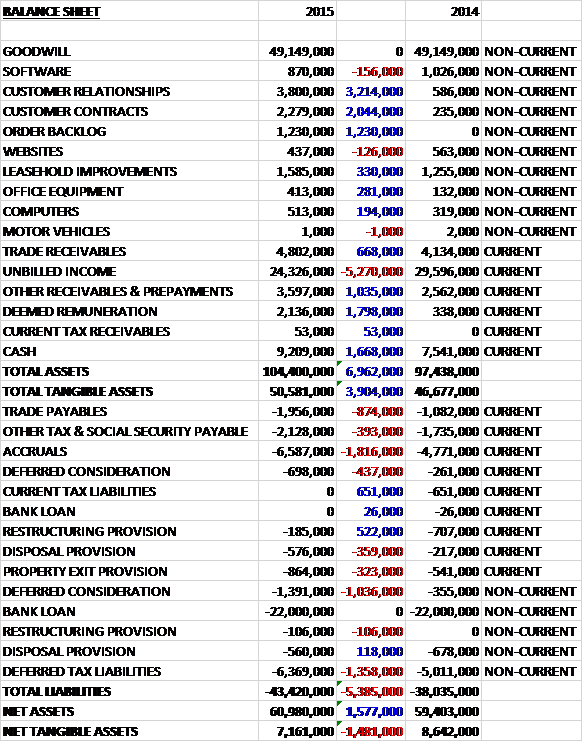
When compared to the end point of last year, total assets increased by £7M driven by a £3.2M growth in customer relationships, a £2M growth in customer contracts, a £1.2M increase in order backlogs, a £1.8M growth in deemed remuneration, a £1.7M increase in cash and a £1M growth in other receivables and prepayments, partially offset by a £5.3M decline in unbilled income. Total liabilities also increased during the year due to a £1.8M growth in accruals, a £1.4M increase in deferred tax liabilities and a £1.5M growth in deferred consideration. The end result is a net tangible asset level of £7.2M, a decline of £1.5M year on year.

BEGcash

Before movements in working capital, cash profits declined by £2.3M to £3.2M. There was a cash inflow from a decrease in receivables but this was offset by more tax and interest so the net cash from operations came in at £3.8M, a fall of £1.8M year on year. The group spent £1.2M on fixed tangible assets, mainly relating to the new London office, and £177K on deferred consideration before £3.7M was spent on acquisitions to give a cash outflow of £1.4M before financing. The group then issued new shares which brought in £2M, enabling them to pay a dividend (I really don’t see the logic in issuing more shares and declaring a dividend!) and have a cash inflow of £1.7M for the year and a cash level of £9.2M at the year-end.

The discontinued operations include the global risk partners division and this year’s loss from discontinued operations includes a £570K loss on disposal. During the year the group invested in their London office with the team moving to new premises in Canary Wharf; and after the year-end they launched BTG Global Advisory, a new international alliance of independent insolvency, restructuring and financial advisory firms operating in key global jurisdictions (that’s as clear as mud then).

It was another difficult year for the insolvency industry with national volumes at their lowest level since 2007, falling from 18,994 to 16,380 and in addition, the insolvencies in Q1 2015 were just 4,014, the lowest quarterly level since Q4 2007, although these levels have now stabilised through the year. There has also been a change in the means of generating SME insolvency cases in recent years with the increasing use of internet-based marketing techniques.

The segment result in the Insolvency and Restructuring business was £8.5M, a decline of £2.3M year on year. The reduced level of market activity led to lower insolvency appointments for the group, which combined with the ongoing pressure on fee rates, caused the reduced revenue levels in the year. During the year the group restructured the division in response to the lower levels of market activity, together with discontinuing the loss-making global risk partners division. As a result of these cost-cutting actions completed this year, the cost base will reduce by some £1.5M in the new financial year.

The group will continue to develop this division through a combination of senior recruitment, acquisitions and staff development with the intention of increasing their market share, although they are already the market leader. Further development over the medium term could come from winning higher value, more complex instructions from existing clients and prospects.

The segment result in the Property business was £744K which represents the division’s maiden profit after being acquired in December 2014. The team is being appointed on a number of the group’s insolvency cases. In addition, operating synergies, through shared property and other overhead costs, are being realised in line with board plans. It is intended that the division will be developed through a combination of senior recruitment and acquisitions with the intention of developing the service offering and geographical coverage.

During the year the group made a number of acquisitions. Two insolvency practices were acquired – Ian Franses Associates in June 2014, a London-based insolvency practice; and Broadbents Business Recovery Services in April 2015, a Yorkshire-based insolvency practice. The total consideration was just over £1M satisfied by £800K in cash and £270K contingent consideration. The businesses have £1.2M in net assets which included £1.5M in intangible assets. Since the date of the acquisition, they contributed £357K to pre-tax profits so these look like good deals.

In December the group also acquired Eddisons Commercial Holdings, a property services consultancy. The total consideration was £7.6M which consisted of £6.3M in cash and £1.3M of contingent consideration deemed remuneration. The acquisition comes with £6.4M of net assets with £6.3M of those being intangible. The business contributed £511K to group pre-tax profit in the five months since its acquisition.

There are quite a lot of related party transactions at the group. Various properties used by members of the group during the year are owned by Ric Traynor, a director of the company. Rent paid on those properties totalled £720K which actually seems like quite a lot. Also, one commercial property used by the group is part owned by director Mark Fry which cost £85K in rent and he part owns a company which provides archiving facilities to the group which cost £24K. Finally Ric Traynor owns a company called Red Flag Alert and Begbies was charged a fee of £150K for use of their quarterly stats. These are probably all fine but it is worth keeping an eye on all of these items.

The group has principle banking facilities of £30M of which £22M has been drawn down. There are also £7.8M of non-cancellable operating leases outstanding. One thing worth noting is the number of receivables that are past their due date with about half of them overdue. This is as a result of the kind of work that the company which also means there are fairly large receivable impairments to contend with too. Presumably the group charges enough to take this into account. Due to the fairly sizeable debt here, the group is also somewhat susceptible to interest rate increases with a fifty basis point increase giving rise to a profit reduction of £71K, although there is probably a natural hedge with insolvencies likely to increase in this eventuality. The group also operates a defined contribution pension which cost £925K this year.

In addition to the above risks, the operating risks really relate to the macroeconomic environment where assignments run counter-cyclically. Also, the fact that the group operates in regulated markets gives rise to potential risks.

In December the group completed a share placing of 13,094,982 shares at a price of 40.5p per share in order to raise £5.3M which is a little disappointing to see.

Activity levels in the insolvency market have stabilised over the past year but there are no indications of a change in the benign financing environment in the UK and the board therefore remained cautious about activity levels in the near term. The combination of the reduced cost base in the insolvency division, the removal of losses from the discontinued business and the full year impact of the Eddisons acquisition, however, should leave the group well placed over the next year.

At the year-end, net debt stood at £12.8M compared to £14.5M at the end of last year. After the dividend was kept the same, the shares currently yield 5% which is what is expected for next year’s dividend yield too. As the group made a loss, we can’t use the PE ratio as a method of valuation but on next year’s consensus forecast, the shares trade on a PE ratio of 13.9.

Overall then, this has been a tough year for the group. They swung to a loss during the year and even when the plethora of “non-underlying” items are taken off, the performance was still below that of last year. Net assets also declined and operating cash flow declined with now cash left after the acquisitions to pay the dividend. The core insolvency business is struggling due to the benign financing conditions in the country, although the decline seems to have stabilised and the much smaller property division contributed its first profit to the group.

The insolvency acquisitions look good value and the Eddisons purchase was definitely important in order to diversify earnings a bit. Going forward, business is likely to remain difficult but the sale of the loss making discontinued operation and the reduction in the cost base of the insolvency division should improve the bottom line next year. With a forward PE of 13.9 and dividend yield of 5% these shares are not expensive and are looking a bit interesting in my view.

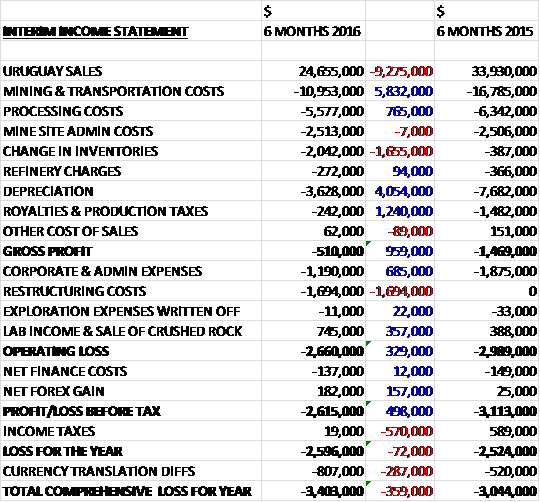
Orosur Mining Share Blog – Interim Results Year Ending 2016

Orosur Mining has now released its interim results for the year ending 2016.

OMIinterimincome

Revenues fell by $9.3M when compared to the first half of last year due to both a reduction in the price of gold and a fall in the amount produced. Cost of sales fell even more though as a $1.7M increase in cost of inventories was more than offset by a $5.8M fall in mining & transportation costs, a $4.1M decline in depreciation following the impairment last year and a $1.2M reduction in royalties after the Uruguay government gave the company a reprieve for a year. The mine site admin costs were broadly flat despite an $881K in additional contingency recognised following a final verdict from the judge relating to a labour claim from 2006. After this, the gross loss improved by $959K when compared to the first half of 2015.

We then see a $685K fall in corporate expenses and a $357K growth in income from the sale of crushed rock and lab services, along with the income from the lease of the exploration camp in Colombia, offset by $1.7M of restructuring costs to give an operating loss some $329K better than last time. There was a decent forex gain but the tax rebate was much lower, presumably due to the effects of the Uruguay peso’s depreciation on deferred tax, which meant the loss of the half year was $2.6M, an increase of just $72K year on year.

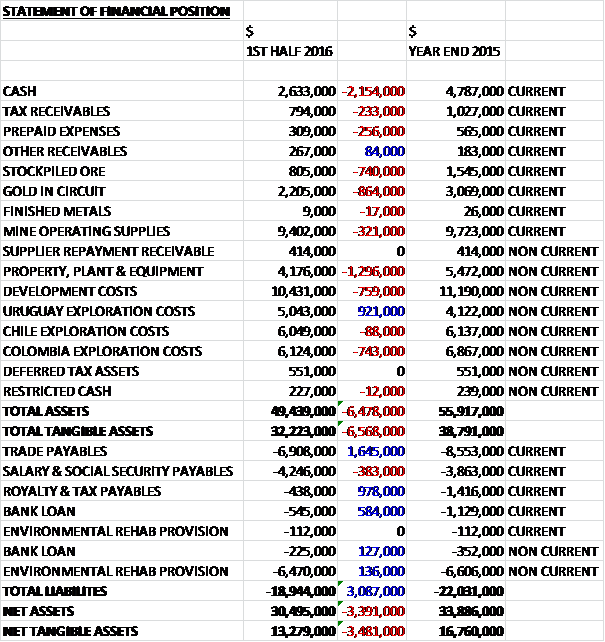
OMIinterimassets

Total assets declined by $6.5M when compared to the end point of last year driven by a $2.2M fall in cash, a $1.3M decline in property, plant and equipment as depreciation outpaced capex, a $743K fall in Colombian exploration costs due to foreign exchange movements and a $1.9M decrease in inventories partially offset by a $921K increase in Uruguay exploration costs. Total liabilities also declined over the past six months due to a $1.6M fall in trade payables, a $978K decline in royalty payables and a $710K decrease in bank loans. The end result is a net tangible asset level of $13.3M, a decline of $3.5M over the last half year.

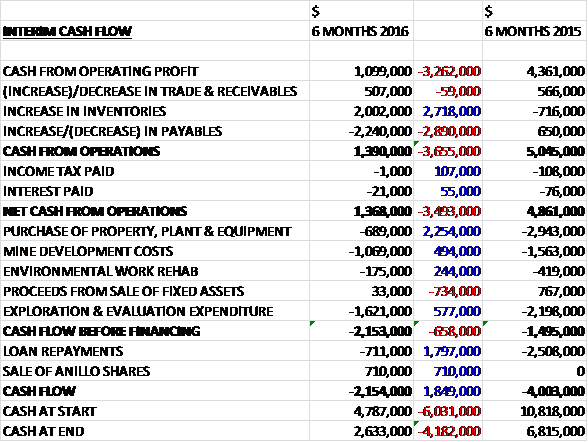
OMIinterimcash

Before movements in working capital, cash profits fell by $3.3M to $1.1M. There was a slight cash inflow from working capital, but much less than last time, so the cash from operations came in at $1.4M, a fall of $3.5M year on year. This did not cover the $1.8M of tangible assets (mainly development costs) or the $1.6M in exploration costs so before financing there was a cash outflow of $2.2M. The sale of Anillo shares paid for the loan repayment so the cash flow for the period was $2.2M and the cash level at the end of the half year was $2.6M.

Despite Q2 being a transition quarter, all in sustaining costs show a significant improvement from last year, falling to $1,166 in Q1 and $1,095 in Q2 but the company expects that the benefits of the programme are yet to be fully realised and will be more pronounced next quarter. Although an improvement, this does not compare that well with the average gold price received of $1,100, down from $1,212 at the same point of last year.

In December the president of Uruguay granted the company an exemption on the royalty payment to the government which covers the period from April 2015 to March 2016. The group have also been able to reduce staff levels by more than 40% and have enacted a reduction in the cash remuneration of the board. (Don’t worry, they are not taking a pay cut as they will be paid partly in shares instead.)

The company produced 8,172 ounces of gold in Q2 compared to 12,854 at the same point of last year with a total of 20,643 ounces produced in the first half. In the quarter, 199,352 tonnes of ore was processed at a grade of 1.34g/t with 319,244 processed at a grade of 1.34g/t in Q2 2014, and 409,268 tonnes was mined which included 192,164 tonnes of ore and 217,104 tonnes of waste at an average grade of 1.39g/t. compared to 318,840 tonnes of ore and 955,806 tonnes of waste at a grade of 1.38g/t during Q2 last year.

In Uruguay the San Gregorio Deeps underground mine project continued to advance through permitting. A prelim permit was issued by the environmental authority in Q1 2016 and the mining permit is currently in process with the mining authority. The main pit of San Gregorio has been de-watered during the last three months and is now ready for about 1,500 ounces to be mined from it. Some initial development work is expected to commence shortly to connect the main ramp of open pit mine with the designed portal for San Gregorio Deeps. Based on limited sampling, a portion of the material in this sections carries grades between 2 and 5g/t, mixed with waste material.

A short infill RC drilling campaign of 500m is underway from the main ramp of the open pit mine with the intention of further defining resources at level 17 of the San Gregorio Deeps project. This work also gives the company the opportunity to potentially advance mining of a chamber as well as gaining geological and geotechnical information to optimise the mining design. At Arenal Deeps, the company is testing a down-plunge extension of the Arenal mineralised structure. A 90m tunnel has been completed to access and make room for more cost efficient drilling with the aim of testing for a net structure within a distance of 300m from the current underground workings. During December, a 1,100m drilling campaign commenced and is expected to continue through to April.

As far as brownfield exploration in Uruguay is concerned, possible extensions of known mineralisation have been identified in a number of locations including adjacent to the open pits at Veta Rey, Laureles and Zapucay mines as well as at Rieles which represents the eastern extension of the San Gregorio main pit extending to the East extension pit. The company is currently focusing its brownfield exploration effort for the remainder of the year in Vesta Rey and in the Sobresaliente area. Here, the main focus will be on advancing known target zones using NSAMT geophysics methods and developing a programme of approximately 5,000m of Pantera drilling.

At Anillo in Chile, a campaign of 13 RC holes totalling 3,600m of drilling was completed on time in December. Drilling tested geologic, geophysical and geochemical indicators of Au-Ag epithermal mineralisation at the central-north, NE, S and W sectors of the project. Testing of all drilling interceptions is currently underway to validate assay results and obtain further information on pathfinder geochemical behaviour. The results to date demonstrate a non-obvious mixture of low and high sulphidation epithermal, thought to be a result of at least four different magmatic events recognised by geoscientists in the region. Additional geochemistry is expected to aid in the preparation of a geological model that interprets the levels of exposure of the dominant mineralisation systems in place. A meeting of the technical committee of Anillo is planned for February to review the results and determine the next phase of the exploration campaign.

Following the negative NPV and write-off of assets at the Pantanillo project the group decided not to fulfil the payment of advanced royalties totalling $1.6M due to Anglo American in December, which triggers the process for the properties to be returned to them which will take place over the coming months and will not have any additional adverse effect on the balance sheet of the company.

As part of the company’s cost reduction plan, a portion of the Anza exploration camp in Colombia has been rented until August to a major mining company exploring a neighbouring district which seems a sensible use of space.

In June the company signed an option agreement for the funding of the next exploration phase at Anillo in Chile with AC. The agreement defines a non-dilutive financing of up to $3.5M in advance of the exploration and states that AC may earn up to a 40% interest in the project. The group incorporated Anillo SPA, an 84% owned associate and transferred the property of the project to the business. AC has subscribed for an initial amount of Anillo shares equal to 16% of the capital for $850K. AC has a further option to elect to earn up 32.5% and then 40% by funding an additional $1.25M and $1.375M. Should AC not fund the purchase of shares in phase 2, they will lose their participation interest.

Phase 1 exploration will include a geophysics campaign and a minimum of 3,600m of RC drilling and have an estimated duration of up to ten months. Phase 2 would include an additional geophysics campaign and a minimum of 5,500 metres of RC drilling and have an estimated duration of 18 months and phase 3 would include further geophysical work and additional RC drilling and also have an approximate duration of 18 months.

In November, in Uruguay, Minerales Cala gave notice to the company of the completion of its expenditures and reported obligation with respect to phase 2 of the option agreement, thereby earning an additional 29% in the project for a total of 80% with Orosur retaining 20%. Phase 3 of the option agreement has commenced and Minerales Cala is obligated to submit a detailed work programme and budget to the company.

In September, also in Uruguay, due to a number of objections concerning the submitted phase 2 expenditures and an ongoing dispute between the parties, the company exercised its right to request an audit of the itemised statement of accounts delivered by Gladiator. Later in the month, Gladiator notified the company that phase 3 of the option agreement will not be completed by the end of December and that it should be considered finalised which terminated their option to acquire a further 29% interest in the project. Once the audit of the phase 2 expenditures has been finalised and the earning of the phase 2 interest is either confirmed or rejected, the parties will be required to renegotiate a new joint venture agreement in order to continue with the development of the project.

The cash balance at the end of the half was $2.6M and the debt balance was $800K with $3M of undrawn lines of credit available.

Overall then this has been another difficult period for the group. Losses were flat year on year but the pre-tax loss improved despite some $1.7M of restructuring costs as the group benefited from reduced staff costs and from renting out their exploration camp in Colombia. Net assets declined, however, as did operating cash flows with no free cash being generated. The group produced less gold when compared to the first half of last year but the real issue is the fact that AISC was $1,095 whereas the sales price for the gold was $1,100 which is hardly conducive to making lots of profit. The company expect the AISC to come down in H2 but where will the gold price be?

This is of course, the crux of the investment case here and until the gold price shows a sustained improvement, I am not investing in this company.

On the 21st January the group announced that it had granted 2,920,000 stock options to its employees. The options are exercisable at a price of C$0.105 per share by the start of 2021 and will vest in three parts with the first vesting immediately and the others in Jan 2017 and 2018. The company also issued 2,103,894 shares to satisfy the termination consideration with Pablo Marcet. Lots of confetti being distributed here, I guess cash is very tight.

On the 3rd March the group stated that it had granted an aggregate of 193,880 stock options and 126,226 shares to directors and officers in lieu of 20% of their standard cash compensation for the last three months which is equivalent to a cash amount of $29,513. This is not a material amount but it does hint at the fact that cash is getting very tight here in my view.

Shoe Zone Share Blog – Final Results Year Ended 2015

Shoe Zone has now released its final results for the year ended 2015.

shoeincome

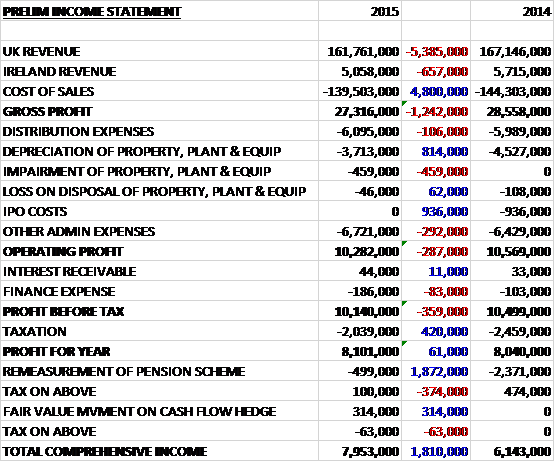
Revenues declined when compared to 2014 due to a £5.4M fall in UK revenue and a £657K decrease in Irish revenue caused by the closure of some stores and difficult trading conditions following the warm autumn weather. Cost of sales also fell but gross profit still came in £1.2M below that of last year. Distribution expenses were up modestly but we see an £814K decline in depreciation, partially offset by a £459K impairment of property, plant and equipment and a £292K increase in other admin costs. Despite the IPO costs of £936K not being repeated this time, the operating profit fell by £287K and after finance costs increased, the pre-tax profit was down by some £359K. A large fall in tax, however, meant that the profit for the year came in at £8.1M, a growth of just £61K year on year.

Shoeassets

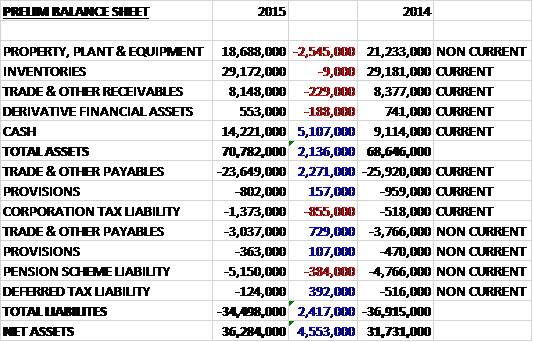
Total assets grew by £2.1M when compared to the end point of last year driven by a £5.1M increase in cash, partially offset by a £2.5M fall in property, plant & equipment and a £229K decline in receivables. Conversely, total liabilities fell during the year as an £855K growth in corporation tax liabilities and a £384K increase in the pension liability was more than offset by a £3M fall in payables, and a £392K decrease in the deferred tax liability. The end result is a net tangible asset level of £36.3M, a growth of £4.6M year on year.

Shoecash

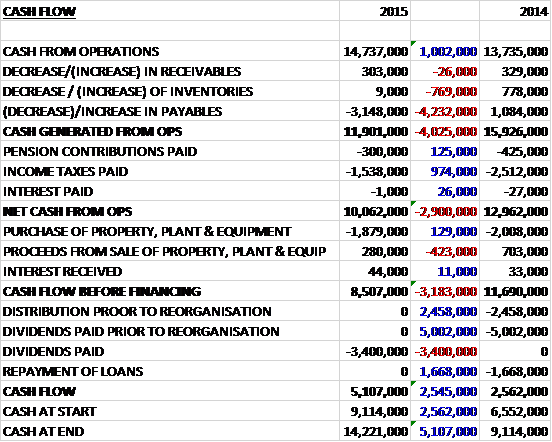
Before movements in working capital, cash profits increased by £1M to £14.7M. There was a cash outflow through working capital, in particular a fall in payables, but pension contributions, interest and taxes were all lower than last year to give a net cash from operations of £10.1M, a decline of £2.9M year on year. The group then spent a net £1.6M on capex which meant that free cash flow was £8.5M. The group then only spent £3.4M on dividends to give a cash flow for the year of £5.1M and a cash level of £14.2M to at the year-end.

Following a slow start to the year the group made some adjustments to their future ranges to ensure greater diversity of product and to give them future confidence about average price and transaction value. These transaction values stabilised in the second half of the year and have reverted to historic levels after the year-end. The group have made progress in their non-footwear ranges. During the year sales were up 33% to £5.5M and 2016 is already showing good signs of further growth and they have extended the full non-footwear range in their Grade 3 stores which has apparently had a great start.

At the end of the year the group were trading from 535 stores with 12 new ones opening, including seven relocations. They also completed 40 store refits during the year, at a total capex of £1.9M. They continue to rationalise their store portfolio and will close further loss making stores in the coming year, reducing sales but improving profitability.

The rents at lease renewal over the past year have fallen by 27.2% which seems to be a remarkable result. The board still see opportunities to reduce rents and relocate to better sites and therefore continue to open larger, more profitable grade one stores while closing smaller grade three stores. The average lease length is now just 2.7 years which provides the group with some flexibility with secondary locations showing limited signs of rental recovery outside London. The group have also been trialling new equipment during the year to increase store densities without the need for refitting which so far have been successful and will rapidly increase the number of grade one stores in 2016.

Since the launch of the fully responsive upgraded website, the group’s customer database grew by 47% which has helped e-mail campaign sales increase by 65%. Conversion improved on all devices and overall e-commerce growth was significantly ahead of market expectations, growing by 44.7%. In addition to their own website, the group also sells via Amazon and eBay which represent some 40% of online sales. The group have now started selling to over 30 additional countries via Amazon and eBay and they will continue to increase the number of countries in which their products are offered. In addition, they are working on further developments over the next year that will improve delivery options for international customers on shoezone.com.

Trading in the first quarter of 2016 has been challenging amid the well documented high street trading conditions for apparel retailers. The stock position, however, is well controlled and they have achieved strong gross margins having chosen not to discount stock before Christmas, as usual. Capital investment for the full year will be increased to about £3M from the original £2M expectation to allow increased investment in stores, warehouse and IT. This includes refitting an additional ten stores, significant investment in the distribution centre to allow for increasing volume of e-commerce sales, and a roll out of new point of sale terminals which will be completed by 2018.

So far in the new year, the group have opened six new stores and refitted a further four. In August a trial project will be launched in three stores. These stores will be twice the size of an average grade 1 store. These stores will benefit significantly from an extended product range, higher priced footwear and an enhanced environment which will allow the group to benefit from the out of town market as well as creating a strong new avenue for growth. The falling oil price is already having a positive impact on the cost of logistics and should also impact the price of raw materials which should have a positive effect on margins in the coming year.

Trading in the first quarter of the year has been challenging, amid the well documented high street trading conditions for clothing and footwear retailers. Despite this we have continued to make progress against our strategic objectives whatever that means.

At the year-end the group had a net cash position of £14.2M compared to £9.1M at the end of last year. At the current share price the shares trade on a PE ratio of 11.7 which falls to 10.6 on next year’s forecast. Following the announcement of the special dividend of 6p, the shares are now yielding 8.3% which falls to 5.6% on next year’s consensus forecast – good stuff and the group have stated that they will pay excess cash over £11M to shareholders.

Overall then this has been a fairly decent year for the group although pre-tax profits did fall, net assets increased and despite a decline in operating cash flow due to a reduction in payables, cash profits increased and there was plenty of free cash generated. The 27% reduction in operating leases sounds really good and the group have indicated more could be to follow. In addition, the closure of the smaller stores and opening of the more profitable larger ones seems to be a good strategy. The e-commerce side of the business seems to be doing very well and with a forward PE of 10.6 and dividend yield of 5.6% these shares are looking rather good value to me.

Unfortunately they state that trading in Q1 has been challenging but don’t say quite how challenging it has been which is very frustrating and until I seem some brokers estimates, it makes this a difficult investment to make.

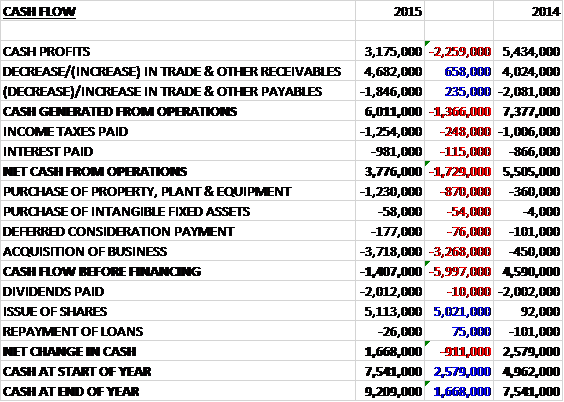
Orosur Mining Share Blog – Final Results Year Ended 2015

Orusur Mining is a gold producer incorporated and domiciled in Canada. They are duel listed on AIM and the Toronto stock exchange and the company operates in Uruguay, Chile and Colombia. In Uruguay they operate the San Gregorio gold areas where gold is produced in the form of dore which is shipped to refineries for final processing. In Chile they conduct exploration and development activities and in June they reached an agreement with Asset Chile Exploration which enables them to explore the Aniullo rea. In July 2014 they completed the acquisition of Waymar Resources which has exploration properties in Colombia.

The San Gregorio gold mining complex in Uruguay is the only gold producing operation in the country. The company has been exploring in Uruguay since 1996 and acquired the current operation in 2003. Currently they are operating the Arenal Deeps underground mine and several open pits in the San Gregorio district and also have strategic land holdings throughout Uruguay and have active near mine and regional exploration programmes focused on increasing gold reserves.

In Chile the company has an active exploration programme on the Anillo property, optioned from Codelco, the national mining company, located close to Antofagasta in Northern Chile. During the year, an extension of the farm-in contract period was completed until 2020. The company also owns 100% of the Pantanillo property, located in the Maricunga Belt and 25% of the Talca exploration asset located close to La Serena, north of Santiago.

It has now released its results for the year ended 2015.

OROincome

Revenues declined by $14.5M when compared to last year due to the fall in gold price and the lower quantities of gold sold. In general, cost of sales also fell as a $1.3M growth in mining and transportation costs along with a $1.1M increase in processing costs were more than offset by a $2.1M movement in inventories and a $2.2M fall in depreciation to give a gross loss of $3.8M, a deterioration of $11.3M when compared to 2014. Corporation and admin expenses fell by $598K but this was offset by a $437K fall in other income due to land sales that were not repeated this year and a $552K increase in the obsolescent provision.

We also see a $27.6M increase in exploration write-offs, mainly relating to properties in Chile, and a $14.2M increase in asset impairments which meant that there was a detrimental $53.4M movement in the operating profit. Interest costs more than halved, however, and there were small improvements in the environmental rehabilitation accretion and forex gains. There was a big swing to a tax charge, however ($6.4M) relating to differences in asset valuations following the depreciation of the Uruguay peso, which meant that the loss for the year came in at $54.4M, a detrimental movement of $59.5M year on year.

OROassets

When compared to the end point of last year, total assets declined by $51.8M driven by a $24.1M decrease in the Chile exploration costs, a $12M fall in development costs, an $8.7M decline in property, plant & equipment, a $6M fall in cash and a $4.9M decrease in the deferred tax asset, partially offset by a $6.9M growth in Colombian exploration costs. Total liabilities also fell during the year, mainly as a result of a $3.5M decline in bank loans. The end result is a net tangible asset level of $16.8M, a decline of $30.4M year on year.

OROcash

Before movements in working capital, cash profits fell by $13.3M to $10.6M. There was a small inflow of cash through working capital, in particular a fall in receivables, to give an operating cash flow of $11.4M, a decline of $10.7M year on year. The group then spent $5.2M fixed tangible assets relating to the construction of the phase 2b of the second tailings dam, the repair of heavy equipment and new trucks, $2.5M on mine development costs and $5.2M on exploration which meant that there was a $1.5M cash outflow before financing. The group also paid back $4.6M in bank loans which gave them a cash outflow of $6M for the year and a cash level of $4.8M at the year-end.

This year the group sold 52,994 ounces of gold at an average price of $1,232 compared to 61,074 ounces at $1,298 last year, although the sales price in Q4 had fallen to $1,196. Total production was 53,485 ounces with about 55% of the ore mined from the Arenal Deeps underground operation and 45% from several open pits which was a higher proportion from the open pits than expected. While the tonnage of ore processed increased from 920K tonnes to 1.2M tonnes, the grade declined from 2.16g/t to 1.48g/t. Cash operating costs were $912 per ounce compared to $792 last year due to the processing of more ore to offset the lower grades. All in sustaining costs increased from $1,049 per ounce to $1,185.

In Uruguay, during the year the company continued a significant exploration programme, concentrating its efforts in brownfields exploration and in-fill drilling. As a result, at the end of the year, measured and indicated resources in the country totalled 752K Oz of gold at an average grade of 1.18g/t and proven and probable reserves stand at 159K Oz at an average grade of 1.8g/t. While they managed to significantly increase their resources, up 212Oz, the addition of new reserves to replace production was partially offset by taking some reserves off the books as a consequence of using higher cut-off grades due to lower gold price assumptions (net loss of 35K oz).

During the second half of the year, 3,000 metres of in-fill geotechnical and exploratory drilling were completed at the San Gregorio deposit. At the Granulitic corridor, where drilling was focused on, the following projects went through initial phases of exploration: Arenal Este, Rincon de los Castillos and Arroyo Laureles. At Arenal Este, drilling tested the trace of the principal F1 fault that had been delineated last year and similar programmes were carried out at the other two prospects where the main elements of structural preparation, prospective geology and anomalous geochemistry indicated the presence of several targets, although no significant economic results were produced.

The Laureles project has been part of the company’s portfolio since 2003 and after the new geological modelling developed last year, a drilling campaign of 700m was completed in the year to define a new resource model which resulted in 4,400 Oz of new reserves. Since 2013, high grade lenses have been the targets of drilling programmes at Veta Rey and this year a total of 3,292m was drilled resulting in additional reserves of 14,000 Oz. Work in near mine projects with a Tamrock Pentera drill allowed the definition of 5,700 Oz of near-surface reserves at Vaca Dorada, Cross Hill and Veta Guillo. DD drilling was carried out at seven different underground levels at the arena Deeps mine and a total of 3,862m was drilled resulting in 11,000 Oz of new reserves; and at Arenal Repetition, a new underground development of 90m was started at the end of the year to reach a site for an underground drilling station.

At the Anillo project in Chile, the group has until the start of 2020 to complete a bankable feasibility study in order to acquire a 65% interest in the project. A definitive agreement for the funding of the next phase of exploration was signed with Asset Chile which established non-dilutive financing of up to $3.5M to advance the exploration programme. In June, Asset Chile contributed with phase 1 funding of $850K which earns them a 16% stake in the project with options for further funding leading to up to 40%. This phase of the exploration programme includes a geophysics campaign and a minimum of 3,600m of RC drilling with an estimated duration of ten months.

During the year management determined based on the results of drilling activity completed during the year that the carrying value of certain capitalised exploration expenditures attributed to specific were impaired as substantive expenditure or further exploration and evaluation activities in those areas is neither budgeted or planned in the foreseeable future. Of the $27.9M impairment recognised, some $25.5M relates to the Pantanillo exploration project in Chile where there is an NPV of $49.7M at a gold price of $1,250 per ounce but the NPV is negative at prices below $1,095 per ounce. The group have also completed an assessment of the carrying value of its cash generating units and recognised an impairment charge of $14.7M for property, plant, equipment and development costs as a result of the decline in gold prices.

In July the company completed the acquisition of Waymar Resources for 18,466,938 Orosur shares along with some warrants and stock options with the purchase price being calculated as $5.9M.
Obviously there are various risks associated with the group. A 10% fall in the price of gold would reduce profits by $6.5M but it is also worth noting that many costs are incurred in Uruguay pesos and the gold sales are made in dollars so a strong dollar is beneficial for the group (apart from the fact that a strong dollar generally means a weak gold price). As well as currency risks and the gold price risk, the group is also susceptible to political risk. The Uruguayan government have considered a project for a new law regulating big mining projects. It appears that Orosur might qualify as a bit project which would mean they would be subject to additional taxation in cases of high profits but as of the year-end, this law has now been implemented. Nevertheless, this shows the issues of operating in such countries.

At the year-end the group had a net $3.3M in cash along with $6.4M in receivables and inventories (excluding mine operating supplies) with some $13.8M of payables and accrued liabilities. There is also $3M of committed lines of credit with Santander available. A significant decline in the price of gold would meant that the company is required to seek additional sources of funding. Following the construction of the ramp at Arenal Deeps, however, the group does not have the same strong cash requirements for capital expenditure in the next year as it did over the last two years.

In light of the recent and sustained decline of gold prices, recently hitting levels below the company’s AISC guidance of $1,100 and $1,200 per ounce, they have conducted a review of their operating and exploration plans for the year and have consequently implemented a plan designed to reduce costs. The primary objective of this plan is to reduce AISC below $1,000 per ounce.

The company expects AISC of about $1,200 in Q1 2016 but to reduce to about $1,000 for the rest of the year. To accomplish this significant reduction, there will be lower production contribution from the open pits along with cost reduction measures across exploration, development and corporate areas. The revised guidance for 2016 is now production of between 30,000 ounces and 35,000 ounces at AISC of $1,000 to $1,100 per ounce. In the event of a sustained improvement in the gold price, the company has the capacity to significantly increase production.

Overall then this has been a difficult year for the group. There was a big loss and even after the impairments were stripped out, there was a pre-tax loss of $6.8M which was much worse than last year. Net assets also fell along with the operating cash flow which left no free cash – although it should be noted that the company was able to repay quite a lot of debt. Overall there was less gold sold at lower prices of last year. As of Q4, the sales price was $1,196 compared to $1,298 last year. This is a problem as the group’s all in sustaining cost per tonne was less than this at $1,185.

Resources did increase but despite exploration drilling, reserves fell due to the lower gold prices. The lower prices took their toll on many of the group’s assets with the Pantanillo project in Chile experiencing negative NPV at prices below $1,095 per ounce. Now that the Arenal Deeps ramp is finished capex should reduce this coming year but if gold prices fall further then a placing could be on the cards. In conclusion, this does not seem to be the right time to be investing in this company.

Berkeley Group Share Blog – Interim Results Year Ending 2016

Berkeley Group has now released its interim results for the year ending 2016.

BKGinterimincome

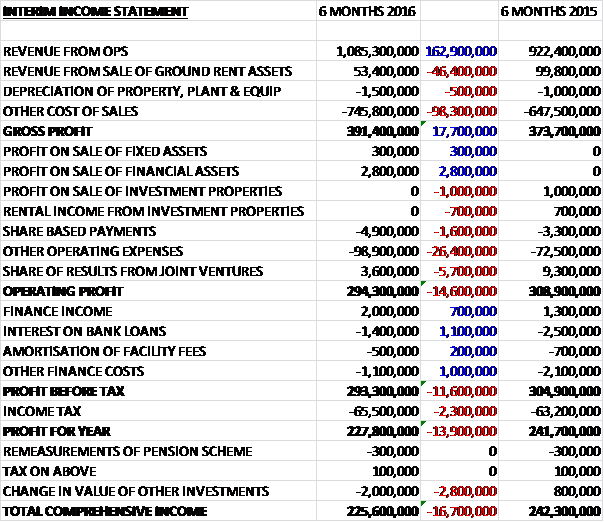
Revenues increased when compared to the first half of last year as a £46.4M decline in sales of ground rent assets was more than offset by a £162.9M growth in revenue from operations. Cost of sales also increased, which meant that gross profit was £17.7M ahead of last time. The group then made £2.8M on the sale of financial assets, offset by a £1.7M decline in income from investment properties and a £1.6M growth in share based payments. There was a £26.4M growth in other operating expenses, however, mainly as a result of the increased share scheme charge as the company’s share price increased (a £16.3M increase) and the group’s share of profits from joint ventures fell by £5.7M to give an operating profit some £14.6M below that of the first half of 2015. Finance costs did fall, but income tax increased to give a profit for the half year of £227.8M, a decline of £13.9M year on year.

BKGinterimassets

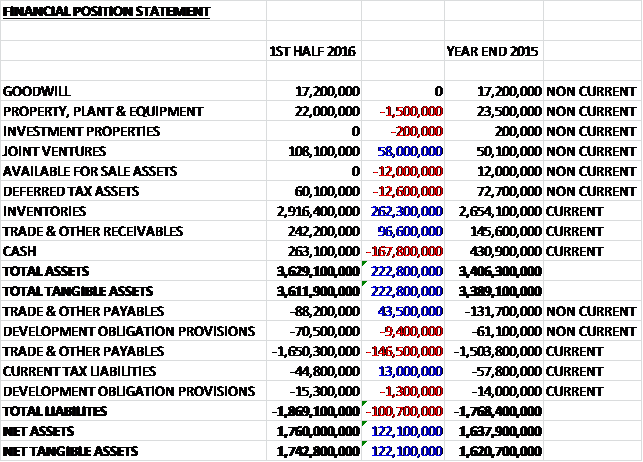
Total assets increased by £222.8M when compared to the end point of last year, driven by a £262.3M growth in inventories relating to land under development and work in progress, a £96.6M increase in receivables despite a reduction in receivables from joint ventures and a £58M growth in the value of the investment in joint ventures, partially offset by a £167.8M fall in cash, a 12.6M decline in deferred tax assets and a £12M sale of the available for sale assets. Total liabilities also increased during the period as a £103M growth in payables due to an increase in trade payables provisions and a £10.7M increase in provisions was partially offset by a £13M fall in current tax liabilities. The end result is a net tangible asset level of £1.724BN, a growth of £122.1M over the past six months.

BKGinterimcash

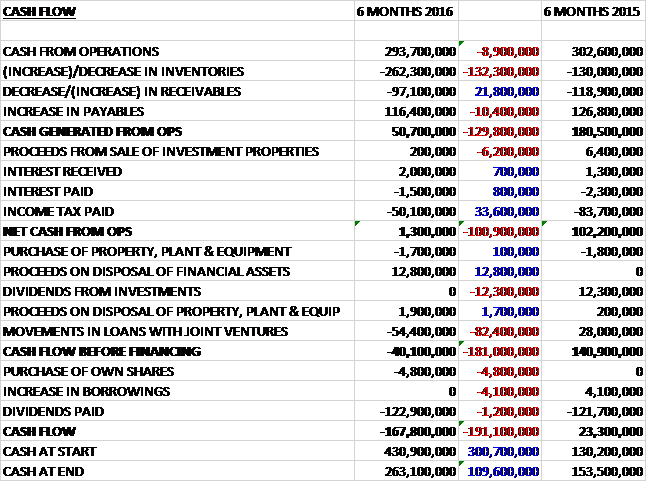
Before movements in working capital, cash profits fell by £8.9M to £293.7M. There was then a cash outflow through working capital with a large growth in inventories, partially offset by a £33.6M reduction in tax payments. This meant that the net cash from operations was just £1.3M, a decline of £100.9M year on year. The group then loaned a further £54.4M to joint ventures but received £12.8M from the sale of financial assets to give a cash outflow of £40.1M before financing. We then see some £122.9M spent on dividends along with a modest purchase of shares (no doubt to satisfy the director payments) to give a cash outflow of £167.8M for the period and a cash level of £263.1M at the end of the half.

The first six months of the year have seen a stable operating environment, supported by the decisive general election result, in which normal transaction levels experienced are consistent with the equivalent period last year. Sales price increases have continued in line with those reported in the wider market and are generally matched by cost increases. The cash due on forward sales over the next three years has increased by £137M to £3.096BN. The period saw the group’s launch of their new scheme at South Quay Plaza in Docklands along with launches of new phases on a number of other schemes. They continue to see good demand on both new and existing schemes, with domestic demand remaining strong and London continuing to attract inward investment from the UK and overseas. Cancellation rates of around 10% remain below the normal historic levels of 15% to 20% and completed stock remains at historically low levels with 39 completed residential properties held in the inventory at the period-end.

The total revenue from operations included £1.067BN of residential revenue and £18.5M of commercial revenue and there were no land sales in the period. A total of 2,091 new houses were sold across the SE at an average selling price of £506K compared to 1,372 at an average price of £649K in the first half of last year. The reduction in selling price reflects the mix of schemes completing in the period which were principally Riverlight and Goodmans Fields compared to the first completions at Ebury Square last time where the average selling price was some £6.4M!

The commercial revenue included the sale of 65,000 square feet of office, retail and leisure space across a number of the group’s developments including Battersea Reach, Langham Square, Fulham Reach, and Marine Wharf. This represented an increase of £8.4M over last time when the sales included 25,000 square feet of space at Fulham Reach, Langham Square and Worcester.

During the year the group sold a further portfolio of ground rent assets across some 43 sites for proceeds of £53.4M and a gross profit of £51M which is a decline of £34.1M year on year. This latest sale completes the disposal of the historic ground rent assets and there are no further assets ready for sale.

The group’s land bank of 38,233 plots (37,473 last year) is a combination of owned or contracted sites, most of which have a planning consent and are in construction with an average selling price of £473K (£456K last year). They also hold a strategic pipeline of long-term options for over 5,000 plots. The group has secured 14 planning consents this year, five on schemes which did not previously have an implementable planning consent, and nine revised consents. The new consents include 73 homes at Latchmere House in Ham, some 1,400 homes at White City, 594 homes at Southwater in Sussex and 247 homes at Taplow in Berkshire, in addition to over 800 homes at St. William’s site in Battersea. The revised consents include Royal Arsenal Riverside, Fleet, West Horsham, 190 Strand, Wimbledon Hill Park, Goodmans Fields, Royal Wells Park, Kingston Gas Works and Woodberry Down.

Four new sites have been acquired unconditionally during the year, West End Green in Paddington as well as sites in Wokingham, Cockfosters and Southwater, the latter having come through from the group’s strategic land. Two have been acquired on a conditional basis, including a site in Blackheath and the Fulham Gas Works site which is contracted to St. William. A the period-end, the group has 75 sites in its land holdings, of which 56 have an implementable planning consent and are in construction. Of the remaining 19 sites, two have an implementable consent and will shortly move into construction and nine have at least a resolution to grant planning consent. A further eight remain in the planning process, of which six are under conditional contracts.

The group’s share of profits from joint ventures was £3.6M, a decline of £5.7M and principally reflected a further 78 completions at 375 Kensington High Street and Stanmore Place. St. Edward has four schemes currently in development at Stanmore Place, 375 Kensington High Street, 190 Strand, and launched in this period, Green Park in Reading. 78 homes were sold in the period at an average selling price of £1M compared to 86 at £1.4M last time which reflects the mix of properties sold, predominantly 375 Kensington High Street. Some 2,038 plots in the group’s land holdings relate to St. Edward schemes and the business controls a commercial site in Westminster which has a detailed planning consent but will not move into development until the premises are vacated by the current tenant (no indication of when that might be).

2,425 plots on three sites in the group’s land holdings relate to St. William schemes. This joint venture with National Grid has the potential to deliver some 7,000 plots from an initial ten sites and is a clear source of future land. The sites in the land bank currently are at Battersea, Rickmansworth with the latter having contracted in the period.

The net promoter score for the group continues to be a key differentiator and at 69.8 is ahead of its industry peers. The group have also recently completed the development of a new product called the Urban Family House, which is designed to make higher density urban living work for families and deliver 50% more homes per hectare than standard terraced housing. It apparently maximises living space and provides every amenity that a modern family needs while making the very best use of land.

The group has been selected as the GLA’s preferred bidder on a 27 acre former Parcelforce site at Stephenson Street, adjacent to West Ham station which seems to have serious potential.
As well as the over-riding cyclicality of the industry, there obviously remain some short-term risks which include the upcoming EU referendum and the potential for continued changes to property taxation which may end up having an adverse effect on the housebuilding industry.

The group has some £575M of unused banking facilities so is very well covered and they are currently in a net cash position of £263.1M compared to £148.4M at the same point of last year and £430.9M at the year-end. At the current share price, the shares are yielding 4.9% which increases to 5.2% on the full year consensus forecast with a proposed £2 dividend to be paid every year until 2021.

Overall then this was another decent performance from the group. Profits did fall year on year but this was attributable to lower sales of ground rent assets and the ridiculous charges related to the share scheme. Net assets improved but the operating cash flow deteriorated with the large increase in inventories meaning there was no free cash generated during the period. Overall the housing market has been stable and the number of homes sold by the group has increased. The average price achieved for these homes has fallen but this was due to a very high end development at Ebury square completing last year.

There are a number of potential banana skins this year with the likely interest rate hike and EU referendum probably the most obvious, and with a PE ratio of 15.9 predicted this year the shares do not appear initially cheap. With a big net cash position, however, and a dividend yield of 5.2% they are actually better value than this metric shows in my opinion. I am very tempted to dip in here.

On the 19th January the group announced that a director in the company, Mr. Brightmore-Armour purchased 1,000 shares at a value of £37K which represents his maiden share purchase.

On the 18th March the group released a trading update covering November to February. The London housing market has remained stable over the period and they are seeing good underlying demand for their properties, with cash due on forward sales in excess of £3BN. Reservations are approximately 4% lower than in last year due to a change in mix of product and the strength of the forward sales secured in recent years. Transaction levels at the upper end of the housing market have been affected by the significant increase in transaction taxes over the last year and a half which will have consequential effects on the supply of new homes. Since the half year-end, they have sold 62 properties at prices over £2M, a similar number to the same period last year when the market slowed in the run up to the general election.

The group remains on course to deliver £2BN of pre-tax profit over the three years to 2018. For the current year, the board expects results to be at the top end of expectations after absorbing about £25M of accelerated operating expenses following the changes to the 2011 LTIP (that’s a huge amount!). At the end of April, they expect to see net cash in the region of £100M, allowing for further land expenditure.

The group have acquired four sites in the period, including two conditionally contracted long term regeneration schemes. These are the Oval Gasworks, adjacent to the Oval cricket ground in Lambeth and an 11.2 acre site in Hornsey which has been acquired by St. William. In addition, two sites have been contracted outside of London: a 23 acre site in Ascot which has been acquired unconditionally and a 12 acre site in Cookham contracted on a subject to planning basis. They have also made good progress in the period in enhancing their land holdings through three new and nine revised planning consents. The new consents are in Sevenoaks, Winchester and Kingston.

Berkeley Group Share Blog – Final Results Year Ended 2015

The Berkeley Group is engaged in residential-led mixed use property development focusing on London and the South East of England. It has now released its final results for the year ended 2015.
BKGincome

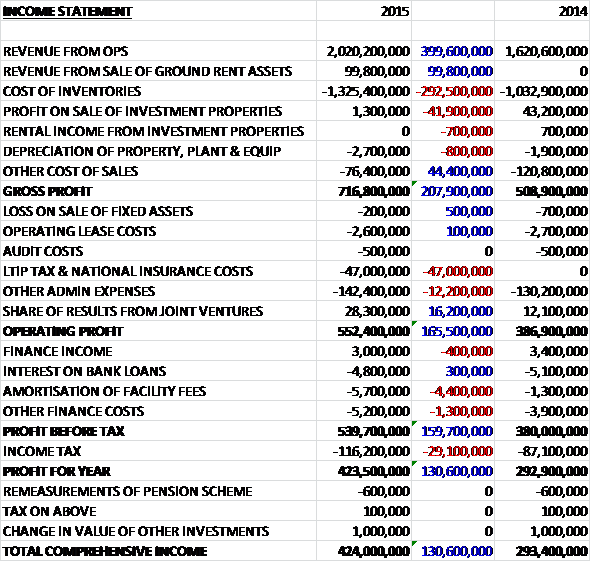
Revenues increased when compared to last year with a £399.6M growth in operating revenue and a £99.8M revenue achieved from the sale of ground rent assets which did not occur last year. Cost of inventories were up £292.5M and there was a £41.9M reduction in the profit from sales of investment properties but other cost of sales fell to give a gross profit £207.9M above that of last time. We see a £47M settlement of LTIP tax costs and a £12.2M growth in other admin costs offset by a £16.2M increase in the share of the joint venture results so that operating profit came in £165.5M ahead of 2014. There was a larger amortisation of the bank facility fees reflecting the expensing of £3.9M of un-amortised fees following the refinancing and other finance costs relating to imputed interest on land creditors also increased which meant that after a £29.1M growth in the tax charge, the profit for the year was £423.5M, a growth of £130.6M year on year.
BKGassets

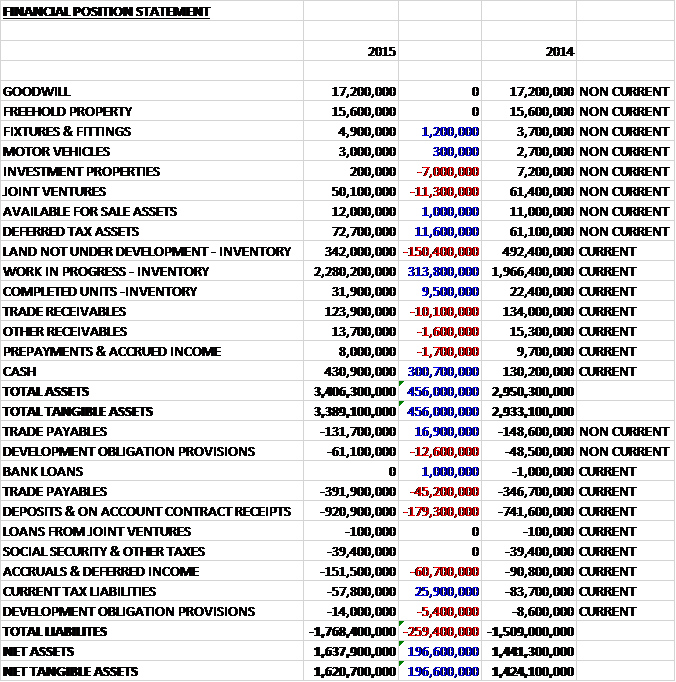
When compared to the end point of last year, total assets increased by £456M driven by a £313.8M growth in work in progress, a £300.7M increase in cash and an £11.6M increase in deferred tax assets, partially offset by a £150.4M fall in the value of land not under development, an £11.3M decrease in the value of joint ventures and a £10.1M fall in trade receivables. Total liabilities also increased during the year as a £179.3M growth in deposits on account, a £60.7M increase in accruals & deferred income, a £32.6M growth in trade payables and an £18M increase in provisions was partially offset by a £25.9M decline in current tax liabilities. The end result is a net tangible asset level of £1.620BN, an increase of £196.6M year on year.
BKGcash

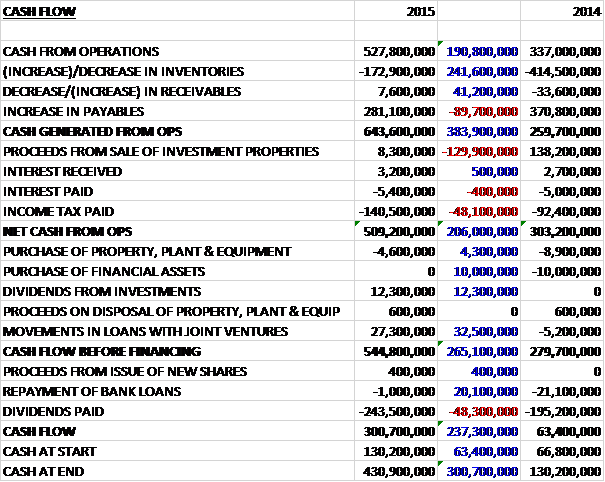
Before movements in working capital, cash profits grew by £190.8M to £527.8M. A decline in working capital, mostly as a result of an increase in payables, meant that cash generated from operations increased by £383.9M to £643.6M. There was a £129.9M fall in the proceeds from the sale of investment properties, however, and the group paid £48.1M more in tax which meant that the net cash from operations stood at £509.2M, an increase of £206M year on year. The group only spent £4.6M on property, plant and equipment so that after a £12.3M receipt of dividends and a £27.3M repayment in loans from joint ventures, there was a stonking cash flow of £544.8M before financing. After dividends were paid, the group then had a cash flow of £300.7M for the year and a cash pile of £430.9M at the year-end.

During the year the housing market returned to normal transaction levels from a high point in 2014. Domestic demand was strong in the group’s core markets of London and SE England, whilst London has continued to benefit from a stable social and political environment. The group has experienced sales price increases in line with those reported in the wider market but these have generally been matched by cost increases at a similar rate.

The group launched a number of new schemes to the market this year, from London Dock in Wapping to Smithfield Square in Hornsey and 250 City Road in Islington amongst others, all of which were marketed in the UK first and were well received by customers. The stable market has resulted in cancellation rates of 10% compared to historical levels of 15% to 20% and completed stock remains at historically low levels with 31 completed residential properties in inventories at the year-end.

Following the announcement of the formation of a joint venture with National Grid, St. William, to regenerate redundant gas works across London and the South East, the group is now working with its partner to identify sites from across its portfolio to bring through its pipeline and land holdings. This has had the potential to deliver some 7,000 plots from an initial ten sites and is a clear source of future land. One site in Battersea was already in the group’s land bank, and one further site in Rickmansworth has been added this year.

The group has secured 28 planning consents during this year, nine on schemes which did not previously have implementable planning consent and 19 revised consents. The new consents include Fitzroy Gate in Isleworth, 250 City Road in Islington, 22-29 Albert Embankment in Lambeth, Smithfield Square in Hornsey, South Quay Plaza in Docklands, and further residential schemes in Kingston, Bracknell, Barnes and Orpington. The revised consents have improved the planning position on each of the schemes on which earlier phases are already in construction, and these include a full re-plan of the third phase at Kidbrooke Village and a detailed consent on the waterfront block at Royal Arsenal Riverside which will contribute further impetus to this regeneration scheme.

Since the year end the group has acquired a resolution to grant planning at its scheme in White City for over 1,400 homes to be delivered over the next fifteen years, and a resolution to grant planning for 839 at St. William’s first scheme in Battersea.

Two new sites have been acquired unconditionally during the year, a 15,000 square foot office building in Sevenoaks and a scheme for 600 homes in Reading in the St. Edward joint venture. Three have been acquired on a conditional basis, including sites in Kingston and Winchester, as well as the second St. William site in Rickmansworth.

At the year-end, the group has 74 sites in its land holdings, of which 55 have an implementable planning consent and are in construction, a further ten have at least a resolution to grant planning but the consent is not yet implementable and seven remain in the planning process. The group’s land holdings now stand at 37,473 plots compared to 35,963 last year with an estimated gross margin of £5.272BN and an average selling price of £456K (£419K last year).

Within the £2.02BN of revenue from operations, there was £1.936BN (£1.605BN) of residential revenue, £12.3M (none) from land sales on three sites, and £71.7M (£15.6M) of commercial revenue. In all, 3,355 new homes were sold across London and SE England at an average selling price of £575K compared to 3,742 new homes at an average price of £423K last year. The increase in average selling price reflects the first completions at Ebury Square, Riverlight, Fulham Reach and One Tower Bridge, all London schemes acquired in 2009 and 2010. Last year included the disposal of 534 properties from the rental fund to M&G Investments at an average selling price of £197K and the sale of two student developments.

The revenue of £71.7M from commercial activities included the sale of some 130,000 square feet of office, retail and leisure space across a number of the group’s developments including Fulham Reach in Hammersmith, Langham Square in Putney and Royal Worcester as well as a 90,000 square foot hotel at Goodman’s Fields in Central London. The £15.6M from last year was mainly from the sale of retail space on developments including Marine Wharf in Deptford, Goodman’s Fields in Aldgate, Fulham Reach and Imperial Wharf. During the year the group also sold a portfolio of 10,000 ground rent leases across sixty sites for proceeds of £99.8M and a gross profit of £85.1M. The group has also exchanged contracts for the sale of a further portfolio of ground rent assets for £53M which is expected to be completed in the first half of 2016 and give rise to a profit on disposal of £50M.

The £47M charge with regards to the LTIP scheme is in respect of the company’s decision to settle the tax and national insurance liabilities arising from the vesting of options for the 2009 LTIP scheme, in lieu of issuing shares to this value and the intention is to do the same in respect of options next year. Of this £47M, £33.5M is in respect of prior periods and £13.5M in respect of this year.

The group’s share of the results of joint ventures was a profit of £28.3M compared to £12.1M last year which reflects a further 230 completions at 375 Kensington High Street and Stanmore Place. The reduction in investments in joint ventures from £61.4M to £50.1M reflects the distributions in the year relating to St Edward, a joint venture with Prudential. The business has three schemes currently in development at Stanmore Place, 375 Kensington High Street, and 190 Strand. 230 homes were sold during the year at an average selling price of £1.229M. Some 2,116 plots in the group’s land holdings relate to this joint venture which includes a site at Green Park in Reading which was acquired during the year. The joint venture also controls a commercial site in Westminster which has a detailed planning consent but is conditional on vacant possession and is included in the land bank.

Key challenges include the upward pressure on costs and the limited availability of skilled labour and materials in the supply chain. Another risk is the potential referendum for the UK to stay within the EU and of course the house building sector is very cyclical and come the next down-turn, these shares will be hammered considerably. Obviously another risk is the potential increase in interest rates and the effect this will have on the housing market along with regulation risk and mortgage availability.

Interestingly the group enjoys the highest customer loyalty in the housing sector and apparently is the only public company to address and measure people’s wellbeing in the places that they build with adherence to certain space standards, something that many new builds don’t seem to take into consideration. They have a net promoter score of 69.8 and some 98% of customers would recommend the group to a friend so they genuinely seem to have a differentiating focus on customer service.

During the year the group renegotiated its banking facilities. They increased their committed corporate facilities from £525M to £575M, extending the maturity date to March 2020 and have materially reduced the ongoing costs associated with the facility. It seems strange, though, that the group don’t seem to be using it – is this just some leeway for a potential downturn? A further £60M of banking facilities in St Edward Homes were cancelled during the year as they were no longer required by the joint venture.

It has to be said that I have never seen directors so highly paid as those at this company. This is mainly as a result of a LTIP scheme devised during the recession when the shares were much lower than they are now, but nevertheless, the total remuneration for Chairman and founder Tony Pidgley was £23.3M this year – ridiculous! Sean Ellis, the lowest paid director, took home an incredible £3.8M! Also, during the year the company dismissed its finance director, Nicholas Simpkin, who was put on fully paid gardening leave. Nicholas has issued legal proceedings against the company which they are defending.

Whilst earnings remain sensitive to the timing of delivery of certain key developments, the board currently expects adjusted earnings in 2016 to be similar to that of 2015 and is targeting the delivery of pre-tax profits in the region of £2BN over the next three years. This target is a result both of the group planning to deliver the London sites which were acquired between 2009 and 2013, and of continuing to benefit from the maturity of its longer term regeneration sites. The new year will see increased investment in construction ahead of this advanced profit delivery.

At the current share price, the shares trade on a PE ratio of 12.5 but this increases to 15 on next year’s consensus forecast. At the current share price the shares are yielding 5.2% which increases to 5.8% on next year’s forecast. At the year-end, the group had net cash of £430.9M compared to £129.2M at the end of last year.

Overall then, this was a very good year for the group. Profits increased strongly, net assets grew and the operating cash flow improved and provided oodles of free cash. The housing market in the SE of the country is steady and we also see the group’s land holdings grow, with an increased average plot sale price. In addition, the joint ventures have been performing strongly but it should be noted that profits this year were boosted by the sale of ground rent leases which are not going to be a permanent feature going forward.

It is nice to see that Berkley seem to have a genuinely impressive customer service ethos which should hold them in good stead but as with all potential investments, not everything here is perfect. The LTIP scheme is a bit ridiculous in my view with material amounts being spent on it and the directors getting pretty grotesque salaries. Their performance has been impressive but total remuneration of over £23M for a chairman is just too much in my view. There are also other risks here, the housebuilding industry is clearly very cyclical and come the next downturn, the shares are likely to collapse. Plus (hopefully) more short term risks include the potential of a UK exit from the EU and an increase in interest rates.

With a forward PE of 15, the shares do not look that cheap but there is plenty of net cash on the balance sheet and the dividend yield of 5.2% is very nice to have. The question has to be though, are they worth the risk and the answer to that is probably dependent on when you see the next recession hitting the UK. I am thinking about taking a position here.

Games Workshop Share Blog – Interim Results Year Ending 2016

Games Workshop has now released its interim results for the year ending 2016.

GAWinterimincome

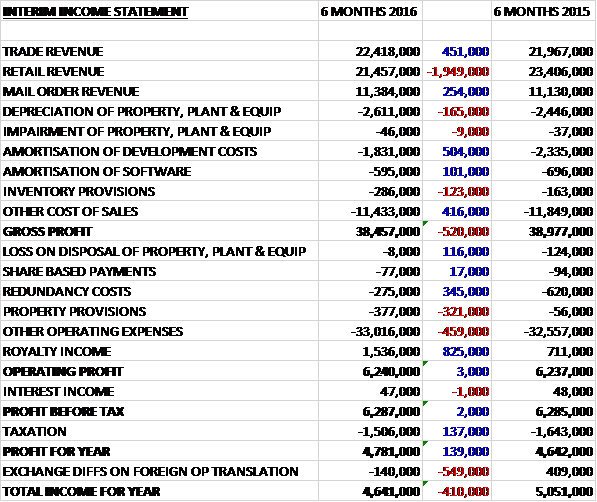
Revenues declined when compared to the first half of last year (although there was a modest increase on a constant currency basis) as a £451K growth in trade revenue and a £254K increase in mail order revenue was more than offset by a £1.9M decline in retail revenue. Depreciation was somewhat higher but amortisation fell by £600K along with other cost of sales but this was not enough to prevent a £520K fall in gross profits. We then see a £345K improvement in redundancy costs offset by a £321K increase in property provisions and a £123K growth in other cost of sales but due to an £825K increase in royalty income, the operating profit was flat. After a £137K reduction in the tax charge, the profit for the half year came in at £4.8M, an increase of £139K year on year.

GAWinterimassets

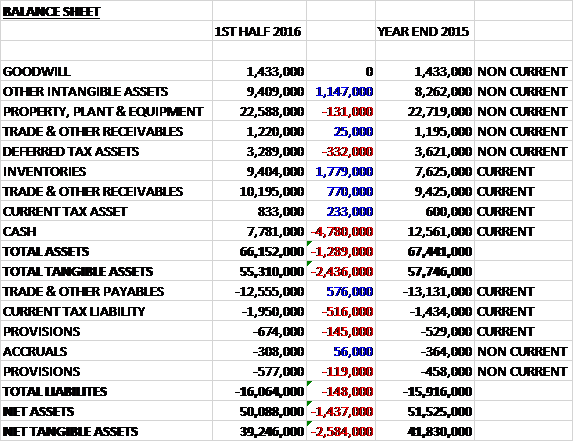
When compared to the end point of last year, total assets declined by £1.3M driven by a £4.8M fall in cash, partially offset by a £1.8M growth in inventories and a £1.1M increase in intangible assets. Total liabilities increased modestly as a £516K growth in the current tax liability was offset by a £576K fall in payables. The end result is a net tangible asset level of £39.2M, a decrease of £2.6M over the past six months.

GAWinterimcash

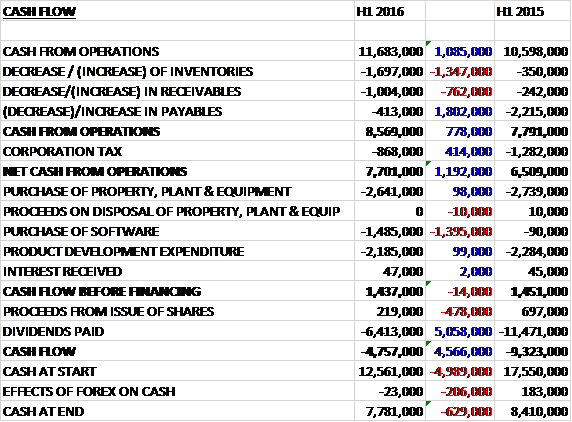
Before movements in working capital, cash profits increased by £1.1M to £11.7M. This was eroded somewhat by a growth in working capital requirements but after a decline in tax paid, the net cash from operations was £7.7M, a growth of £1.2M year on year. The group spent £2.6M on fixed tangible assets, £2.2M on product development and £1.5M on software which gave a few cash flow of £1.4M. This was nowhere near enough to cover the £6.4M paid out in dividends so that the cash outflow for the half year was £4.8M and the cash level at the period-end was £7.8M.

Overall, the fall in operating profits was almost entirely due to currency difference which accounted for a loss of £900K during the period. On a constant currency basis, profits were broadly flat.

Within the Trade division, there was an increase in revenue in Europe, North America and Asia with declines in Australia and non-core trade. The operating profit in the division was £5.8M, a decline of £188K year on year. During the period, the net number of trade outlets increased by 61 accounts and to broaden the core trade products reach, a small new product range has been designed and distribution agents have been signed up to sell the product to North America.

Within the Retail division, there was in increase in non-core revenue but declines in all other areas due to adverse currency effects, although North America and Asia were both nearly the same year on year. The operating loss in the division was £2.5M, a deterioration of £1.4M when compared to the first half of last year. The group opened 22 one man stores and three multi-man stores in the period. They also started their trial of four multi man format stores in high footfall locations in Sydney, Munich, Paris and Copenhagen. After closing 13 stores the total number of stores at the period-end was 430.

Within the Mail Order division, there was a strong growth in Citadel and Forge World revenue, partially offset by a decline in non-core revenue due to falls in sales in digital, export and the book trades. The operating profit in the division was £6.2M, an increase of £297K year on year. The group did well to increase royalties, more than doubling to £1.5M during the period, and the operating profit in the Product and Supply division was £4.1M, a growth of £601K when compared to the first half of 2015.

At the period-end, the group has capital expenditure contracted for but not yet incurred of £867K which included the replacement of the local area network in Nottingham and tooling & machinery spend. Recent projects include the European ERP system replacement which remains on track, the Forge World mail order store which was launched in August, and the Mail order warehouse system replacement which has been postponed until after the busy December trading period.

December sales were below expectations across the group and at this stage in the year, internal projections indicate that pre-tax profit for the year as a whole unlikely to exceed £16M.
Overall this has been a mixed half year period for the group. Profits did increase, but this was attributable to a fall in tax and pre-tax profits were flat year on year. Net assets declined over the period but the operating cash flow improved, although due to higher capex, the free cash flow was flat and not enough to cover the dividends. The main issue actually seems to have been adverse forex movements without which, profit would have been much improved. The operating profit in the trade business fell, and the losses increased in the retail business.
Performance was better in the mail order business along with the product and supply division, and there was a strong increase in royalty income.

Unfortunately the second half of the year has not started well with December sales below expectations so I will not be buying shares until this improves.

On the 6th June the group released a trading update covering the year ended 2016. The board expect profit to be slightly above market expectations due to earning more licensing income than expected. Over the year, sales have been largely flat year on year, however. Strangely this update led to Peel Hunt lowering its prediction for profit which has thoroughly confused me!

Real Good Food Share Blog – Interim Results Year Ending 2016

Real Good Food has now released its interim results for the year ending 2016.

RGDinterimincome

It is a real annoyance that the group does not include the split by business area for last year in its set of results so I have had to delve into the half yearly report for 2015. Unfortunately the totals don’t equal the amount stated in the most recent accounts so I have had to include an adjustment to take it back to the correct level – this is most irritating and I don’t understand why I have had to do this. Anyway, total revenues increased by £1.1M but it seems that revenues in most of the businesses have declined, although there was a maiden £1.6M contribution from Rainbow Dust. Cost of sales then fell to give a gross profit £1.9M above that of last year. Distribution costs increased by £254K and admin costs grew by £685K which meant that operating profit was £990K ahead. Due to a large increase in finance costs, however, as a result of the loan note repayment, the pre-tax loss from continuing operations was £216K, an improvement of just £167K year on year. We then see a big gain on the disposal, however, so that the profit for the year came in at £9.3M compared to a loss of £4.7M last time.

RGDinterimassets

When compared to the end point of last year, total assets declined by £36.3M as the group disposed of the £41.4M of assets related to the discontinued business and cash fell by £2.3M. This was partially offset by a £4.4M growth in inventories and a £3M increase in receivables. Likewise, liabilities also fell. The group disposed of the £27.3M of liabilities relating to the discontinued business and also reduced borrowings by £16.6M. The end result is a net tangible asset level of £21.2M, an increase of £10.1M from the end point of last year and clearly shows how much the disposal has improved the balance sheet.

RGDinterimcash

Before movements in working capital, last year’s cash loss swung by £5.1M to a cash profit of £2.1M. There was a big cash outflow from working capital, however, with increases in inventories and receivables combined with a fall in payables that in addition with a £757K increase in interest paid and a £614K adverse movement in tax, meant that the net cash outflow from operations stood at £12.4M, a growth of £7.8M year om year. The group also spent £1.5M on capex but this and the operating loss was easily covered by the £41.2M cash injection from the disposal which meant that before financing, there was a £27.3M cash inflow. This was used to pay back borrowings with an £8.3M repayment of the bank loan and a £21.2M repayment of the revolving credit facility. The end result is a cash outflow of £2.3M over the half year period and a cash level of £4.3M at the end of the half.

The underlying operating profit in the Renshaw business was £2.2M, a growth of £156K when compared to the first half of 2015. Volumes were slightly down on a like for like basis but this was largely due to the ending of a third party manufacturing contract, in line with the strategy of improving sales and margin mix. Early signs are that the important Christmas trading period will be strong and sales in overseas territories such as the US and Australia continue to make good progress. In addition to these sales initiatives, considerable work is underway to upgrade the product range and to invest in flexible manufacturing systems which will improve customer service. The group have also started plans to increase the warehouse capacity at the Liverpool site which once completed will bring an immediate cost benefit by reducing outside storage costs.

The underlying operating profit in the Garrett business was £232K, a decline of £41K year on year. The sugar and dairy markets continued at unprecedented lows during the first half of the year, bringing greater competition and as a consequence, despite a similar volume and product mix, revenues were about 30% below last year, although as seen above, operating profit held up better. Following the sale of Napier Brown, the team are focusing on pursuing a number of added value initiatives such as targeting of new sectors including the Sports Nutrition market. While there are some signs that sugar prices will rise following the new October contract season, the dairy markets remain volatile.

The underlying operating loss in the R&W Scott business was £170K, an improvement of £100K when compared to the first half of last year. Sales volumes were slightly down on the last year, but as seen, gross margin did improve reflecting the strategy of improving the sales mix and migrating the business towards added value accounts and new products. Operational improvements were delivered in materials control and stock management and an investment has been made in additional capacity for the new pie filling business. The second half of the year will see the completion of a significant capital investment programme which will give the business the manufacturing profile it requires to maximise its sales growth opportunities.

The underlying operating profit in the Rainbow Dust business was £694K compare to nothing in the first half of last year. Integration following the acquisition is now complete and overall sales continued to show significant year on year growth with the operating profit following a similar trend. Over 500 new accounts were registered to the website in the first half of the year which suggests that this growth trend is sustainable. New warehouse capacity designed to serve the sugar craft sector will be in place early next year and the team is working with the European business to identify additional market opportunities in the continent with a number of new product launches planned for the second half of the year.

The underlying operating profit in the Haydens bakery business was £77K which was flat year on year. The critical trading period in Q3 in the run up to Christmas has so far been promising with a strong presence of products in Waitrose, Costa, M&S, Aldi and Morrisons. A new sales manager for the foodservice sector has also already delivered a number of new opportunities and the business is undergoing a major overhaul of its identity to reflect its new strategy and ability to serve a broader customer base.

The underlying operating profit in the European business was £21K compared to a loss of £235K in the first half of last year. The introduction of new business systems to integrate order and stock management in the warehouse and the installation of a new labelling machine will enable a more bespoke service offering. A new “tropical” recipe of sugar paste has also been launched to meet the requirement for a firmer product in hotter climates in Southern Europe. The focus is now to grow market share across all European geographies and the second half should benefit from sales growth in the important German market, where two new sales reps have been recruited.
Apparently the largest proportion of profit is made in the second half of the year over the Christmas period.

During the period the group repaid the loan notes of £2.774M to Napier Brown Ingredients, a company who non-executive director Mr. Ridgwell has a beneficial interest. Together with this amount, the group also repaid the accrued interest of £277K, interest for the period of £47K and a redemption fee of £902K. I have to say I am a bit uncomfortable about this. Mr Ridgwell is one of the largest shareholders of the company and the redemption fee in particular seems very excessive – nearly 33% of the total amount of the loan!

The group seems to have got a decent price for Napier Brown Sugar and made a profit on disposal of £9.4M and managed to sell the goodwill in the business for the full value of £12M so I am tempted to suggest that £21.4M in profit has been made – an excellent result really and the cash from the disposal has been used to repay the debt which has reduced from £36.3M at the half year point in 2015 to £3M at the end of this half year. The group has, however, entered into a new facility arrangement with Lloyds Bank, creating a £10M revolving credit facility which will fund future working capital requirements and assist in funding its capital projects.

At the start of the important Q3 trading period, the group has seen positive sales trend so far at both the cake decorating business and at Haydens. The board are therefore confident that the outcome for the full year will be in line with current market expectations. The group are also continuing to explore further earnings enhancing acquisitions.

No dividend is proposed for the first half of the year, much like last year. The group has, however, instructed its solicitors to begin the process to transfer its share premium reserve into distributable reserves and upon completion of this legal process, the board will consider the approval of a dividend to shareholders.

On the 20th November the group released further clarification regarding their repayment of the loan note. As mentioned earlier, the company has repaid the £2.8M loan note as well as interest of £324K and a redemption fee of £902K. The company agreed in 2014 to start interest payments when permissible under their banking facilities at a rate of 10% per annum until 2020 in recognition of the fact that no interest had been paid in relation to the loan since 2005.

Following the disposal and as the loan note and all accrued interest was fully due but it became apparent that there was a possible dispute in relation to the quantum of interest due as the total interest accrued and claimed since 2005 was in excess of £2.5M. The board decided that it was in the best interests of the company to settle this dispute and agreed to pay the loan note and accrued interest together with the payment of the redemption fee in full and final settlement of all or any claims relating to the loan note.

As we know, Patrick Ridgwell, a non-executive director of the company, has a beneficial interest in the company that provided the loan and also has a 32% in the company’s shares. The independent directors consider that the terms of the redemption fee were fair and reasonable as far as its shareholders are concerned. I am not fully aware of the conditions that led to the loan note being issued but I can only assume the company were in a desperate state but I am still not happy about all of this. Hopefully though the company can put this behind it and not enter into any dubious loans in future.

On the 25th November the group announced that a company owned by CEO Pieter Totte purchased 100,000 shares at a value of £53K which means he now owns 2.8M shares equal to about 4% of the company.

On the 10th December the group announced the acquisition of ISO2 Nutrition sports supplements brand from the administrators of Cre-8tive Health ltd for a nominal amount. The brand has developed a range of bodybuilding supplements, whey protein and sports nutrition products and are now one of the leading suppliers within the sports supplements market. Based in Swindon, the business will be integrated with Garrett Ingredients, with whom they have enjoyed a long standing relationship as a customer. This enables the group to enter a new channel which should help decrease their dependency on the diary and sugar commodities markets. Given the price paid for this, it could be an interesting roll of the dice.

Overall then this seems to have been a bit of a mixed half year for the group. There was a loss from continuing operations but this did improve year on year and if it were not for the extortionate loan note redemption fee, the group would have made a profit. Net assets improved considerably following the disposal and the balance sheet is now looking much better but there was a cash outflow at the operating level. This was due to a large increase in working capital, however, and cash profits improved – it is worth noting that even with a neutral working capital position the group would not have generated any free cash, however.

The Renshaw business continued to do well with an improved product mix and the Rainbow Dust acquisition really seems to be bedding in well. The European business also performed better and made a small profit and performance was flat at Haydens, although the Christmas trading apparently started well. Conditions were not so good at Garrett, where profits fell due to continued pressure on the prices of sugar and dairy but although still loss making, the performance at RW Scott improved despite a fall in volumes. The transformational news is the disposal, however. The group really seem to have got a good price for the business and as a result the balance sheet has been repaired and the shares seem investible. In fact I am tempted to take a nibble.

On the 1st February the group released a profit warning. The business has invested heavily in people, product and brand across all businesses as it executes its strategy of achieving the optimal operating platform from which to drive future growth. The board now expects that within the continuing business EBITDA will remain flat year on year as this investment, when combined with other one-off events in the various businesses (no clue as to what those might be), has led to a short-term impact on margins. As a result, they do not expect the final profit outcome for 2016 to meet current market expectations. The board is “confident”, however, that the negative impact on margins is short term.

The disposal of the Napier Brown business delivered an exceptional profit of £9.4M. As a result, the board expects total pre-tax profit and EPS to be significantly improved when compared to last year. In addition, net borrowings for the group will be substantially reduced following the inflow of the £44M from the disposal which has enabled the group to repay its borrowings.

This setback is disappointing as the group seemed to be in a really good position following the disposal. I am not rushing to buy in here until it is clear that the un-named issues are really temporary in nature.

On the 10th February the group announced the acquisition of Chantilly Patisserie for a total consideration of £1.75M to be satisfied from existing cash resources. The business is based in Devon, employs forty staff and produces hand-made frozen desserts, supplying the foodservice sector with customers such as Marston’s Brewery, Warner Leisure, Brakes and Country Range. Over the last nine months it made EBITDA of £400K and had net assets of £700K so this looks like a decent enough acquisition to me.

On the 26th April the group released an update covering the year ending 2016 where they confirmed that they expect to report EBITDA in line with current consensus expectations. They will be reporting an exceptional profit for the period, including £9.4M as a result of the sale of Napier Brown for a total consideration of £44.4M. This means that the board expects pre-tax profit to be about £13.9M. The sale resulted in a substantial improvement in the net debt position which they now expect to be £5M as of the end of the year compared to £30.1M at the end of last year.

Real Good Food Share Blog – Final Results Year Ended 2015

Real Good Food is a food business serving a number of market sectors including retail, manufacturing, wholesale, food service and export. The group now focuses on cake decoration, food ingredients and premium bakery.

The group has a number of different subsidiaries operating in various markets. Napier Brown distributes bulk sugar and manufactures and supplies packed sugar to the retail and industrial food sectors which is the business that is being discontinued. Garrett Ingredients distributes bagged sugar and dairy products to the industrial food sector; Renshaw manufactures and supplies marzipan and ready to roll icing to the industrial and retail sectors; R&W Scott manufactures and supplies chocolate coatings and jam to the industrial and retail sectors; and Haydens manufactures and supplies ambient cakes and desserts to the retail sector.

Real Good Food has now released its final results for the year ended 2015.

RGDincome

Overall revenues declined by £5.7M as a £3.8M growth in Renshaw revenue, a £1.3M increase in European revenue, a £1.1M growth in Haydens revenue and a maiden £755K contribution from Rainbow Dust was more than offset by a £12.2M fall in Garrett revenue reflecting the fall in commodity prices within the business. Cost of sales also fell, however, to give a gross profit some £3.6M ahead of last year. Distribution costs then increased by £1.3M and admin expenses were up £1.8M which meant that operating profit was £531K above that of last year. We then see a growth in interest costs and the pension costs which produced a pre-tax profit for continuing operations of £1.6M, which was flat year on year. A large swing to a tax payment compared to a rebate last year, partly relating to some £502K of current year losses not recognised compared to some adjustments to previous years in 2014, plus the £4M loss from the discontinued operation drove the group into a loss of £3.4M, a deterioration of £2.8M year on year.

RGDassets

Overall, total assets fell by £3.6M when compared to 2014 as a growth in goodwill was unable to offset declines in receivables and inventories. In contrast, total liabilities grew during the year as a decline in borrowings was more than offset by increases in payables (annoyingly the split for the liabilities relating to the discontinued business doesn’t include different payables), and a £2M growth in the pension obligation. The end result is a net tangible asset level of -£941K, a deterioration of £11.1M year on year. This is a bit of a weak balance sheet but this business sale should go some way to repairing it.

RGDcash

Before movements in working capital, cash profits fell by £1.6M to £1.1M. There was a cash inflow from working capital, however, in particular a decline in receivables and inventories due to the reduction in the cost of sugar, which fell 25%, which meant that after there was a £1.3M positive swing to a tax rebate, the net cash from operations grew by £3M to £3.7M. The group then spent £1.4M on capex and £1.2M on an acquisition which gave a cash flow of £911K before financing. The group took out an additional loan to pay back some of the revolving credit facility which left them with a cash outflow of £1.9M for the year and a cash level of £6.6M at the year-end.

The group figures for the year were dominated by the market issues in sugar which impacted both Napier Brown and Garrett Ingredients. The first half of the year was badly affected by the problems associated with the British Sugar dispute and while this was resolved from the start of the second half of the year, the sharp fall in sugar market prices made trading conditions very tough. The home baking market, however, has been in growth for a number of years, fuelled by media activity, in particular the Great British Bake Off. Within this market, the fastest growing sector has been cake decorating.

The underlying operating profit at the Garrett business was £520K, a decline of £650K year on year. The business was hit by dramatic deflation in both its core commodity markets of dairy and sugar. Excess sugar stocks in Europe had a particular impact on the spot market which is the business’ main focus, while the dairy market was also hit by price falls caused by a combination of factors including the weather and EU sanctions against Russia. Both volumes and revenue fell significantly and while trading margins were well managed, profits fell accordingly. Distribution operations were withdrawn from the Napier Brown site in the autumn of 2014 and this process was completed by the end of the year.

The business undertook a new engagement with its customers at the Ice Cream Alliance Exhibition in February and will look to build on this. Priorities going forward include new sources of dairy, new added value ingredients and developing a logistics offering. In addition, the new management team is working on a strategy to support its commodity trading operation with other value added products and services with a number of initiatives being pursued focusing on the needs of the customer base.

The underlying operating profit at the Renishaw business was £5.1M, a growth of £700K when compared to last year. Sales revenue was up nearly 9% with export sales being particularly strong as growth occurred across Europe, the US and Australia. Operationally the business coped well with the increased volumes, hence the increase in profit. While there are some indications that overall growth in the home baking market is beginning to plateau, the interest in cake decoration continues to be buoyant. A number of product initiatives were developed during the year including soft fondants and coloured marzipan. While growth is anticipated across all trade channels, the major areas for growth opportunities are identified as foodservice and export. The key strategy going forward is to grow export and B2B, upgrade the product offering and invest in new flexible capacity.

The underlying operating loss at R&W Scott was £260K, an increase of about £200K when compared to 2014. Sales volumes were marginally ahead but revenue was slightly down reflecting deflation in chocolate coatings. The growth in losses was also due to a planned increase in overheads as management was recruited to build a sustainable stand-alone business. A major foodservice contract was gained in jam which will give the business significantly increased scale in this market but servicing this contract caused a number of operational cost challenges which have now been rectified and leaves the business well placed to develop its jam offering to a wider customer base.

The development of the foodservice jam business has led to a new opportunity in pie fillings, sales of which began in August following an initial investment of £140K in specialist equipment. On the retail side, listings have been achieved for a Scott’s chocolate spread and a relaunch of the jam ranges, focusing on the “no added sugar” proposition which has been well received. Priorities going forward include a B2B jam offering and the implementation of the site investment plan.

The underlying operating profit at Haydens was £444K, a growth of £335K year on year. The business posted a modest sales growth of 4% on last year but a dramatic change in product mix following the decision to exit a number of product categories and concentrate on five main sectors gave rise to the increase in margins. Sales in Danishes, pies and tarts all showed increases of over 20%. The objective of broadening the customer base was achieved with three new national customers being added: Aldi, Caffe Nero and Asda. There are plans in place to invest in the bakery to ensure it has the capability to manage the growth and a number of new products are planned such as mini tarts and injected yum yums. Priorities going forward include new product development, developing new customers and investment in site infrastructure.

The underlying operating loss at the European business was £48K, a positive movement of £353K when compared to last year and the business just moved to a break-even EBITDA position by the end of the year. The major product focus has been on the Renshaw ranges of coloured sugar paste and marzipan, and the main geographic focus was on Benelux, France and Spain. The main marketing effort was directed at trade and consumer cake shows across Europe which are becoming increasingly popular. The development of a multi-lingual sales team each with a country focus has worked well and the move to a warehouse on the outskirts of Brussels was successfully implemented. The business is investing in local labelling to ensure that customers receive the product and format they need which will increase costs in the short term but help fast track the growth plans. Priorities going forward include a new warehouse, offering the Rainbow Dust offering and opening up new countries.

The underlying operating profit at the newly acquired Rainbow Dust was £418K. The business was acquired in January 2015 and is a specialist supplier of cake decorating products to the sugar craft industry, including coloured edible glitters, dusts, sprinkles and food paints. The total consideration was £7.5M representing an initial payment of £4M in cash and a further £3.5M in contingent considerations which is expected to be paid until the end of 2016. The transaction generated goodwill of £6.2M and given the profits made in just three months of ownership, this looks to be a good deal to me. The priorities going forward include the development of the management team, growing export sales and upgrading the warehouse.

The operating loss in the discontinued business was £3.9M compared to £2M last year. The discontinued business is the Napier Brown sugar operation and after the year-end, it was sold to Tereos Participations SA for £44.4M and £1.9M in transaction costs which seems to compare well to the net assets of £14.4M being held for sale.

During the year there was a modest number of “non-underlying” costs. Management restructuring costs of £568K (some of this is included in discontinued operations) related to restructuring of the sugar division and head office, and the £282K acquisition costs related to the purchase of Rainbow Dust Colours.

The vast bulk of sales are made in the UK but the group is exposed to currency risk on purchases of almonds from the US but this risk is partially mitigated by an attempt to match sales in foreign currencies. The effect of a 10c strengthening of the US dollar against Sterling would result in a net £73K gain on payables/receivables with the opposite also being true. The group is also exposed to currency risk on the purchase of sugar from Europe, again mitigated by sales in foreign currencies. A 5c strengthening of the Euro against Sterling would have resulted in a £47K decrease in profits. In addition, the group is exposed to interest rate risk with a 1% increase in the applicable interest rate reducing profit by £369K.

It is worth noting that a loan note of £2.8M is owed to Napier Brown Ingredients, in which director Mr. Ridgwell has a beneficial interest. Agreement has been reached in principle that interest will be paid from April 2014 with all claims for interest prior to this being waived and accrued interest at the year-end stood at £277K. In fact, the group has quite an interesting shareholder register. The only two shareholders with over 3% of the company are Napier Brown Ingredients, controlled by non-exec Pat Ridgwell with 32% of the equity; and Omnicane International Investors, who seem to be a sugar cane grower and have nearly 29% of the share capital. The founder, Pieter Totte is currently CEO and executive chairman which is never a good combination in my book but the directors do seem to be fairly sensibly rewarded with no excess in evidence.

The group operates a defined benefits pension scheme which was closed to new members in 2000. It currently has a liability of £5.3M and base annual contributions were set at £264K with annual increases of 3% for the following two years. In addition, the group has agreed to make a one-off contribution of £166K payable at the rate of £11K per month starting in November 2013. The present value of the obligation is not huge, standing at £21.8M which means the deficit is a substantial percentage of this but it is unlikely to become too large.

As with any business, there are a number of risks. One being the reliance on some key customers, some of whom operate on contracts which are subject to annual renewals. Another key risk is the cost of raw materials with sugar, almonds and dairy all being major inputs. The group could also be impacted by changing consumer trends. Home baking seems to be riding high at the moment but this fad won’t go on forever with potential risks including concerns over obesity and healthier eating.

The group has £2.7M of unutilised tax losses that have not yet been recognised. And at the year-end the group had committed to the acquisition of £690K worth of property, plant and equipment.

Trading in the early months of the new year have begun well and with the funds being received from the sale of Napier Brown being received in May, they are now in a position to fast track some of the investment opportunities the board have identified which will include spend on jam, sauce and pie filling capability at R&W Scott; infrastructure at Haydens to support its growth; and increased capacity at the Renshaw site in Liverpool. They will also look at potential bolt on acquisitions. The group is also proposing to upgrade its facilities of the group innovation and development team by relocating them to a separate site in Liverpool which will free up space at the Crown Street site for Renshaw to expand its business.

At the current share price the shares trade on a huge PE ratio of 62.6 but this falls to a much more reasonable 10.6 on next year’s consensus forecast, although there is currently no dividend to be had here. At the end of the year, the group had net debt of £30.1M compared to £31.1M at the end of last year, but this debt was eliminated following the disposal.

Overall then this has been a difficult year for the group. Continuing profit fell, although this was due to the reversal of a tax rebate last year and pre-tax profit from continuing operations was flat. Net tangible assets also declined and were negative, but this should reverse when the cash from the disposal comes through. Operating cash flow did improve and provide some free cash but this was due to a reduction in working capital and cash profits fell. The main two factors affecting the group have been the reduction in sugar prices and dairy, along with the continued popularity of home baking in the UK.

By far the largest contributor of profits, Renishaw, improved its performance year on year as cake decorating continued to increase in popularity. Elsewhere, the Rainbow Dust acquisition looks to have added a useful profit source to the group and Haydens bakery also improved with increased sales of pies and tarts along with new customers. The European business, although it made a loss in the year, now seems to be at break even and improved its performance year on year. Elsewhere things were less rosy. Garrett saw profits decline as sugar and dairy prices fell – this business is attempting to expand into value added products; and RW Scott saw losses increased due to deflation in chocolate coatings, although the jam and pie filling products look as though they might improve things here going forward.