Solid State Share Blog – Final Results Year Ended 2015

Solid State supplies specialist electronics equipment which include high tolerance and tailor made battery packs, specialist electronic components, specialist antennas, industrial computers and secure communications systems. The market for their products is driven by the requirement to address needs in harsh environments where durability and resistance to extreme temperatures is vital. Drivers in their markets include efficiency improvement, cost saving, environmental monitoring and safety.

The distribution division comprises Solid State Supplies and the manufacturing division includes Steatite and Q-Par Angus. Steatite is a supplier of electronic equipment. It designs, manufactures and supplies products that include lithium battery packs, rugged mobile computing solutions, secure communications systems, industrial computer hardware and software. Q-Par designs and manufactures antennas. It provides commercial grade and bespoke microwave antennas, subsystems and associated microwave components. Solid State Supplies is a distributor of components to the UK OEM community, selling semiconductors, related components and modules for embedded processing, control and communications switches, power management units and LED lighting.

Solid State has now released its final results for the year ended 2015.

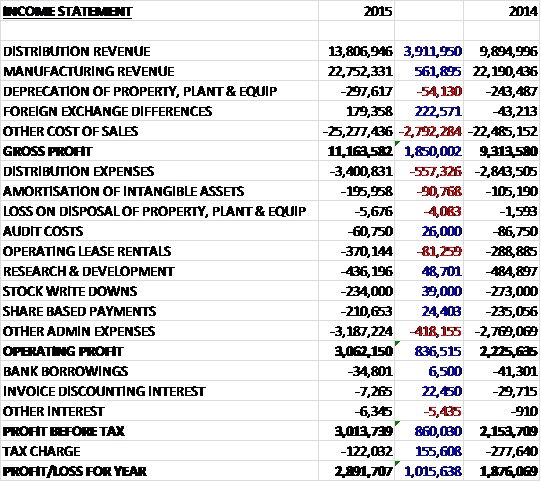
SOLIincome

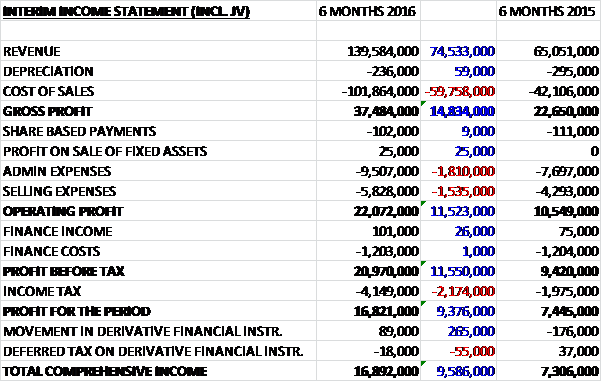
Revenues increased when compared to last year with a £3.9M growth of distribution revenue and a £562K increase in manufacturing revenues. Cost of sales also increased to give a gross profit £1.8M ahead of last time. Distribution expenses increased by £557K and “other” admin costs were up £418K, partially offset by a £223K positive swing in forex differences and a £49K decline in R&D costs which meant that the operating profit was £837K above that of 2014. There was then a decline in invoice discounting interest and the tax charge more than halved, mainly due to enhanced tax relief on R&D expenditure that will not be repeated going forward, so that the profit for the year was £2.9M, an increase of £1M year on year.

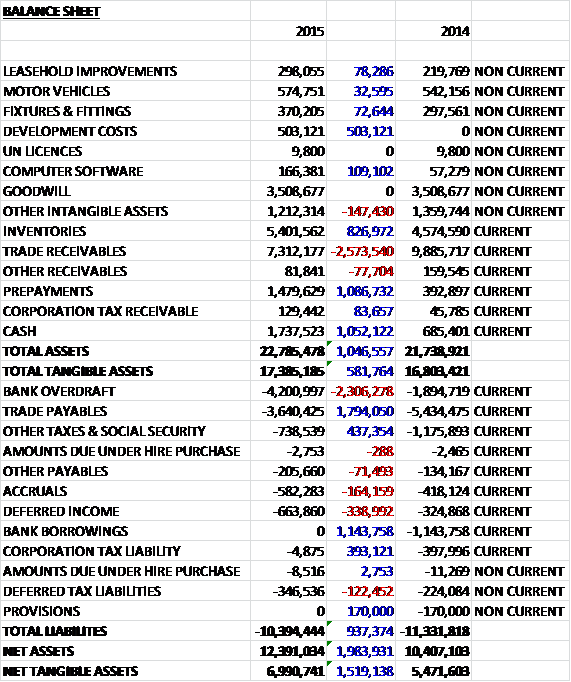
SOLIassets

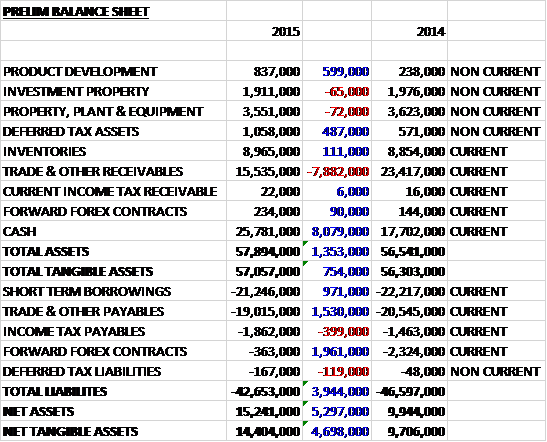
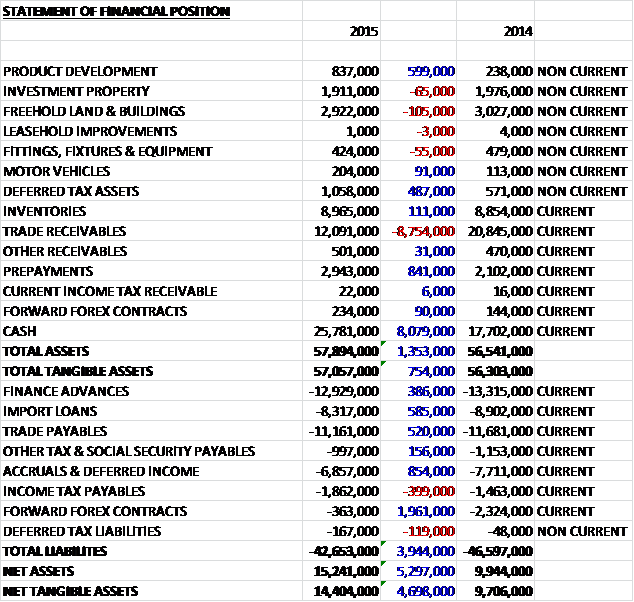
When compared to the end point of last year, total assets increased by £1M driven by a £1.1M growth in prepayments, a £1M increase in cash, an £827K growth in inventories and a £503K increase in development costs partially offset by a £2.6M decline in trade receivables. Total liabilities fell during the year as a £1.8M decrease in trade payables, a £1.1M fall in bank borrowings and a £437K decline in other taxes and social security payables were partially offset by a £2.3M increase in the bank overdraft. The end result was a net tangible asset level of £7M, an increase of £1.5M year on year.

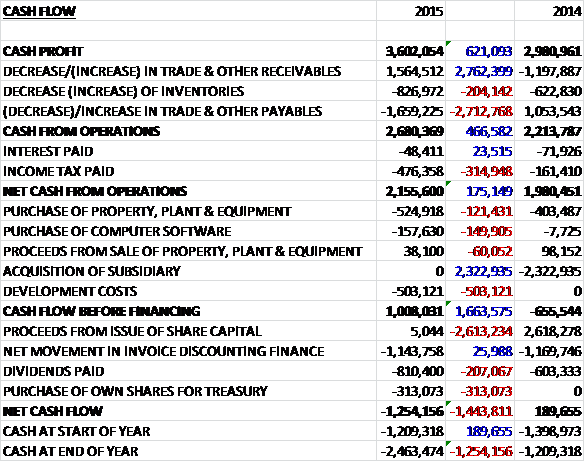
SOLIcash

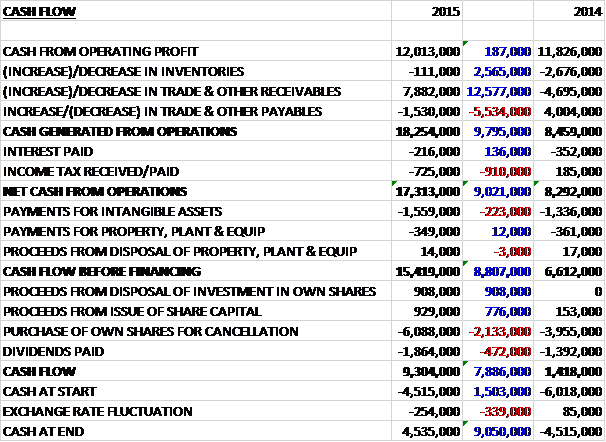
Before movements in working capital, cash profits increased by £621K to £3.6M. There was a cash outflow from working capital due to an increase in inventories and a decrease in payables, however, and after a £315K growth in the tax paid, the net cash from operations came in at £2.2M, an increase of £175K year on year. The group then spent £503K on development costs relating to the development of a new electronic monitoring unit to enable them to expand the operations of their manufacturing division into this new area, £525K on fixed tangible assets and £158K on computer software to give a free cash flow of £1M. The group then paid £810K on dividends and £313K on the purchase of treasury shares which meant that after a £1.1M repayment of the invoice financing which has now ceased, the cash outflow for the year was £1.3M and the cash level at the year-end was -£2.5M.

The pre-tax profit at the distribution division was £661K, a growth of £264K when compared to last year. The year saw the completion of the integration of the 2001 Electronics business into Solid State Supplies. After adjusting for the previously reported exit from the very low margin commodity LED business, the enhanced customer base and product ranges have delivered organic growth of about 4% which is apparently above the industry average for the sector. Margins also improved by 1.6% year on year. The business’ move towards a range of own brand products continued during the year, with the introduction of a number of high output LED modules enabling lighting companies with little experience of electronics and thermal management to benefit directly from high power LEDs. The value added services operation provided a useful contribution to the increase in gross margin throughout the year and a minor capital investment resulted in the award of a £1M contract for programmed devices from a major UK innovator in the field of Metrology.

The pre-tax profit at the manufacturing division was £3.4M, an increase of £500K year on year. Steatite performed well during the year with a 9% increase in pre-tax profits with improving market share. They are also entering new markets in the electronics industry such as green energy and security products. The business has grown export sales, aided by a new range of communications systems.

Steatite was awarded a contract by the MoJ in July 2014 for an initial three year term worth an estimated £34M for the supply and maintenance of offender tagging technology. The development of tagging devices for the government is progressing well under a dedicated management team with its own bespoke facility. The contract is progressing with expectations for a strong performance in the second half of next year. Beyond the initial MoJ contract, this new team is developing a range of devices for applications in the medical and home care sectors as well as enhanced justice platforms which the board expect to lead to opportunities in new market sectors both in the UK and abroad.

Q Par saw order intake grow and pre-tax profits were up some 142% compared to last year. Further investment will be made in the year ahead with new purpose built facilities planned, along with significant investment in test and measurement facilities that will apparently bring benefits to the whole group.

The group is somewhat susceptible to increasing interest rates and if it had been 1% higher, interest payments would have been £19K higher this year. They also have some exposure to foreign exchange changes. A 10% weakening of Sterling against the US dollar end Euro would reduce profits by £36K.

After the end of the year, the group acquired Signregion and its subsidiary Ginsbury Electronics for a cash consideration of £2.125M. Ginsbury Electronics specialises in the supply of high quality display components, monitors panels, signage and power components in the commercial, retail, industrial and military markets in UK and the rest of Europe. The consideration paid on completion was £1.6M with further payments of £175K due six, twelve and eighteen months after the date of acquisition and £525K of goodwill was generated.

After the start of the new year the group have an order backlog of £19.4M compared to £15.1M at the same point of last year. The board are continuing to see potential acquisition opportunities and this is an area that they are going to progress further going forward.
At the current share price the shares trade on a PE ratio of 18.2 which falls to 18 on next year’s consensus forecast which is not exactly cheap. After a 41% increase in the dividend, the shares yield 2% which is expected to remain the same for the year as a whole. There is currently an undrawn overdraft of £1.4M available to the group.

Overall then this has been a good year for the group. Profits were up, net assets an increased and operating cash flow was also up on last year with some free cash produced, although not quite enough to cover the share purchases and the dividends. The distribution business seems to be performing fairly well with a slow but steady improvement and the manufacturing business also had a good year that culminated in the awarding of the very material MoJ contract which should add to revenues substantially when it is up and running.

It is hard to form an opinion on the acquisition as there are no details for the profitability of the business but the price paid is not huge. So, this is a decent company with growing businesses and little in the way of debt but with a forward PE of 18 and yield of 2% the market is certainly taking this into account.

Zytronic Share Blog – Final Results Year Ended 2015

Zytronic has now released its final results for the year ended 2015.

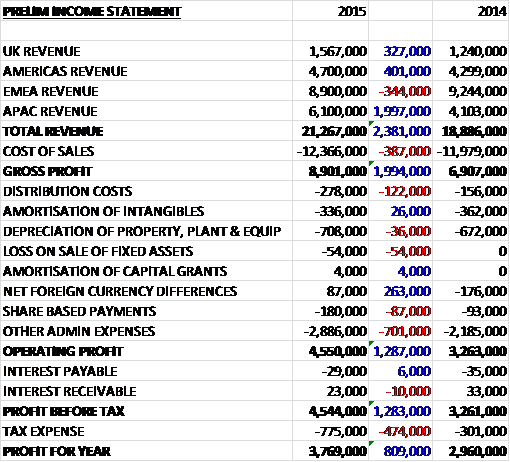
ZYTincome15

Overall revenue increased by £2.4M when compared to last year due to a £2M growth in Asian Pacific revenue, a £401K increase in Americas revenue and a £327K growth in UK revenue, partially offset by a £344K decline in EMEA revenue. After a modest increase in cost of sales, the gross profit increased by £2M. Distribution costs were up £122K and share based payments increased by £87K with a growth of £701K in other admin costs mainly resulting from increased staff costs but there was a £263K positive movement in foreign currency so the operating profit was some £1.3M ahead of last year. Interest payable and receivable broadly cancelled each other out but the tax expense increased by £474K due to a rebate last year following over provision in previous periods to give a profit for the year of £3.8M, a growth of £809K year on year.

ZYTassets15

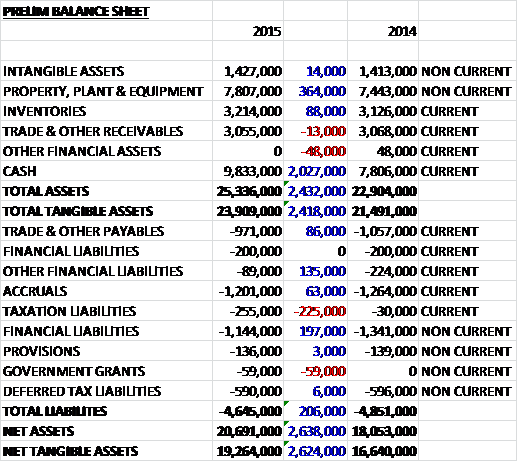
When compared to the end point of last year, total assets increased by £2.4M driven by a £2M growth in cash and a £364K increase in the value of property, plant and equipment. Conversely total liabilities fell during the year as a £232K decline in financial liabilities, as the group pays off its mortgage, was partially offset by a £225K increase in current tax liabilities. The end result is a net tangible asset level of £19.3M, an increase of £2.6M year on year.

ZYTcash15

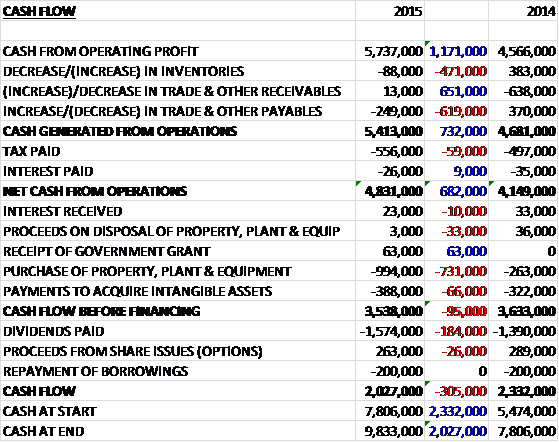
Before movements in working capital, cash profits increased by £1.2M to £5.7M. There was a small outflow of cash due to working capital, in particular a fall in payables and the tax payment was modestly higher which meant that the net cash from operations came in at £4.8M, a growth of £682K year on year. The group spent £994K of this on tangible assets with £400K spent on the refurbishment of the original cleanroom to increase capacity, and £300K on a new lamination machine. They also spent £388K on developing intangible assets to give a free cash flow of £3.5M before £1.6M was spent on dividends and £200K was paid off the mortgage to give a cash flow for the year of £2M and a decent cash pile of £9.8M at the year-end.

The improved performance this year is principally as a result of a 16% revenue growth in the touch sensor products. The total volume of sensor units sold increased by 10,000 to 149,000 with increases in sensors of over 15” but declines in smaller sensor sizes.

The largest area of export growth was attributed to sales to the Asia Pacific region which saw a £2.3M increase in South Korean sales to £2.8M, mostly supplies into the gaming market with sales to China, which is driven in the main by ATM sales, accounting for £1.9M of total revenues and remaining unchanged year on year. The most significant year on year reduction affecting the region was the end of life of an agricultural telematics project for an Australian customer, which significantly contributed to the £300K reduction in revenues in that country.

The EMEA region remains by far the largest export market but sales reduced year on year, mainly as a result of a £500K reduction in non-touch product revenues in the financial market across Germany, Hungary and the Netherlands. Other contributing factors were associated with the vending market with a fuel service payment terminal touch project in Benelux which concluded at the start of the second half of the year.

In the Americas, gaming revenues are predominantly driven by direct supply into Las Vegas based equipment manufacturers for casino cabinet slots, which during the year reduced as some machines approached end of life and new designs were being developed, with a change in the resultant supply chain this year through South Korea. This period has benefited from the substantial increase in the purchase of units through Canada for the Coca Cola Freestyle drinks dispensing touch project, which was triggered by an end of life notification for the LCD unit used in the existing design.

The main driver of growth in the UK was the work undertaken by the group in providing ultra-large format touch products to an interactive table manufacturer for the retail sector, and a project for a car showroom deployment across a number of European outlets associated with the launch of a new car model.

The revenues from non-touch products were flat year on year, although above management forecasts. This was mostly attributable to the £400K of revenues generated by the uptake of a curved non-touch display unit into Asia Pacific, used in the same design of casino cabinets as the touch sensor provided. In total, non-touch ATM product revenues increased by £600K but revenues from the largest contributor of ATM display filter glasses did decline, down £600K when compared to last year.

The financial market continues to be the group’s largest, accounting for £6.3M of revenues. This year continued to benefit from a new platform launch by one of their major ATM customers, were the group is supplying multiple different sized touch sensors used in the same ATM machine. Consequently this, combined with a level of growth from existing designs, gave a total volume increase in ATM units. As with last year, they have once again experienced a reduction in financial type kiosks, partly countering the increase in ATM volumes.

Vending machines maintains its ranking as the second largest touch market for the group with revenue growth of 24% to £3.7M. There were two main factors that influenced the overall performance of this market during the year, the first being the positive uplift in the Coca Cola project mentioned above where the uplift in the volume of sensors sold was nearly double that of 2014. This was countered by a volume and revenue reduction of sales across the fuel vending application area, however, which in the main had an effect on EMEA sales.

Sales into the industrial market for human machine interface control devices and general application kiosks were similar to those of last year at £2M. Significant growth in the year was seen in the gaming market which showed the highest percentage growth of all touch markets at 80% to £3.4M and about a third of all units supplied were for a new curved 42 inch MPCT design, supplied through a South Korean integrator customer, replacing a flat designed PCT model to the same end markets. The healthcare market also showed sales growth in both revenue, up £100K to £400K, and volume due in the main to sales to a Singapore manufacturer of a blood analyser unit.

There was a decline in revenues from the telematics and signage markets, the former being significantly influenced by the end of life of an agricultural GPS project which declined by £500K to £100K. Revenues from the signage market declined by £200K as the mix of the supply of larger sized units decreased. The home market which was solely influenced by sales of the Bosch cooktop unit saw an increase and was in line with management expectations.

There are a number of R&D projects ongoing and recently completed. Development has been initiated on a new MPCT controller for sensor sizes under 20 inches. This controller, when coupled with a MPCT sensor will provide tablet-like performance for the harshest environments for up to ten individual touches at the same time. The development has the potential to drive performance and functional improvements into most of the units under 20 inches in size that the group has produced in 2015 and it is expected that a production release will occur early in 2016.

In combination with further developments of the MPCT controller electronics, the group has initiated the design and development of a second Zytronic Application Specific Integrated Chip, which will drive cost savings, performance improvements and PCB size reductions across the MPCT family of controllers with the benefits to become realisable from 2017.

Additional developments have been undertaken to improve material performance aspects of the sensors and include specialist anti-reflective coating materials to improve the optical performance of the touch sensors in bright outdoor conditions as well as antimicrobial glass to aid in reducing the potential for the transmission of microbes from one user to another through the touch interaction process.

During the year the group has partnered with a European Commission consortium group comprising academic and industrial partners to evaluate and develop, over a three year period, high resolution and small feature sized inkjet printing techniques for printed electronics. Their involvement is to determine the potential for a developed solution as a method for 2D printing of metallic fluids for touch sensors, as a means of complementing its present manufacturing processes.

During the year the group opened up a representative office in Taiwan to service sales opportunity generation across greater China. Also, from June, they have employed a regional specialist sales consultancy organisation in Japan to further develop the Japanese market, through close collaboration with its existing sales channel partner, and to provide services and directly promote the Zytronic Japan entity. Unfortunately the initiative in mainland China mentioned in the report last year, did not prove as successful as hoped due to local initiative funding issues in the country which means that it has drawn to a premature close.

Early in the year the group undertook a review of the touch manufacturing capacity and capability requirements across the three factory facilities. This resulted in a capital project being undertaken over the year to remove the oldest section of its original 1989 cleanroom and refurbish its existing 2001 cleanroom to expand into the floor space created. This has increased its total touch sensor manufacturing cleanroom footprint within the business by 25%.

In addition they invested in new 2D direct write electrode printing machines and a further automated laminator, to increase the throughput of ultra large touch sensors. A new computer controlled glass profiling machine was also installed to replace an older obsolete machine, allowing the group to improve the finish of the edges of its glass across much larger glass sizes than previously, whilst extending the range of customisations they can offer in the supply of its bespoke touch sensors.

The new year has started positively with maintained momentum. The board are continuing to focus on increasing shareholder value and will update shareholders on progress and material developments during the course of the coming year. This is an intriguing statement and sounds like there might be an acquisition coming here, although that could be a red herring.

At the current share price the shares trade on a PE ratio of 16.7 and after a 20% increase in the total dividend, the shares have a dividend yield of 3% which seems like reasonable value, although I don’t have any updated broker forecasts for next year yet. The group are currently enjoying a net cash position.

Overall then this has been an excellent year for the group. Profits have increased, net assets grew and operating cash flow was above that of last year with plenty of free cash being generated. The good performance seems to have been driven by a Coca-Cola vending machine project in Canada and strong gaming revenues in Korea along with an interactive table contract and a project for car show rooms in the UK, partially offset by the end of a fuel service payment terminal project in Benelux, the end of an agricultural GPS project in Australia and lower non-touch financial service product sales in Germany, Hungary and the Netherlands.

There seems to be a decent pipeline of products being developed and the increased presence in Taiwan and Japan will hopefully bear fruit, unlike the doomed office in China. There has also been a good level of capex with an increase in cleanroom capacity. So far this year, the positive momentum has continued and with a current PE of 16.7 and dividend yield of 3% with a decent net cash level, these shares still look pretty good value. Of course the nature of the large projects that the group undertakes always leaves them open to a shortfall in revenue at some point but overall I am happy to hold these shares.

On the 25th February the group released a trading update where they confirmed that trading and future prospects remained in line with management’s expectations. Progress continues on various initiatives such as interactive signage, investments in touch sensor output, durable touch technology and expansion in North America.

Plastics Capital Share Blog – Interim Results Year Ending 2016

Following the acquisition of Flexipol, the board have now reclassified the group into two operating divisions: Films, which includes Palagan and Flexipol; and Industrial which includes BNL, Bell and C&T Matrix. The films businesses operate substantially in the UK market for high strength film packaging whereas BNL, Bell and C&T Matrix each make and sell engineered plastics products on a global basis. Plastics Capital has now released its interim results for the year ending 2016.

PLAinterimincome

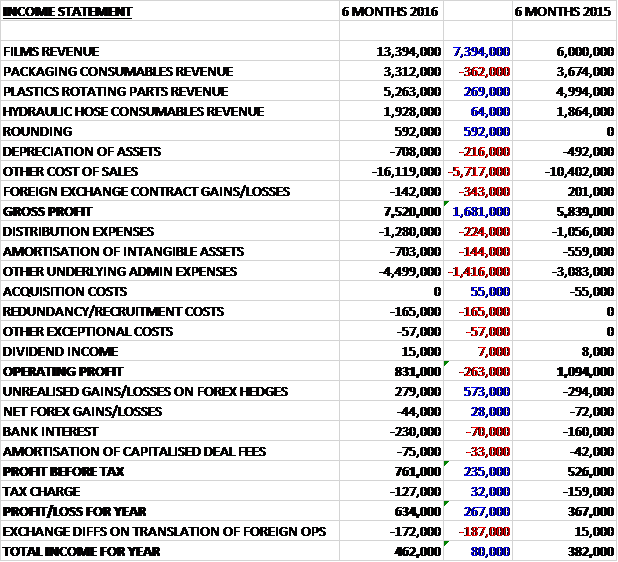
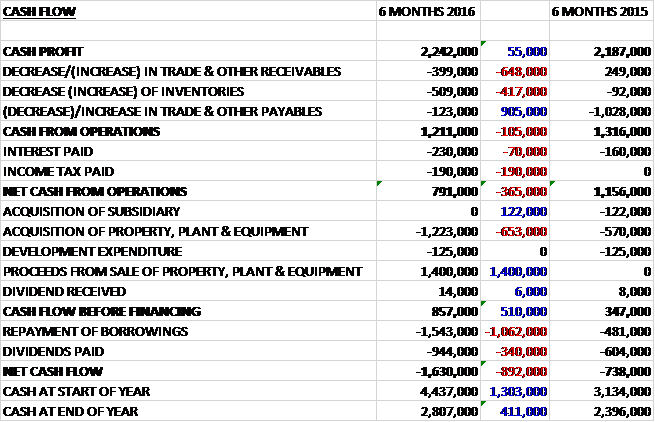
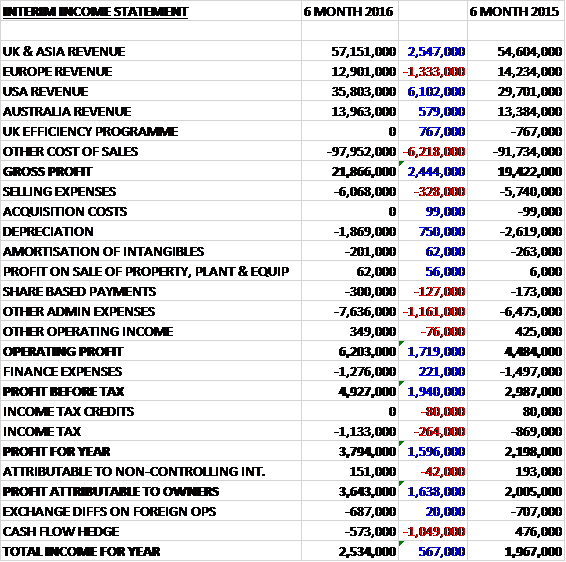
Revenues increased when compared to last year as a £362K fall in packaging consumable revenue was more than offset by a £7.4M growth in films revenue, a £269K increase in plastics rotating parts revenue and a £64K growth in hydraulic hose consumable revenues. Depreciation was up slightly, and there was a £343K adverse movement in foreign exchange contracts, along with a growth in other cost of sales which meant that gross profit was some £1.7M higher than last year. Distribution expenses were up £224K, amortisation increased by £144K and other admin costs grew by £1.4M and we also see £165K of redundancy costs and £57K of other exceptional costs which gave an operating profit which was £263K below that of the first half of last year. We then see a £573K positive swing in unrealised gains in forex hedges which meant that the profit for the half year came in at £634K, a growth of £267K year on year.

PLAinterimassets

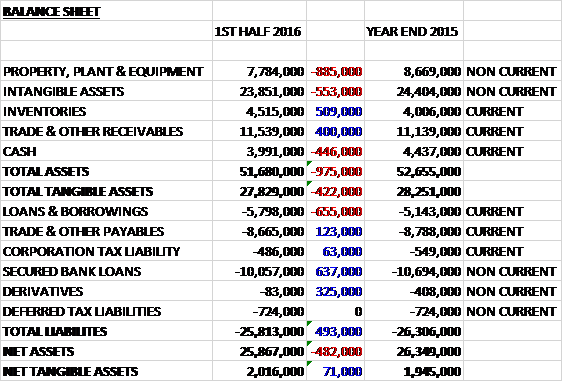
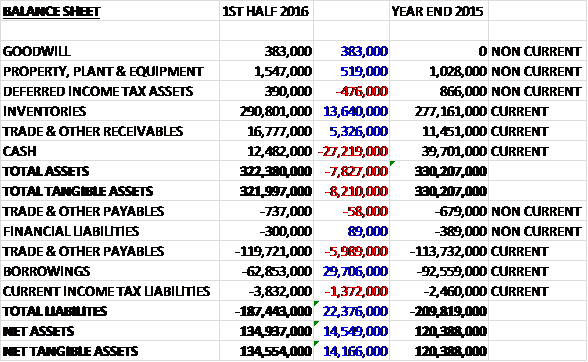
When compared to the end point of last year, total assets fell by £975K driven by an £885K decline in property, plant & equipment, a £553K fall in intangible assets and a £446K decrease in cash, partially offset by a £509K growth in inventories and a £400K increase in receivables. Total liabilities also declined during the six month period due to a £325K fall in derivative liabilities and a £123K decrease in payables. The end result is a net tangible asset level of £2M, an increase of just £71K over the half year period.

PLAinterimcash

Before movements in working capital, cash profits were broadly flat, increasing by just £55K. An increase in both receivables and inventories, plus a £70K increase in interest payments and a £190K tax payment meant that the net cash from operations for the six month period was £791K, a decline of £365K year on year. This did not cover capital expenditure of £1.2M property, plant & equipment along with £125K of development expenditure but the £1.4M of proceeds from the sale and lease back meant that before financing there was an £857K cash inflow. This did not cover the £944K of dividends and there was also a £1.5M repayment of borrowings to give a cash flow of £1.6M and a cash level of £2.8M at the period-end.

I notice the group is now stating an EBTDA figure at constant exchange rates and polymer prices! I have heard it all now, it seems fairly common for companies to quote earnings at constant currency rates, particularly if there has been a detrimental movement, but I think it is a bit much to assume a constant raw material price! Why not just have done with it and quote a constant sales price and volume too?

The pre-tax loss in the Industrial division was £124K, a detrimental movement of £347K year on year with the decline being blamed on foreign exchange movements as profits on a constant currency basis were broadly flat. Sales have improved in the bearings business, increasing by 5% year on year, partly due to prior period new project wins flowing through into increased production as well as the development of important key accounts in the swimming pool cleaner and poultry processing industries. The mandrel business has seen sales that were flat year on year as new business wins offset softer end markets.

The pre-tax profit in the films division was £223K, an increase of £51K when compared to the first half of last year. These results include the first full half-year contribution from Flexipol, which has performed ahead of original expectations so organic profits seem to have fallen. The board have also started the process of identifying and implementing synergies between Palagan and Flexipol and anticipate that this will deliver over £500K of incremental annual operating profit over the next year and a half as both cost savings and additional sales flow through. Profitability in the period was negatively affected by the increase in raw material prices following the substantial fall in polymer prices in Q4 2015 but raw material prices have now stabilised.

There are a number of initiatives that the board believe will help with their target of doubling EBITDA over the next five years. In the films division, these include expanding the sales of specialist patented products which has involved the addition of 850 tonnes of additional capacity installed during the period and the appointment of a new sales person – the expected additional sales are apparently already coming through; the introduction of a new ultra-high strength wide width range of films with a new conversion line being installed in the second half of the year; and cross selling between the two businesses.

In the industrial division, these initiatives include: bringing already won bearings business successfully into production with the current pipeline that has been won but not yet being produced standing at £4.3M per annum which should come through over the next five years; building on the investment made so far in China where the sales teams have identified a number of bearings and mandrels opportunities with extra products expected to hit the market next year; increasing the mandrel business development resource with additional sales and R&D resources being recruited; and forward integration in matrix where there is an opportunity to increase profits by getting closer to box makers through investment in distributors.

As the board have pointed out, there are risks involved with some of these initiatives with the possibility of customer delays and unforeseen technical issues. Customer loses is also a factor that they have made allowances for and they continue to run the risk of a downturn in the global economy as this new investment comes on stream.

The board have stated that a number of good acquisition opportunities have presented themselves over the past six months and they remain enthusiastic to add businesses to the group and are hopeful to bring at least one to fruition over the next year or so – I am not sure where they are going to find the cash to do that, but I suspect this is the only way they are going to increase EBITDA by the amount they are looking for.

Apparently the order books in both businesses are strong and the board anticipate a significantly improved performance in the second half of the year which means that they expect to trade in line with expectations for the year as a whole. Unfortunately most of the analysts do not agree and have cut their targets for earnings and dividends.

At the end of the period, net debt stood at £11.9M, an increase of 48% year on year. After a 9.8% increase in the interim dividend, the shares now yield 3.8%, increasing to 4% on the full year forecast – but these are shareholder returns that the group can’t really afford in my view. The forward PE now stands at 9.8 after some reductions in the consensus forecast for the year as a whole.

Overall then, this has been another half year where the group doesn’t seem to have made much progress. Profits were up due to unrealised gains on the forex hedges – operating profit fell. Net tangible assets were broadly flat and fairly low and cash profits were equally flat with a reduction in operating cash flows due to a cash outflow from working capital and a higher tax payment. There was a swing to losses in the industrial division which is being blamed entirely on foreign exchange losses and the films profits increased due to the previous Flexipol acquisition – organic growth seems to have been non-existent (as usual).

There are some investment initiatives to remedy the ongoing situation here where the group never seem to be able to make any organic growth and the board expect a better performance in the second half of the year. With a forward PE ratio of 9.8 and dividend yield of 4%, the shares do look cheap but debt is still rather high and I am not sure whether I believe that a recovery really will occur in H2. This is one I am not interested in at the moment.

On the 15th February the group released a trading update where they stated that they were trading “broadly” in line with market expectations, which in proper English I assume means trading slightly below. Revenues showed a significant improvement over H1 with strong trading in the Films division being offset by poorer trading conditions in the Industrial division. Product gross margins have been mostly unaffected by these poor conditions, however, with the group’s operating profit margin continuing to improve as the year progresses.

The Films division has made good progress on its key initiatives over the year. The group have added about 1,000 tonnes of new capacity, representing about 8% of annualised installed capacity, and this has now been fully utilised through new business growth in specialist sacks for food manufacturing and distribution customers. Three significant new product initiatives are in the process of final development for introduction during the next year, including one for which a patent has been registered. Synergies across Flexipol and Palagan are progressing in line with expectations and should lead to reduced costs in a number of areas which should become increasingly noticeable over the next year.

In the Industrials division, the bearings business is trading as expected, reflecting gradual improvement over the prior year. Conversion of won projects into sales continues to advance but this remains a little slower than anticipated. New product activity is strong and they have some substantial potential projects in the automotive and home appliance sectors that are progressing well and the board hope to sign these in the near future.

Matrix activities continue to be affected by the downturn in emerging markets, although there is some evidence that destocking in the distributor network, evident over the past year, is coming to an end. More encouragingly, the business is making good progress in markets where they have direct control over sales such as the UK and India, and where they work closely with distributors in providing value added technical services to end users.

Demand weakness in mandrels has been somewhat more significant than expected, but they continue to win new business in the area. This new business is not fully compensating for the underlying weak trading conditions. Most significantly, they have converted their first local key account in China, which has a substantial industry manufacturing hydraulic, automotive and industrial rubber hose, most of which is supplied by local Chinese manufacturers using inferior mandrel types. Over the past two years the group has established sales and technical services for mandrels in Shanghai and have a large list of target accounts who are testing their products. This first conversion is with a leading rubber hose manufacturer and is one which they believe will lead to further conversions in due course.

Trading conditions remain somewhat variable reflecting global economic conditions, but financial performance in improving and overall the board anticipate that performance over the second half of the financial year will be broadly in line with market expectations. Despite this, however, I am trying to rationalise the number of companies I cover and this one, given the debt levels and variable trading doesn’t make the cut at the moment – I might revisit if debt is paid down a bit.

On the 28th September the group released a trading update where they stated that they traded in line with market expectations. Trading in the past six month period saw an improvement on the prior year, primarily due to organic sales growth in the industrial division and the initial contribution from Synpac in the Films Division, which was acquired in July 2016.

In the industrial division, sales at the bearings business continued to improve due to previously won projects that are now starting to ramp-up after some initial delays. The pipeline of business won but still to go into production remains strong, as does the pipeline of projects in prototype development and testing. In addition, this business is being assisted by the weakness of sterling against the US dollar, although the benefit of this is not expected to be seen materially until 2018.

Demand at the matrix business is also improving relative to last year. This is partially as a result of stock depletion during the prior year by some distributors in emerging markets but also the result of strong sales of C&T Matrix’s broadening range of matrix products and other consumables. Mandrel sales have also grown relative to the prior year, the order book is strong and the list of customers undergoing trials is extensive which suggests that sales should progress well in the second half of the year.

Sales have also increased across the films division. Flexipol continues to trade well and has a healthy order book as it moves into the busy time of its year. The project to install a new extruder to provide an additional 2,500 tonnes of capacity over the next three years is on track for completion by the year-end. Palagan’s performance has suffered a little while it makes changes to shift patterns, account management and product development whilst Synpac which joined the group in mid-July is trading in line with expectations.

Overall then this seems like a positive update so the half year results should make interesting reading, hopefully some progress has been made on their debt situation.

Plastics Capital Share Blog – Final Results Year Ended 2015

Plastics Capital is a UK based consolidator of plastics products manufacturers. They have five factories in the UK, one in Thailand, two in China and sales offices in the USA, Japan, India and China. The group has two divisions – industrial products and packaging products. Within industrial products there are two businesses. Bell Plastics manufactures hydraulic hose mandrels which are long, high-spec rods used by the manufacturers of industrial hoses; and high performance hose film with applications in construction, mining equipment and automotive. BNL designs and manufactures plastic bearings, assemblies and technical mouldings with applications in automotive, office machines, ATMs, security cameras and conveyors.

In the packaging division, C&T Matrix manufactures creasing matrixes, which is a consumable product used in the manufacture of cardboard boxes to facilitate accurate creasing prior to folding. Their products also include rubbers and printing accessories with applications for cardboard box manufacturers and point of sale products. Palagan is a manufacturer of high strength film packaging such as brown polyethylene films used in industrial packaging where high strength, tear and puncture resistance are requirements with applications in courier bags, asbestos bags, animal bedding bags and food packaging. The recently acquired Flexipol Packaging produces similar films to Palagan used in high strength specialist sacks, bags, liners and films with applications in food packaging and animal feed bags.

The company has now released its final results for the year ended 2015.
PLAincome

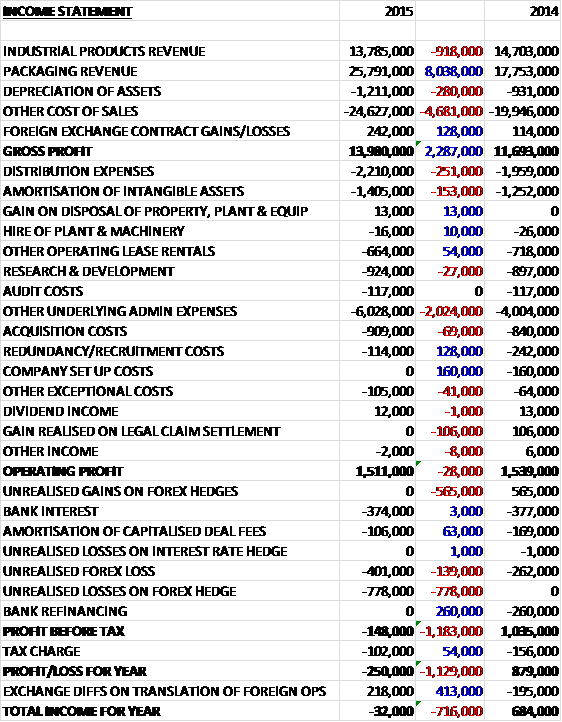
Revenues increased when compared to last year due to the Flexipol acquisition as a £918K fall in industrial product revenues was more than offset by an £8M growth in packaging revenue. Cost of sales also increased during the year and gross profit was £2.3M above that of last time. Distribution expenses were up slightly but admin costs grew by £2M which along with a few other costs meant that operating profit was broadly flat when compared to 2014, declining by £28K. We then see a £1.3M detrimental swing on the forex hedge which meant that, after the lack of the bank refinancing charge that occurred last year and a slightly lower tax charge, the loss for the year was £251K, a detrimental movement of £1.1M year on year.
PLAassets

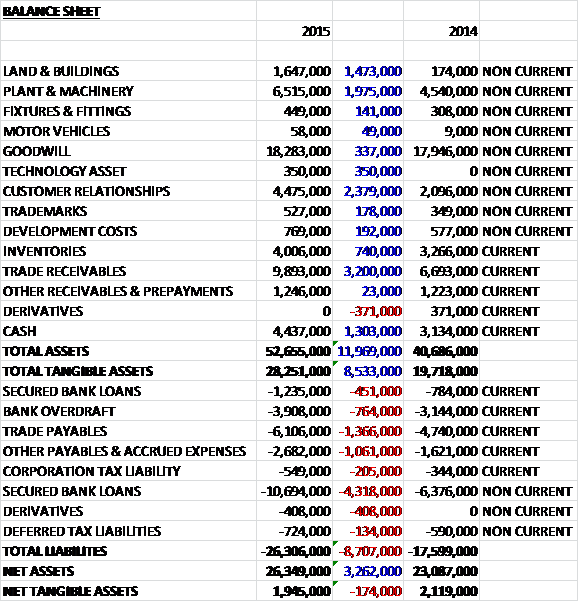
When compared to the end point of last year, total assets increased by £12M driven by a £3.2M growth in trade receivables, a £2.4M increase in customer relationships, a £2M growth in plant and machinery, a £1.5M increase in land and buildings, and a £1.3M growth in cash. Total liabilities also increased during the year due to a £4.8M growth on bank loans, a £1.4M increase in trade payables and a £1M increase in other payables. The end result is a net tangible asset level of £1.9M, a decline of £174K year on year.
PLAcash

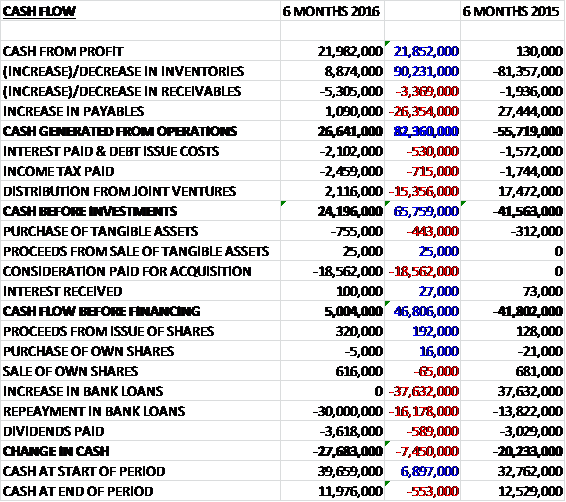
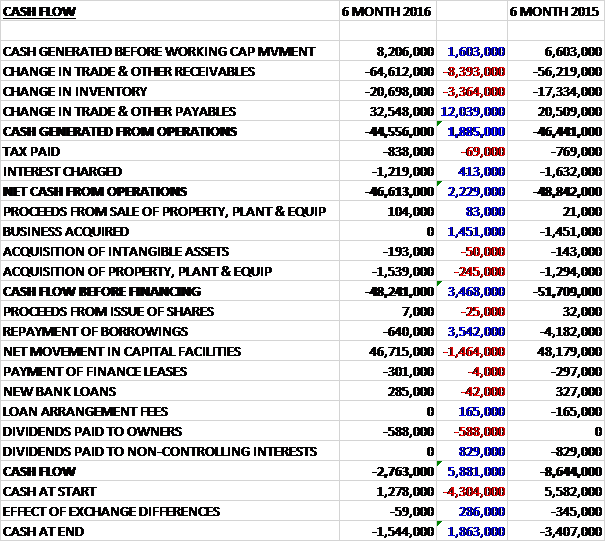
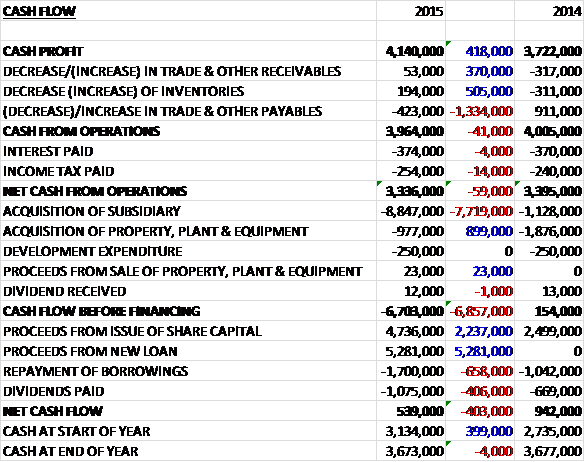
Before movements in working capital, cash profits increased by £418K to £4.1M. There was a small outflow from working capital due to a fall in payables and a modest increase in tax so that the net cash from operations was £3.3M, a decline of £59K year on year. This covered the £977K paid on fixed assets and £250K of development expenditure (capital expenditure is expected to increase somewhat going forward) but not the £8.8M spent on the acquisition so before financing there was a cash outflow of £6.7M. There was a net £3.6M of new loans to pay for this, along with £4.7M from the issue of new shares so that after a £1.1M spend on dividends, which the group can’t really afford, the cash flow for the year was £539K to give a cash level of £3.7M at the year-end. I am not sure what the logic is in conducting a new share placing and paying out dividends at the same time.

The recent acquisitions enabled turnover to grow by 22% for the year but although organic growth has improved significantly, overall it has been disappointing. The mandrel business was unable to sustain the 39% increase in sales that it had achieved in the prior year and sales fell back by 21% year on year. In bearings, H2 saw a significant improvement over H1 as projects which had been delayed went into production and they finished slightly ahead for the year after adjusting for foreign exchange movements. In the Packaging division, creasing matrix volumes increased 7% and retained sales in industrial packaging films were flat. On a pro-forma basis including a full year of Flexipol, organic growth of industrial packaging film sales was up 3.4%.

The pre-tax loss in the Industrial Products division was £528K, a detrimental movement of £835K year on year. Bell Plastics, who manufacture hose mandrels and films had a weak year after an exceptional prior year with sales falling by 21%. Demand was adversely affected by lower demand in the oil, gas and mining sectors with new business won in the last year slow to turn into re-orders and ongoing demand being generally weak. Operationally, capacity expanded by 30% as faster line speeds were phased in through the year and all lines were fully automated. In addition, new materials were added to widen the range of products available such as the introduction of standard and flexible grades of polypropylene using faster line speeds which has enabled the business to target new segments of the hose market.

The board believe that pipeline prospects for the business are excellent and they have started to see conversion of the pipeline during the first quarter of the current year despite the fact that the market generally remains subdued. Whilst the volatility of this business is inherent to the markets it serves, they believe that over the long term they will achieve the 10% annual growth that has been evident over the last five years.

BNL, which manufactures plastic bearings and other rotating parts, saw sales improve significantly during the year as new projects and some recurring businesses came through in the second half of the year. Some excellent new project wins were also secured with important new key accounts such as bearings for two tier one steering column manufacturers, four projects for different CCTV manufacturers in China and the first project with a major Japanese document management company.

Operational performance has been good. The Thailand factory has continued to increase in importance and standards there have improved. All major customer audits during the year were passed and new tooling designs have been progressed so they no longer represent a major bottleneck in the conversion process. The new business pipeline at BNL remains at £3.5M and this business is expected to flow through over the next three years. Meanwhile the list of projects which have not yet been converted but for which prototypes have been produced and are under test is substantial and would produce another £3.8M annual sales if it all converted – historically though there has been a 55% conversion rate.

The pre-tax profit in the Packaging division was £1.6M, about double that of last year. C&T Matrix, which manufactures creasing matrix, a consumable used by packaging manufacturers to crease cardboard, increased sales by 2% which included a 7% increase in high margin matrix volumes, a 24% increase in ejection rubber and a decrease in low margin traded accessories. The growth in matrix was driven by new product introduction and through growth in key developing markets like Brazil, Mexico and India. The growth in volumes but some strain on the business’ operations in the first part of the year. Management then made some progress on fully implementing a new planning system and on improving machine speeds and efficiencies without compromising quality and gradually, over the course of the year, performance improved and overtime costs were nearly eliminated.

The integration of Shengli into the business has proceeded well and the group are now harmonising product ranges and consolidating sales activity where it makes sense. Shengli products are now represented by the C&T sales team outside China with the reverse applying within the country. The run rate of production and commercial synergies is about £100K per annum which is expected to increase over the next year. C&T’s future growth will be based on organic development in emerging markets and potentially through bolt on acquisitions in developed countries, which may broaden the range of die-making and die-cutting consumables made available to end users.

Palagan, the industrial film packaging business, had a mixed year with flat volumes but significant margin growth, mainly as a result of the fall in raw material prices during the second half. Operational performance was good with improvements on the prior year in terms of scrap rates, returns and operating efficiencies.

The recently acquired Flexipol packaging business has provided a number of opportunities for growth and profit improvement and serves the same broad industrial packaging markets as Palagan but with different product ranges. Cost saving opportunities include raw material purchases, energy and transportation. In terms of cross-selling, both businesses can now offer a fuller range of products to their customers and annual run-rate margin improvements to date are about £300K. The board see excellent opportunities to grow organically in this division. Capacity expansion is planned at Flexipol to enable the business to develop the sales of its specialist products to new accounts and to manufacture some new high strength products and further sales resources are being added. In addition there are opportunities for complementary acquisitions in this area which the board have started to explore.

The group has been targeting key account wins in the Industrial division. In the second half of the year the projects pipeline in the bearings business has started to convert and the board hope to see this increase over the next two years. Tool orders for steering column bearings have been won from two new important tier one automotive customers and they now have tool orders from four CCTV camera manufacturers in China. In mandrels, the slump in the oil and gas and mining sectors affected demand and no new accounts were converted during the year. After the period end, however, they achieved the conversion of three important mandrel accounts. Another 15 active prospects remain in the pipeline and management are optimistic about this business returning to growth in the new year.

Commodity raw material prices edged downwards during the first half of the year and then declined by 20-25% during the second half. These polymer prices are somewhat linked to oil prices which had then declined sharply. This has the effect of temporarily improving margins in the industrial firms division during Q4 and contributed 3-4% of EBITDA for the year. Raw materials have increased sharply since the year-end, however, as polymer manufacturers have reduced capacity largely because of unplanned plant shutdowns. It is anticipated that greater that greater stability will return to raw material prices during Q2 2016. Engineering plastic prices have been largely unaffected but the group are aware of some shortages in certain types of material.

The group’s strategy is to achieve greater than 5% annual turnover growth by organic means and to augment this with acquisitions. This organic growth target has eluded them over recent years, however, and they have spent some time assessing the reasons for this. The board remain convinced that this level of growth is achievable in their businesses provided they focus on key customers, technical service and incremental product innovation. They have identified the need to be more disciplined in resource allocation, implementation follow through and project management of key initiatives and consequently have put in place a number of actions across the group to address these issues.

Capital expenditure fell somewhat this year as the prior year saw significant investment which included additional capacity to the industrial films business through the installation of a new extrusion line and tool room investment at the bearing business which was completely upgraded as part of an initiative to improve conversion speed of projects.

The group are somewhat susceptible to interest rate hikes. If they were to increase to 4% from the current 0.5%, the interest charge would increase by £447K. The group’s policy is to hedge 100% of its anticipated net cash flows in US dollars for the subsequent year and a half but a 10% strengthening of Sterling against the dollar wold have an adverse effect of £589K while a similar change against the Euro would reduce profits by £267K.

In November 2014 the group acquired Flexipol Packaging, a manufacturer of films and industrial bags primarily for the food and animal feed sectors, for a total consideration of £10.2M consisting of £9.8M in cash and £410K in contingent consideration. The acquisition generated goodwill of just £337K with a further £4.1M of intangible assets. In the four or so months since the acquisition the business generated a profit of £682K which is a remarkable return really and this looks to be a very useful acquisition indeed to me. Since the acquisition, the business has performed very well with all key accounts being retained and additional business being secured in a number of areas.

Flexipol more than doubles the size of the group’s films business and means that 55% of sales now come from this area. Last year the group acquired Shengli in China which has enabled them to develop their bearings and mandrels business there and to achieve a leadership position in creasing matrix. Integration has gone according to plan with a number of product synergies achieved and consolidation of sales and distribution activities are in progress.

As far as further acquisitions are concerned, the group have a good list of target companies with whom they have ongoing discussions. Most would fit alongside their existing businesses and be complementary, or would be integrated into their current businesses to create a stronger global player.

Following the year-end, the group undertook a sale and leaseback of the Flexipol property which realised cash of £1.4M. Unless they are desperate for cash, I would rather not see sale and leasebacks as I think owning their own property would mean the company has extra asset backing and flexibility going forward, not to mention the operating lease payments that they will have to make now they no longer own it.

Trading in the current year is in line with management’s expectations. Compared to the prior year, trading is weaker in the packaging division but stronger in the industrial division where the operational gearing is greater. The pipeline of new business remains strong and the board are aware that converting it into sales is key to performance this year. Although they are optimistic about this, they apparently have to recognise that the outlook for new business wins is always uncertain (covering themselves somewhat here I think). In contrast, customer retention remains very good.

At the current share price the shares are yielding 3.7% which increases to 4.3% on next year’s consensus forecast. As the group made a loss this year, we cannot determine a PE ratio but on next year’s forecast it currently stands at 9.5 which looks rather cheap. The net debt at the year-end of £11.4M increased by £4.2M over the year.

Overall then this has been a mixed year for the group. Profits fell, seemingly due to the forex revaluations (presumably offset by helpful movements elsewhere) but operating profit was flat. Net tangible assets declined and the balance sheet does not look that great, and operating cash flow was flat due to a fall in payables – cash profits increased year on year but there is little free cash generated and the group had to issue more shares to make the acquisition, which is not great to see. Operationally, the Industrial sector is loss making, mainly as a result of a collapse in Mandrel sales due to the oil and gas end markets being very weak. Packaging profits increased, mainly as a result of the Flexipol acquisition but the lower raw material prices improved profits at Palagon too.

The Flexipol acquisition does look like a very good one but the company can’t really afford it, I would much rather see company’s make acquisitions out of their own reserves and perhaps a bit of extra debt but debt here is already very high, hence the share issue I guess. It is a little concerning to see the board seem intent on making further acquisitions. Unfortunately, since the year-end, polymer raw material prices have increased which will put a pinch on margins and the group remains susceptible to interest rate increases and forex movements. They readily admit that they find organic growth difficult, and this really has to change before these shares become in demand I think.

The new year has been mixed with an improvement in industrial products but a less successful start in packaging. With a forward PE of 9.5 and a dividend yield of 4.3% these shares look cheap but there is a lot of debt to take into account and before some of the other problems are sorted out, I would expect the shares to remain cheap. Not for me at the moment.

On the 2nd October the group released the details of the new LTIP to run from 2015 to 2020. The plan involves the issue of special classes of shares known as “growth shares” in an intermediate holding company. They will be exchanged for a certain number of new ordinary shares in the company at the end of the LTIP five year period, based on the share price at the end of this period subject to financial performance and vesting criteria being met.

For any of the growth shares to be exchanged for normal shares, the share price at the end of the period must be about £1.50 per share, representing a 40% uplift to the current share price. The total value of the growth shares at the end of the five year performance period will equate to 20% of the increase in share price above this £1.50 hurdle, multiplied by the number of ordinary shares in issue at the start of the scheme (35,344,573). The value of will be capped, however, so that shareholders cannot be diluted by more than 10%.

I have mixed feelings over this. The hurdle (if it remains in place) does offer some decent upside to the shares but it is not all that ambitious and giving away 10% of the company to directors for doing their job leaves me with a rather sour feeling about all of this – it does appear rather greedy to me.

Colefax Share Blog – Final Results Year Ended 2015

Colefax is an international designer and distributer of luxury furnished fabrics and wallpapers and an international decorating company. It designs, markets, distributes and retails furnishing fabrics, wallpapers, trimmings, related products and upholstered furniture in the UK and overseas. They also sell antiques, interior design services, decorating and furnishing for private individuals and commercial firms. They are listed on the AIM. Sales are split into the product division and the decorating division under brands that include Colefax and Fowler, Cowtan and Tout, June Churchill, Larsen and Manuel Canovas. They have offices in the UK, the US, France, Germany and Italy.

The group does not manufacture any fabrics and wallpapers so they are sourced from third party suppliers, mostly in Italy, France, Belgium, the UK and India. They sell primarily to interior designers and retail fabric and wallpaper shops and apart from two retail outlets in London, there is no direct retail activity. In addition to the core fabric and wallpaper brands, the group owns a UK based luxury sofa manufacturer Kingcome sofas. Production takes place at a freehold factory in Devon and the sofas are a relatively small part of the group.

The group also owns a luxury interior design business trading as Sibyl Colefax and John Fowler and this activity is the original business from which the rest of the group evolved. It undertakes interior design and decoration projects primarily for high-end residential customers. The division also encompasses a decorative antiques business which complements the interior design and decorating business. The group has now released its final results for the year ended 2015.

CFXincome

Overall revenues declined during the year as a £2M growth in product revenue was more than offset by a £3.2M fall in decorating revenue. Cost of sales also declined however, so gross profit increased by £419K. Distribution and marketing costs were up £700K and there was a £460K detrimental swing on exchange rate gains and losses which were offset by an £850K fall in other admin costs to give an operating profit some £115K ahead. There was a slightly lower loan payment and taxation to give a profit for the year of £3.5M, an increase of £189K year on year.

CFXassets

When compared to the end point of last year, total assets increased by £1.1M driven by a £2.6M increase in cash and a £355K growth in the value of leasehold improvements partially offset by a £1.2M fall in inventories and a £442K decline in trade receivables. Total liabilities declined during the year, mainly as a result of a £508K fall in payments received on account. The end result is a net tangible asset level of £23.8M, a growth of £1.5M year on year.

CFXcash

Before movements in working capital, cash profits increased by just 65K to £7.1M. There was a cash inflow from working capital due to a decrease in inventories due to timing differences in the launch of new fabric collections, and receivables due to a reduction in debtors in the decorating division, and after a broadly flat tax payment the net cash from operations was £7.1M, a growth of £3.8M year on year. The group spent £2.2M on property plant and equipment to give a free cash flow of £4.9M. This was spent on dividends (£472K) and the purchase of their own shares (£1.6M) to give a cash flow for the year of £2.9M and a cash level of £6.9M at the year-end.

The results this year reflect a good performance from the fabric division with an increase in operating profits of 28% to £5M mainly due to the continued recovery of the US market and a significant strengthening of the US dollar in the second half of the year. In contrast the decorating division had a challenging year reporting a loss of £139K on sales down 28% reflecting the fluctuations in the timing of major products and a weak trading environment for antiques.

The profit in the product division was £3.7M, an increase of £1.1M year on year. In the fabric division, sales in the US, which represent 56% of the division’s turnover increasing by 7% on a constant currency basis. The market in the US continues to improve and the group are confident that market conditions will remain positive for the remainder of this year. They have taken over the distribution of their product from their agent in Boston and will be opening a new showroom within the next year. They now operate their own showrooms in seven of the major US territories and these account for about 65% of sales in the market.

Sales in the UK increased by 1% during the year. In the second half of the year the high end housing market was adversely affected by the threat of the mansion tax and a significant increase in stamp duty. Whilst the mansion tax threat was removed following the election, the rise in stamp duty is having a negative effect on high end housing transactions. Overall the board are optimistic that this market will perform well in the current year, however, due to the underlying strength of the economy.

Sales in Continental Europe were down by 7% but flat on a constant currency basis. There has been little improvement in any of the major markets in the continent and trading in France, the largest market, remains challenging. The board believe that the dual benefits of quantitative easing and a much weaker exchange rate will provide a boost to Eurozone economies, however, and help to improve trading conditions in the second half of the year. They are seeing some benefit from the new showroom in Milan and there are encouraging signs of an improvement in some of the smaller European markets but they will not have a material impact on the overall result. Sales in the ROW increased by 3%. In Australia, China and the Middle East, they are seeing reasonable growth but this has been partially offset by a significant decline in Russia.

Sales of sofas increased by 8% to £2.45M and operating profit increased from £24K to £171K. Market conditions for high end furniture have continued to improve and the group are continuing to explore opportunities for this division to make a more significant contribution to results.
The loss in the decorating division was £119K, a detrimental movement of £859K when compared to last year. This is a disappointing result which mainly reflects the uneven timing of major projects. In addition, they experienced a decline in antique sales and with demand for antiques remaining subdued, they do not envisage a significant improvement in this part of the business so they are cautious about prospects for the year ahead despite a reasonable level of decorating deposits.

The group currently doesn’t have any bank debt but it has various facilities available to it amounting to £3M. They are somewhat susceptible to exchange rate risk between Sterling and US dollars with a 1c deterioration in the dollar against sterling reducing profit by £94K. Other risks include the market reaction to new products, a downturn in the housing market and the risk of obsolete inventory.

It is worth noting that the CEO and Chairman, Mr. Green, owns nearly 34% of the company’s shares and he earns an astonishing £717K a year which is very substantial for a company of this size. In fact, the £1.5M spent on directors is a considerable amount in my view considering operating profit is just £5M.

Going forward, trading in the US and the UK continues to improve and the board are optimistic about further growth in the core fabric division. Continental Europe remains difficult but they are hopeful that trading conditions will start to improve in the second half of the year. Although they are cautious about prospects for the decorating division, they expect to see increased activity in all the other areas of the business and are therefore optimistic about their overall performance.

At the current share price the shares are trading on a PE ratio of 15.6, falling to 13.5 on next year’s consensus forecast. After a 5% increase in the total dividend, the shares are currently yielding just 0.9% which is expected to remain the same next year although the group did return £1.6M of surplus cash to shareholders by purchasing 418,982 shares during the year representing 3.7% of the total share capital.

Overall then, this has been a fairly good year for the group. Profits were up despite declining revenue, net assets increased and the operating cash flow improved to give plenty of free cash, although this was due to a cash inflow from working capital due to the timings of new product launches and cash profits were broadly flat. The fabric business is performing well, mainly due to a strong market in the US, aided by favourable forex movements. The UK market was somewhat effected by the increase in stamp duty whilst in Europe, conditions remained mixed with the weak Euro not helping. The sofa business seems to be performing well, although this still makes up only a small proportion of results, but the decorating business found going tough due to the timing of large projects and a subdued market for antiques.

I am a little concerned about the control exerted by the exec chairman and his excessive remuneration but with the US market remaining strong and a forward PE of 13.5, this careful company seems quite interesting to me. The dividend yield is not much to write home about at 0.9% but the company did buy back some of its own shares (representing 3.7% of the total share capital) so shareholders are being rewarded here too in addition to the directors.

On the 17th September the group released an AGM statement. They stated that so far this year, overall trading has been broadly in line with expectations. In the fabric division, total sales for the first four months of the year increased by 1% and were flat on a constant currency basis. That seems a little subdued to me.
Compass Share Blog – Final Results Year Ended 2015

Compass how now released its final results for the year ended 2015.

CPGincome

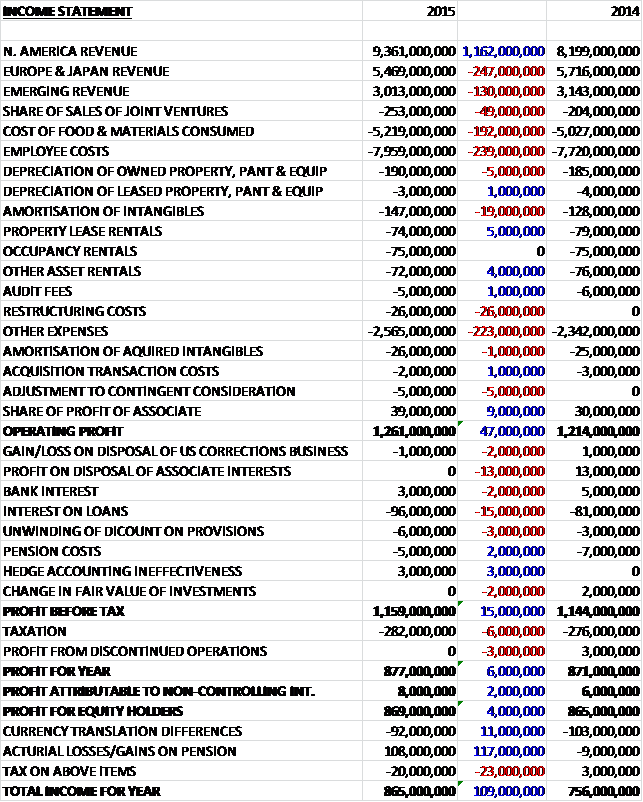
Revenues increased when compared to last year as a £247M decline in European and Japanese revenue and a £130M fall in Emerging Market revenue was more than offset by a £1.162BN growth in North American revenue. The cost of food and materials consumed grew by £192M and employee costs were up £239M with amortisation up £19M and other operating costs up £223M. There was £26M of restructuring costs that did not occur last year but despite this, operating profit increased by £47M. The loan interest then increased due to the additional debt required to finance the return of cash to shareholders (I really don’t understand the rationale of taking out debt to return cash to shareholders) and tax grew so that the profit for the year came in at £869M, an increase of just £4M year on year.

CPGassets

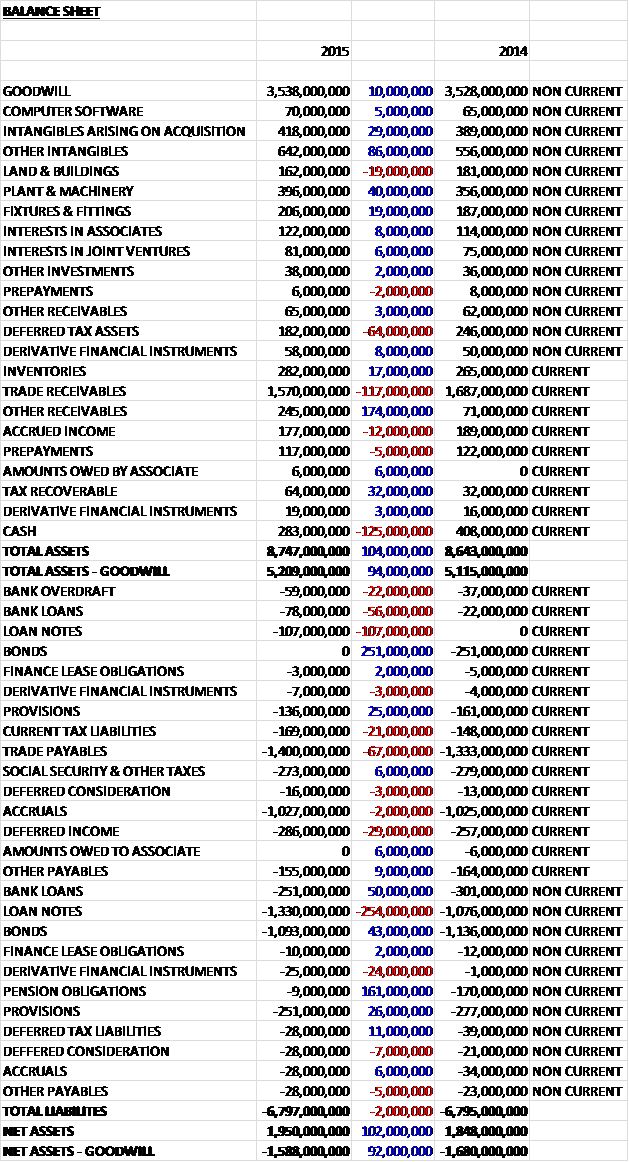
When compared to the end point of last year, total assets increased by £104M driven by a £174M growth in other current receivables, an £86M increase in other intangible assets, a £40M growth in plant and machinery, a £32M increase in current tax receivables and a £29M growth in acquired intangible assets, partially offset by a £117M fall in trade receivables, a £125M decline in cash, and a £64M decrease in deferred tax assets. Total liabilities also increased during the year as a £361M growth in loan notes, a £67M increase in trade payables, and a £29M growth in deferred income was partially offset by a £251M fall in bonds, and a £161M decline in pension obligations. If we discount goodwill, the end result is a net asset level of -£1.588BN, a positive movement of £92M year on year.

CPGcash

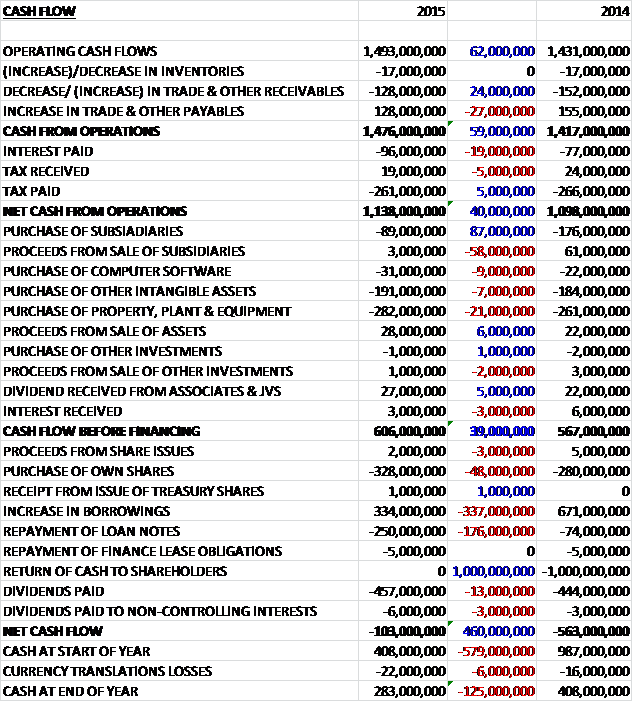
Before movements in working capital, cash profits increased by £62M. Working capital movements broadly cancelled each other out and after a higher amount of interest was paid, the net cash from operations was £1.138BN, an increase of £40M year on year. The group then spent £282M on property, plant & equipment, £191M on intangible assets and £89M on bolt-on acquisitions to give a free cash flow of £606M. Some £457M was paid out in dividends and more debt was taken out to buy £328M-worth of the company’s own shares to give a cash outflow for the year of £103M and a cash level at the year-end of £283M.

The underlying operating profit in North America was £768M, a growth of £96M year on year with the operating margin remaining static at 8.1%. This was driven by good new business wins and excellent retention rates. The group have seen some like for like volume improvement across most of the business which has been partly offset by volume and price weakness in the offshore and remote sector. The benefits from the ongoing efficiency programmes and the leveraging of the overhead base have been reinvested to drive and support the higher levels of growth and offset the impact of lower like for like in the offshore and remote sector, hence the flat margins.

Business and Industry has delivered good levels of net new business combined with some positive like for like volumes with contract wins including Kimberley Clark and Rogers Communications. In the healthcare and seniors sector, organic revenue growth was driven by new contracts for both food and support services including Genesis Health Systems. The group have also expanded their relationship with Community Health Systems through increased locations and services.

Organic revenue growth in the education sector came from net new business and increased levels of participation. Contract wins included Emory University, Chesterfield County Public Schools and Kennesaw State University. The sports and leisure business has delivered excellent organic revenue growth with near 100% retention and strong attendance levels at sporting events. Contract wins include the Mapfre Stadium, home of the Columbus Crew MLS team and Videotron Centre in Quebec City. The recent decline in key commodity prices has impacted like for like revenue in the offshore and remote business, however, new contracts continue to be won including Manitoba Hydro and Emera.

The underlying operating profit in Europe and Japan was £402M, a decline of £10M when compared to last year with margins that increased slightly from 7.2% and 7.3%. The organic revenue growth in the region was 1.9% in the full year and nearly 3% in the second half. This performance was driven by improving rates of net new business, reflecting the investments made over the last two years in the sales and retention teams. Like for like volumes remained broadly flat.

Accelerating levels of new business, especially in the UK, Spain and Japan, combined with improving retention rates across the region drove the positive net new performance. The group have expanded their relationship with several clients including Sony in Japan, Continental in Germany and the defence portfolio in France. They have won new contracts with the Universidad de Navarra and the Rafa Nadal Sports Centre, both in Spain; Weston Park and Entrust in the UK and a senior living contract with Le Noble Age in France. Retained contracts include the National College of Technology in Japan, ISE Andalucia in Spain, and the Edinburgh International Conference Centre, Kettering Hospital and the Ricoh Arena in the UK.

Like for like volumes in the UK, Germany and parts of Central Europe show an improving trend, but this is being offset by ongoing weakness in France and the exposure to the oil and gas market in the North Sea. The group continues to focus on operational efficiencies and cost reductions to support the growth that they are seeing and improve the operating margin, hence the small increase in margins seen.

The underlying operating profit in Fast Growing and Emerging markets was £218M, a fall of £8M when compared to 2014 on margins that remained steady. Organic revenue growth for the region was 6.9%. Emerging markets delivered organic revenue growth of 11% driven by strong new business which helped mitigate the decline in Australia.

In Australia, the offshore and remote business declined by 6% with clients reducing headcounts on site, construction projects coming to an end and some production contracts being mothballed. The group have won new business with BHP Billiton, however, to provide support services across several locations and they have retained contracts including Glencore. Other sectors continue to perform well and they won new business with the University of New England, multi-site contracts with both Mars and Nestle, and Target stores where they have developed an instore café offering.

The other offshore and remote business in the rest of the region has seen some growth driven by new business wins across Latin America, including, in Chile, BHP 7000 and Abengoa, a solar project in the Atacama Desert. This has more than offset the difficult oil and gas environment. They have just signed a new seven year contract with an existing client to build and operate a new remote camp in the CEMEAT region.

Double digit organic revenue growth in each of Brazil and Turkey reflected good new business wins, offset in part by some sharp declines in like for like volumes driven by challenging macroeconomic conditions. A continued focus on cost efficiencies has helped to partially mitigate the pressure from high cost inflation and declining volumes. New contract wins include the provision of multi services to Grupo Marista and food services to Coca Cola in Brazil and Doga schools and Carrefour in Turkey.

A strong new business performance in the Middle East included contracts with Al Ain Hospital, Corniche Hospital, Beach Mall and additional military sites. In South Africa they retained contracts with Nedbank and RCL Foods. Elsewhere in the region, New Zealand saw good levels of organic growth including the signing of a 15 year contract with the government to provide food services to public hospitals and the expansion of their relationship with the Defence Force. Double digit organic growth in India and China was driven by new business wins including SMIC Private School Shanghai and HAECO, an aircraft engineering group in Hong Kong.

The capital expenditure of £507M was slightly above the historic amount due to the investment in returning Europe to growth. It is believed that this rate will continue and in addition, next year they will be investing in a camp in their CAMEAT region as part of a long term contract extension with an existing client. As far as working capital is concerned, the board are expecting them to average out at a small outflow but net year there will also be a negative impact of around £70M due to the timing of the payroll run in September in the US and UK which will reverse in 2018.

During the year the group completed a number of small infill acquisitions in several countries for a total consideration of £93M, of which £76M was paid during the year with a further £13M of deferred consideration being paid relating to prior years. The acquired businesses contributed £6M to operating profit during the period. There were £230M of capital commitments contracted for but not provided for at the year-end with the majority of the commitments for intangible assets.

As announced previously the group is reducing their cost base in the offshore and remote business globally and in some emerging markets. This incremental restructuring cost of around £50M will be included in operating profit and this year some £26M was incurred, most of which was for labour cost reductions (£17M) and the rest as onerous contract provisions with the remaining £20M to £25M of restructuring costs to be incurred in 2016.

It is worth noting that the book value of goodwill attributable to Turkey is £70M with headroom of £27M. It is possible that changes in some key assumptions would cause the value of goodwill attributed to this country to fall below the carrying value which could lead to an impairment. This is not important to me but the market my view such an impairment differently.

Going forward, next year the board are changing the way they run the business and will adjust their regional reporting accordingly. These regions will be N. America, Europe (now including Turkey and Russia) and ROW (including Japan). This seems fairly sensible to me considering that emerging and fast growing margins no longer seem to be emerging or fast growing.

North America continues to deliver excellent growth, the business in Europe and Japan is enjoying a strong recovery and the fast growing and emerging regions performs fairly well despite lower volumes and pricing pressures in some parts of the market. The board’s expectations for 2016 are positive and unchanged. The pipeline of new contracts is strong, and the savings from the restructuring, together with the margin improvement in the rest of the group, are expected to offset the impact of lower volumes and pricing pressures in the fast growing and emerging region.

At the current share price the shares trade on a PE ratio of 21.3 which falls to 20.2 on next year’s consensus forecast. After an 11% increase in the total dividend, at the current share price the shares yield 2.6% which remains broadly the same on next year’s forecast and this year the group also bought back £328M of their own shares. The net debt at the year-end stood at £2.6BN compared to £2.371BN at the end of last year.

Overall then this has actually been a fairly good year for the group, Profits increased despite the restructuring costs, the operating cash flow improved and they continued to generate decent amounts of free cash. The net tangible asset level did improve, although it remained negative. The performance in North America has been very good but profits in both Europe and emerging markets fell due to currency headwinds – constant currency profits improved in both regions.

There are some headwinds, however. The offshore and remote business has been hit by the collapse in commodity prices and some emerging markets have become much more difficult with Brazil and Turkey causing particular problems. Indeed, the latter seems to be susceptible to a goodwill impairment.

Next year there will be further restructuring costs and with a PE of 20.2 and a dividend yield of 2.6% these shares look a bit too expensive to me despite their obvious appeal as a safe and steady ballast stock in a portfolio.

On the 11th December it was announced that director Alfredo Ruiz Plaza purchased 10,000 shares at a value of £112.8K. He now owns 64,746 shares in total – this seems to be a decent sized buy actually.

I have decided that these shares are probably a bit too expensive for me so this is likely to be my last update for Compass until the shares look a bit cheaper.

Sanderson Share Blog – Final Results Year Ended 2015

Sanderson has now released their final results for the year ended 2015.

SNDincome

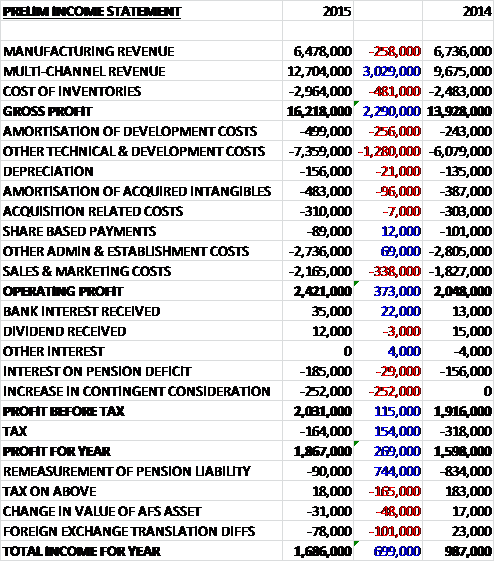
Revenues increased when compared to last year as a £258K fall in manufacturing revenue was more than offset by a £3M growth in multi-channel revenue. Cost of sales increased somewhat to give a gross profit some £2.3M above that of last year. The amortisation of development costs increased by £256K and other technical costs grew by £1.3M and after admin expenses were broadly the same and selling and marketing costs increased by £338K, the operating profit was up by £373K. We then see an increase in contingent consideration offset by a fall in the tax charge relating to the utilisation of tax losses and over provision in previous years so that the profit for the year came in at £1.9M, a growth of £269K year on year.

SNDassets

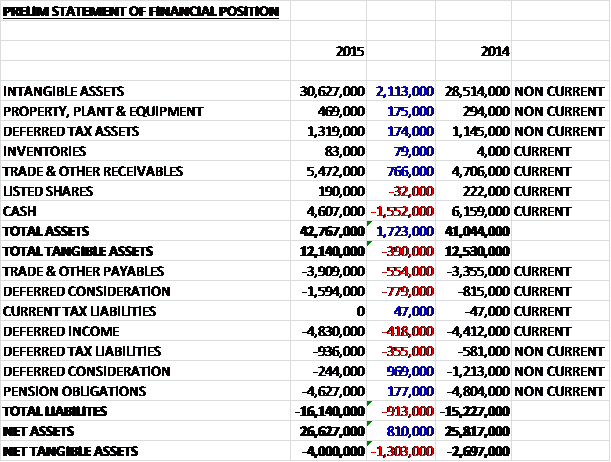
When compared to the end point of last year, total assets increased by £1.7M driven by a £2.1M growth in intangible assets and a £766K increase in receivables, partially offset by a £1.6M fall in cash. Total liabilities also increased during the year due to a £554K growth in payables, a £418K increase in deferred income and a £355K growth in deferred tax liabilities. Overall the net tangible asset level was a negative £4M, a deterioration of £1.3M year on year.

SNDcash

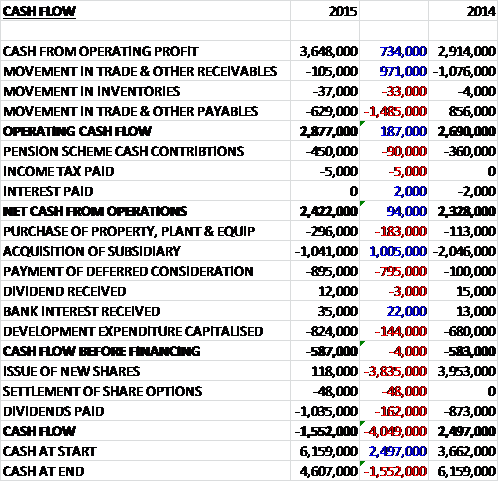
Before movements in working capital, cash profits increased by £734K to £3.6M. There was an outflow of cash through working capital, in particular a decline in payables. The pension scheme cash contribution was slightly higher and the net cash from operations was £2.4M, an increase of £94K year on year. The group spent £824K on development expenditure and £296K on tangible assets and this year there was also £1M spent on an acquisition and £895K on deferred consideration which meant that before financing there was a cash outflow of £587K. The group also spent £1M on dividends to give a cash outflow of £1.6M for the year and a cash level of £4.6M at the year-end.

Overall trading results for the year are in line with market expectations but the order book is somewhat lower than at the end of last year, down by £60K to £2.35M. During the year, pre-contracted revenues accounted for 51% of the total and some 21 new customers were gained.

The operating profit at the multi-channel business was £1.9M, a growth of £748K year on year. Mobile enablement and deployment continues to be a key business driver in this sector with increasing levels of activity. The acquired One Iota business increased revenues by more than 70% during the year but it is not clear how much profit the business contributed. The wholesale distribution and cash and carry market has been a slower area of business during the year but prospects for the coming year have improved, driven by the latest enhanced version of software. Proteus has made a steady start as a subsidiary of the group, contributing £58K of profit.

In the coming year management expects to focus further efforts on delivering growth across the digital retail market, where the One Iota business has a growing presence. Several new customers were gained in the division including Anzac Wines and Spirits, Superdry and Matthew Algie with continued large orders from existing customers who generally invest in the latest technologies to attract new customers and maximise sales. The year-end order book fell by £30K to £1.45M but with good sales prospects, the division is apparently well positioned to achieve its increased trading targets for the current year.

The operating profit at the manufacturing business was £502K, a decline of £375K when compared to last year, although some £109K of this fall was due to restructuring costs. The overall divisional trading performance was lower than expected in contrast to the strong performance last year. The group is focusing their investment in new products on the food and drink business. Traceability of products and ingredients through the food manufacturing and supply chain is a strong feature of the group’s offering but the business operating in this market saw some delay in the receipt of expected sales orders and delivered a lower level of profitability as a result. One large order values in excess of £400K was gained just after the year-end, however, outlook for the current year is much improved.

The business which addresses the general manufacturing market improved its trading performance which is expected to continue into the current year. The introduction of the new Unity Express ERP product aimed at new and emerging manufacturing businesses has proved successful and three new customers were gained in the year, albeit at an average contract value in the region of £35K compared to the average value experienced by the rest of the group of £75K across the new customer contracts signed this year.

Eleven new customers were gained during the year including Simtom Food Products, Summit Chairs, St. Marcus Fine Foods, Wine Bottling Solutions, Purdie Dished Ends and Nutri Fresh. Large projects with existing customers include Food Partners, Cook Trading ad Freddy Hirsch. Recurring revenue represents over 58% of total divisional revenue and covers over ¾ of divisional overheads. A good start to the current year together with a strong sales prospect list should ensure that the manufacturing division achieves a much improved trading result for the year.

On the 5th December the group acquired Proteus Software for a maximum consideration of £1.9M with £1.4M paid in cash on completion and up to £500K will be payable subject to certain performance targets up to December this year. Based on current forecasts, management expect to pay £191K in January. The business provides warehouse management solutions to customers in the areas of third party logistics, warehouse management and supply chain distribution. The acquisition generated goodwill of £1.1M and in the ten months since purchase has contributed £58K to pre-tax profits.

On the 8th June 2015 the group made a small acquisition of Evogenic for a maximum consideration of £445K with £110K paid in cash on completion, deferred consideration of £60K to be paid at six monthly intervals starting this month and further contingent consideration of up to £275K that will be payable subject to certain performance targets in the three years to June 2018. Based on current forecasts, management expect to pay £238K over the three year period. The business has developed an ERP solution to meet the demands of SME manufacturers and distributers and last year it generated pre-tax profit of £5K and contributed £5K to group pre-tax profits since acquisition.

The increase in deferred consideration charge of £252K relates to a change in the calculated value of deferred consideration by discounting expected future cash payments using the company’s cost of capital. The discount is then charged to the income statement over the period of the deferral. As a result of certain payments in respect of One Iota being paid earlier than previously forecast, an accelerated charge of £252K has arisen, which is a non-cash item and rather than reflecting an increased amount, reflects an earlier payment.

During the year Ian Newcombe, who has apparently made a major contribution to the formation of the group’s strategy, driving the development of the multi-channel business, was appointed CEO of the group. They also appointed David Gutteridge as a non-executive director. He has previously been at Financial Objects and Cyan Holdings and was also a non-executive of the group from 2004 to 2012. Until May 2014 he was Chairman of Tinglobal who were sold to the Singapore business, Declout.

Revenues derived from the digital retail market have grown from £4.53M last year to £5.87M this year and going forward the board intends to report its breakdown of divisional results in terms of a digital retail business division and an Enterprise software division which consists of a manufacturing business and a warehouse and logistics business. The board will continue to invest in the ERP software businesses in order to ensure that the product offering continues to attract new customers. The combination of more rapid growth available via a digital retail division and the steadier growth from the Enterprise software business is expected to enable the group to meet its strategic targets over the next three years.

The board are confident that they will make further progress and deliver trading results that are at least in line with market expectations for 2016.

At the current share price the shares trade on a PE ratio of 20.1 which falls to 13.2 on next year’s consensus forecast which is not exactly that cheap. After a 20% increase in the final dividend, the shares currently yield 3.1% which increases to 3.4% on next year’s forecast which is a useful pay out in my view.

Overall then, this has been a fairly slow but decent year for the group. Profits did increase, as did operating cash flows but there is very little free cash generated, and certainly none after the regular acquisitions are paid for. The balance sheet doesn’t look great either (not uncommon for a software company) with a negative tangible book value which has got worse over the past year. Operationally, the multi-channel division performed well driven by digital retail demand but the order book looked rather flat at the year-end. Conversely the manufacturing division performed poorly due to the delay in some orders from the food manufacturers but the order book is looking much better after the receipt of a big order after the year-end.

I like the comment about current trading being at least in line with expectations but overall things are moving slowly here and the negative net asset value is not ideal in my view. Although I will continue to monitor the company, I think this will be my last update until something major changes.

Character Share Blog – Final Results Year Ended 2015

Character has now released its final results for the year ended 2015.

CCTincome

Revenue increased by £1.2M when compared to last year and cost of sales fell by £1.5M. We then see an £886K reduction in the product development cost amortisation and a £4M positive swing with regards the credit from the foreign exchange hedge market value change which gave a gross profit some £7.5M above that of 2014. Selling and distribution costs were broadly flat but staff costs increased by £2.5M so that the operating profit was £5M ahead. Finance costs reduced somewhat but this was offset by an increase in taxation to give a profit for the year of £10.2M, an increase of £4.3M year on year.

CCTassets

When compared to the end point of last year, total assets increased by £1.4M driven by an £8.1M growth in cash partially offset by a £7.9M fall in receivables. Total liabilities declined during the year due to a £2M decrease in forward forex contracts, a £1.5M fall in payables and a £971K decline in short term borrowings. The end result is a net tangible asset level of £14.4M, a growth of £4.7M year on year.

CCTcash

Before movements in working capital, cash profits increased by £187K to £12M. A large fall in receivables was only partially offset by an increase in tax payments and the net cash from operations came in at £17.3M, an increase of £9M year on year. The group then spent £1.6M on development costs and £349K on property, plant and equipment to give a stonking free cash flow of £15.4M. The group paid £1.9M in dividends and purchased £6.1M worth of their own shares which meant the cash flow for the year was £9.3M to give a cash level of £4.5M at the year-end.

The domestic market has trading ahead of expectations but international sales were hampered by adverse exchange movements and a generally difficult economic climate. Going forward, the board expect their international trade to return to normal. The most important brands during the year included Peppa Pig, Minecraft, Fireman Sam, Teksta, Little Live Pets, Scooby Doo, Doctor Who and their activity ranges. The UK subsidiary has been appointed the global master toy partner for Teletubbies and the new line of these characters will be launched in early 2016.

The company continues to win awards for its toys with Character Options being awarded Toy Supplier of the Year at the Toy Industry Awards last January. Product awards were also received for best gaming toy (Minecraft), best interactive toy (Little Live Pets) and joint winner in the Craze of the Year (Cra-Z-loom bracelet maker). The group also received supplier awards from both Argos and Tesco.

A significant portion of the group’s purchases are made in US dollars so they are exposed to foreign currency fluctuations and they manage the risk through the purchase of forward exchange contracts and derivative financial instruments. The group is required to make an adjustment to its financial statements to incorporate a mark to market valuation of these instruments. This has resulted in a credit to the income statement of £2.05M compared to a charge of £1.93M last year. It is unclear to me whether this should be taken out of the results or whether this corresponds to a similar increase in costs due to the appreciation of the dollar and should therefore be included. It is very difficult to make a judgement on this company without knowing this as the bulk of the profit increase is explained by the revaluation.

During the year the group spent over £6M buying back 2,336,330 shares in the company. It remains part of the group’s overall strategy to continue to repurchase shares where appropriate but this will now be limited to a maximum 15% of the issued share capital during the year.

The pre-tax profit figure for the year is apparently ahead of results anticipated and current trading remains encouraging and in line with management expectations. At this stage, the board believe that their underlying performance should be able to deliver another year of solid progress.

At the current share price the shares trade on a PE ratio of 10.5 which is expected to remain the same next year – so no growth is forecast in 2016 then. After a 52% increase in the total dividend this year, at the current share price the shares yield 2.3% which increases to 2.5% on next year’s consensus forecast.

Overall then, this set of results has left me a bit confused. Profits were up but this was due to the credit regarding the mark to market of the forex hedge and lower product development amortisation. Net assets did increase as did operating cash flow, although the latter was mostly due to a large fall in receivables which gave a stonking free cash generation. Operationally it is very difficult to see what is going on, there is almost no detail at all. The only thing I can deduce is that the domestic market has done well whilst the international market has struggled. The PE ratio of 10.5 makes the shares look cheap and the 2.5% dividend is OK. The fact the PE is not forecast to fall next year is a bit of a concern, however, given the likelihood of more share buybacks.

Overall as I say I am a little confused about this. The crux of the performance is really down to the forex valuation. Is the mark to market credit offset by higher purchase costs or not?

On the 7th December it was announced that non-executive director David Harris purchased 2,603 shares at a value of £12.5K to give him a total of 46,700 shares overall. Whilst nice to see directors buying, this is not exactly a huge amount.

Character has now released their annual report and there is a bit more detail in this update, but not all that much! The more detailed balance sheet is below:

CCTbalance

Within the modest increase in assets we can see that the £8.1M growth in cash was offset by an £8.8M decline in trade receivables. Within the decline in liabilities, the main change was the £2M decline in forward forex contract liabilities along with a few other smaller decreases.

I suppose the most useful bit of information is the adjusted operating profit split by region. In the UK the operating profit stood at £4.5M, a growth of £2.3M year on year; in the Far East, the operating profit was £7.4M, a decline of £1.4M when compared to last year; and in the rest of the EU, the operating profit was just £6K, a fall of £97K year on year.

On the 24th December the group announced that non-executive director David Harris purchased 1,703 shares at a cost of £8K. He now owns 48,403 shares in the company.

On the 22nd January the group released a trading update from their AGM. The group continues to perform well, with sold Christmas period sales across all major lines. To date, sales in the current year are up about 6% over the same period of last year and the board fully expect their underlying performance to deliver another year of solid progress and they remain on track to meet current market expectations.

The ongoing performance of the established cornerstone brands including Peppa Pig, Minecraft and Fireman Sam continue to be very encouraging and a number of new introductions will be coming to market over the coming year, including the new ranges based on the Teletubbies characters which was launched this month. Overall, early reaction to the new ranges has been enthusiastic and the board are confident that the offering will deliver in terms of demand and sales across both the UK and international.

Overall then, a decent, steady update. I continue to hold.

On the same date the group announced a number of director changes. One of the founders and exec chairman, Richard King intends to relinquish is executive role and will remain as non-executive chairman. Kiran Shah and Jon Diver who currently share the MD role along with their other roles of Finance Director and Marketing Director respectively are relinquishing their secondary roles and remaining as joint MDs. Therefore, Mark Dowding, current CFO is promoted to the position of group Finance Director and current Marketing Director of Character Options ltd will be promoted to Group Marketing Director.

Following the passing of non-exec Lord Birdwood last year, the group have appointed Clive Crouch as a non-executive director. He was a member of the senior team that launched GMTV and held the role of COO before establishing his own media consultancy business. These changes sound sensible to me and should help the group to be a bit more professional as a public company.

Telford Share Blog – Interim Results Year Ending 2016

Telford Homes has now released its interim results for the year ending 2016.

TEFinterimincome

Management believe that the joint ventures are an integral part of the business so they have included them in the income statement – I agree with them! (This year they generated profits of £444K and in the first half of last year, £10.8M) Revenues increased by £74.5M when compared to the first half of last year and after a £59.8M growth in cost of sales, the gross profit increased by £14.8M. We then see a £1.8M growth in admin expenses due to higher employee costs along with legal and professional fees associated with the acquisition and a £1.5M growth in selling expenses as a result of the successful sales launches in the first half of the year along with an increase in the number of completions to give an operating profit some £11.5M above that of last time. Finance costs were broadly flat and mainly relate to non-utilisation fees on the bank facility but tax costs more than doubled which meant that the profit for the half year came in at £16.8M, a growth of £9.4M year on year.

TEFinterimassets

When compared to the end point of last year, total assets declined by £7.8M driven by a £27.2M fall in cash partially offset by a £13.6M growth in inventories and a £5.3M increase in receivables. Total liabilities also decreased over the period as a £29.7M fall in borrowings was partially offset by a £6M increase in payables and a £1.4M growth in current tax liabilities. The end result was a net tangible asset level of £134.6M, a growth of £14.2M over the past six months.

TEFinterimcash

Before movements in working capital, cash profits increased by £21.9M to £22M. A fall in inventories meant that there was a cash inflow from working capital and after an increase in interest and tax, a much lower contribution from the joint ventures meant that net cash from operations came in at £24.2M, a positive movement of £65.8M year on year. The group then spent £18.6M on acquisitions and £755K on intangible assets to give a free cash flow of £5M, of which £3.6M was spent on dividends and some £30M was spent in paying back bank loans so that there was a cash outflow of £27.7M over the past six months to give a cash level of £12M at the period-end.

As expected, the double digit sales price inflation seen in London in 2013 and early 2014 has stopped and affordability constraints have ensured a more sustainable market over the past year with increased of about 4% to 5% per annum. Build cost inflation is still evident across the industry but this has also moderated to a similar rate of increase and is in line with board expectations. At the group’s price point they are seeing consistently strong demand and there is no evidence of that slowing as London still suffers from an acute shortage of homes compared to current need.

Strong demand for the group’s homes has led to continuing sales success across a number of different developments. The launches of both Manhattan Plaza and Bermondsey Works earlier this year exceeded the board’s expectations. In September the group opened a new central sales and marketing suite in Stratford which has already proved its worth through the launch of the remaining 32 homes at Stratosphere with 18 reservations secured on the first day and only eight now remaining for sale. Including the revenue reported for the first half of the current year, the group has secured total forward sales of more than £700M to be recognised from 2016 onwards.

Investor demand continues due to a thriving rental market and, despite recent tax changes, this is expected to remain a significant component of the group’s sales over the next few years. Owner-occupier demand is also prevalent and the board expects to derive more benefit from the new Stratford sales and marketing suite on future schemes across a wide spectrum of buyers.

The group has already indicated that it has been monitoring the emergence of institutional investment in the Private Rented Sector and the board expects this to be a feature of their sales in the future. Strong values can still be achieved based on rental demand and yields in certain locations and, as recipients are paid during construction, cash flow is improved with no need for external debt finance. They have recently been marketing one of its developments for PRS and hope to conclude a sale in the near future. If this is successful further developments could be sold to the same market.

After an initial delay, full planning permission is now in place for 156 homes at Caledonian Road and work is underway on site. In addition permission has been granted in the last few weeks for 471 homes at Chobham Farm, Stratford in partnership with Notting Hill Housing Group, for 192 homes at Redclyffe Road and for an increased scheme of 155 homes at Limeharbour.

The group had drawn debt of £65M at the end of the period from its £180M corporate loan facility leaving headroom of £115M to fund future site acquisitions and construction costs. The facility extends to March 2019 and they expect to utilise it in full over the next few years.

At the end of June the group acquired the regeneration business of United House Developments which consists of a group of companies that have various interests in four significant development opportunities in North and East London. An amount of £23M was paid in September which includes an amount held in escrow relating to one of the four developments, Gallions Quarter, where completion is conditional on UHGHL securing a legal interest in the site. The consideration at the end of June was £18.6M which generated goodwill of £304K.

After the period-end the group issued 13,888,889 shares at 360p per share as a result of a share placing which raised £50M. The net proceeds of the placing are expected to be committed within one year and fully utilised within two years with an initial focus on driving sustained profit growth and targeting annual pre-tax profit exceeding £45M from 2019 onwards. Beyond this the board expects to maintain controlled growth towards pre-tax profits of £60M whilst also utilising the recycled equity to manage future debt requirements and therefore reduce longer term gearing.

The group has already begun allocating the placing proceeds to new opportunities and towards the end of November they announced that they had exchanged contracts for the purchase of a significant development site on Carmen Street in Poplar for over £20M. The site has full detailed planning consent for a 22 storey development consisting of 206 new homes and a nursery, and represents an improvement on the board’s expectations of committing the new equity on sites requiring a planning consent. Work is expected to commence in 2016 with completions expected in 2019 and 2020.

The board is very confident in the prospects for the group over the next few years with output expected to more than double over the next five years. The results for the 2016 as a whole are expected to be weighted to the first half of the year with a greater number of open market completions occurring in this period. The number of open market completions in the first half of the year was 282, up from 140 last year. The balance between the two half years reflects the timing of completion of the group’s developments with the remaining homes at Cityscape, Parkside Quarter, and the Boatyard handing over in the first half of the year together with over one third of the 198 open market homes at Stratford Plaza. Overall the board is very confident of meeting market expectations for the year as a whole.

At the current share price the shares are yielding 3.2% which increases to 3.5% on the full year consensus forecast.
Overall then, this has been a good half year period for the group. Profits are up, net assets increased and operating cash flow grew to give plenty of free cash. The business is very lumpy though, and this mainly reflects timing of sales with the second half of the year expected to be slower. Property inflation in London has now slowed but it seems that build cost inflation has also slowed to increase at roughly the same rate. Demand for the group’s homes is still strong and the board are expecting investor demand to remain strong despite the new legislation taxing buy to lets. The institutional investment in PRS seems as though it should improve cash flow but I assume this must be at the detriment of margins so this could be a bit of a short-term gain for long term pain situation and as such I am not sure I like it.

There seems to have been some decent planning permissions coming through over the period and at my reckoning with £65M debt at the period-end and a net £30M cash inflow from the placing and the Carmen St development, there should be plenty of headroom on that £115M facility. Despite the first half weighting, the board are very confident of meeting market expectations for the year as a whole which sounds like they might slightly beat expectations and with a forward yield of 3.5% this company is looking interesting. There is still a bit of a profit gap in 2017, however, and the debt levels are not inconsequential. This is all fine if the economy continues to do well but what happens if a recession hits in 2018 when most of the group’s developments are coming on stream and they have leveraged to the hilt (as they intend to do)? It’s not without its risk, this one.

On the 22nd December the group announced that the wife of non-executive director Frank Nelson purchased 12,954 shares at a cost of £50K. This is his first share purchase so I am not reading much into it.

On the 5th February the group announced that Jane Earl had been appointed as a non-executive director and will replace David Holland who is retiring at the AGM. Jane holds a degree in law and is on the board of Sentinel Housing Association. Previously she worked on the board of the Planning Inspectorate and was formally CEO of Wokingham Unitary Council and took positions at a number of local government organisations across the South of England. This looks to be a useful appointment to me.
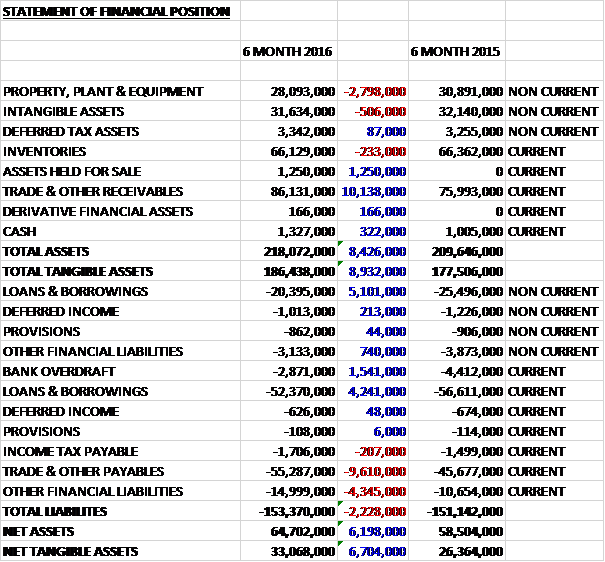
On the 15th February the group announced that it had exchanged contracts for the sale of The Pavilions, Caledonian Road, to a subsidiary of L&Q, one of the country’s leading housing associations. The transaction is for the sale of all 156 homes within the development, 96 of which will form part of L&Q’s substantial private rented sector portfolio. Under the terms of the planning permission, the remaining 60 homes have been sold to L&Q for affordable housing. The contracted price for the entire development is £66.75M with regular payments to be made by L&Q throughout the construction period. As a result the development will not require any equity or debt to be invested by Telford. Construction is already underway and is expected to be complete by mid-2018.

This contract marks the group’s first significant development sale in the PRS sector. There is increasing institutional demand for developments to be “built for rent” and the group have been encouraged by the overall response to the marketing of the Pavilions. They are already exploring a second development for sale in the sector and the board expects that similar PRS sales will form an important part of their sales mix going forward.

On the 17th February the group announced that Land Director James Furlong purchased 20,000 shares at a value of £66.5K which takes his shareholding up to a hefty 1,334,342 shares. A day earlier they announced that non-executive director David Holland purchased 10,000 shares at a value of £32.5K and David Campbell, group sales and marketing director, purchased 2,000 shares at a value of £6.5K. These transactions meant that Mr. Holland owns 571,444 shares in the company and Mr. Campbell owns 41,796 shares.

On the 22nd March, it was announced that Land Director James Furlong purchased 20,000 shares at a value of £69K which gives him a total holding of 1,254,342 shares. It was also announced that non-executive director Frank Nelson purchased 14,385 shares at a value of £50K to give him a total of 27,339 shares. It seems to me that the director buying here is starting to get interesting.

On the 13th April the group released a trading update covering 2016. The board expects pre-tax profit to be slightly ahead of current market expectations. They are already over 90% forward sold at the start of the year but have improved on original forecasts due to initial profit recognition on the PRS sale.

The market has remained strong for the typical Telford product. The launch of the Liberty Building, E14, has demonstrated that investor demand continues to be healthy. In the last four weeks the group have secured over £40M of future revenue at this development with 68 of the 105 open market homes already sold. A third of these sales were to UK investors and the remainder to international investors in China and Hong Kong. The development is expected to be completed in 2019.

The average price achieved was around £900 per square which is at the upper end of the normal price range and ahead of initial expectations with no abnormal incentives having been required.
The group has seen the effect of recent stamp duty changings having a limited impact on sales of more affordable properties. Apart from the Liberty Building, other sales have also been progressing well with the new central sales centre in Stratford achieving 40 sales with a combined value of £25M since opening in September. The total forward sales to be recognised from the start of this month stands at £579M against £503M at the start of last year. This will increase as further sales are achieved during the year and the group has over 50% of the cumulative revenue expected in the three years to 2019 already secured.

The group are positive on the future benefits which institutional PRS brings. They have secured the sale of the Pavilions in Caledonian Road to L&Q, one of the country’s leading housing associations, for nearly £67M in February and have now agreed terms on a second PRS transaction with another investor. These sales improve cash flow but also bring forward profit recognition on a moderately reduced margin so they basically bring forward profits that would have been made at a later date but for less money. The board expect these sales to become an increasing feature of their sales mix over the next few years.

Assisted by the anticipated PRS sales, the group no longer expects there to be a dip in profit levels in 2017, an issue originally created by planning delays. Instead they expect profit levels to continue to grow so that pre-tax profit is now expected to be over £50M in 2019, ahead of prior expectations.

Following the United House acquisition last year, the development pipeline remains over £1.5BN of future revenue. The group raised £50M of new equity in its placing last year and in addition has headroom in its banking facility of £140M. Immediately after the placing they announced the purchase of a site in Camden Street, Poplar for £20M. Many opportunities continue to be appraised and the board is confident of committing the remainder of the placing funds in the coming year.

The group is focused on relatively affordable locations in London where demand remains strong from owners and investors. The balance of supply and demand in London is significantly in the group’s favour and whilst external political factors such as the Brexit vote is likely to cause a period of uncertainty, it should not change this dynamic. The board are confident that they will be able to deliver a significant increase in profit levels over the next few years.

Overall then, this is a positive update with the group now expecting profits to be slightly higher before. It is a shame that this is offset by a slight reduction in margin and the need for them to have raised equity in the market. There are some short-term headwinds in the industry as a whole and until the uncertainty over Brexit is over, I am reluctant to jump in again here.

International Greetings Share Blog – Interim Results Year Ending 2016

International Greetings has now released its interim results for the year ending 2016.

IGRinterimincome

Revenues increased when compared to the first half of last year as adverse movements in exchange rates were mitigated by favourable timing of sales with a £1.3M decline in European revenue being more than offset by a £6.1M growth in US revenues, a £2.5M increase in UK revenues and a £579K growth in Australian revenues. Cost of sales also increased but there was no charge for the UK efficiency programme which accounted for £767K last time which meant that gross profit increased by £2.4M. Selling expenses increased by £328K and underlying admin costs grew by £420K as a £750K decline in depreciation was offset by increases in other admin costs, which gave an operating profit £1.7M above that of last time. A lower finance expense was offset by an increase in tax so that the profit for the period came in at £3.6M, an increase of £1.6M year on year.

IGRinterimassets

When compared to the same point of last year (due to the highly seasonal nature of sales, this seems to be the most sensible comparison) total assets increased by £8.4M driven by a £10.1M growth in receivables and a £1.3M increase in assets held for sale, which was moved from property, plant and equipment and relates to the printing site in Aberbargoed following the relocation of printing to the Penallta site, driving a £2.8M fall. Total liabilities also increased during the year as a £9.6M growth in payables and a £3.6M increase in other financial liabilities was partially offset by a £9.3M fall in borrowings and a £1.5M decline in the bank overdraft. The end result is a net tangible asset level of £33.1M, a growth of £6.7M year on year.

IGRinterimcash

Before movements in working capital, cash profits increased by £1.6M to £8.2M. We can see just how much cash is absorbed by working capital at this time of year (it peaks in October), however, with large increases in receivables and inventory only partially offset by a growth in payables due to the earlier sales profile reflecting the variable phasing of deliveries to customers year to year, which meant that after the interest charge fell by £413K to £1.2M; the net cash outflow from operations came in at £46.6M, an improvement of £2.2M year on year. The group spent £193K on intangibles and £1.5M on fixed assets reflecting the initial costs of the investment in an improved converting capability in the US as well as further investment in efficiency in Europe and China, to give a cash outflow of £48.2M before financing but if there was a neutral working capital position, there would be plenty of free cash available. The group spent a bit on dividends and after the cash income from capital facilities, the cash outflow for the period was £2.8M to give a cash level of -£1.5M at the period-end.

Overall, performance in the first half of the year was in line with expectations. The profit in Europe was £835K, a fall of £87K when compared to the first half of last year as manufacturing efficiencies and customer channel mix was not quite enough to offset the effect of a weaker Euro which impacted margin on products that are predominantly purchased in US dollars. The profit in the UK and Asia was £3.6M, an increase of £115K year on year where strong sales growth was underpinned by a strong portfolio of licensed brands including Star Wars, Minions and Coca-cola, although gross margin fell due to changes in product mix. The business is also on track to deliver expected annual efficiencies resulting from investment in the manufacturing facilities in Wales.

The performance of the China-based Christmas cracker manufacturing operation has exceeded targeted efficiencies and they have delivered in excess of 70M crackers for the 2015 season. They have continued to invest in semi-automation at the facility to mitigate the challenges associated with the increasing cost and reduction of availability of labour in the country. The profit in the USA was £1.8M, a growth of £1.2M when compared to the first half of 2015 on improved sales in a market that remains strong. Gideon Schlessinger started his role as CEO of the US business in April. The profit in Australia was £509K, a decline of £85K year on year despite sales growing during the period. The joint venture is apparently still on track to meet profit expectations though.

It sounds as though the results during the first half of the year have been aided by favourable timing of sales with earlier phasing of deliveries to customers. The benefits of tax losses are starting to unwind and cash tax is increasingly payable in most of the group’s geographic regions as historical tax losses are fully utilised. There are still unrecognised losses with a tax value of $2.3M in the US and £300K in the UK, however.

So far in the second half, trading activities are in line with expectations with a strong order book in place for the balance of the year and already beginning to build for next year. The group are on course to achieve targeted growth in EPS and remain firmly focused on reducing debt through converting profit into cash, which is good to hear.
At the end of the half net debt stood at £78M, still substantial but £6.6M below that of the same point of last year. At the current share price, the shares are yielding 1% in dividends. I have not yet been able to see a forecast for the full year but going by historical forecasts, the yield was predicted to be 1.1% for 2016.

Overall then this has been a fairly decent half year for the group. Profits increased year on year but on closer inspection this was due to a fall in depreciation and the lack of efficiency programme and acquisition costs that occurred last time. Net assets did improve, though, and operating cash flow also improved despite remaining heavily negative due to the timing of Christmas orders and the effect this has on working capital movements. The UK performed fairly well due to increased sales of lower margin licensed brands but it was the US that was the stand-out performer. Things were not quite so good in Australia and Europe, both probably effected by weakness in the respective currencies.

I am a little concerned that the results this year were pumped up a bit by a favourable phasing of orders and without this effect, I can’t see them having been up year on year. Still, the board see the performance this year as being in line with expectations and the real story here is the continued recovery and pay down of the debt which will only really become apparent for the full year. The dividend of 1% is nothing much to get excited about but I will probably hold on here for the long term story.

On the 15th December the group announced the appointment of Mark Tenori as a non-executive director. He is currently CFO of Adelie Foods which manufactures and supplies sandwiches to retailers and is owned by private equity group HIG. I’m not sure what specific experience this brings to the group to be honest, but the board obviously saw something in him.

On the 18th January the group released a trading update covering Q3 which includes Christmas trading. Business continued to be strong during the Christmas period with results in line with expectations and all regions trading profitably. In Wales and Holland the new giftwrap manufacturing facilities have enabled the group to produce high volumes very efficiently with return on investment in line with plans. The operation in China performed well through the year, in the US record sales levels were reached with growth across all channels together with an expansion of export activities to Canada, Mexico and Brazil. There has also been significant growth of their market share in Australia where the “Celebrations” product offering has broadened to include a comprehensive party ware offering, which is an interesting development. Sales performance during the period of the licenced product portfolio featuring big hitters such as Star Wars, Minions and Frozen included sales to new territories and customers.

Overall then, a pretty decent update and things seem to be going as expected.

On the 18th April the group released a trading update covering 2016. The financial performance was ahead of expectations, resulting in a further year of double digit EPS growth. Operational cashflow and debt reduction continued to reduce leverage significantly ahead of expectations and property held available for sale at Aberbargoed in Wales was sold with proceeds of £1.45M being received. The company intends to pay a final dividend of 1.75p which means that the yield is currently standing at 1.4%.

All regions have delivered year on year growth and an overall market outcome ahead of market expectations. In the UK and China, record sales combined with a good manufacturing performance delivered profitability ahead of forecasts. In Continental Europe, sales growth and effective management of mix have mitigated forex transaction headwinds. Trading in the second half of the year in Australia has resulted in in significantly enhanced overall profitability.

In the US, the commercial, operational and financial performance of business has been encouraging. This has included the implementation of phase two of the programme of fast payback investment in manufacturing which will accelerate their capability to profitably grow their share of this market.

This is great stuff, and I am very satisfied with my holding here. If there is any weakness before the results I might even double up on my investment.

On the 24th June the group announced that it had changed its name to IG Design Group, thankfully the ticker remains the same.